We arrived at Split in plenty of time for our ferry to the island of Korcula which we are crossing on our drive to Dubrovnik.
We took snacks for the 2.5 hour crossing and sat on a bench outside to enjoy the view.
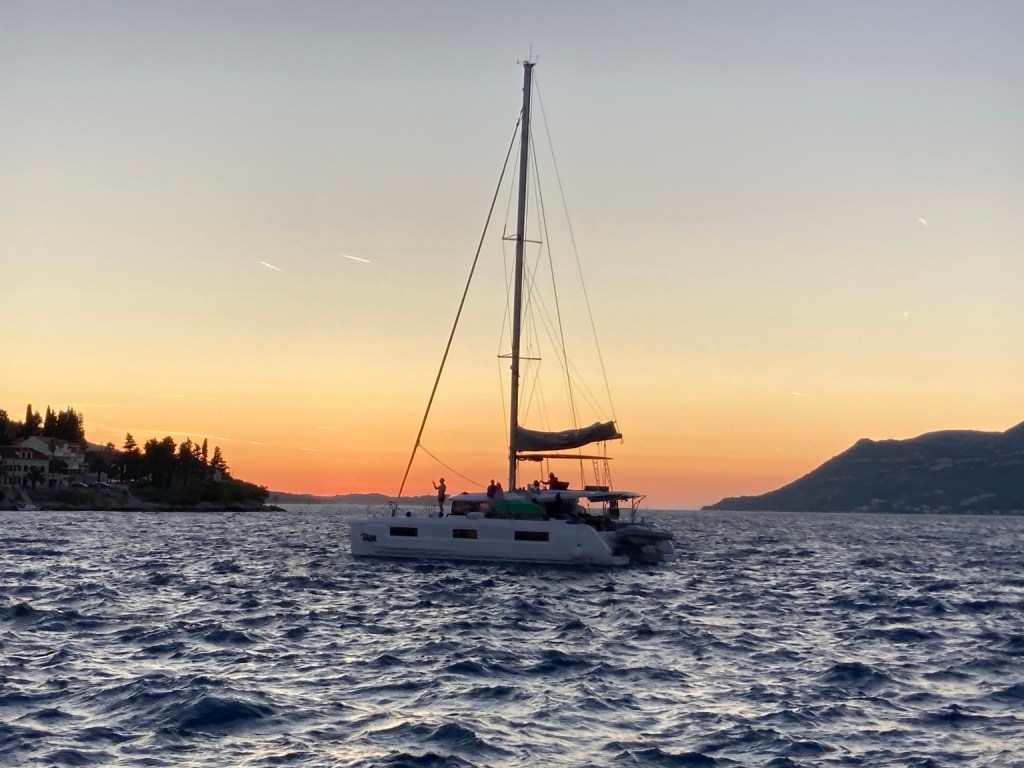
The port of Vela Luka was built in times past to export wine and oil and is now a car ferry port, but still offers a handsome face to the sea.
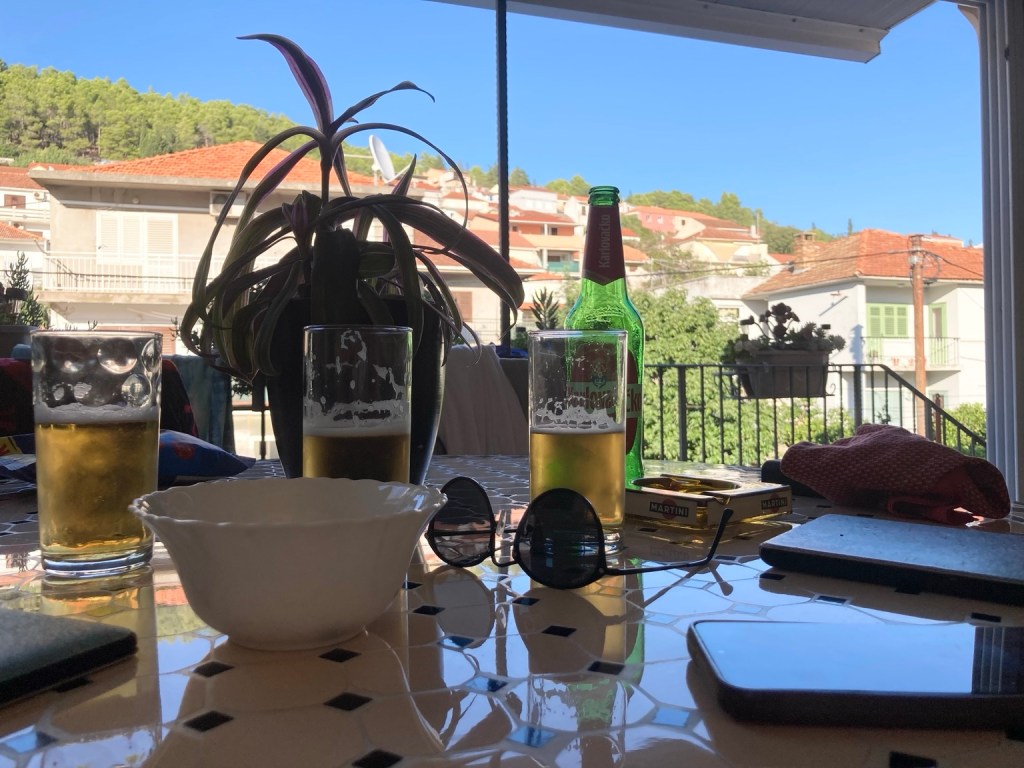
We soon found our apartment, above a family run restaurant where we were welcomed with more Rakija and homemade biscuits and after sitting down all morning, walked to the town beach for a bit of sun, a read and a dip and took the water taxi back to beers on our very own sit out terrace.
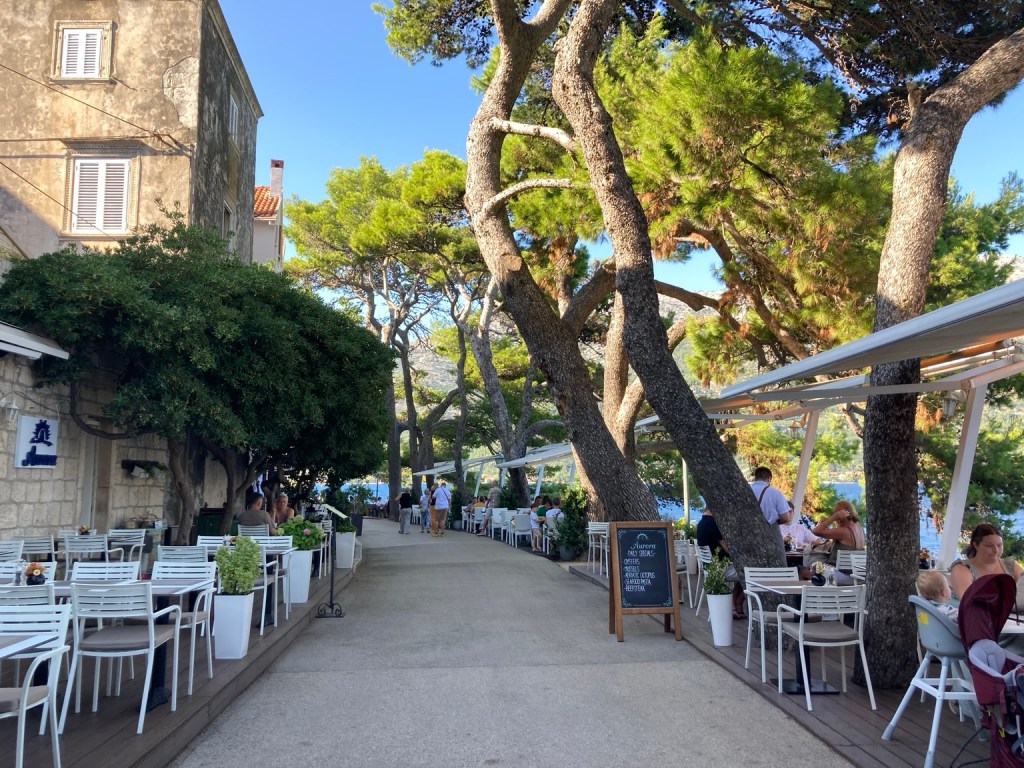
In the evening as we checked out restaurants, we noticed the attractive sea themed mosaics running round the harbour pavement which celebrate an artists expo in the 1960’s.
We spotted the local makaruni pasta on the menu, handmade scraps of pasta rolled round a needle to make tubes, so I had mine with ragu and J with monkfish while C had ravioli with spinach and truffle.
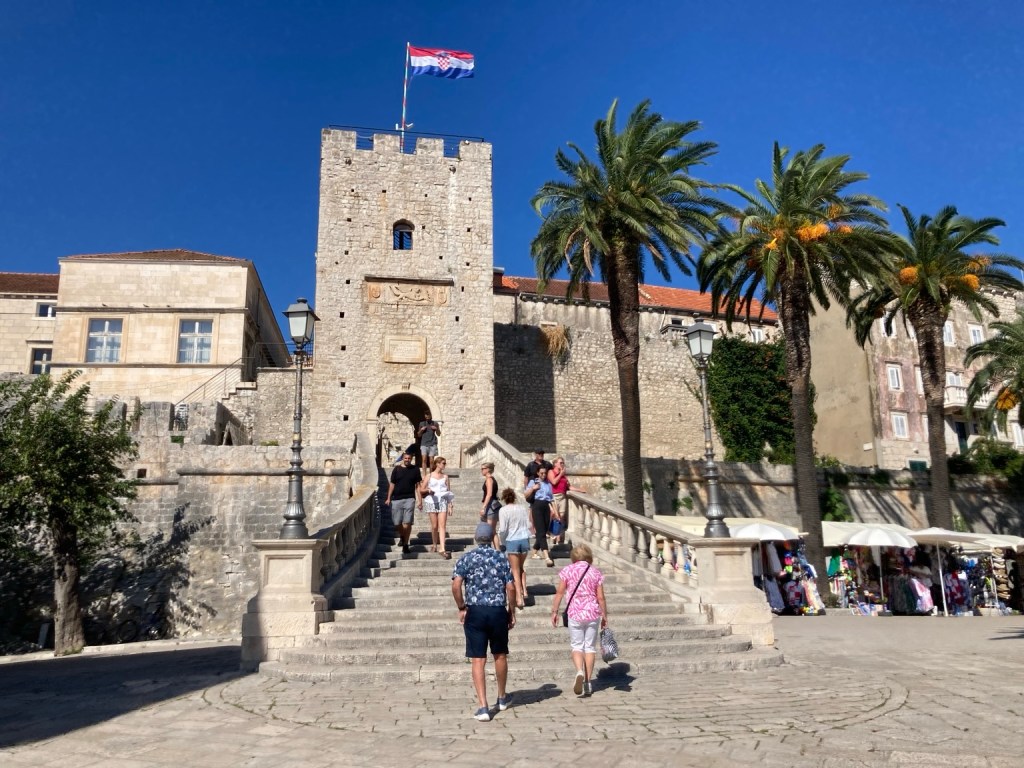
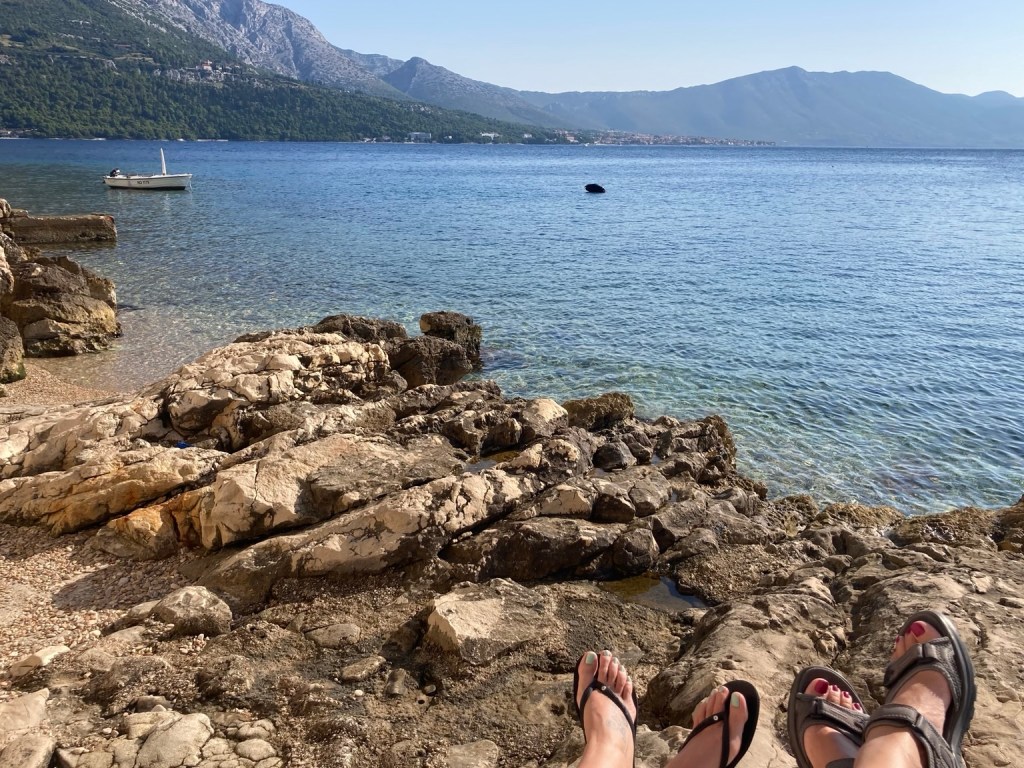
Although we didn’t realise at the time, this was the point that our trip started moving in an unplanned direction. While getting up in the morning, Chris had a dizzy spell so we delayed our departure so he could take things slowly, and we thought he’d maybe had too much sun the day before. Joanna was our second driver, and having already driven yesterday, was delighted for the opportunity to drive again and we made our way across Korcula island, enjoying the scenery. We made a brief stop at a beach with a cafe and continued to Korcula town where tourist cars have to use the park and ride. We got a great photo from the shuttle which took us to the town gates.
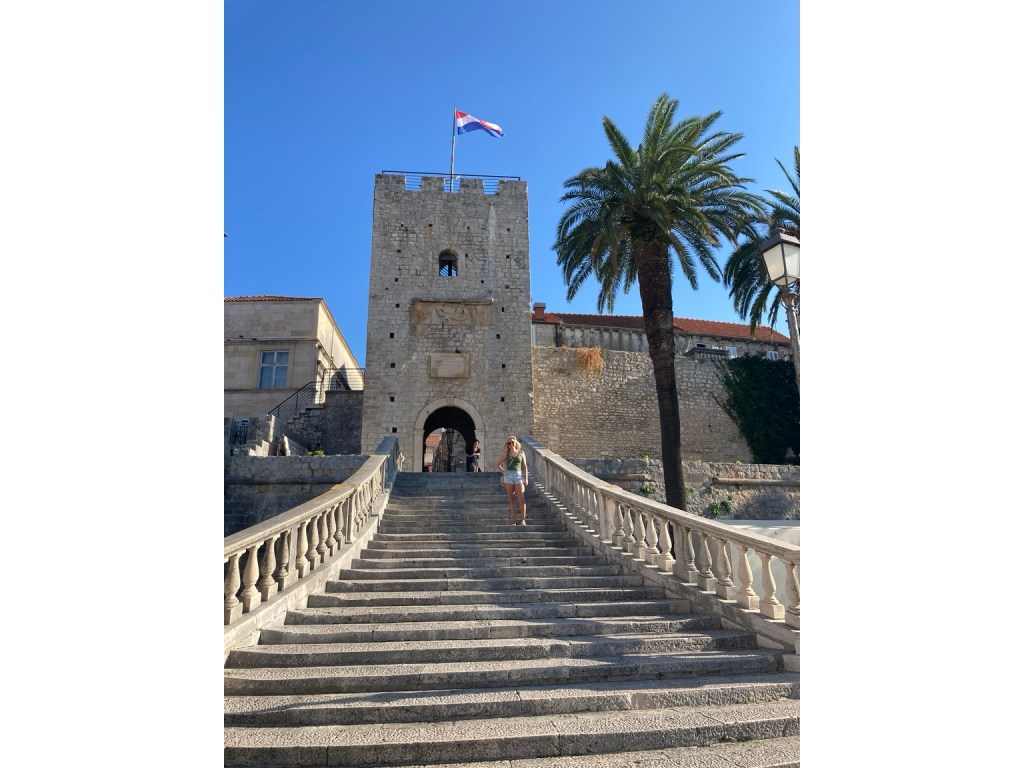
As we walked into the walled town …
… it was apparent that Chris wasn’t feeling great and was also nauseous, but he was sure that an early night would do the trick so we checked in and left him to rest.
Joanna and I went exploring. We wandered round the town …
… through charming squares …
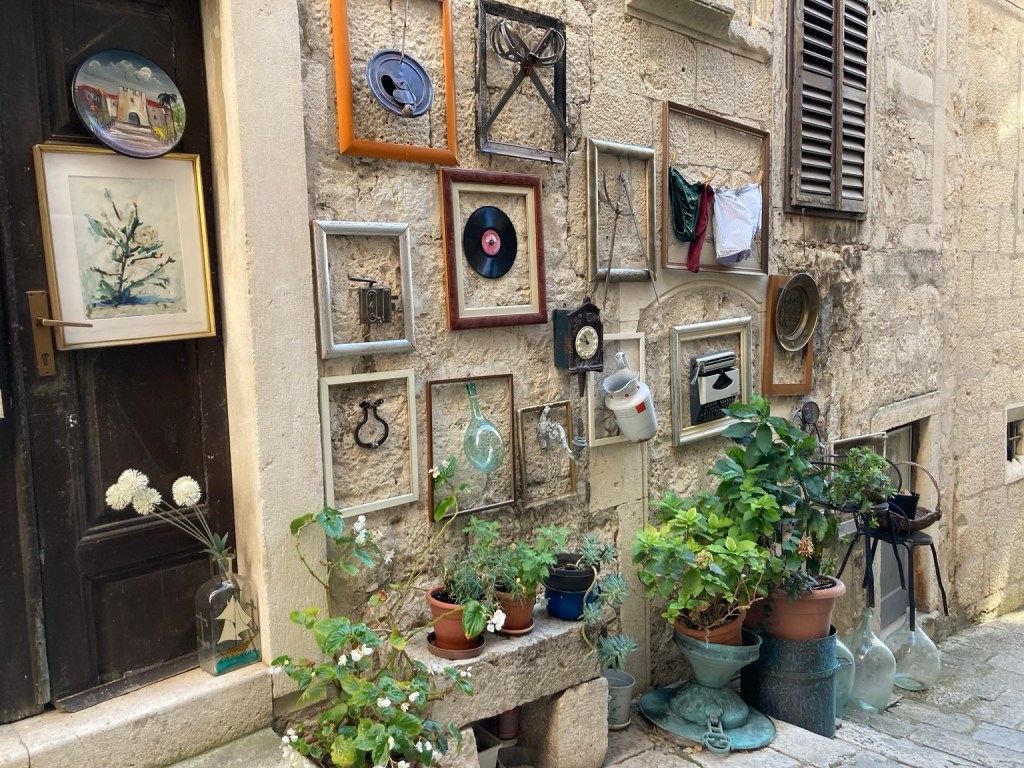
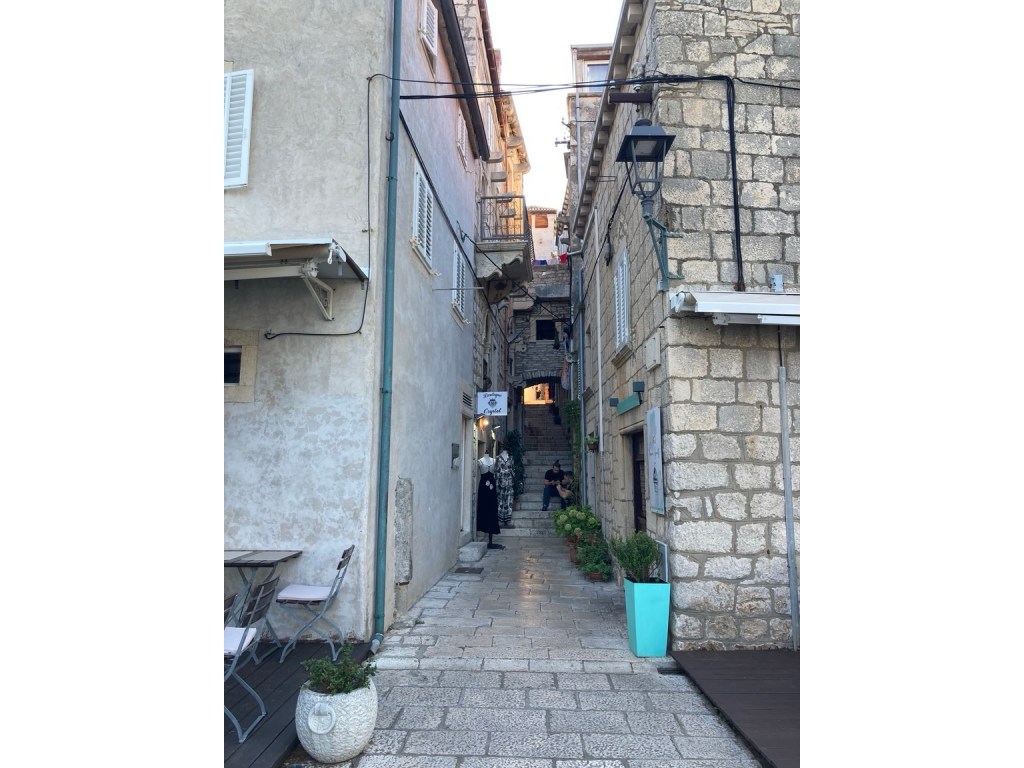
… and along narrow stone alleys which are laid out fishbone-style, with the angled side streets allowing the breeze to pass through and cool the buildings.
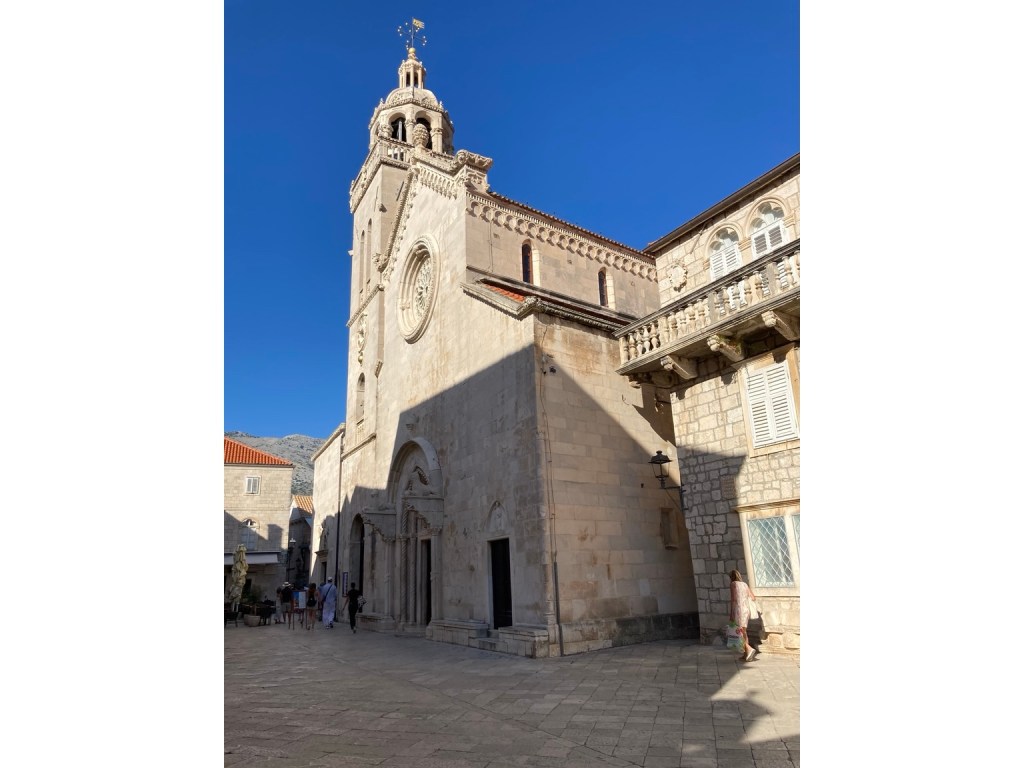
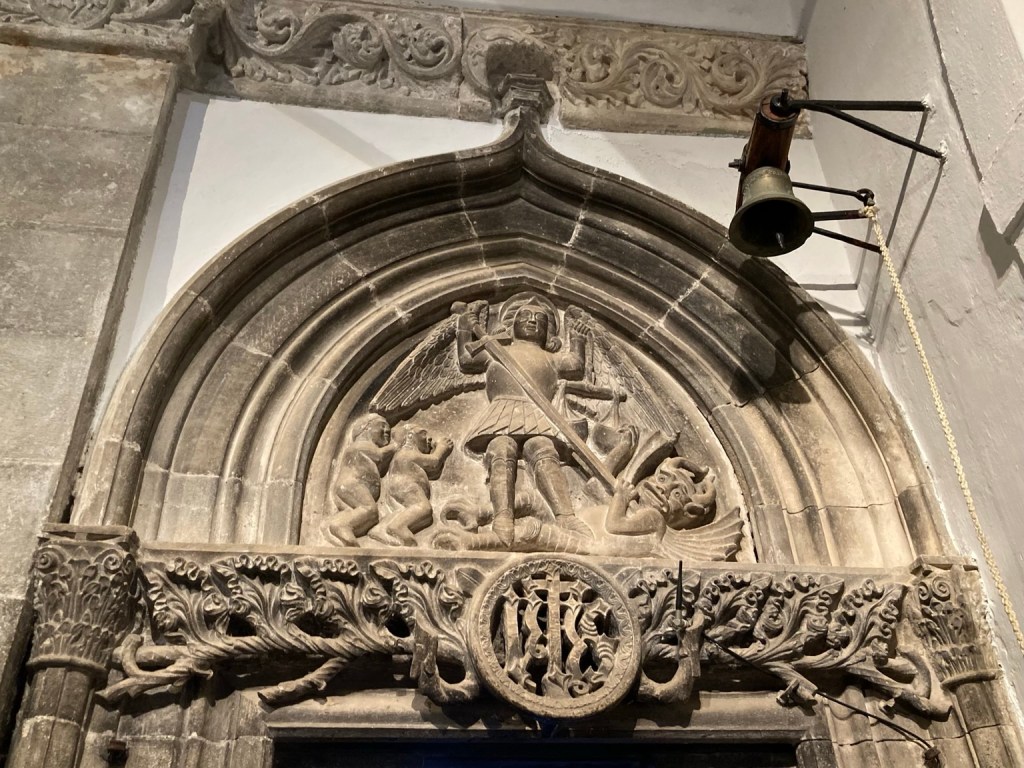
St Mark’s Cathedral dominates the main square …
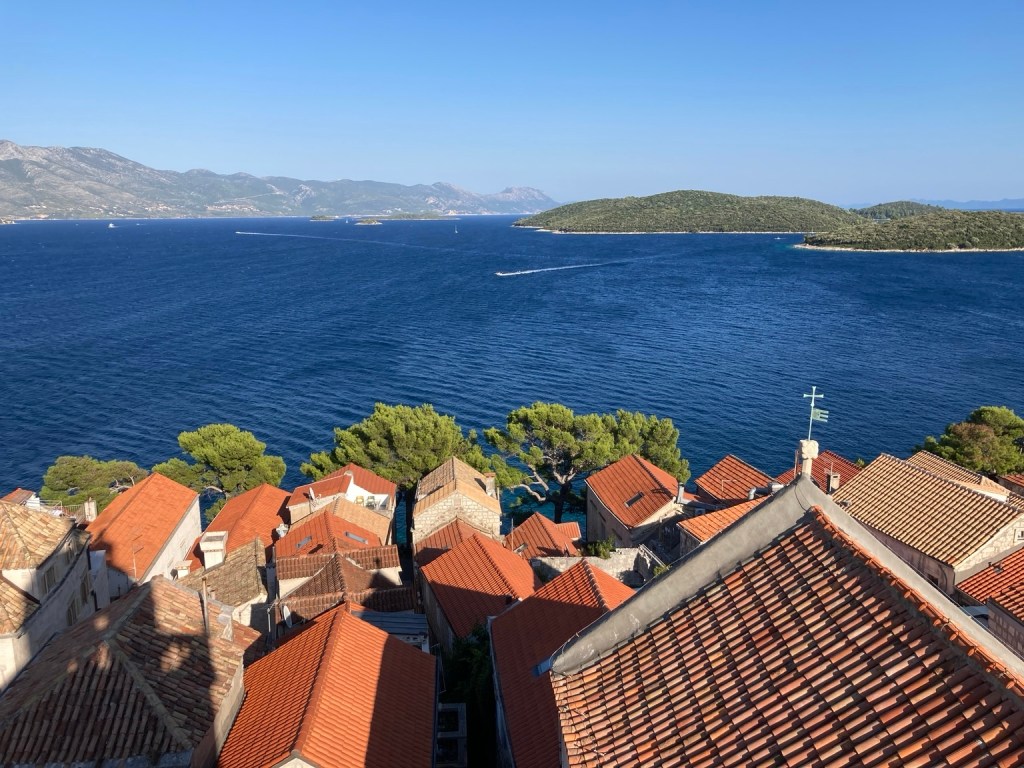
… and we climbed the clock tower to get views over the rooftops and out to sea …
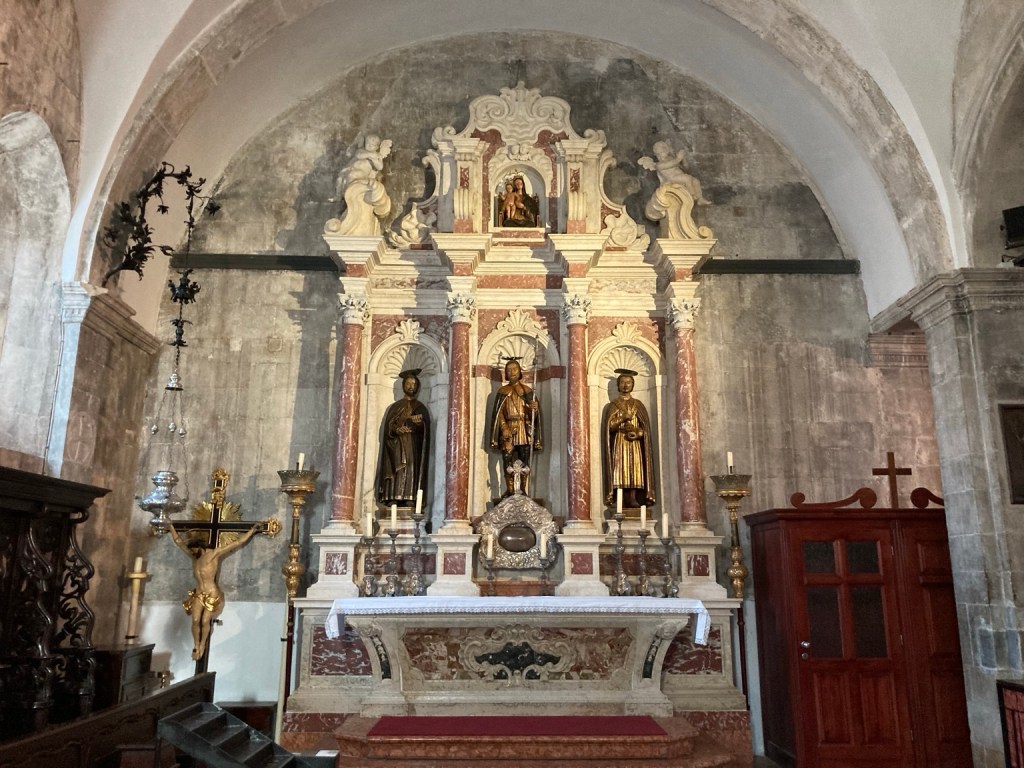
… and took a peek inside.
We took a last few photos then relaxed with wine and pizza.
In the morning, Korcula was deserted …
Joanna and I snatched a view with our breakfast pastry …
… but with Chris not really any better, we took the ferry to the mainland and Joanna drove us directly to Dubrovnik …
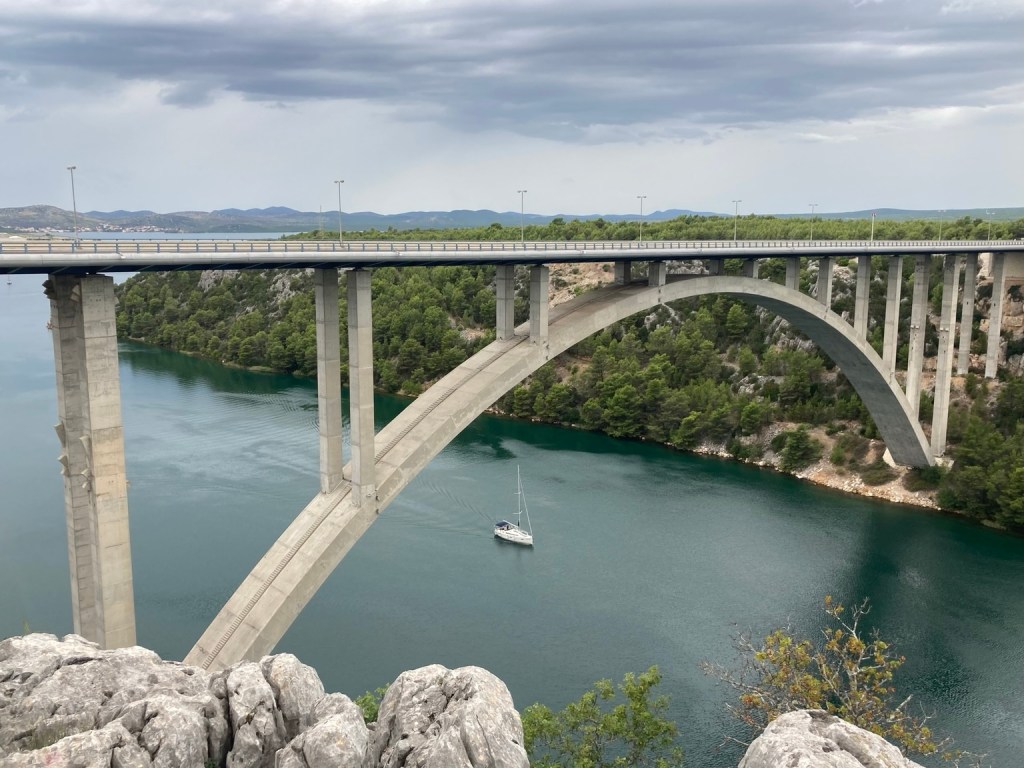
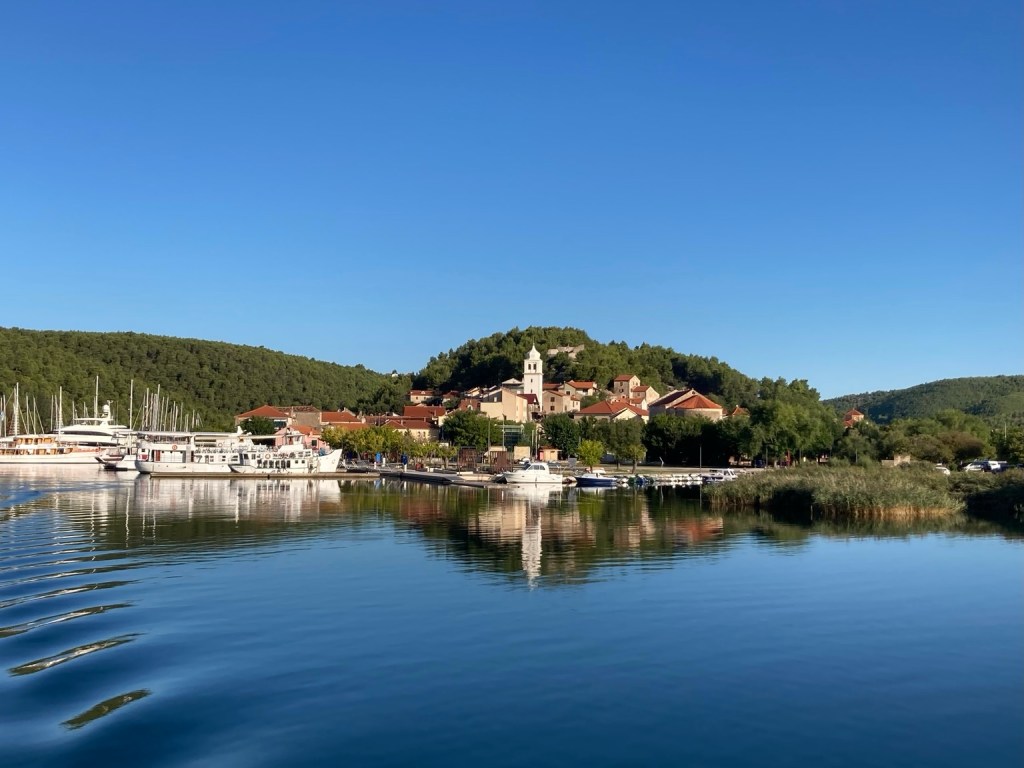
Having flown into Split and picked up the car, a short drive north brought us to the pretty riverside town of Skradin. From the highway rest stop we took photos of the bridge over the Krka river …
… and also caught our first view of Skradin …
… but were alarmed to feel the odd drop of rain … surely not!
At our apartment, we were welcomed with a glass of homemade Rakija, a fruit brandy made throughout Croatia. After toasting Živjeli! we were advised the best way to tackle Krka next day then went to explore.
We tried to ignore the rain drops as we wandered down the main street lined with pastel coloured buildings …
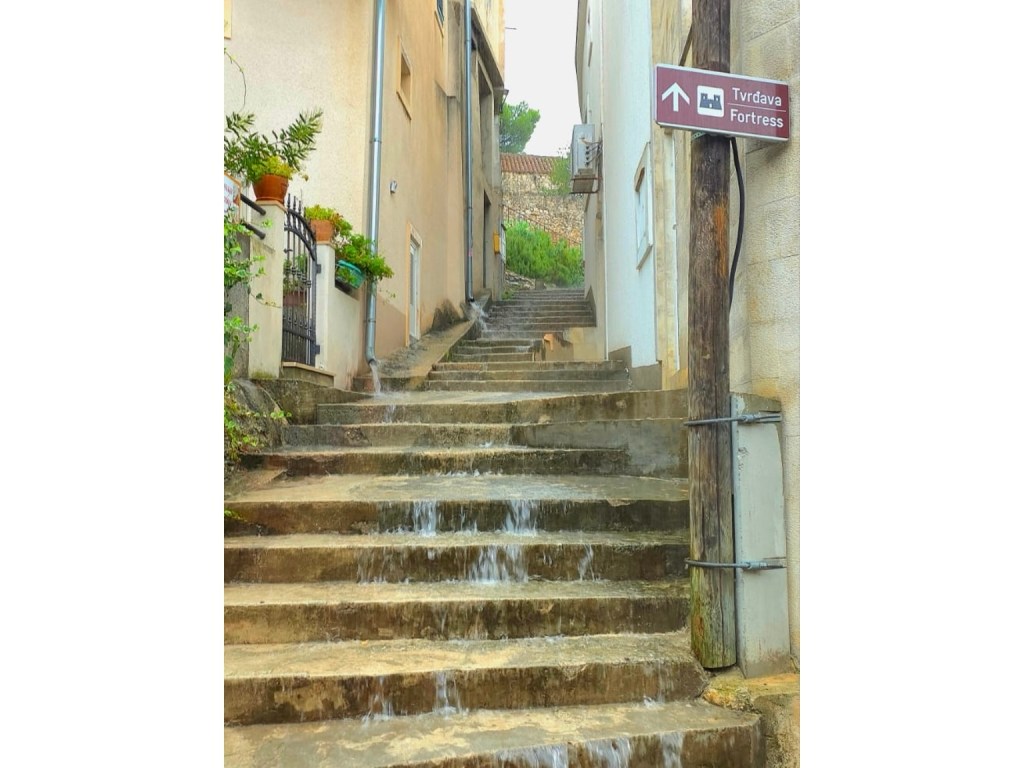
… but as we started climbing to the small medieval fortress above the town, it became downpour …
… and we had to shelter from the worst of it in a bar with a beer!
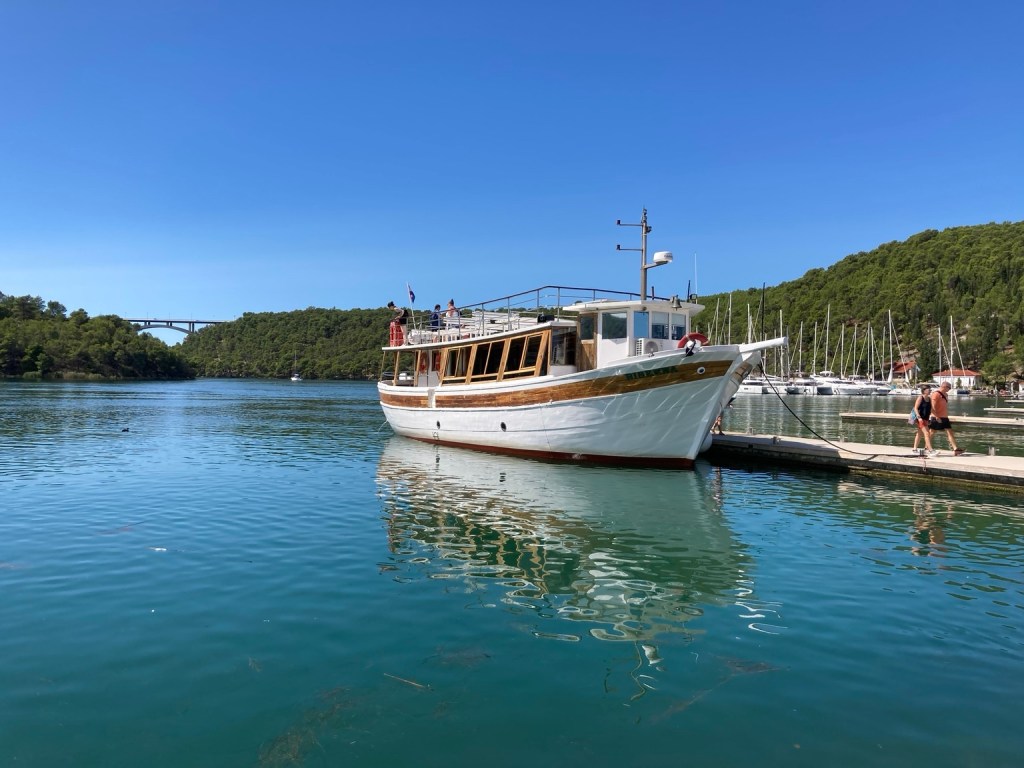
Next day dawned sunny and we were up and waiting for the 8.00 boat into Krka National Park so we could beat the crowds.
The tufa landscape is one of the most unique features of Krka National Park. Eroded limestone is deposited in the river and trapped by the plants to form tufa or travertine barriers. These are constantly reshaped by water flow to create spectacular waterfalls, cascades, and natural pools.
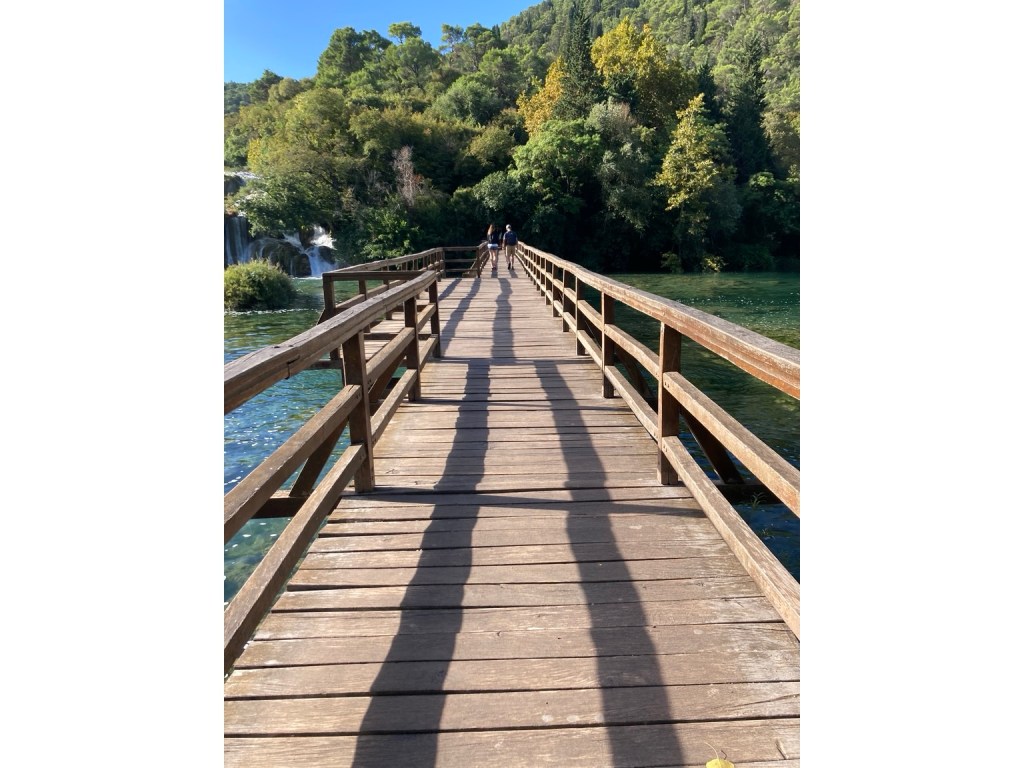
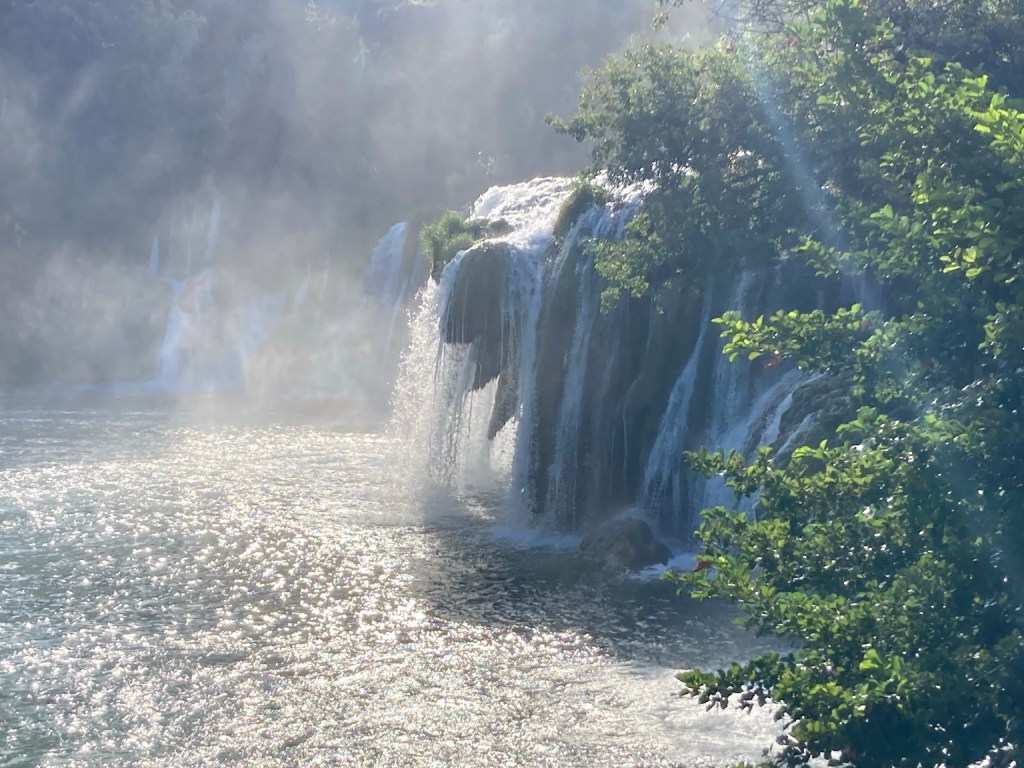
The main event is Skradinski Buk, the most impressive waterfall in the park. It is made of 17 waterfalls cascading into one another and then creating a beautiful lake and is viewed from a network of wooden trails and bridges. It certainly didn’t disappoint, and we all took lots of pictures.
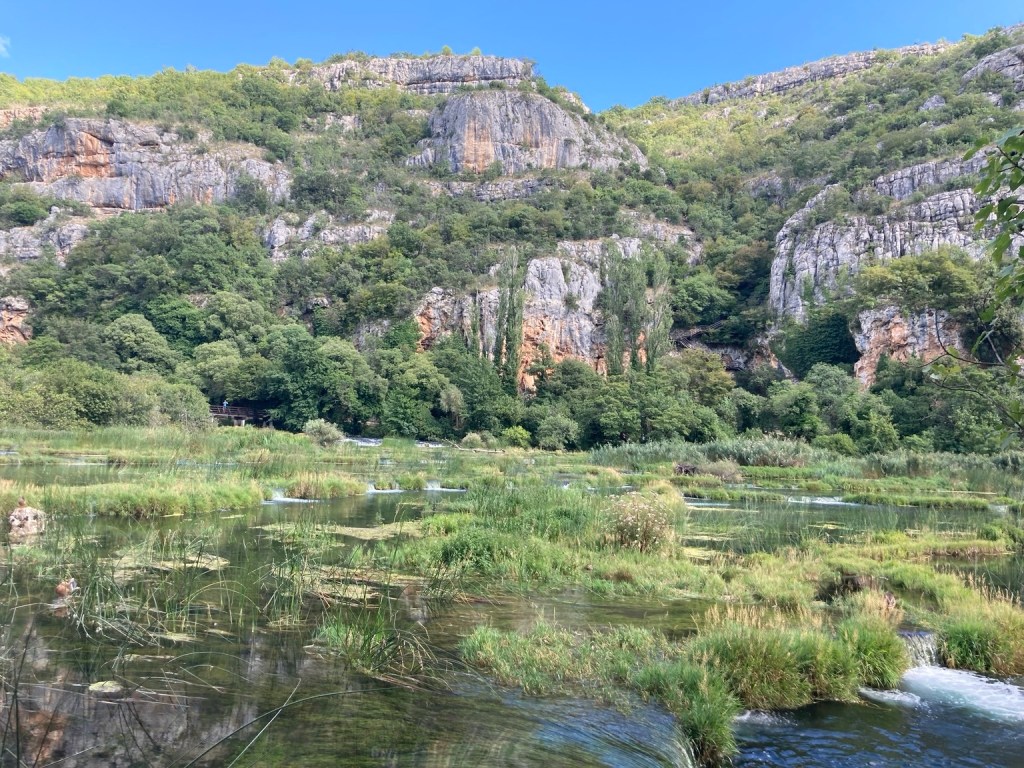
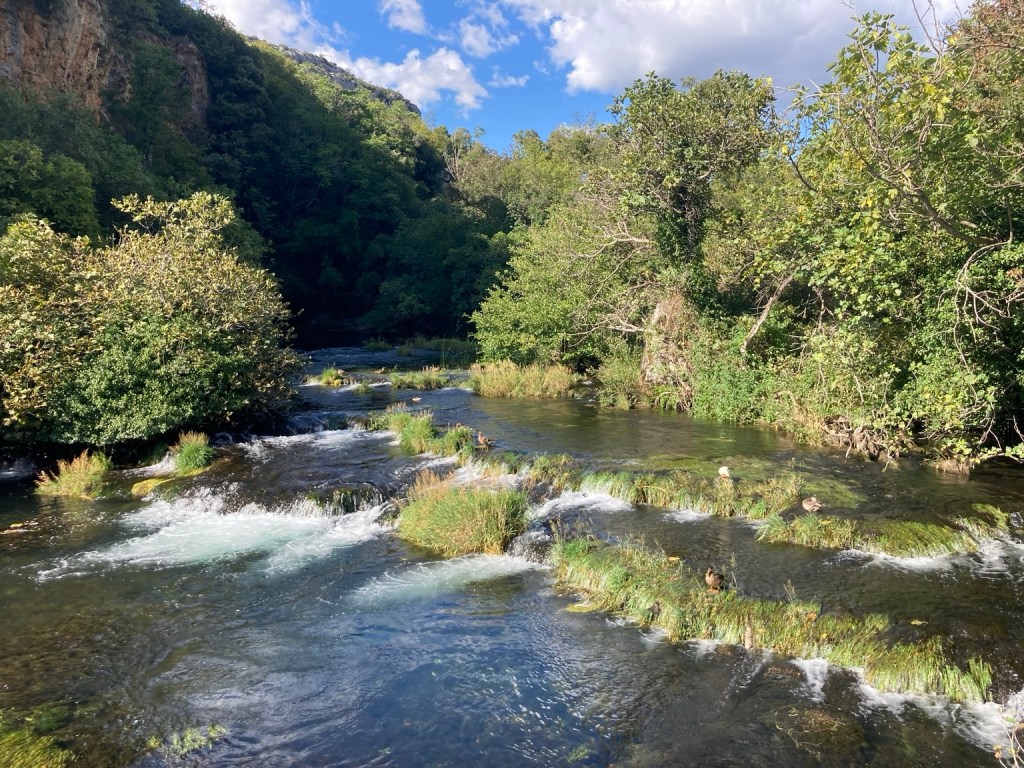
Fortified, we followed the walking route at Roški slap, where the waterfall fans out in a series of shallow cascades, known locally as The Necklaces, before falling into Visovac lake below.
There were also ruins of old watermills which once lined the river and were used to grind corn …
… and viewpoints.
By the time we had walked the circuit and were returning to the start, we saw that the crowds had certainly increased and were pleased we’d made an early start. Behind the bridge you can see part of the first hydro electric plant in Europe, opened just after Tesla opened the world’s first one in Niagara Falls in 1895.
We returned to Skradin by boat then picked up the car and drove first to a couple of viewpoints, firstly to see the tiny island of Visovac which was settled by Franciscan monks in 1445 and then on to the Panorama restaurant where Chris spotted omelette on the menu and Joanna and I shared crispy polenta coated trout and salad.
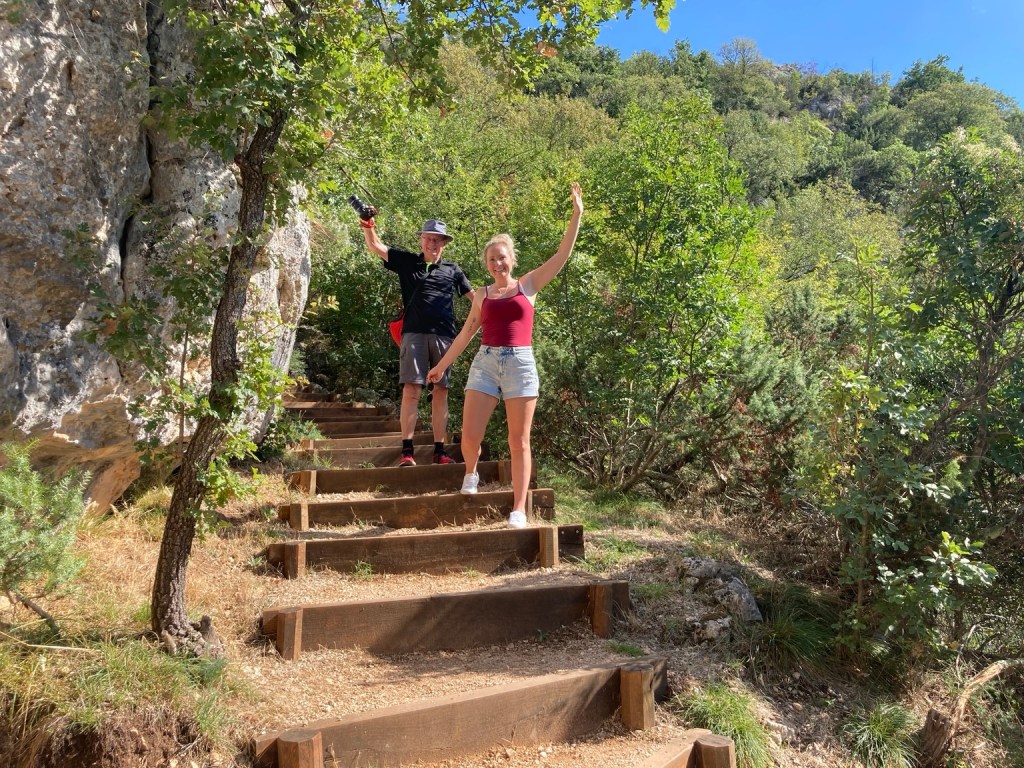
The viewpoint is reached by climbing a huge staircase which zig zags up the cliff and can just be seen above.
We were all up for it, but I abandoned when I saw a shady bench while and Chris and Joanna continued. They made the top but admitted the photo of the falls was no better!
Some of the photos we had seen were more impressive than ours, but then conditions have to be perfect for perfect shots and we enjoyed walking round, watching the antics of the ducks.
On a high after conquering the steps, Joanna drove us back from Roški slap, the first time she had driven on the wrong side of the road. The first part was very twisty and narrow, but she learnt how to make full use of the mirrors and did a grand job, delivering us safely back to Skradin.
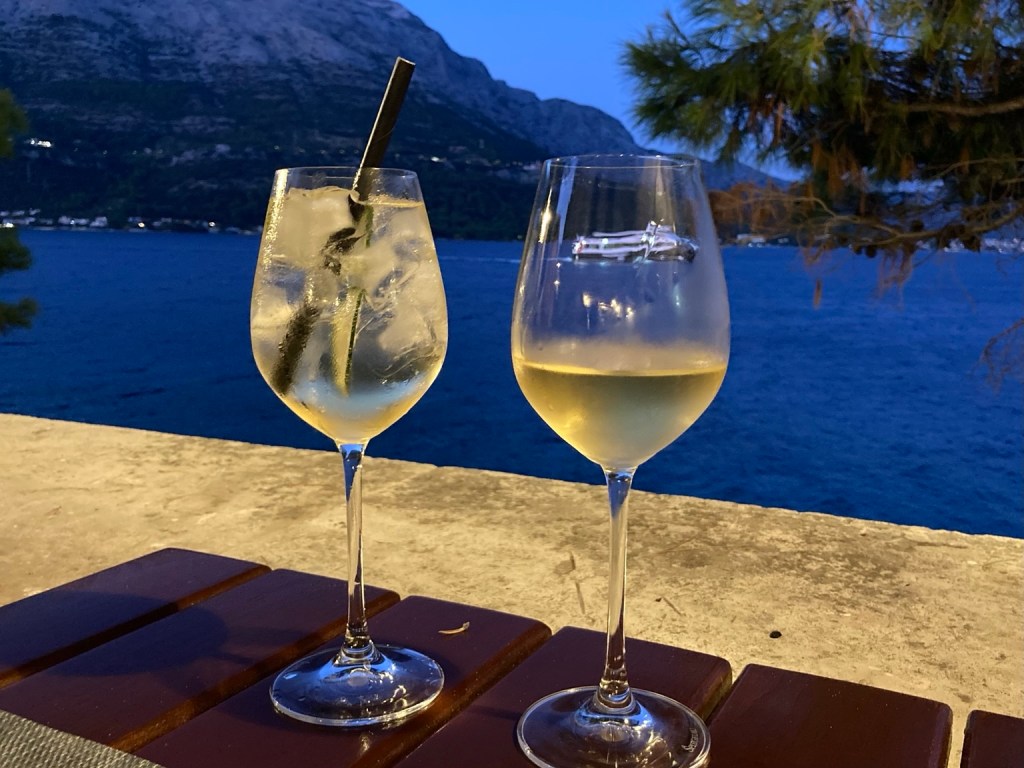
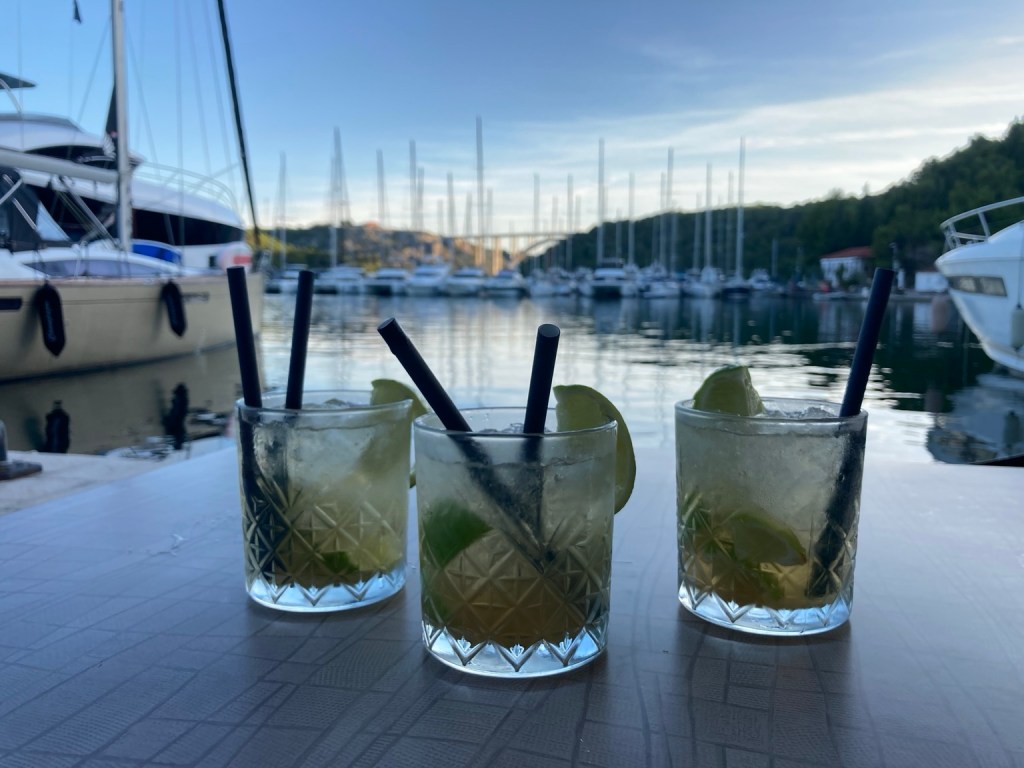
After all that exercise we were were done for the day, and enjoyed relaxing later with caipirinha cocktails watching the sun do down, followed by a dinner of Gorgonzola gnocchi for C, Skradin sprats for J and John Dory and capers for me. We finished with Skradin Torte, a cake made with eggs, honey and ground walnuts then glazed with chocolate … yum!
Krka has certainly been a success and I’m so pleased we chose to stay in Skradin so we could get into the park early – it made all the difference to enjoy it while it was quiet.
Joanna is home from Sydney for three weeks so we are looking forward to making more memories, this time during a trip to Croatia.
Starting in Split, we are spending a day exploring the waterfalls at Krka National Park then driving across the island of Korcula for a bit of beach R&R before continuing to the splendid walled city of Dubrovnik.
So here we go, three off travelling together again!
It was a 350km drive back to Oslo, but we broke up the journey with a cruise along the Telemark Canal which was built in the C19th to join several waterways and link Dalen to Skien for the transport of goods. Today it just carries pleasure boats, and we just travelled on the final stretch from Ulefoss to Skien.
Once through the locks at the beginning …
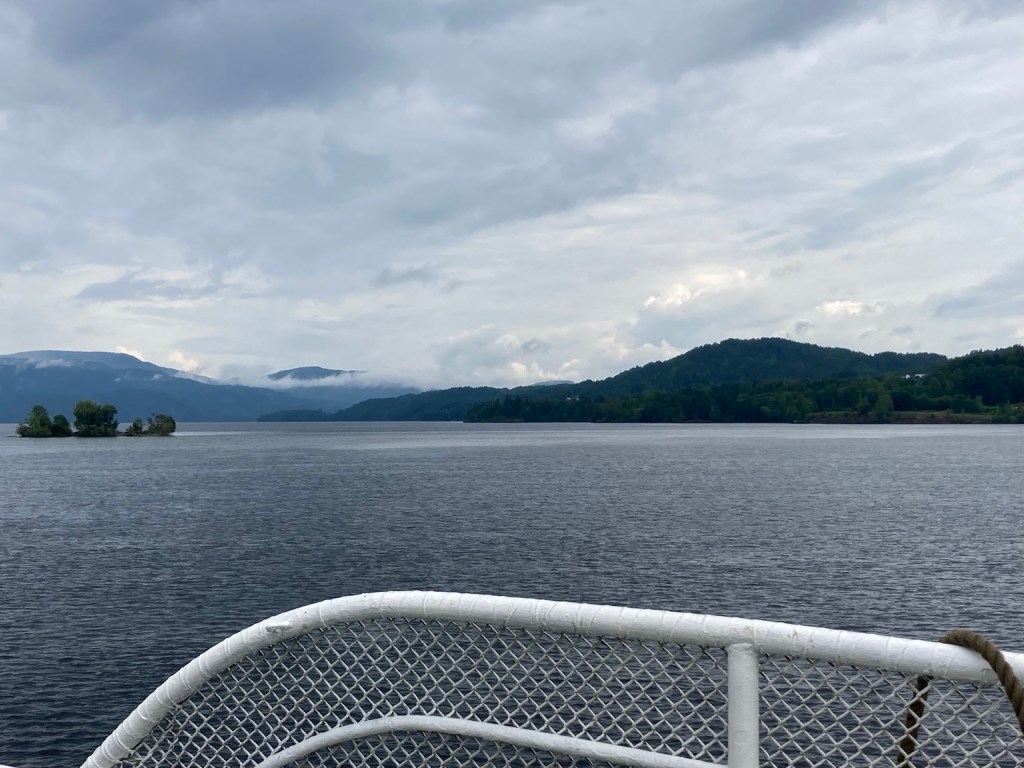
… most of the trip was along a fjord …
… with a final lock at the end.
We were checking in to our hotel in Oslo early evening and it was time to say farewell to our guide Paula and the interesting bunch we had spent the week with, all with varied departure times next day.
It has been surprising to see how most restaurants serve world food from one country or another, rather than traditional Norwegian fare. So, when Graham and Lisa who we’d chatted to a fair bit during the trip, suggested eating at the Oslo Food Market, we thought it was a great idea to spend the evening with the locals, munching various curries and stir fries!
Our flight was not till late, so we visited the Norsk Folkemuseum. Travelling like locals in a country where a boat is often the quickest transport, we took the ferry across the bay to the open air museum.
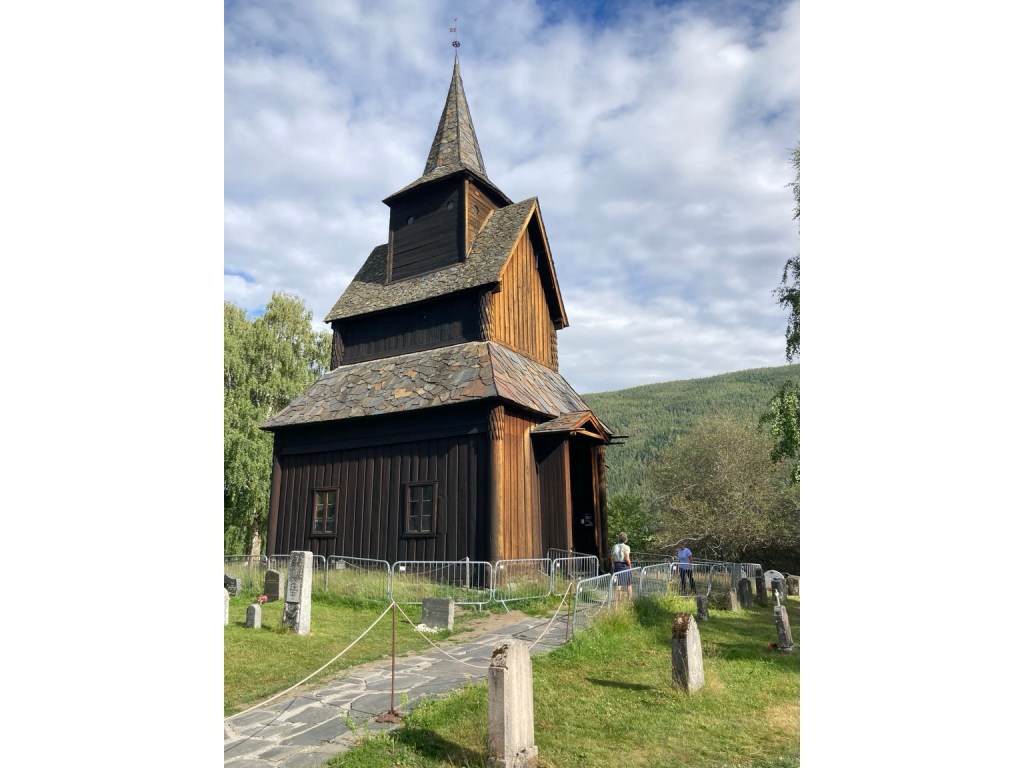
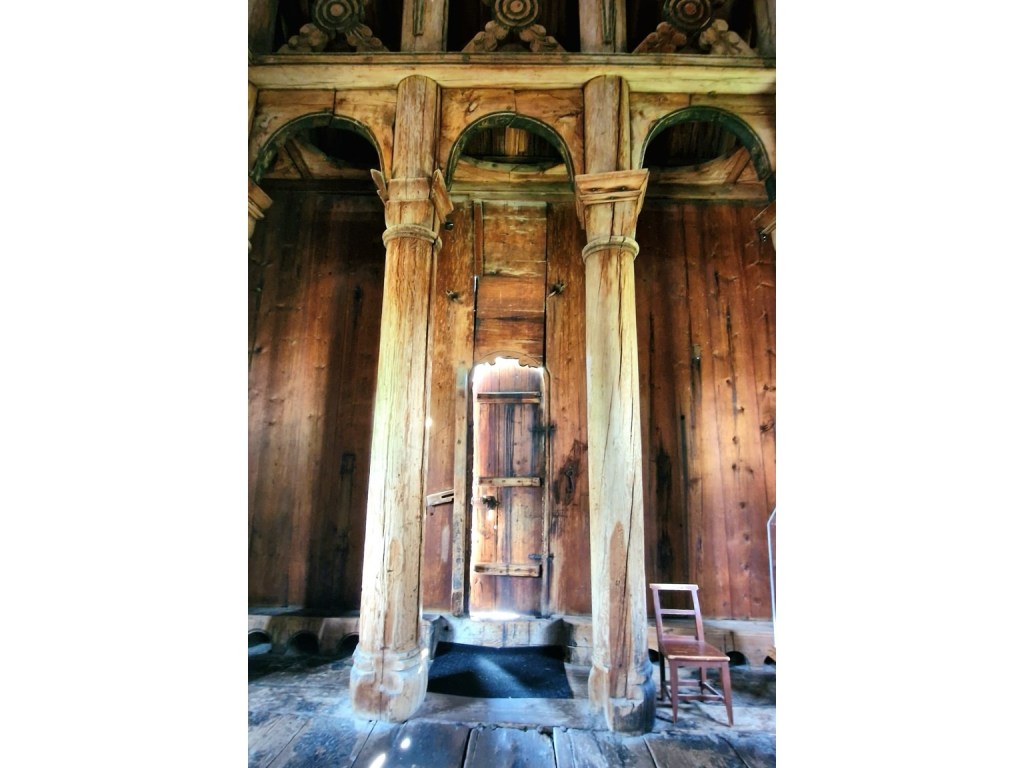
We were eager to find out more about the Stave Churches of Norway which were built when the country became Christian from C9th-C12th. Our tour had stopped at two but only very briefly. We did pay and go into the first one at Torpo and the first thing we noticed was the smell which comes from the black preservative made from pine resin.
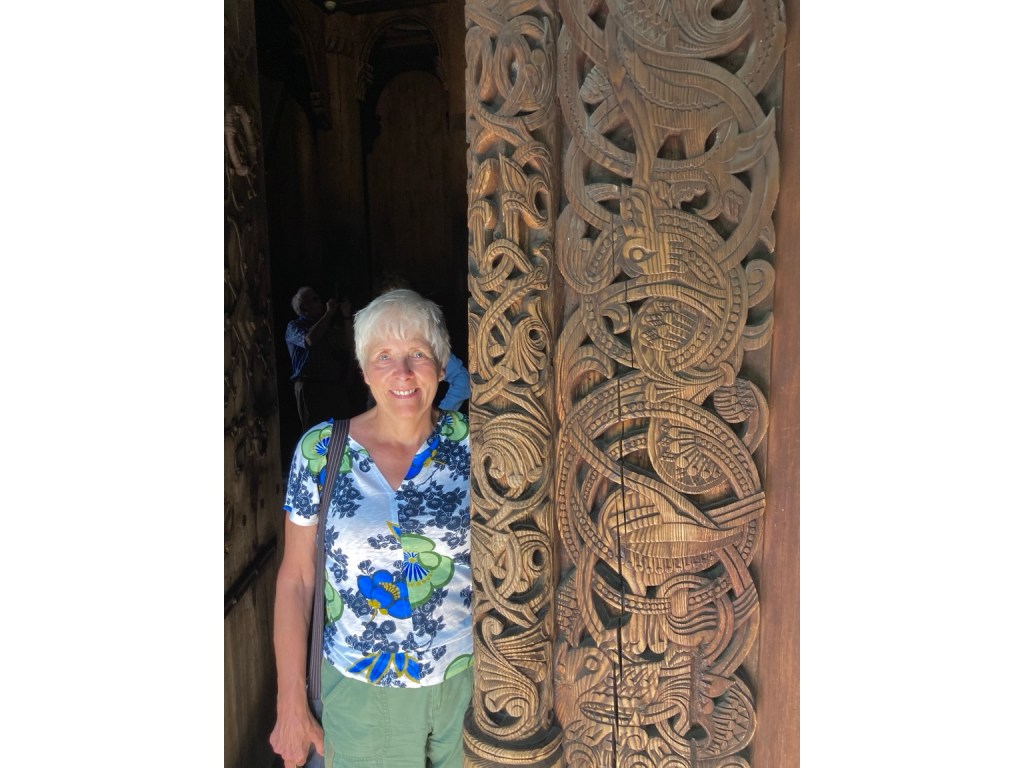
The heavy wooden door is decorated with dragons, vines and animal heads…
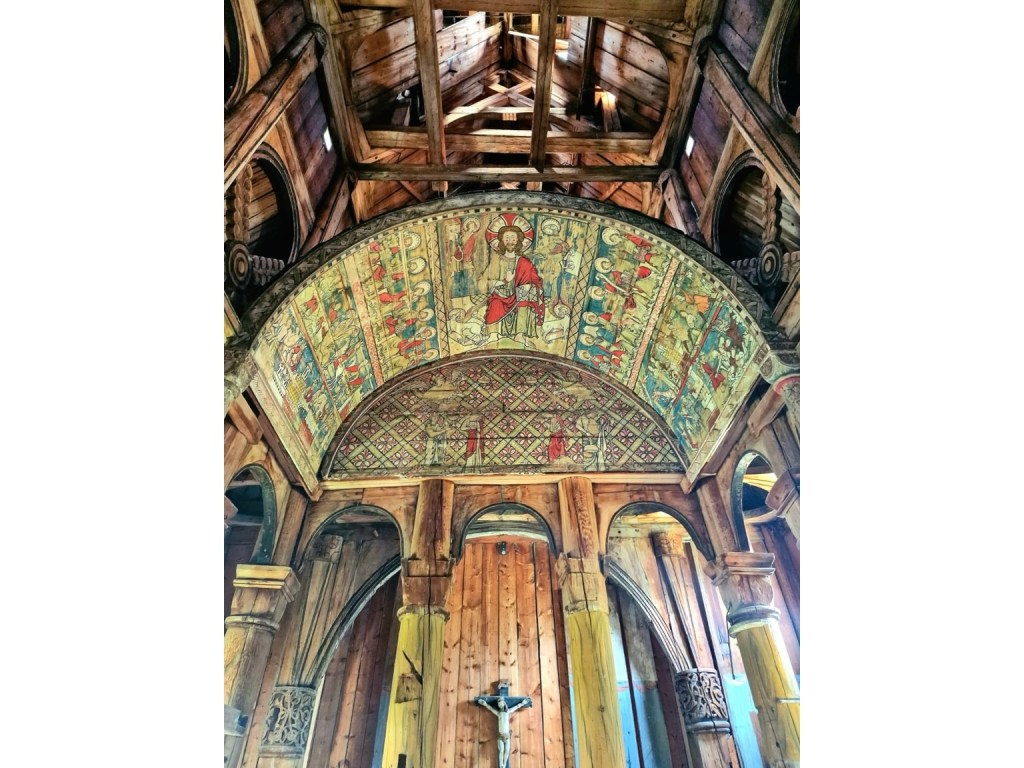
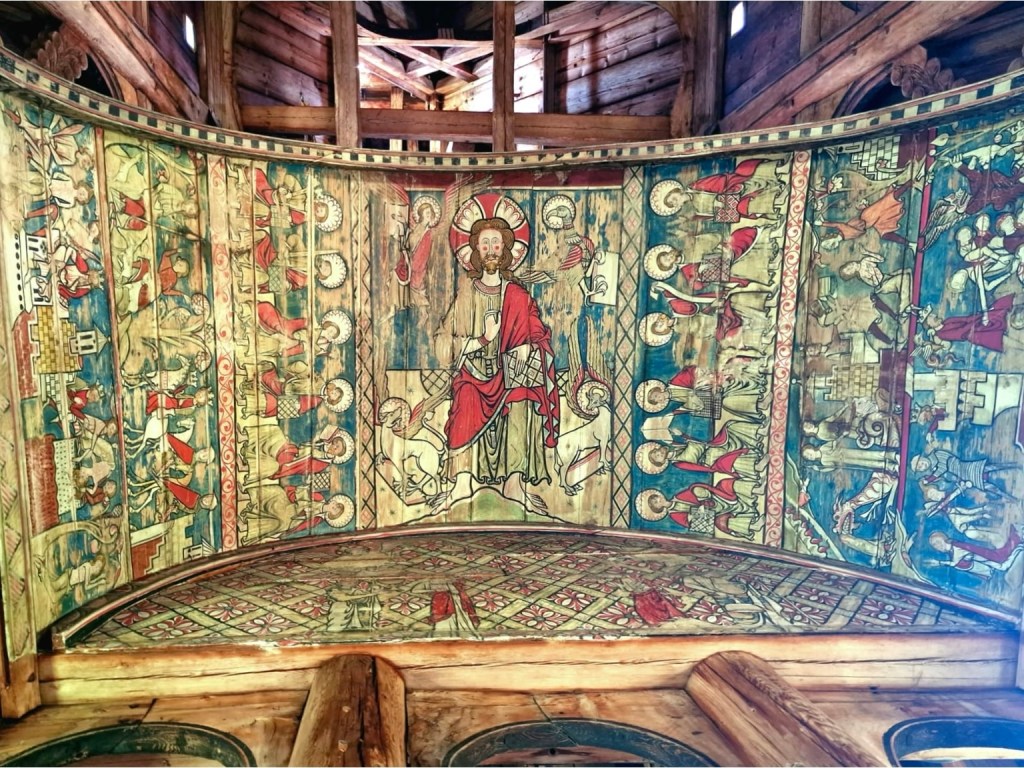
… and inside, the nave is dominated by a great decorated vault depicting Christ with the apostles and the legend of St. Margaret. It was probably put up and painted at the end of the C13th, making some of the oldest decorative paintwork in Norway.
A couple of final snaps of the woodwork and we had to leave.
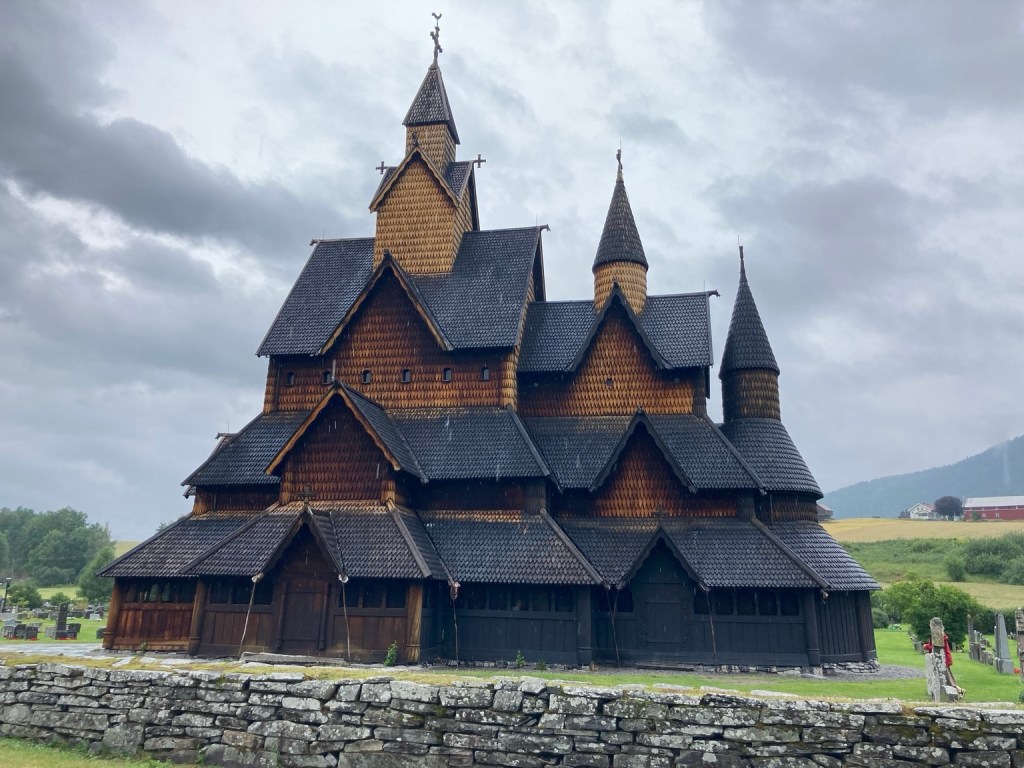
From one of the smallest, to the largest. According to legend, Heddal was built in only three days with the help of a troll named Finn and shows how elaborate the structures became with its multi-tiered roof and three towers.
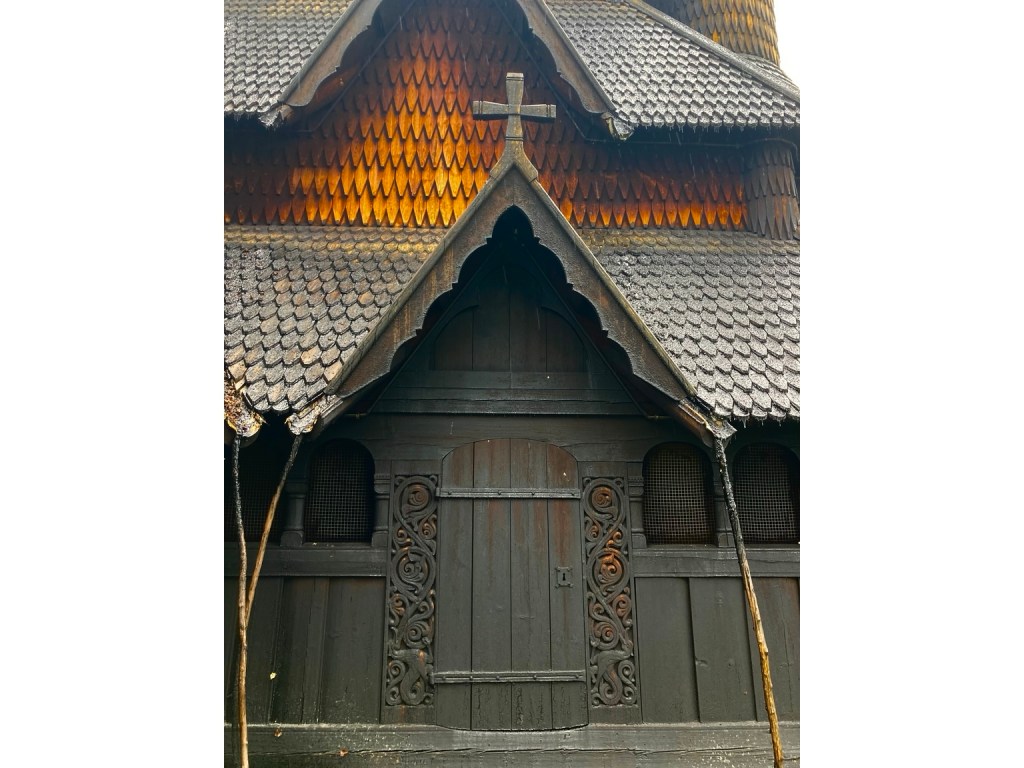
It has an exterior gallery where there are fantastic woodcarvings around the four entrance doors …
… and I got the briefest glimpse inside.
When it came to building churches, the Vikings built in wood and used ship building techniques which resulted in the stavkyrkje or stave church. The name comes from its corner post or stave which is prepared like a ship mast. First the tree was selected, the branches removed and the tree left for several years. It would then swell with sap, seeking to repair the wounds and this resin would act like a preservative. The seasoned staves were cut, and erected on a stone foundation to keep away rot. The rest of the church was built around this frame, and then regularly painted with pitch, which the Vikings used to seal their ships and make them watertight.
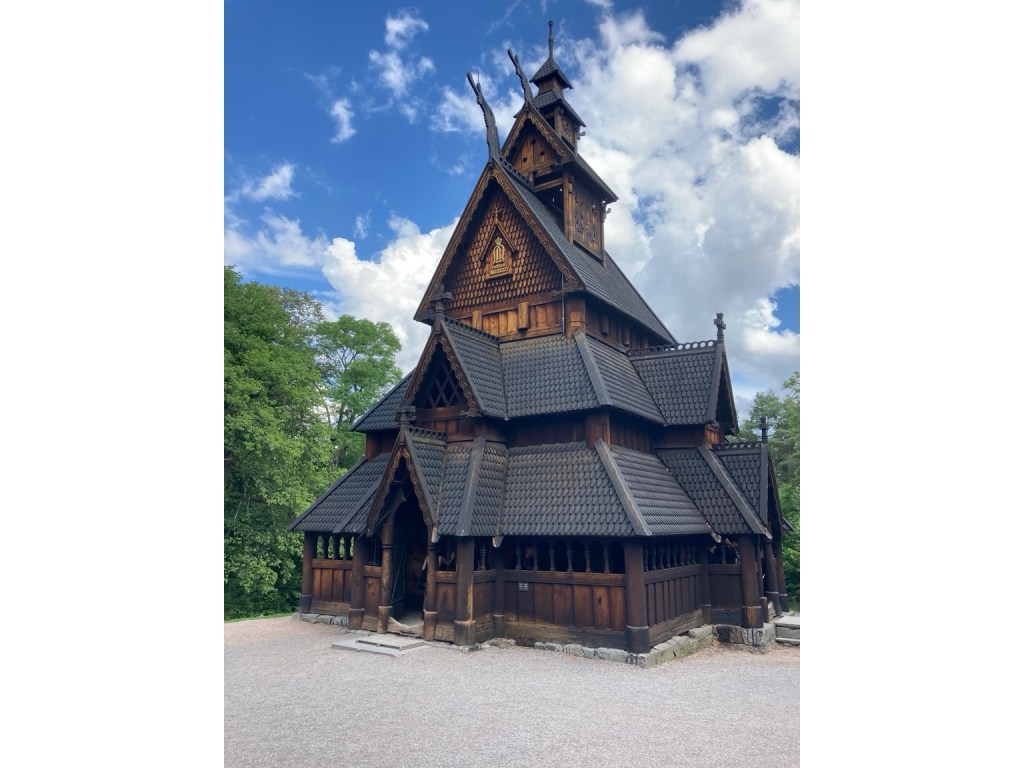
In the C19th the stave churches were deemed too small and dark so many were demolished or sold in favour of new buildings and today only 28 remain. The Gol stave church, built around 1212, was rescued and moved to Oslo and is now the highlight of the museum. Swooping dragon heads are attached to the roof, just like the prow of a viking longship …
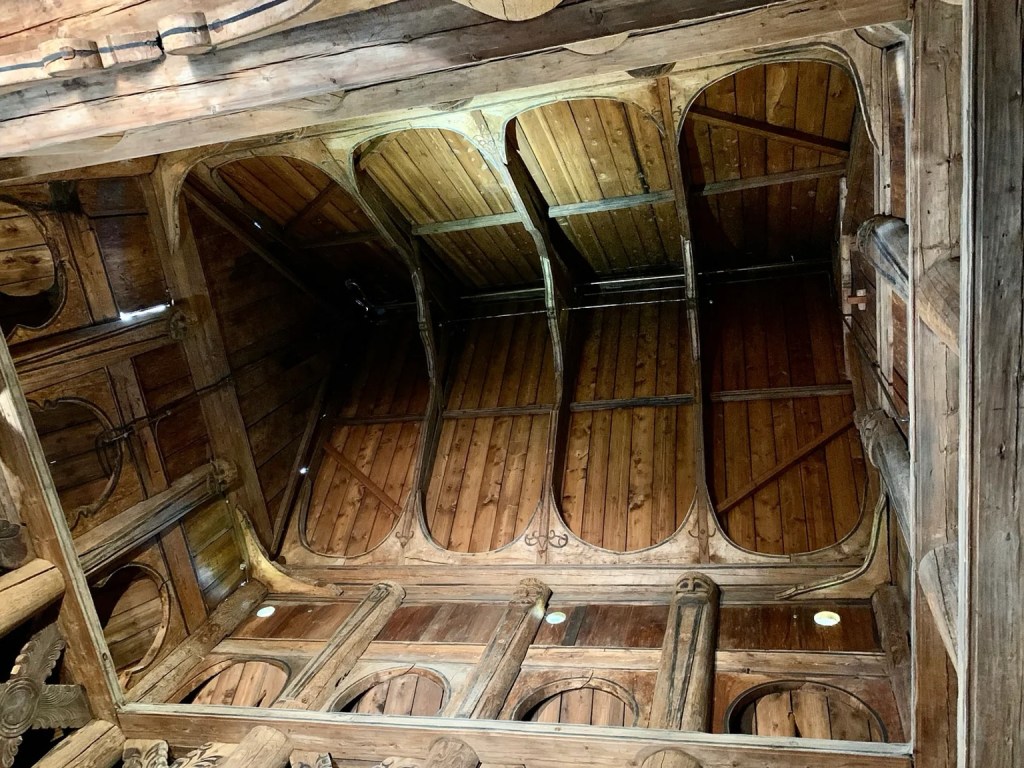
… and inside, the wooden ceiling is constructed like the upside-down hull of a ship.
The murals in the choir and apse date to 1652 and were financed by members of the congregation, offering a glimpse into the church’s history after the Reformation.
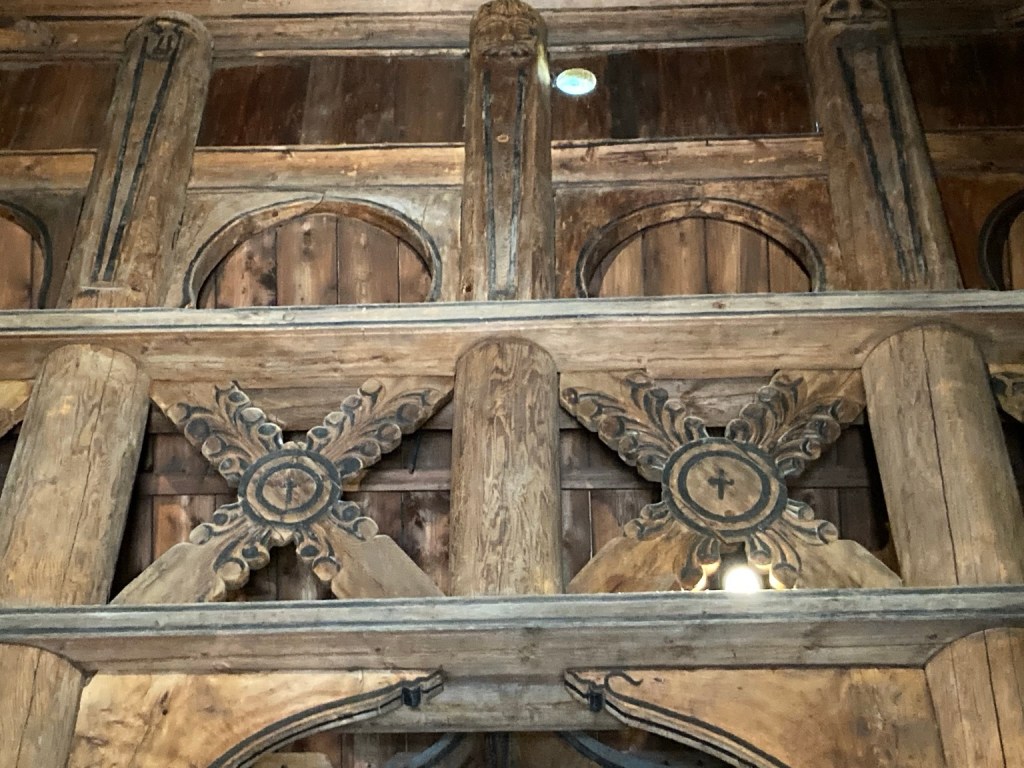
There was also metalwork and carvings of dragons and plant motifs.
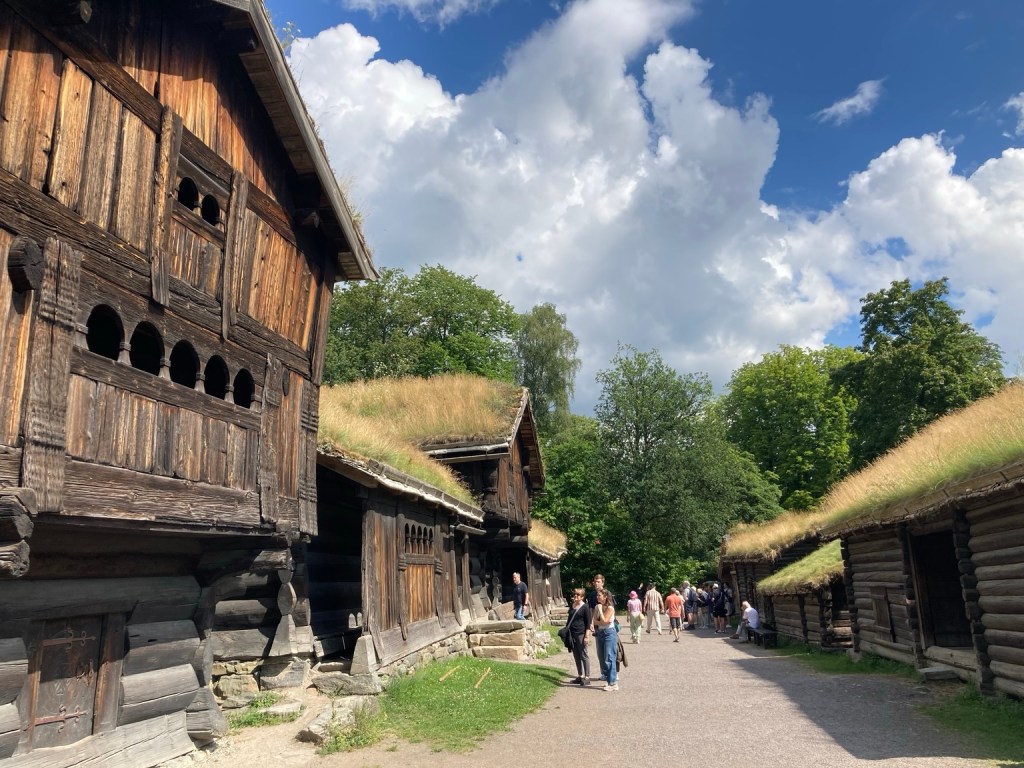
The rest of the museum had displays of costume, textiles and decorative arts as well as a collection of buildings from various regions and we wandered round in the sunshine and even spotted some country dancing.
It was soon time to go and we took the ferry back and a train to the airport and reflected on our trip. We’ve enjoyed visiting Norway, but have decided we won’t be booking another organised trip for the time being as we prefer making our own way, taking our time and just going off travelling together.
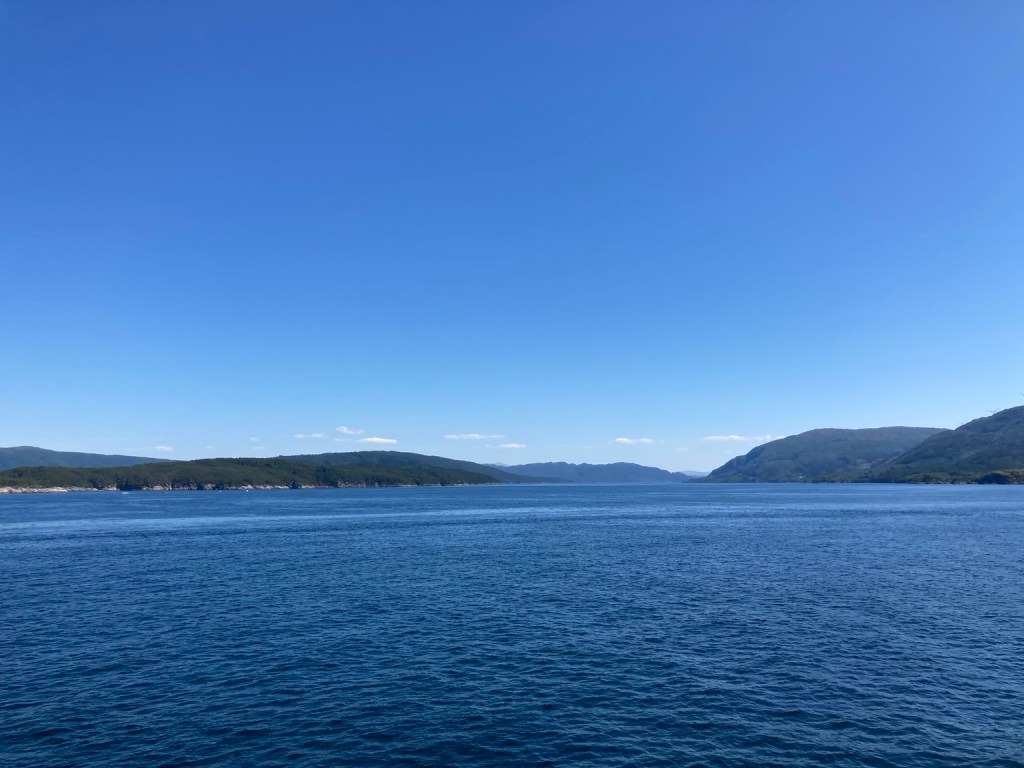
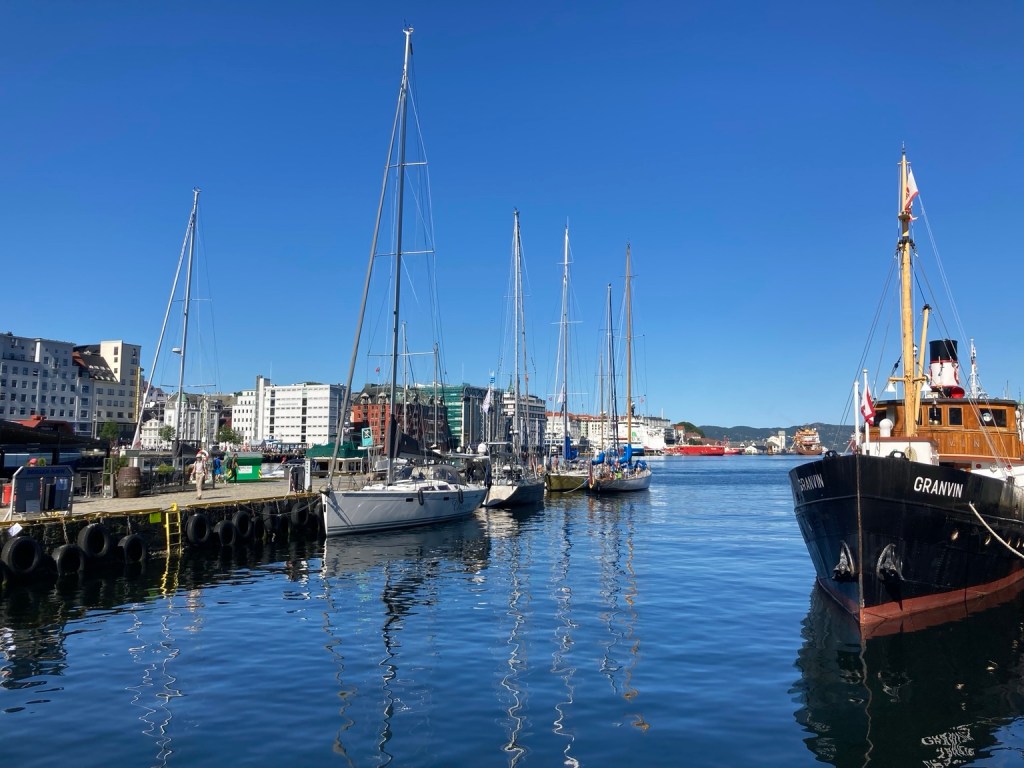
Finally, with the fabulous weather, we’ve seen lots of Norwegian blue in both the sky and water …
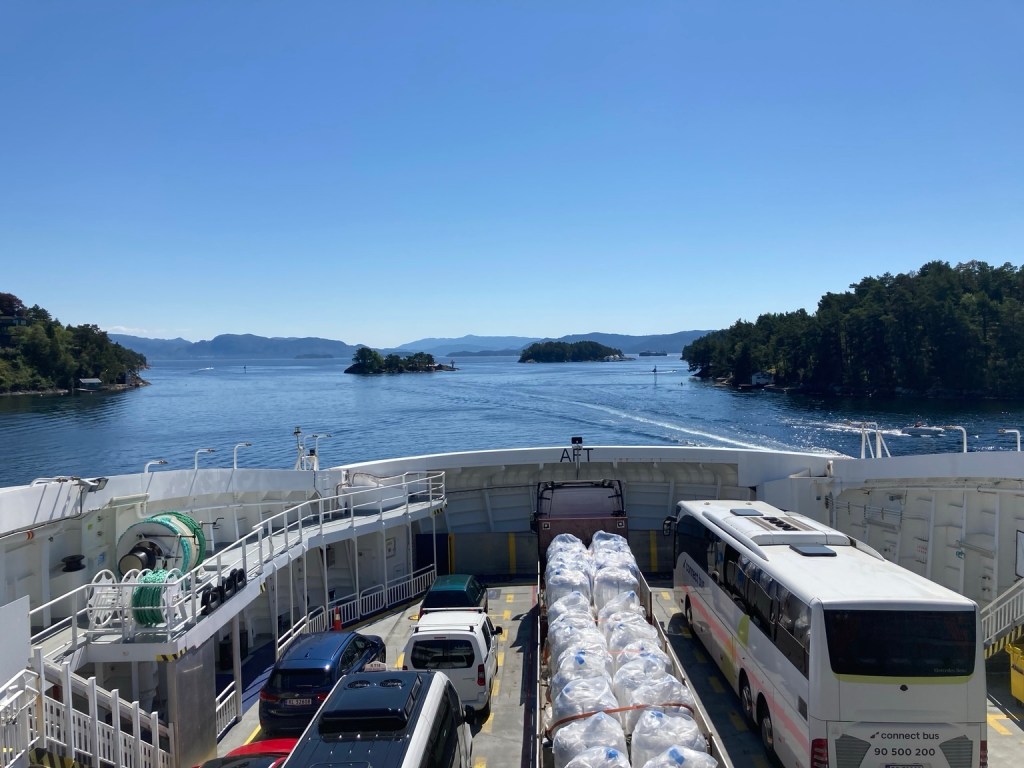
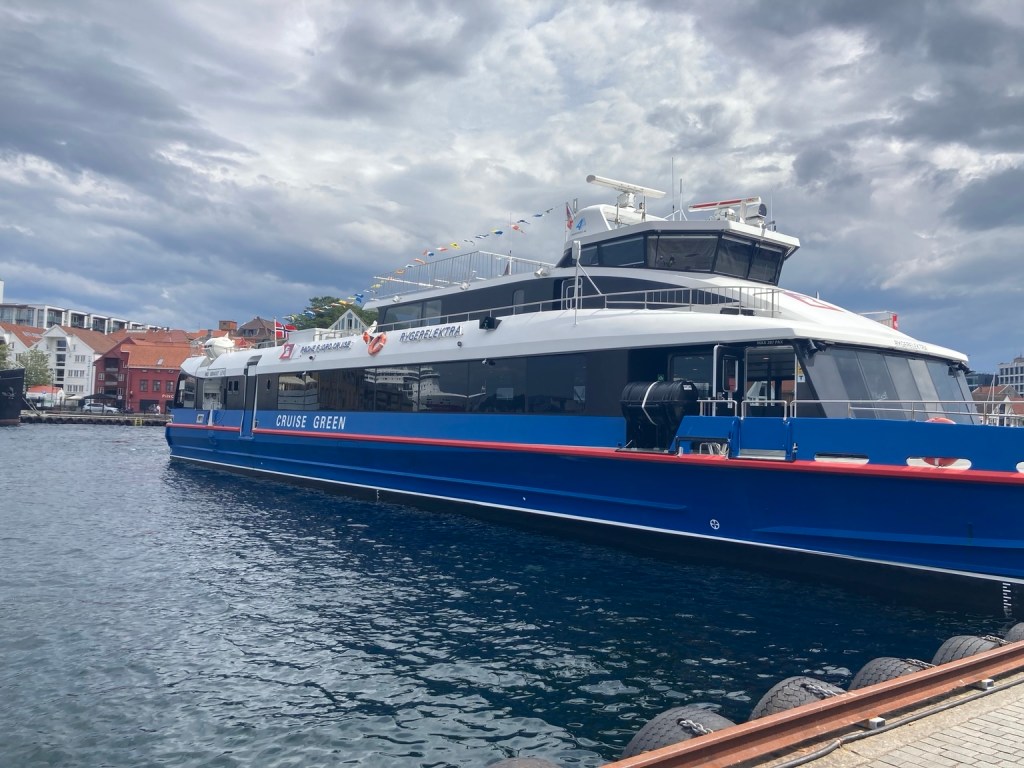
We travelled along Norway’s southwest coast by land and sea, including two ferry crossings and a submarine tunnel.
We stopped to see the Sverd I fjell monument commemorating the Battle of Hafrsfjord in 872, when King Harold Fairhair gathered all of Norway under one crown …
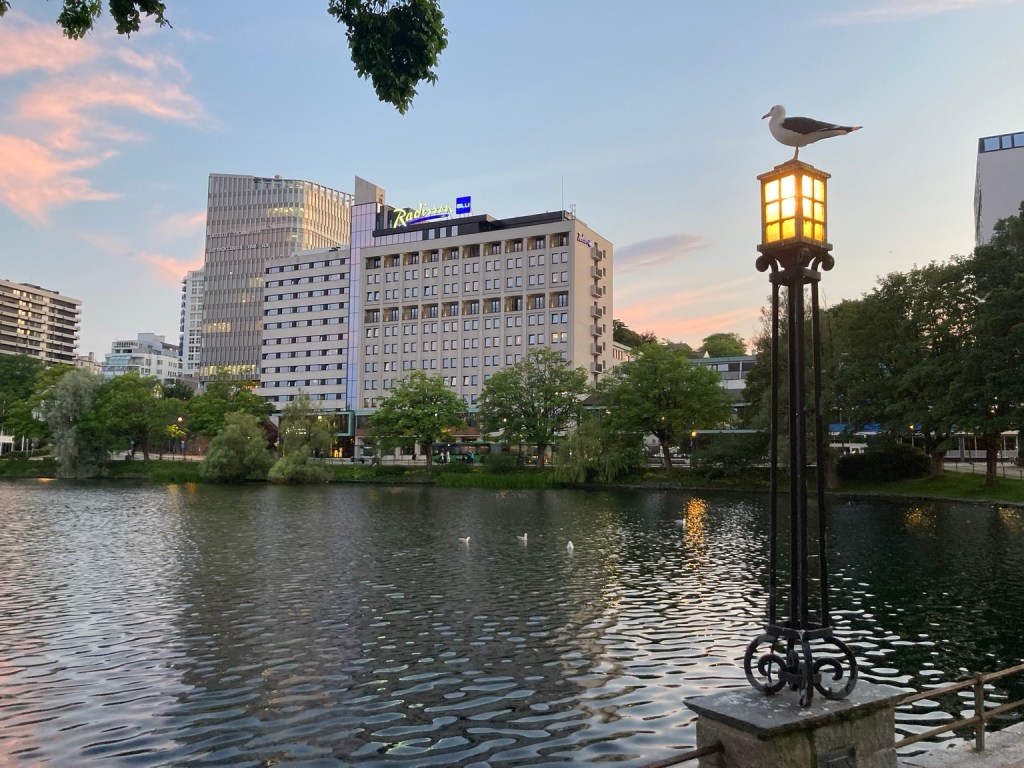
… and soon afterwards, we were checking into our hotel in Stavanger where we had a great view of the central lake or Breiavatnet.
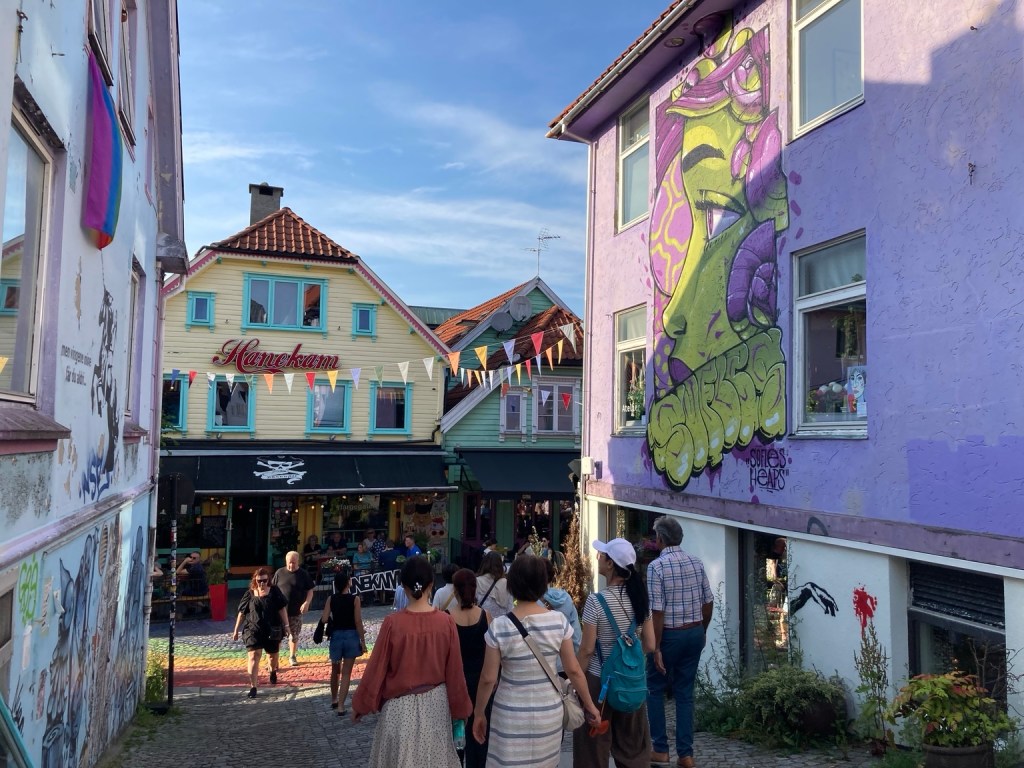
We had a brief guided walk through colourful backstreets dotted with restaurants and decorated by vibrant street art driven by an annual festival.
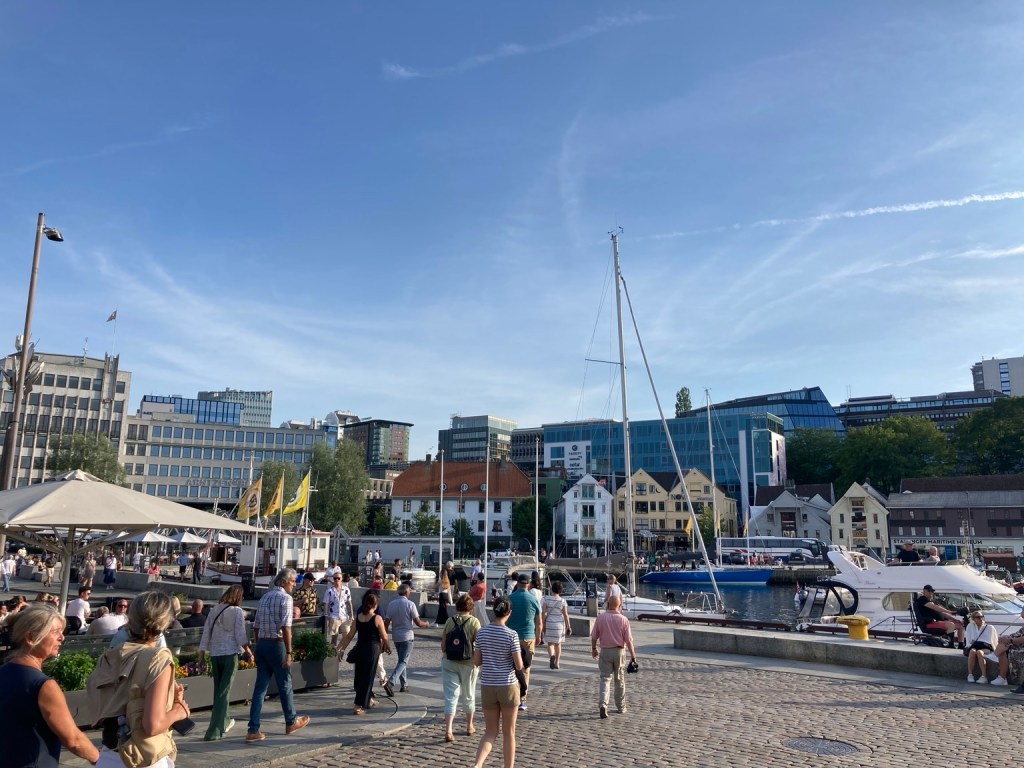
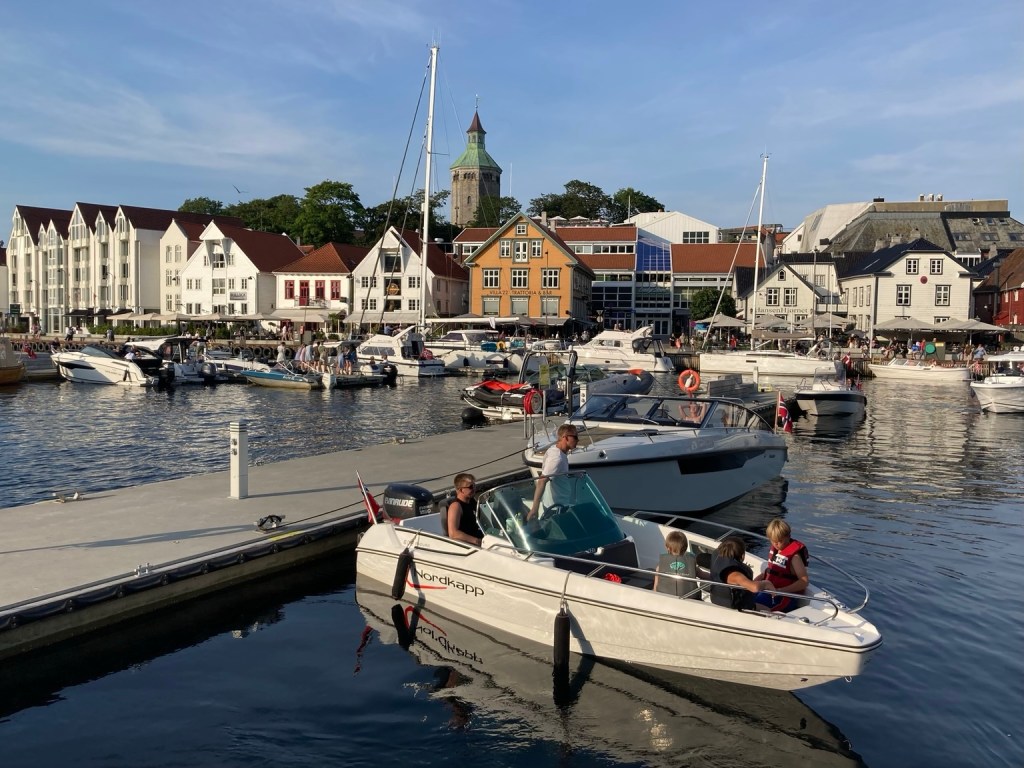
Reaching the harbour …
… there were wharves originally built to support the herring trade in the C19th, but now containing vibrant bars and restaurants.
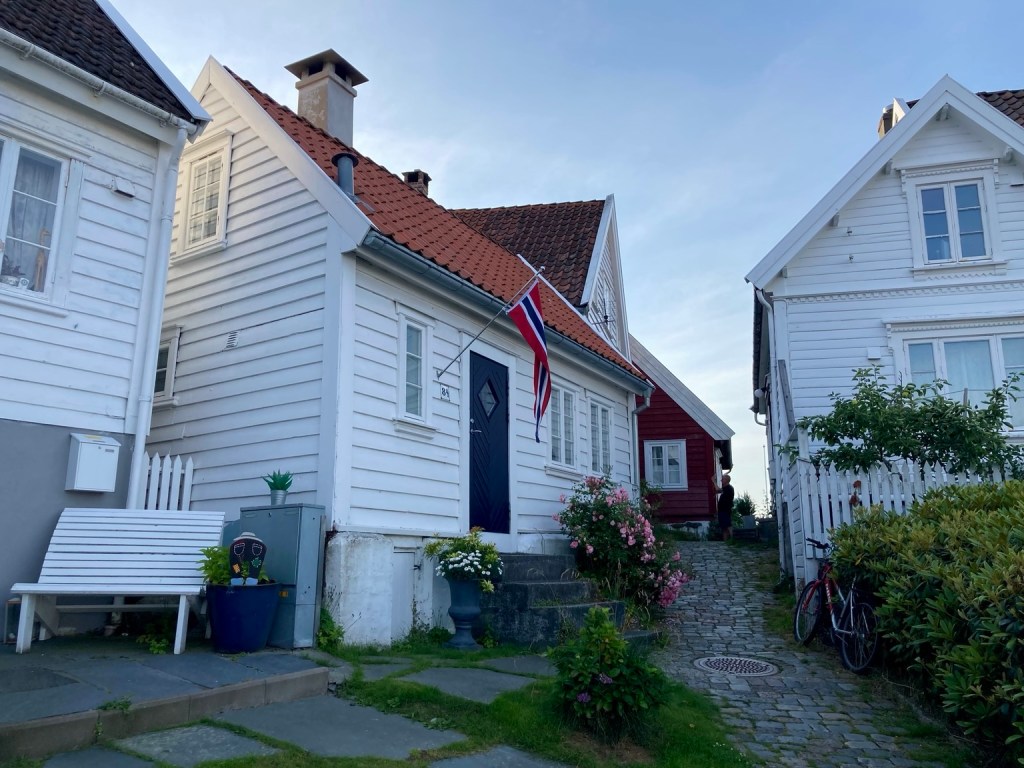
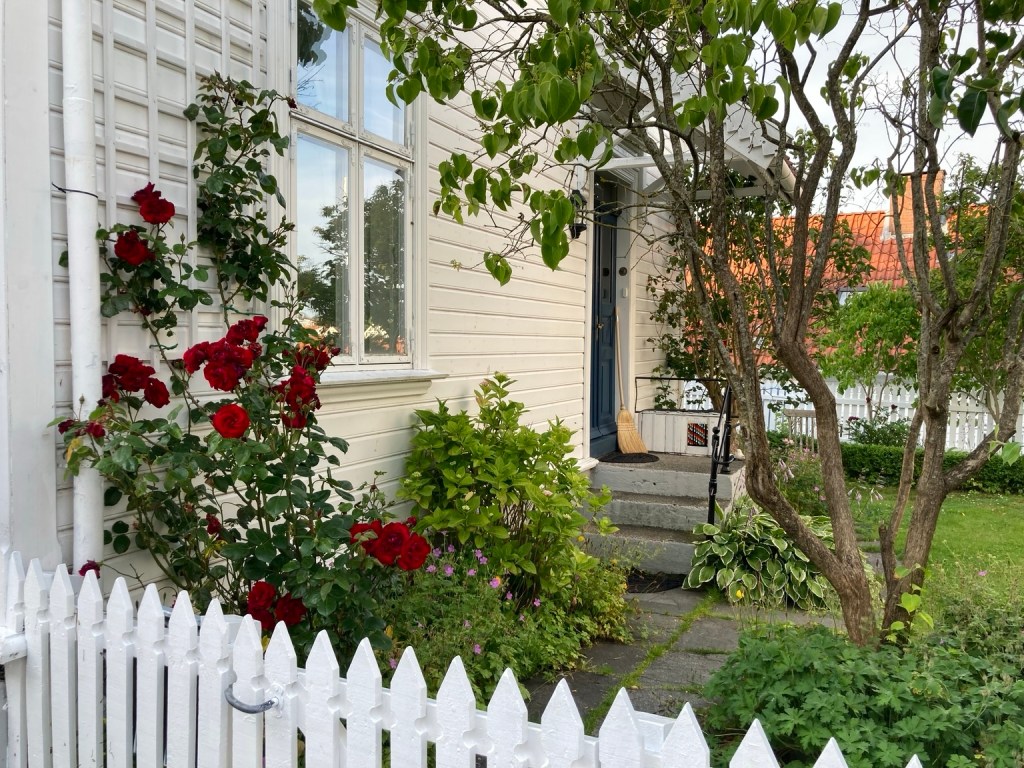
With an evening at leisure ahead, we enjoyed wandering through the lovely wooden houses of the old town where there was a photo round every corner.
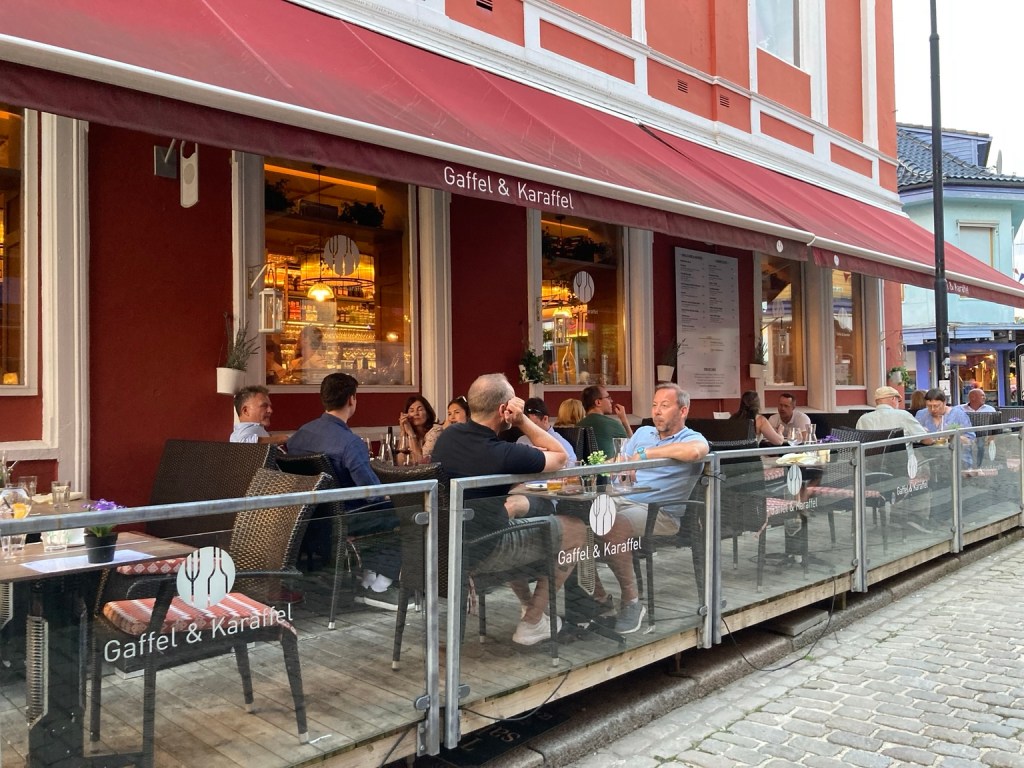
Peckish, we stopped for dinner where we found great veggie options.
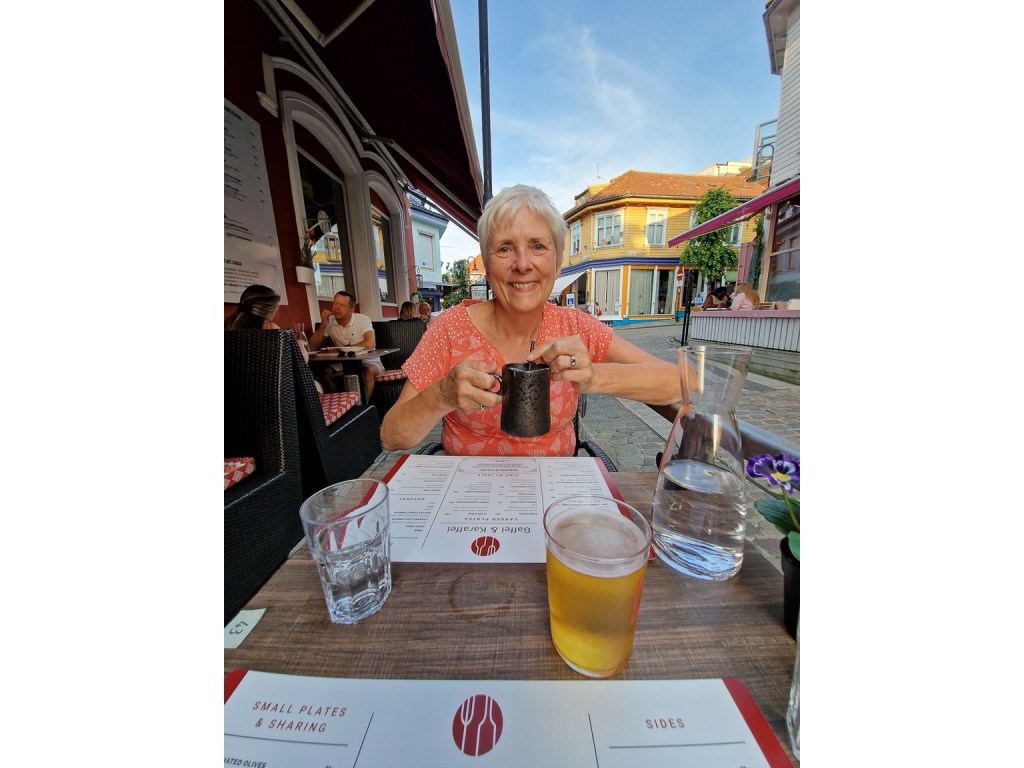
In fact, this was the first leisurely dinner of the trip, and we celebrated with drinks, mine an aquavit mule and for Chris a local beer.
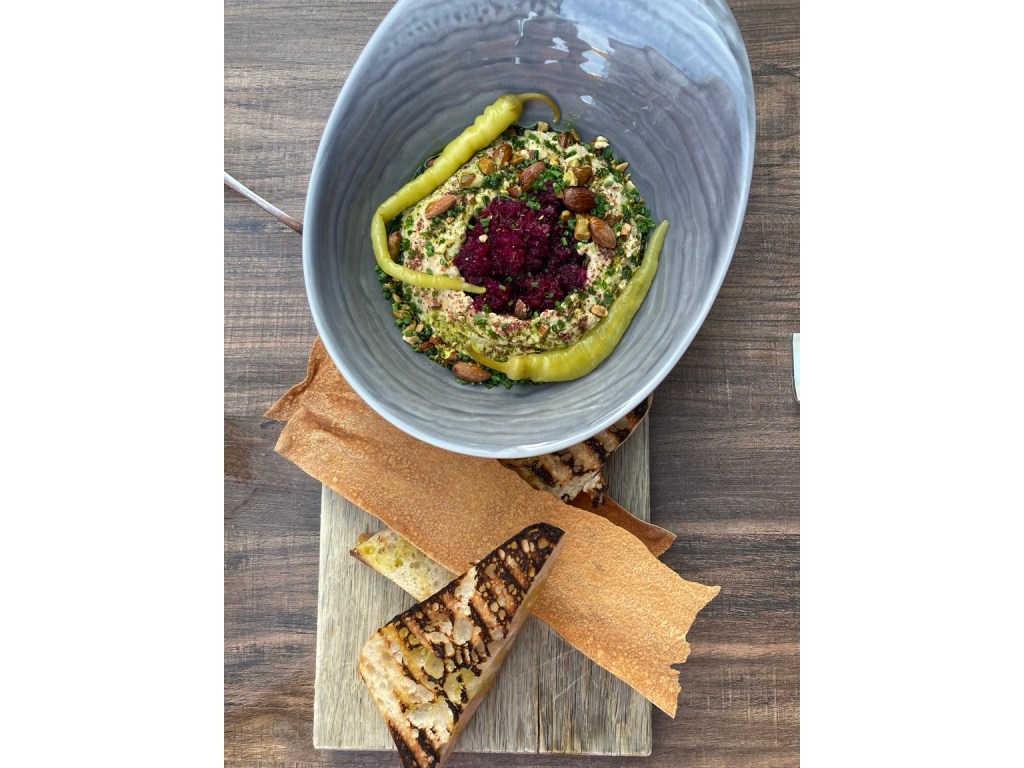
In Norway, the state endeavours to save the population from themselves by imposing huge tax levies on alcohol, having a state-owned alcohol monopoly called Vinmonopolet and banning advertising. In fact, even eating out is quite expensive, but having virtually ducked dinner the night before, we threw caution to the wind! We shared humous to start …
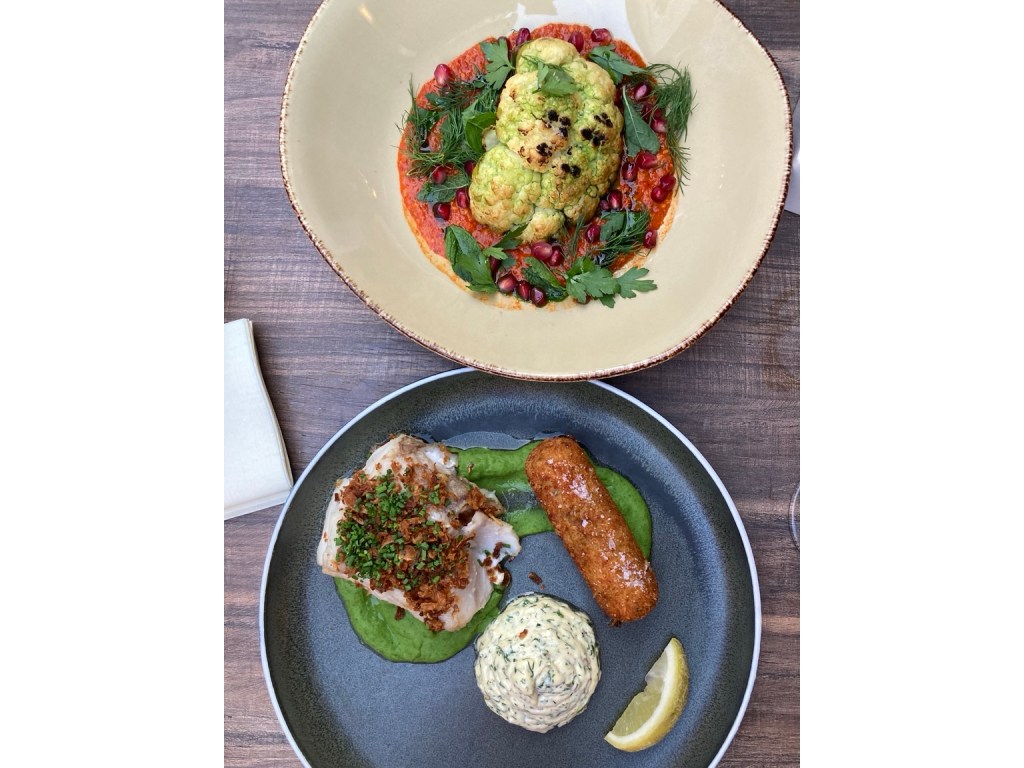
… and followed with roasted cauliflower with romanesco sauce for Chris and deconstructed fish & chips for me, with a glass of wine each, and while the bill might not be unusual in London, we thought it a tad steep.
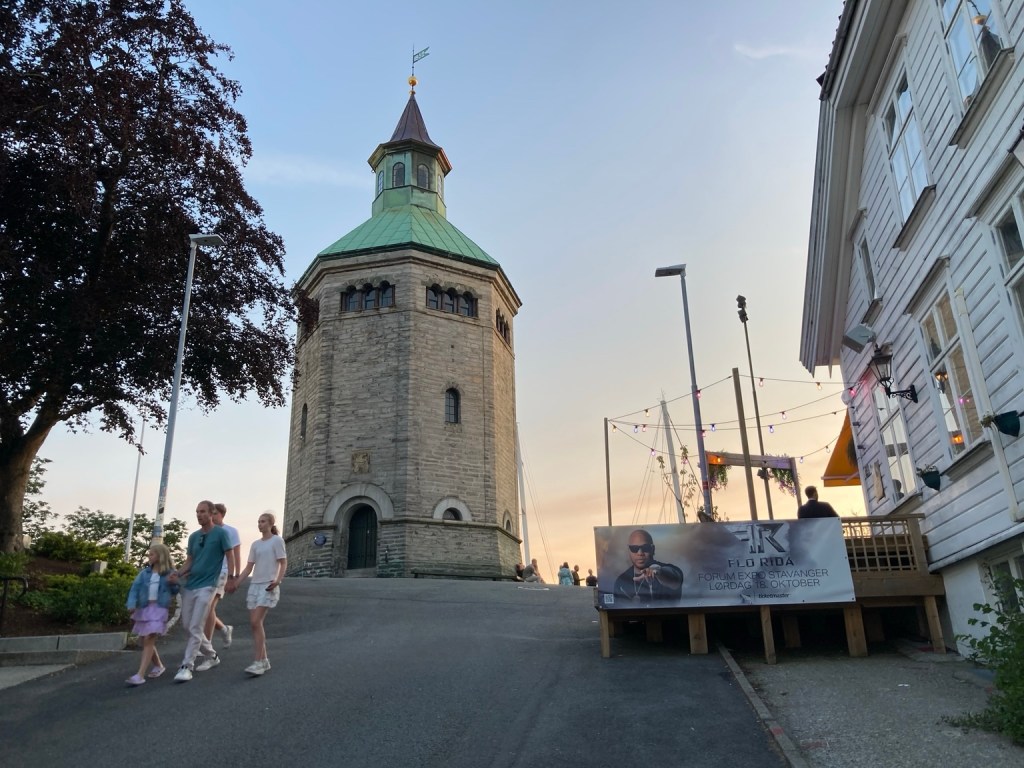
On the way back we stopped at the Valberg tower built to keep watch for fires …
… and enjoyed the sunset …
… before walking back round the lake to our hotel.
Next day, we awoke to a grey morning.
It certainly meant that we saw the other side of Norway as we cruised through Lysefjord …
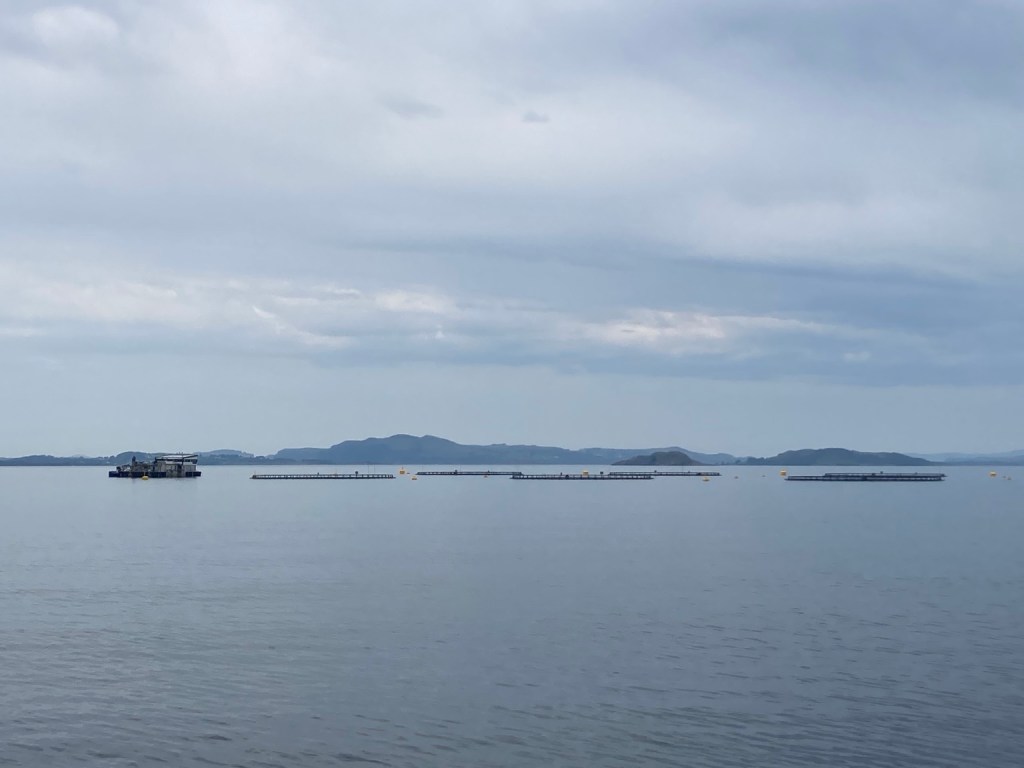
… past salmon farms …
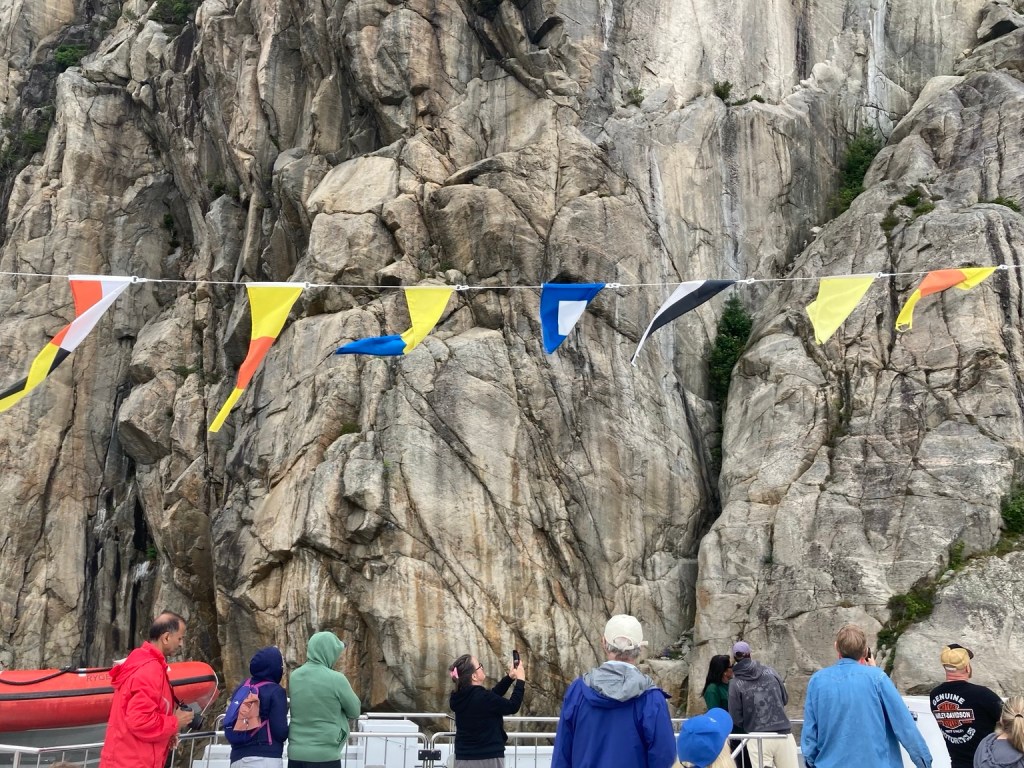
… and into Lysefjord with sheer rock faces …
… a cave where vagabonds once sought refuge …
… and the 400m Hengjanefossen waterfall.
There was also Preikestolen or Pulpit Rock, a locally famed hiking destination which juts out dramatically over the fjord which we viewed from below.
Tiny people moving on the top could just be seen through a zoom lens and Chris had fun playing with the sliders on an image later!
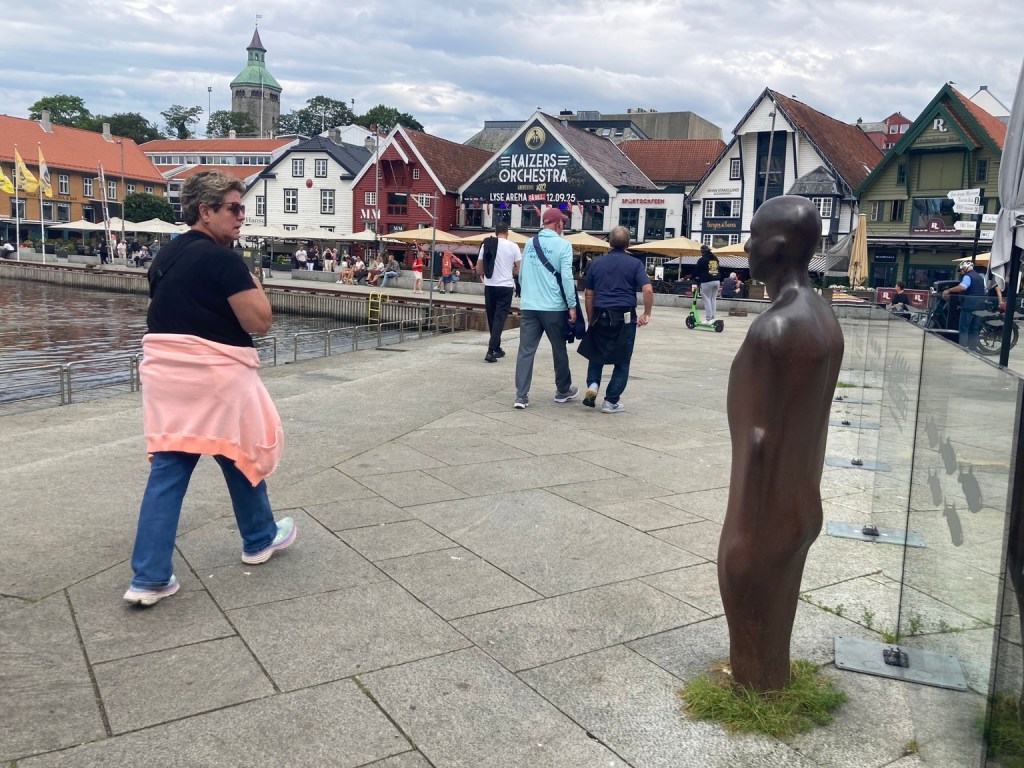
Once back we had a break for lunch and spotted a couple of chaps keeping watch as we walked back from the harbour.
These are just two of the 23 figures installed throughout the town by Anthony Gormley as part of his art work called the Broken Column.
While we ate our sandwich, we reflected on how little we had heard about the most significant event in Norway’s history in the last 60 years. Oil was discovered in the Ekofisk field in 1969 and has completely changed the Norwegian economy, leading to the establishment of the Oil Fund which manages the revenue from petroleum activities and holds over US$1.9 trillion in assets. It is the world’s largest single sovereign wealth fund which translates to US$340,000 per Norwegian citizen and provides economic stability for Norway now and for future generations.
Today almost all this oil and gas is exported, and counter to this, and maybe as some form of compensation, Norway itself strides forward with green measures and targets. Electric vehicles abound – scooters, bikes, cars, trams and boats, with hydro responsible for almost all domestic energy supply. With longer in town, we could have visited the Norwegian Petroleum Museum, but it was not to be, but at least we spotted one oil rig!
Another afternoon drive brought us to the charming Revsnes Hotel, hugging the shore of Byglandsfjord.
It was already nearly time for dinner, but we were keen to walk out on the jetty and admire the view.
Spotting a handy little sandy beach, several of us had a quick dip …
… and the water was lovely!
Dinner was another buffet, but pretty good, and later we sat on the deck chatting and enjoying the view.
After a 3 hour drive we arrived in Bergen, but with so much packed into the day, it was almost 10pm before we arrived and checked into our sea view room!
Despite the bright sunshine, it felt too late for dinner, so we just got take away pizza slices from the 7-eleven and sat in the park to eat them before heading to bed.
We had a guided tour round the town in the morning starting on the far side of the bay …
… and then had a couple of hours free time to explore further, which was a lot to pack into a morning. Luckily it was a beautiful day, which is rare in Bergen where it rains on average 260 days a year.
From the C11th, Bergen was the largest and most important town in medieval Norway and is known for its maritime history. It became a hub for the Hanseatic League which enabled dried stockfish from the north of Norway to be traded, mainly for grain. In time, the League which was controlled by German merchants, came to dominate the economy, becoming increasingly wealthy and disliked by local Norwegians.
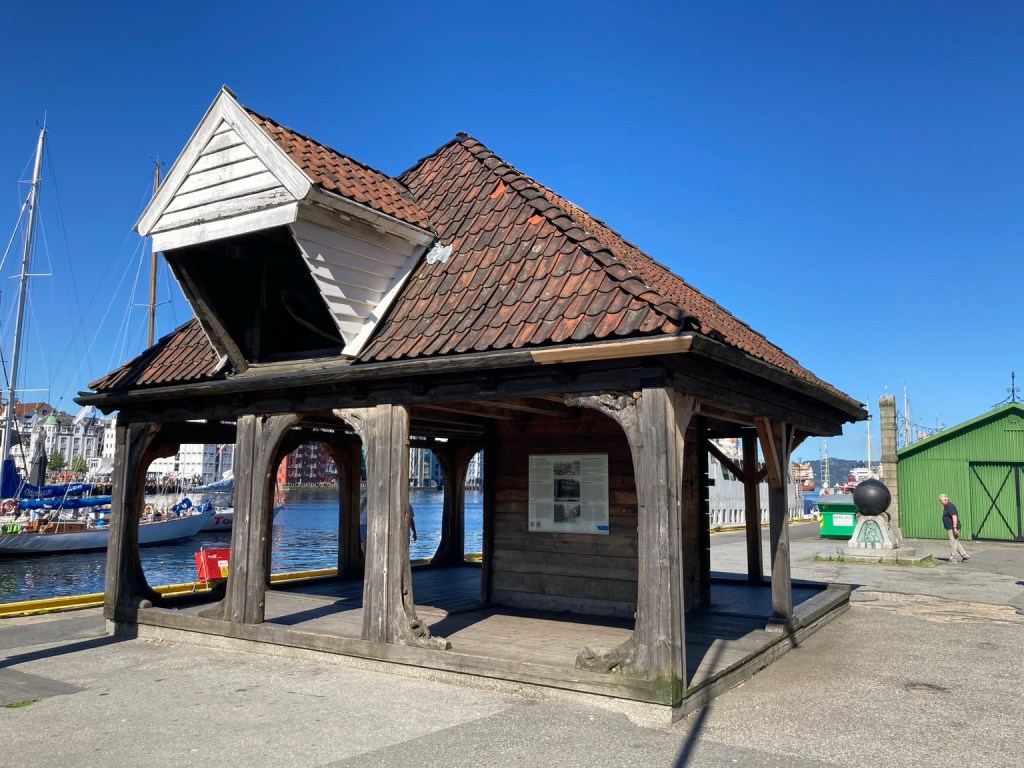
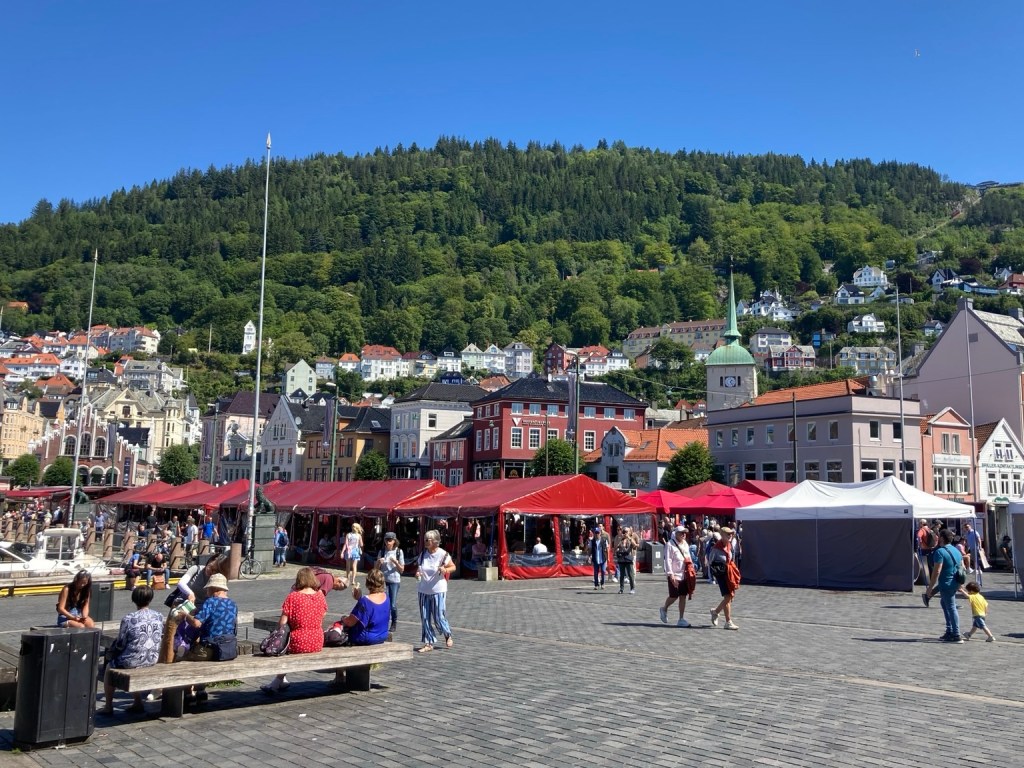
The heart of the town is the harbour …
… and Torget, the open air fish market …
… where they still sell stockfish …
… amongst other fishy things …
… but I just had tasters of reindeer and whale sausage. There were also jams, and while cloudberry is the most famous, it is very sweet so we chose a small jar of lingonberry jam to bring home.
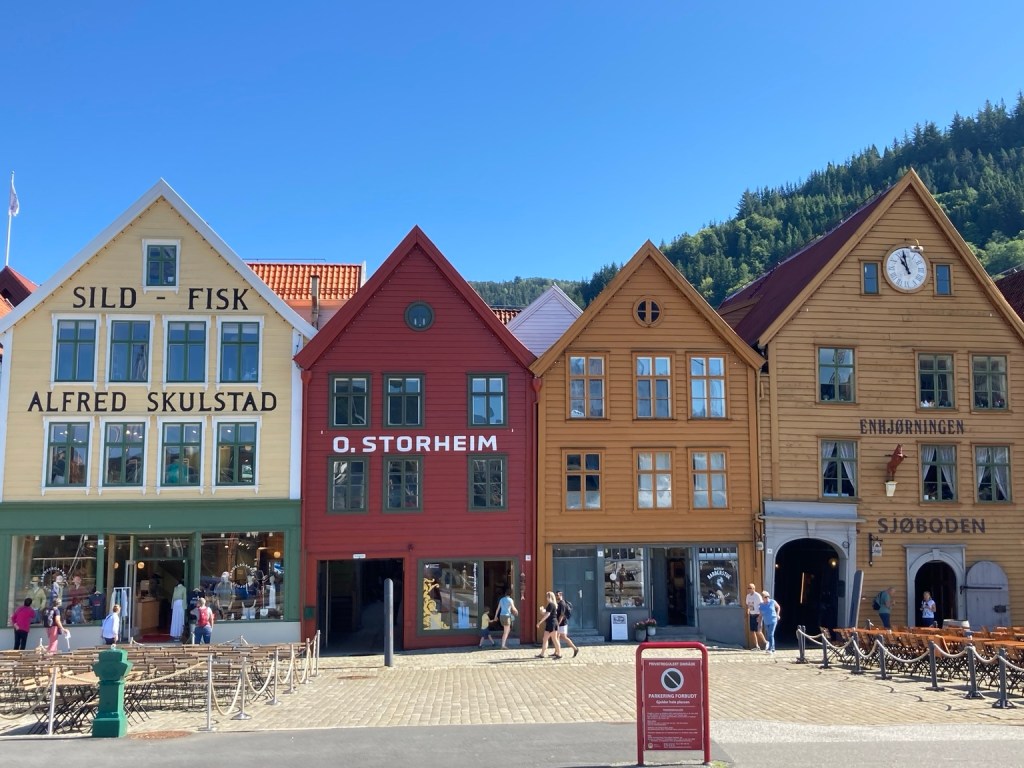
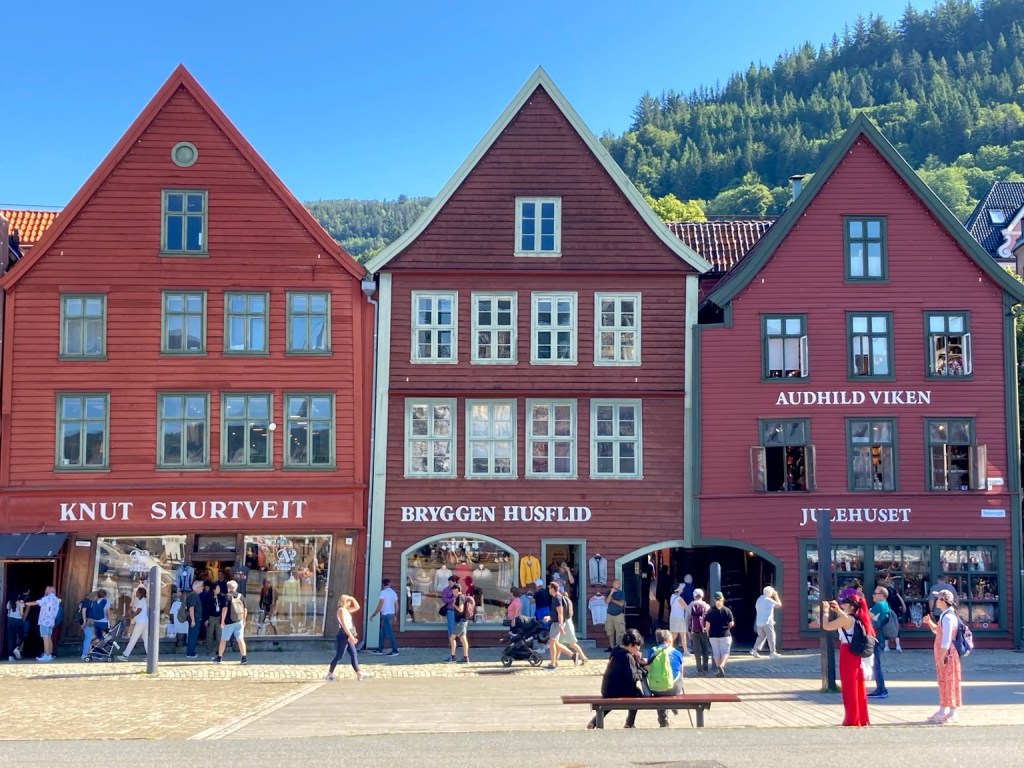
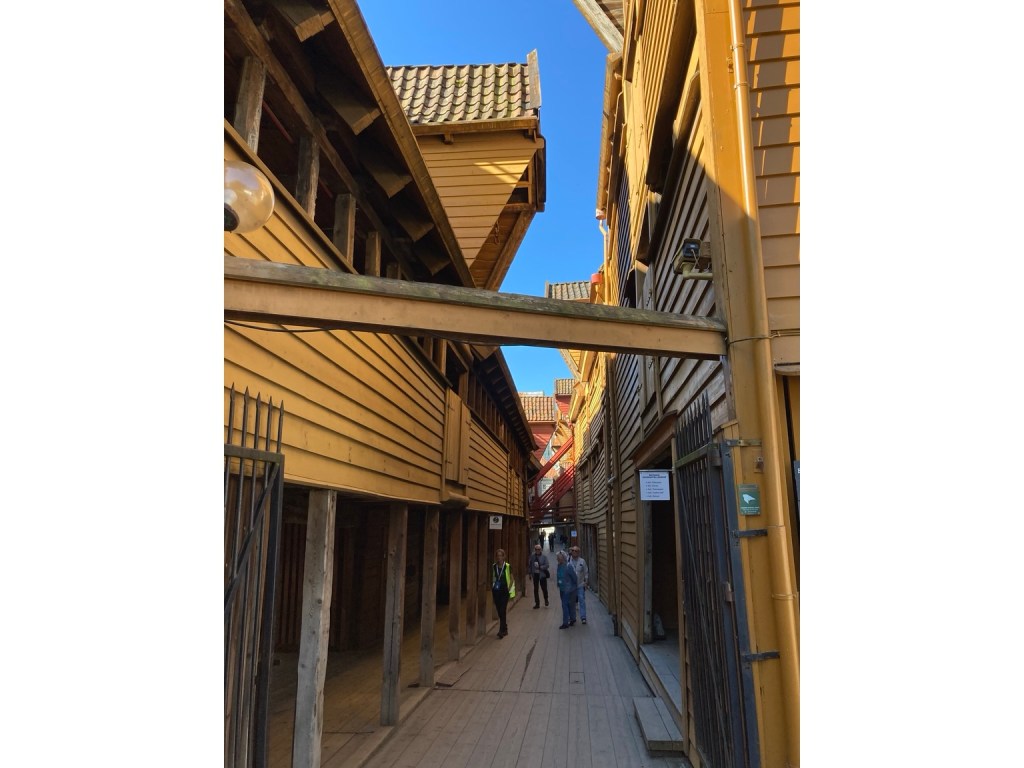
The harbour side area called Bryggen is lined with merchants’ trading houses, built after the great city fire of 1702. The very oldest are wooden and now protected …
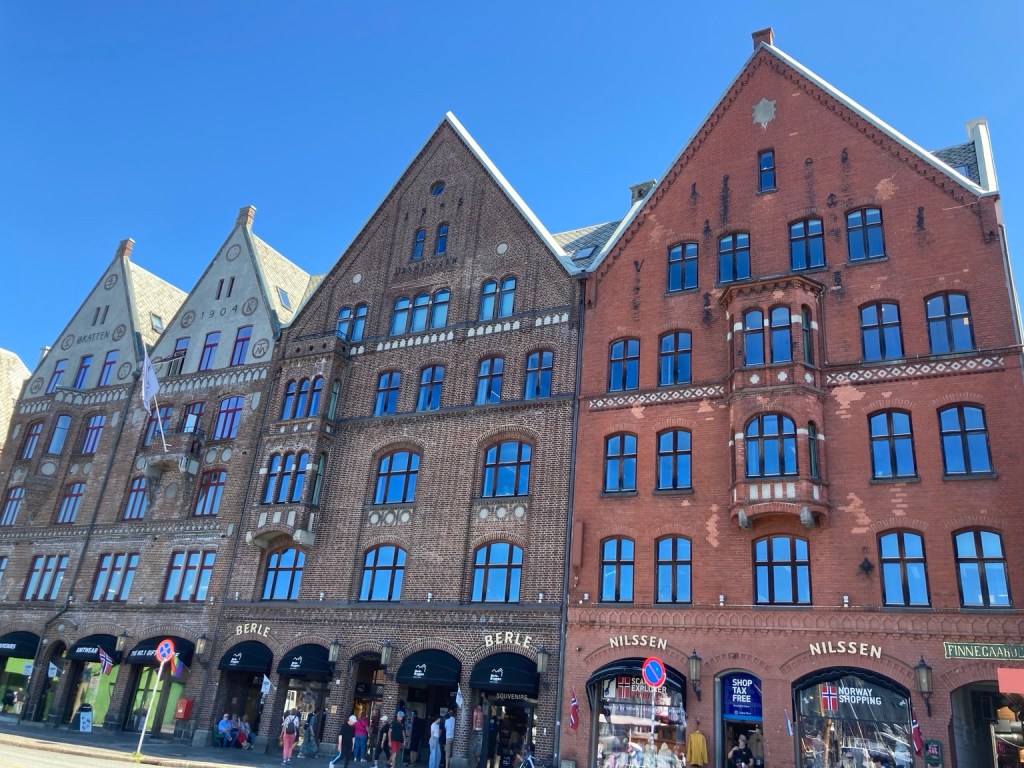
… but others were demolished in favour of brick buildings, although their style is sympathetic.
Everything about the League was regulated from the design and size of the buildings to the behaviour of the employees, but sleeping above all that smelly fish can’t have been pleasant. This model shows how the area would have looked.
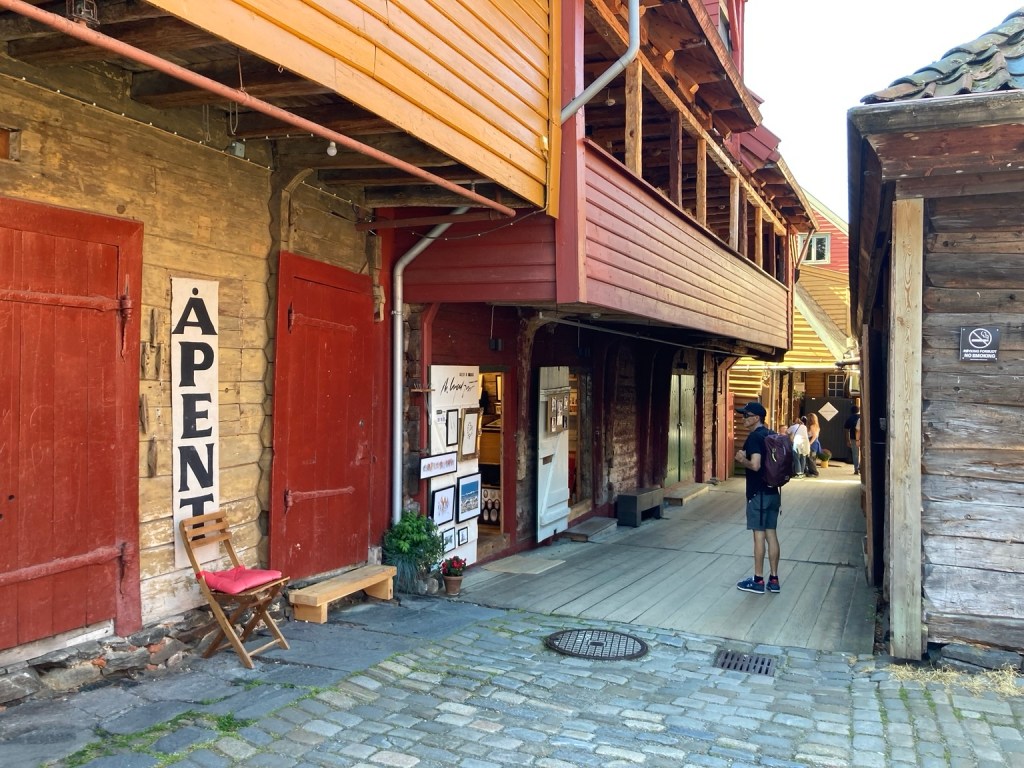
We wandered down the alleys and between the buildings, most now giftshops selling jumpers and trolls.
The Hanseatic Museum was closed for renovation, but we did visit the Schotstuene or assembly rooms, where merchants gathered to eat, hold council and relax.
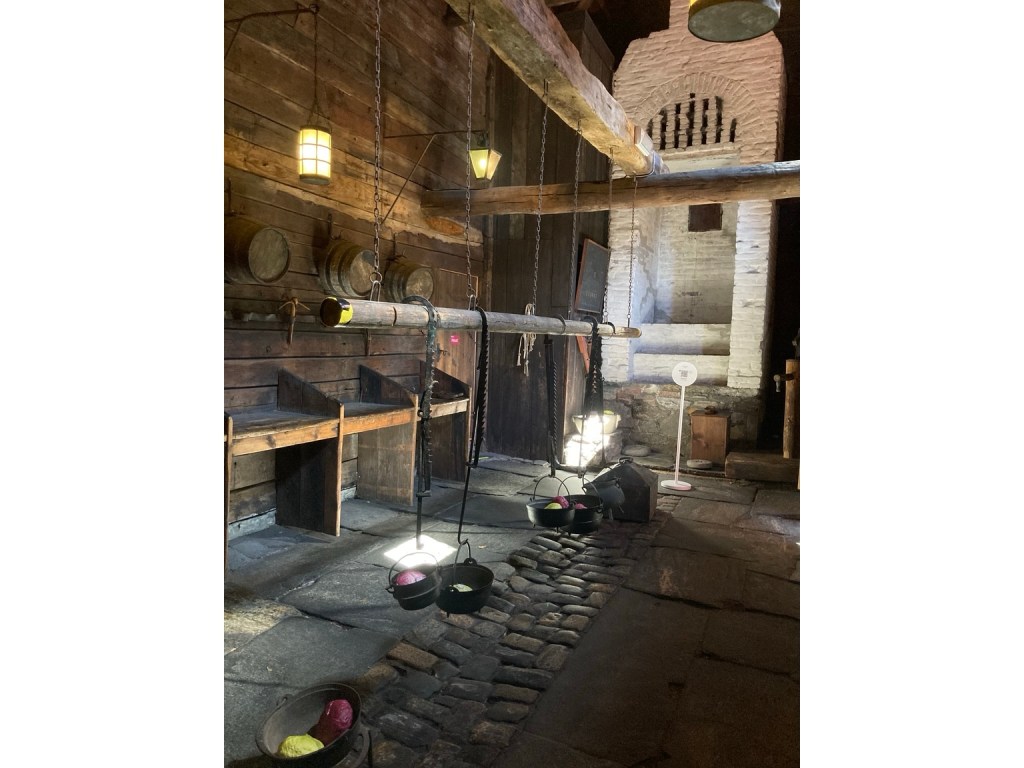
To safeguard against fire, this building had a stone built kitchen and was the only place in the trading post which allowed cooking and heating. The kitchen was laid out with each trading company having its own workstation and cooking pot …
… and the stone hearth at the end would heat the assembly room on the other side.
Later intricate metal stoves were installed.
We passed the old meat market …
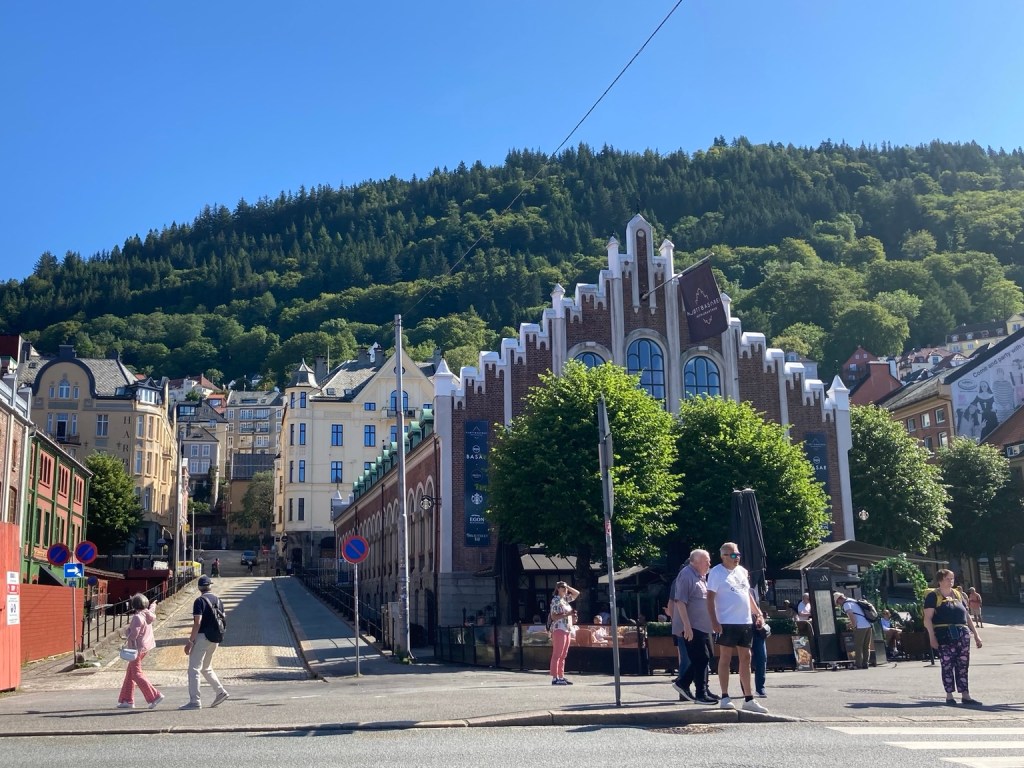
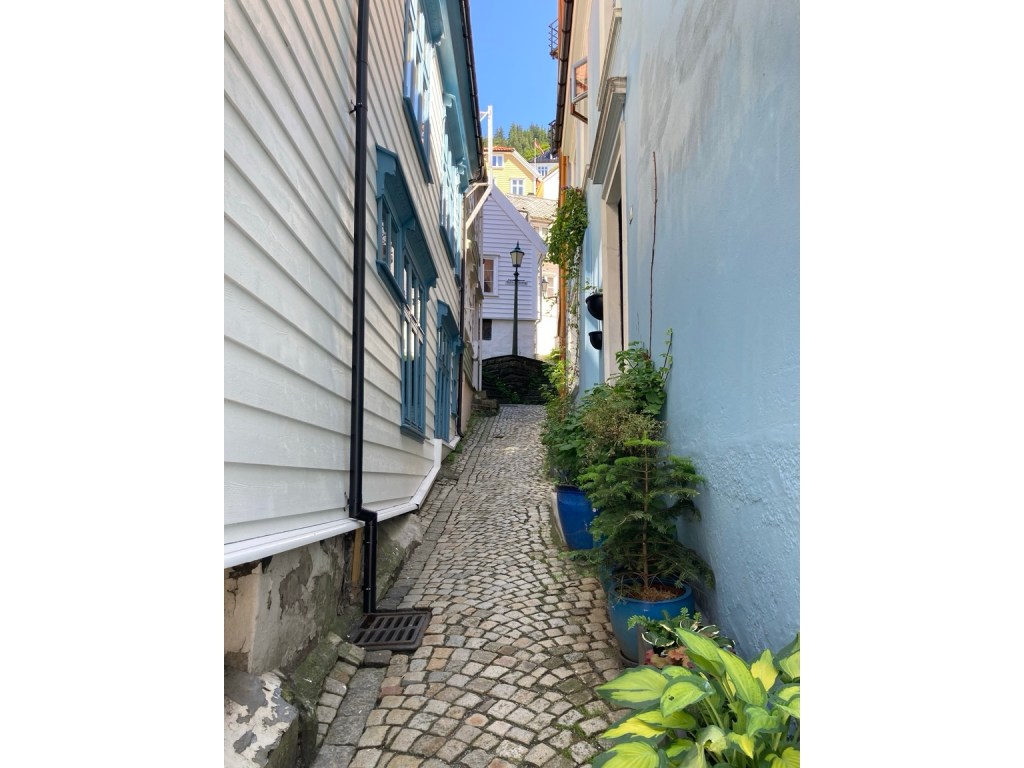
… and took a wander through the back streets …
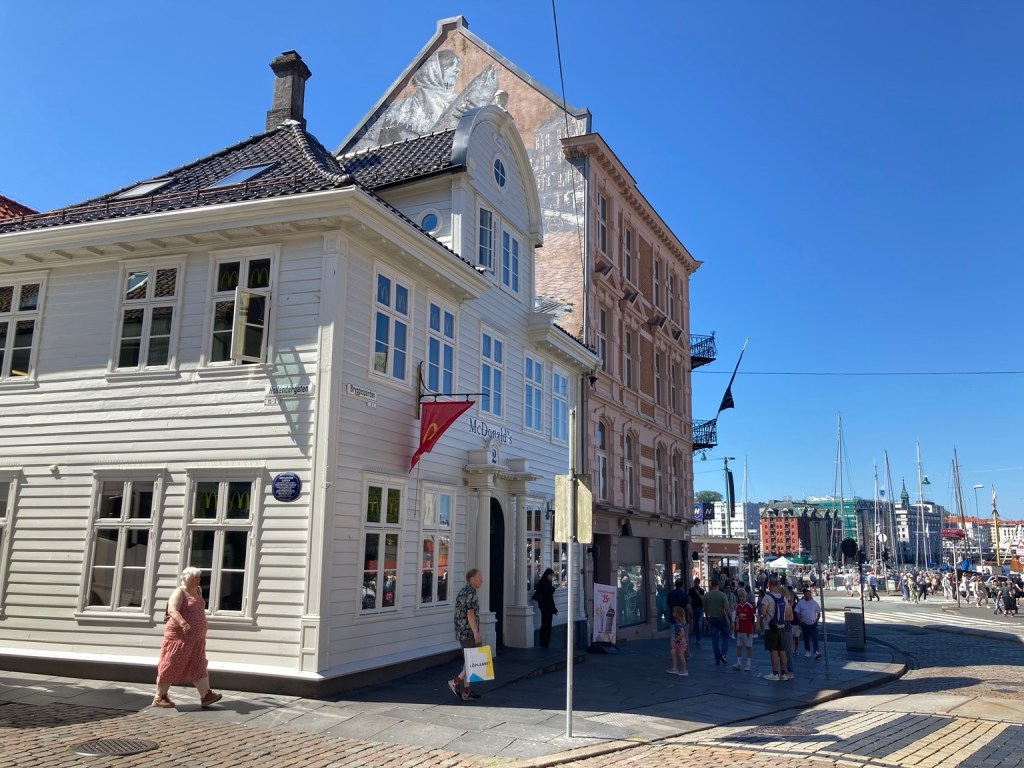
… where even the Macdonalds was cute.
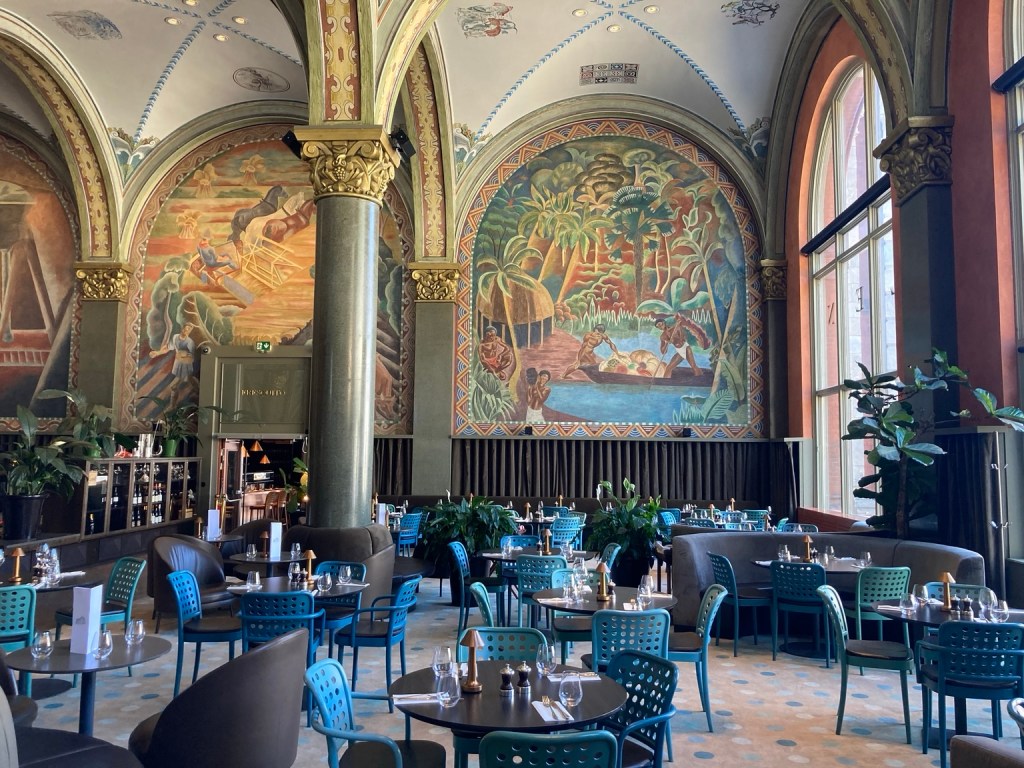
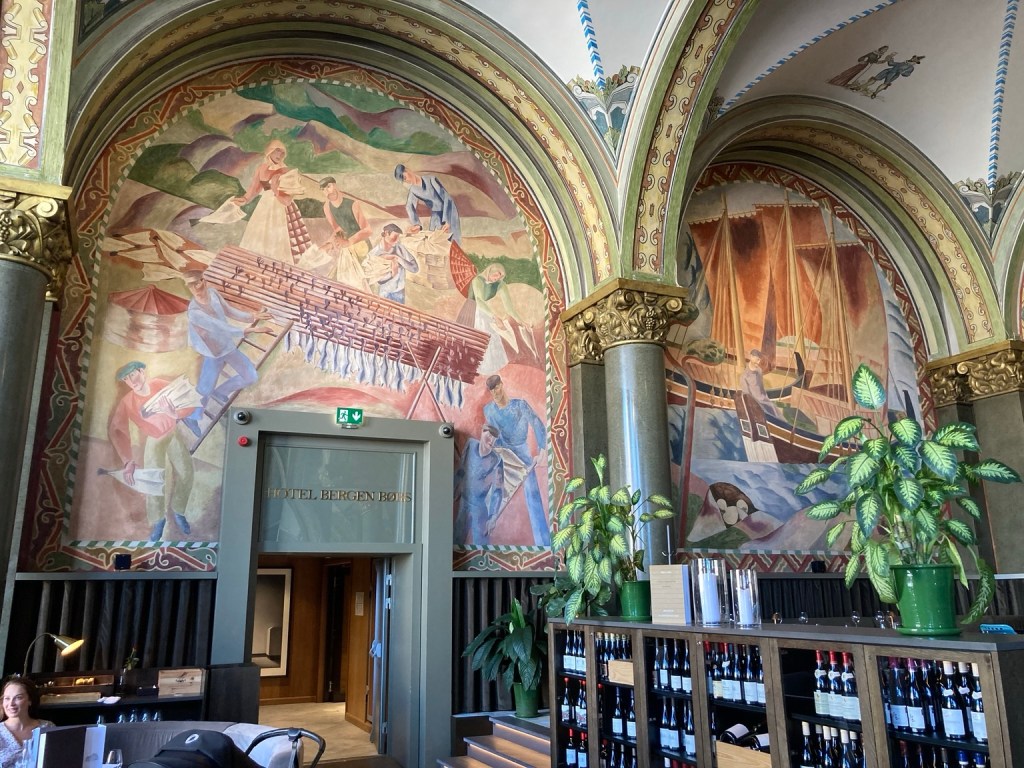
We also popped in to the Fresco Hall, part of the old stock exchange building, which was decorated with frescoes linked to Bergen’s business life in the 1920s, but now a restaurant.
Finally, Bergen has installed a pneumatic waste collection system to do away with bins and trucks. Instead, rubbish is deposited into special chutes and it gets sucked away through pipes to a terminal. We were eager to try it and saved our lunch wrappers specially …
… only to find you need to have a residents code to use it! As Chris spotted, check out the shirt, at least one slot machine worked this season!
Time is up … got to go … we’ve got a ferry to catch!
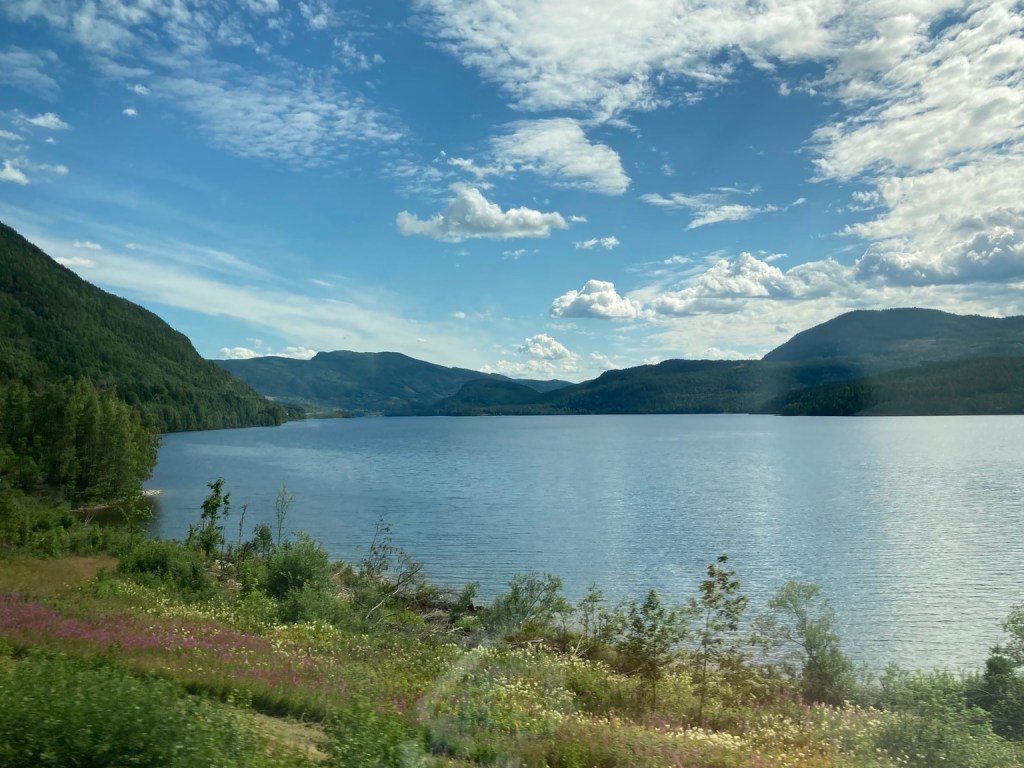
A long afternoon drive took us westwards, alongside stretches of water and through lush valleys …
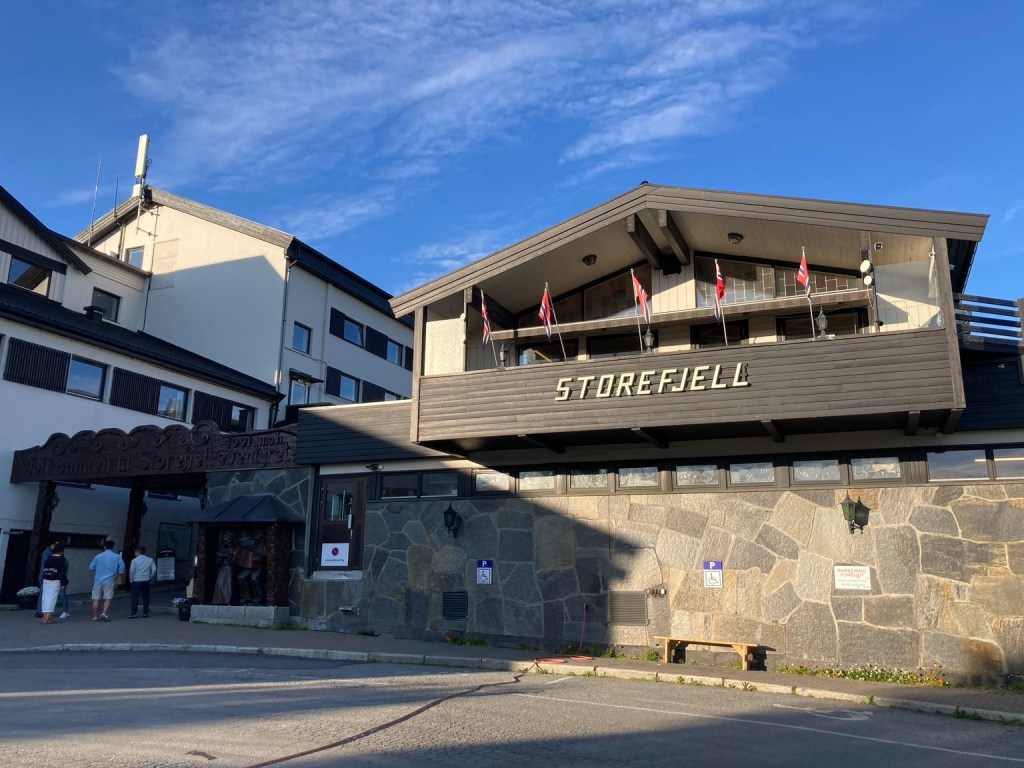
… until we started climbing to the Storefjell Resort Hotel, which has views across the mountains.
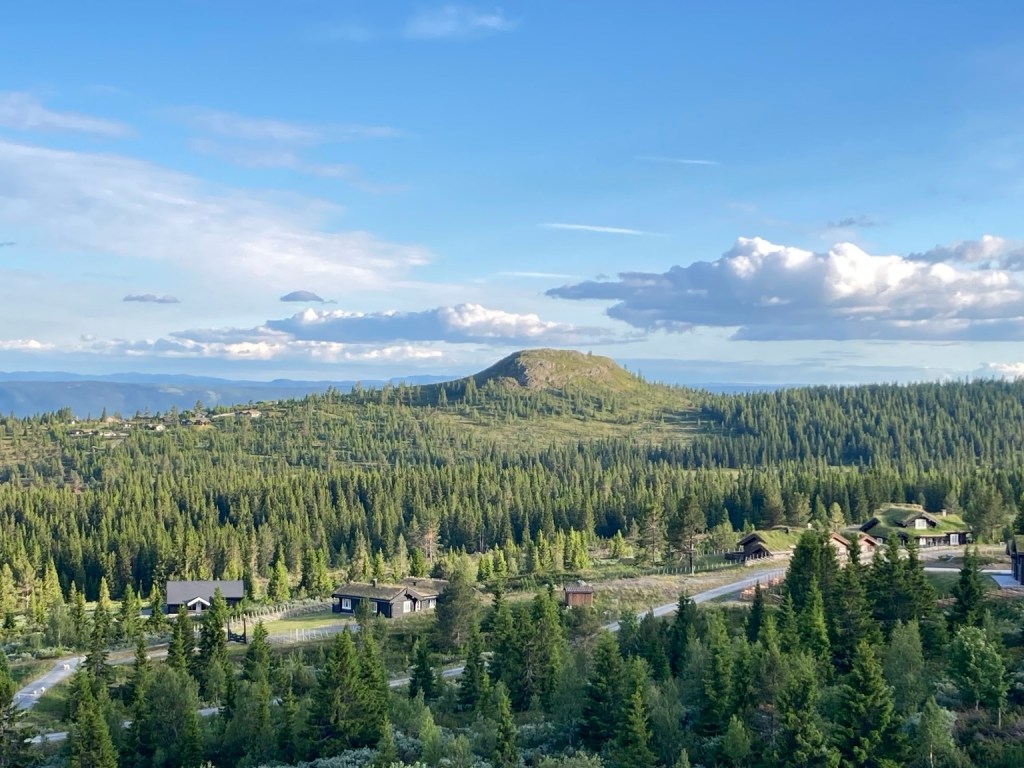
We stood on the deck in the sunshine after dinner and counted the number of small farm buildings with grass growing on the roof!
These grass or sod roofs were commonplace in the countryside and despite more modern materials, are making a bit of a comeback. The turf is laid over layers of birch bark and provides excellent insulation, helps to absorb rainwater and reduce runoff, with the weight of the sod compressing the logs to make the house more airtight.
Everyone in the hotel had an early start so breakfast was like an Olympic event, collecting food and cutlery in relays, then speedy consumption so we were on the coach by 8am!
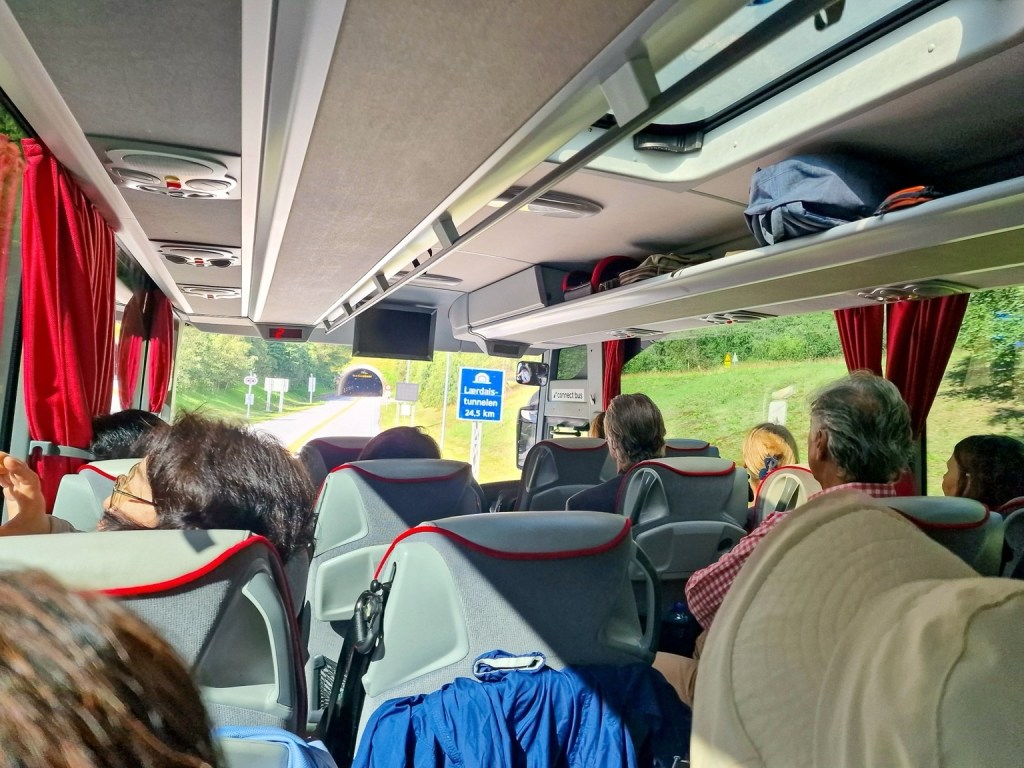
Our day was action packed, beginning with a drive through the Lærdal tunnel which at 24.5kms is the world’s longest road tunnel – plunging us in the dark for 20 minutes!
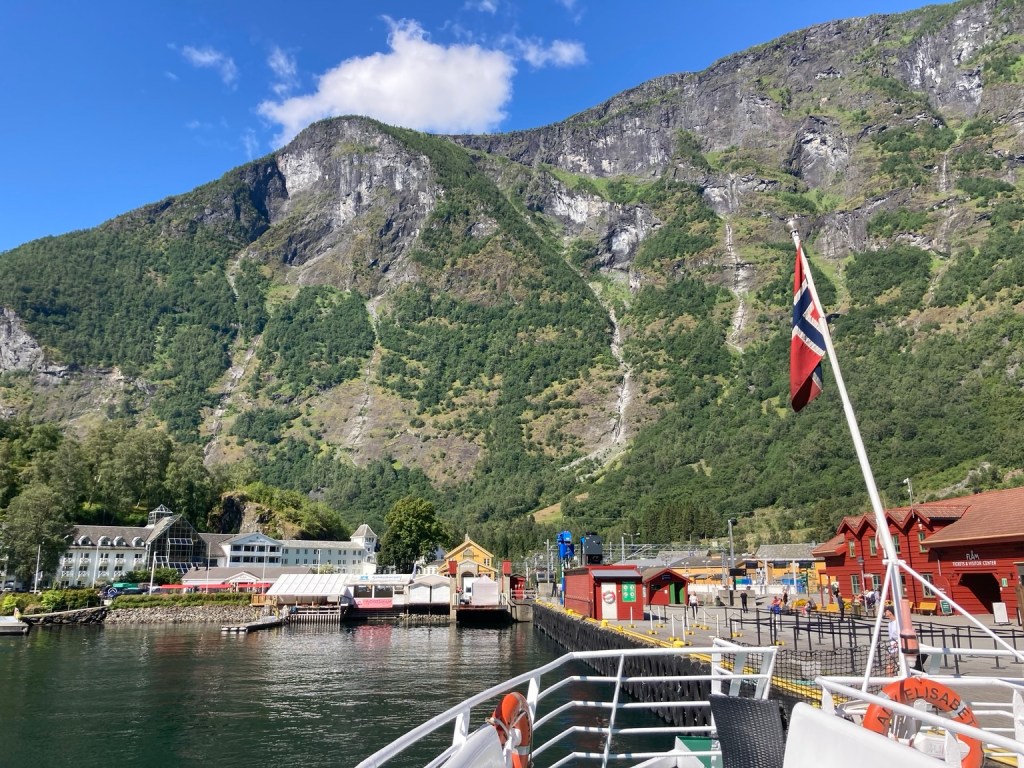
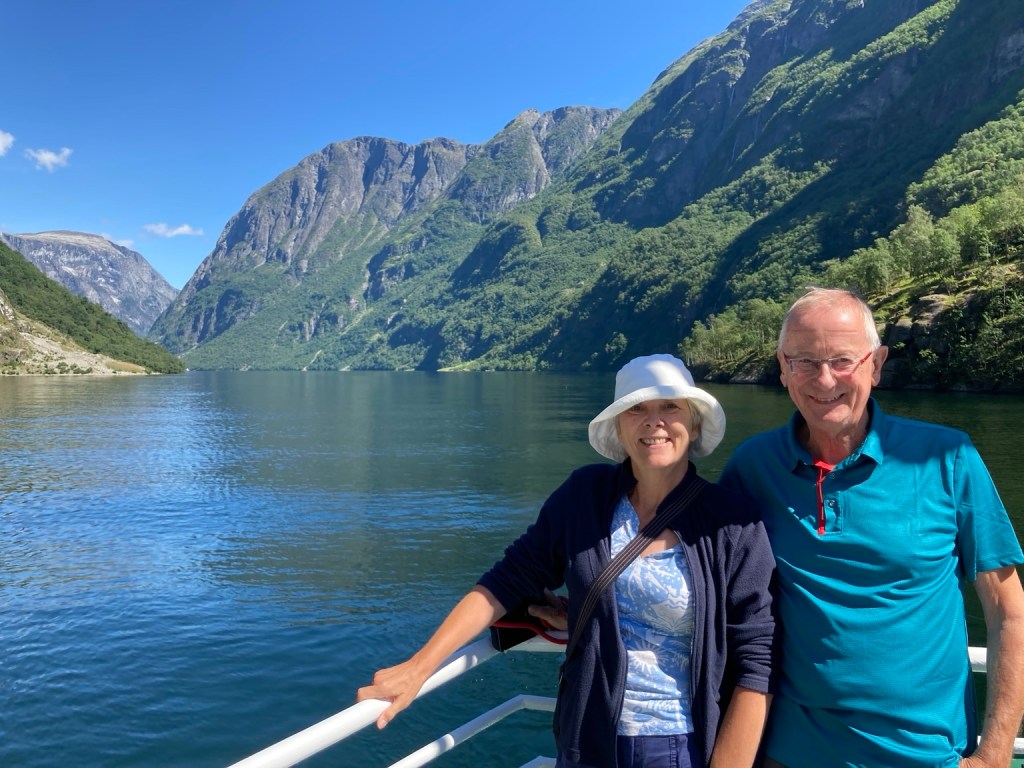
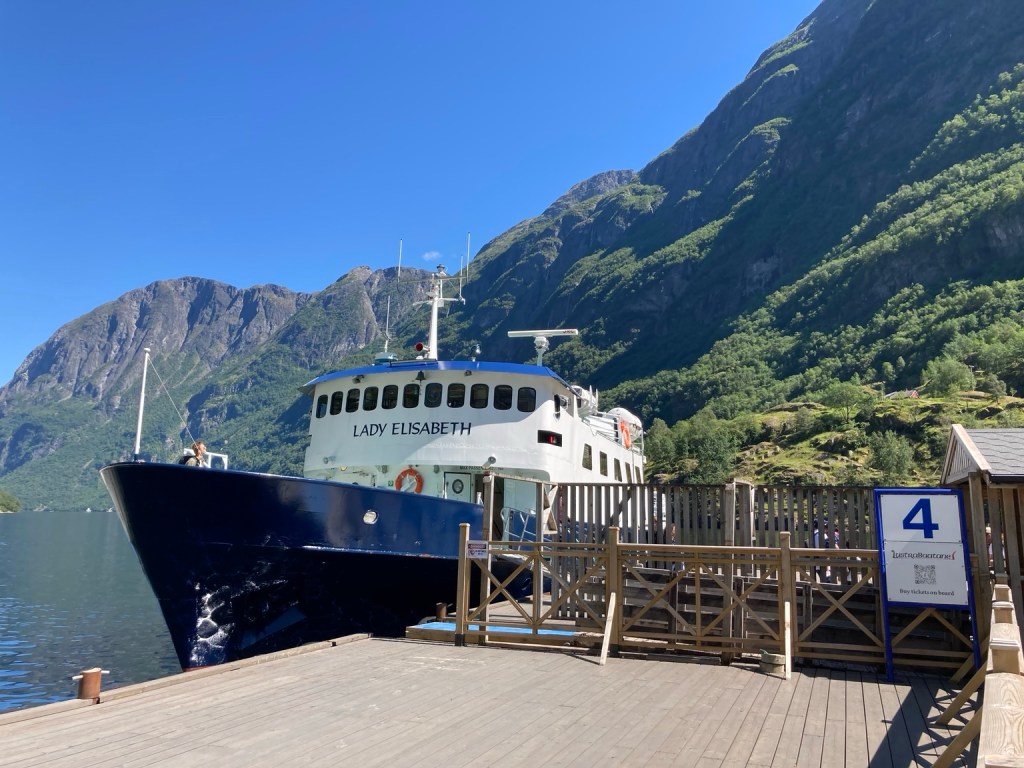
We continued to Flåm, situated on a branch of the vast Sognefjord, Norways longest and deepest fjord. Here we boarded the Lady Elizabeth …
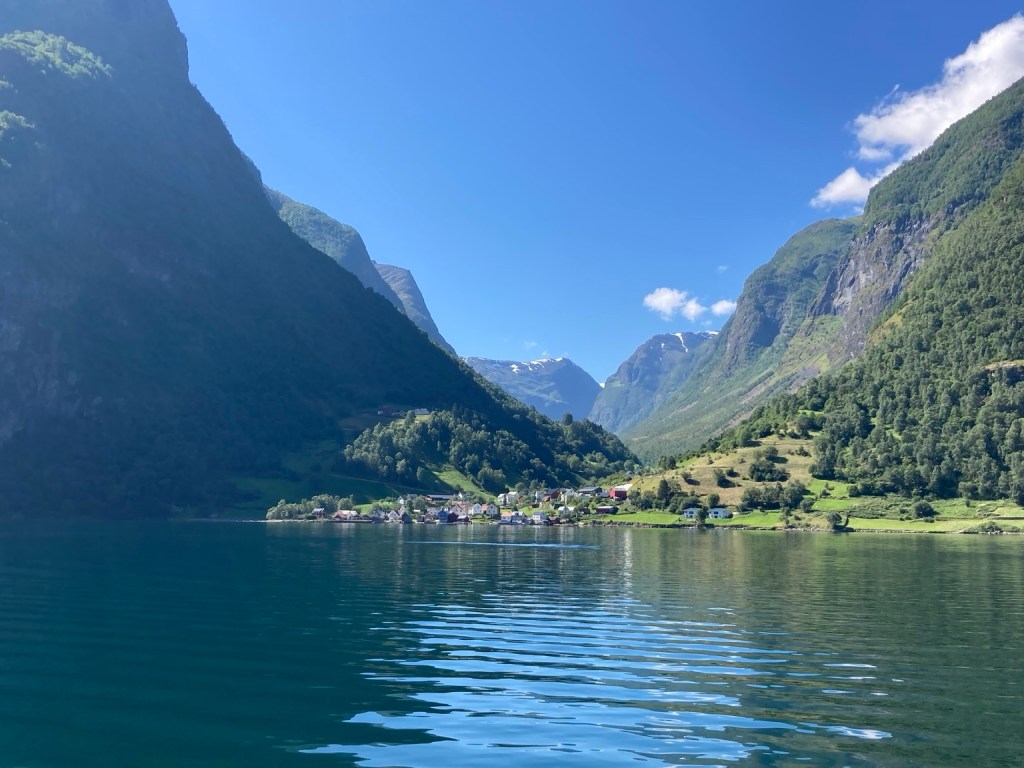
… for a 2hr cruise down the Aurlandsfjord and then into the Nӕrøyfjord to Gudvangen.
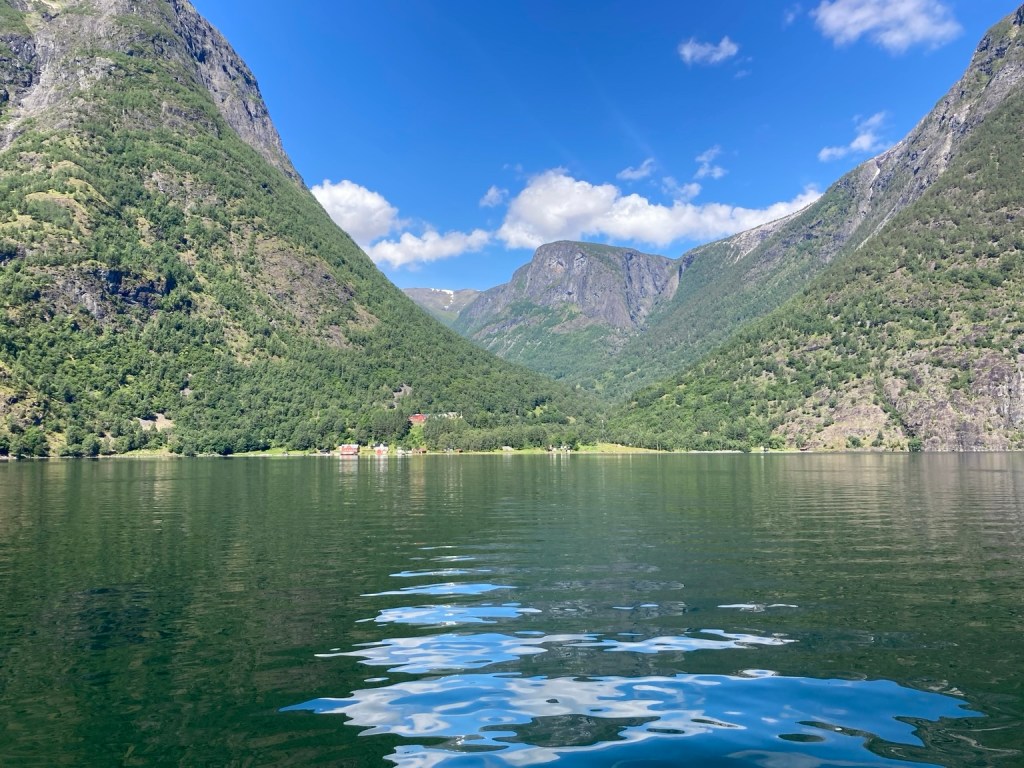
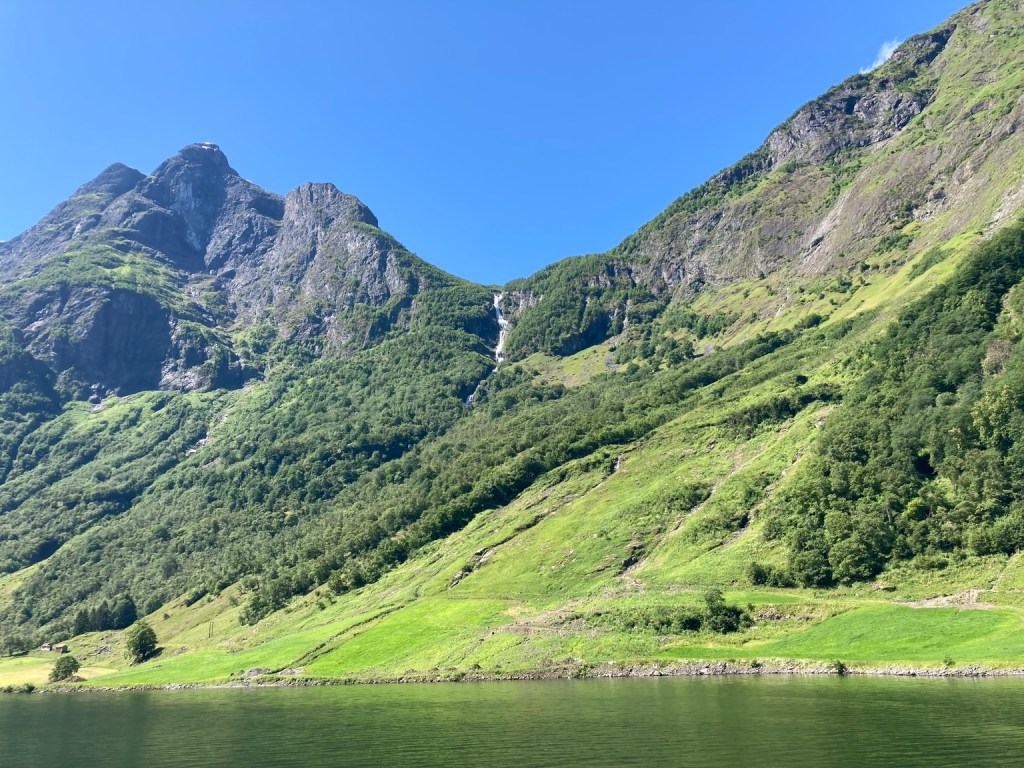
It was breathtaking … the snow capped mountains were high, the waterfalls gushing, the fjord clear and blue and the sun shining.
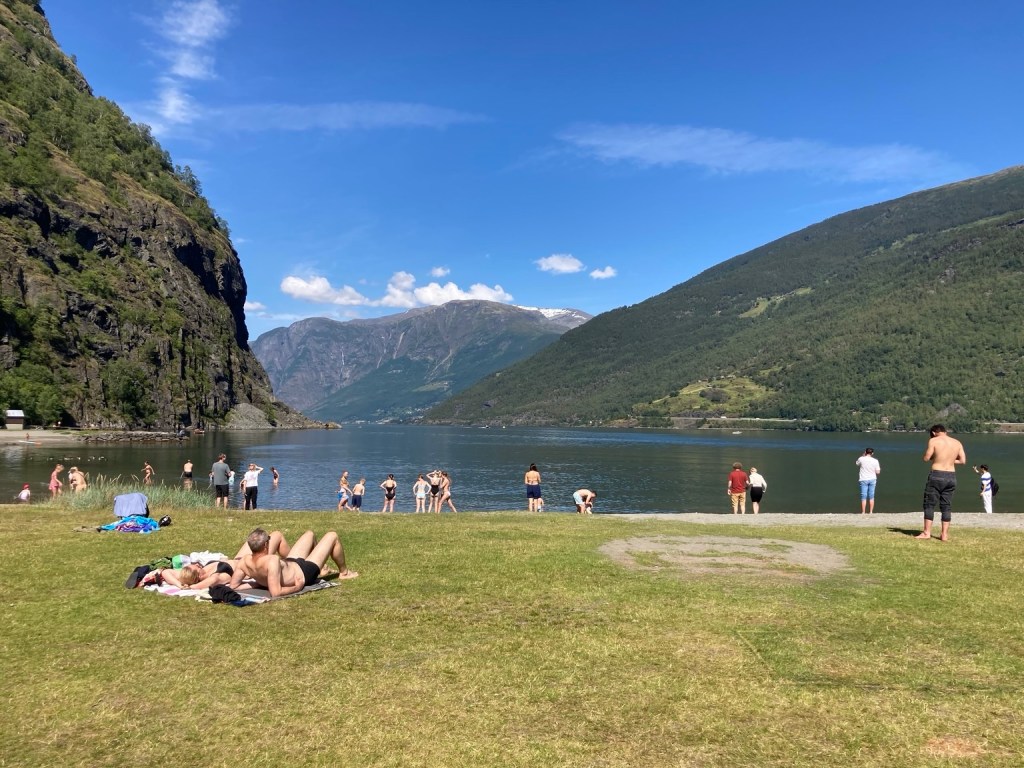
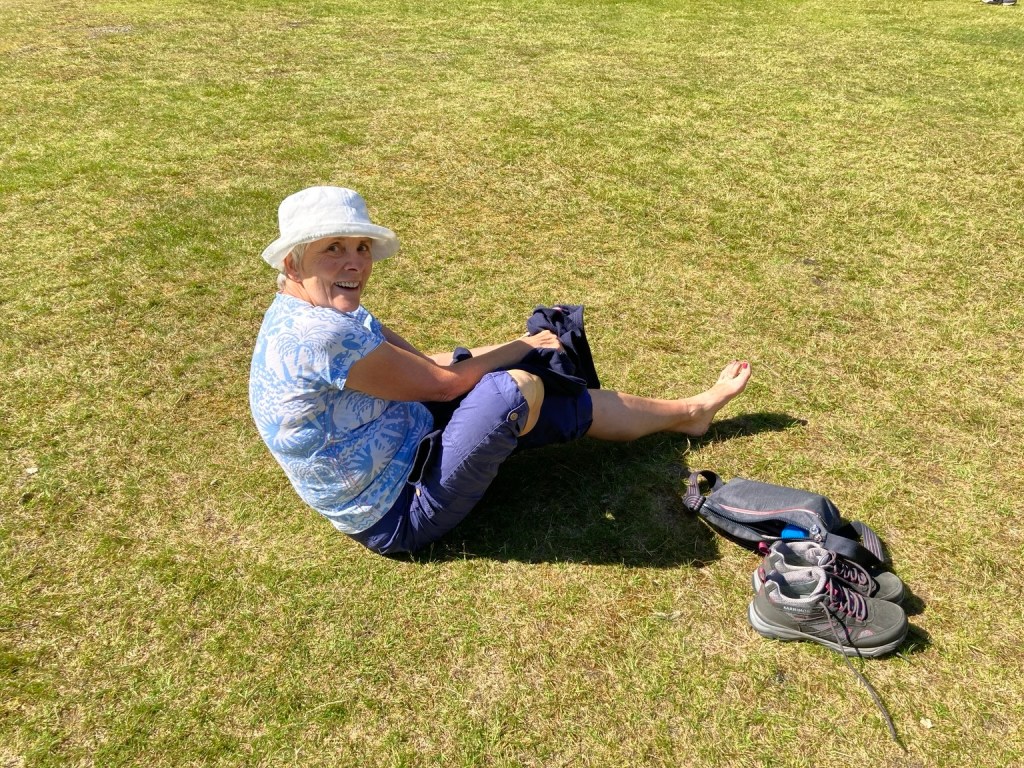
The coach returned us to Flåm, were we had free time to get some lunch. We also had time to paddle …
… and to look round the museum which told the story of the building of the Flåmsbana, a 20km stretch of railway linking Flåm with the Oslo-Bergen line. Built in the 1920s with 20 mainly hand-dug tunnels, it took 4 years to complete. It is also the steepest standard-gauge railway in Europe so fortunately the trains have several sets of brakes … just in case!
Once we boarded …
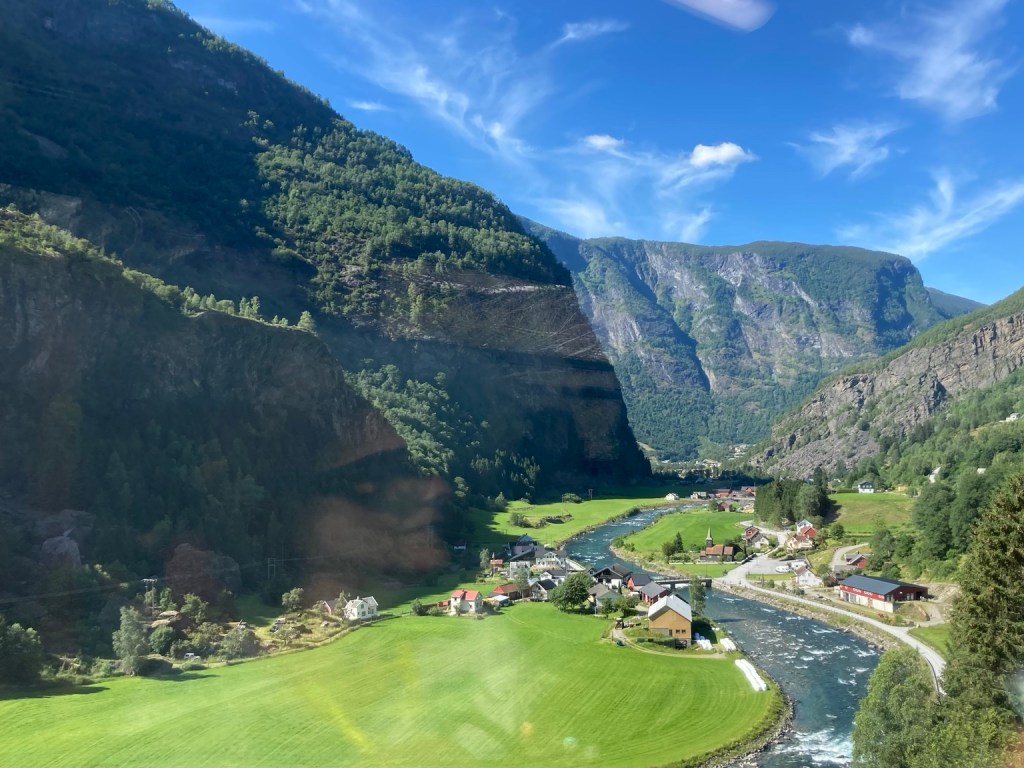
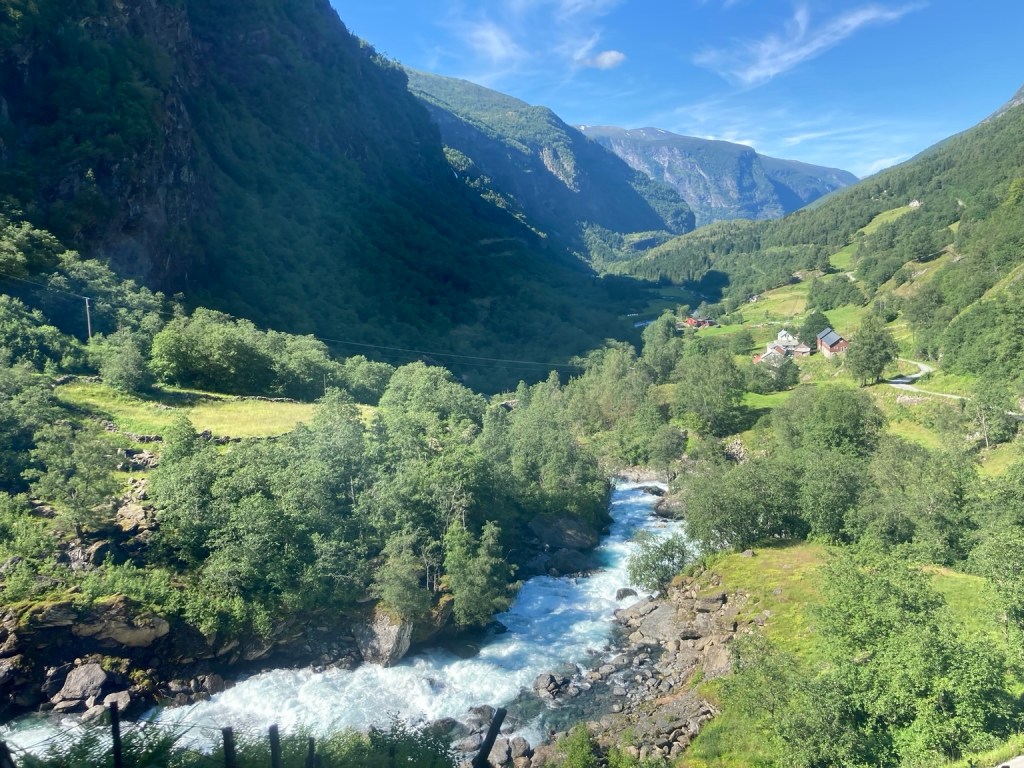
… photos were a little tricky but we were treated to more incredible Norwegian landscapes …
The highlight was the stunning Kjosfossen waterfall, which has its own station just to allow tourists to get off the train and take photos. We were also entertained by a woman in red, resembling the mythical Huldra, dancing to strains of mystical music!
Back on the coach, we had a final waterfall stop …
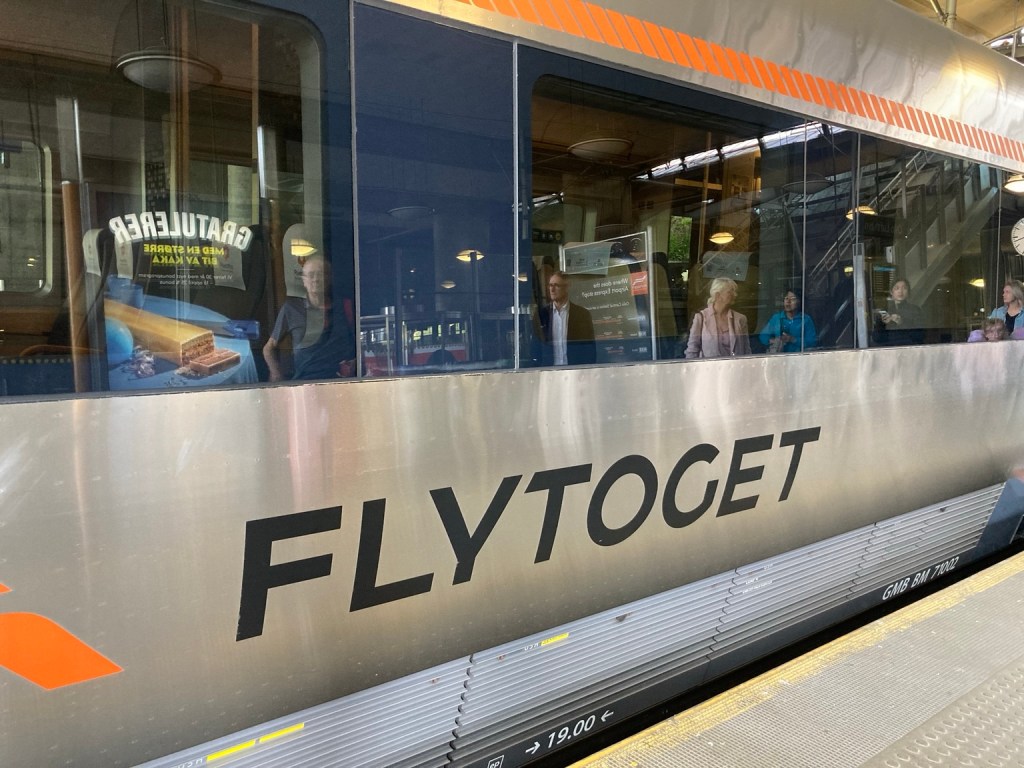
The Flytoget train whisked us into the city centre from the airport effortlessly …
… and we were soon checked in to our central hotel and off to explore.
We were enticed into a bakery by the array of sweet treats and chose twisted cinnamon buns called Kanelsnurrer which were delicious …
… before walking to the harbour. Knowing we would have a city tour next day, we went to the Norwegian National Museum for the afternoon. We started with the applied art and design floor and an extensive collection of furniture and interiors from medieval times to the present day. We then went up to the roof to get a view across the harbour to the Akerhaus fort, built in the C14th by King Hakon V …
… before wandering through the collection of Norwegian art.
Just a brief history lesson to put things into perspective. During the Viking Age, Norwegians expanded their influence through exploration, trade, and raids across Europe with Norway becoming a single kingdom in 900. Christianity slowly became the dominant religion, replacing Norse paganism, but a decline began when the bubonic plague wiped out half the population in 1397.
Subsequently, Norway became a dependency of Denmark, which lasted for 400 years during which the Reformation led to the establishment of Lutheranism. After the Napoleonic Wars, Norway was forced into a union with Sweden but it wasn’t until 1905 that this union was dissolved. Norway became a fully independent country with a referendum choosing Prince Carl of Denmark as their king, Haakon VII and the capital was returned to its Norse name Oslo.
It was at this point that a growing sense of nationhood inspired artists to depict the sublime Norwegian landscapes and gave us a taste of our trip to come! Here are a few, Stalheim by Johan Christian Dahl …
… the Grindelwald Glacier by his pupil Thomas Fearnley …
… this romantic view of The Bridal Voyage on the Hardanger Fjord by Hans Frederik Gude …
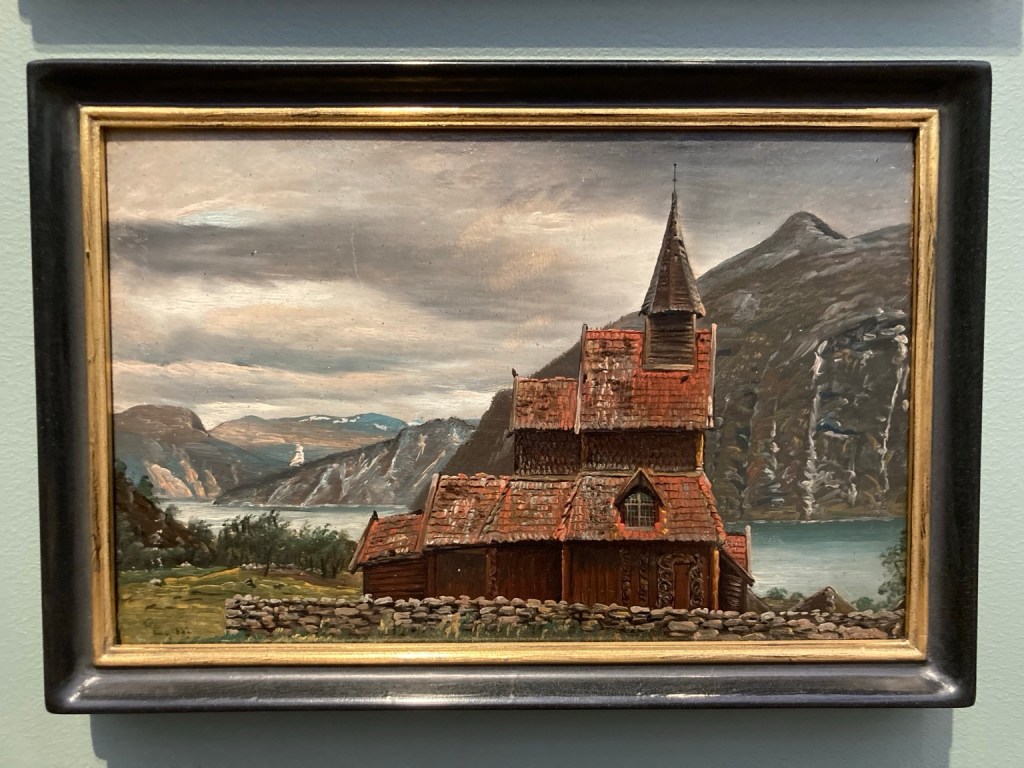
… and finally this view of a stave church, but more about them later.
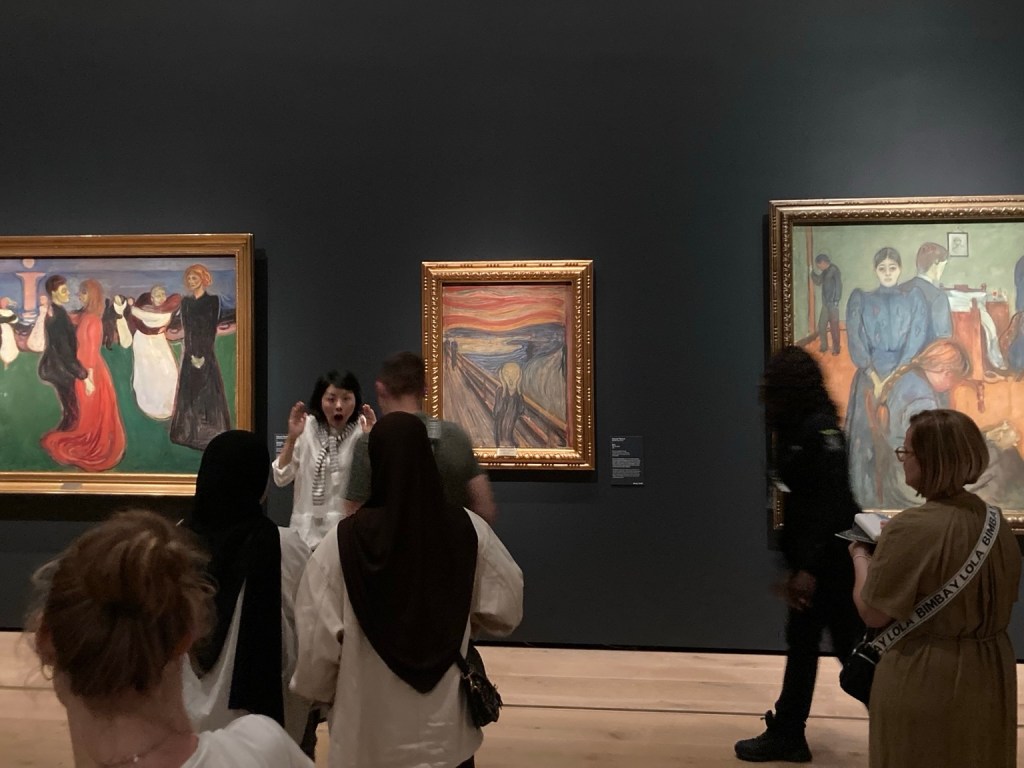
Of course the most famous painting in the gallery has to get a mention, The Scream by Edvard Munch, which had a constant stream of visitors taking selfies!
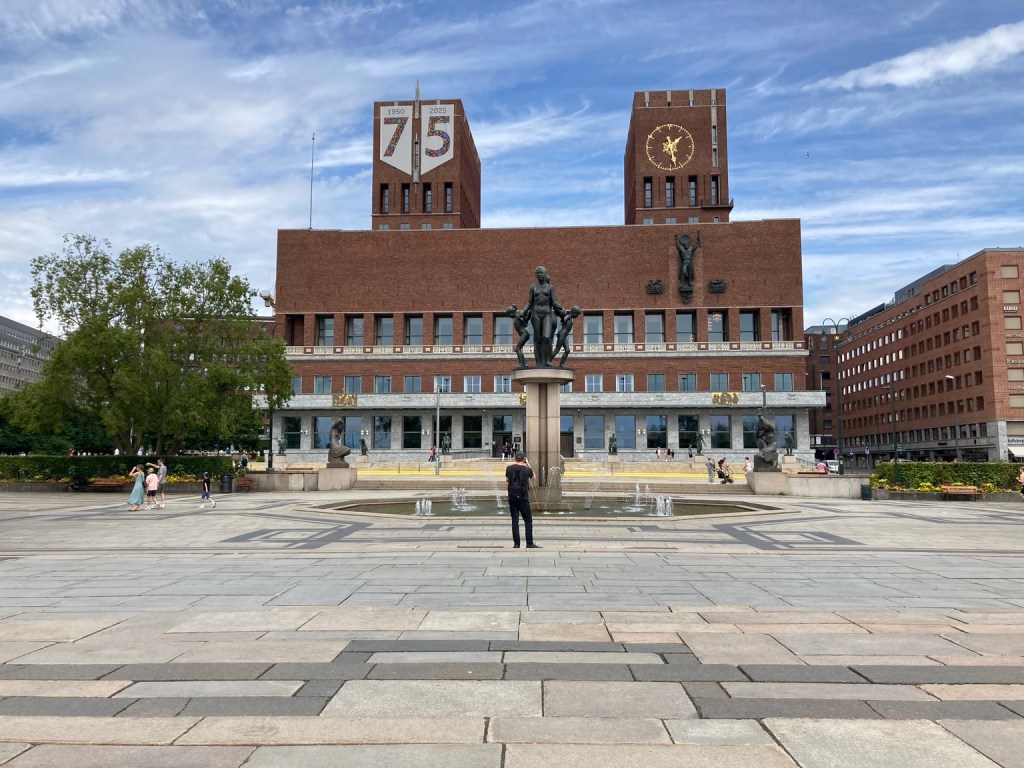
Our walk back took us past City Hall which we will visit tomorrow …
… The Nobel Peace Centre which celebrates Alfred Nobel and the Nobel Peace Prize which is awarded in each year in Oslo …
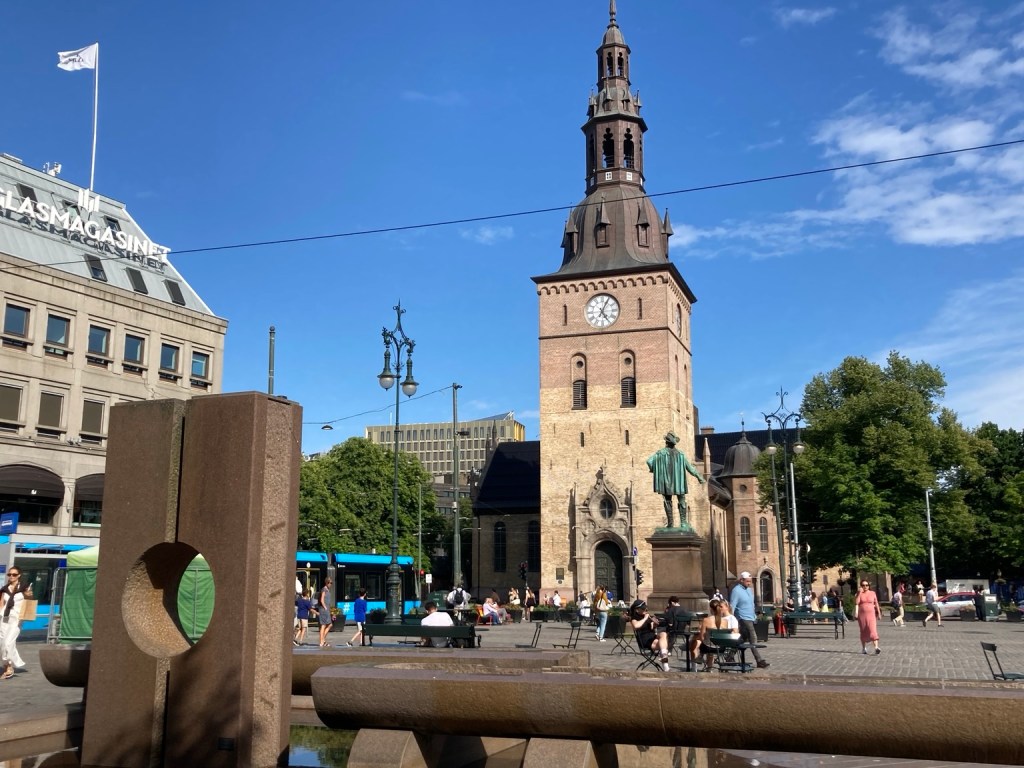
… and the Domkirke or cathedral.
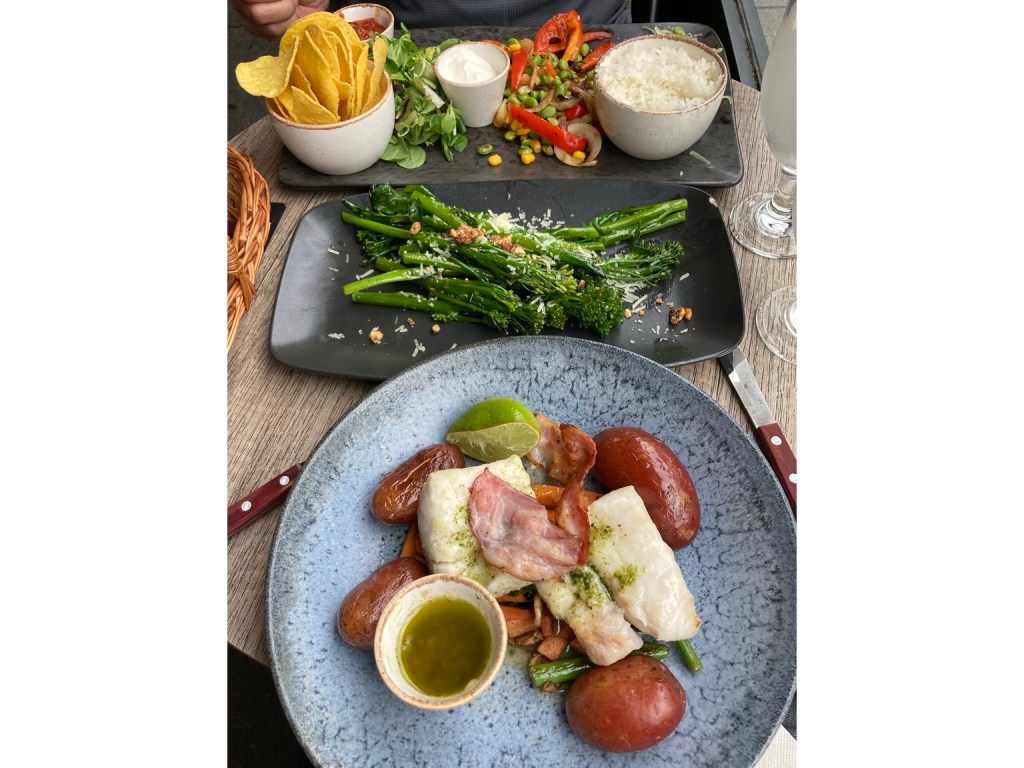
SInce the weather was so lovely, later we found a restaurant with seats outside that served both traditional and veggie dishes and I had Norwegian cod, served with the national staples of potatoes, carrots and mushrooms! Vegetarian choices all seem to be foreign and Chris chose the fajitas!
We returned to the hotel for a brief meet and greet with Paula our tour guide and a number of the group who had already arrived, then went for wander …
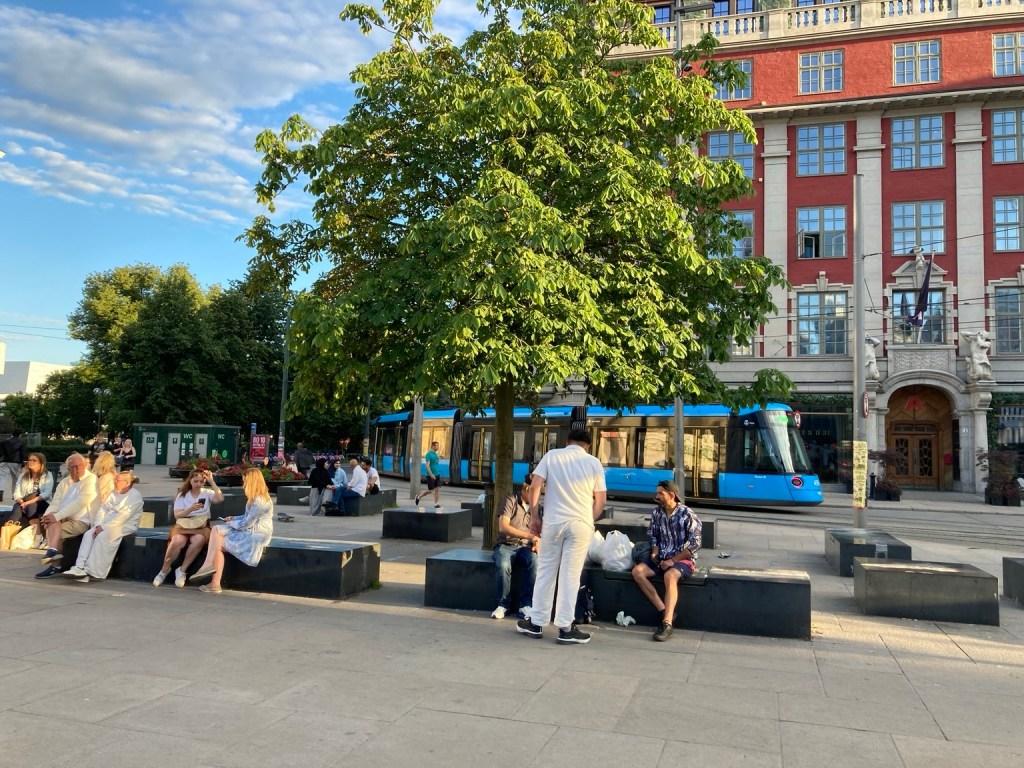
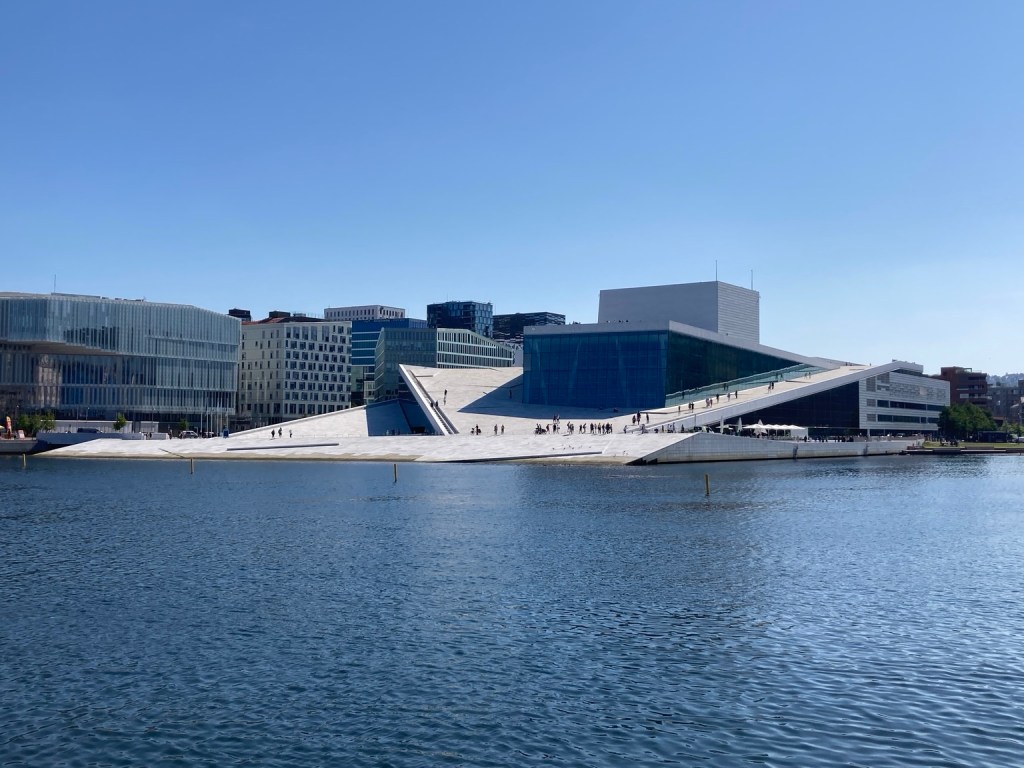
… which eventually took us to the Opera House where people were enjoying the warm evening sunshine.
Oslo isn’t far enough north to be in the land of the midnight sun, but sunset wasn’t till 22.30 and it doesn’t get darker than nautical twilight, so good job we packed eye masks so we got a good sleep!
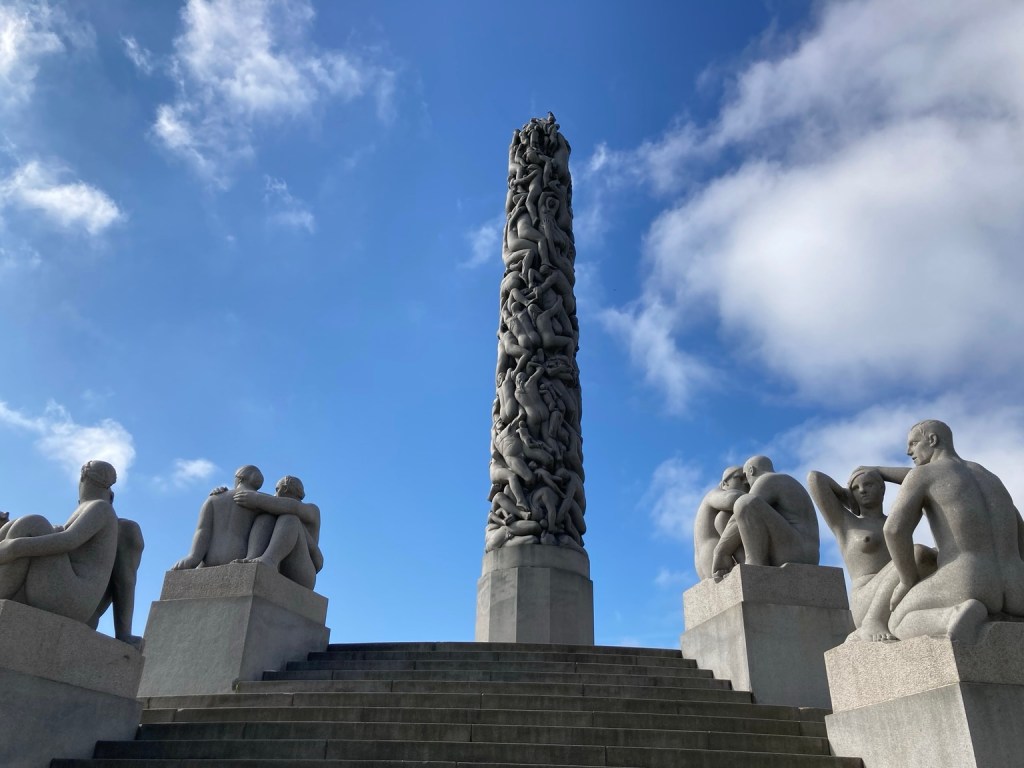
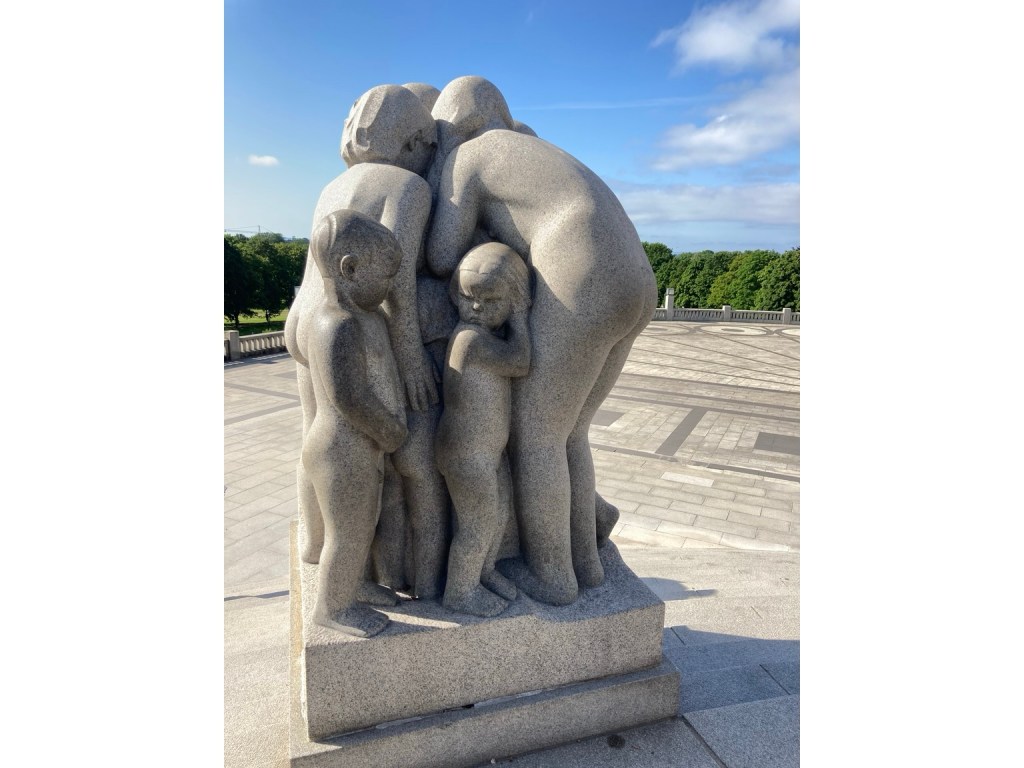
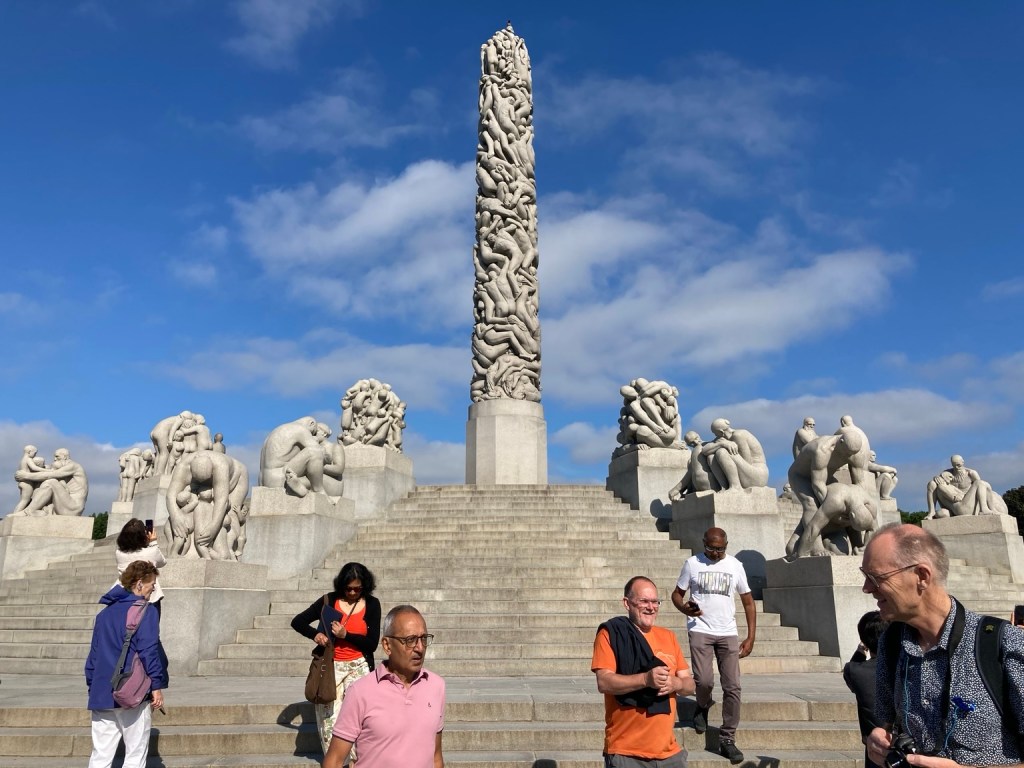
Next day we had a bit of a drive round the city in the coach, then a tour on foot beginning with the Vigelandsparken, a sculpture garden which was the life’s work of one man, beginning in 1924. Gustav Vigeland started as a woodcarver, but was influenced by Rodin in Paris and switched to stone and bronze.
The sculptures all portray the cycle of life, with the 20m Obelisk surrounded by groups of figures …
… with all ages represented.
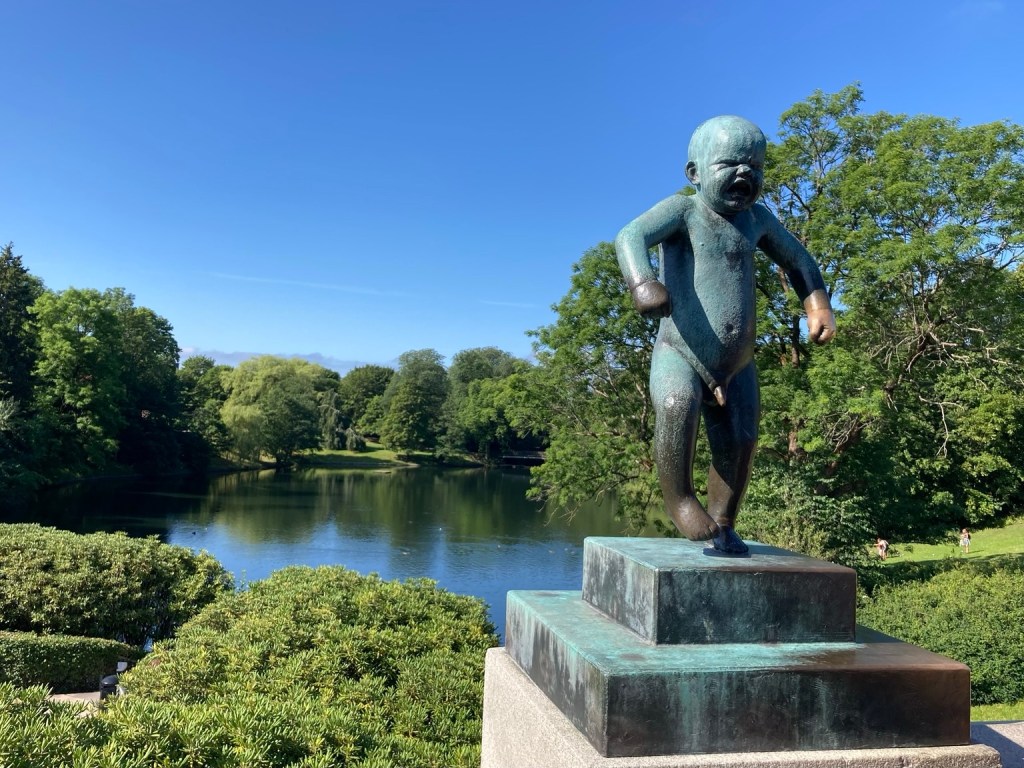
The fountain and bridge are adorned with bronzes …
… including this cheeky chap …
… and a joker …
… and the park ends with an impressive gate.
During a quick photo stop for the Opera House …
… we also noticed these floating saunas, where you can cool off afterwards by swimming in the Oslofjord.
The Radhus or City Hall was next. Opened in 1950, this modernist building was meant to be a mark of civic pride, but locals were slow to love what they saw as pretty ugly. Now 75 years on, it has become one of the city’s most popular buildings.
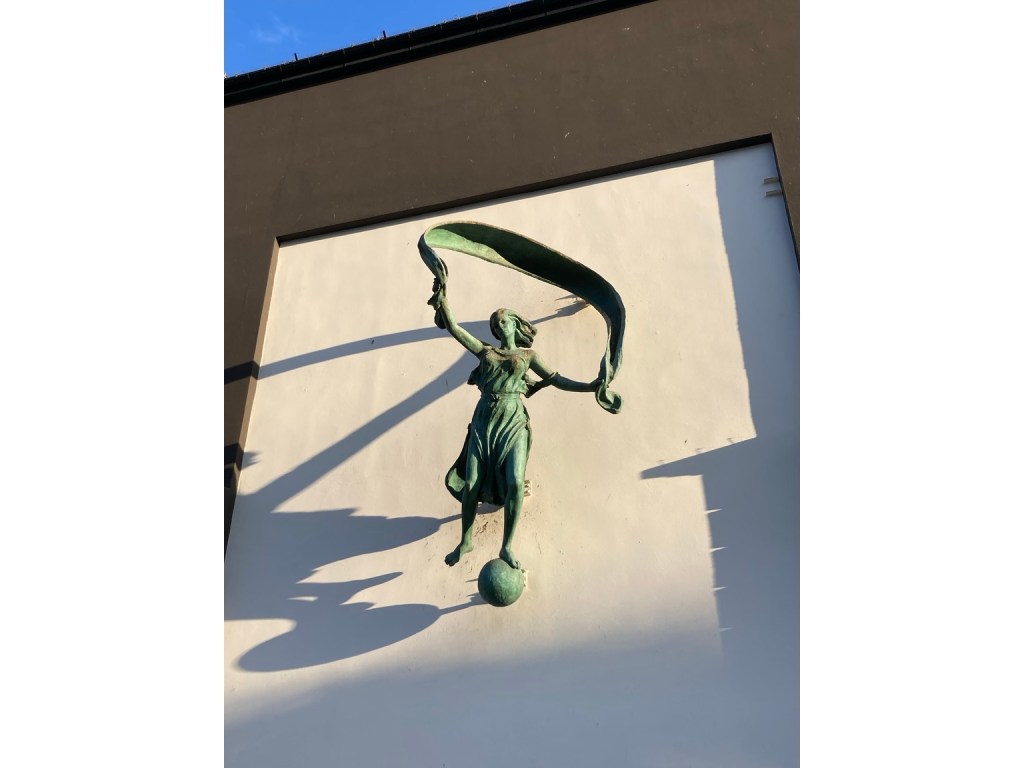
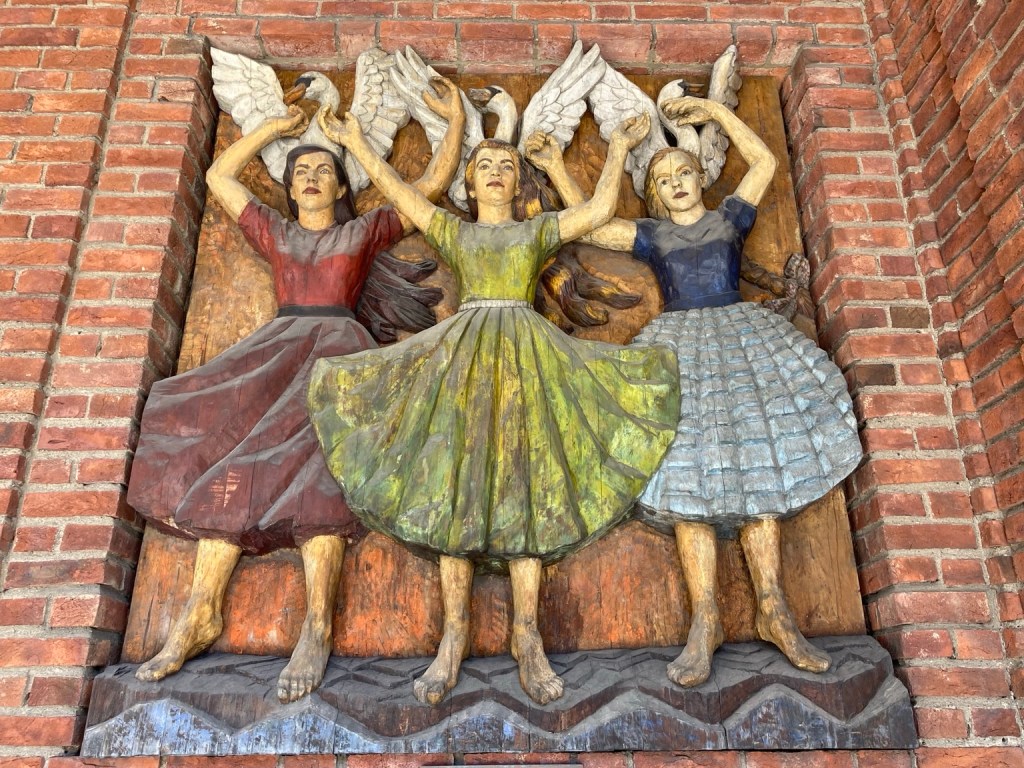
The entrance is decorated with wooden carvings from Norse myths including this one of Swan Maidens.
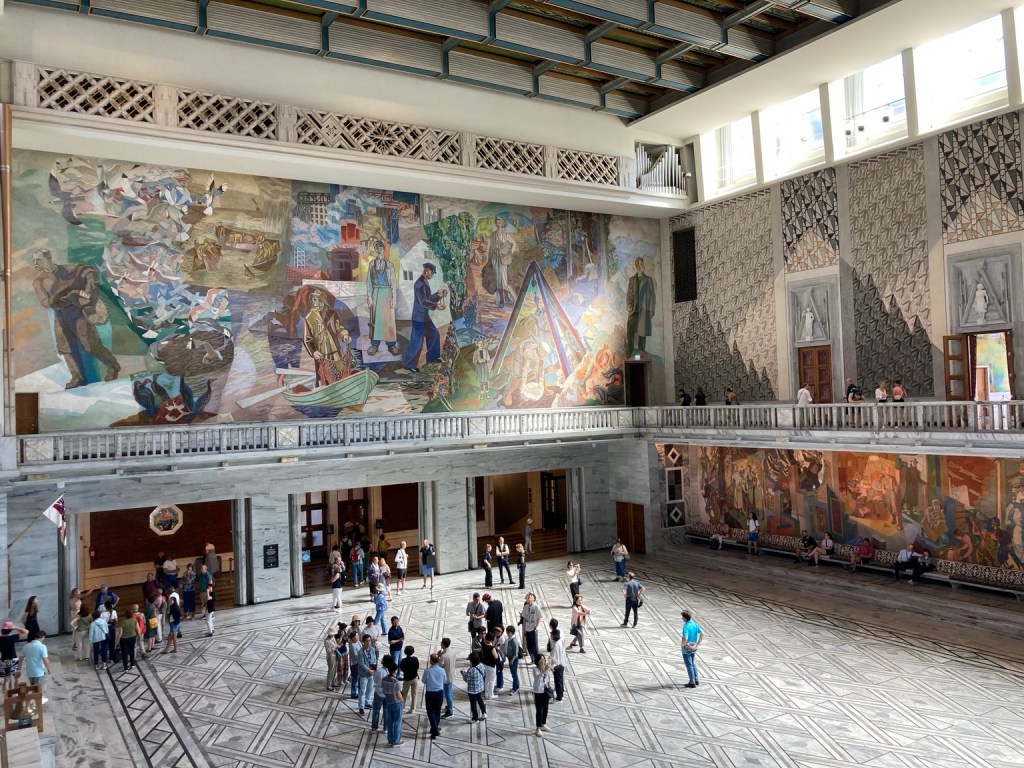
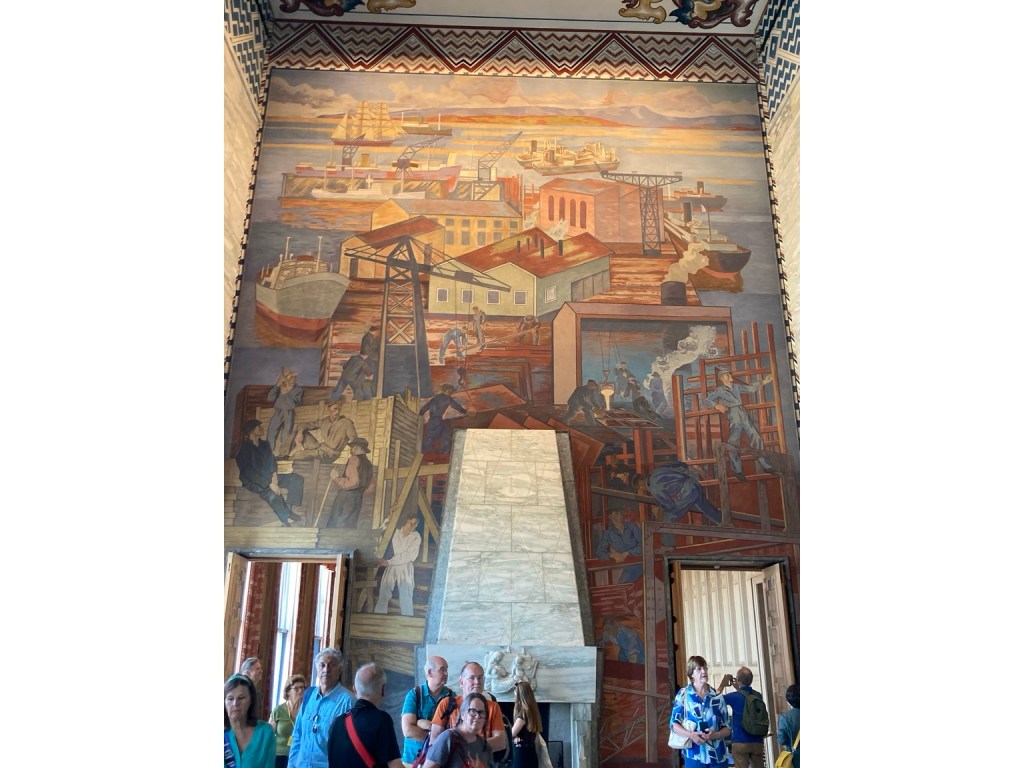
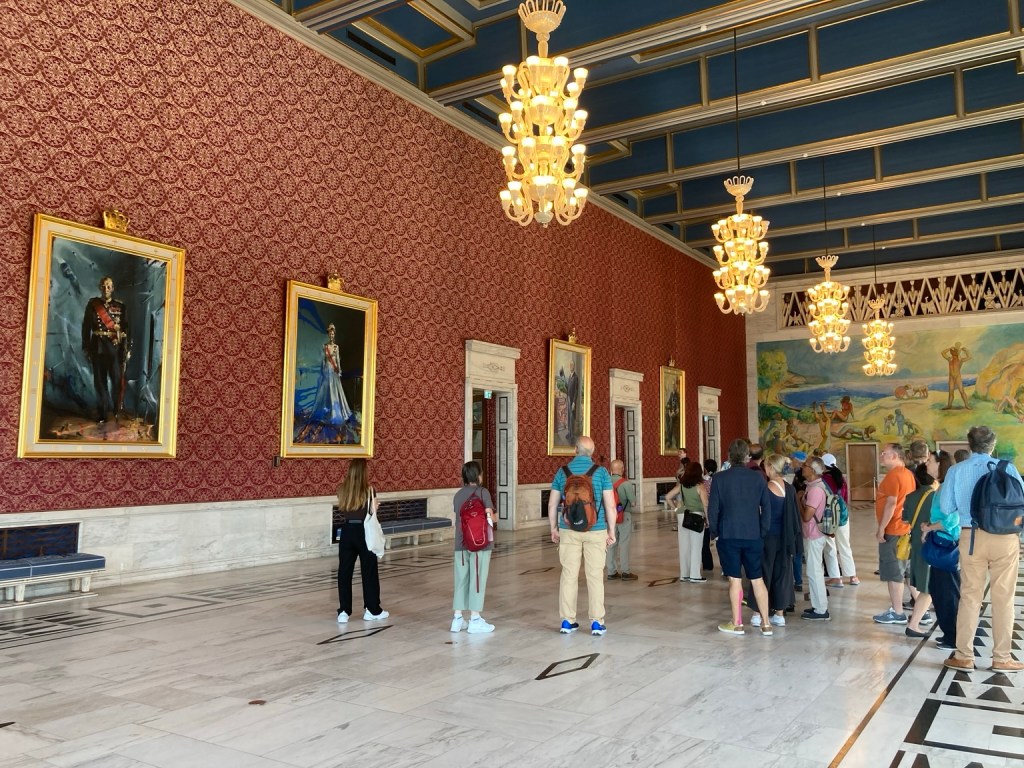
Inside, the main hall is huge and painted on all sides with stylised and secular murals.
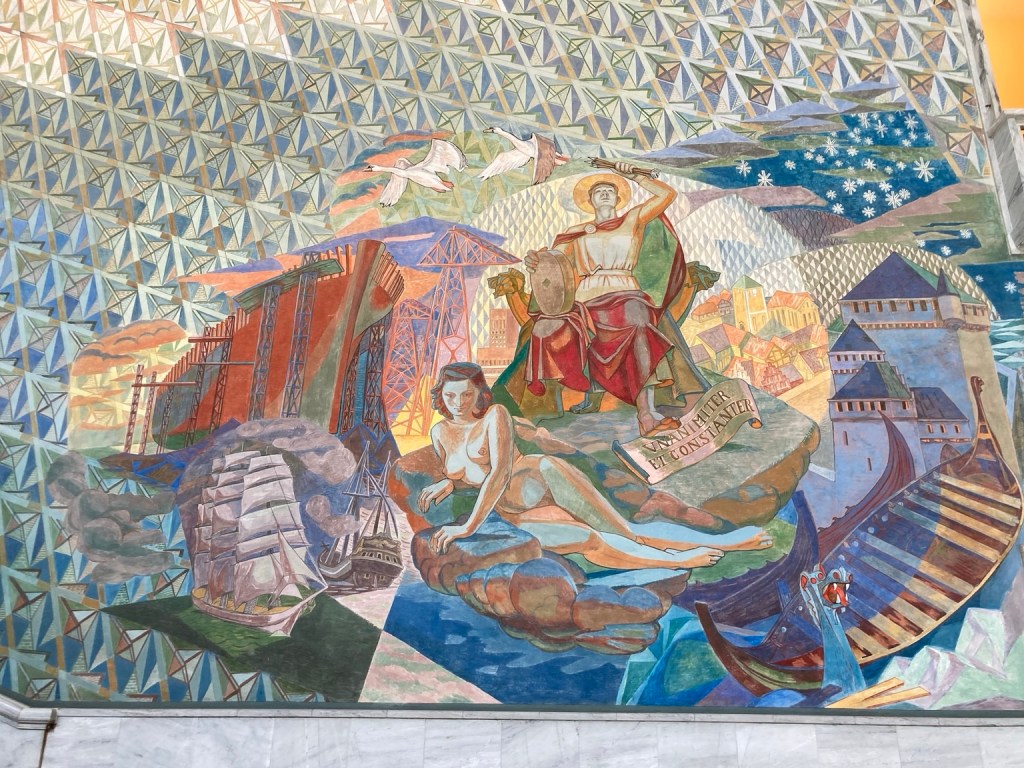
This is From the Fishing Nets in the West to the Forests of the East with a polar explorer on the left and a dramatist on the right symbolising the spirit of adventure and intellectual development of the nation.
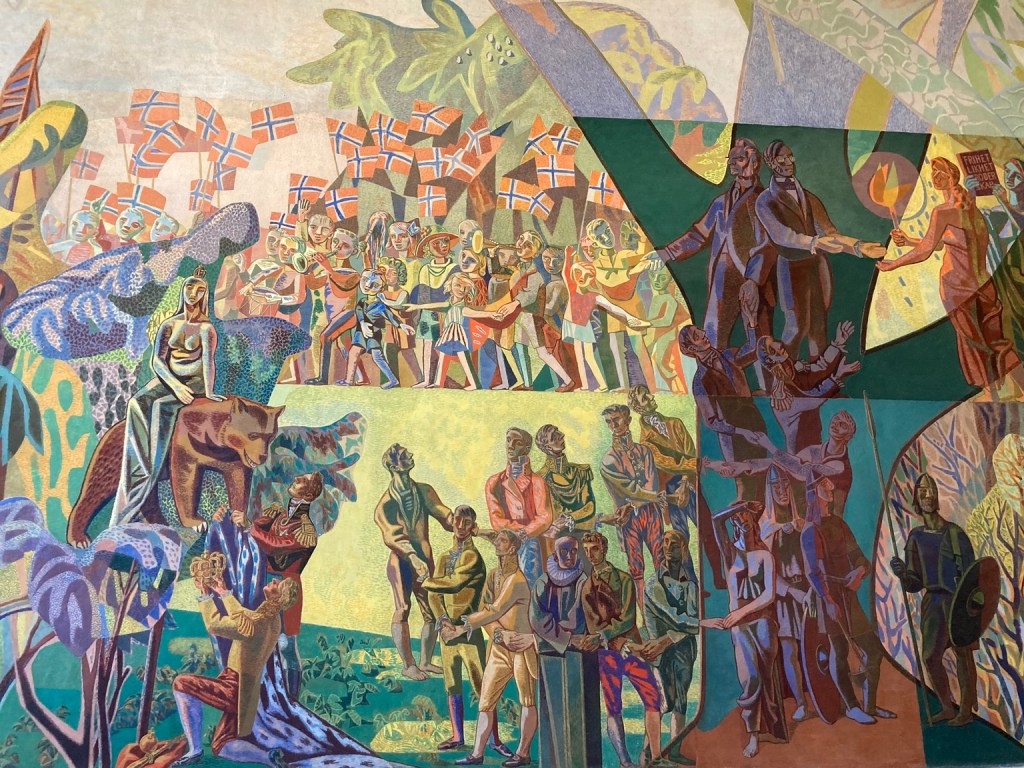
On the opposite wall is Work, Administration and Celebration which illustrates social reforms, education, social struggles, the war years and Norwegian Royal history featuring many prominent Norwegians, but also regular people carrying out their everyday life.
Saint Hallvard, the patron saint of Oslo appears several times …
… and upstairs there are more patriotic images of town and country …
… and even the beach!
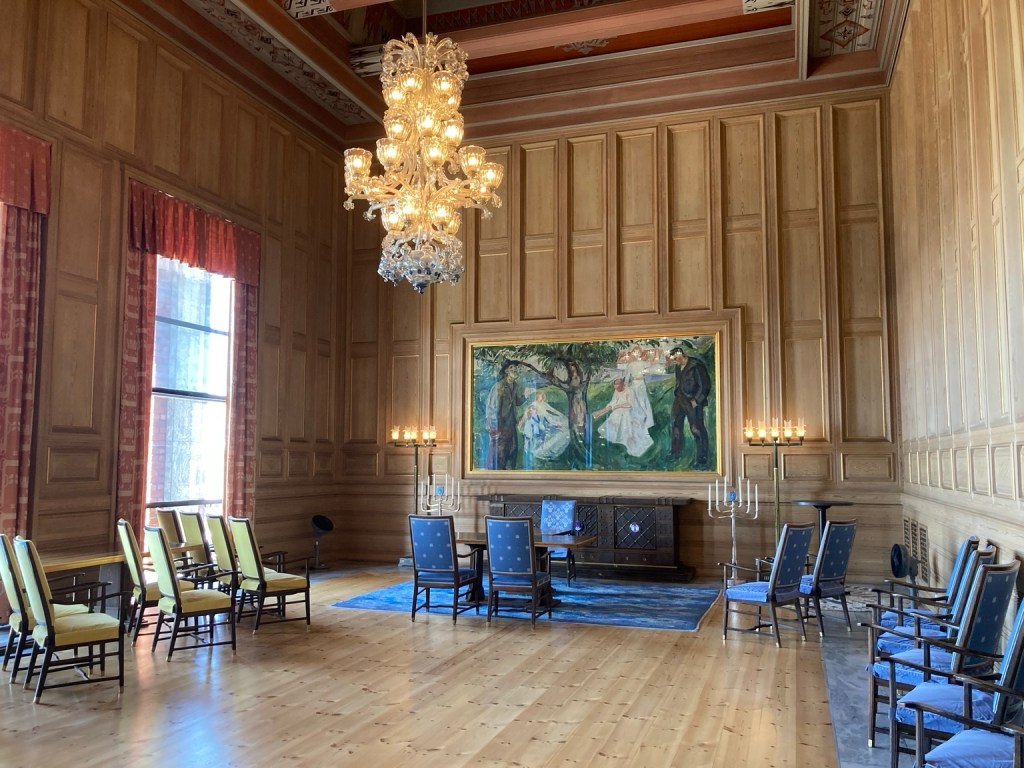
The Munch Room with his painting ‘Life’ adorning the back wall is used for weddings …
… but no snacking here today!
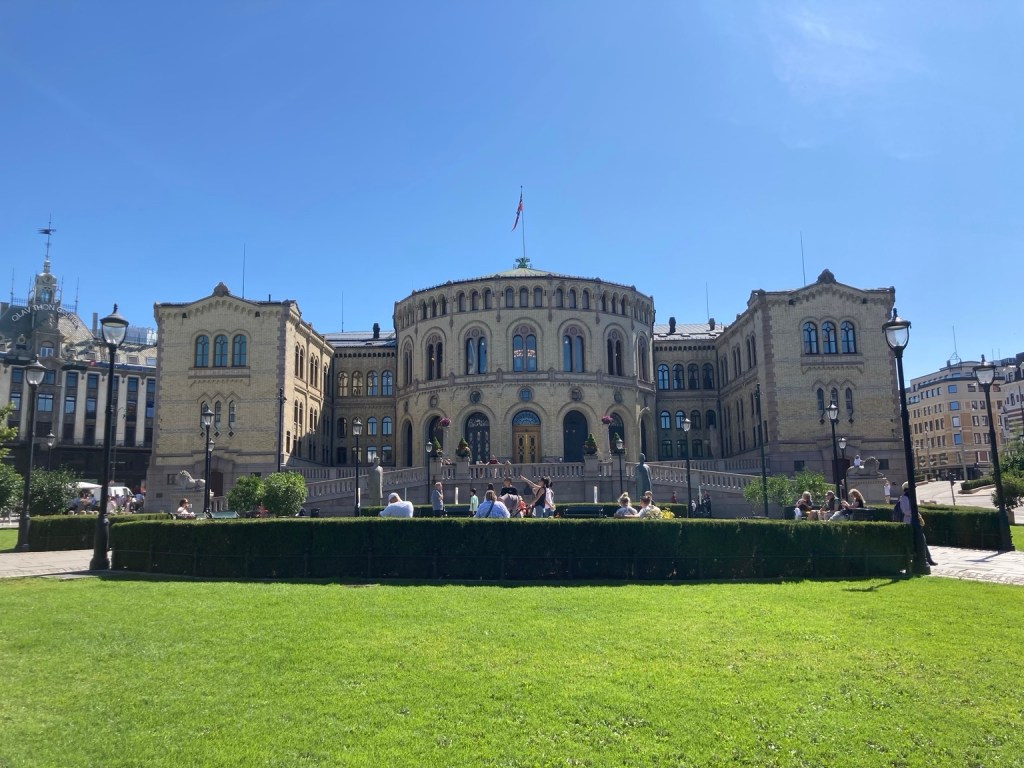
With a couple of hours free to wander, we snapped the Stortinget or parliament building. Since Viking times, local social justice was resolved at a ‘thing’, a sacred place where all freemen from the surrounding areas would assemble, so unsurprisingly their parliament translates as the ‘big thing’!
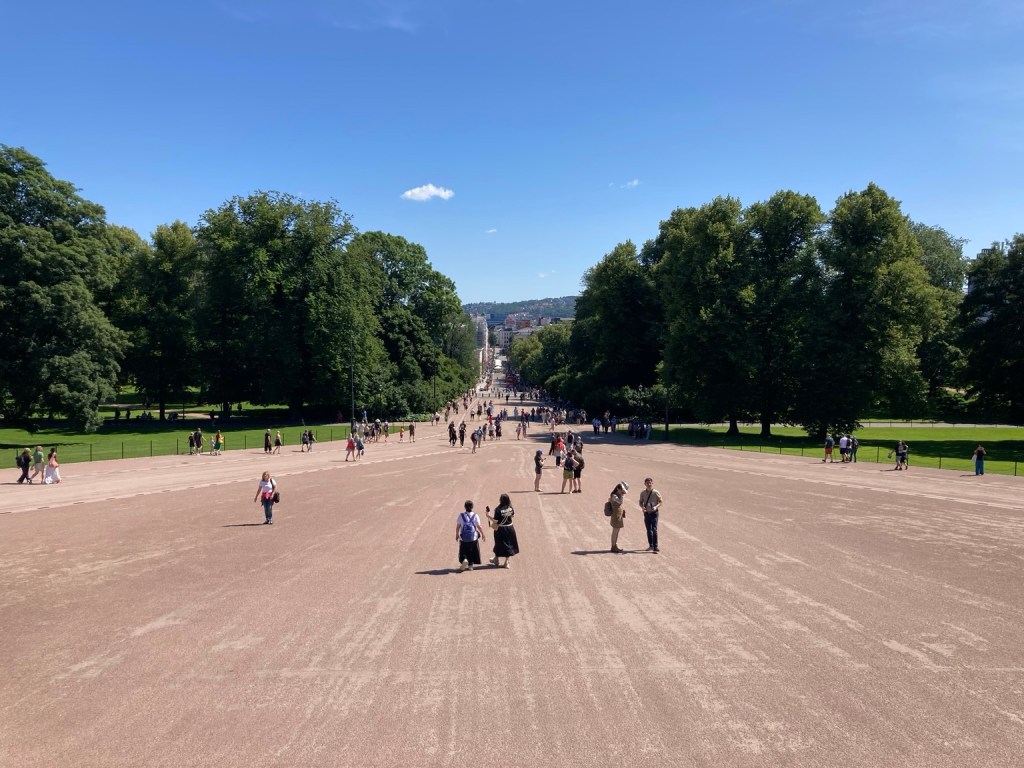
The Royal Palace is set in a park completely open the the public …
… and we were in time to see the changing of the guard, unfortunately rather uninspiring, especially with the digger centre stage!
Our brief time in Oslo at an end, we headed for the coach and a drive westwards …
Continuing the avian metaphor, I realise this is a wild goose chase, but just couldn’t resist the title!
Seriously, this is our first taste of Scandinavia, a whistle stop tour with Exoticca of almost 1000 miles in a week, taking in Oslo, Bergen and Stavanger as well as fiords, the Flam Railway and the Telemark Canal.
We are hoping for blue sky and blue water but if we spot a parrot, we’ll be delighted!
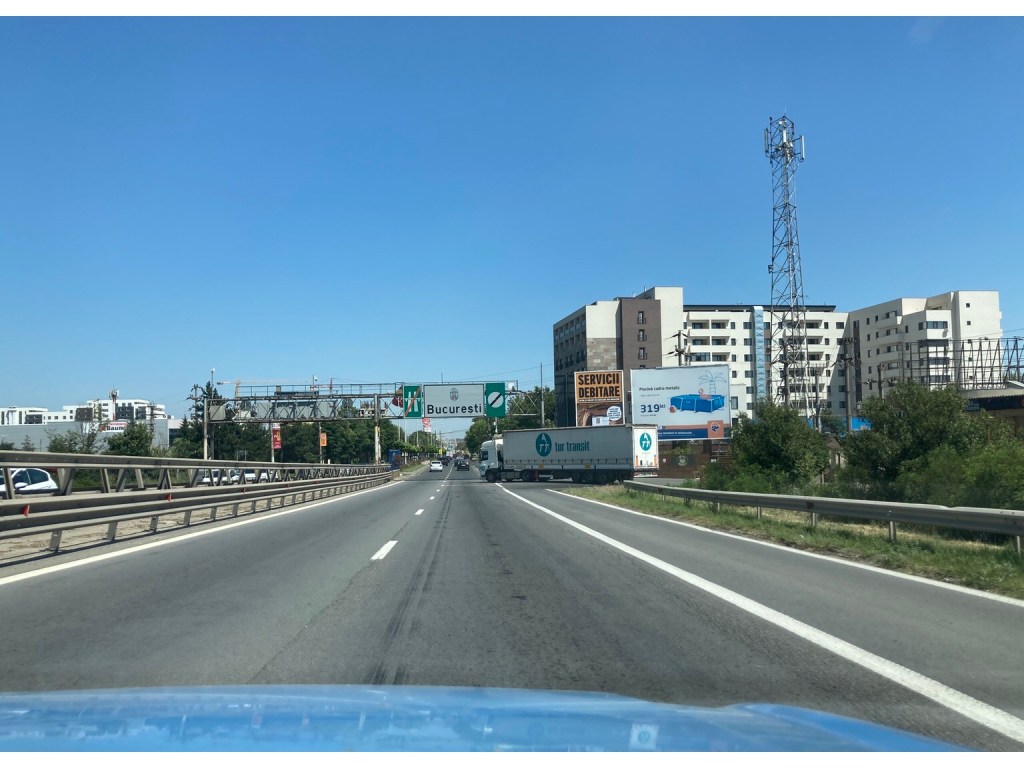
The 150km drive on the motorway to Bucharest was easy, but the AC was running as it reached 37.5° outside!
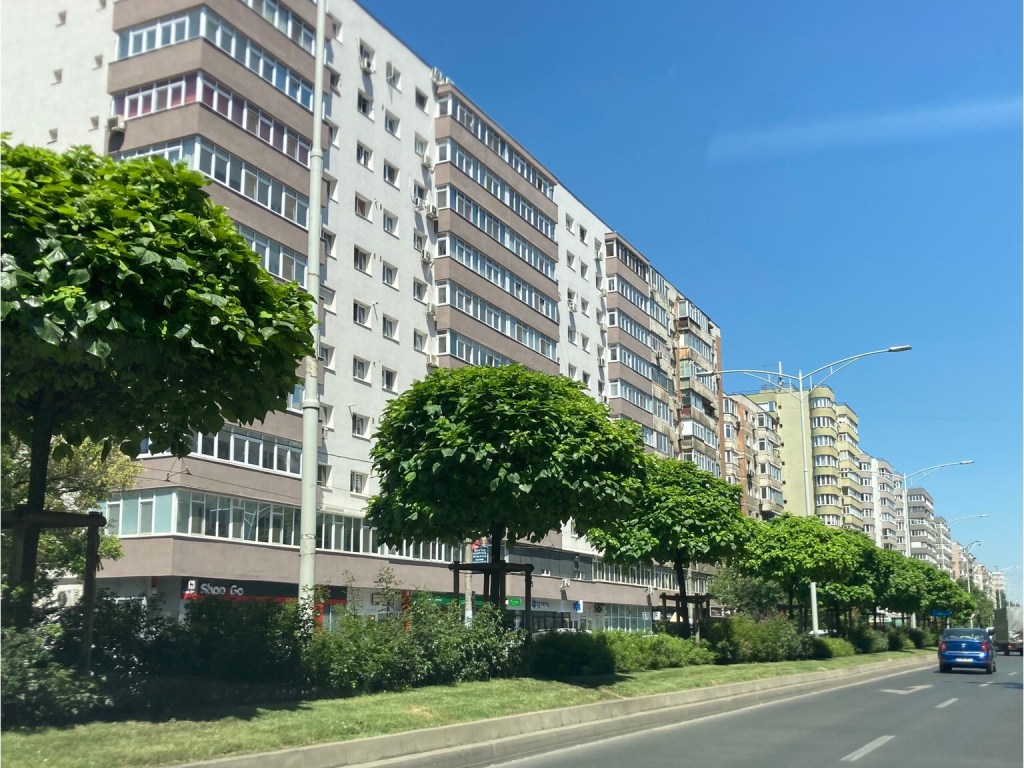
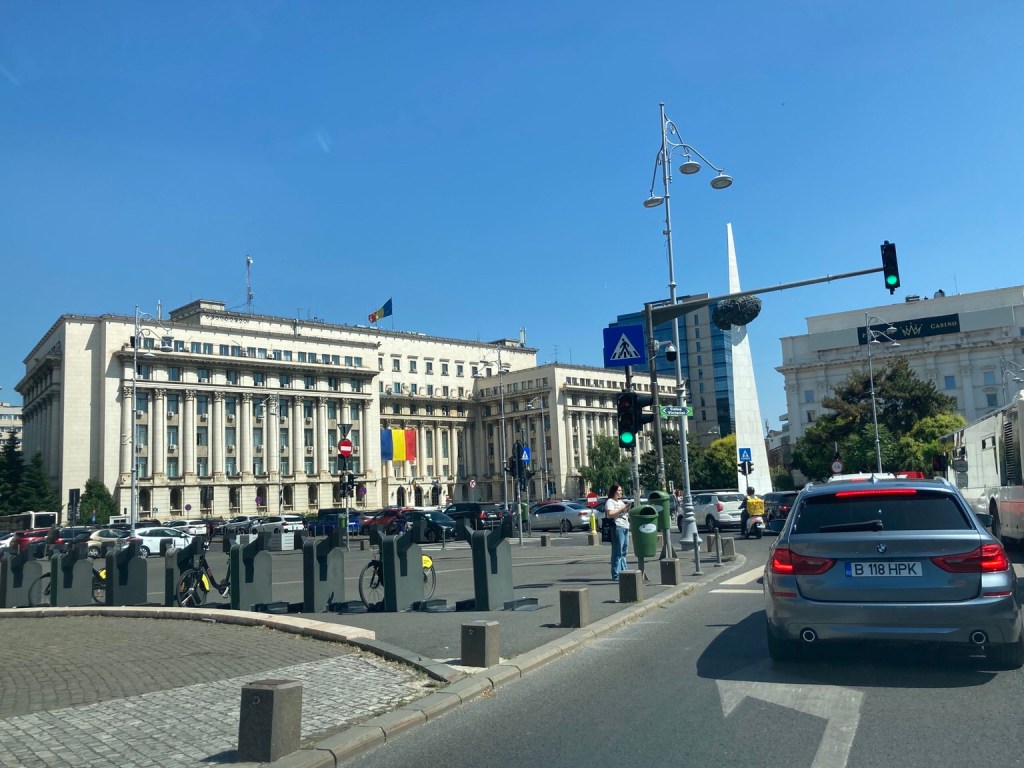
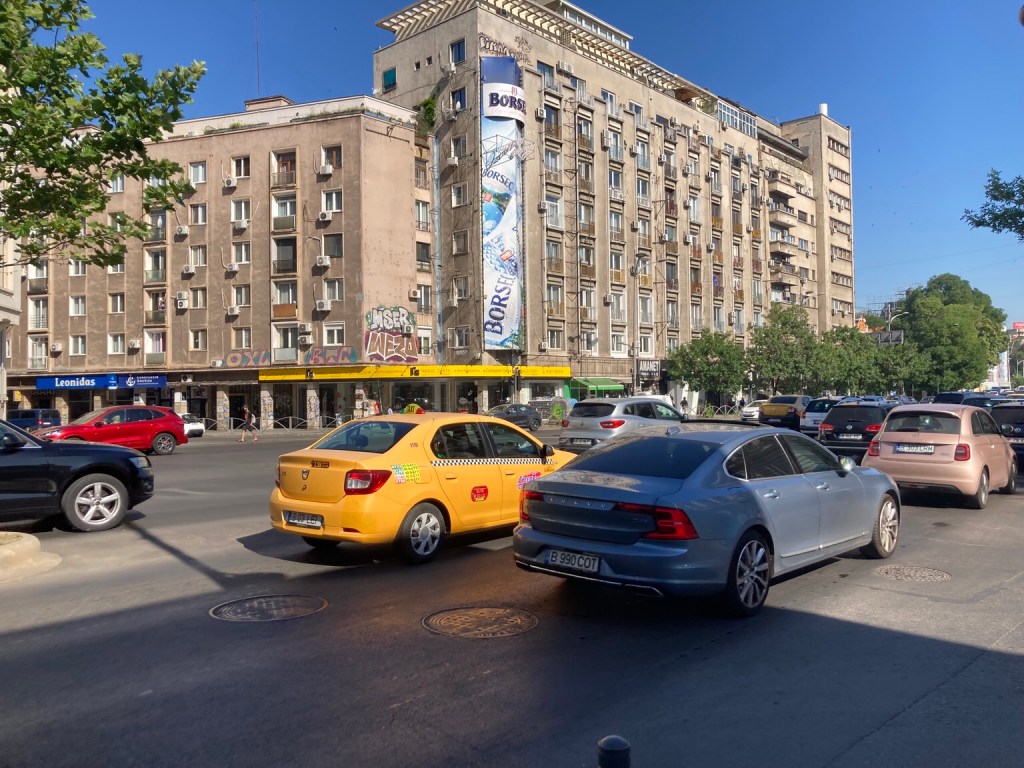
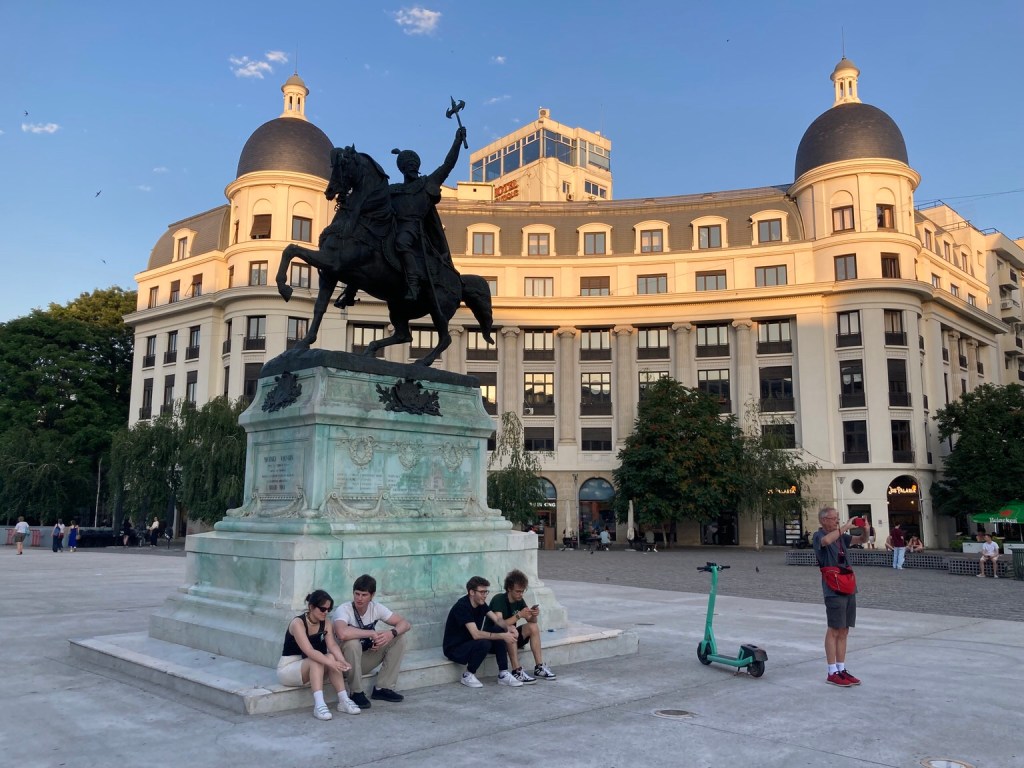
Surprisingly driving through the centre of the city wasn’t as bad as we thought and I took a couple of snaps.
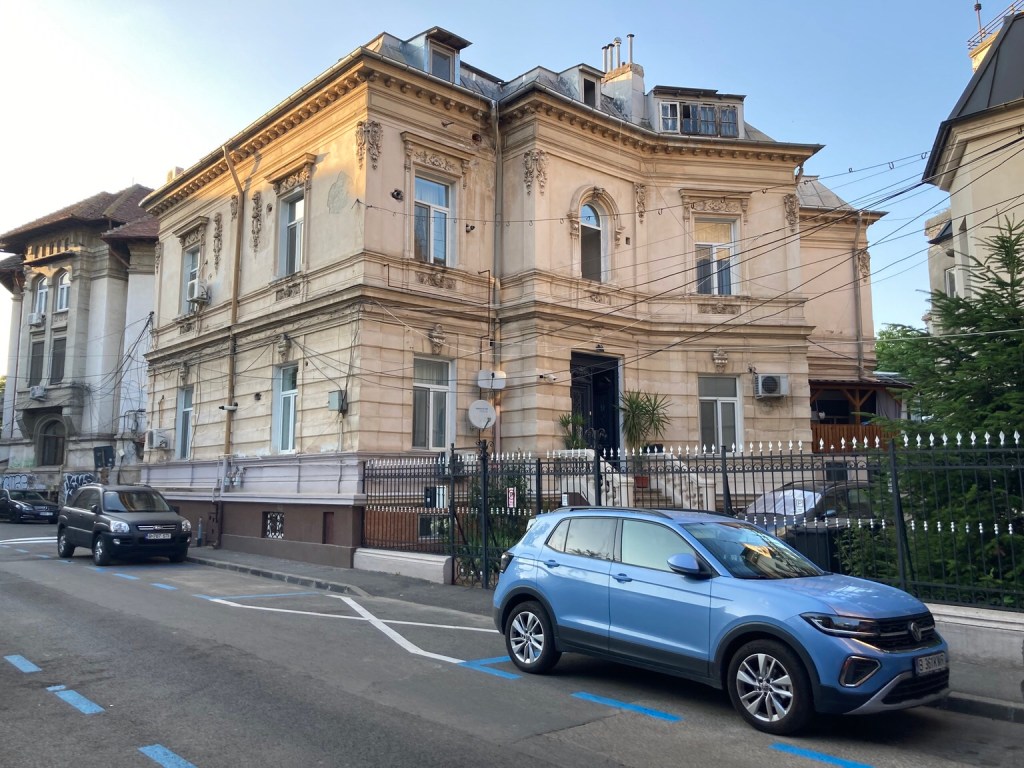
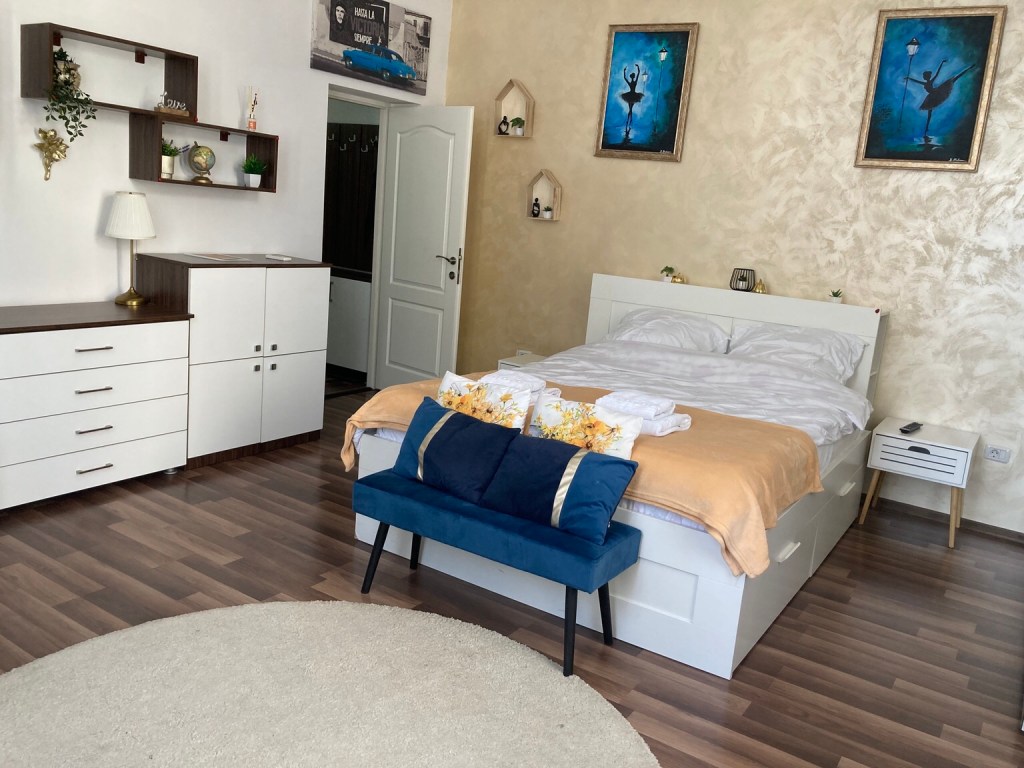
We even managed to find a parking space right outside our apartment for free. The apartments here really have it sorted, with self-check in using a passcode and key box, complete with photos to recognise the outside and step by step instructions.
All have been light and airy and this one even had AC which was certainly welcome, as was the bottle of white wine in the fridge!
Later we ventured out for dinner, taking a recommendation from the apartment for a trattoria just a few minutes walk away and a salad fitted the bill perfectly.
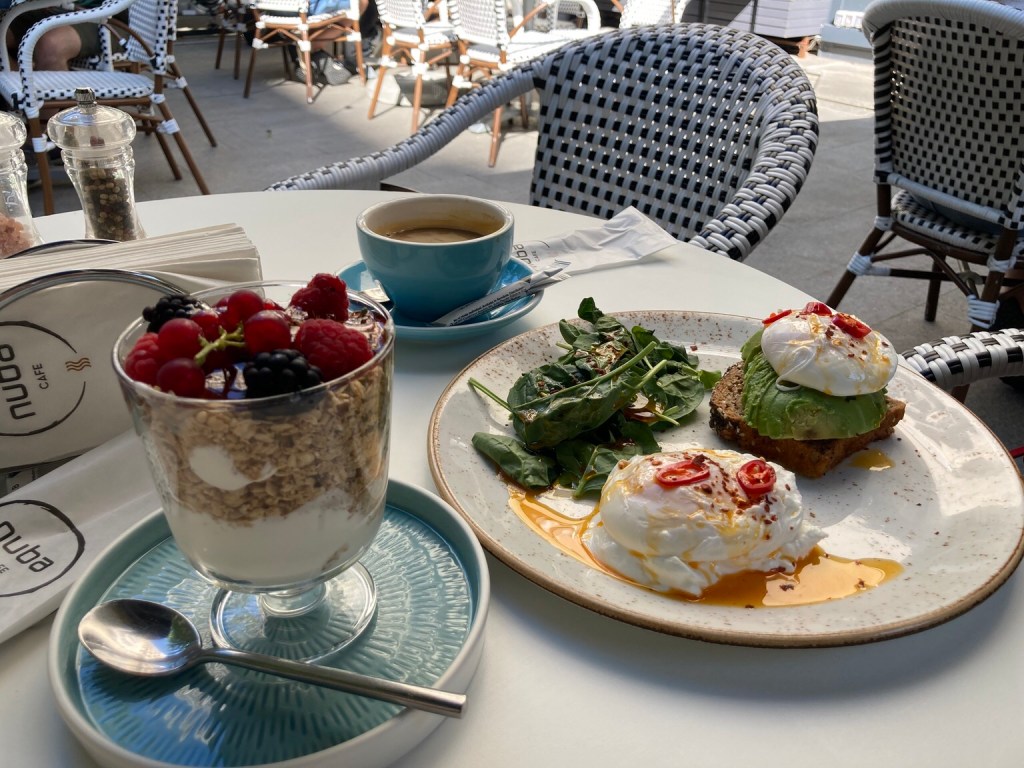
We spotted a breakfast cafe just next door, so we were back in the morning to start the day.
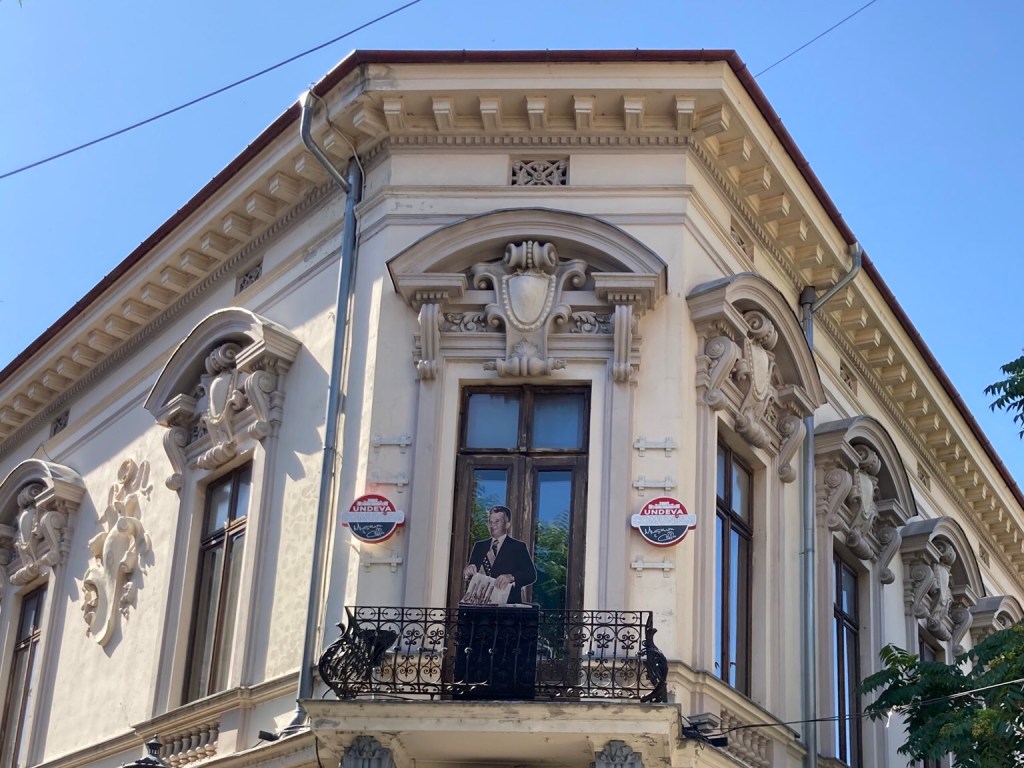
Bucharest became the capital of the new nation of Romania in 1862, and inspired by Paris, the city was built with a mix of gothic, neoclassical and Art Deco architecture. There is still grandeur, albeit a little faded, but an earthquake in 1977 and subsequent redevelopment in the 1980’s seriously changed the city.
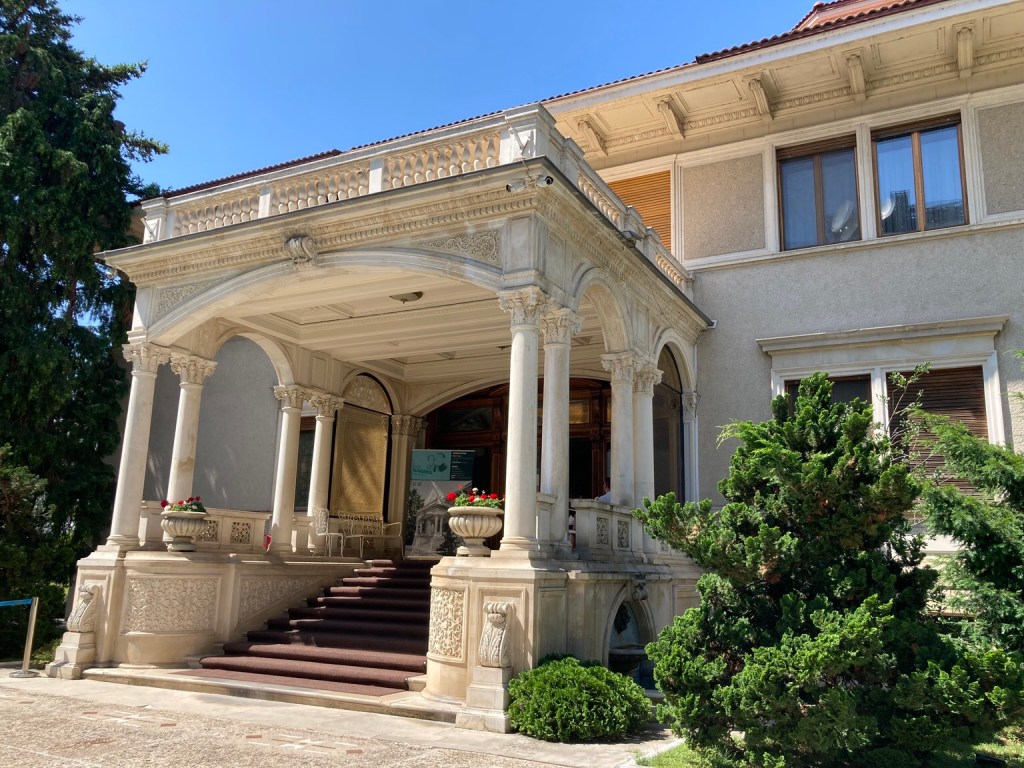
With just one full day here, we’ve decided to be very selective, especially since it’s going to be jolly hot again. Our first visit was to the Spring Palace, the former private residence of Nicolae Ceaușescu and his family.
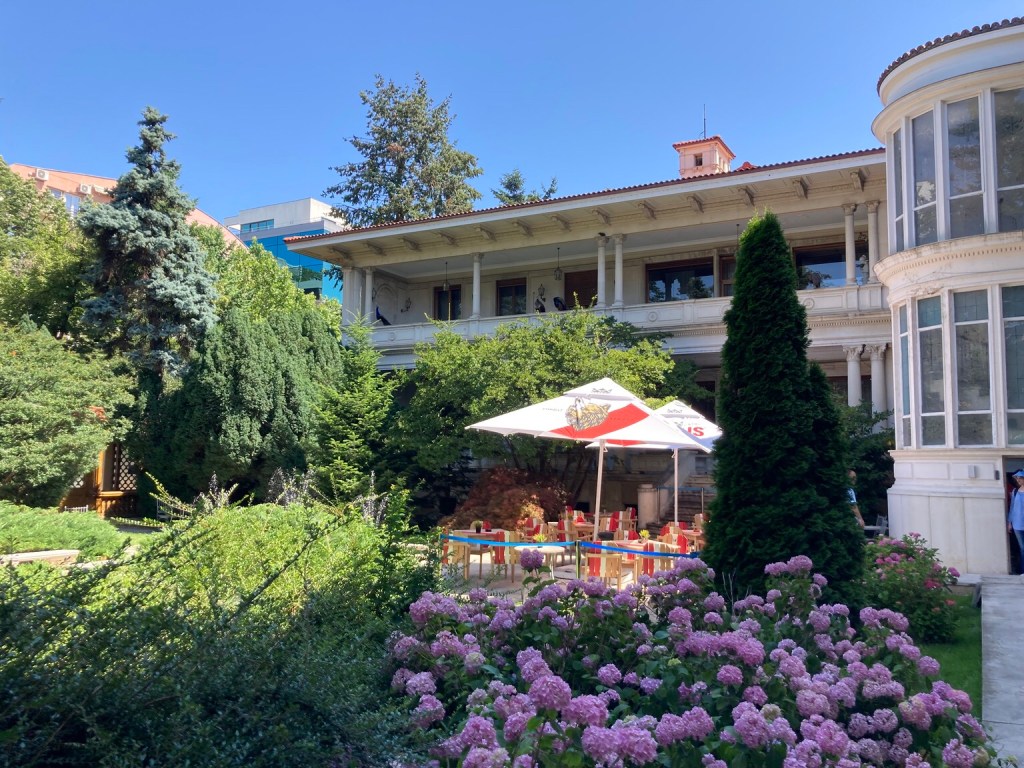
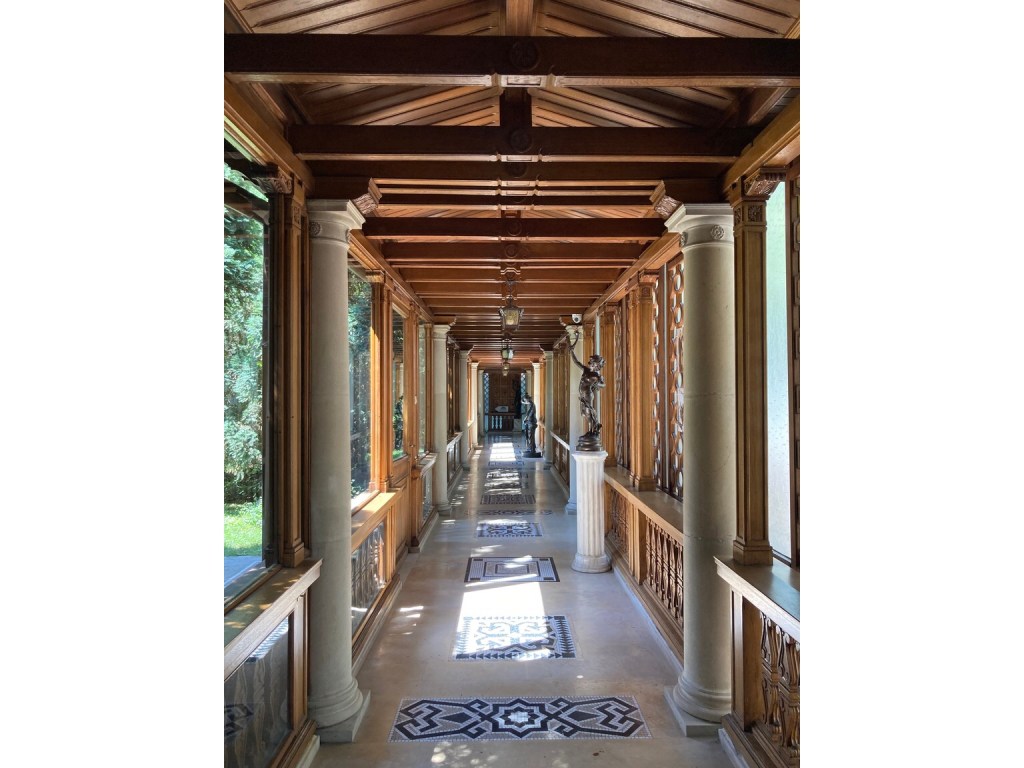
Built in the 1960’s set in a small garden …
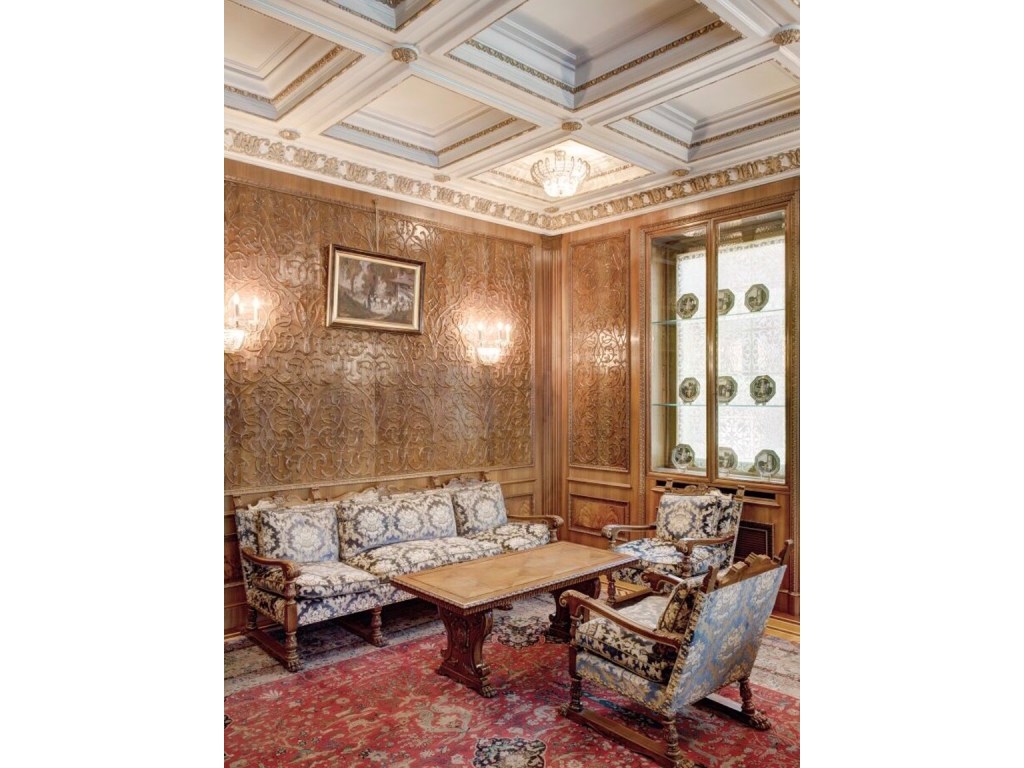
… the unassuming exterior contains 80 rooms and we saw almost half on the tour.
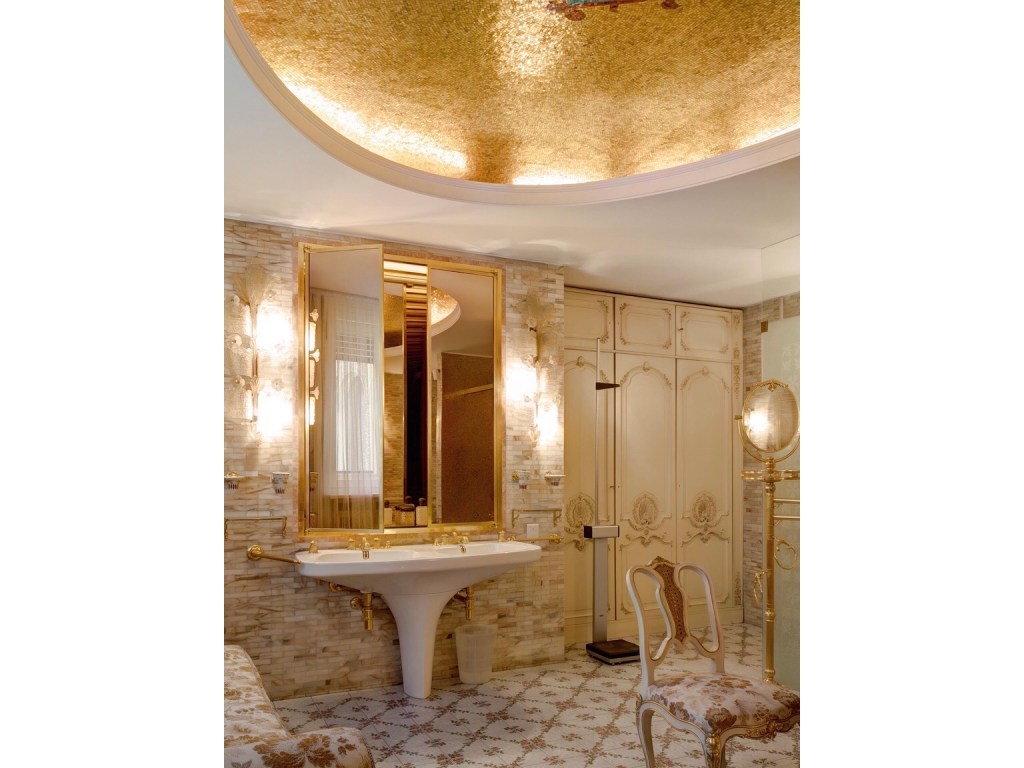
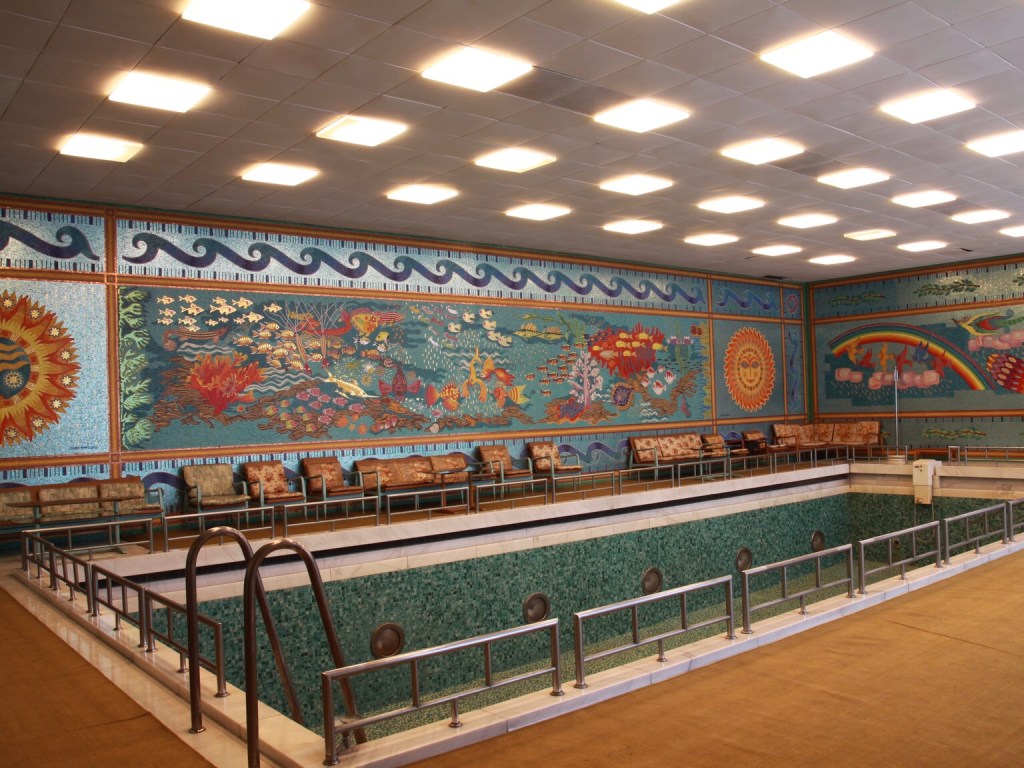
The guide was very droll as he pointed out that no expense had been spared, the most skilled craftsmen had used the finest materials, and all this was for just 5 people. This is shocking when at the same time his regime which only came to an end with the revolution in 1989, had caused such pain and suffering and many people in Romania were starving.
We were surprised that it was in equal parts drab and bling … did this reflect his personality … dull and petty?
We couldn’t take pics inside so these are from their website.
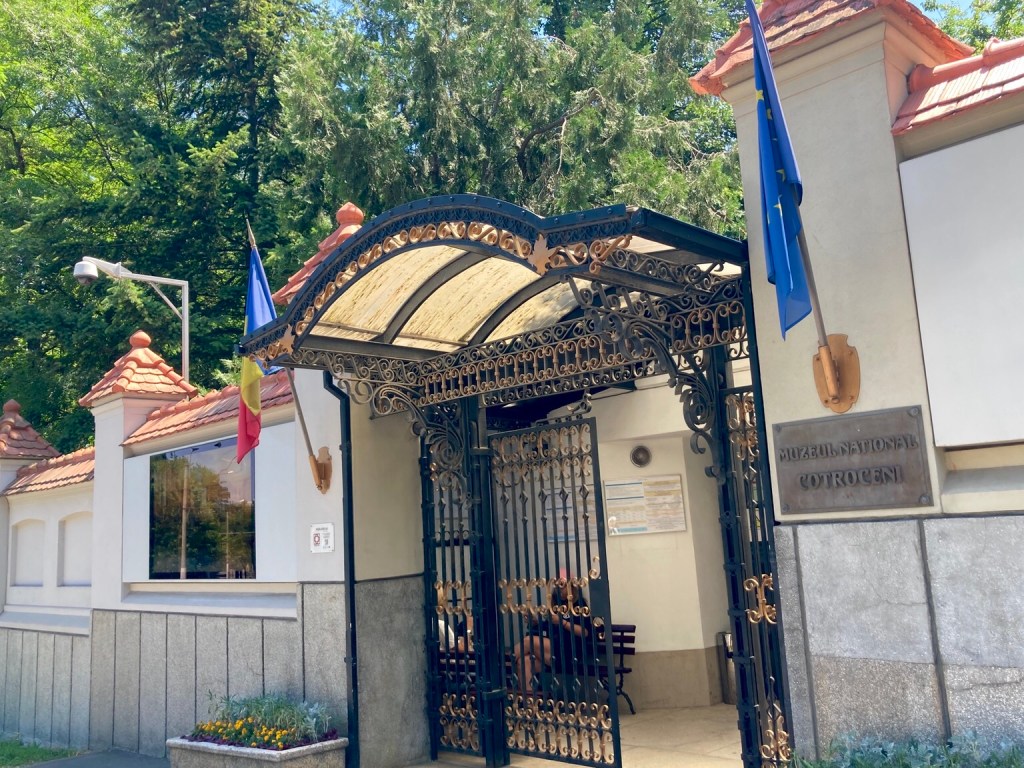
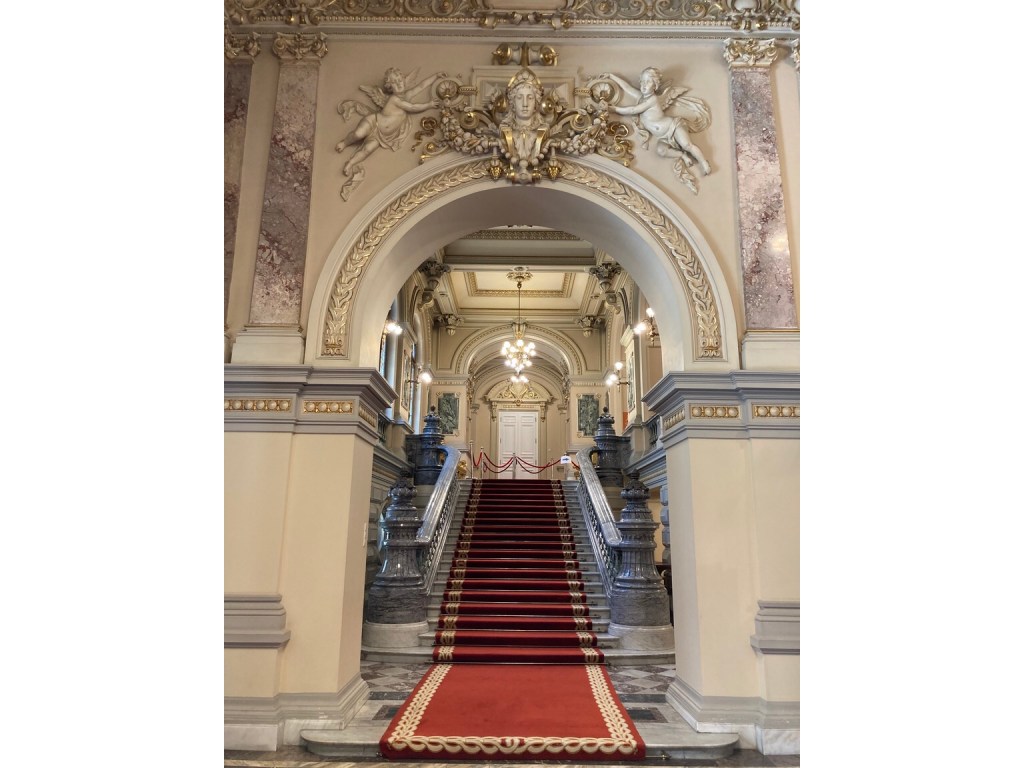
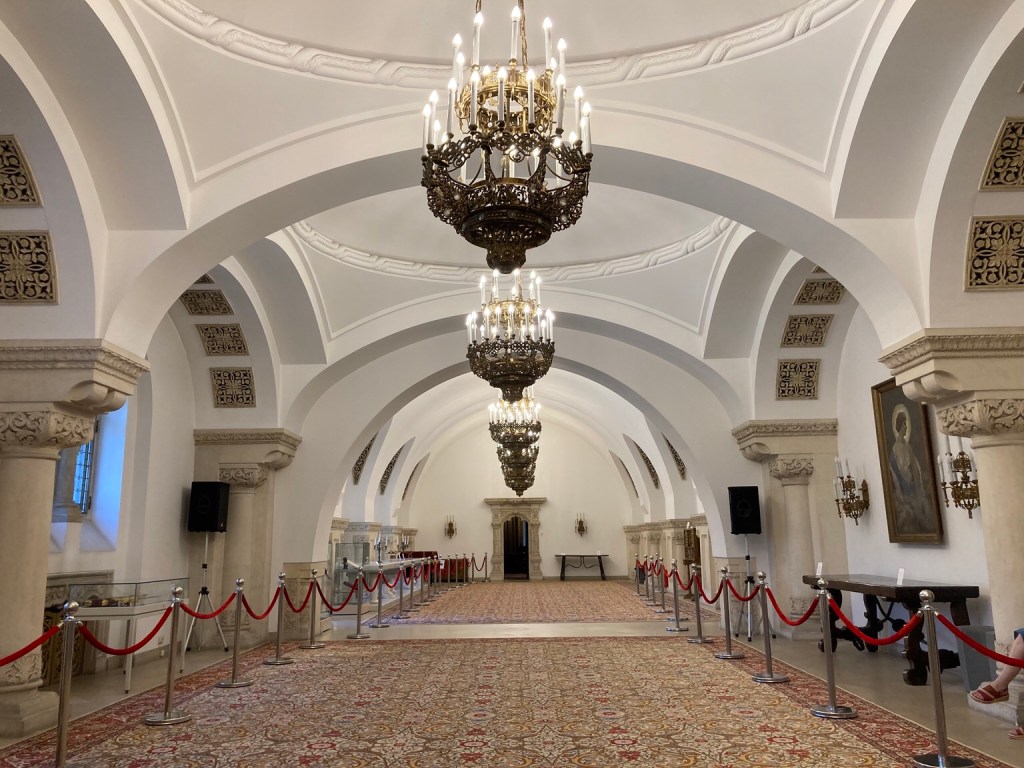
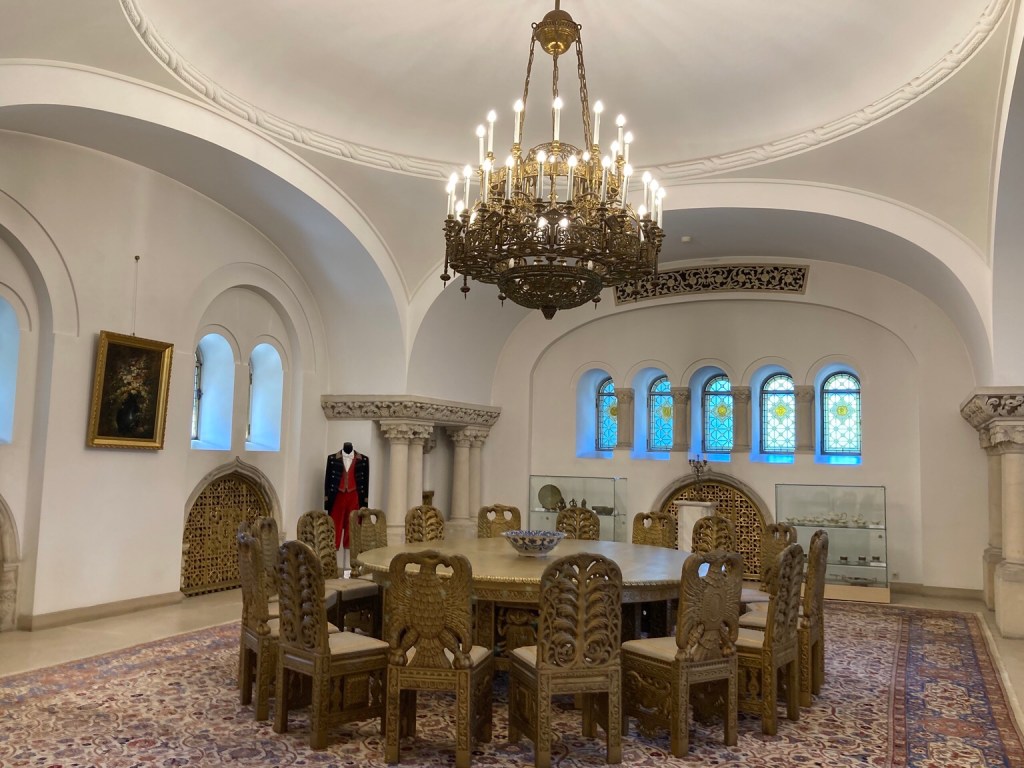
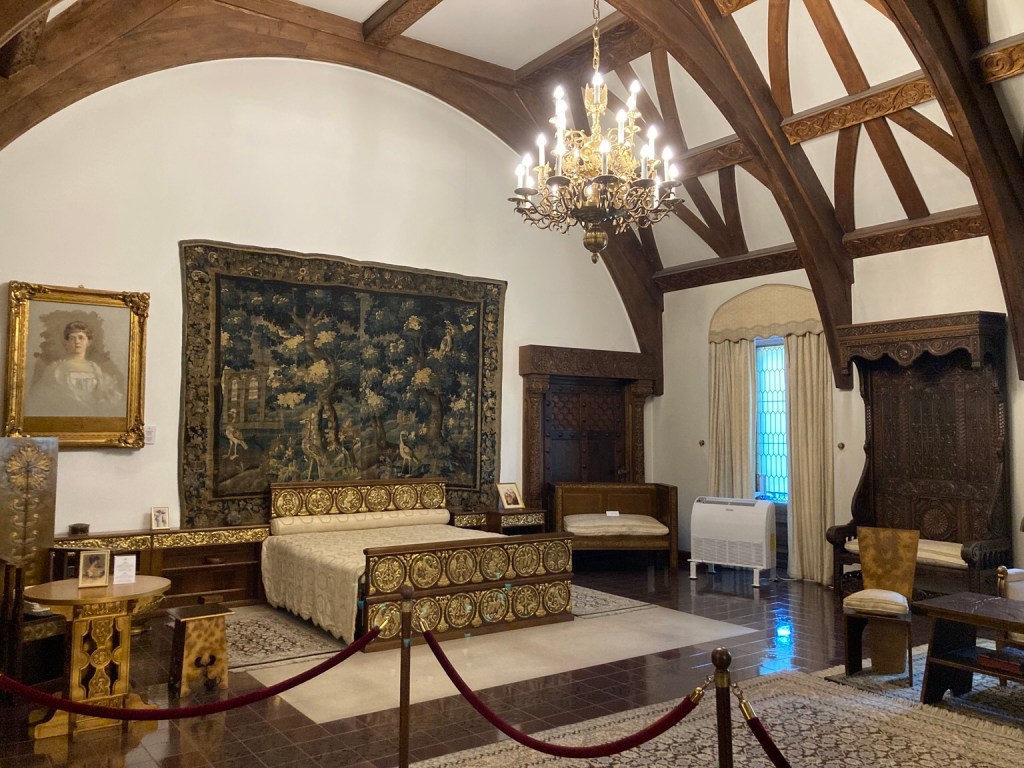
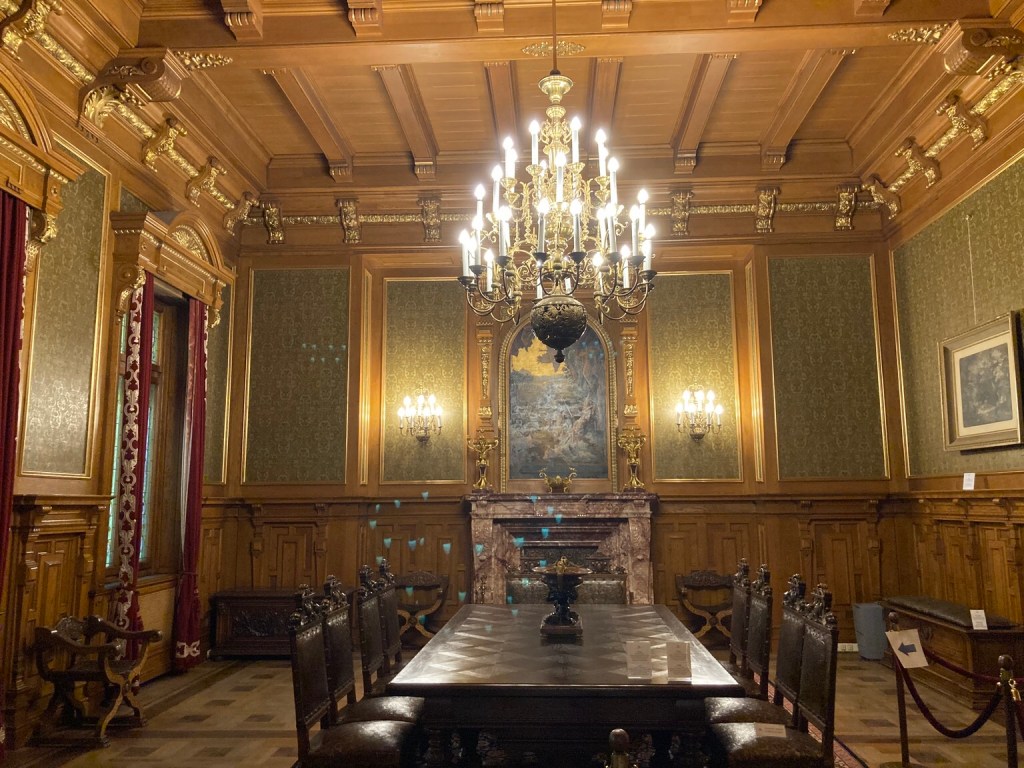
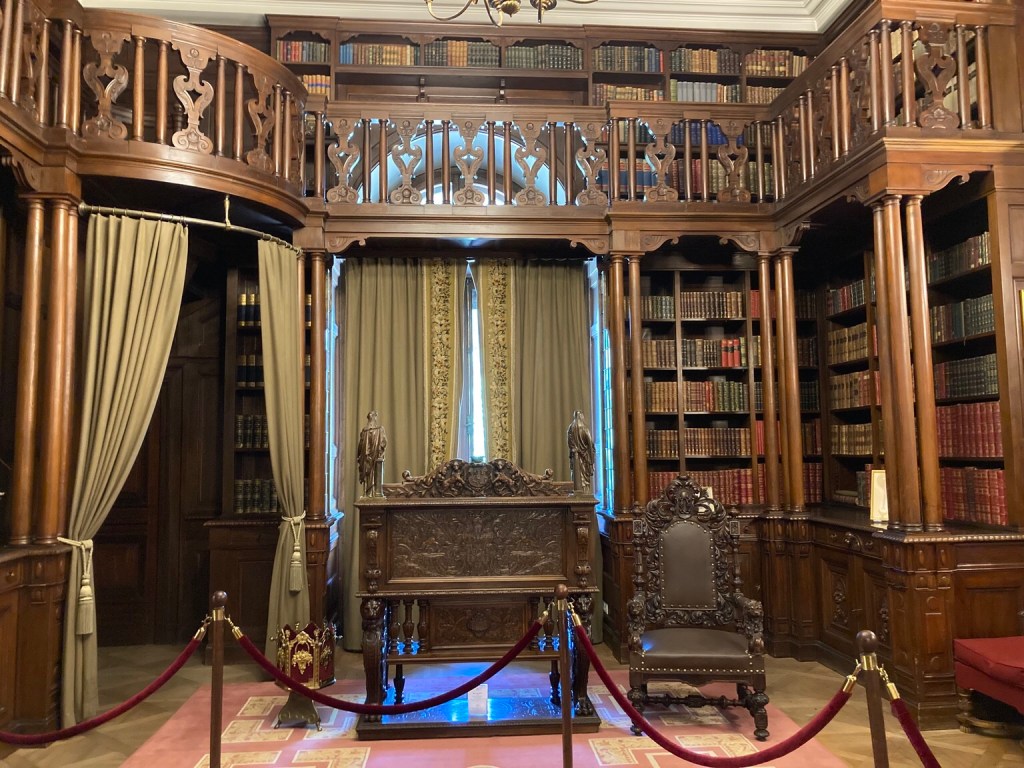
In contrast, our next visit was to the Cotroceni Palace, built in 1895 for the newly wed Prince Ferdinand and Princess Marie and remained the royal residence until 1939.
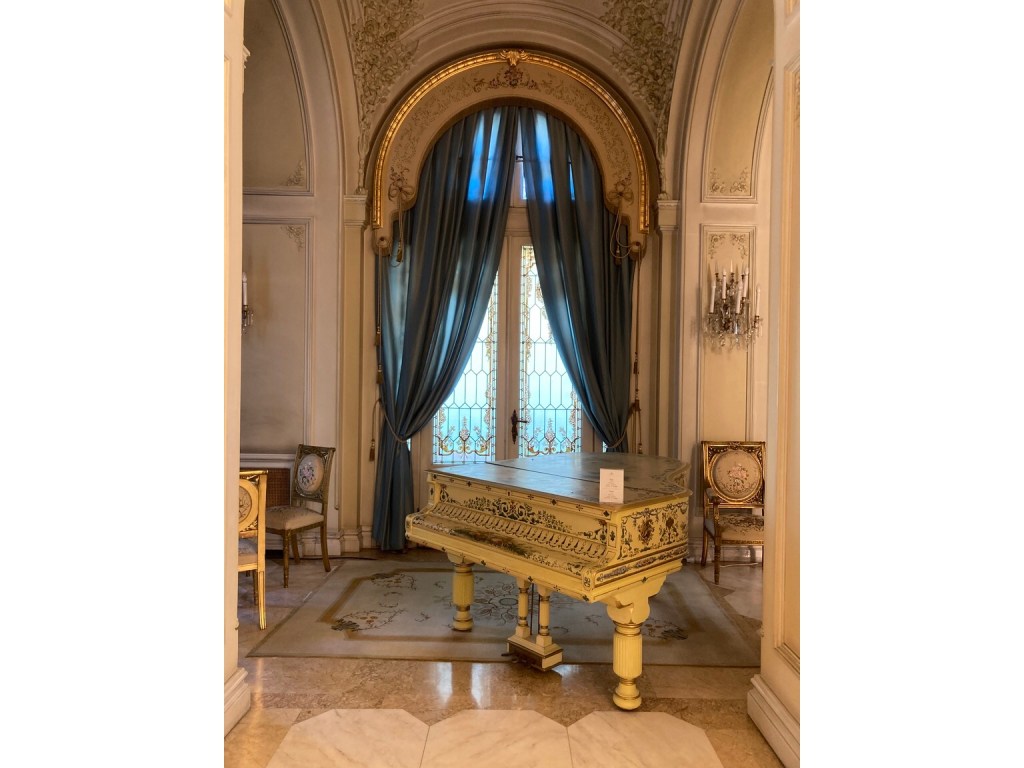
Having seen inside Bran Castle, with rooms also decorated by Marie when she was queen, the aesthetic wasn’t surprising, favouring light and airy …
… and Art Noveau
… to balance Ferdinand’s choice of heavy wood.
Under communism, it was used by the Romanian equivalent of the youth army and is now one wing is used for Presidential functions and the rest is a museum.
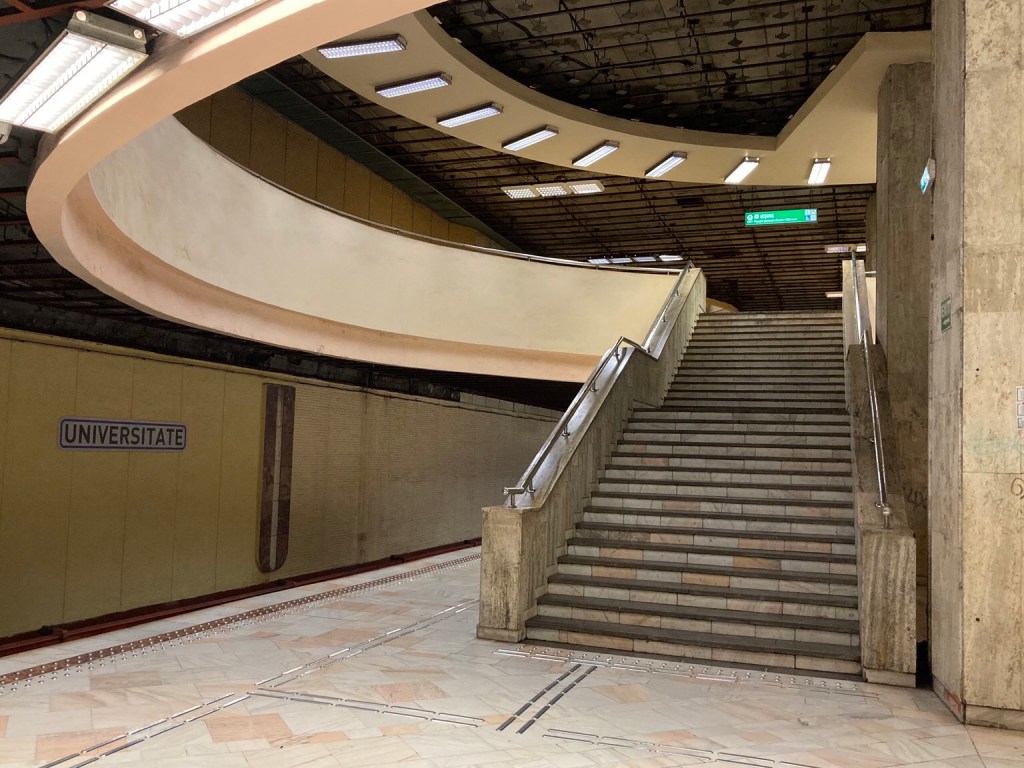
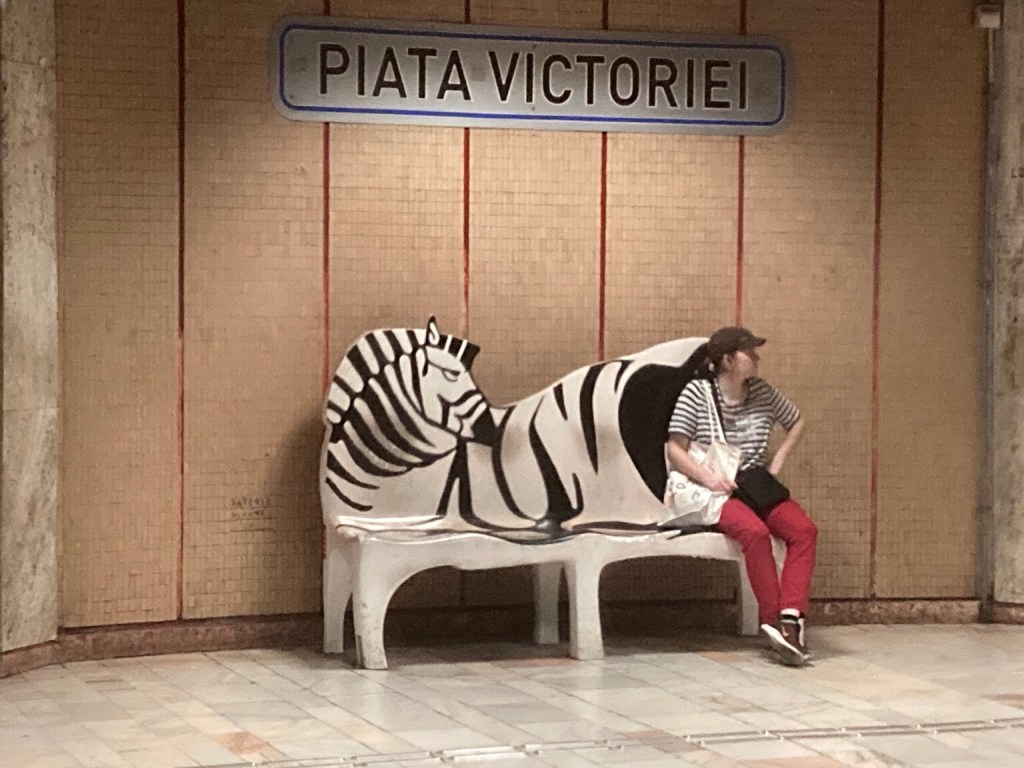
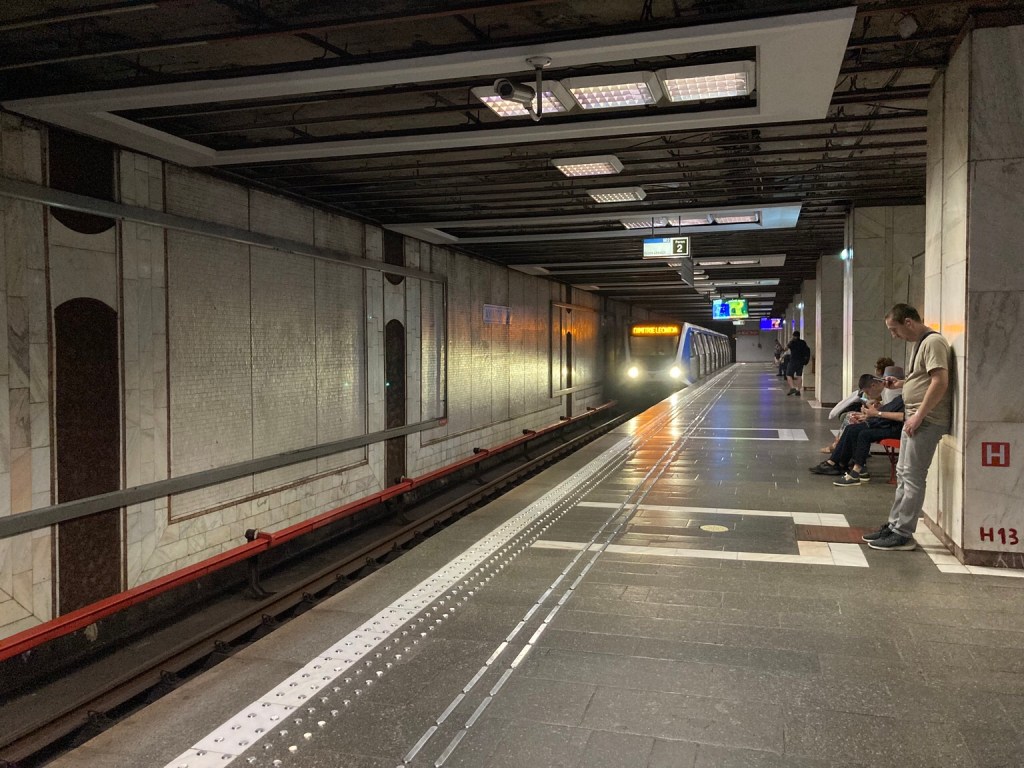
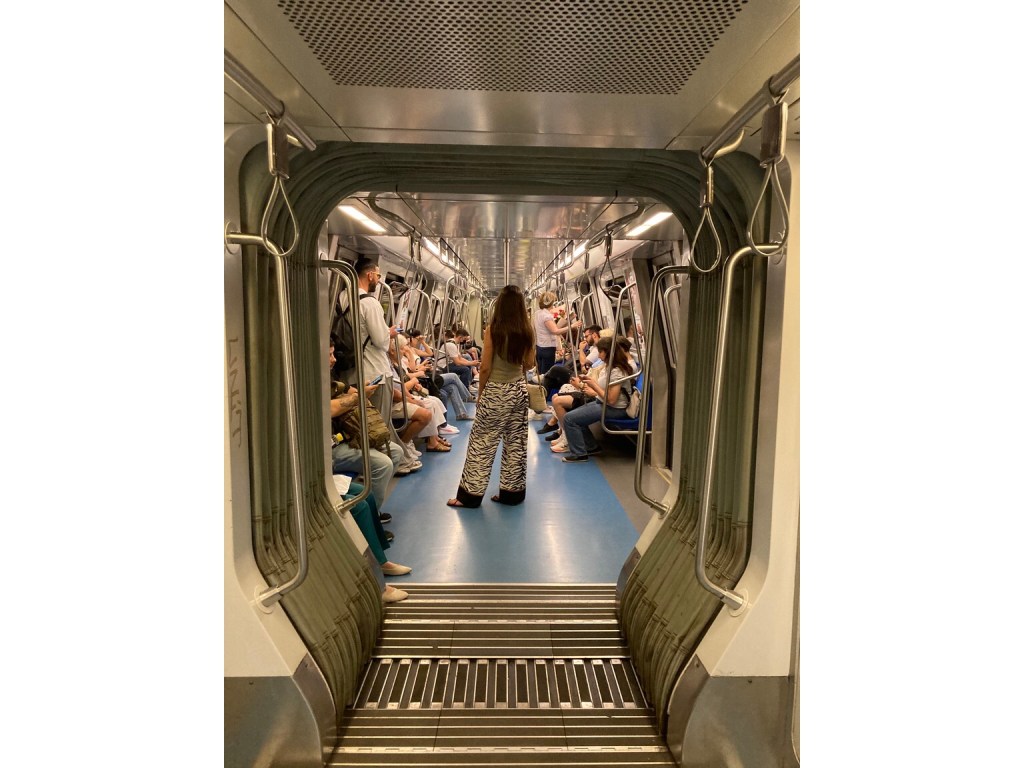
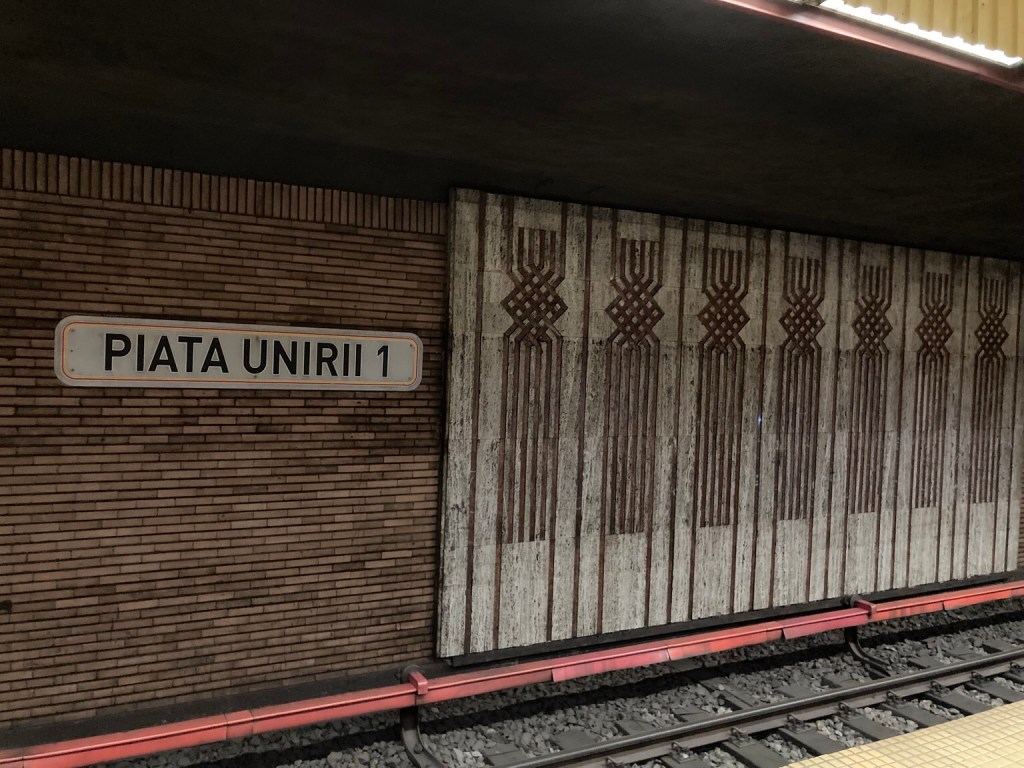
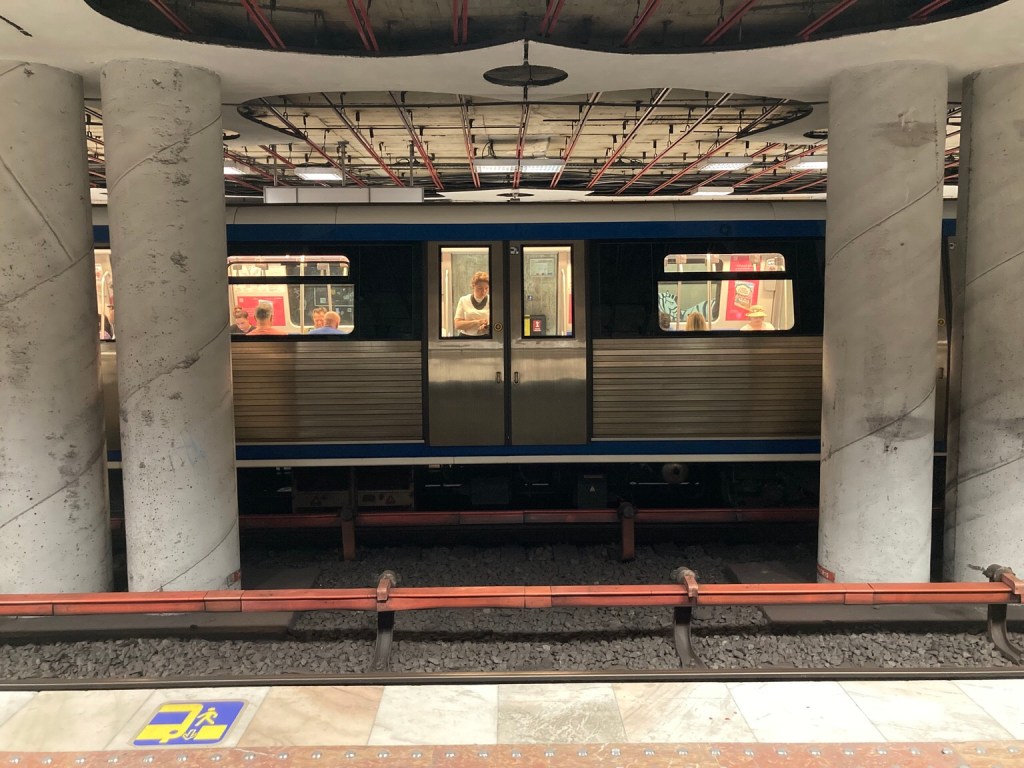
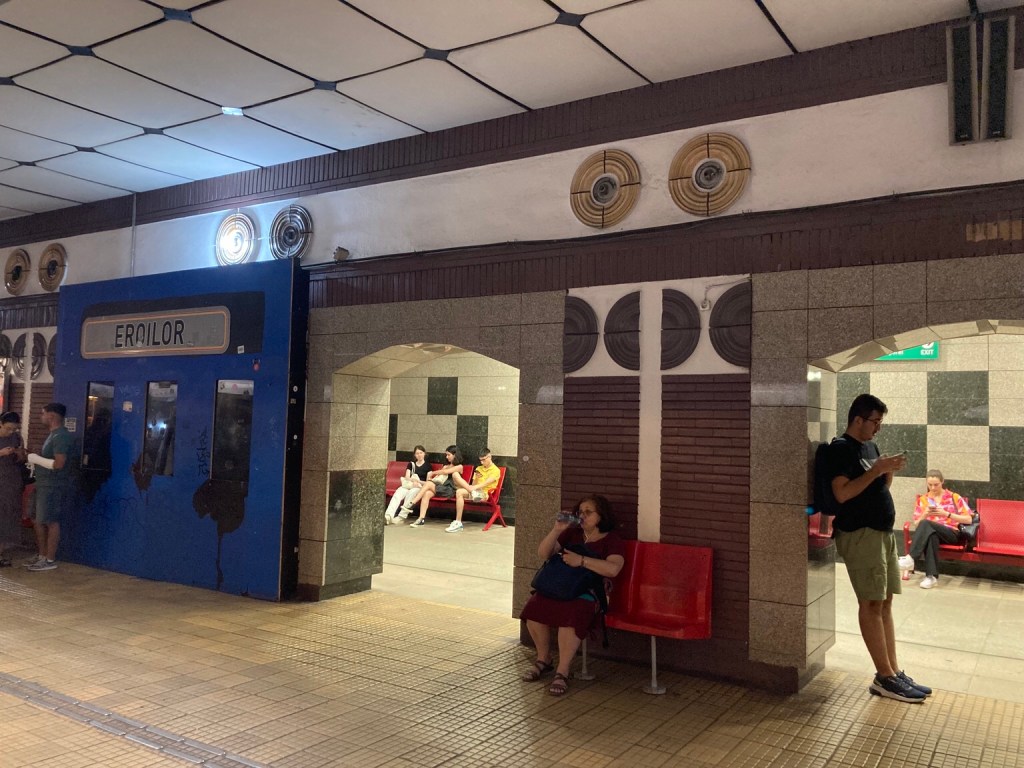
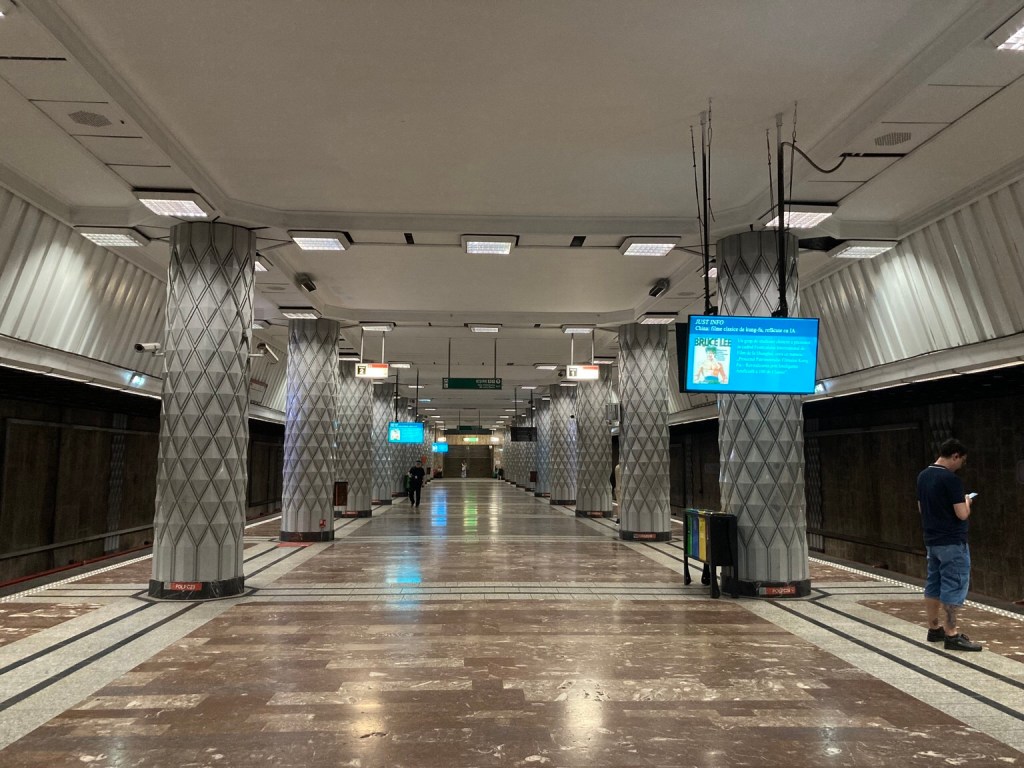
Thus far, we had been using the metro, interested to see how it looked, although it is quite utilitarian with little ornamentation. Having said that, here are a couple of snaps …
… and the platform at Politehnica actually has fossils in the floor!
By now we were getting weary, and even the 15 minute walk back to the metro seemed a little daunting, so we took a cab instead, easily done since Chris had downloaded the app just in case!
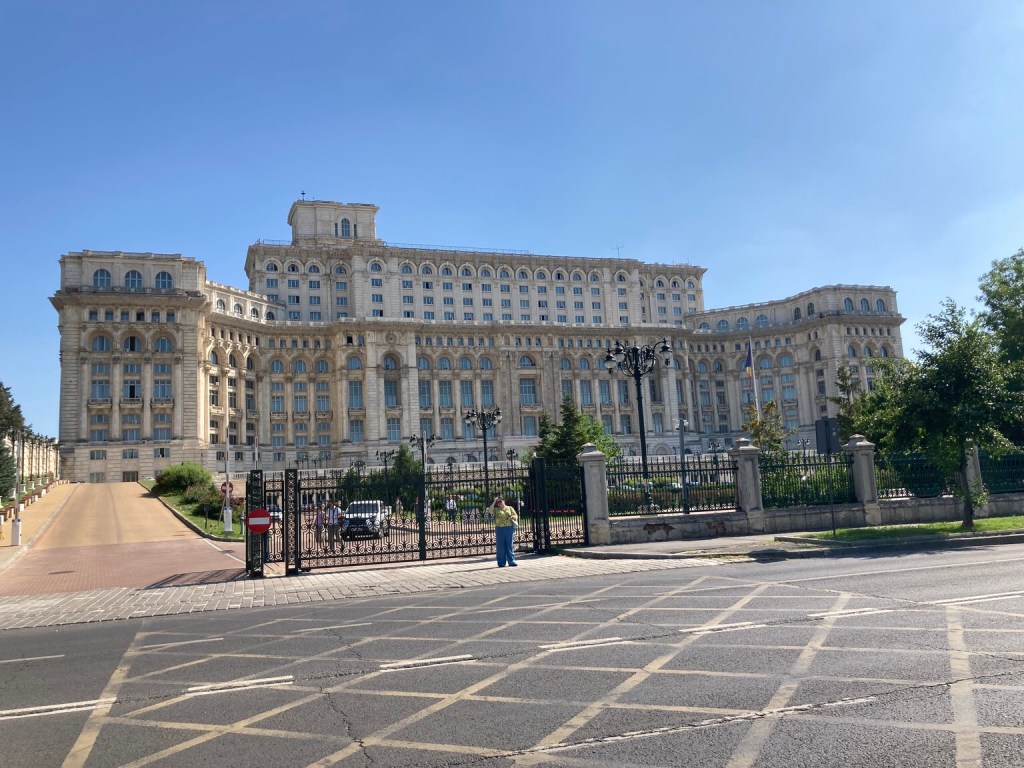
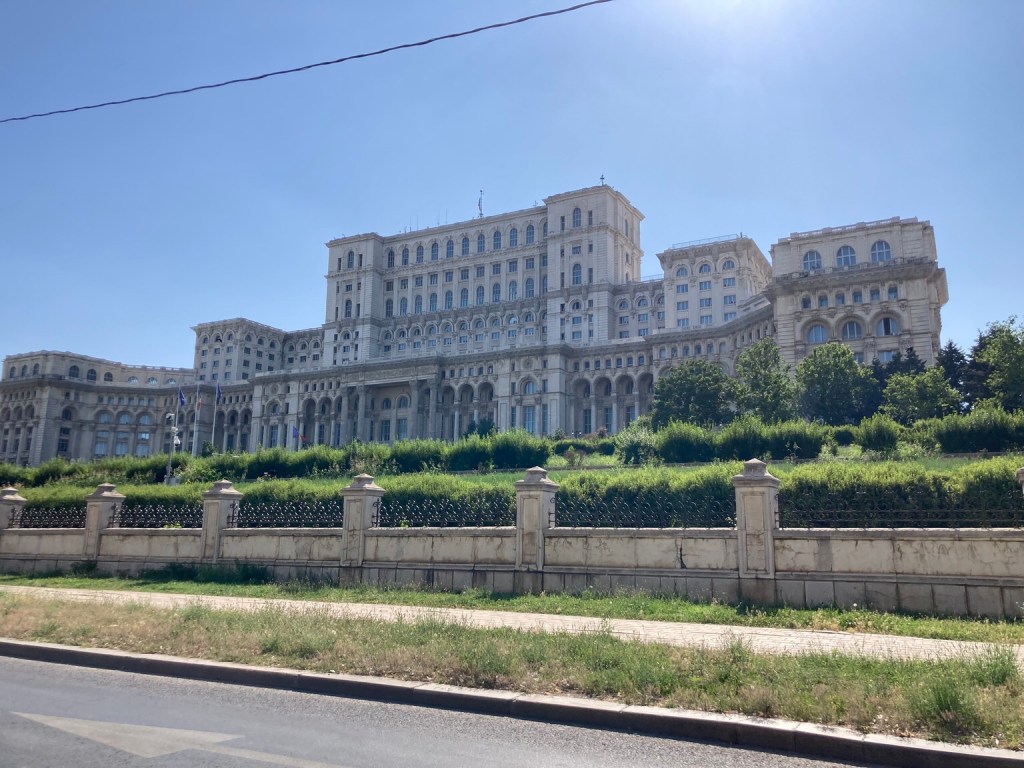
Our last stop is The Palace of the Parliament, claimed to be the largest administrative building in the world after the Pentagon and epitomises the megalomania that overtook Ceaușescu in the 1980’s. We didn’t go in, just snapped from a distance, quite a distance to get it all in! Today it houses the Senate and Parliament as well as museums, but much is unused.
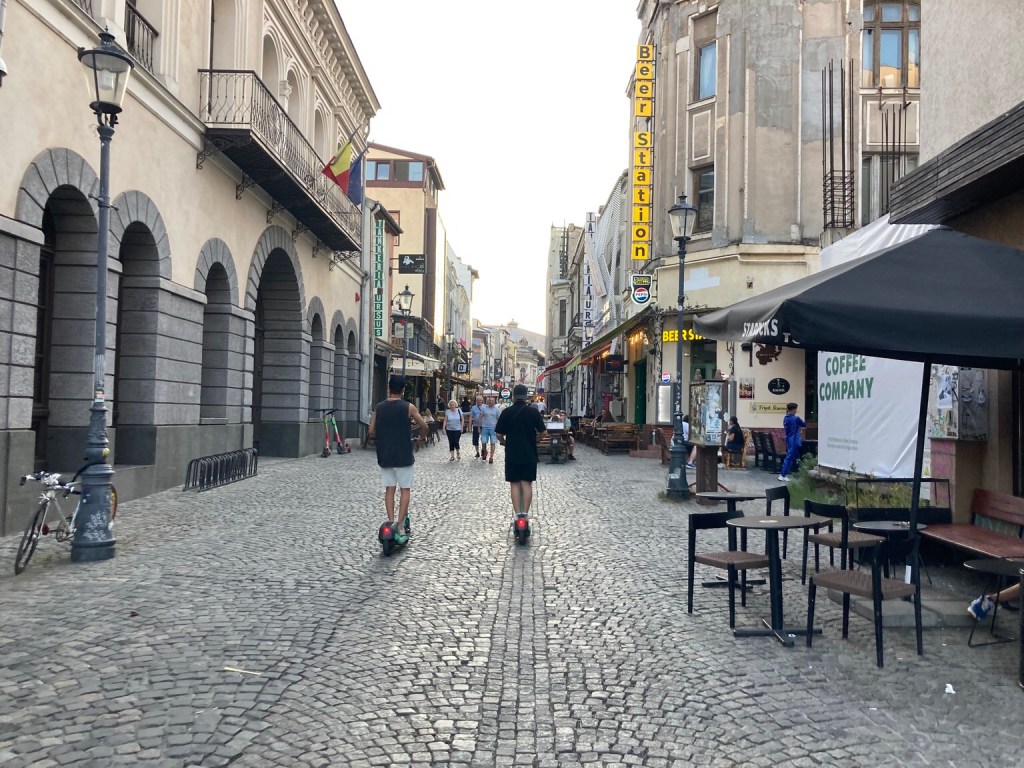
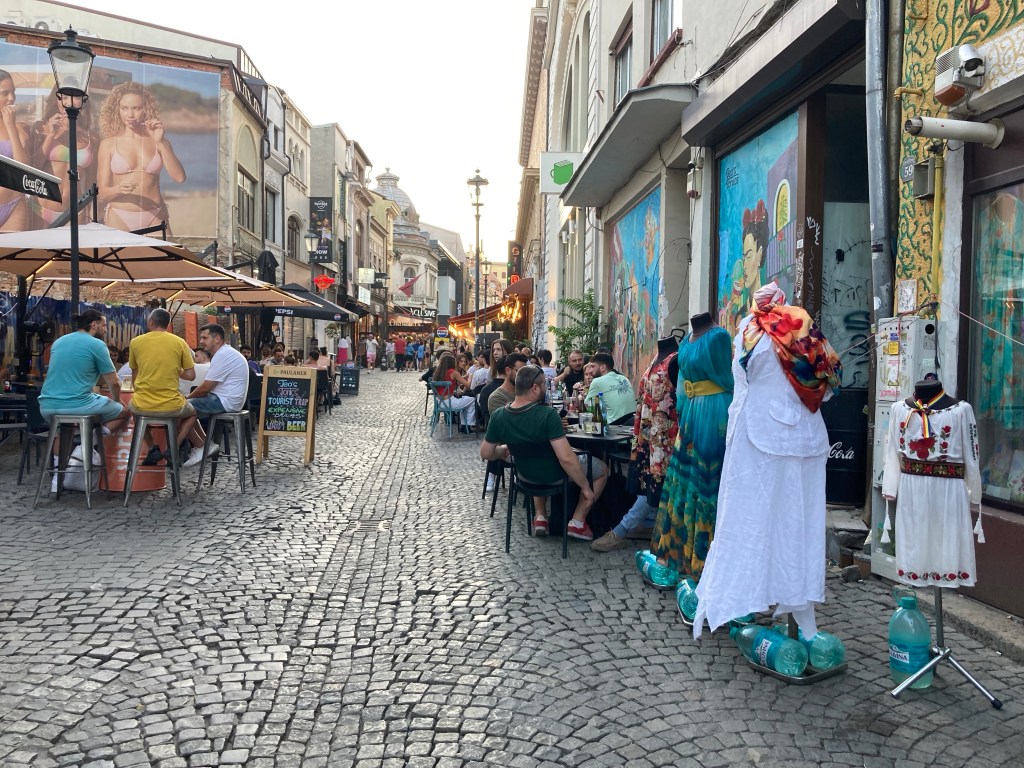
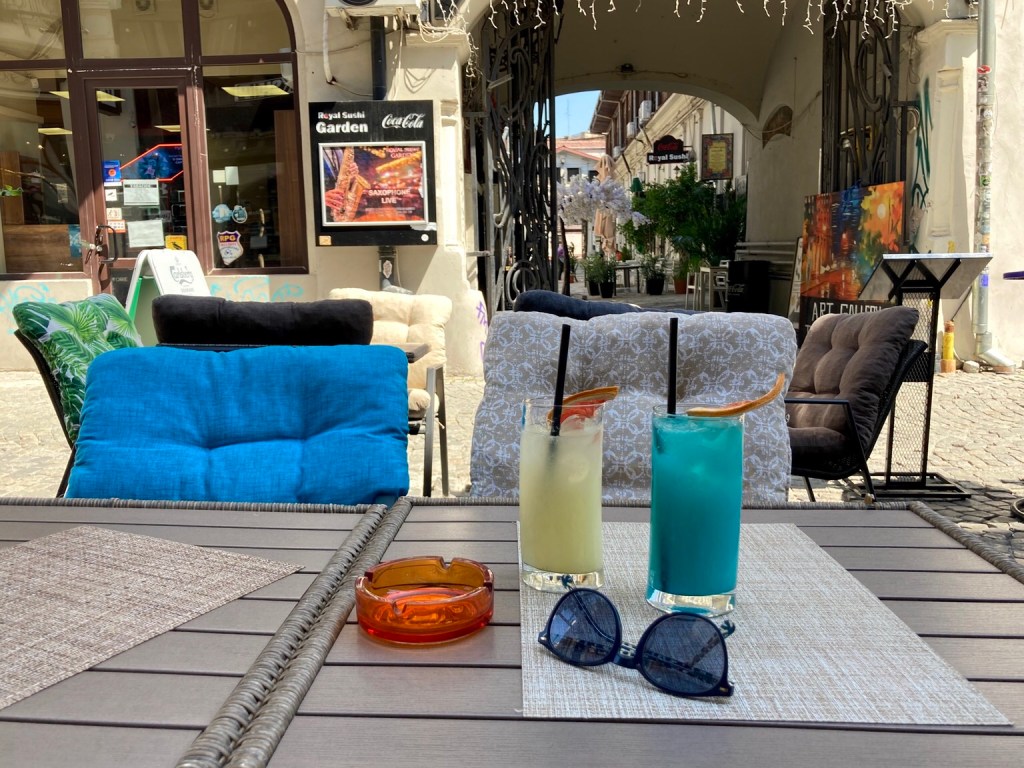
Another cab back to the apartment for a rest and to cool down. Later, we ventured into the old town, billed as vibrant, we found beer central complete with booming music and pushy staff trying to entice you inside.
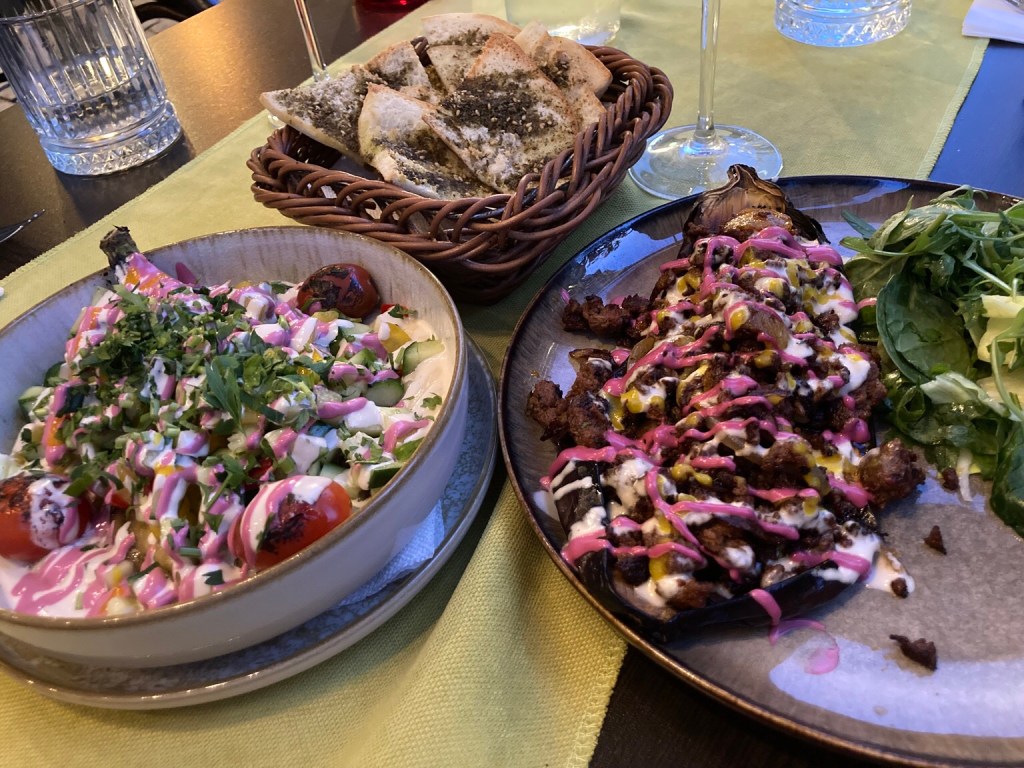
We were looking for Aubergine, which proved fairly quiet and a great choice for our last night – one Eggplant Pot and one Eggplant with Beef with crispy pita with za’atar and wine …
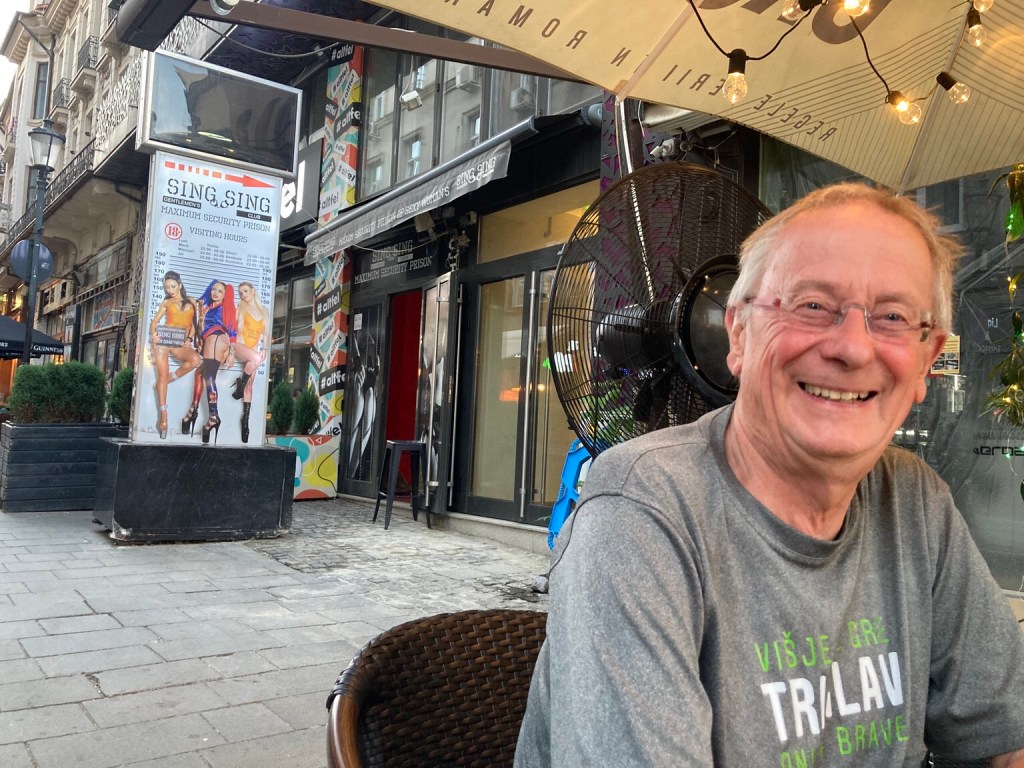
… although the establishment behind Chris became increasingly distracting when it started showing previews on the screen above!
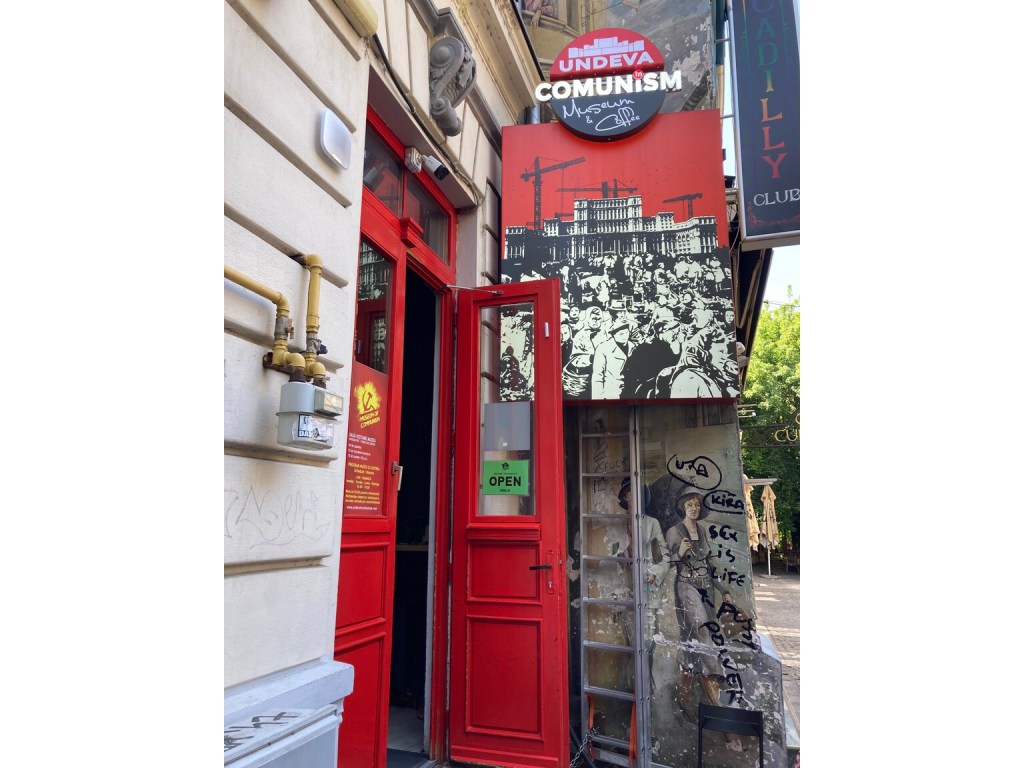
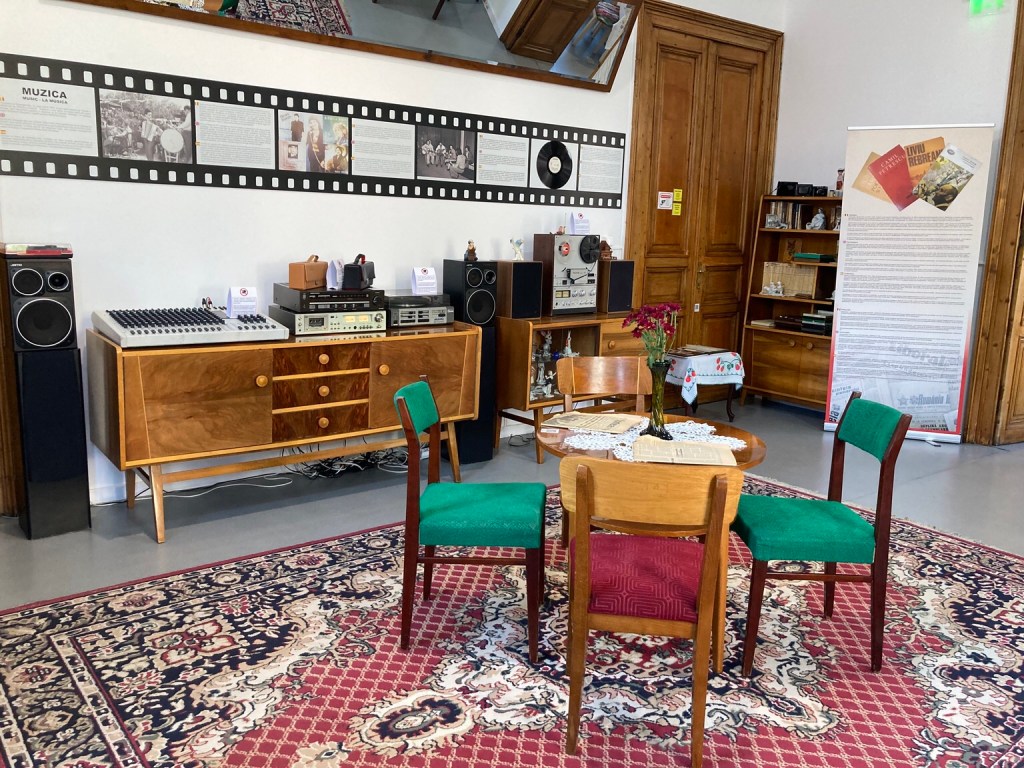
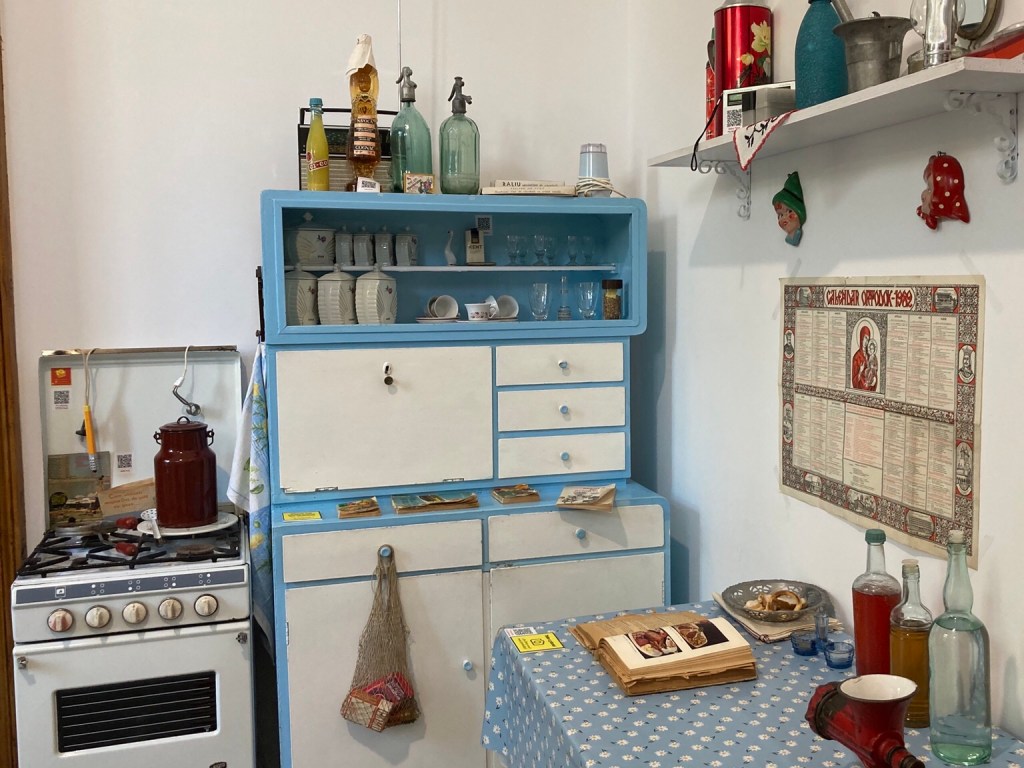
We squeezed in one final stop in the morning, The Museum of Communism which gave us more insight into this period of Romanian history which lasted almost 40 years, and remains in living memory for many.
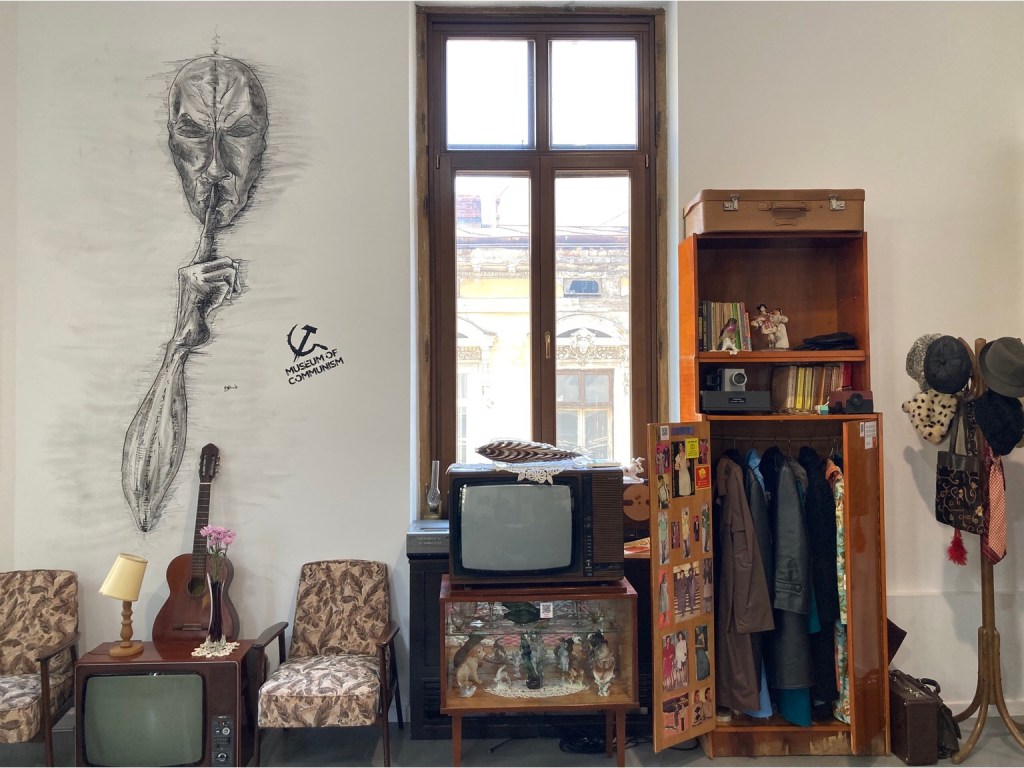
The regime certainly moved the country forward in industrial and technological achievement initially, but the the debts undertaken to achieve this eventually had to be paid back at huge cost to the people who suffered hardship and starvation through austerity measures and political repression. There were various displays and room settings to illustrate the era …
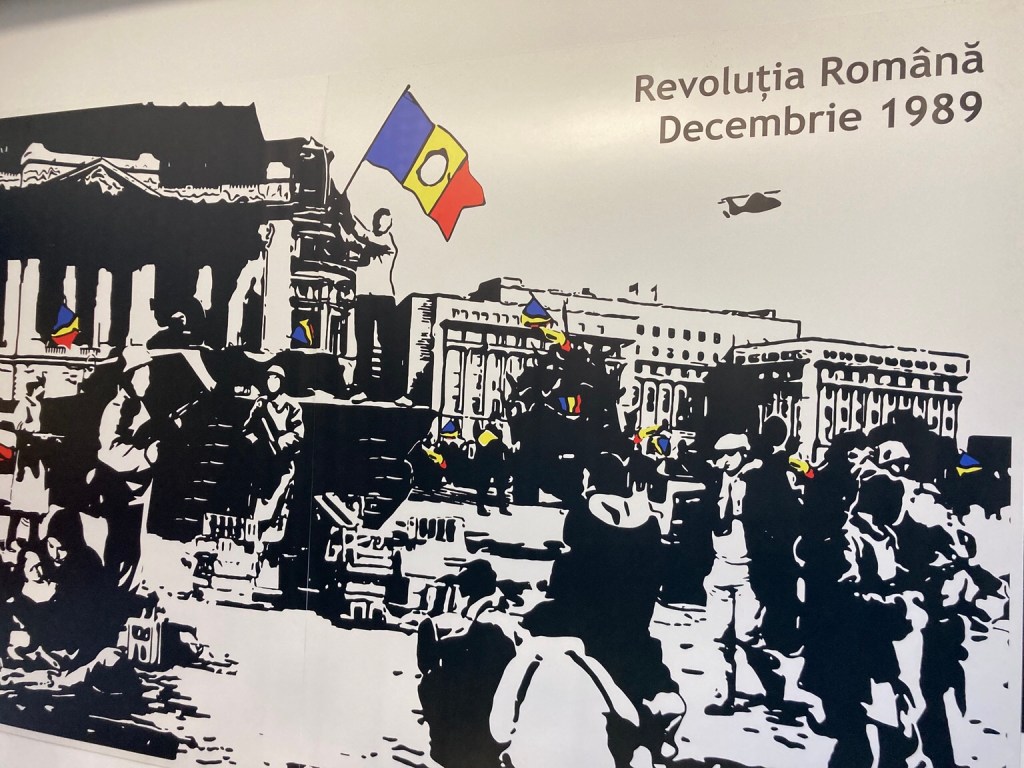
… which came to an end with the revolution in 1989, when Ceaușescu was overthrown and shot.
After that, just time for a cold drink and a bit of a review of our trip.
Of course it will all be fine we said as we set forth, and it certainly was! The driving was smooth, the people friendly and communication easy. We saw everything we hoped for and munched our way round Romania trying all the local specialities. It was also incredibly good value and the Transfagarasan Highway was definitely one of the highlights.
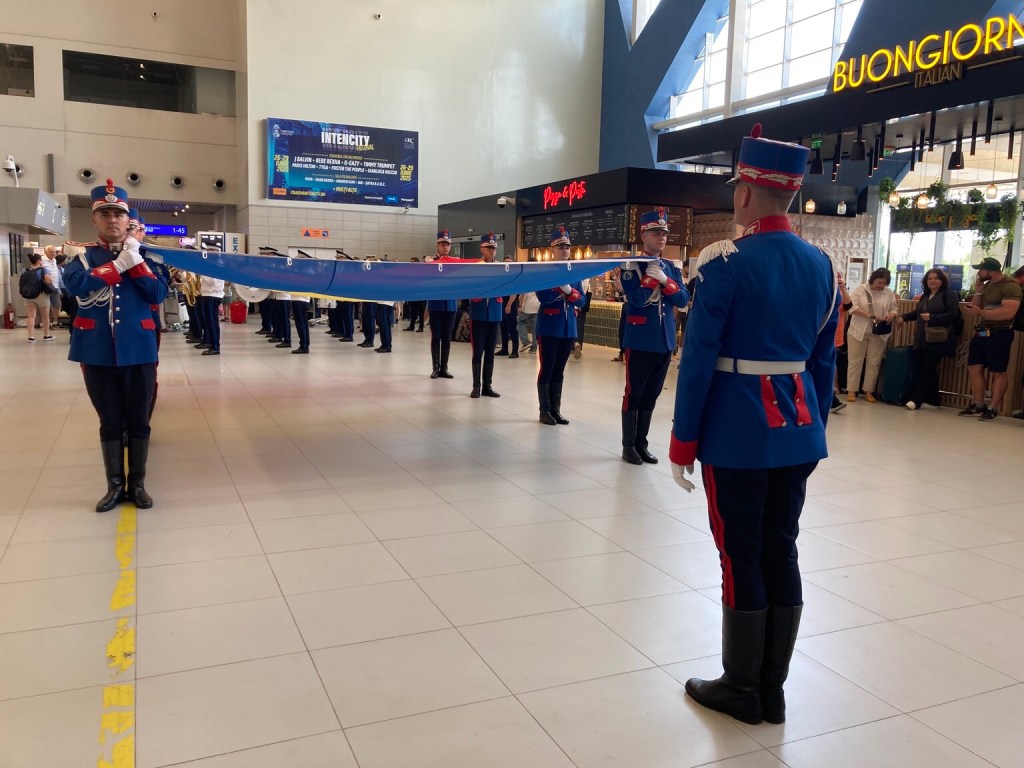
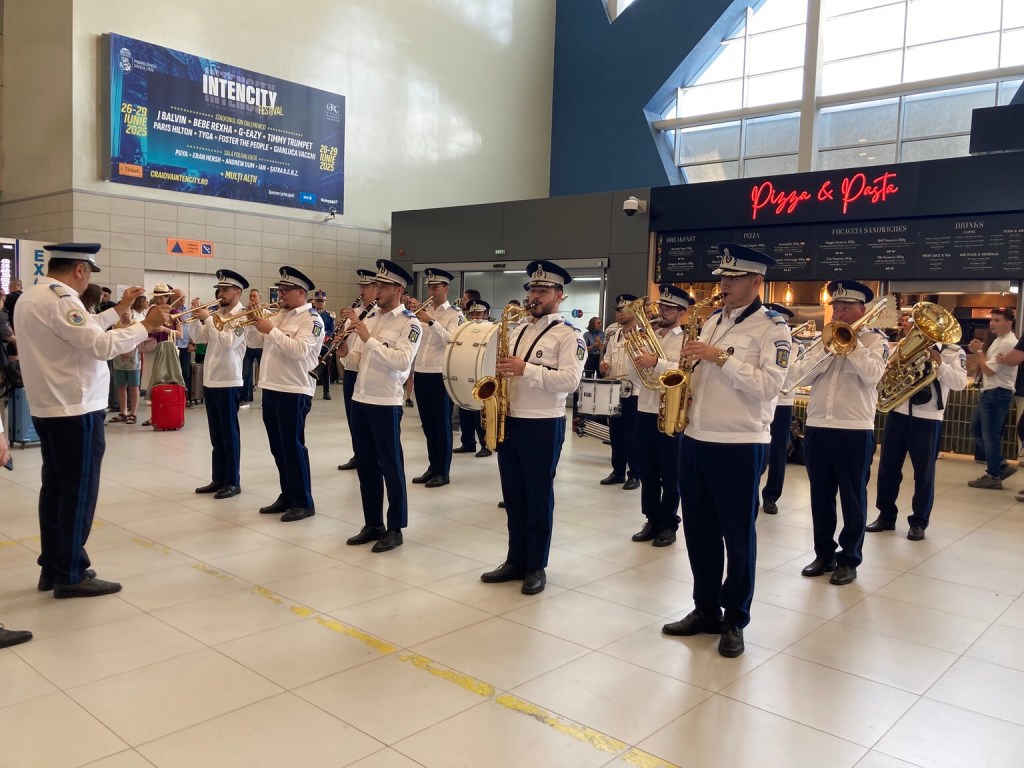
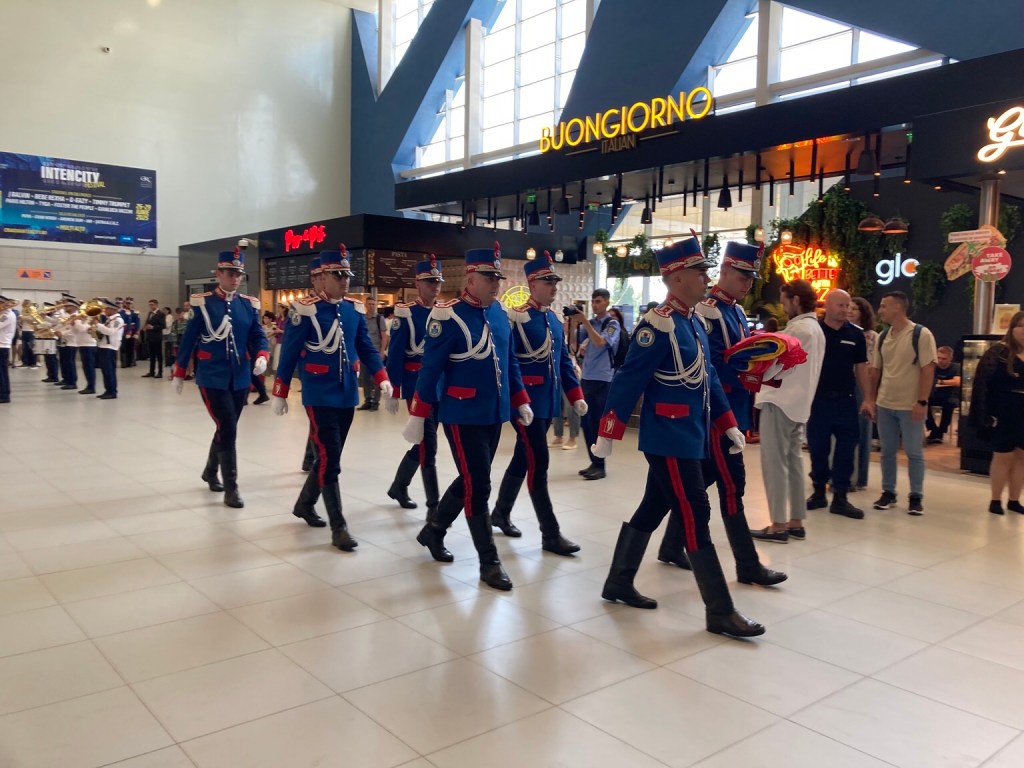
At the airport we were met by a brass band commemorating 26 June which is National Flag Day, and we were just in time to see the flag folded and marched out of the airport!
All that remains is to share our favourite Romanian phrase which means safe travels … Drum Bun!































































































 Off Travelling Together