We were most surprised to pull the curtains and see a little drizzle, the first rain we’d seen in a month, but it soon dried up. It remained overcast and the day was cool, but with a flight to catch later that suited us fine.
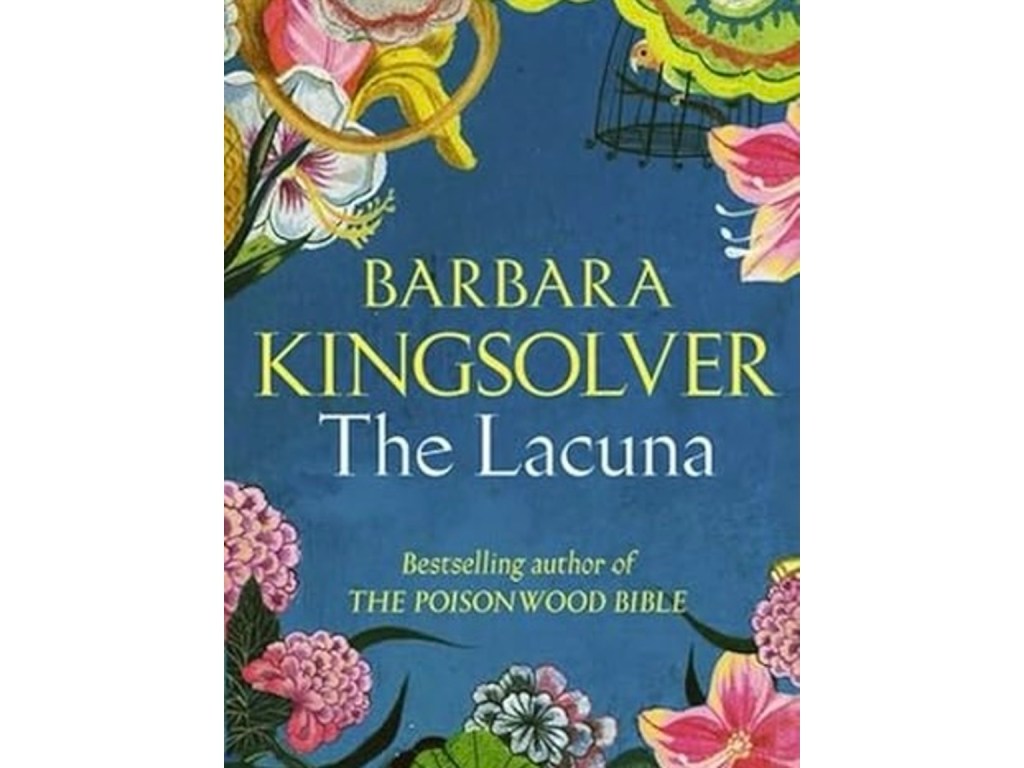
I always like to do a bit of background reading and this trip read a novel by Barbara Kingsolver called The Lacuna. It tells the life of Harrison William Shepherd, a writer raised between Mexico & the US who becomes entangled with real historical figures such as Frida Kahlo and Diego Rivera, and later serves as a secretary to Leon Trotsky who was given asylum in Mexico after his exile from Russia.
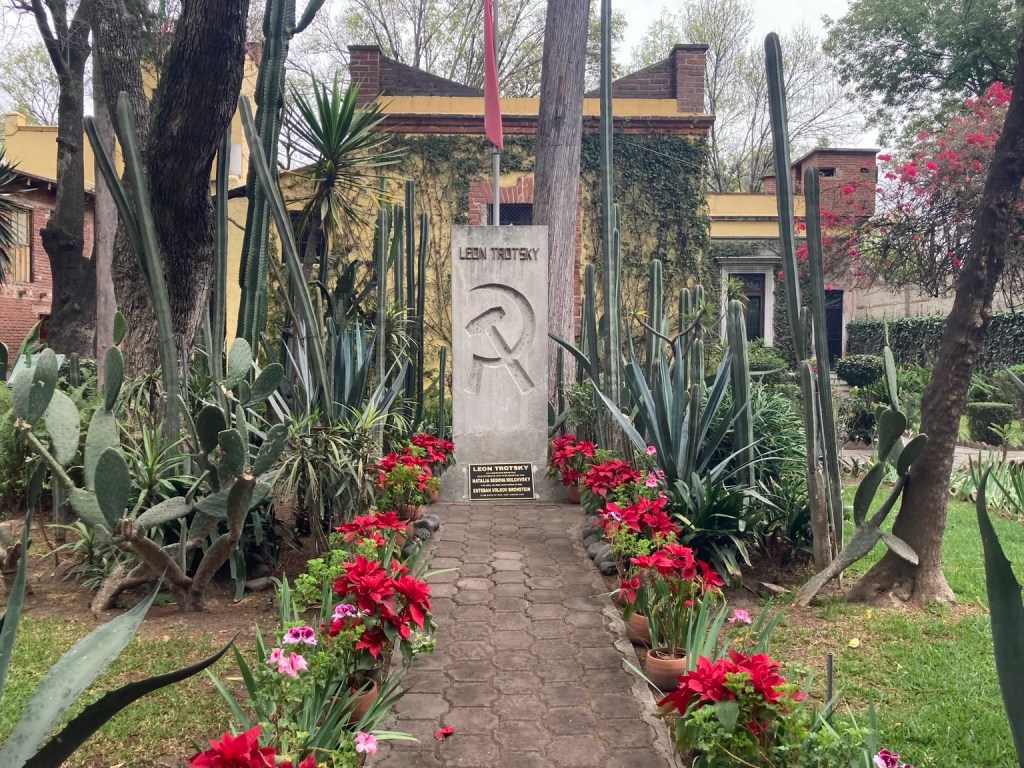
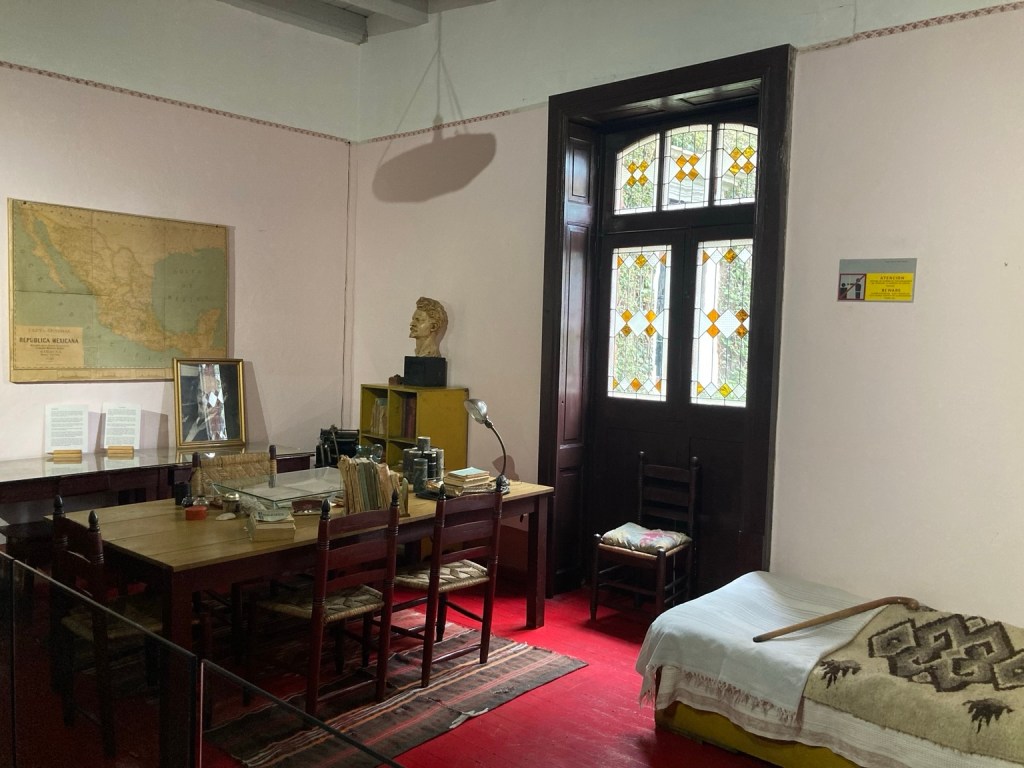
Trotsky initially lived with Diego & Frida at Casa Azul but later moved to a house close by which could be more secure. We saw his house where is he buried …
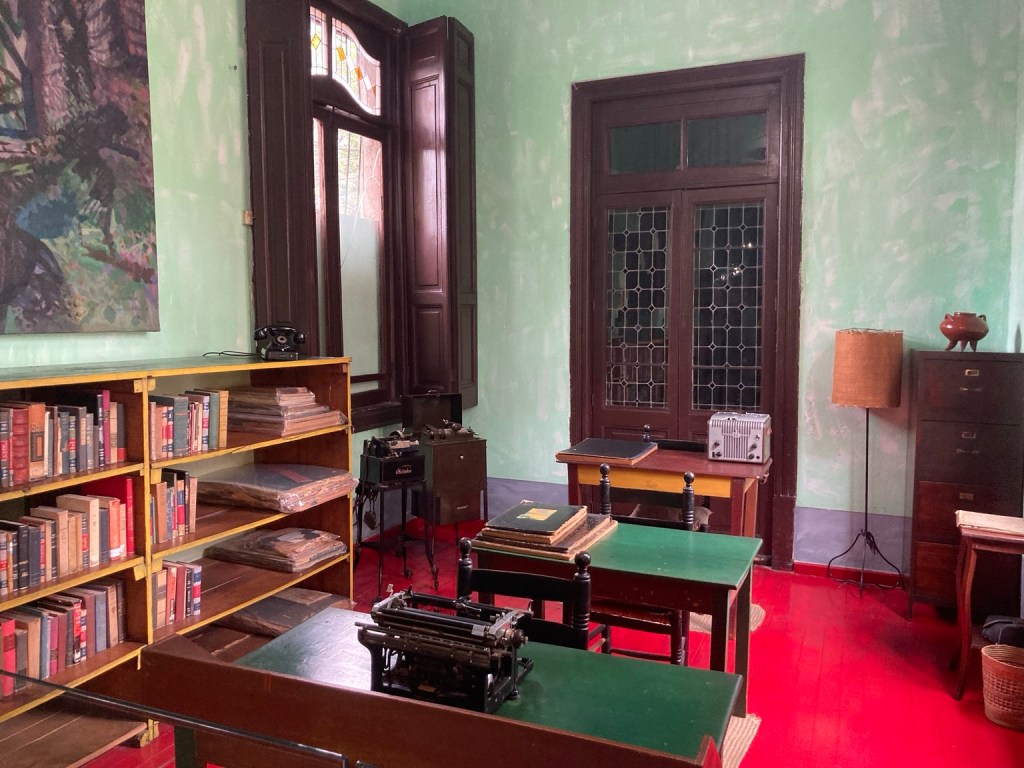
… the offices from which he continued his campaign against Stalin …
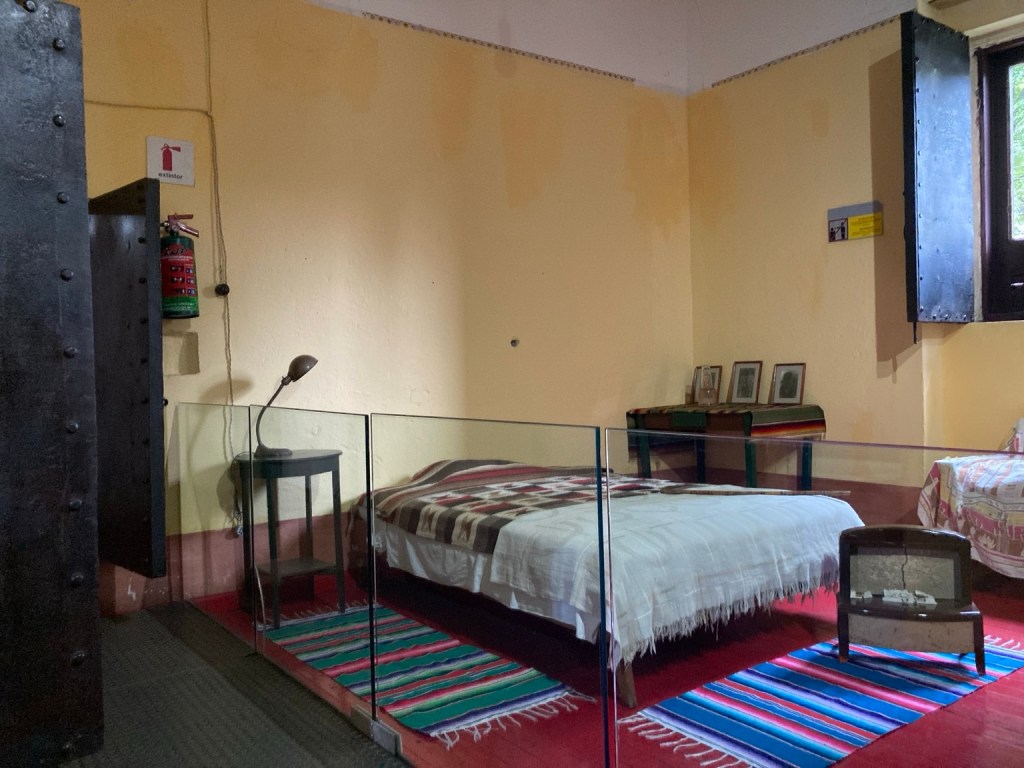
… and his bedroom complete with armoured doors.
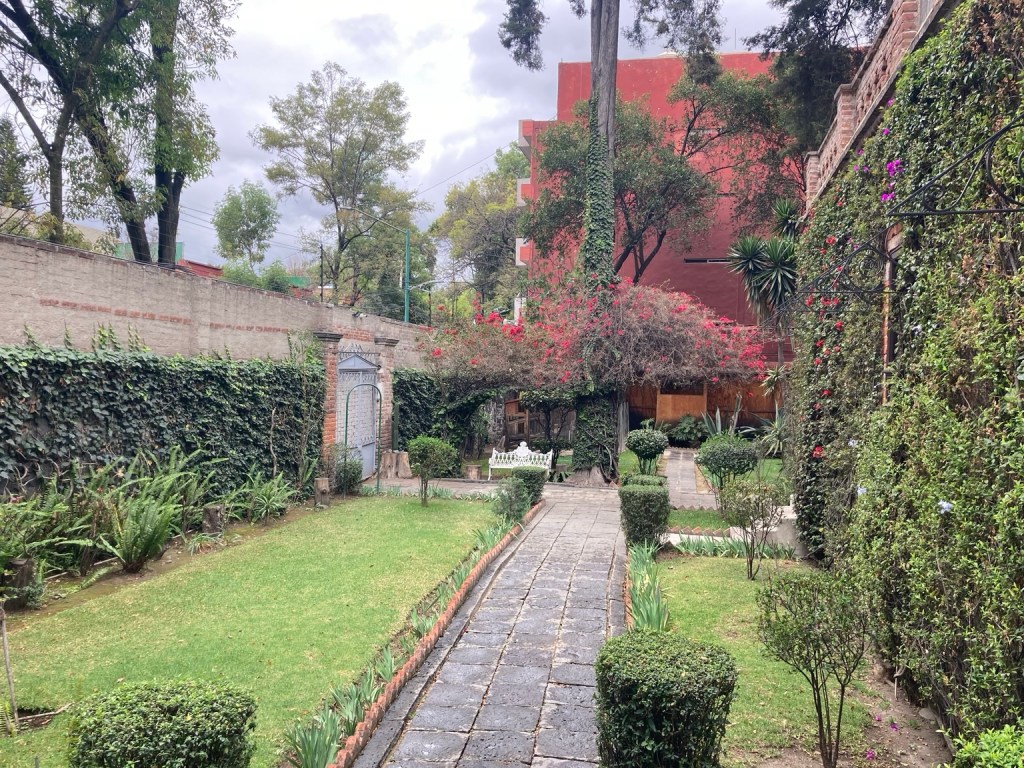
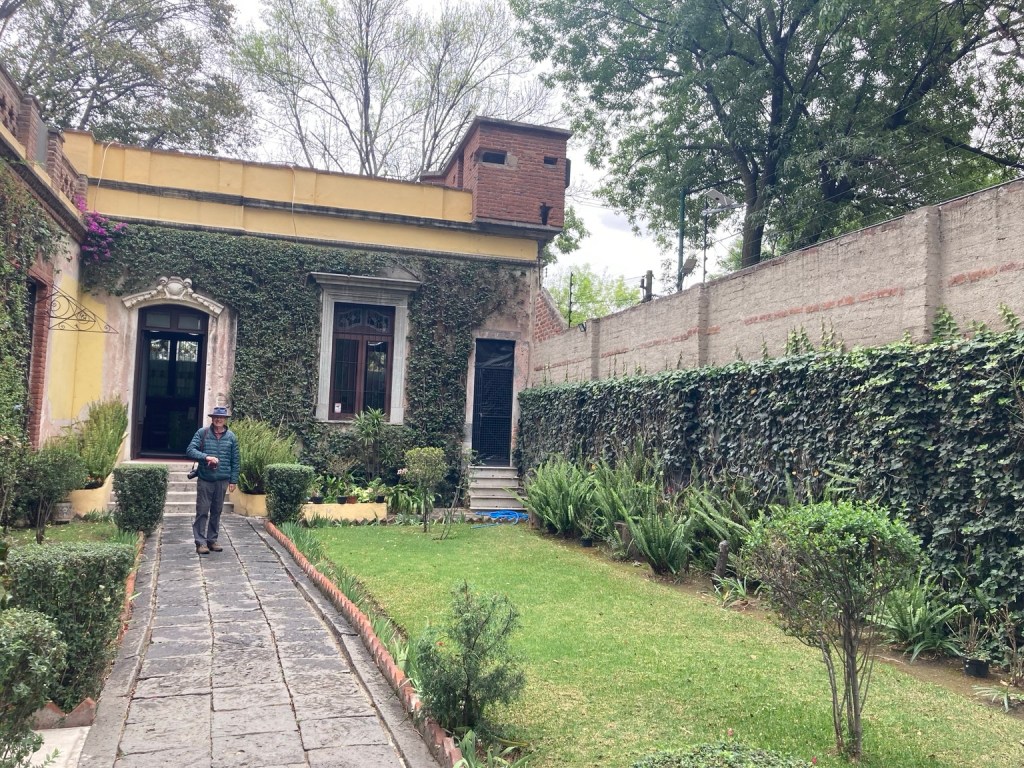
Garden pics show the high walls and guard posts, but it was not enough as he was later assassinated by a soviet agent.
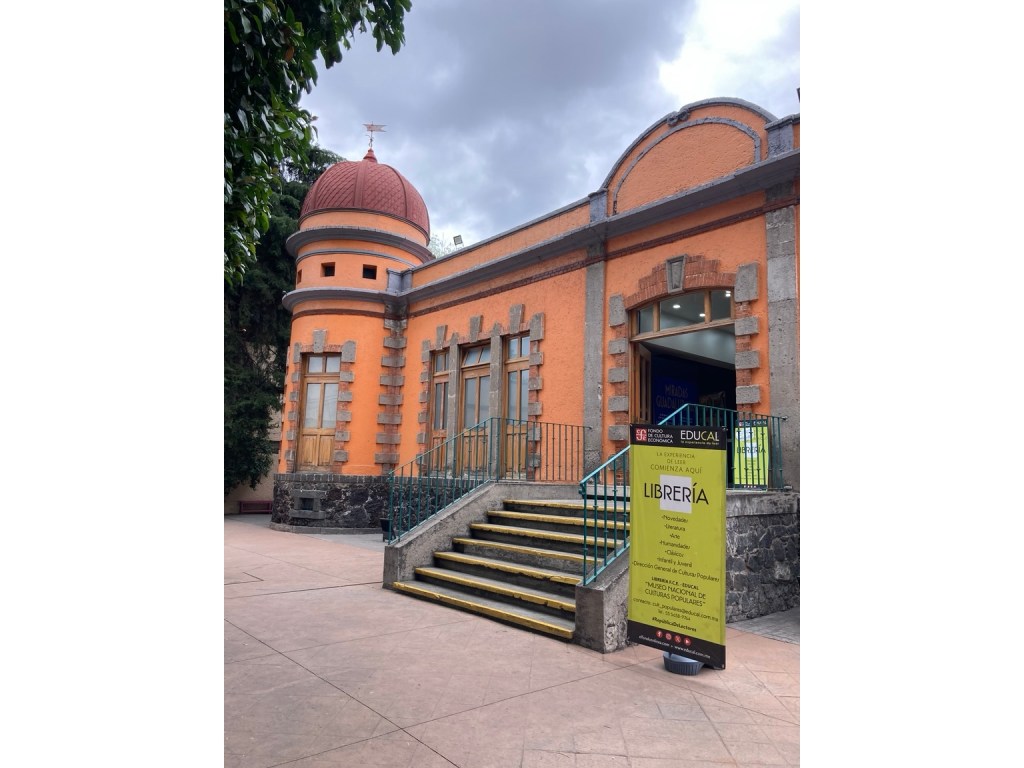
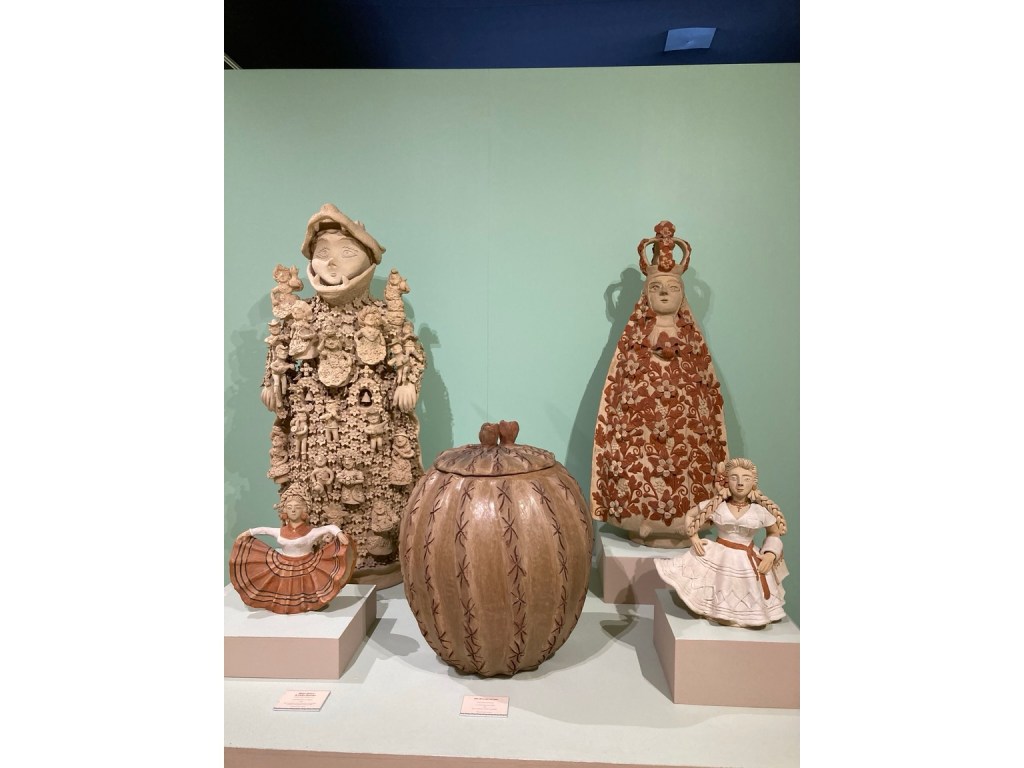
The last place to visit was the National Museum of Popular Culture which showcases Mexico’s cultural and ethnic diversity …
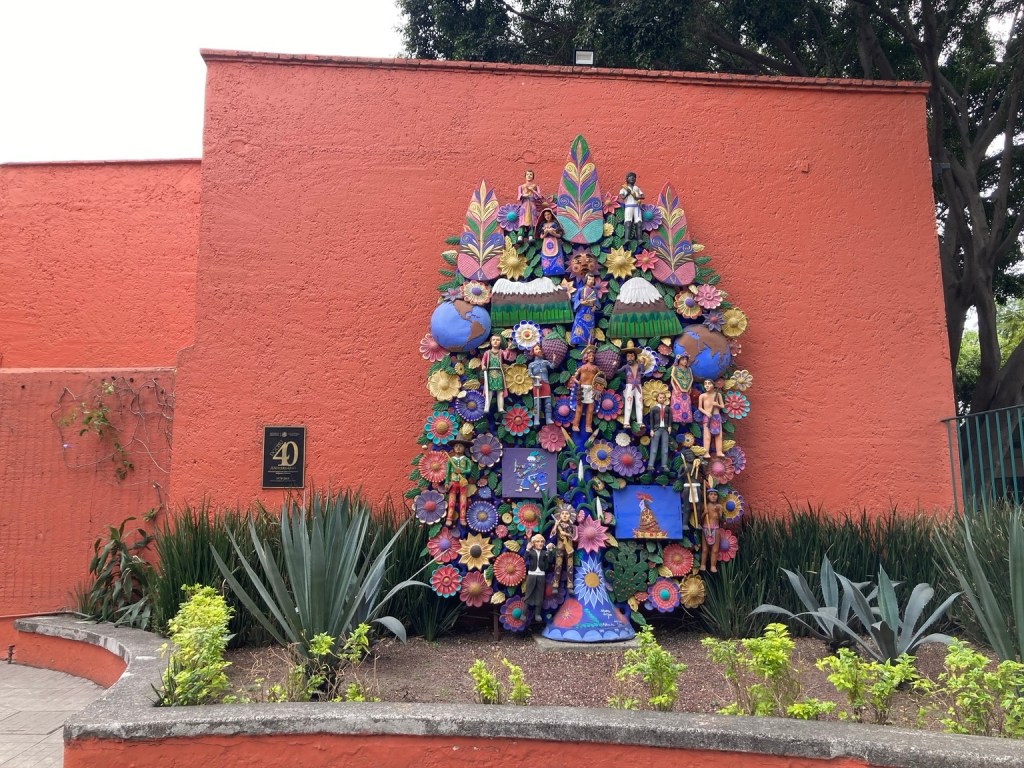
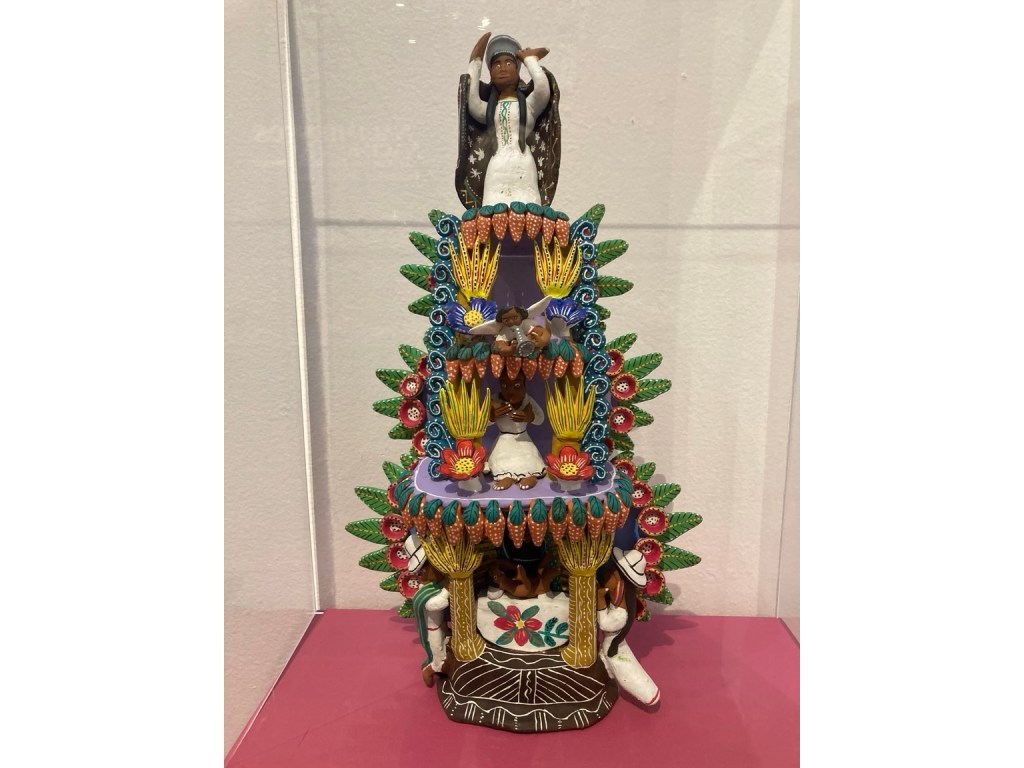
… and outside is a Tree of Life honouring the 500th anniversary of the arrival of Columbus.
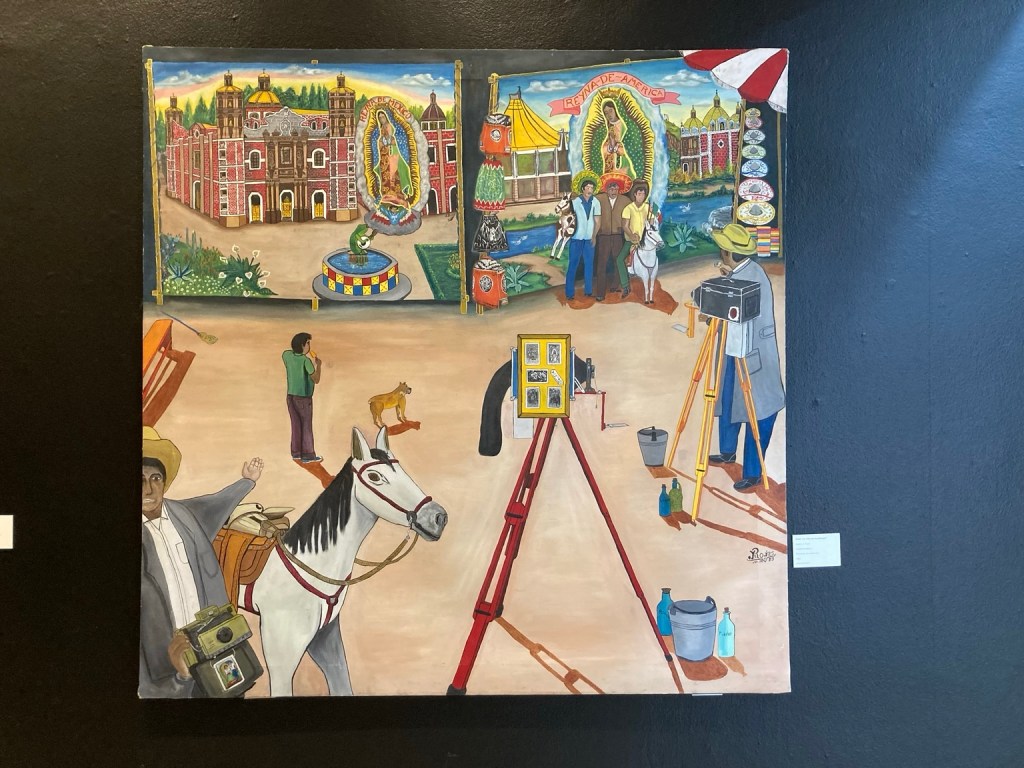
Exhibits included an exploration of Our Lady of Gualaloupe in art …
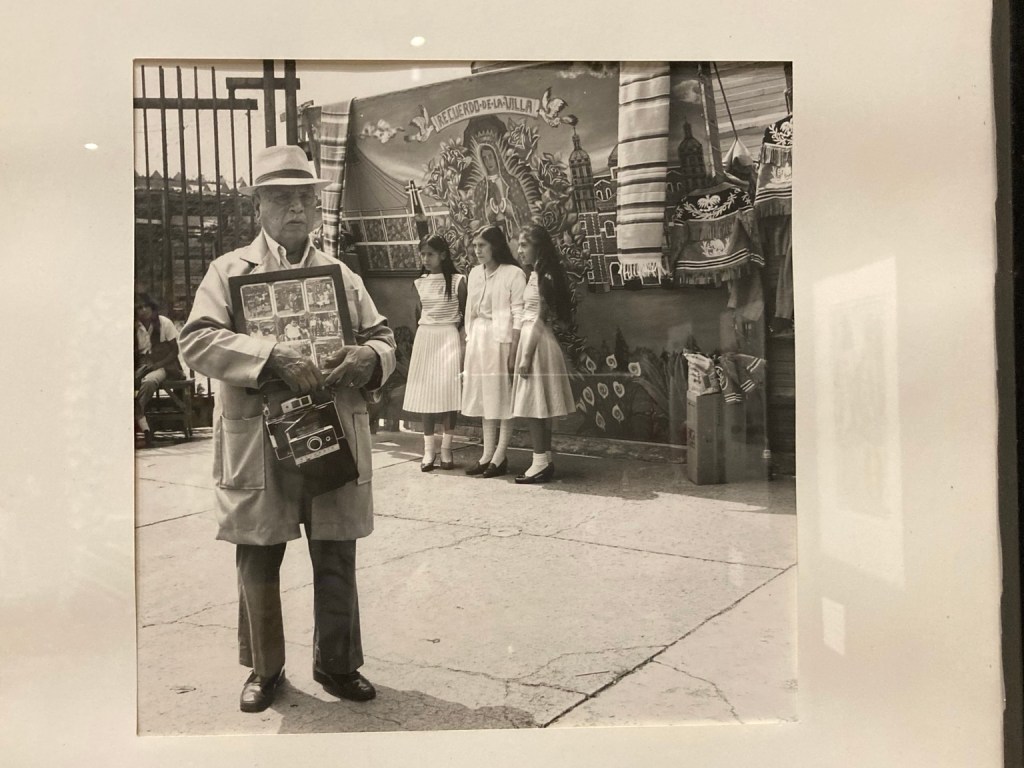
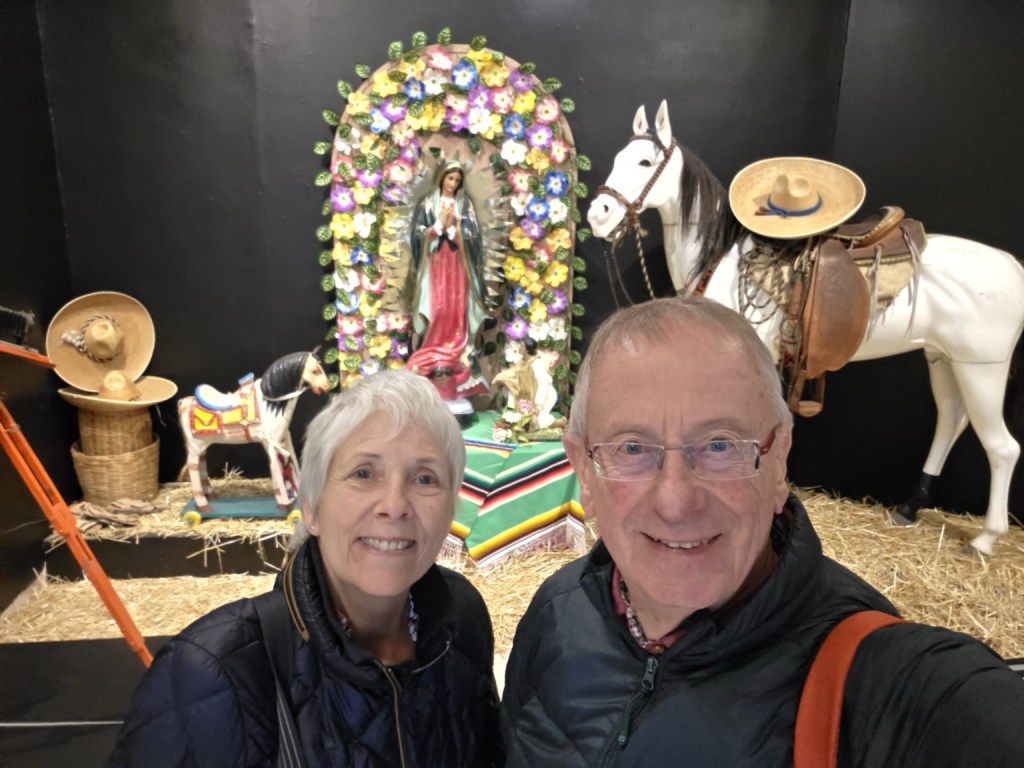
… which even gave us a chance to make our own image …
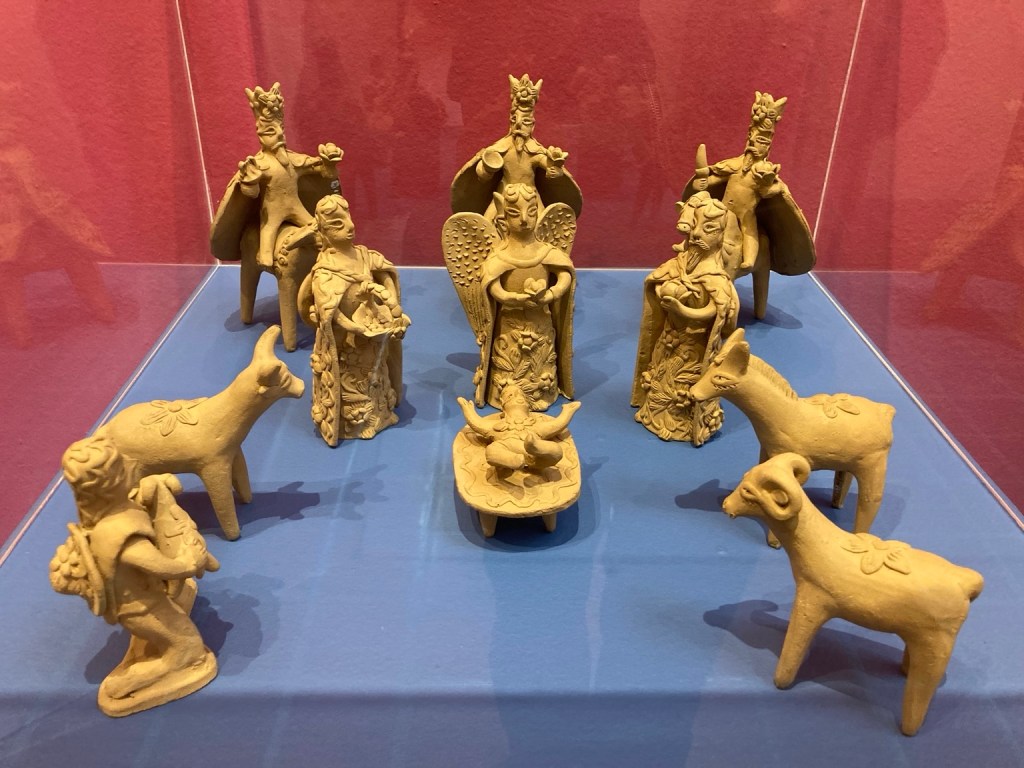
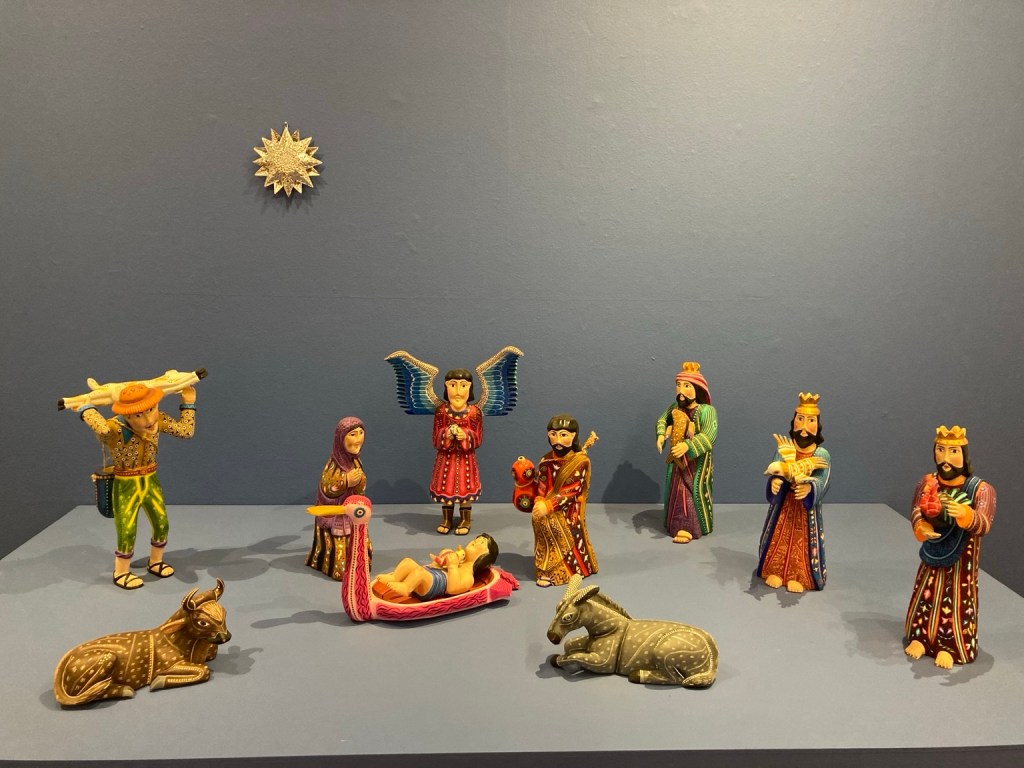
… nativity scenes made of many materials …
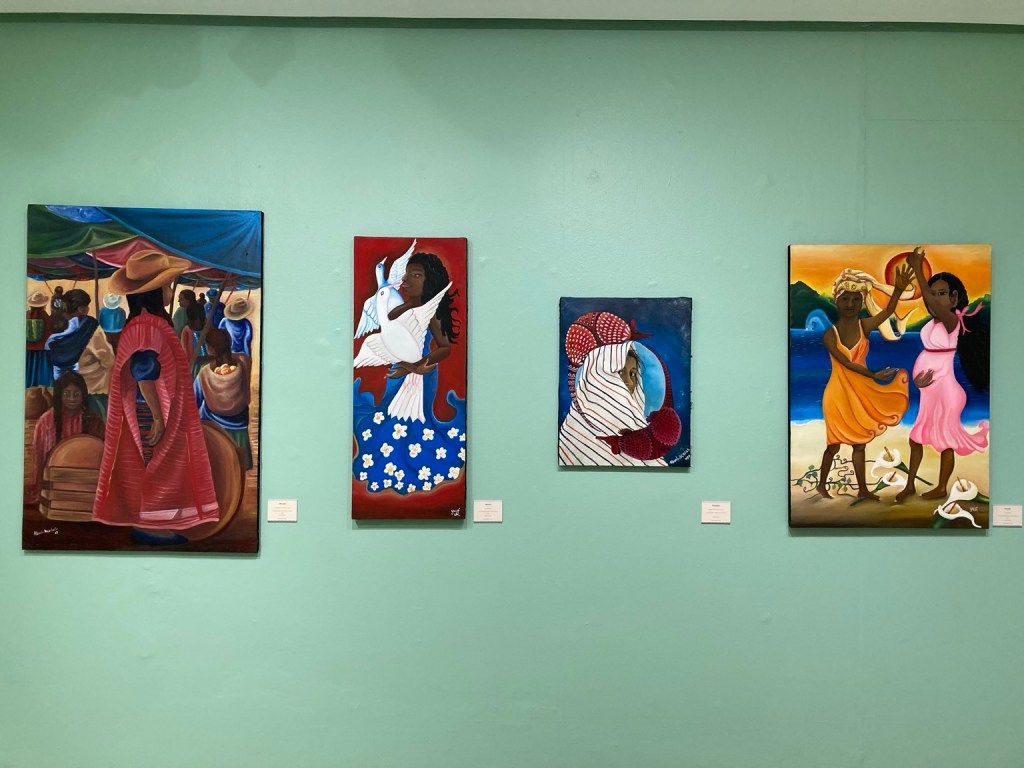
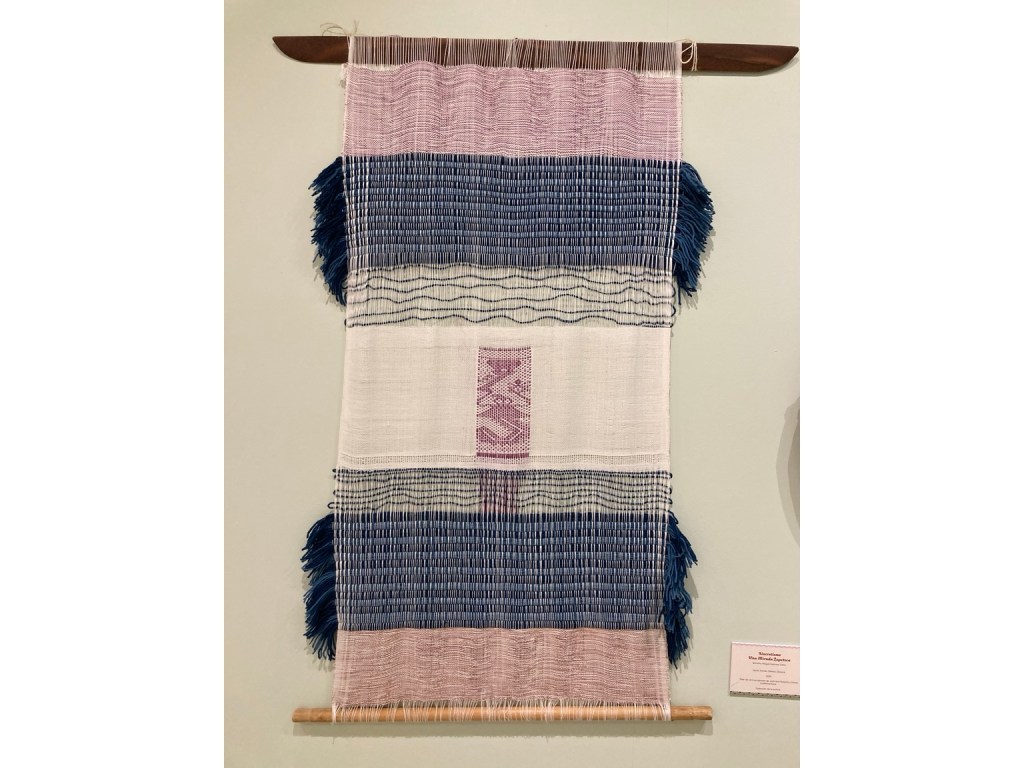
… and art made by women.
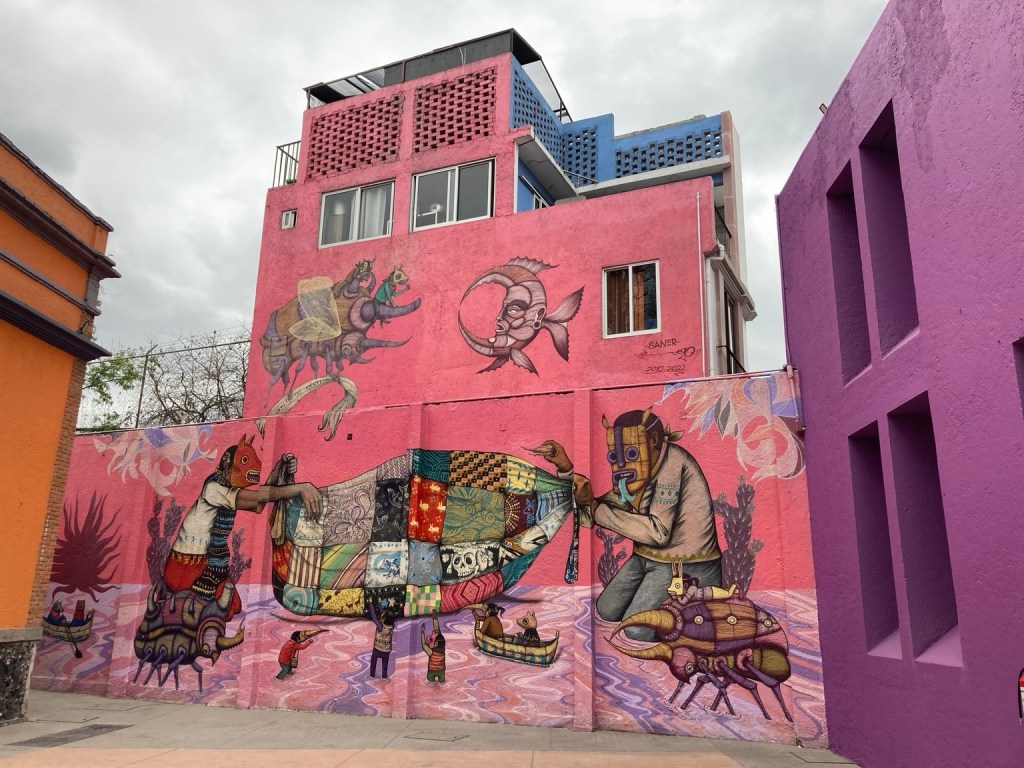
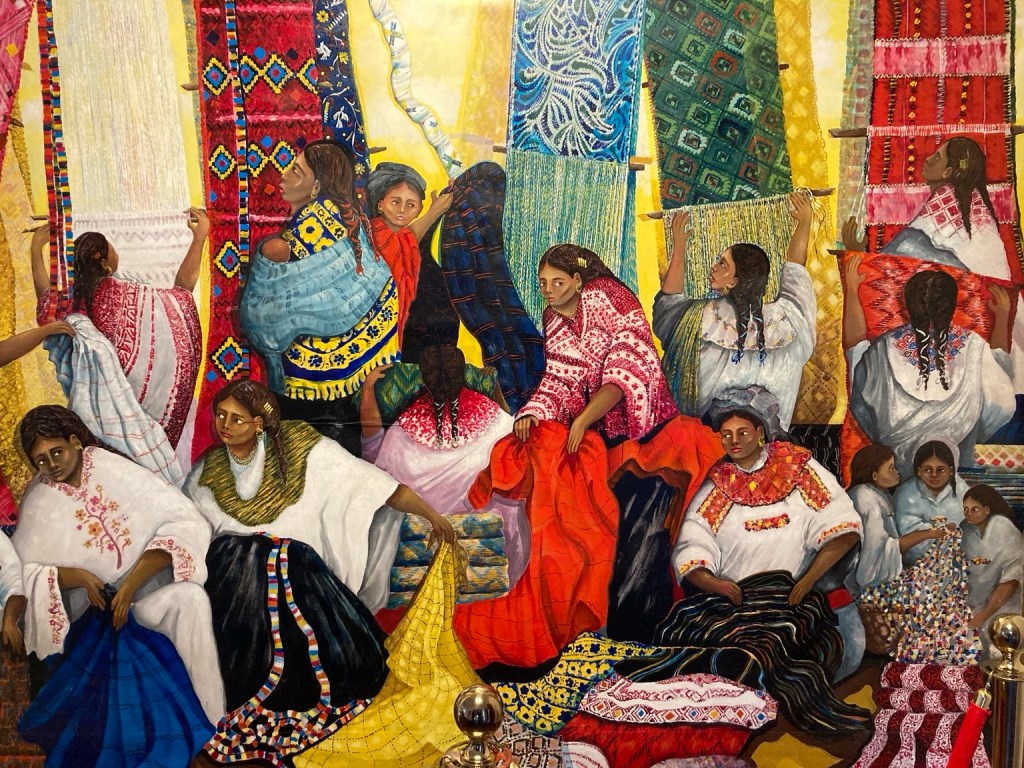
This huge graffiti style mural in the courtyard called Weavers of Dreams, shows the evolution of Mexican folk art which can now be influenced by pop-art like comics and robots.
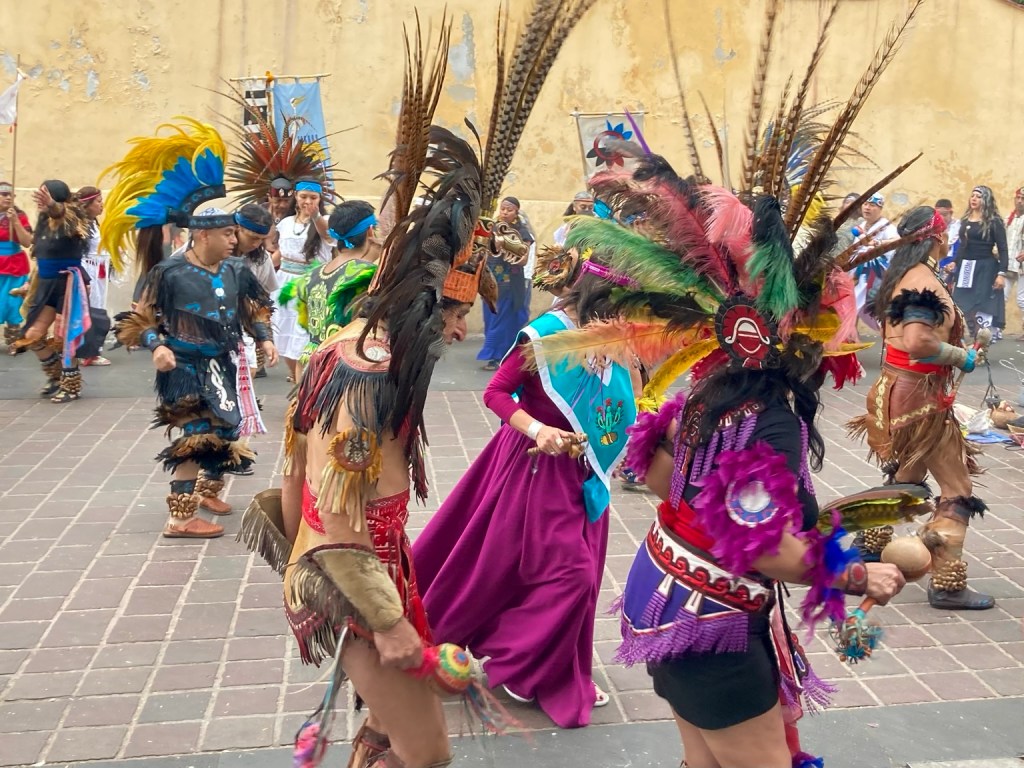
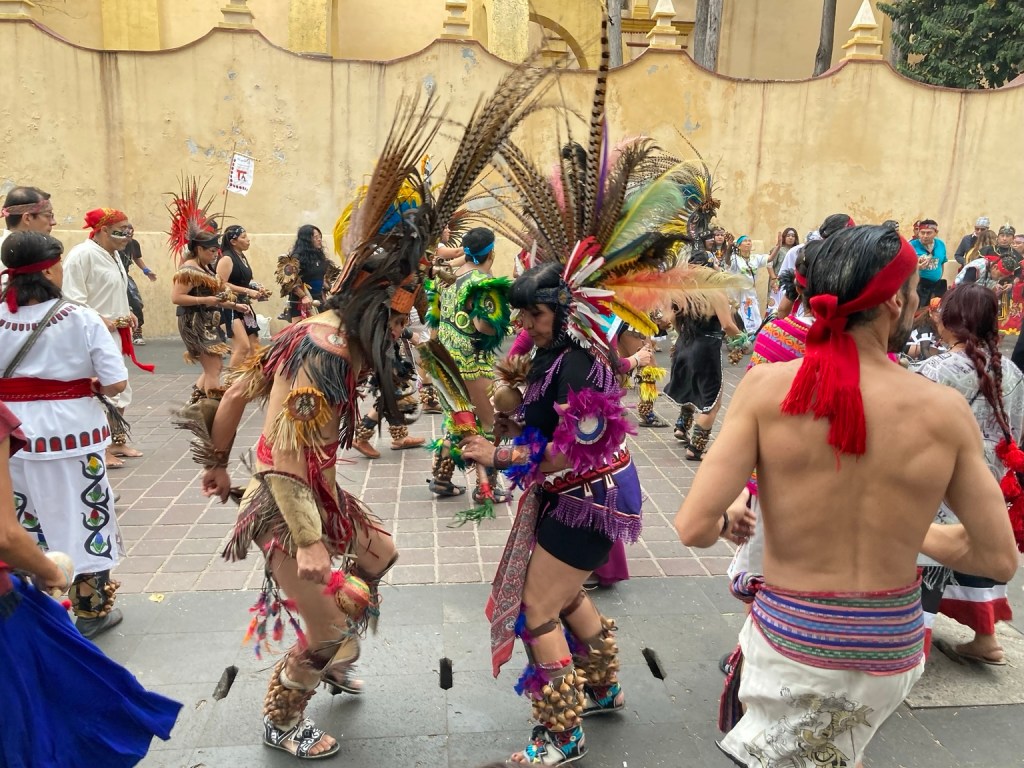
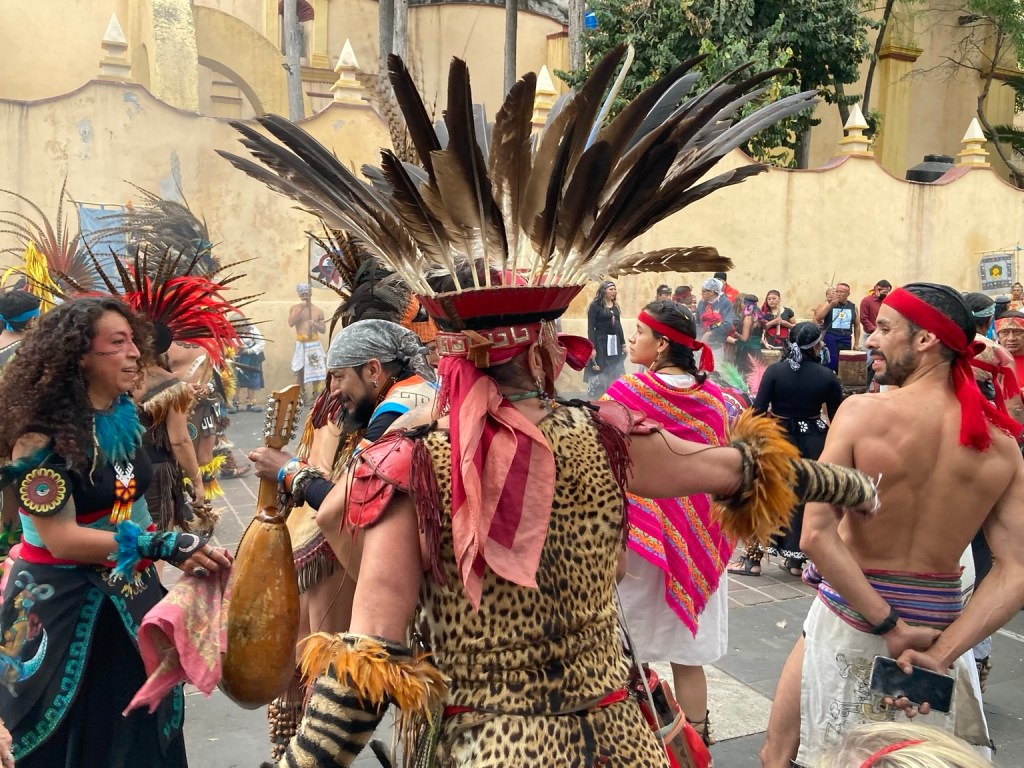
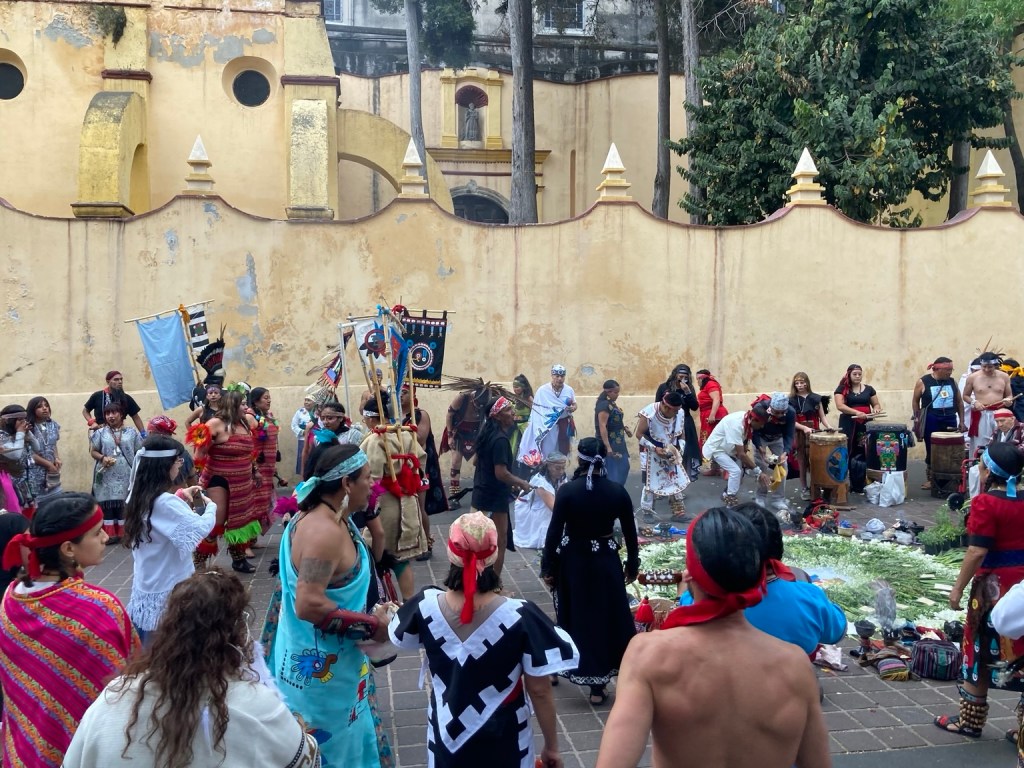
As we left, we could hear rhythmic drumming, and as we reached the plaza, we found a group of maybe 200 Concheros or Aztec dancers outside the church, using dance and ritual to connect with their indigenous roots, with an offering of plants and flowers in the centre … a spectacular finale for our trip.
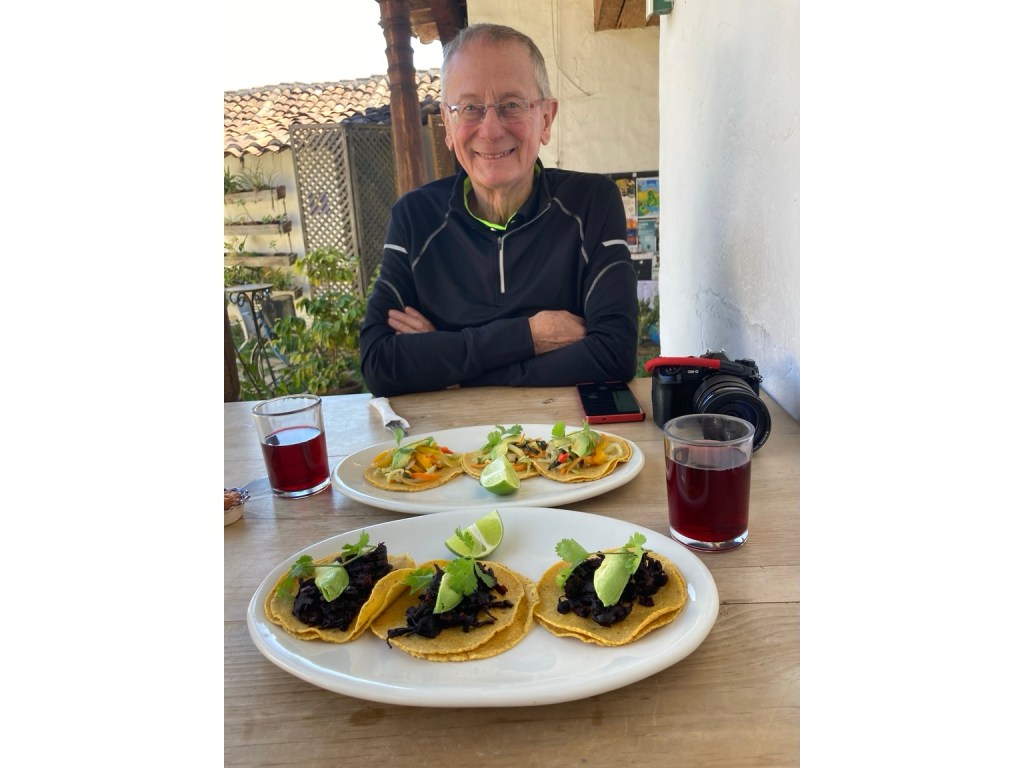
The main thing we’ve learnt is that they can be big or small, flat or folded, crispy or soft and called tacos, enchiladas, tostadas, quesadillas, sopes, tlayudas, chilaquiles, burritos … but they are all just tortillas, the one thing all Mexicans have in common apart from Our Lady of Guadeloupe.
We’ve tried the lot – and that’s before we get onto the filling or topping or sauce – so you can see why a month just wasn’t enough to try them all!
It wasn’t until we were home that we learned of the cartel violence breaking out when El Mencho, Mexico’s most wanted man, was fatally injured during capture by the military. Concentrated in western states, tourists were asked to stay inside and some flights were cancelled, so we timed our return perfectly.
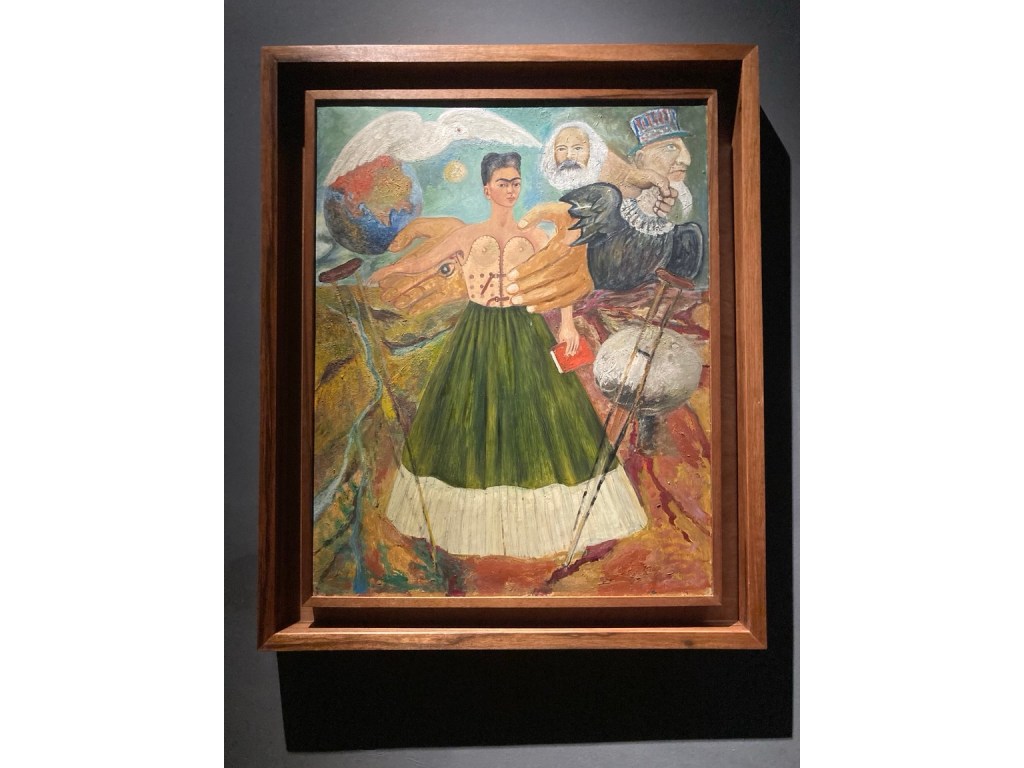
The one thing we missed was the Museo Dolores Olmedo with its extensive collection of paintings by Diego and Frida as it has been closed since Covid. The only bright side is that 14 works are coming to Tate Modern in the summer for ‘Frida – Making of an Icon’ so that’s something to look forward to.
Our taco trail ticked all the boxes, including lots of pyramids, colonial towns, arts & crafts, margaritas and sunshine. What’s more, all has gone according to plan with fab buses which were more spacious than an aeroplane!
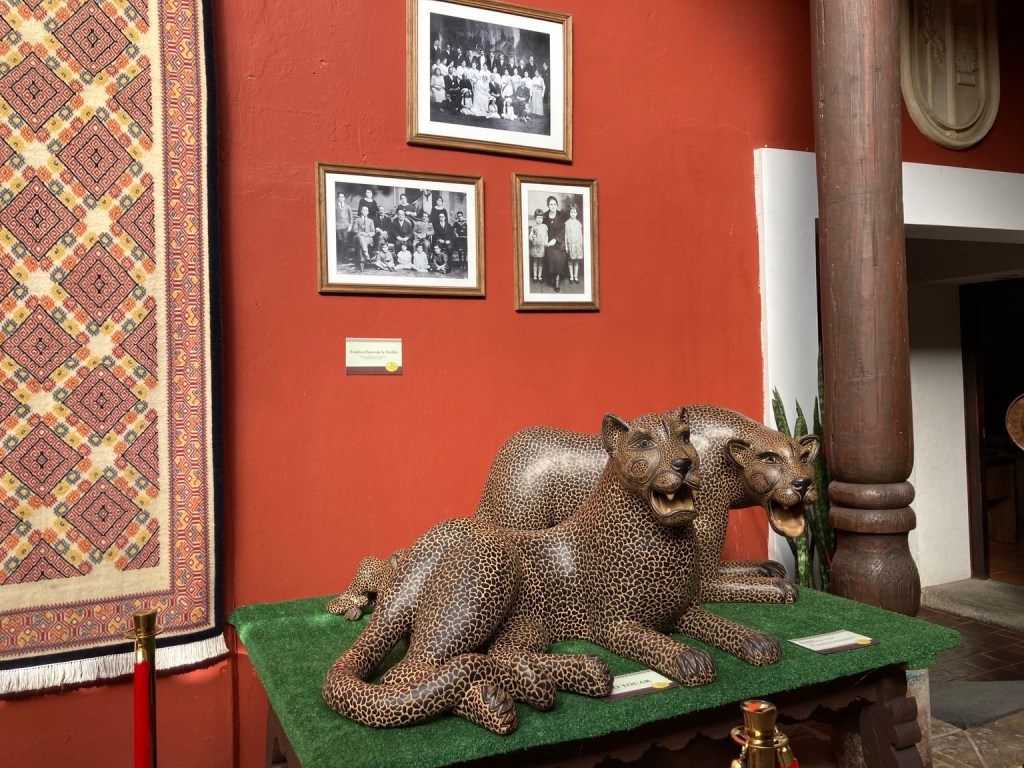
Despite limiting ourselves to carry on to make life simpler, we still had room to bring back our very own woven coffee mats, a whistle that sounds like a jaguar, chocolate, the mezcal miniatures we didn’t actually drink and a turquoise spoon that will go beautifully on the kitchen wall and remind us of Casa Azulejo and Frida Kahlo.
And it has definitely been slow enough, with space and time to take it all in and enjoy la buena vida … the good life!
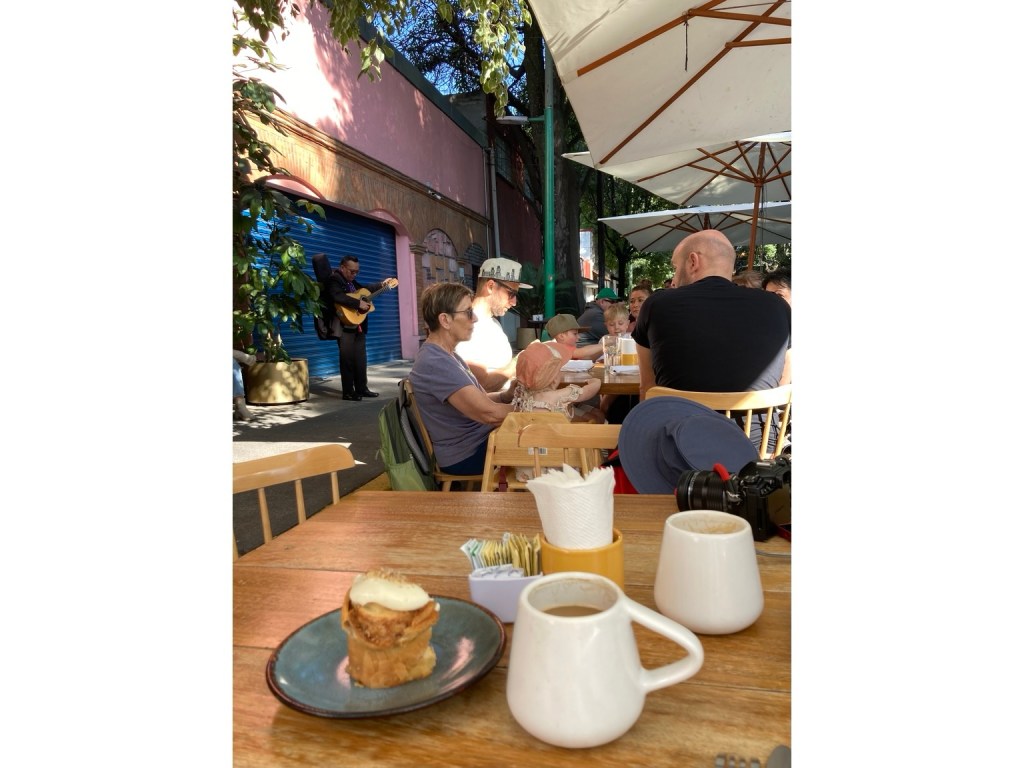
Next day we were focused and popped just down the road for breakfast at Croasan and were lucky to get the last table in the sunshine. When I ordered a poached egg with mushrooms, bacon and Parmesan I was surprised to find my egg in a bowl surrounded by a wonderful mushroom broth, but I was delighted I’d picked it as it was such a well crafted bowl of yuminess! Chris had a spinach and cheese omelette so was was prepared for the day Popeye style and we even had tunes while we ate.
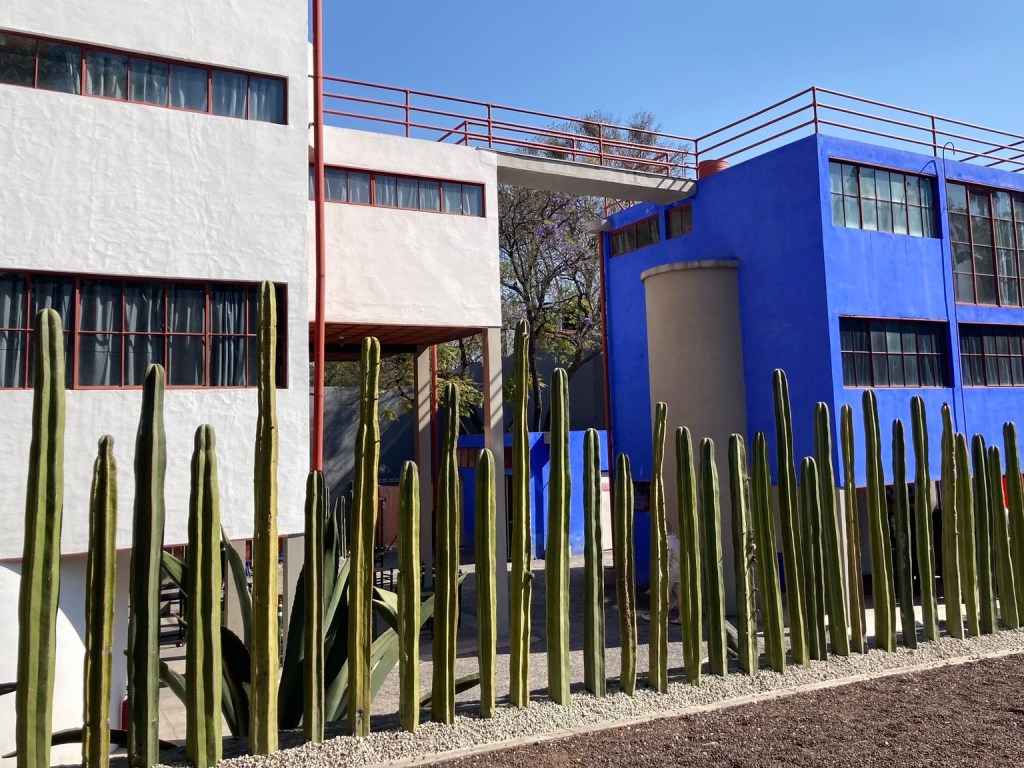
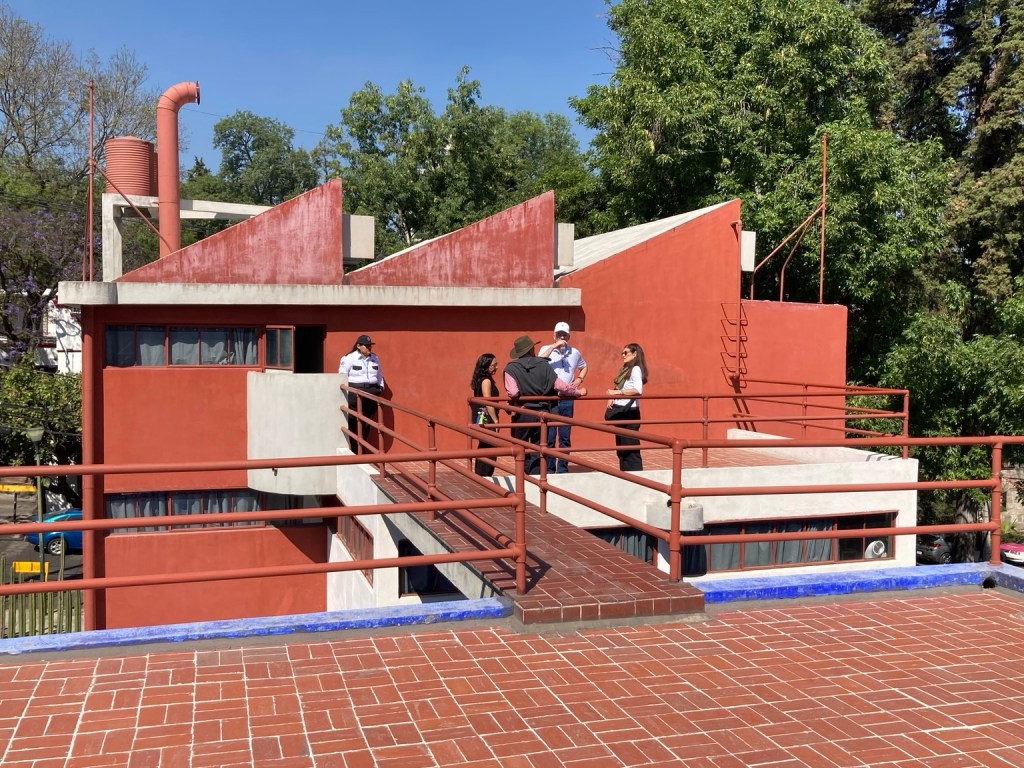
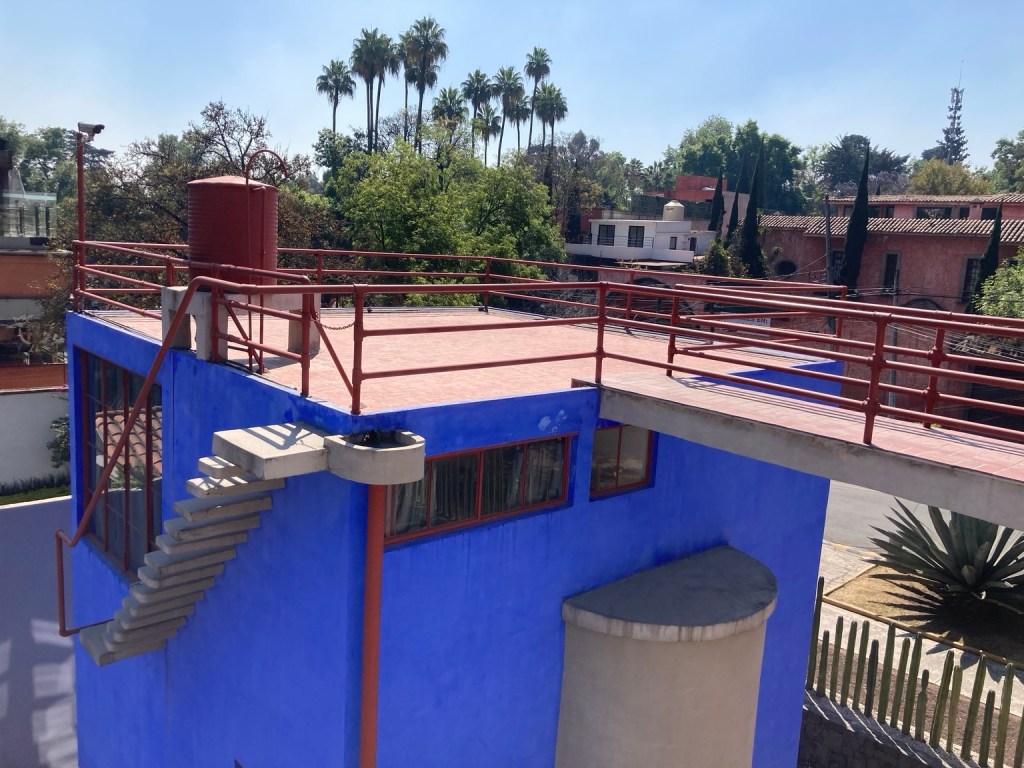
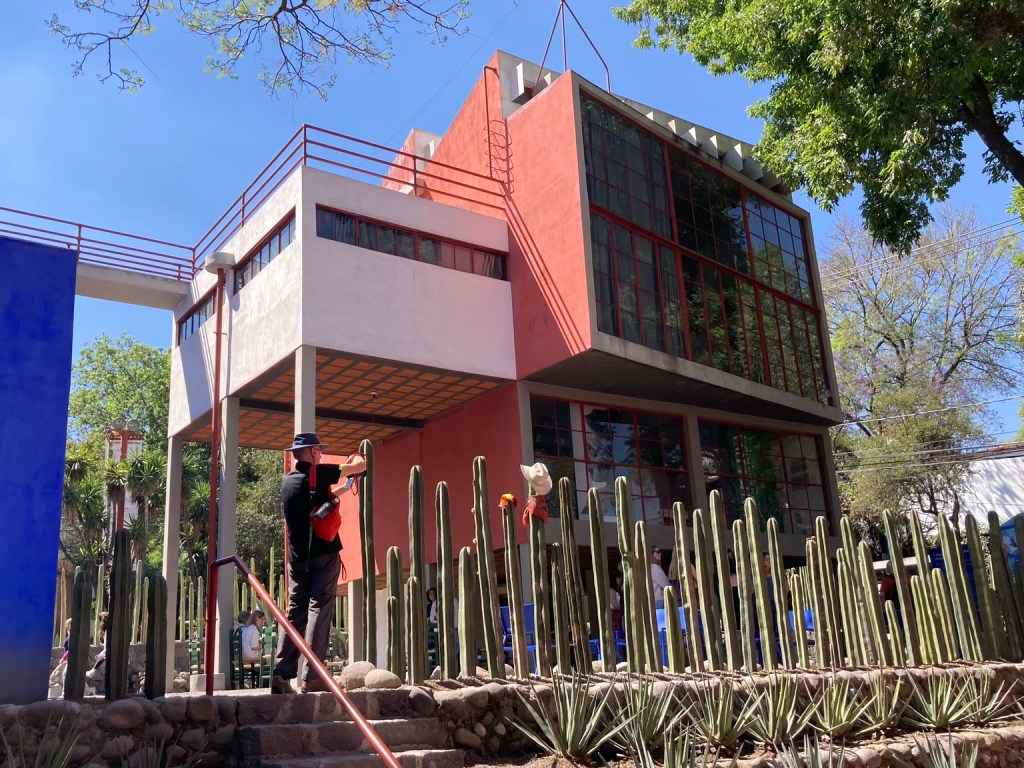
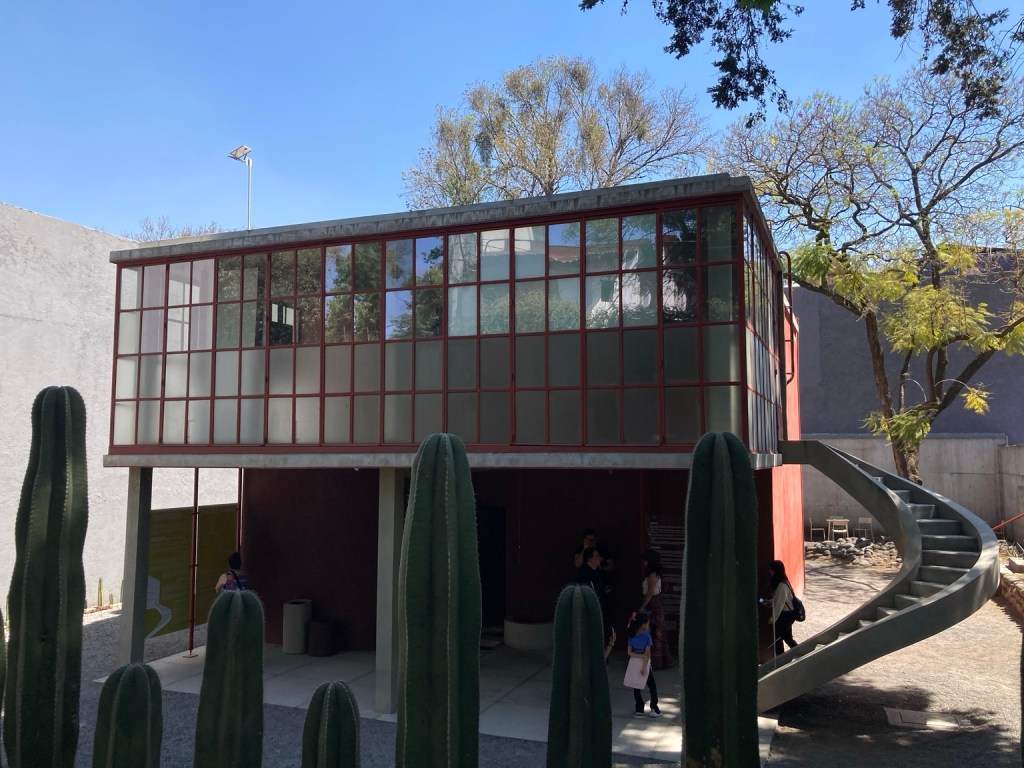
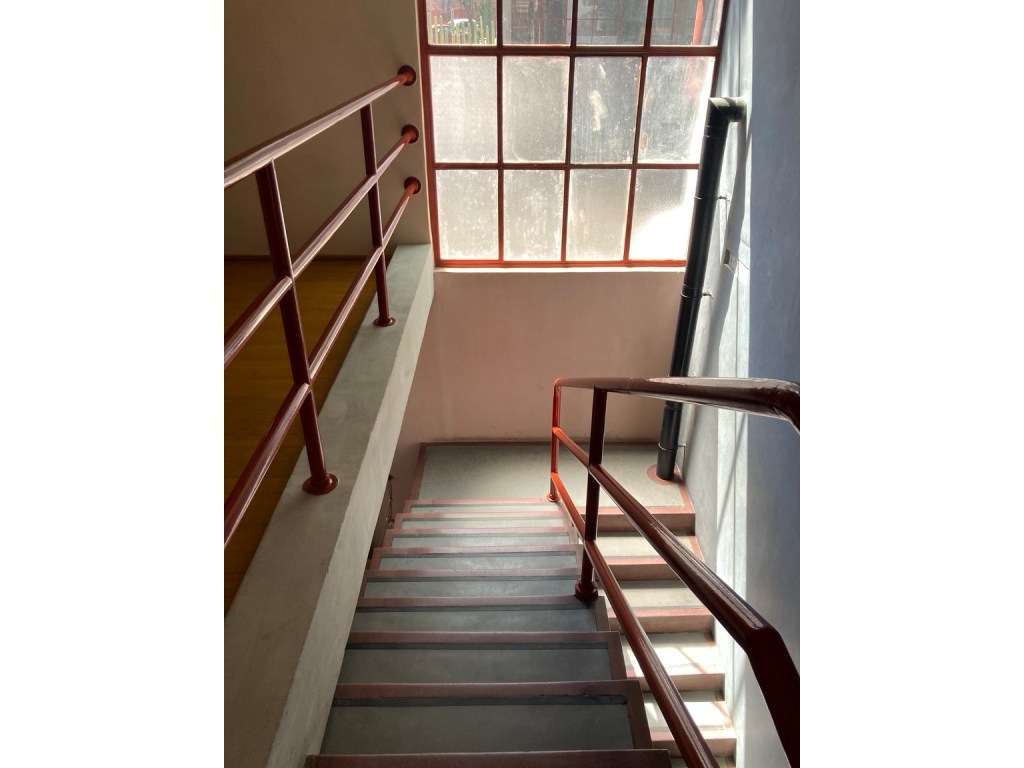
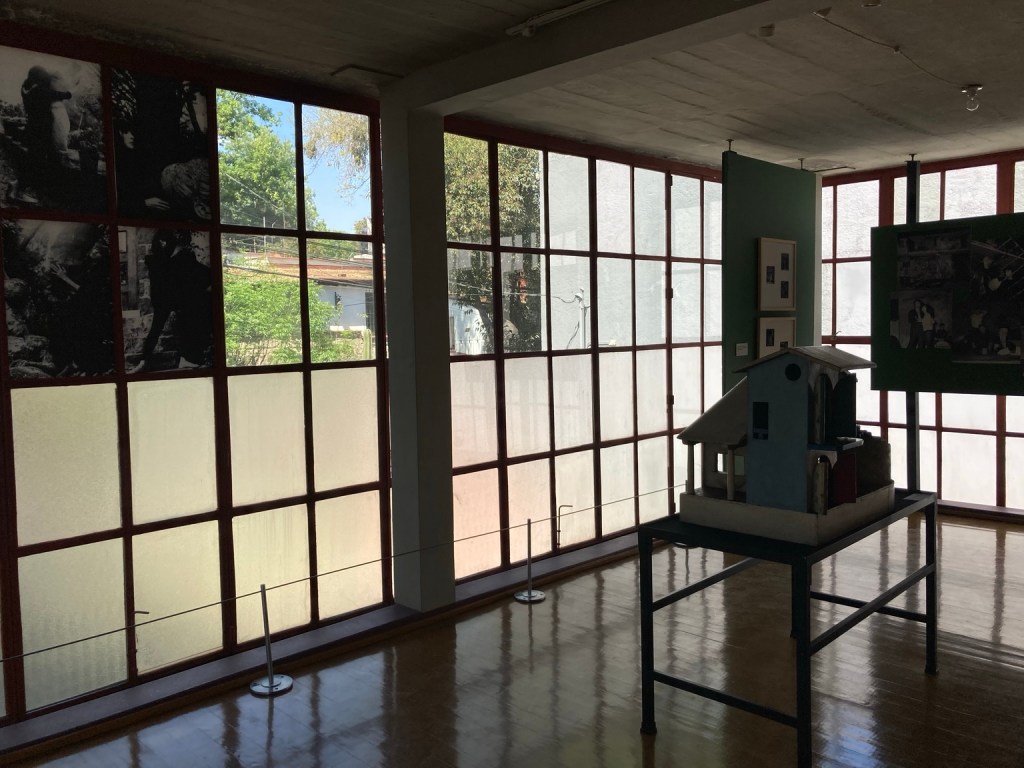
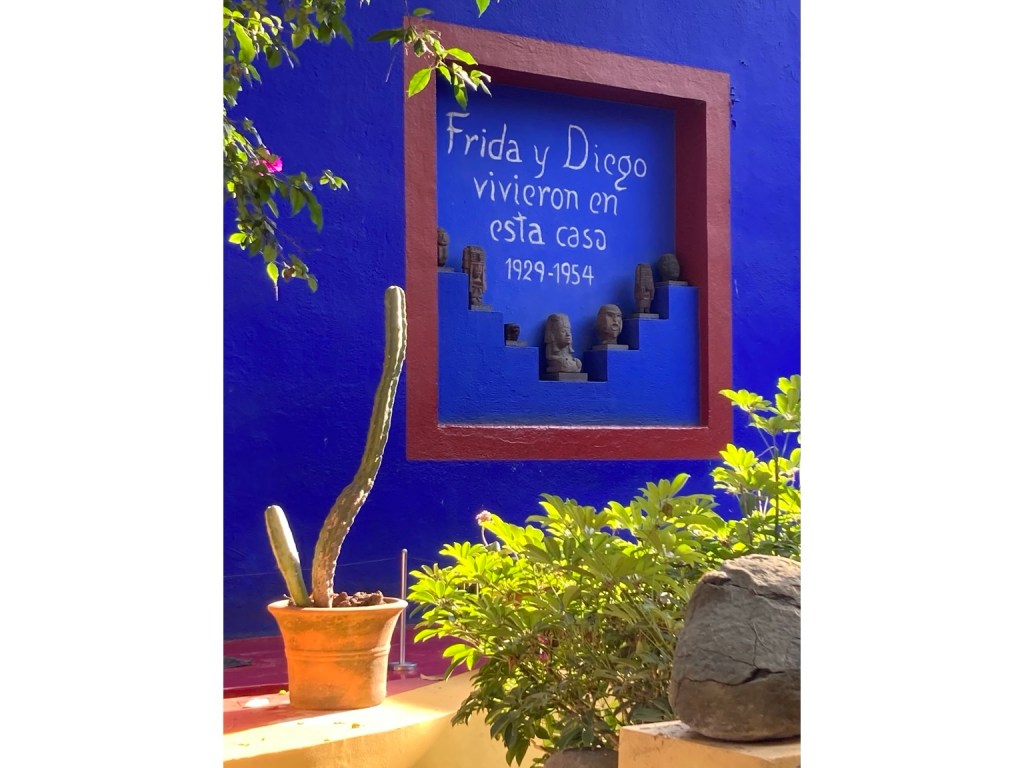
In 1929 Juan O’Gorman built a house based entirely on functionalism as developed by Le Corbusier. It was the first building in Mexico that implemented a social architecture putting technique before aesthetics and this utilitarian style of building appealed to Diego Rivera, reminding him of the philosophy of the Russian constructivist movement. He commissioned Juan O’Gorman to build a house-studio for him and another for his wife Frida Kahlo, linked by a bridge which was built on the adjacent plot. All three buildings now form one museum.
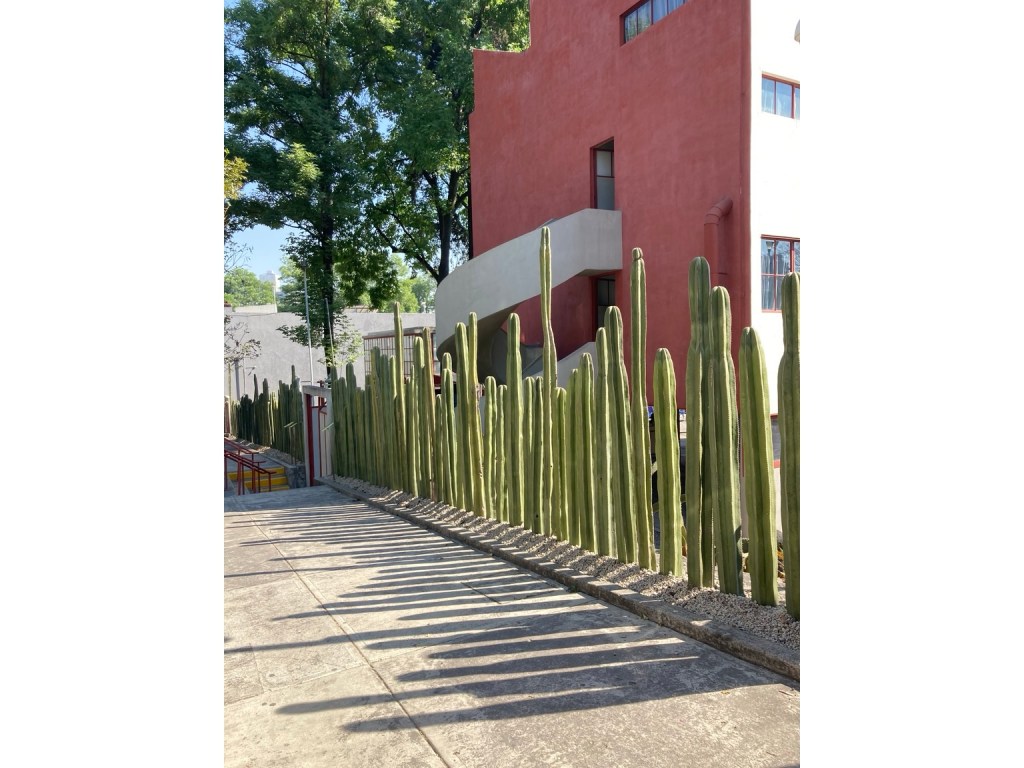
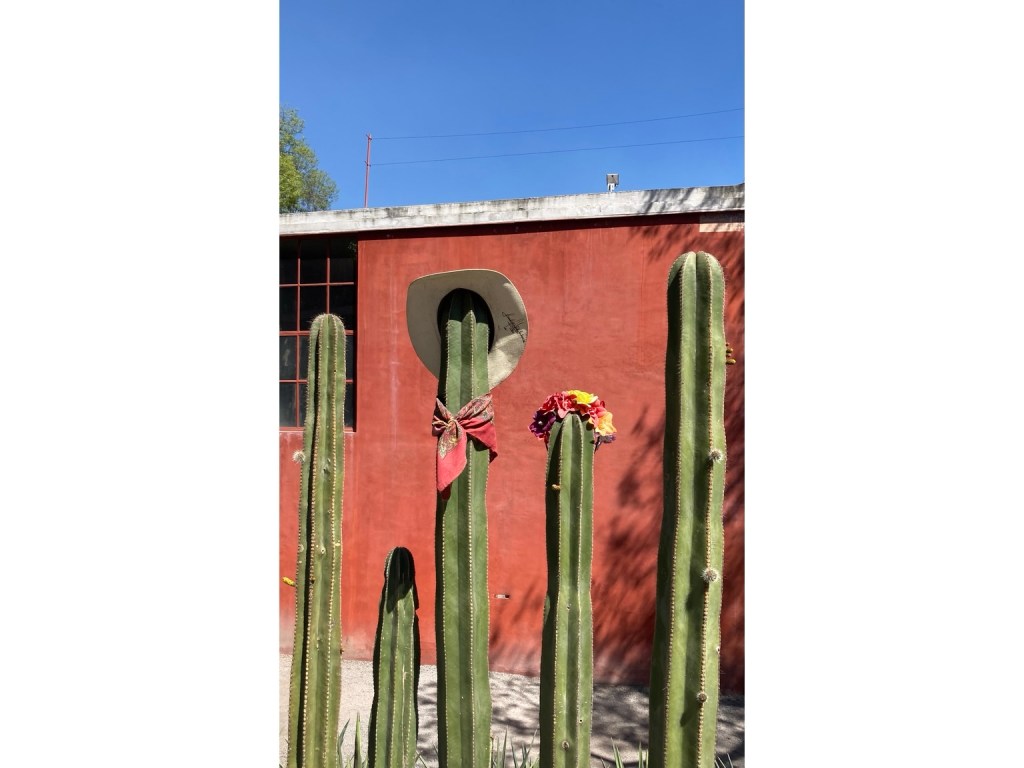
The first glimpse was of the famous cactus fence surrounding the property, and the vibrant walls beyond.
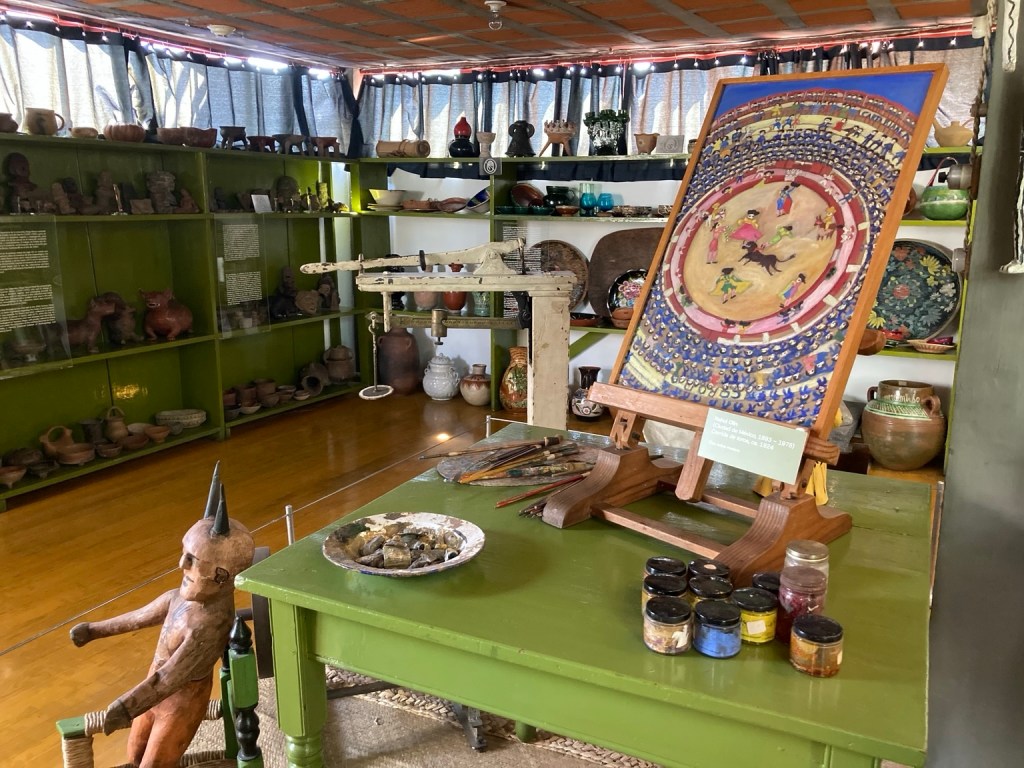
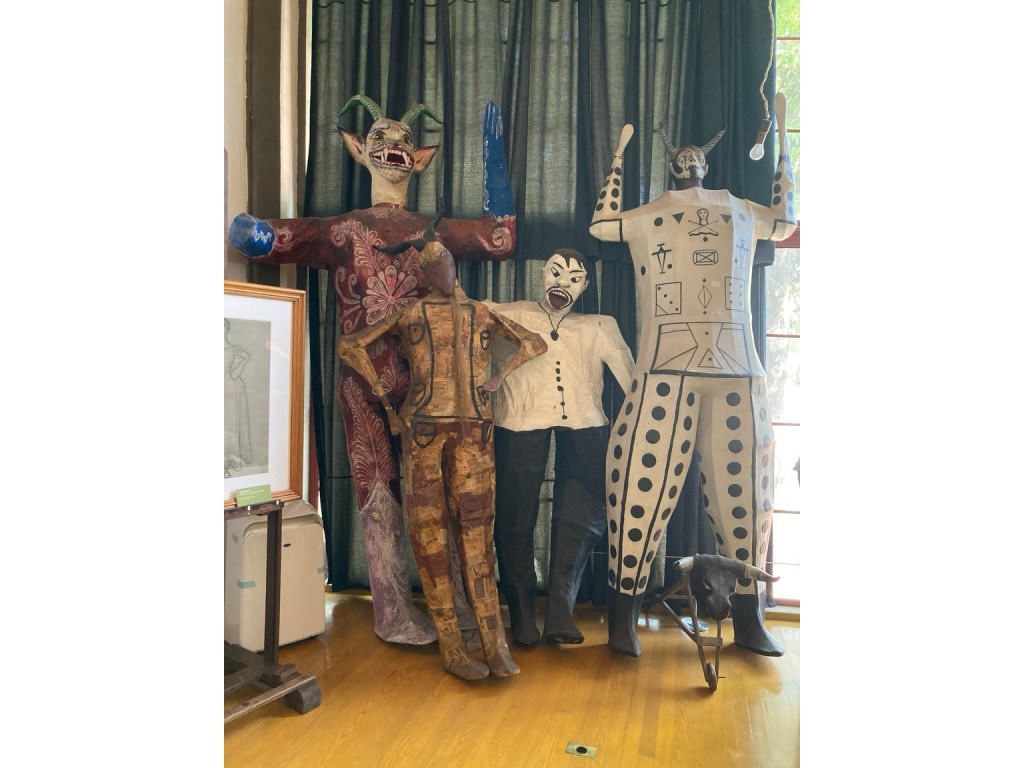
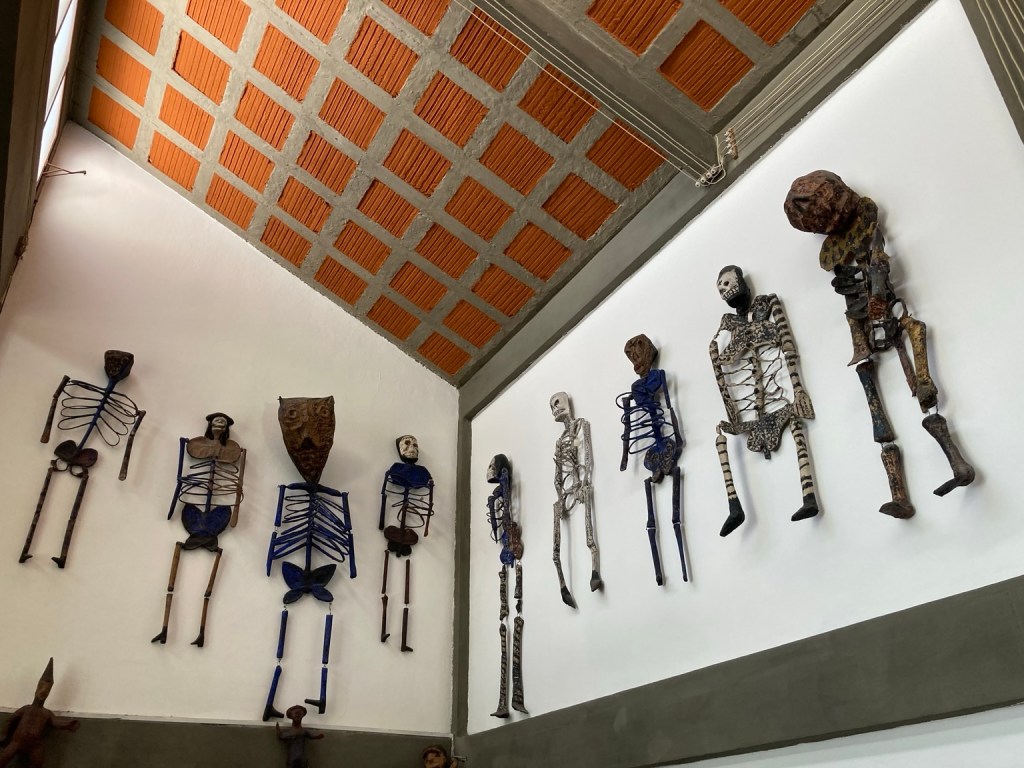
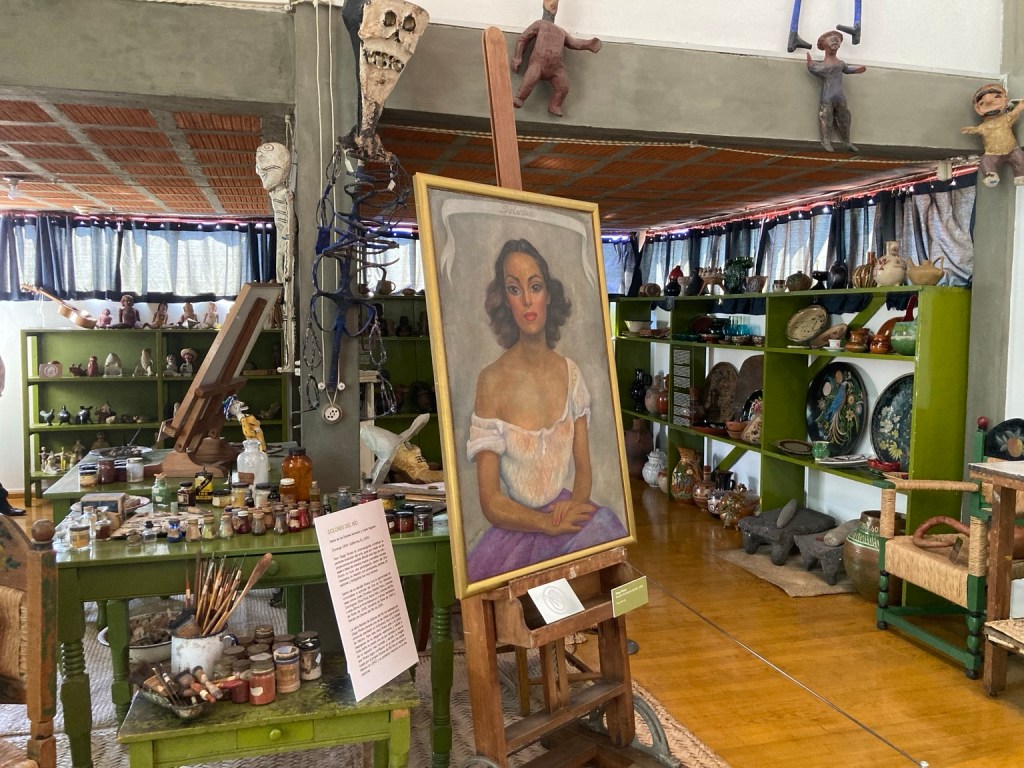
The main space in Diego’s house was his double height studio, and what a treasure trove it was, filled with personal items and almost as if he had just popped out.
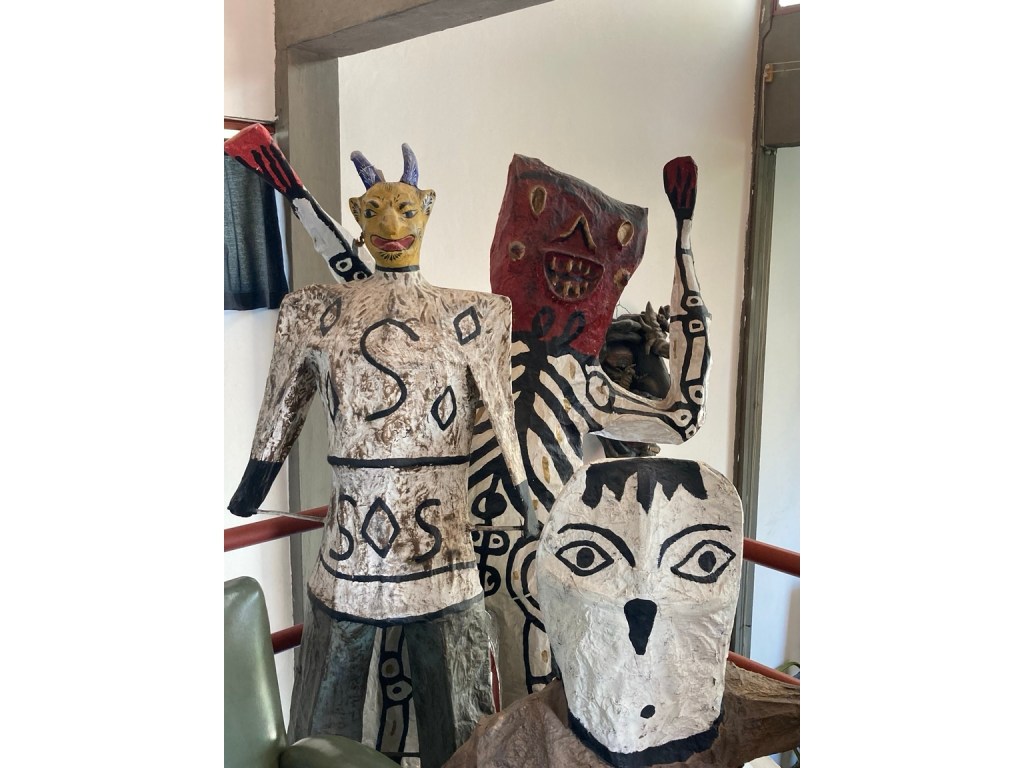
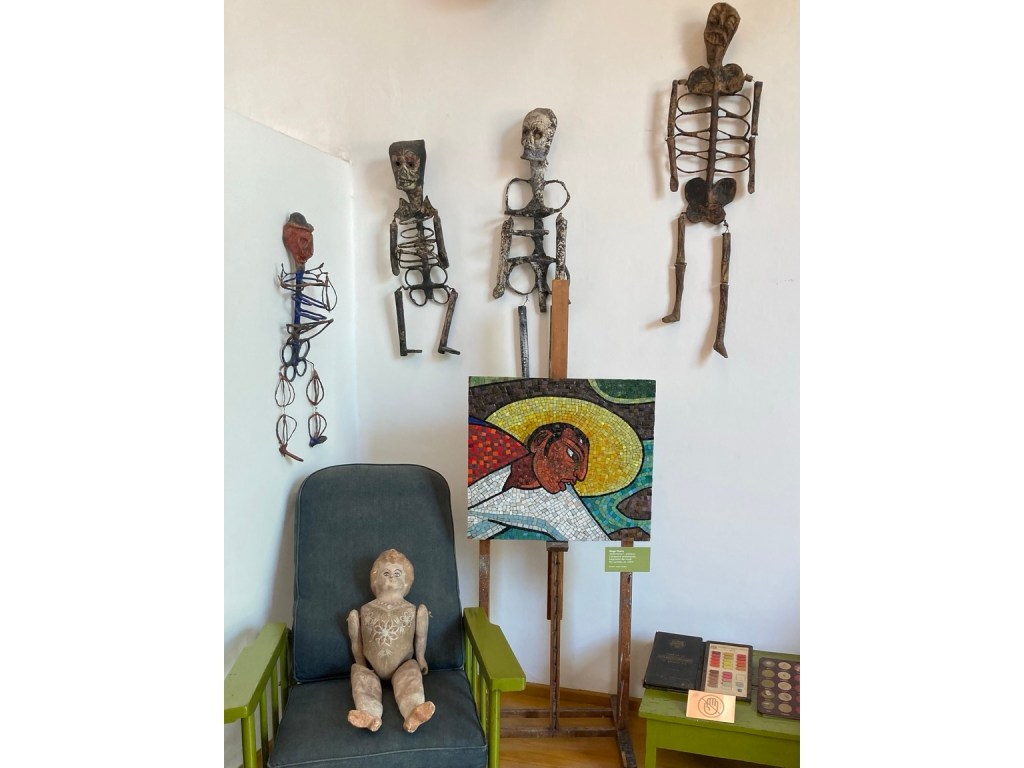
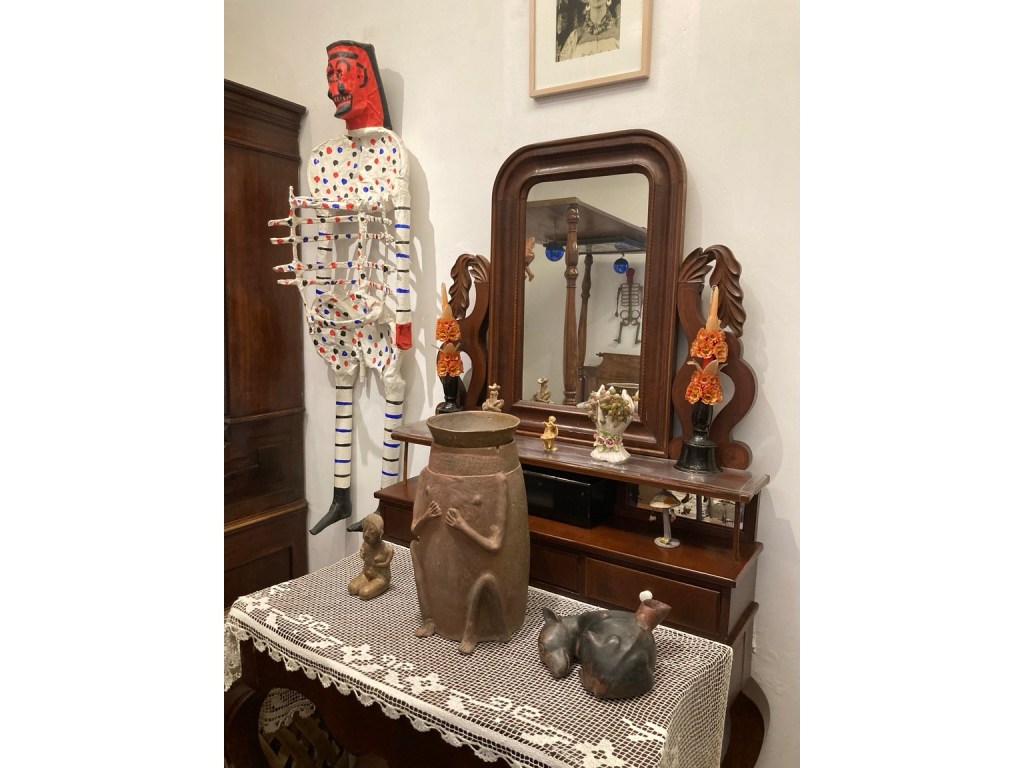
The huge skeletons and other figures are part of his judas collection – papier-mâché figures traditionally burned in Mexico during Holy Week to represent evil or, in this context, to serve as whimsical, satirical art.
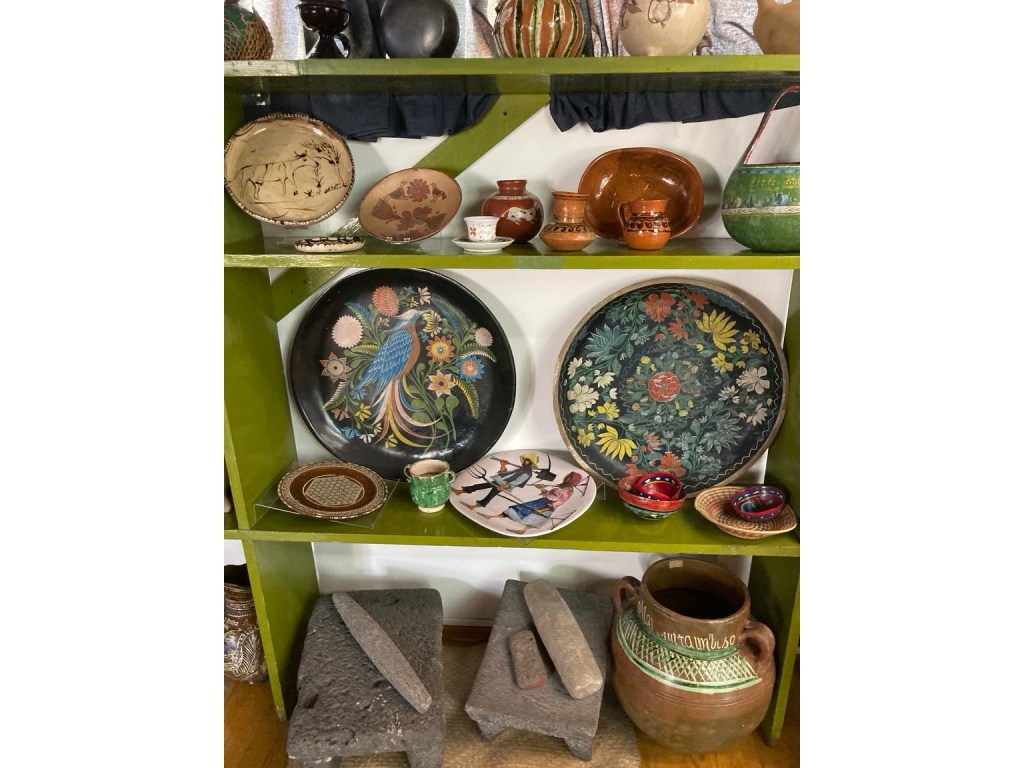
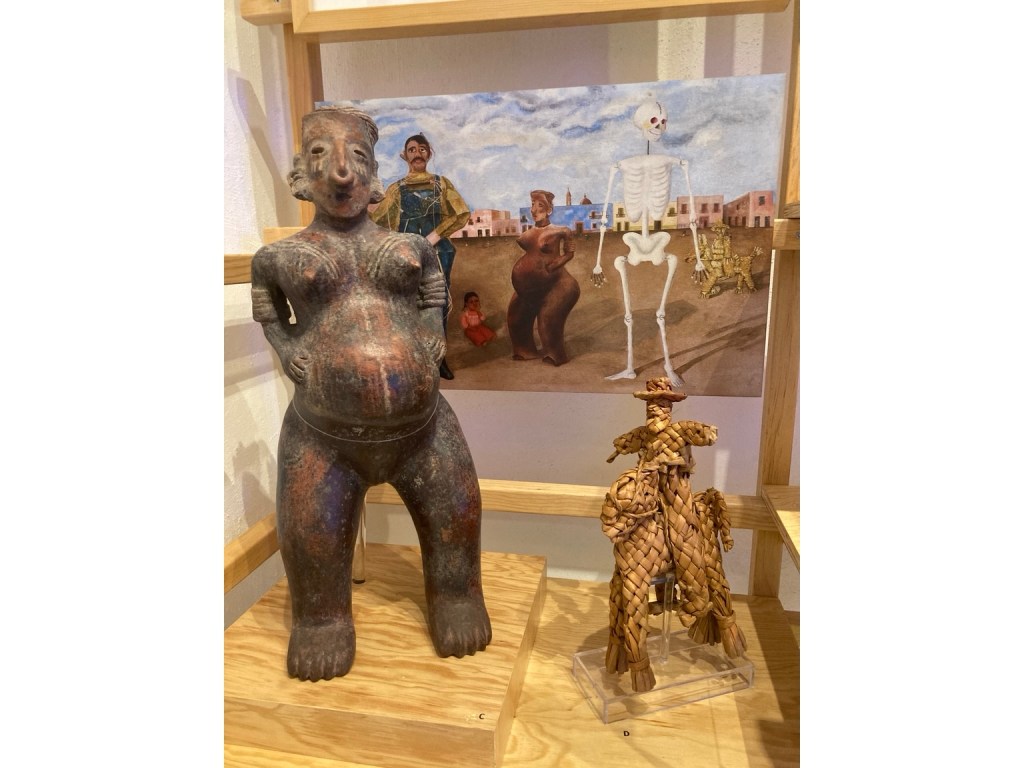
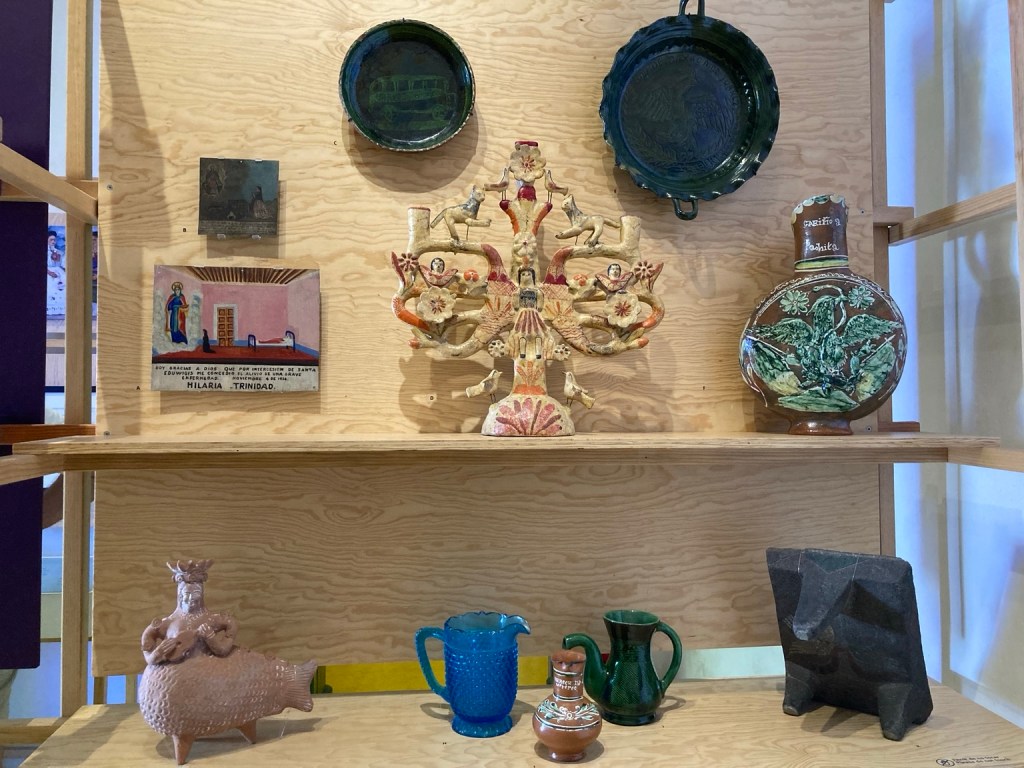
Diego had collected folk art since he spent his pocket money on small clay items as a child and he considered it more than just a tradition as it also showed contemporary expression.
Part of his pre-Hispanic collection is here too … and also shelves of pigments, natural pigments which his assistants would grind and mix.
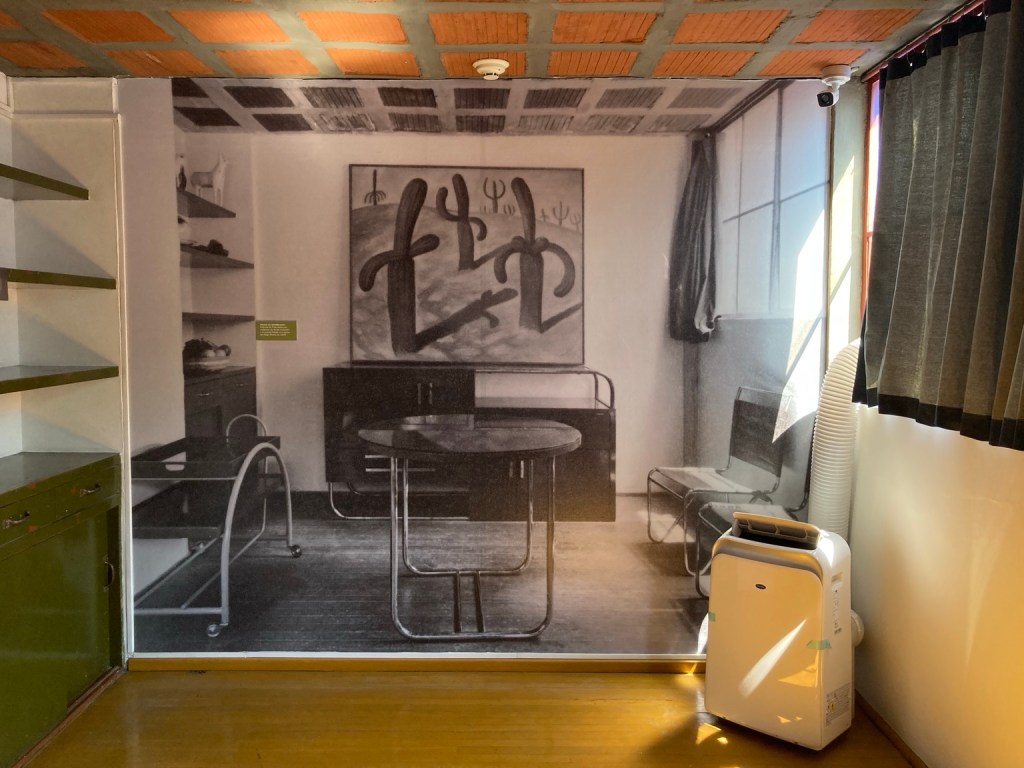
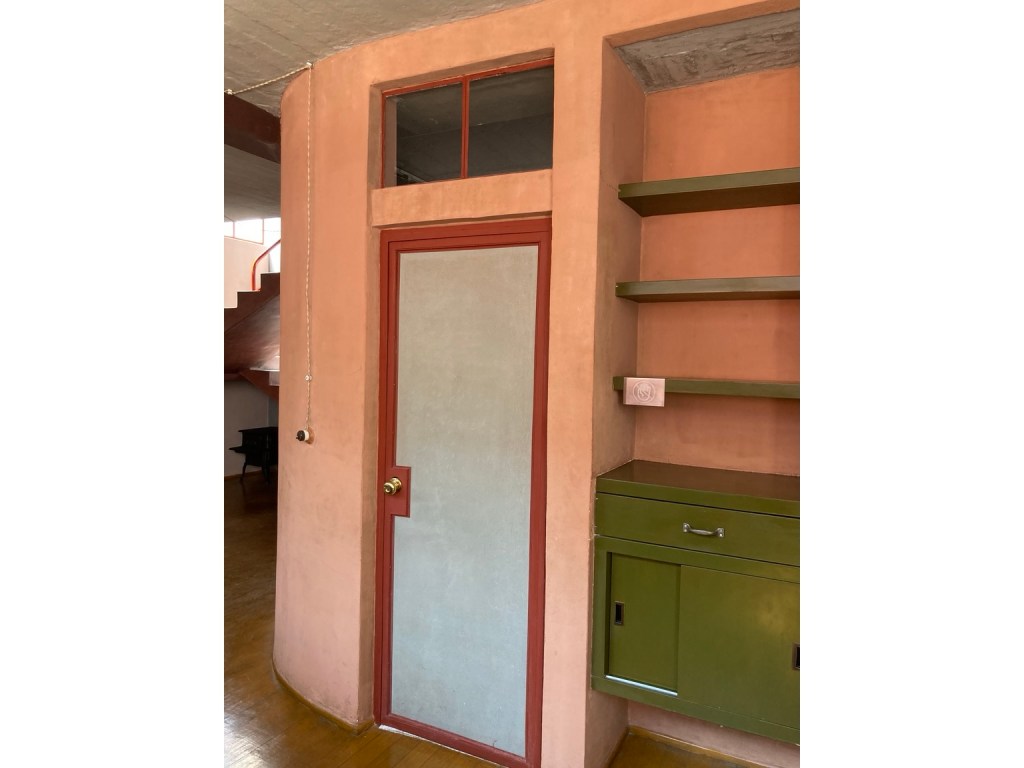
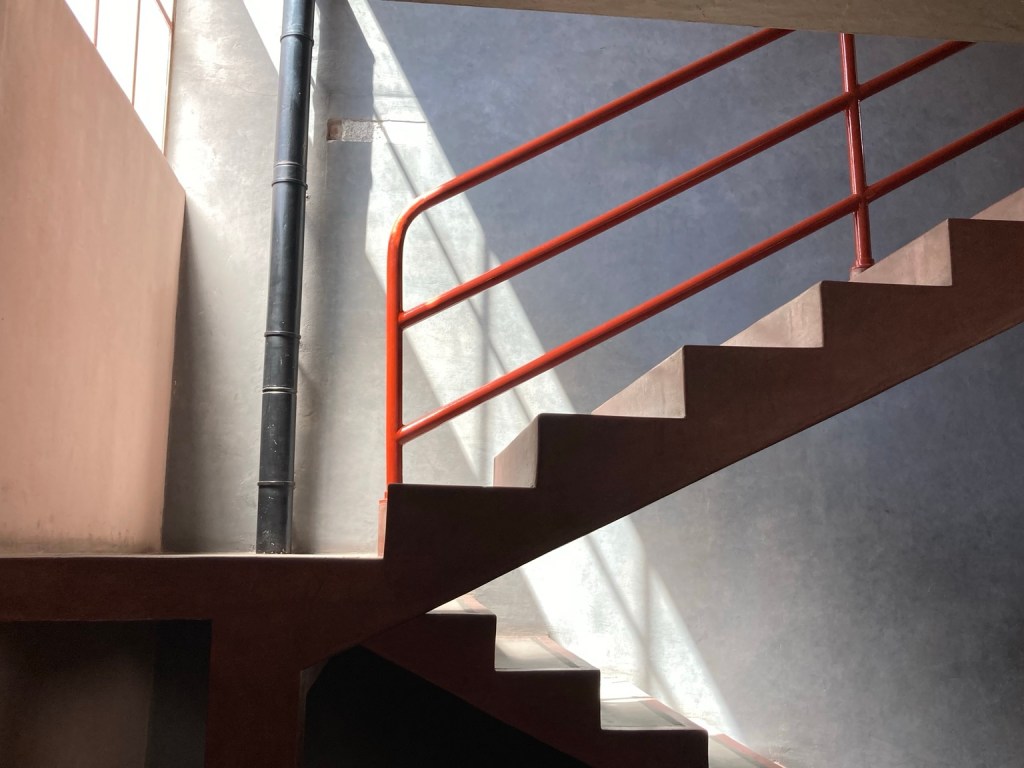
Once the wow factor of walking into the studio settled, we started taking in details of the building – clean lines, metal framed windows, polished grey concrete, wooden floors and exposed clay panels of the ceiling. Colour comes from the denim blue curtains – fabric used for American workwear, and the wooden furniture lacquered olive-green – commonly used to paint pulquerias at the time.
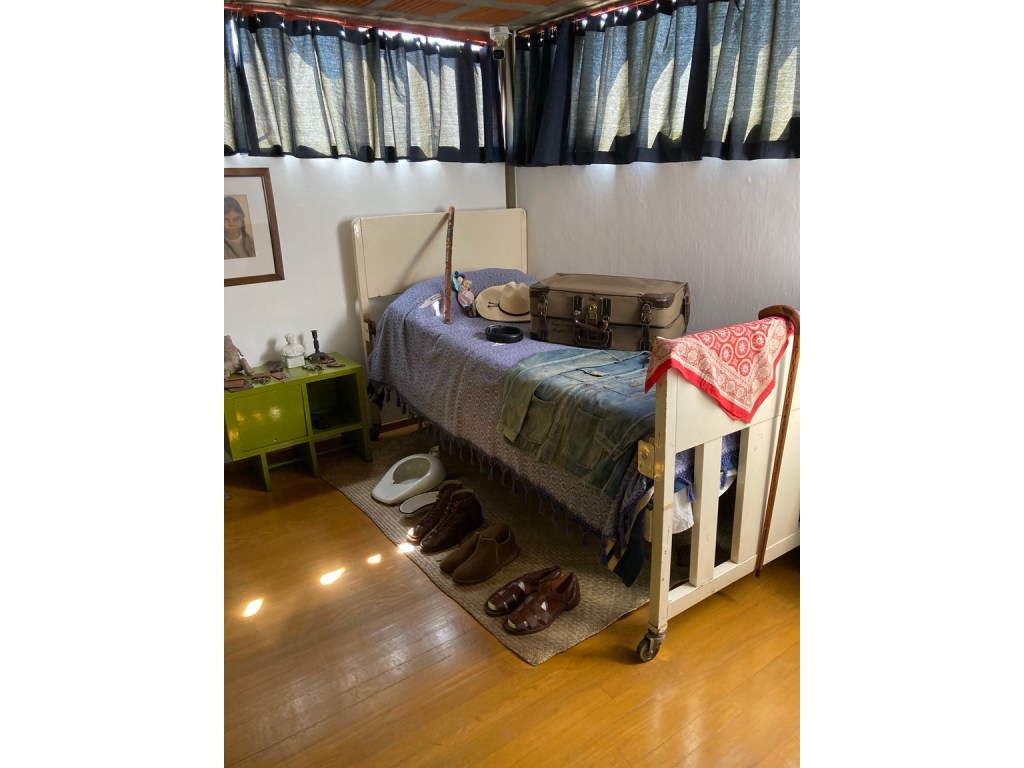
His bedroom was tiny …
… and then up to the roof where exposed functionality provides a striking roofline.
Looking then towards Frida’s house, the bridge that joins them can be seen, and also steps into her house. As I stood waiting to take my photo, I thought how precarious they looked for a woman with mobility issues, but a guide showed me a photo of her standing on the steps, so she did use them. Fortunately, when the window concertinas open, it provides a barrier at the base of the stairs, but I still think H&S would be on the case!
The idea of the linked houses was to live together, but also apart, so they each had studios, and bedrooms but the living area was just in Frida’s house. Here’s a snap. but no belongings remain. She lived here on and off for a couple of years but having seen Casa Azul, I can quite see why she preferred it!
A courtyard links the building.
Finally we looked round O’Gorman’s house, with a concrete spiral staircase to his studio, but again empty, highlighting its clean lines.
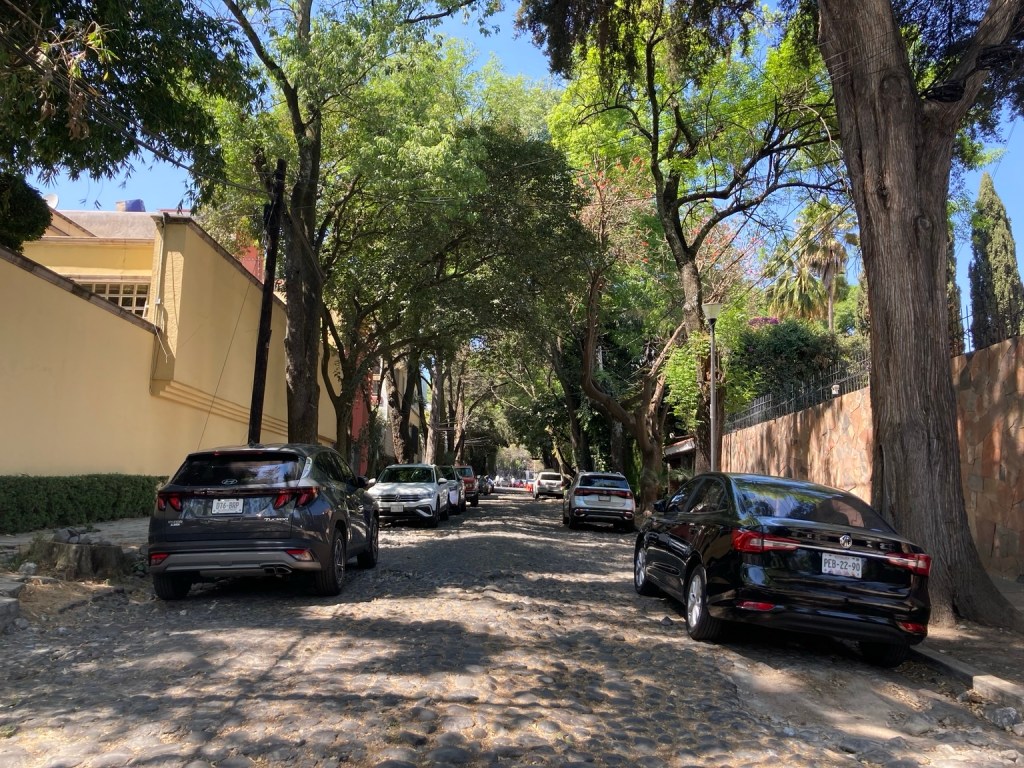
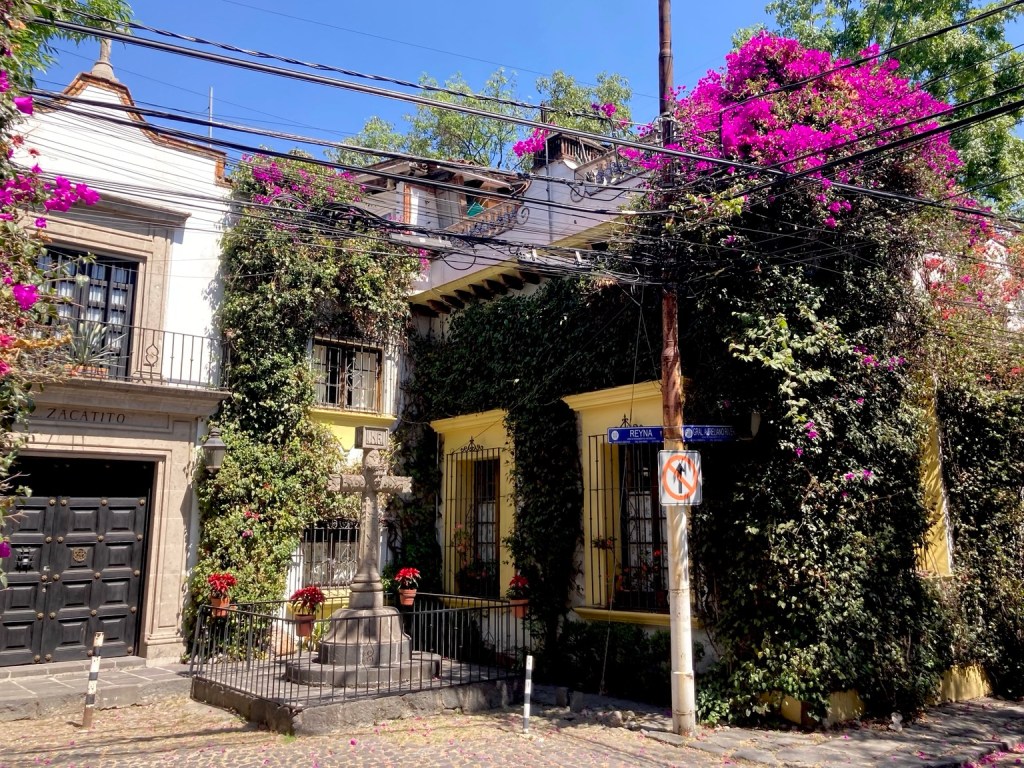
Time for some lunch so we walked to the market in San Angel, interested as we went so see what a smart neighbourhood it was, retaining the charm of cobbles, but with properties hidden with large gates, we could only guess at the luxury concealed.
Saturday is market day, with a vibrant art and craft market where we browsed but didn’t buy! We stopped in a cafe, pleased to sit down and ordered cold drinks and cactus tacos.
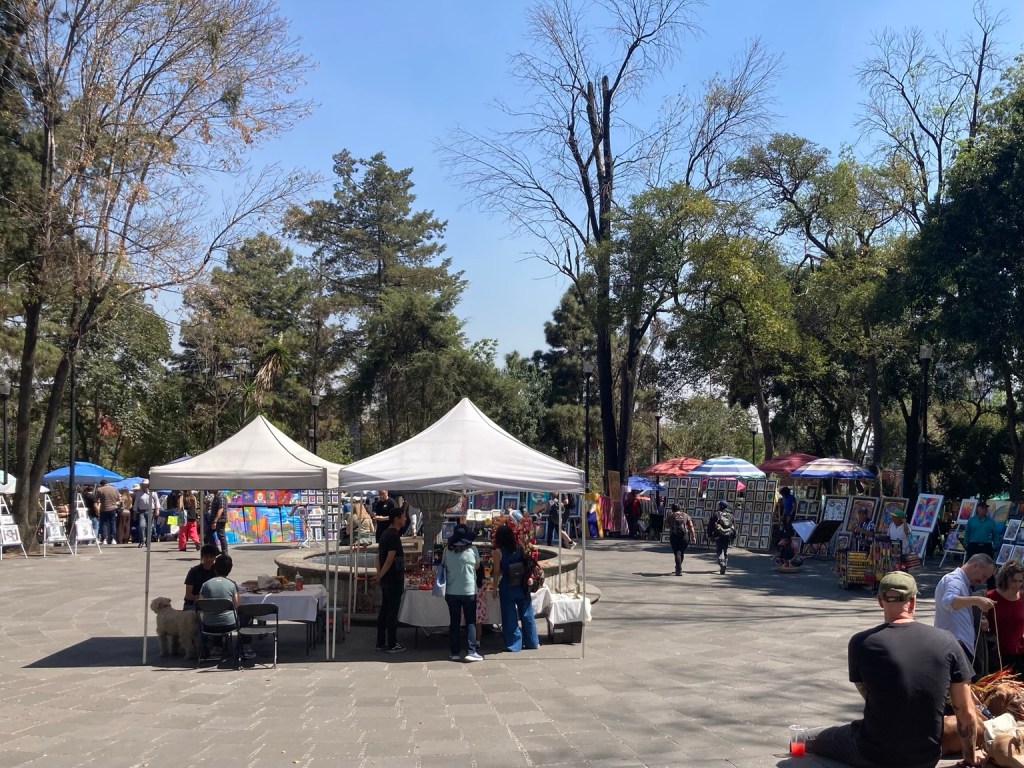
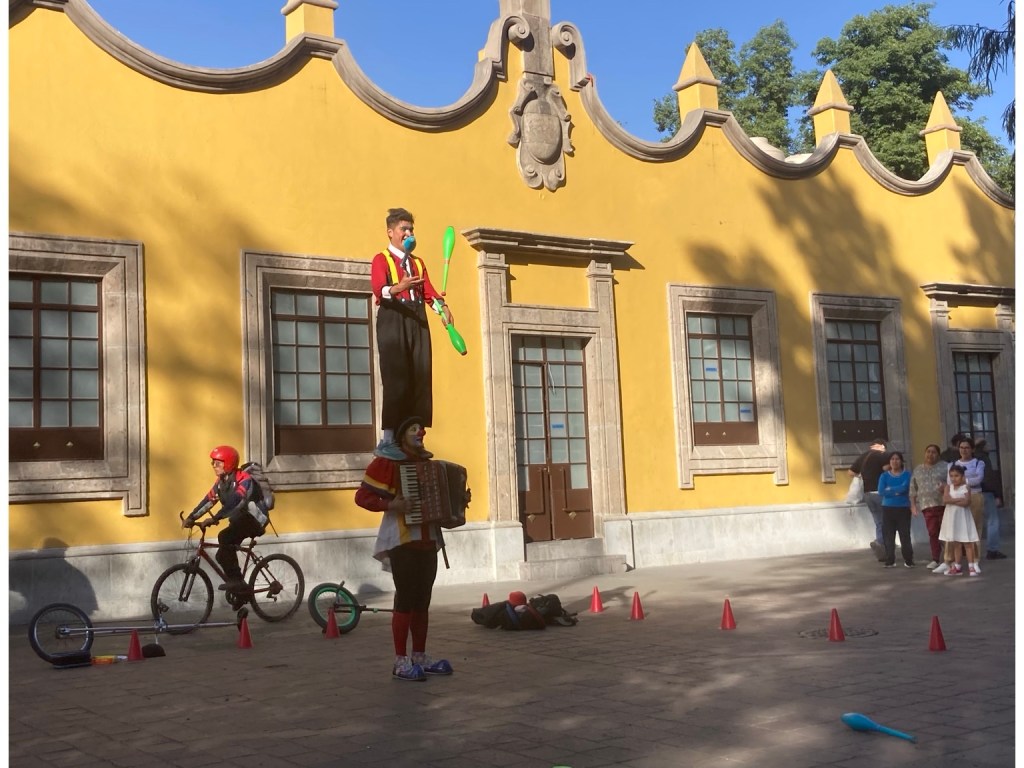
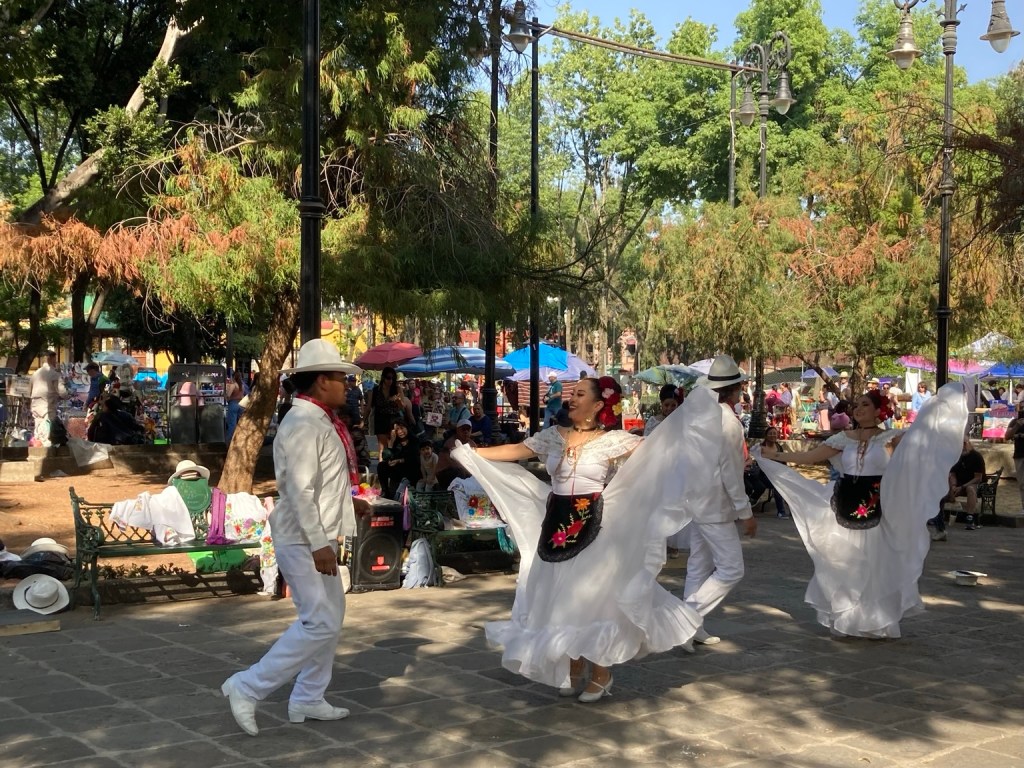
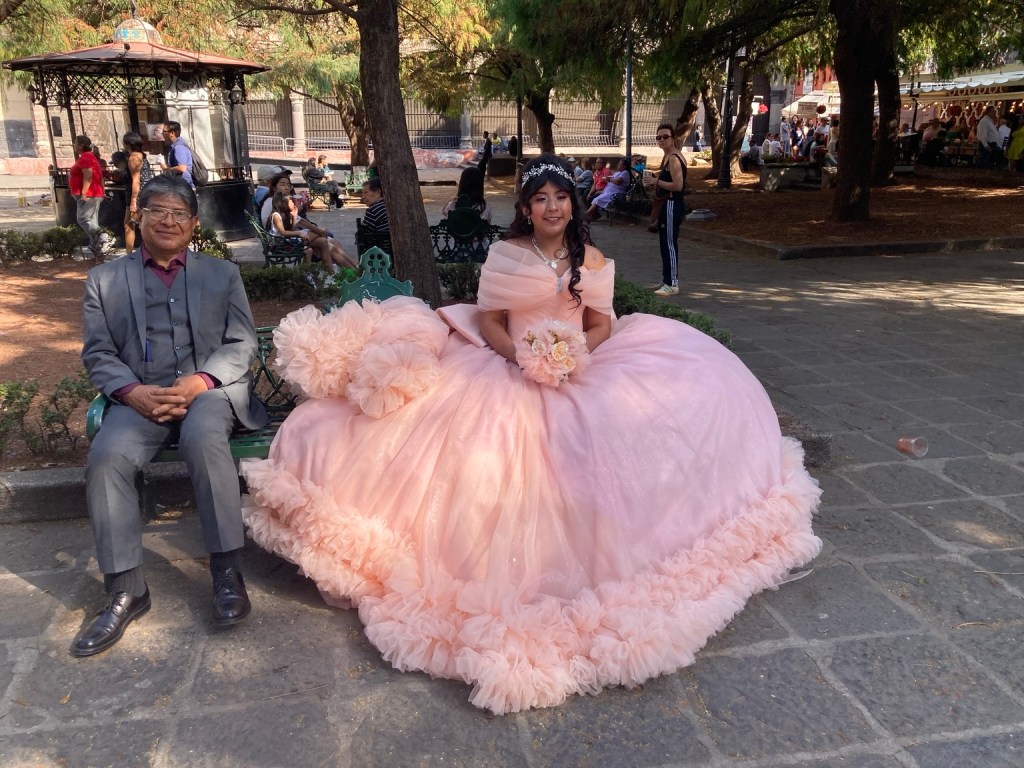
Coyoacan was also busy when we got back with clowns, dancers and even a wedding.
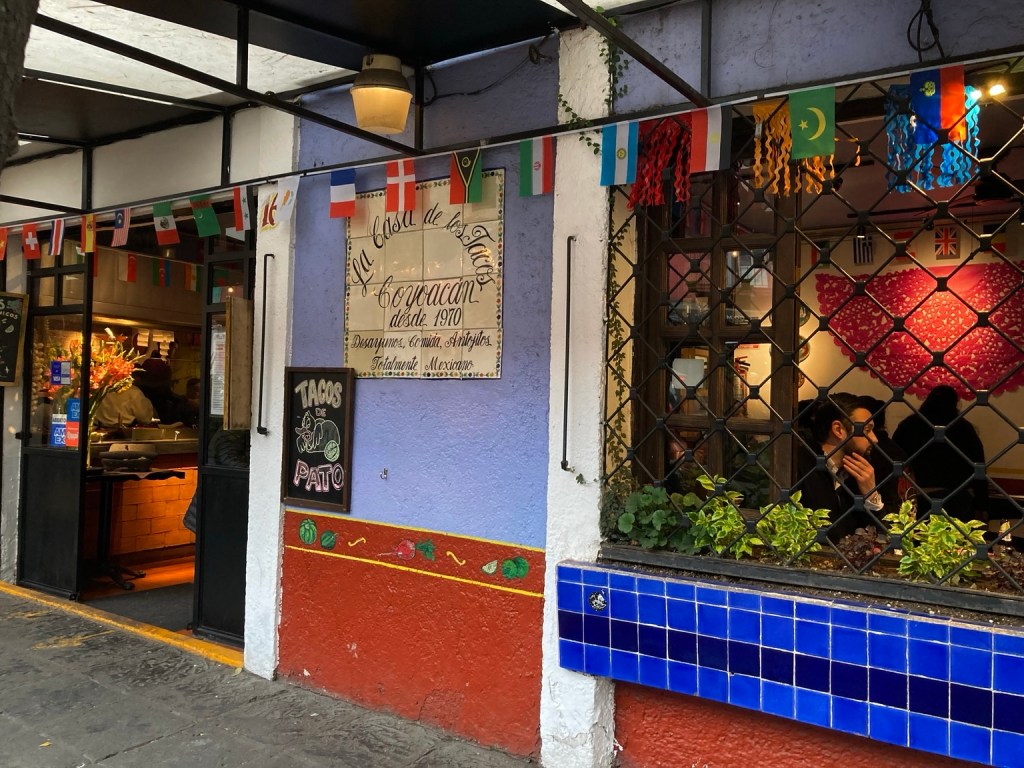
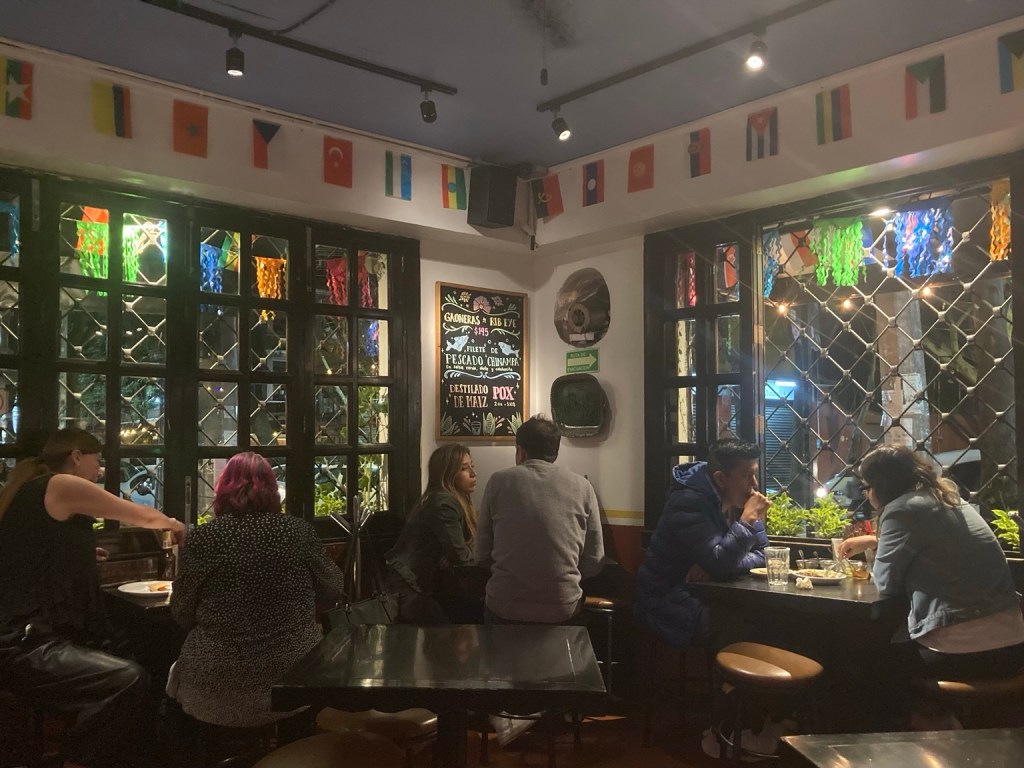
The town was still buzzing when we went for dinner, with foods stalls that had popped up to line the streets and a night market selling anything and everything. We ate in a small but very cute taco bar down a side street and had the best mexcal margaritas with the tacos.
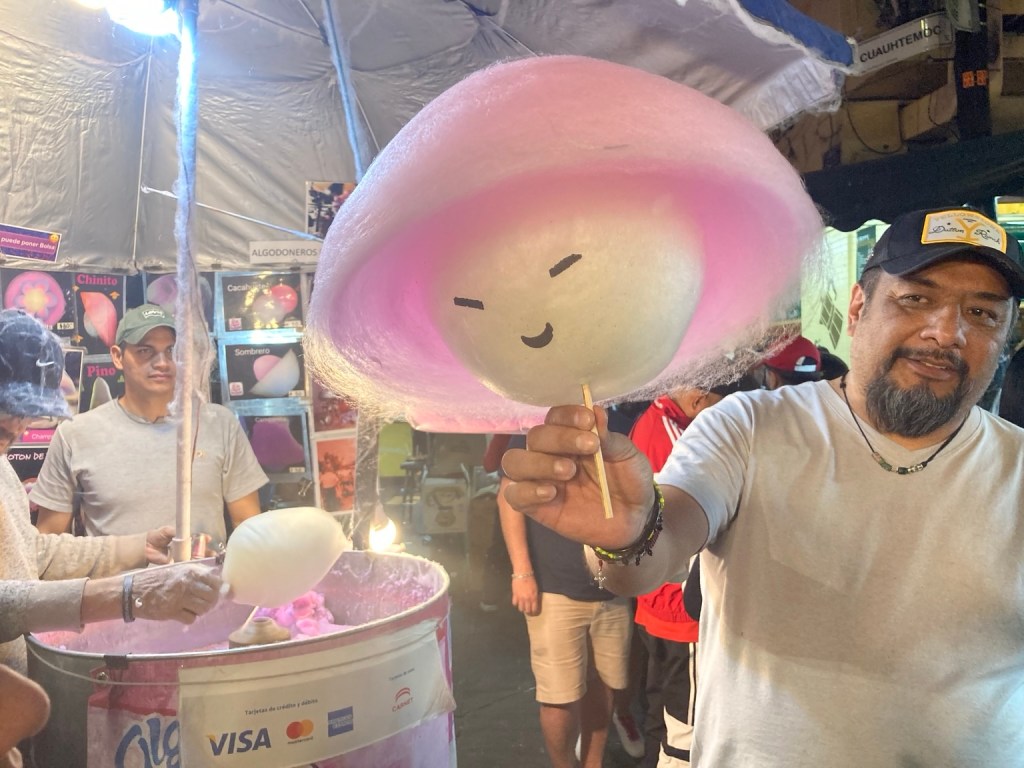
On the walk back, entertainment was everywhere from a god squad rock band, candy floss art and a man dislocating his shoulder for tips, but you only need a photo of the chinaman!
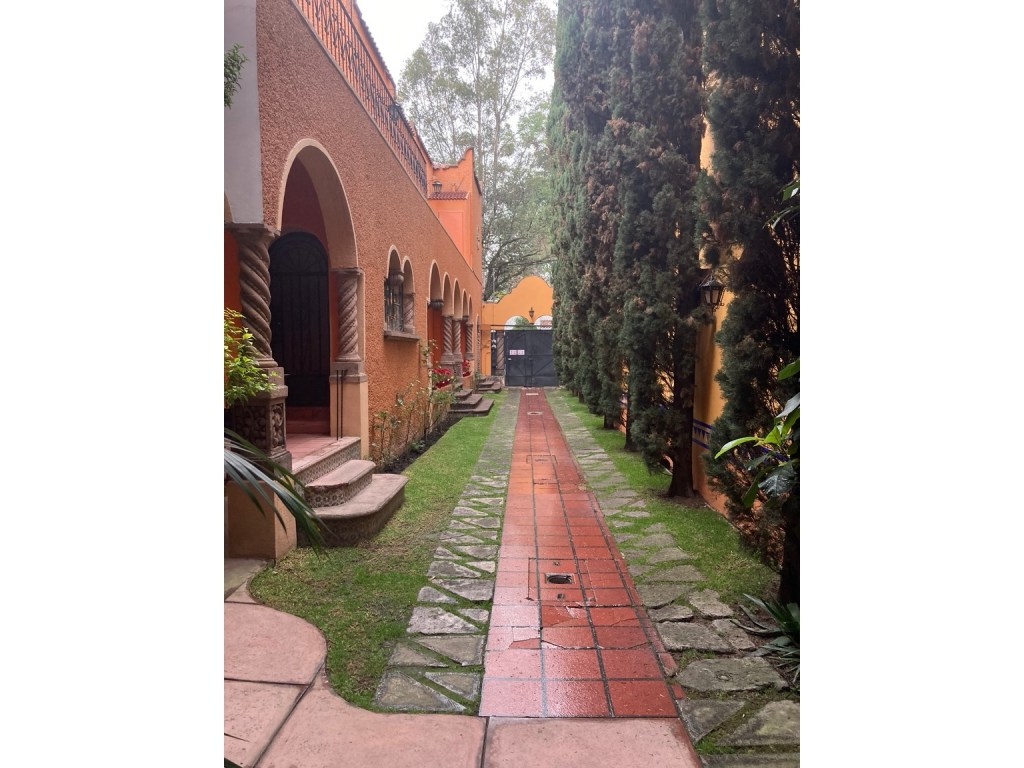
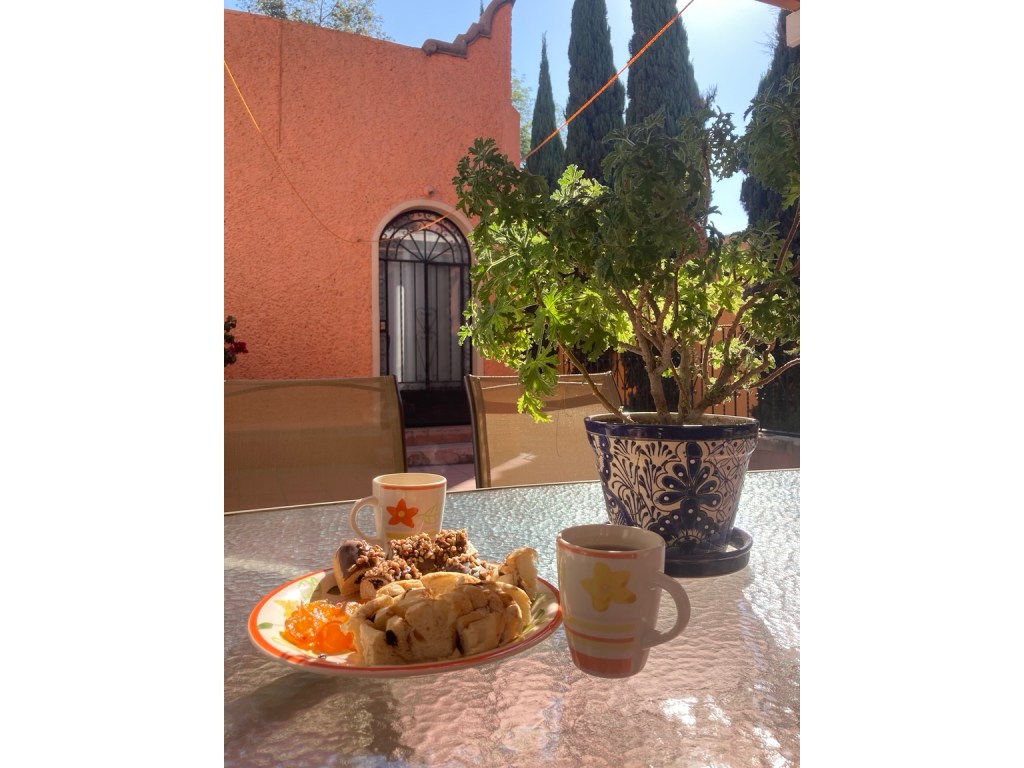
… and a taxi ride on the busy Mexico City orbital route and we arrived in the leafy suburb of Coyoacan. Villa Alfonsina is our home for our last few days, a family run colonial style house with cosy rooms, a little kitchen handy for making drinks and a terrace to enjoy breakfast.
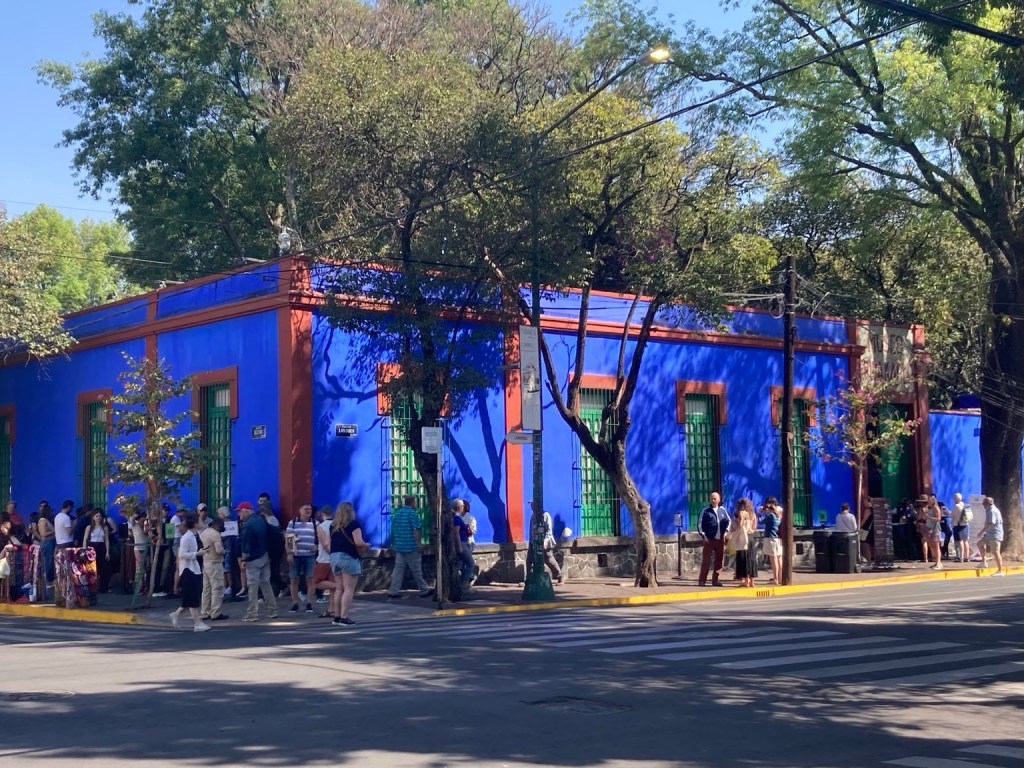
We are also just across the road from Casa Azul, birthplace of Frida Kahlo and the hottest ticket in town, so luckily we booked ours weeks ago, but more of that later.
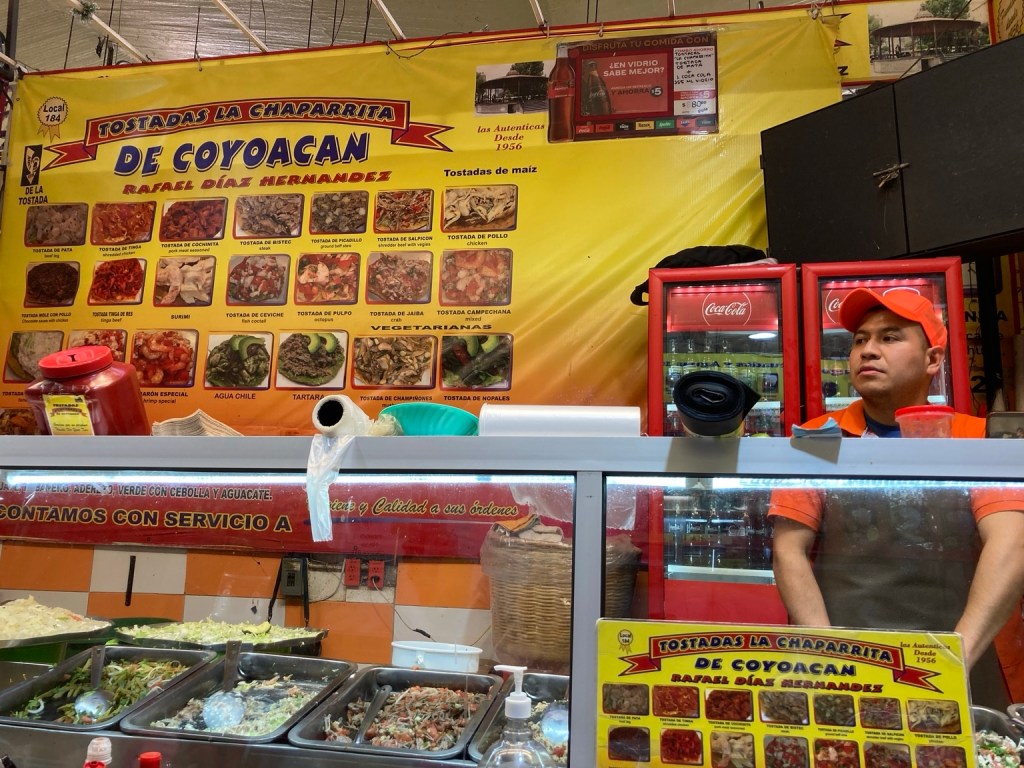
Hungry, we headed straight to the market where there were a number of tostada stalls, all claiming to be the original and the best, each with their own special recipes for the array of possible toppings.
We munched through a couple each – thin and crispy on the bottom loaded with filling that is just waiting to fall off – mushroom, cactus, cochinita and chipotle chicken.
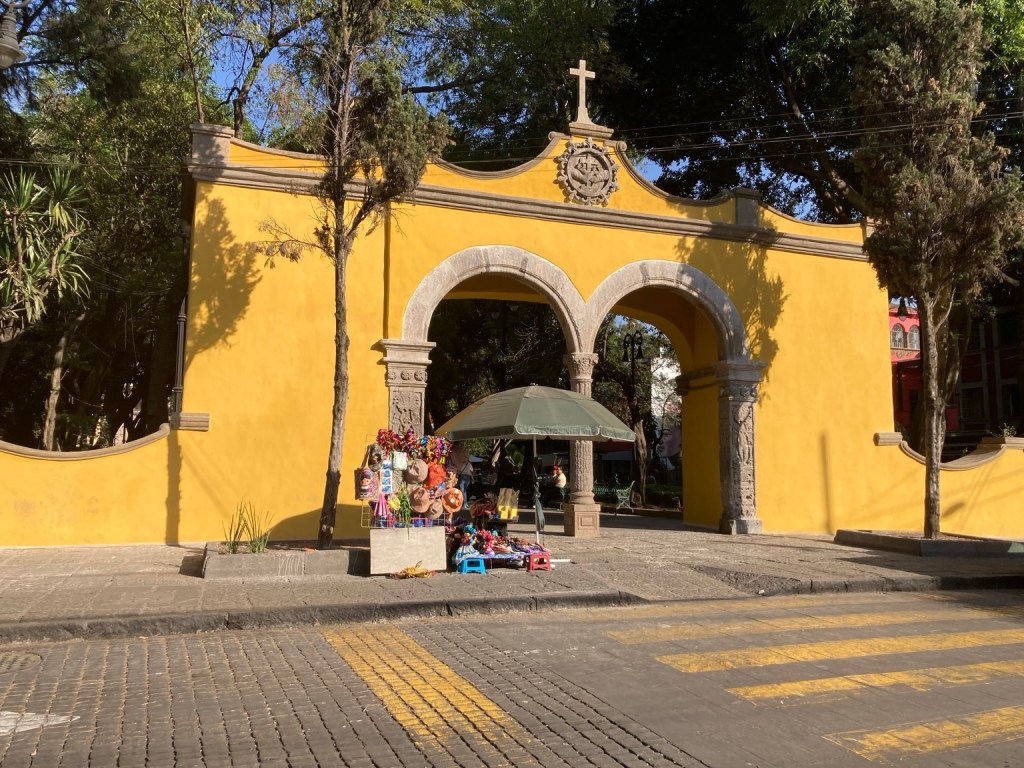
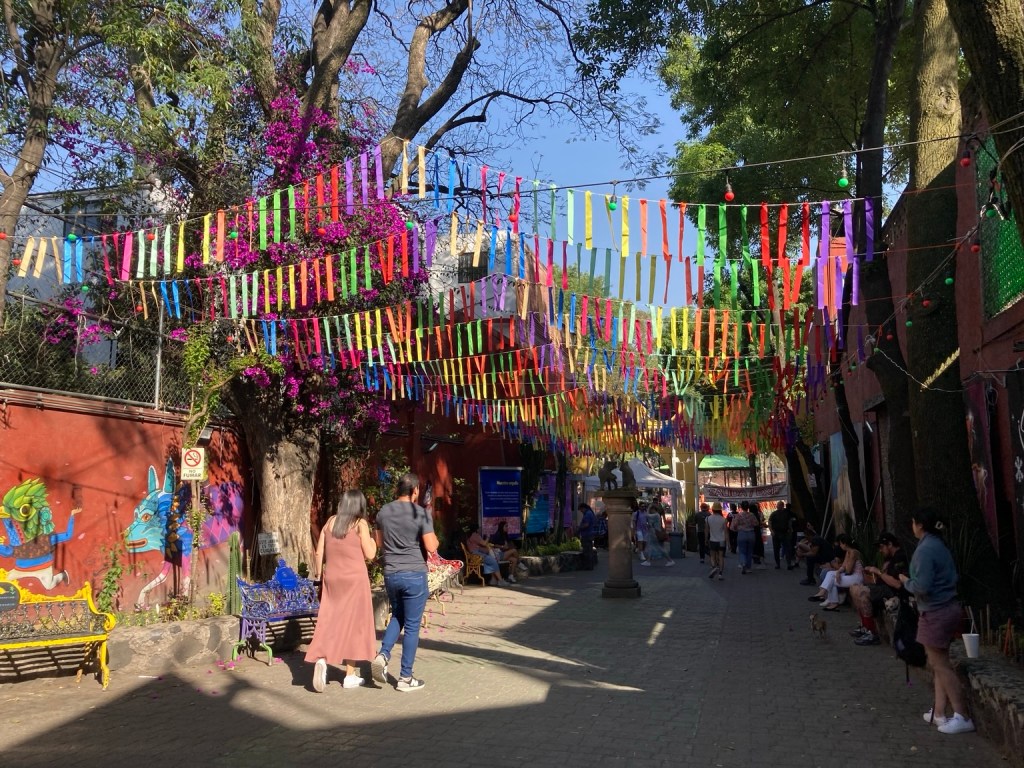
Coyoacan is known for its cobbled streets, leafy parks and old-fashioned charm, but with the Diego & Frida connection, it obviously attracts lots of visitors so restaurants and gift shops abound. Nonetheless, it still feels more like a small town rather than part of Mexico City!
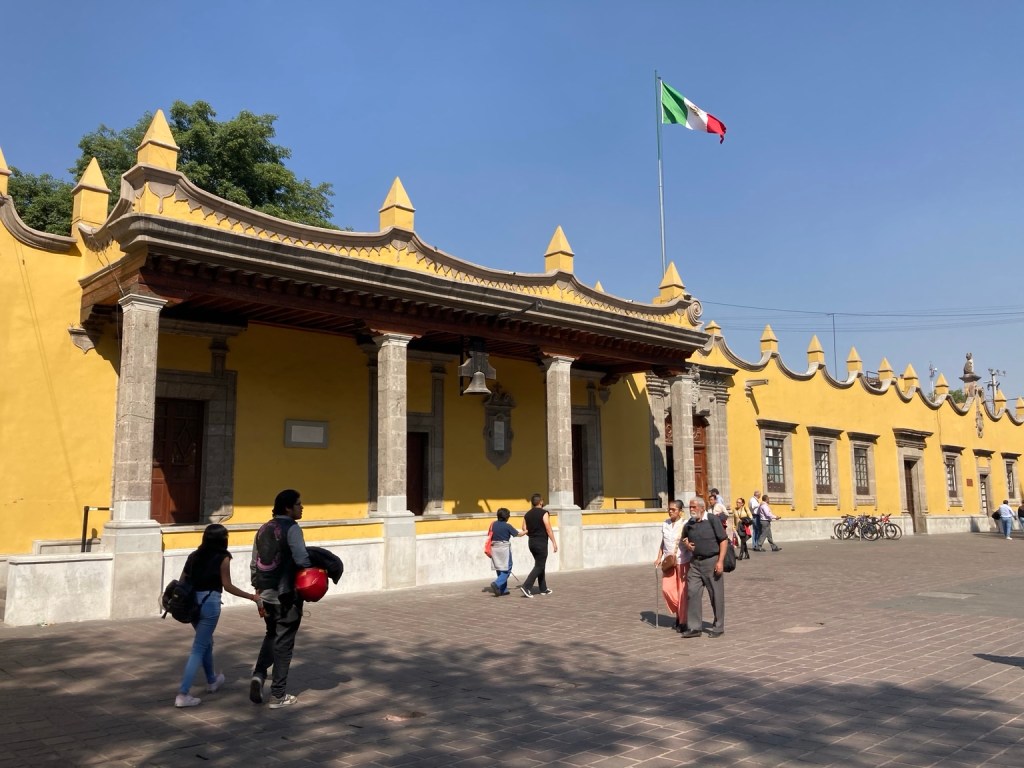
We walked on to the centre where we saw the Palacio Municipal, also known as the Casa de Cortés after Hernán Cortés who led the Spanish conquest first settled here after the fall of Tenochtitlan.
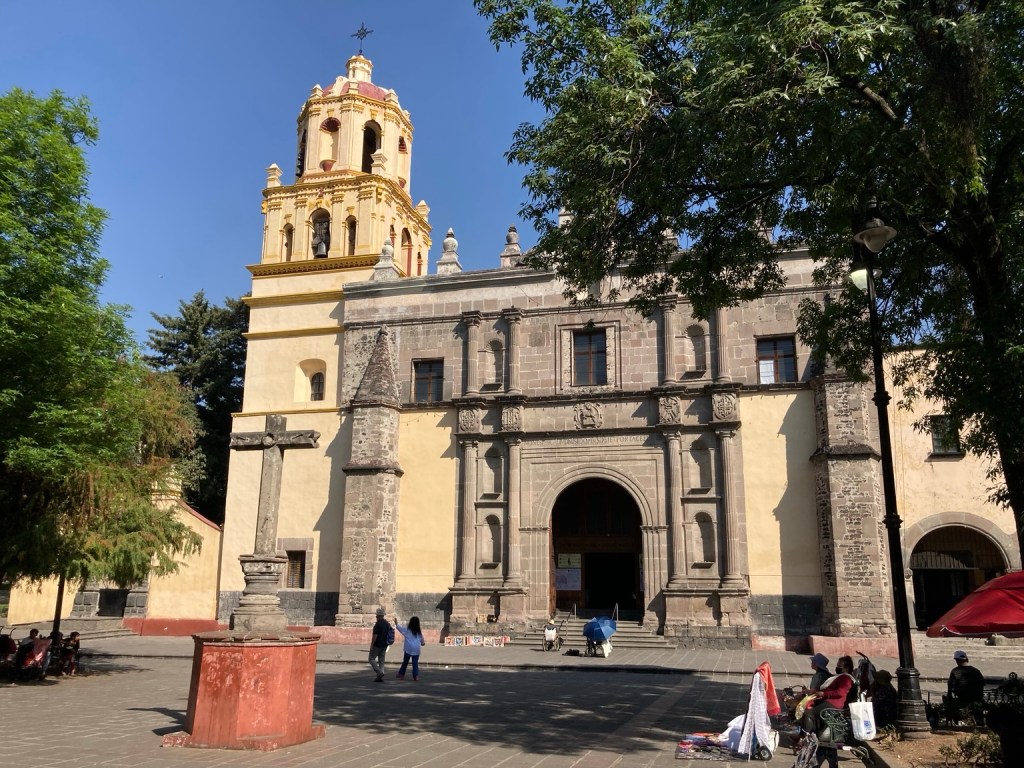
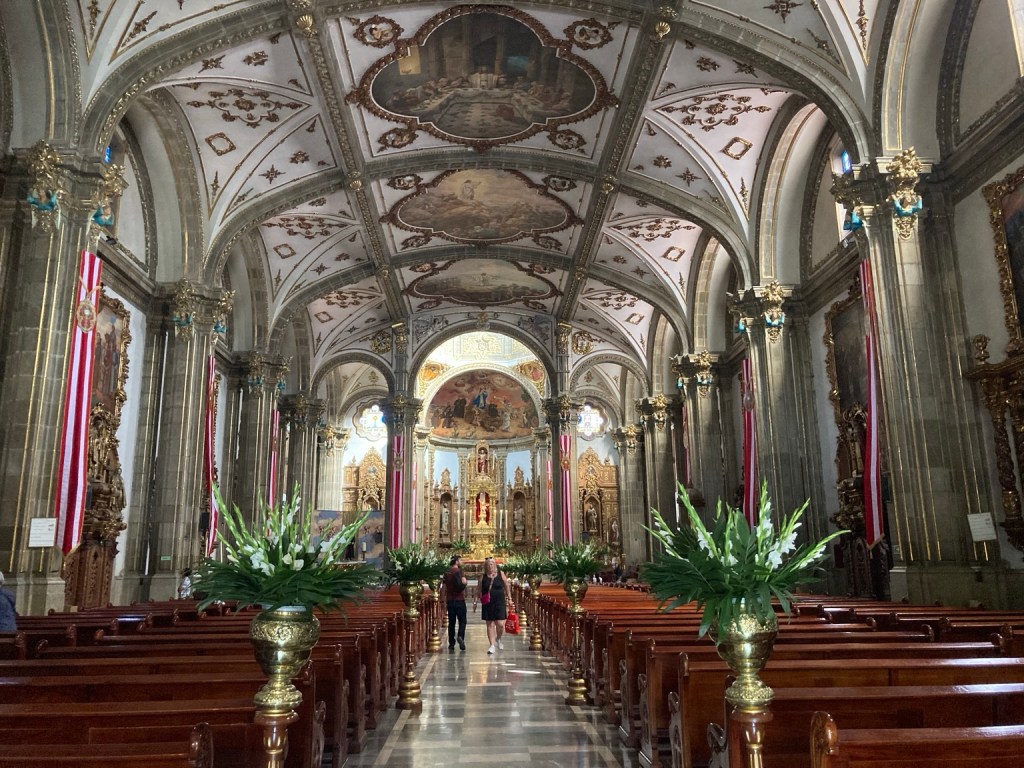
Opposite is the C16th Church of San Juan …
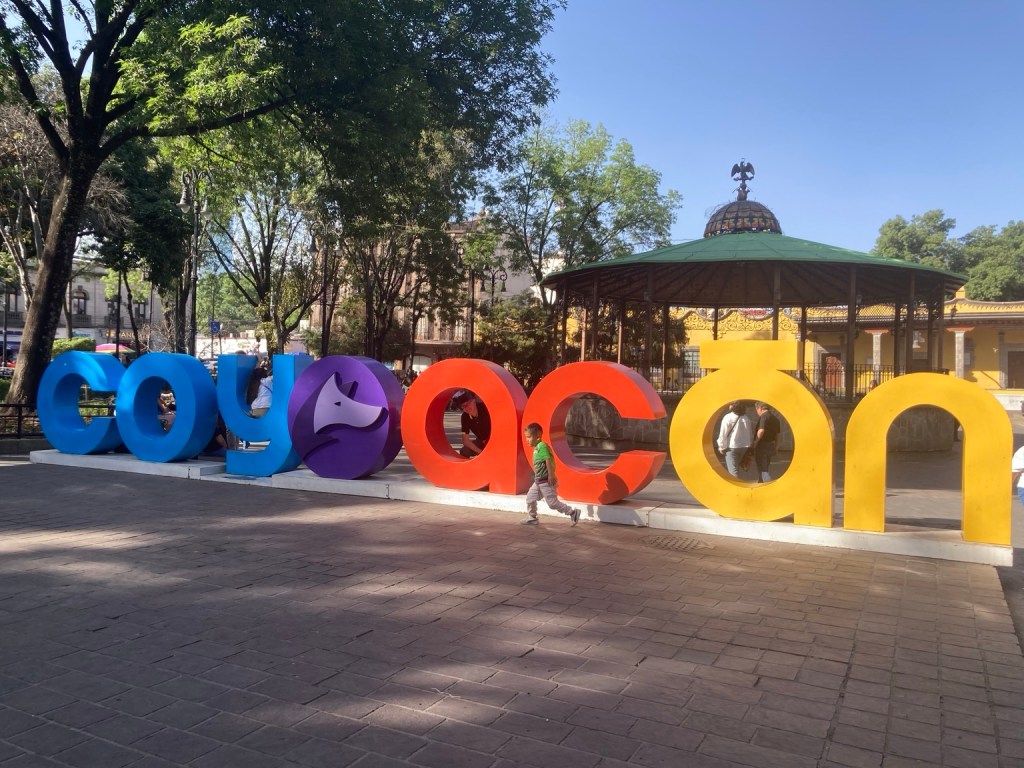
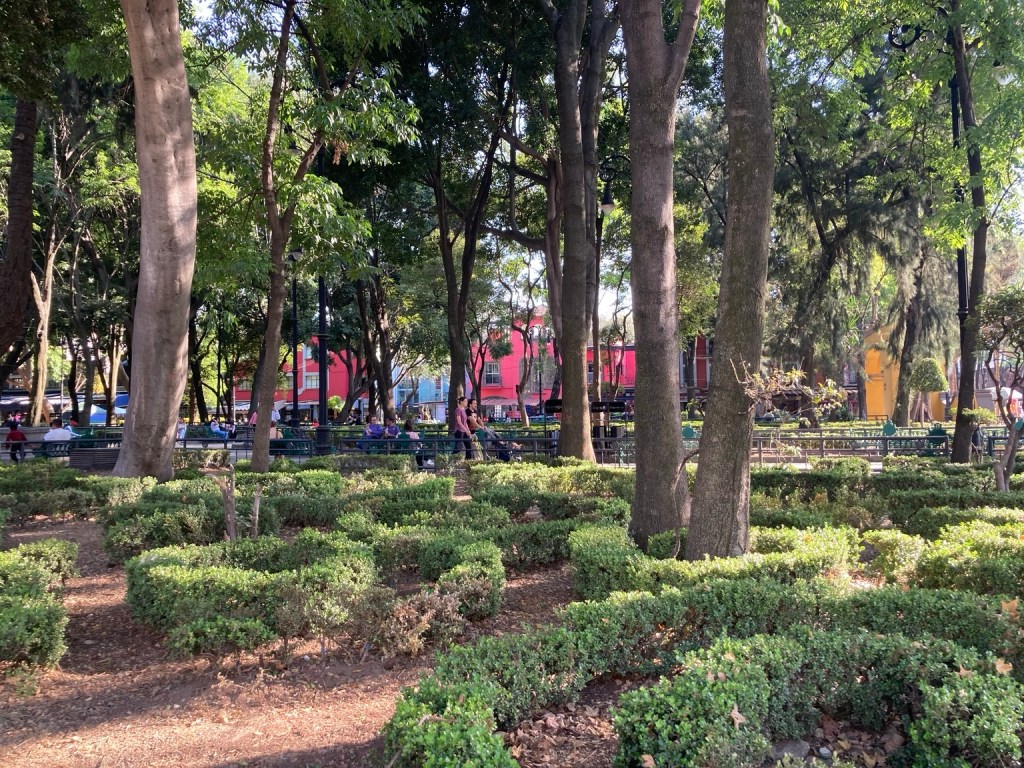
… and outside a large plaza.
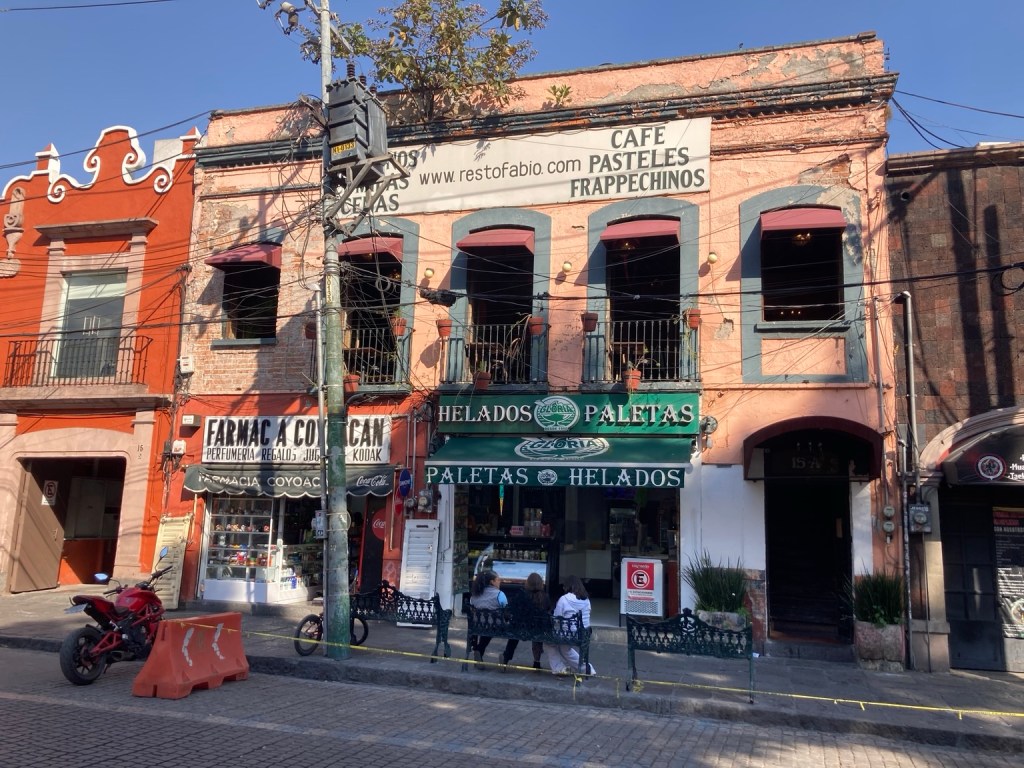
The ice cream has been great here – I love the walnut which seems very popular – and this place is quite an institution.
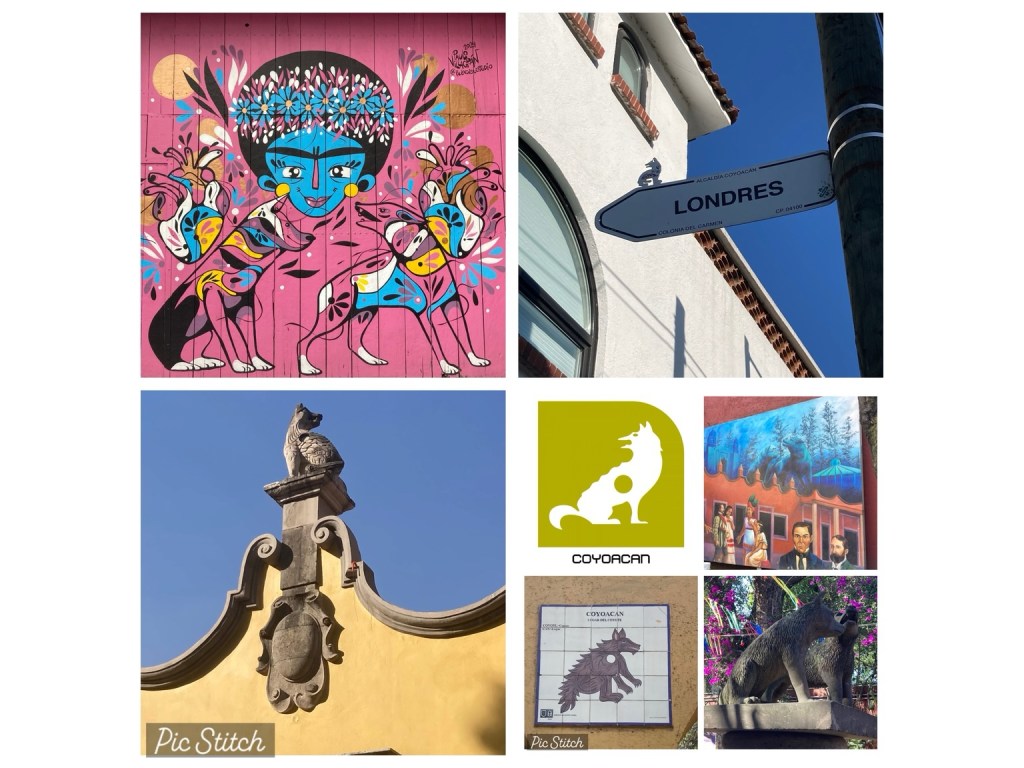
There are statues and images of coyotes everywhere, hardly surprising as Coyoacán is an Aztec word meaning ‘place of the coyotes’ and in Aztec times this area was a forest.
Next morning, after breakfast on the terrace …
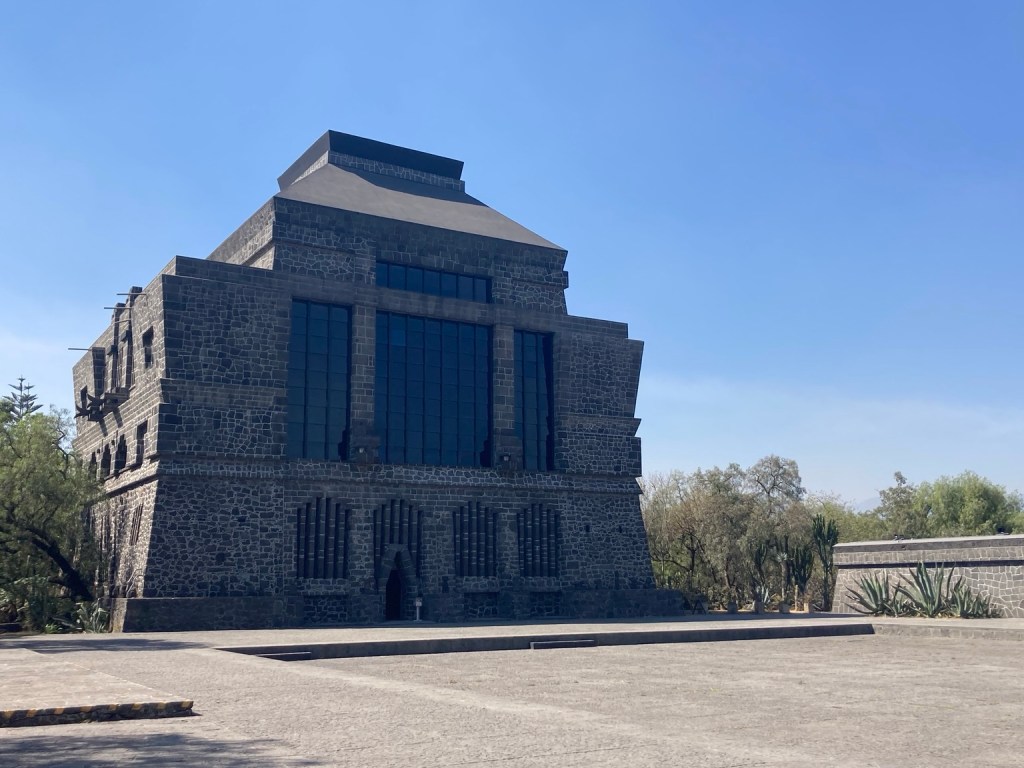
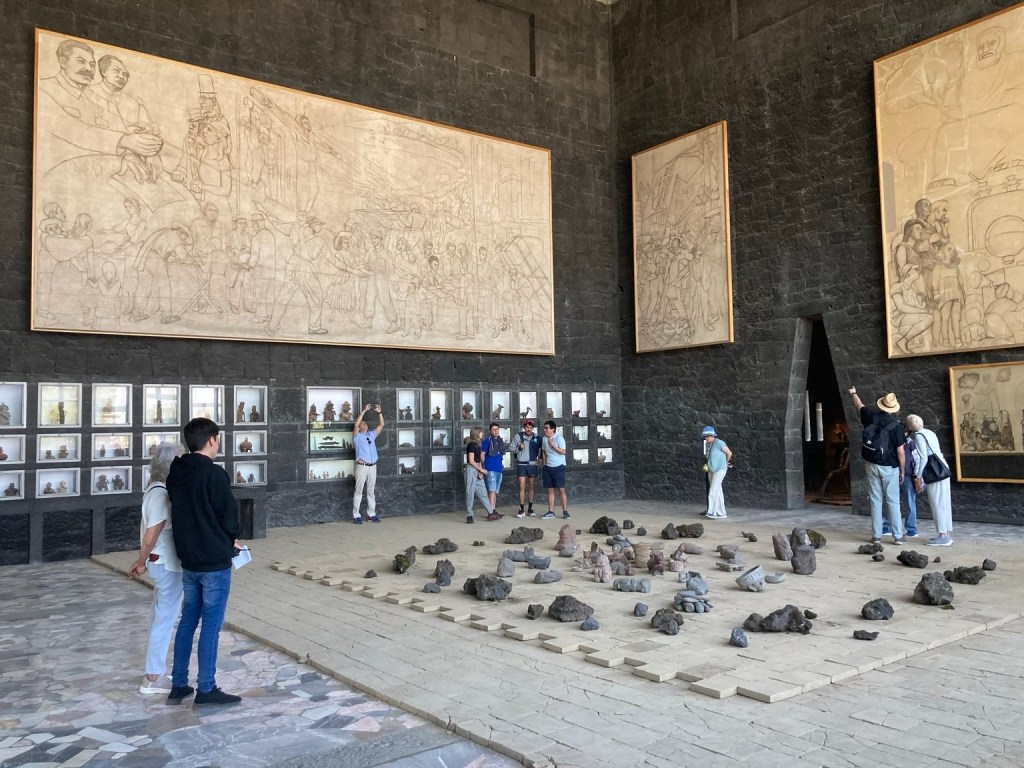
… we got a taxi to Museo Anahuacalli, the final achievement of Diego Rivera, a temple displaying the art and craftsmanship of his indigenous collection within a modern monument inspired by the ancient world.
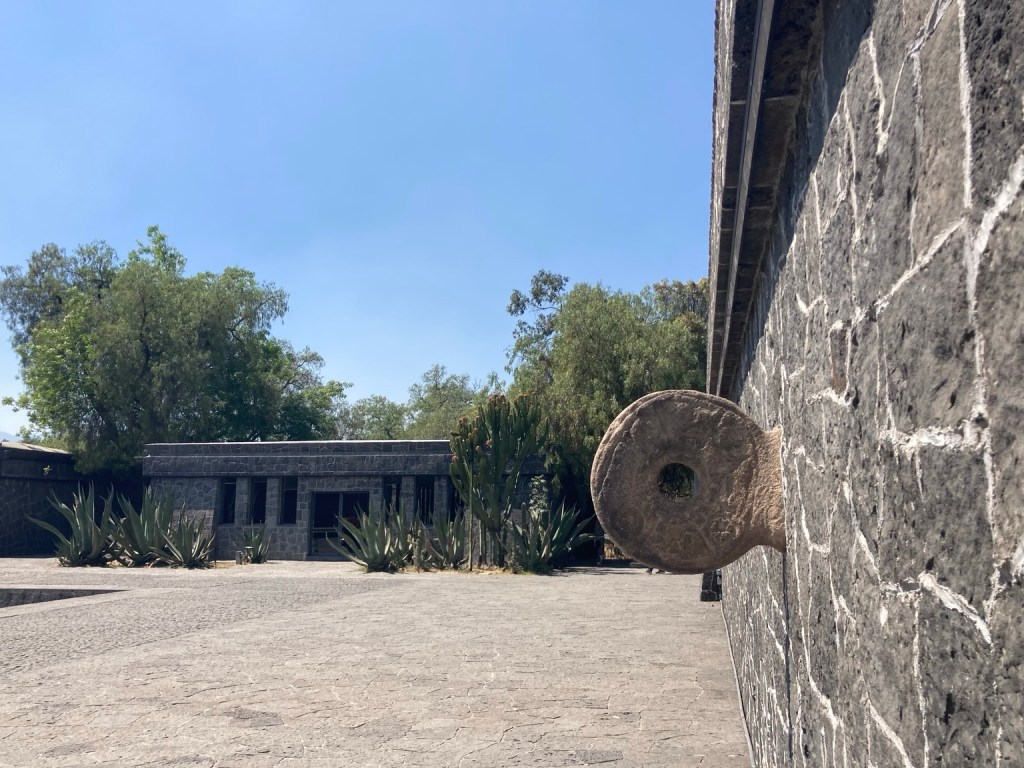
Made from local volcanic rock, it echoes the shape of a Mesoamerican pyramid with a ball court outside.
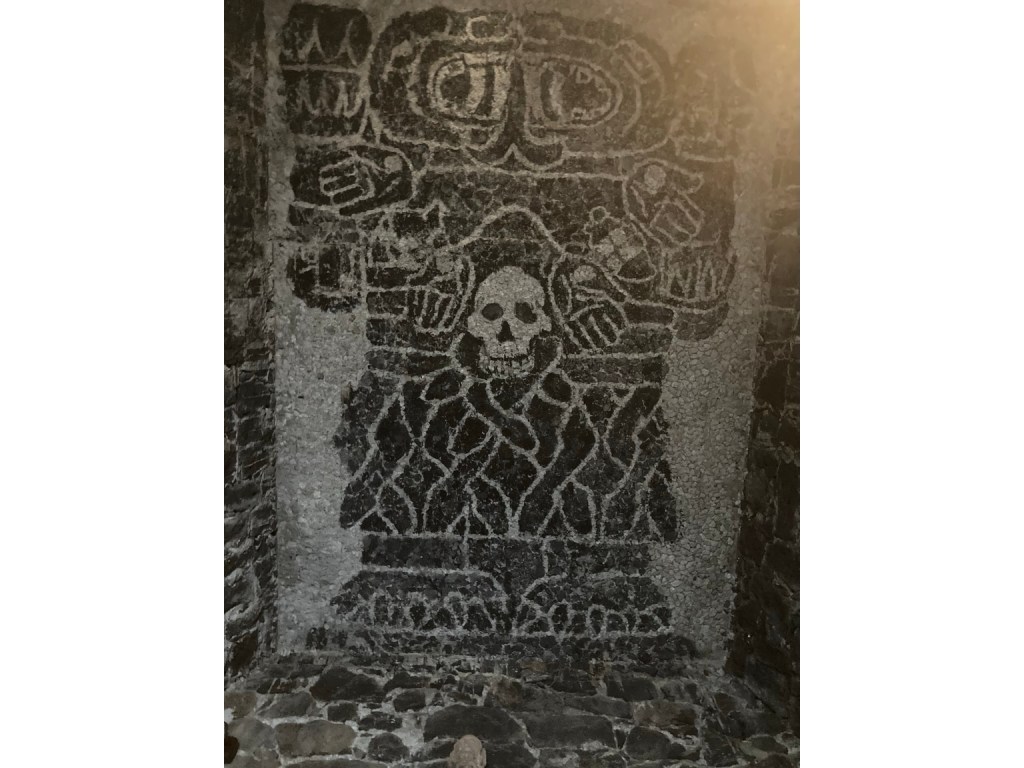
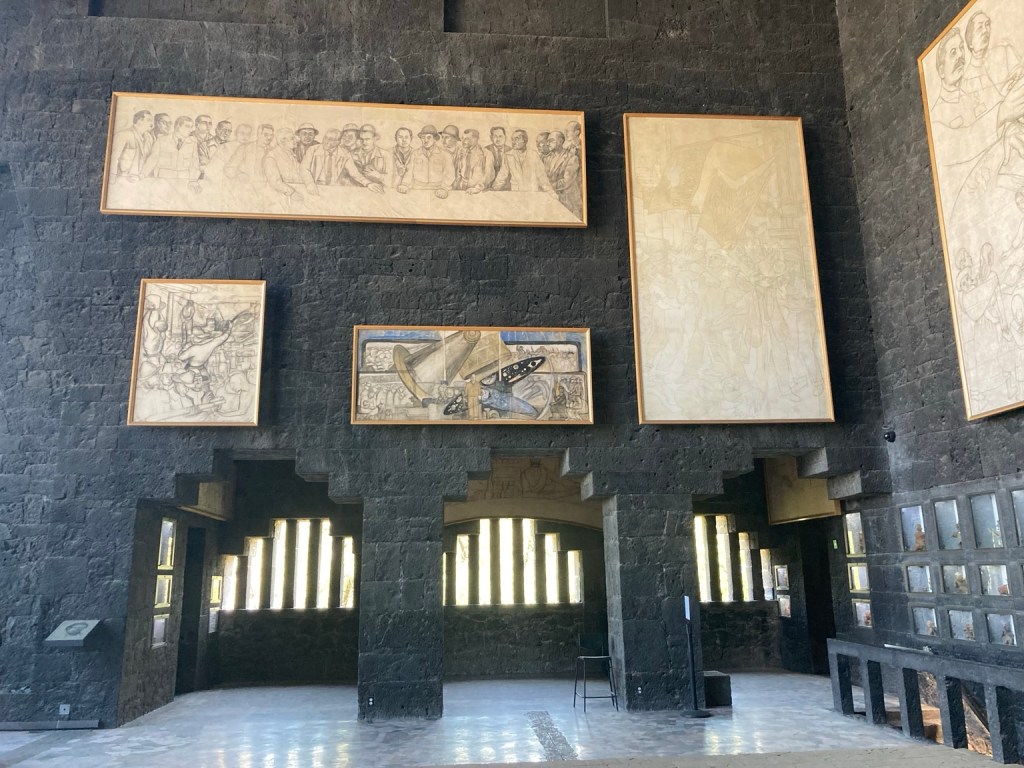
Inside, we rose through the underworld and the earth to the cosmos and each corner depicted the earthly elements and their gods. In order to make a modern building feel ancient, there are mosaics on the ceilings, like this one of the mother goddess who welcomes us …
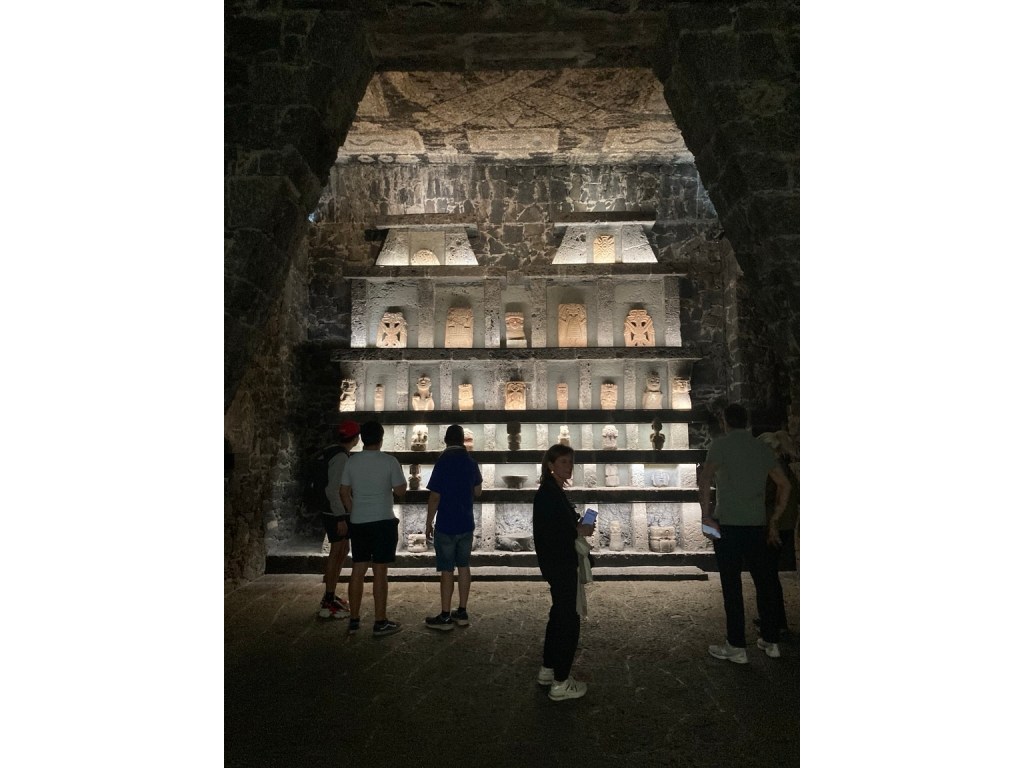
… and a beautifully lit altar in the underworld.
The most impressive space was planned as a studio for Rivera, although he died before he was able to use it. Preparatory sketches line the walls, and with some of the murals now lost, they are more precious.
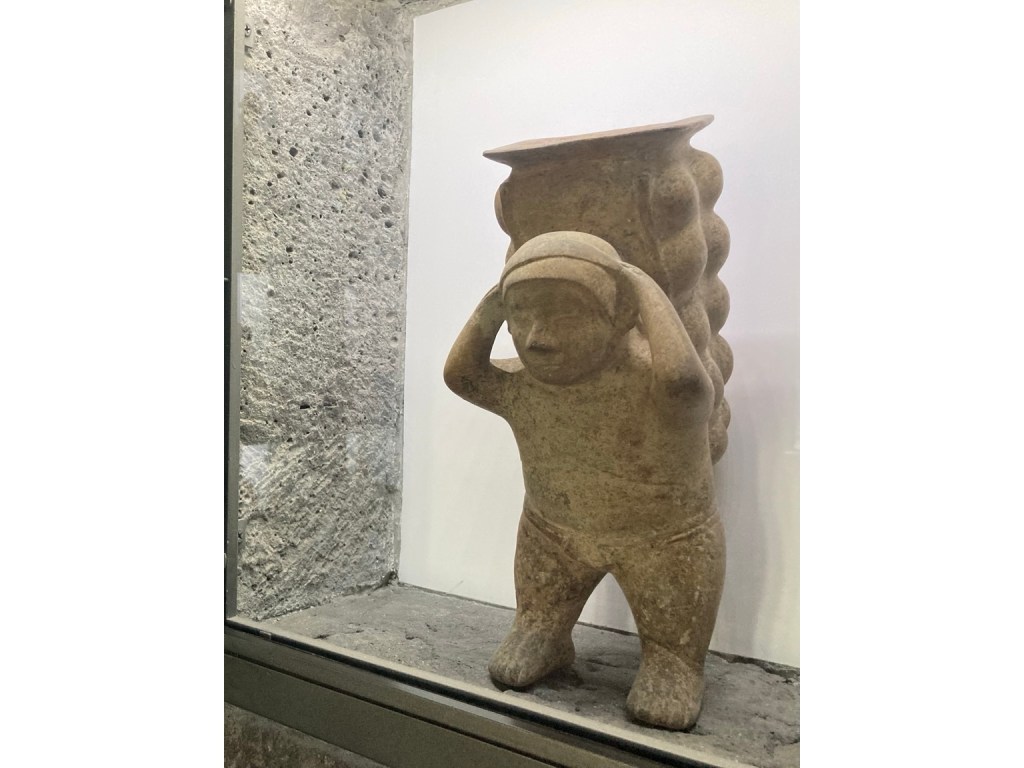
The cabinets on each floor contain much of his collection of over 50,000 pieces of Pre-Hispanic art, amassed at a time when there was little restriction in the trade of such items.
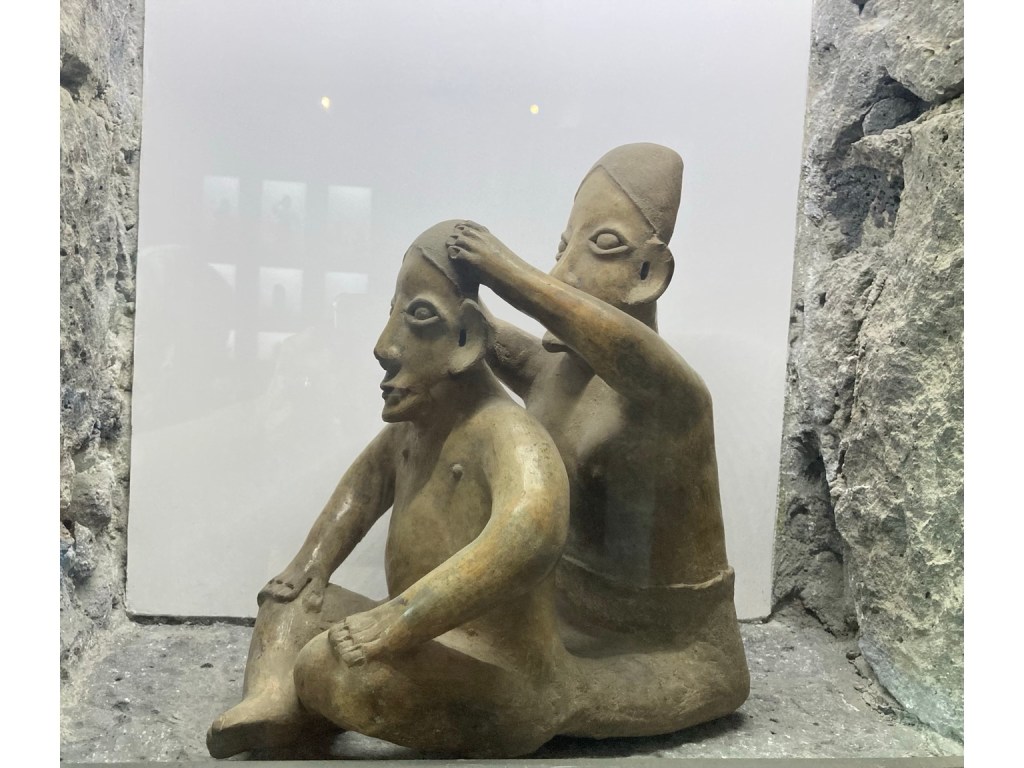
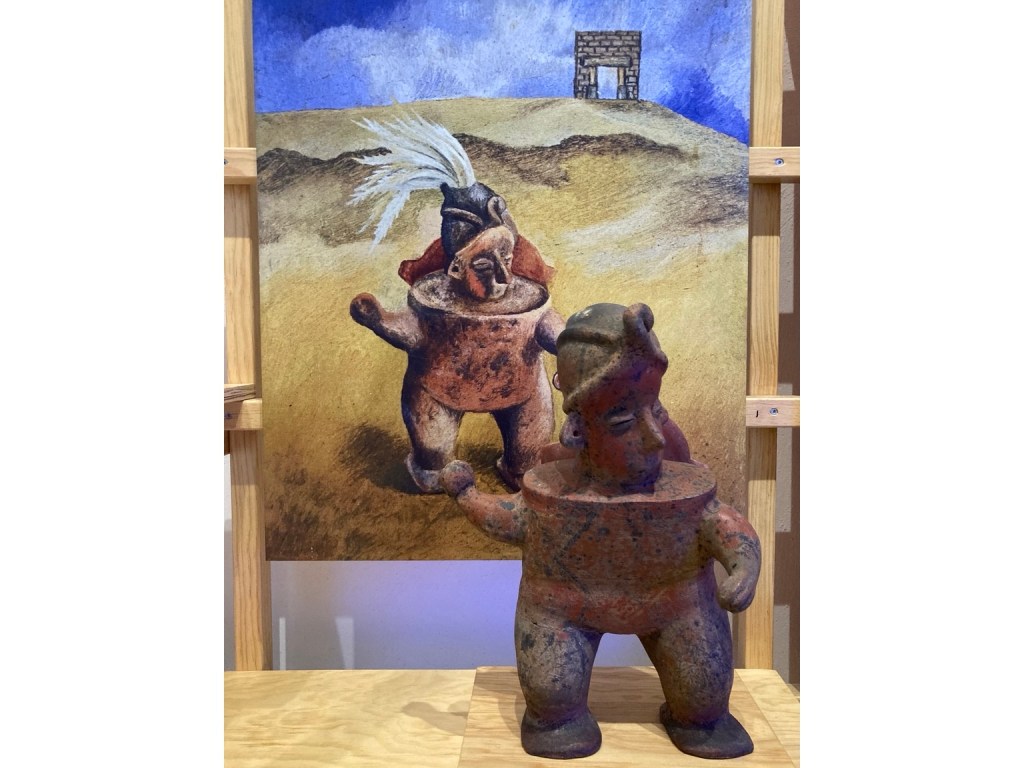
There are no labels as he wanted them to be seen as art rather than an archaeological collection. This figure is a bearer and was given a second life as a character in his murals …
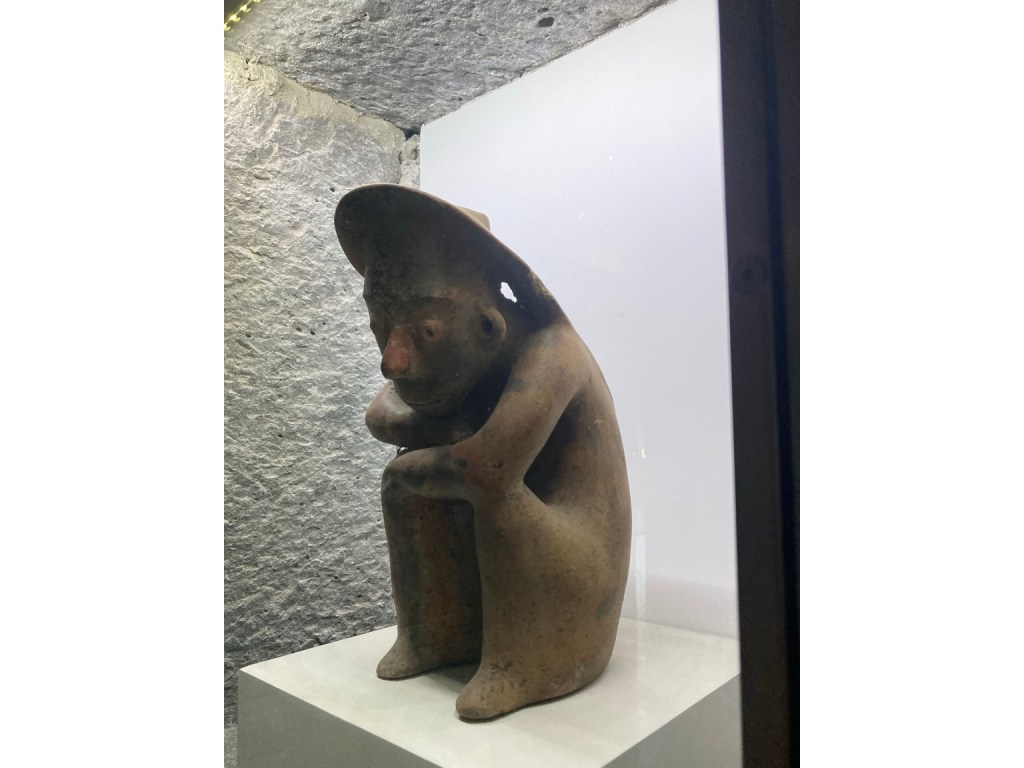
… and unlike many figures which show little emotion, this one is lost in thought …
… and maybe this just shows nits are not a new thing!
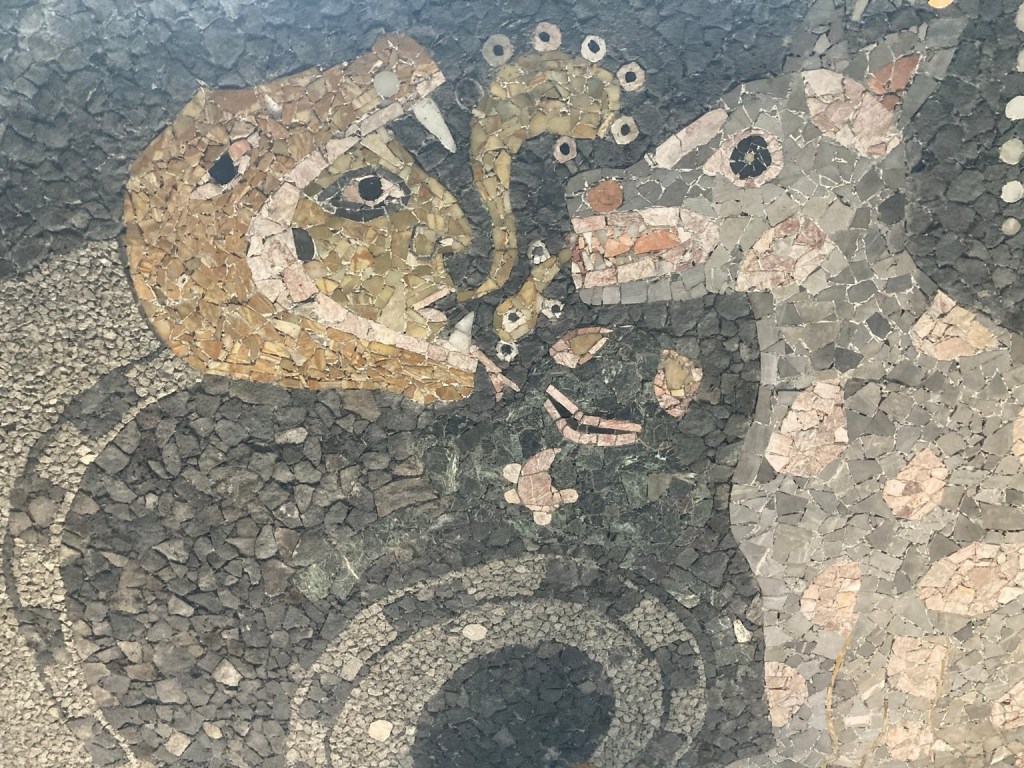
We spent several hours here, totally engrossed in the visual spectacle. This ceiling mosaic is maybe Rivera’s farewell. A dog personifies the guide of souls through the underworld while the creator of humanity is a serpent with a human face. Between are the large eyes and smile of a Frog – Diego listening to life and death talking together.
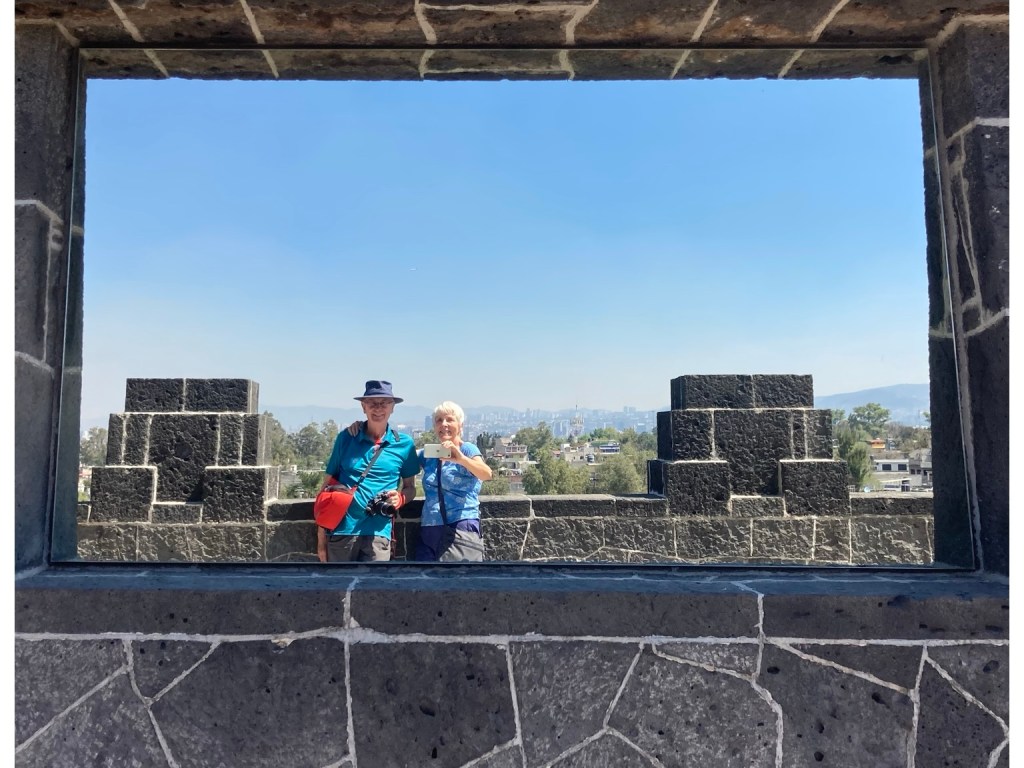
The roof gave a photo op and it was back to town
It was definitely a Diego & Frida day, as our timed ticket to visit Casa Azul was at 3.30.
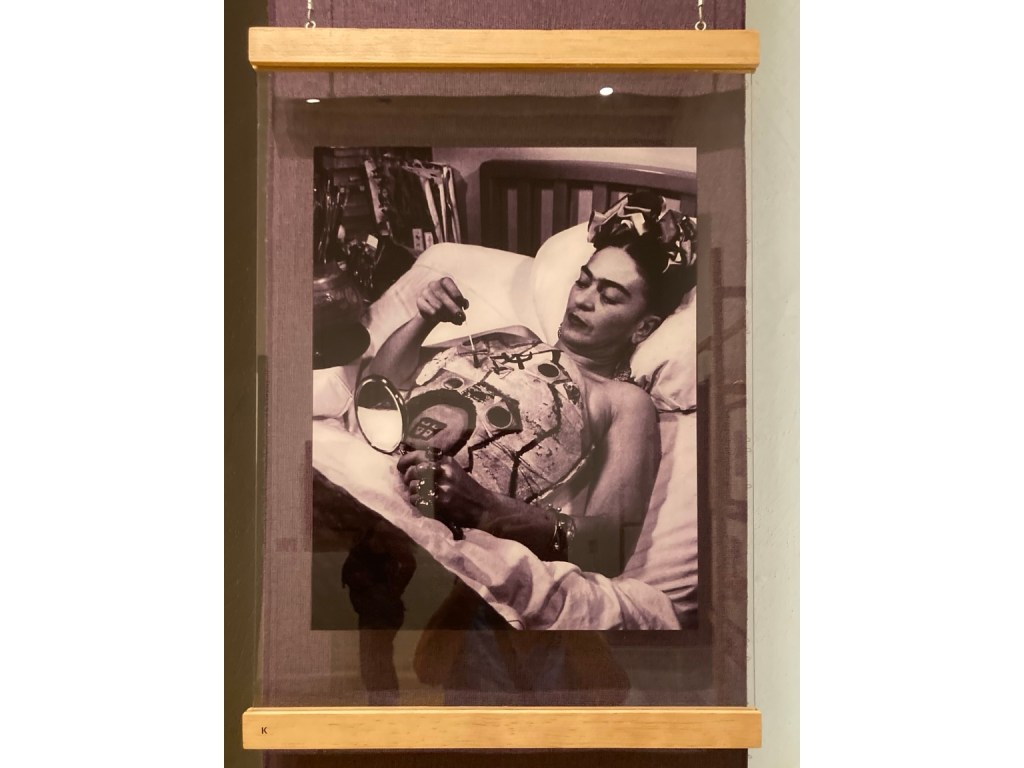
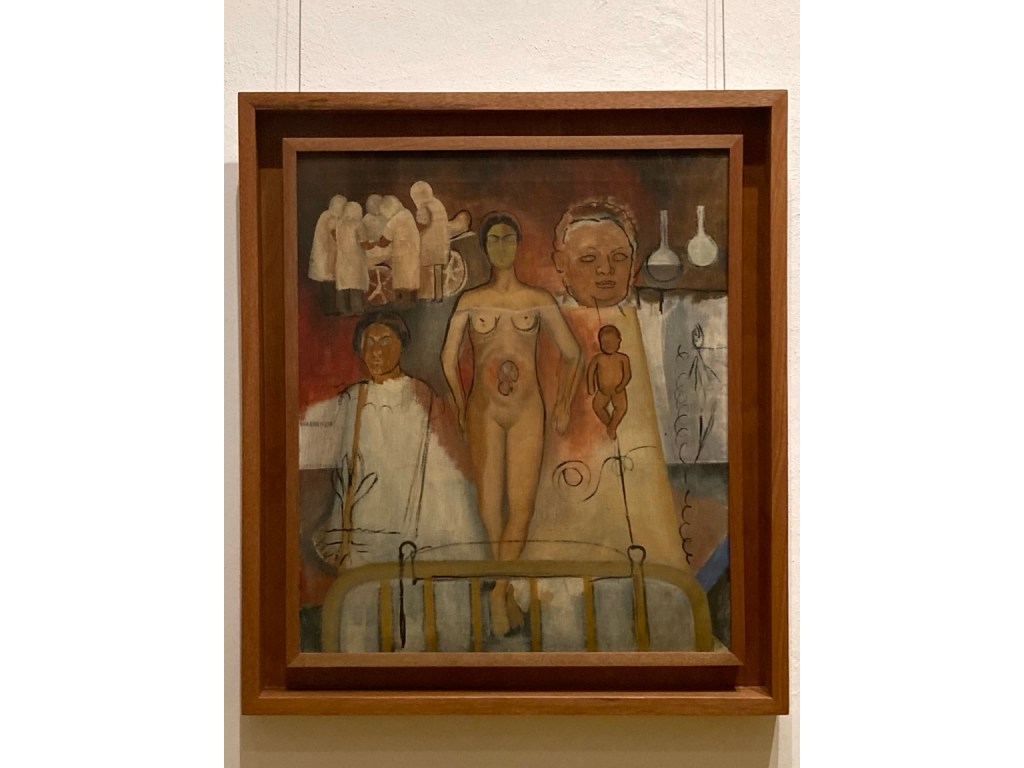
Frida lived here for much of her life and so much has been written about her. The first few rooms told of her early life, her struggles with health and how her art helped to heal her emotionally, especially when couldn’t carry a baby to term.
We remembered some of the items from the V&A exhibition in 2018 which was the first to show the Frida Kahlo’s clothing, jewelry, prosthetic limbs, and hand-painted corsets outside Mexico.
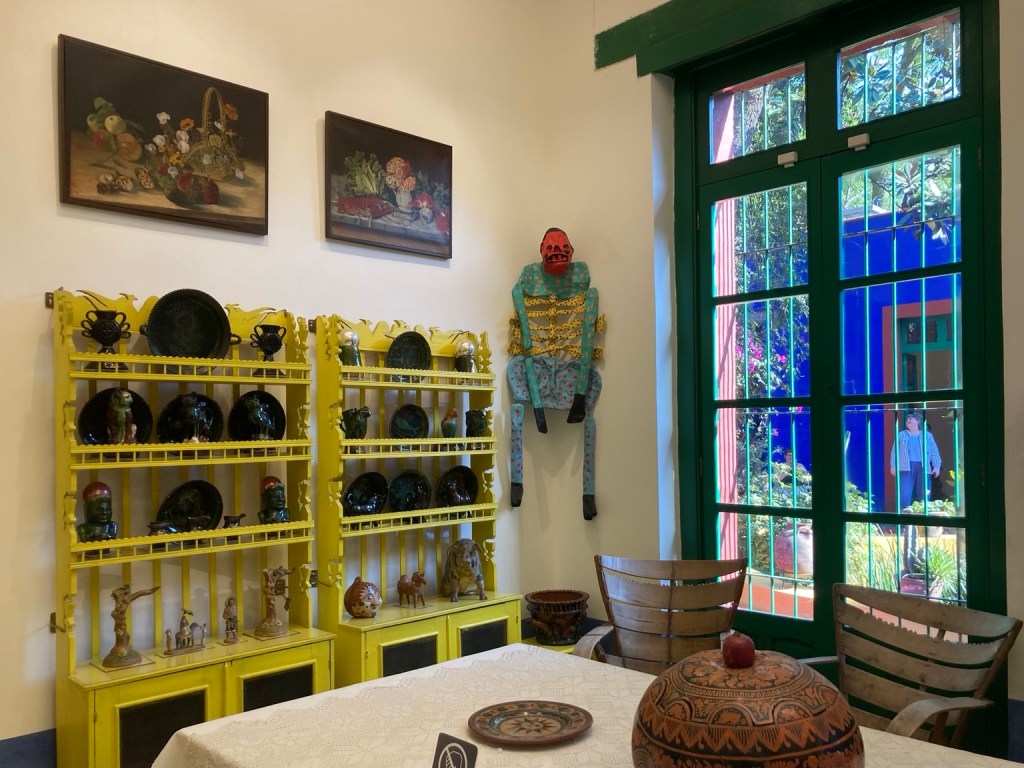
Her collection of folk art inspired her and she included them in her work …
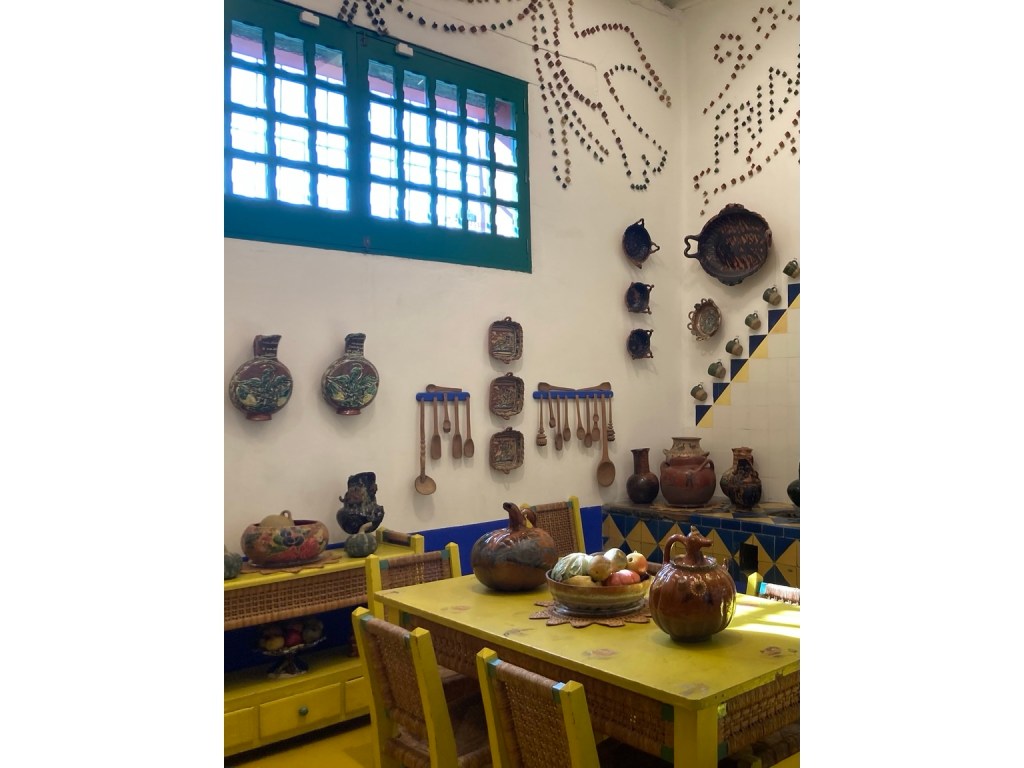
… and displayed them throughout the house …
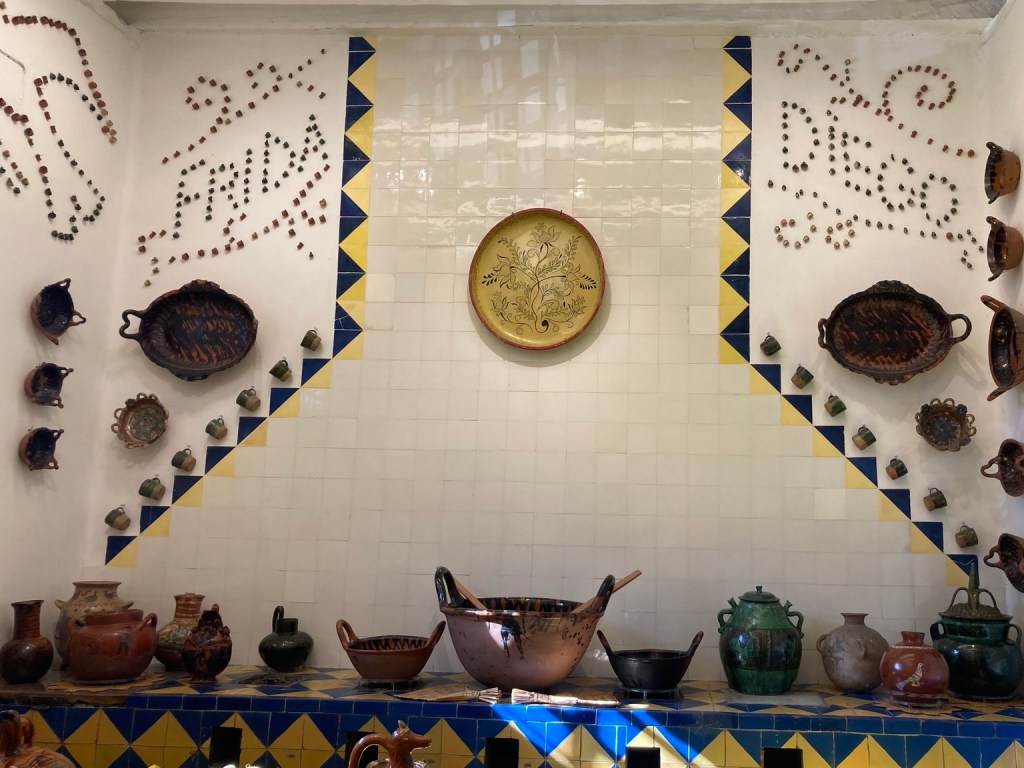
… including cute jugs on the kitchen wall!
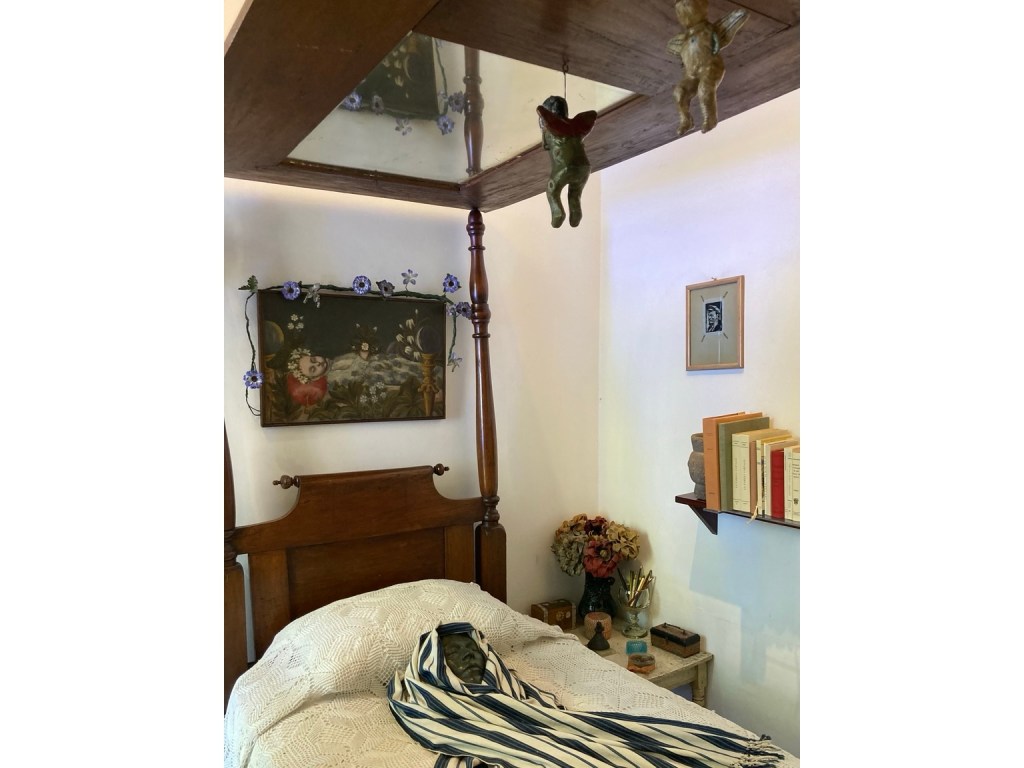
Her bedroom was poignant, with the mirror above the bed which enabled her to paint self portraits …
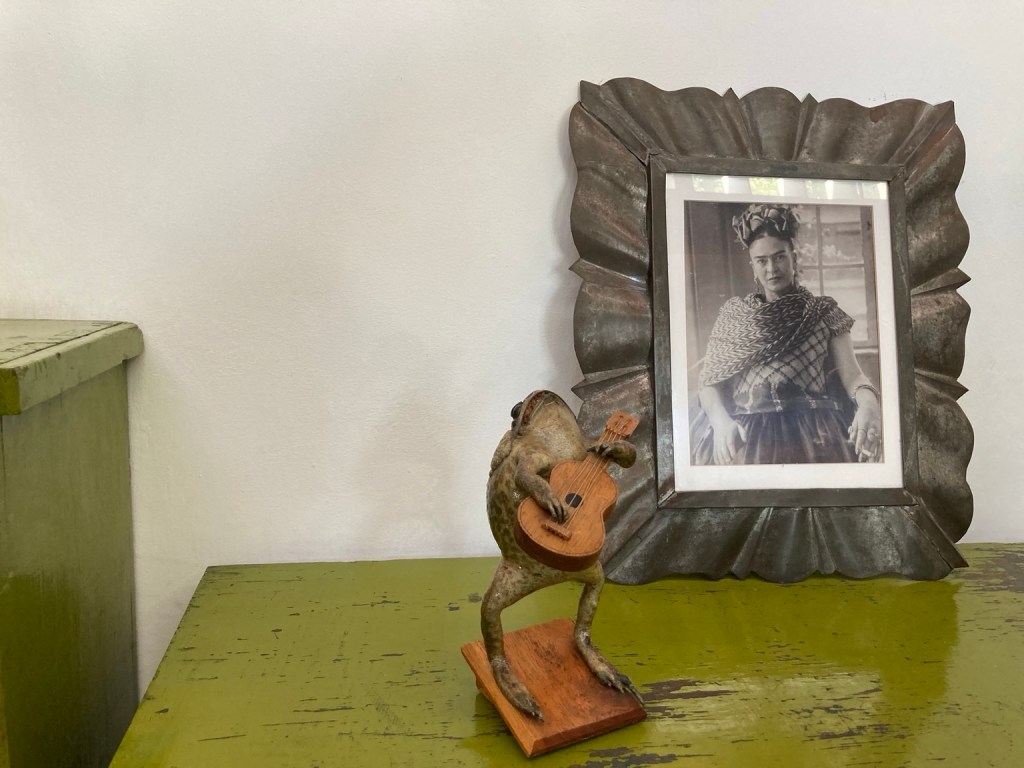
… and the frog shaped jug on the dressing table containing her ashes.
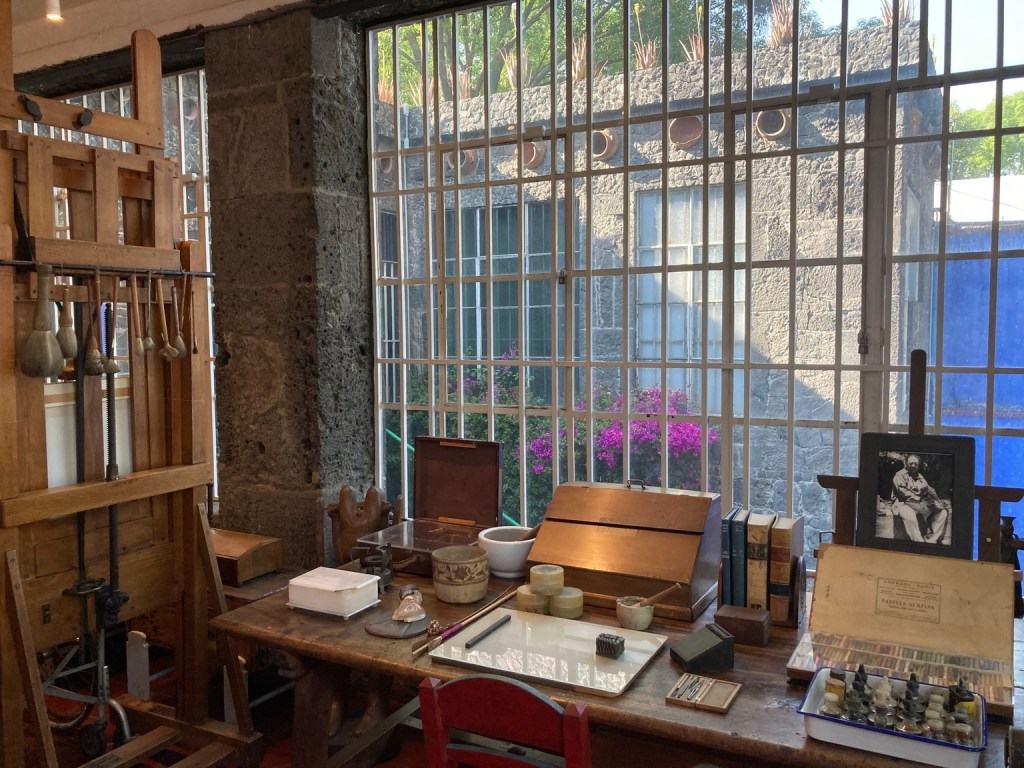
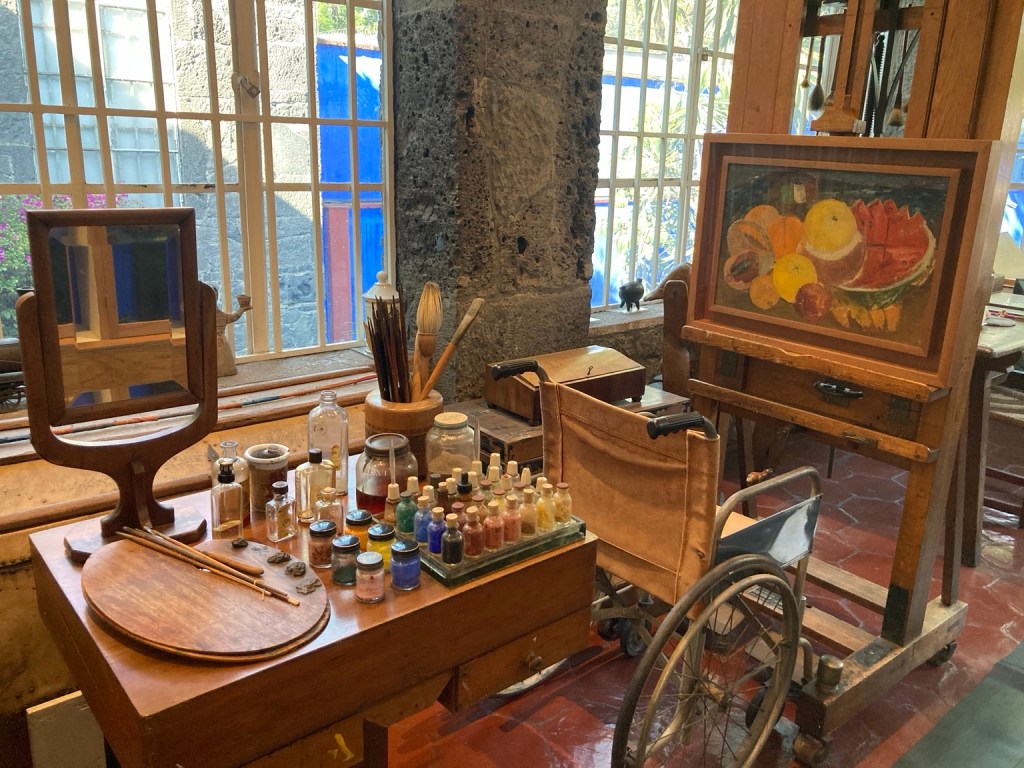
Finally her studio with paints, easel and a wheelchair …
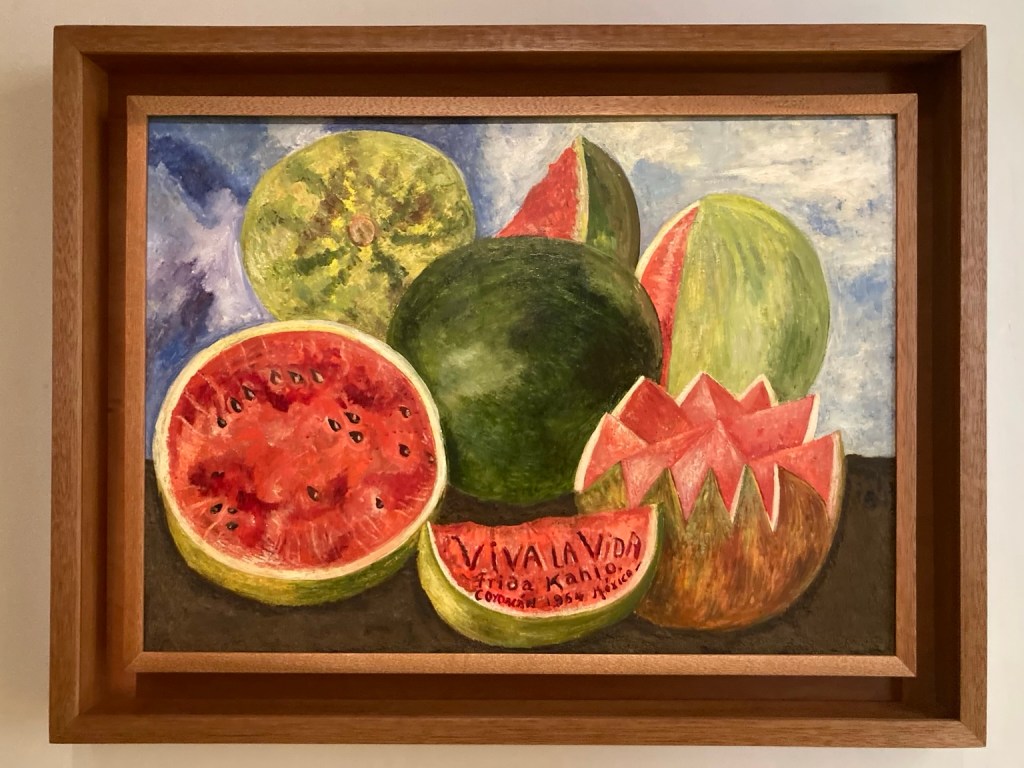
… and her last painting, a vibrant still life of watermelon.
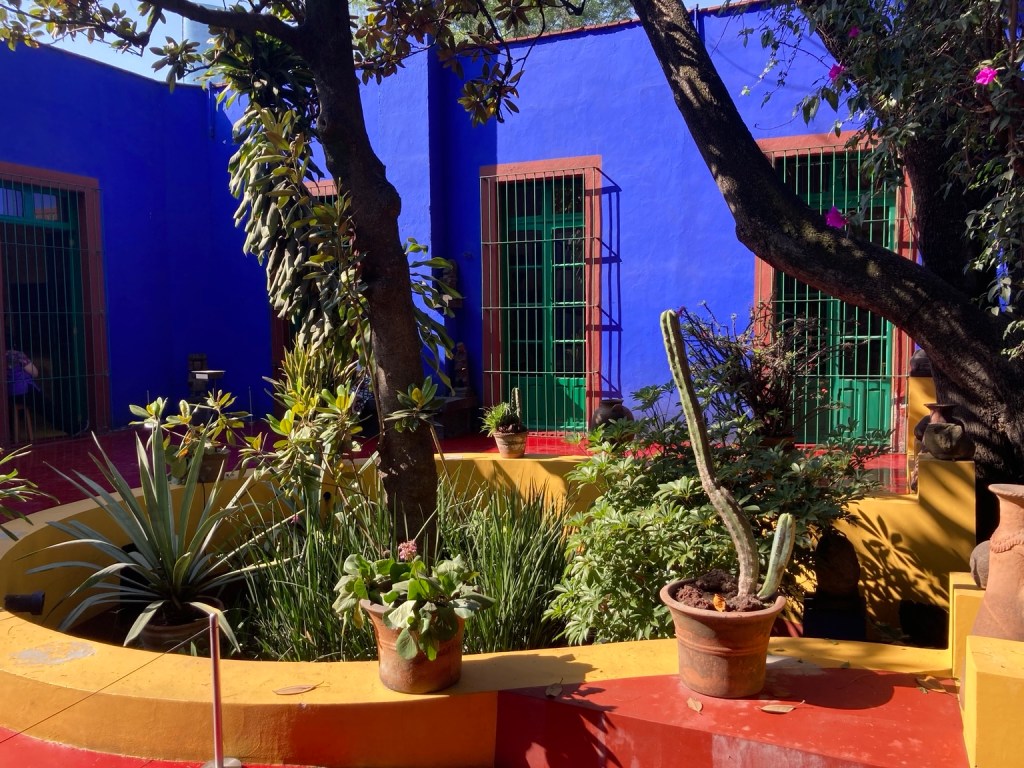
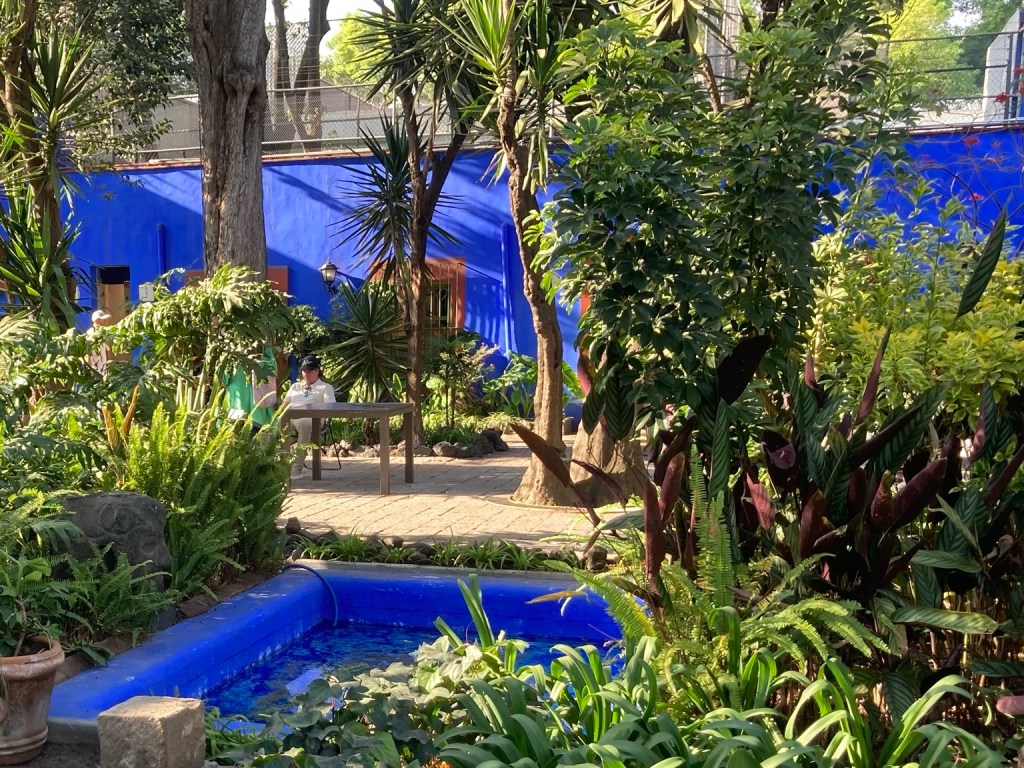
The garden was lovely in the afternoon light …
… and that just left the gift shop, where I found a blue spoon to remind us of our visit.
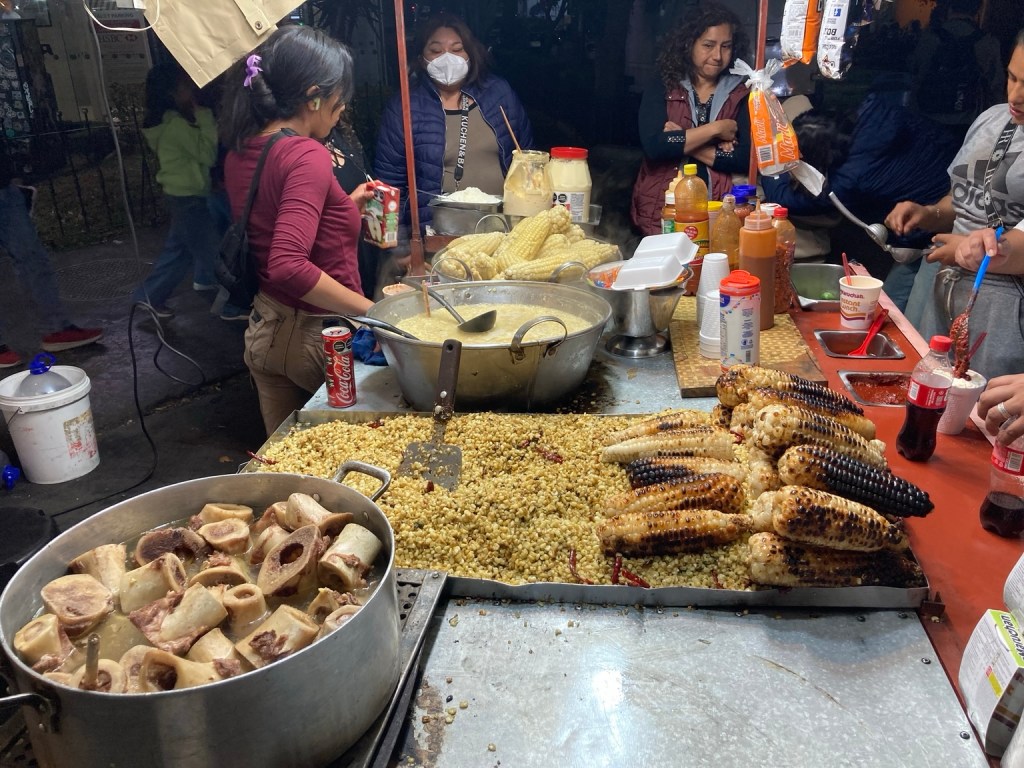
We headed into town for dinner, but almost got sidetracked by the night market with stalls offering everything from the corn that is for sale on every corner …
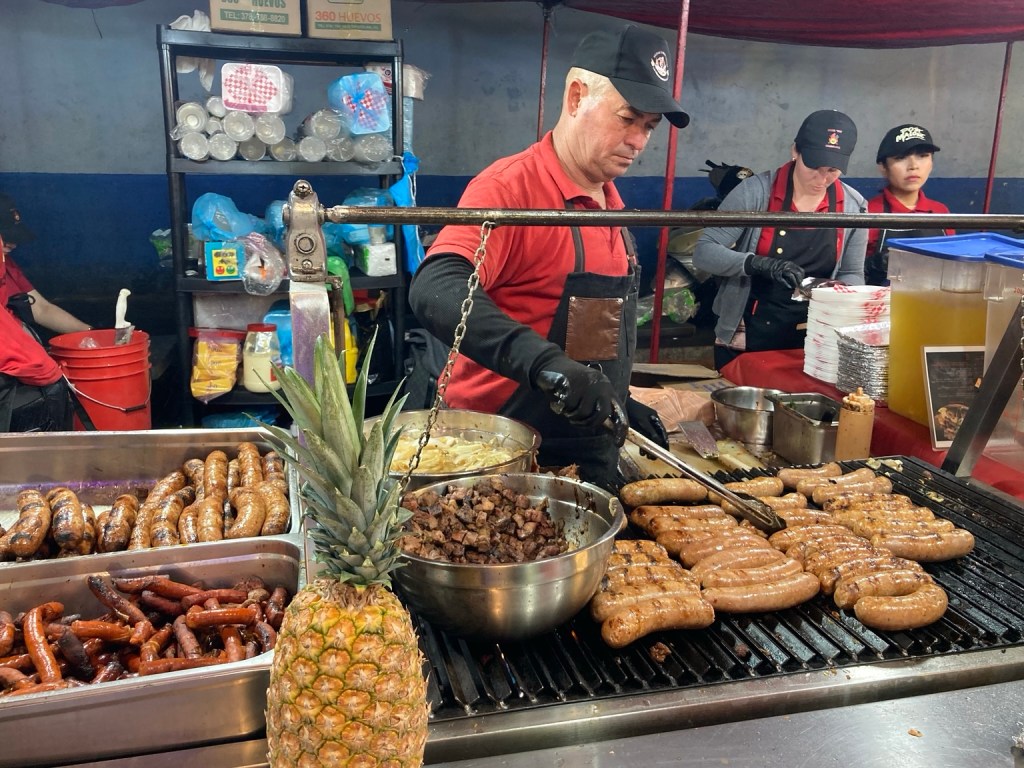
… to bbq meat …
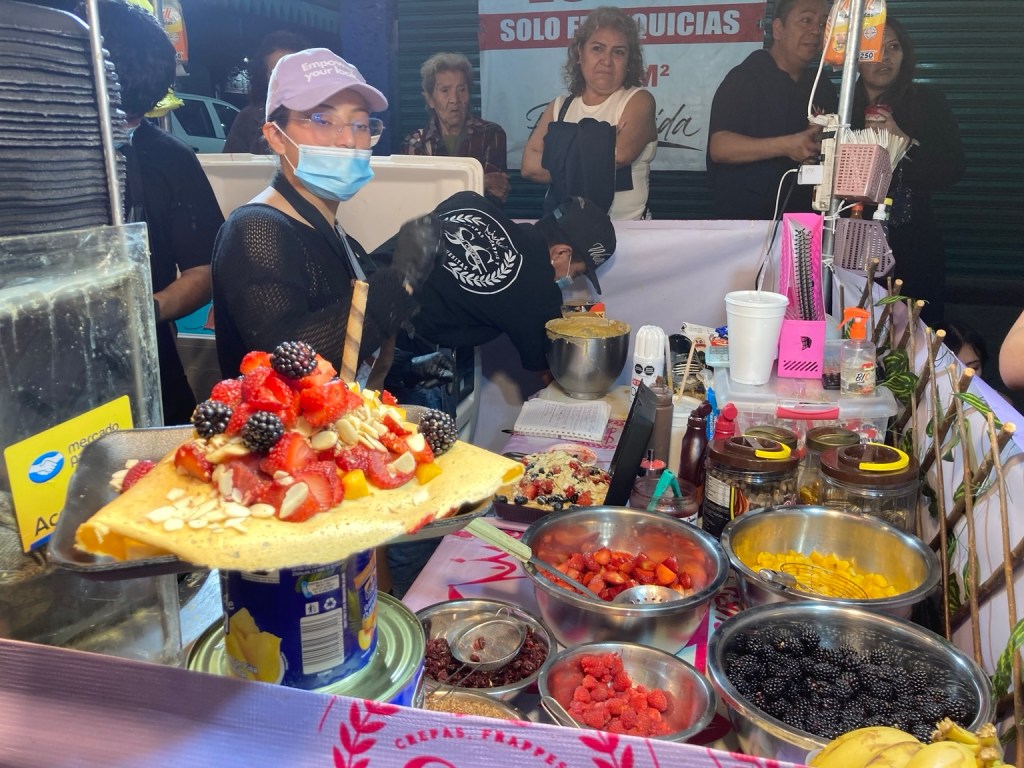
… and crepes and ice cream …
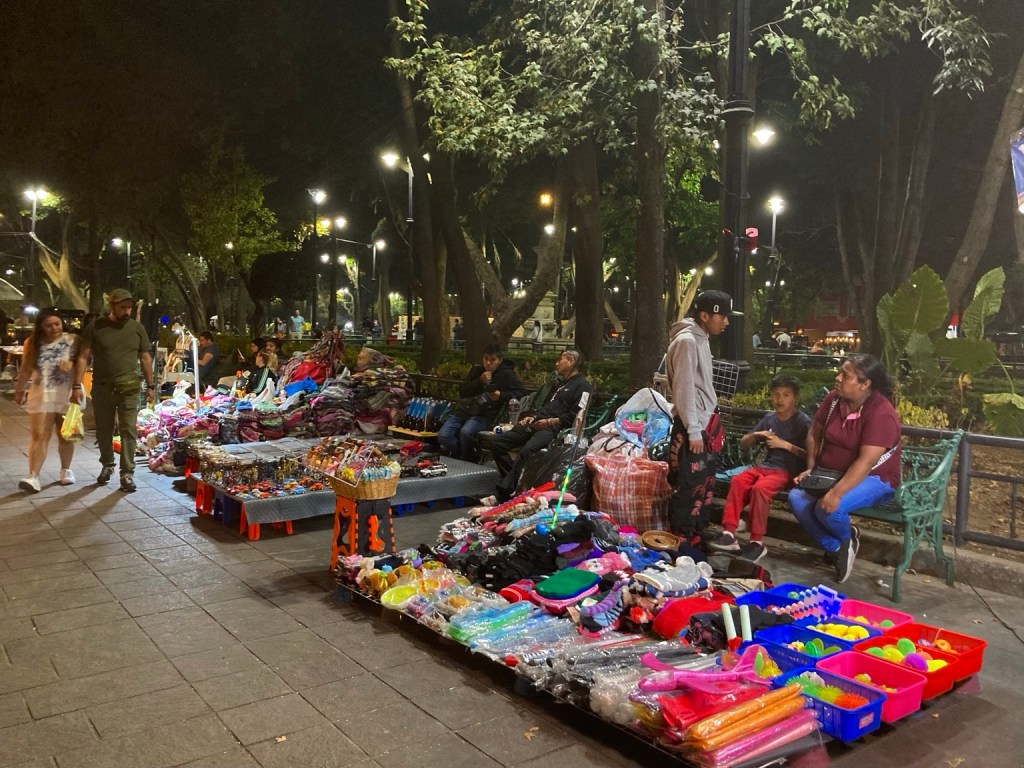
… as well as every souvenir you could ever want … or not!
In fact there is so much food for sale everywhere I can’t believe it could all be eaten!
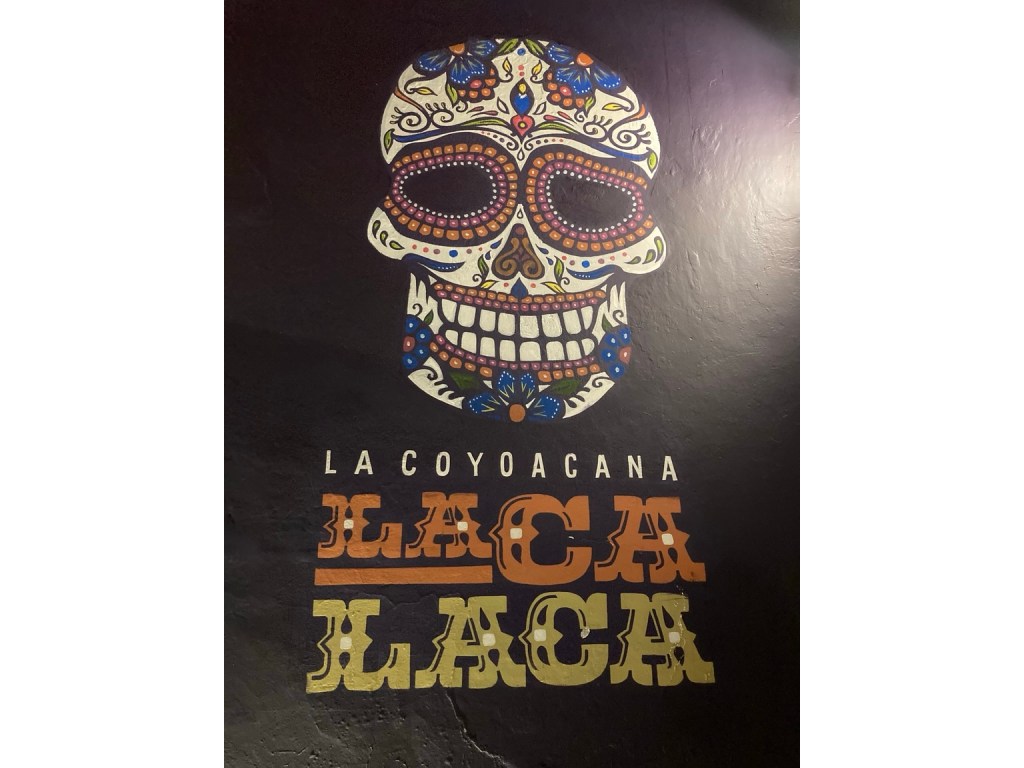
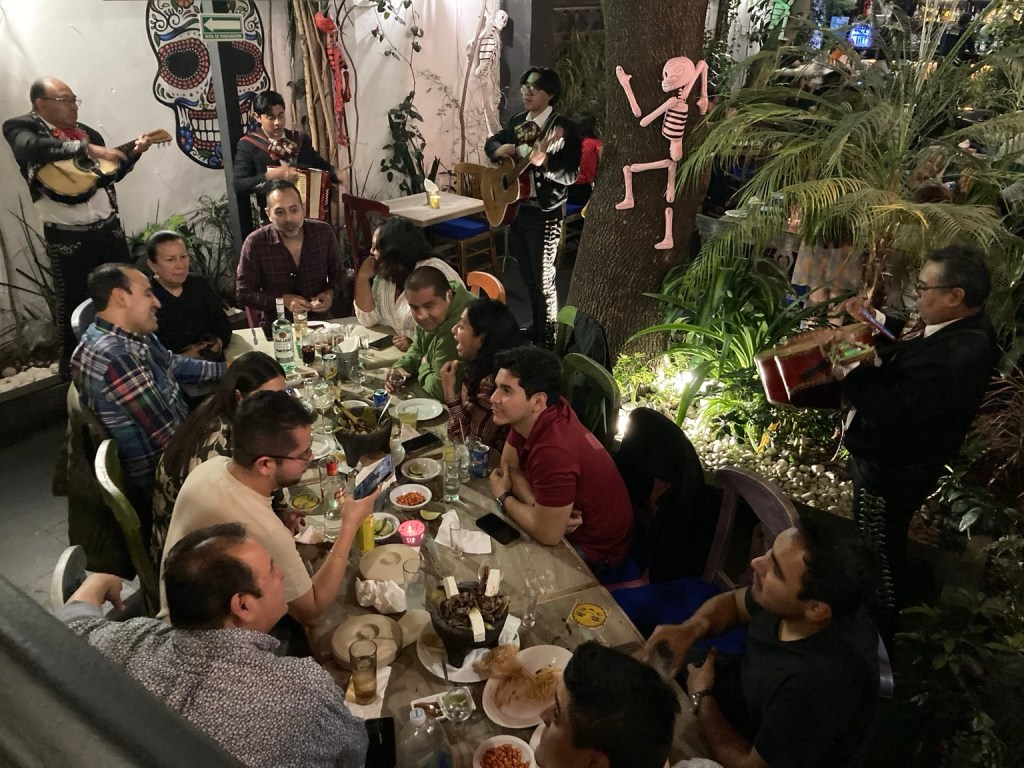
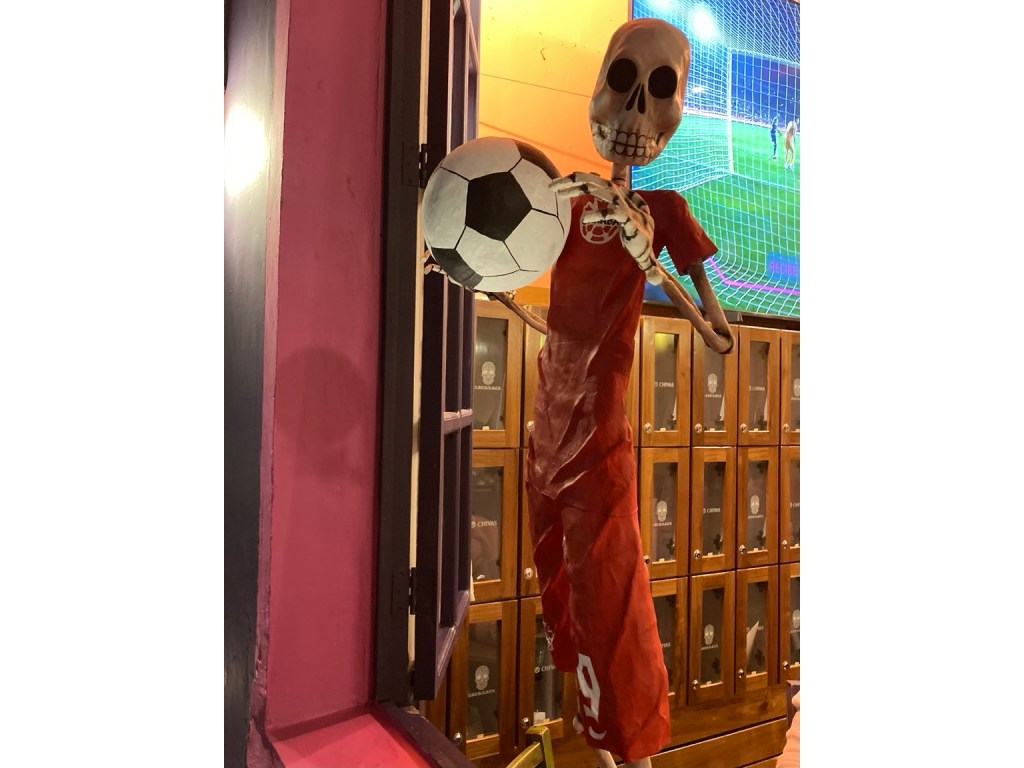
Our destination was La Calaca, meaning the skeleton …
… and as soon as we entered there was a mariachi band who continued to play tune after tune at full volume, accompanied by the family group who were celebrating.
Since we had been in Oaxaca, we’d been on the look out for decent margaritas, but none had hit the spot till tonight … finally mexcal margaritas once more and fab!
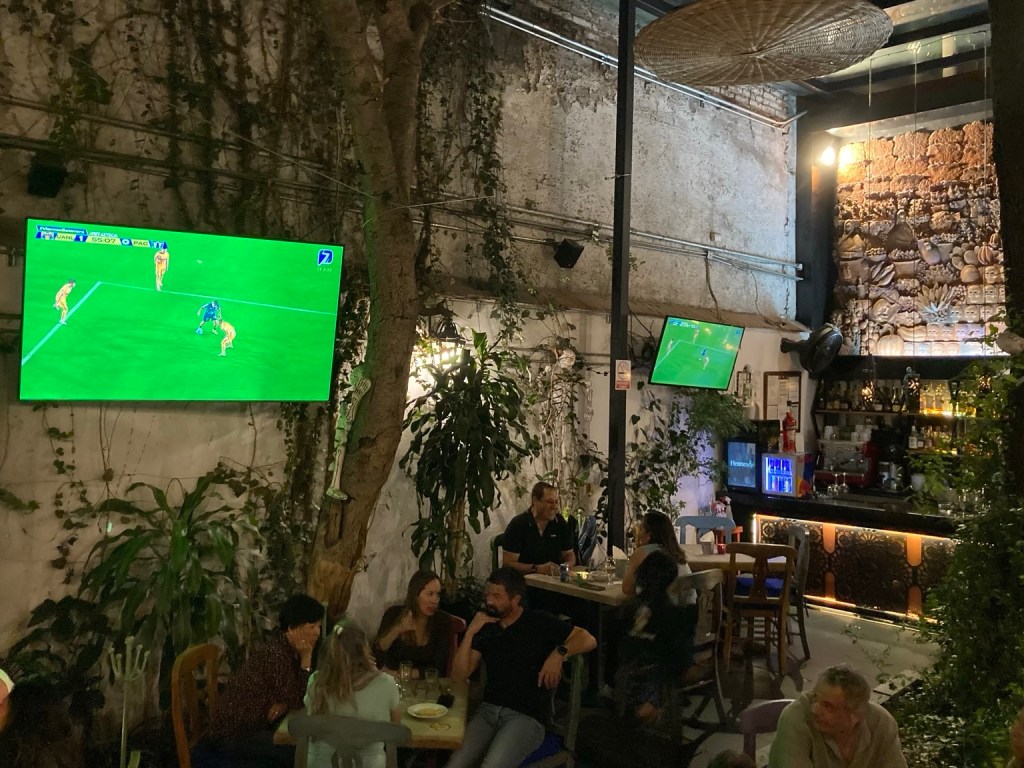
We’d also been hoping to see a football match, but it hasn’t happened, so Chris had to be content with screens showing a local match and even a redman!
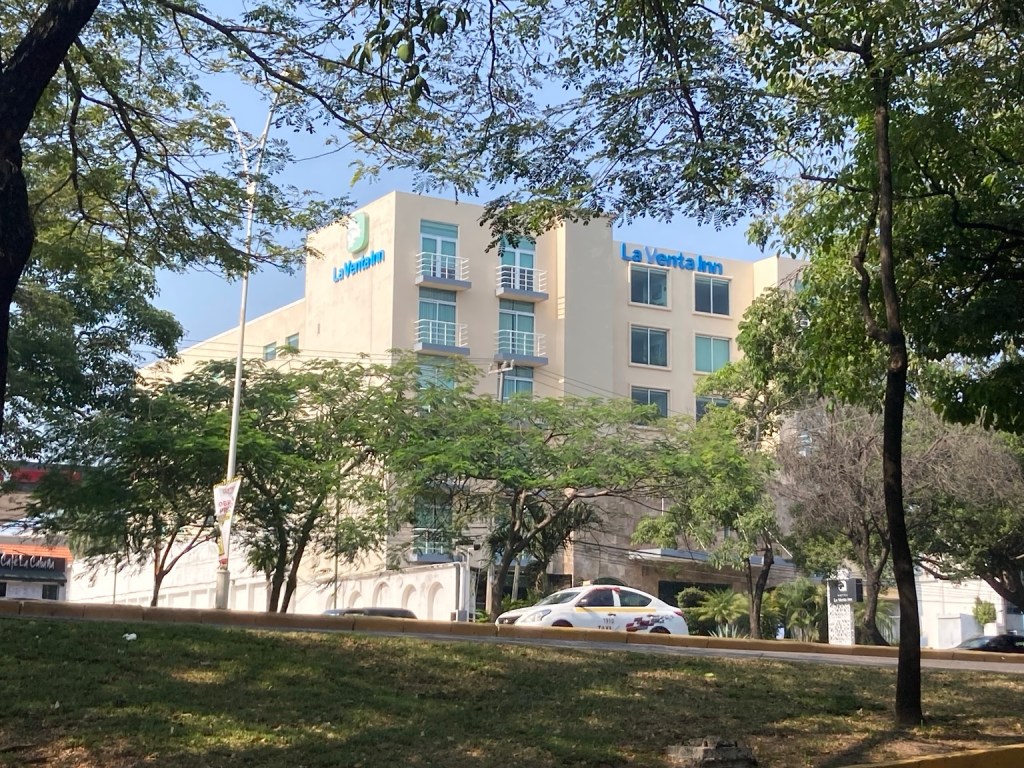
The bus arrived early evening and we checked in to La Venta, a pretty basic business style hotel chosen for its location …
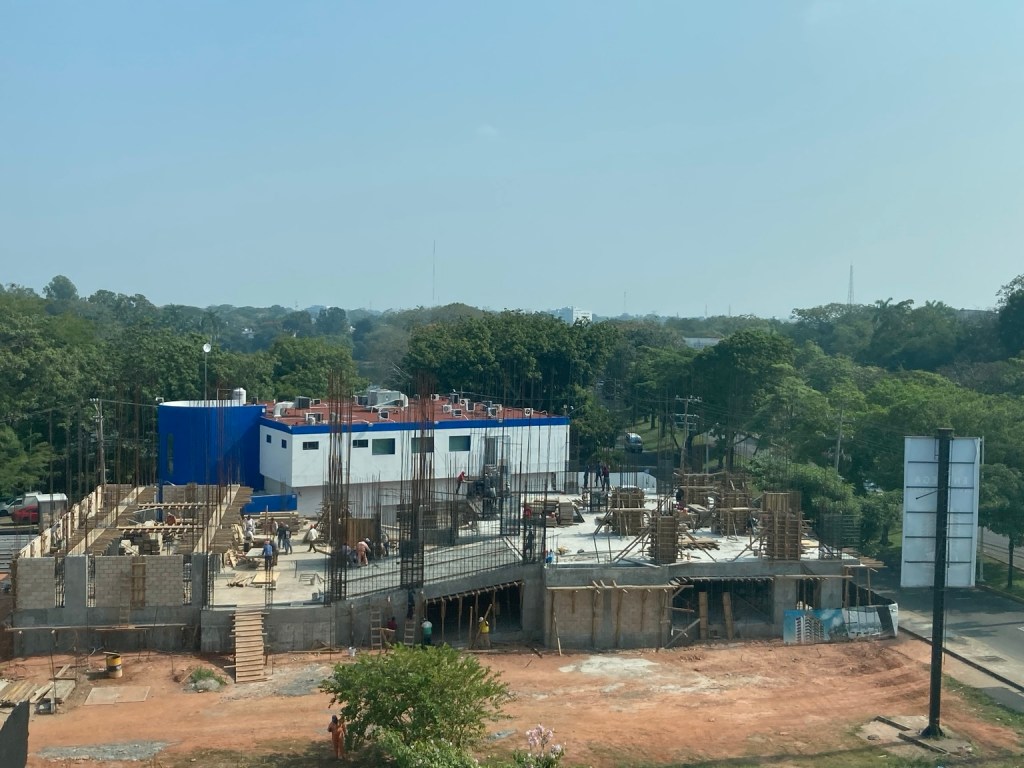
… rather than its view!
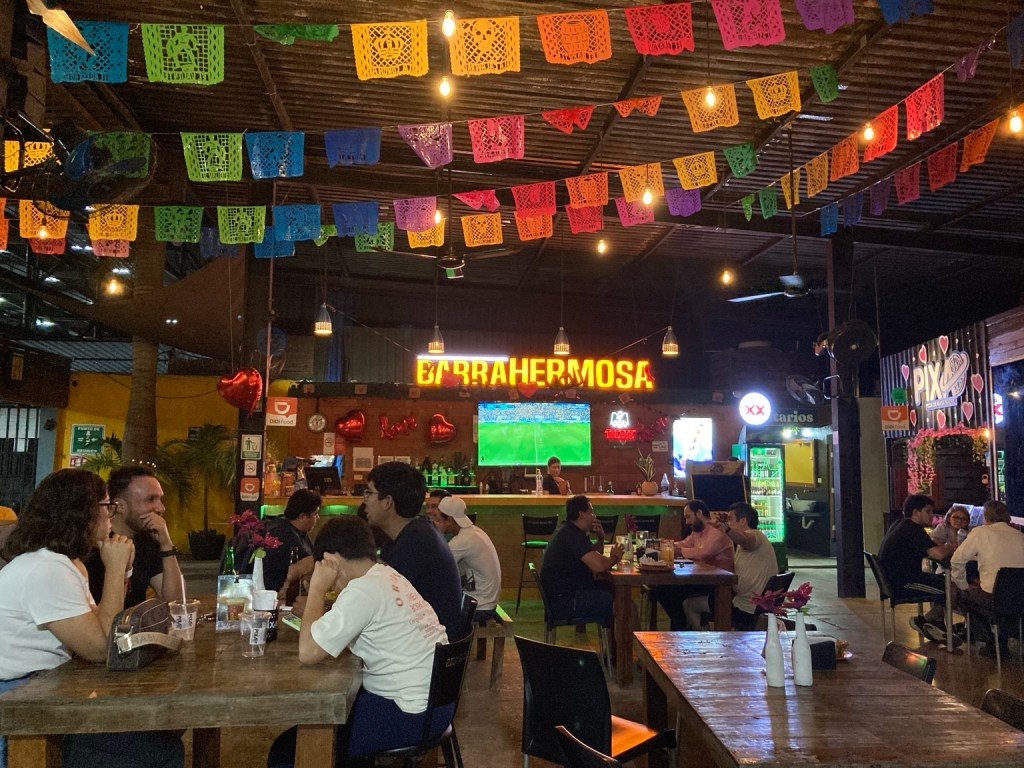
After a good lunch, we weren’t feeling that hungry but wanted to stretch our legs, so ventured out, with care as the hotel is on a busy road. We ended up at a food court and beer garden Mexican style, and had a couple of beers each and some guacamole before calling it a night.
Villahermosa is the state capital of Tabasco and also the easiest airport to fly back to Mexico City, and we could have just stayed the night and flown out, but there is something we wanted to see.
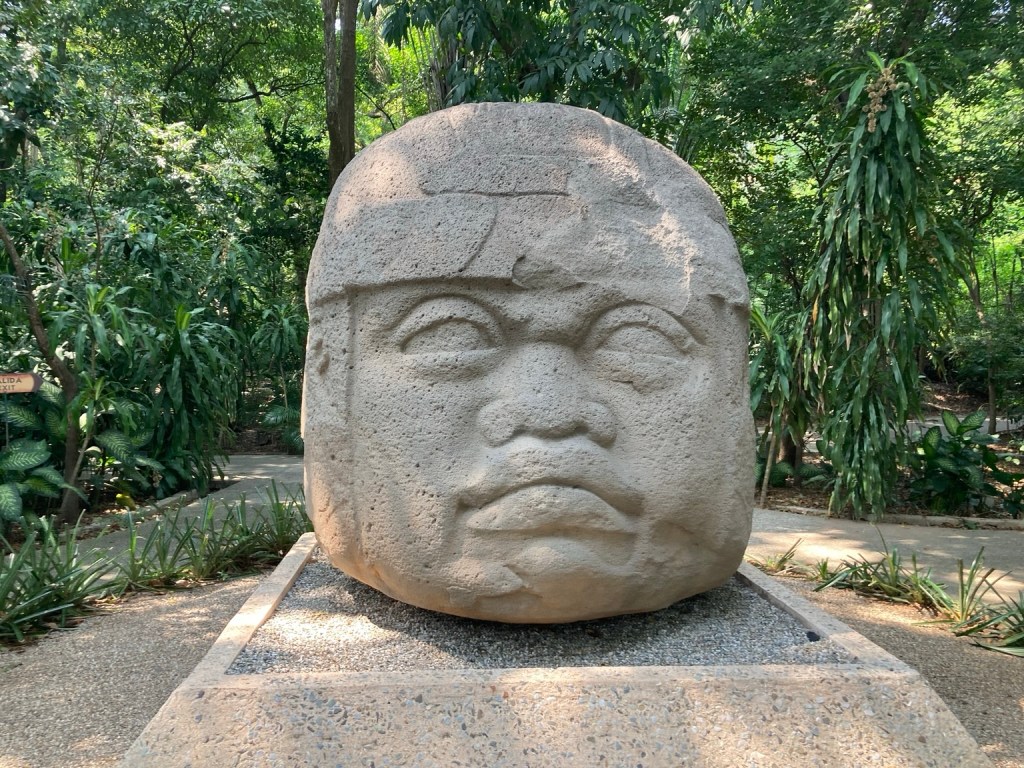
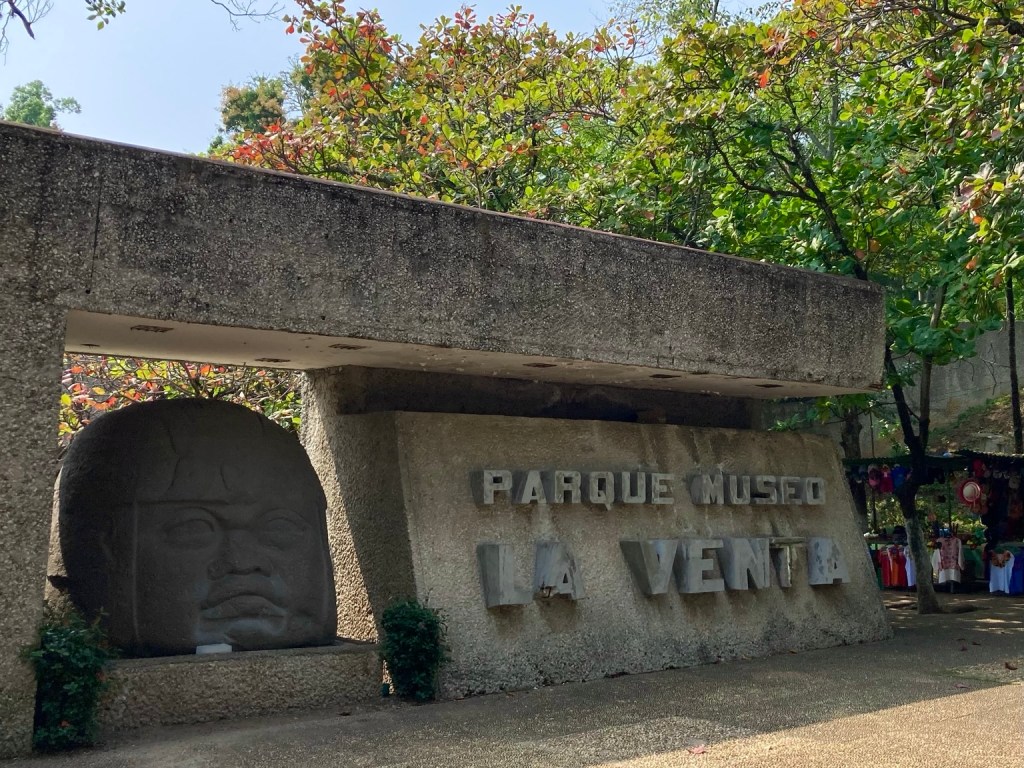
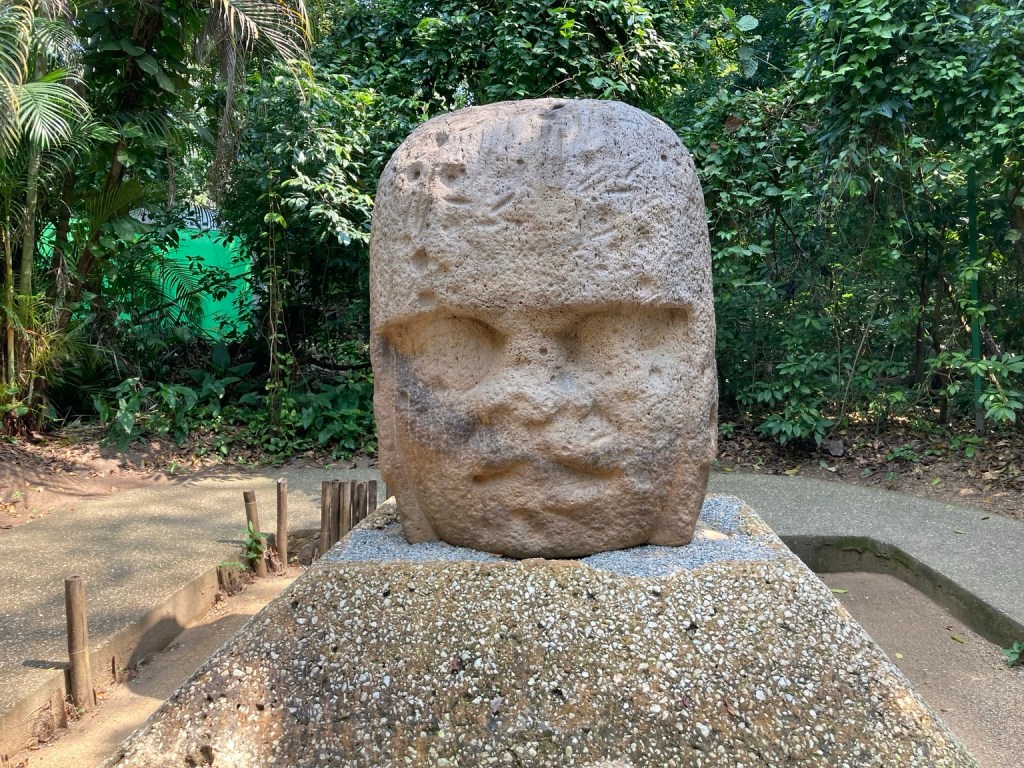
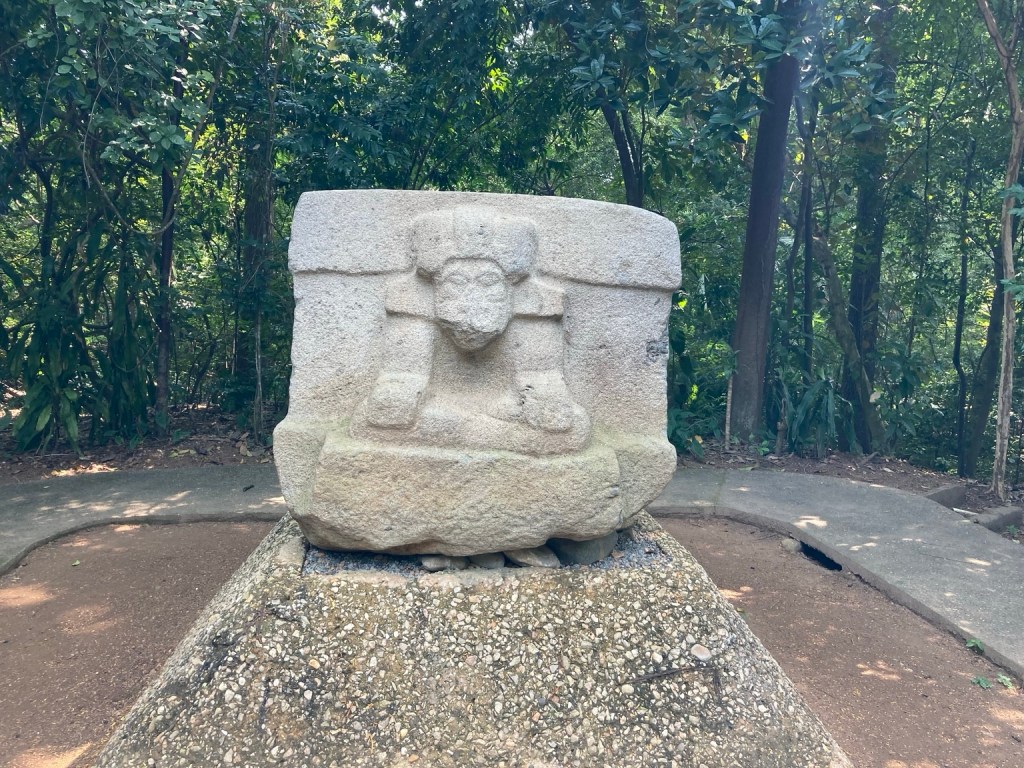
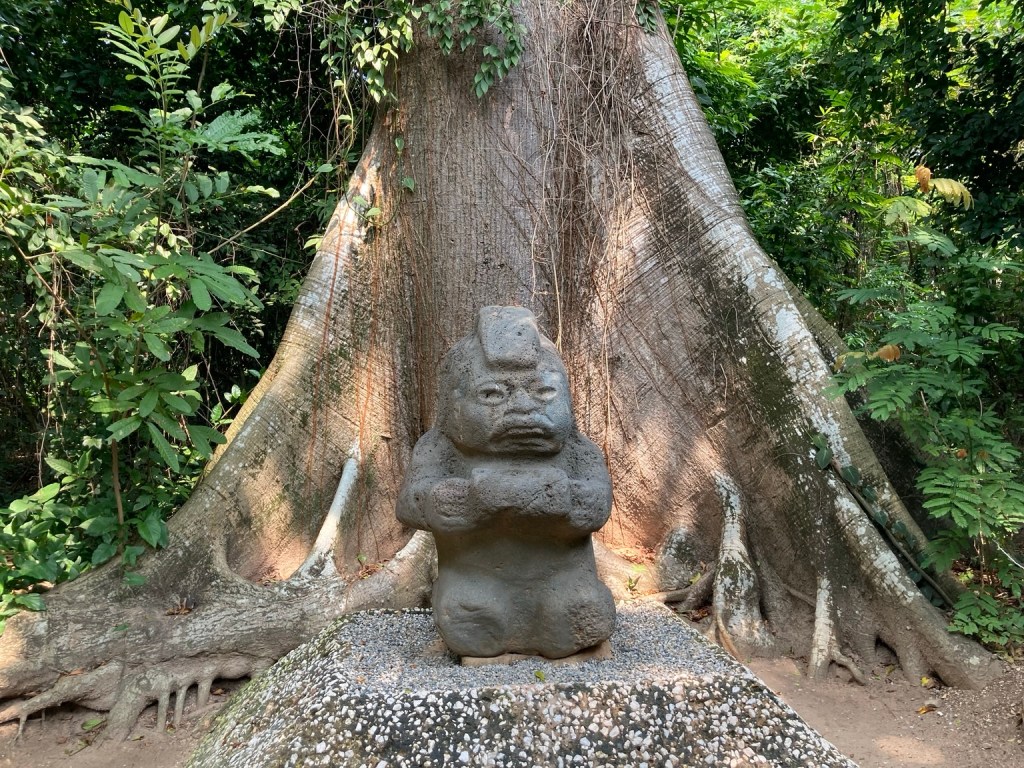
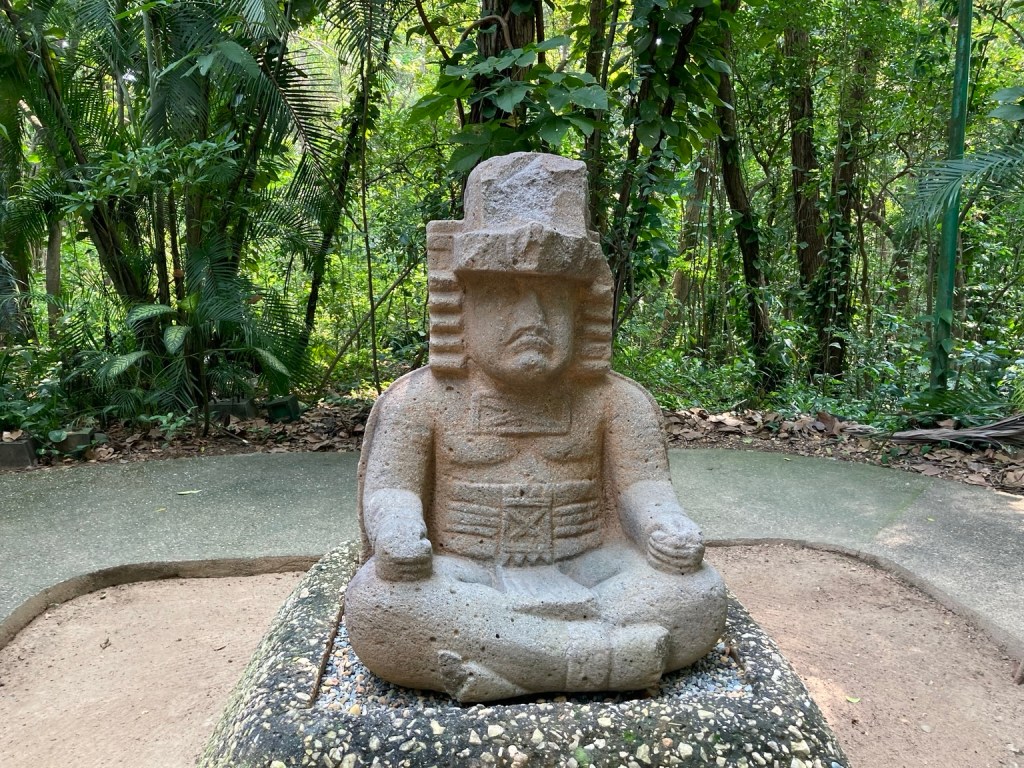
Just across the road from our hotel is the Parque Museo La Venta, an open-air museum in a jungle setting featuring major Olmec sculptures, including massive colossal heads and altars rescued from the nearby La Venta Archaelogical site.
The Olmecs were the first major, complex civilization in Mesoamerica, earlier than everything else we’ve seen. La Venta was their most important centre, began in 1750BC and at its zenith 900BC to 400BC with a population of some 18,000 people. It was built with a planned architectural outline centred around an impressive clay pyramid around 130m across and 31m high and was discovered by Frans Blom in 1925 and excavated through the 1940s. In the 1950s Mexico prioritised oil development and state owned Pemex built a petrochemical complex very close to the centre of the site destroying much of the remains and the most significant pieces were moved here.
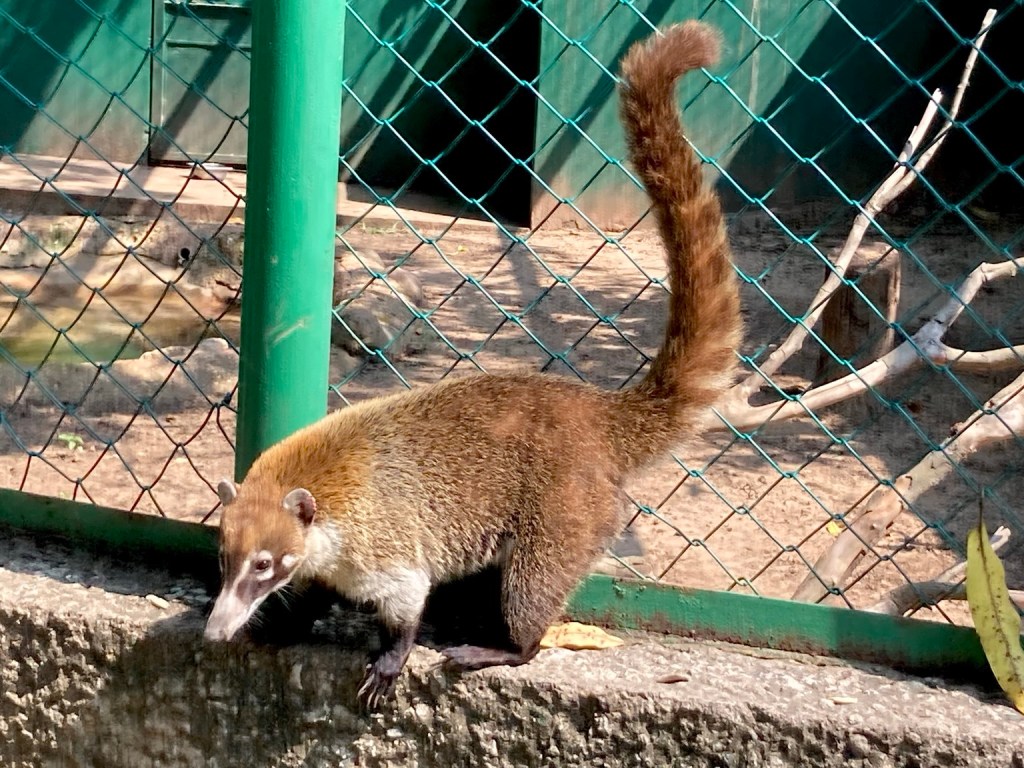
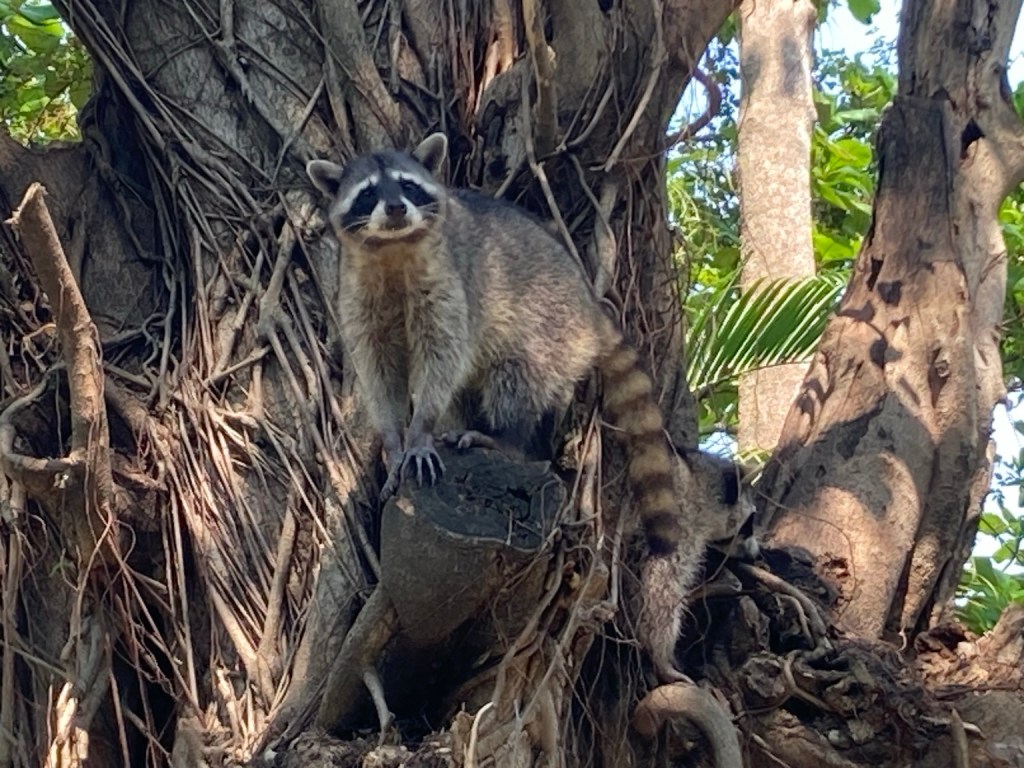
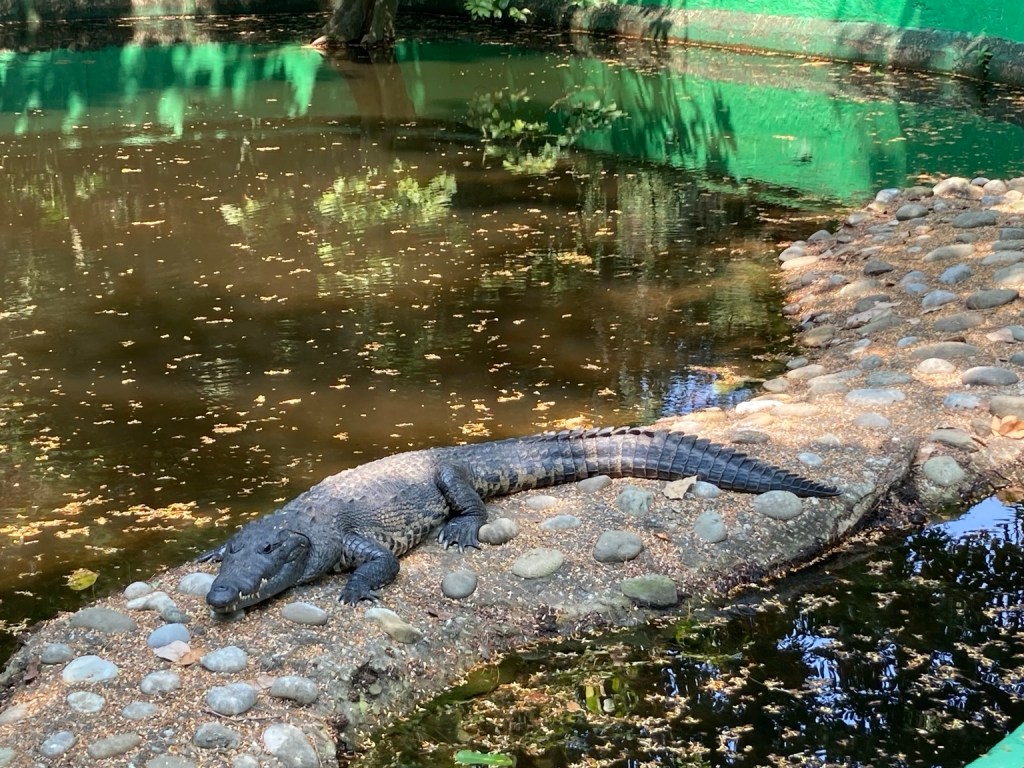
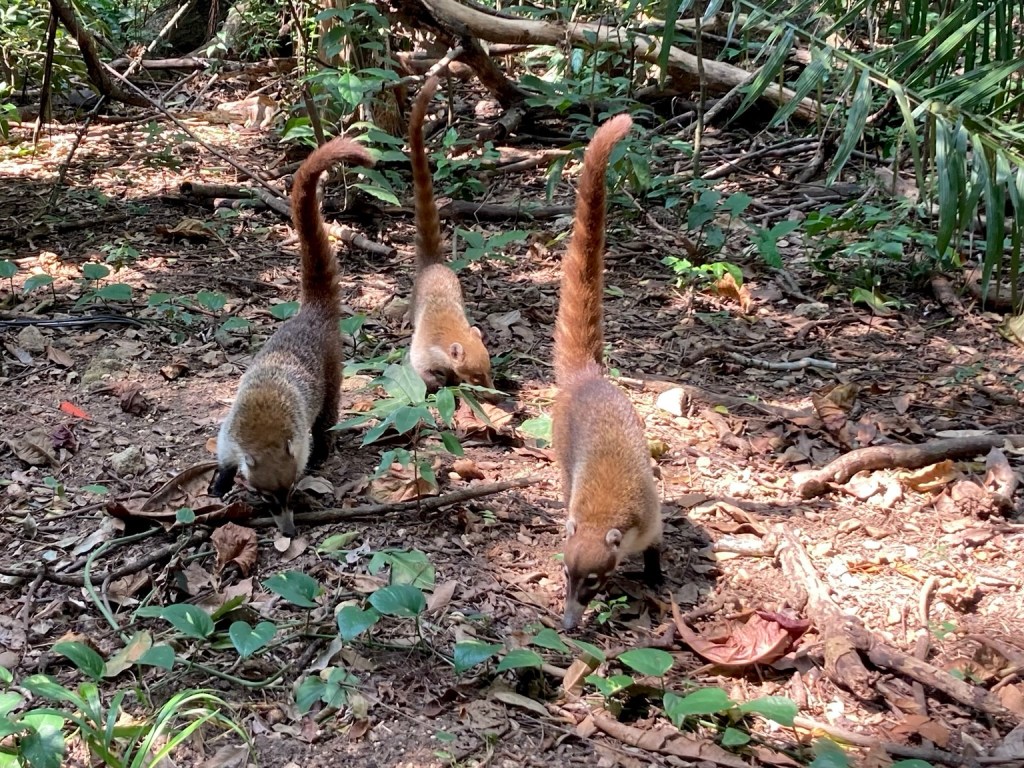
Despite being by a main road, it was like an oasis, with few visitors and green and shady which was lucky as it reached 32° today. Since it opened, the first part has been a zoo showcasing animals from Tabasco, and the monkeys seemed free to roam as did these cute creatures called coatis.
The smaller creatures were ok …
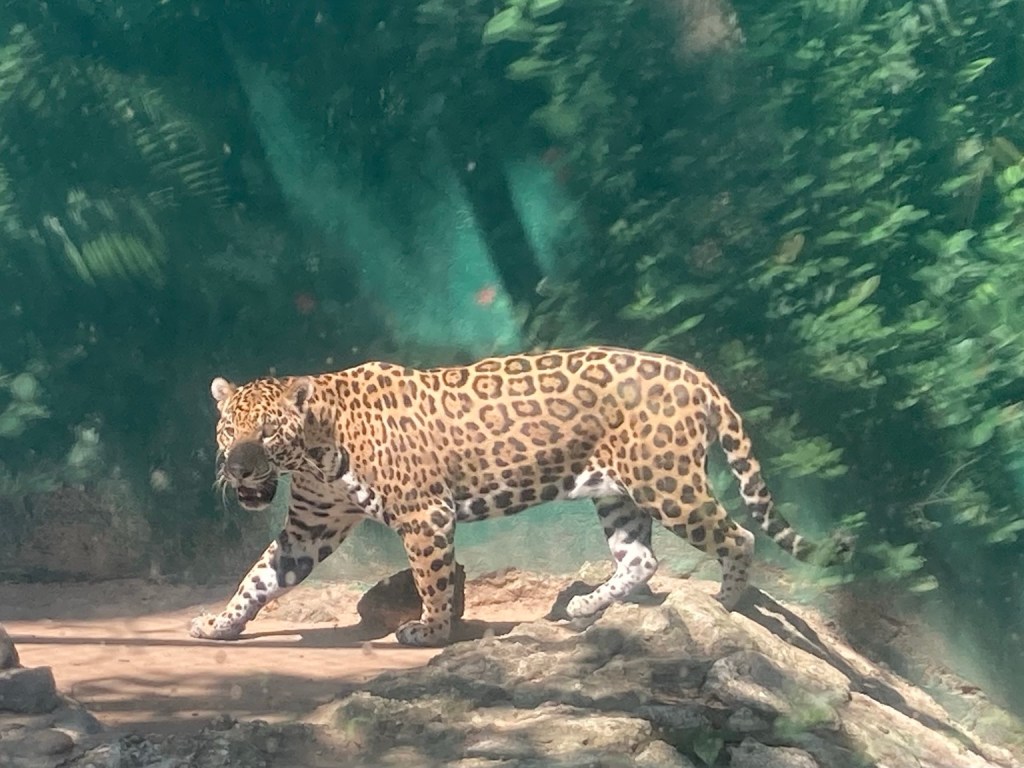
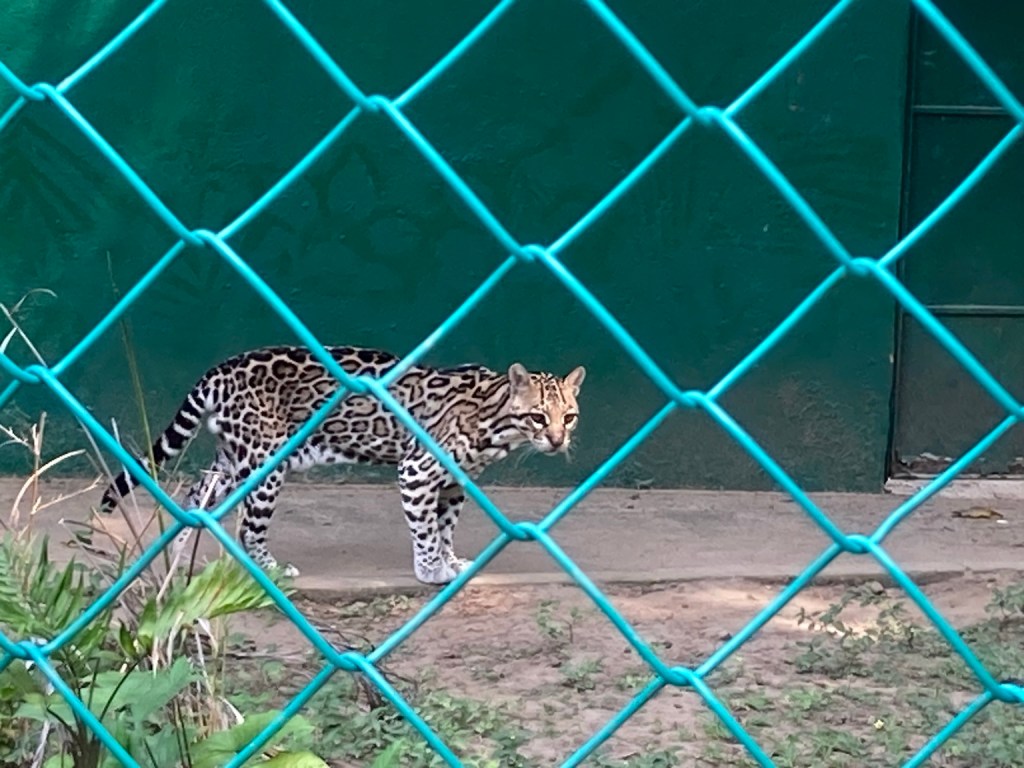
… but I would prefer them not to have jaguars or ocelots as they haven’t enough space.
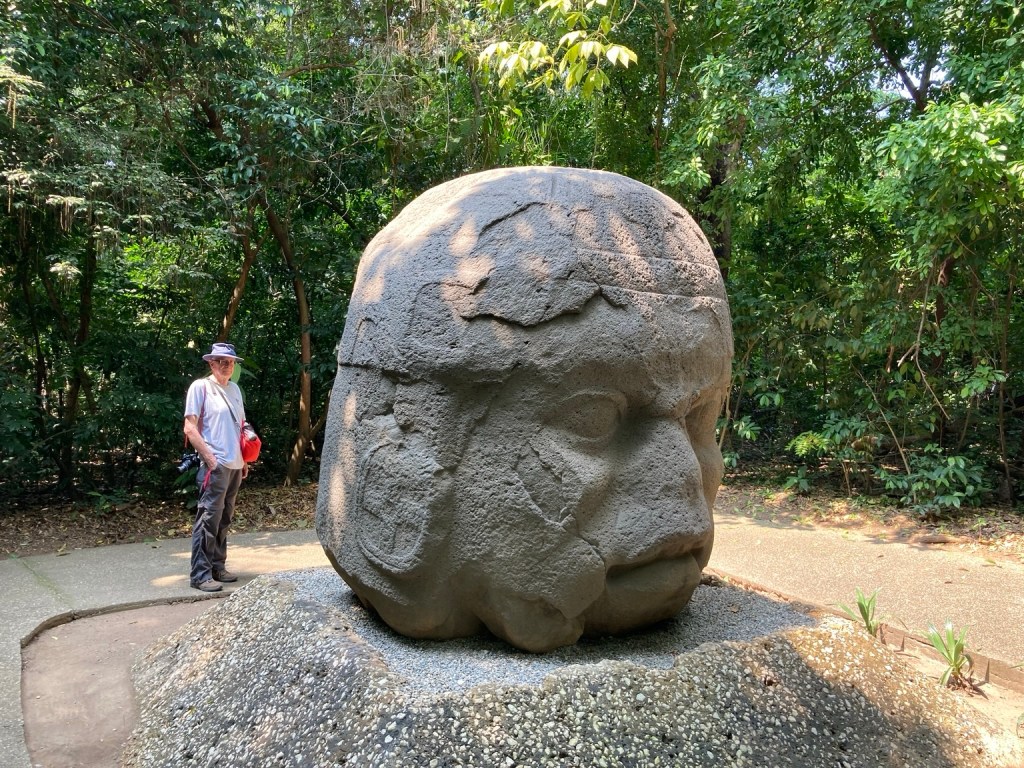
Moving on, we reached the reason for the visit, a collection of huge heads and altars, carved from basalt, which would have been sourced some 150kms away which is a feat in itself. The colossal heads of La Venta were originally positioned around the great pyramid as if protecting the sacred part of the city and here are three of them, all with similar features, slightly surly expressions and earspools.
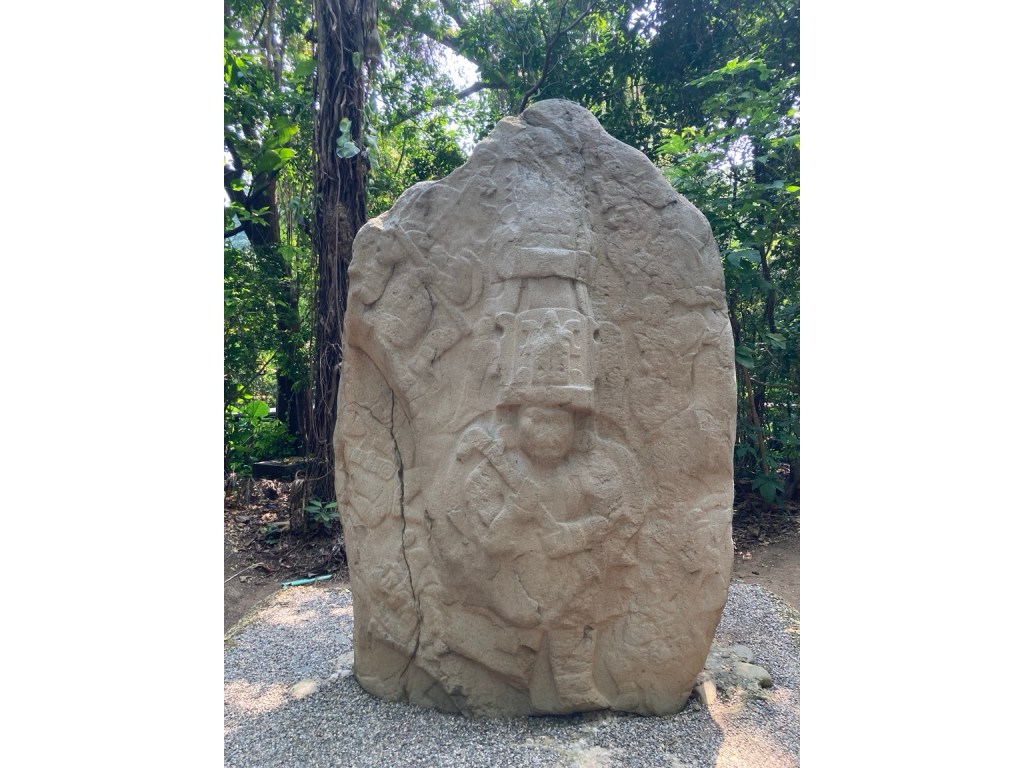
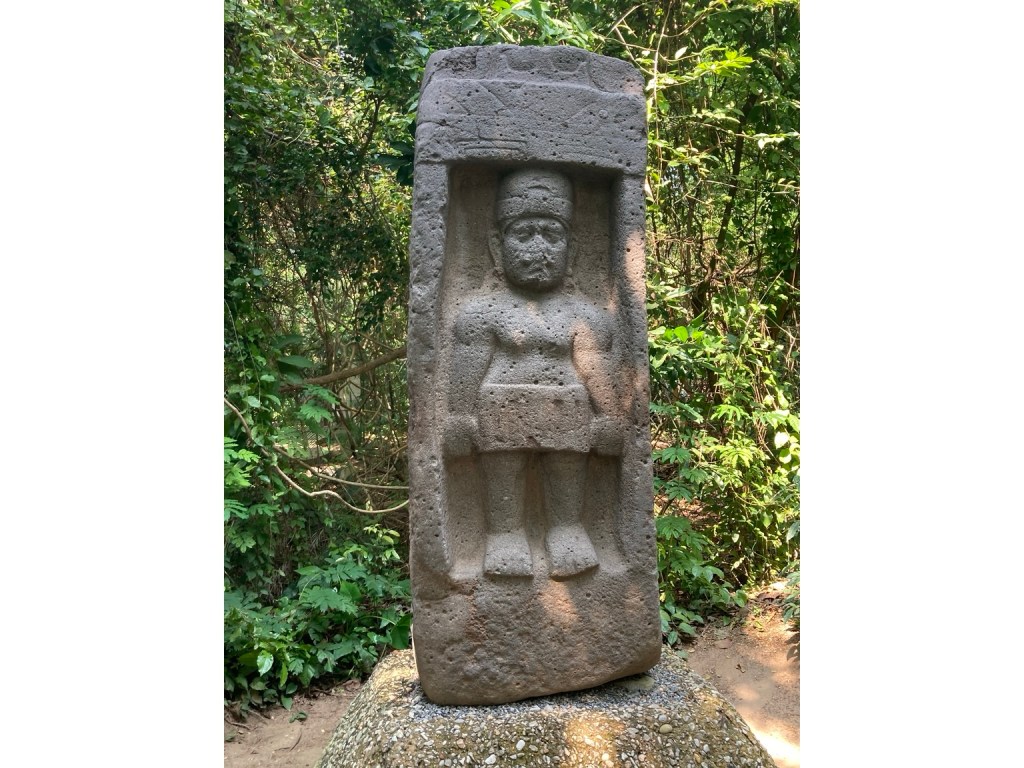
This stela was found close by and has been called the King’s Stela due to the importance of the figure.
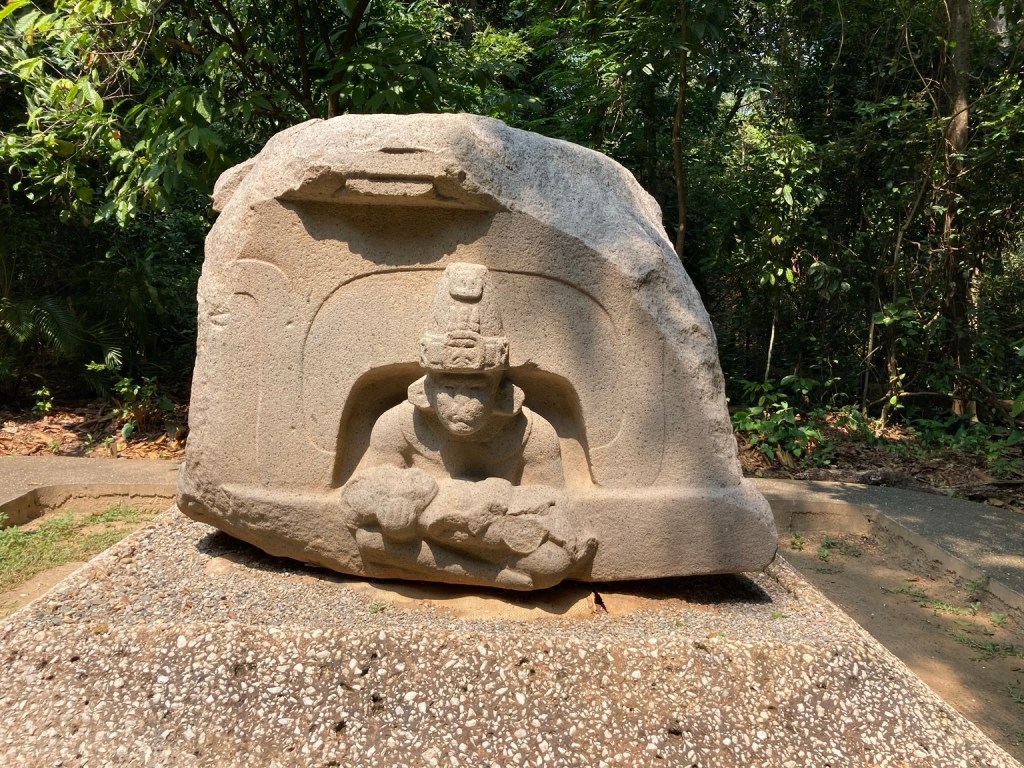
There were also several altars, with a sculpted figure inside …
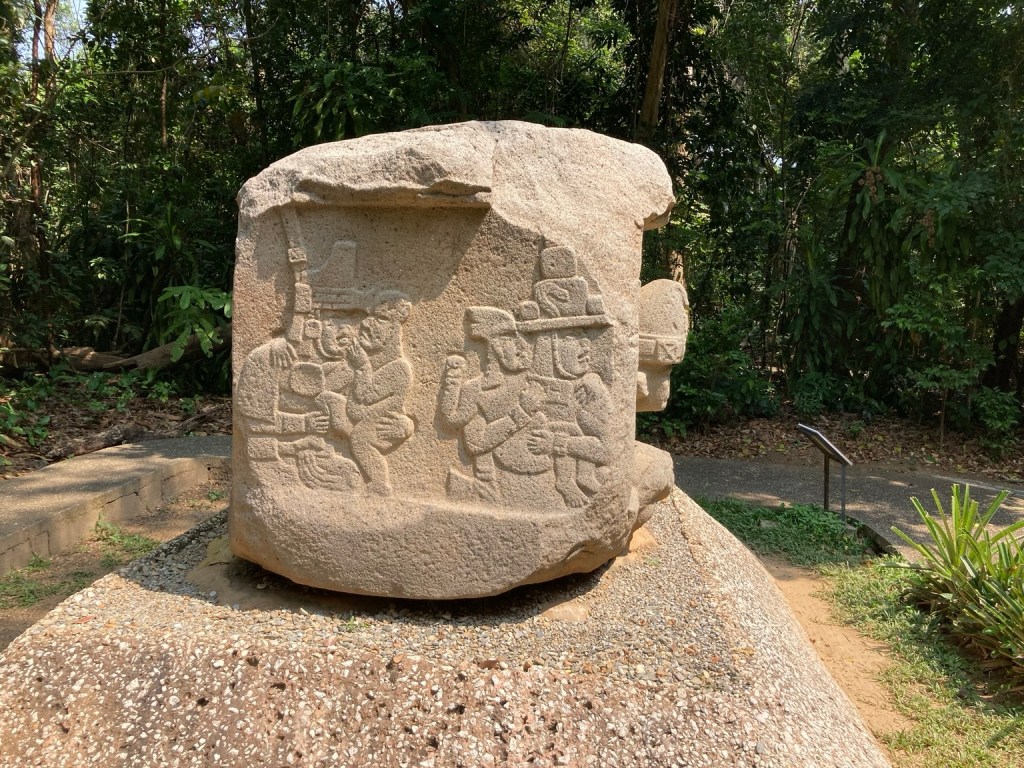
… and this one with an additional relief on the side …
… as well as sculptures referred to as the Grandmother …
… and the Governor.
We were in no hurry and spent the morning happily wandering around …
… enchanted with the antics of the coatis …
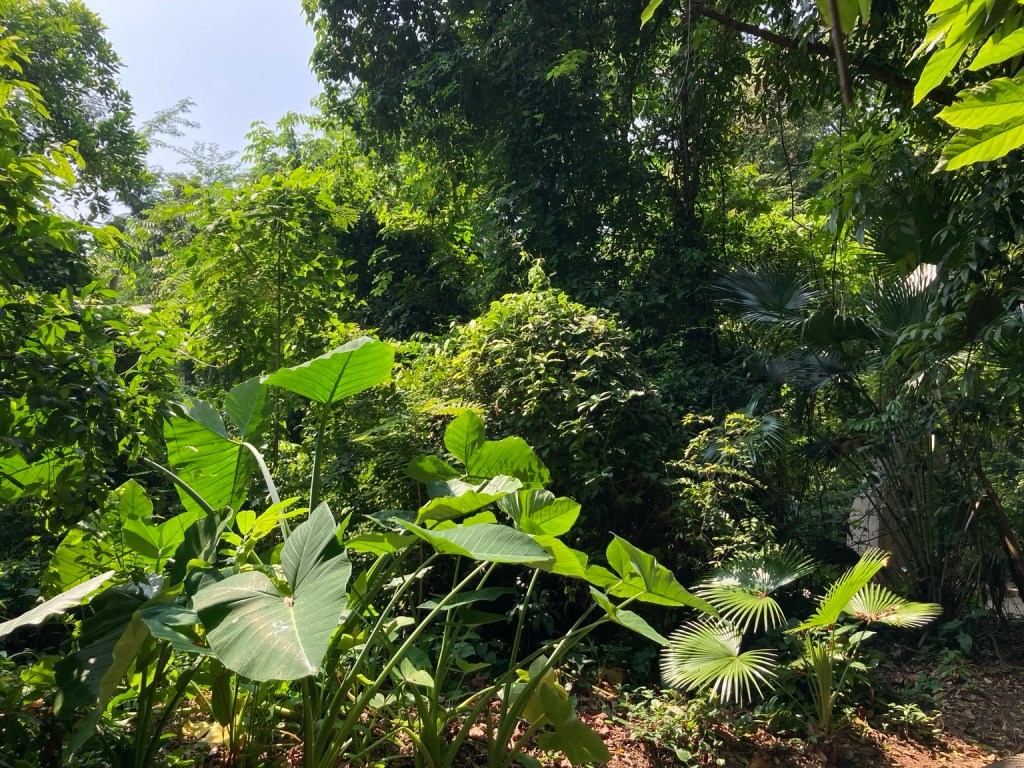
… and just enjoying being outside surrounded by green.
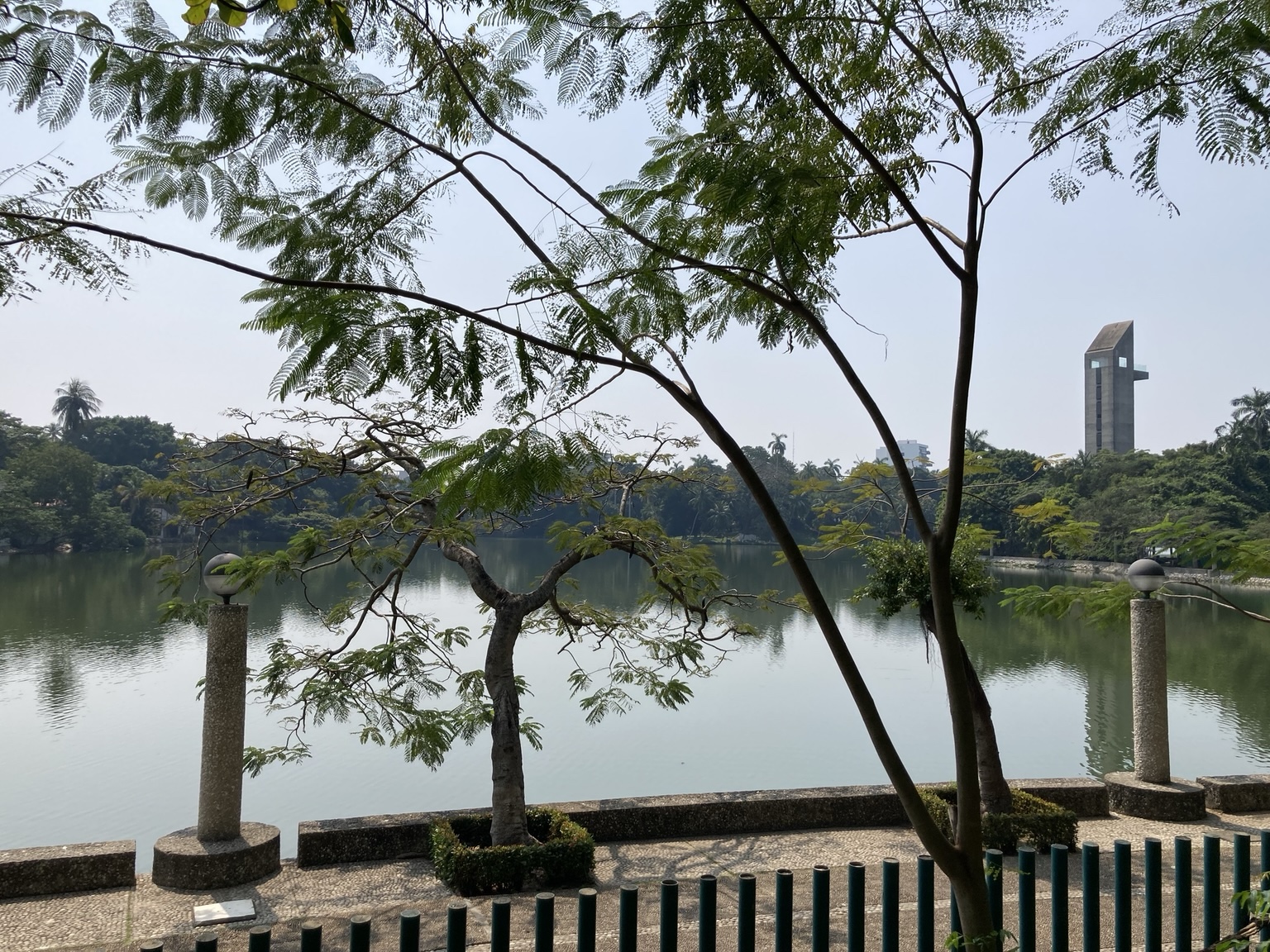
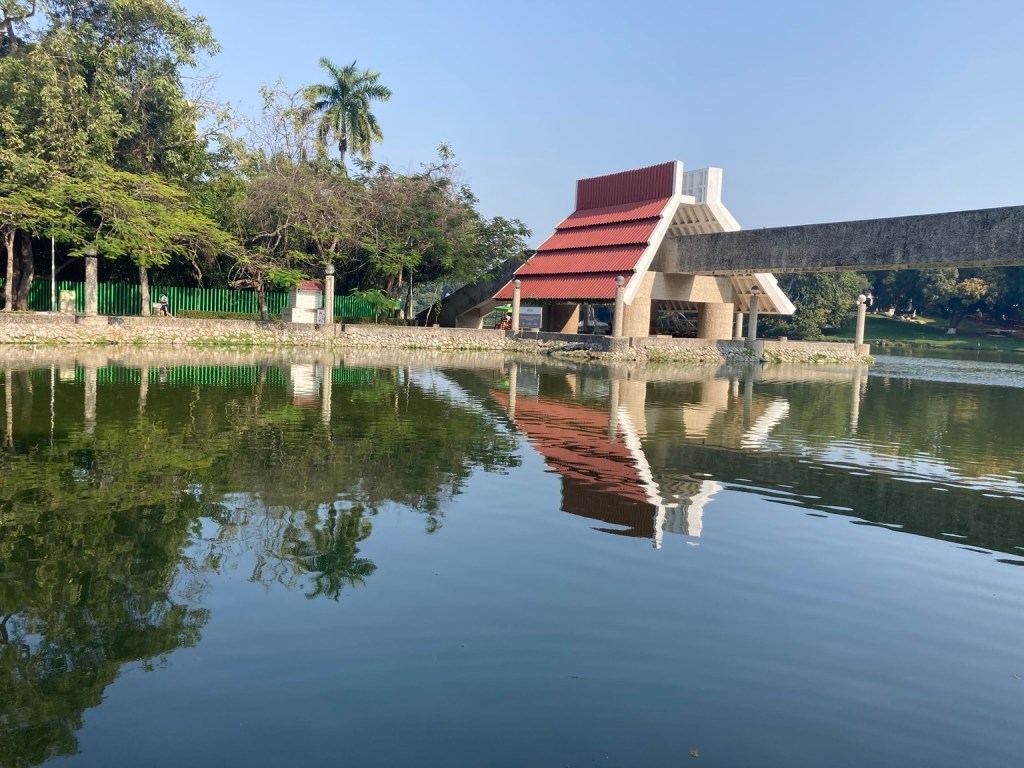
When we were done, we walked along the lakeside …
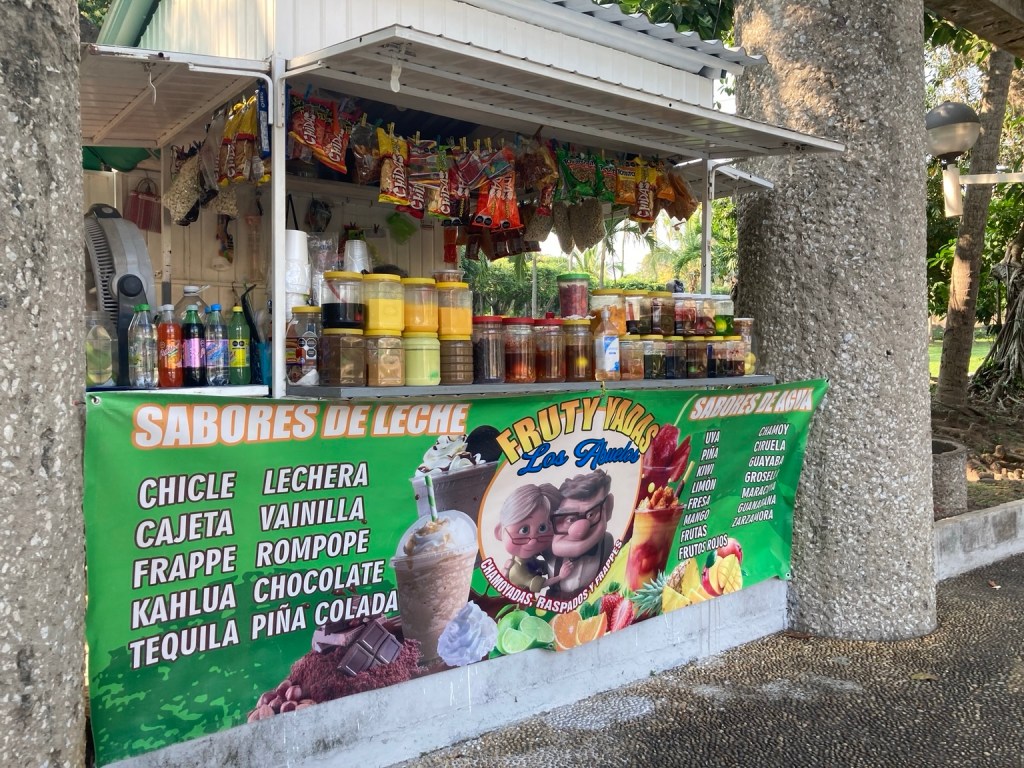
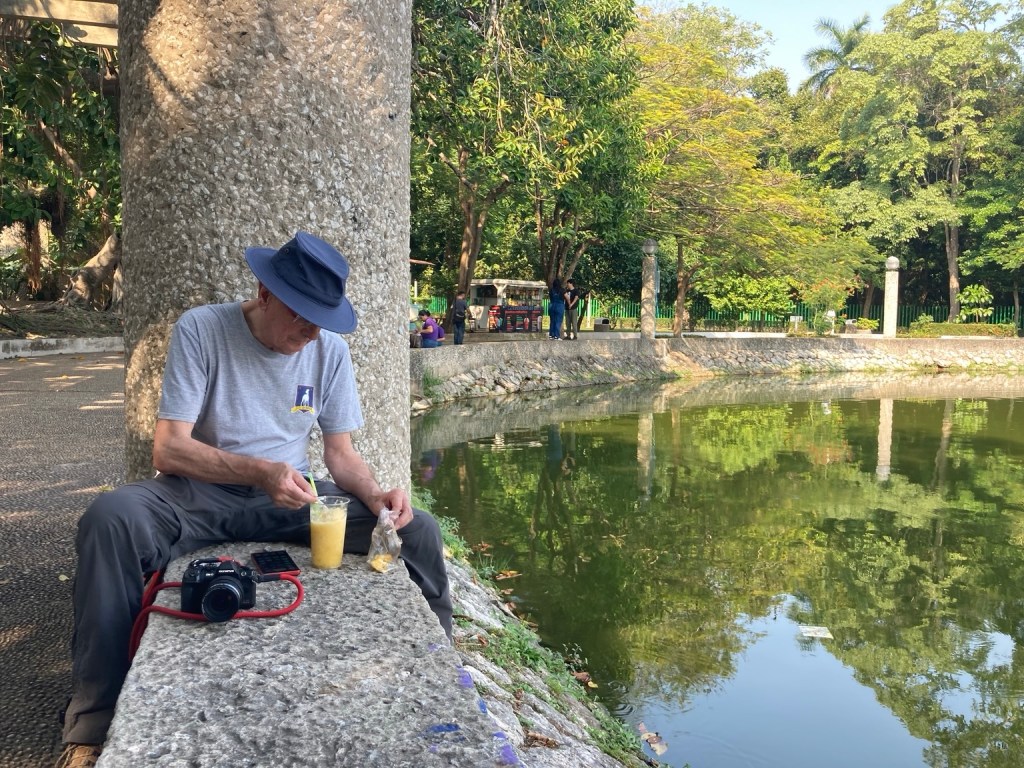
… until we found refreshments.
Villahermosa translates as beautiful town and certainly the park and lake were just that.
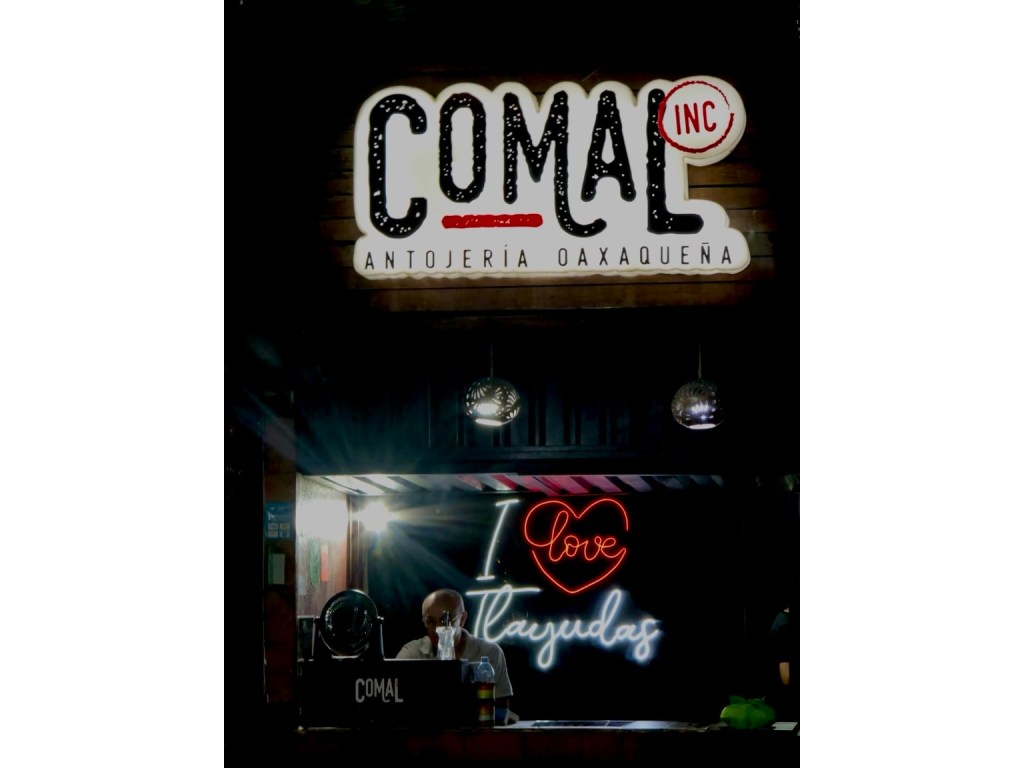
As for dinner, it was back to Barrahermosa, not necessarily beautiful but certainly popular and my tlayuda hit the spot while Chris played it safe with pizza … although he did add a drop of sauce … Tabasco of course!
Up early tomorrow and we are flying back to México City for the last stop on our taco trail …
A trip to Yaxchilan and Bonampak had been on our wishlist, but I wasn’t sure we’d be up for the trek. Chatting to someone who had been a few days ago changed my mind and then a leaflet was thrust into my hand when we arrived in Palenque!
So why go … what’s to see? Yaxchilan was one of the most powerful Maya states along the Usumacinta River and is visited for its jungle location and detailed stonework while Bonampak, has the finest examples of classic Mayan murals.
The minibus collected us at 5.30 and drove for a couple of hours through the sunrise then stopped for a breakfast of eggs, bread, fruit and coffee to keep us going.
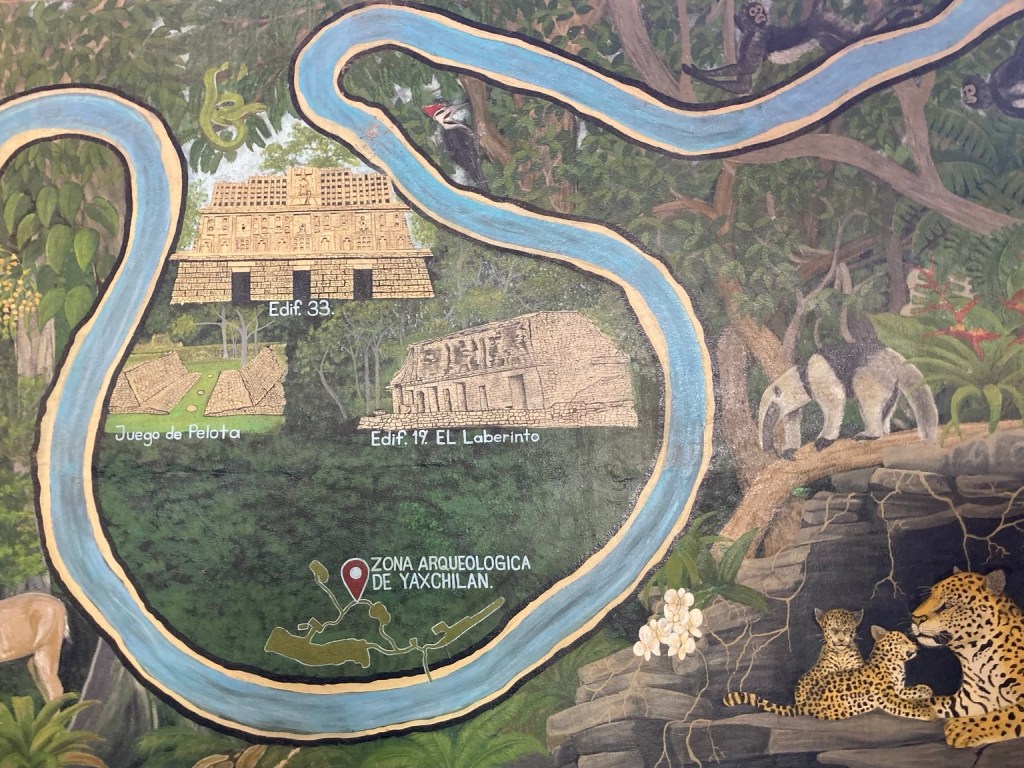
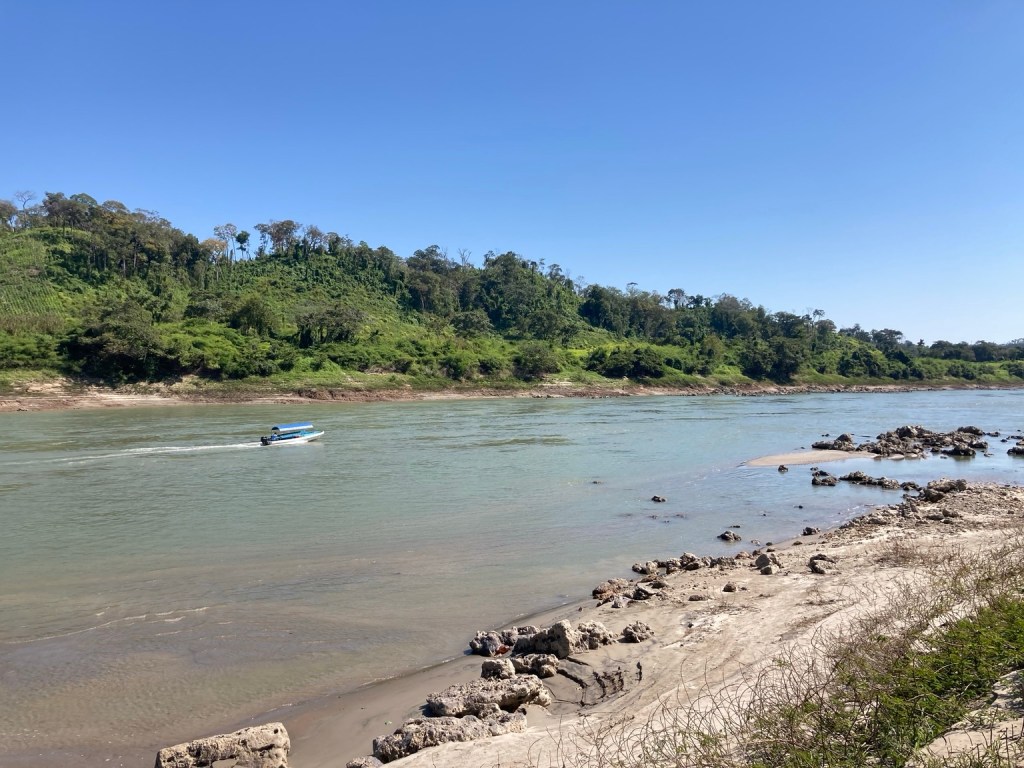
Yaxchilan is set on a horseshoe shaped section of land, surrounded by the Usumacinta River on three sides and deep within the Lacandon rainforest …
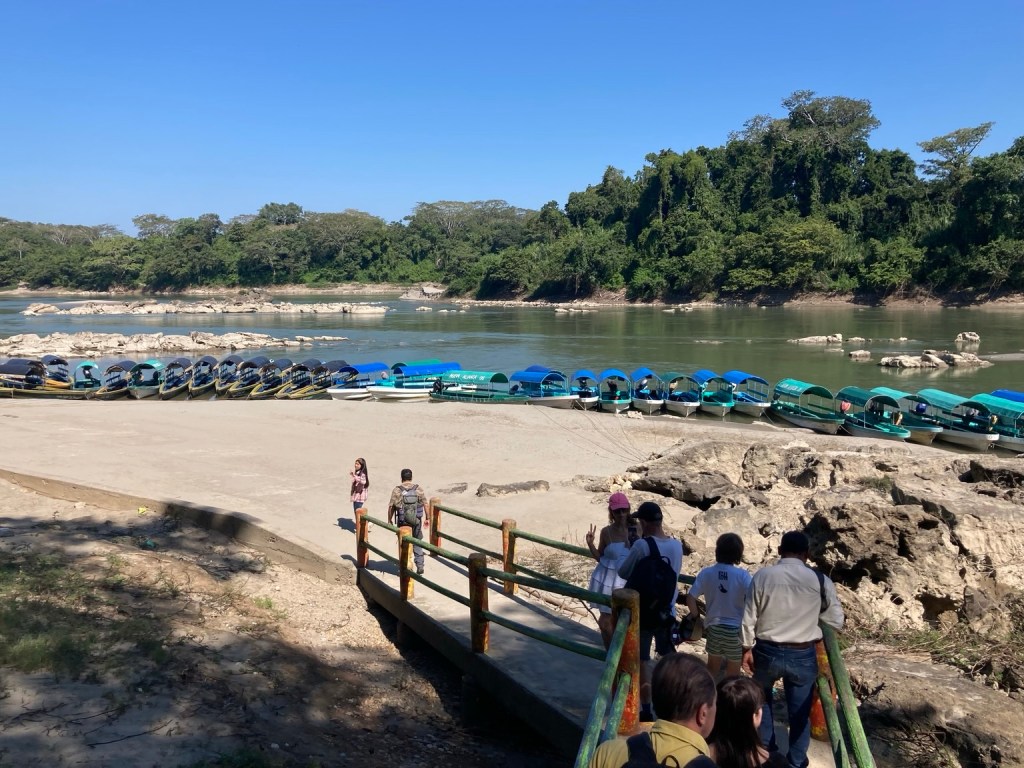
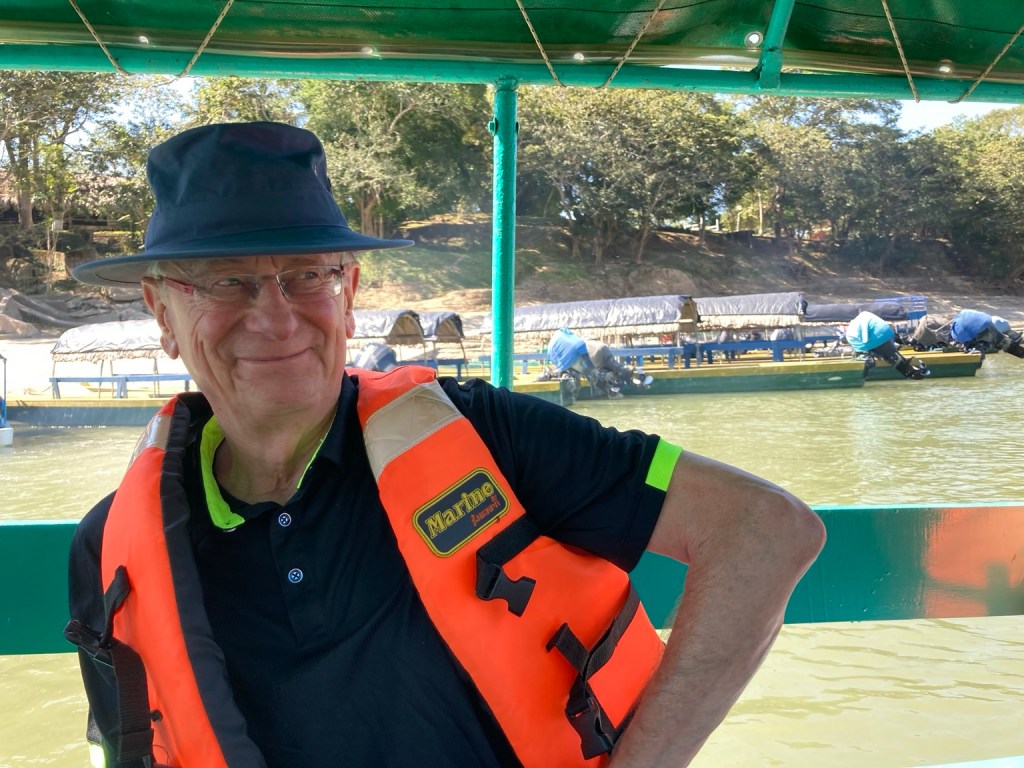
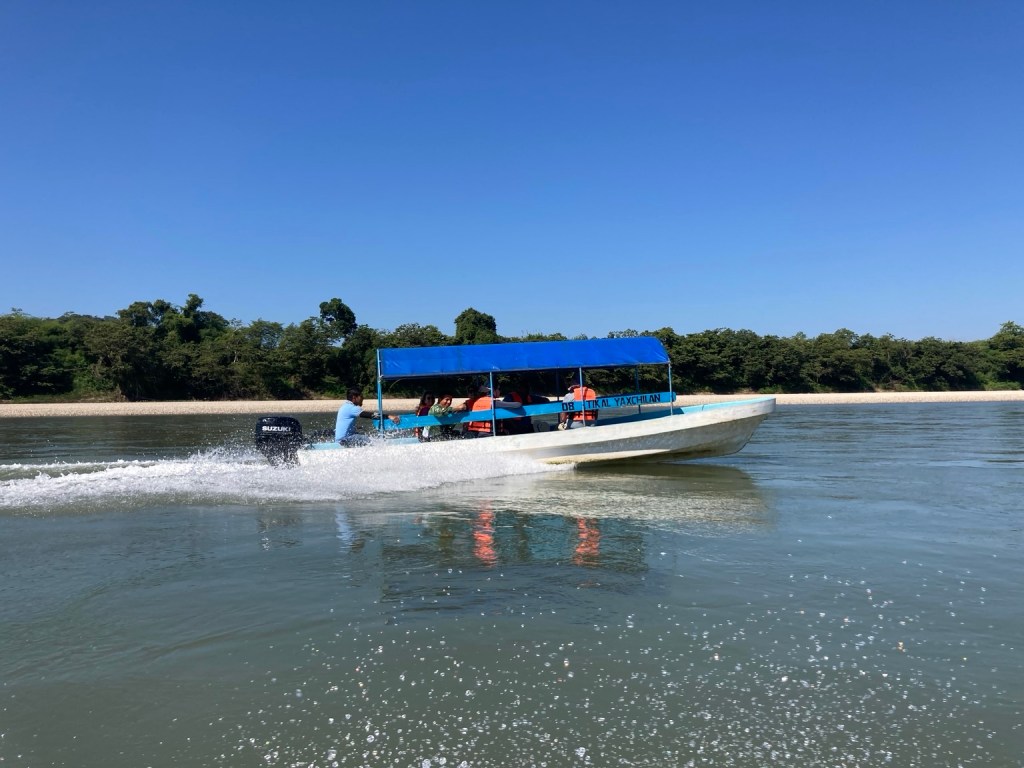
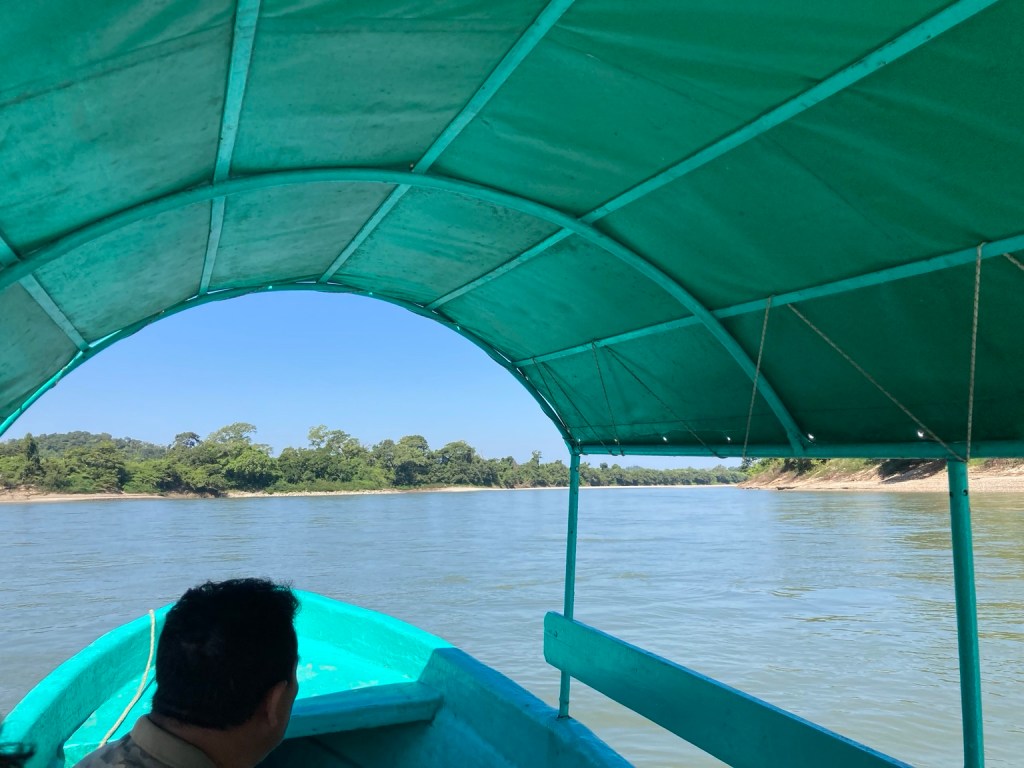
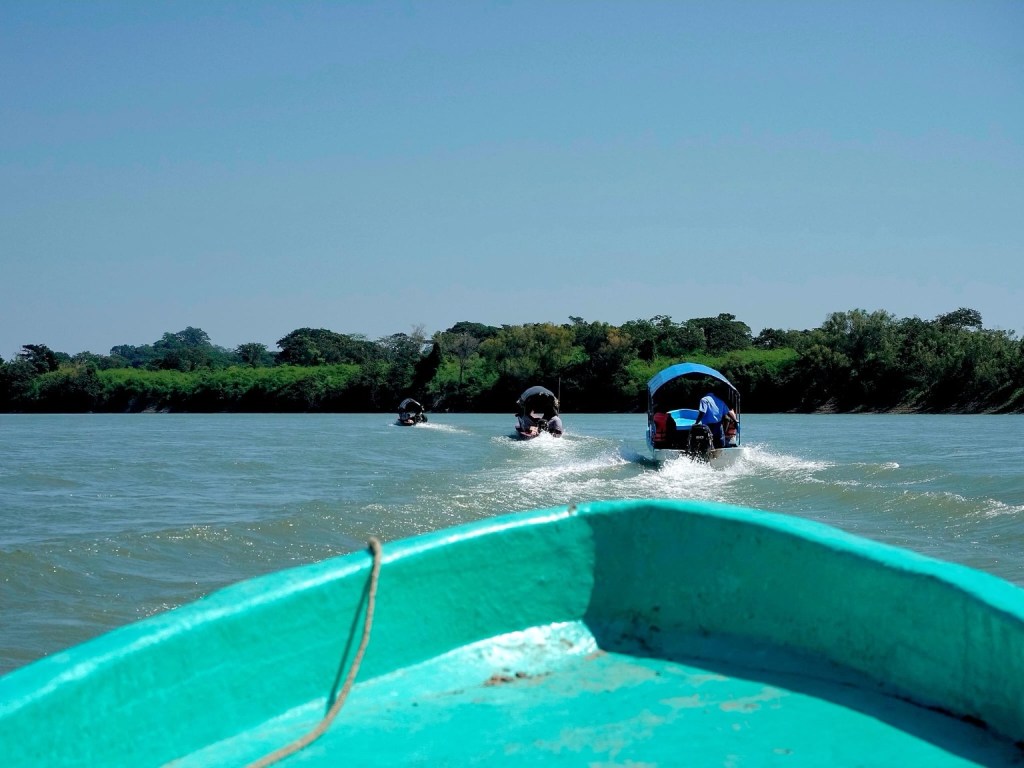
… and the only way to reach it is by long boat or lancha.
The boat sped along for around 40 minutes with Guatemala on the far bank, and since we crossed the mid point, Guatemala can be added to our destinations visited!
The six English speakers in our group shared a local guide who told us Yaxchilan reached its zenith between 600-800AD under Itzamnaaj B’alam II, or Shield Jaguar II and his son Yaxun B’alam IV or Bird Jaguar IV and these rulers commissioned the major structures we were going to see.
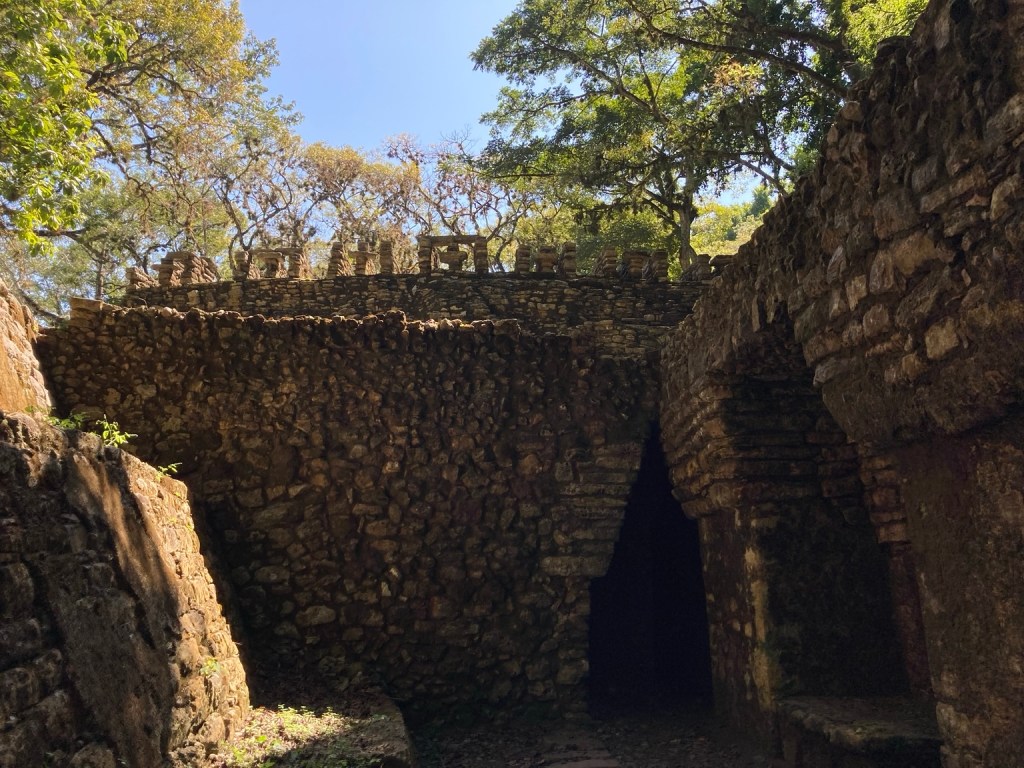
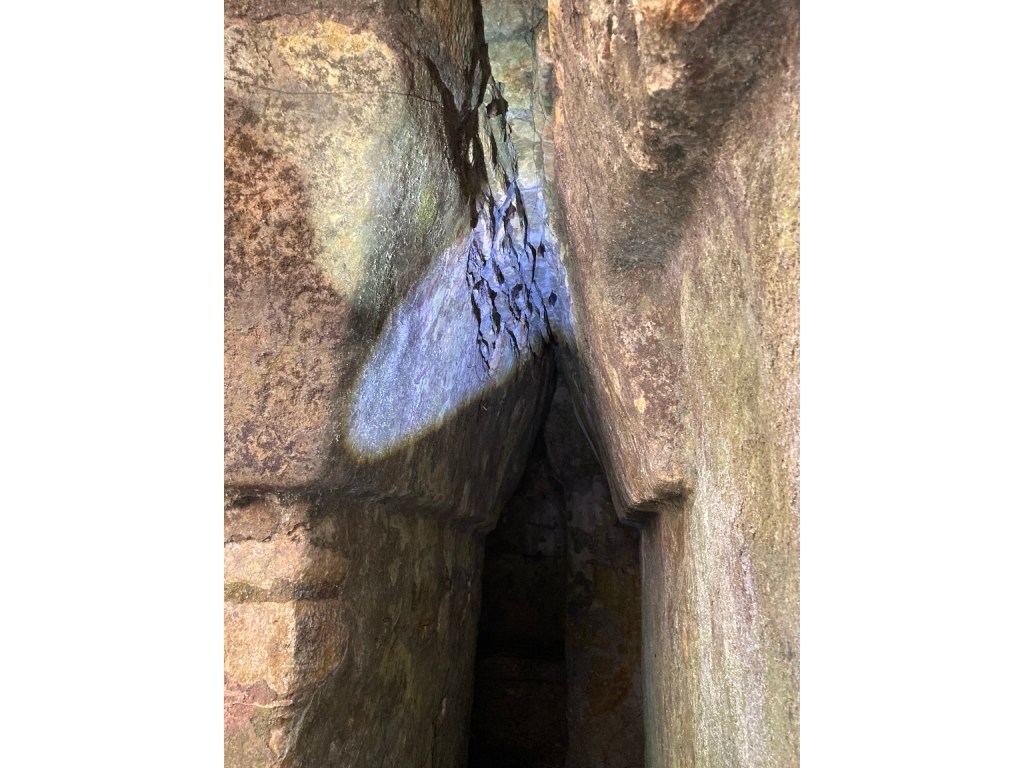
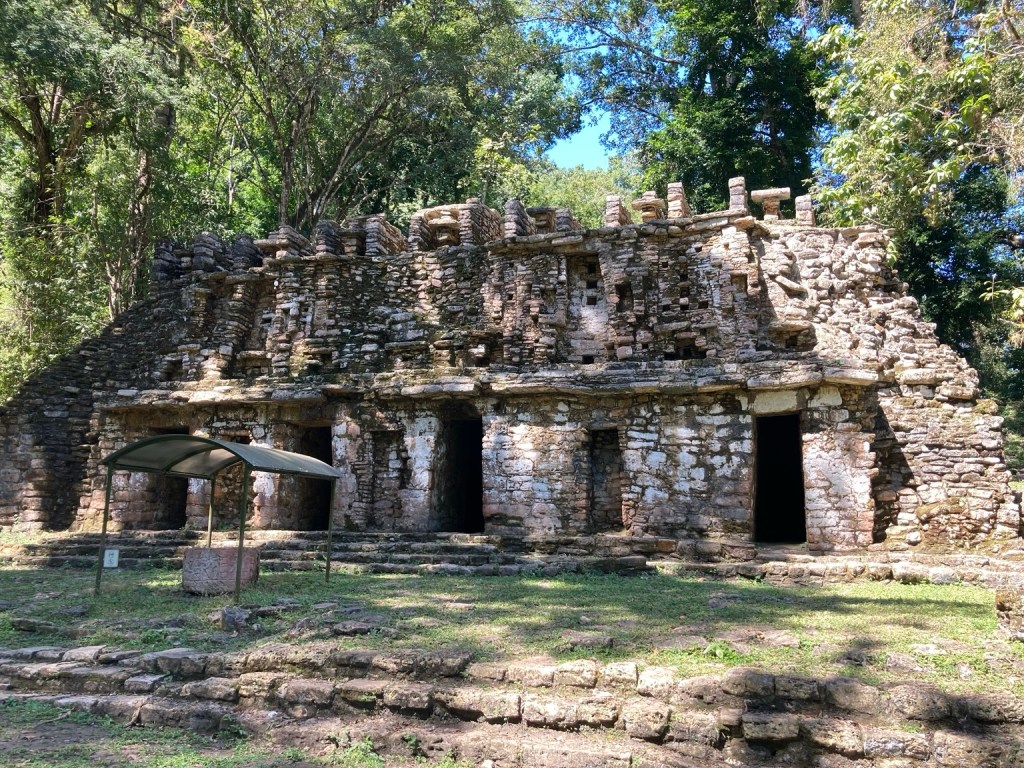
We entered through a building called The Labyrinth, which contains three levels with multiple doors, passageways and stairs interconnecting the rooms within.
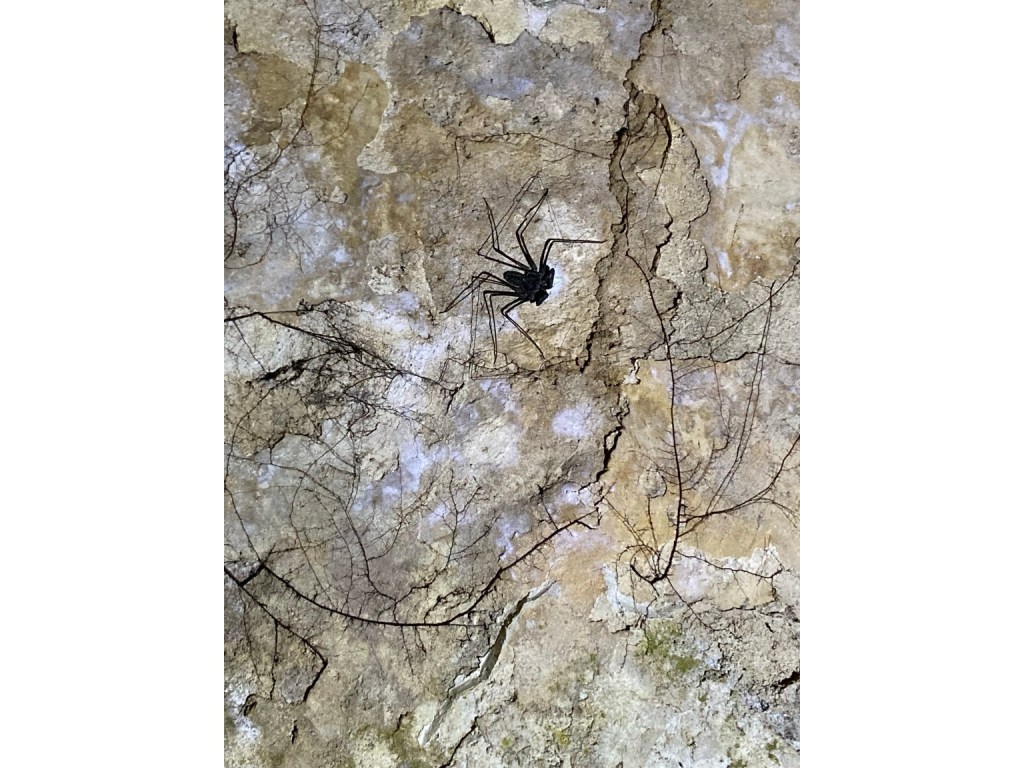
We spotted bats and a large spider living inside ..
… so were pleased to reach the sunshine … and here is the Labyrinth from the plaza.
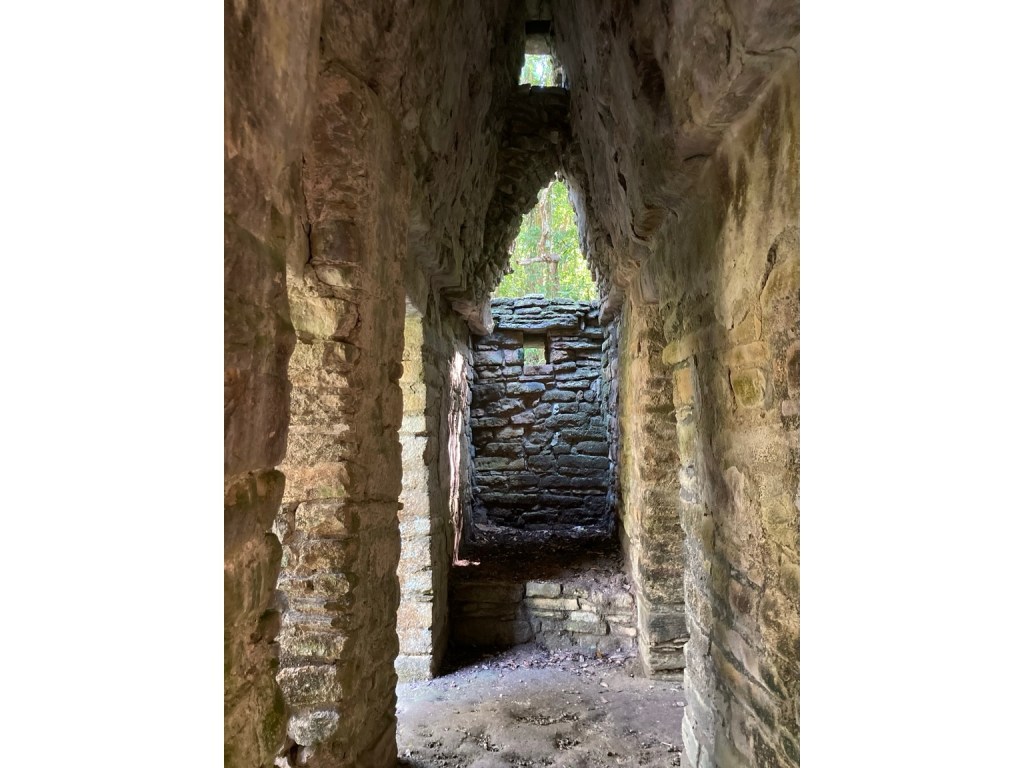
Mayan buildings use the corbel arch to achieve high-ceilinged structures with heavy stone, but it does have limitations. Thick walls, narrow rooms, and restricted space as can be seen here, but certainly durable.
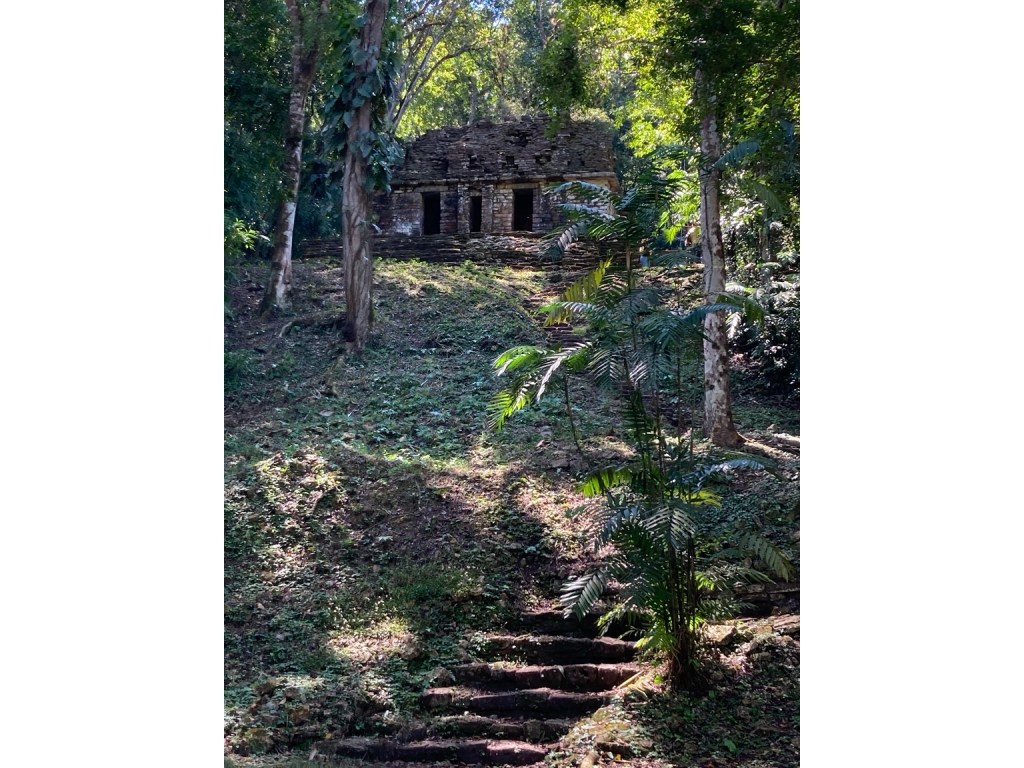
There are lots of buildings half hidden by the foliage …
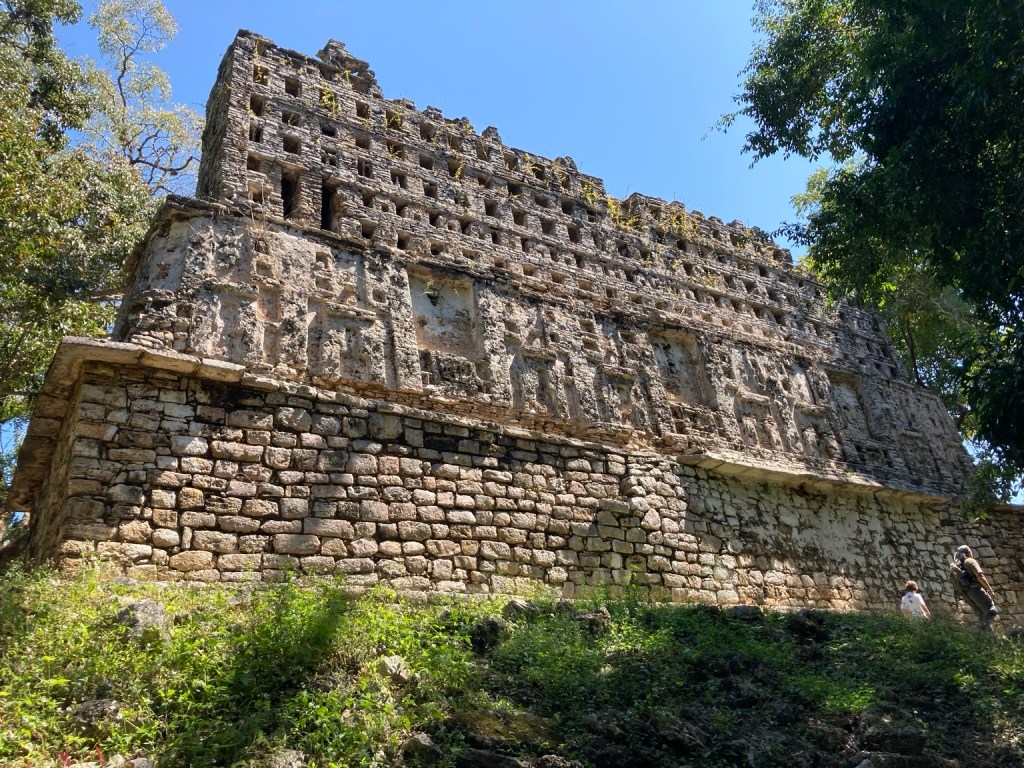
… and we approached this one from the rear.
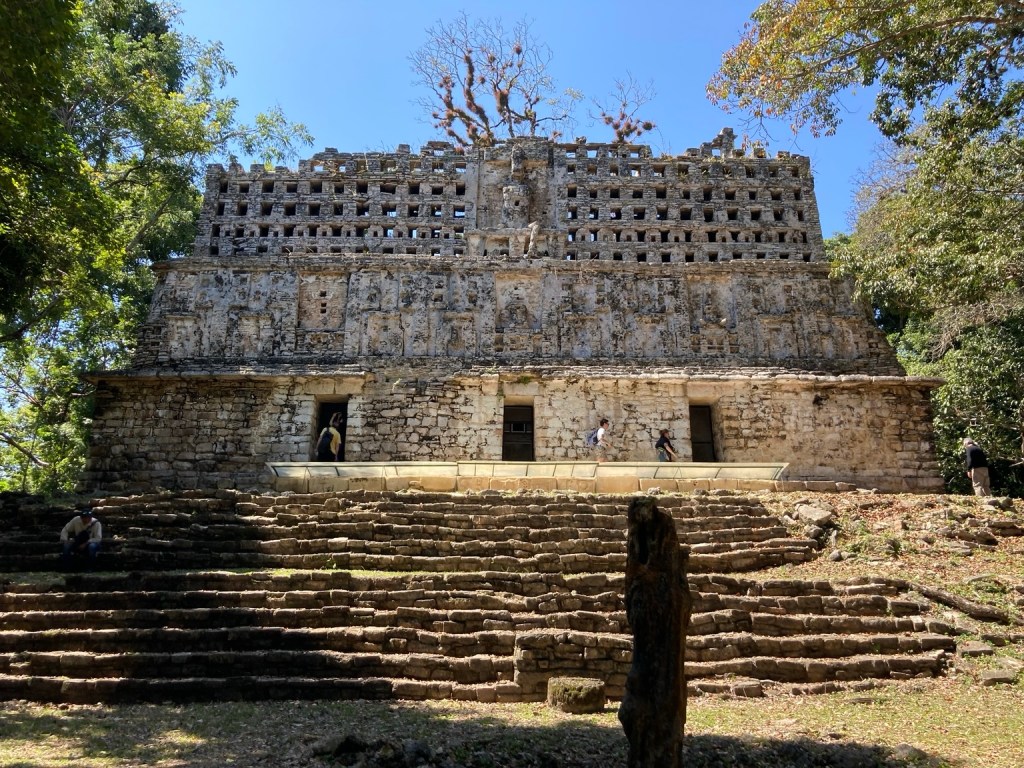
We climbed up and walked round to the front of the building called Structure 33, the most impressive on the site.
Pierced stone structures called roof combs features on several buildings here, a decorative effect to add height and prestige. At the center of the roofcomb was once a gigantic figure of Bird Jaguar wearing an enormous headdress, although it is difficult to make out now.
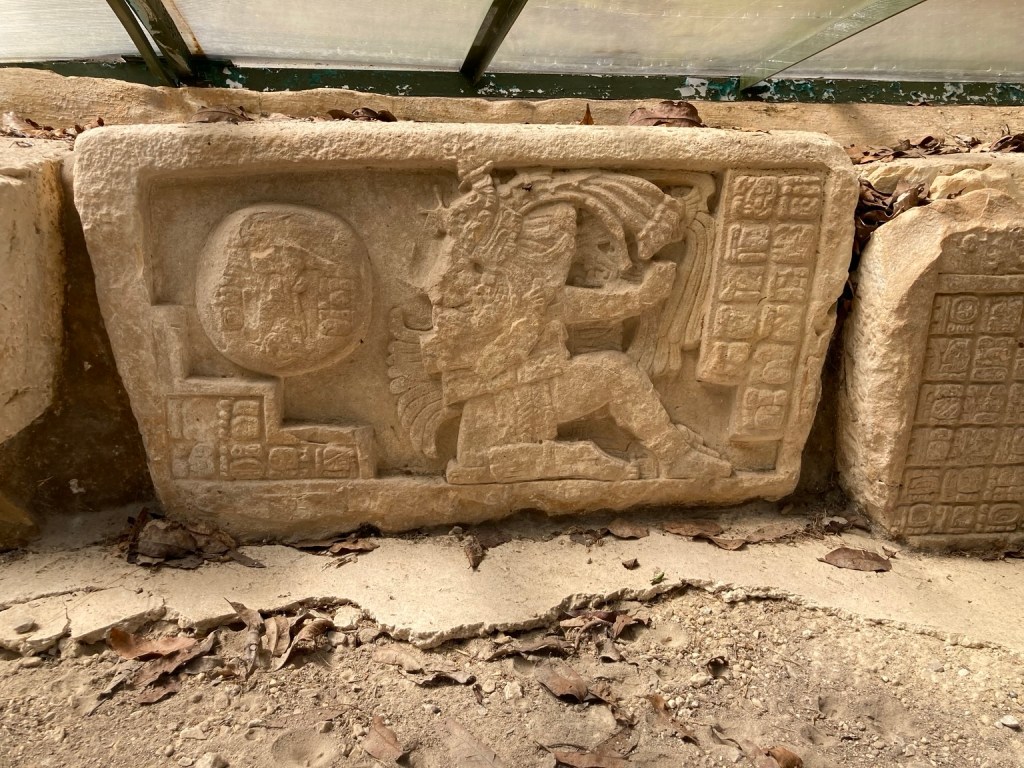
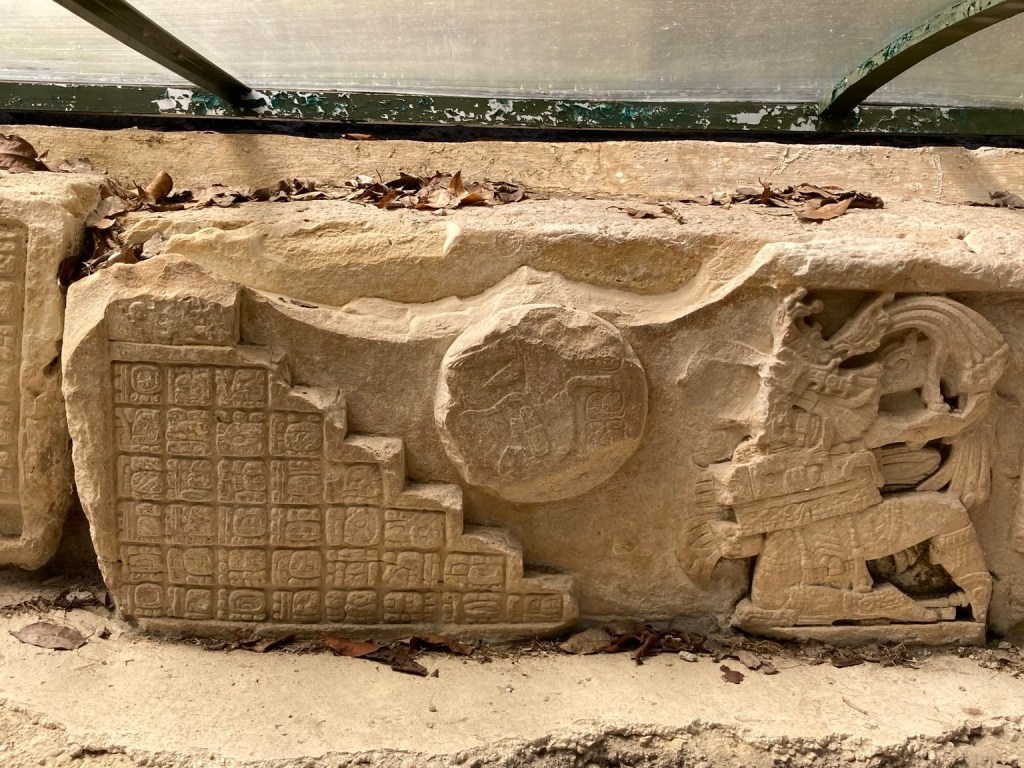
There were several things to look at. Firstly the risers to the steps at the front featuring reliefs of the ball game – the first shows Bird Jaguar IV’s father, Shield Jaguar II playing ball …
… and this one is the largest, and shows Bird Jaguar IV in his first ballgame, remembering that this is not really a game, more a sacred ritual.
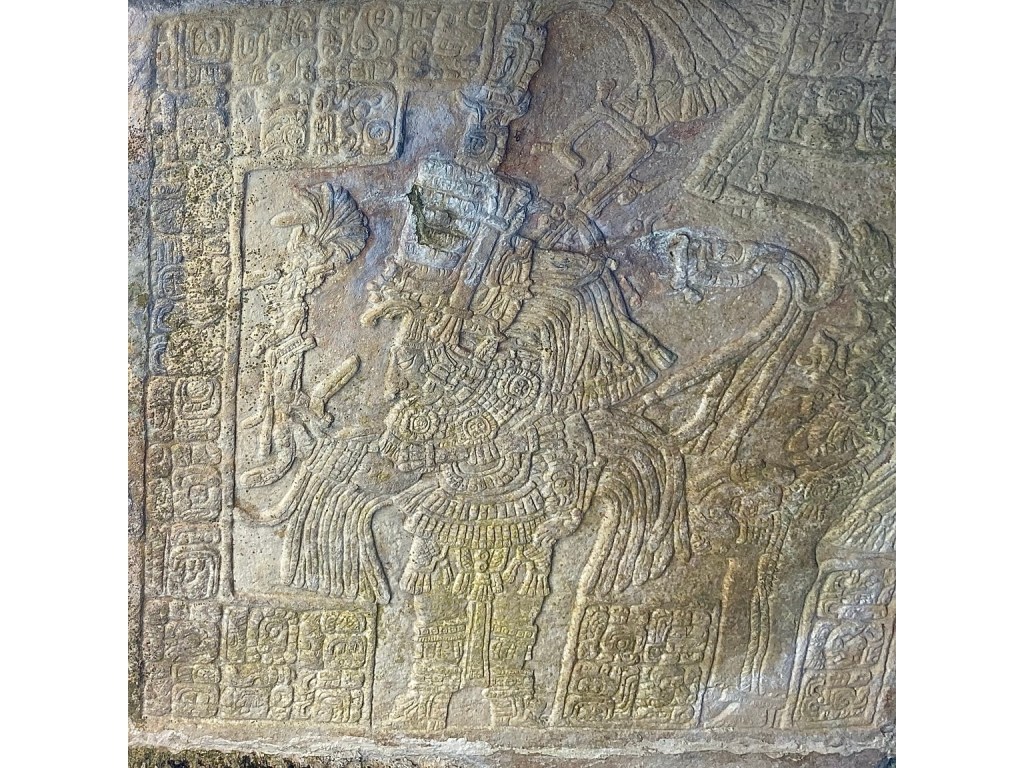
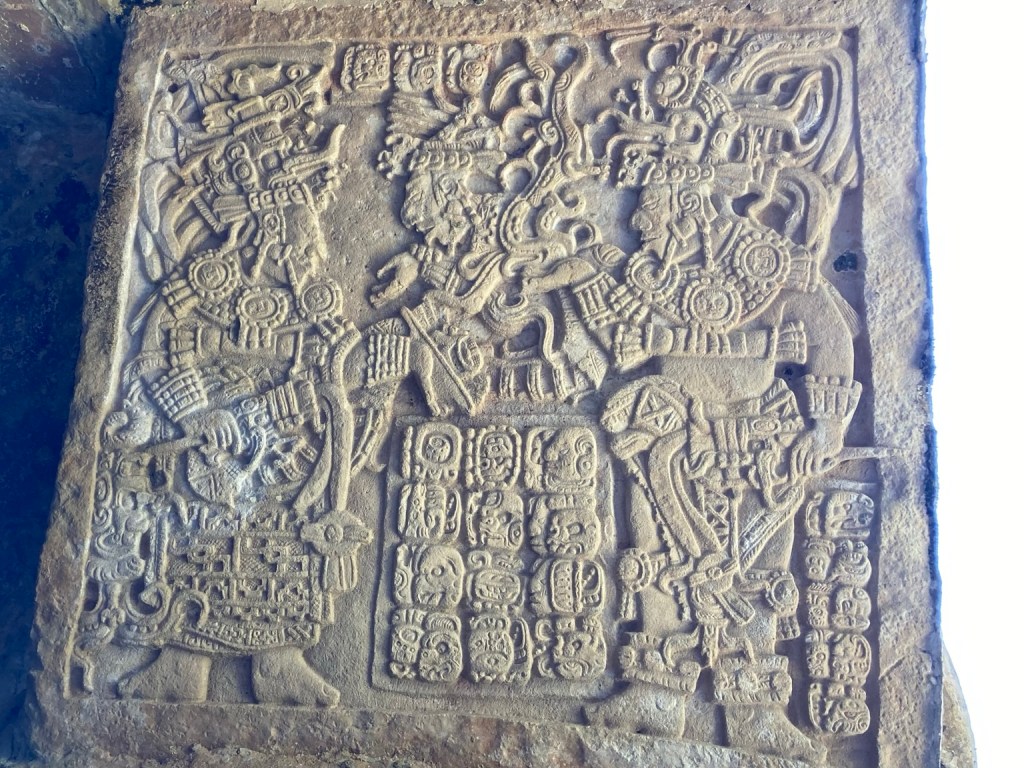
The underside of the doorway lintels are carved, each showing Bird Jaguar IV in a dance ritual. The first commemorates his accession to the throne, wearing a wild headdress and with his wife, the Lady Great Skull behind him.
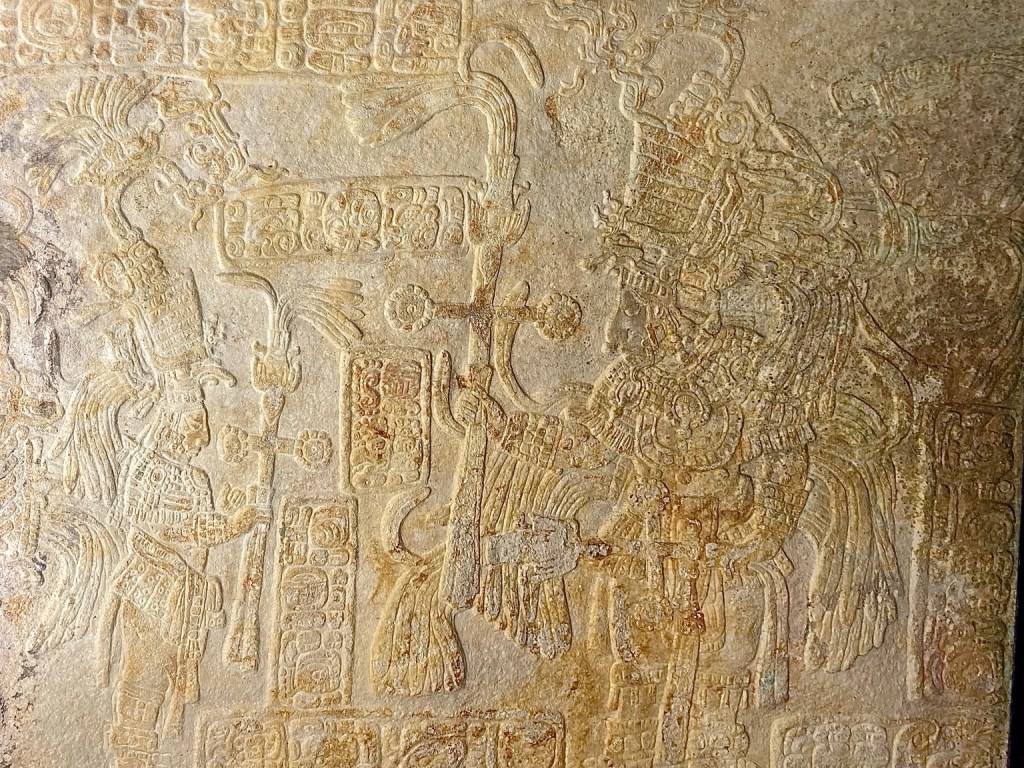
The central one shows the end of five years on the throne, dancing with his son. They both hold Mayan crosses with curved ends.
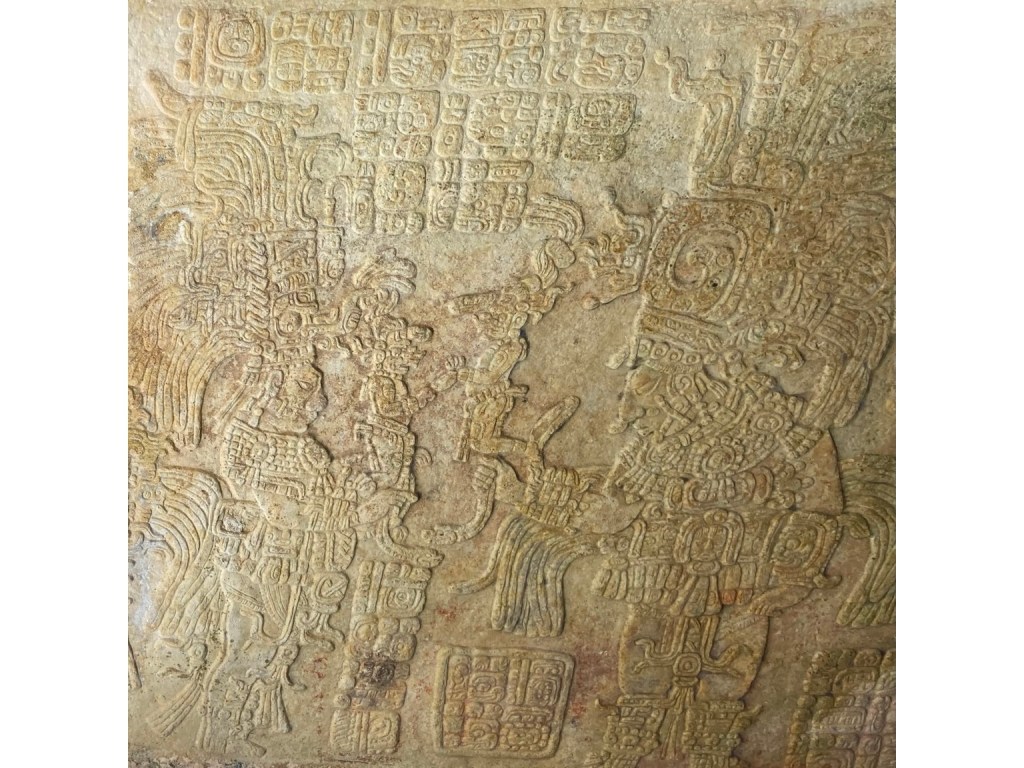
In the last Bird Jaguar IV wears a headdress composed of a giant coil of spotted material, snakeskin or a roll of stuffed jaguar pelt and commemorates a year on the throne.
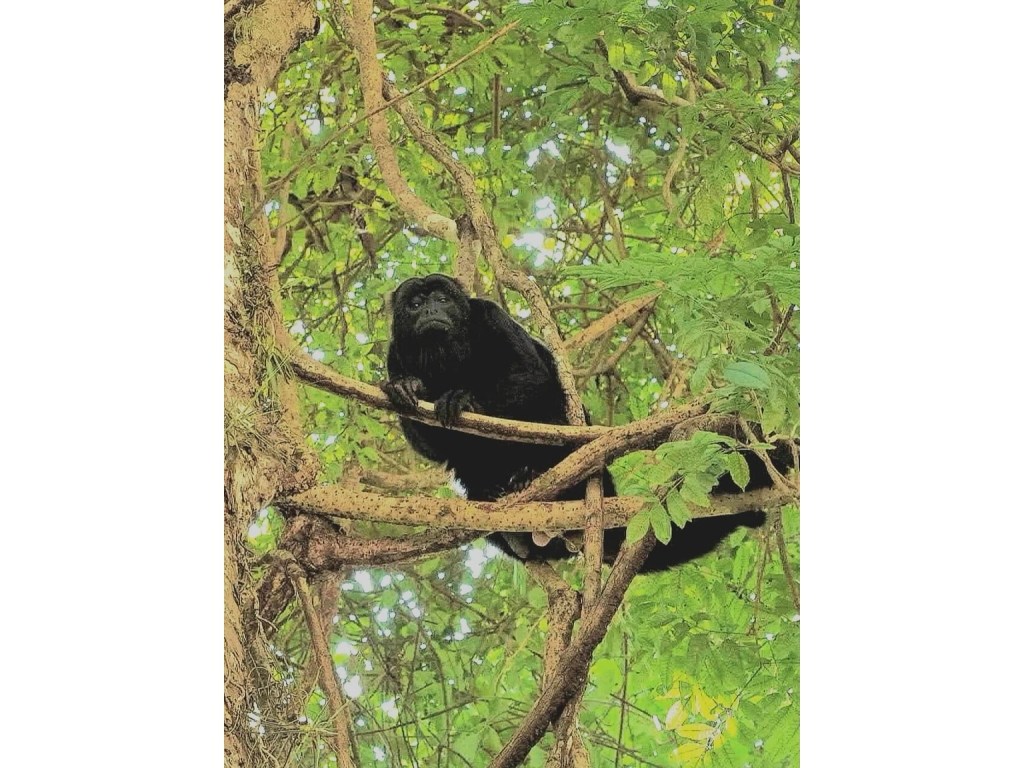
All the time we had been at the site, we had heard the distant sound of howler monkeys accompanying our visit and now a group of spider monkeys were spotted in the canopy and Chris snapped this one.
The bellowing of the howler monkeys came closer and began to echo all round us for some time, but we didn’t spot a single one!
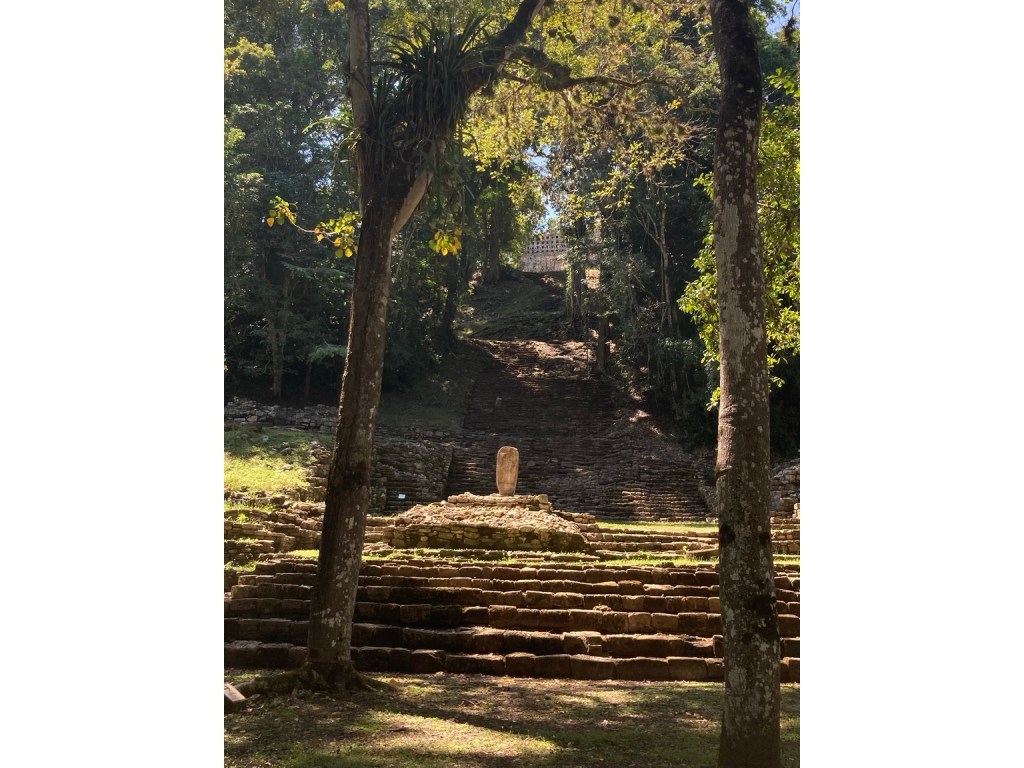
We descended back to the great plaza and looked back, and imagined how imposing the building must have been with fewer trees.
Other highlights include this lintel with a well defined relief of Lord and Lady Great Skull and a ritual-induced vision of a snake creature. Several lintels have also been removed from the site, some to Mexico City and three in the British Museum.
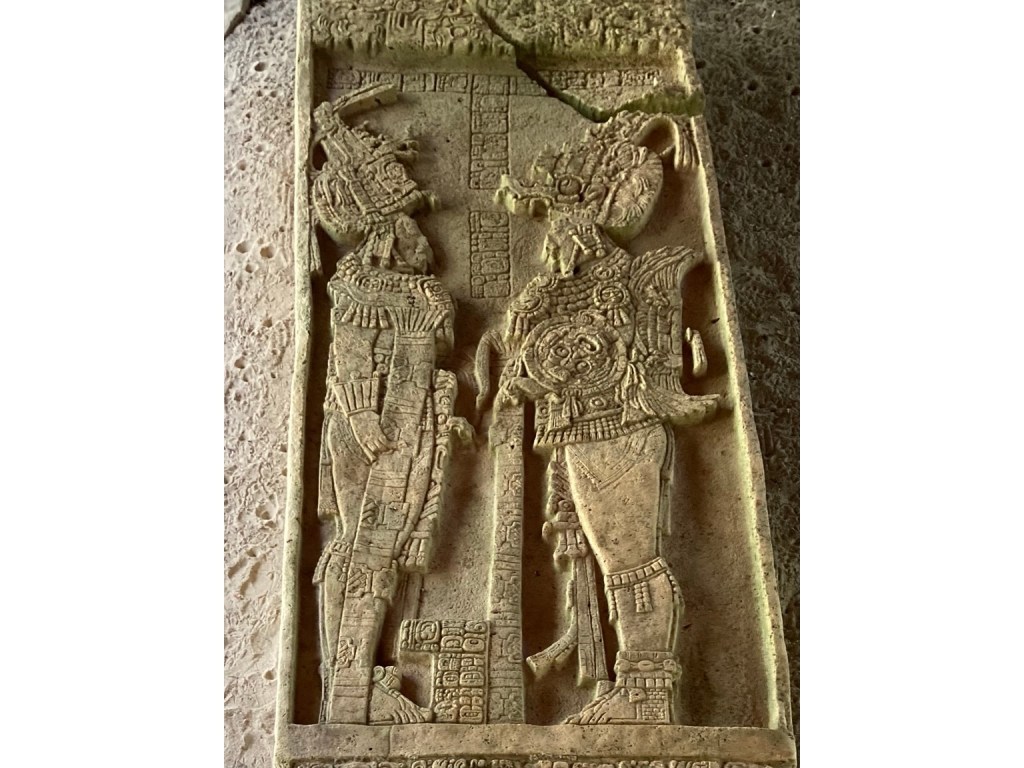
The site also has a number of stele and the clearest was destined for Mexico City, but somehow never went. Interestingly, it is a monument of political propaganda as it shows the transfer of power from Shield Jaguar I to Bird Jaguar IV, an event which never happened, but made to legitimise his rule.
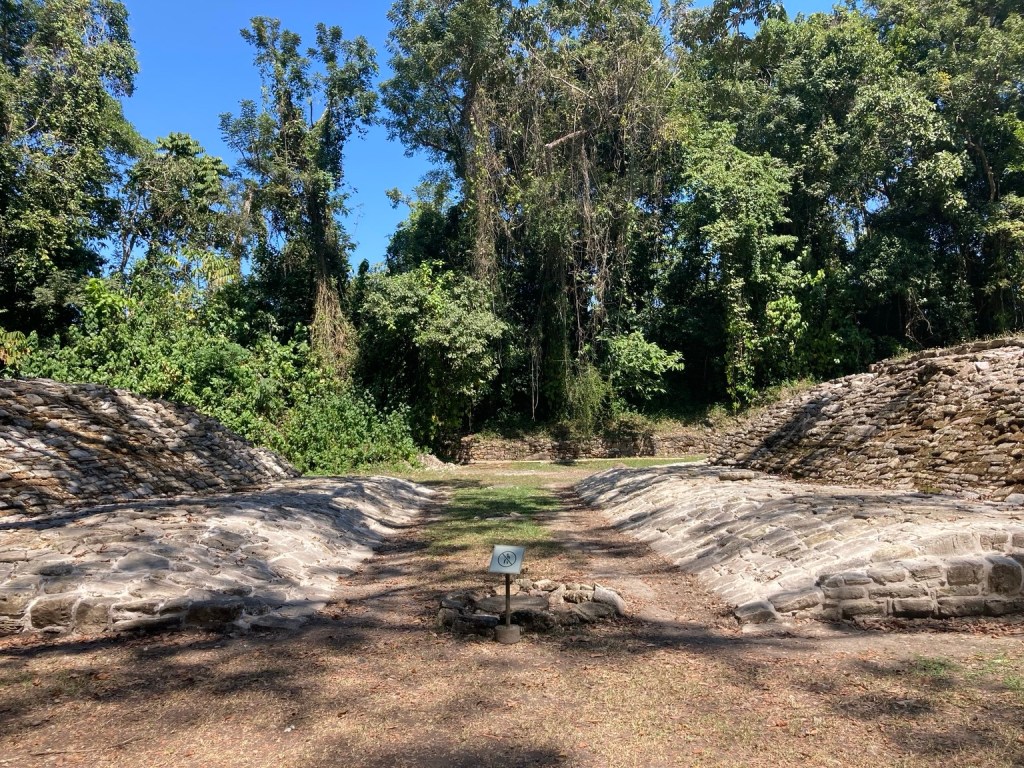
Finally, we walked back past the ball court …
… and down to the river for our return trip …
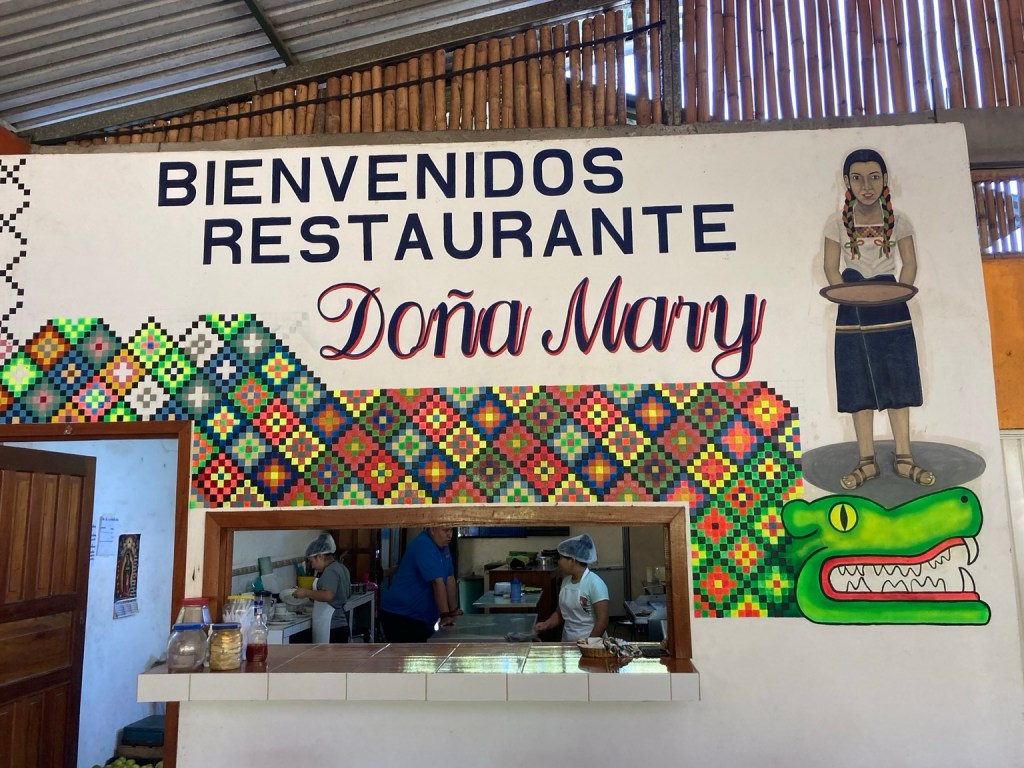
Donna Mary provided a very good lunch before our visit to Bonampak which was on our way back.
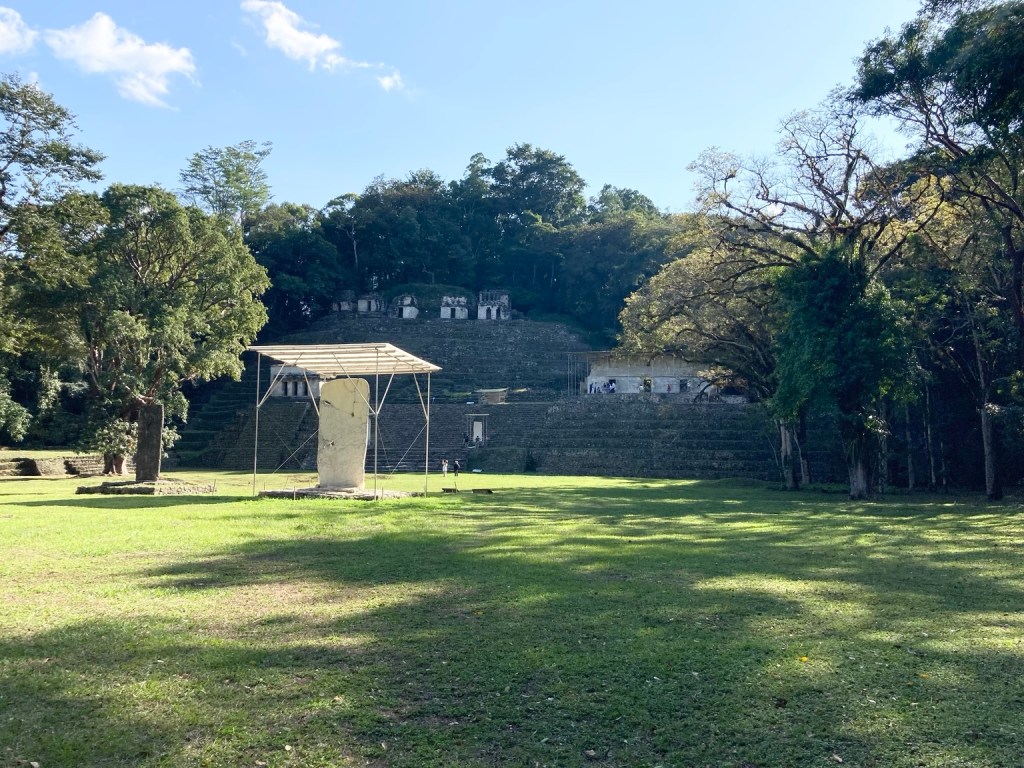
This whole area is the homeland of the Lacandon people, the same indigenous community that the owners of Casa Na Balam in San Cristabel had worked with. The Lacandon continue to be guardians of the forest and we transferred to their transport for the last stretch to Bonampak. We walked through the forest into the grand plaza with several buildings ahead, but the only interesting one was the building under a cover to the right with three rooms.
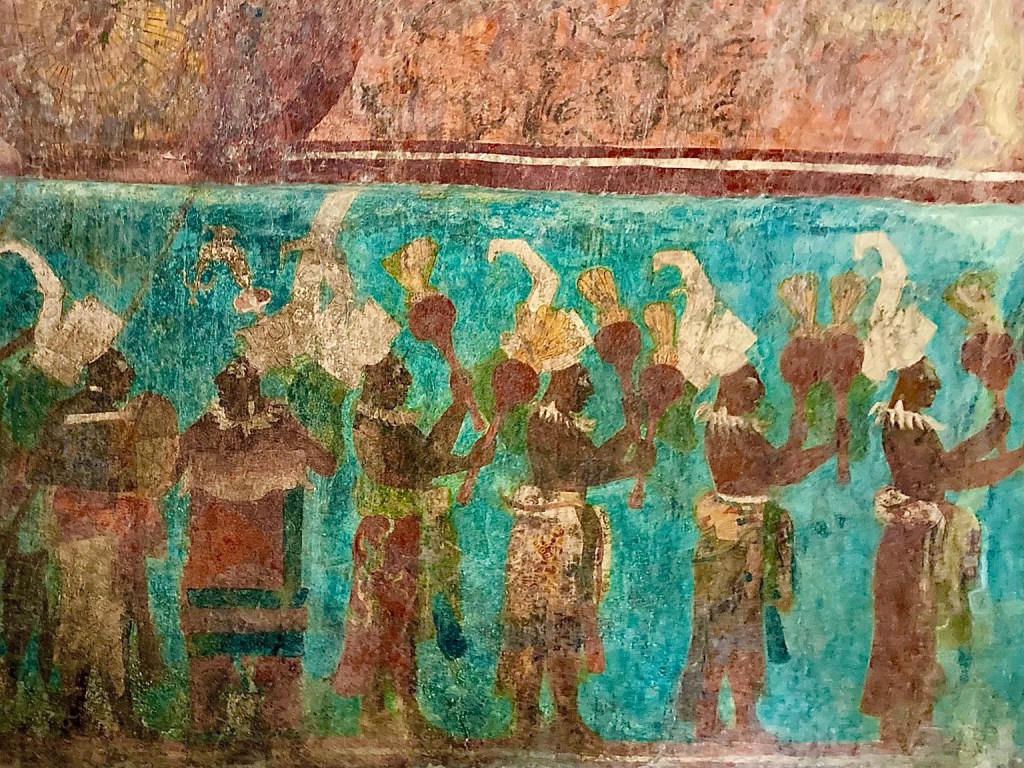
Bonempak had become a satellite of Yaxchilan by 600AD and king Shield Jaguar III oversaw the accession to the throne of Chan Muwaan II at Bonampak and hired Yaxchilano artisans to commemorate it in murals.
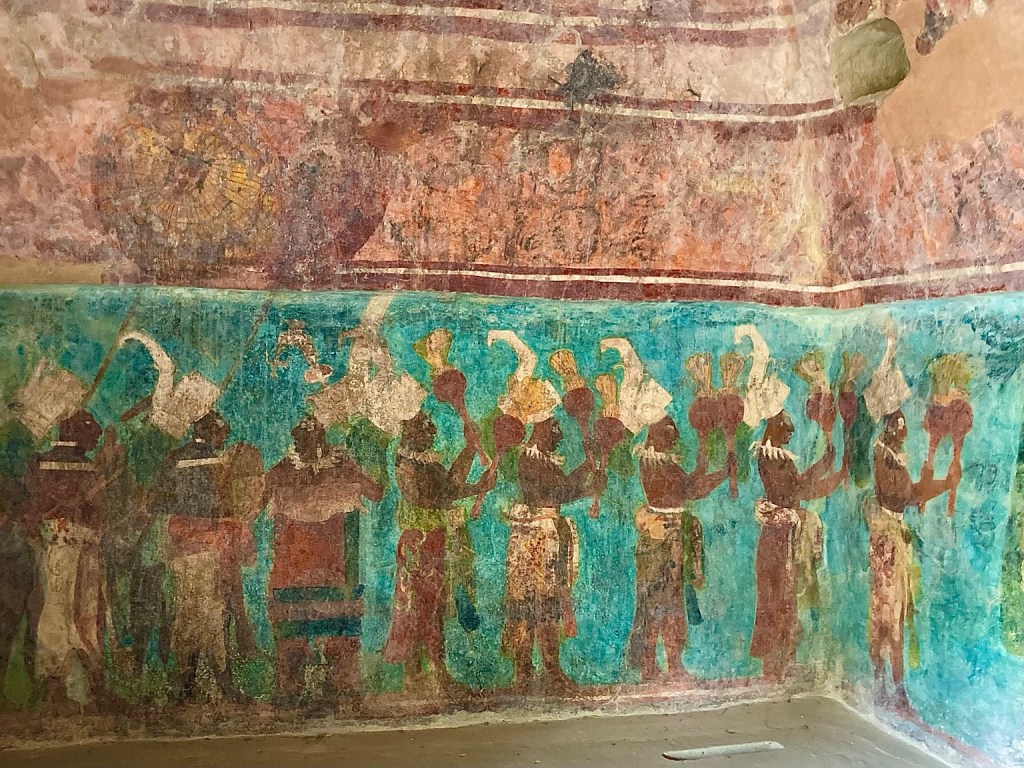
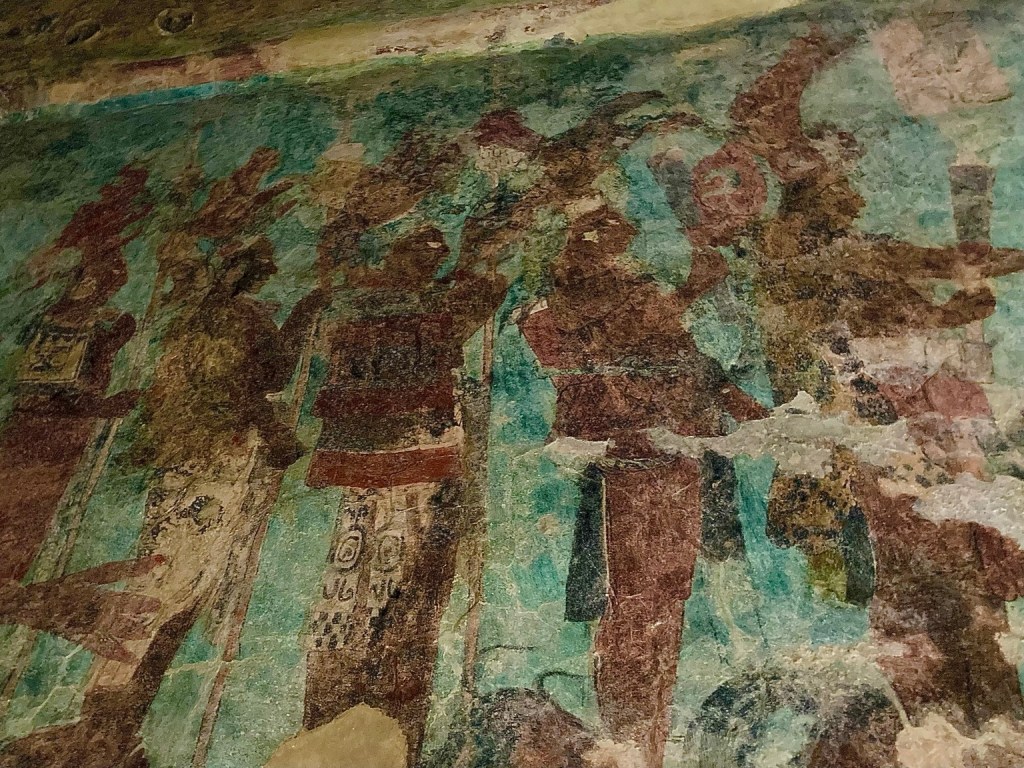
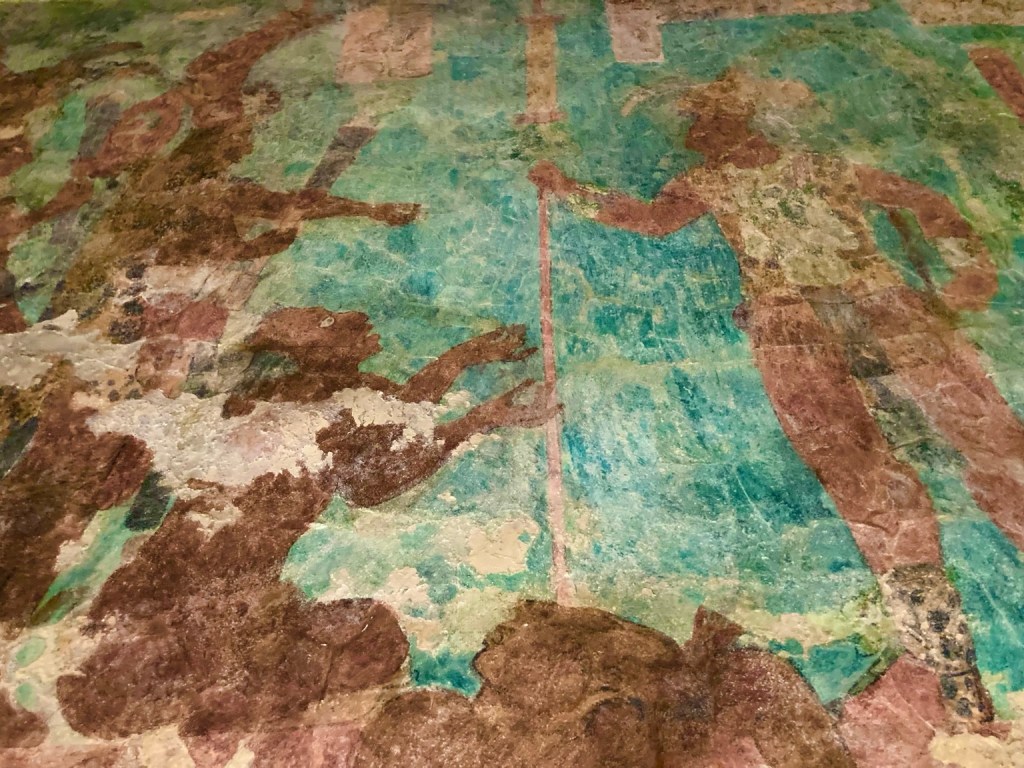
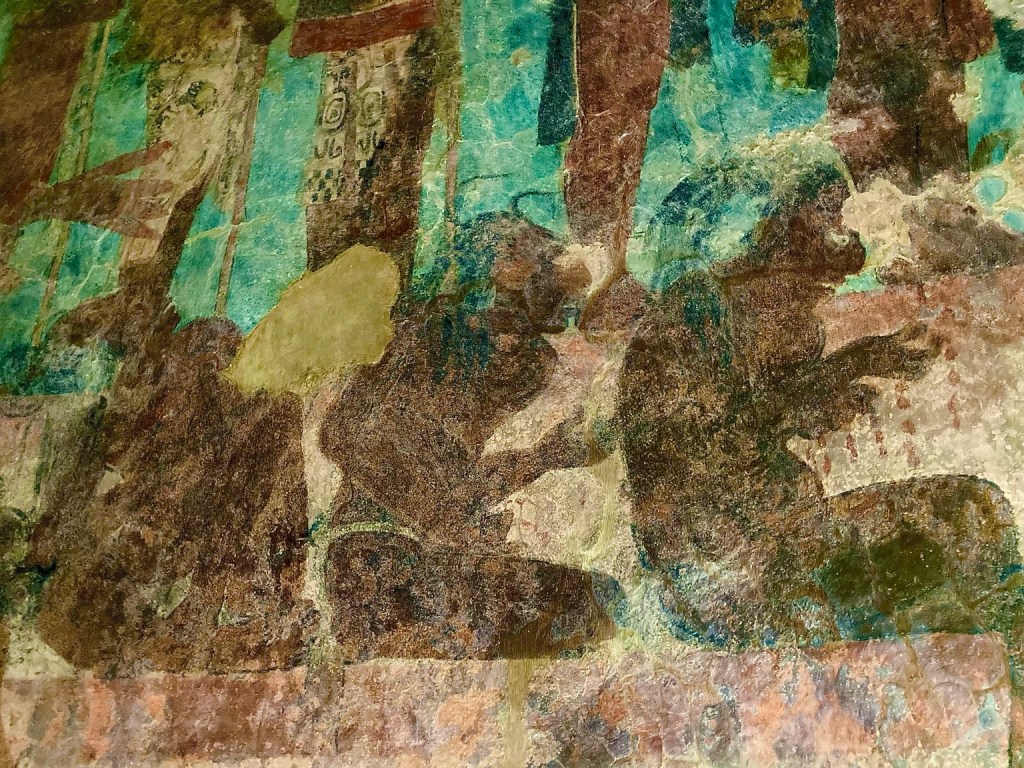
It seems that a trick of nature is responsible for the survival of these murals as over time, calcium rich water seeped into the building and deposited a coating of crystallised calcite to seal the fresh colours beneath. Specialists in the 1980’s, meticulously removed this layer and stabilised the murals but there is a twist to the tale. Apparently good was not enough, and visitors subsequently sprayed kerosene on the images to brighten them for photos, until it was realised it was causing damage!
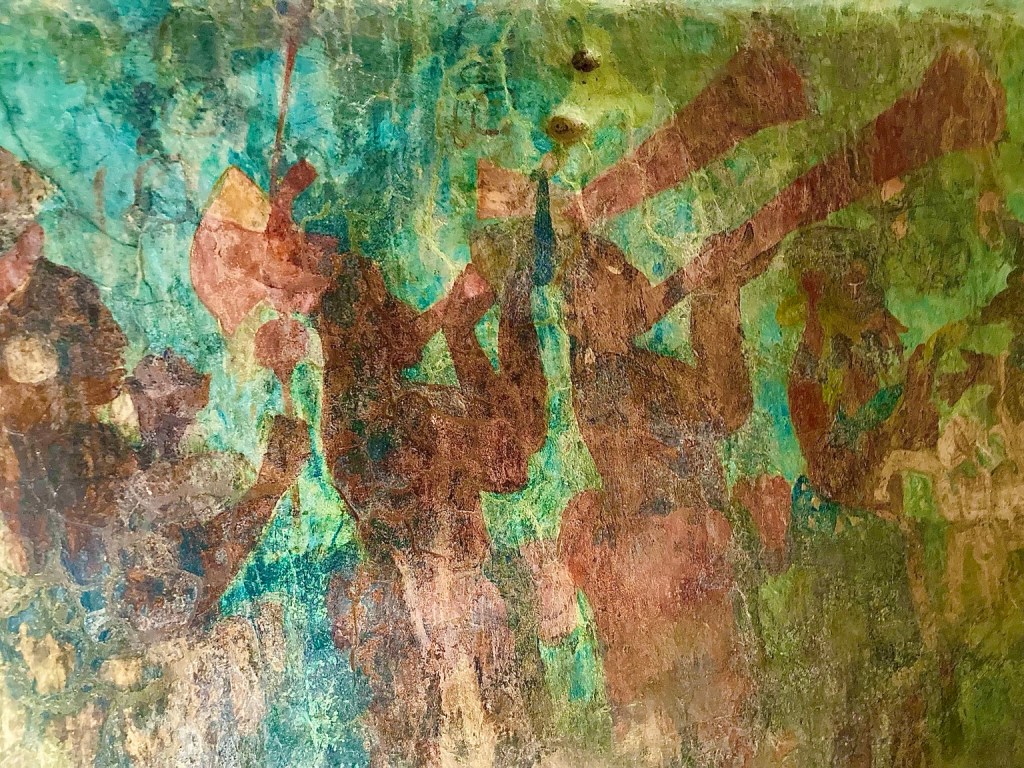
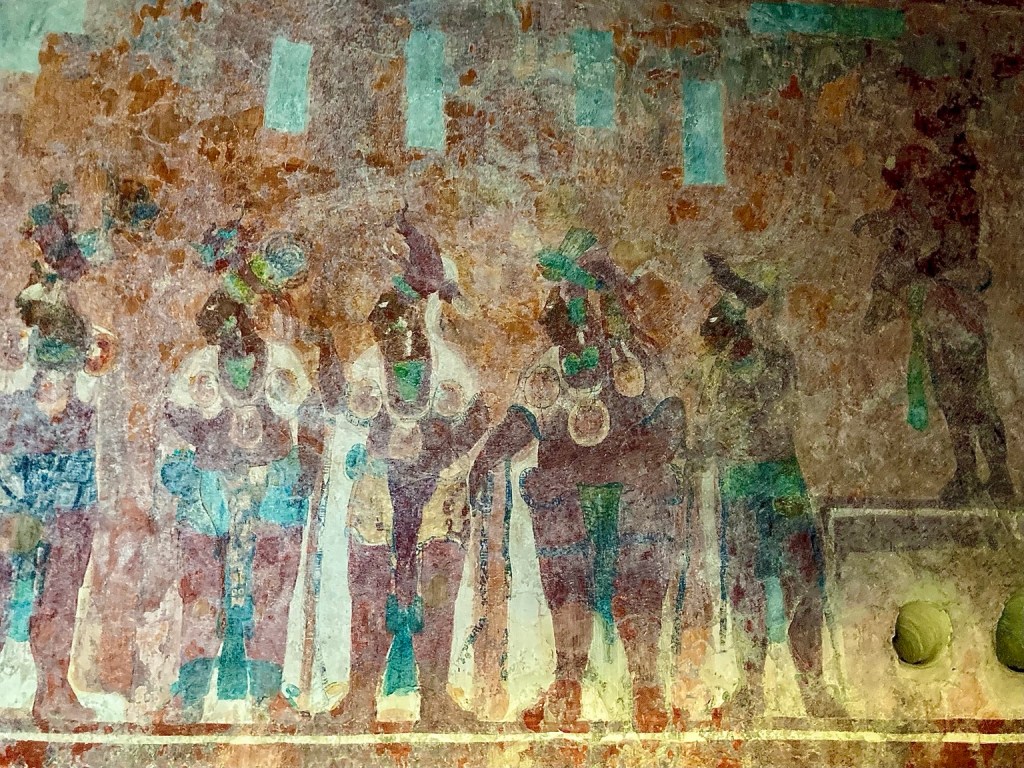
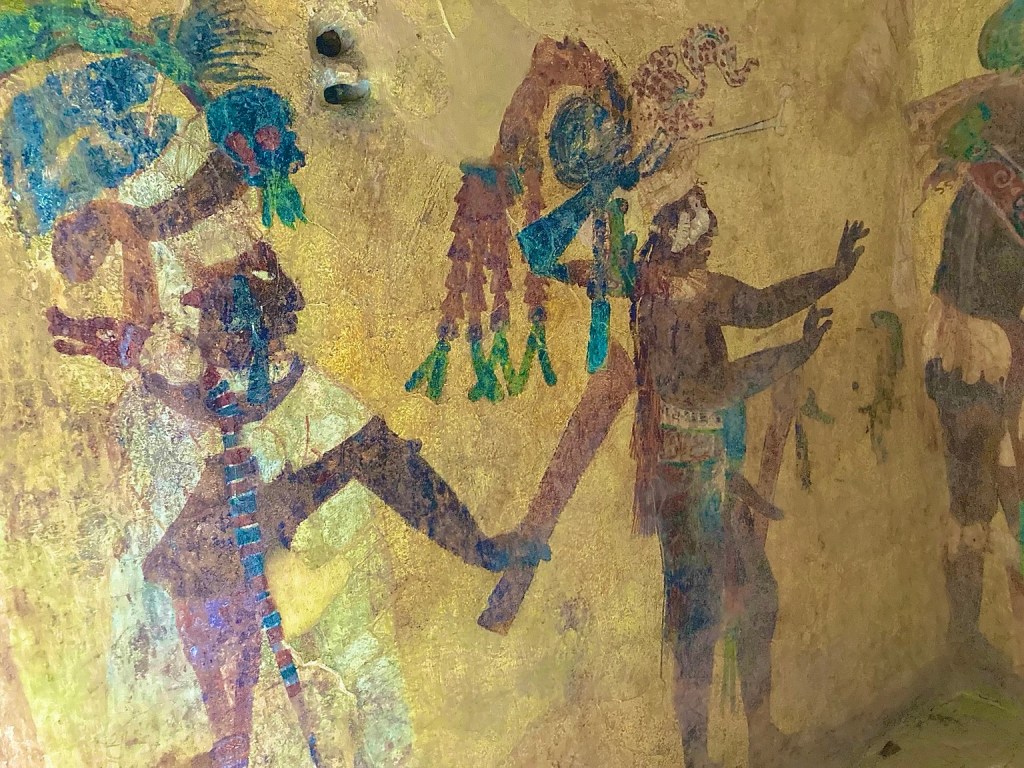
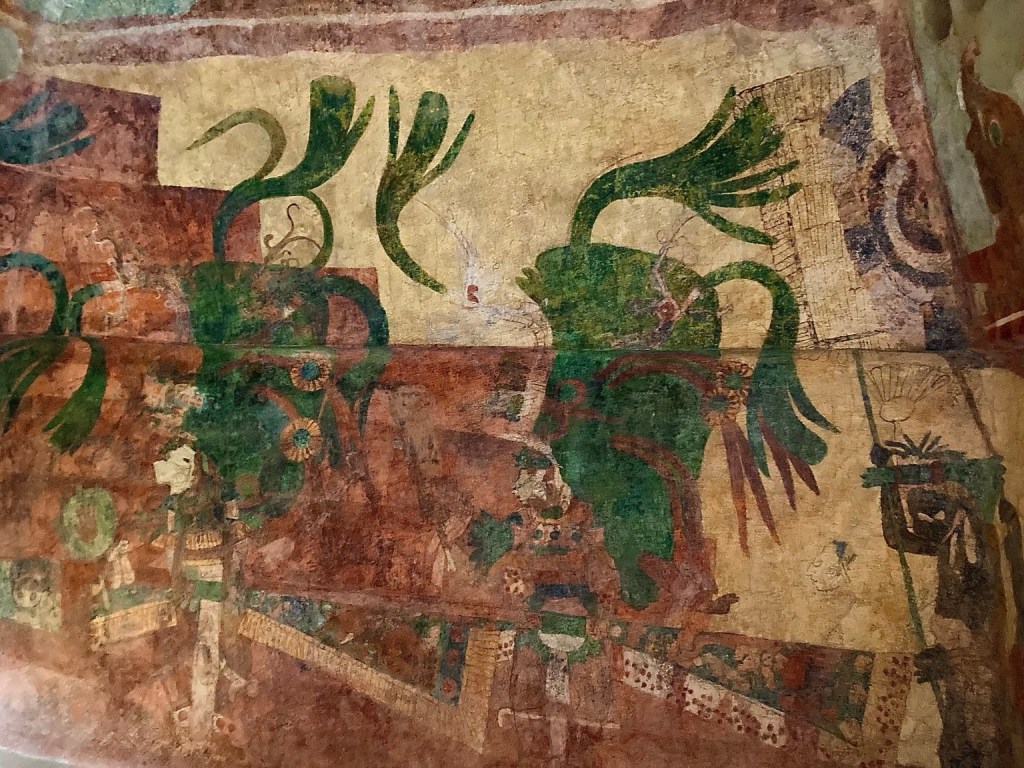
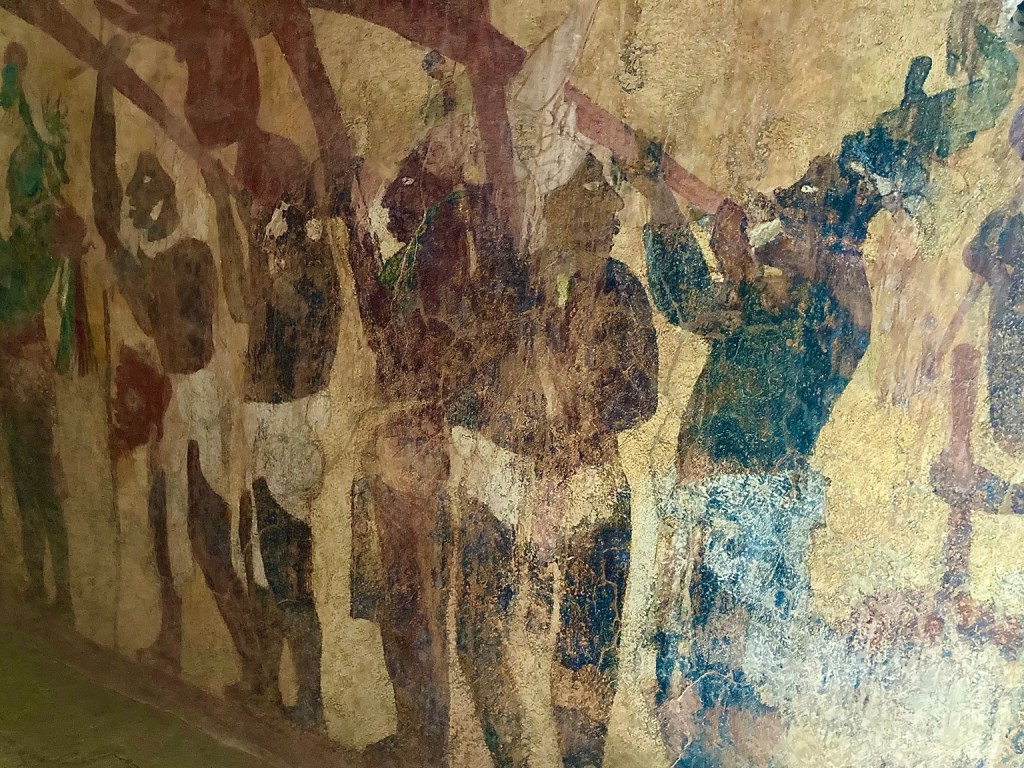
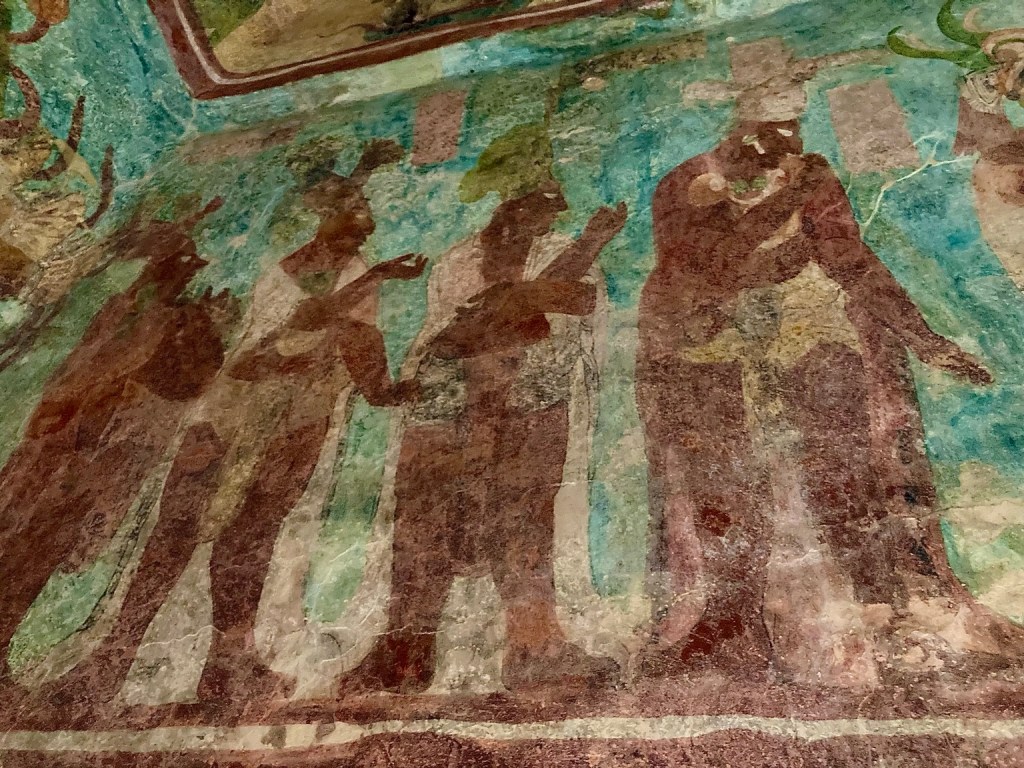
While parts of the painting are vivid and clear, others are worn or damaged and I’ve pumped the colours to make the images easier to see. I’m just including the parts that I could identify easiest, so here goes.
The first room shows tribute and was the most colourful with this parade of percussionists who play turtle carapaces, drums & large gourd rattles …
… and trumpeters.
There is also an image of Chaan Muan II, presenting his new son and heir to the nobles of his court, each dressed in fine fabrics and wearing precious spondylus shells.
The next room was difficult to make out with chaos of battle and damage, but here is a line of lords after the battle wearing more decorated fabrics …
… a triumphant Chaan Muan with his pleading prisoners …
… and others with blood dripping from the hands where their nails have been ripped out!
Finally, the celebration with dancing wearing huge headdresses …
… a fanfare …
… but also ritual blood letting.
Afterwards, I found this excellent article by Richard Quinn which details later research and how infrared and other photography techniques have been used to enhance the images for better understanding and it’s definitely worth a look.
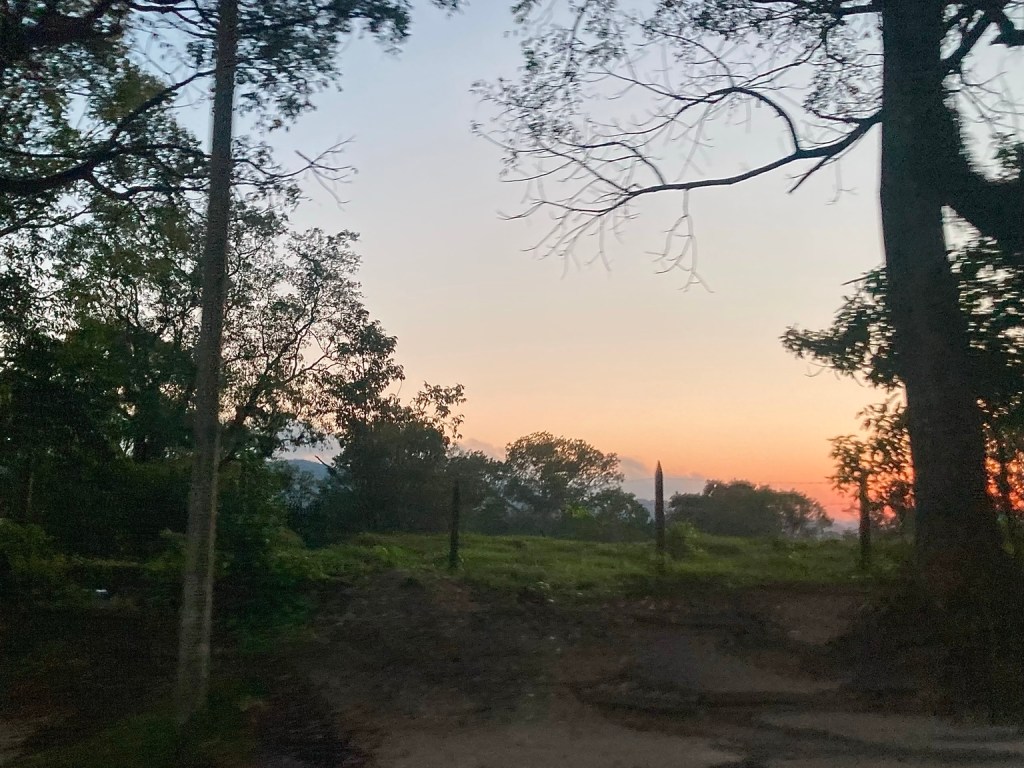
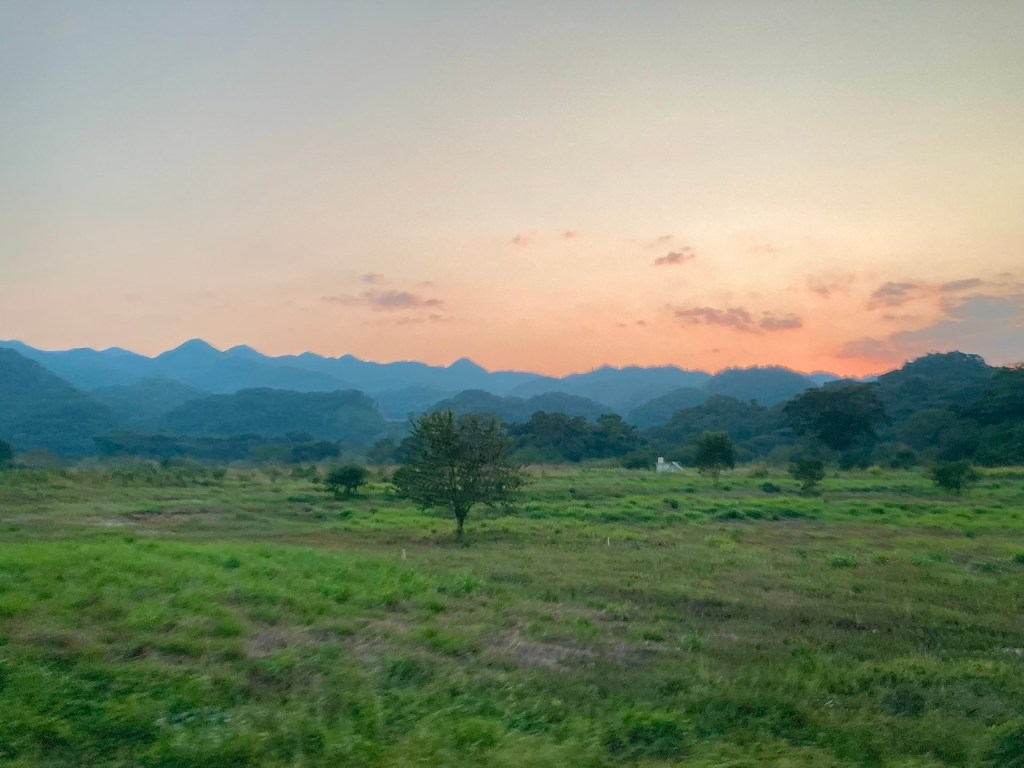
We walked back to the bus, and then had a long drive back to Palenque, seeing the sun set on the way … and arriving at 8pm.
It was a very long day but well planned and the driving was excellent, especially as it was all on a minor road through small settlements and villages and each is protected with a tope or speed bump either side. They are barely visible and rarely signposted and our driver slowed for every one!
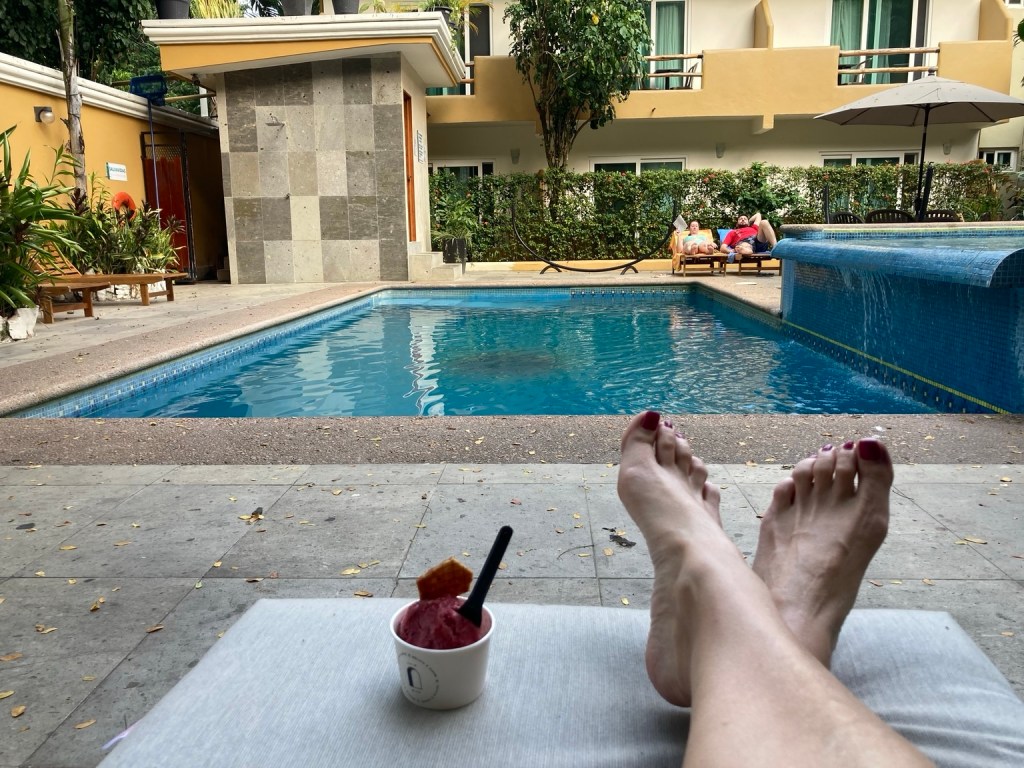
The rest of our time in Palenque was the R&R we had planned, a whole day in the hotel, brunch, sitting by the pool, watching this little chap …
… a dip, an ice cream and dinner and the following morning was similar as we didn’t get on our final bus until lunchtime.
Mind you, it wasn’t idle time as it was a chance to do a little laundry, but getting clothes to dry with high humidity is a challenge but the twisting in a towel trick has now been joined by utilising the hairdryer and the iron! Also, I became engrossed finding out more about the carvings and the murals we had seen and writing the Palenque posts of course.
Anyway, onwards and forward … but ironically backwards in time to the Olmecs
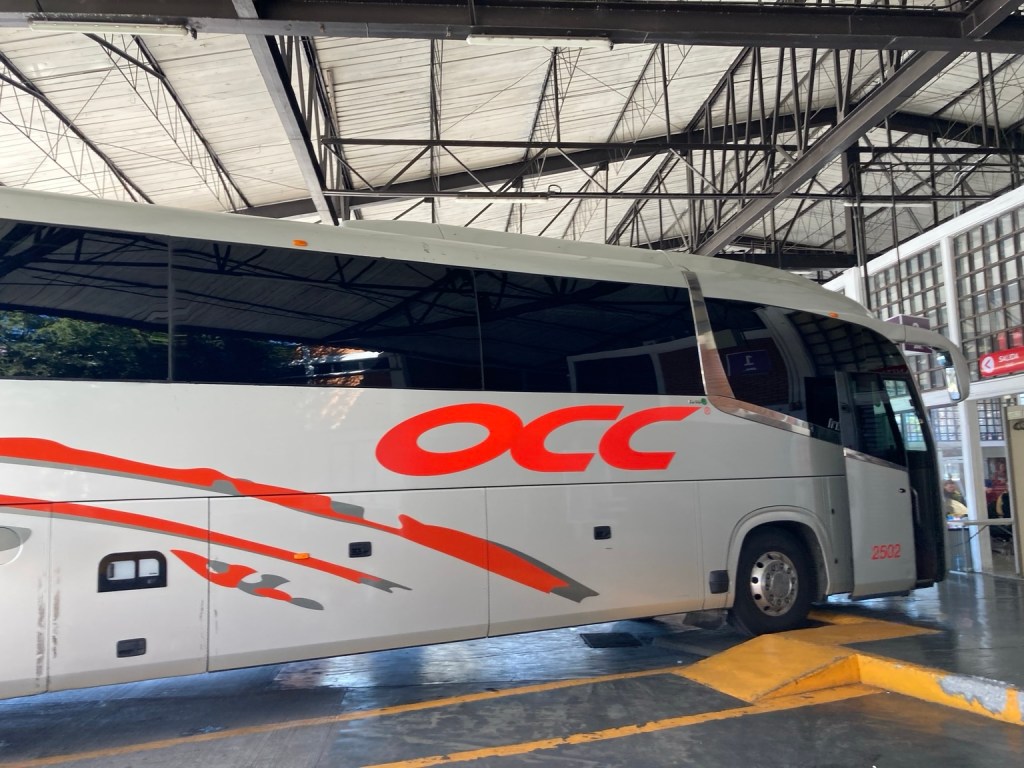
This time we had a silver OCC bus and not an ADO red one … sorry Chris!
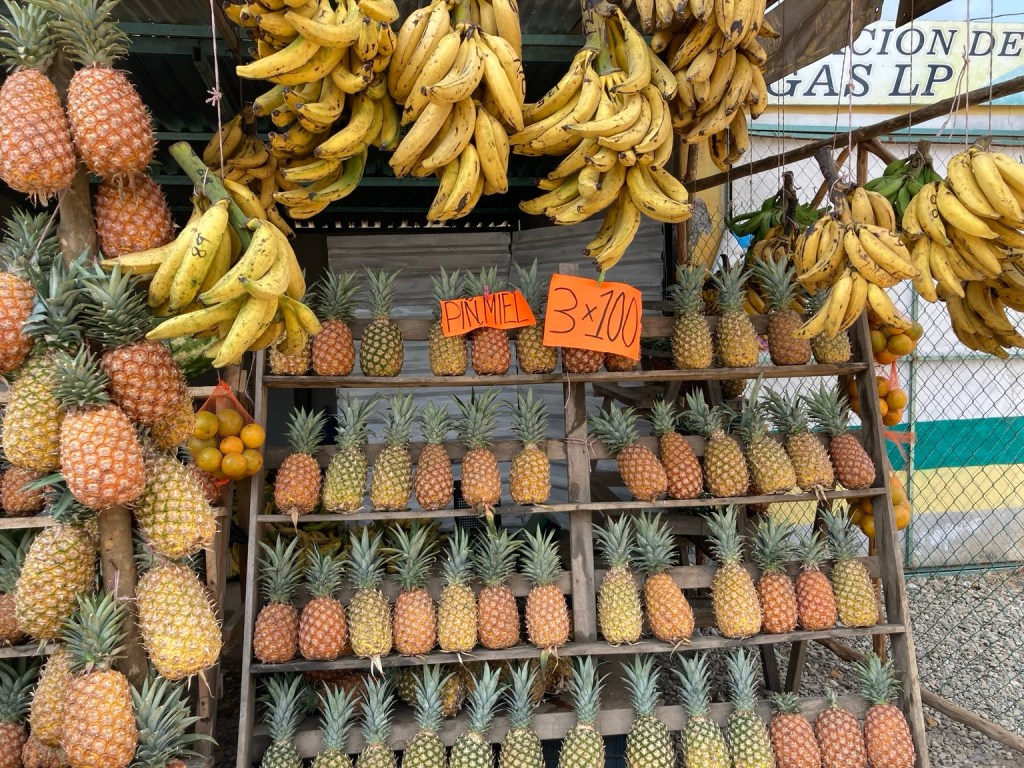
Otherwise there was no difference which was good as it was going to be a long day. We left at 10am stopping for a brief stop halfway with loos and snacks. We checked out the fruit stall …
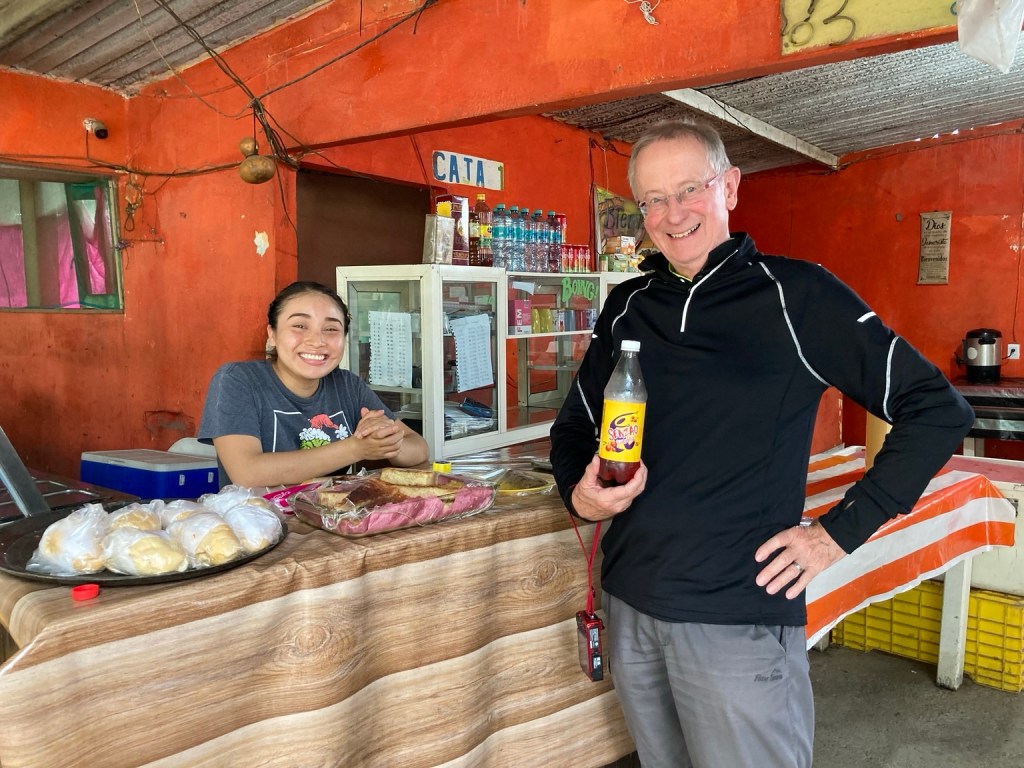
… but just got a soft drink to share.
It said Senzao and when we checked it said it was guarana flavored soda from Brazil …guarana being a berry high in natural caffeine … well it was a long day!
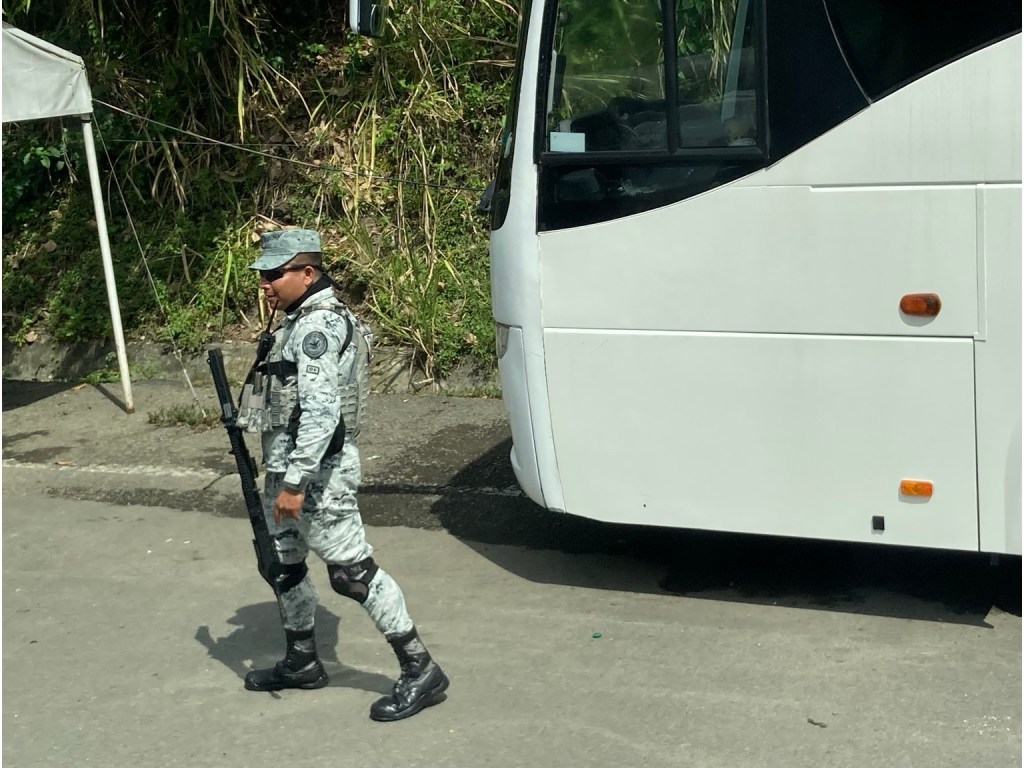
We passed state border guards …
…. and the sun set.
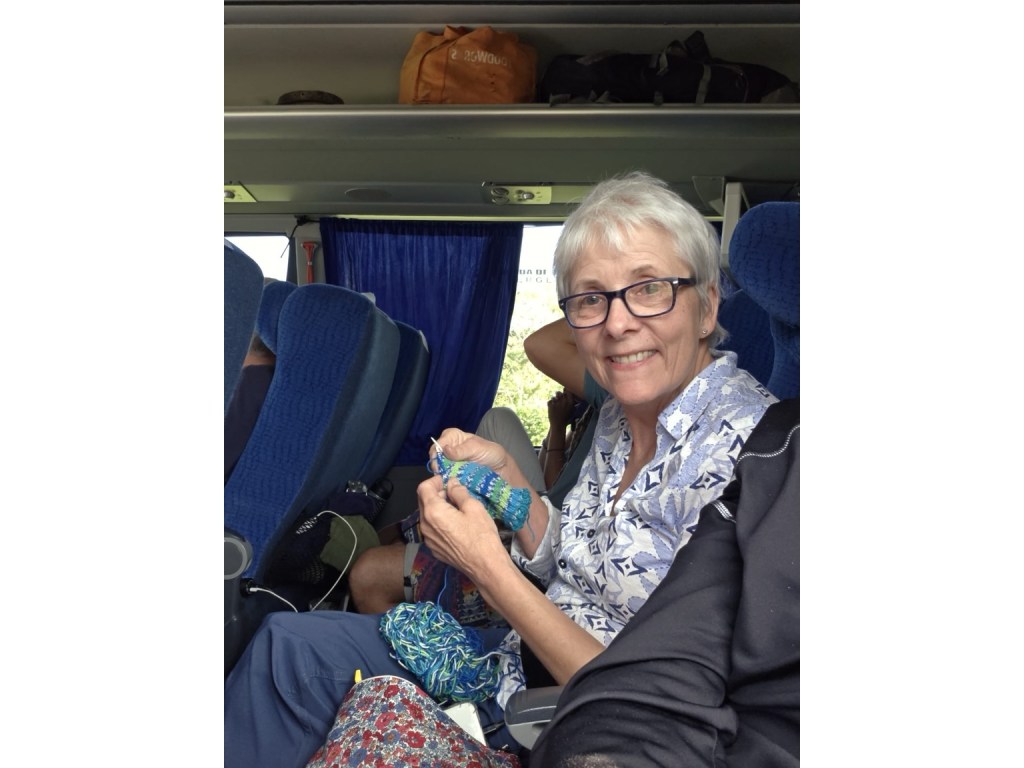
Finally we pulled into Palenque around 6pm and I had knitted all day and reached the heel of my first sock!
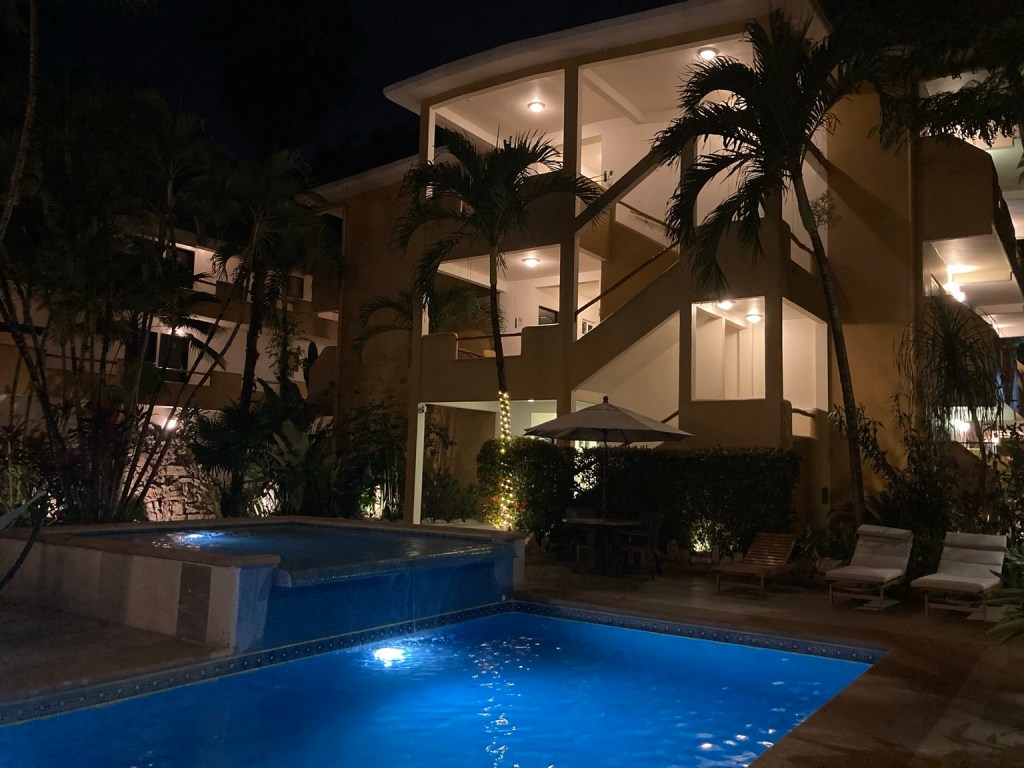
As we stepped out of the bus, the warmth and humidity enveloped us, such a change from the highlands … and the pool twinkled in the light.
Having checked in, our first job was to sort out the tech gremlins as both our phones had run out of data and a very nice Telcel man helped us recharge our SIMs so we are back online and happy once more. Next dinner and bed.
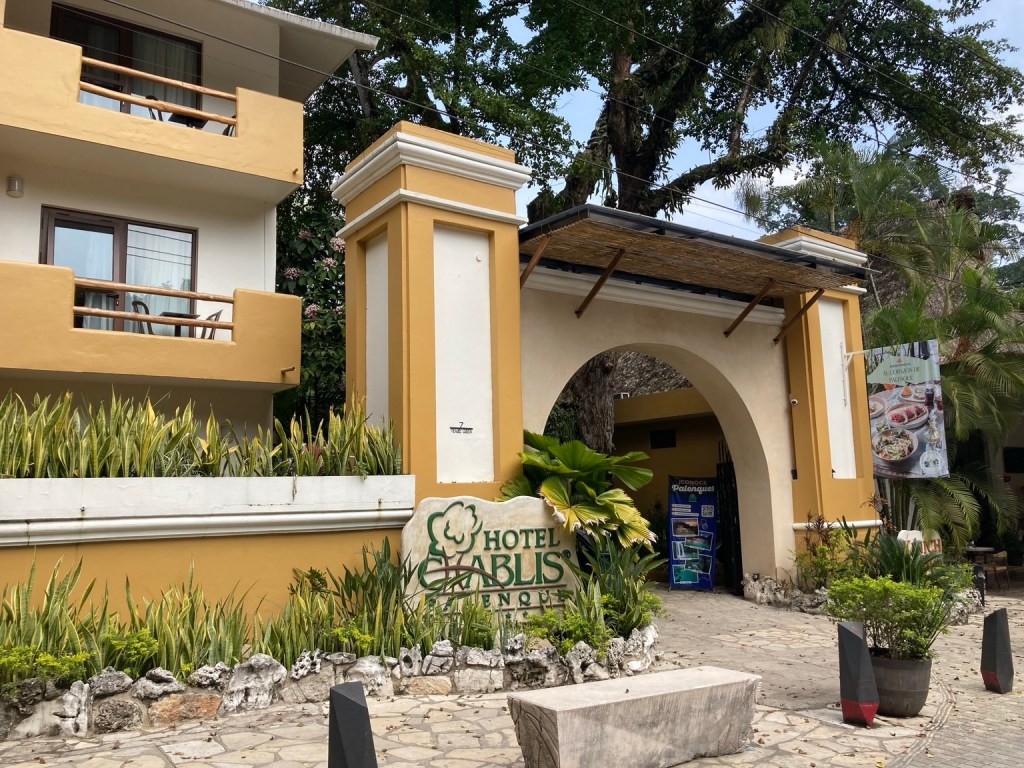
The day dawned on La Cañada, the part of Palenque which translates as the glen, a green area near the bus station, but not quite in the town. It suits us with Hotel Chablis providing a nice room with balcony and a pool to relax round and dip into as well as a choice of restaurants on the doorstep. Apart from visiting Palenque ruins, this was our opportunity for R&R since we didn’t include a beach visit.
We headed to the Palenque ruins after breakfast. A taxi to the ticket office, a ticket for the national park, another for the ruins and a third for a collective to save a good mile uphill to the entrance and finally we were in!
Palenque flourished from 600-800AD and at its zenith was a powerful Mayan city with around 6,000 people. Palenque’s greatest ruler was K’inich Janaab’ Pakal, also known as Pakal the Great who came to power at the age of 12. Most of the buildings at Palenque date from his reign or his two succeeding sons and grandson. Decline followed as another group took power in the region and Palenque was then hidden by the jungle until 1950.
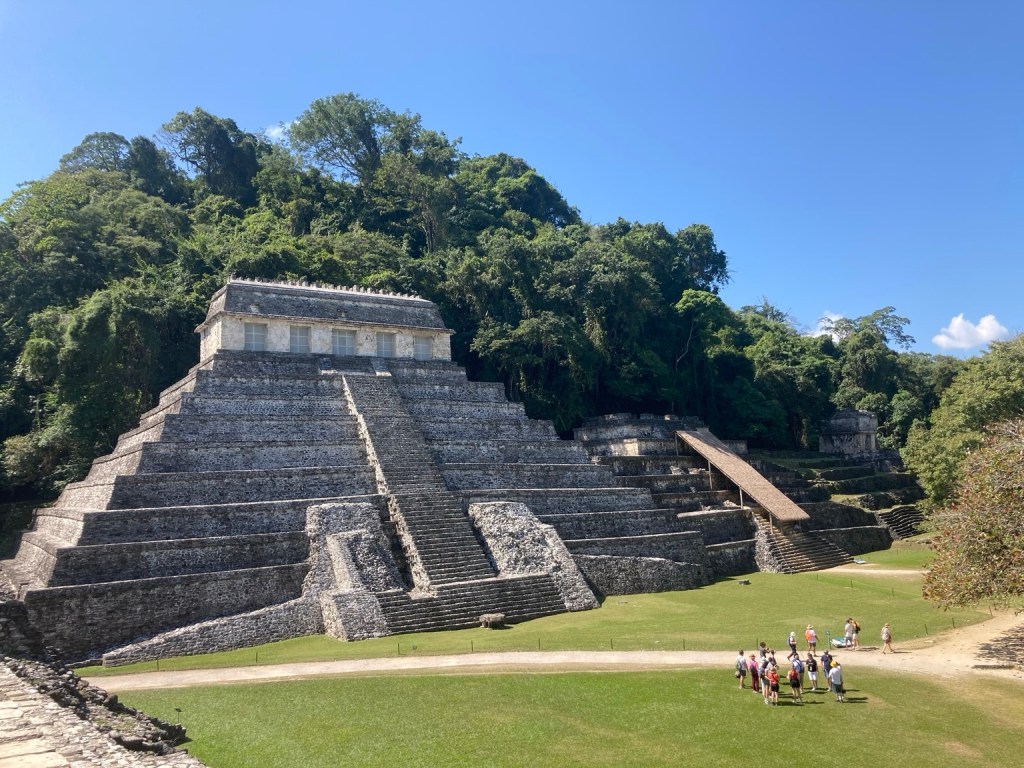
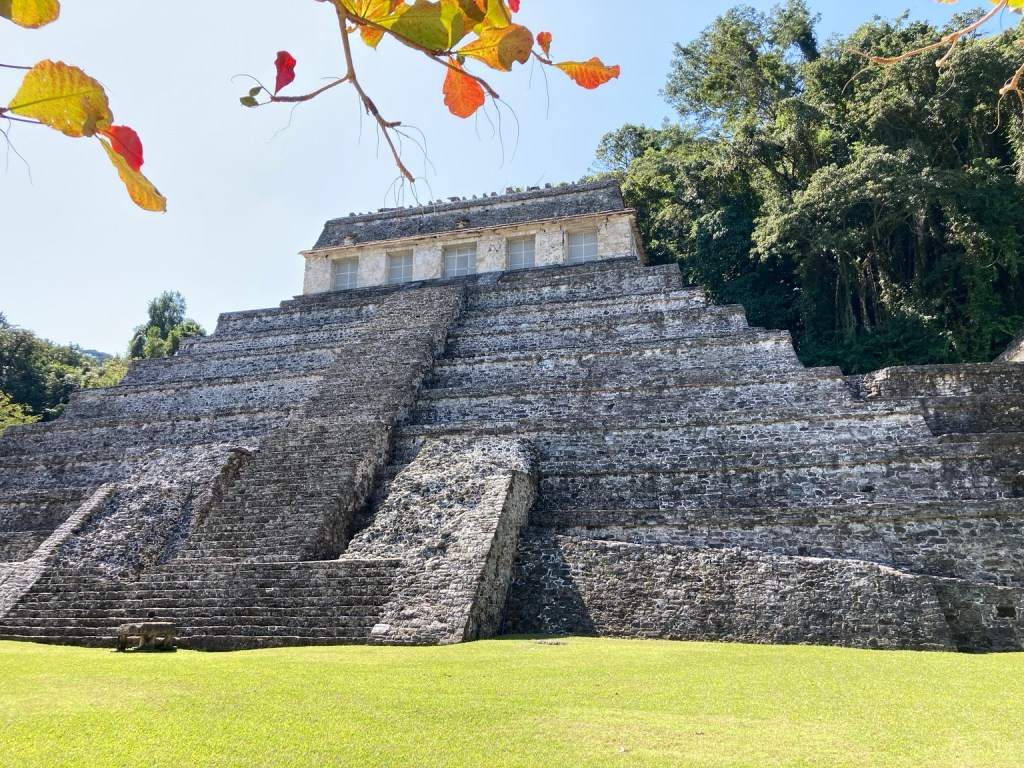
Entering the plaza, the largest building is the stepped pyramid called The Temple of the Inscriptions, named for the three large inscription panels inside from which experts have deciphered around 180 years of the city’s history.
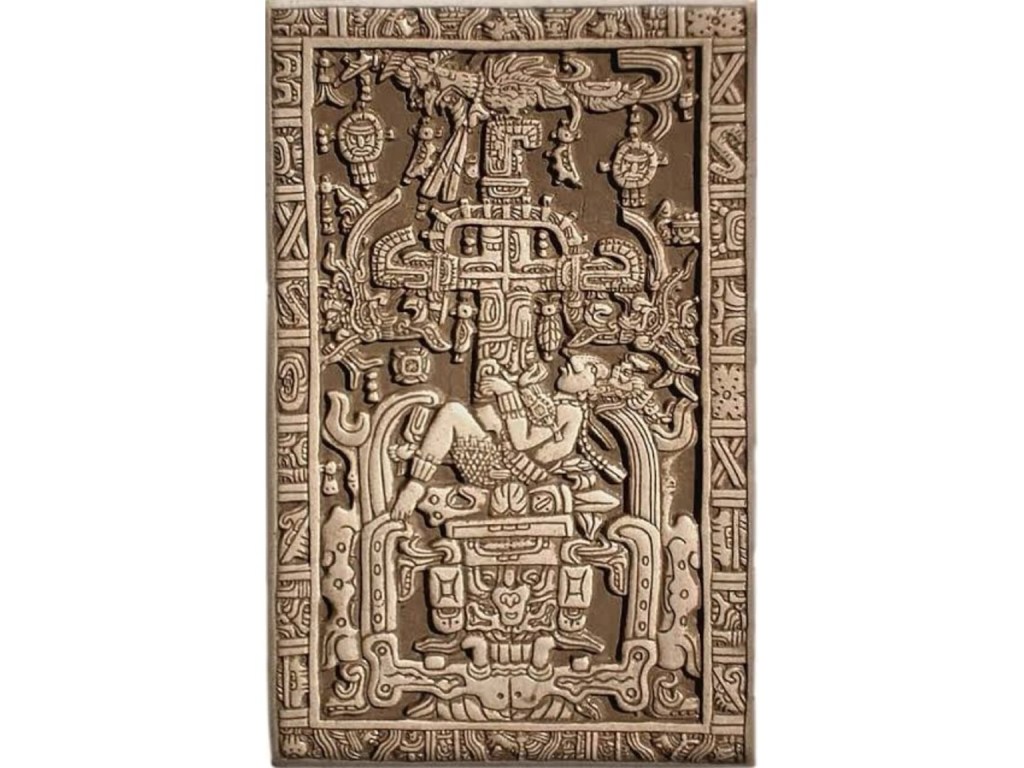
It is also the tomb of the Great Pakal who was interred in an engraved sarcophagus, still inside, which depicts Pakal at the moment of his death, falling into the underworld. Having whetted your appetite, I now have to say that the building has been closed to the public for 25 years to protect it, so here’s a copy of the lid.
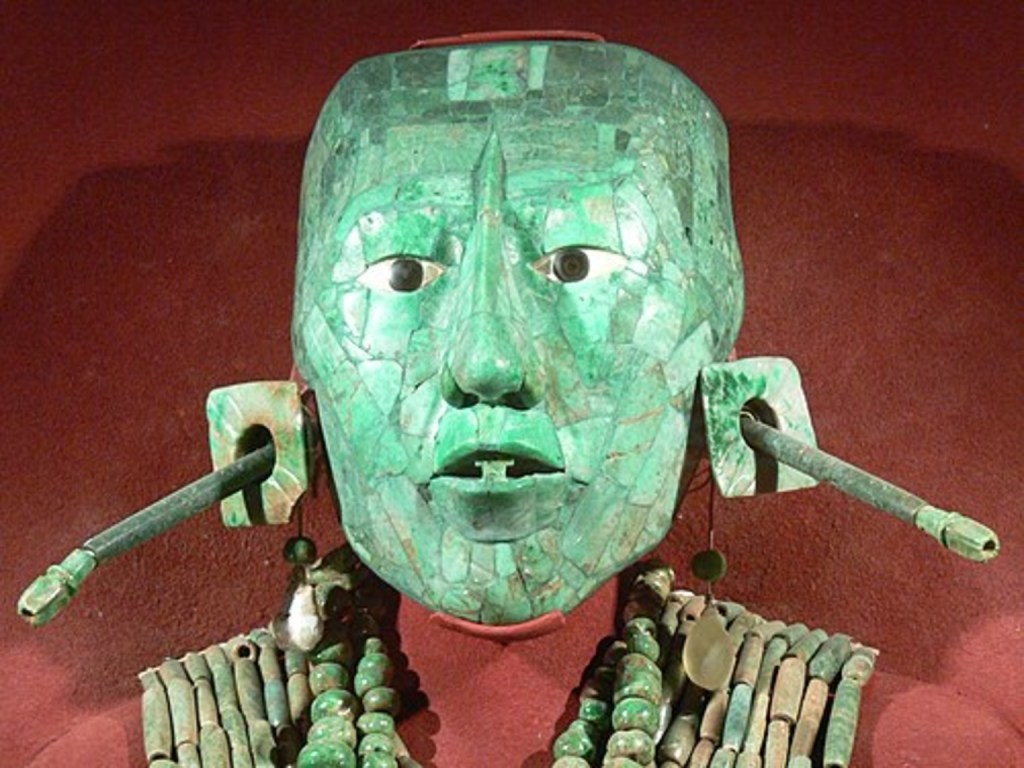
Also, his body was found covered by a jade suit held together by gold wire and his face had a mask made up of 340 hand-carved pieces of jade, now in Mexico City, but here is a picture.
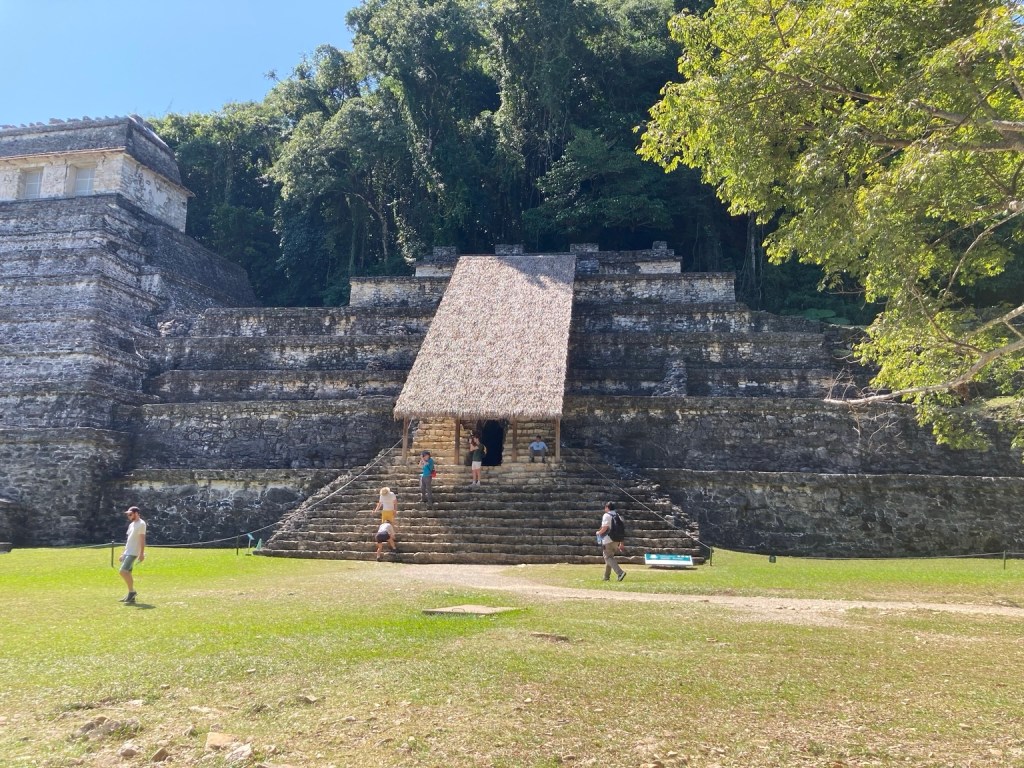
Next to it is the Temple of the Red Queen, named for the red cinnabar and the attributes of a royal burial.
We could go inside and see the sarcophagus.
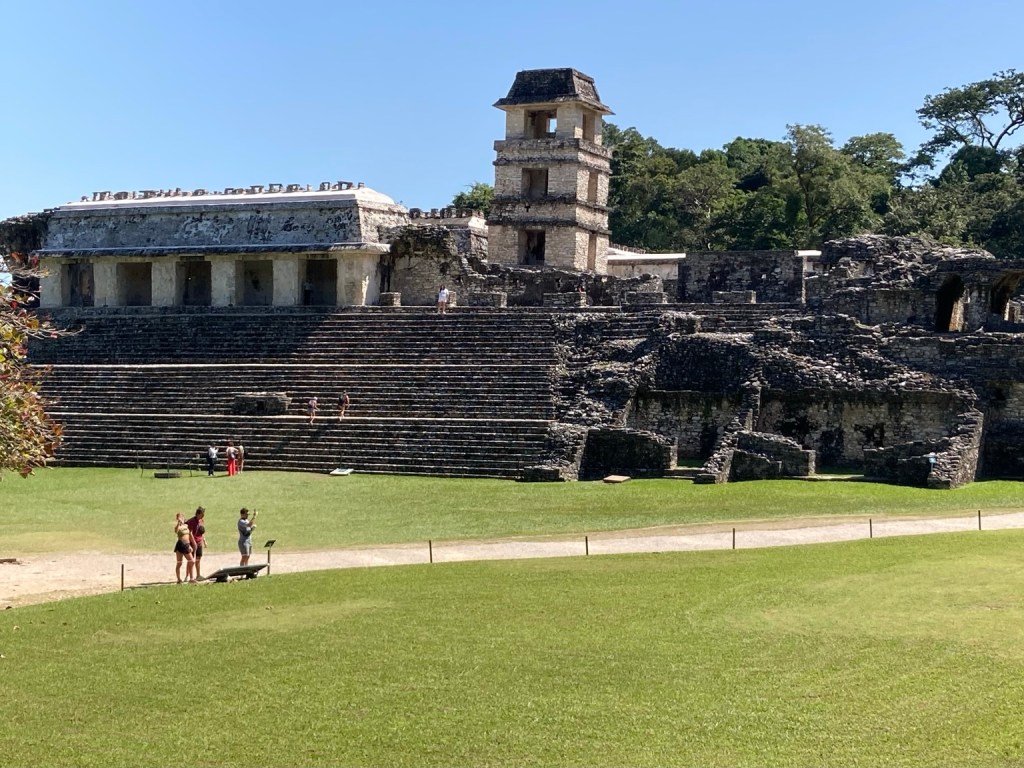
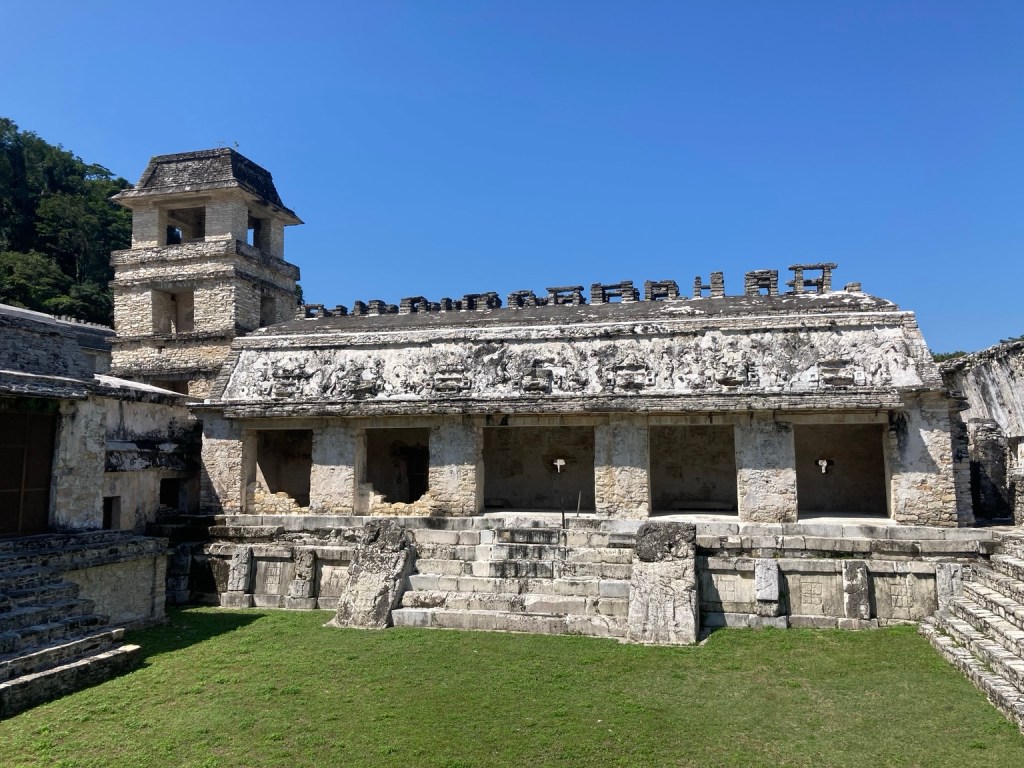
Across the plaza is the centrepiece, The Palace, rambling complex of administrative and residential buildings, topped with a unique square tower, whose purpose is unknown – watchtower … observatory?
The patio behind has carvings but none very clear.
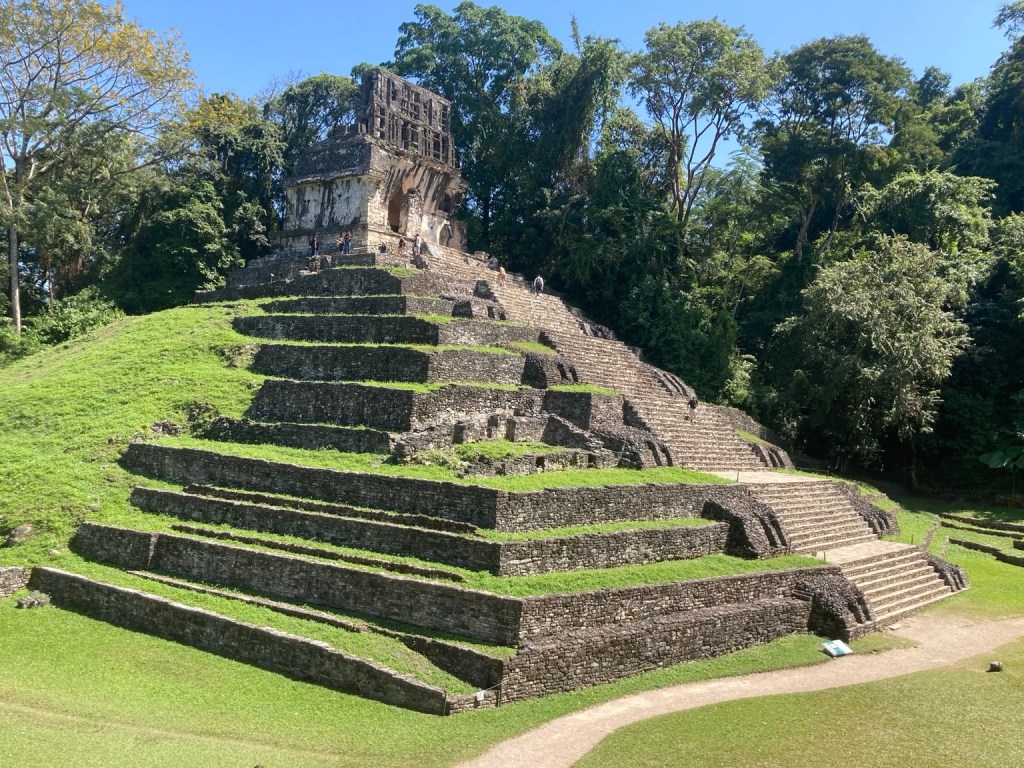
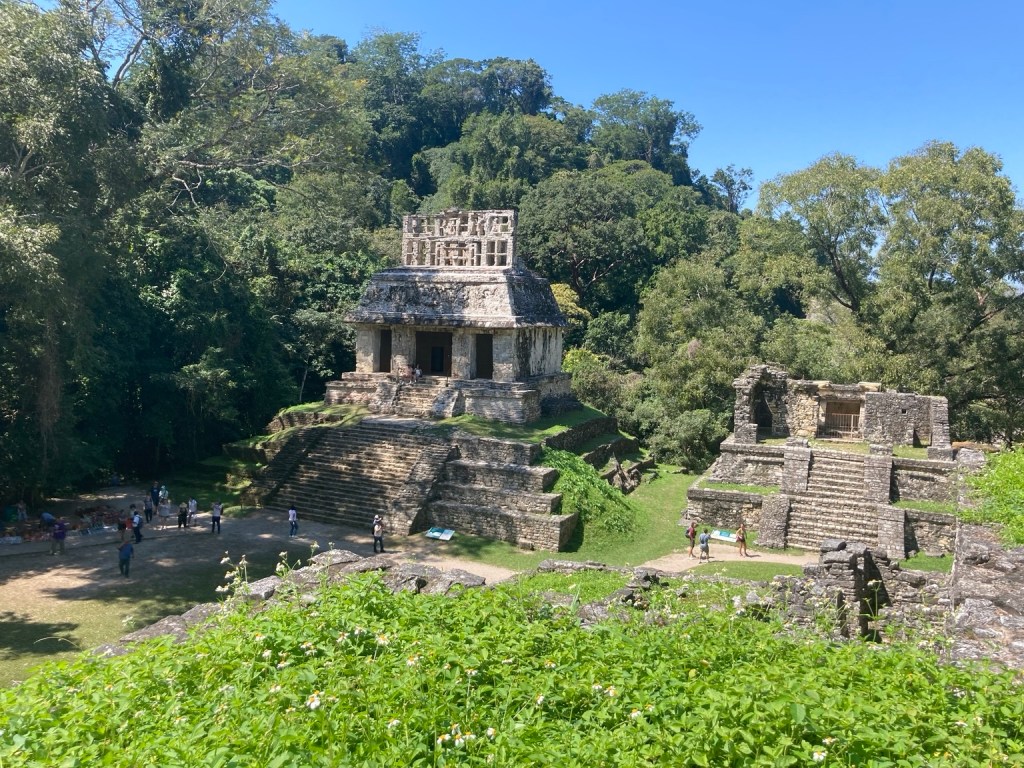
Crossing a stream, we found another group of temples including Temple of the Sun …
… and The Temple of the Leafy Cross, both named after pretty indistinct interior carvings …
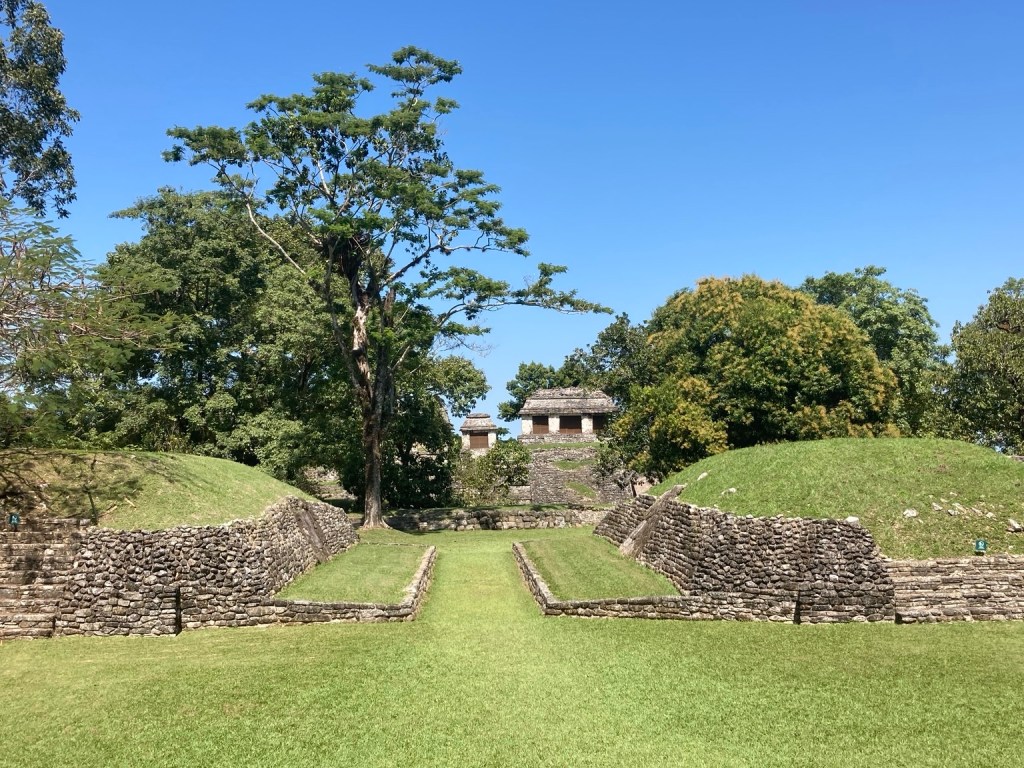
… and then we saw the ball court. This had profound religious and symbolic meaning, representing the cosmic struggle between life and death, light and darkness, rather than just a sport.
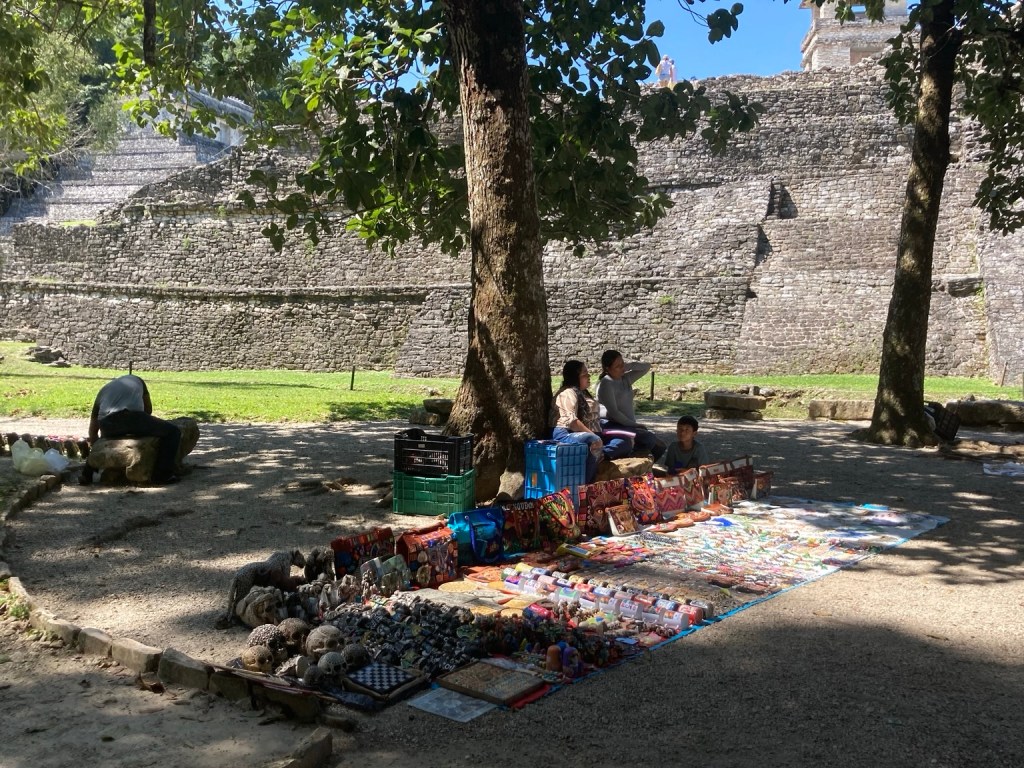
We had been avoiding souvenir sellers, but I finally relented and ended up with a handheld whistle shaped like a jaguars head that roars … the nearest we will get to a jaguar I’m sure!
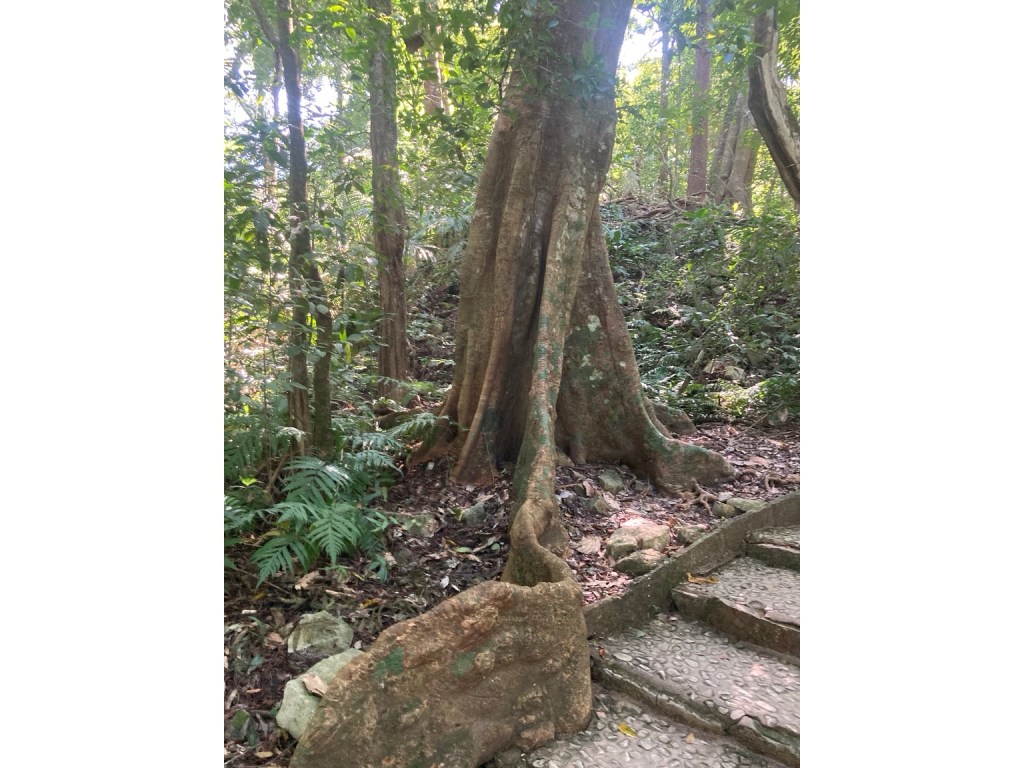
We took a path through a wooded area …
… and past cascades …
… and some less restored ruins …
… until we reached the museum … but hey this is Mexico … and it is closed for several weeks!
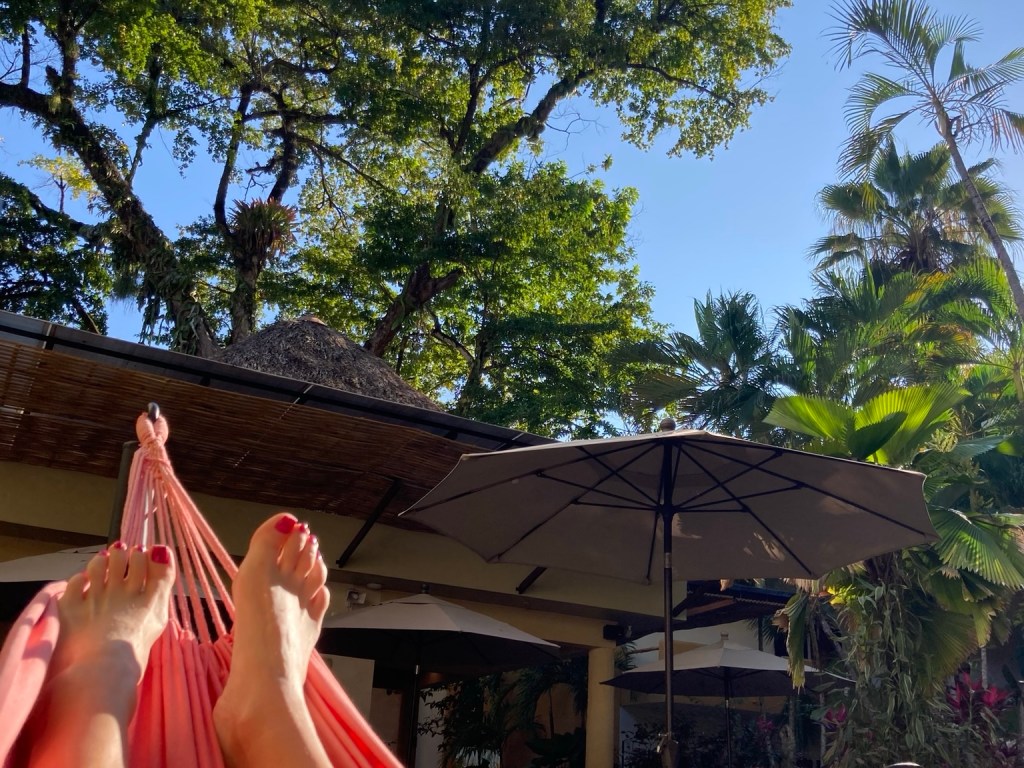
We made our way back for some pool time …
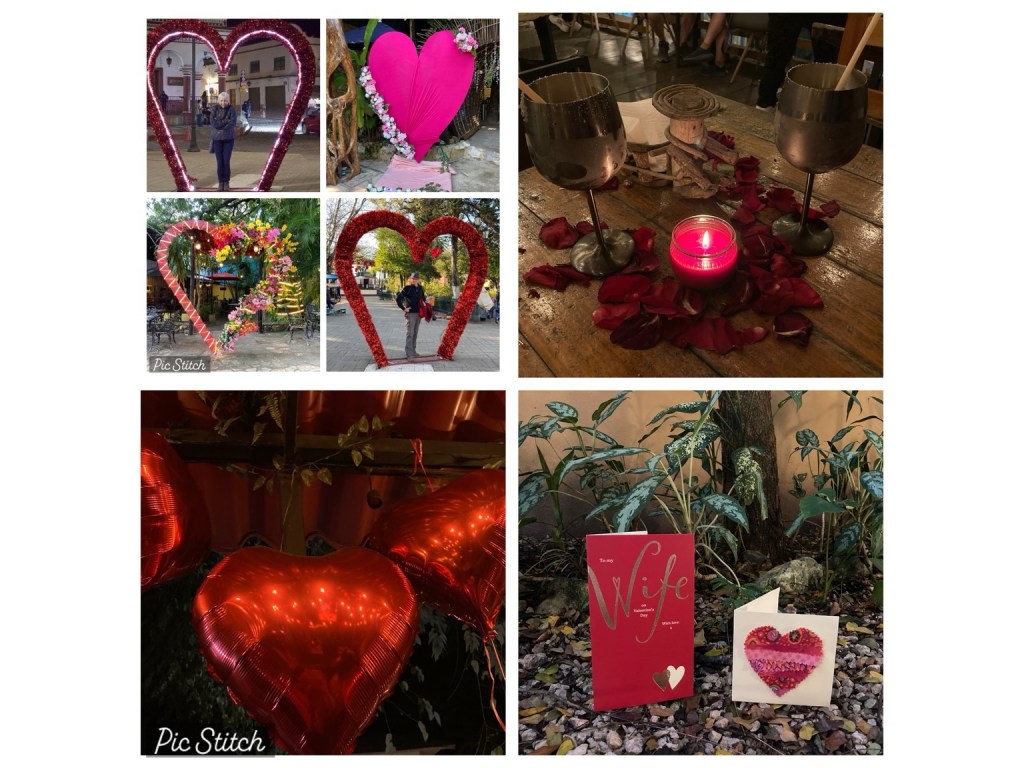
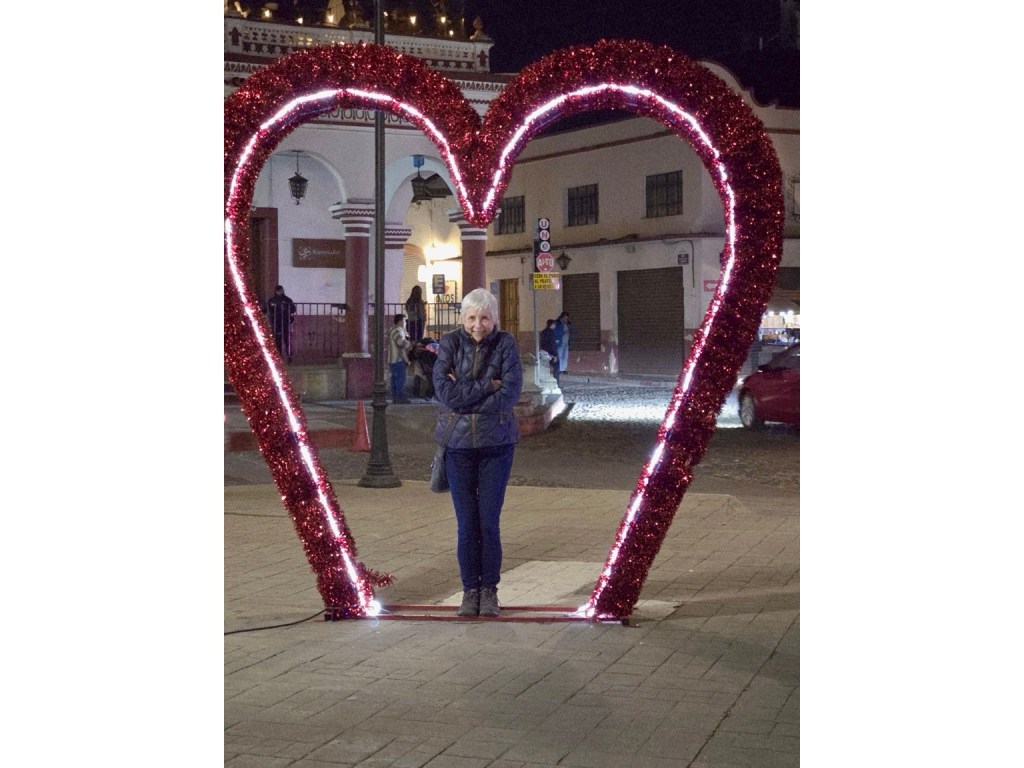
… and prepared for a romantic meal … after all today is Valentine’s Day and love is in the air!
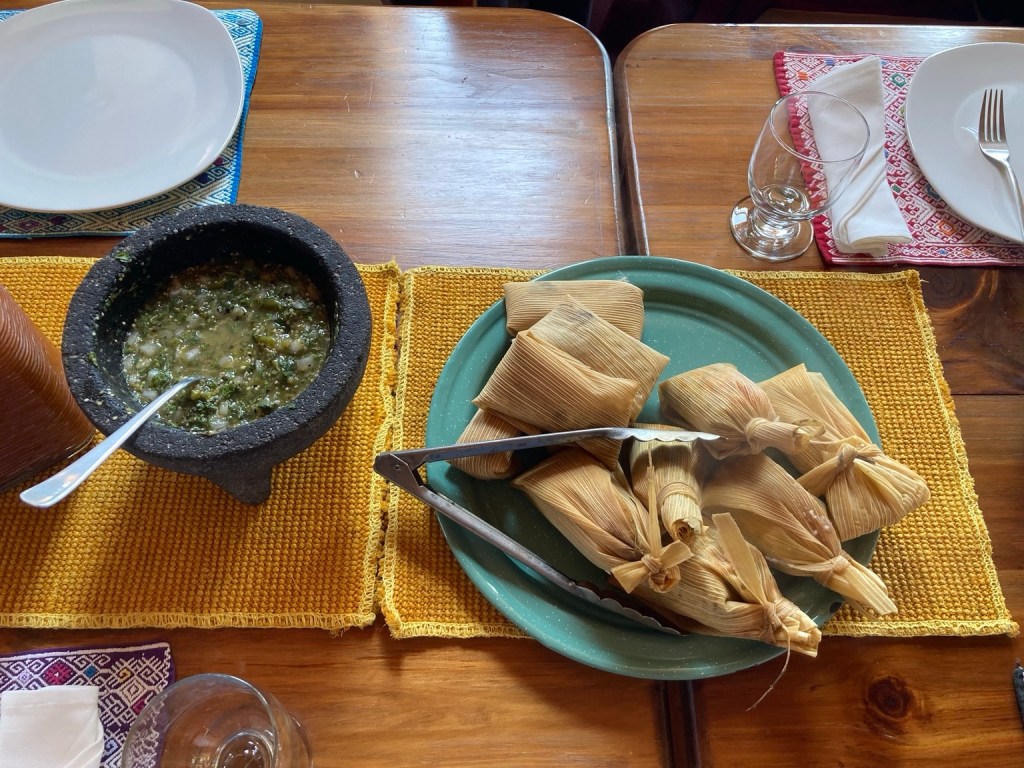
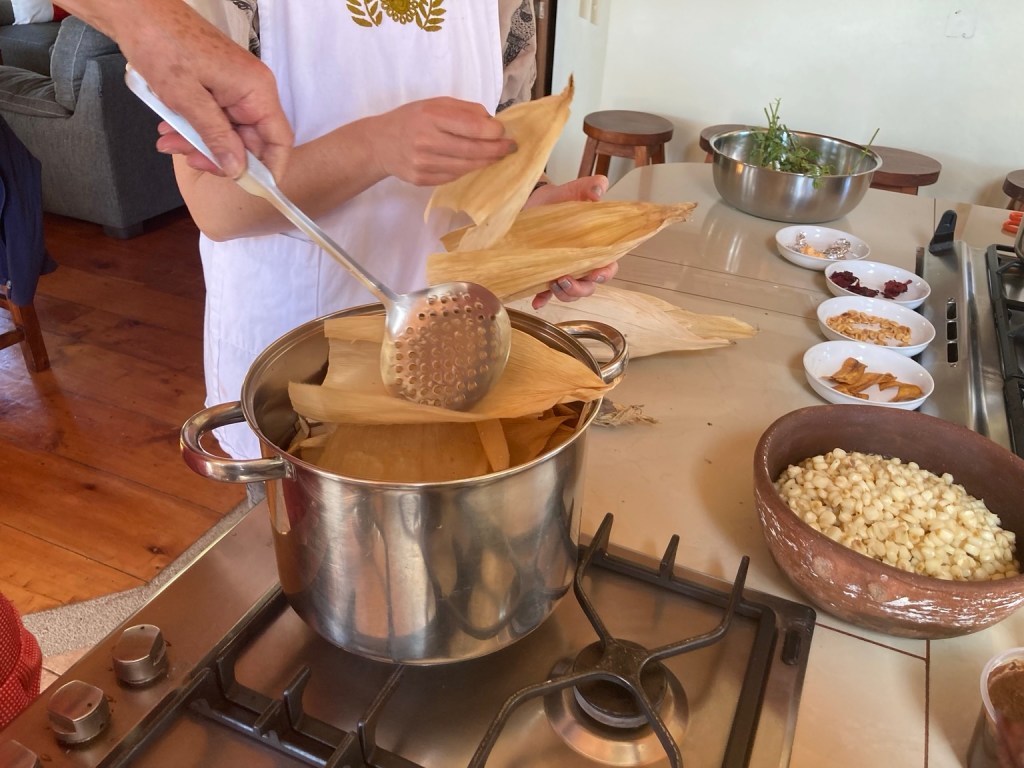
Tamales are one of the staple foods of Mexico, although the filling is usually made with lard, so we were delighted to find a cooking class at El Tizitz with a vegetarian option.
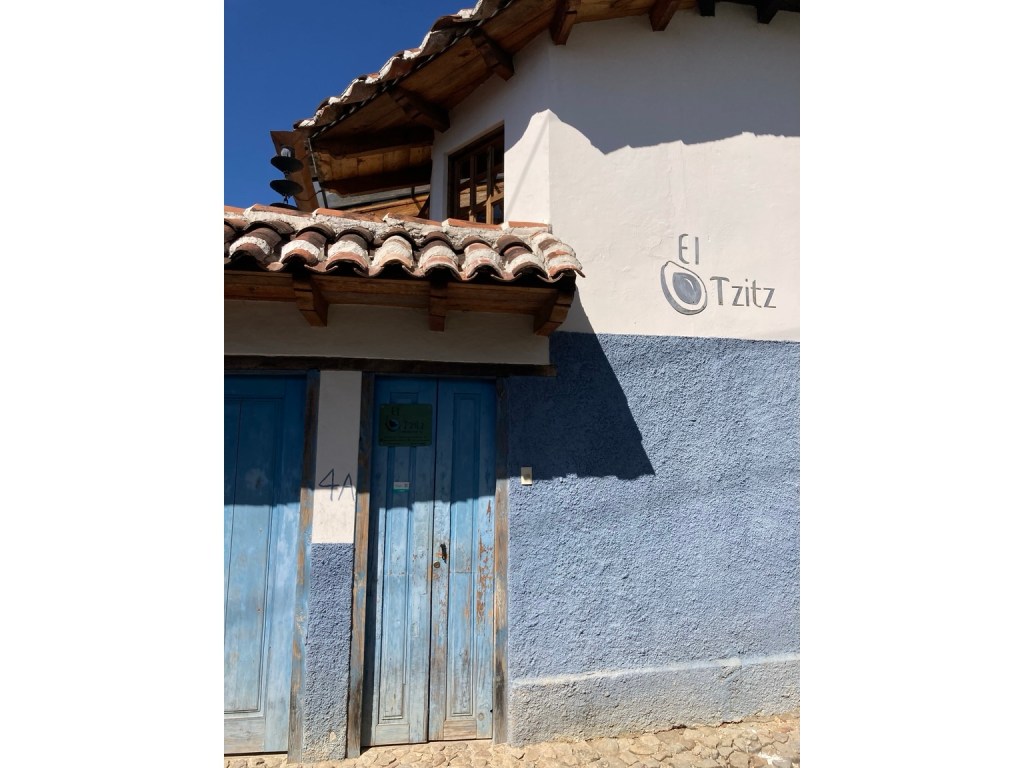
We found the blue door as directed …
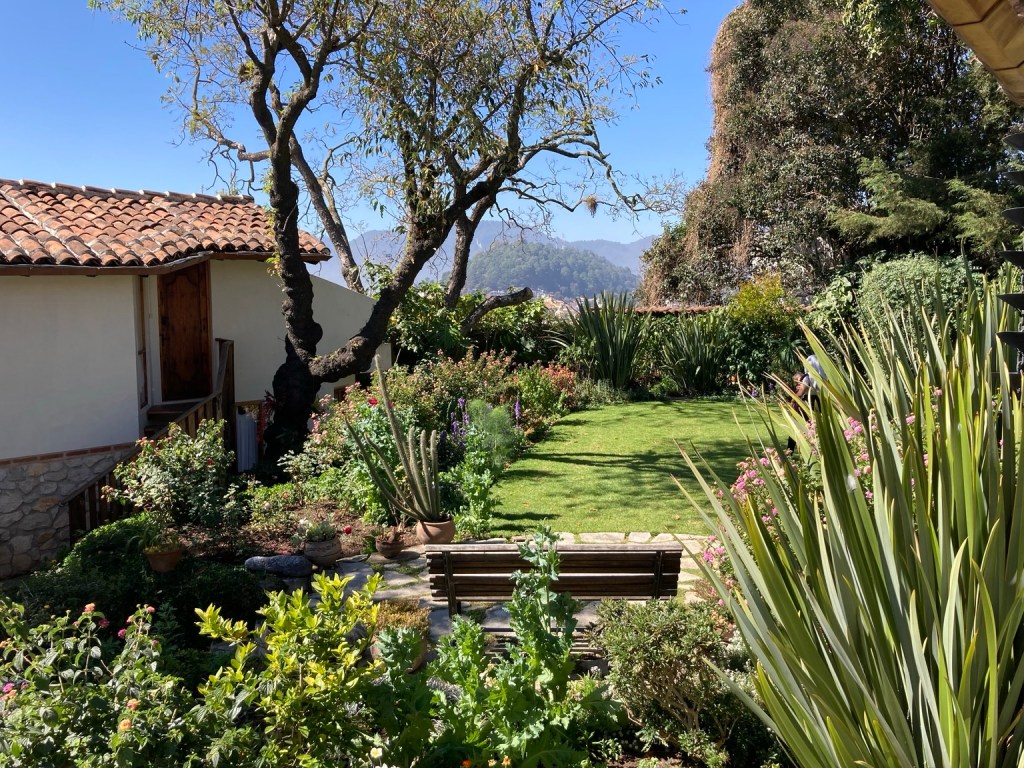
… and were amazed to see the beautiful house and garden hidden behind such an unassuming door!
We were greeted by Irma and joined by Caitlin from Colorado, whose sister was poorly and unable to come, so just the three of us.
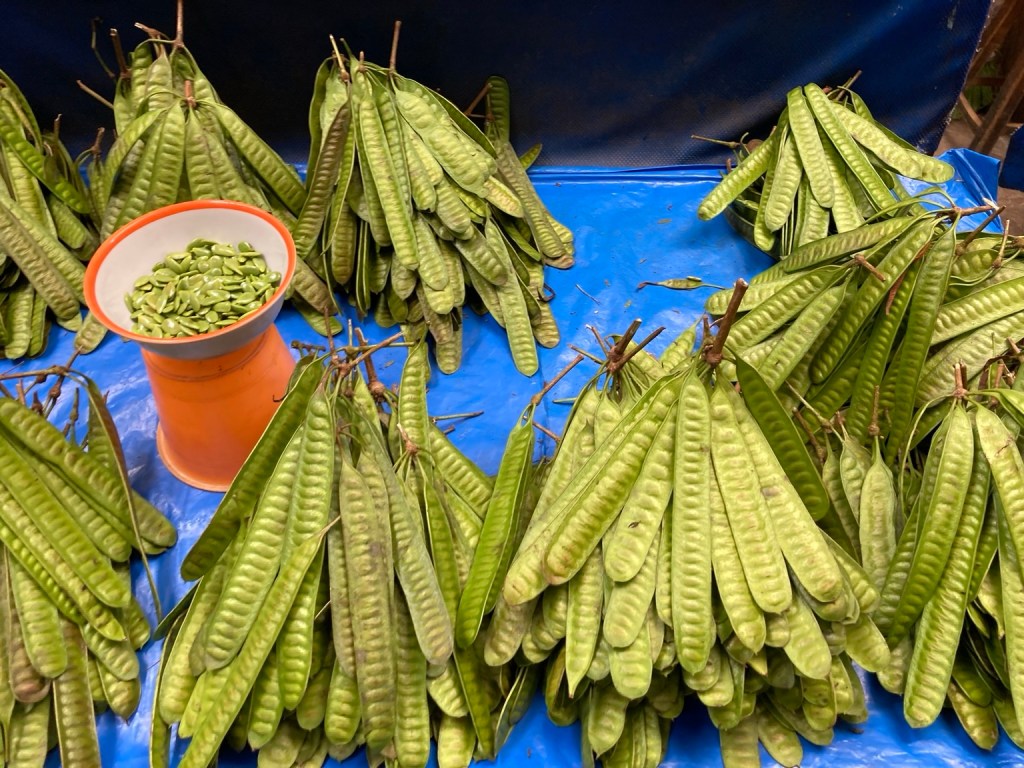
First we had a market tour, but photos were not encouraged. It was good to find how much we had learnt already since being in Mexico, realising that some of the fruit and veg were now familiar to us. This was a new one though, Guaje seeds which are either roasted as a snack or used fresh in salsas.
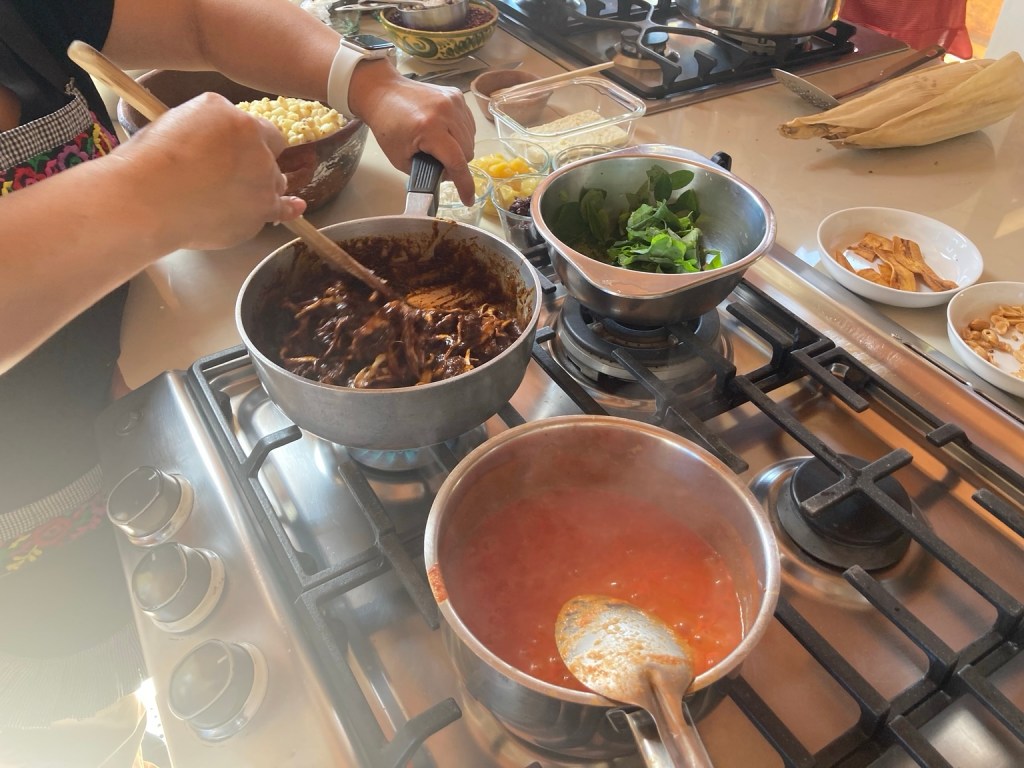
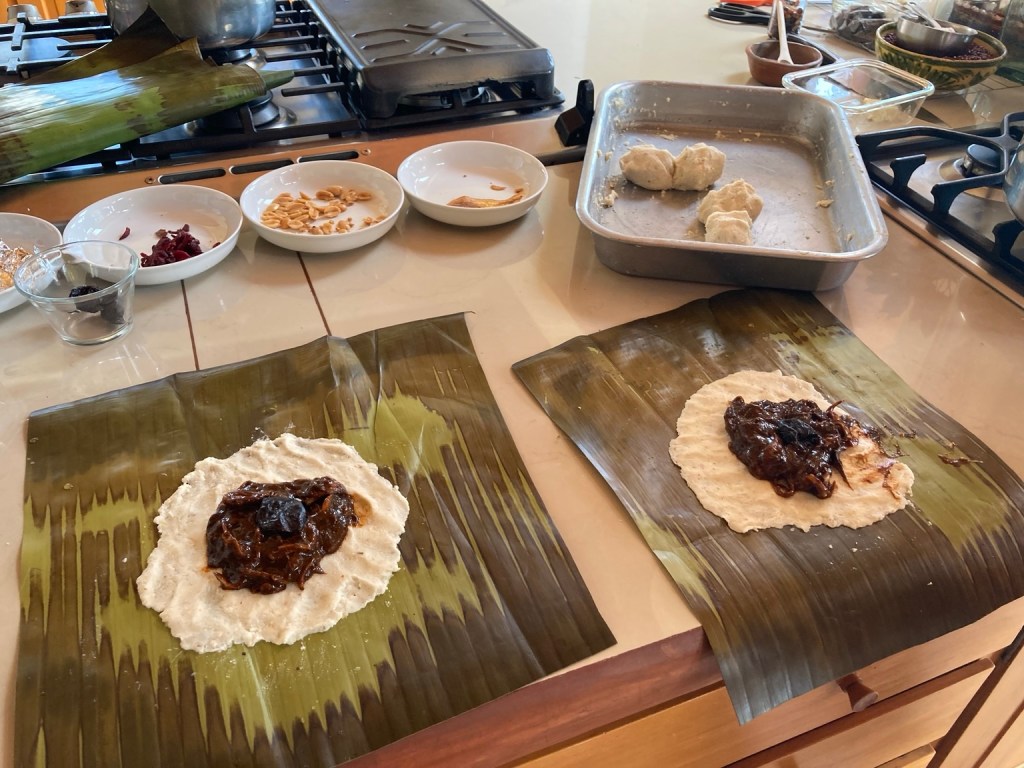
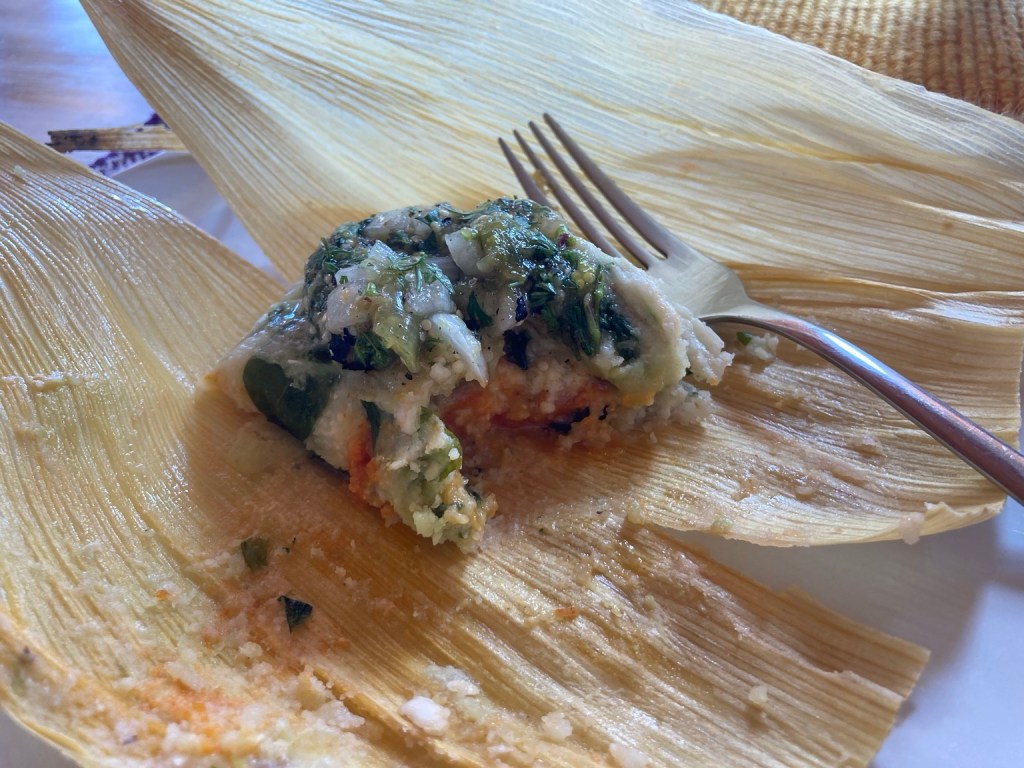
We were cooking three varieties of tamales – one flavoured with a herb called chipilin, containing a little red salsa and a cube of cheese, another with homemade mole with oyster mushrooms and a prune, and a dessert one mixed with cinnamon, chopped pineapple, raisins and some grated coconut.
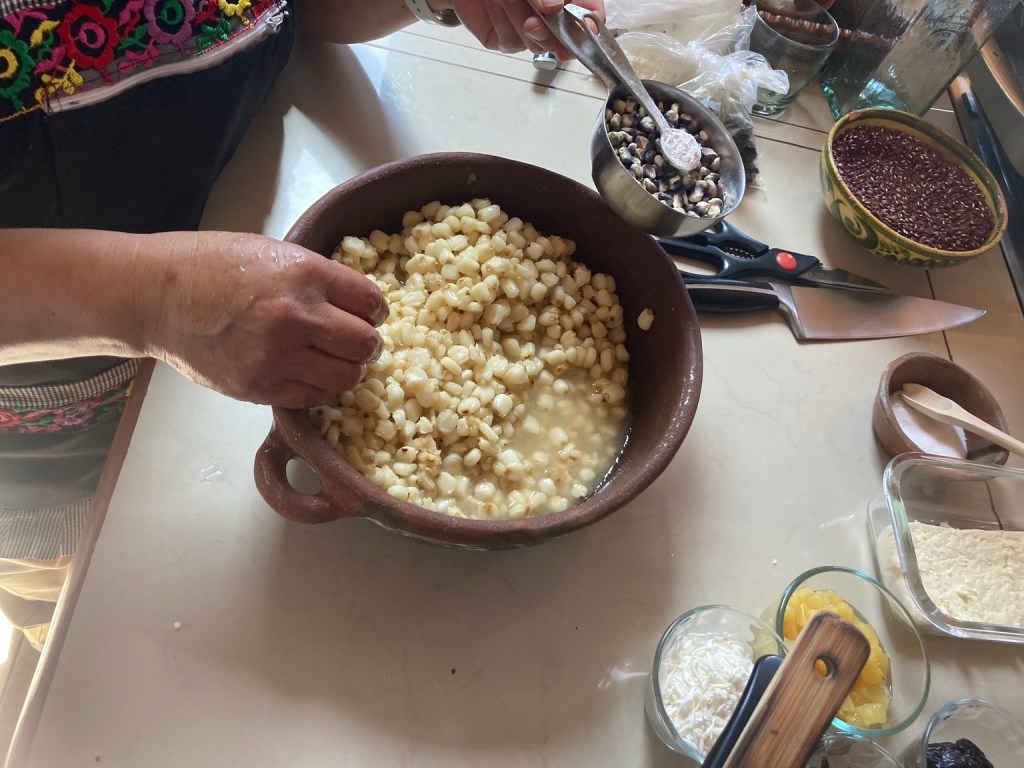
Irma had done some preparation beforehand, including simmering the corn in water with lime for three hours to cook it.
We all helped with the tasks like stirring …
… soaking the corn husks to soften them to make wrappers …
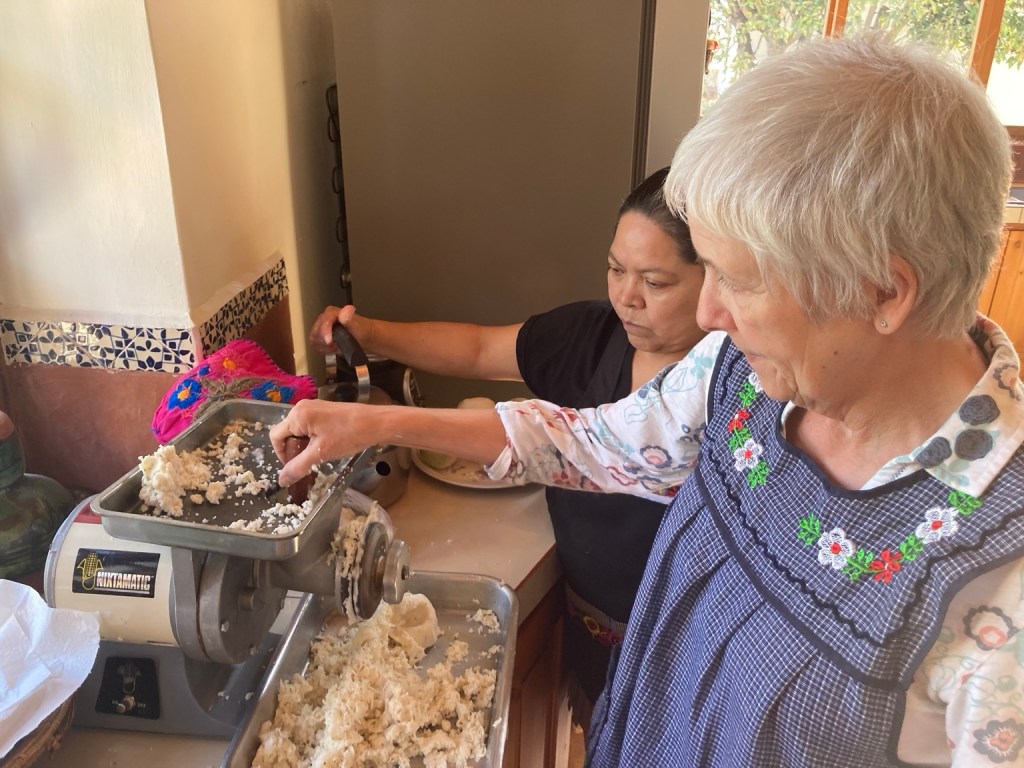
… putting the corn through the Nixtamatic grinder twice to make the masa or dough …
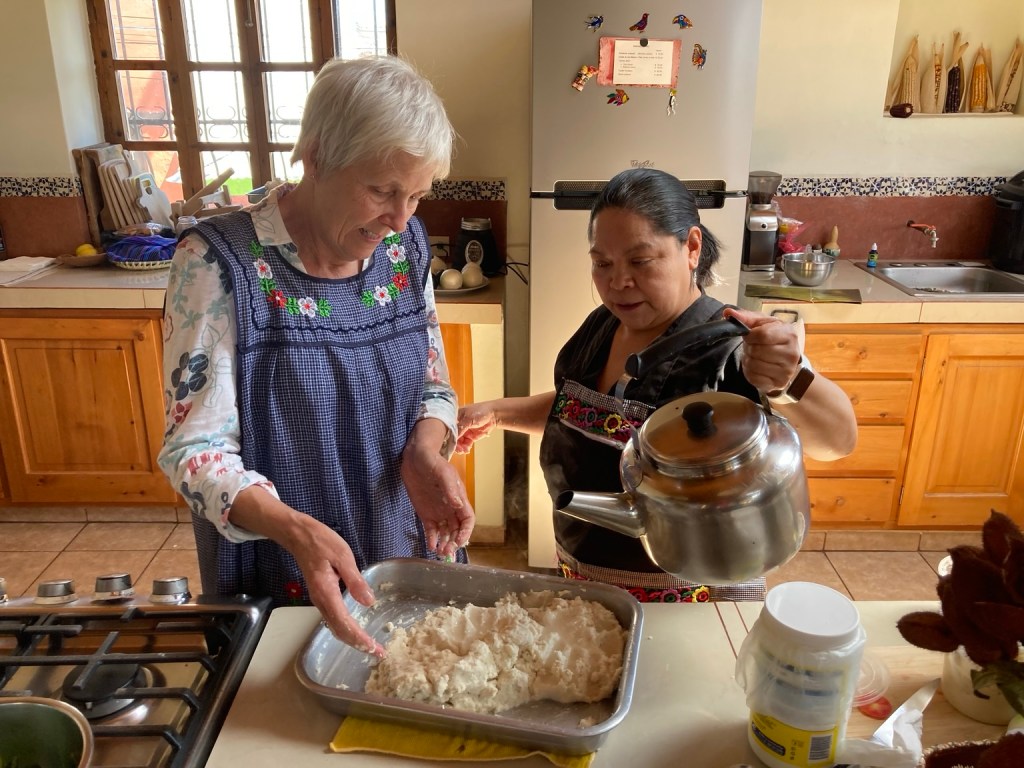
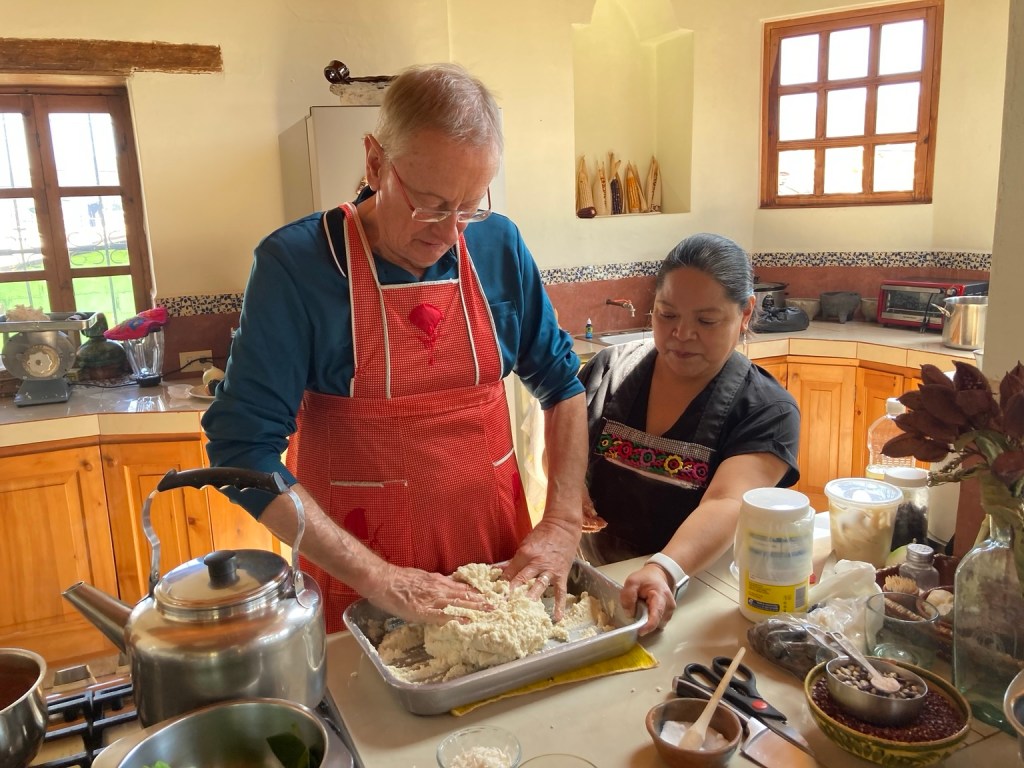
… then mixing it with water and working it till smooth which Chris excelled at!
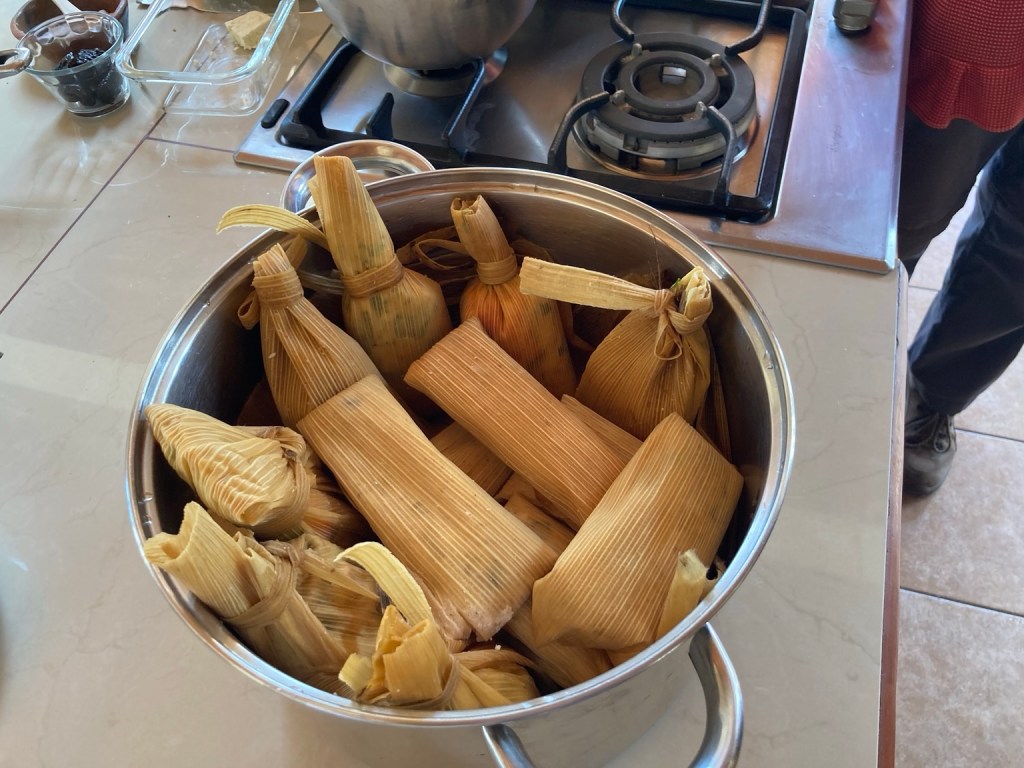
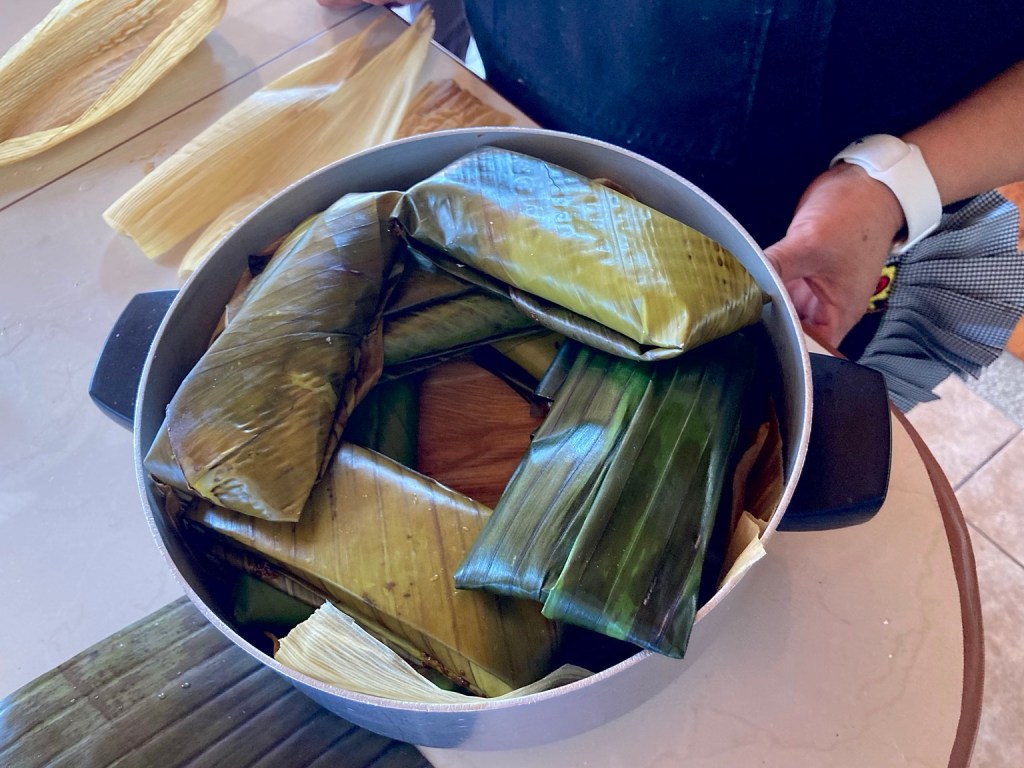
It was then time to start building the tamales, carefully encasing the filling in dough and wrapping them.
They were then layered into a pan with a trivet and cooked.
Meanwhile, we toasted tomatillos, garlic and chillis till scorched and worked them to a paste with a pestle & mortar before adding coriander and diced onion.
Everything was very tasty and it was a lovely experience …
… even if it unlikely I will make them again as I doubt I can just substitute Jolly Green Giant!
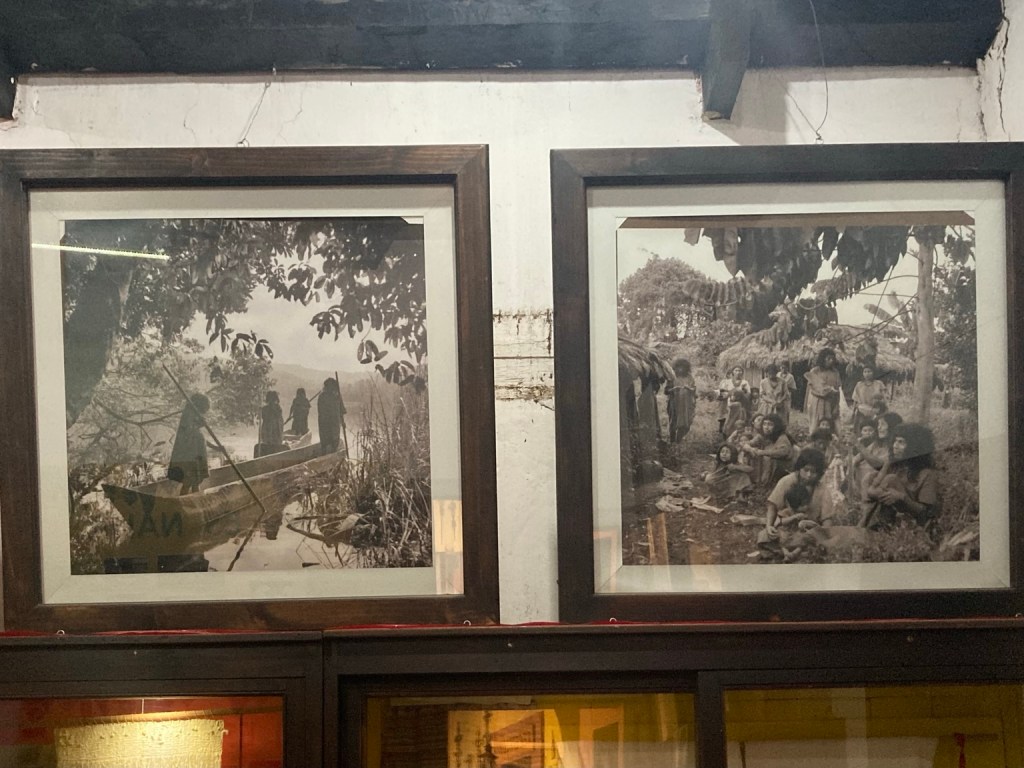
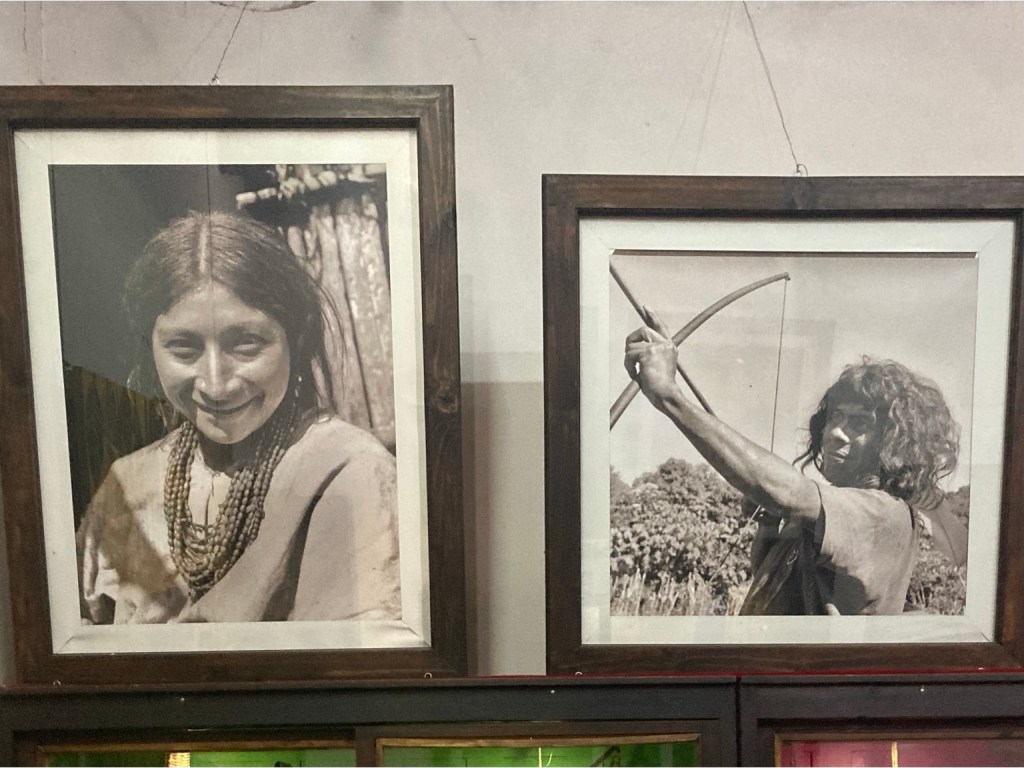
In the afternoon, we stopped at Casa Na Balom, once the home of Frans Blom, a Danish explorer and archaeologist, who with his wife researched and recorded the Mayan cultures of Chiapas. It is now a museum, hotel and research center dedicated to the protection of the Lacandon Maya and the rain forest, an area close to Palenque.
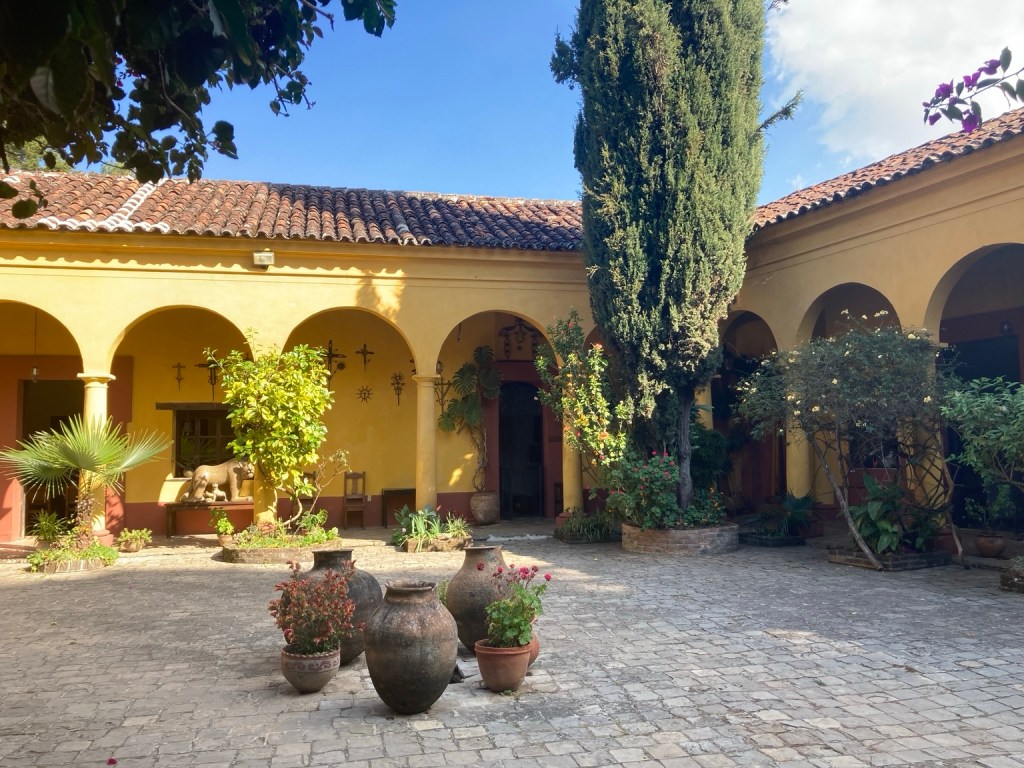
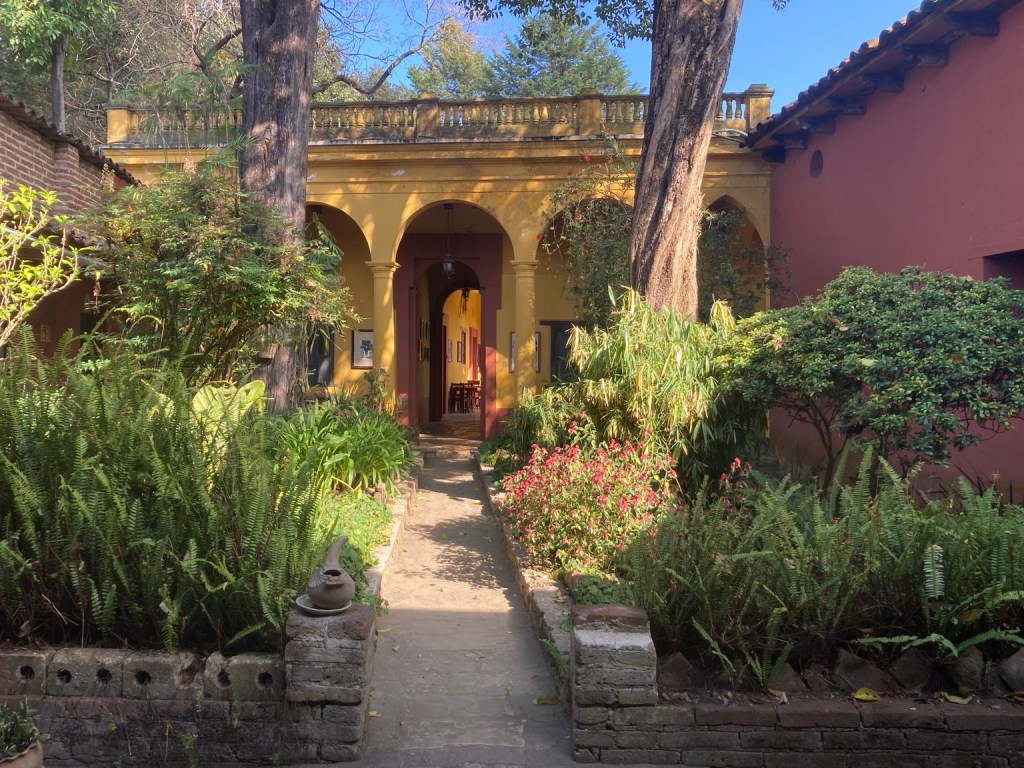
The building and garden were lovely …
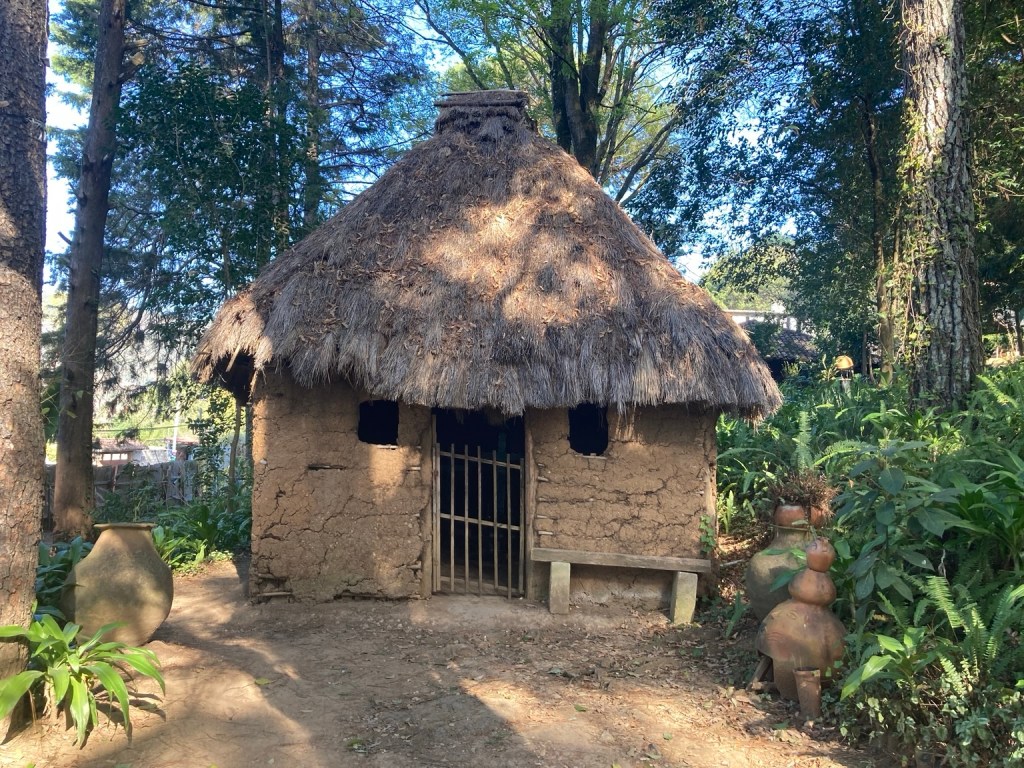
… and there was a replica adobe hut …
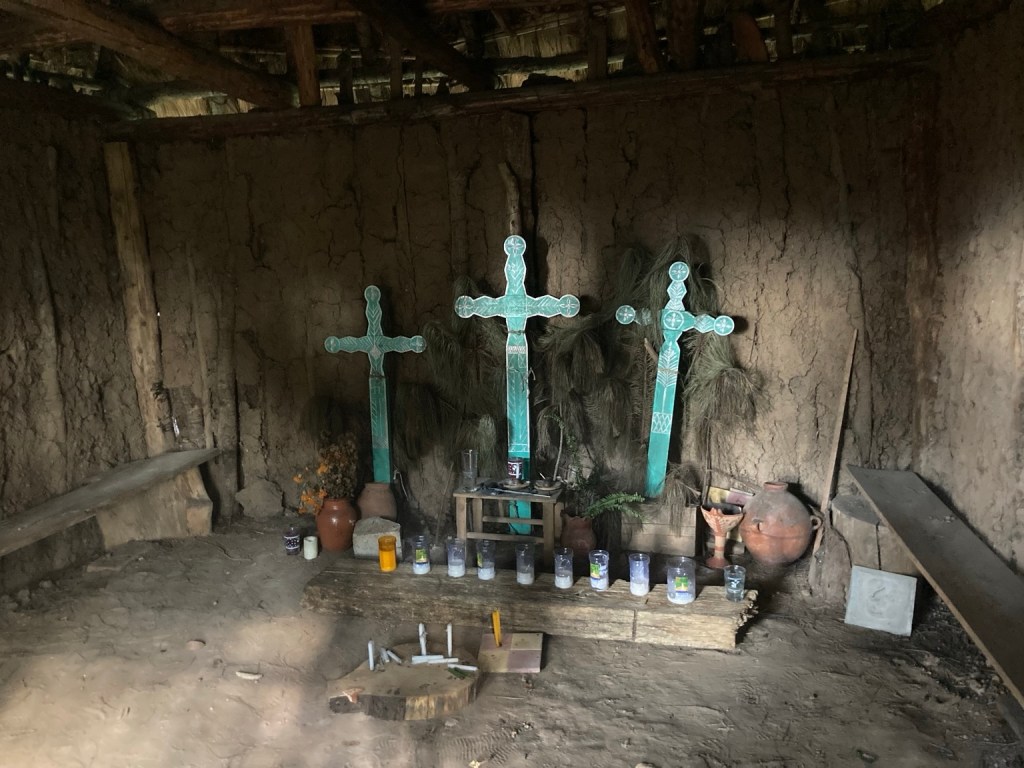
… with Maya crosses inside …
… as well as old photos of the Lacandon people.
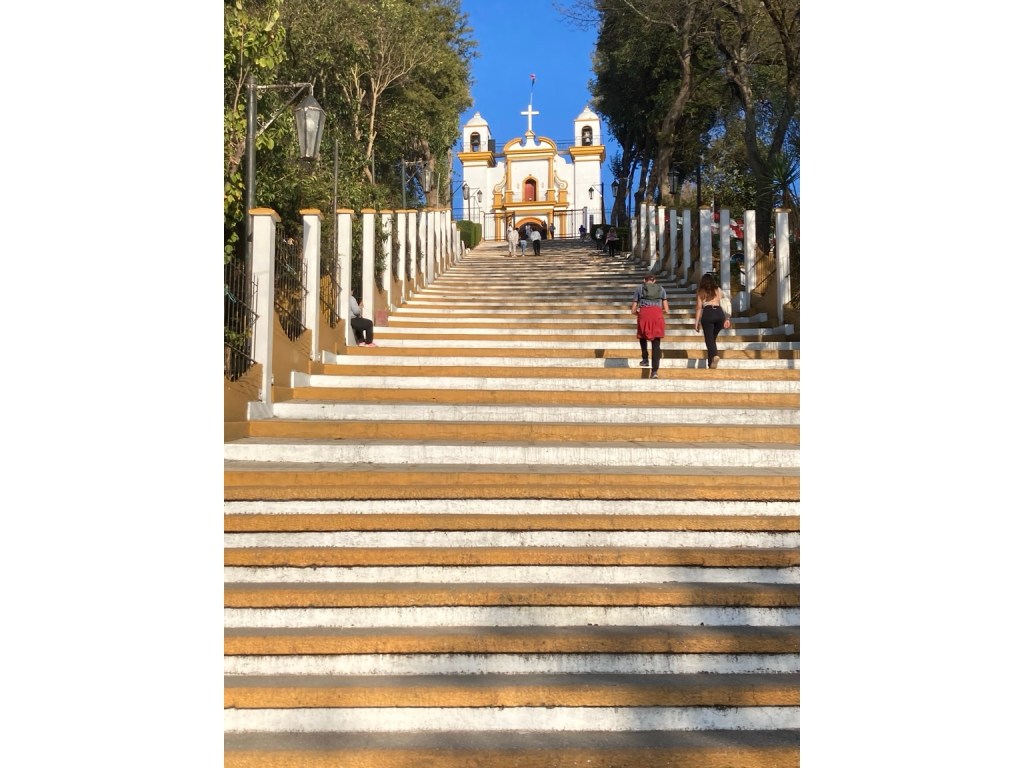
We also climbed up to Guadeloupe church before calling it a day.
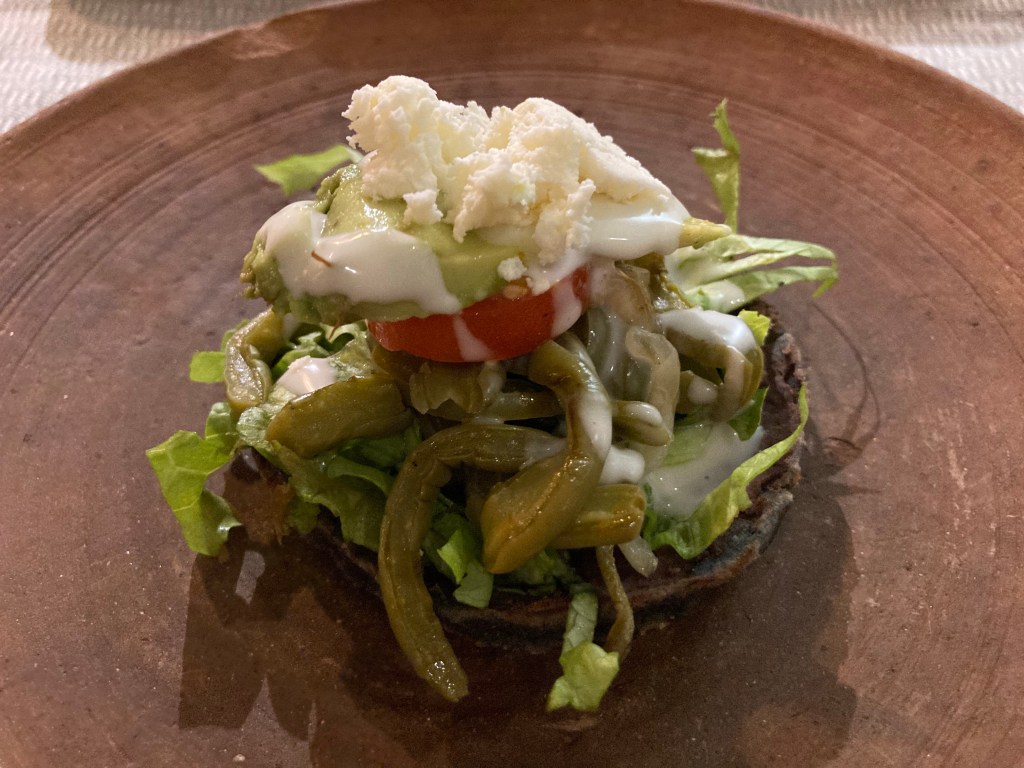
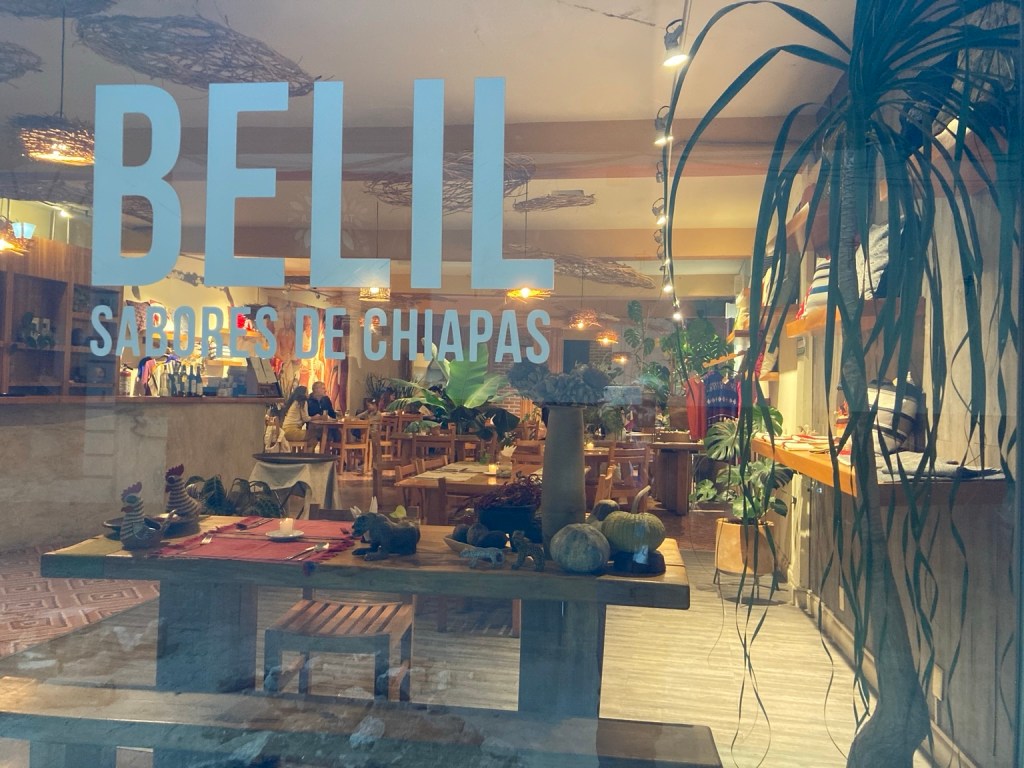
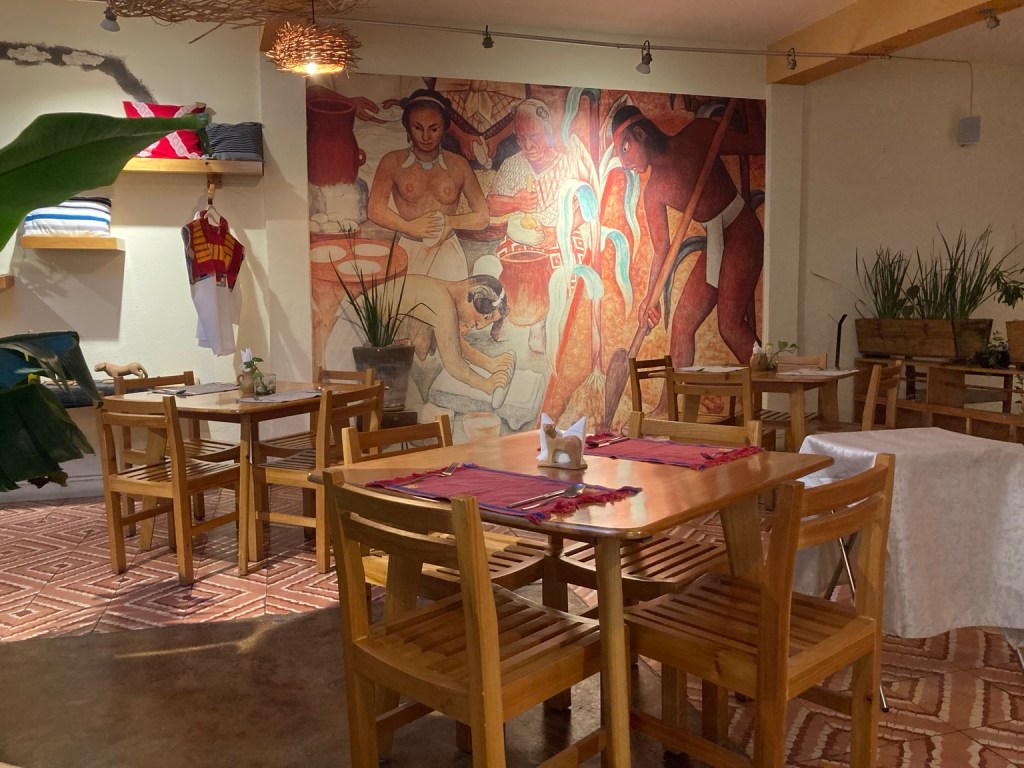
Creatures of habit, once we find a restaurant we like, we often return a second time, so it was back to Balil for another lovely meal. This time we started with some little sopes, one of which was topped with cooked strips of cactus which we had seen in the market. It had a texture similar to peppers but a fresher more astringent taste and I’ll certainly be looking out for it again.
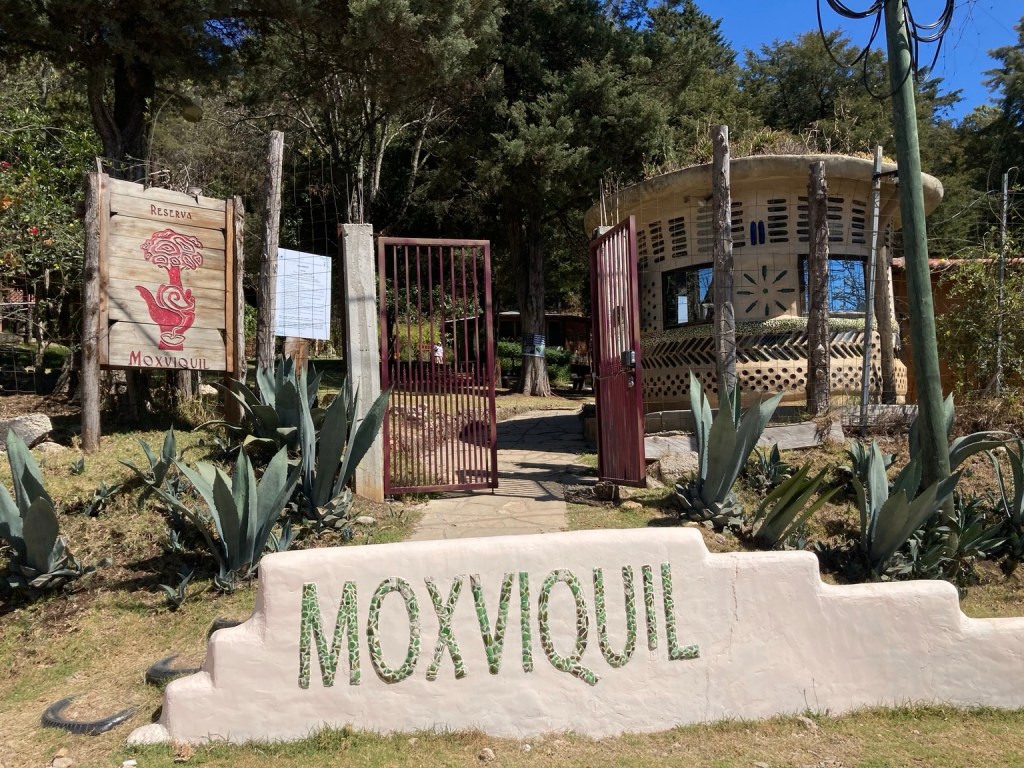
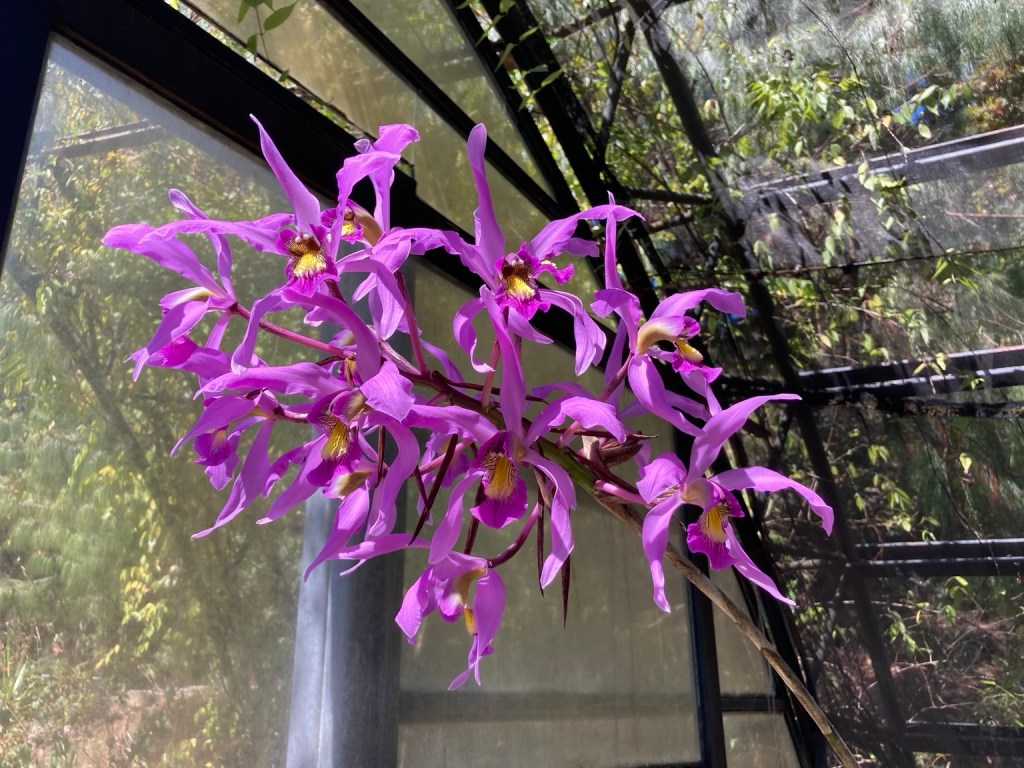
On our last day in San Cris, we took a taxi to the north of the town to the orchid reserve, where they conserve over 600 species of Chiapas orchids, bromeliads, and other epiphytes rescued from areas of deforestation.
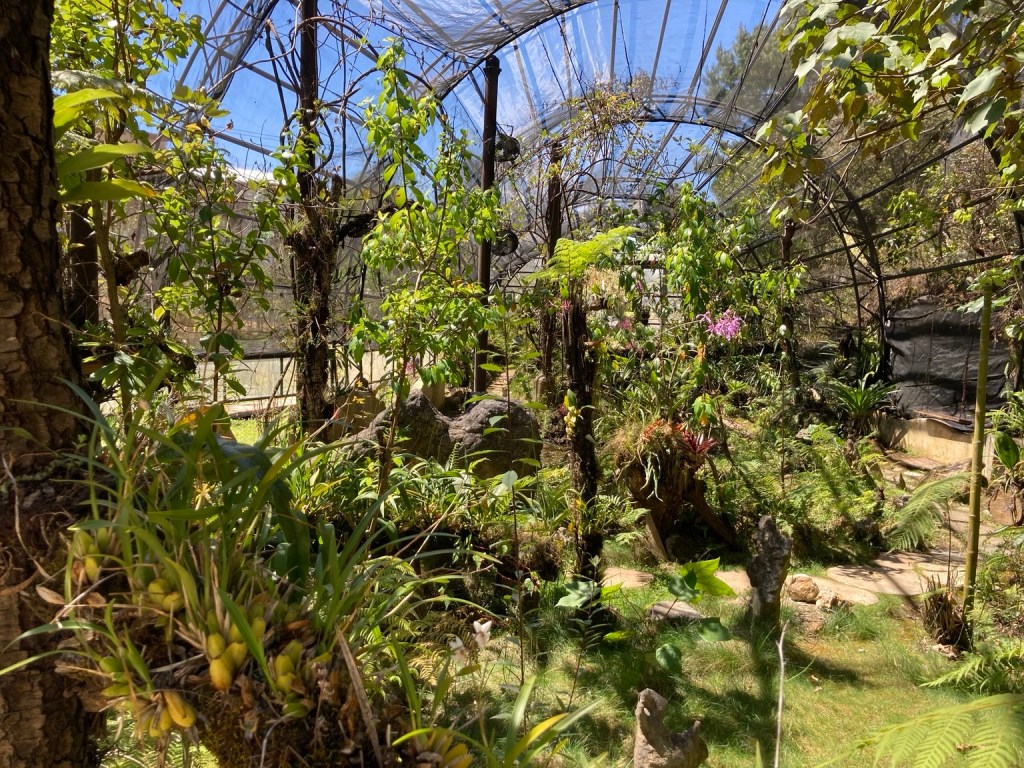
We went in search of orchids and there were two greenhouses.
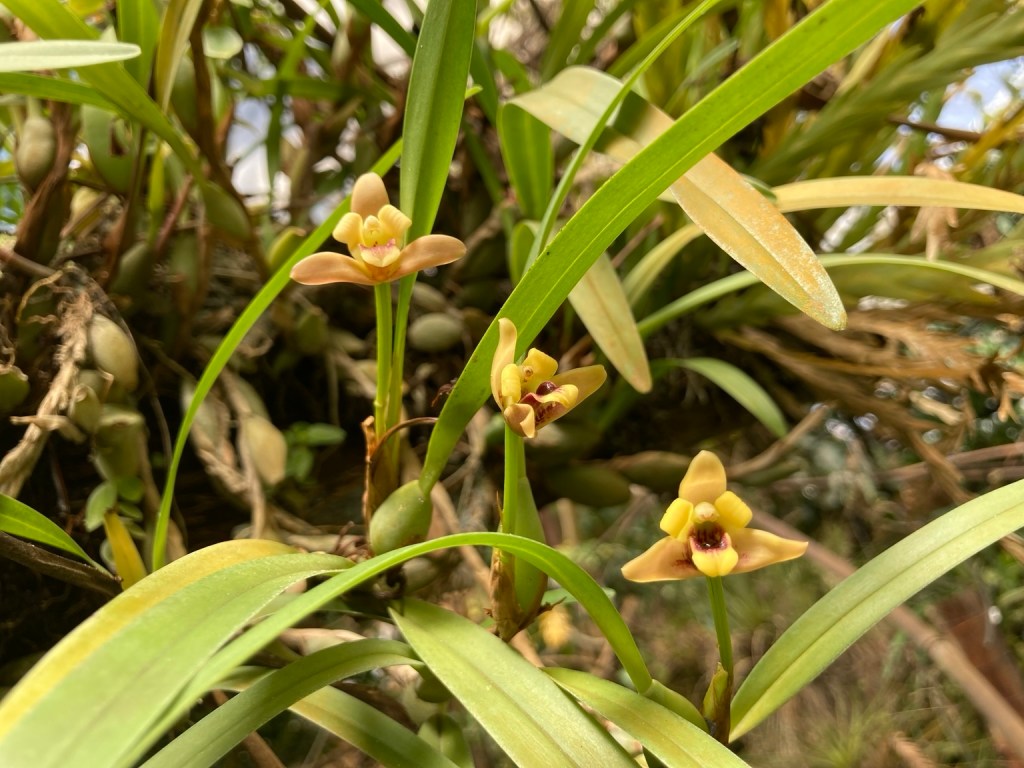
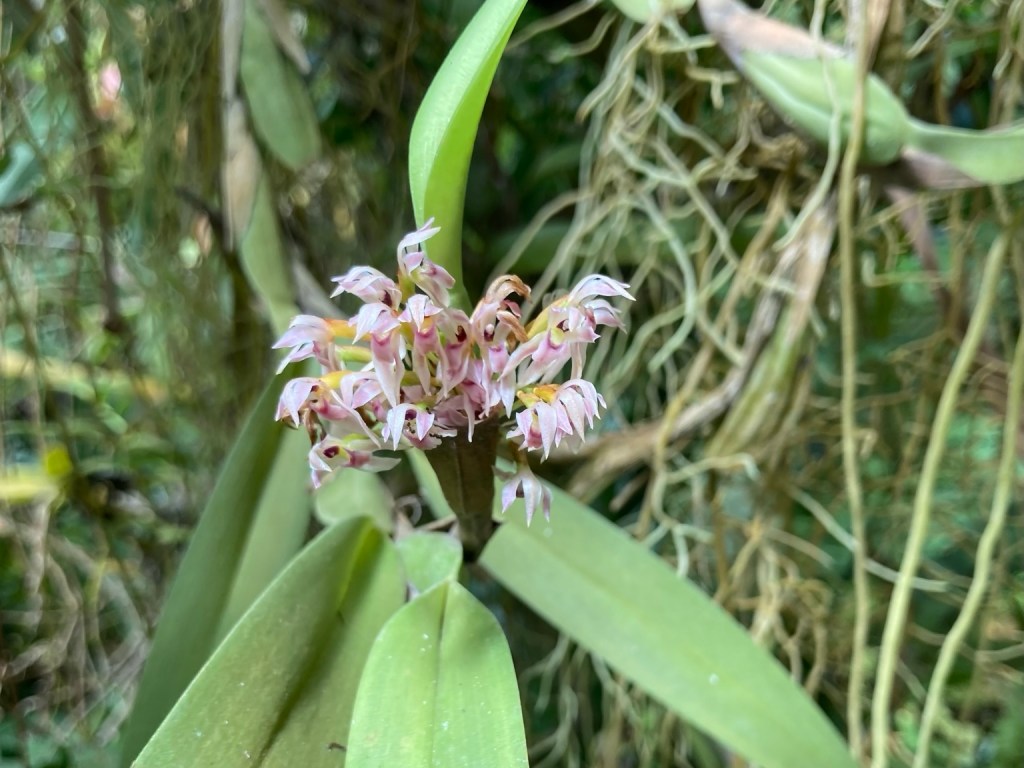
To begin with, it seemed little was in flower until we realised we just had to look carefully! We’ve been so spoilt with impressive cultivars, we almost overlooked these tiny treasures
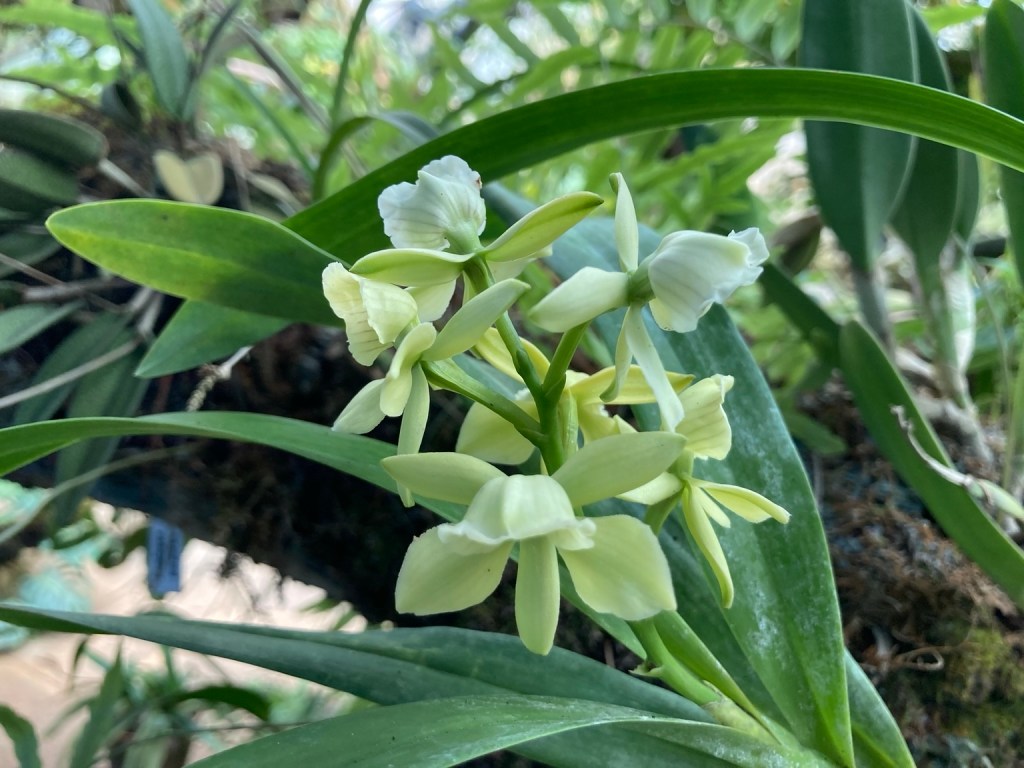
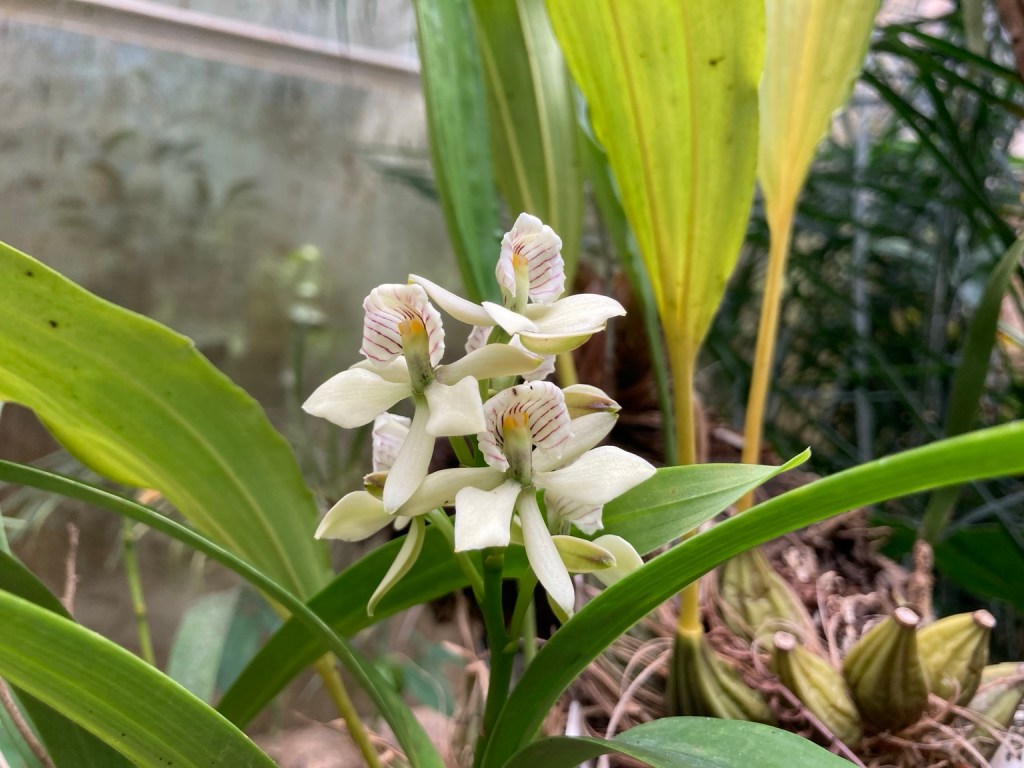
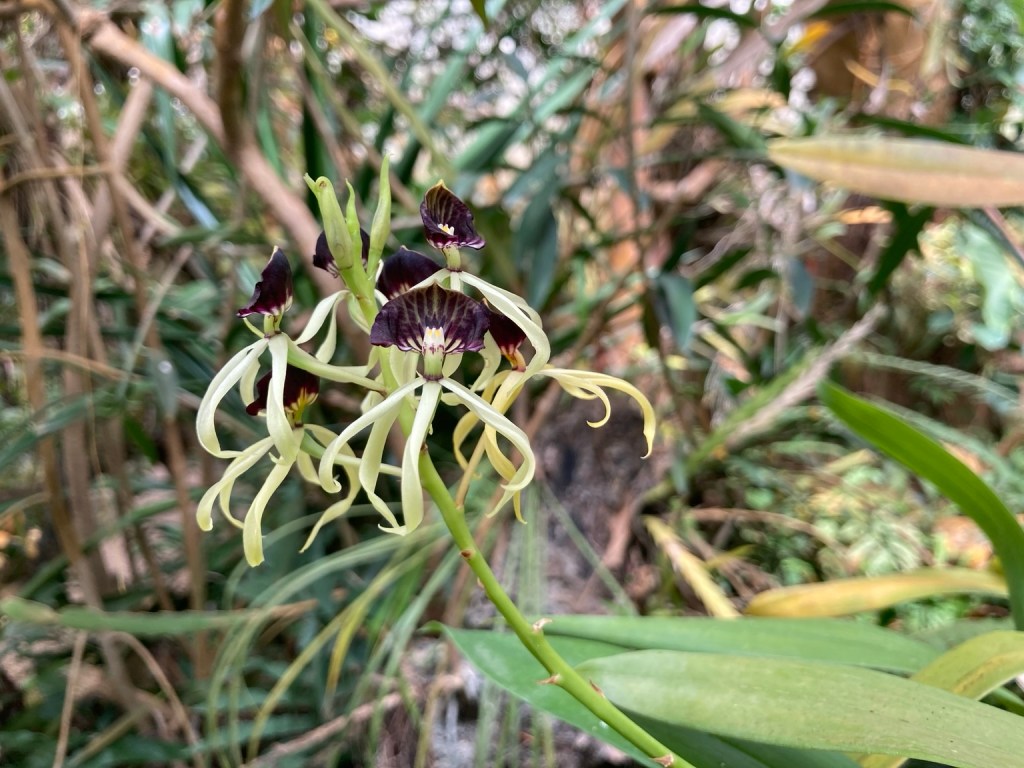
… and then when we thought that was it, we spotted this beauty!
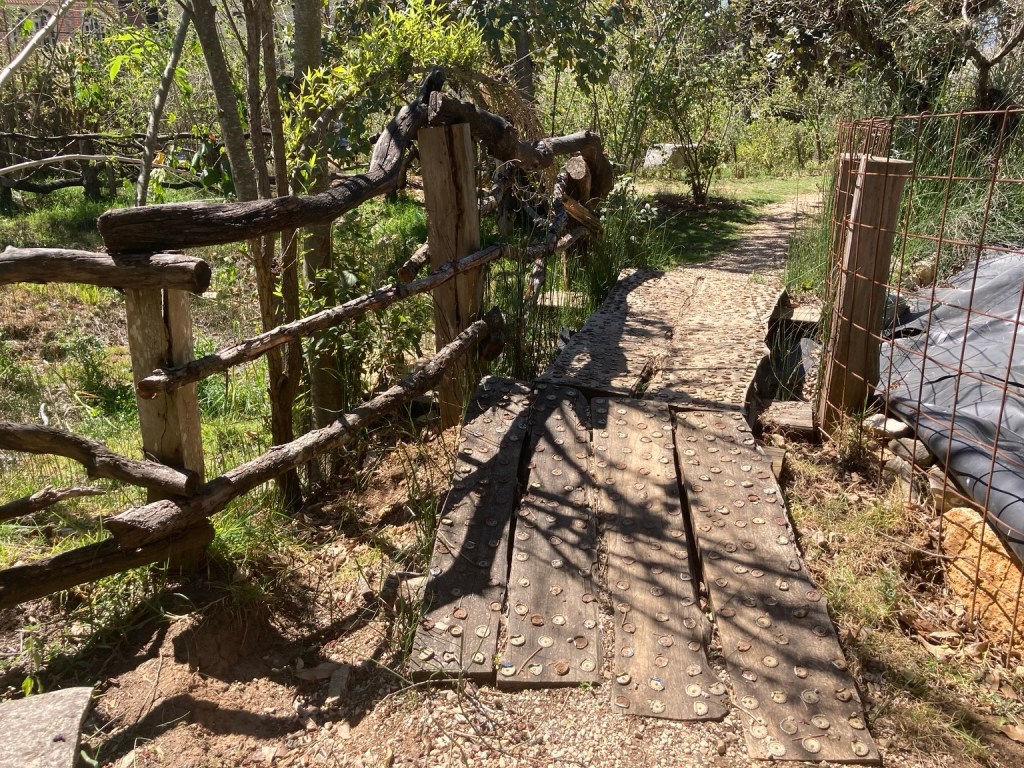
It was all a bit rustic and I loved this use of bottle tops …
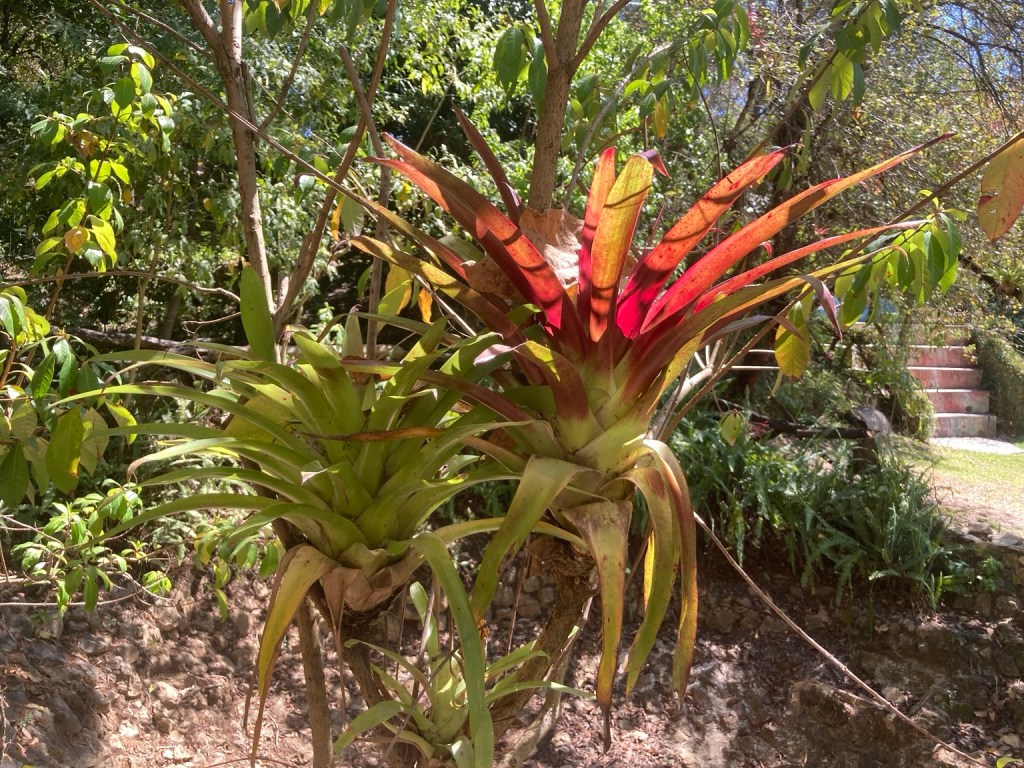
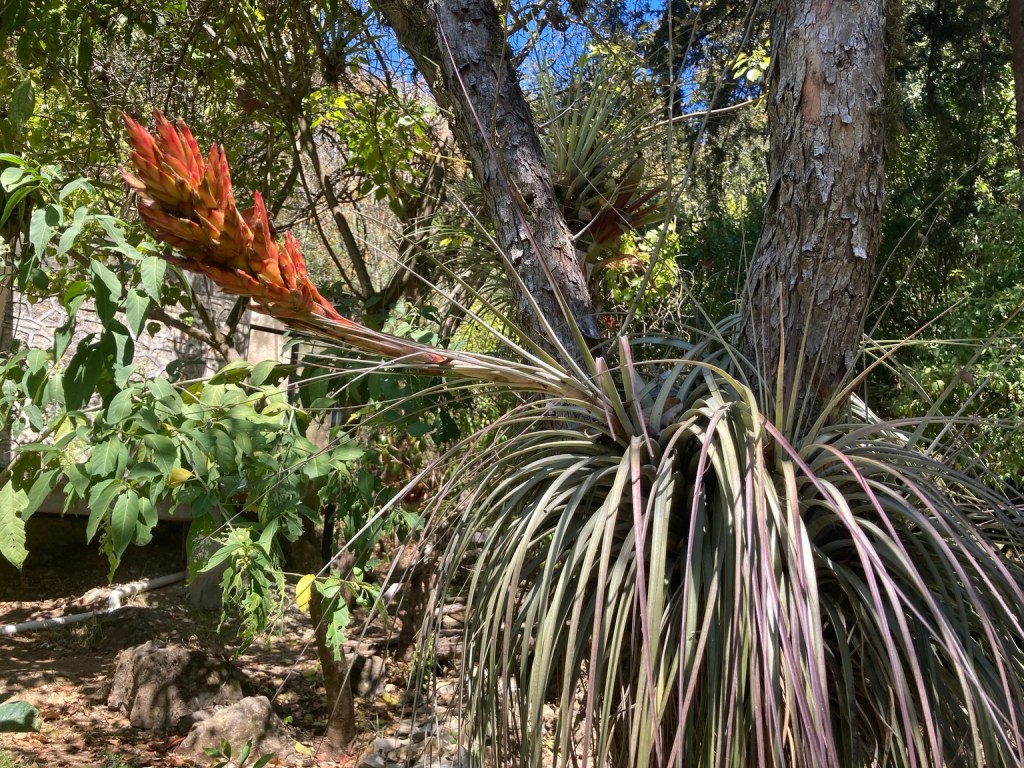
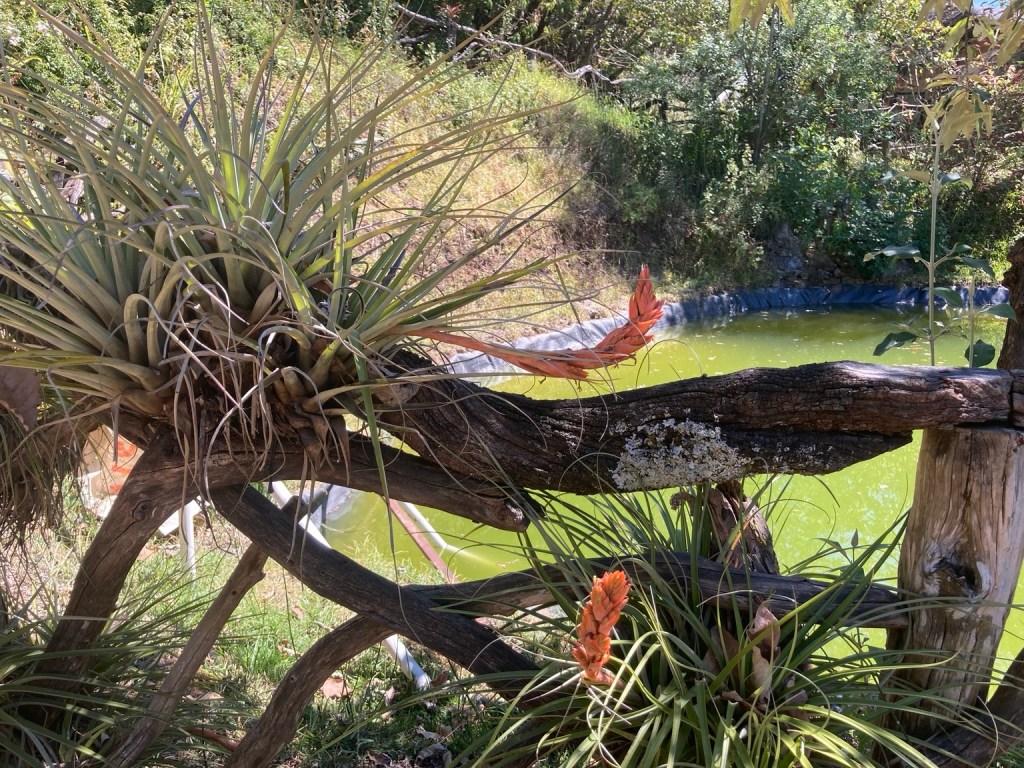
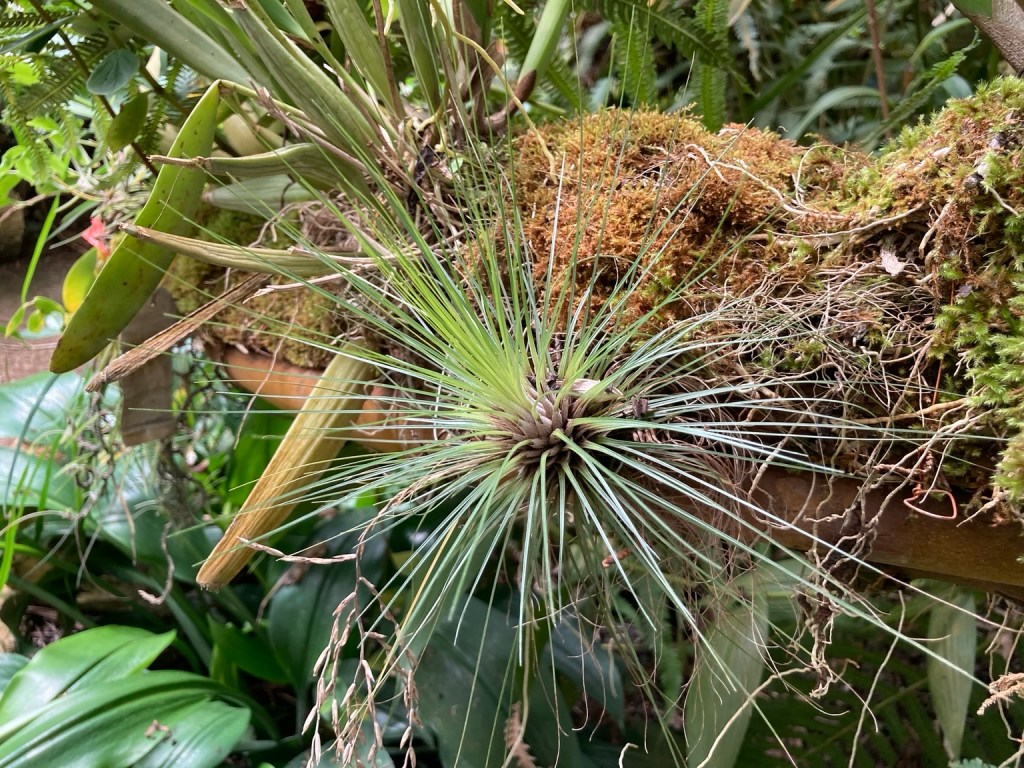
… and here are some bromeliads to finish.
We hailed a taxi back, had a bit of lunch …
and wandered catching a last few snaps …
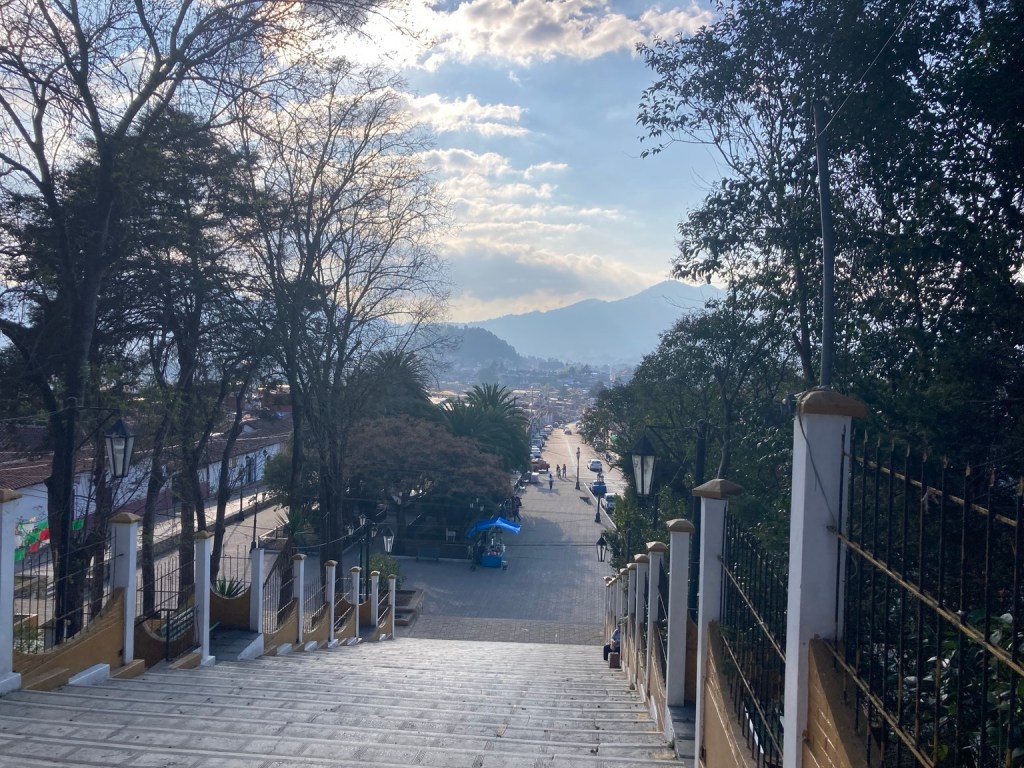
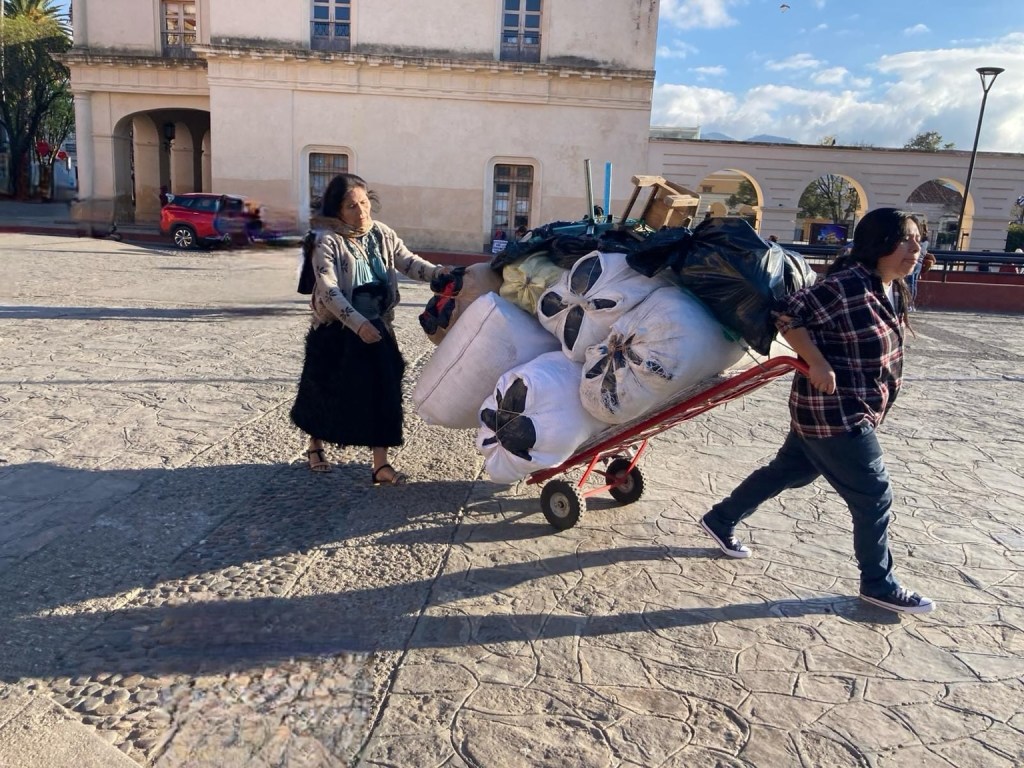
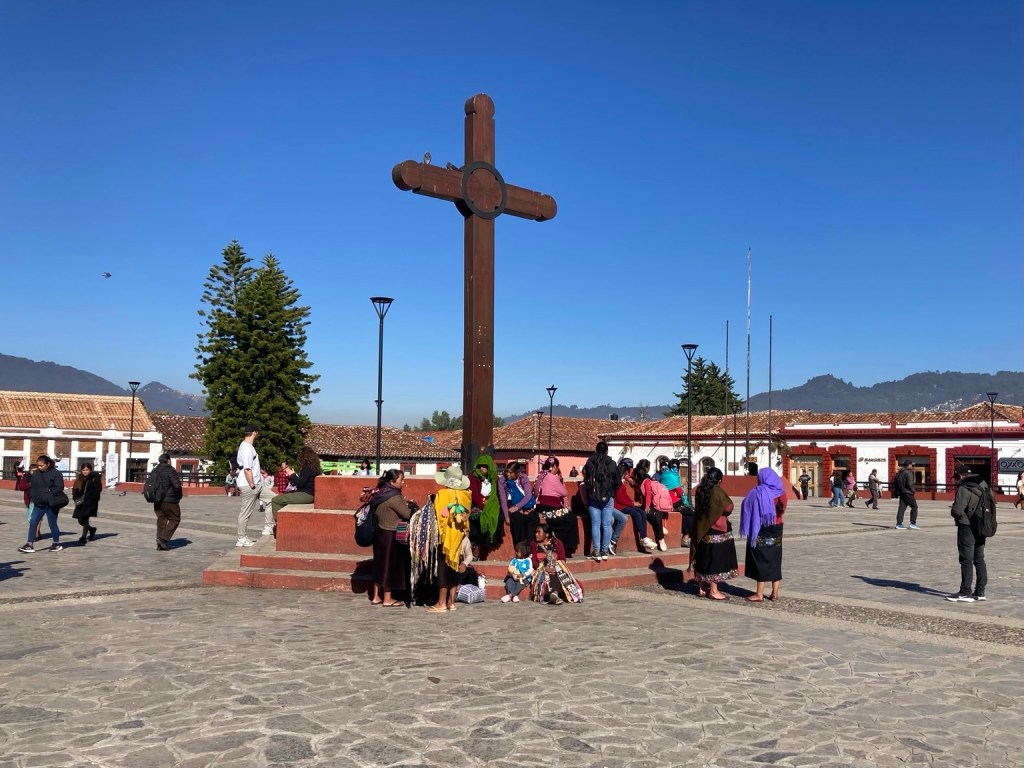
… before sitting a while in the afternoon sun on the steps by the cross watching the arrival of goods for the night market.
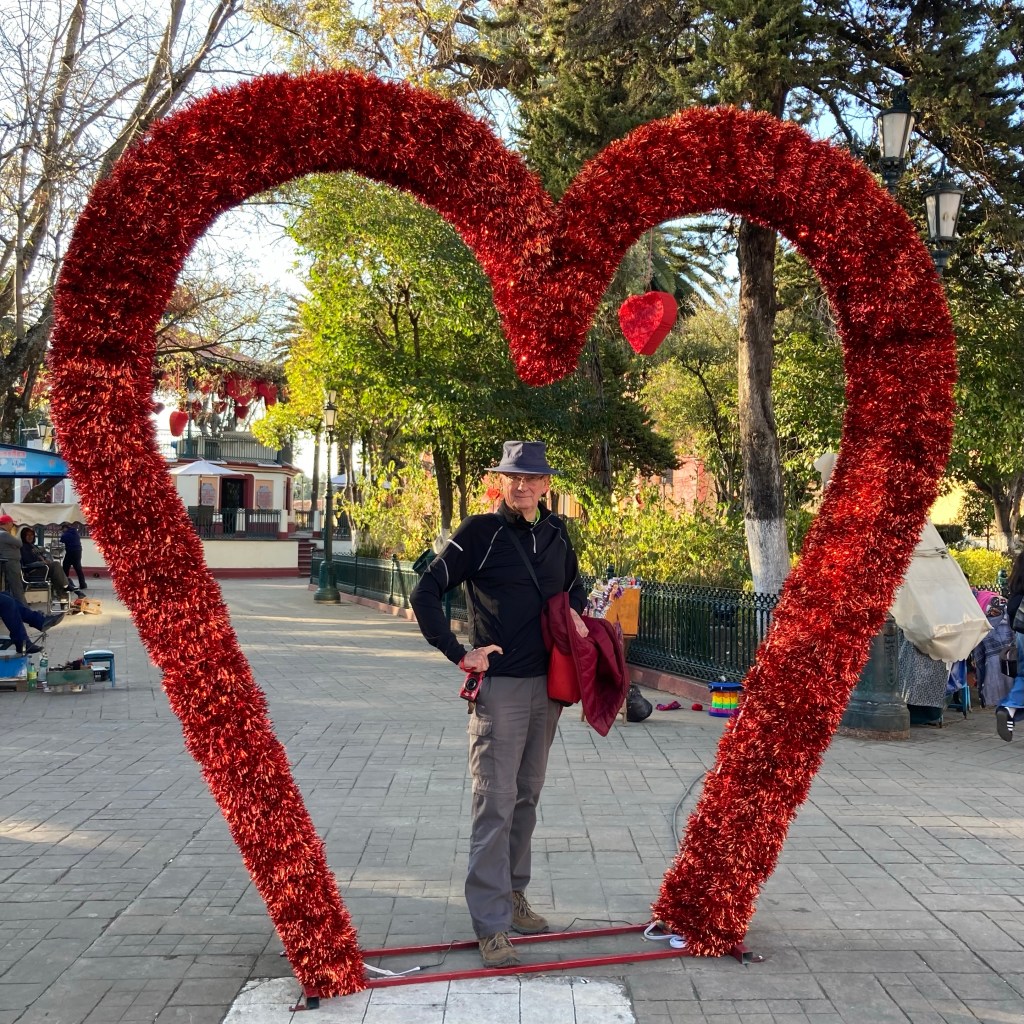
A final pose and in the morning we are off to the jungle!
Of all the cultural tours to indigenous communities, Alex & Raoul’s tours are well respected locally and we were back by the cross in the Plaza de la Paz to meet Cesar at 9.30.
First we went to San Juan Chamula which is renowned for its distinct religious practices, where Catholic customs have mixed with indigenous culture to create a “traditionalist” Catholic belief.
Right at the beginning, we were told we could not take photos of people close up, any ritual or the inside of the church.
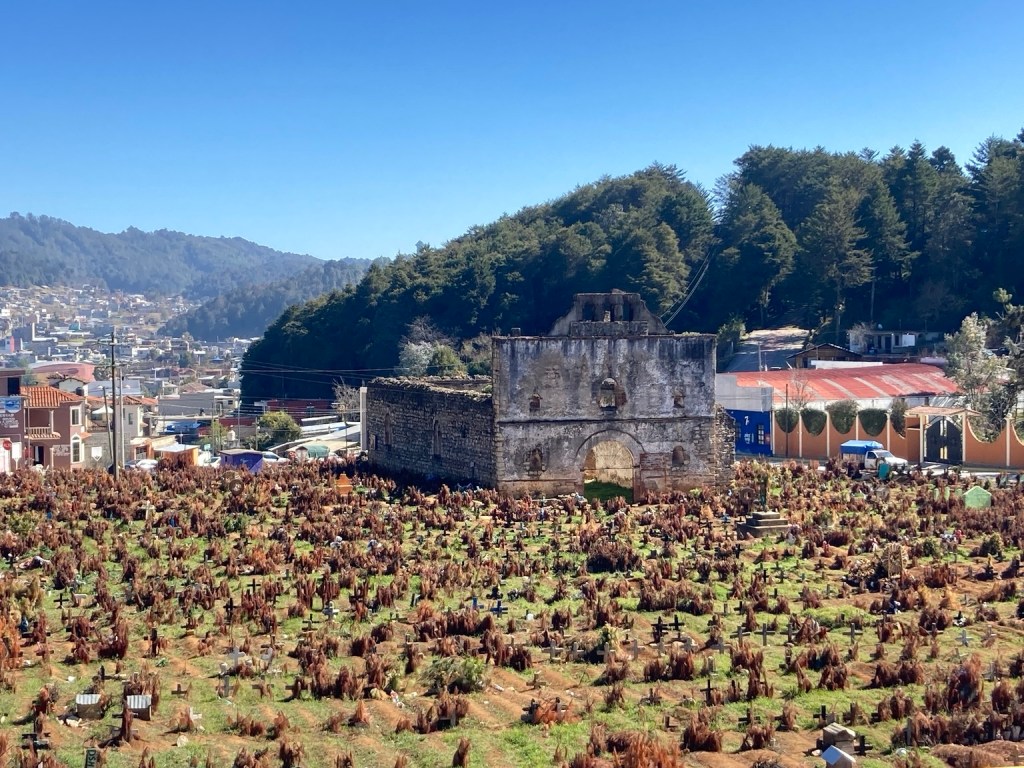
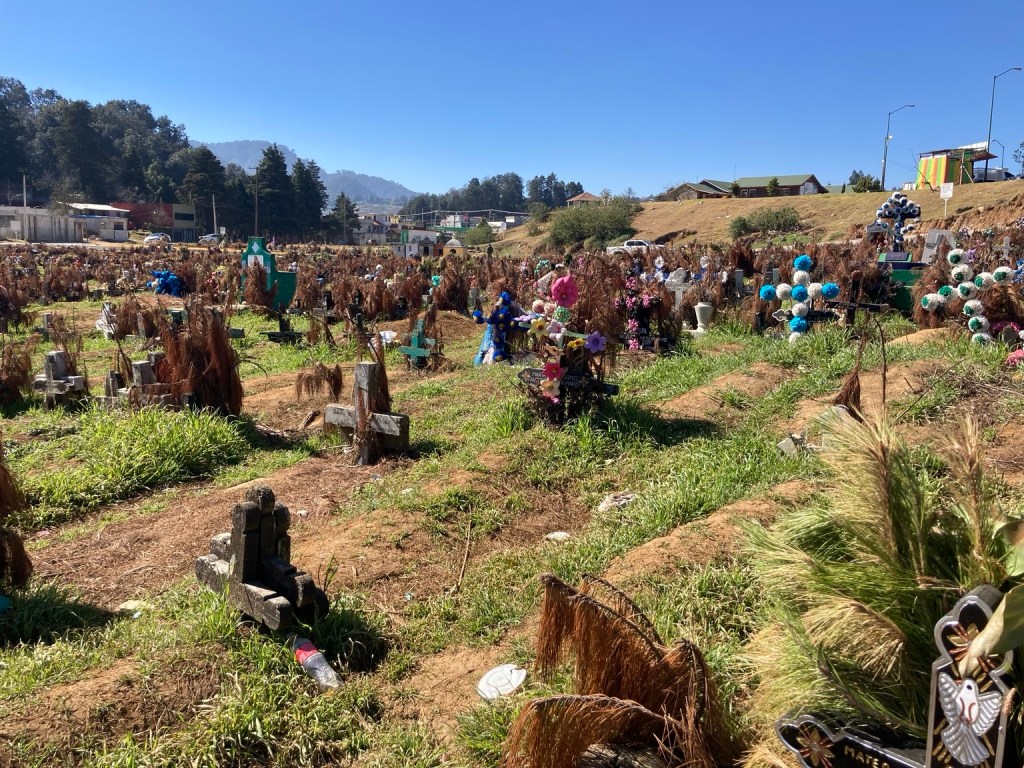
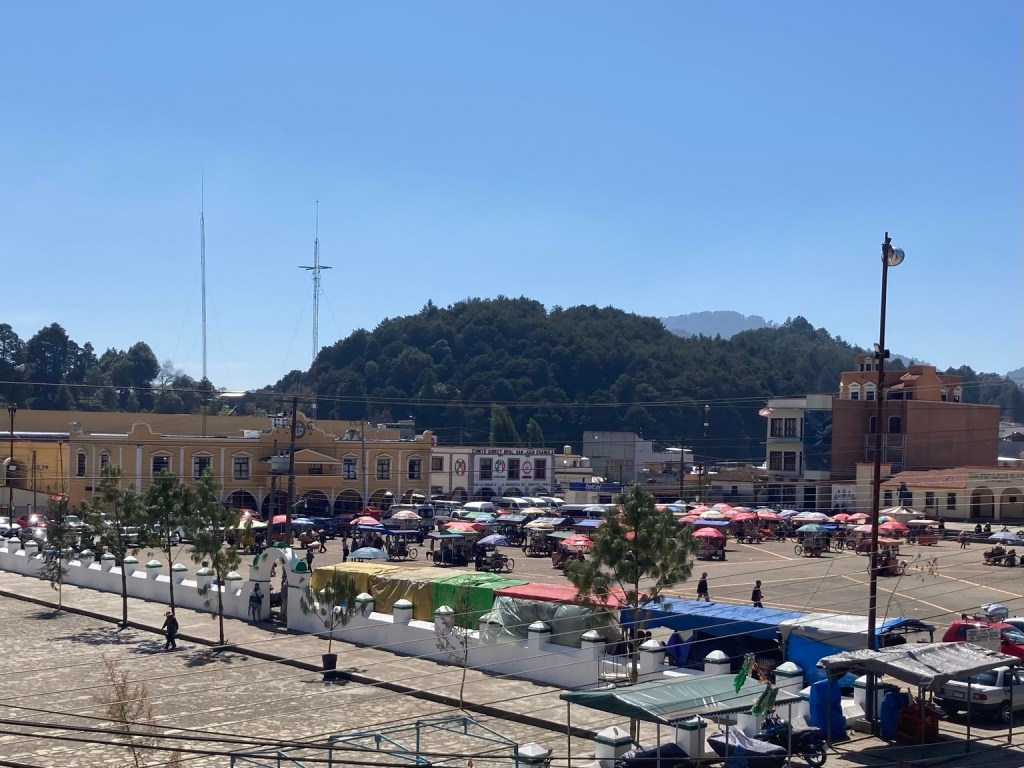
The town is situated between three sacred hills, but it has nothing pretty about it. In fact homes were made of traditional wattle-and-daub homes until the 1960s when concrete started to take over. The graveyard below was decorated with pine, plants and flowers left from Day of the Dead in November.
Graves are built up to continue to provide a good surface for the feast and offerings on this day.
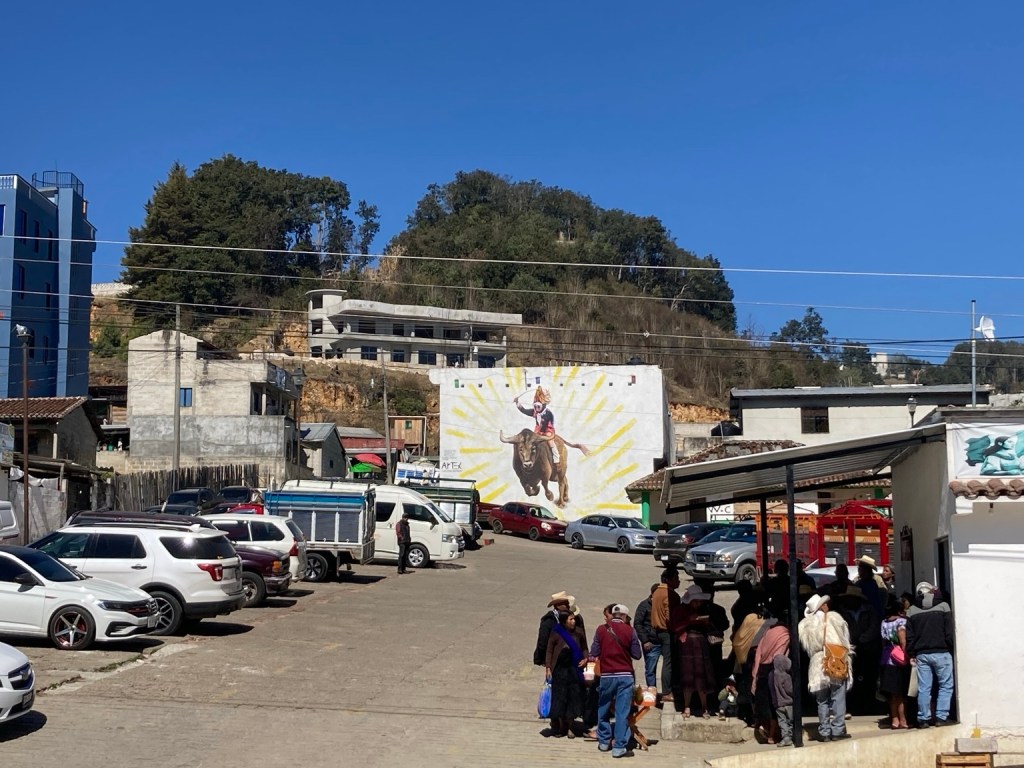
The Tzotzil people of San Juan Chamula live with a unique autonomous status with fierce independence. In order to be a resident of town, religious rules must be followed, enforced by their own police force. Chamula is divided into areas, each with a community leader who volunteers and serves for a year. We arrived at the changeover, celebrated with a big feast and the slaughter of a bull to feed all of his team who have helped him in his duties to the community. This is accompanied by music, fireworks and alcohol and all were wearing their traditional clothes. We saw one area where the bull had already been butchered and hung up in quarters, and another where this was in progress. Apparently people save up for years to have the money required to fund this as they are too busy to work and their responsibilities are extensive and expensive, as much as US$50k but they earn huge prestige for having stood. In another week, there will be more traditional rituals such as running with bulls and fire-walking.
We then visited the home of a spiritual leader who works with his wife to look after a shrine to a particular saint, set behind a panel covered in cut green foliage. Incense is burnt on the altar in braziers, candles burn in bull shaped holders and pox is sprinkled around in rituals three times a day. Other duties include replacing the foliage regularly, caring for the saints clothing, and carrying it in parades. Cesar suggested that savings of around US$20k would be needed to fund their service.
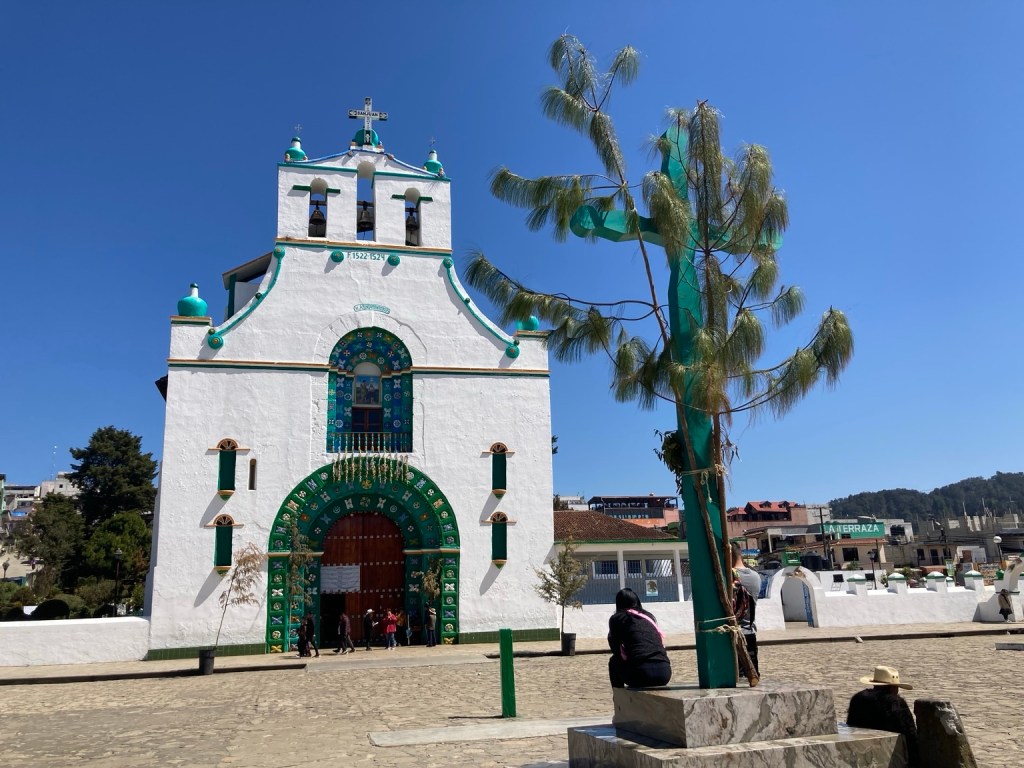
Finally, we visited this church, with a green cross outside adorned with pine, but not a Christian cross as it has rounded ends and represents the Maya tree of life.
Inside, the floor was covered in pine needles, there were no pews, and small groups of people sat on the floor each behind an array of white candles, representing food for the saints. Pox, the local spirit made from sugar cane, and also soft drinks are sprinkled on the ground in offering. Some people had eggs which are used to tell the future, a bit like tea leaves. We also saw several groups with a chicken which would be sacrificed by a shaman to absorb illnesses or negative energy from a person. Obviously we couldn’t stop or stare so only got a fleeting glance as we walked by.
Walking round, the heat from the candles and the smell of alcohol prevailed. Belief is firmly in the life on earth not the afterlife so prayers are offered to the saints for everyday things like food, good health and good fortune.
Once outside, we had a little free time to wander …
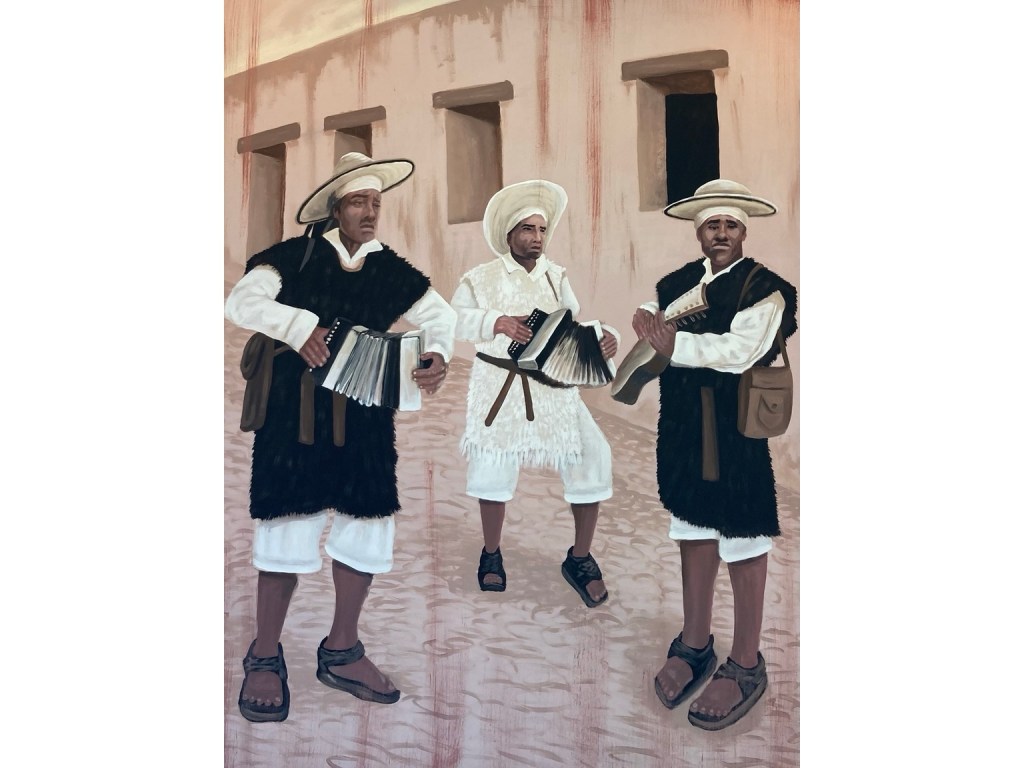
… and we went to a cafe for a drink and saw this picture of men in traditional dress.
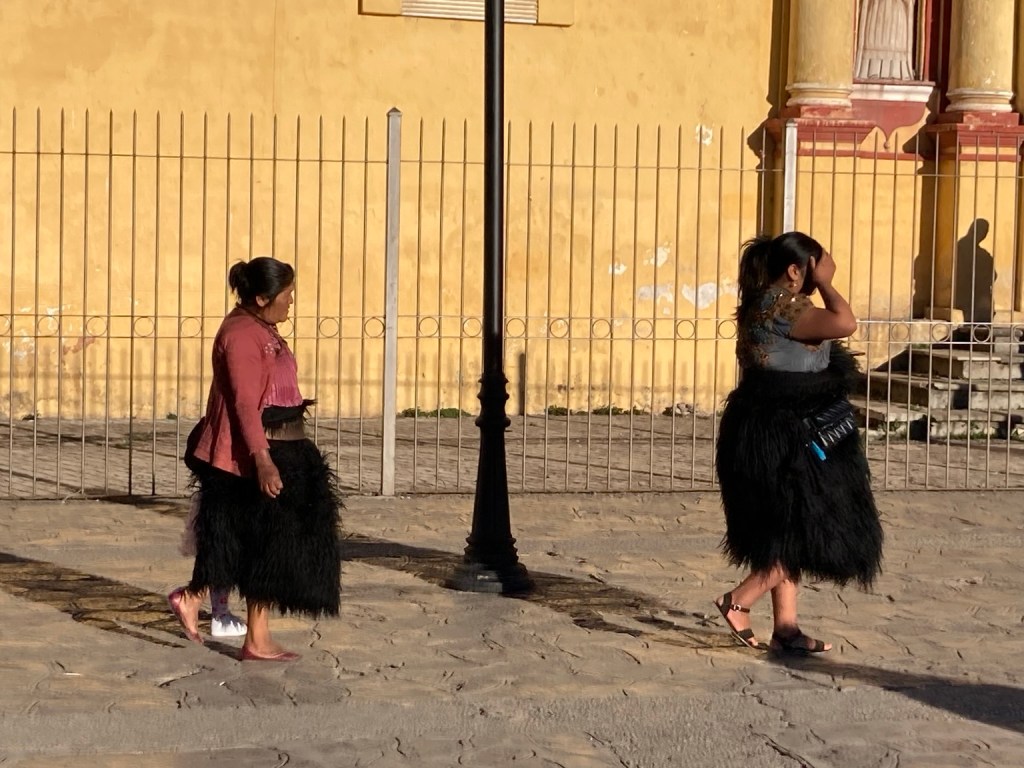
The women wear skirts that look like black sheepskin, but are actual woven wool with tufts of wool incorporated as it is woven, and I took this pic a couple of days later.
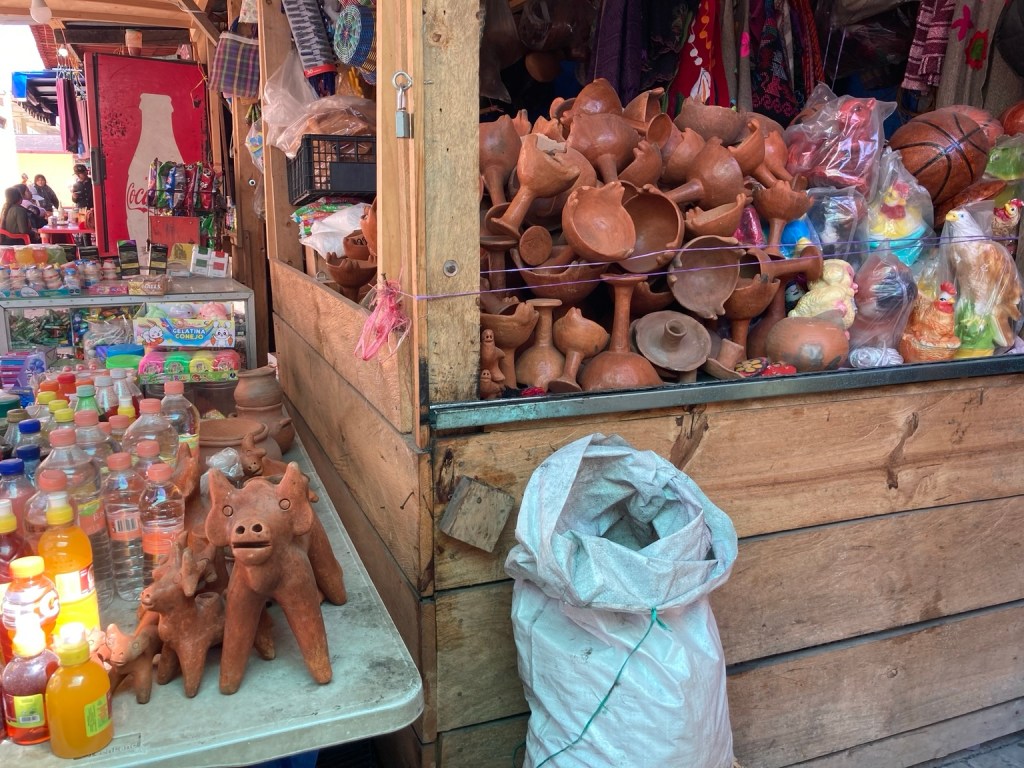
Wandering round, I spotted bull shaped candle holders and braziers like we saw in the shrine …
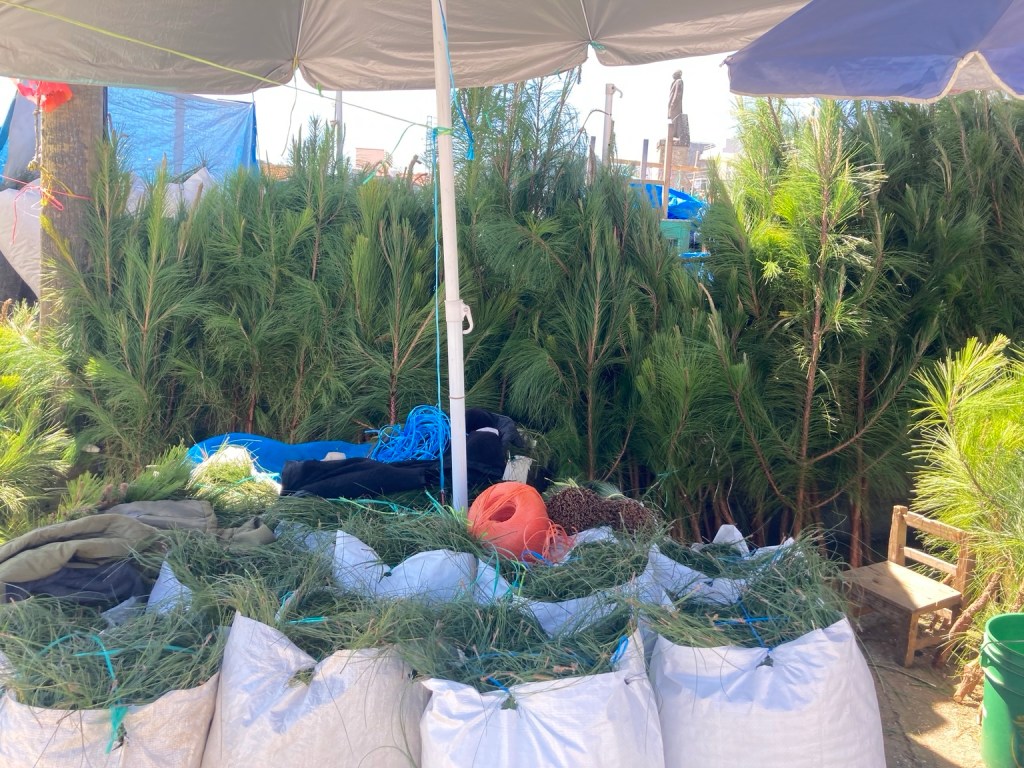
… pine foliage for sale …
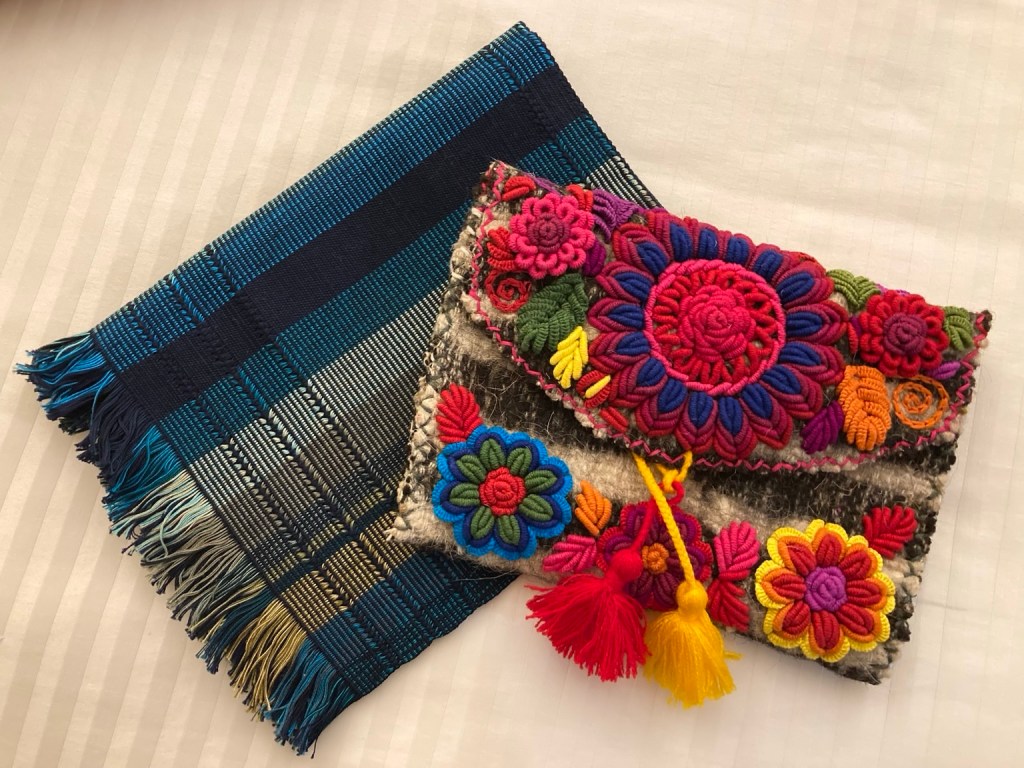
… and bought a pretty bag made of woven wool and embroidered in the market.
The mountainous geography of Chiapas means that many towns are separated by twisting roads and travel between them has been difficult which explains why the customs in the neighbouring town of Zinacantán are so different.
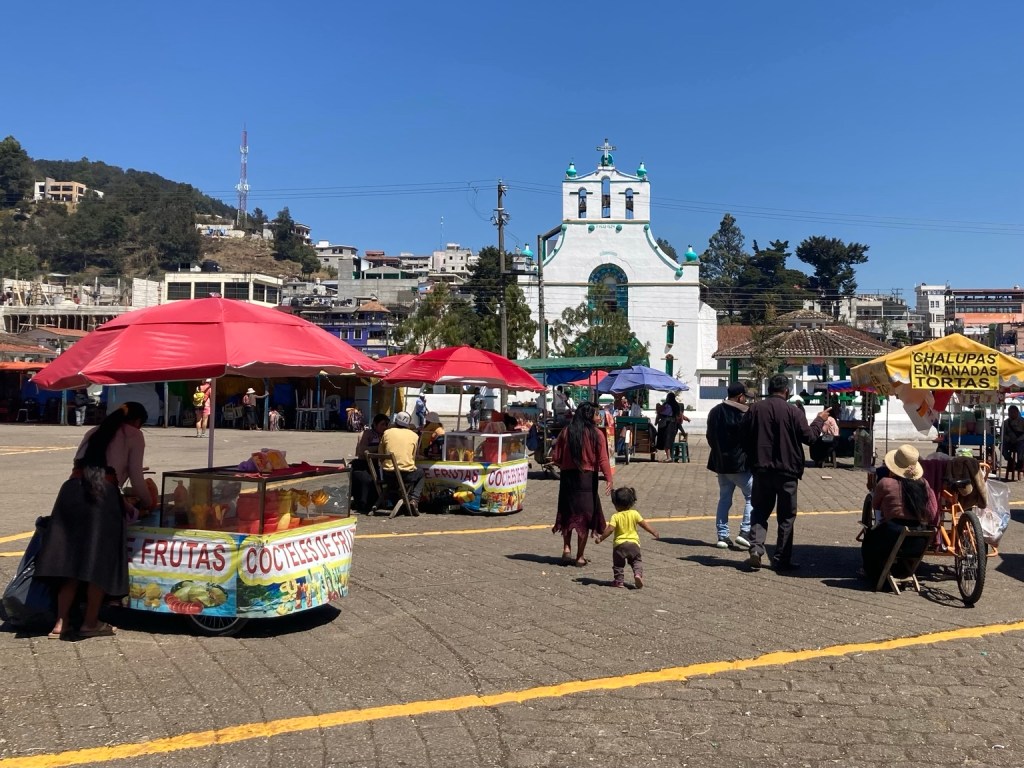
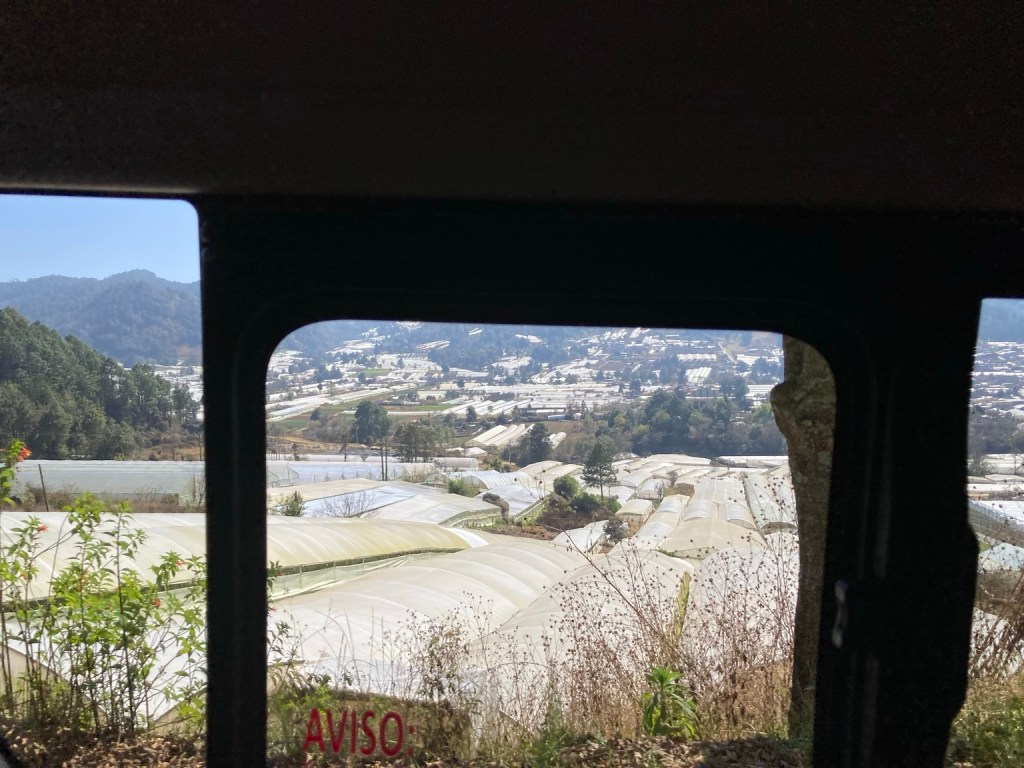
Known for its traditional clothing and skill with textiles, they also have a thriving flower growing industry using swathes of greenhouses which we saw from the bus.
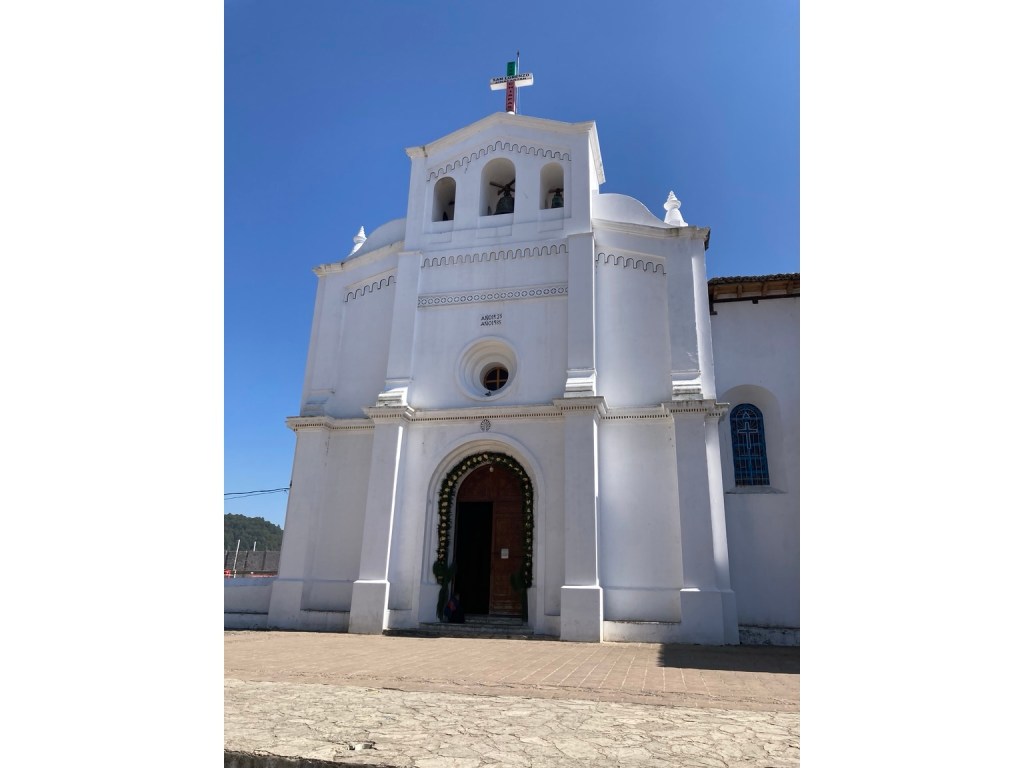
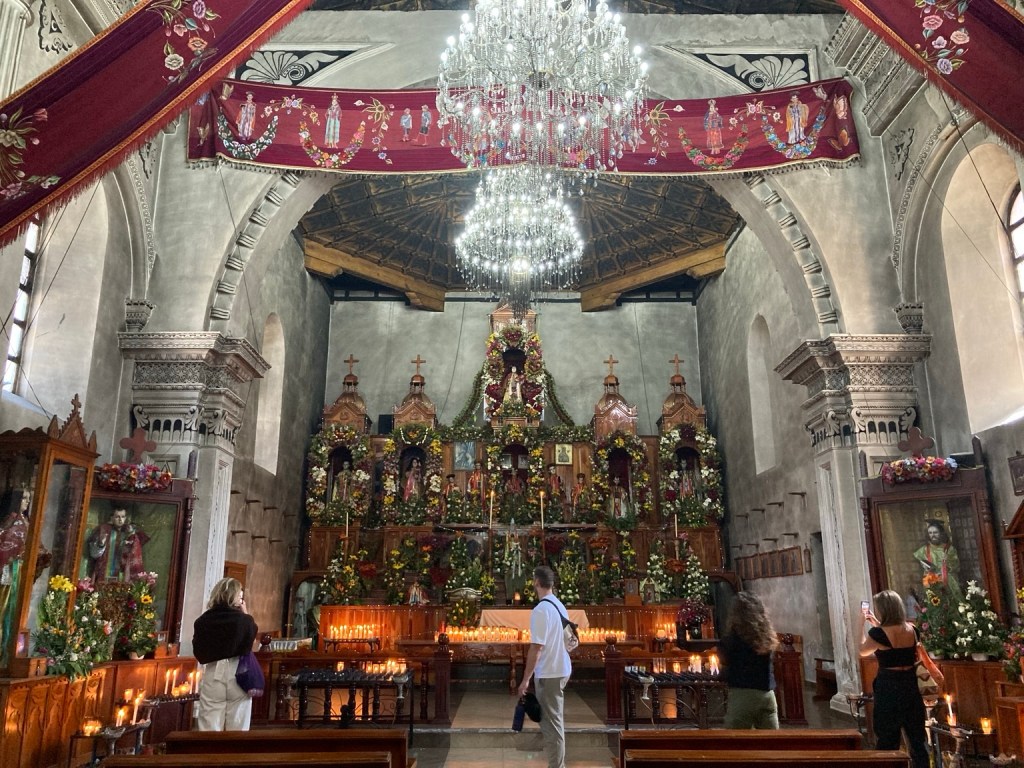
We were able to visit the church …
… and take pictures inside …
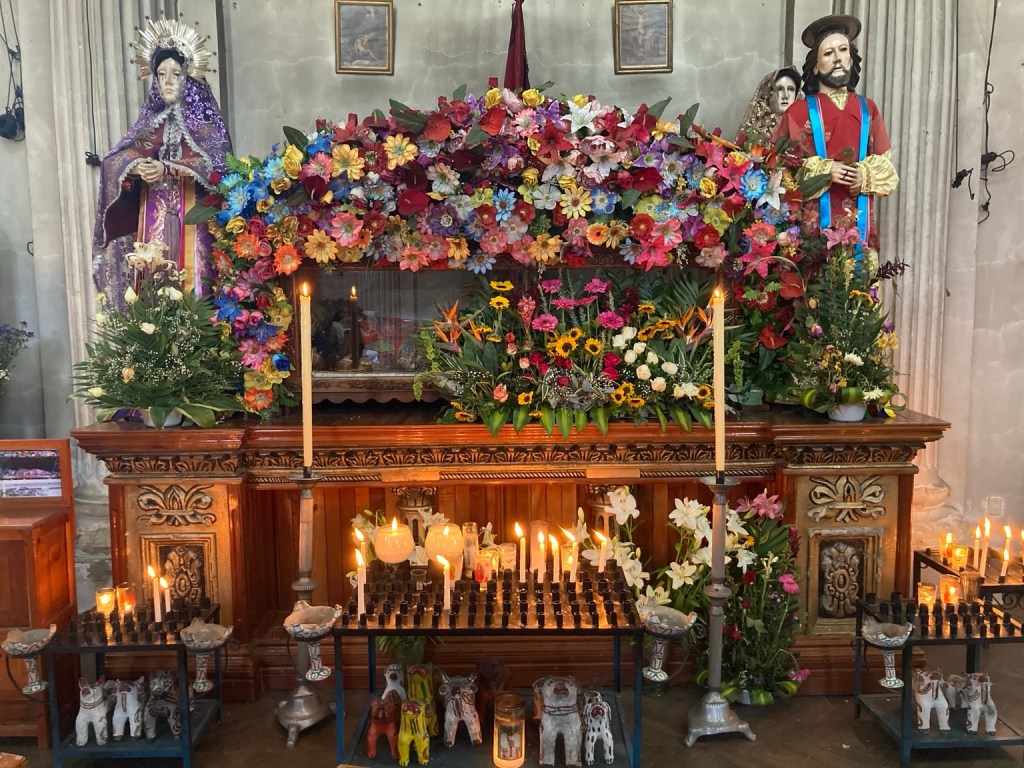
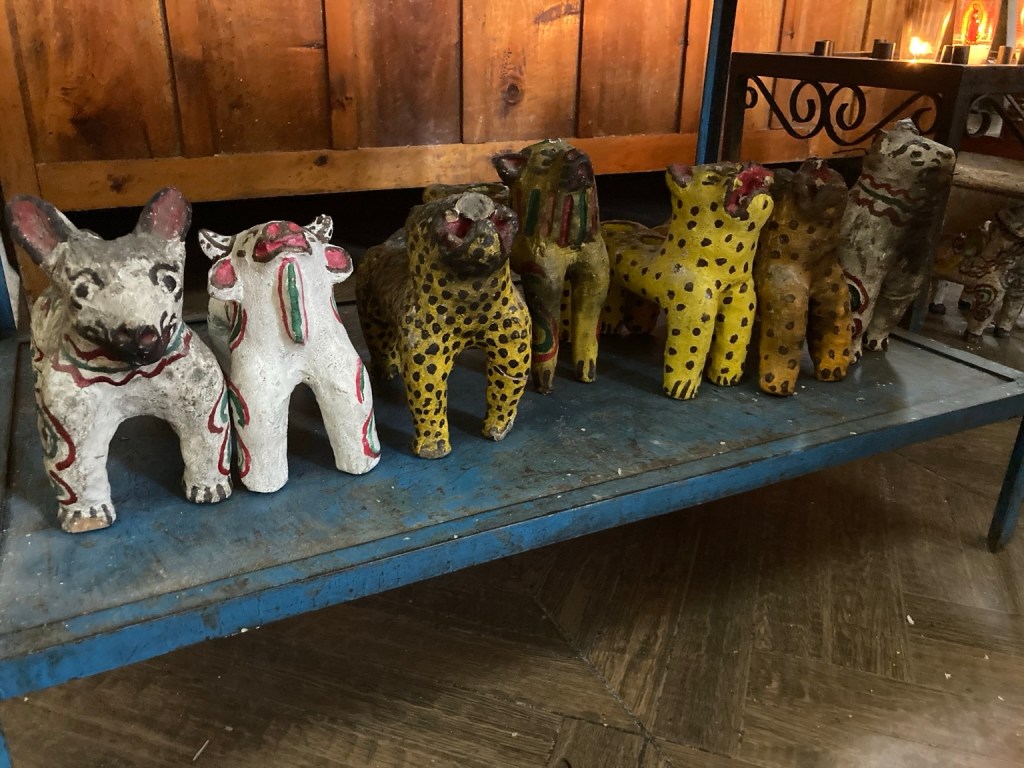
… and we saw that the candle holders were in the shape of a variety of animals.
This is because the people here believe that everyone has an animal companion or chanul, which is central to their spiritual life and shares their soul.
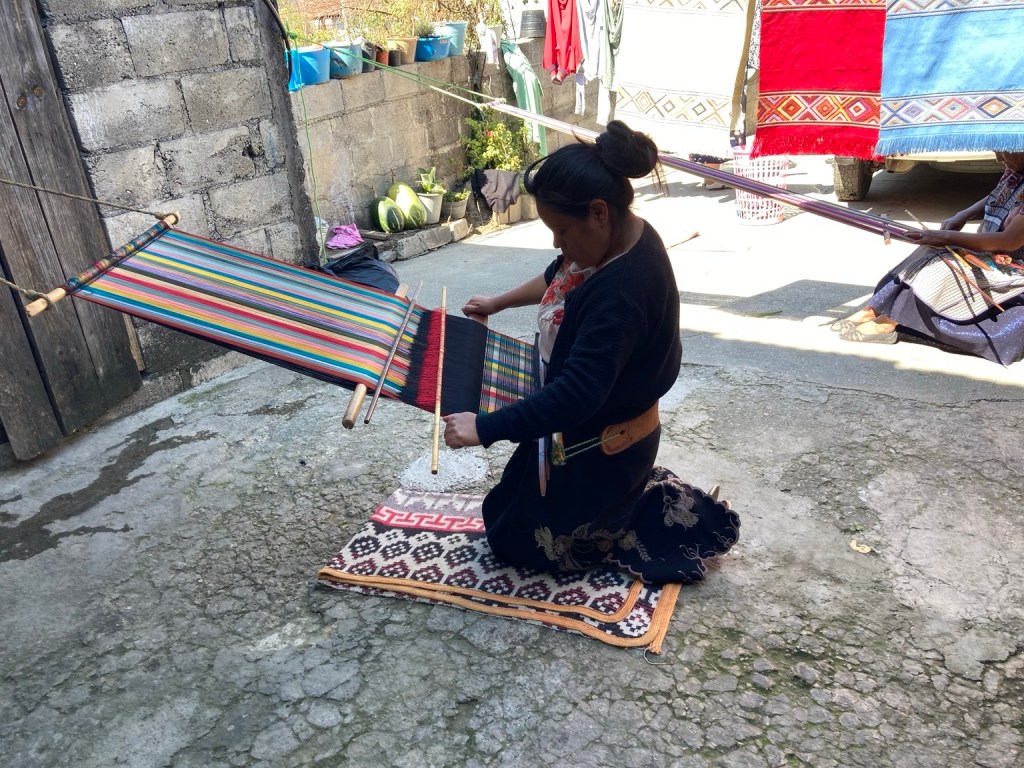
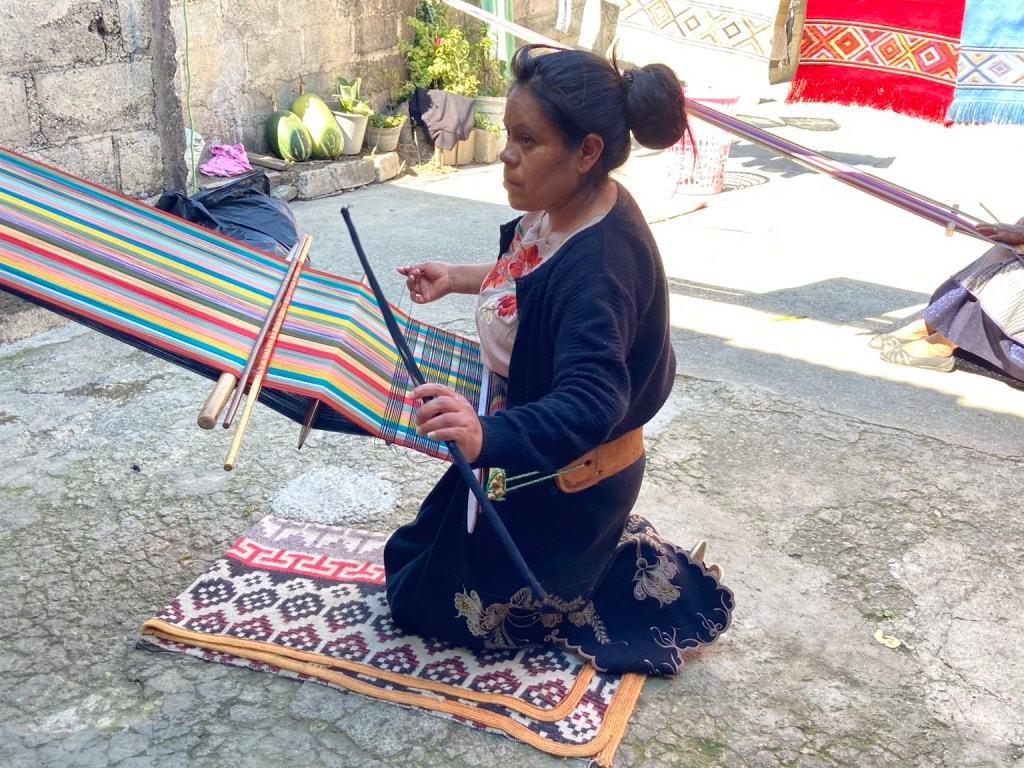
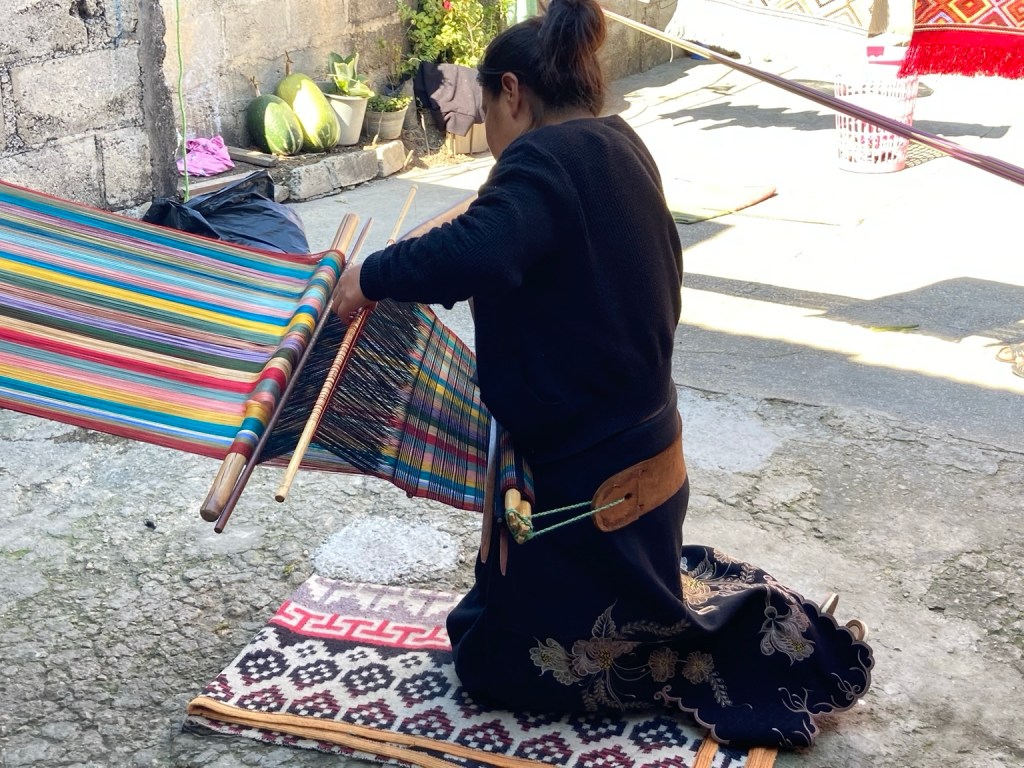
Next, we visited a family of textile makers in their home. We were able to watch weaving using a backstrap loom …
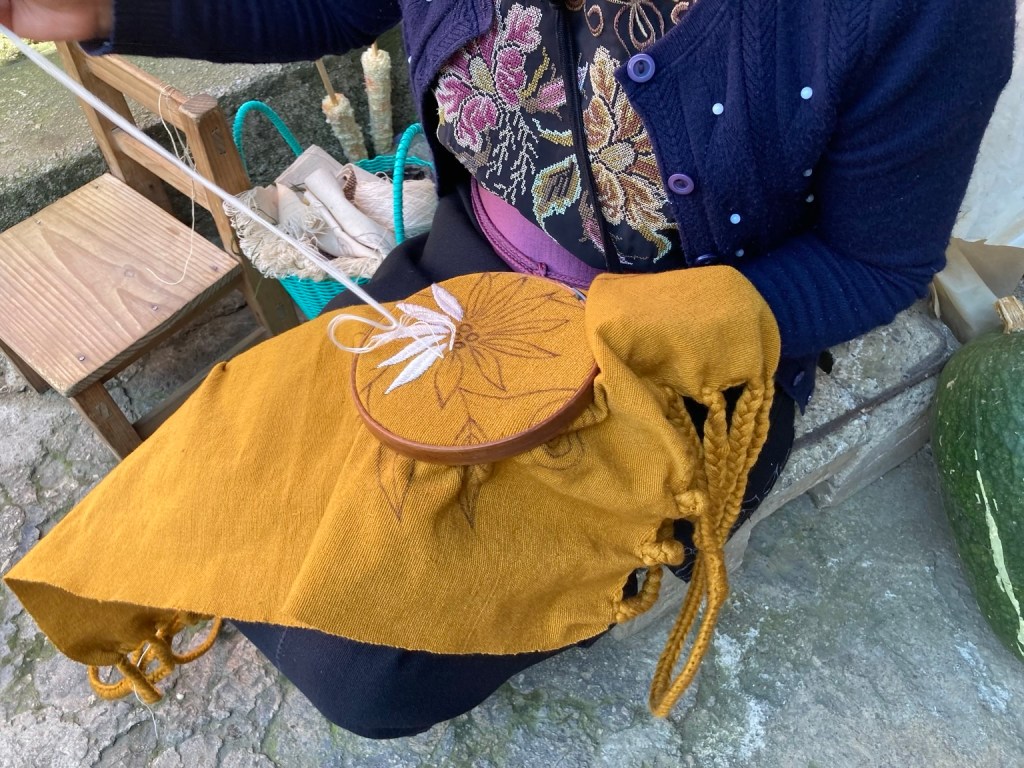
… and also see embroidery.
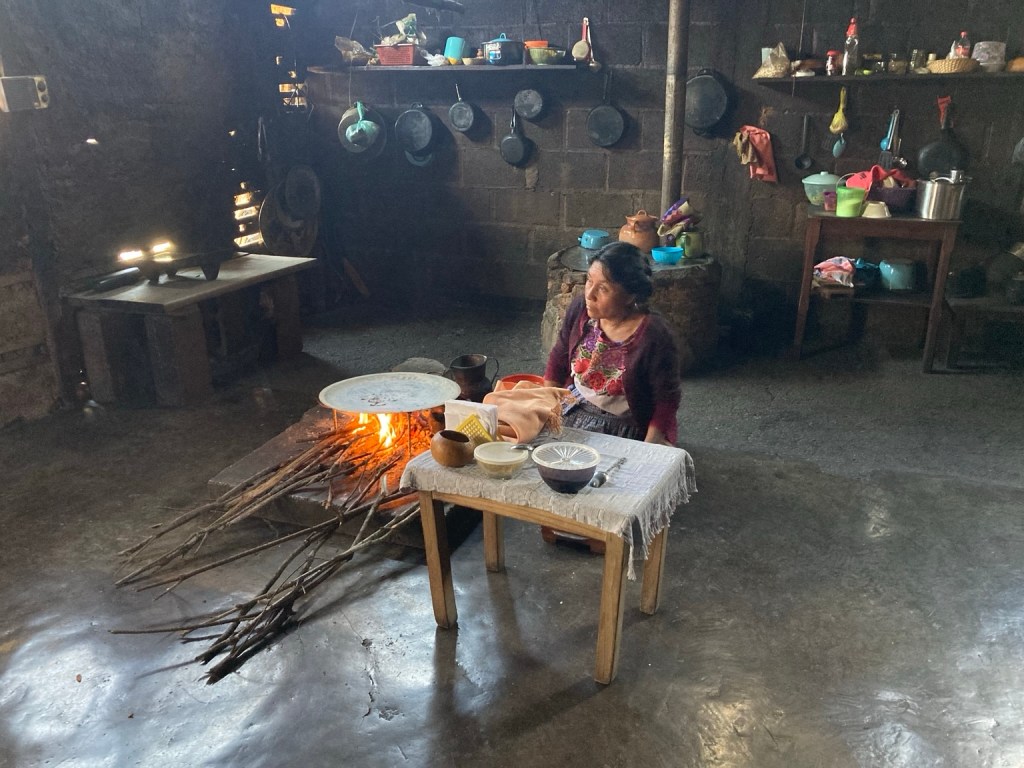
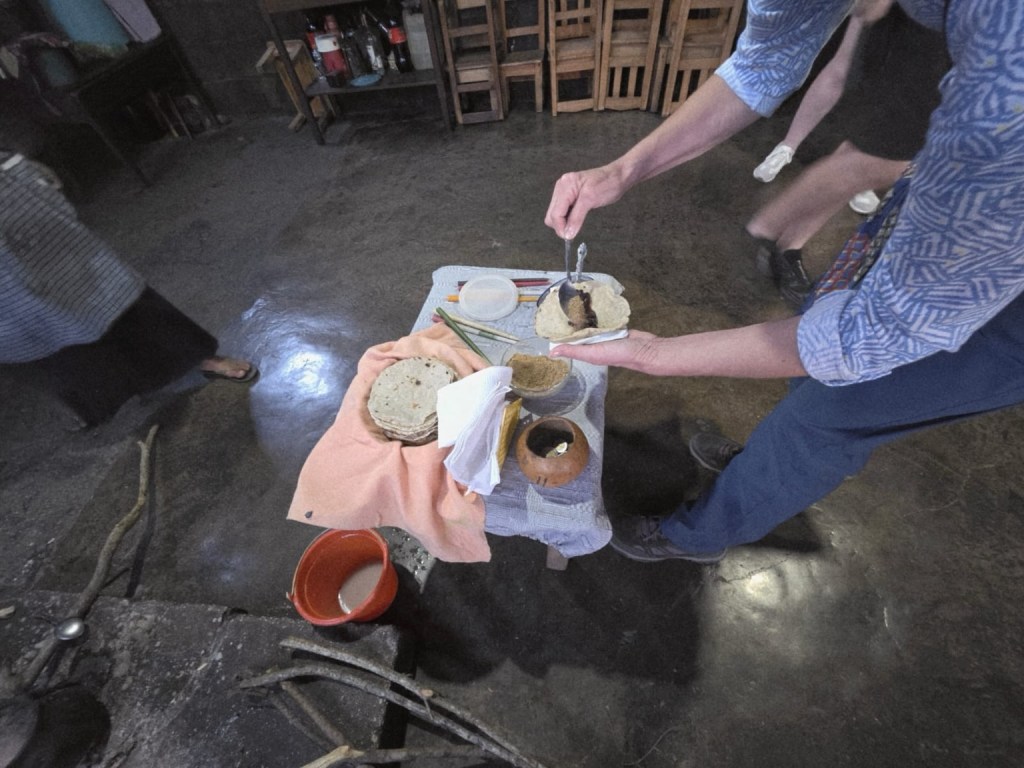
We also entered the kitchen and watched as the woman prepared and cooked a pile of tortillas for us to try …
… with some black beans and sprinkled with roasted and ground pumpkin seeds which tasted a little like roasted peanuts.
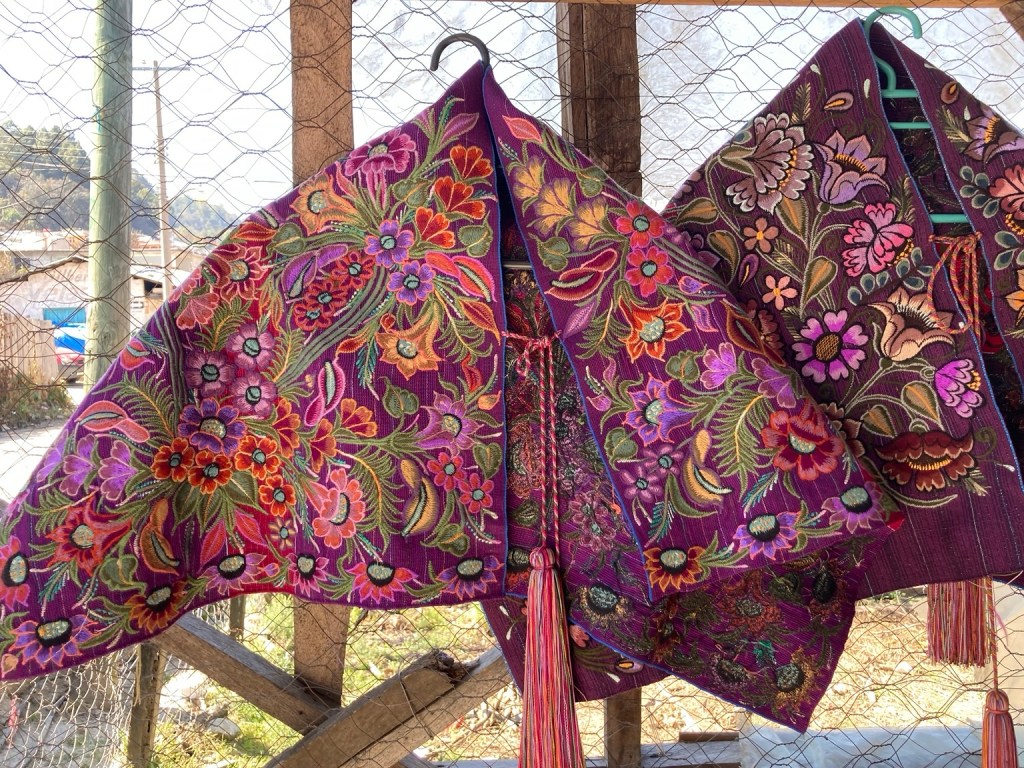
There was an opportunity to look at the items they had made including the traditional woman’s jacket …
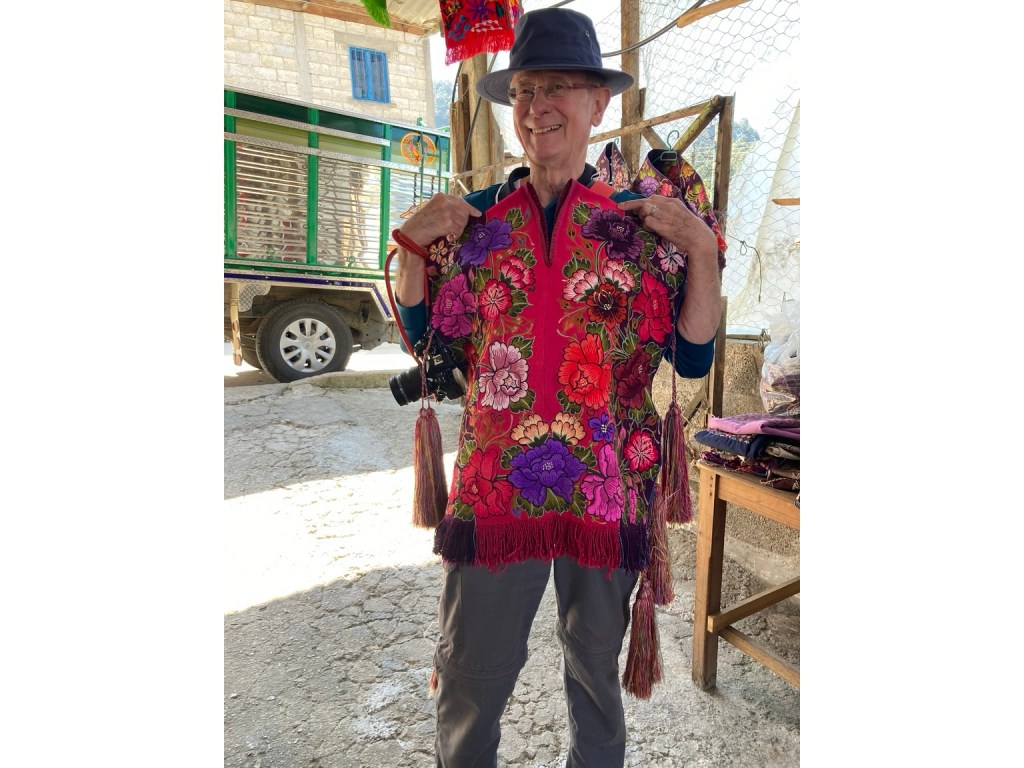
… the men’s jacket modelled by Chris …
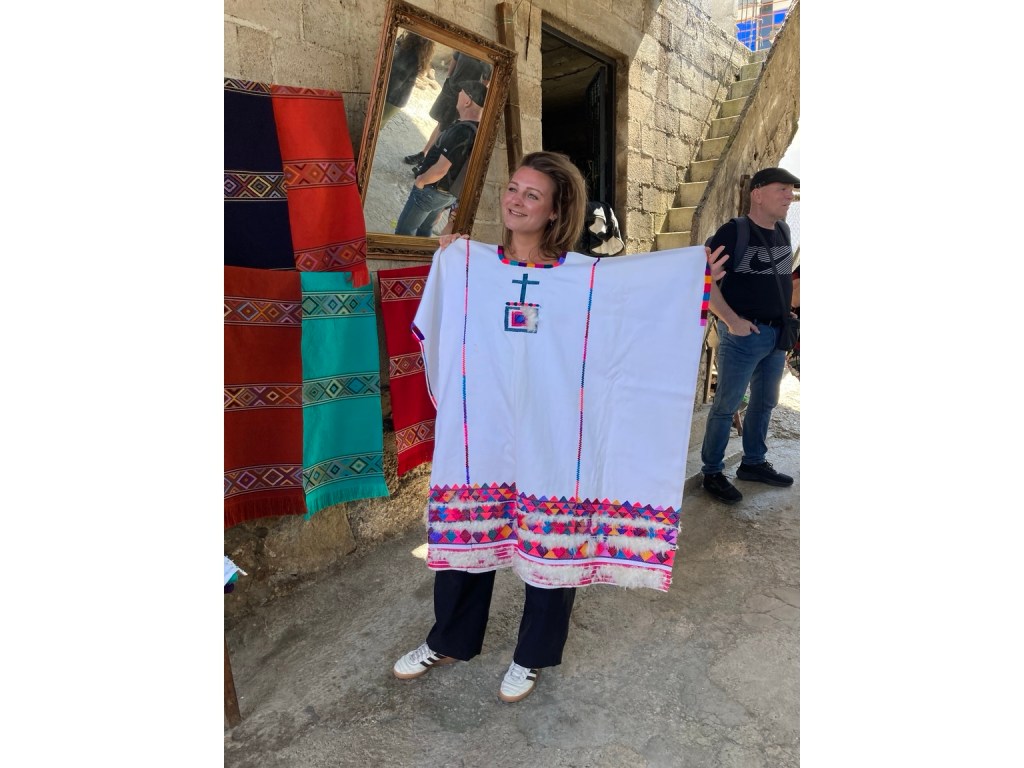
… a wedding dress …
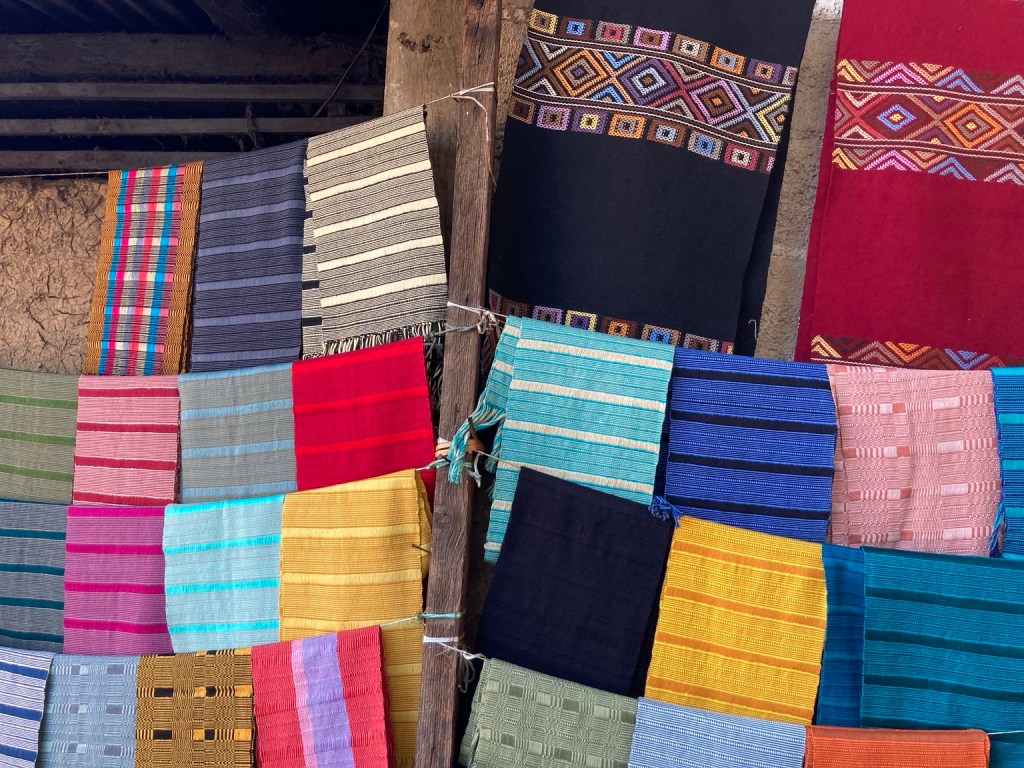
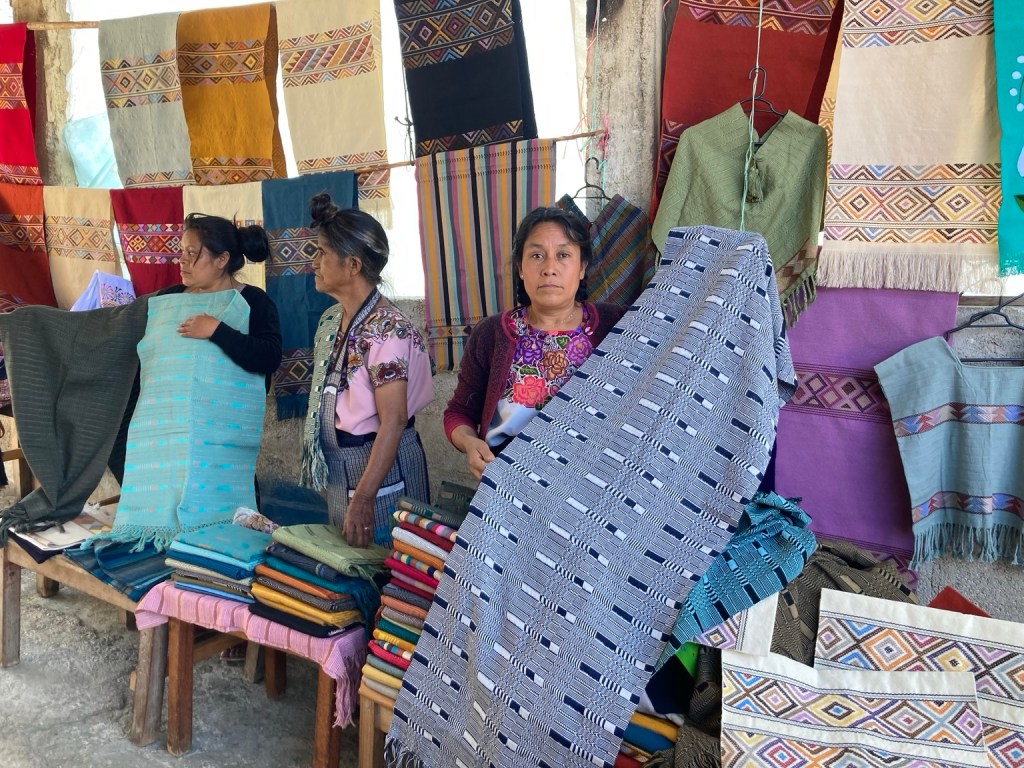
… and scarves and runners for sale …
… and we bought a cloth to keep tortillas warm, or in our case, to line our bread basket!
This visit gave us a glimpse into a mystical world we would not expect to see in the 21st century and thanks to Cesar we understand a little of their way of life.
I was also delighted to have a few more Mexican memories to pack into the case!
When we got back we chilled for a bit in a cafe …
… and sampled some more pox …
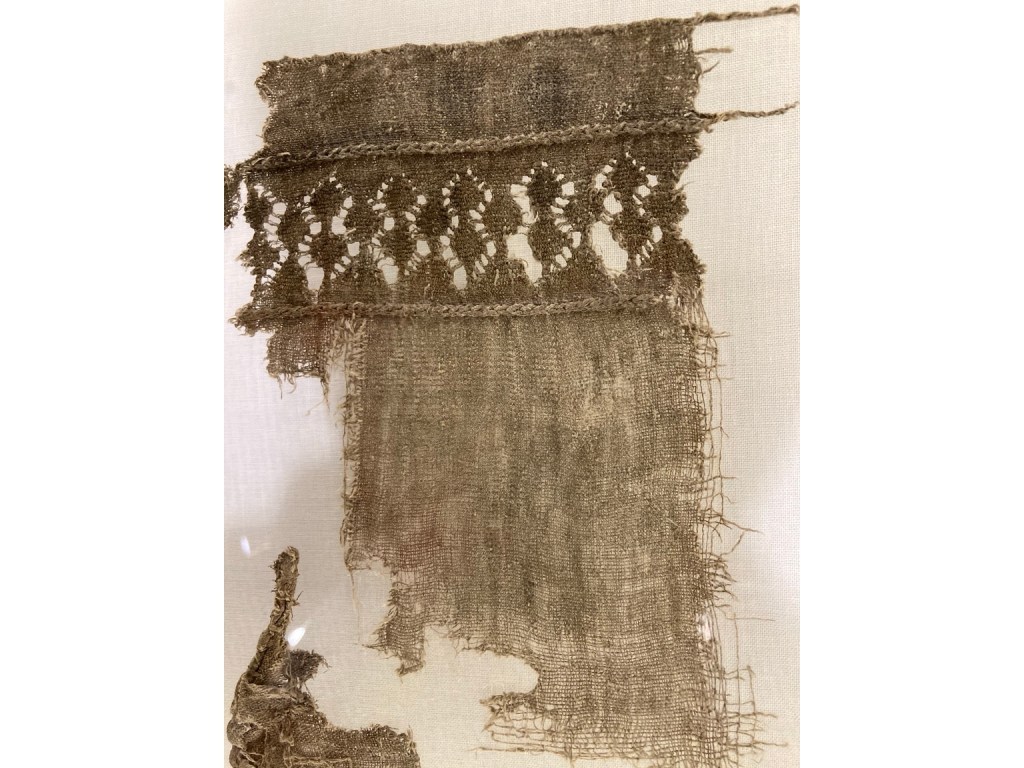
… before visiting the textile museum, where a piece of cloth has survived from 600-900AD which is pretty amazing.
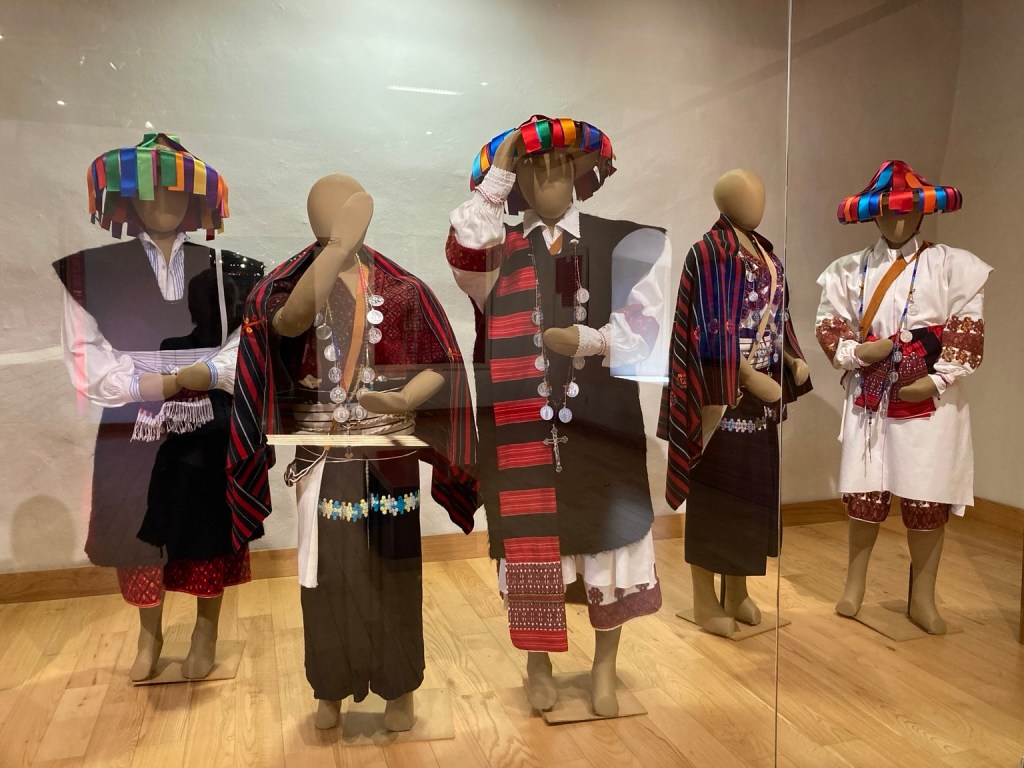
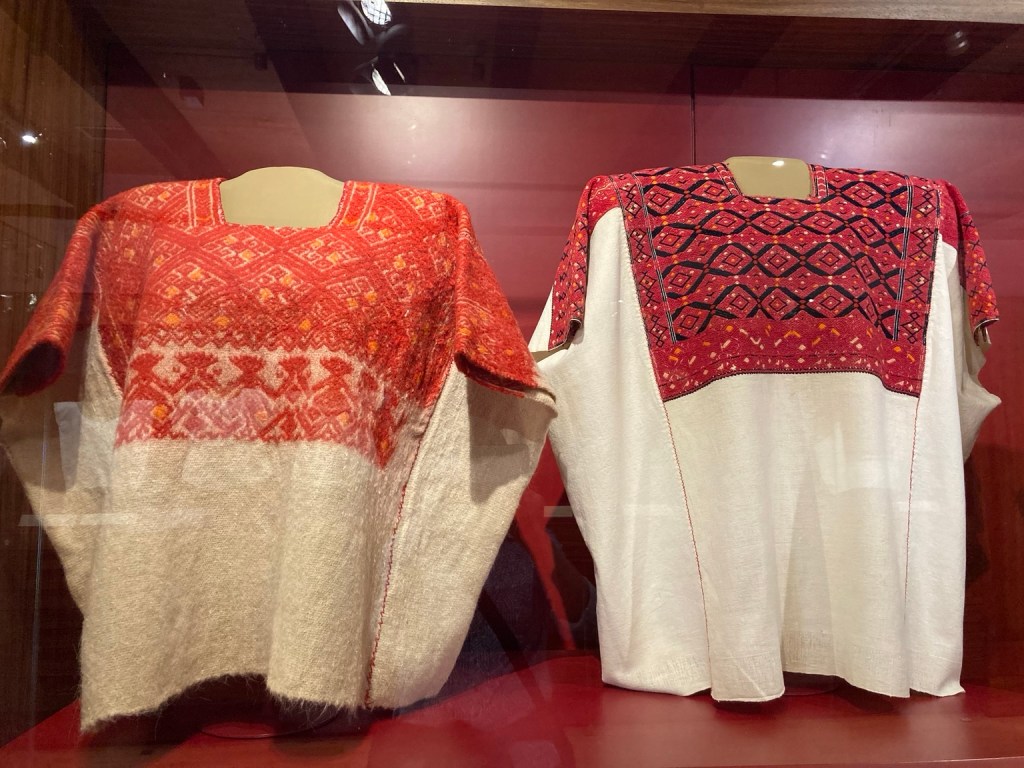
There were also leaders outfits from different communities …
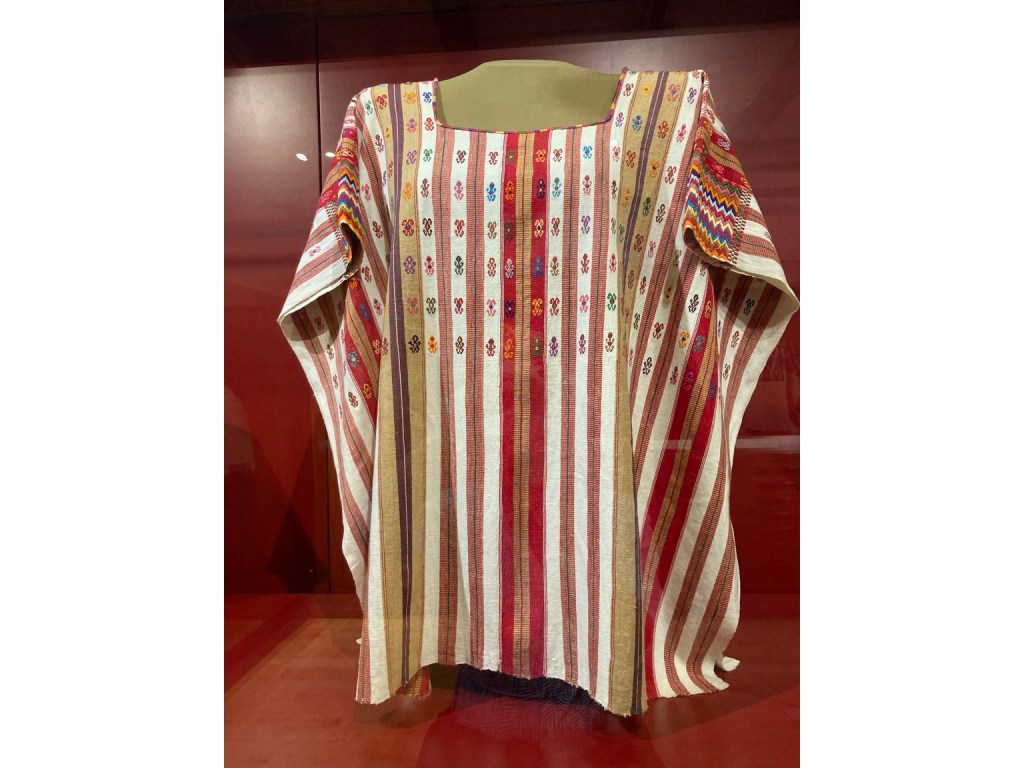
… and a huge selection of huipils, but here are just two local ones.
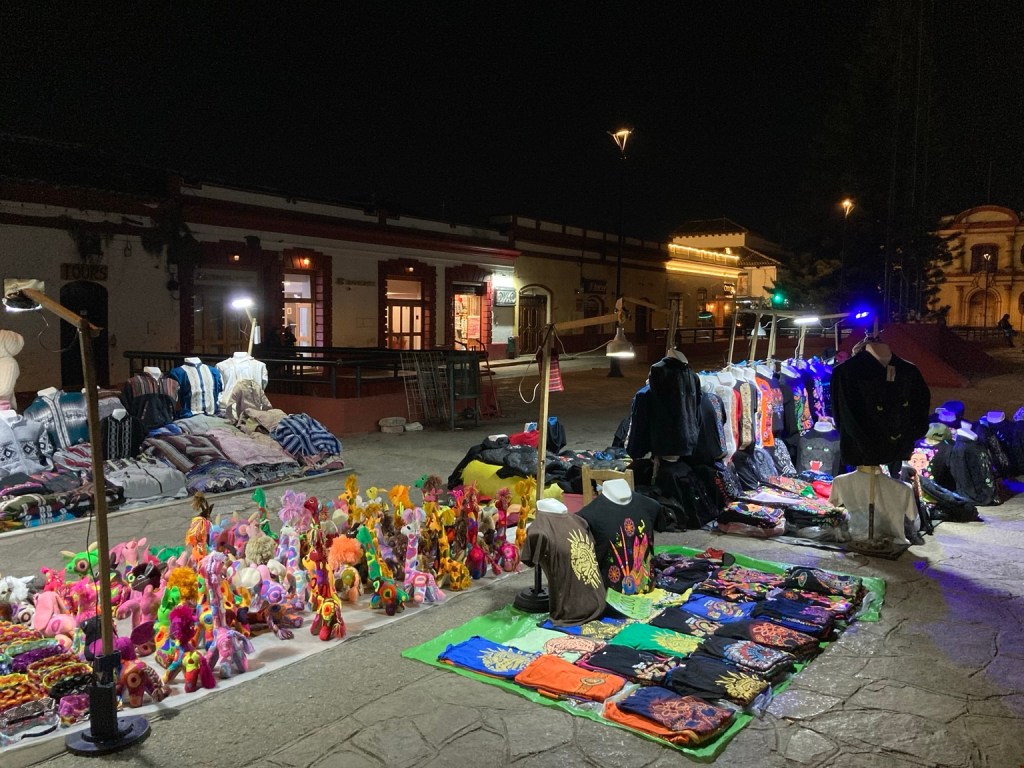
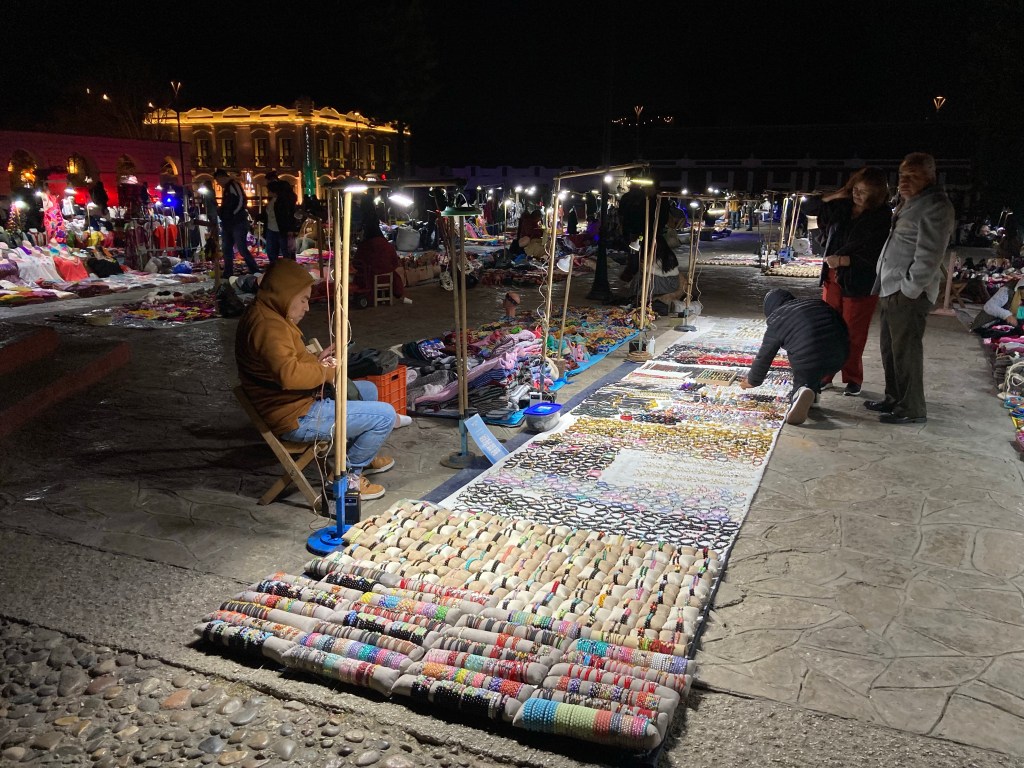
In the evening we walked through the night market, amazed at how all these people selling so much stuff could ever make a living.
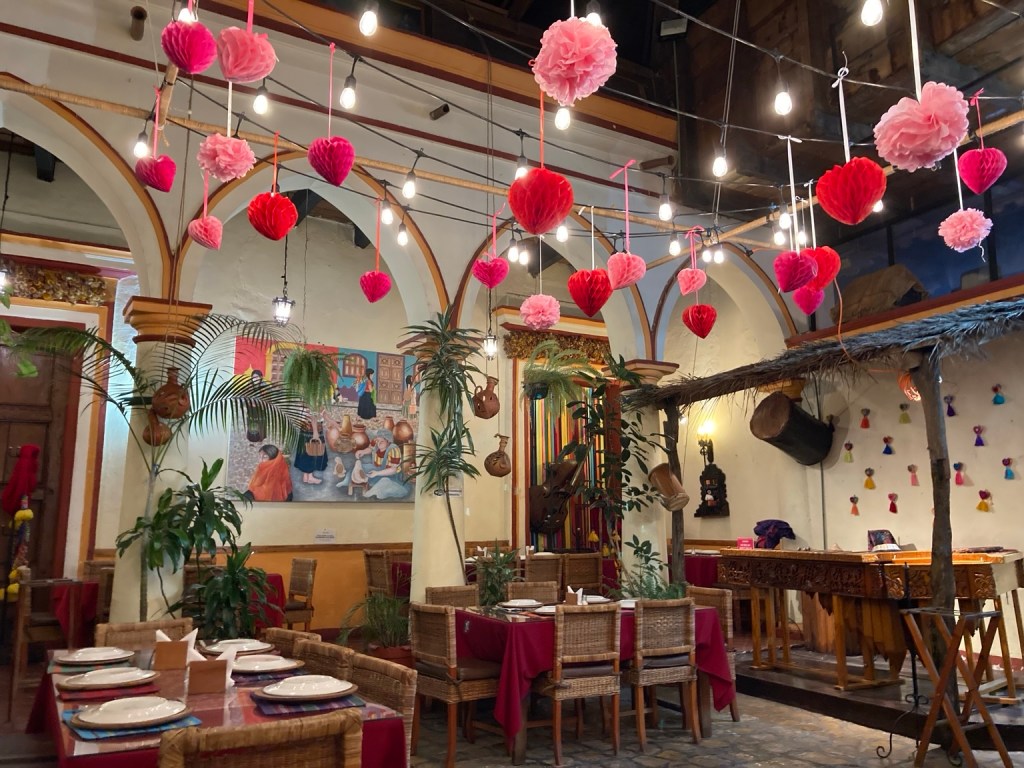
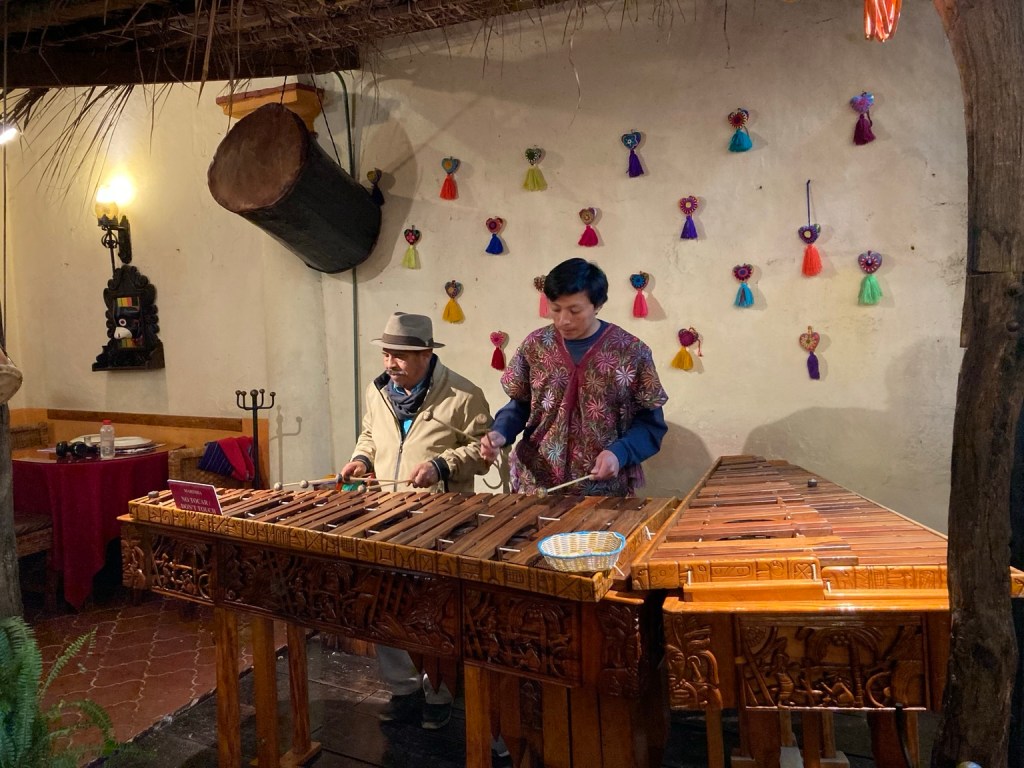
Dinner was at El Fogon de Jovel, where there were even tunes while we ate. We’ve been surprised at how quiet the town and restaurants have been, but apparently this a lull between the Xmas and Easter rushes.
Of course, the next excuse for celebration is just in a couple of days …
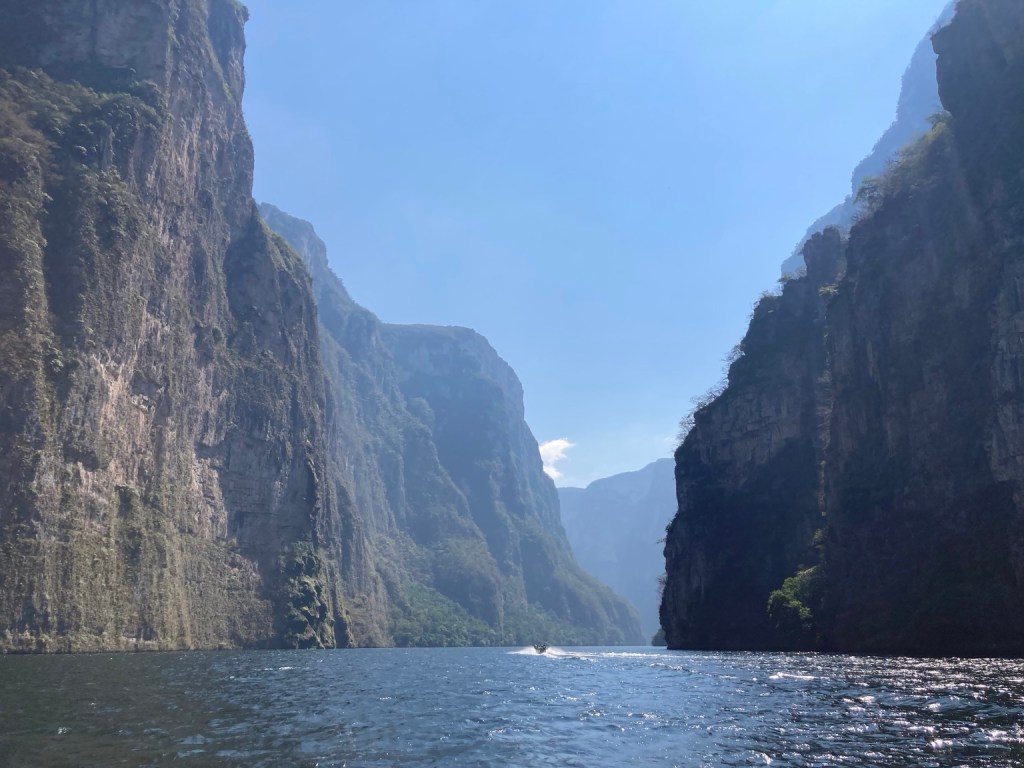
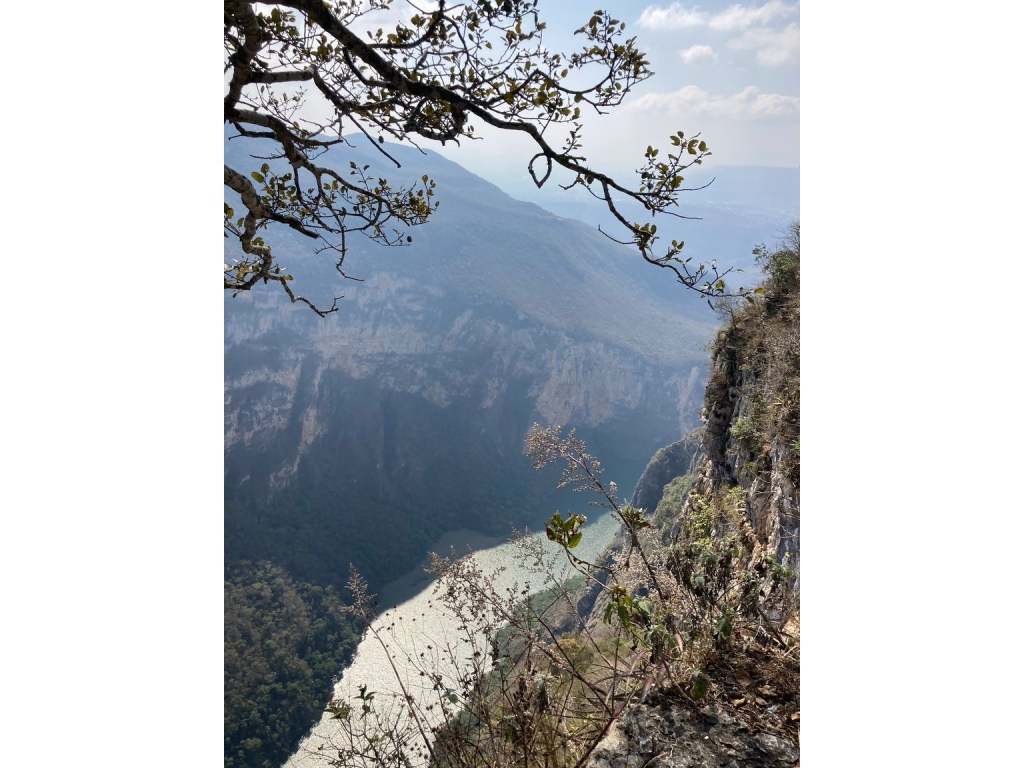
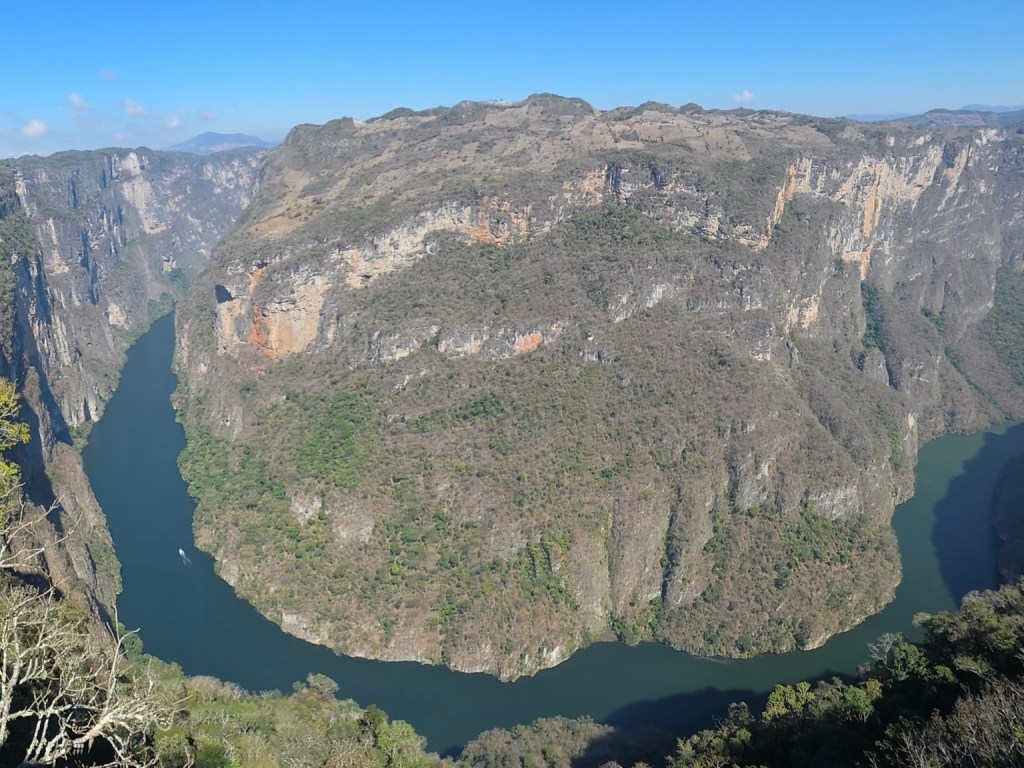
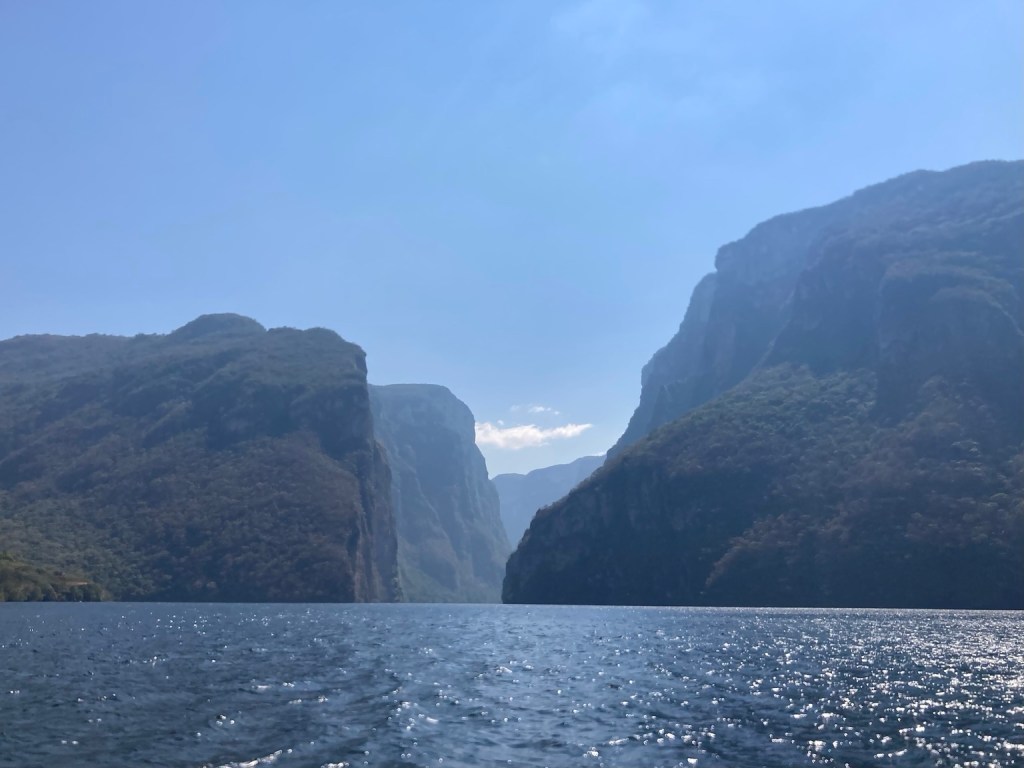
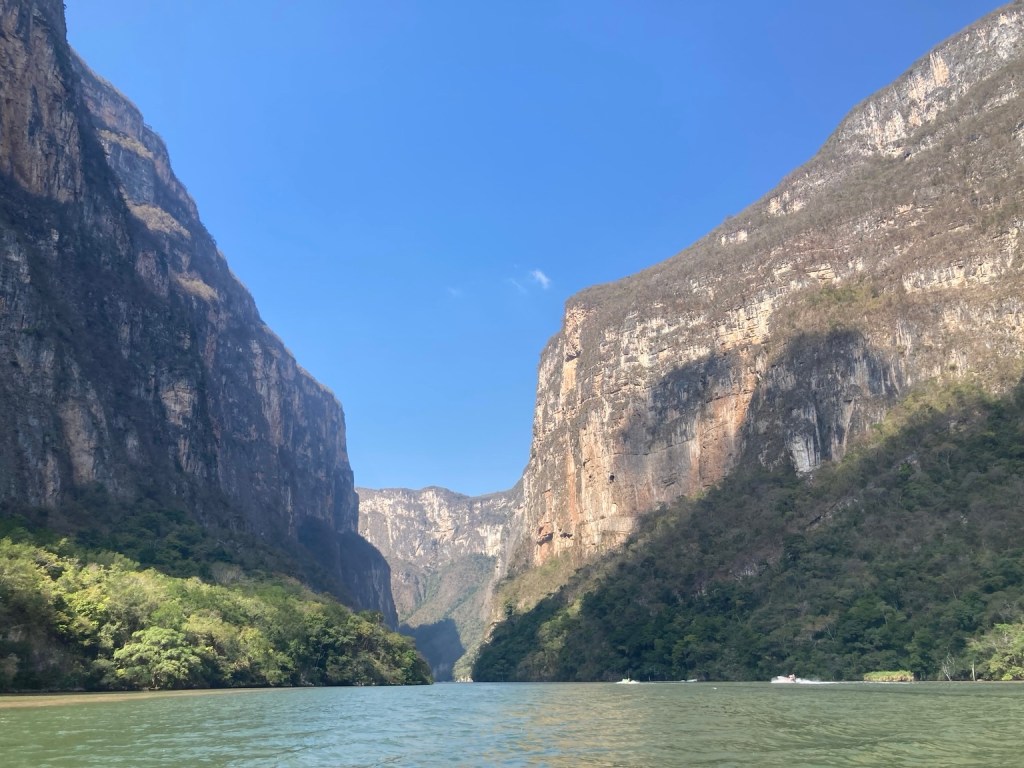
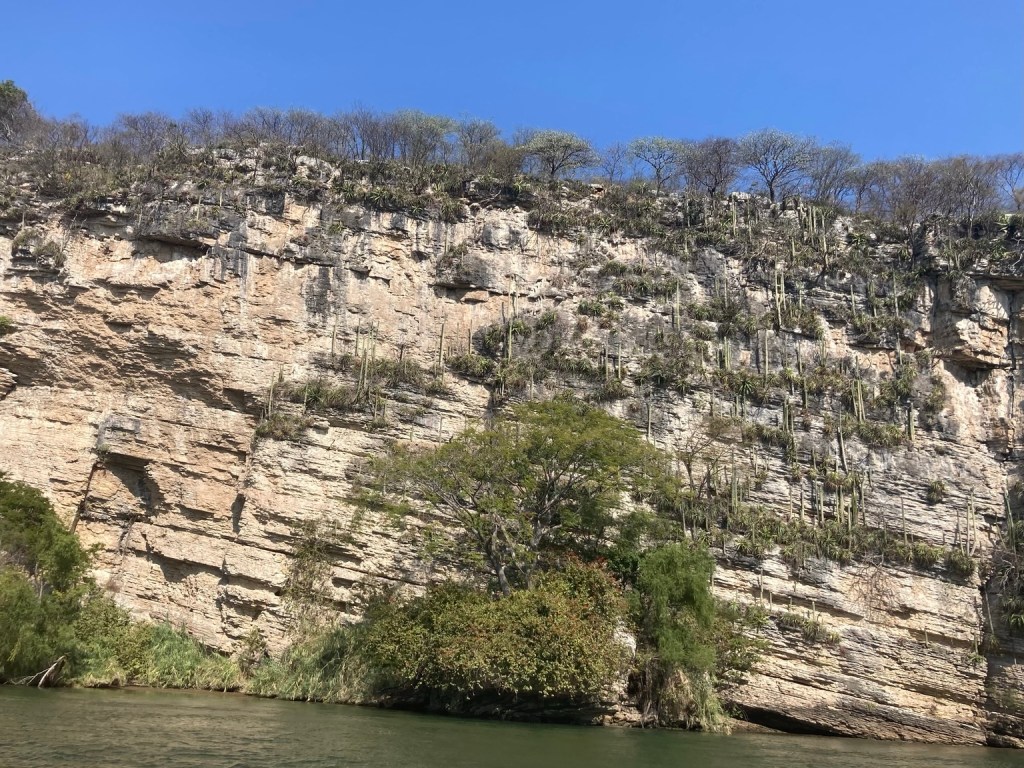
One of the popular day trips here is to visit the Sumidero Canyon and to marvel over its vertical limestone cliffs up to 1km high, carved by the Grijalva River.
We began visiting a couple of Miradors to look down into the canyon, first La Coyota …
… and then the stunning Los Chiapa where Chris took this fab shot of the horseshoe bend.
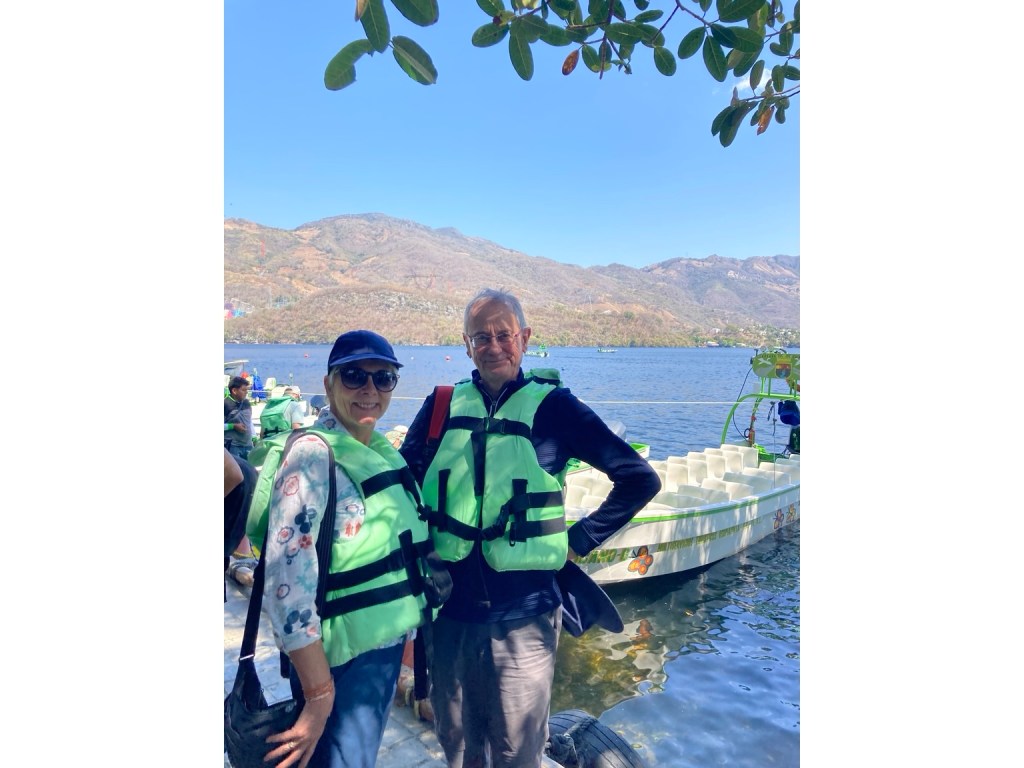
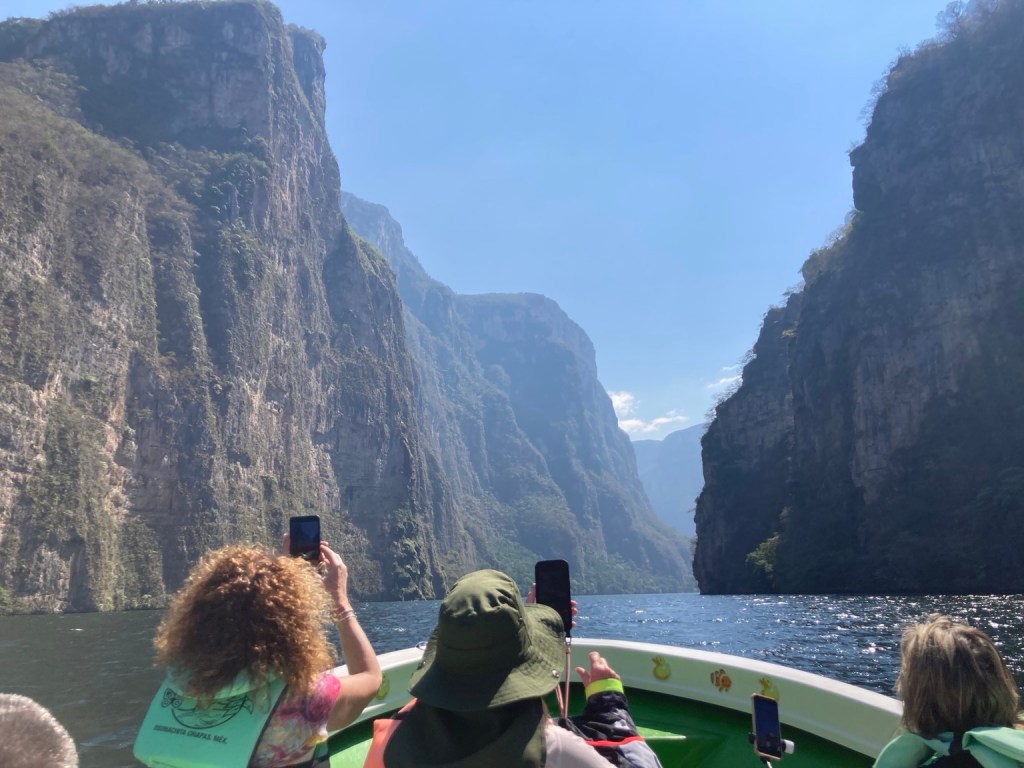
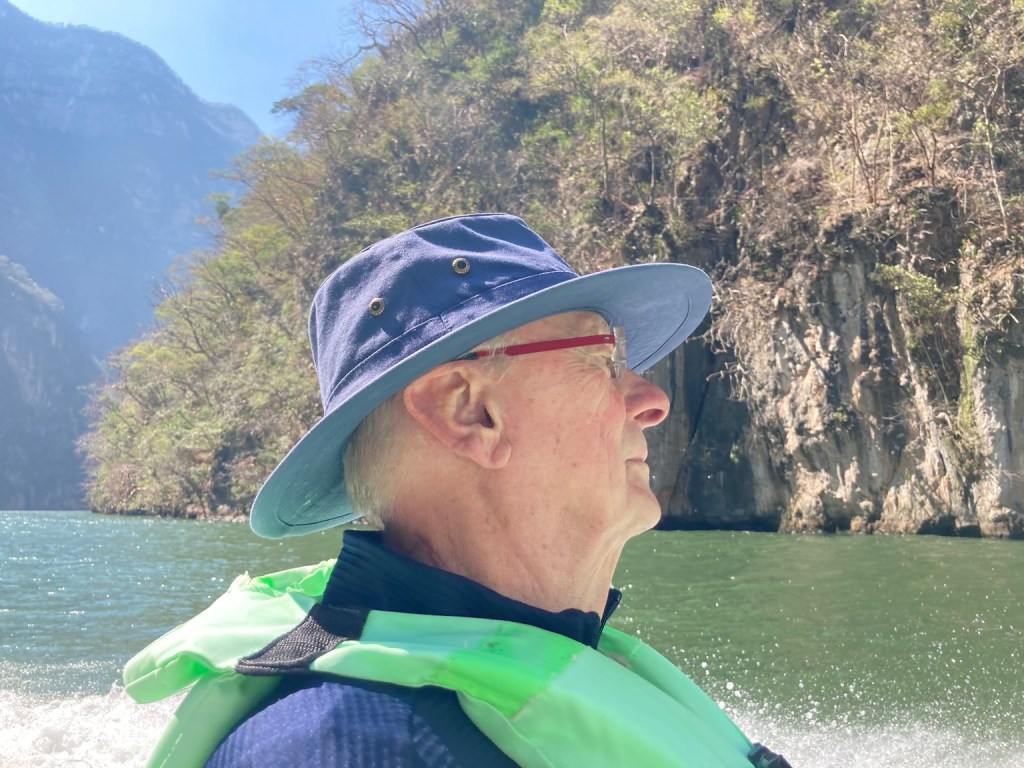
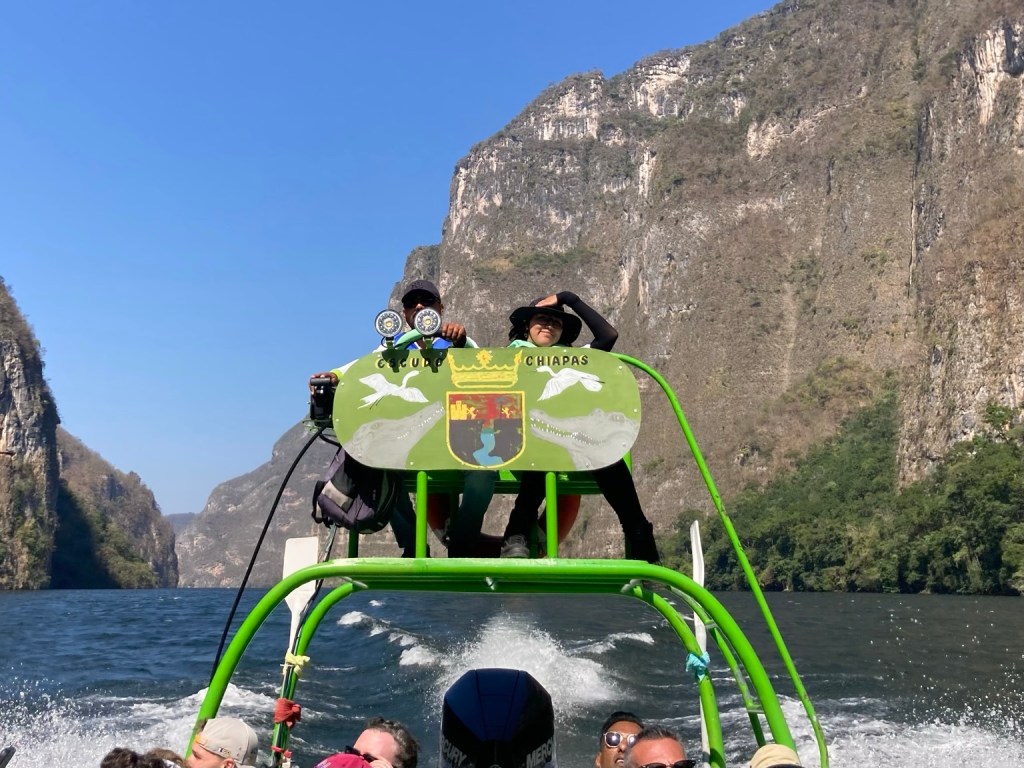
Back down to water level, we got jacketed up ready for a boat trip through the canyon to discover the area’s lush flora and fauna, possibly including crocodiles and monkeys.
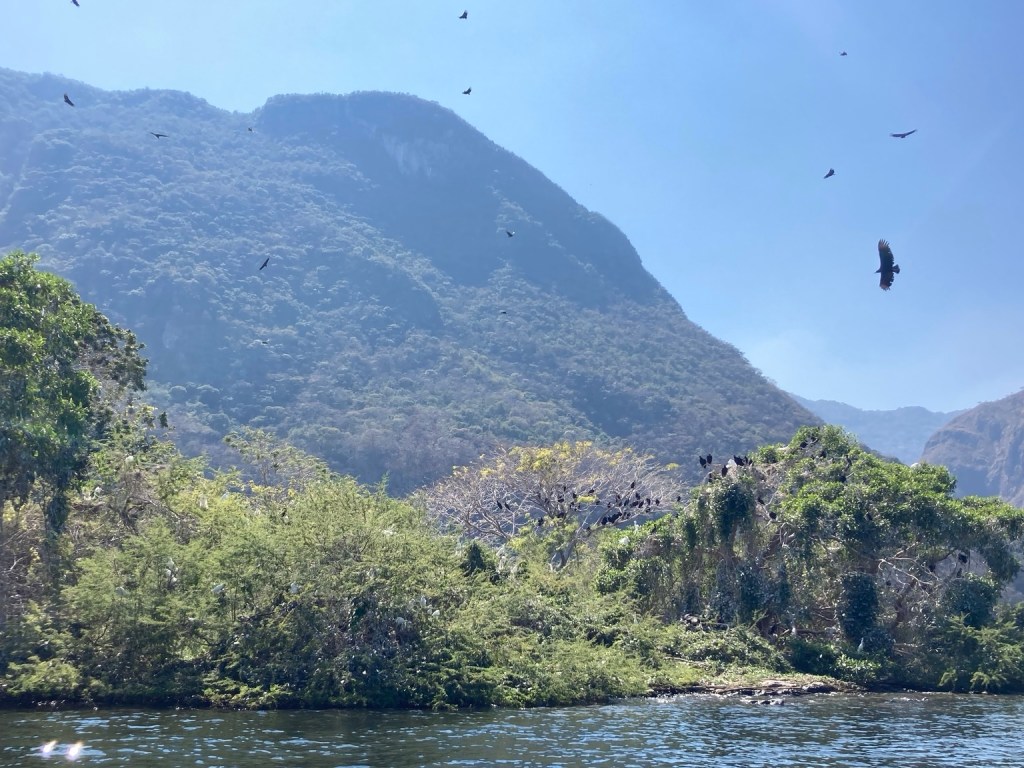
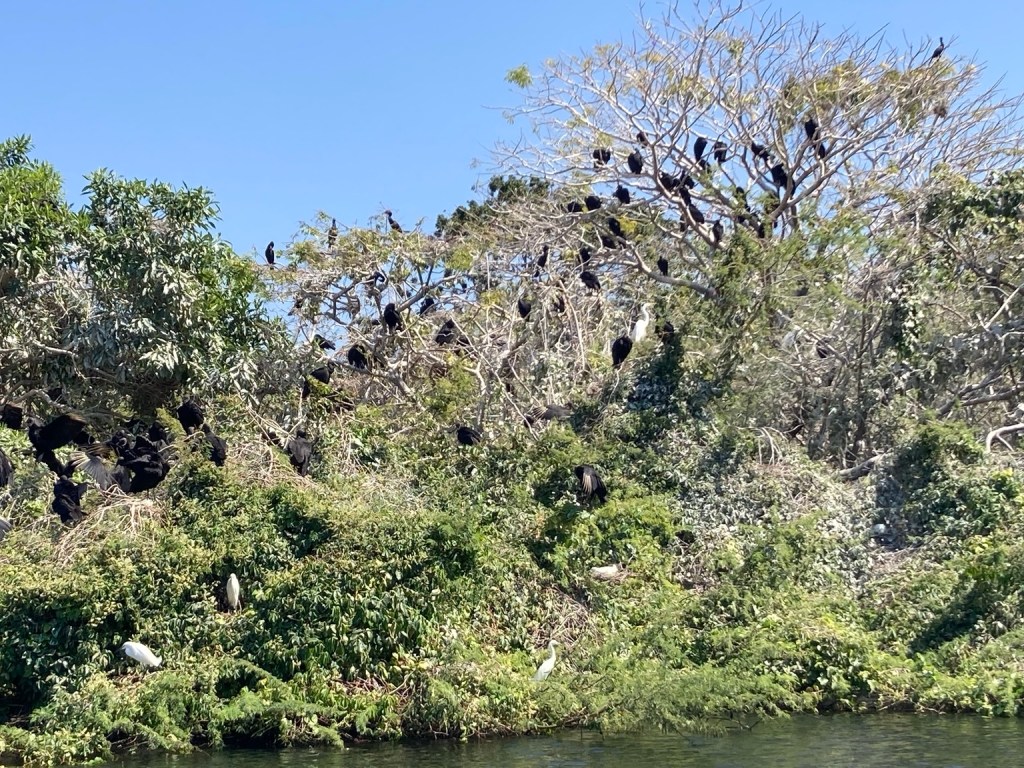
There were lots of birds, mainly hawks and cormorants, although we glimpsed a brown pelican.
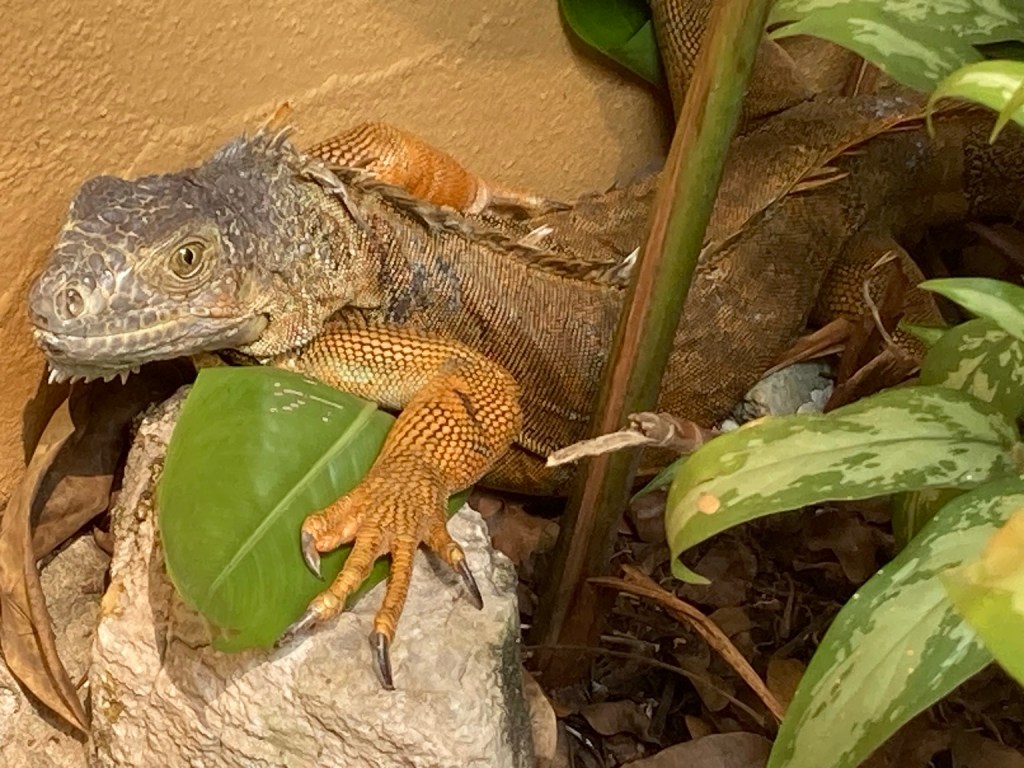
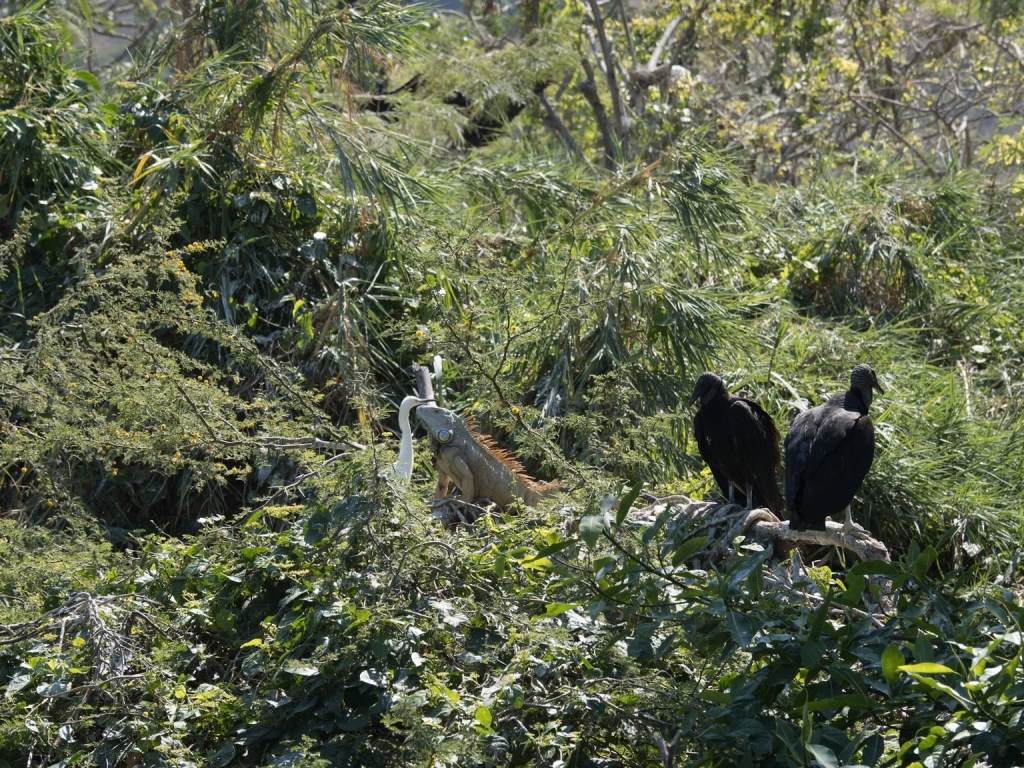
Chris also took this fab photo of an iguana basking.
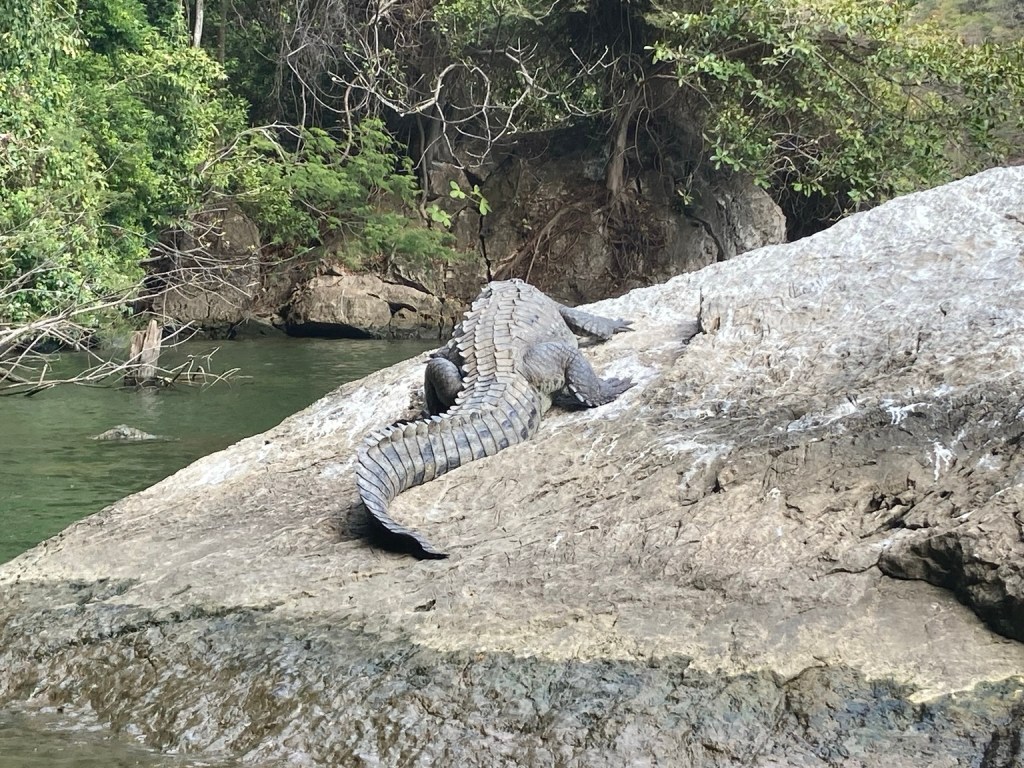
Also basking was this croc, unfortunately only a tail end view … with his mate poking his head out of the water!
The canyon was spectacular and it was such a beautiful day for a boat trip.
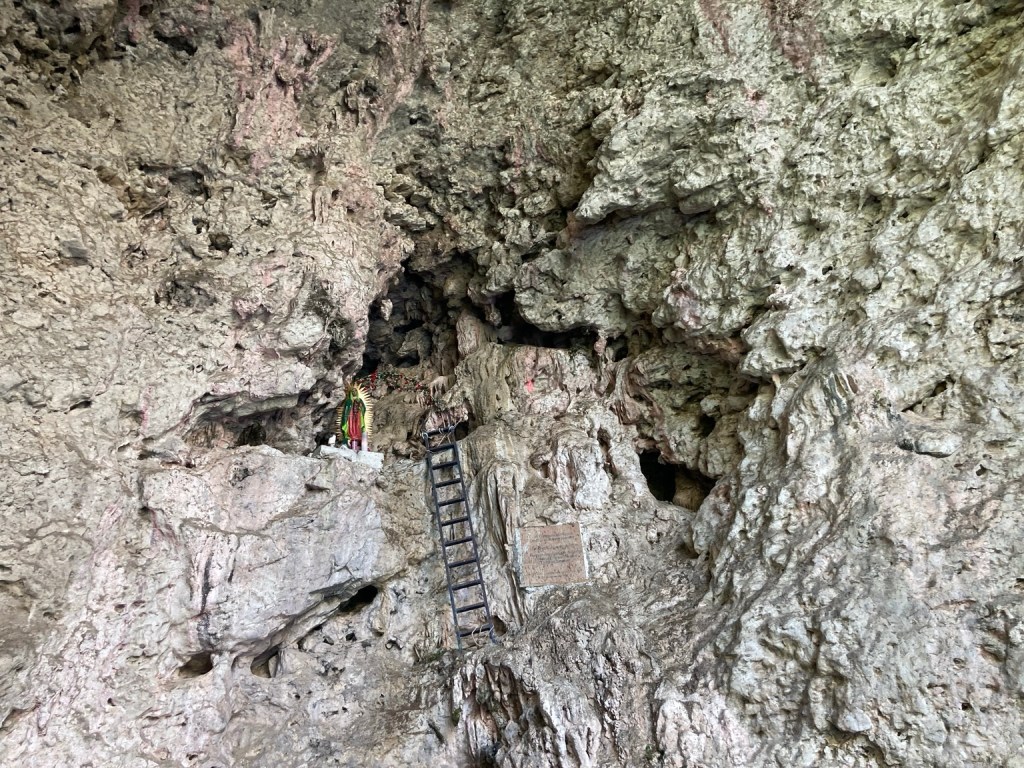
This cave became popular when the image of a crucified Christ was noticed in the wall, just to the right of the ladder, so needless to say, a shrine followed.
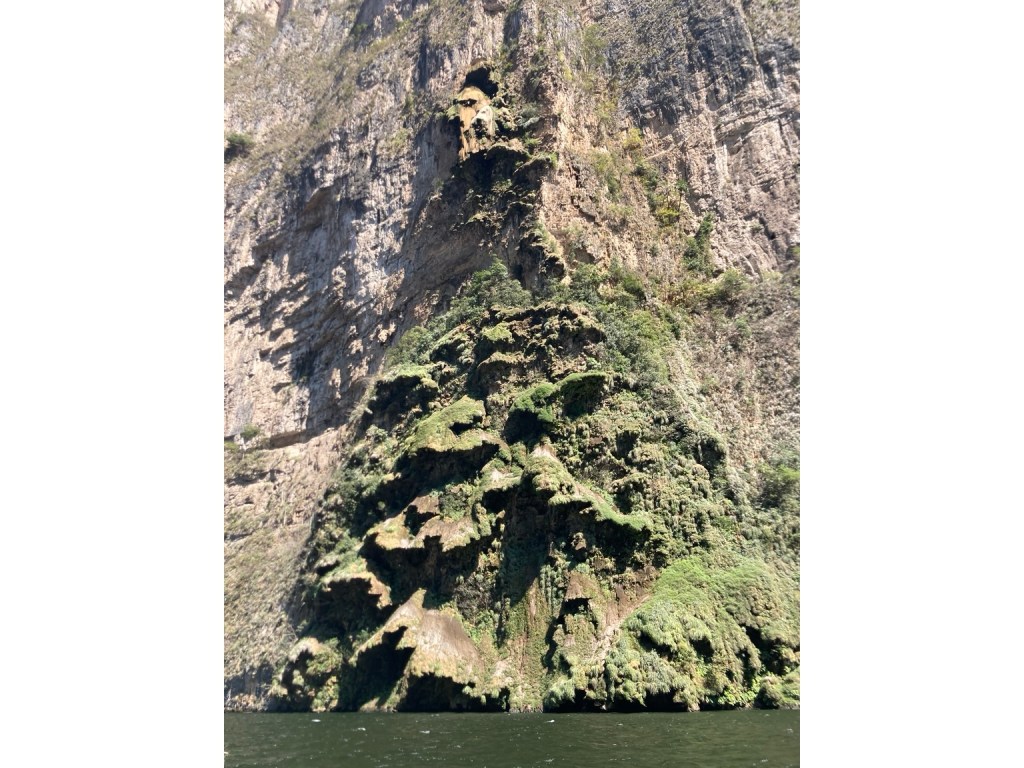
We also stopped to admire a unique waterfall spilling down the side of the canyon, not unsurprisingly called the Christmas Tree. At this time of year, only a few drops of water were falling, but the constant water causes the limestone to deposit into these shapes and enable the plant growth.
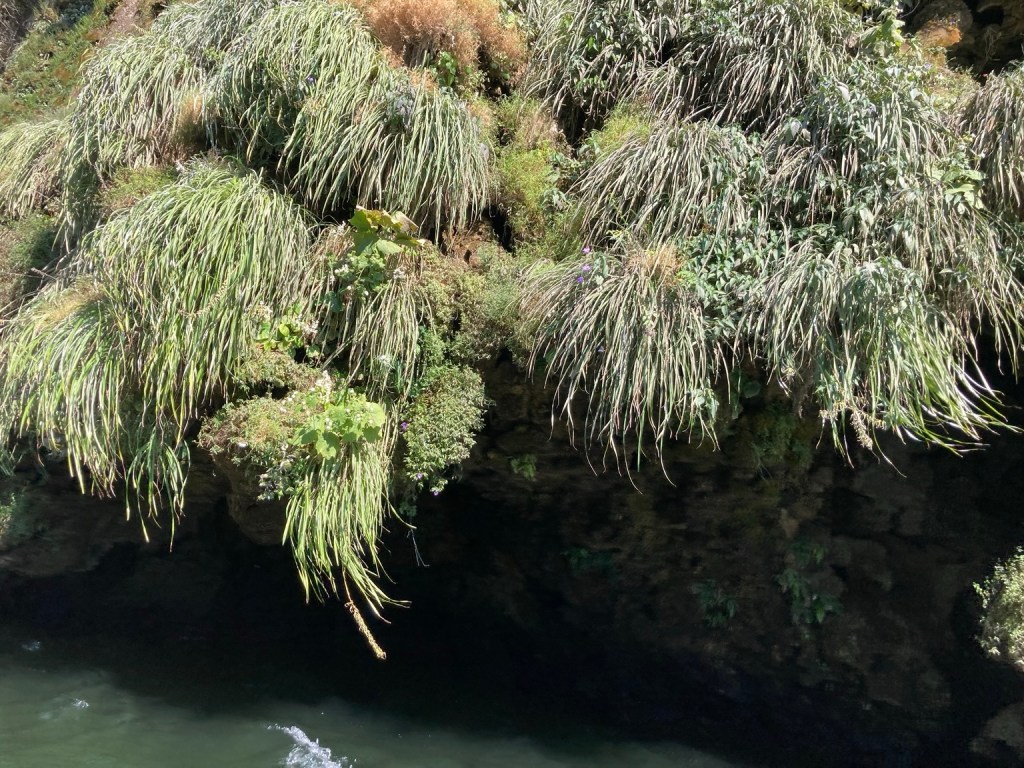
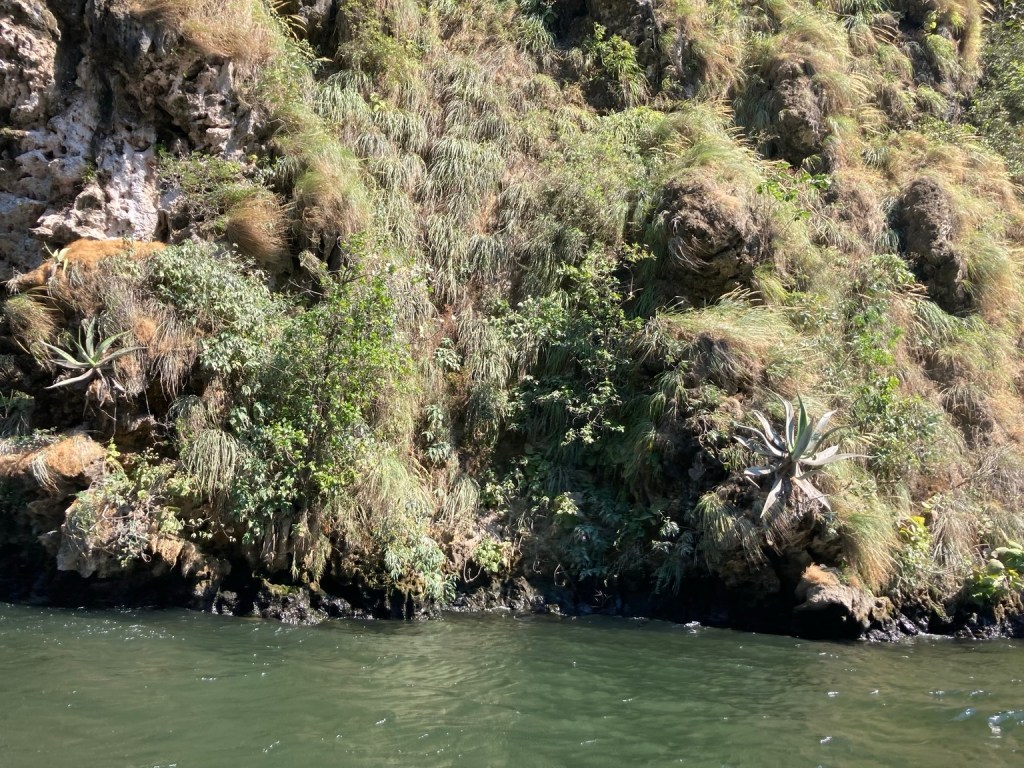
The most stunning canyon views were at the beginning of the trip as the canyon flattened out, but I loved this bit of cliff with cacti.
At Chiapa de Corzo we got off the boat and had hour to wander so we did just that …
… and sat with ice creams in the square, before the drive back.
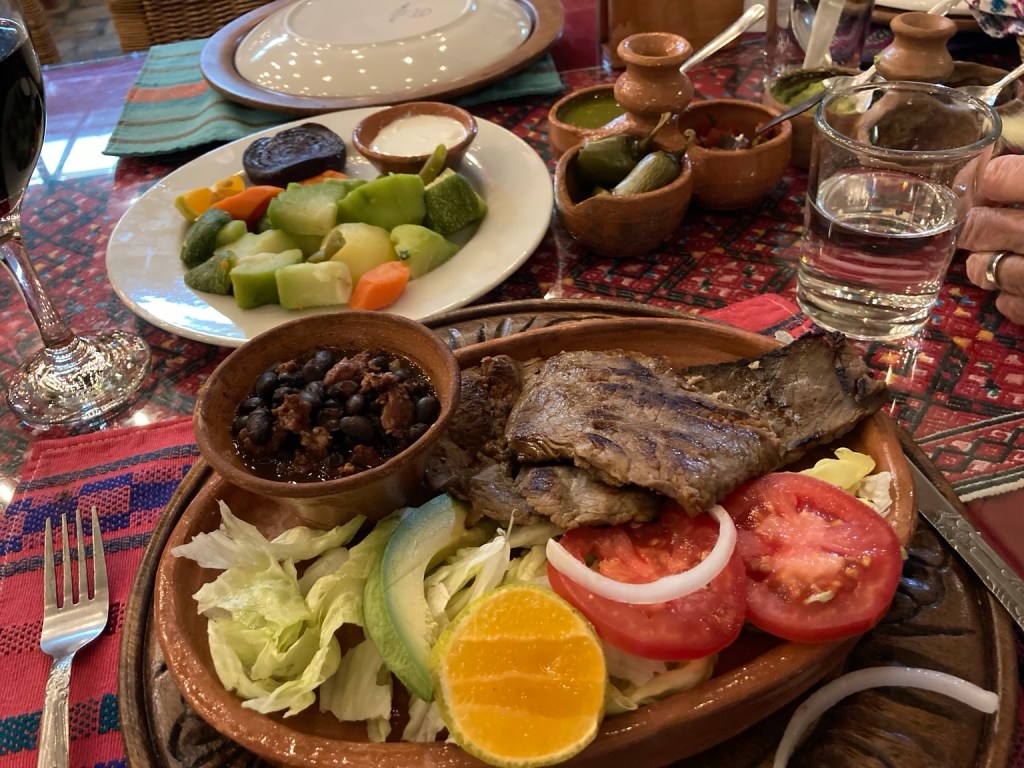
In the evening we went to Belil Sabores de Chiapas, offering authentic Chiapanecan cuisine with veggie options, for local soup, pork stew and quesadillas.
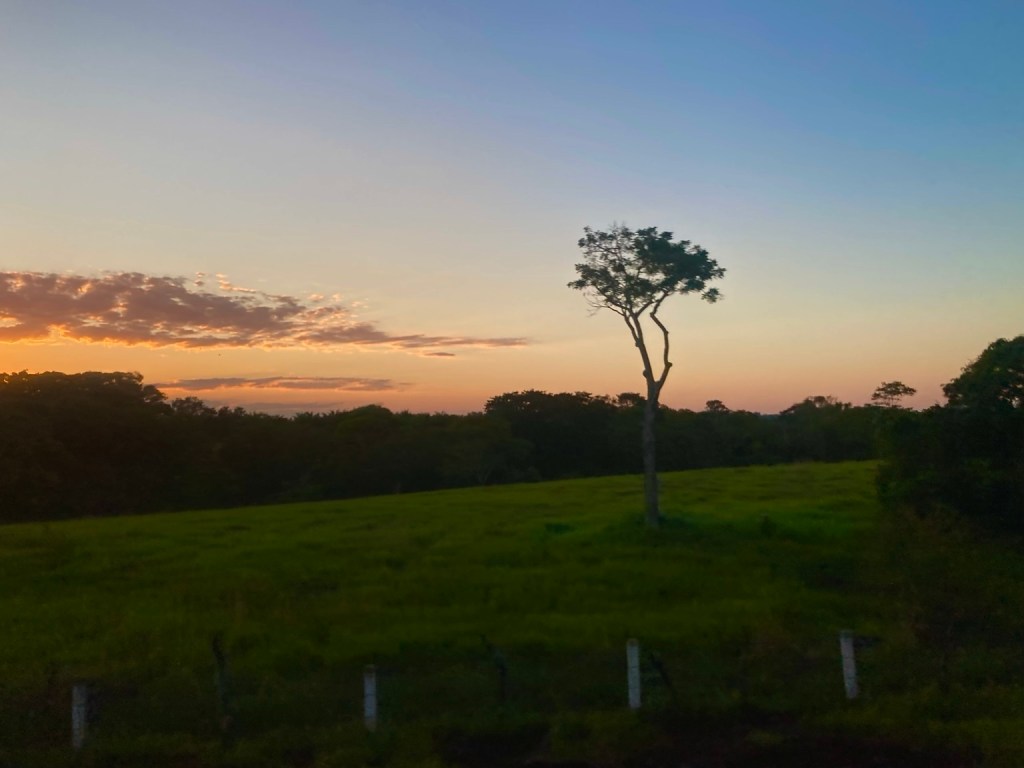
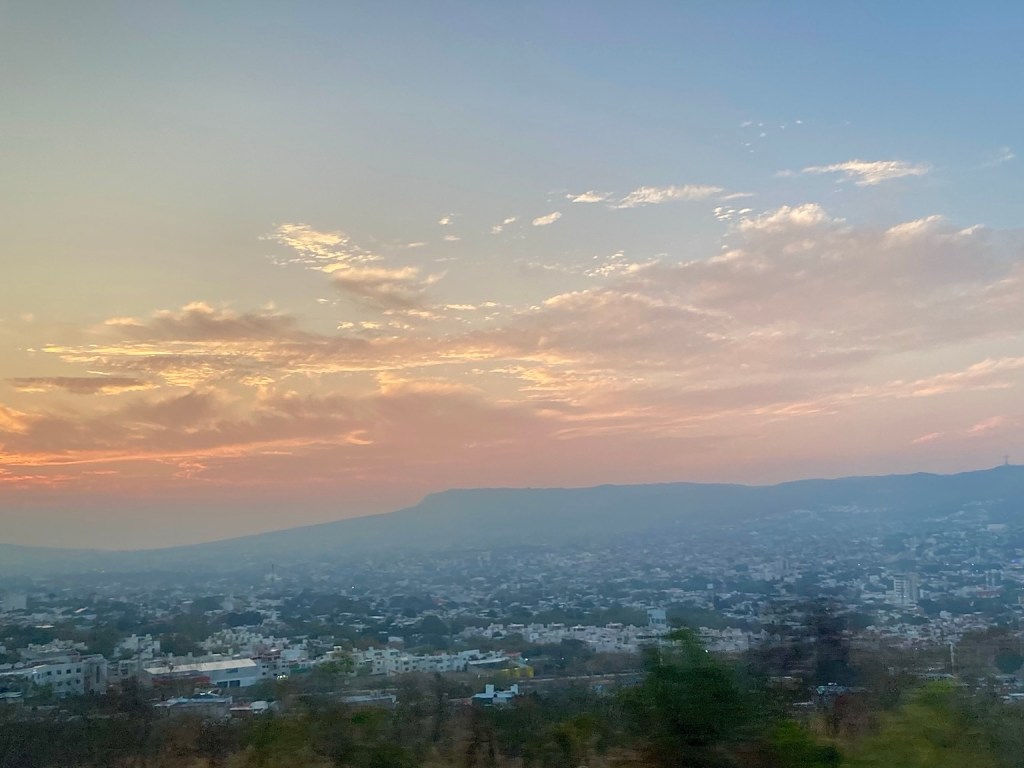
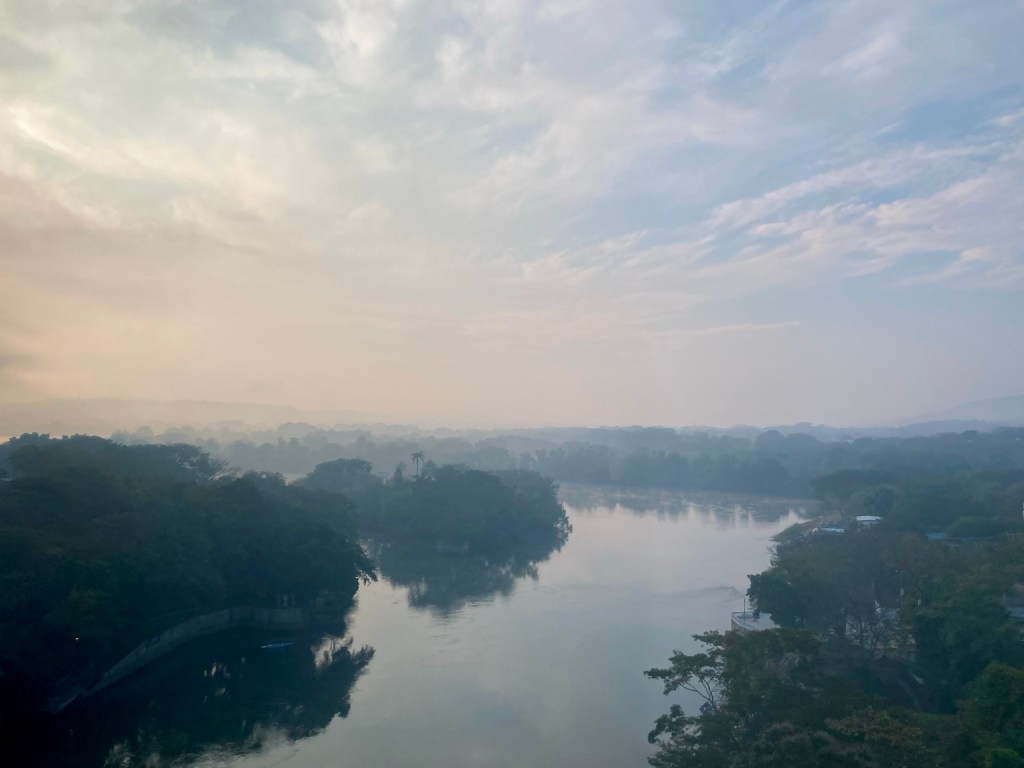
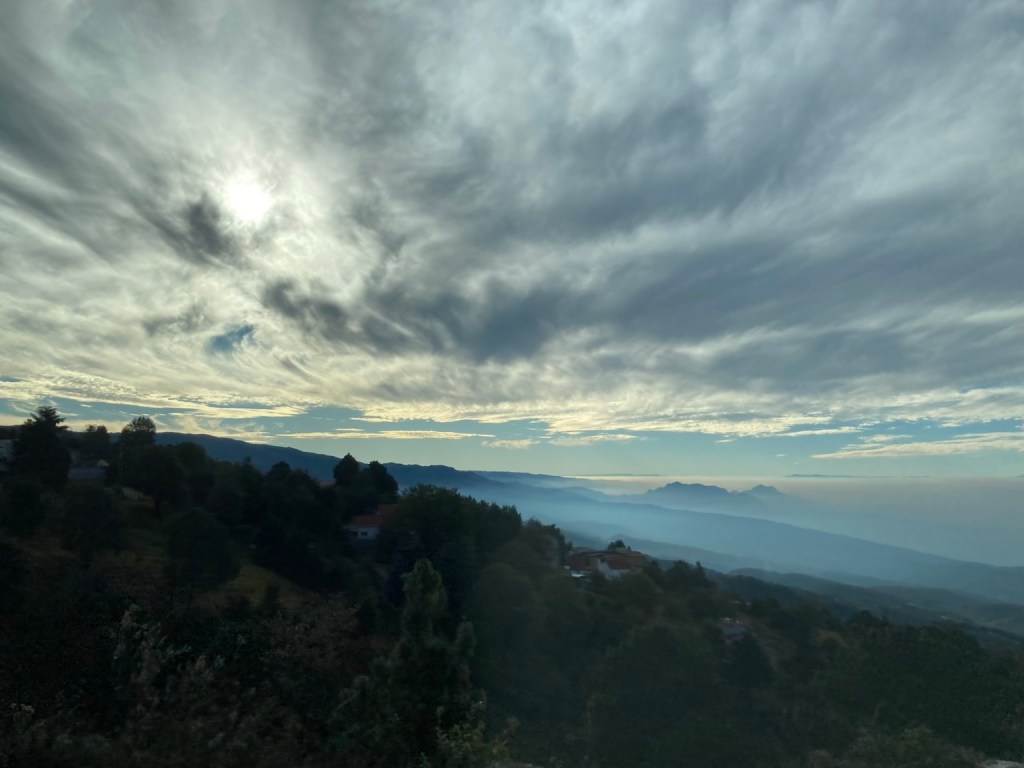
It wasn’t my best night’s sleep, but it was also far from my worst! We stopped at a state border post around 6am and a man came in and briefly inspected the bus and we were on our way again. Got a couple of pics of the early morning …
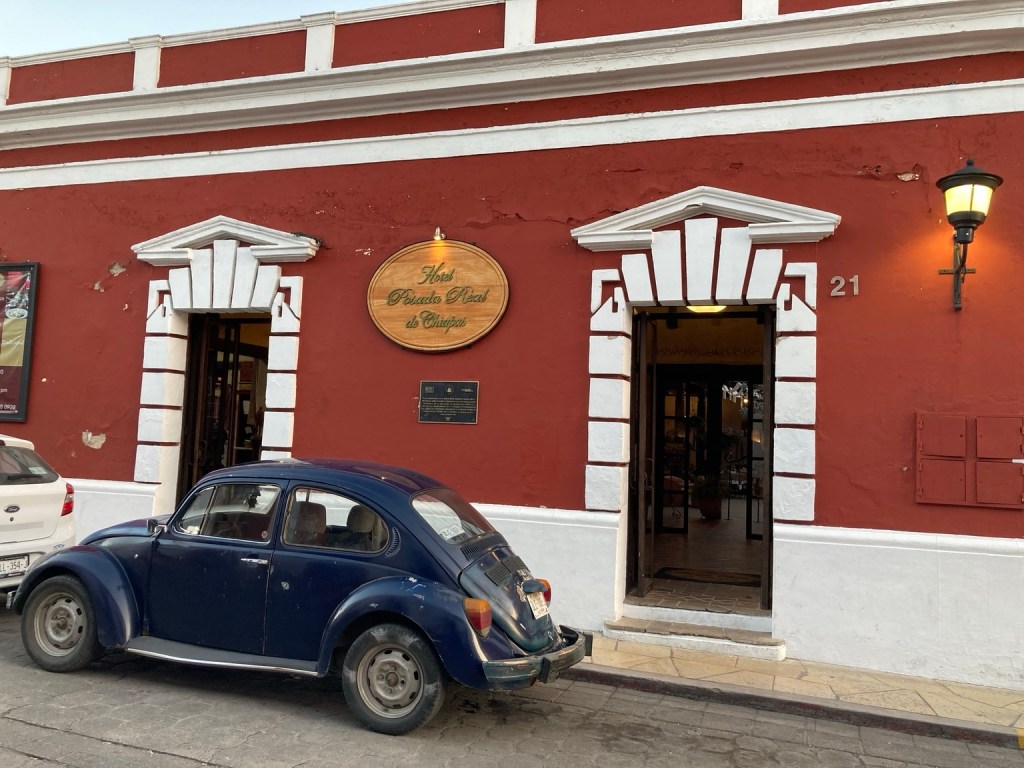
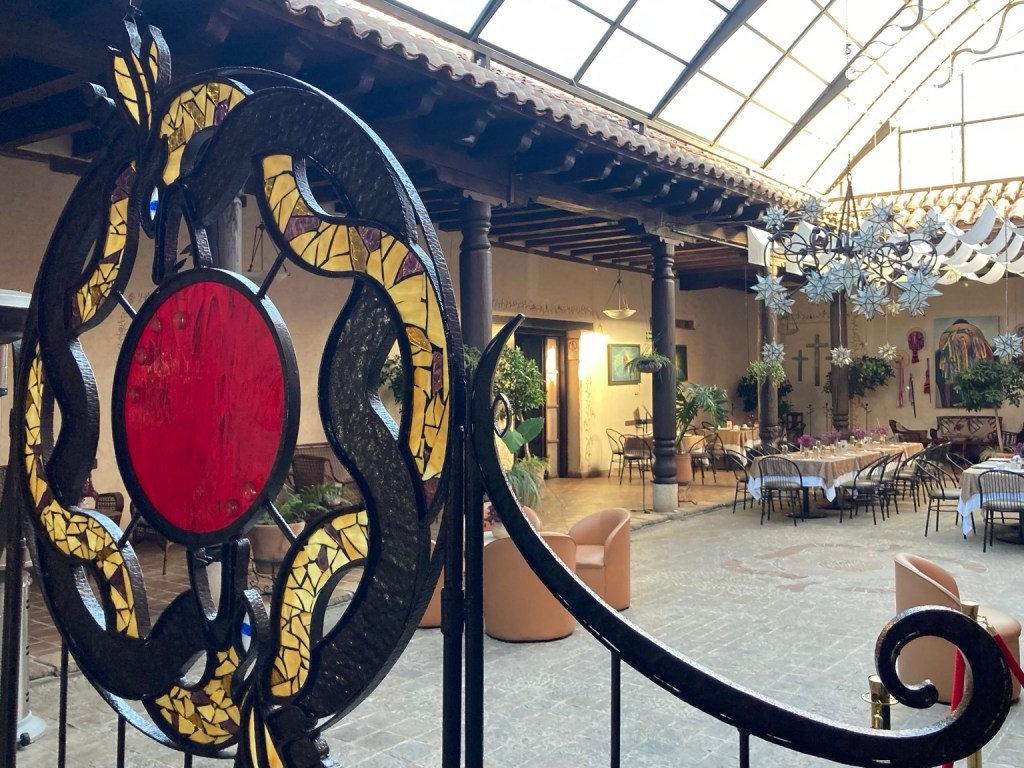
… and we arrived in San Cristobal De Casas right on time at 8.30. It was just a short walk to Hotel Posada de Real de Chiapas, a colonial Manor House set round a courtyard decorated with murals and textiles.
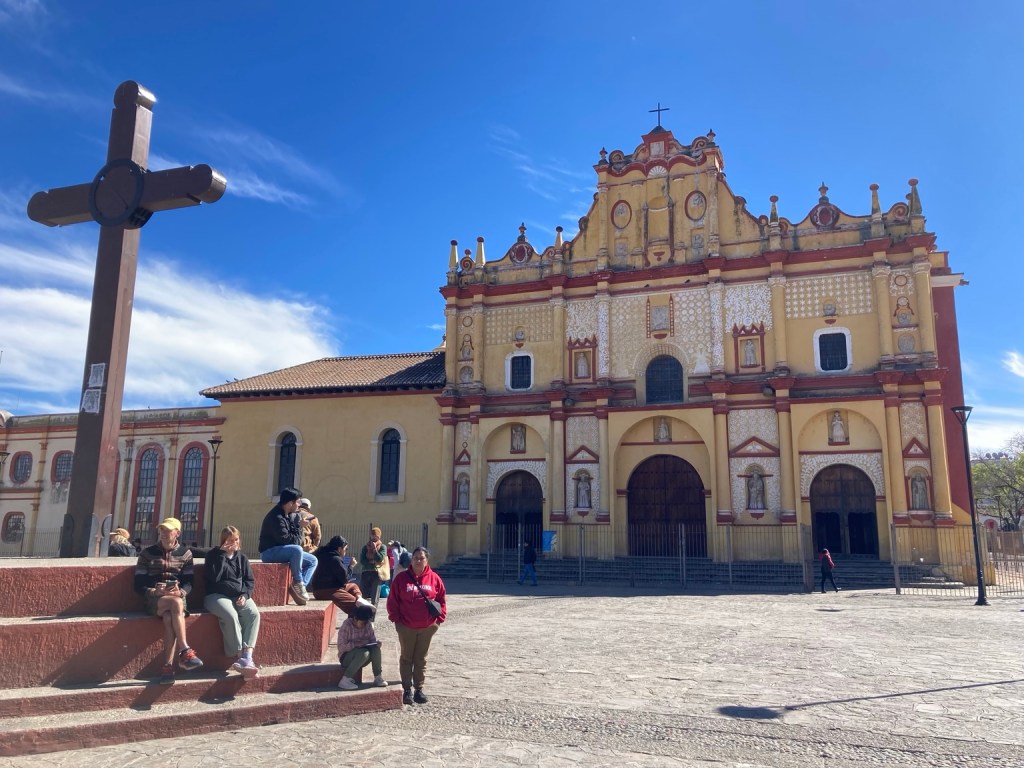
We left our luggage and had a coffee with some pastries we had bought in case we were peckish. We couldn’t check in properly till after lunch, so it was a perfect time to go on a walking tour of the town with Voy a Chiapas. We met at the cross in the middle of Plaza de la Paz right in front of the Catedral de San Cristóbal Mártir …
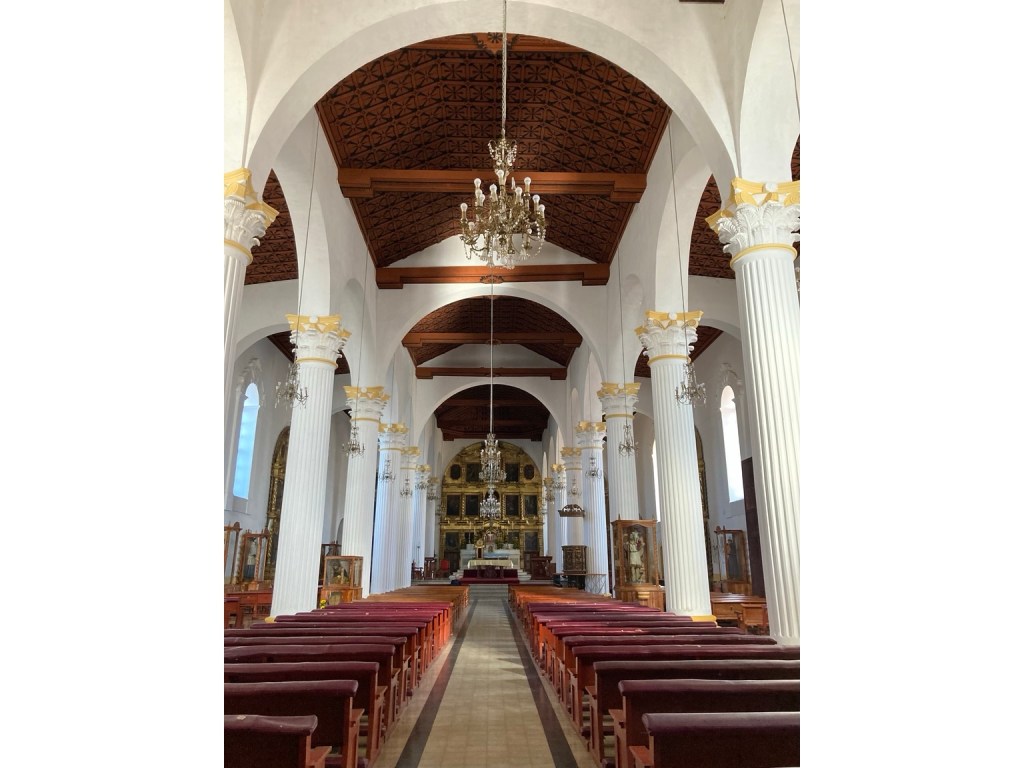
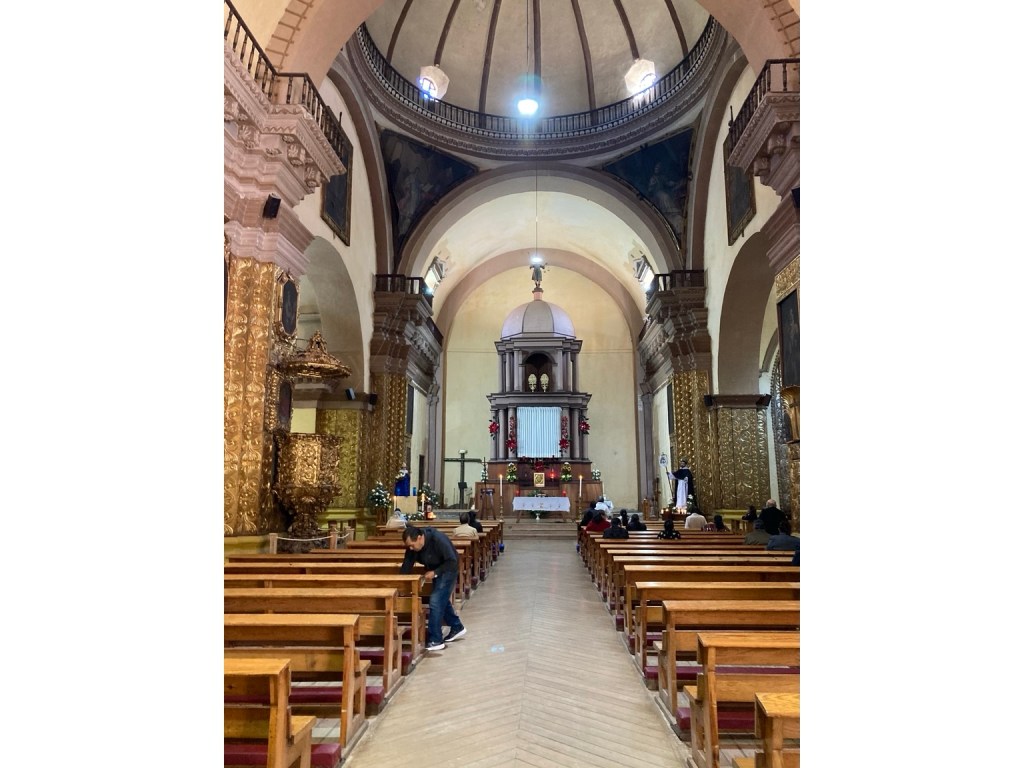
… and had a quick peek inside while we waited.
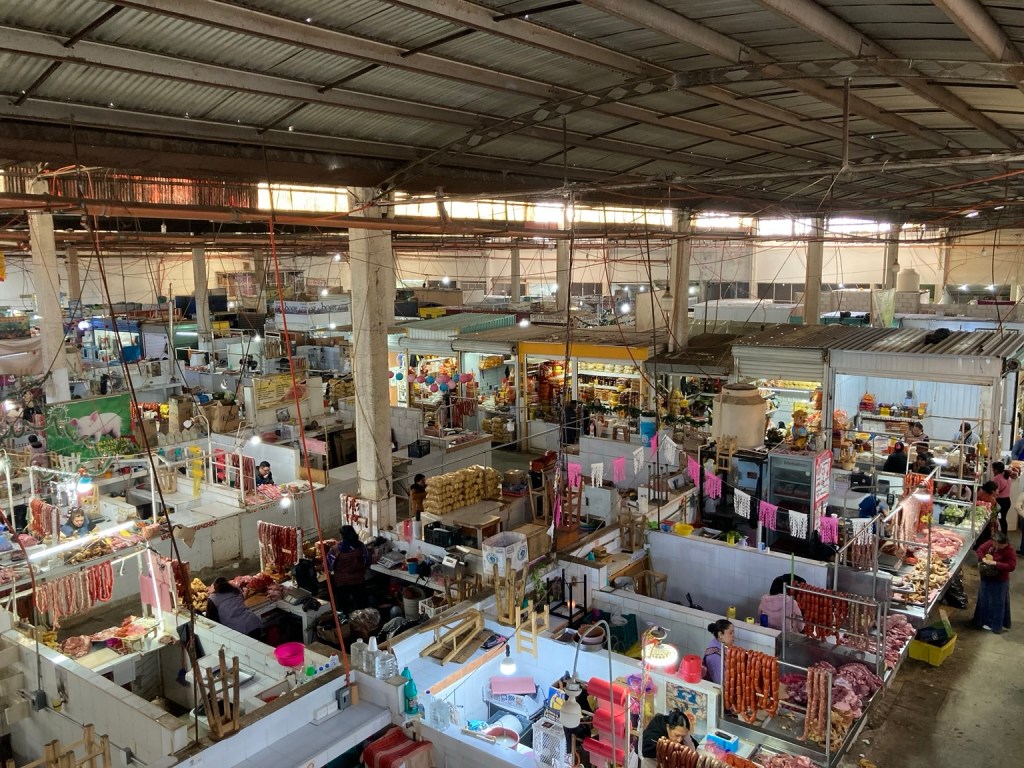
Our guide was Anna and we began by walking to the main market which is so large, it encompasses two churches! Here’s the market …
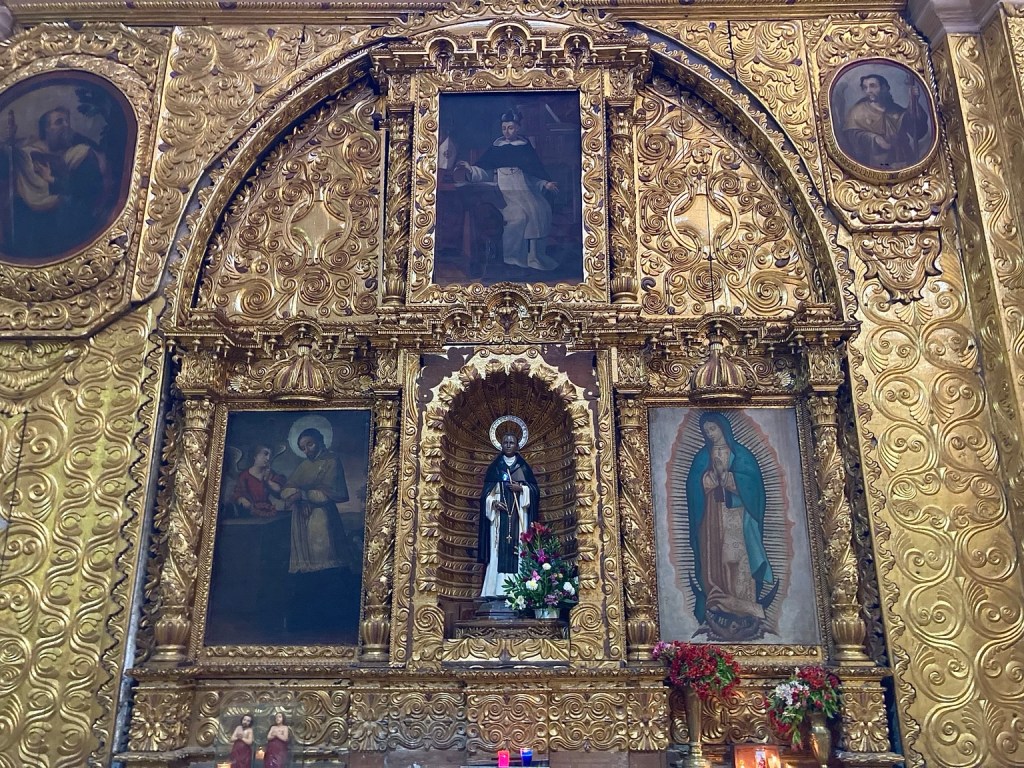
… and Church of Saint Domingo decorated with plenty of gold leaf.
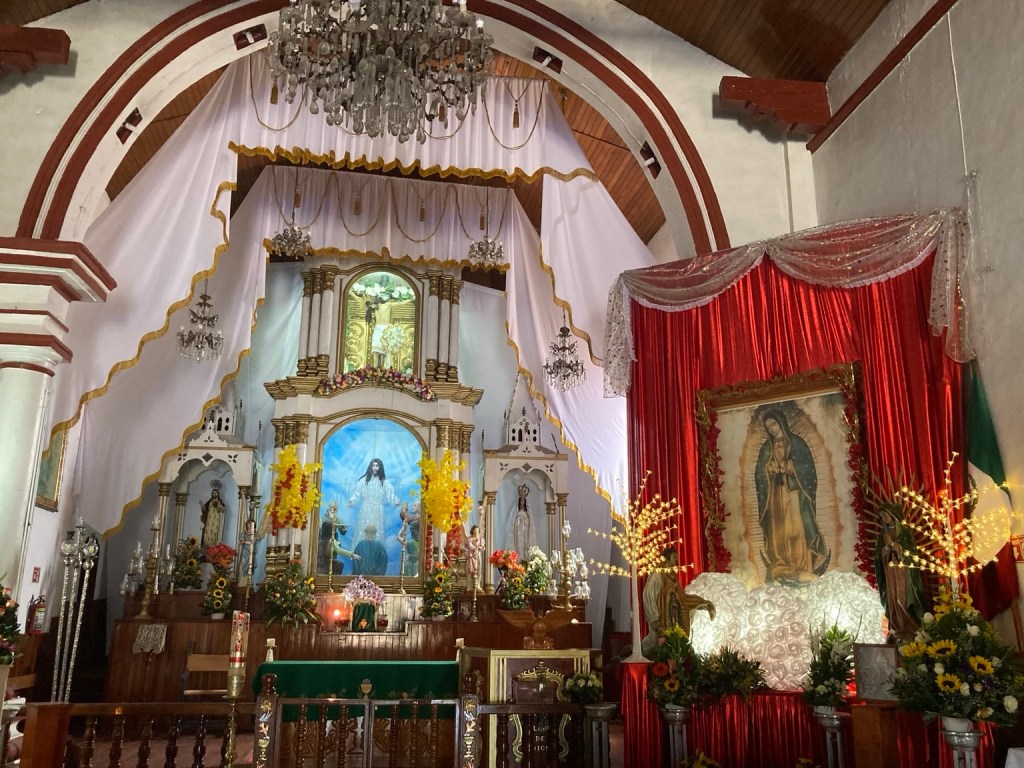
Anna told us of the importance of the Lady of Guadalupe as a profound symbol of Mexican identity. She is always depicted as a woman of mixed Indigenous and European features and she wears a turquoise cape with a sunburst.
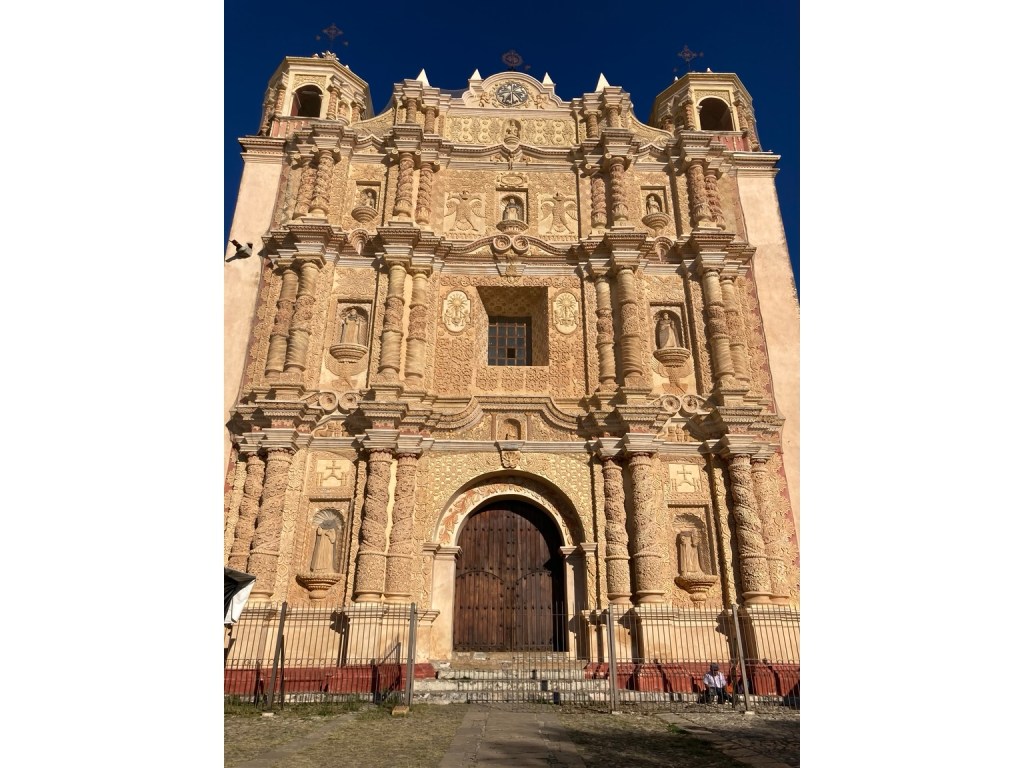
We actually returned to later to see the intricate carvings of the main facade lit with the afternoon sun.
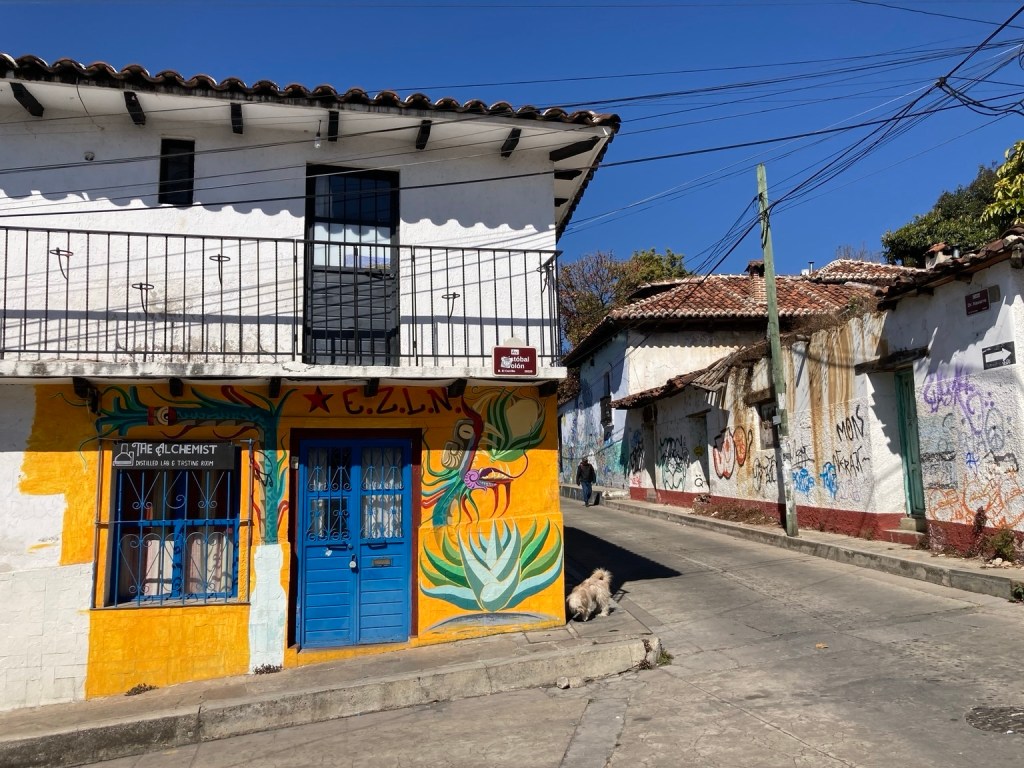
As we walked through the Barrio del Cerrillo, Anna started to talk about Chiapas and San Cristobal. The town was begun by the Spanish as a military fort in 1528. Its elevation in the highlands means that it sees chilly nights and warm days, but temperatures are pretty constant all year. Chiapas, like Oaxaca has a large indigenous population with 12 distinct groups. Here they are directly descended from the ancient Maya civilisation, but each group has developed its own unique customs and culture.
Anna spoke strongly about the life and rights of indigenous people, particularly women, and spends time working with these groups and young people.
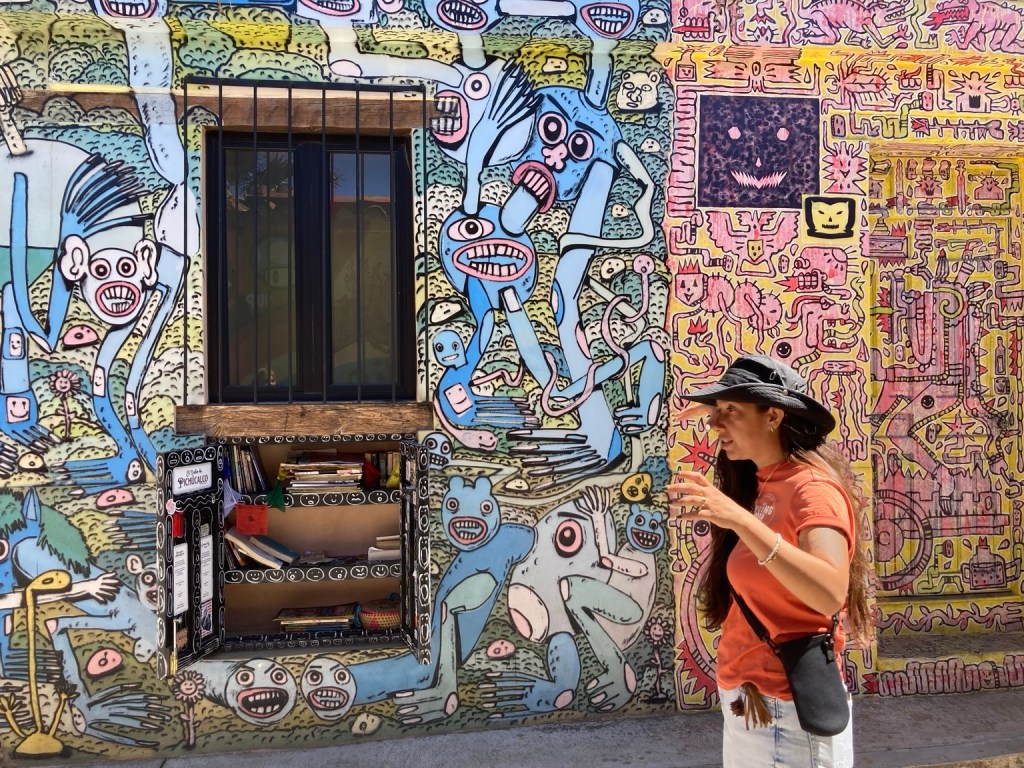
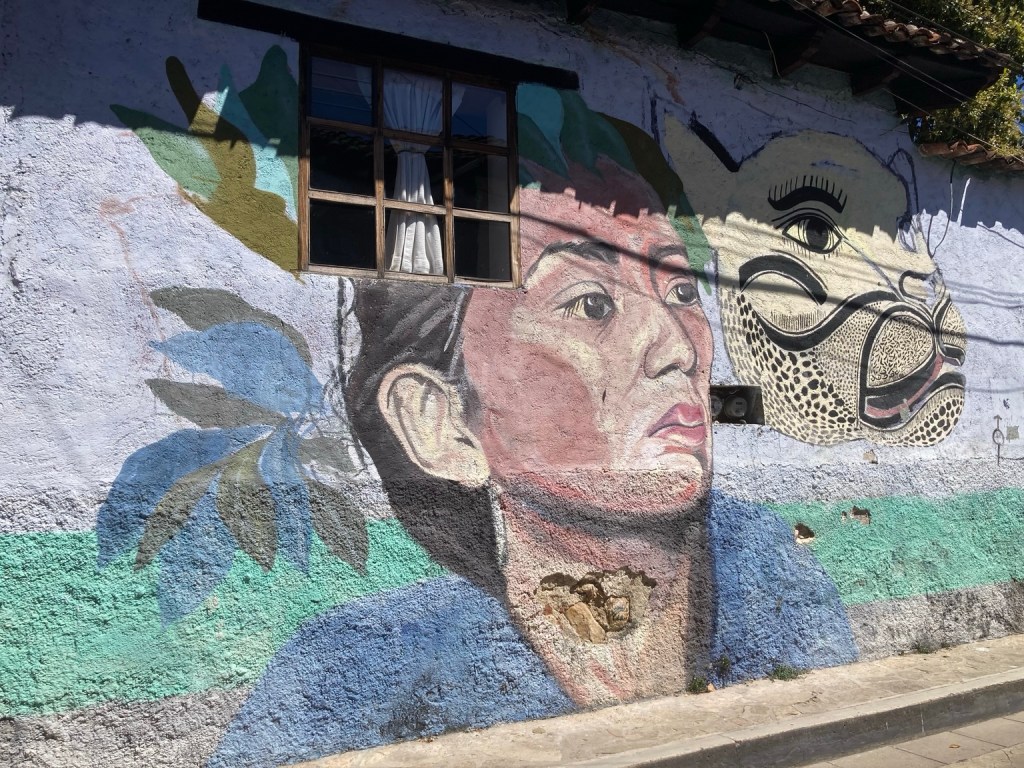
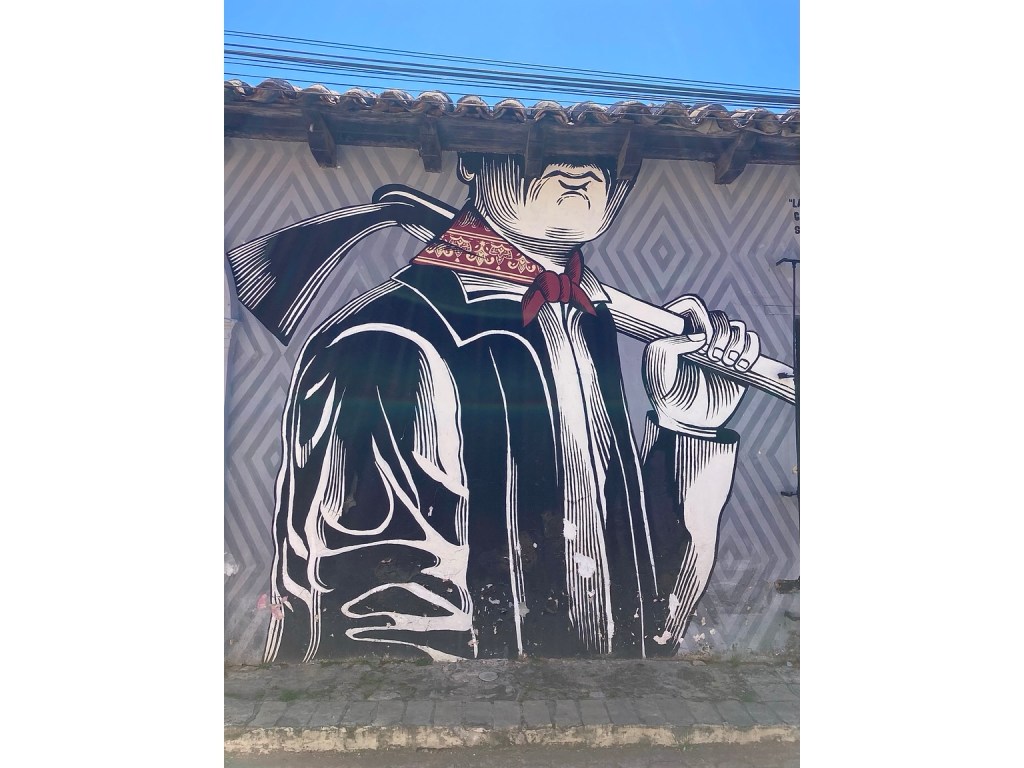
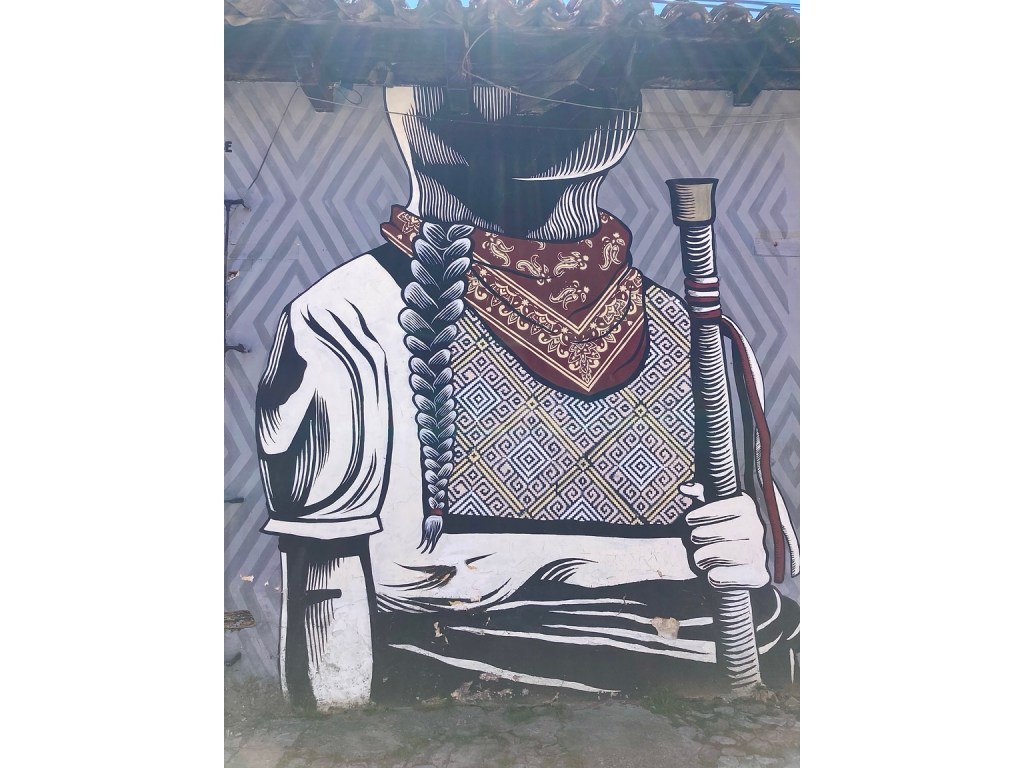
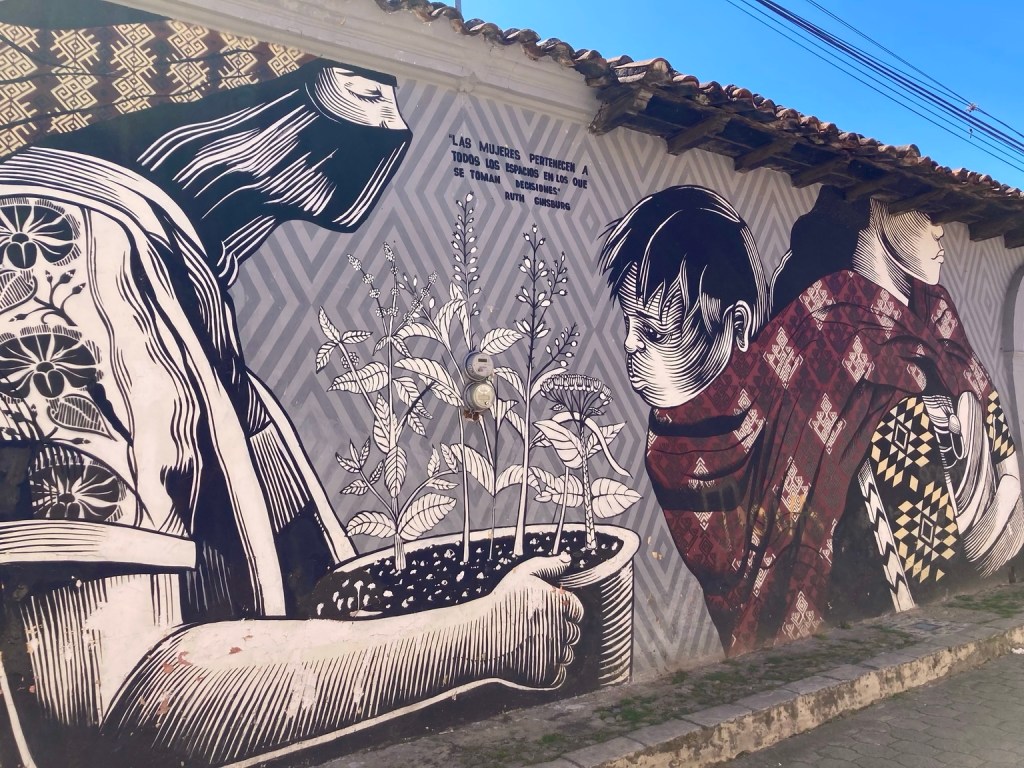
She mentioned the Zapatista uprising in Chiapas in 1994 led by indigenous people demanding equal rights. Several municipal capitals were taken, including San Cristóbal and after 12 days, civil pressure led to a ceasefire. Subsequently, indigenous rights were recognised in the Constitution, but indigenous people still don’t have proper access to education and without even being able to speak Spanish, are obviously at a disadvantage. These murals remember this time and the role women played …
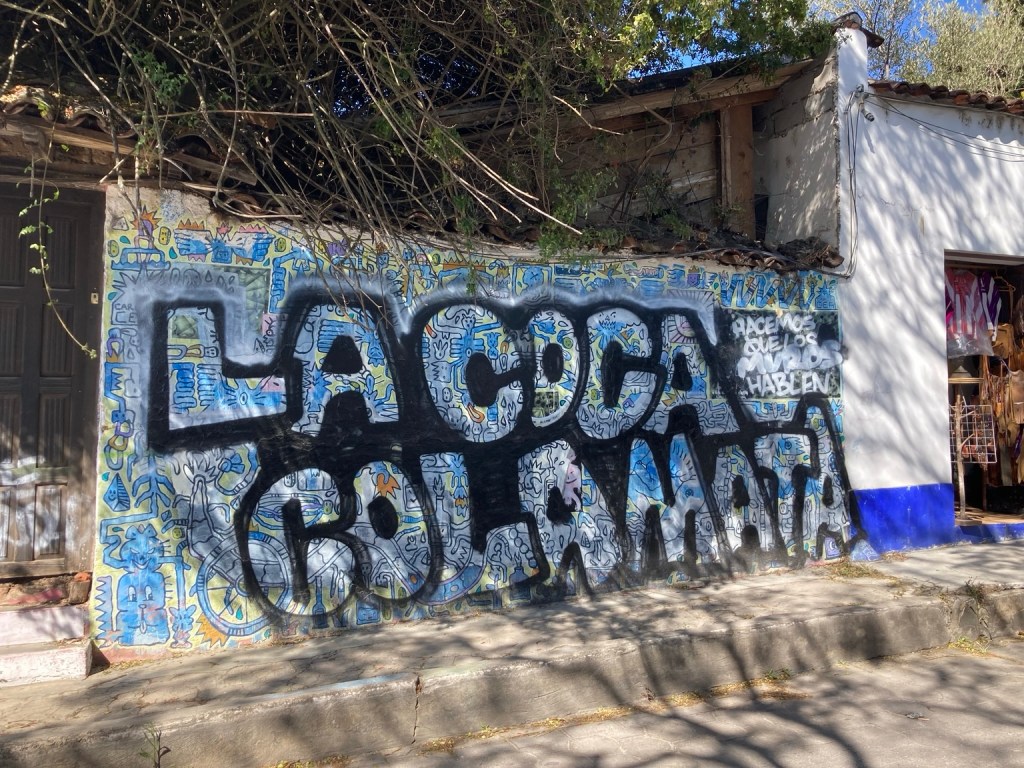
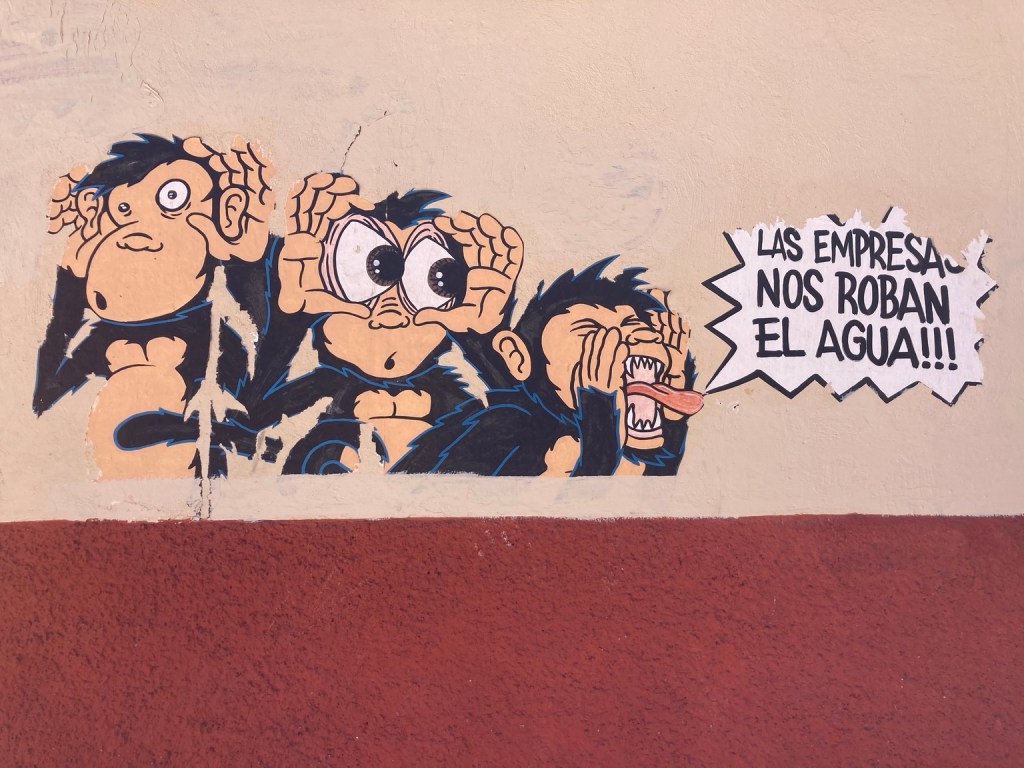
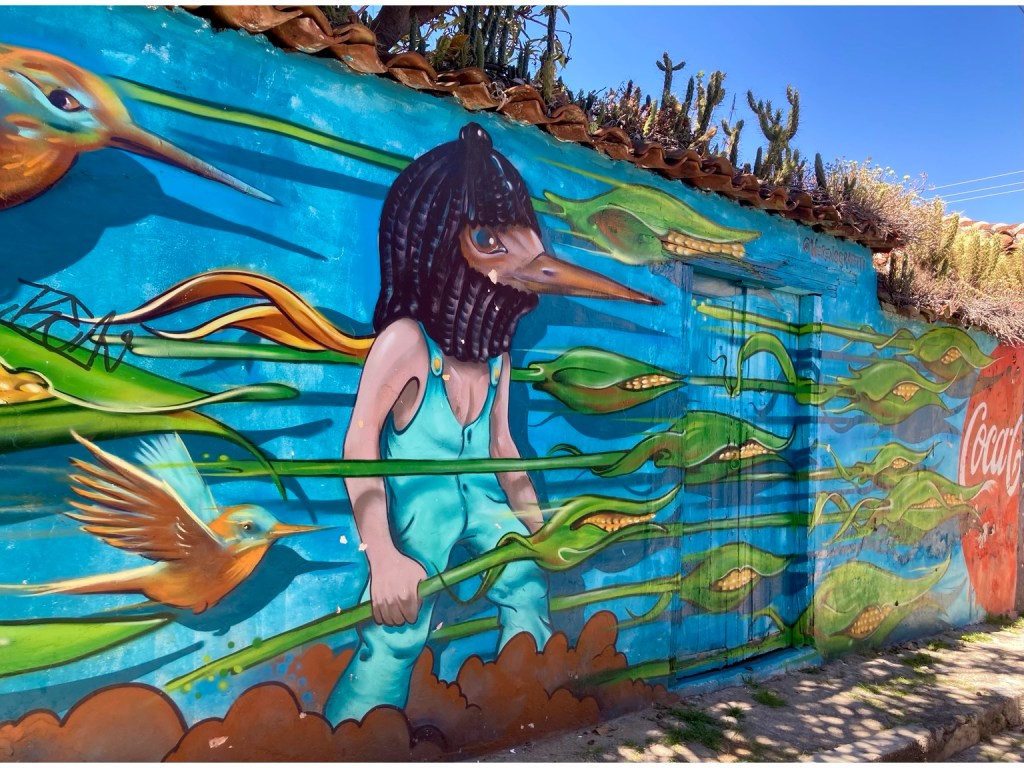
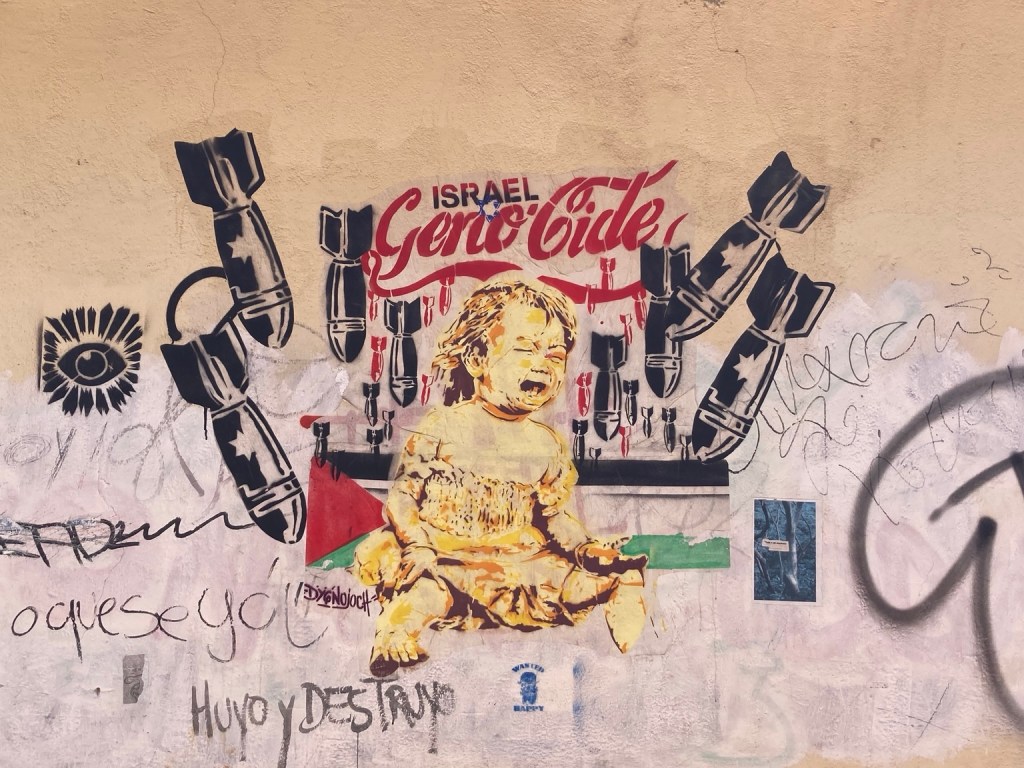
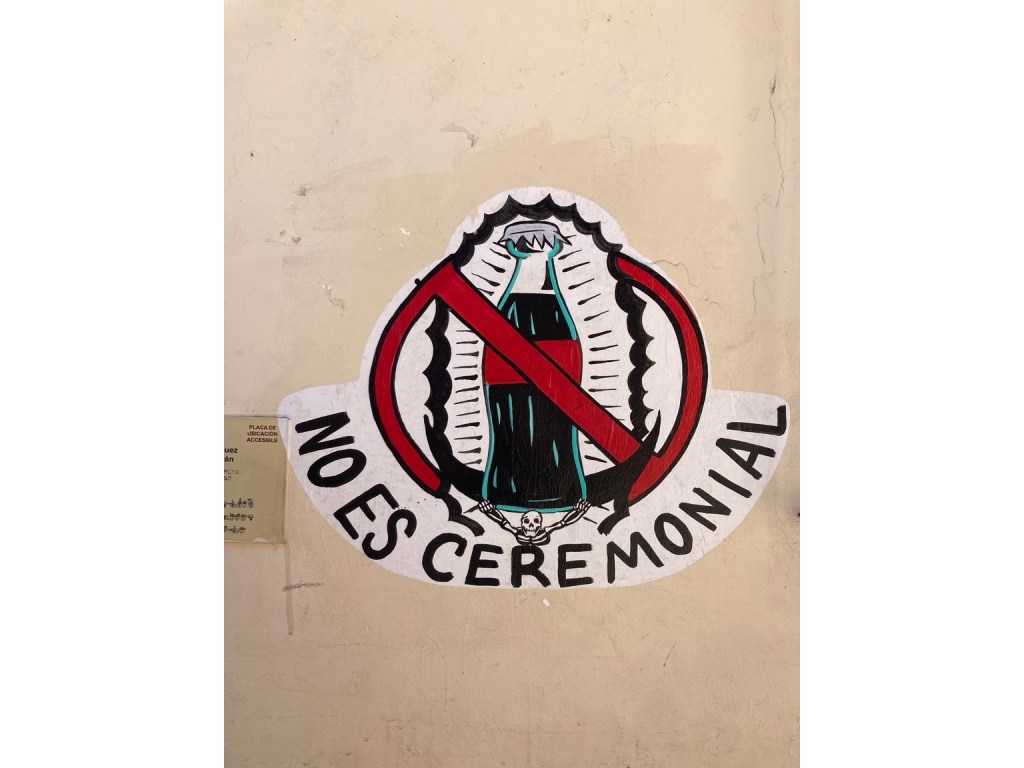
We saw several murals and stickers protesting against Cola-Cola which is deeply embedded here with the world’s highest consumption of over 2 litres a day each. Unsurprisingly, diabetes is a severe and increasing problem here.
Their marketing in the 1960/70s made it a status symbol and a substitute for the traditional alcohol used in religious ceremonies.
In addition, the local bottling plant opened in the 1990s operates under government concessions and consumes so much water it leads to local shortages … but it also employs 16,000 people creating yet another dependency.
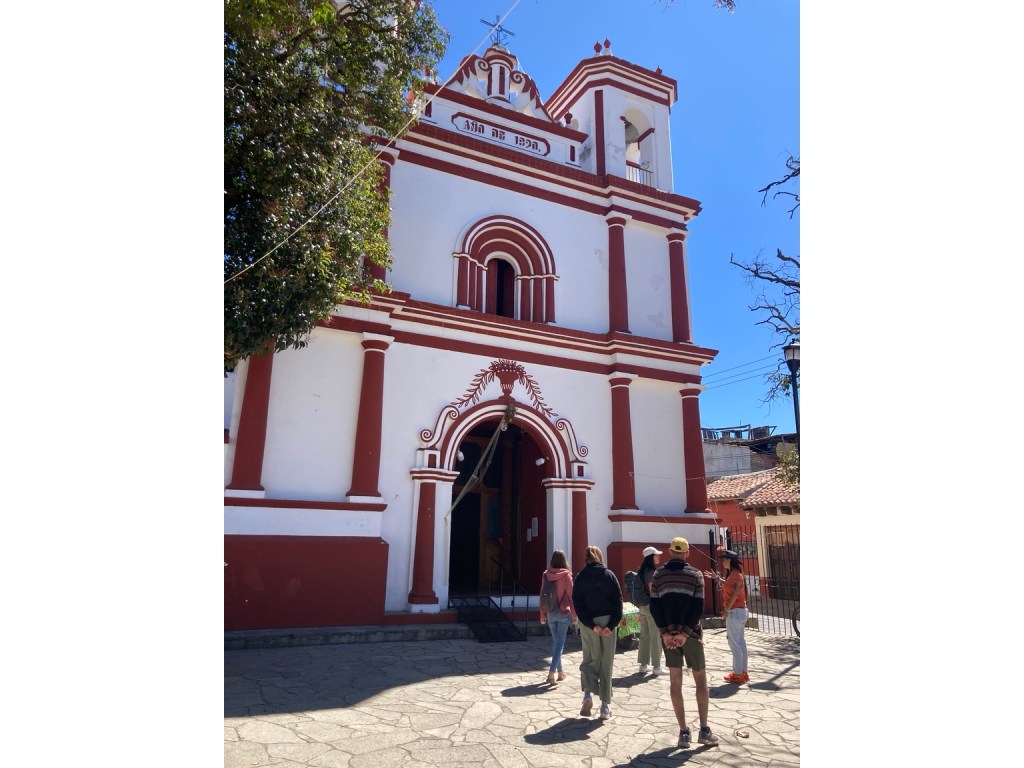
Making our way back, here is the church in the centre of the barrio …
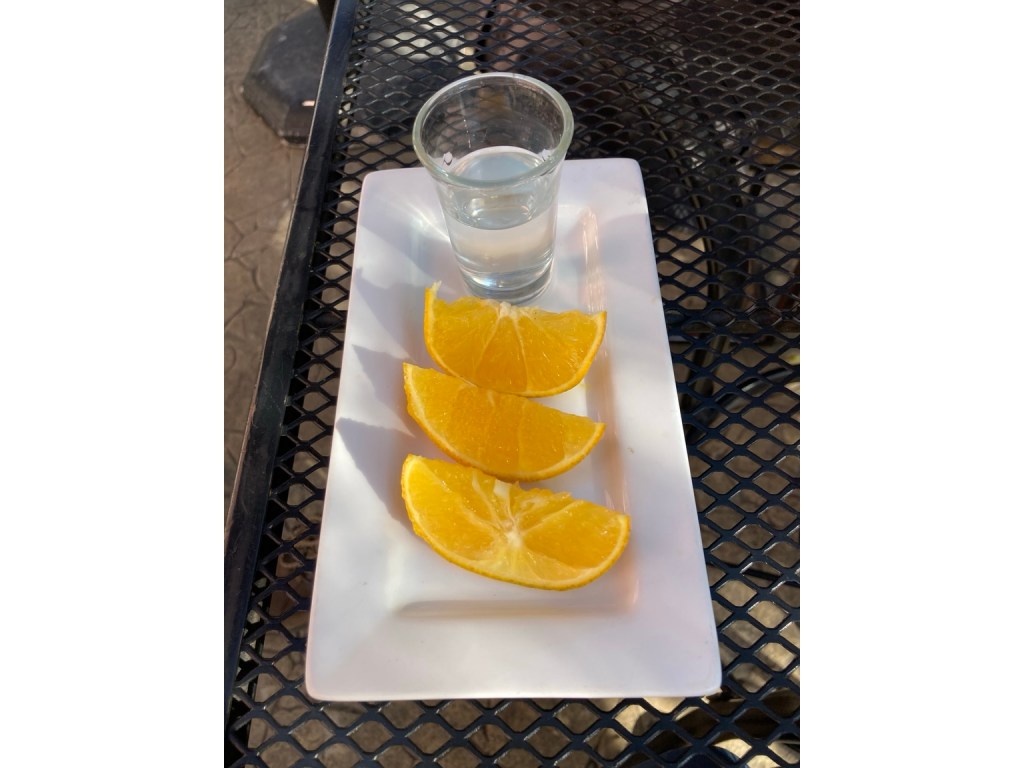
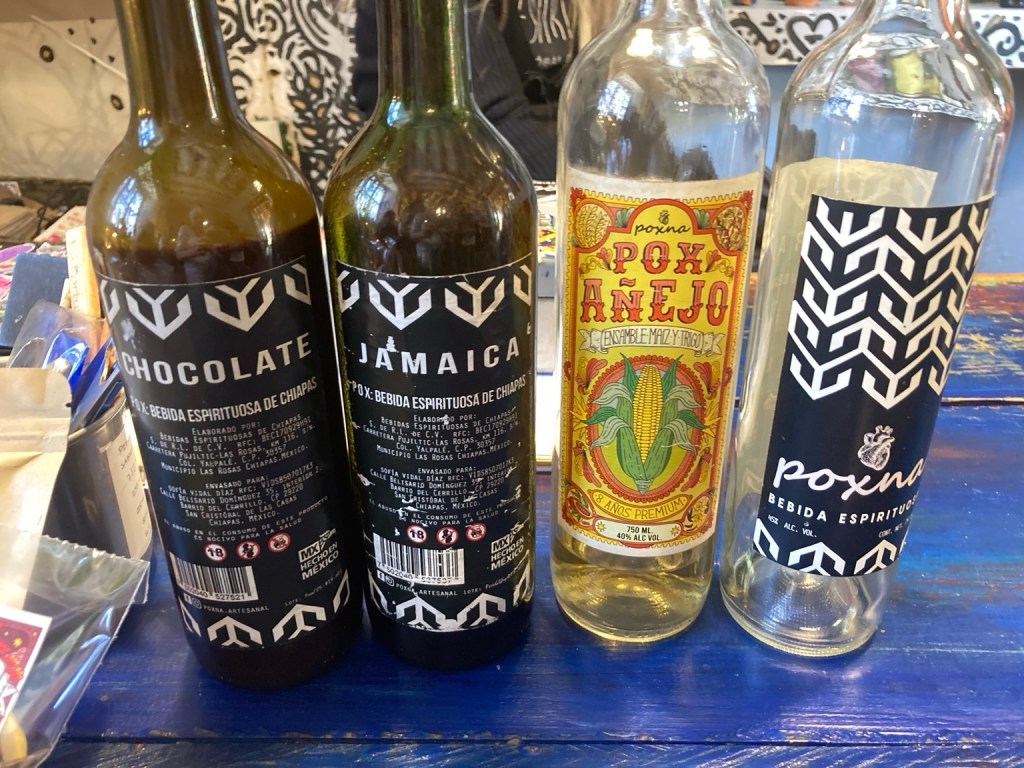
… and we finished at a cafe where we had a tasting of pox, pronounced “posh”, the local artisanal liquor distilled from fermented corn and sugarcane, often used in religious ceremonies.
We tried it neat and also flavoured with hibiscus and chocolate!
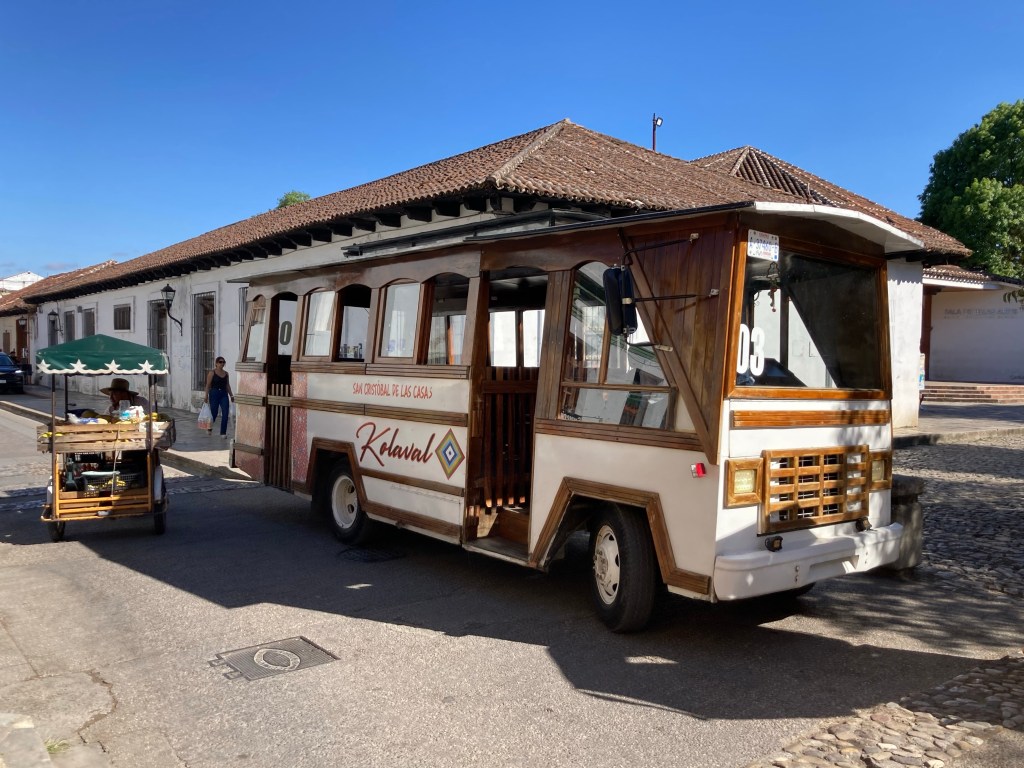
Tzotzil is the indigenous Mayan language spoken in and around San Cris and we learnt that kolaval means thank you, but can also be used as a toast … so kolaval!
After the tour we meandered back, took some downtime and had a huge shock when our phones burst into life with a loud noise! It was an automatic seismic alarm due to continued activity with small quakes 3.0-4.0 reported locally. When we checked, the nearest was 95km away and they were too small to be of any consequence, but it’s worth noting that San Cris has had at least 4 quakes higher than 7.0 since 1900!
An early dinner and we were keen to get a good night’s sleep after our night on the bus.



 Off Travelling Together