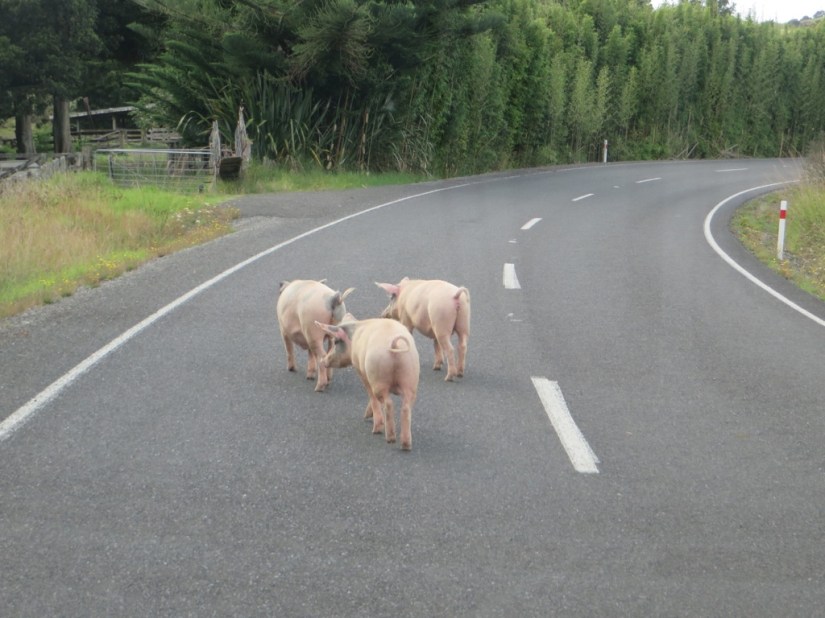
 If we hadn’t needed to slow up for the piggies … on their way to market perhaps … we wouldn’t have missed the ferry … never mind, just another opportunity for a cappuccino!
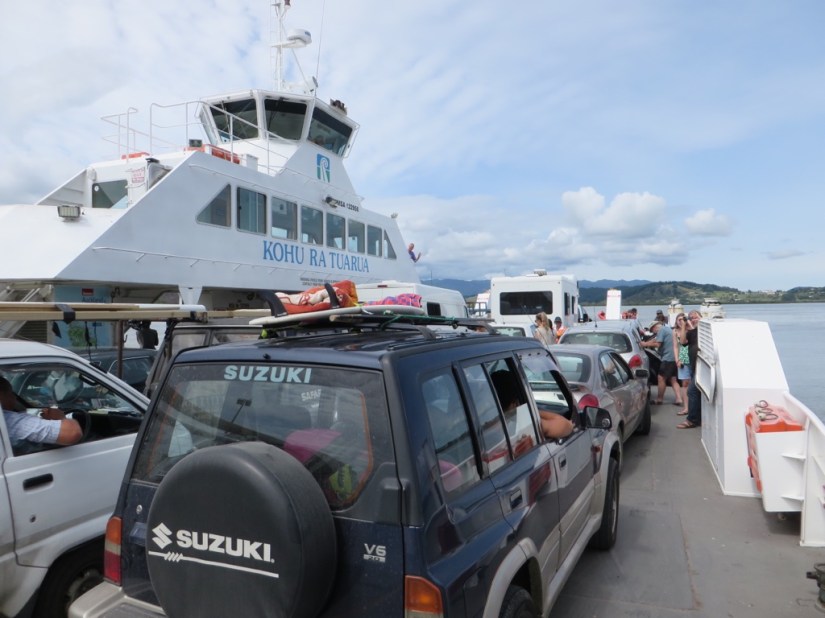
Finally, we took the Hokianga Ferry across the harbour to Rawene which can thank the timber mill here for its pretty weatherboard buildings, some perched on stilts over the water.

On through Opononi, which became famous in 1955 when a young bottle-nose dolphin came into the Hokianga Harbour. Opo became a sensation and attracted hoards of holidaymakers to see his antics in the bay, swimming and playing with the swimmers, but it did not end well as he was found dead, maybe from to much playing and not enough time spent catching food. The lady in the visitor centre remembers swimming with Opo as a young girl and we saw a video of his antics.

Soon we reached Waipoua Kauri Forest, which together with Trounson Kauri Park constitutes the last 100 sqkm of kauri forest that once covered the top half of North Island. The kauri is a type of pine and ranks with the sequoia as the world’s largest trees. It begins life as a conical looking pine, but pushes up through the tree canopy then looses its lower branches and just gets wider.

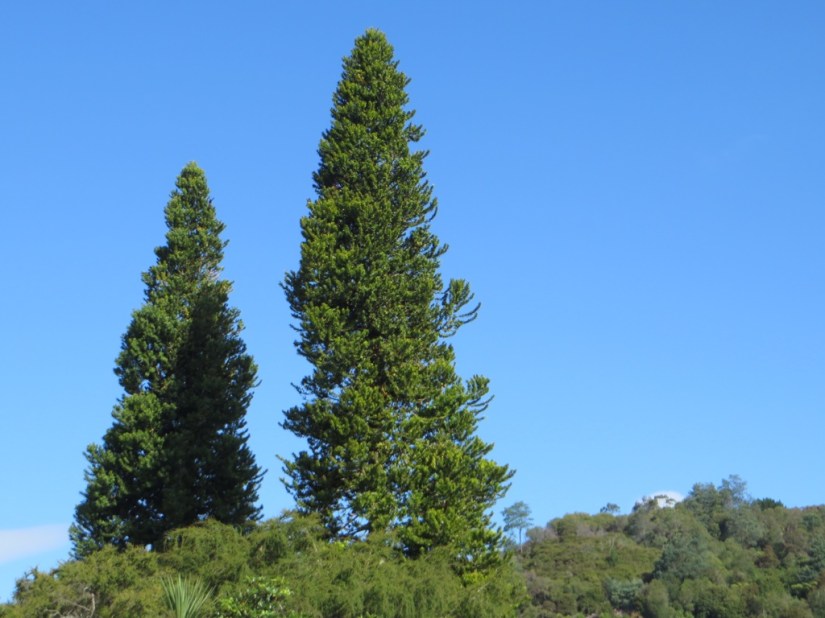

We followed a couple of Boardwalk tracks through the forest to see a couple of the largest known living kauri trees, some 2000 years old, Tane Mahutu, God of the Forest with trunk height 17.68m, total height 51.5m and trunk girth 13.77m …

… and Te Matua Ngahere, Father of the Forest, slightly smaller …

… as well as a stand of four threes called the Four Sisters. Needless to say, the photos don’t do justice to the majesty of the trees.
The campsite we stayed at ran a guided night walk round Trounson Kauri Park in the hope of catching sight of a kiwi, NZ’s famous nocturnal bird, featured on shoe polish tins everywhere! Despite our best endeavours, after a couple of hours we called it a night and returned to camp … no kiwi spotting for us. The nearest we got was hearing a male and female call to each other and a lot of tramping around following a chap with a red light!

Next day we stopped at the Kauri Museum to learn more. The Maori used the kauri sparingly as with hand tools, working these huge trees was hard, but once the European loggers arrived with equipment, most of the trees had gone by the end of the 19C. Once the trees were cleared, the gum diggers moved in. The trees produce a resin to cover any scars and huge lumps form on the trees, which then fall off and get buried. Maori chewed the gum, made it into torches and used it for a tattoo pigment but the Europeans used in varnishes and linoleum and dug up all they could find for export. There were hundreds of photos showing logging, gum digging and the life of the workers. We also saw machinery used to process the wood in every way, examples of furniture, huge pieces of yellow polished gum and we could see how hard the life would have been, but what destruction it caused, and the trees are now gone.
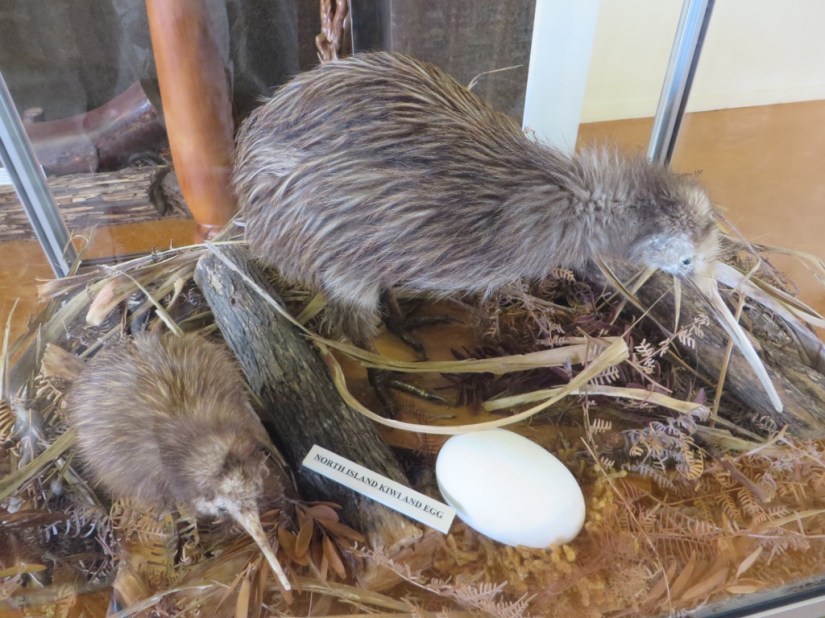
Oh and I guess this is as close as we’re likely to get to a kiwi!
 Off Travelling Together