Next morning was clear and I asked where the best place was to spot Mount Triglav and we were directed to the pretty bridge in the centre of Stara Fužina where I got a perfect shot! We thought this was a great place to end as we drove off towards the airport.
It’s always strange knowing how to spend the day with an evening flight, but we used the time by taking a mountain detour through Pokljuka with some lovely views but no safe stopping places. We also saw men wearing what looked like skis on rollers making their way quite fast up the road carrying ski poles.
A little later we had pulled over the check the map and a van pulled up with Team Germany on the side, and then the man leading in a yellow jersey came to a stop to get water. We found out that this was Benedict Doll, a German biathlete and winner of a couple of Olympic medals. I had to Google the biathlon to understand this is a winter sport combining cross country skiing and rifle shooting in a race, and this was summer practice!
Anyway, that’s really the end, nothing more to report as we wait at the gate for our delayed EasyJet flight home, munching complimentary breadsticks!
As they say here … zelo dobro … which means very good … and everything has been, with friendly people, beautiful scenery and great food so we feel sure we will pay another visit.
Not quite sure when we will be off travelling together again as there is nothing planned … yet!
Today I walked from the bridge to Ukanc, along the footpath than runs close to the northern shore. It was very peaceful …
… with lots of wildflowers…
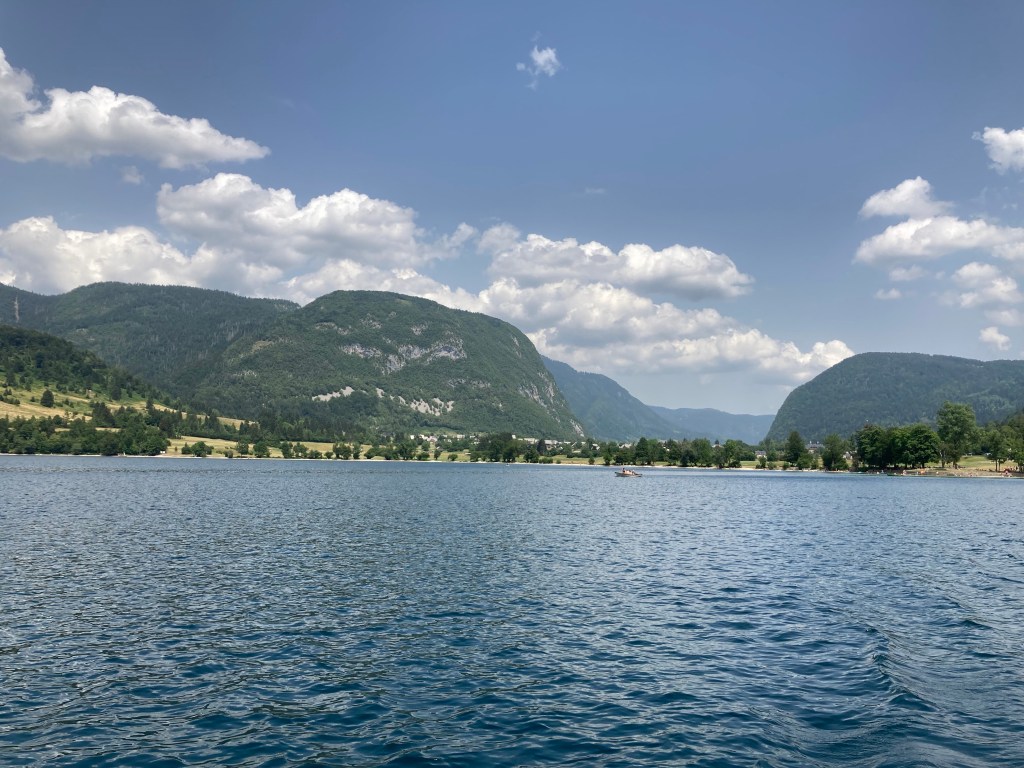
… and views of the lake and mountains …
… including for the eager eyed, the Vogel cable car.
Towards the end, the path crossed the Sava Bohinjka river …
… then in Ukanc, I met Chris who had come by boat. I had a swim to cool off followed by coffee and we took the boat back together.
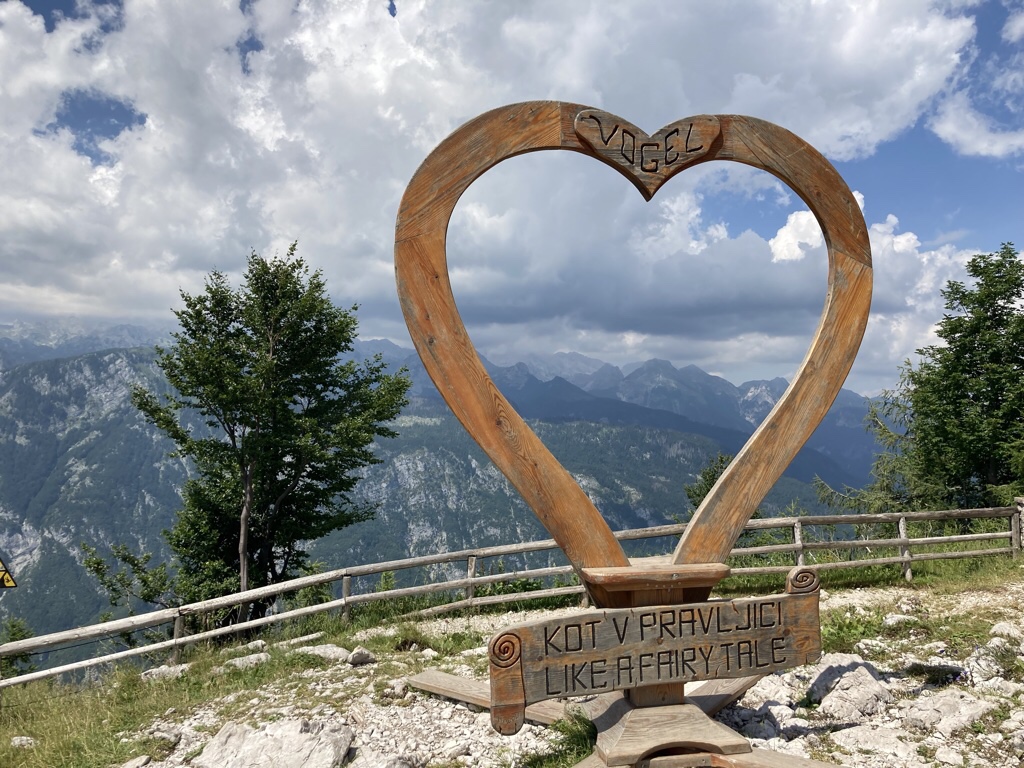
Next stop was the Vogel Ski Centre so we could take the cable car on a 4 minute ride to 1535m.
The views down and across the lake were great …
… and we could see Mount Triglav, the tallest peak in the National Park which is just to the left of the cable in this shot.
After having a look round …
… we took the chairlift still higher, to 1670m …
… and then back down again!
We stopped for a swim stop on the way home where even Chris had a paddle! The shore of the lake is quite stony all round so getting in is hard on the feet … especially without the water shoes we left at home!!
On our way back we stopped at the Alpine Museum …
… which gave the history of cheese making in the area, learned from a Swiss chap from Emmental so the local cheese is of a similar style.
The curator of the museum was so enthusiastic and informative that it really made the history come to life. It must have been hard, taking cattle to mountain pastures and living in a hut on your own for several months before returning with your herd to your family before the winter.
It’s no surprise that this way of life pretty much died out, but more recently, young people are returning to the old ways now that there is a premium for organic products and tourism and we bought some cheese to take home.
Our last night in Slovenia and we returned to Gostilna Bohinj, the local restaurant where we have eaten every evening.
Tonight’s meal was just as good, an amazing mushroom pizza for Chris, complete with fresh porcini, and tenderloin of pork for me with štruklji and mustard sauce…
… together with the recommended local red, with Mount Triglav and Zlatorog, the golden horned chamois on the label.
I heard another thunderstorm in the night with the rumbles echoing round the mountains while the rain came down hard, and when I looked out, the morning was misty and cooler with cloud hanging in the valley and the promise of a mixed day so we settled on exploring.
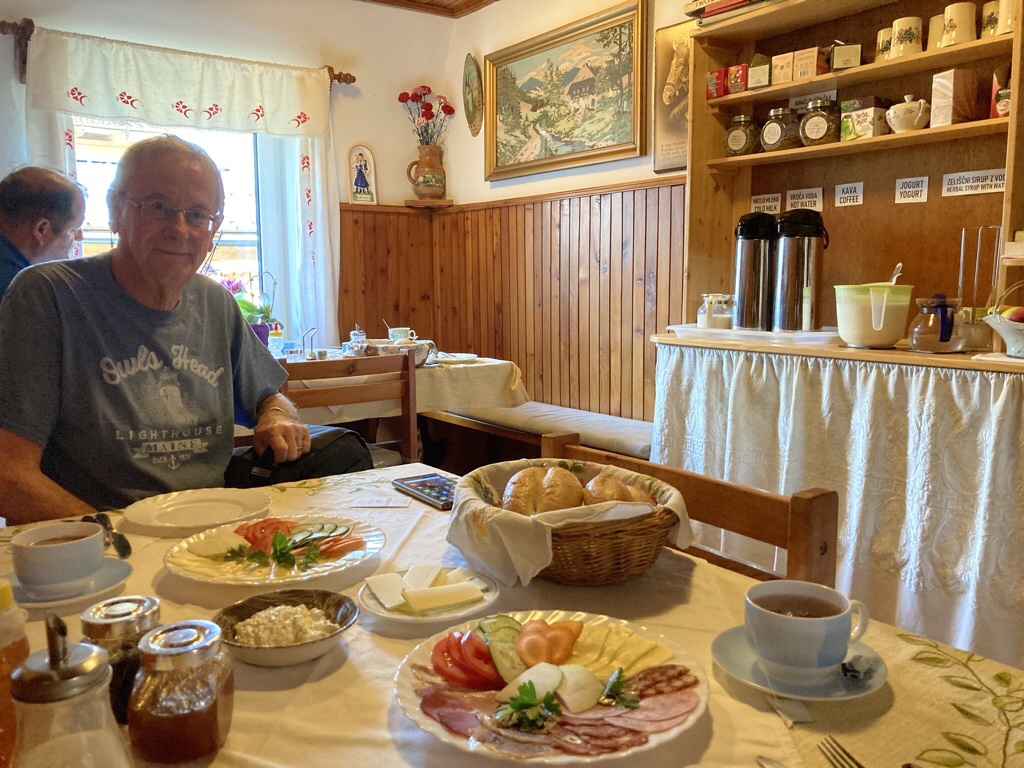
Breakfast was a spread of beautifully presented cold cuts and cheese, eggs cooked to order and bread with homemade jam.
I walked down through the village to the lake …
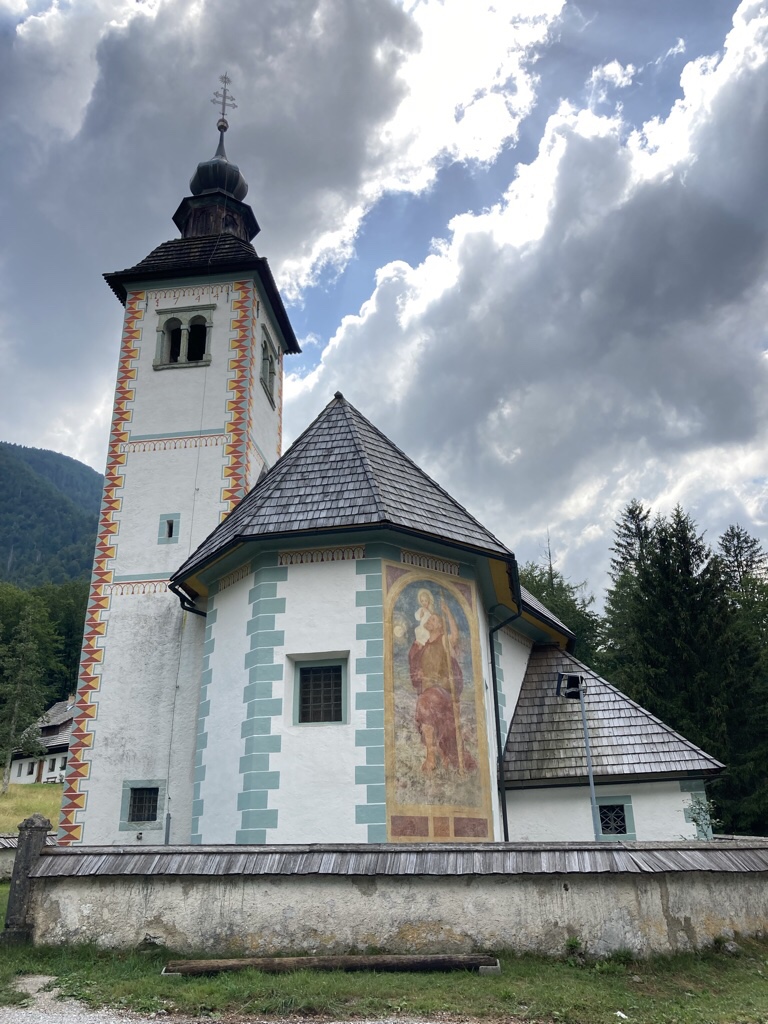
… and met Chris who had driven. The church by the bridge is dedicated to St John the Baptist with a scary wooden decapitated head on a plate just inside the entrance dating to the C14th, which used to be worshipped by those with head or neck complaints.
Outside there is a medieval porch with a square painted coffers on the ceiling and paved with round river stones dating to 1639.
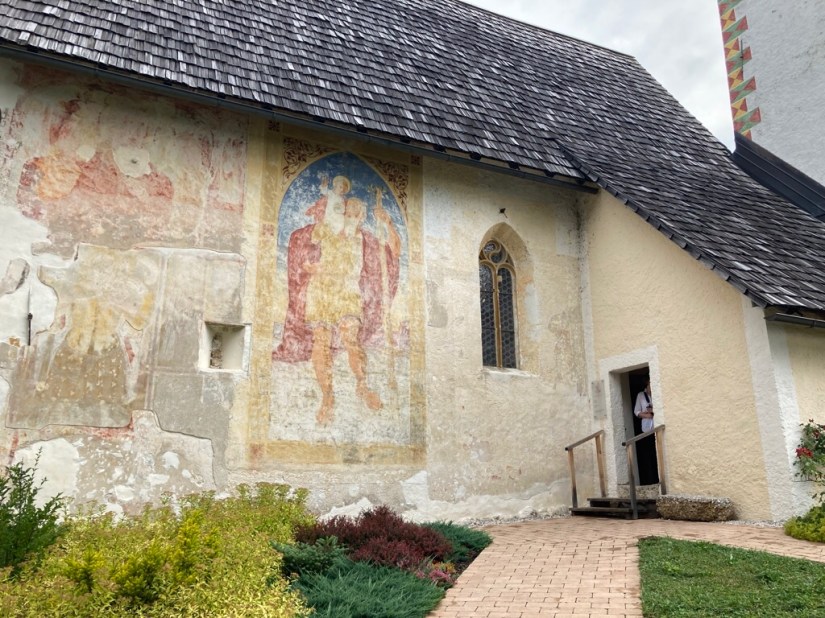
The St Christopher on the outer wall was common in the Middle Ages as people believed they would not die a sudden death during the day if they had looked trustingly at an image of St Christopher in the morning.
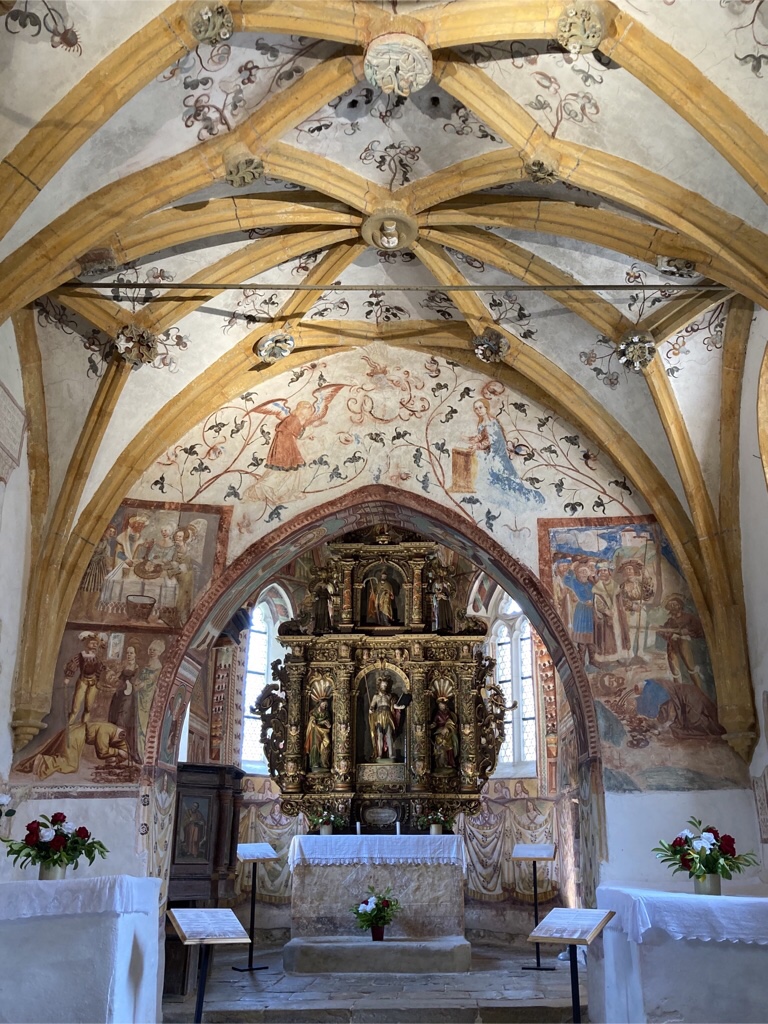
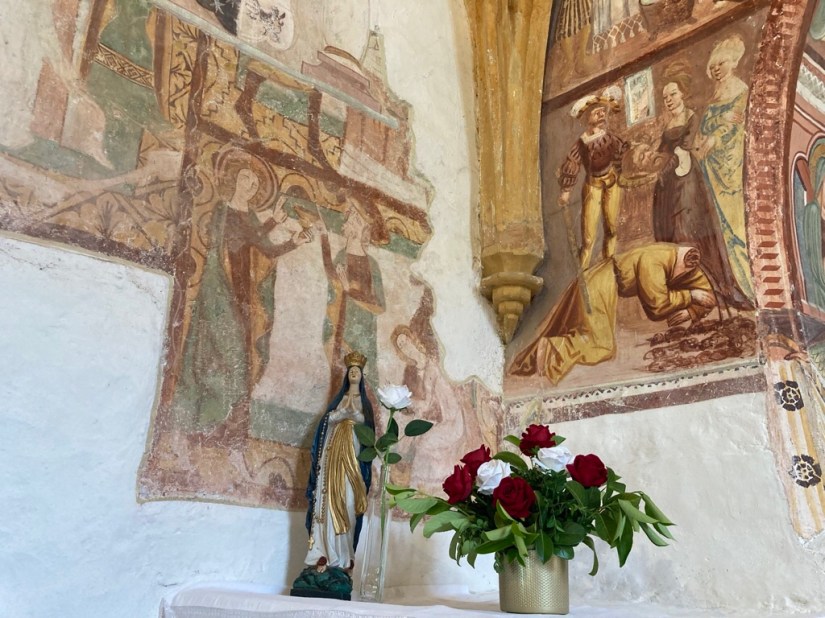
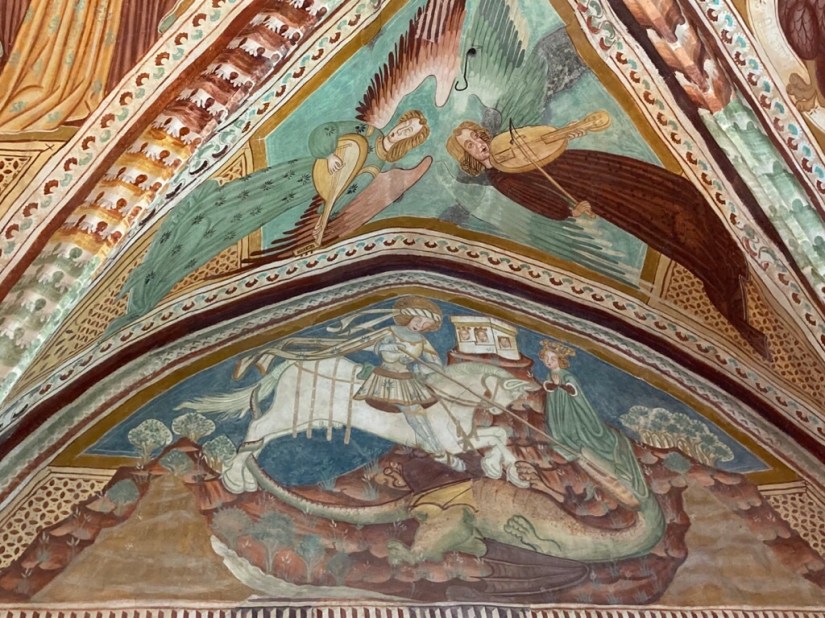
Inside was richly decorated with frescos …
…. the earliest from the C13th being this one of St John the Evangelist.
The richest in the presbytery dated to the C15th such as George and the dragon …
… Mary and Christ with apostles below …
… the baptism of Christ …
… the ceiling with a boss of Christ with angels and evangelists …
… and angels holding a curtain all around the lower wall.
The bell tower was there to be climbed and naturally gave a view of the lake.
We were surprised how quickly the temperature had risen, but after all that rain, it was humid too. We continued to Studor where we looked round one of the three museums included with our tourist card, Oplen House, a traditional local house built in the early C19th.
The story of the family who lived there for the last century before it was abandoned in 1974 brought it to life, together with the household effects and furniture still there.
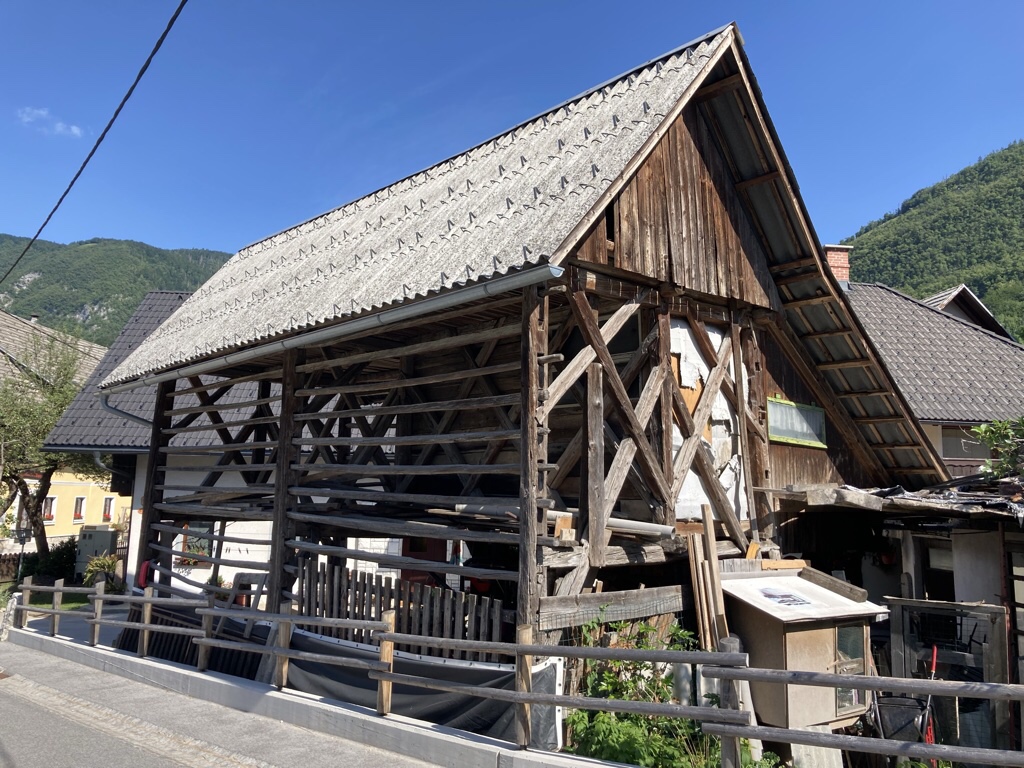
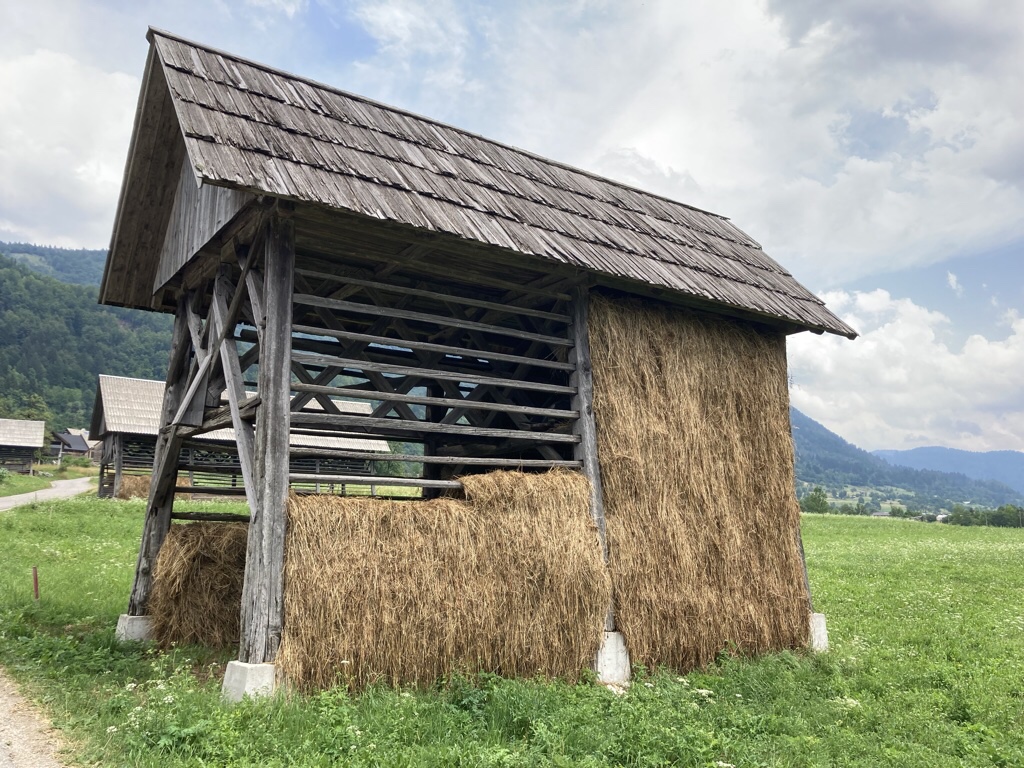
So now I have to talk hayracks, which we have been spotting since our first day in Slovenia. Often there isn’t a safe place to stop and take photos, so we saw loads before we had pics. To begin with we thought they were for drying crops …
but then we saw them used to stack and keep firewood dry.
Later we saw more complex racks combined to make a kind of barn …
… and then today we finally saw them used for drying hay!
The next museum on the list was shut for lunch so we had a coffee and watched as the sky darkened and a few drops of rain fell. The museum hadn’t reopened, so we headed back to the lake, along very wet roads, which just shows how localised the showers are, and continued along the side of the lake to the second church on the lake. There are a couple of stories about the building of The Church of the Holy Spirit in 1743, one that it was part of three vows made by farmers on the advice of a monk after three years of poor harvest because of a worm and the other that it was advised by the Pope to end the drought, hence a roof like a camel’s back!
And it has a St Christopher on the outside wall too!
There was a small wooden dock by the lake …
… and a perfect spot to go for a swim before catching the panoramic boat for our daily trip.
By the time I’d walked back to the guesthouse, I felt I’d got my steps in, good job with the huge plates of dinner they serve here like my Kranjska klobasa, served in the traditional way with potatoes, sauerkraut and mustard.
It was a short hop from one lake to another as we left Bled and drove to Bohinj (another silent j!). Despite being only 25km apart, the atmosphere is completely different … Bled is a bit smarter and more sophisticated, while Bohinj has a relaxed rustic charm of its own.
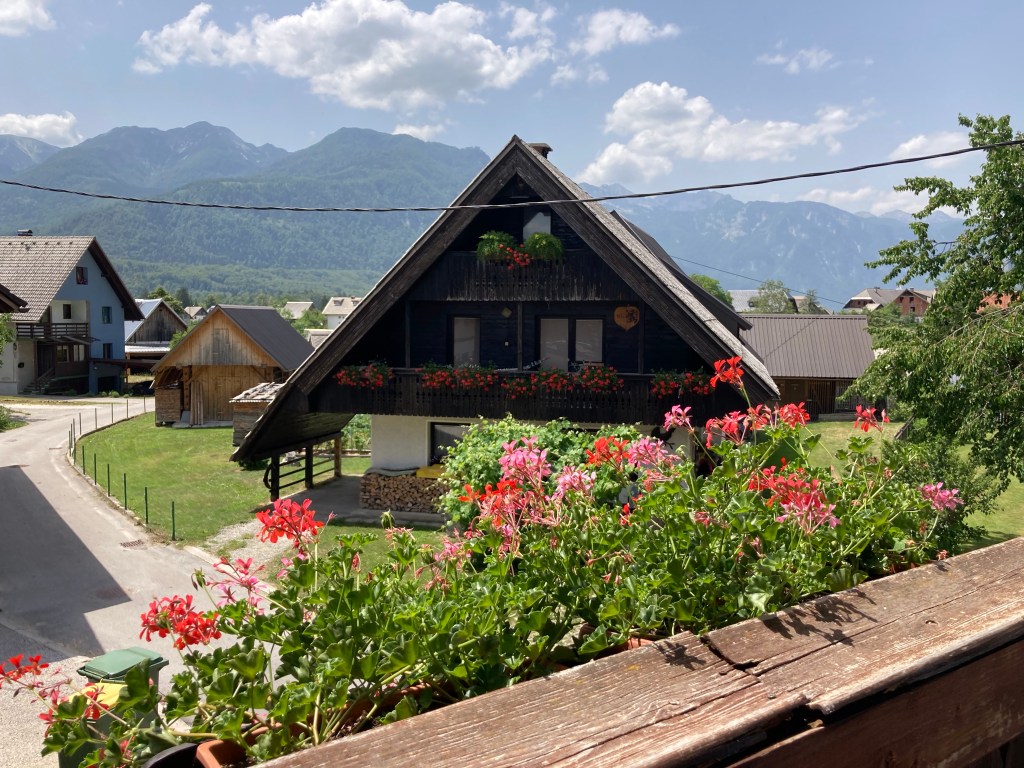
We are staying with Tanja and her family at Rooms Pekovek in the village of Stara Fužina, near to the lake.
She welcomed us with peach schnapps made by her mother and told us how we could make the most of our visit. Being within the Triglav National Park, there is a real push to be as green as possible here, so we bought the tourist card that enables parking in designated spots and free use of public transport, including a daily return trip on the electric panoramic boat which runs up and down the lake almost silently. It seemed like the perfect way to get our bearings so we headed for the lake.
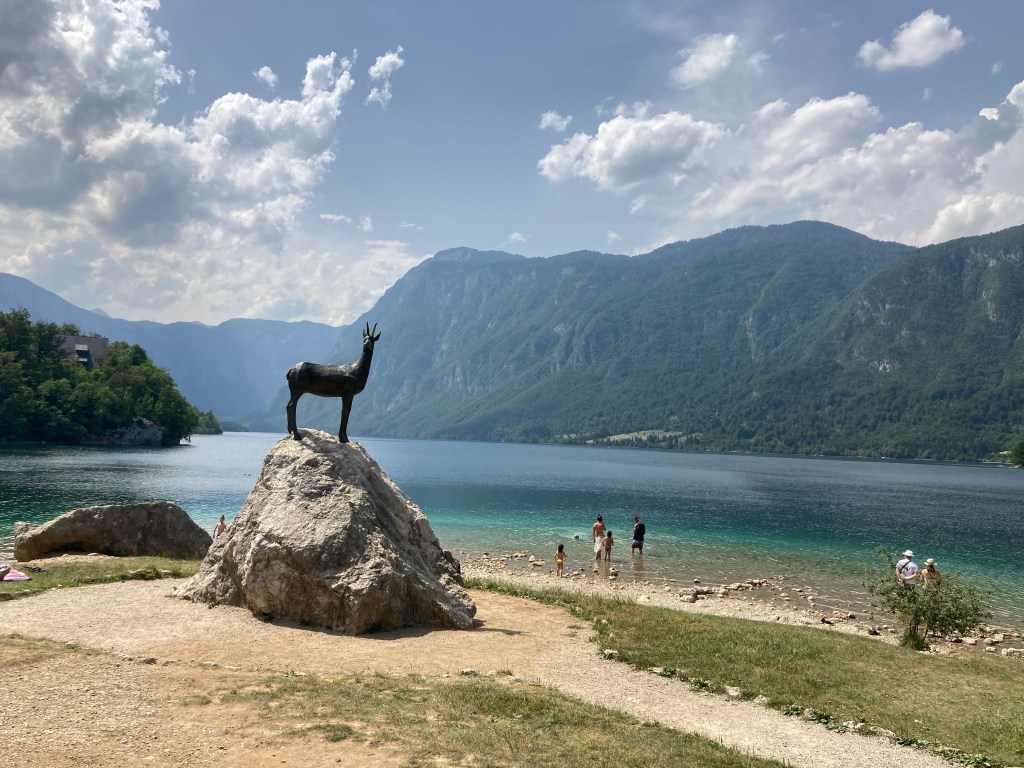
While we waited for the next boat we looked around. The iconic views of Lake Borhinj either include the church and the bridge or Zlatorog, the golden horned chamois of Slovenian folklore. Even the summary of the tale is complicated, suffice to say it includes a handsome hunter, a beautiful girl, a couple of rivals, the chamois, magic flowers and an unfortunate ending!
Once aboard, a brief commentary explained it is a glacially formed lake basin holding almost 100 million cubic metres of water and that the flow through the lake is so great that the water replaces itself three times a year.
It’s about 1km wide and just over 4km long and took 30 minutes to reach the far end at Ukanc, which legend says comes from ‘u konc’, which is said to mean the end of the world.
There is a campsite and water sport centre and a 10 minute stop before the boat returned, although we could have stayed longer.
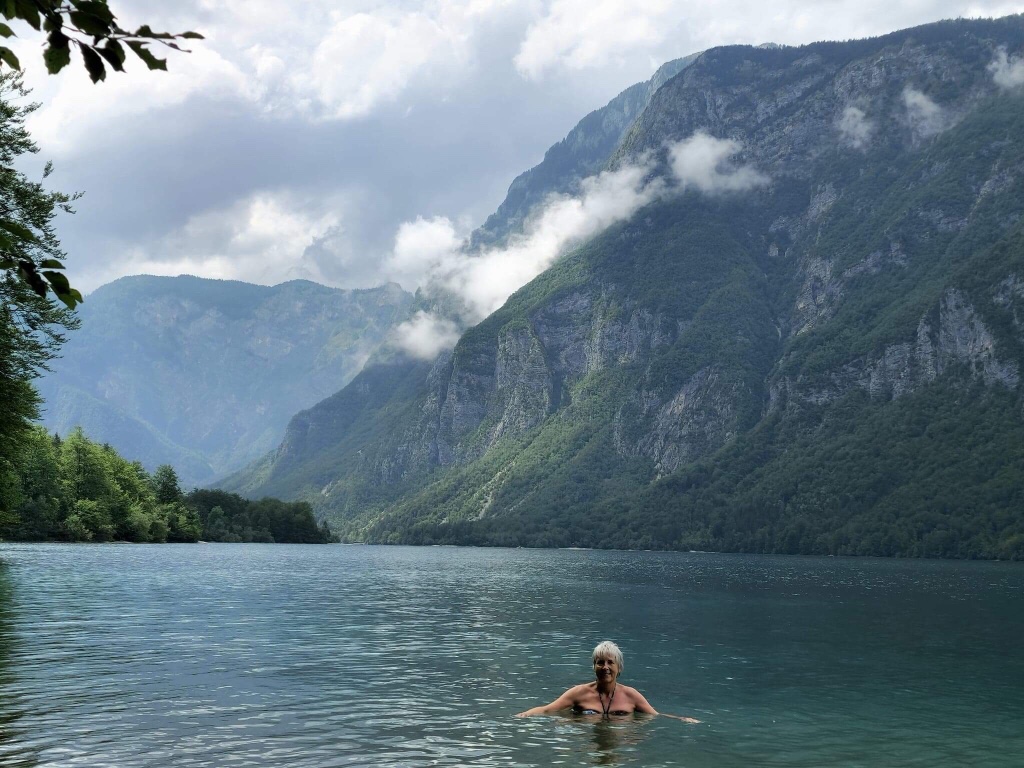
It was very warm when we got back so we parked close to the lake and I took a swim while Chris took photos. It was like the best infinity pool, with barely a ripple and what a view!
The sky had been darkening for a while but by the time I’d got out and changed, the first drops of rain fell.
We joined others sheltering under a tree and to begin with, we just saw it as a photo op.
After a while through, the rain got heavier and the tree no longer provided any shelter …
… so we decided to make for the car park as quickly as we were able, trying to keep our bag of stuff as dry as possible. Some hope! The rain was torrential, but I got to shelter under a roof overhang while Chris went for the car. As we drove back there were hailstones the size of golf balls so I’m glad we weren’t cycling, Back at the guesthouse, wet and chilly, we proceeded to wring the water from our clothes as we took them off. We struggled to remember an occasion when we had been so wet! The storm eventually passed, and we walked to the local (inn/restaurant) for dinner. Apart from a couple of swanky hotels, it was the only place to eat in the village, so everyone was there … couples young and old, families and groups of friends. We shared our table with a couple of Belgian girls as it was so busy. I had venison goulash and Chris chose pizza although both portions were so large, we could have shared a dinner!
Fortunately the rain held off all evening so we got back safely without another drenching.

















 Off Travelling Together