
Well that was a long day, travelling from Baracoa to Havana. We enjoyed a leisurely start, and chatted to Adrian who told us he was a cameraman for the tv company and gave us a copy of a documentary he made about Hurricane Matthew which was very interesting. The flight ended up being delayed by a couple of hours but the waiting room was breezy …

… and the plane finally arrived!

It was 7.30pm before we got back to Reservas El Cristo in Havana where we were greeted by Fidel as old friends! We found Lamparilla tapas bar just down the road and enjoyed a fusion meal of peanut pesto dip, veggie lasagne, meatballs and roasted veg which made a nice change from rice, beans and salad and returned a second night for burritos and a Cuban dish called Ropa Vieja of shredded beef with peppers and onion which was delicious.
With just two days here, we spent the first continuing to explore Habana Vieja or the old town. The four main squares have been restored as well as most of the buildings down a couple of thoroughfares linking them, with a selection of hotels, bars, restaurants, souvenir shops and small museums.
Plaza Armas is the oldest square, with a leafy centre surrounded by grand buildings, including an incongruous Greek style temple called El Templete on the site of the foundation of Havana and the first mass in 1519 as well as a couple of Cuban Baroque Palacios.
Plaza Vieja is the largest square, with a huge fountain and surrounding buildings including a museum, arts centre, shops and cafes as well as a yet to be restored art Nouveau Palacio in the corner. Children from the school were using the shady part to run races!
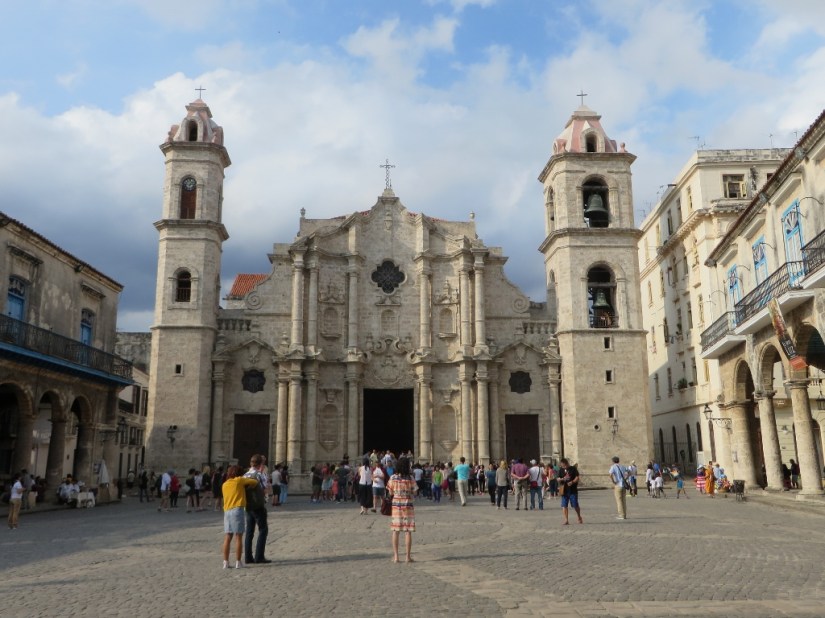
Plaza San Francisco was nearest the dock and dominated by a huge convent church and as for the fourth square, we had already visited Plaza de la Catedral at the beginning of our trip.
There are three restored pharmacies in the old town, the oldest and by far the most impressive was La Reunion, opened in 1853 and the largest of its kind in the Americas, remaining in business until 1959. The wooden cabinets, rows of jars and stained glass were impressive and there were cases of old medical equipment too.
Another impressive edifice built on the edge of the old town is the Edificio Barcardi, an amazing 12-storey Art Deco building built in 1930 as a symbol of the wealth of the Bacardi dynasty and crowned with a bat.
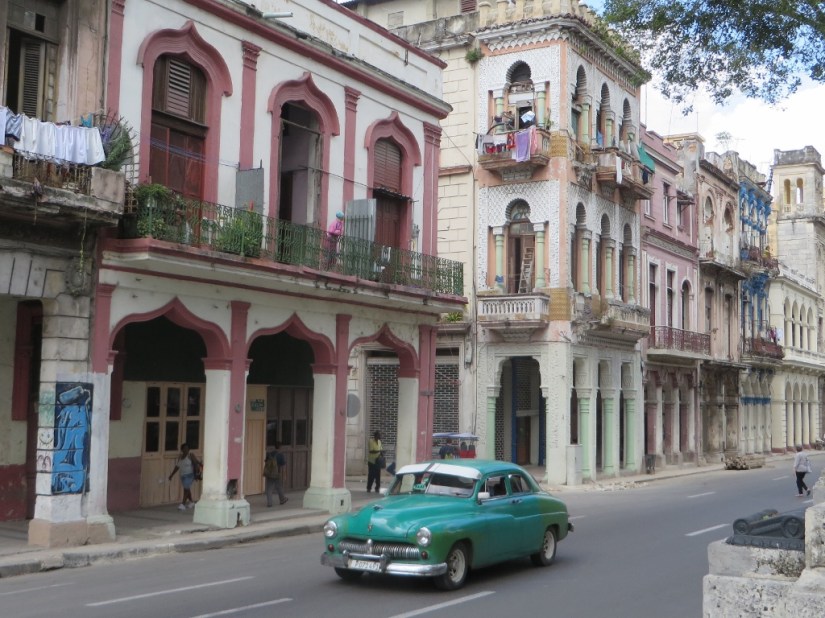
Beyond this everyday life continues along roads lined with pretty dilapidated buildings, with people working and shopping.
We saw signs of further restoration, with boards saying works were either sponsored by the state or with foreign investment.
There is so much to do, I can’t believe it will change overnight, but there are signs showing that Havana will be 500 years old in 2019 so no doubt there is a push towards this date.
Hemingway links are everywhere and attract huge crowds of tourists. La Bodeguita del Medio was one of his favourite haunts, the best spot for a mojito, but everyone else thinks so too so we gave it a miss especially as there didn’t seem to be space on the wall for our names …
… but we did pop into the Hotel Ambos Mundos where he lived for a while …
… went up in the original 1920s lift to the roof for the view then left, unwilling to pay £2 each just to see inside his room.
Whenever we travel, I like to check out any films or books to set the scene and never having read Hemingway, I chose a slim one, called The Old Man of the Sea about an old fisherman’s battle with a huge Marlin off the Cuba shores, no doubt drawing on Hemingway’s own experiences as a keen game fisherman. I then read Adios Hemingway, a modern mystery about a dead body found in the garden of Hemingway’s house, years after his death where the detective is an aspiring author and Hemingway fan which was really good. We also watched Cuba with Sean Connery and Havana with Robert Redford, pretty dire films, but both set around the time of the revolution, showing scenes of Cuba and how some of the swanky hotels in Havana would have looked And there were similar references in Our Man in Havana by Graham Greene. Since I arrived, my reading has lightened up – Distant Marvels about Maria Sirena, born during the Wars of Independence with the Spanish and stretching to Fidel Castro’s victorious revolution. Next up Ghost Heart, a tale of two cousins, one who remained in Cuba after the revolution and the other who went to America and their contrasting lives and I have just started Last Dance in Havana ….
Our second day began at the Museo Nacional de Bellas Artes, just in the Cuban section to see how the C20 had shaped the country’s art.
The building itself was a surprise, a very stylish modern space and here is our pick of the collection including Wilfred Lam’s Third World exploring the Afro- Cuban spirit and a Cuban take on pop art from Raul Martinez.

Tropical Gypsy by Victor Manuel Garcia

Peasants by Eduardo Abela

Cuban Landscape by Marcelo Pogolotti

The Domino Players by Jorge Arche

The Third World by Wilfred Lam

Peasant Militia by Servando Cabrera

Listen America by Raul Martinez

El Fenix by Raul Martinez
We then crossed El Prado into Centro Habana, which had its heyday in the C18-19, and once contained famous shopping streets. The streets are wider than in the old town, and the buildings far more dilapidated, and in places, the word slum would not be inappropriate. It is hard to be sure if the insides are as bad as the outside, although in places, glimpses suggest they are. We both felt sadly voyeuristic walking through the streets taking pictures.
We headed to the Callejon de Hamel, billed as a public space dedicated to Afro-Cuba with a mural painted by Salvador Gonzalez. It also has shrines and images and references to Santeria, but has also been decorated with reclaimed items in a style similar to a Budapest ruin bar, especially with its cafe at one end. On Sundays there are Santeria ceremonies and rumba put on for the tourists, and we would have visited then if our plane had not been late. We learned no more of Santeria on our visit, but the cold drink was welcome and the alley photogenic!
Continuing further we reached Vedado, with tall 1950s buildings …
… one of the tallest being Edificio FOSCA, a Y shaped apartment building which dominates the area …
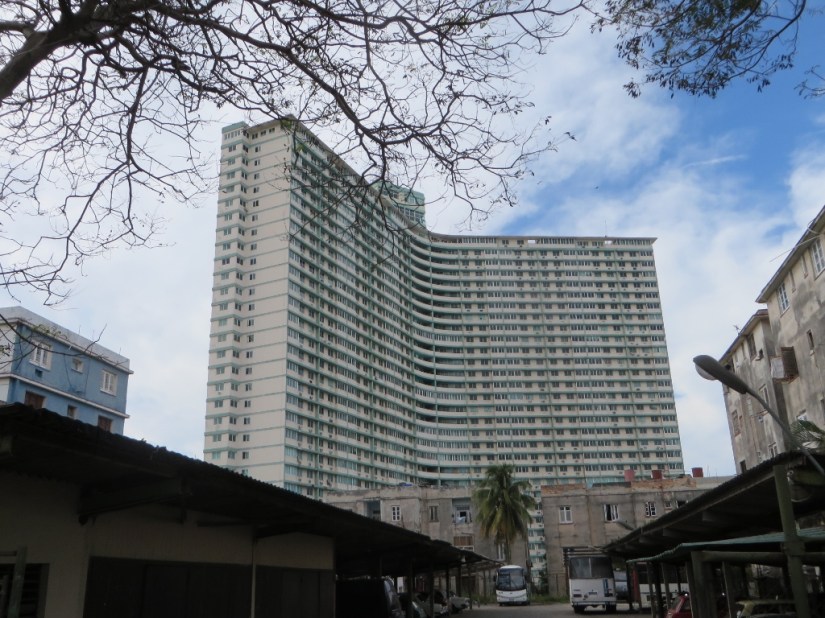
… and La Rampa leading to the sea.

This is also home to the flagship branch of Coppelia, a national chain of ice cream parlours. It is like a spaceship which has landed in the middle of a leafy park, and was designed in 1966 to be within the price range of every Cuban. It serves over a thousand customers a day, and people queue for an hour to be served. We walked round and took some pictures but this area was only for those with national pesos … despite its egalitarian aims, tourists have to use the fast track queue, pay in CUC and sit apart!
On balance, the ice-cream at Helad’oro, a tiny parlour in the old town offering Cuban flavours at a CUC a scoop, including pina colada and mojito as well as exotic fruit like guanabana was far better.
For years Havana was America’s tropical playground and most of the fabulous hotels built by the Mob still exist here in their original splendour, due to benign neglect and recent restoration. These include the The Hotel Nacional de Cuba overlooking the sea and built in 1930, which blends Spanish, Moorish, classical, and Art Deco elements in its imposing design …
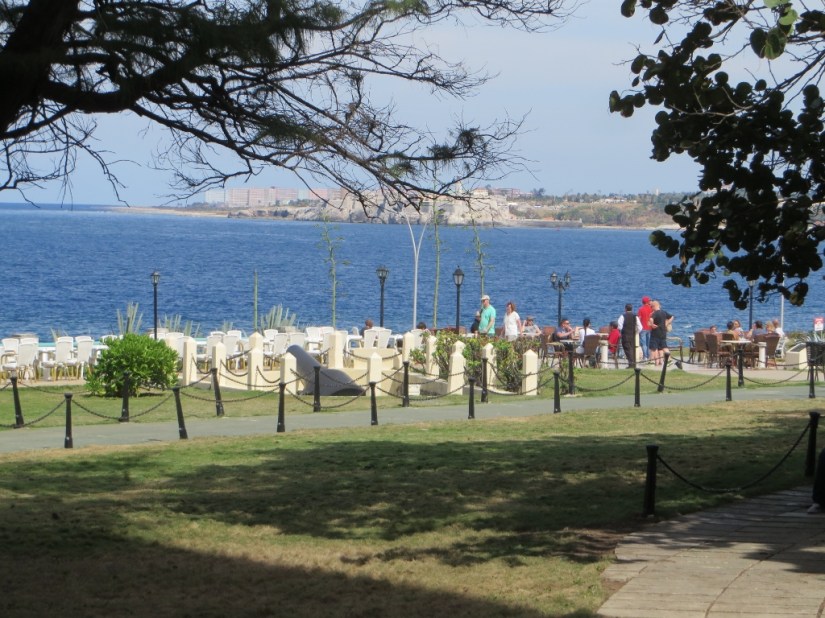 … The Havana Libre, once the Havana Hilton which was the largest hotel in Havana when it was built …


… and The Havana Riviera which is now the best-preserved example of a swank 1950s resort hotel in the world.
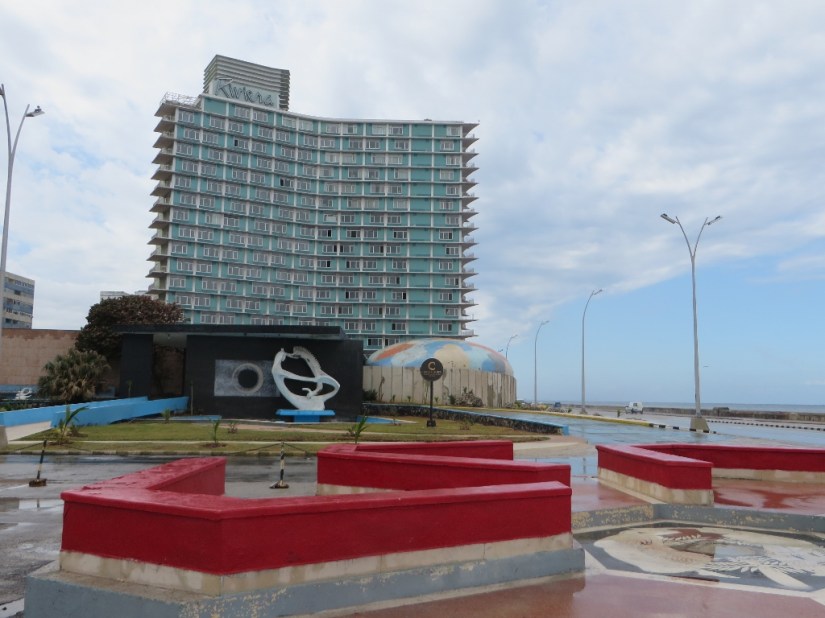

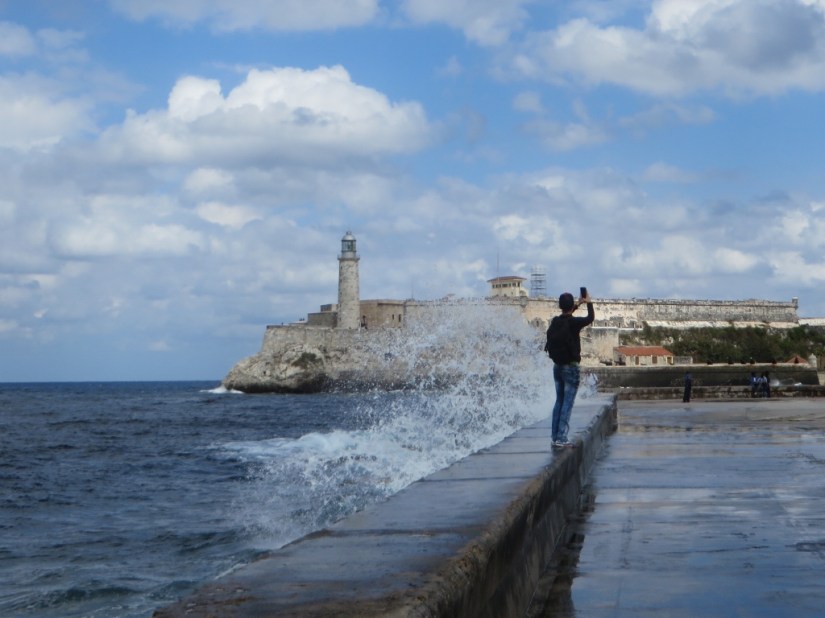
Several times, we were offered an hour touring the city in a convertible American car for CUC$50, but having already had several great American car experiences, we decided to stick to walking and ended the afternoon with a stroll back along the Malecon from the Hotel Nacional to La Punta. It is lined with sections of Neo-classical buildings, once colourful maybe, but now more candy-coloured and some more weather-beaten than others, punctuated with a park, a couple of inventive cafes and the odd 1950s tower. As we walked, we watched people enjoying the sunshine, the cars whizzing by and a cruise ship leaving port.
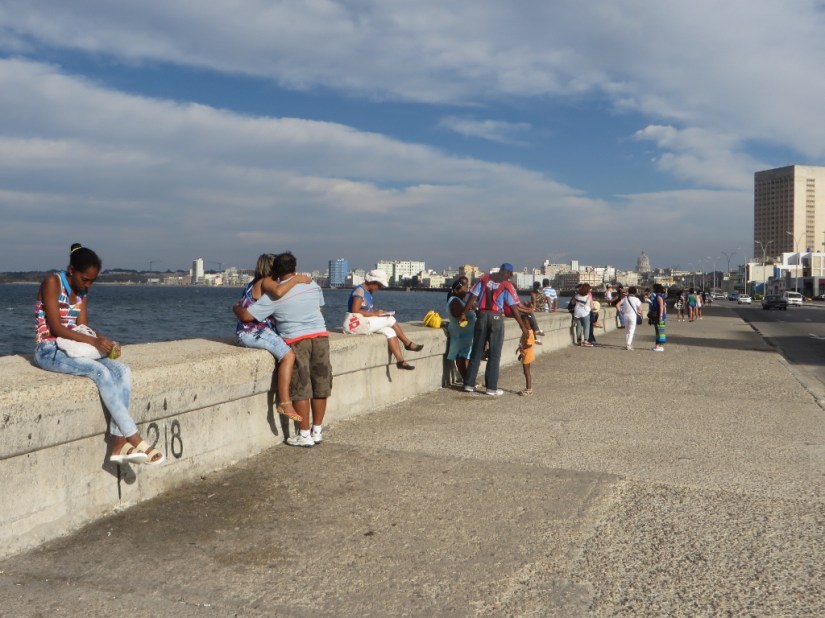


Next day, we awoke to pouring rain, but it stopped after breakfast. The Lada which took us to the bus station drove along the Malecon, so we got our classic car experience in Havana after all!
This time, we are travelling westwards!





 We took a quick turn round the block to stretch our legs and the evening was positively balmy after England. We returned for a home cooked dinner of pumpkin and eggs for Chris and marinated and grilled pork for me, served with salad and plantain fritters called tostones. We also had beans and rice called moros y cristianos – the black bean for the Moors and the white rice for the Christians and washed it all down with a beer. After our long day, we called it a night and dropped off to sleep listening to live music coming from the bar over the road.


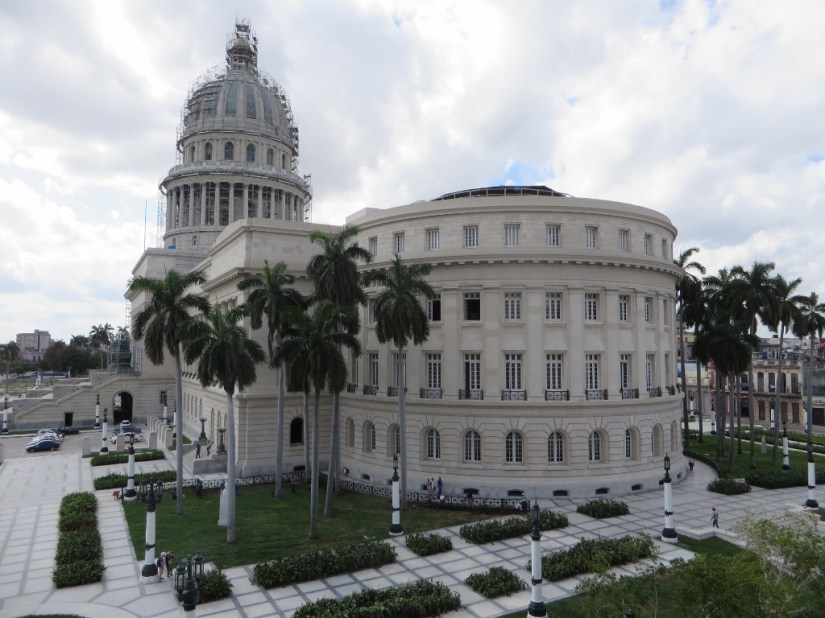


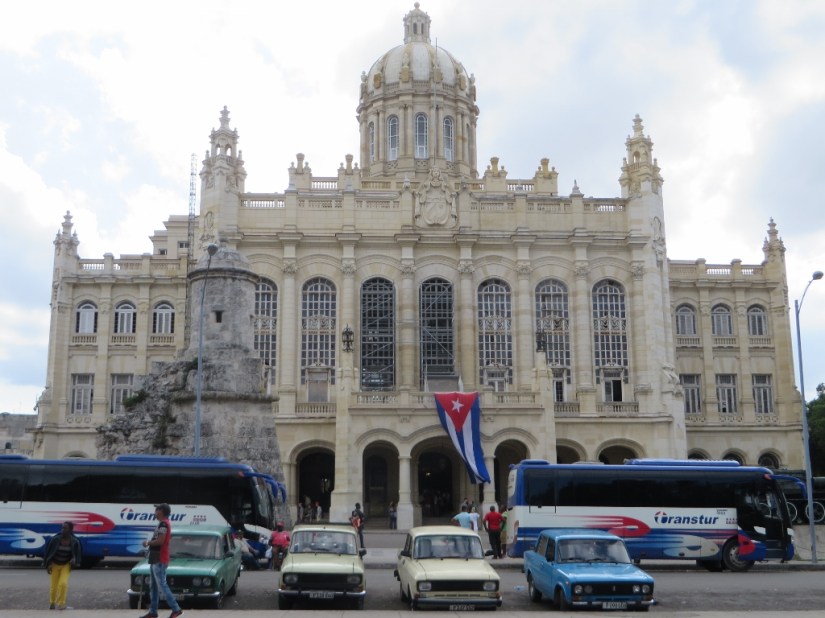
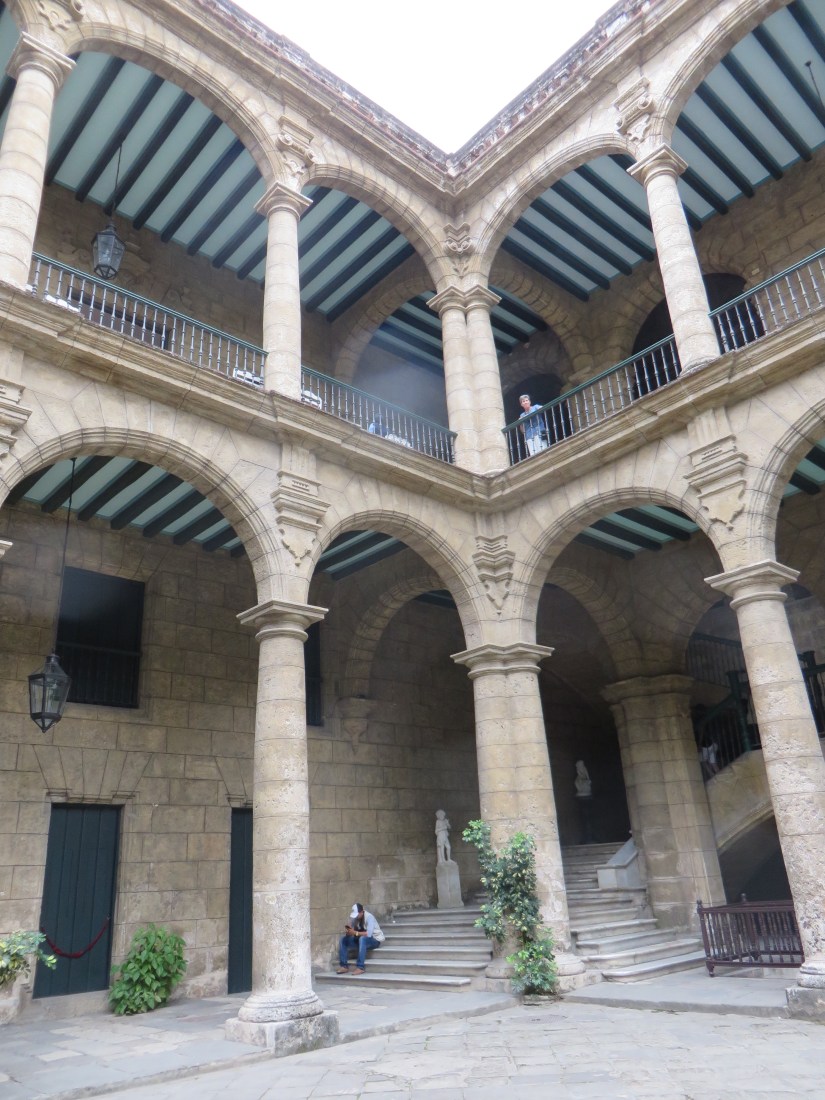
 We walked round the displays which were almost entirely in Spanish, with the odd caption in English. There was one small part about the reforms made after the revolution which looked like it had been newly curated and was ok, but for the rest, there were a lot of black and white photos of men in fatigues with guns, battle plans and various personal bits and pieces. There are still sprays of bullet holes in the courtyard …



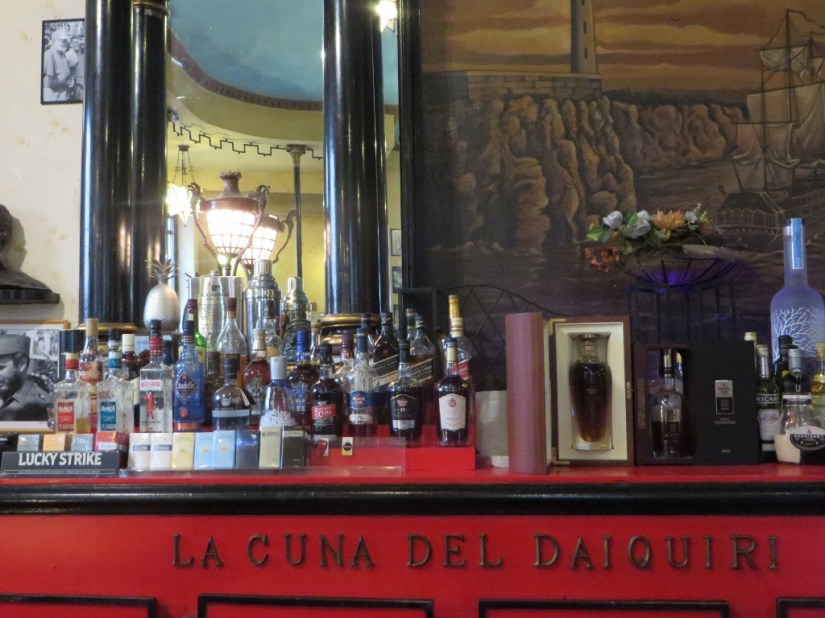
 We decided we had walked far enough and since we were conveniently passing El Floridita, home of the Cuban daiquiri and famous Hemingway haunt, we thought we’d try one out.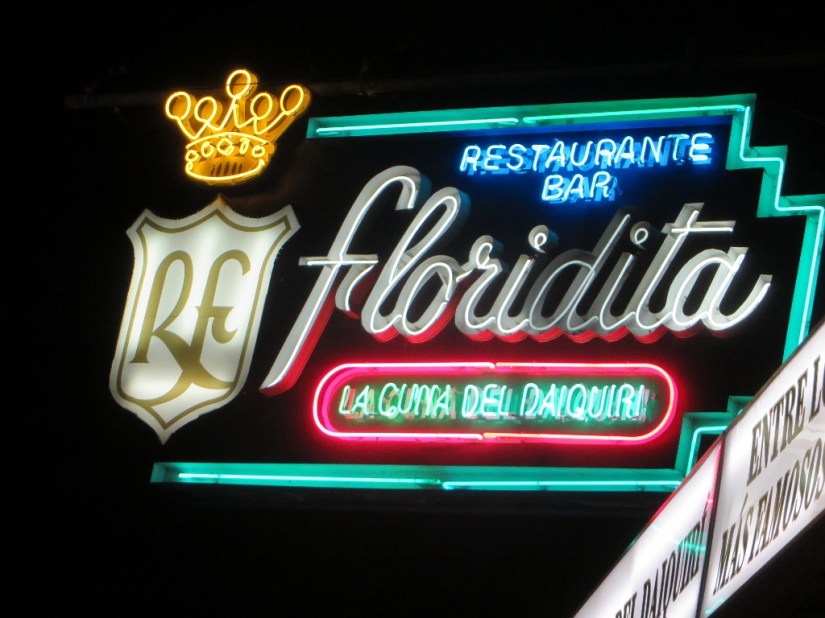


 Off Travelling Together