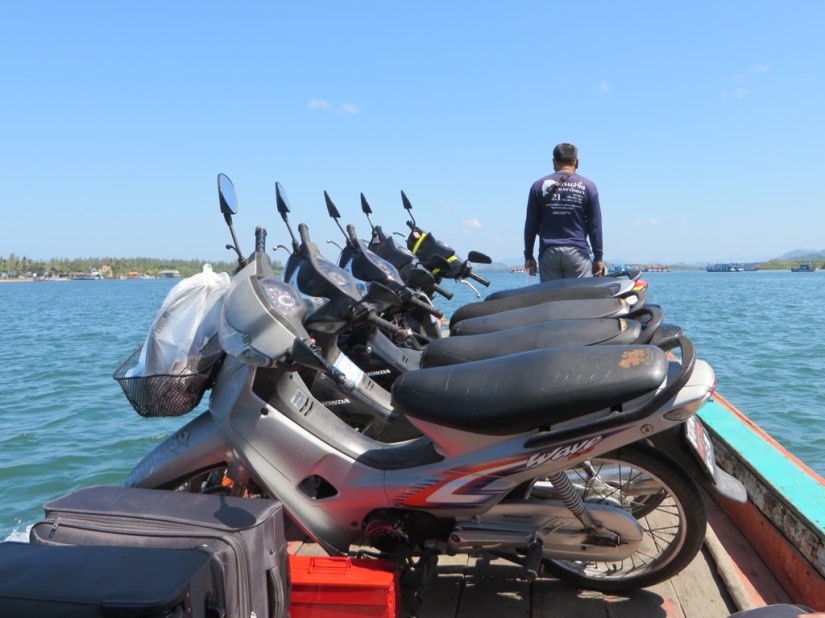
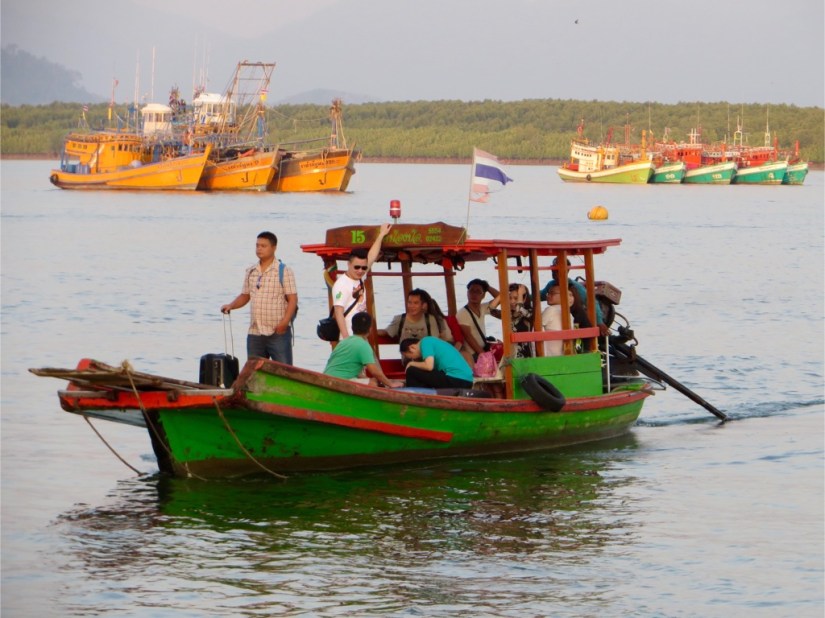
In just a morning we swapped a jungle paradise for a beach paradise! Ko Kho Khao, meaning Neck Mountain Island, is just a short ferry ride from the mainland, on some of the smallest but most colourful vehicular ferries I’ve ever seen.
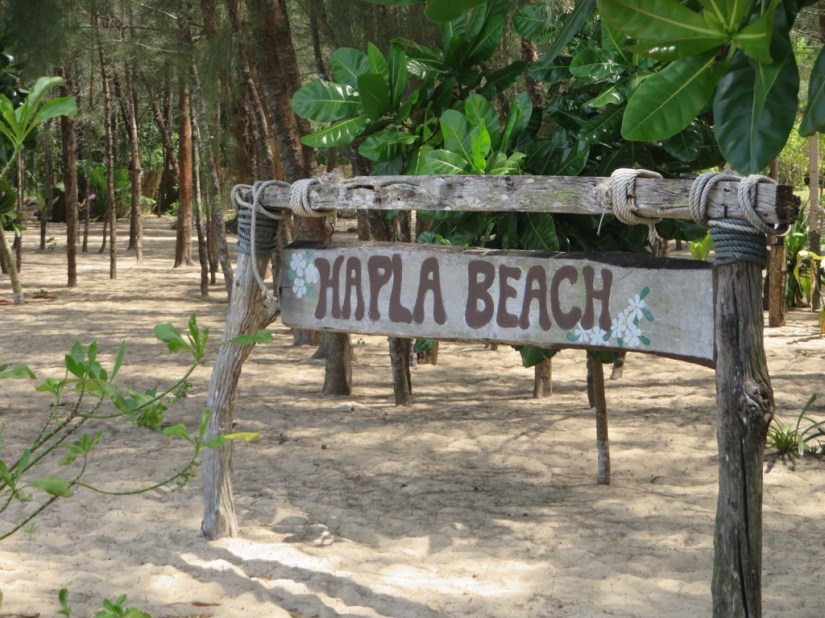
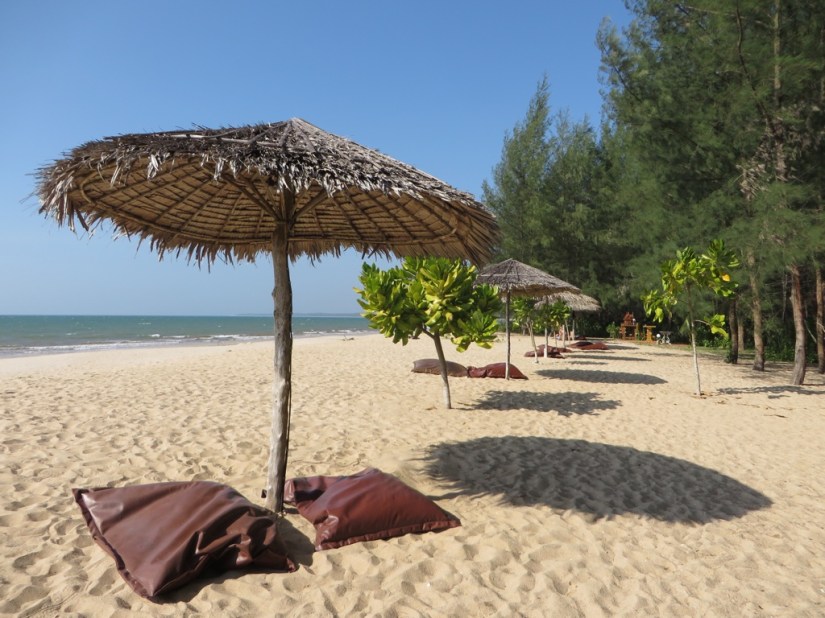
Due to its flat landscape the island was devastated by the 2004 Tsunami, and many locals chose not to return and rebuild, leaving the island quite a sleepy place. We are staying at Hapla Beach, halfway up the beach that runs down the 16km island, backed by feathery casuarina trees and overlooking the Andaman Sea.
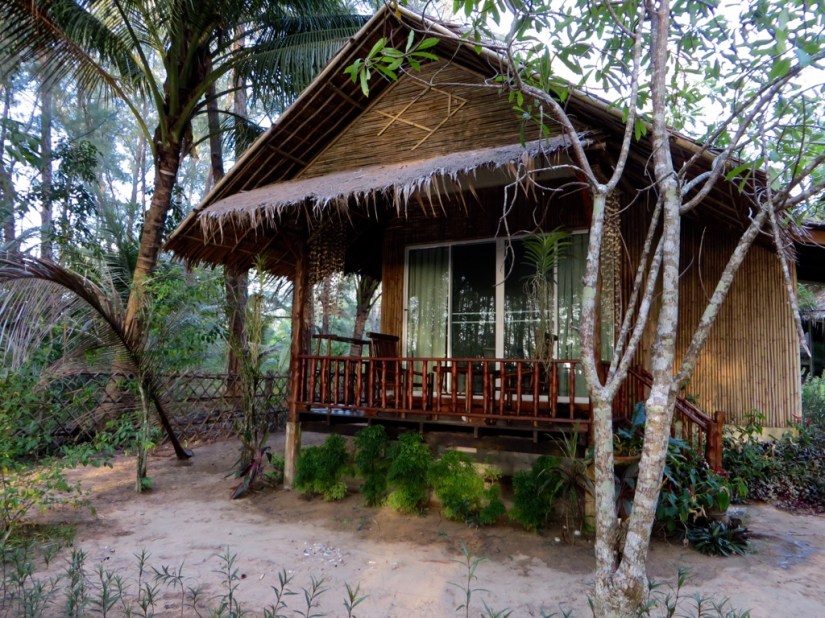
There are just 6 beach bungalows …
and a restaurant …
… set in a shady wooded area overlooking the beach.
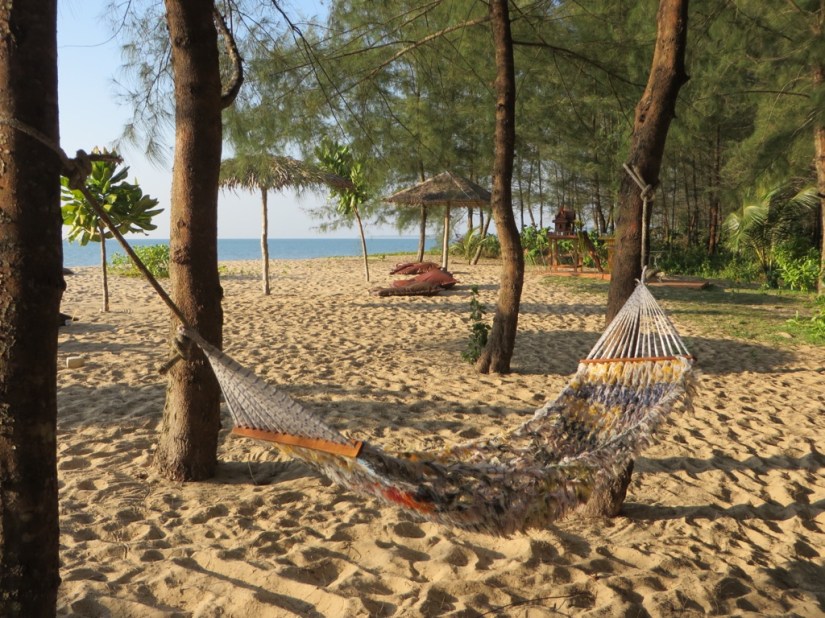
And here is our beach …
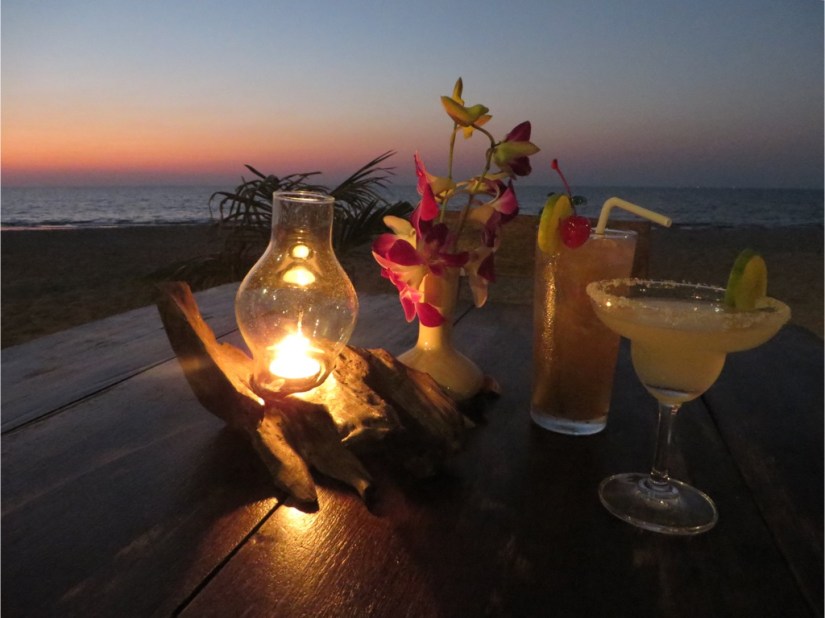
Our days here have been busy … a bit of a walk one way or the other, a little sun, a swim, salad for lunch, chill in a hammock, a bit more sun, another swim, snap the sunset, sundowners and dinner and bed, all to the sound of the sea ….!
There appears to be nothing north of us except beach and to the south just a few resorts. Apparently the centre has grassy sand flats and there are mangroves and canals to the east and the locals are farmers and fishermen but we didn’t stray far enough from the beach to find out for ourselves!
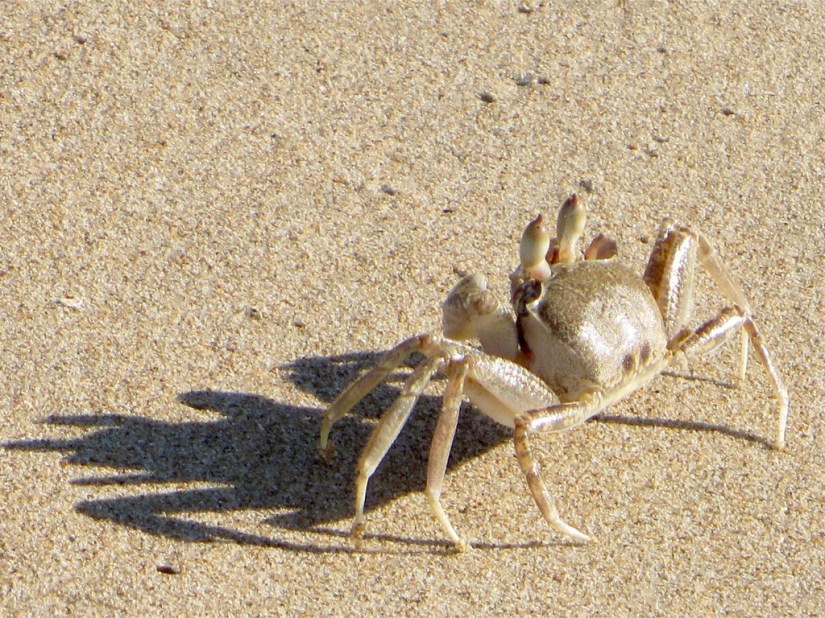
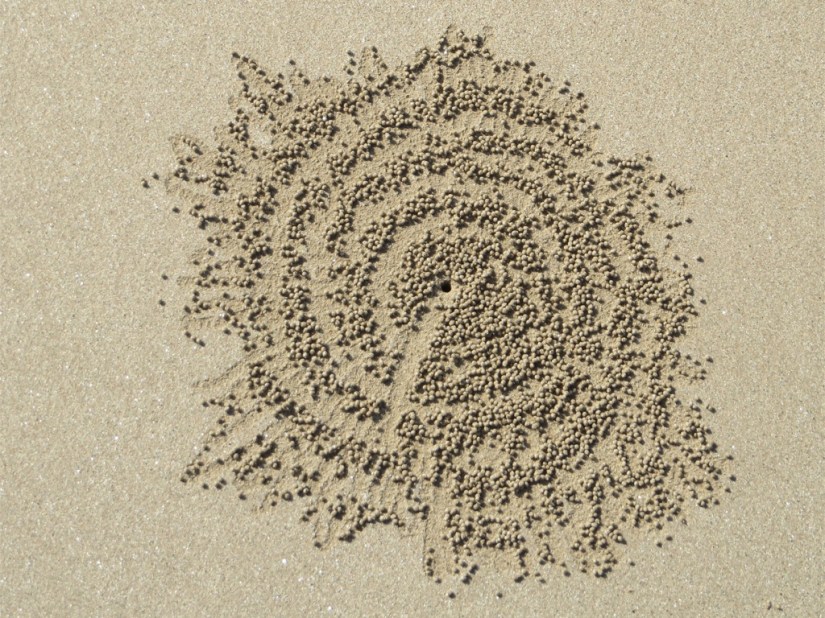
The sea has been like a millpond in the morning as the tide goes out, then as the day warms up, the breeze gets up and the tide returns with breakers. Crabs busily scuttle in and out of their holes, or drag their home along with them and some quick little bug spends the day excavating a sandy burrow, leaving Nasca-like patterns on the sand.
Some days there were visitors or passers by … a boat pulled up with passengers and a large fish to be cooked for lunch … the weekend brought several local families out to eat … exploring tourists looking come for a change to their resort buffet and locals taking a shortcut! One day Gordon the Gecko was found shading under one of the brollies!
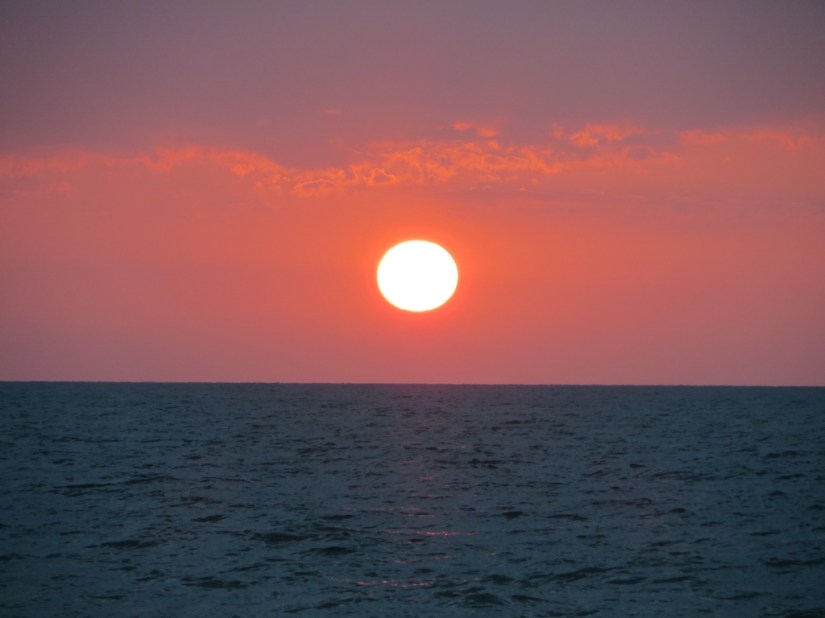
There was a full moon on our last night here, but fortunately we were not on Koh Phangan as there would have been some 30,000 people crammed on one beach celebrating the Full Moon and partying from sunset to sunrise … certainly not an essential on our itinerary! Here the sun sets in tranquility …
We are now well into the second half of our trip, and so far the only Western food we’ve had was a Subway at Surat Thani airport, where the only other choice was KFC or McDonalds! Oh and Chris has had the odd chip here and there … apart from breakfast that is … where my good intentions to eat local dishes fly out of the window when faced with stirfry every day. We started well in Bangkok, with the delicious Thai breakfasts at W-Home, but since then we’ve settled into a bit of a routine, Chris favouring omelette and me pancakes … and I was surprised at how many places served pancakes. Then I read the story about the Banana Pancake Trail … which goes like this. Once upon a time a guidebook was written for backpackers in SE Asia and cafes found that including banana pancakes on the menu helped get an inclusion in the book … as all backpackers like a few home comforts … and now the Banana Pancake Trail, which has no clear route, is used as a metaphor for places popular among Western tourists. I have to say I prefer mango or pineapple, and no we haven’t had a full English or been to an Irish pub!
Having relaxed and topped up the tan, it’s time to leave paradise … but it did have a downside which neither of us will miss … the hungry sand flies which have taken a liking to us both!
Well we opted for the flights – who wouldn’t when you could fly in a plane with a beak!
It was still had a long day travelling some 1500kms – taxi to the airport, flight to Bangkok then Surat Thani, a bus to town and another bus to Our Jungle House, our home in Khao Sok National Park for a week.
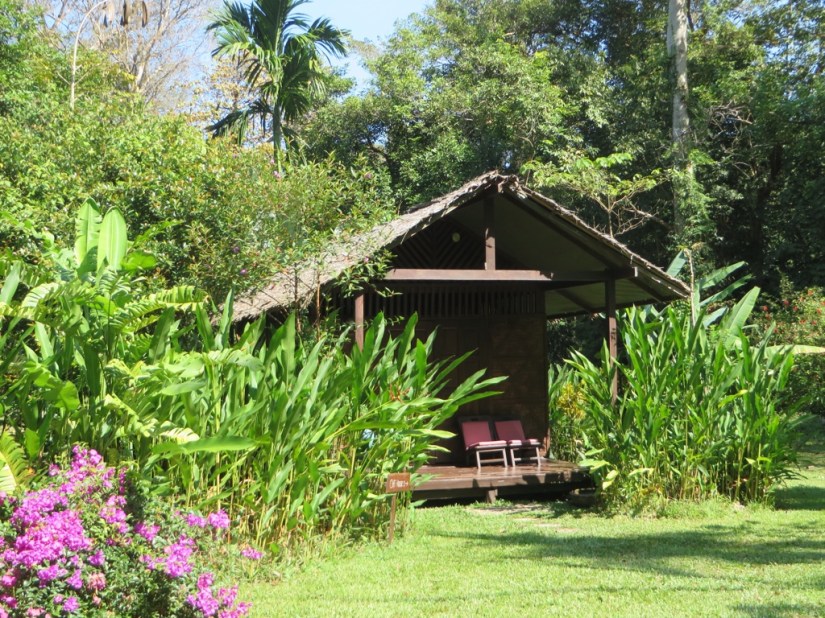
We have a bungalow surrounded by garden! with a clubhouse for meals …
…and facing enormous cliffs which run alongside the Sok river.
The verandah is a perfect shady spot to catch the breeze in the afternoon and read awhile and at night we are lulled to sleep by jungle sounds from frogs and cicadas. The morning brings calls from gibbons we haven’t seen, coming from deep in the jungle.
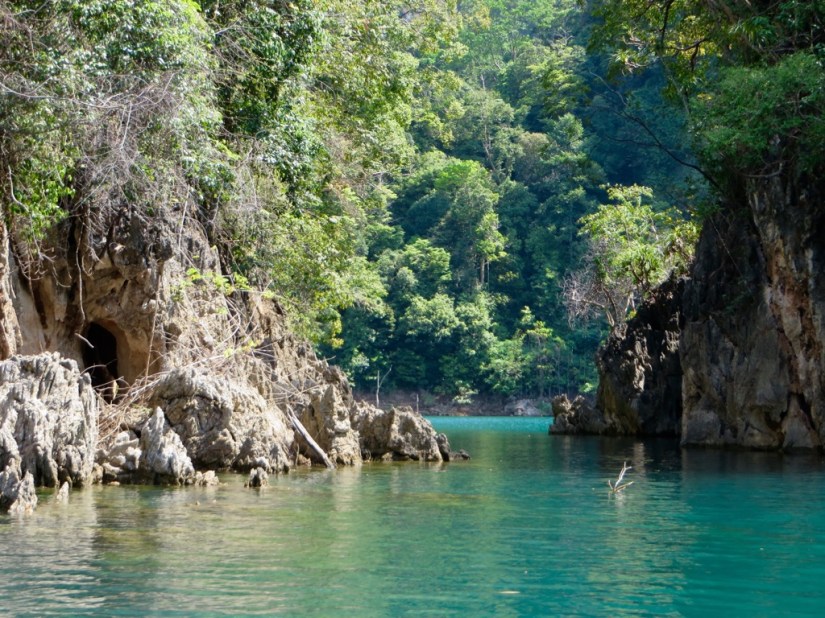
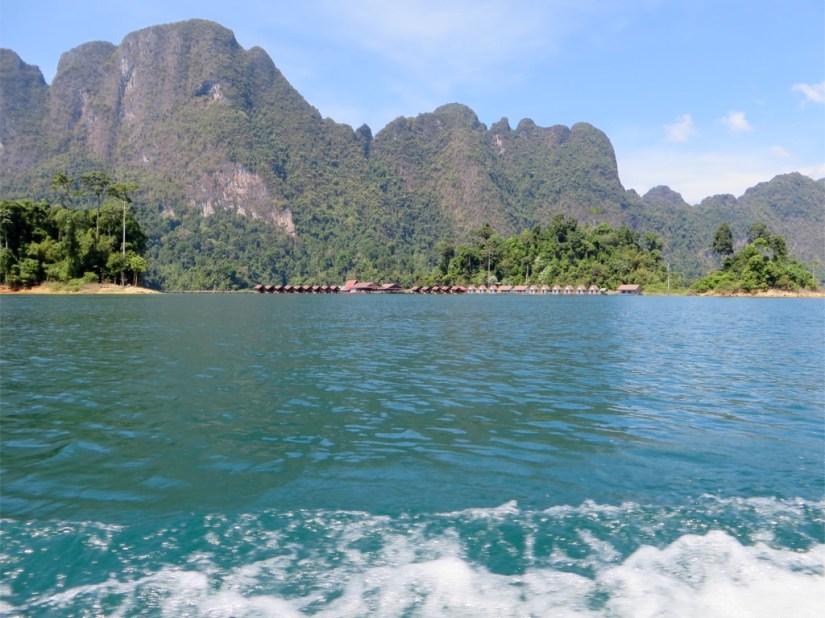
We had a great day at Cheow Lan lake, formed in the 1980s when a dam was built for hydroelectricity. The scenery was stunning, with limestone crags dominating every vista.
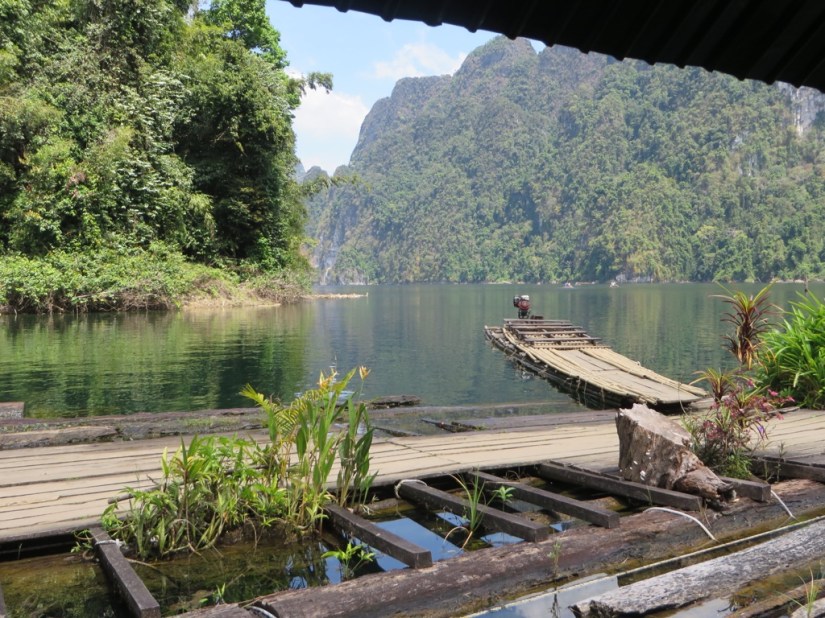
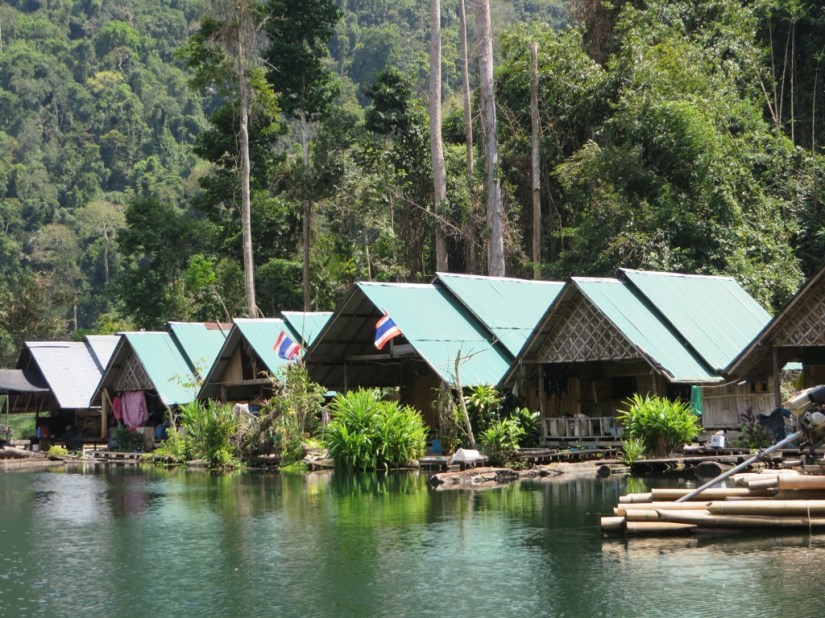
We took a longtail boat across the lake for an hour or so, then hiked over a stretch of jungle to an inner lake, where we took a smaller bamboo boat across to a huge limestone cave, complete with stalagmites and stalactites. There are several floating houses and restaurants round the edge of the lake, built to cope with the fluctuating water level, and we stopped at one for lunch before swimming in the warm jade waters.
Our best wildlife sighting was the shy dusky langur high in a tree.
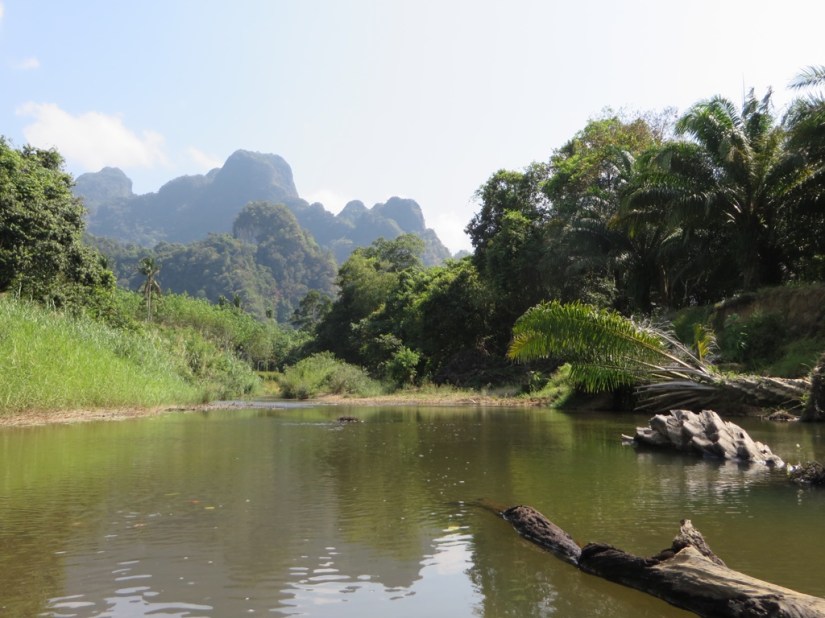
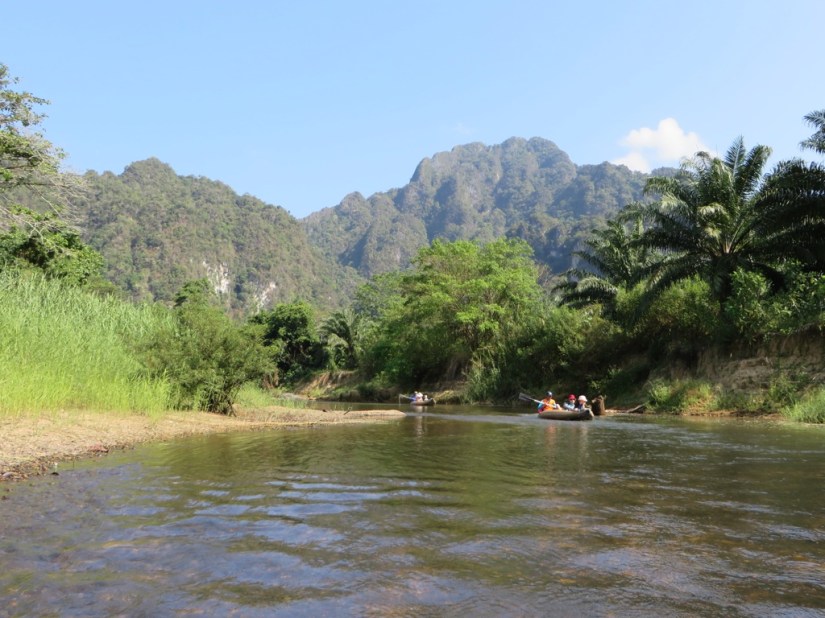
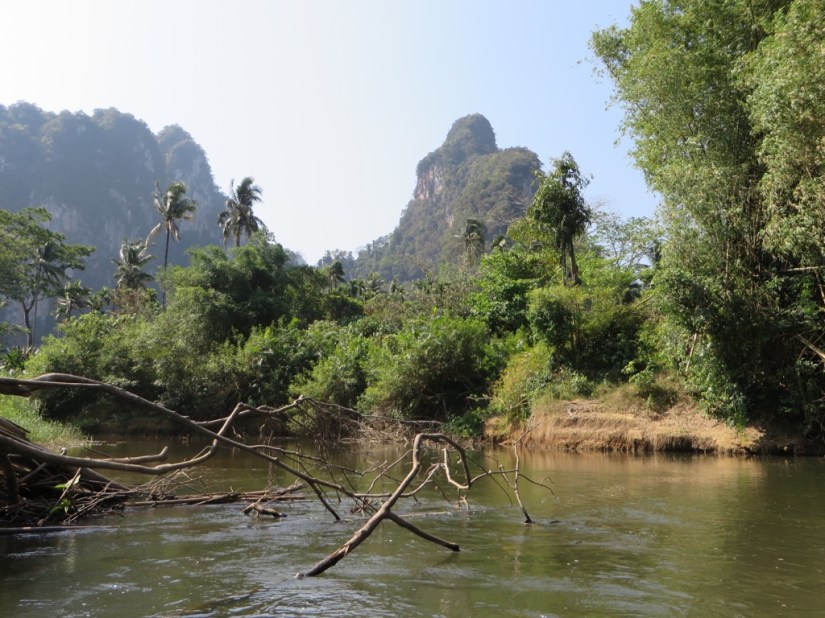
Contrasting with the speed, noise and spray from a longtail boat was our sedate canoe ride along the Sok river one morning. The scenery changed at ever turn, and we stopped halfway for a coffee break, brewed up over a small fire on the bank. We were hoping to see kingfishers, but maybe they had already been fishing as all we caught was a couple of glimpses of iridescent blue as they flew past although we did see a frog … a tree frog perhaps!
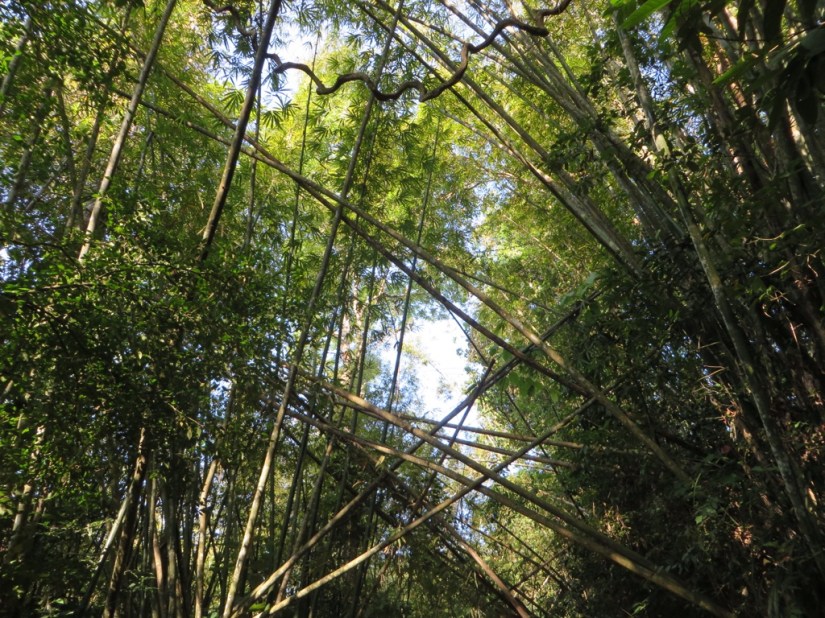
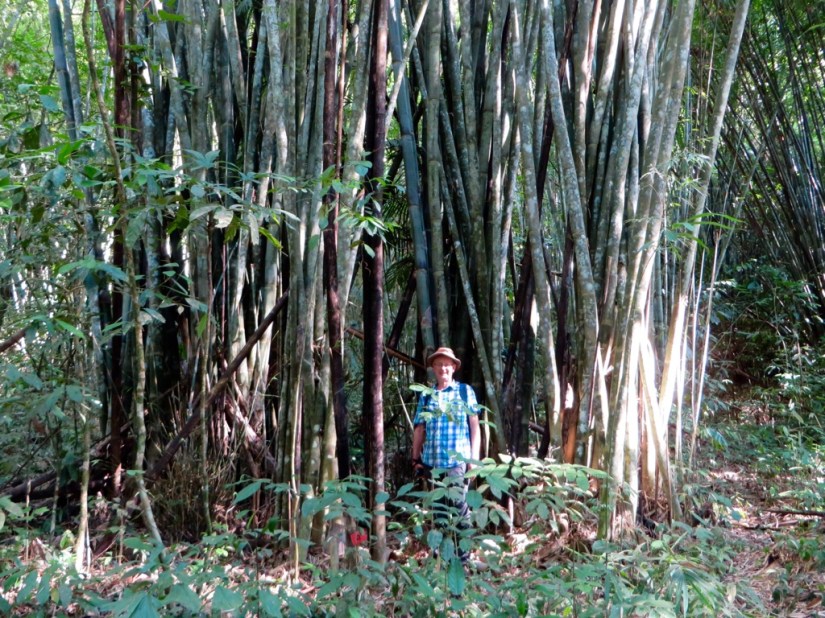
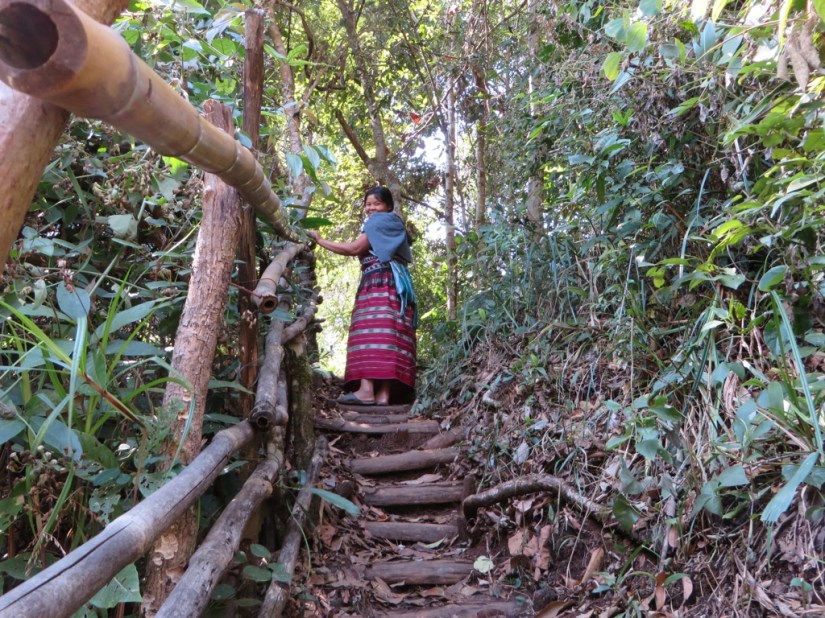
Getting up early one morning, we hiked around 4km into the park, through the jungly jungle.
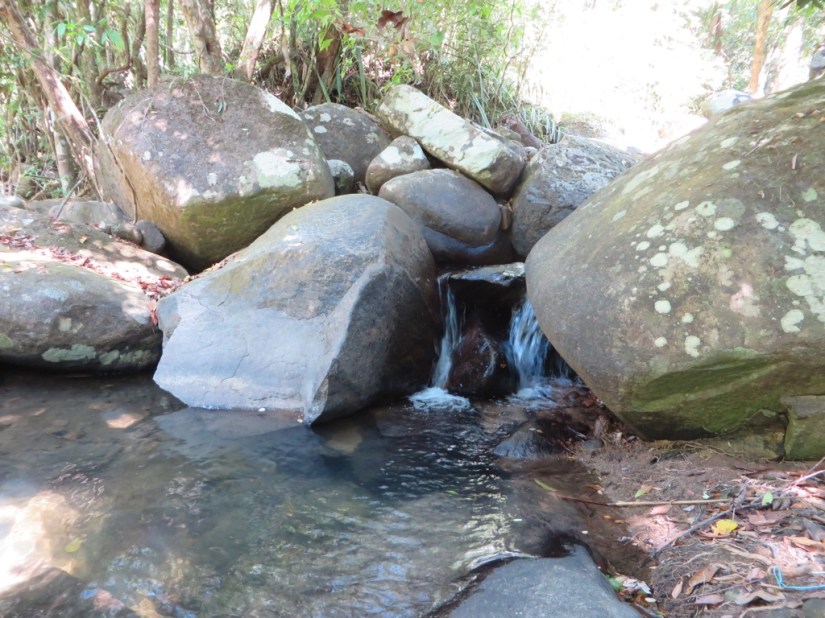
The waterfall at the end was a little disappointing …
… but spotting a troop of playful long-tailed macaque monkeys …
… and then being able to swim in the river and cool off made it all worthwhile.
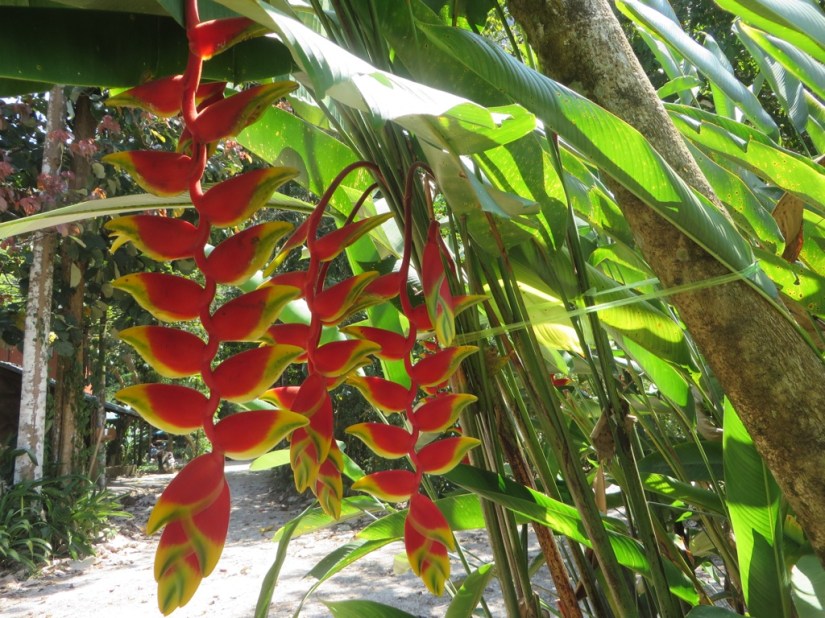
Since Chris is still on a 6-0 high at the moment after Liverpool’s win a few days ago, I thought we might have a special red feature … of lovely flowers we have seen. The last is a bit tongue in cheek, as the real rafflesia flower was unfortunately not blooming during our visit, so we old saw this one at the Valentine festival!
We had seen spirit houses outside homes, shops and businesses in India, but only one, and here they come in pairs, and it was maybe surprising to see them at all as most Thais are Buddhist. Nonetheless, nothing is clear cut here, and Thais also appeal to the Hindu pantheon of deities to help achieve everyday goals like passing an exam or getting pregnant. The taller spirit house resembles a Thai Buddhist temple and is a home for the guardian angel of the land, standing higher to reflect the VIP nature of the Hindu cosmos. The Hindu angel can be seen inside with a sword in one hand and a money bag in the other and this is the house also seen in India. The smaller spirit house resembles an old Thai house and is for the lord spirits of the land that may have been ousted by the building’s construction. These animist spirits can be very fickle and belief in them pre-dates both Hinduism and Buddhism in Thailand. Both houses receive daily offerings of incense, candles and flowers to keep the spirits happy as an unhappy spirit could cause sickness or misfortune. This may seem an outdated idea in the 21st century, but Thais are obviously not willing to take the chance and why should they!
Tomorrow we head beachwards for some sea and sand …
Chiang Rai, 200km north, may have history and even some wats, but we arrived to go trekking and left more impressed with the contemporary art.
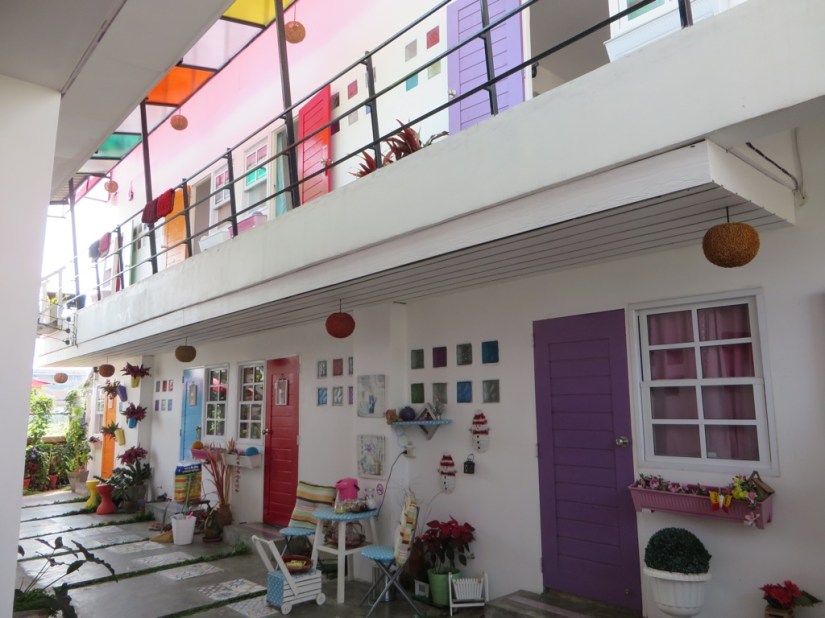
This started with the very modern and colourful Na Rak O Guesthouse where we have a huge comfy room and can make our own breakfast of toast and eggs in the kitchen.
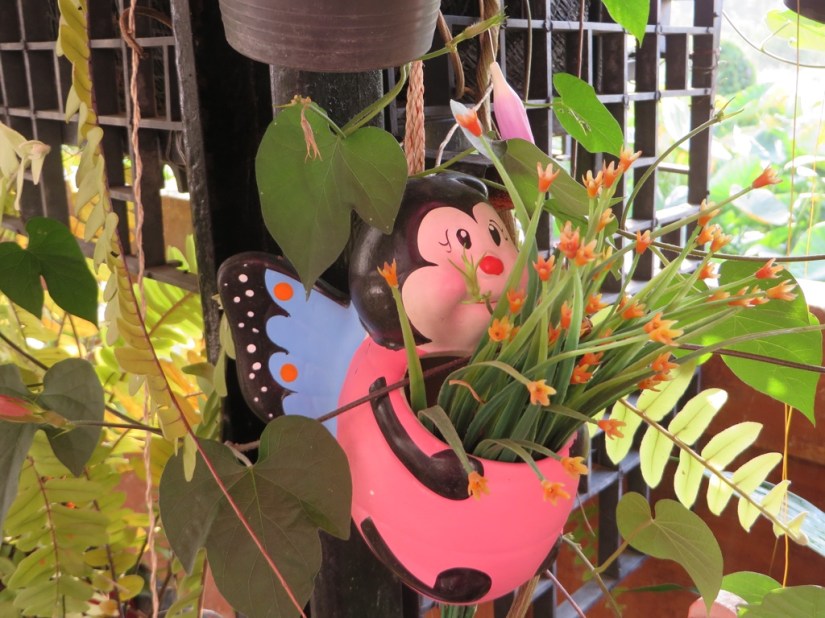
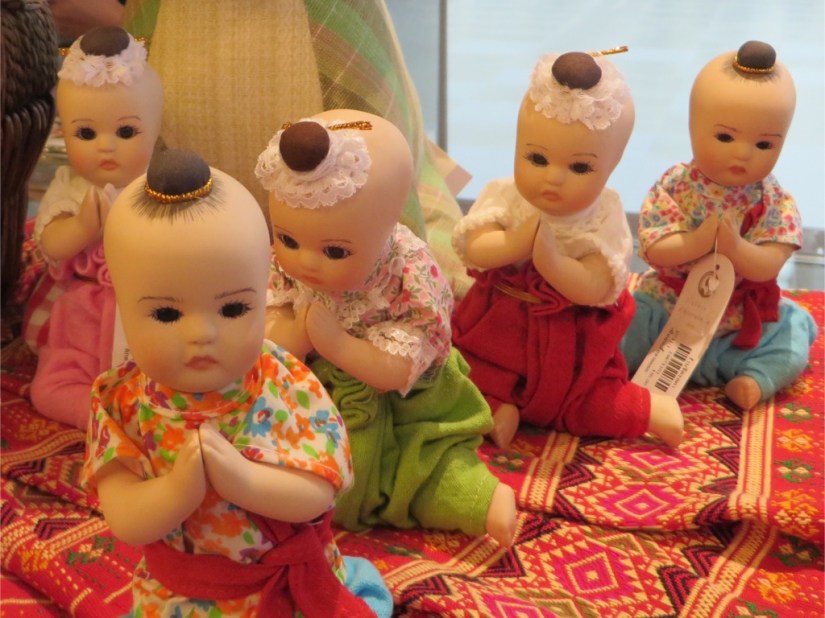
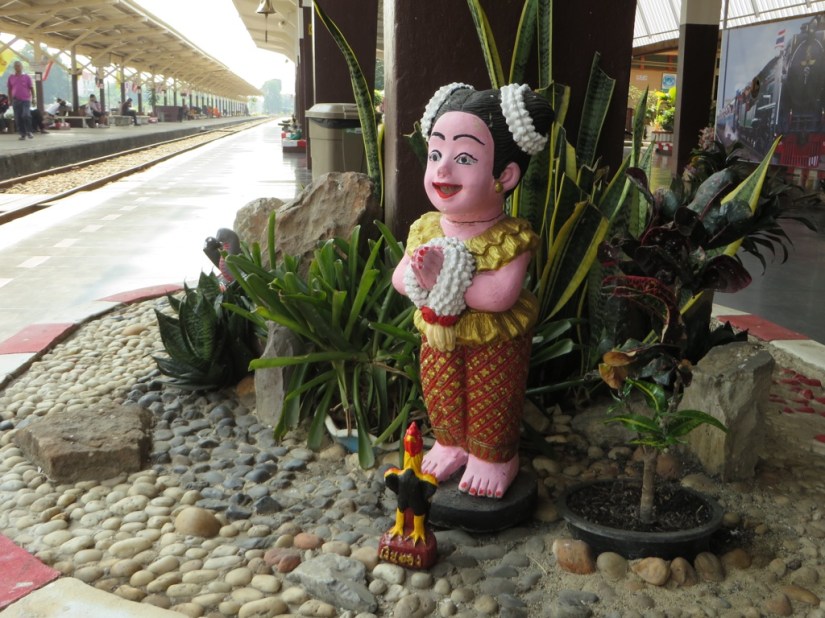
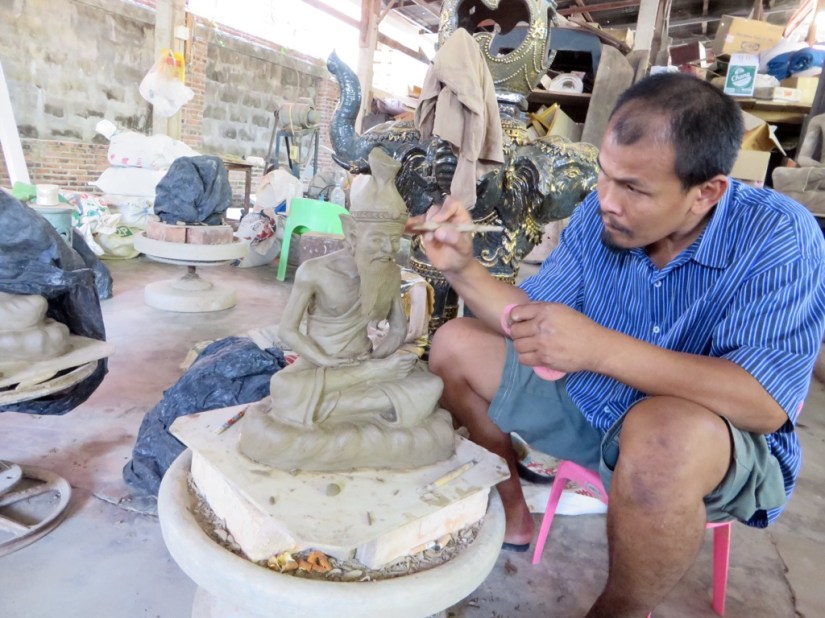
They have taken the concept of what I would like to call “Thailand Cutie” to a new level! The first time we noticed this decorative style was in the palace in Bangkok, there were some ceramic ornaments of cute babies which would have been used to adorn the table for state banquets, dating back to 19C. Since then, we keep noticing them, cute and quite often truly ghastly ornaments in small patches of garden outside homes, shops and businesses, even ornaments you can take home, and not even the railway station is exempt!
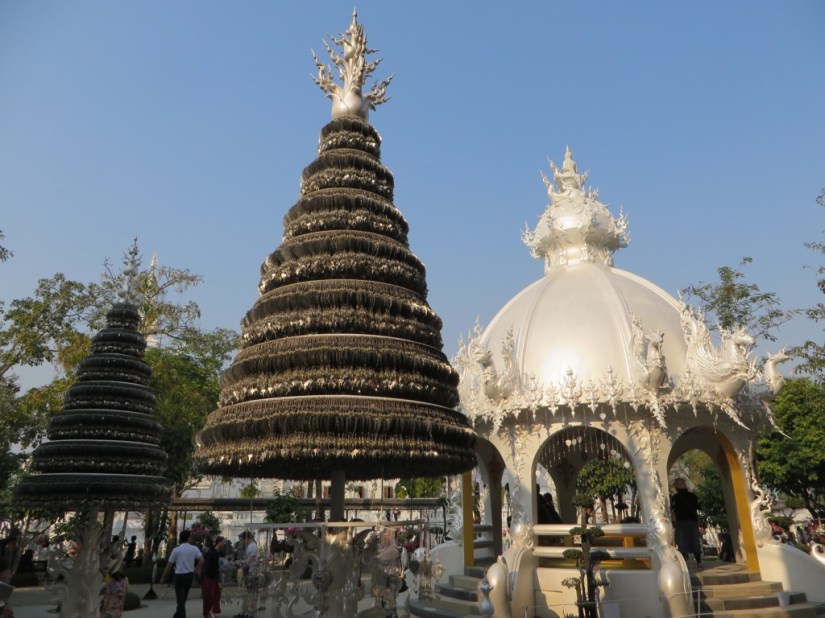
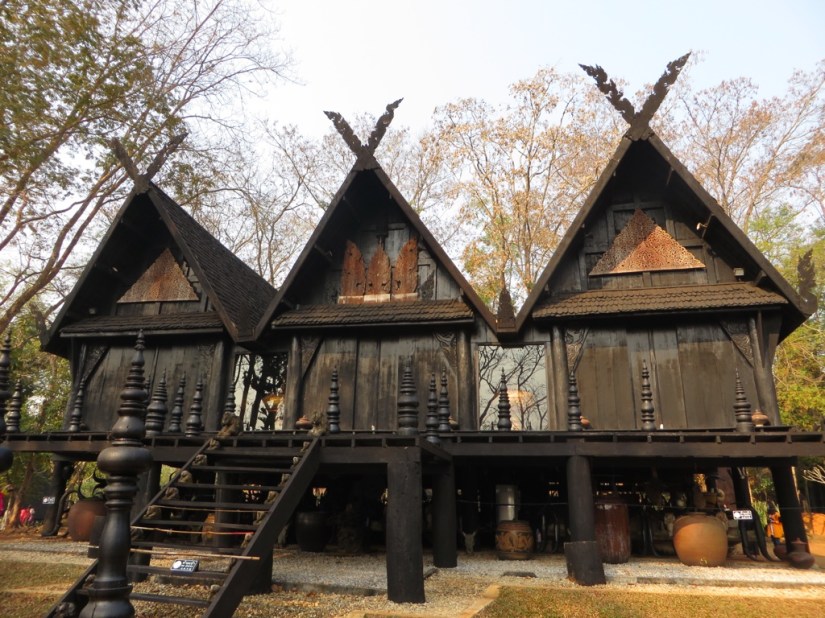
You can’t help but compare the White Temple, a gleaming white vision of heaven and the Black House, dark and full of death. Both were created by Chiang Rai native artists, each of whom combined traditional Tahi Buddhist temple art with contemporary images causing controversy, but both have gone on to exhibit worldwide and also paint murals in various overseas establishments.
Chalermchai Kositpipat then became a monk and rediscovered Buddhism in a big way and began his life’s work, Wat Rong Khun, or the White Temple.
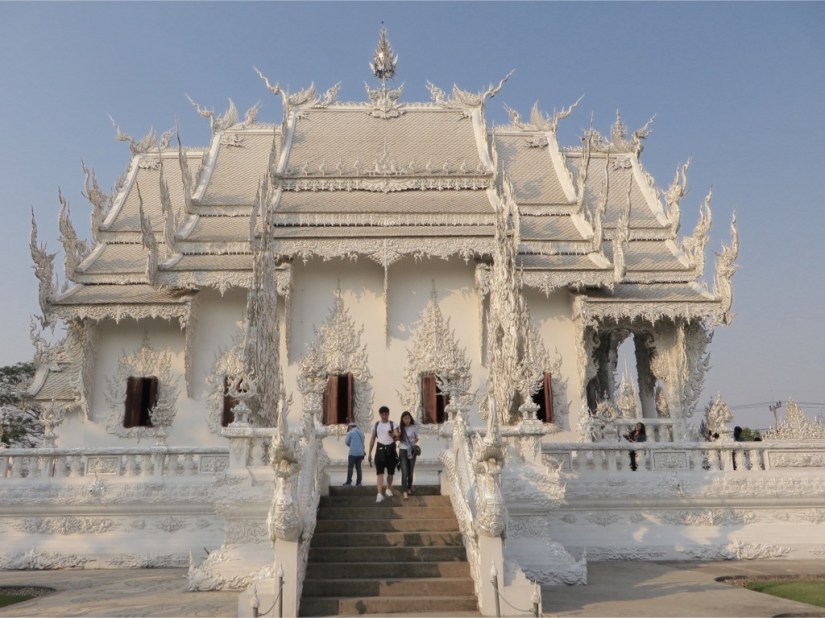
The temple is white for Buddha’s purity and inlaid with twinkling clear glass for his wisdom and to reach the Abode of the Buddha you have to cross the bridge representing the cycle of rebirth …
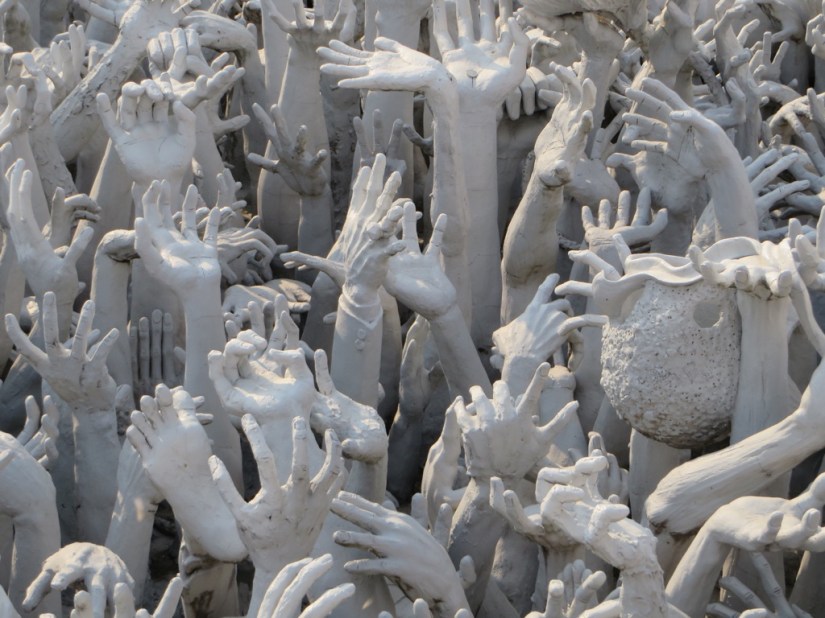
… with the pits of hell below containing all those as yet unworthy with outstretched hands representing unrestrained desire.
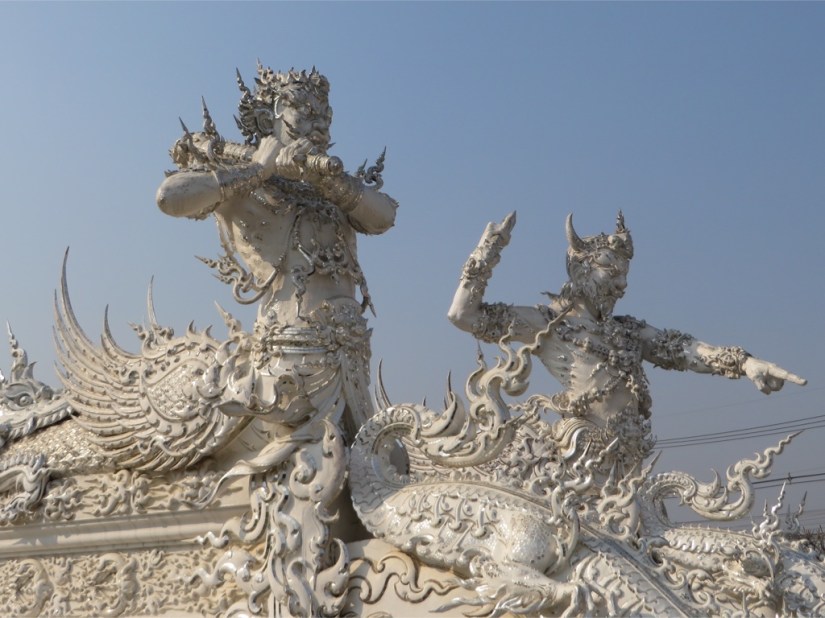
The Gate of Heaven is guarded by two creatures representing Death and Rahu who decides the fate of the dead.
The temple has classic elements like a tiered roof and naga but everything is very white and sparkly … Then you enter and face murals on the side walls of happy people floating upwards towards the statue of Buddha whereas behind are swirling orange flames depicting the various threats to spirituality coming from globalisation such as pollution, technology and many references to popular culture ranging from Elvis, to Superman and even a minion. The moral is clear – people are wicked.
Following the white theme, pretty silver discs can be purchased either as a souvenir, or to leave a prayer, and these huge chedi, are made up completely by tightly packed prayers.
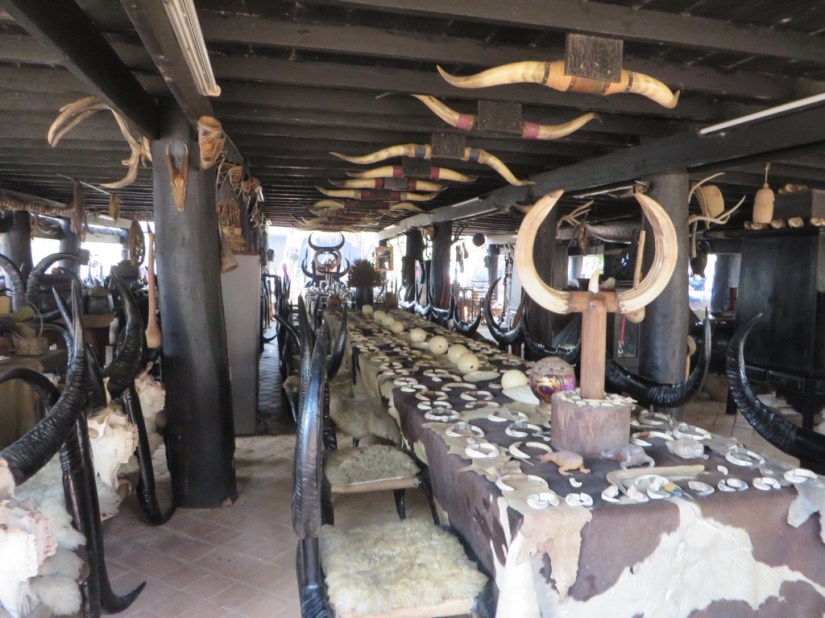
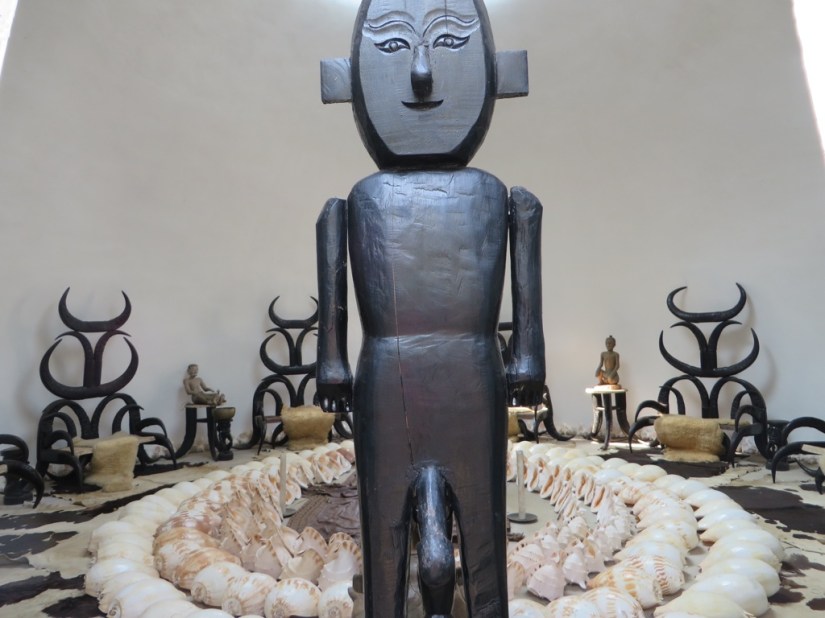
Baan Dam, or the Black House, is the estate of Thawan Duchanee and comprises a huge Lanna-style vihara of charcoal black wood as well as many other small buildings spread out in the peaceful gardens displaying his collection of artwork – sculptures, wood carvings, and furniture created by him, and collected from around the world. This isn’t your usual art collection though. It has an organic feel with wooden structures housing many animal skulls, bones and skins and also little white pods containing more bones, shells and a little happy chap! Not really sure what the significance is … read into it what you will, but it obviously all inspired his painted works.
Trekking is another of those tourist activities that can be a mixed blessing to local people. In fact we were reading that the “long-neck women” are virtual prisoners in an artificial village for the convenience of tourists and the last thing we wanted was to visit. We chose a day trek with the Mirror Foundation as it seemed to focus on walking in the jungle and visiting everyday hill tribe villages that weren’t putting on a tourist show and we were happy for our tourist baht to help support the community causes the foundation runs. Our guide Pat collected us and took us to their office where we saw a short video about their work and watched girls painting clay whistles for sale in the shop.
Our hike started around 11.30 and we walked for 2hr, walking past rice fields first then climbing through a rubber plantation under planted with pineapples where we saw workers stopped for lunch.
We stopped for a rest in a village where Lahu and Akha tribes live …
… then walked another 30mins to a waterfall.
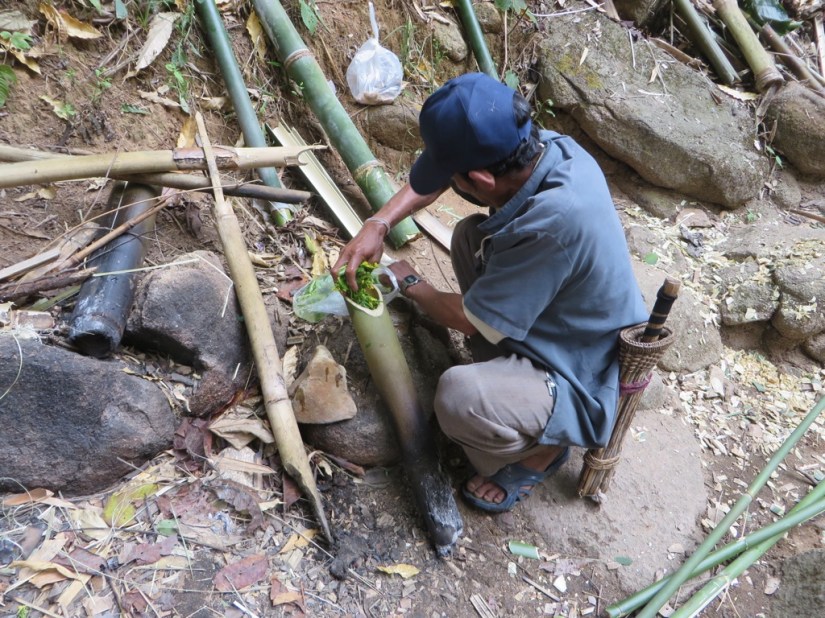
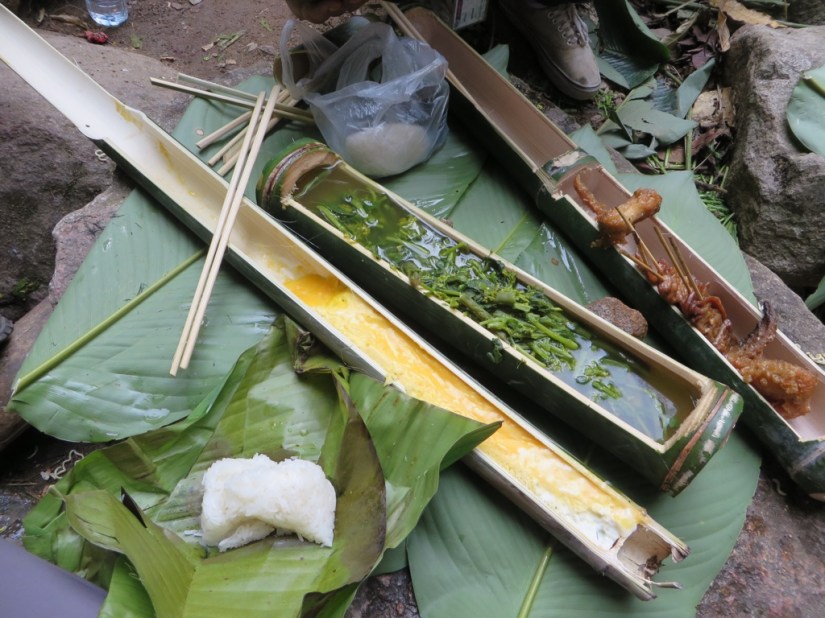
A man from a local village had built a fire and took our vegetables and cooked them in boiling water one length of bamboo and beaten egg into another.
We had this with sticky rice and some little pork kebabs and finished with tea. It was interesting to see how versatile the bamboo is, and how easy to fashion cups and spoons as well. Unfortunately, despite having bought vegetables especially because Chris is vegetarian, they then added pork stock powder, so knowing it was there, he didn’t feel able to try them!
The itinerary said we would be walking for 2-3 hours, and having already done that, we were surprised to have at least another hour’s walk to the final village, where we saw a 75 year old Akha grandmother spinning thread.
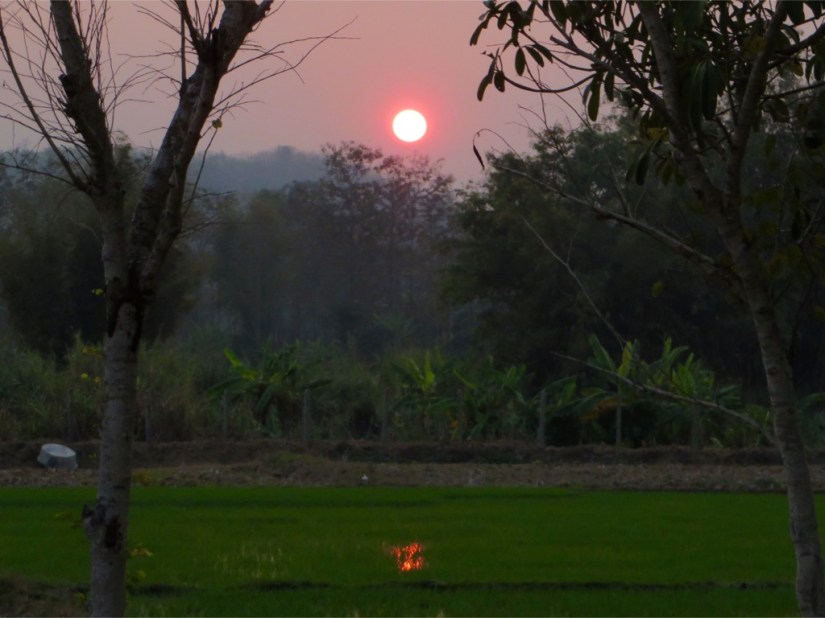
We were very pleased to be returning to the comfort of our hotel, rather than staying overnight in the village or even in the forest, which had been an option and saw the sun set on the way back.
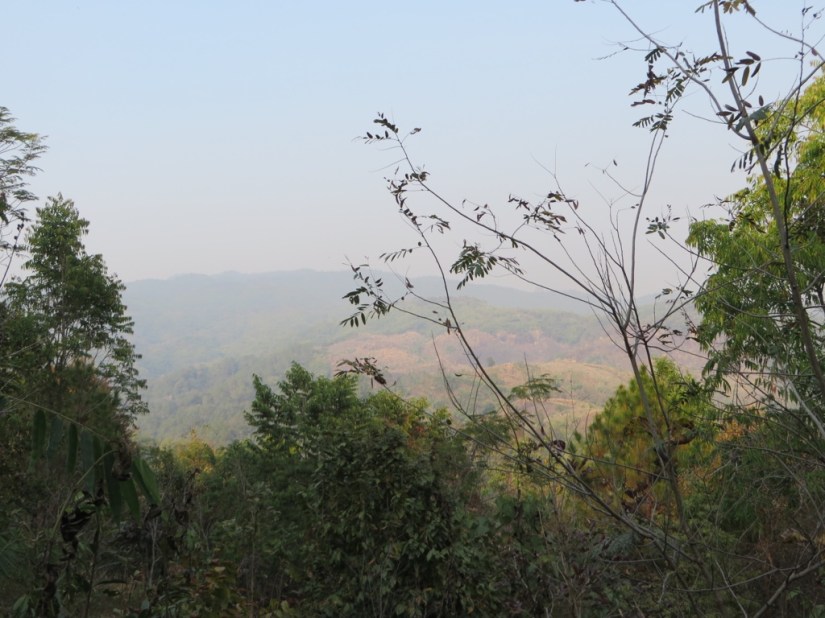
None of the above quite mentions how gruelling the day was even at a slow steady pace, the heat, steep steady climbs and some treacherously slippy descents with scree underfoot where I resorted to descent by bottom, not elegant, but no distance to fall! We were also slightly disappointed that our guide didn’t impart a little more to us about our surroundings, the nature and villages. Most of the paths offered no view apart from being surrounding by jungle and on reflection a very disappointing experience.
We are as far north as we are going now, and the choice was either 2 days travel by bus/train or should we fly down south ….
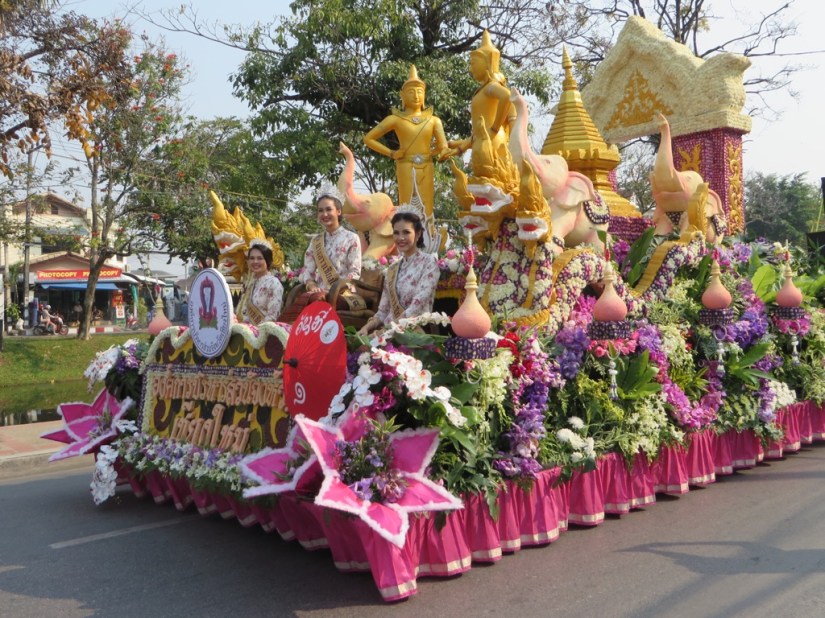
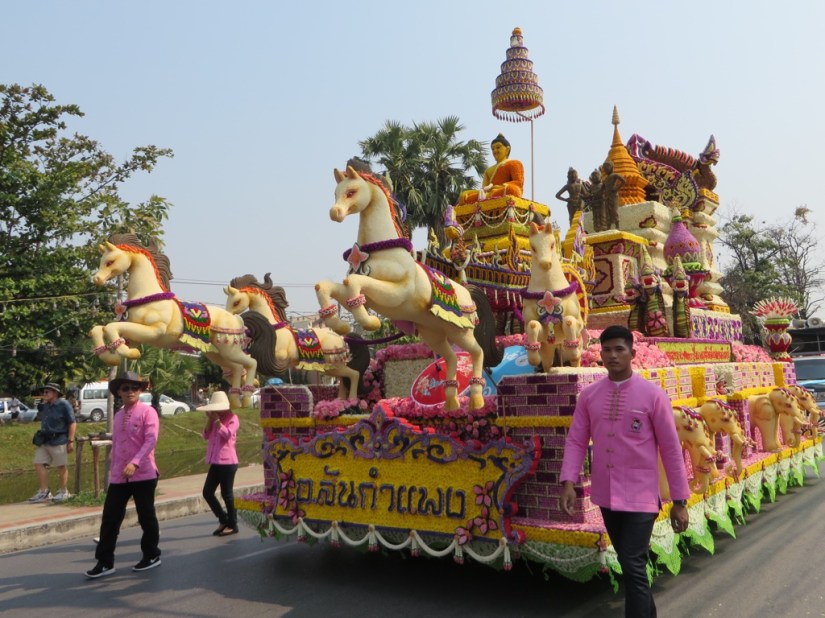
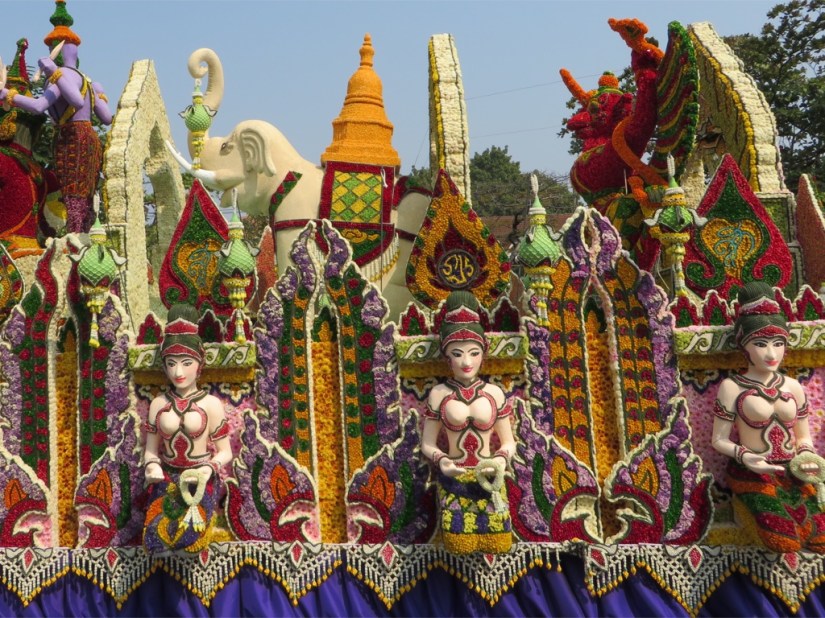
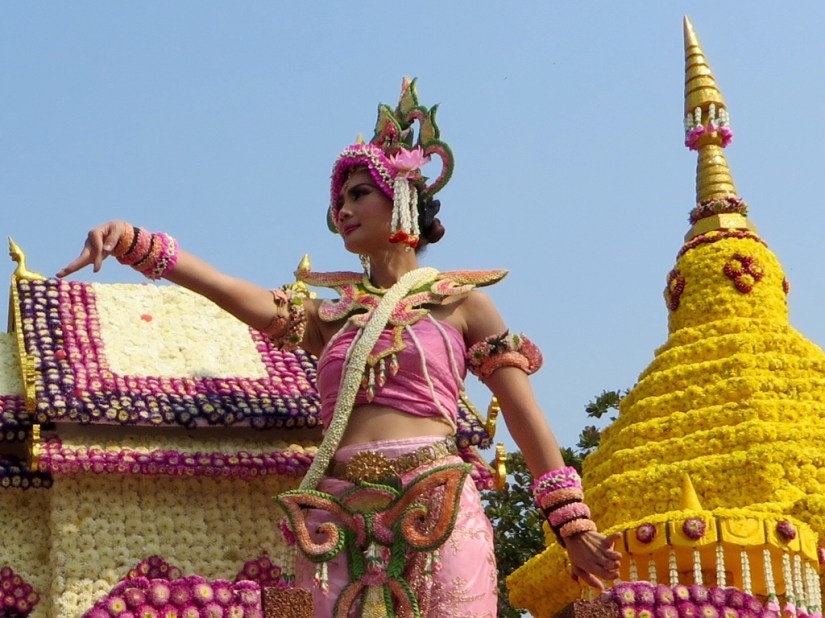
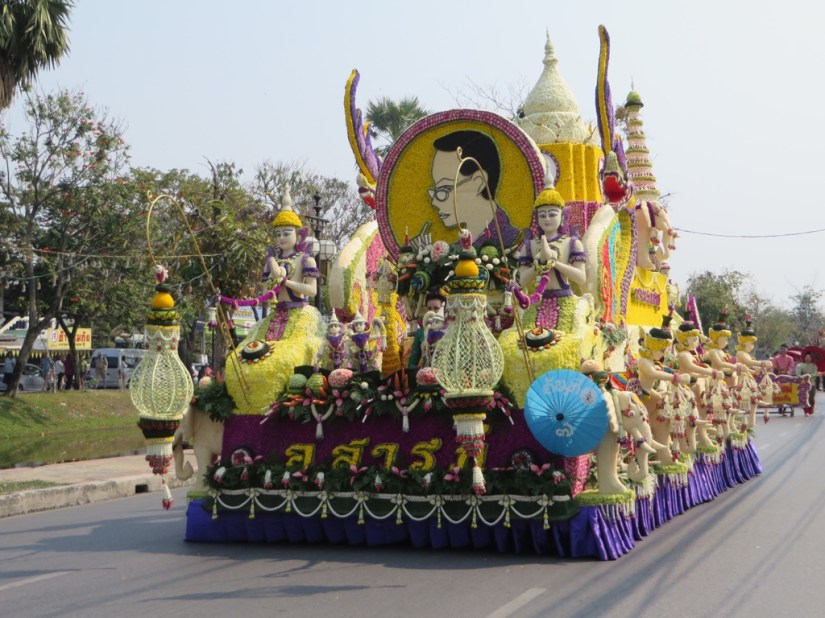
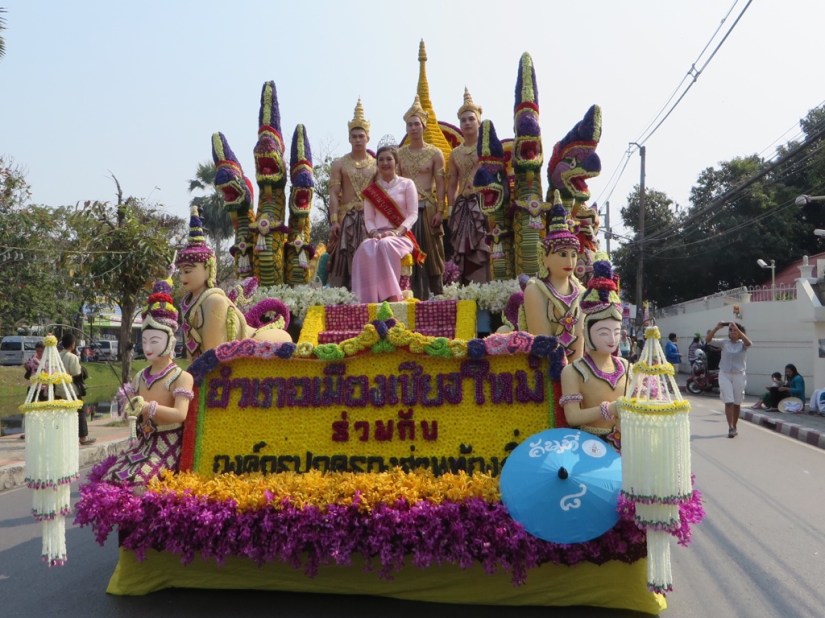
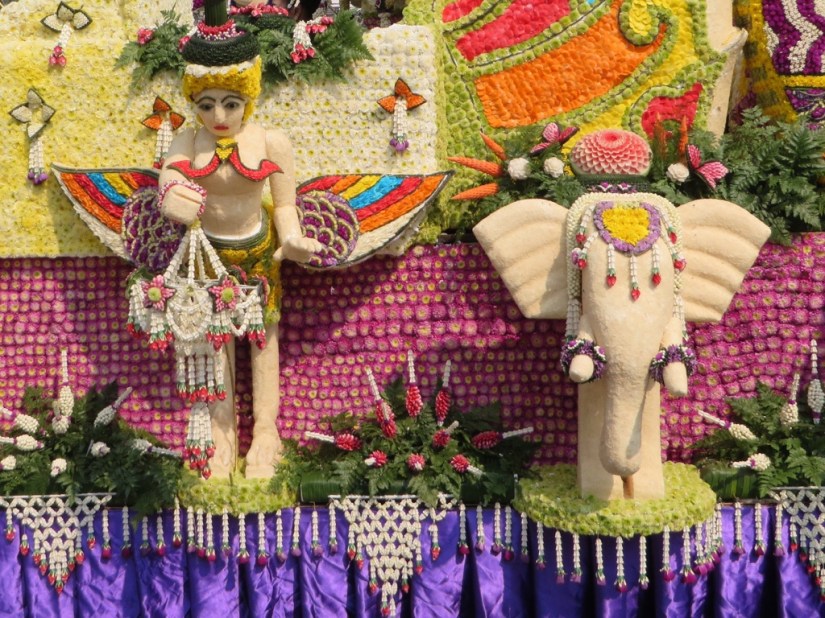
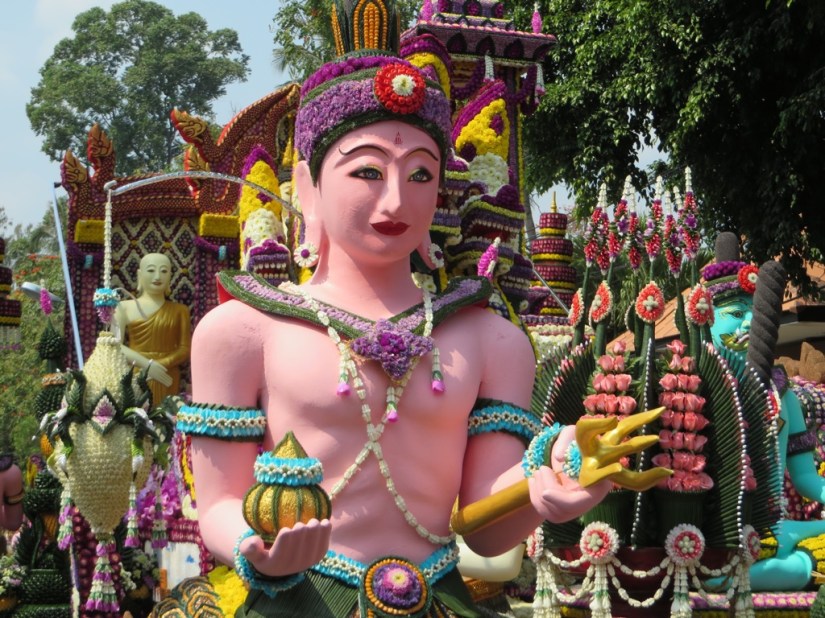
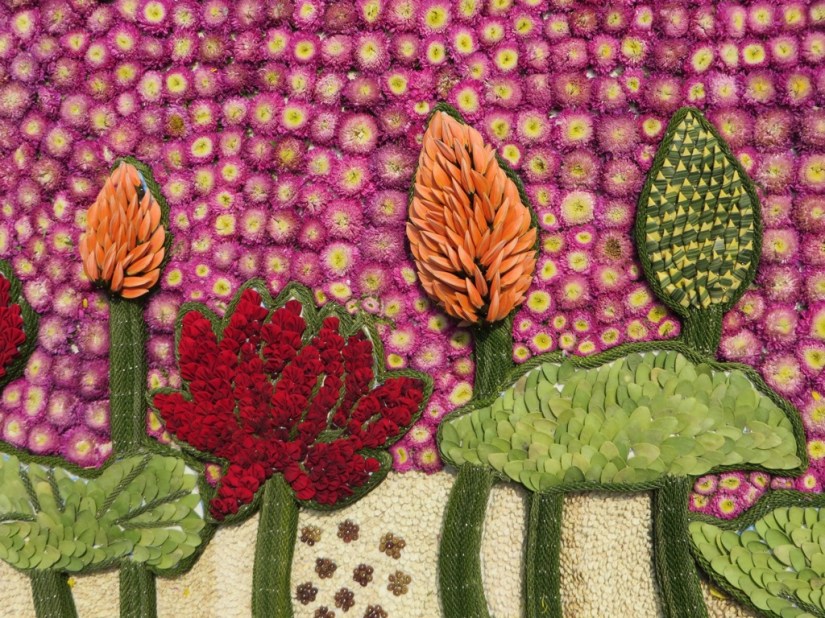
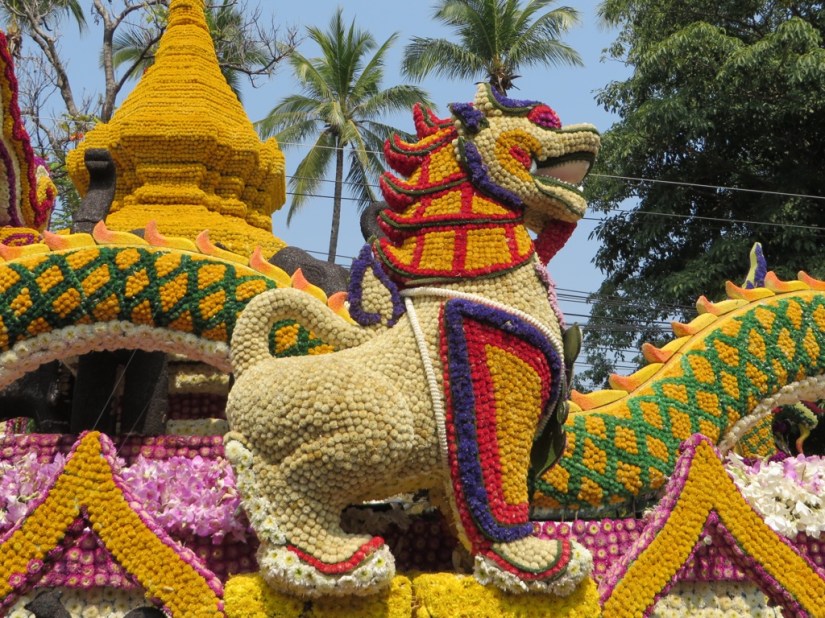
We timed our stay to catch the Flower Festival which began with a two hour parade round the outside of the old centre, ending in a park where the floats could be admired close up and there was an orchid display and street market. We just took so many pictures of the fabulous floats, together with school bands and people in traditional costumes. Some of the large figures are covered in coloured rice, and a few of the flowers were dried and dyed, but most were fresh using a lot of chrysanthemums and orchids and the effect was stunning.
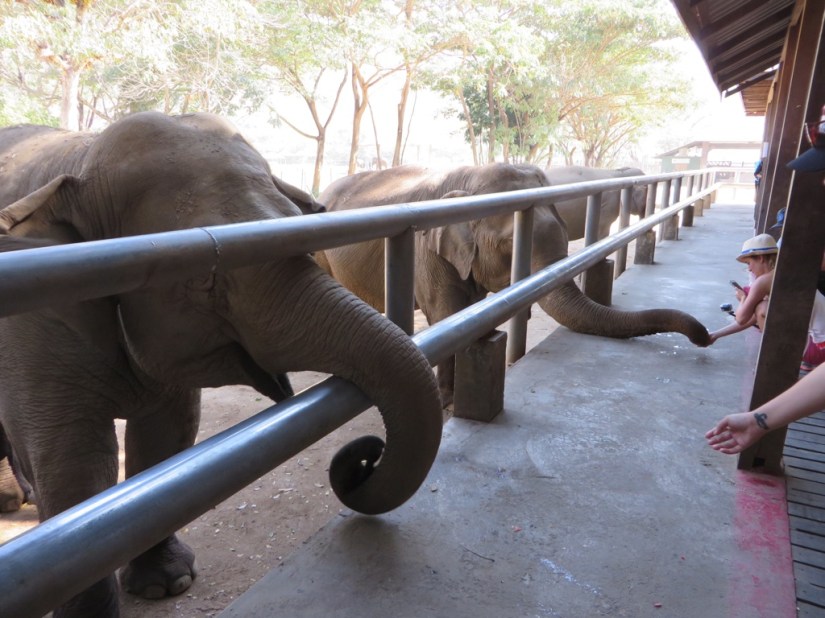
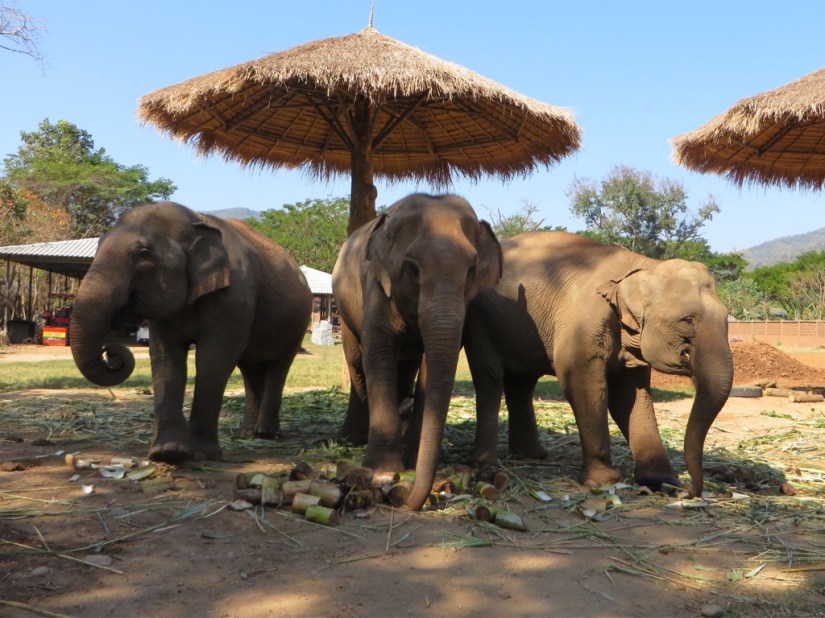
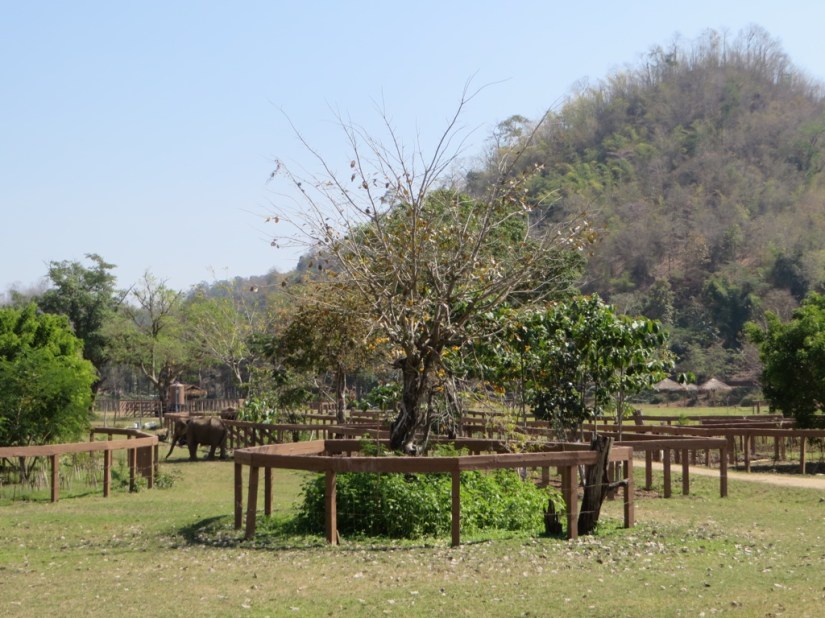
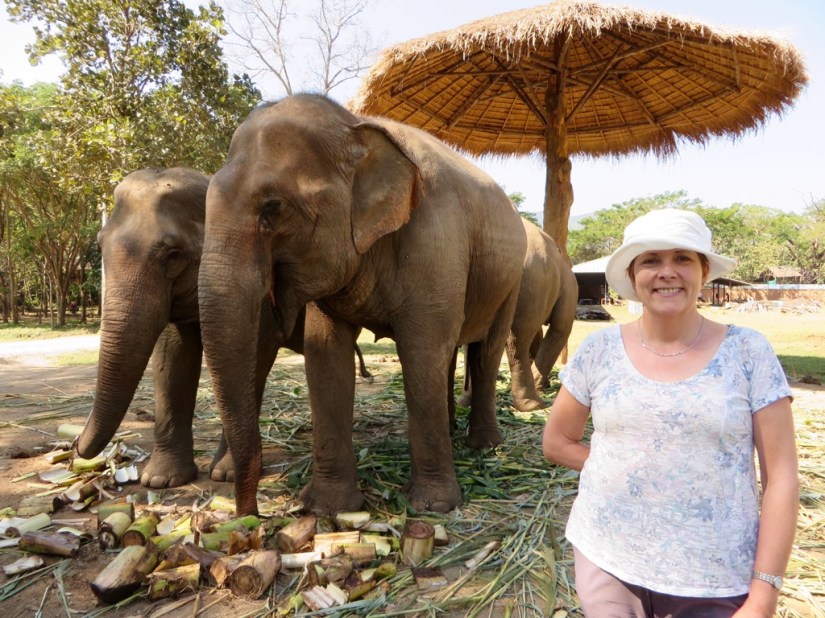
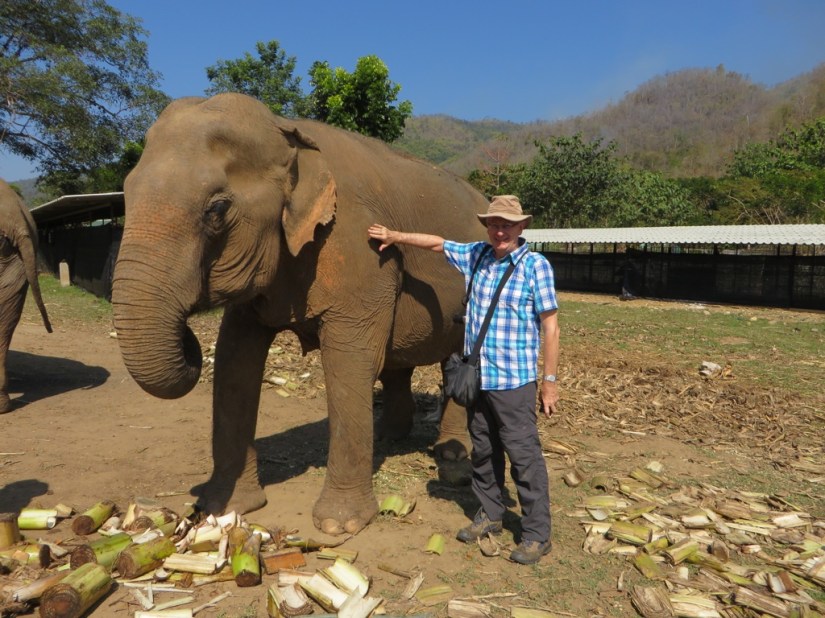
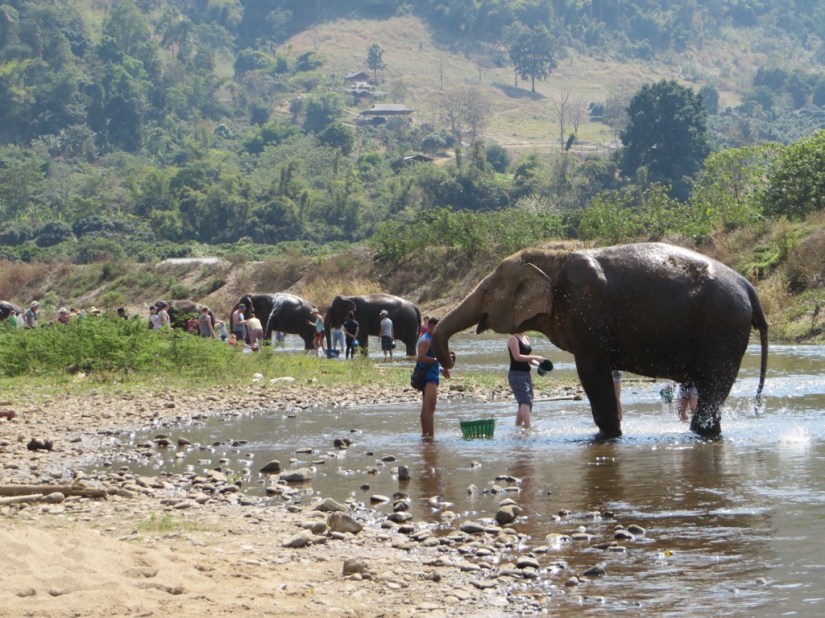
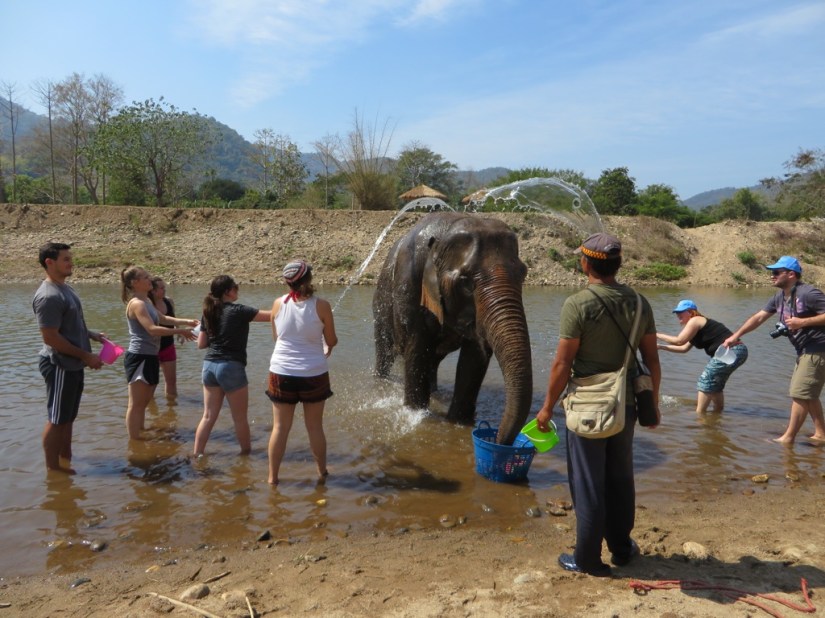
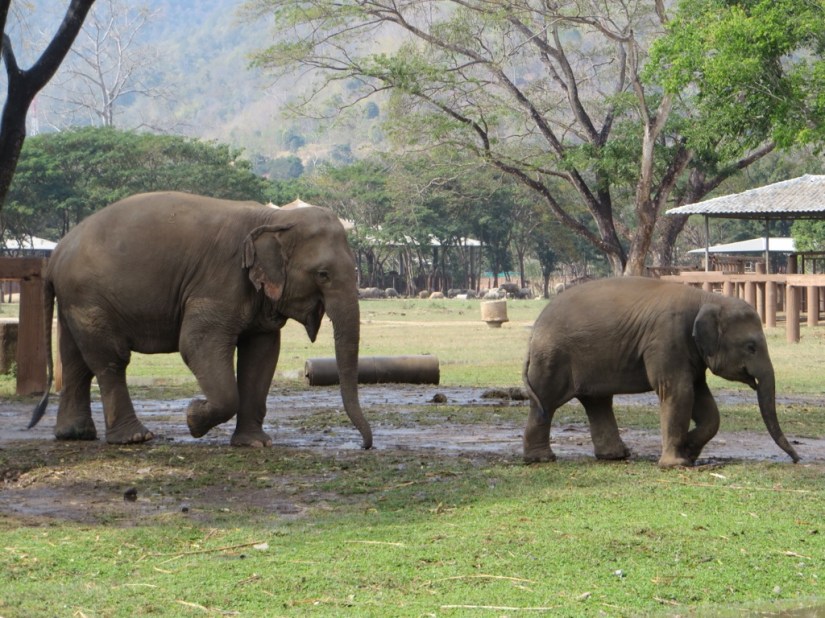
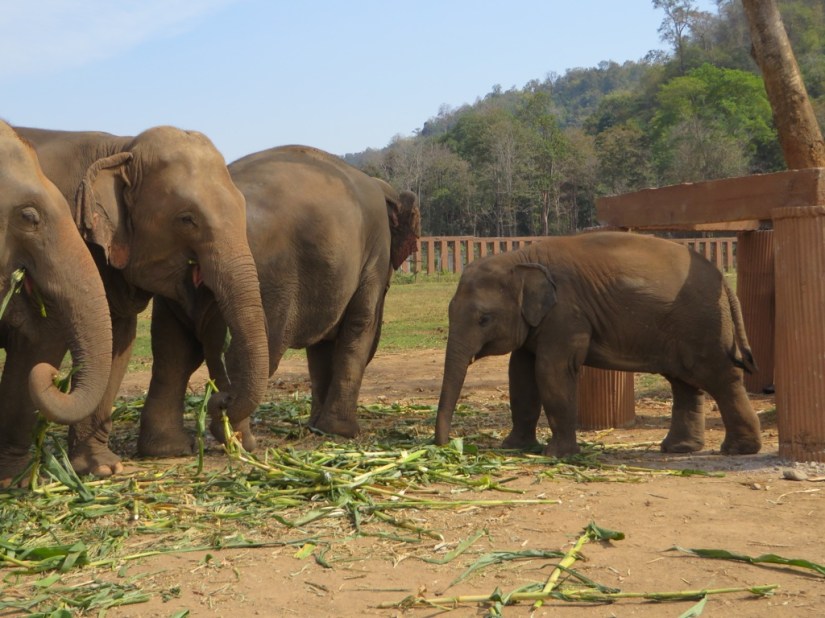
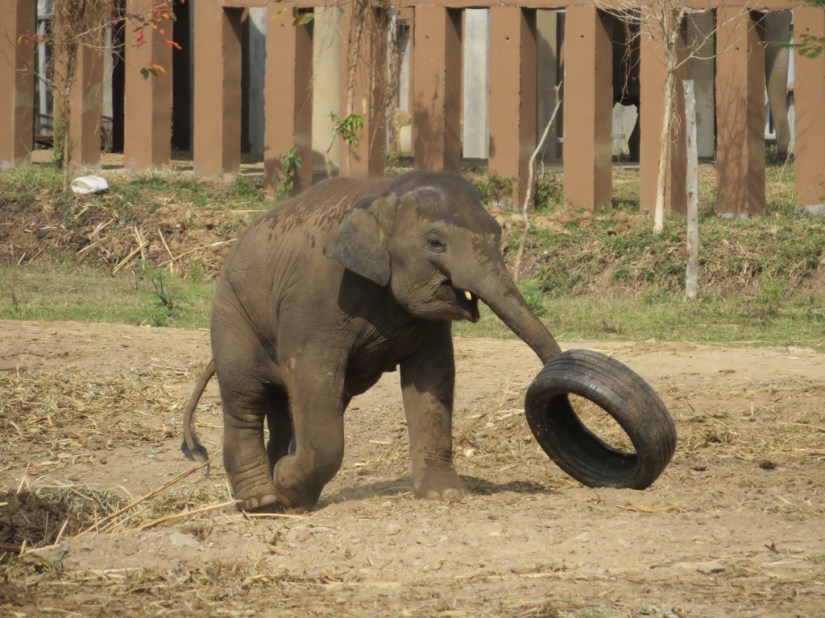
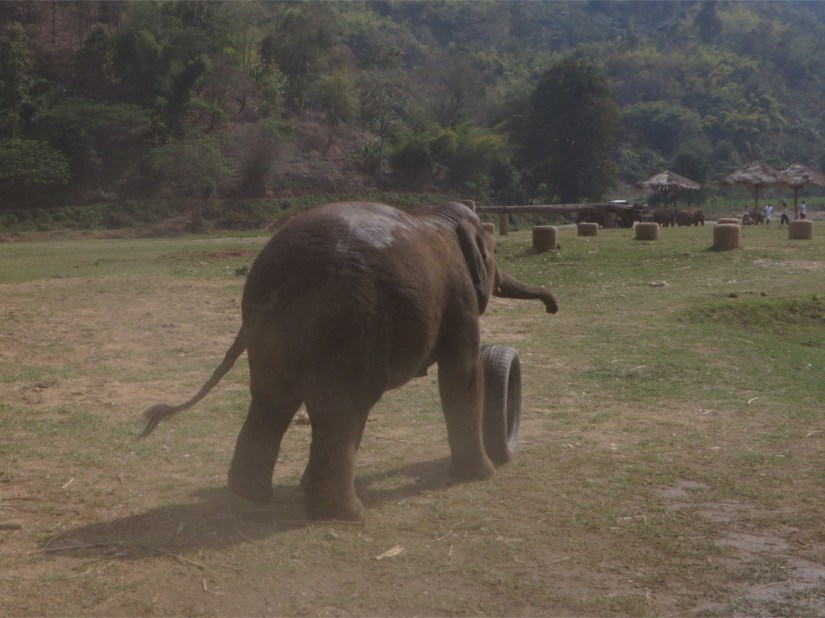
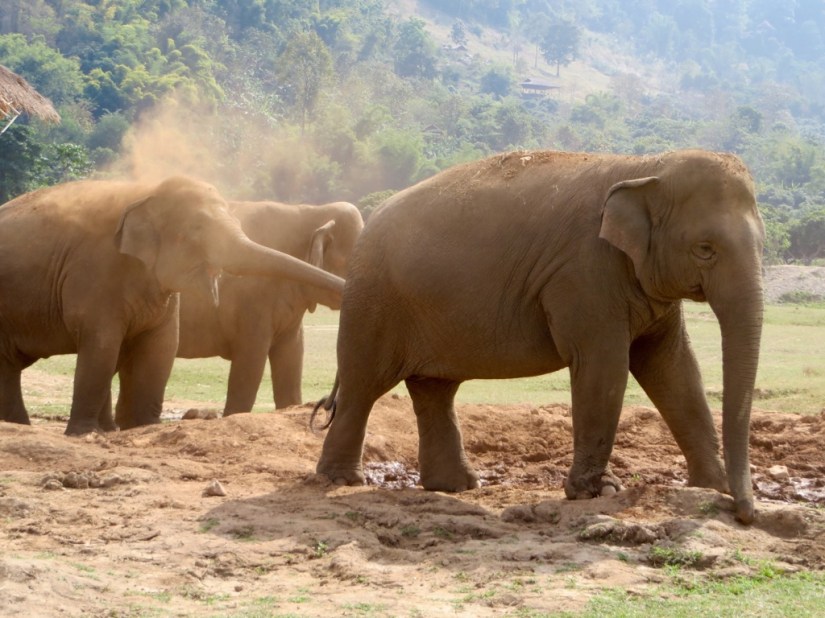
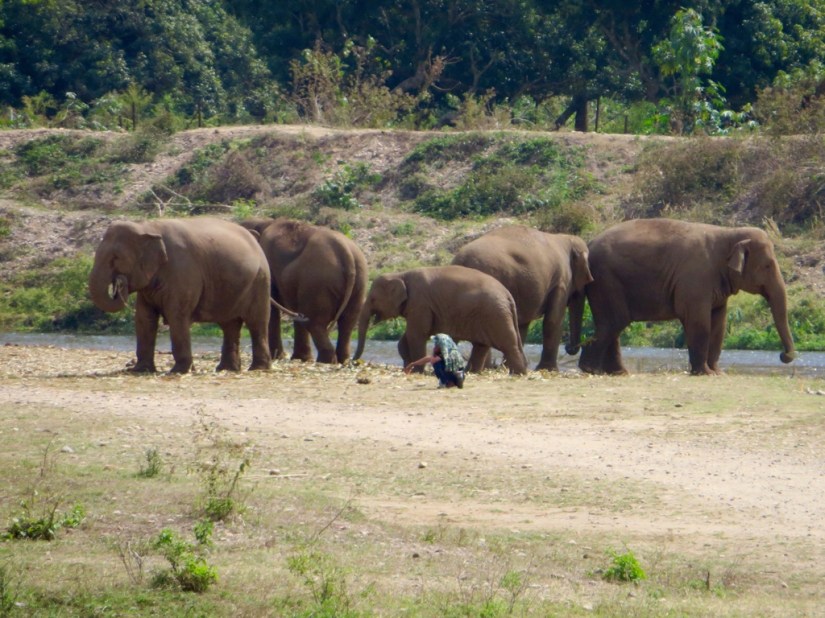
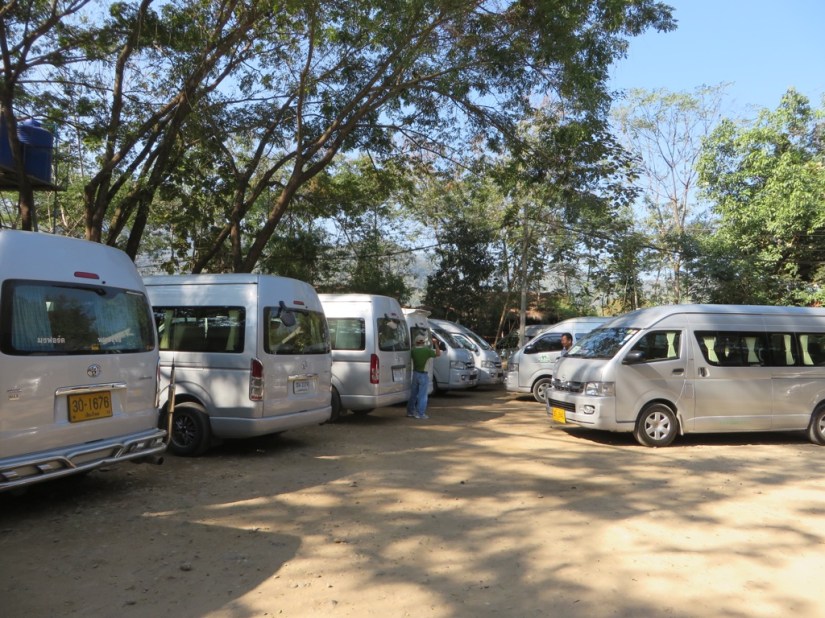
From flora to fauna now … and elephants. The practical role of elephants has been almost as important as their symbolic importance, with one king of Ayutthaya going to war with Burma with an army of 300 elephants and in peacetime they have been used for transport and beasts of burden. Commercial logging was banned in Thailand in 1989 after a severe mudslides caused by deforestation killed 100 people and wiped out complete villages. This left many elephants out of a job, and although tourism stepped in, trekking and elephant shows often badly treat the animals and we did quite a lot of research to decide whether or not we wanted to do an elephant related tourist activity. Fortunately, we found Elephant Nature Park who are a charity providing a sanctuary for elephants. Some have been harmed in the past from logging or land mines in Burma, trekking or just being old or unwanted, but the lucky ones find a home here and are treated with love and kindness. We fed them huge amounts of melon and pumpkin, walked round the sanctuary meeting different groups of elephants and hearing their stories, helping with bath time and of course taking lots of photos and for the more modern, elphies! It certainly is a slick operation as you can see from the car park, but well organised as in our group of 11, we certainly didn’t feel there were that many visitors as we were shown round by our guide Johnny. There are also opportunities for volunteering and all helps to pay for the food and vet bills … A great choice, a great place and a great day!
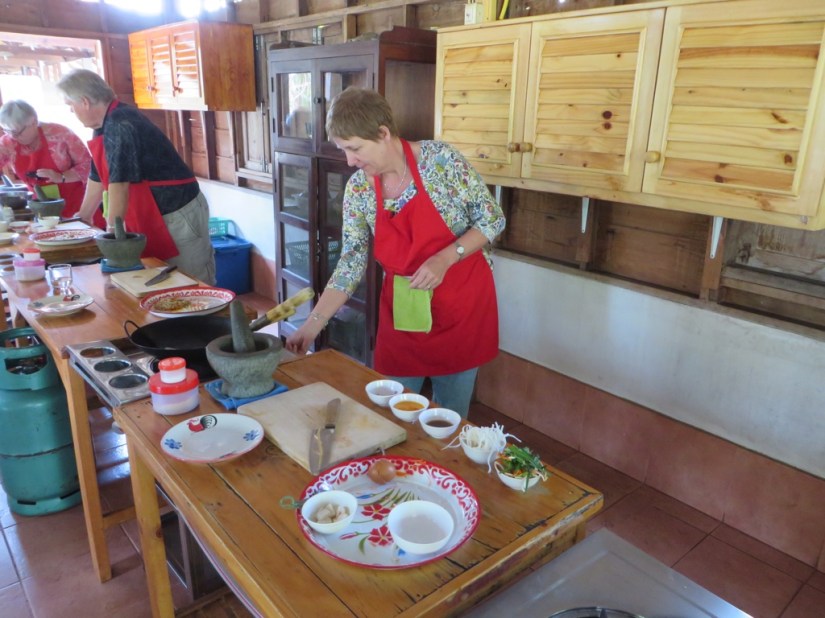
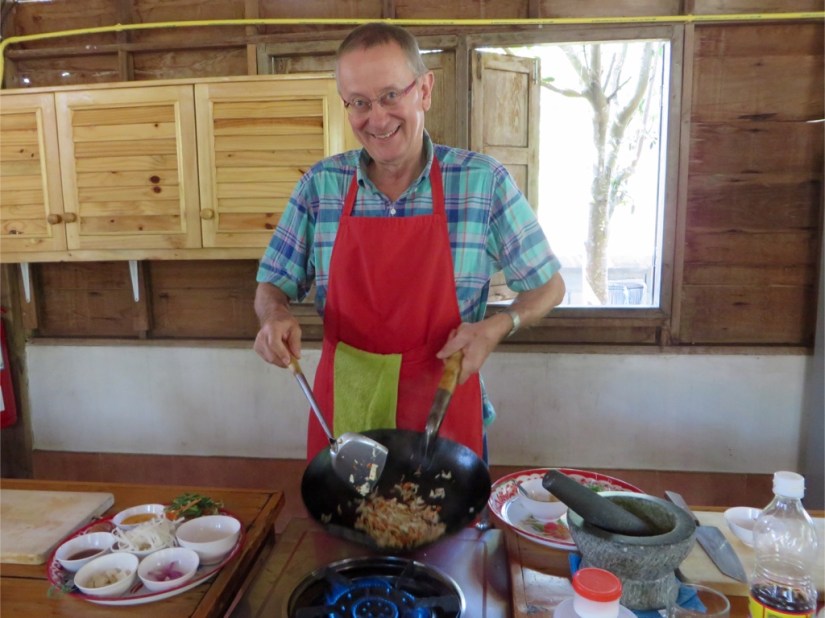
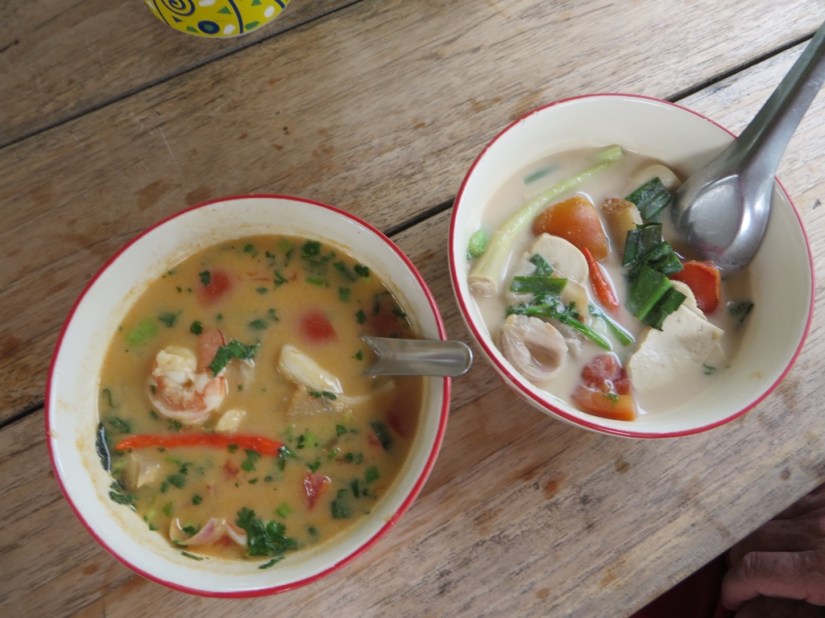
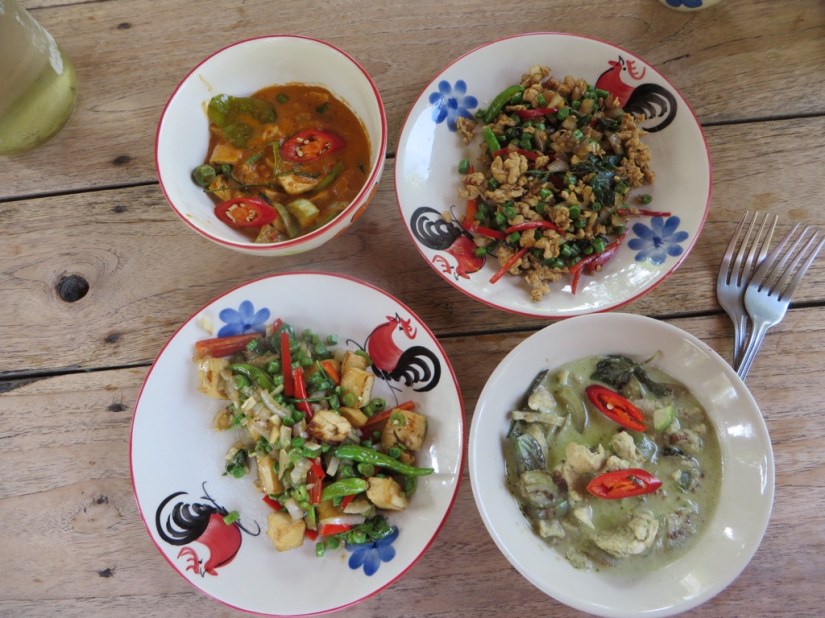
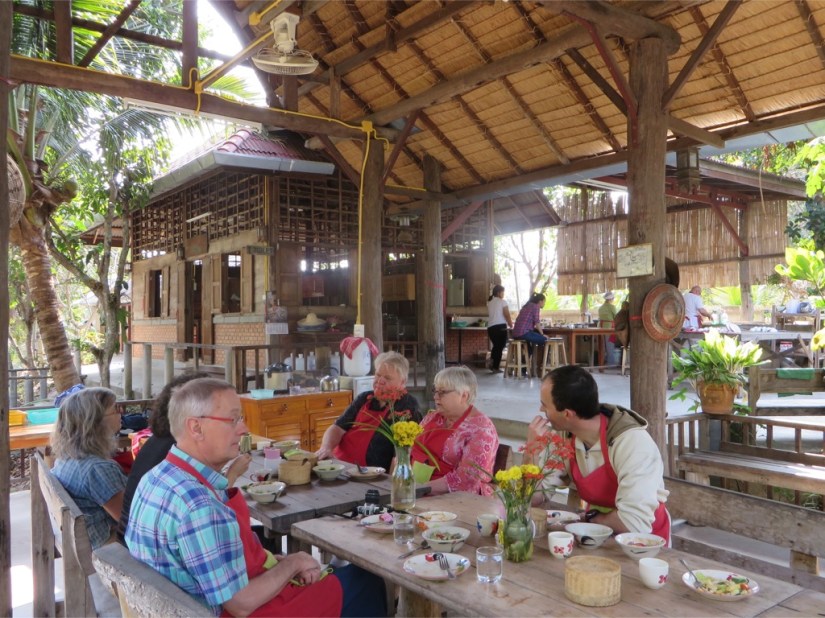
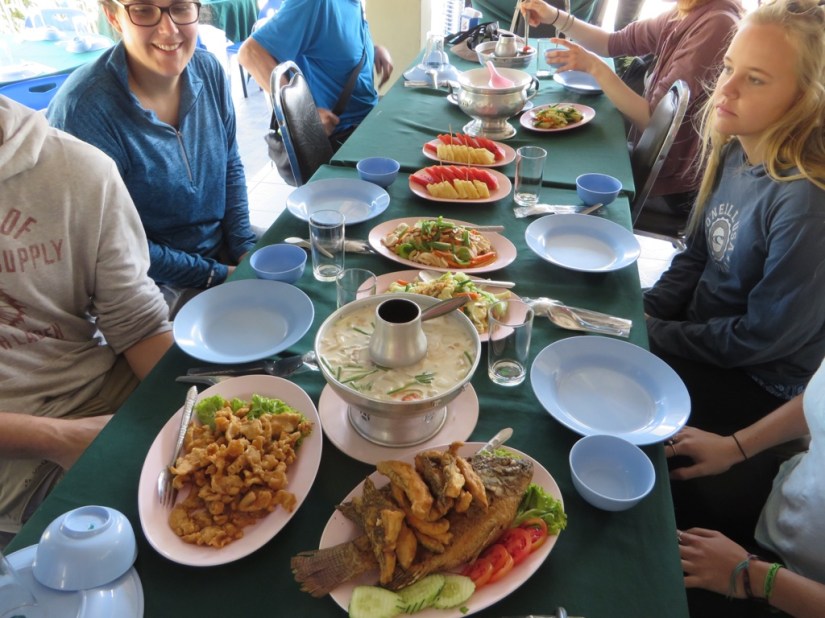
Doing a cookery class has become a regular feature on our trips since our very first class in Bangkok in 2009 and we spent a great day at Thai Farm. We started with a quick market tour and also a look round their organic garden at various herbs and vegetables, then starting cooking in the lovely open air kitchen. Between us we made Tom Yam soup, Pad Thai, spring rolls, curry paste lovingly ground with a pestle and mortar and made into red and green curry, a stir fry with basil, sticky rice with mango and coconut bananas. As there were choices of what you could cook, with a group of 10 it was a little more confusing than all making the same thing, but it all worked out fine. I was most pleased with the pad Thai which I intend cooking again and while I love the green curry, but it wouldn’t seem the same without the special Thai aubergines which I’d have to get from a specialist shop.
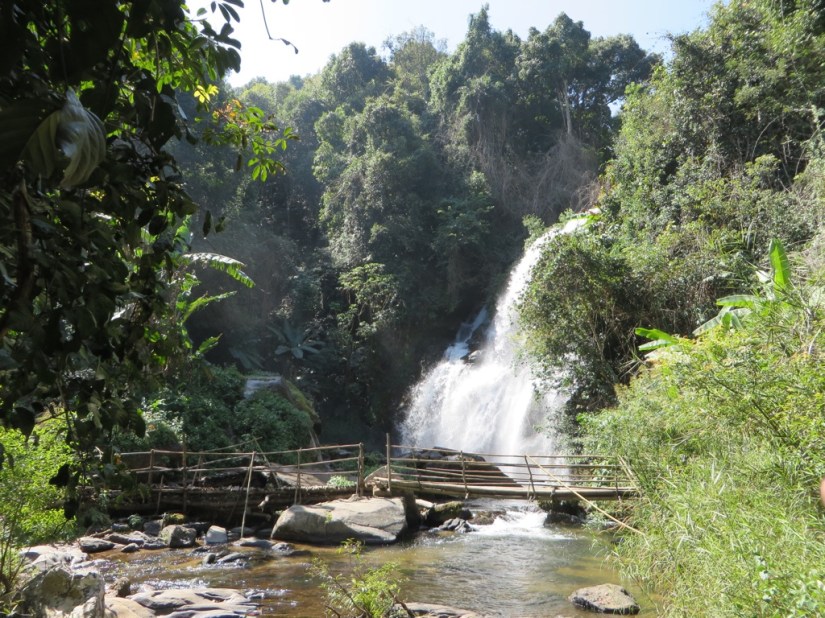
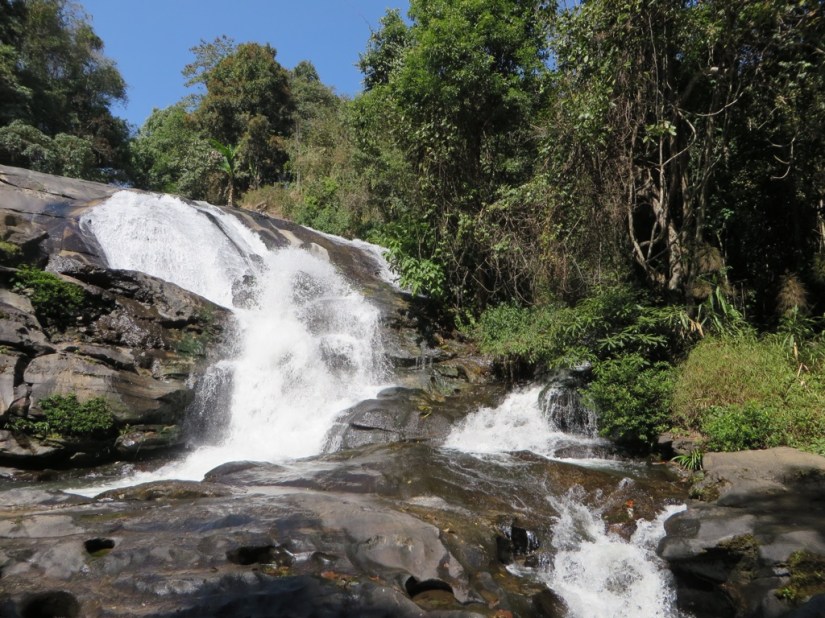
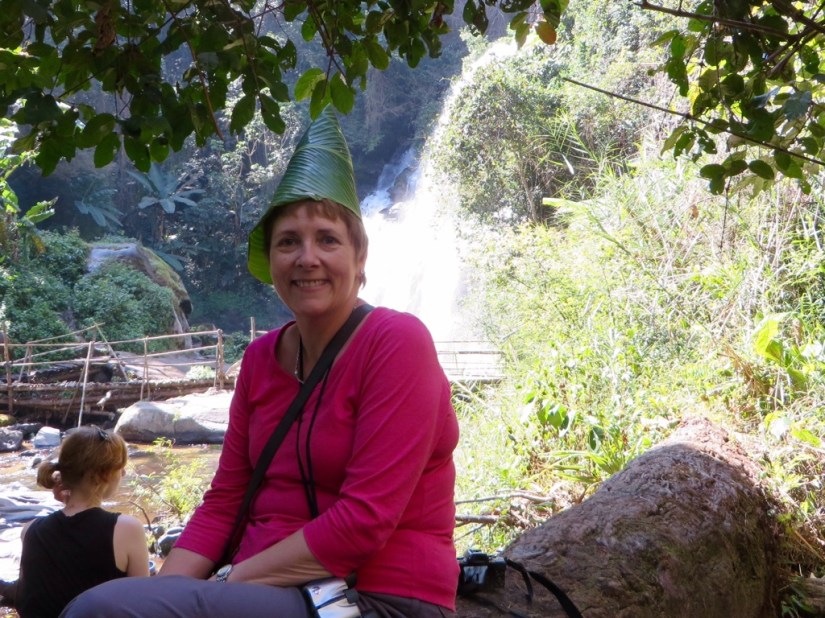
After all that eating, a bit of exercise seemed a good idea and our guesthouse organised for us to go for a trek in Doi Inthanon National Park, 90 minutes from Chiang Mai. In a small group of 8 we began with a stop at Wachirathan Waterfall …
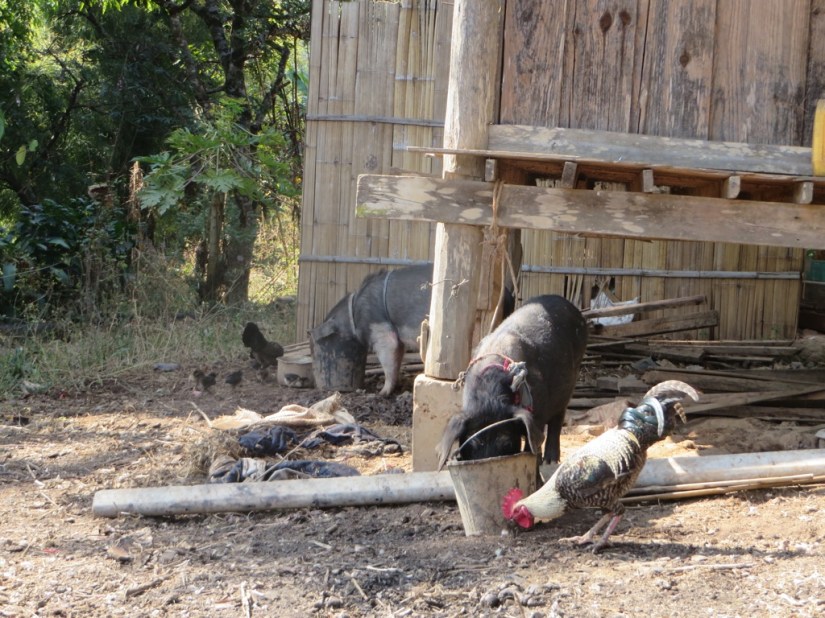
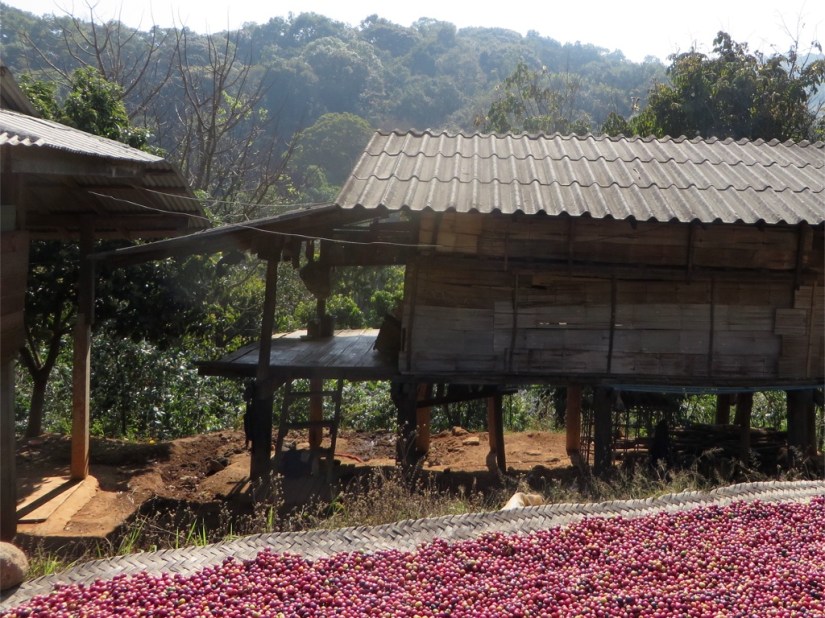
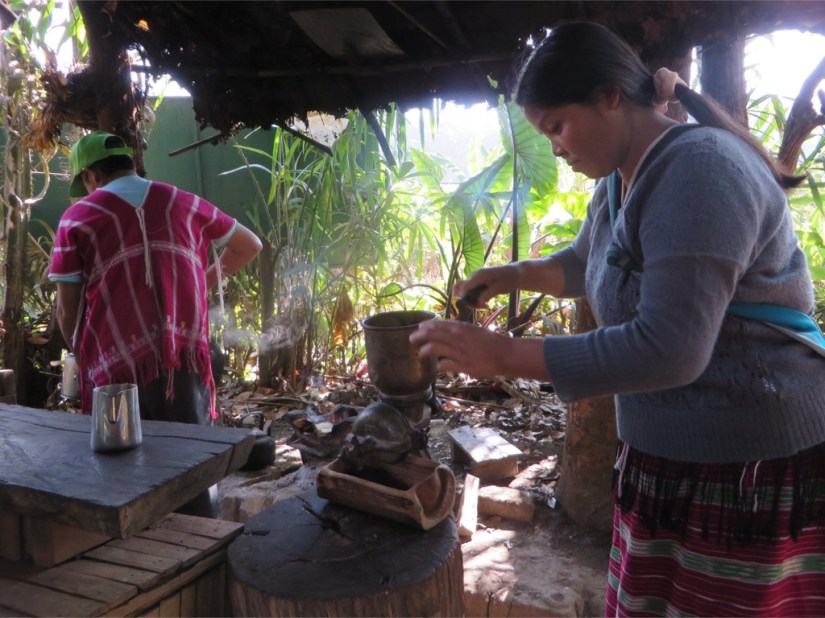
… then began our first trek from a Karen hill tribe village where they grow organic Arabica coffee, and they brewed us up a cup to try.
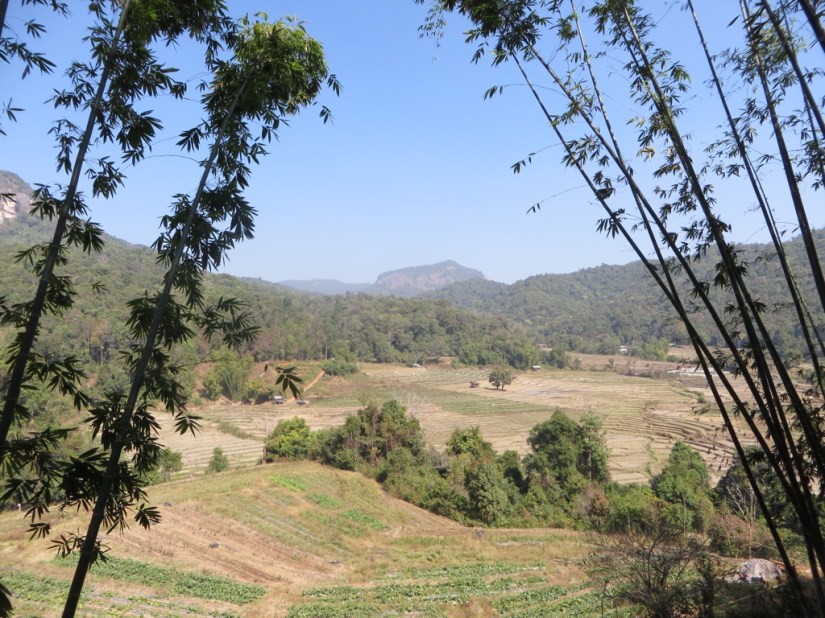
Coffee, along with flowers and strawberries were introduced to replace opium growing which was made illegal in 1959. We then walked for a couple of hours, led by a village guide along a well trodden path at about 1,200m through the forest, passing several waterfalls and catching glimpses of farmland below. At one point, we heard gibbons calling to each other in the canopy but didn’t see one.
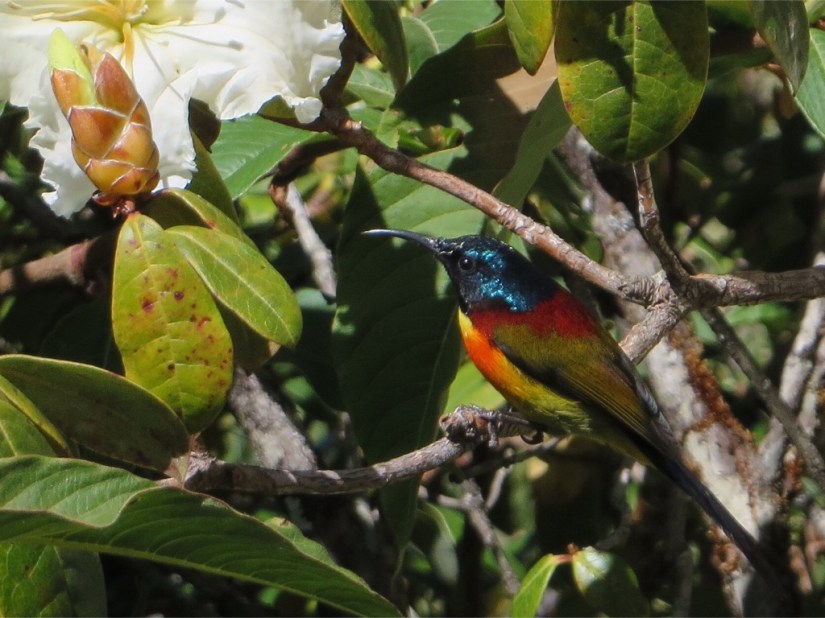
We stopped for lunch, then drove to the highest point in Thailand at 2565m, where actually there was no view but we did see a green-tailed sunbird, tiny and similar to a hummingbird and one of two species unique to the park.
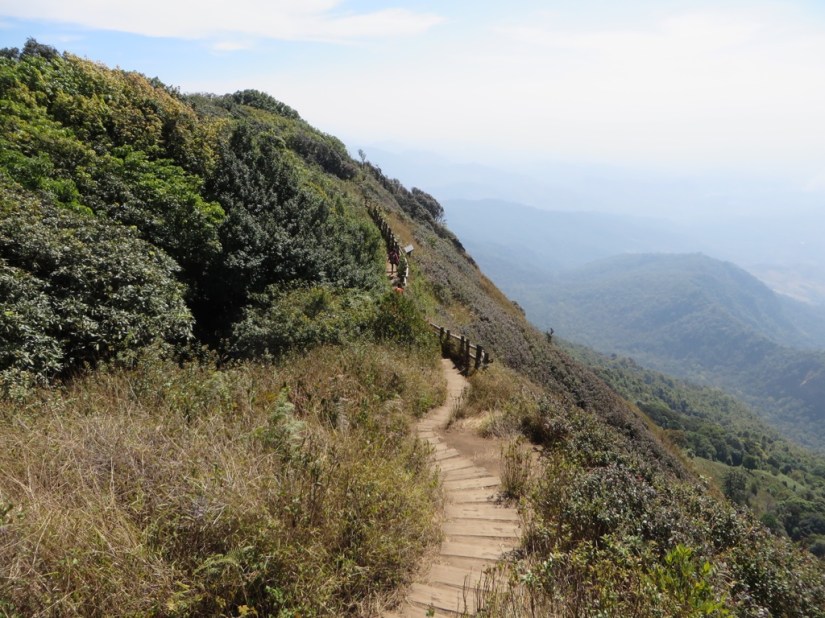
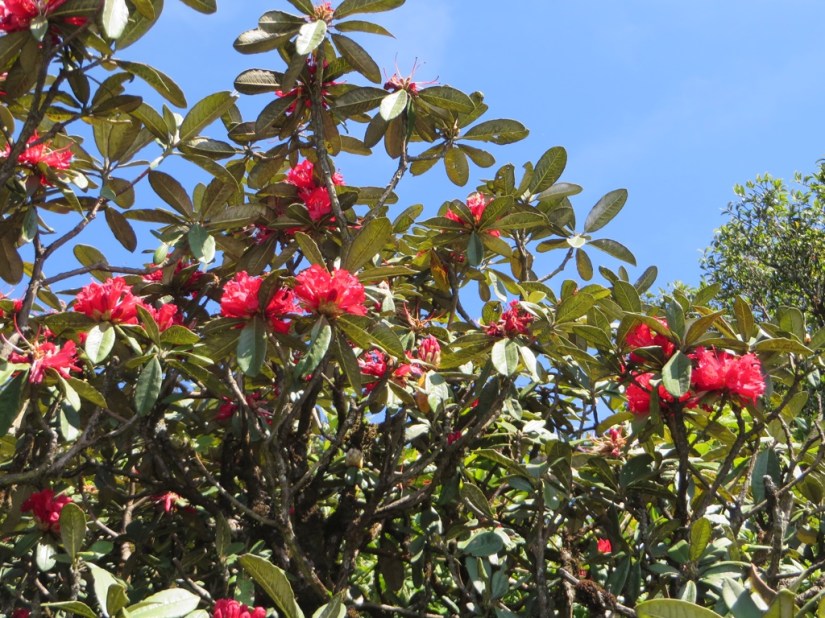
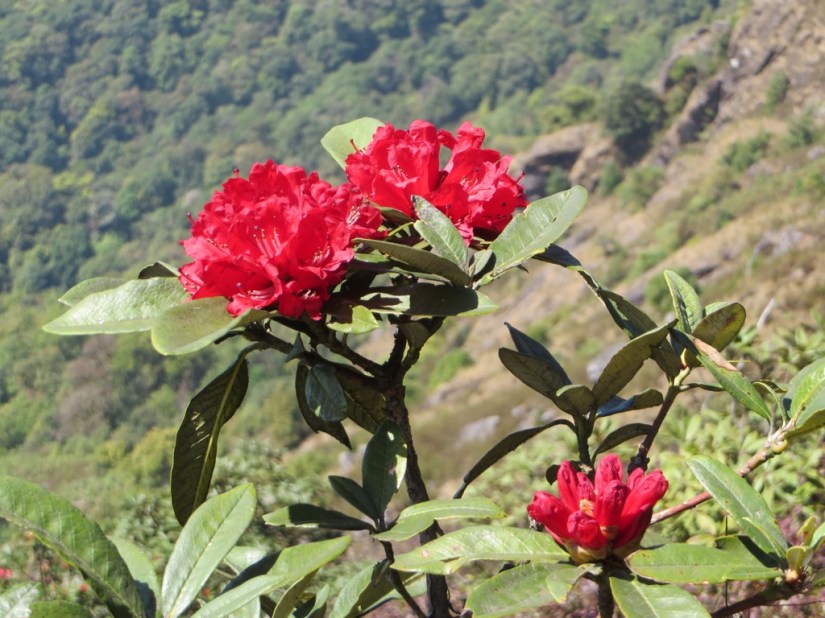
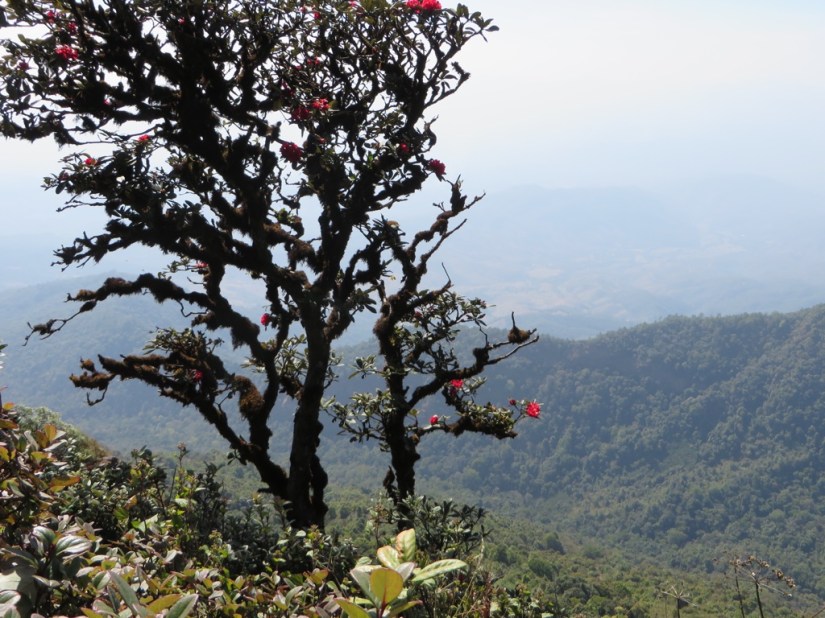
We then walked the … trail at about 2,200m through the cloud forest and alpine meadow where red rhododendron trees grow in their natural habitat.
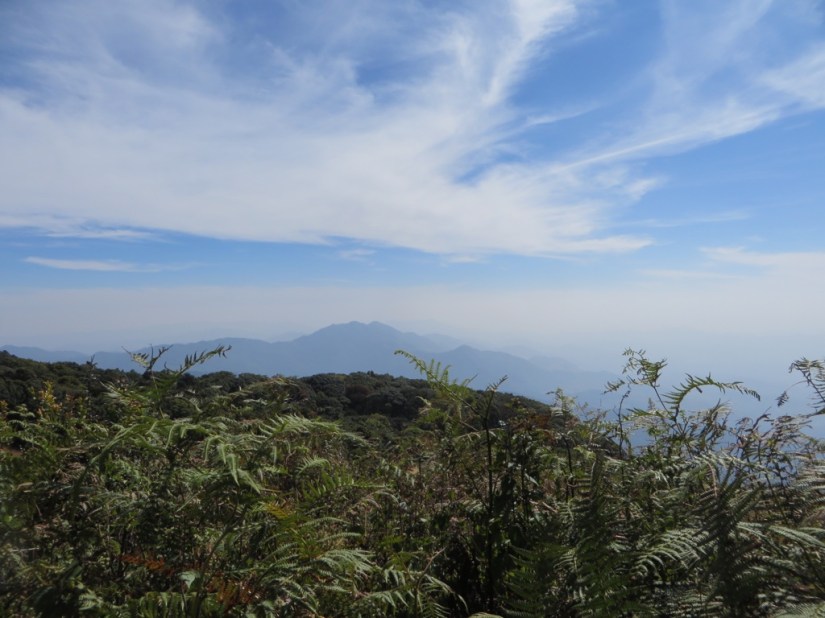
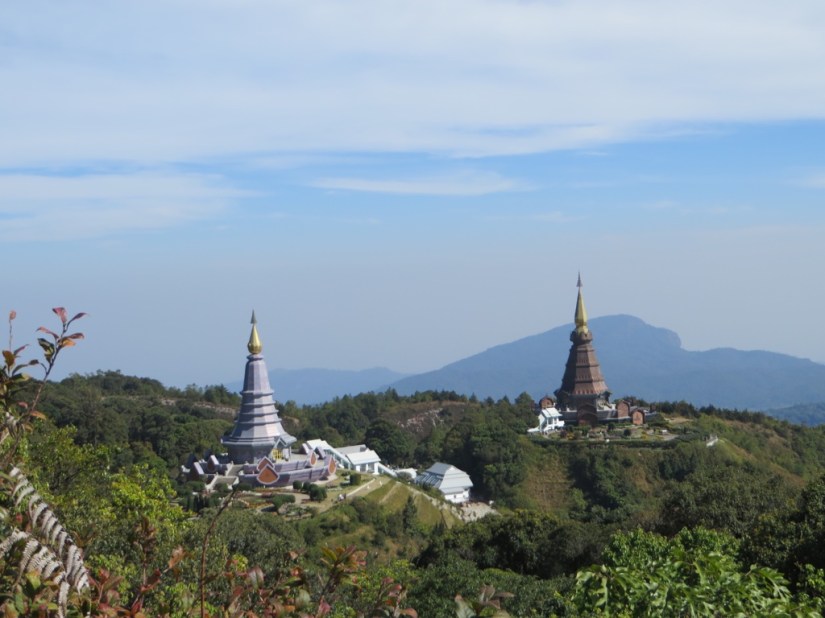
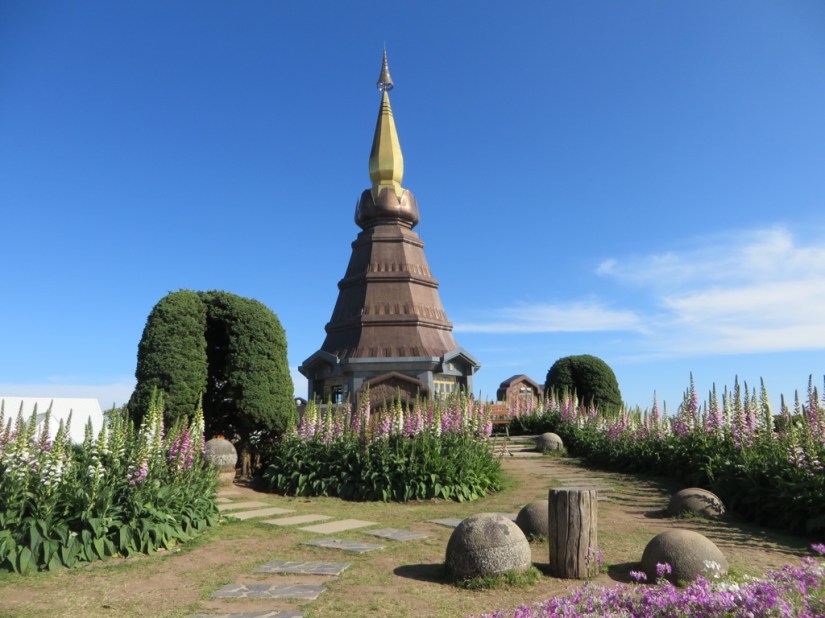
Farmers have just started burning off fields in the valley and with the smoke hanging in the air views were rather misty, but we did see the King and Queen chedis.
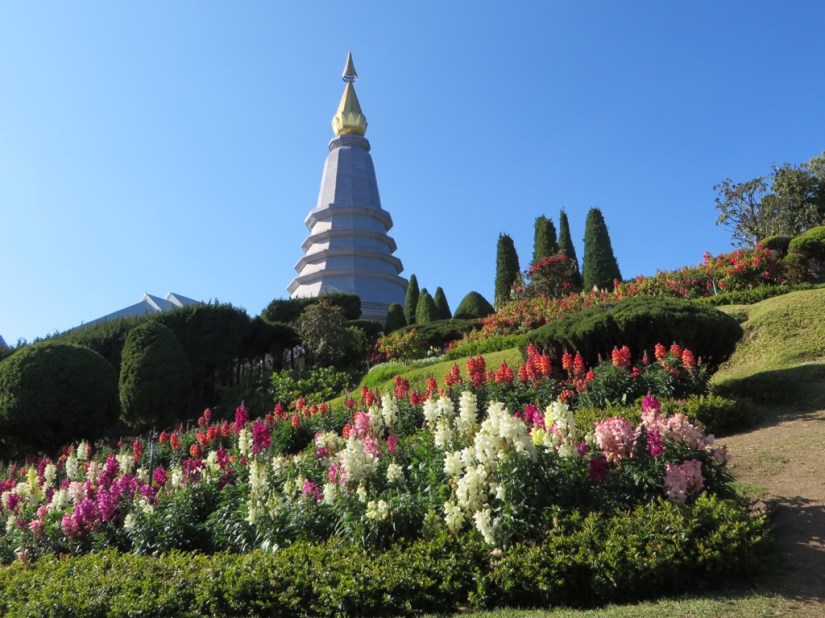
Our last stop was to actually visit the chedis, built to honour the present King and Queen’s 60th birthdays and their colourful gardens, filled with plants just as at home in an English garden.
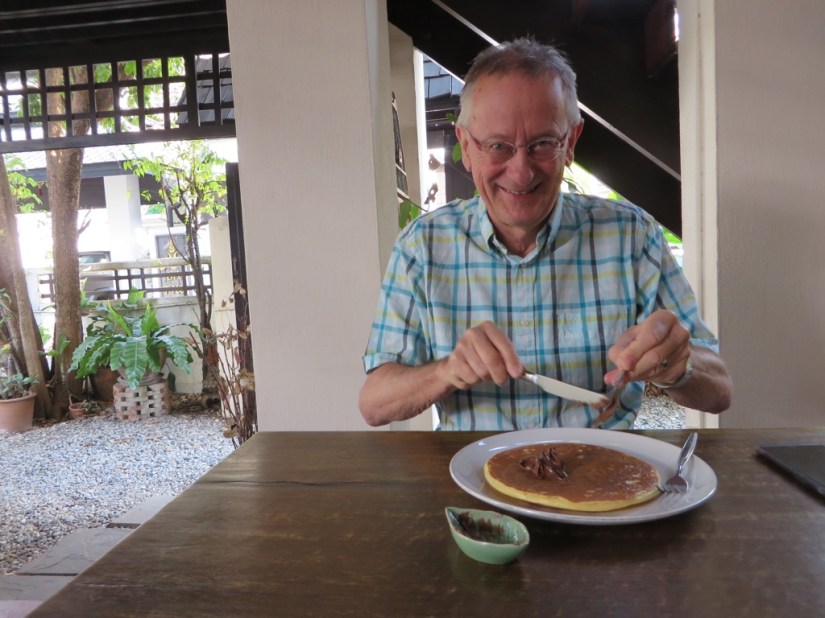
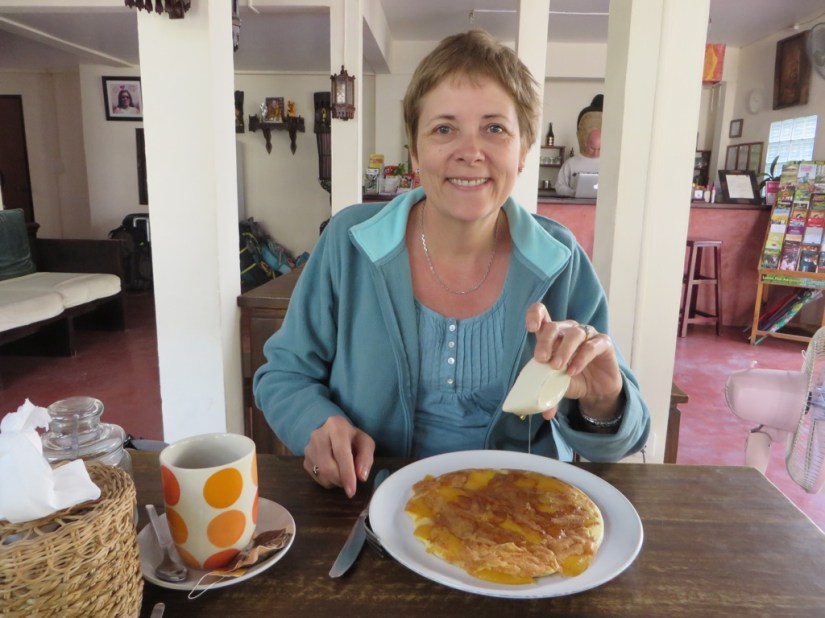
Our time here is at an end, but I just must mention the fabulous pancakes we’ve had for breakfast most days, Chris’s with Nutella and mine with mango!
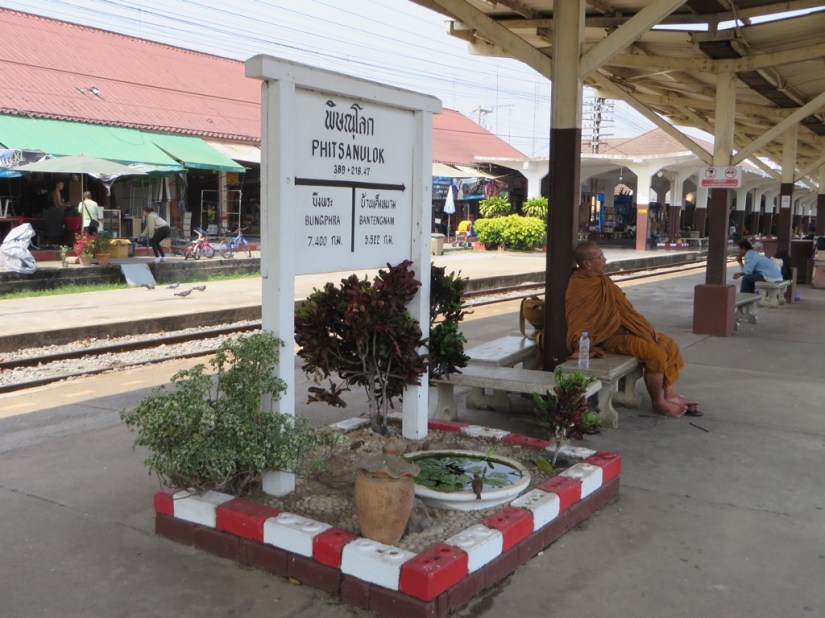
Beginning at Phitsanulok Station, the train took us across the Central Plains with views of farmland as far as the eye can see, mainly rice, but also fruit, vegetables and flowers, punctuated with the odd building and town but then mountains started to loom all around, covered in trees and scrubby undergrowth.
We had already been given a curry lunch and then a cup of tea and a custard bun at 4pm and the journey continued. Then the train stopped and we waited for 30 minutes or so with no explanation. Another engine was attached to the front of our train and we were off again, gradually climbing. We then went through the tunnel, almost 1.5km long that took some 10 years to build. Some time later we came to a halt again and the engine was removed and after a fair wait we were off again. Another stop, this time at a station, another engine was attached and the staff returned with curry and rice in a takeaway carton for each of us …. again not sure if this was planned, or if they thought we needed feeding as we were delayed. Our train left 40 minutes late at 2pm and rather than arriving at 7.30 as scheduled, we rolled in at almost 10.00pm. Fortunately that is the last train trip on our itinerary!
The old kingdom of Lanna was unified into a northern state by King Mengrai who built Chiang Mai, in 1296 and a period of prosperity enabled its own style of art and architecture to flourish. The Burmese captured the city some 200 years later and controlled Lanna through puppet rulers but when Burma sacked Ayutthaya in 1767, the Thais managed to drive out the Burmese and the ruined Chiang Mai was rebuilt. At the end of the 19C, The British, who had control of Burma and also logging rights in the north of Thailand were seen as a threat by Rama V who took measures to integrate the north more with the centre, helped by the arrival of the railway from Bangkok in 1921. Today 80% of Lanna’s population are subsistence farmers, finding it hard to earn a living although there is prosperity in the towns from tourism.
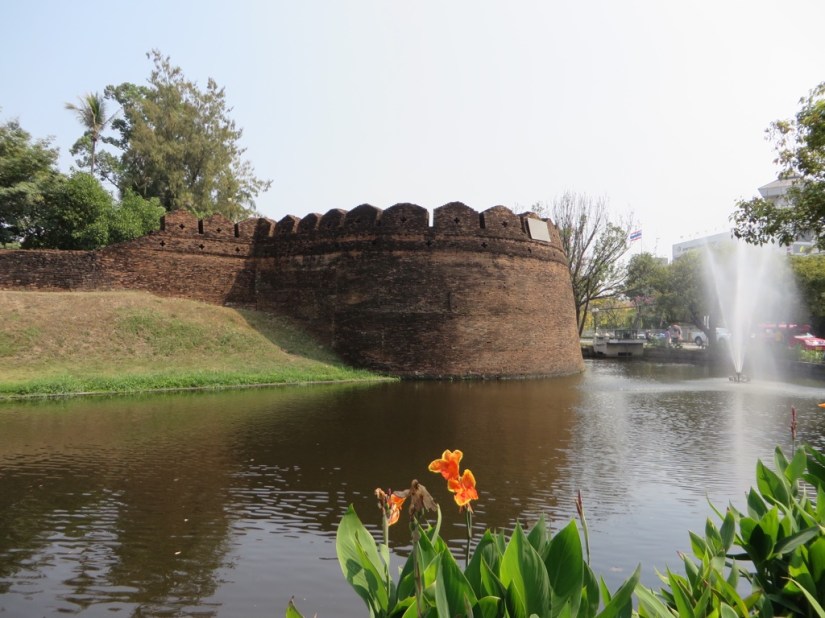
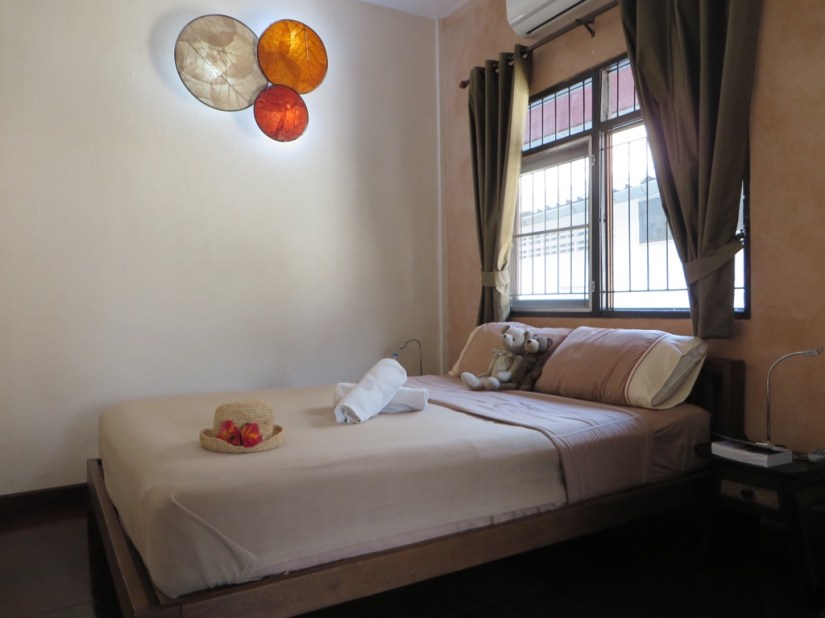
We stayed for a week at Banjai Garden, a guesthouse tucked down one of the lanes within the moated old quarter of the city.
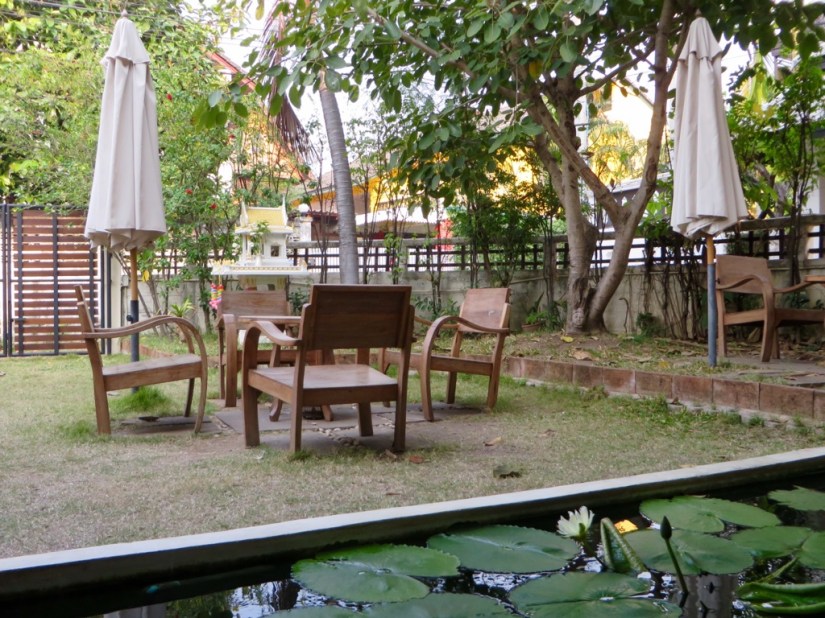
It had a lovely lobby area overlooking the shady garden to relax when sightseeing became too much!
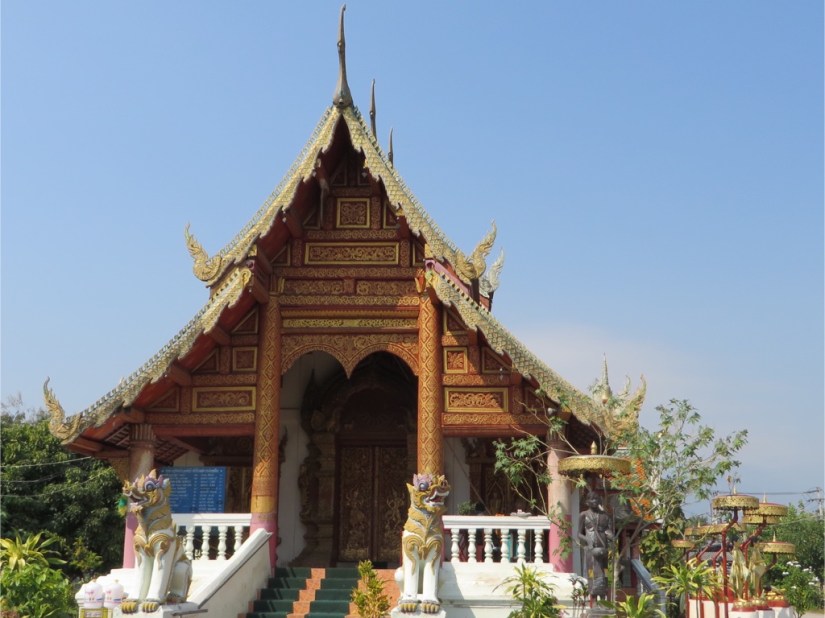
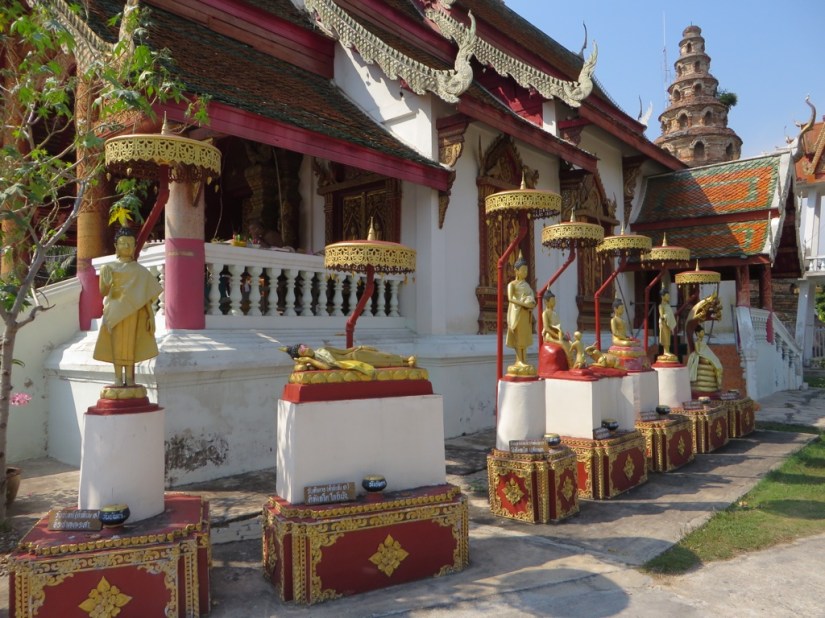
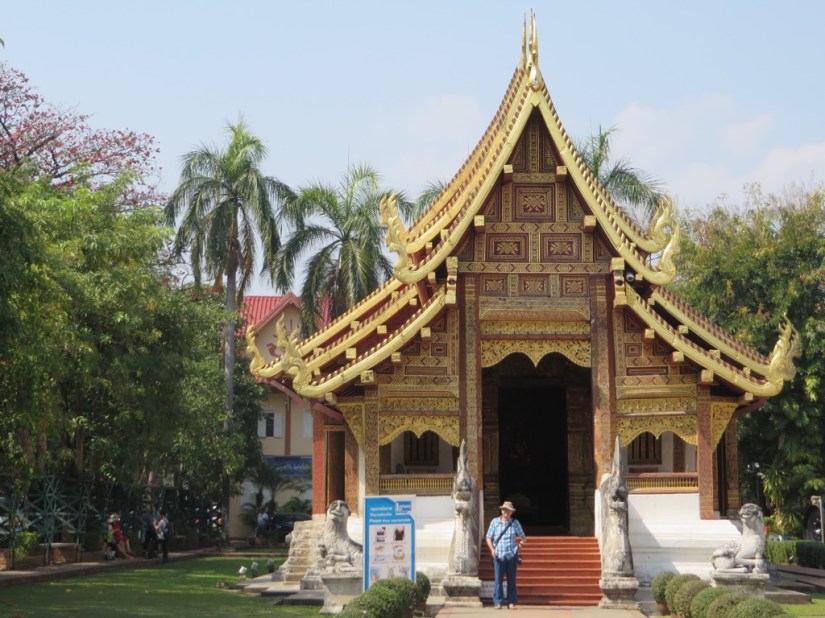
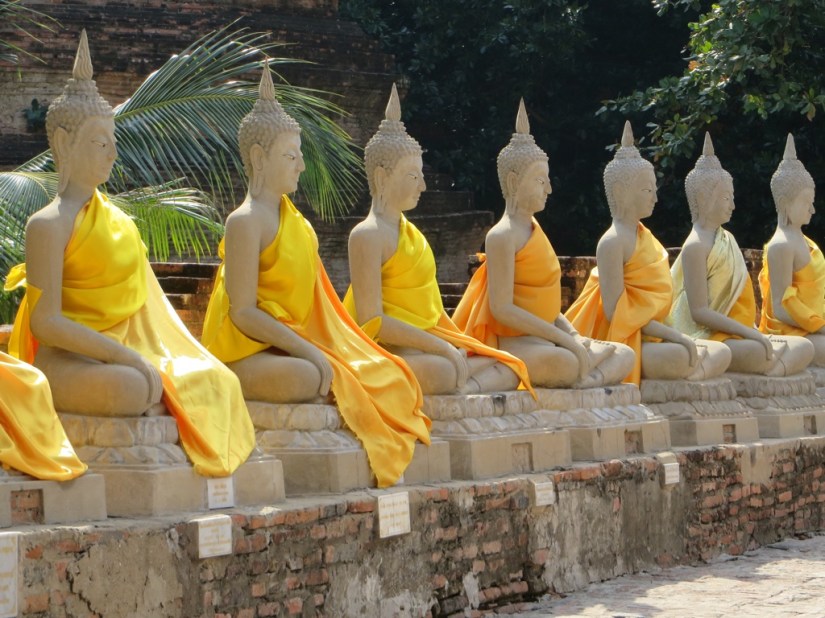
The main sights of the city were just a short walk away, more wats, but definitely living working wats rather than ruins. We started looking round Wat Meun Ngun Krong because we looked through the gate and the lions on guard enticed us in! The viharn or hall is more squat than the ones we had seen in the south and had beautiful red and gold decoration. Several of the wats we visited had a row of Buddha in 7 aspects, one for each day of the week, and it looks like Tuesday’s child gets the best deal, napping on the job!
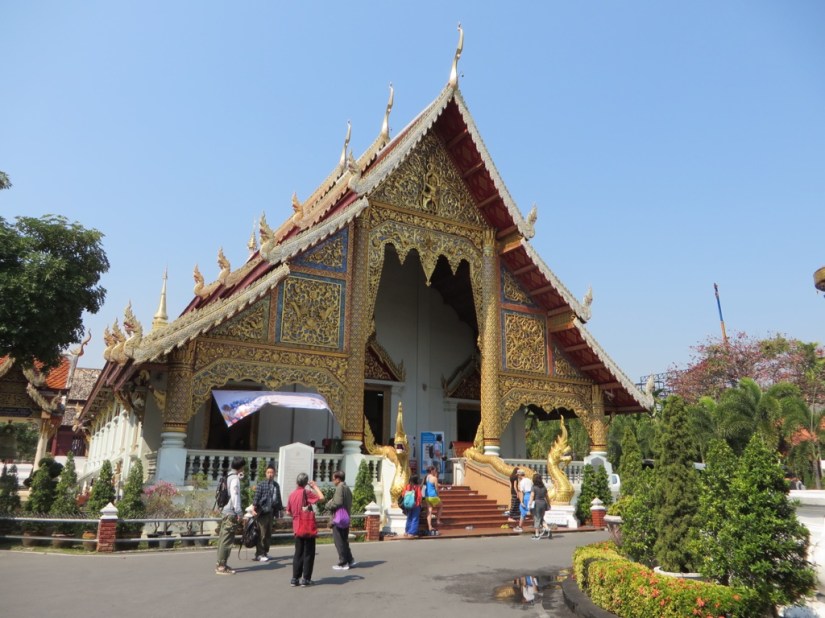
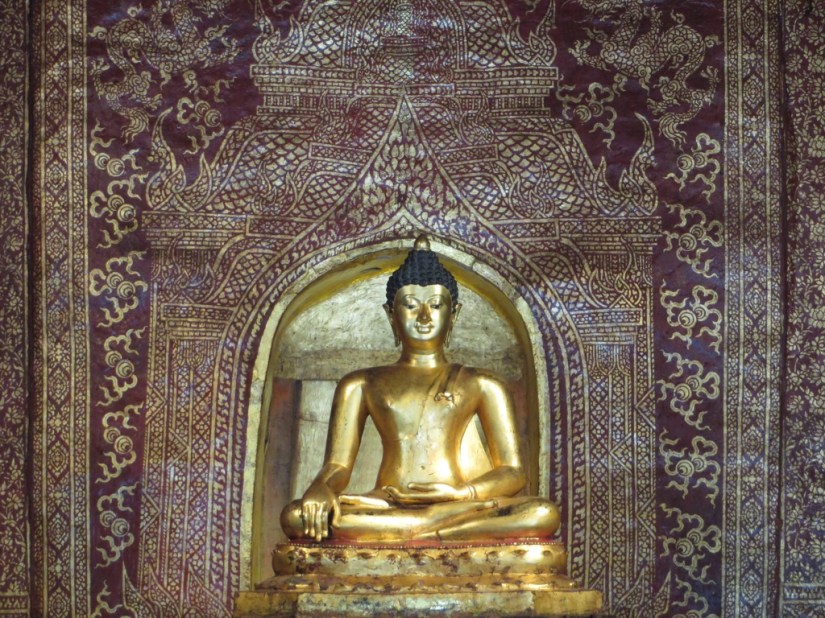
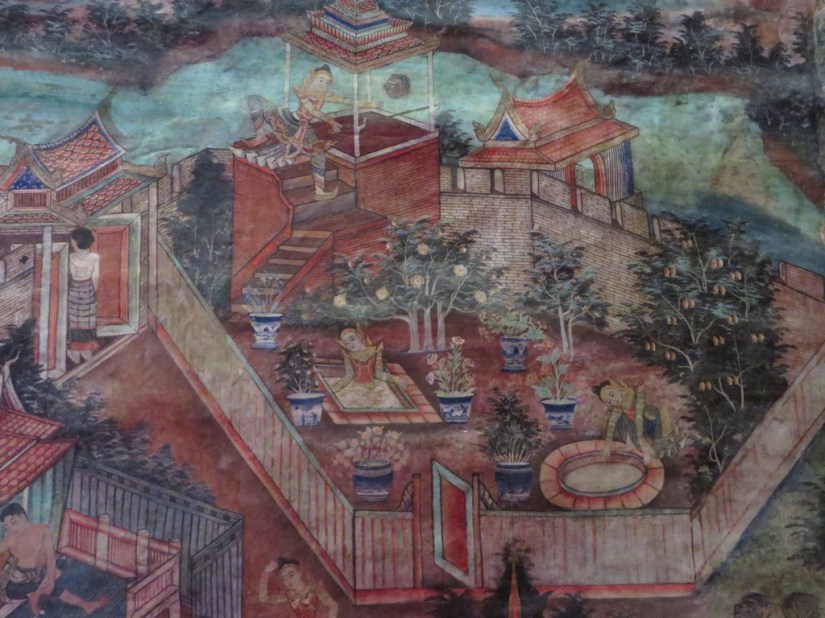
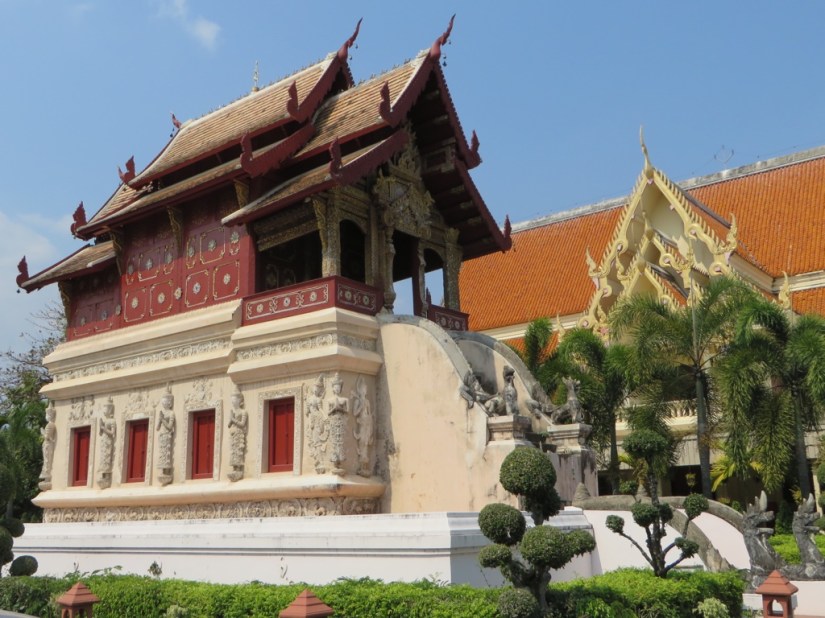
Then onto the Wat wat we were looking for … Wat Phra Singh, with a huge array of buildings including a modern viharn, a 14C wood viharn containing Phra Singh with lovely red and gold mural work behind and pictures on the walls from ancient stories.
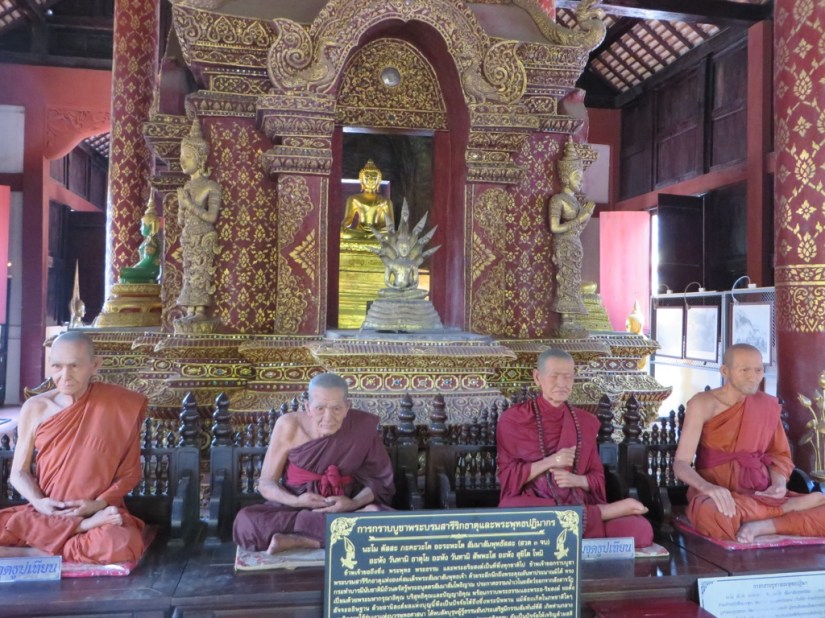
We walked into another hall and saw four praying monks in front of a Buddha … and it took a few moments in the gloom to realise they were not real … spooky!
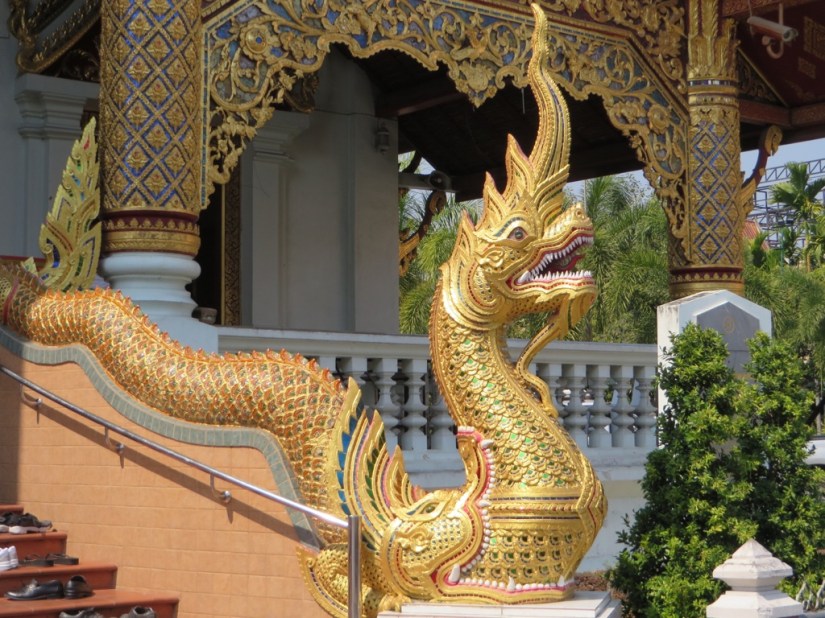
Being a lover of all things sparkly, I had to include a close up of this fabulous naga.
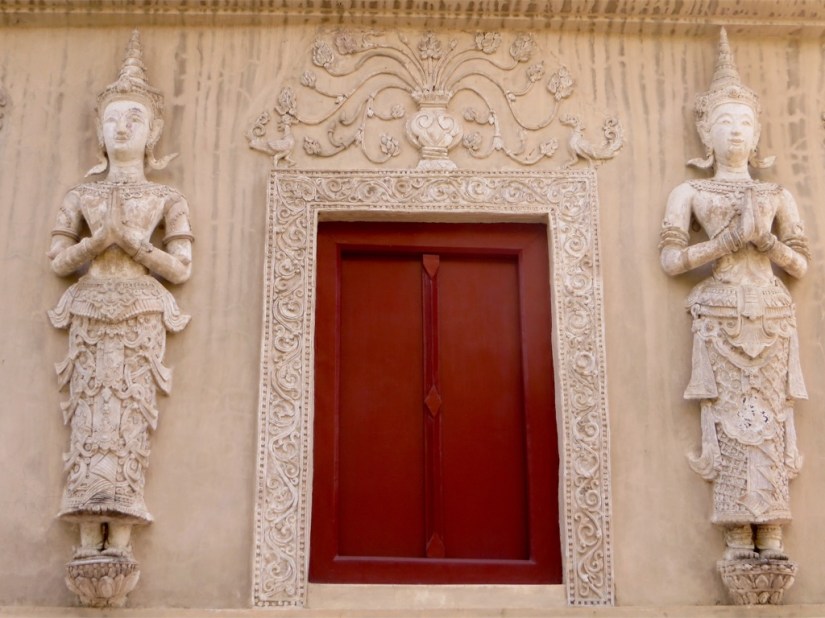
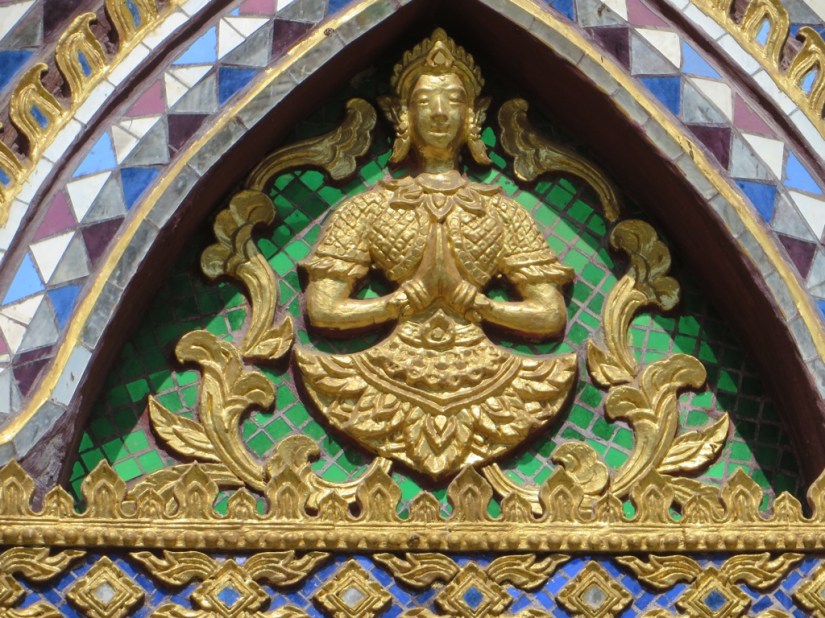
There was also an old scripture hall, decorated with stucco angels.
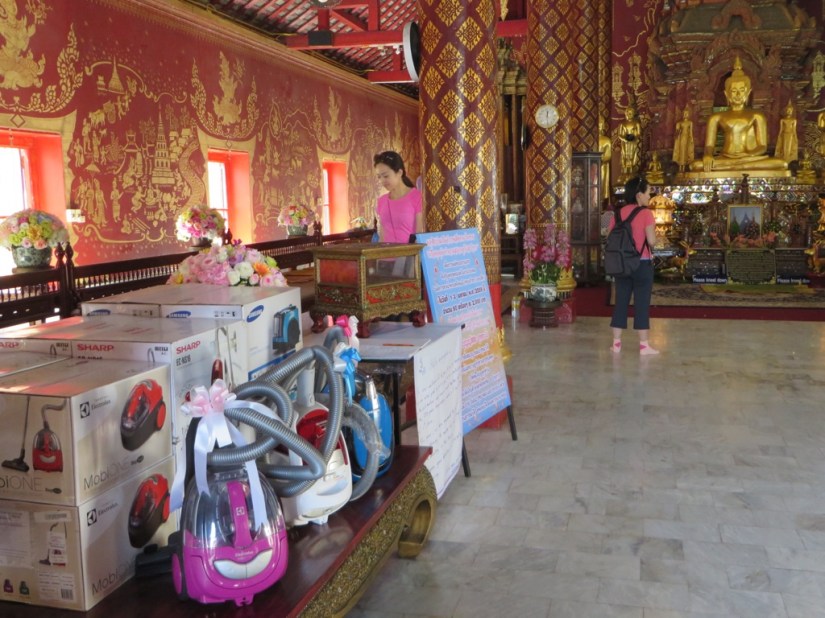
The oldest Wat in town in Wat Chiang Man houses two very special Buddhas which we could barely see. We were more interested in the request that we donate money to fund the purchase of new vacuum cleaners for the monks, and the red and gold murals.
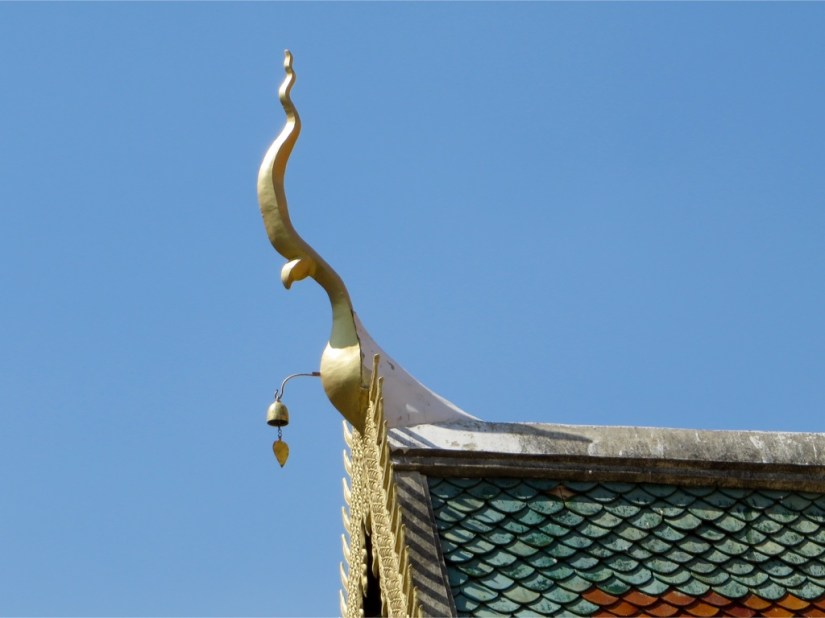
As we wandered round the breeze got up, and all the little bells hanging from the eaves tinkled.
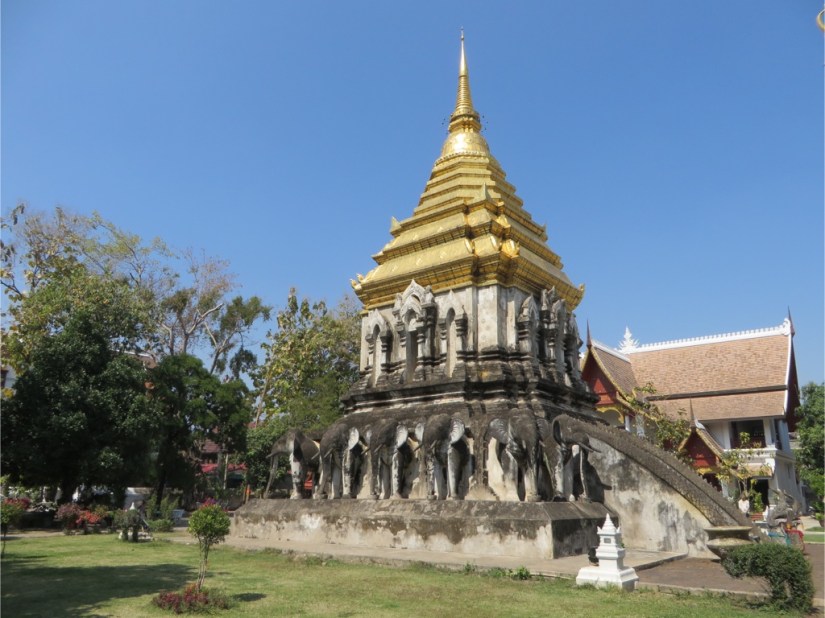
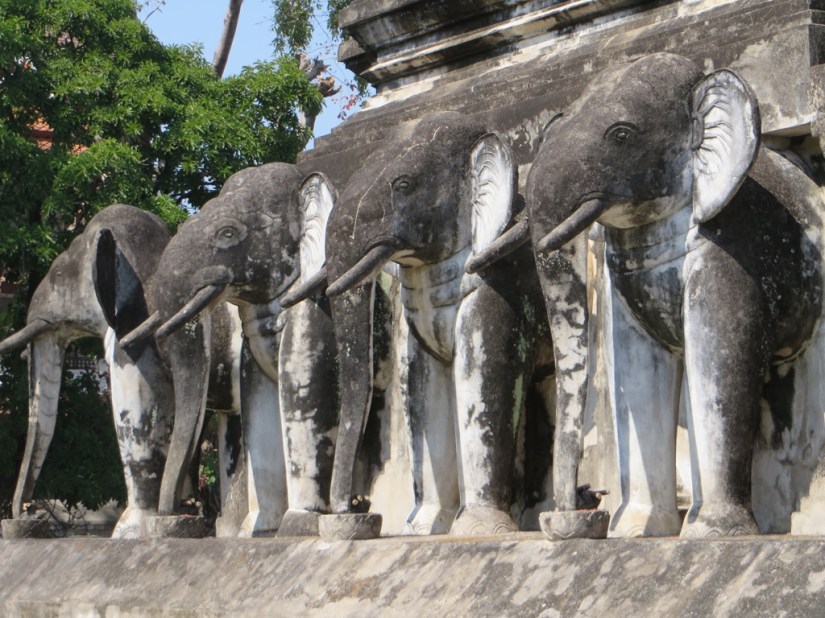
There was also a chedi with elephants round the base …
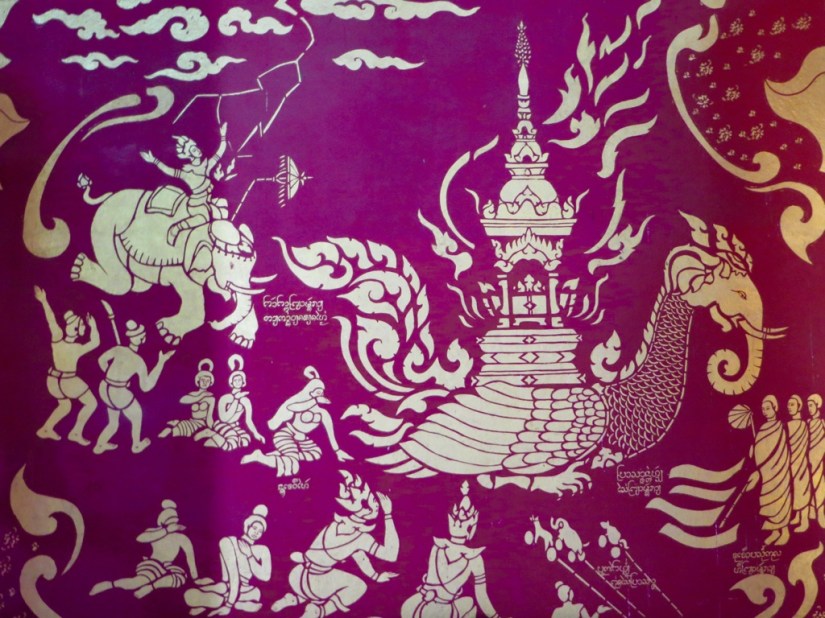
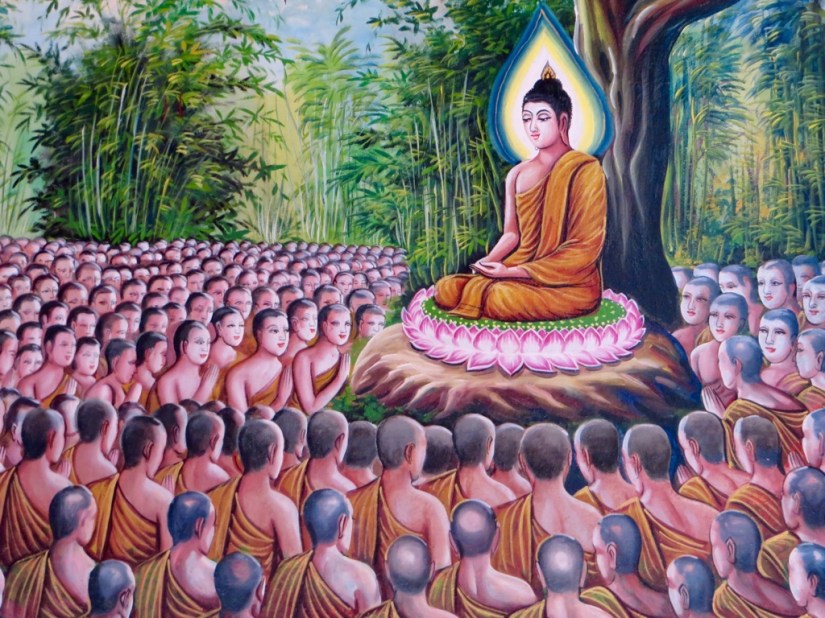
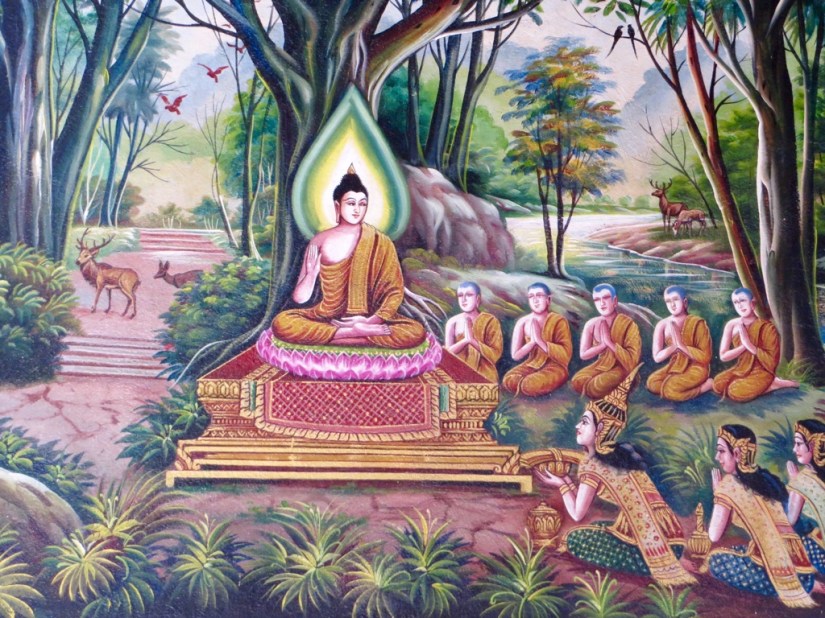
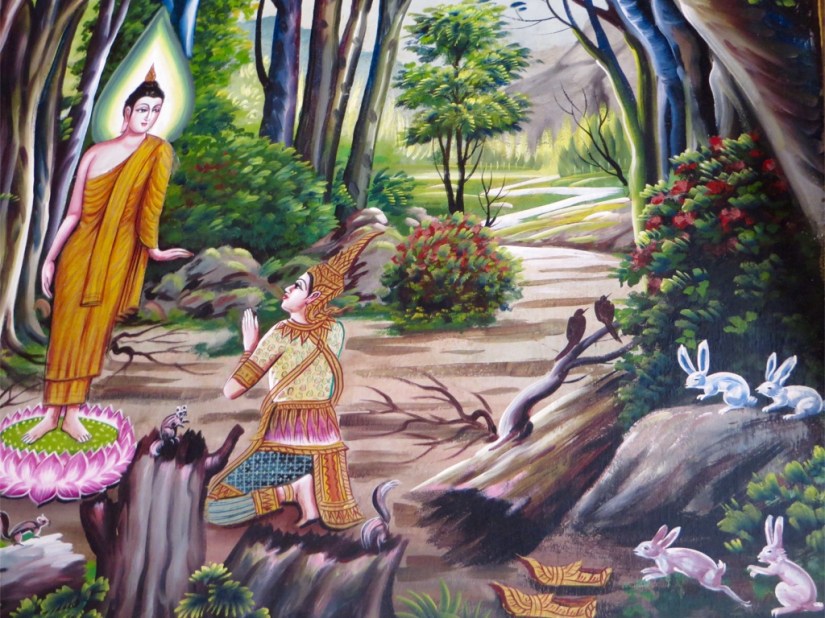
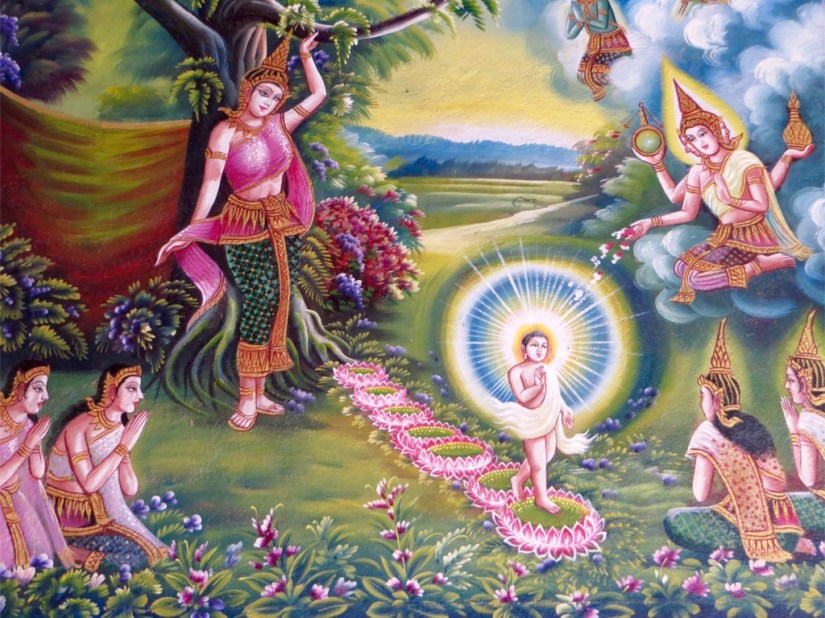
… and a hall with beautiful murals showing the life of Buddha.
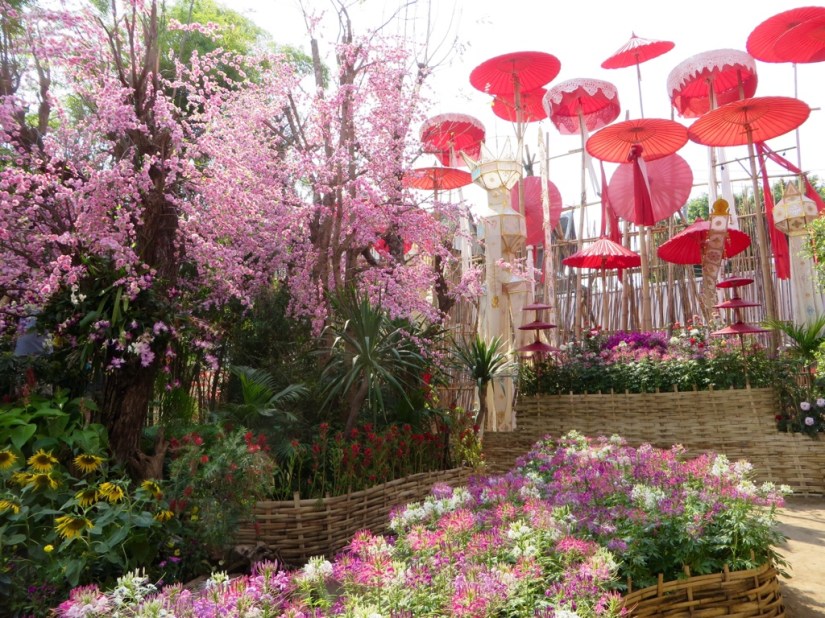
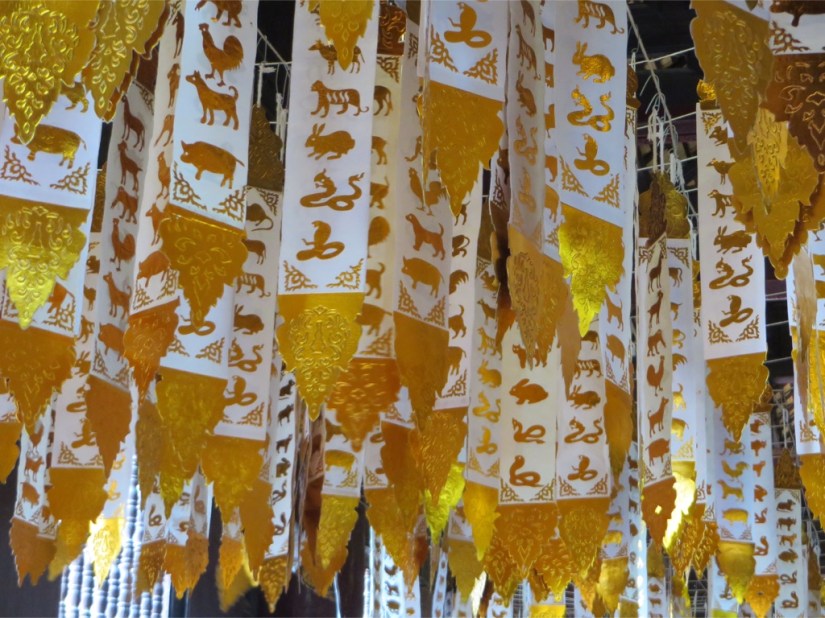
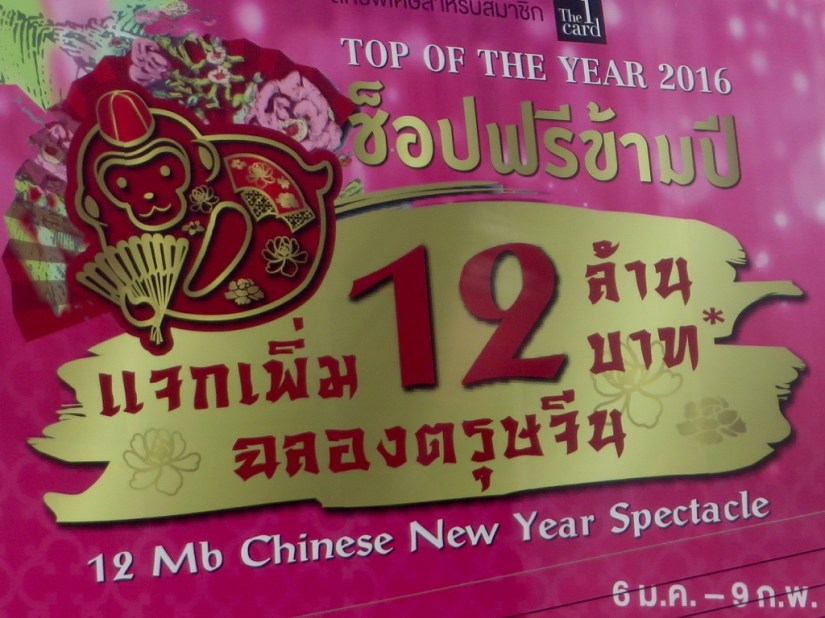
Next door, Wat Pan Tao was all dressed up ready for Chinese New Year to welcome in the Year of the Monkey and while we didn’t realise till we got closer, the blossom was synthetic and attached to the real tree with plastic branches!
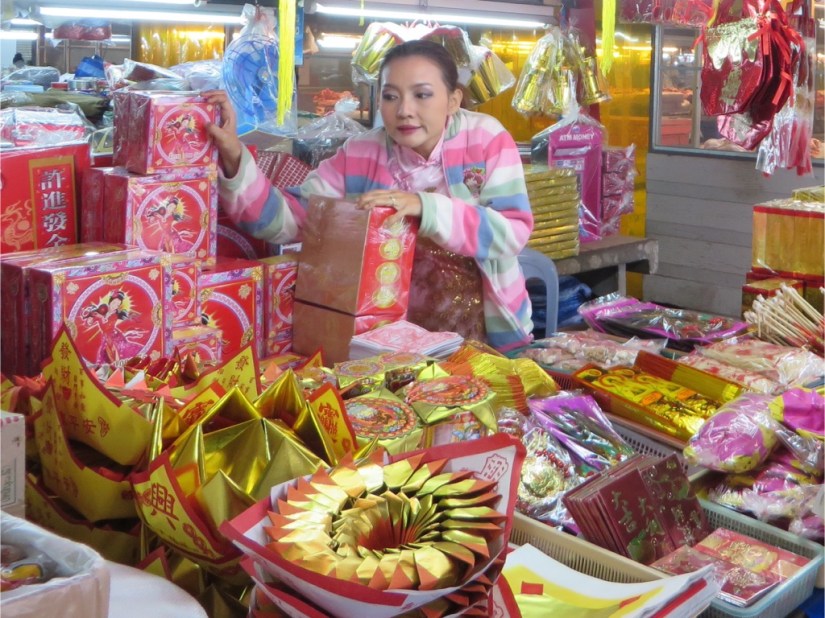
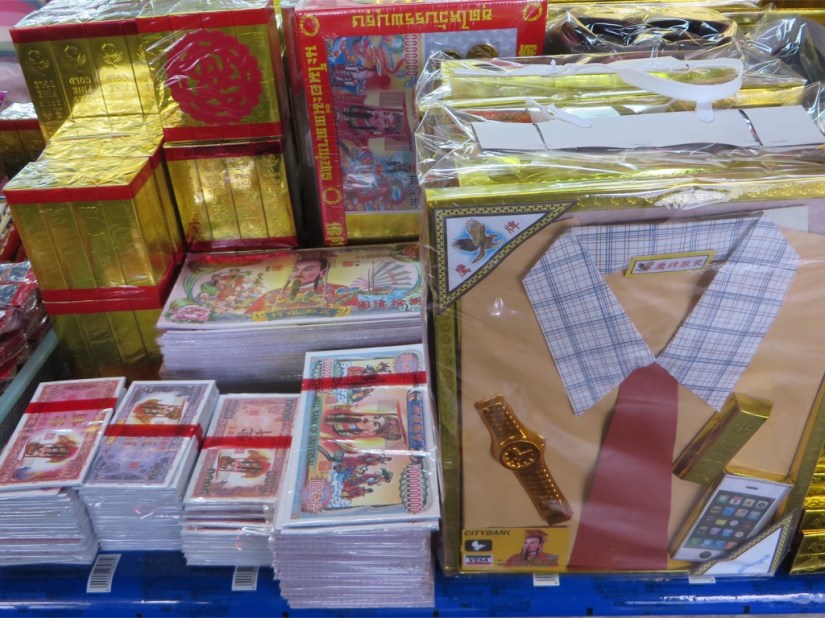
We saw a stall in the market selling New Year necessities, like packs with paper clothes, jewellery and mobiles phones as well as stacks of fake money which are burnt by the Chinese so they go to their ancestors for use in the afterlife … Shame great granny can’t phone home!
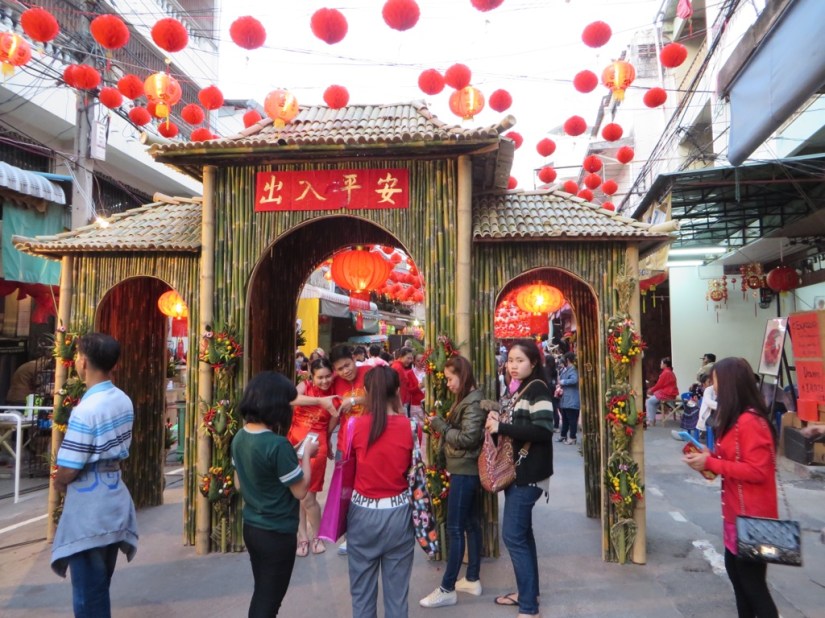
We stopped off in Chiang Mai’s very modest Chinatown, to have a look at the celebrations, but apart from a huge night street food market and a beauty pageant decorated with red lanterns nothing much seemed to be going on.
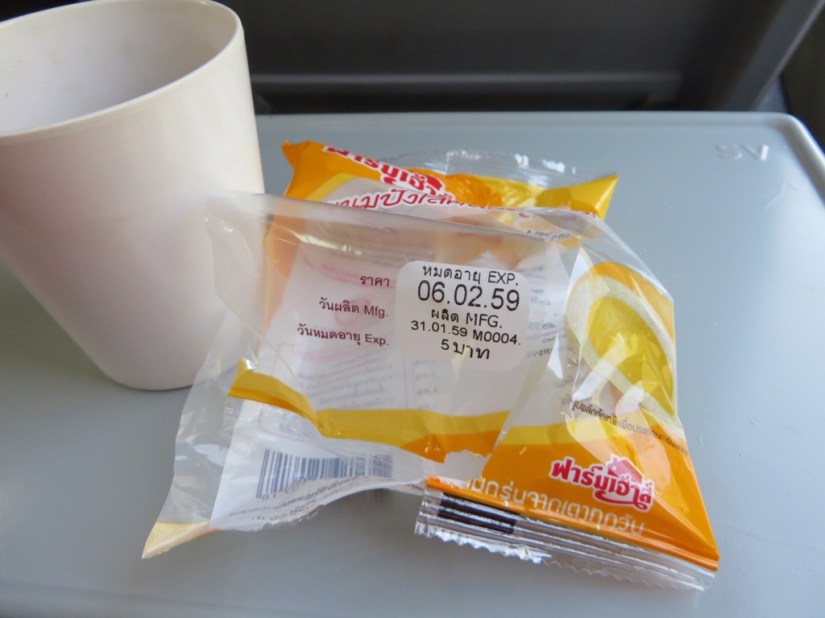
Also worth mentioning my custard bun wrapper here as we were bemused by the expiry date till we realised that in Thailand they use the Thai Solar Calendar counted in the Buddhist Era which began 543 years before the Christian Era so we are now in 2559!
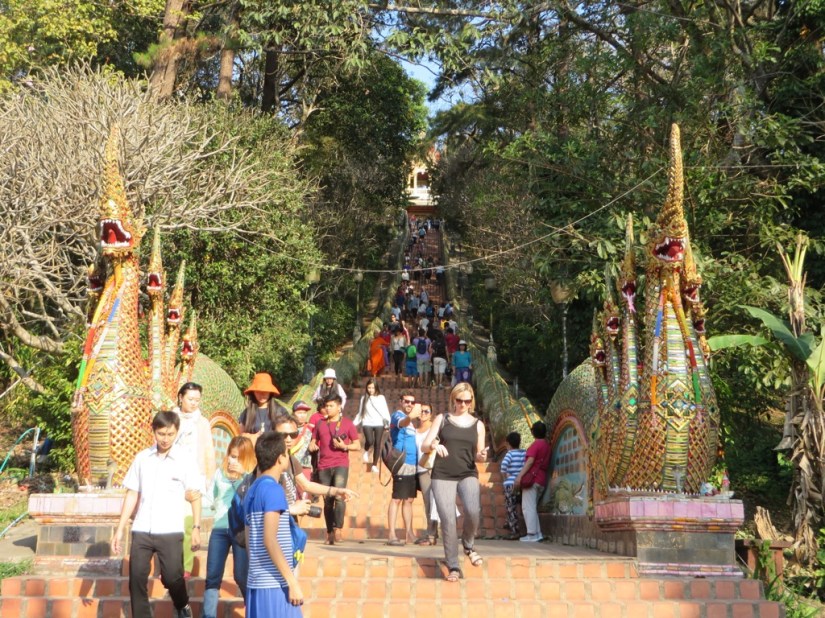
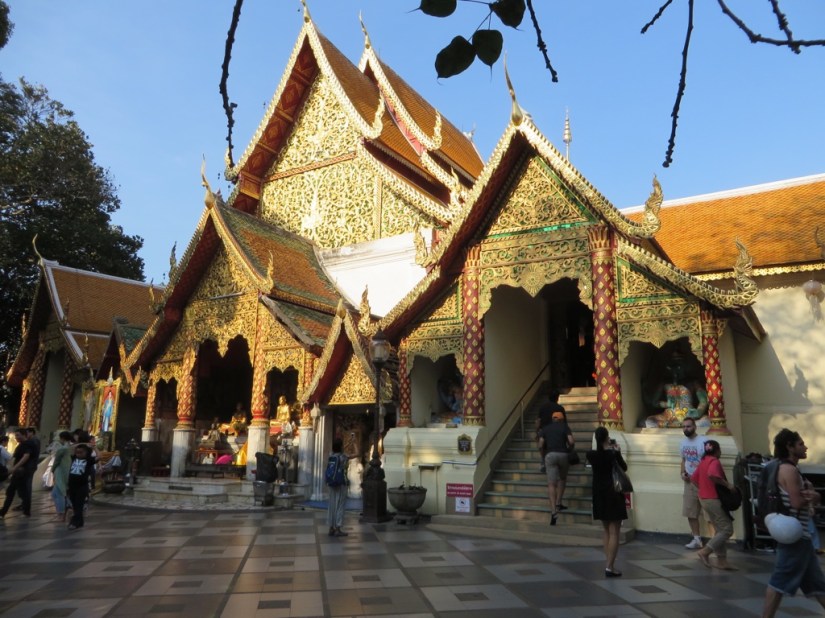
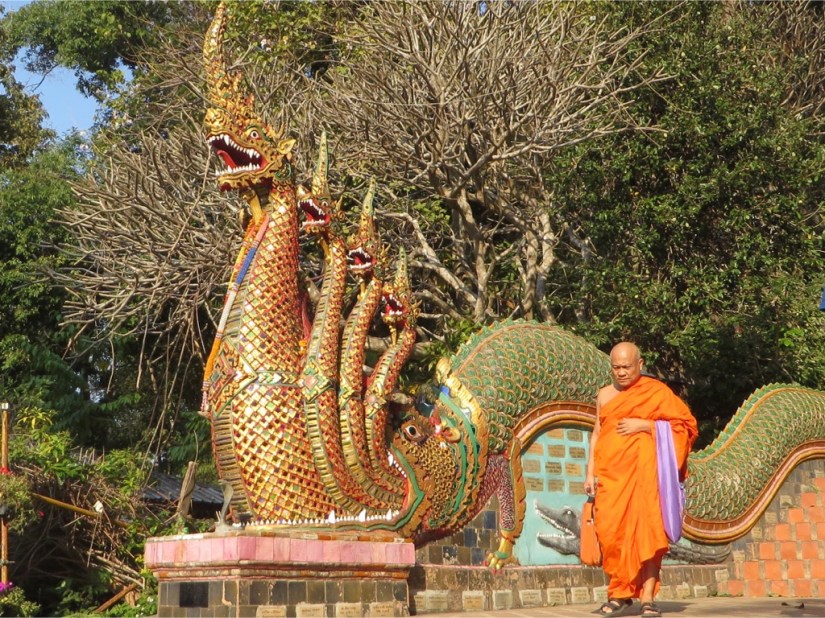
One afternoon, we took a tuk-tuk up Doi Suthep, the mountain that rises steeply to the west of town, to Wat Phra That Doi Suthep, the north’s holiest shrine. It has a good story with a magic relic that miraculously self-multiplied before being enshrined elsewhere, so another home had to be found for the extra relic. King Ku Na put it on the back of a sacred white elephant to see where it took it and the elephant climbed the mountain, trumpeted three times, turned round three times and knelt and died indicating the spot and the Wat was built. First we had to climb 300 steps, flanked by nagas on each side …
From the lower terrace there are views to the city 300m below …
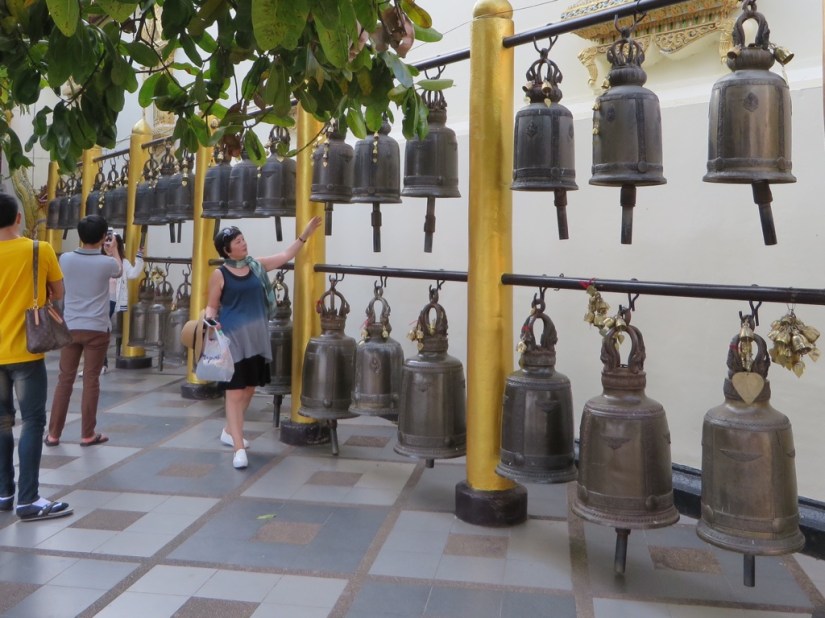
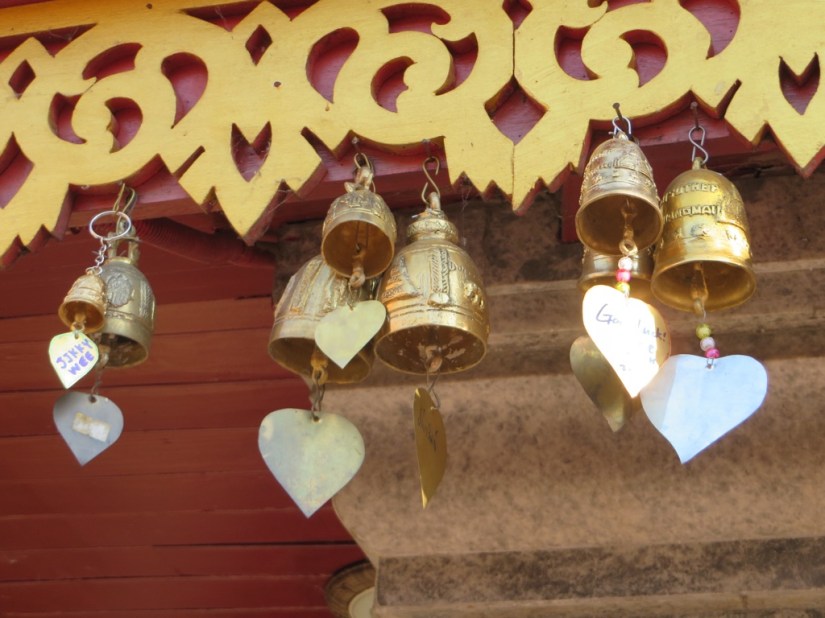
… hardly tranquil though as ringing the bells round the edge is said to bring luck.
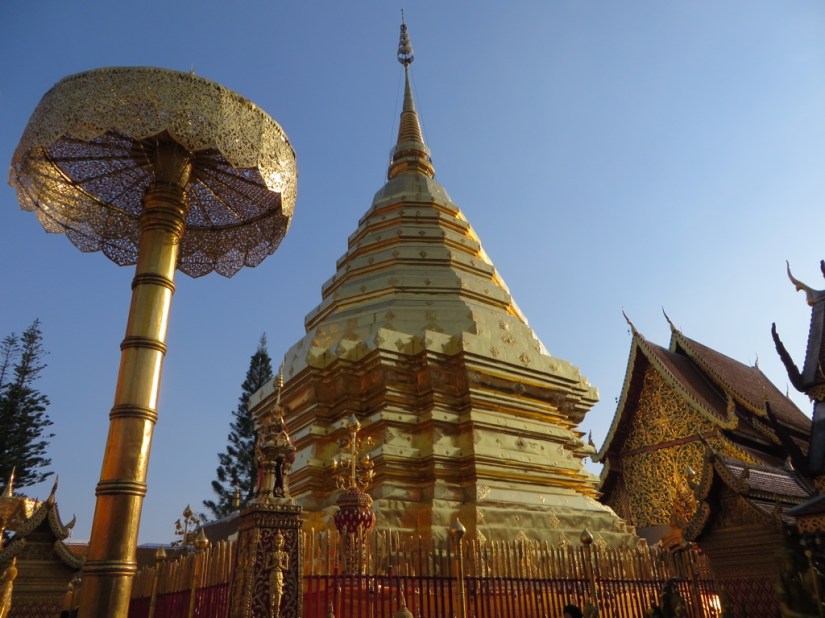
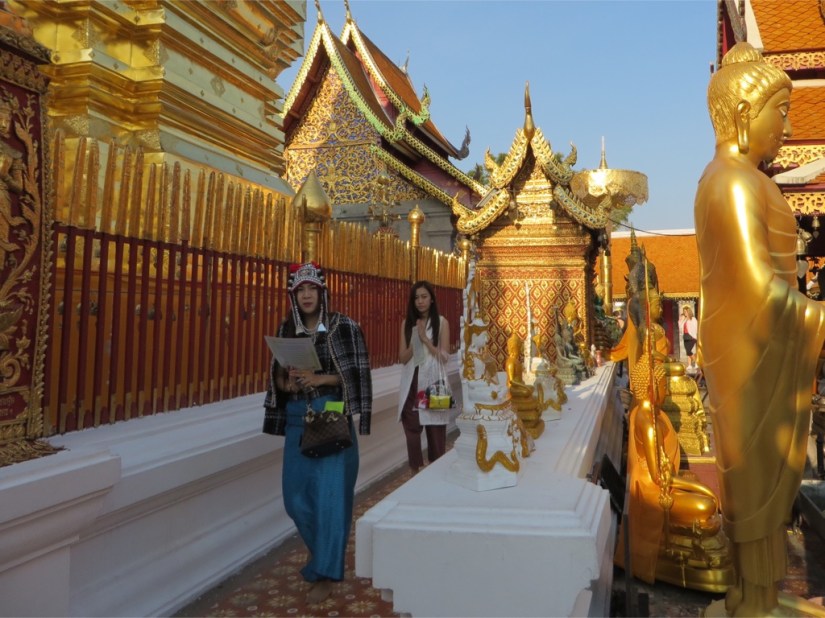
Entering the upper terrace, the central golden chedi surrounded by ceremonial gold umbrellas is breathtaking and worshippers walk round three times in prayer.
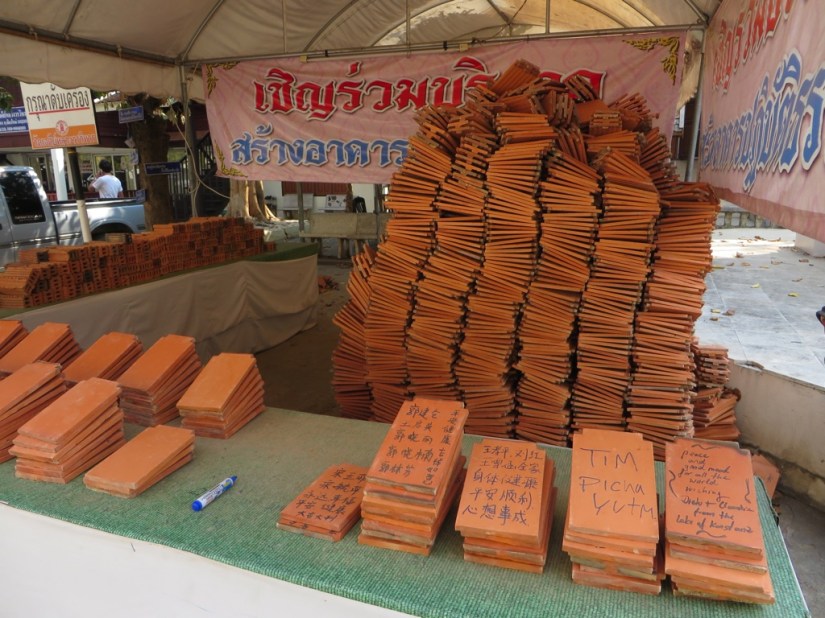
There are plenty of opportunities to gain merit through donation by writing a prayer or message on a gold cloth to be draped round a Buddha, on a bell to tinkle from the eaves or a new tile for the roof. And thankfully, the walk down is a lot easier.
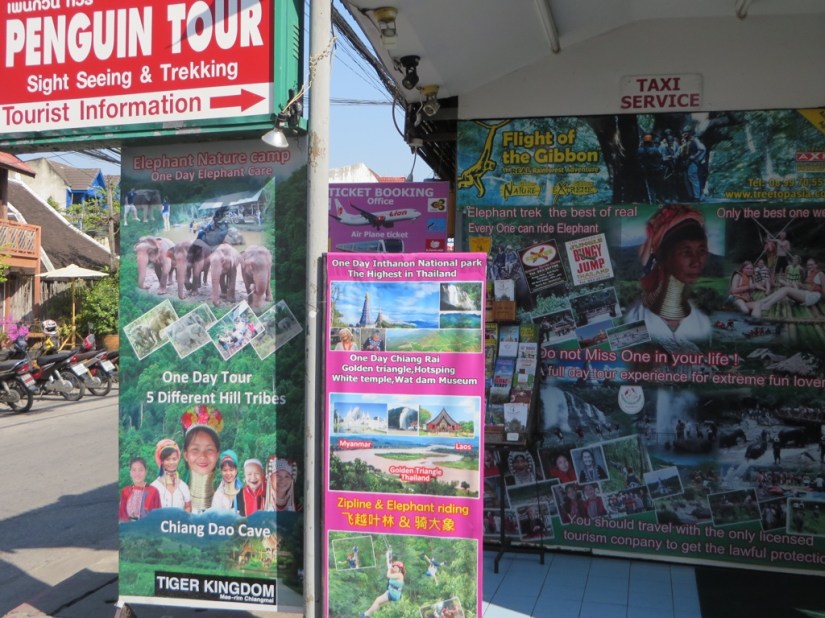
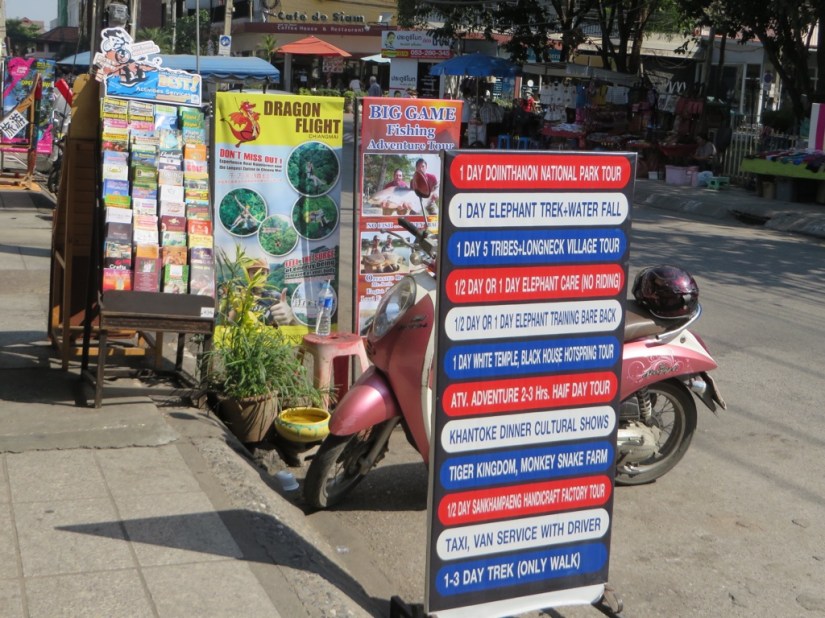
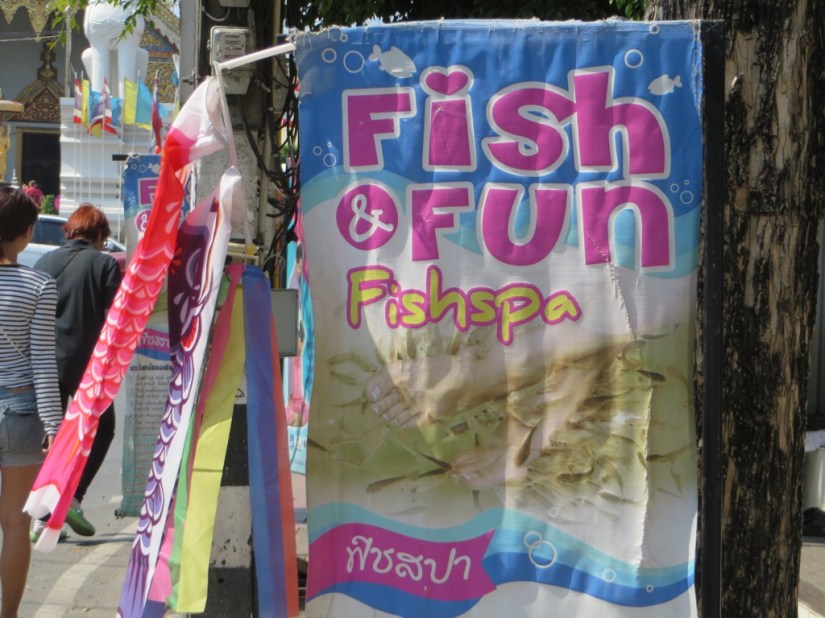
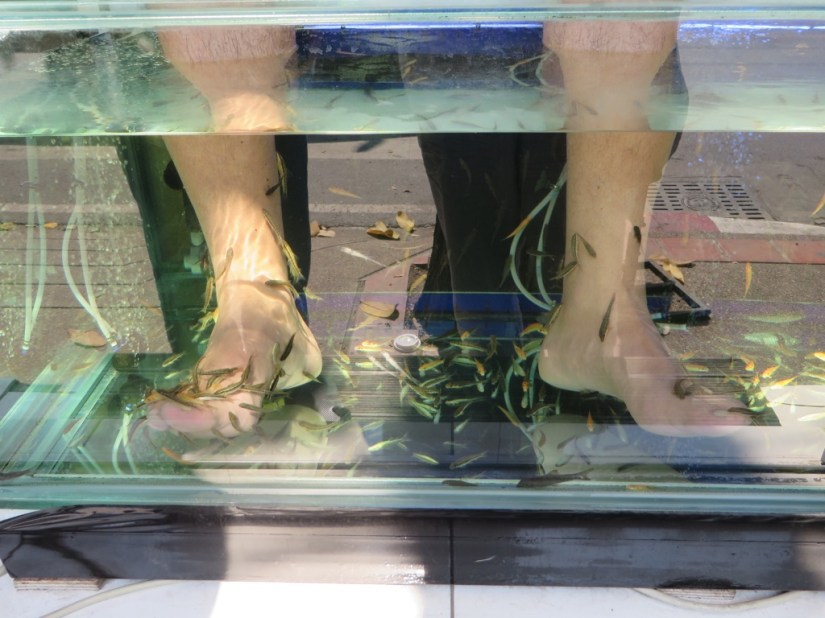
This makes it sound like the city is filled with them … well it is, but they are spread about, and far more noticeable are the streets filled with tourist services, such as accommodation, restaurants and cafes, offices able to arrange tours, trekking, elephant experiences, cooking classes, zipwiring and tubing, souvenir shops, massage shops …
… and even fish spas!
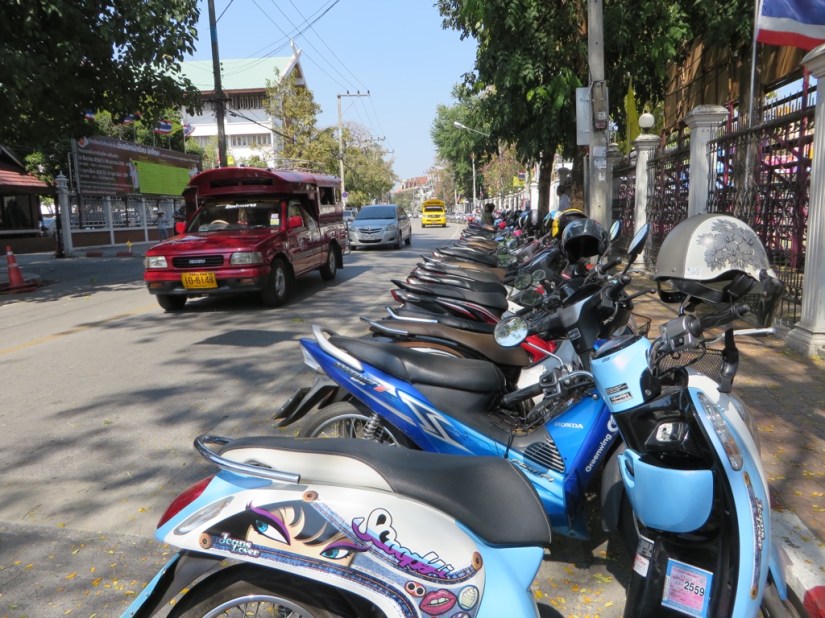
There are also lots of schools and colleges here for the 60,000 students in the city … all seemingly parked down this road!
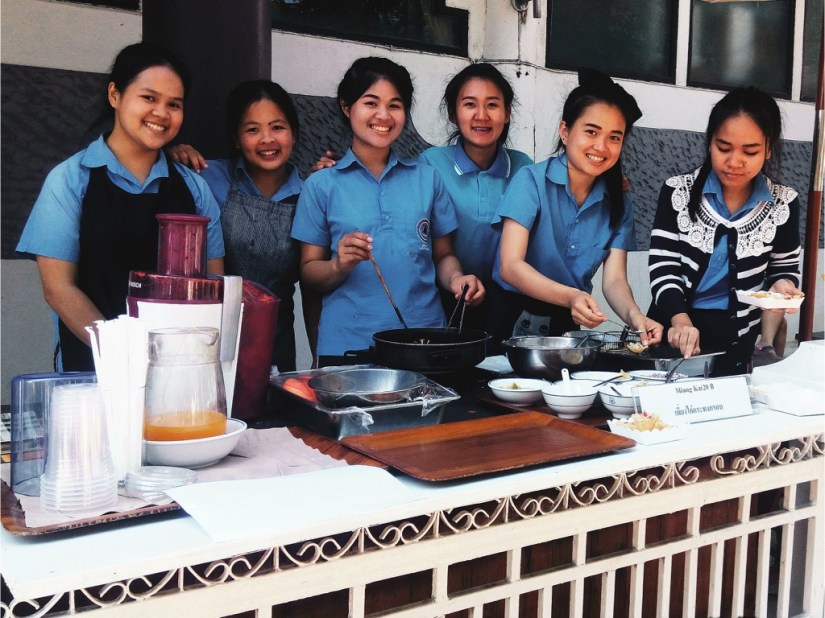
Some catering students had set up shop outside one school and were eager to sell us ginger tea and have their picture taken.
See our second Chiang Mai post to see which of these opportunities we chose!
We’ve travelled 200 miles north and back in time from the kingdom of Ayutthaya to the previous kingdom of Sukhothai.
Capitalising on the Khmers’ weakening hold on central Thailand, two Thai generals founded the kingdom of Sukhothai in 1238 which spread to incorporate most of modern Thailand and could be said to be its birthplace. Sukhothai flourished for over 200 years until it was absorbed by the southern Thai kingdom of Ayutthaya. The third and most important King was Ramhamhaeng who designed the Thai alphabet and adopted Theravada Buddhism as the state religion.
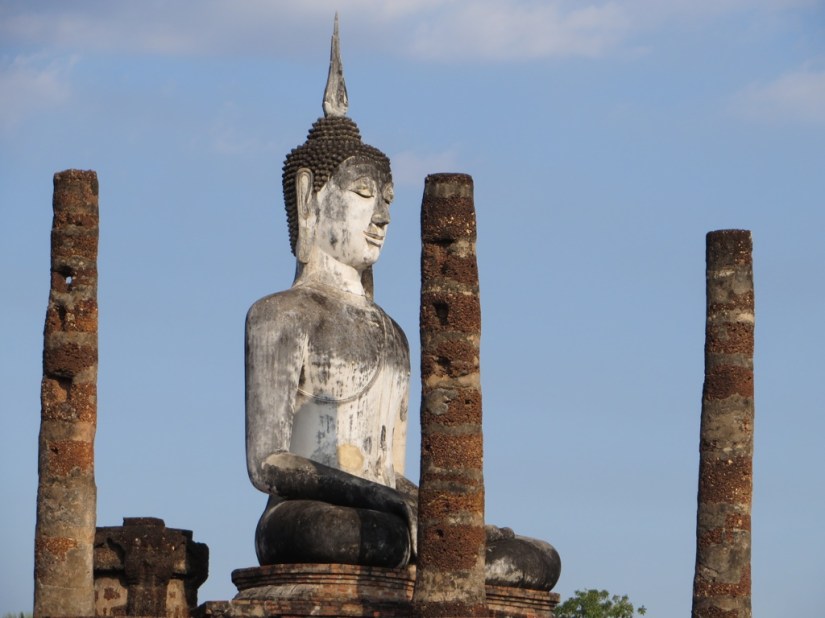
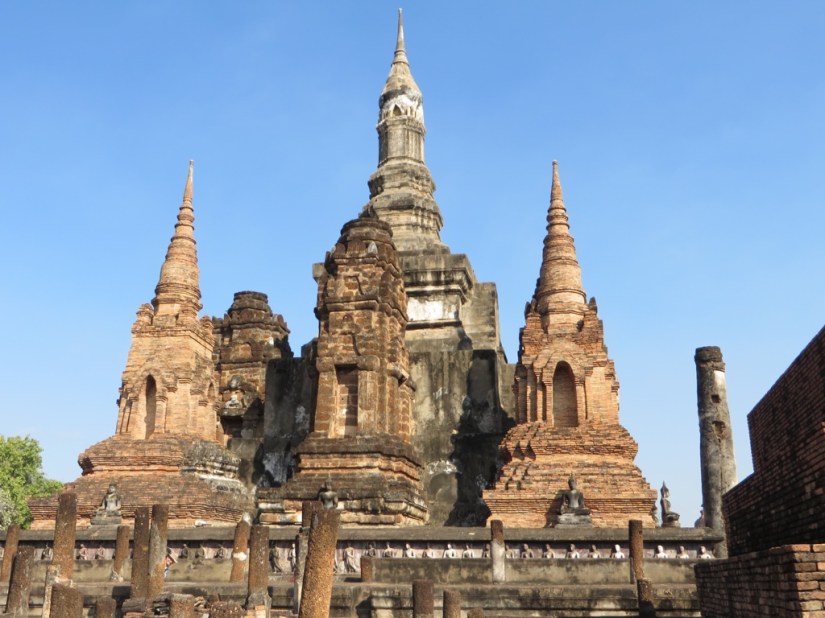
Thai art and architecture styles also began to develop at this time bringing the Sukhothai Buddha which have an ethereal appearance, as if rather than meditating, they are are already enlightened. Most are seated but artists also pioneered the particularly sinuous and elegant walking Buddha. Many of the chedis were modelled on the bell-shaped reliliquary tower symbolising Buddha’s teachings ringing out far and wide, as well as introducing the graceful lotus-bud chedi, comprising a slender tower with a tapered finial in the shape of a lotus-bud which represents the purity of the Buddha’s thoughts nudging through the muddy swamp and bursting into flower.
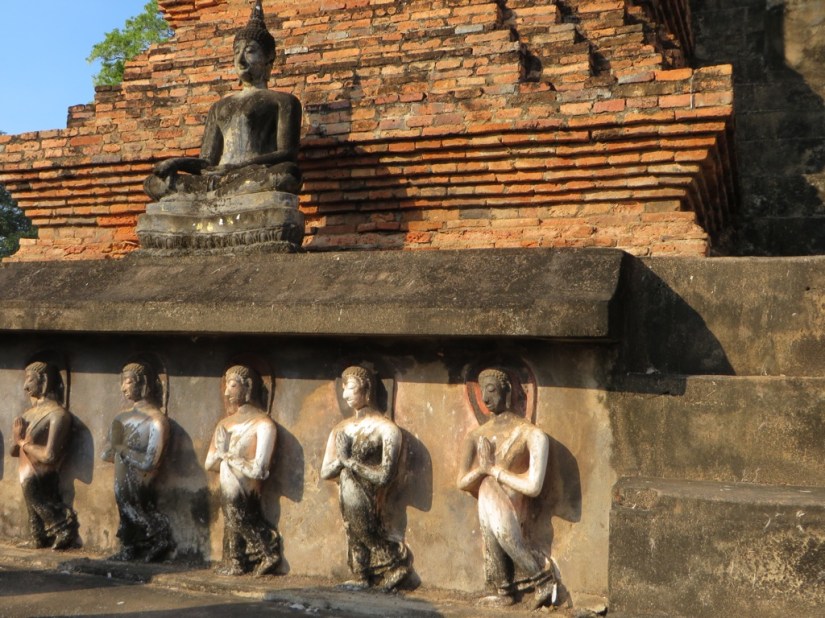
All these features can be see at Wat Maharathat, the most important and largest temple, with the main chedi also having a line of 168 Buddhist disciples clasping their hands together in salutation, round the base and a walking Buddha in an alcove.
When I was choosing an image from the Internet for the front of the blog, until we had taken our own photos, I used a photo of a seated Buddha from this wat, complete with lots of pink water lilies. When the latest Rough Guide was published, the same view was on the front cover! Hard acts to follow, and no pressure, especially as the lilies we not being very generous with their blooms, but this is the view we actually saw!
We also returned at sunset and later to see the floodlit monuments.
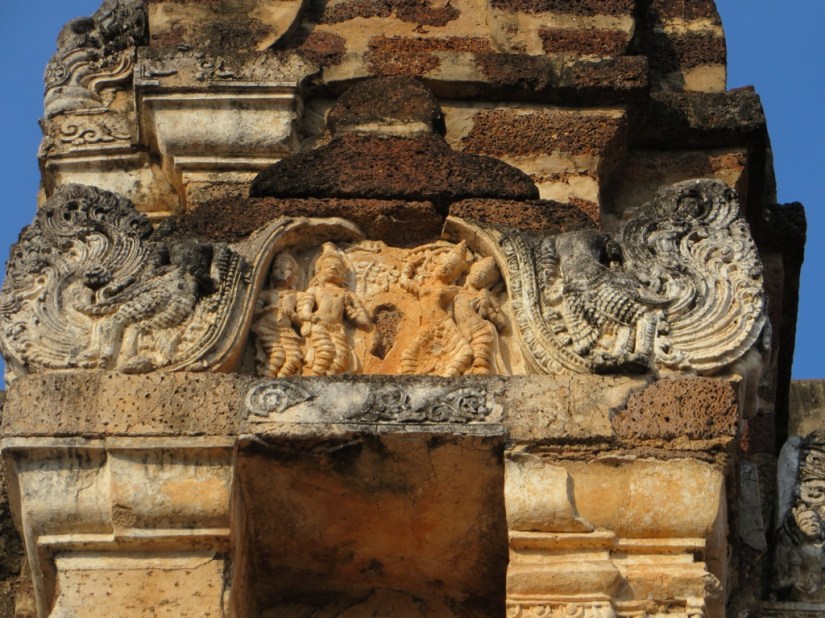
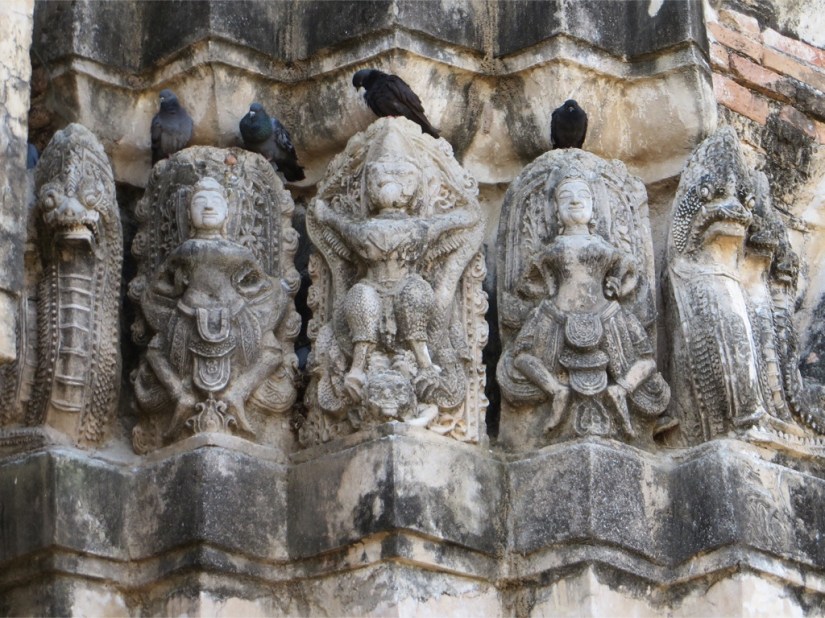
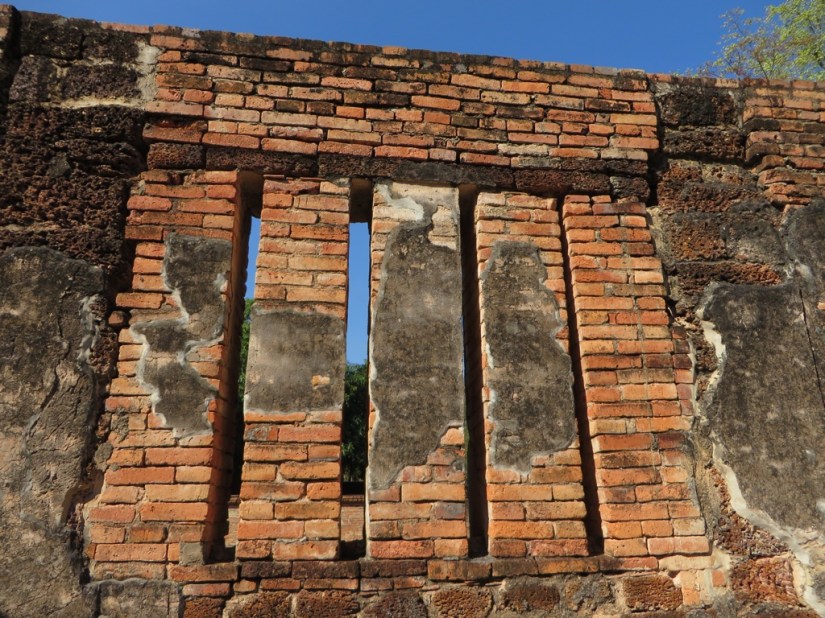
Wat Sri Sawai shows its Khmer heritage with its three prangs, similar to wats at Ankor, and probably began as a Hindu temple. Stucco of nagas and deities provide a roost for pigeons and the side wall shows a common design to increase ventilation.
Oh and look wat Chris found on the way to the wat … happier after a drink but surely to young to be out on his own!
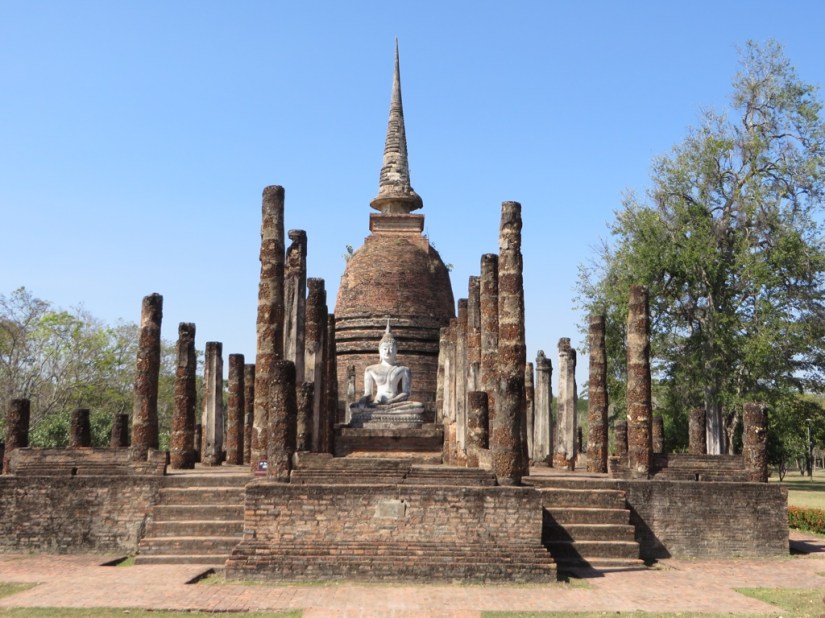
Wat Sa Si, entirely surrounded by water has a bell-shaped chedi and a metallic replica of a walking Buddha, full of grace.
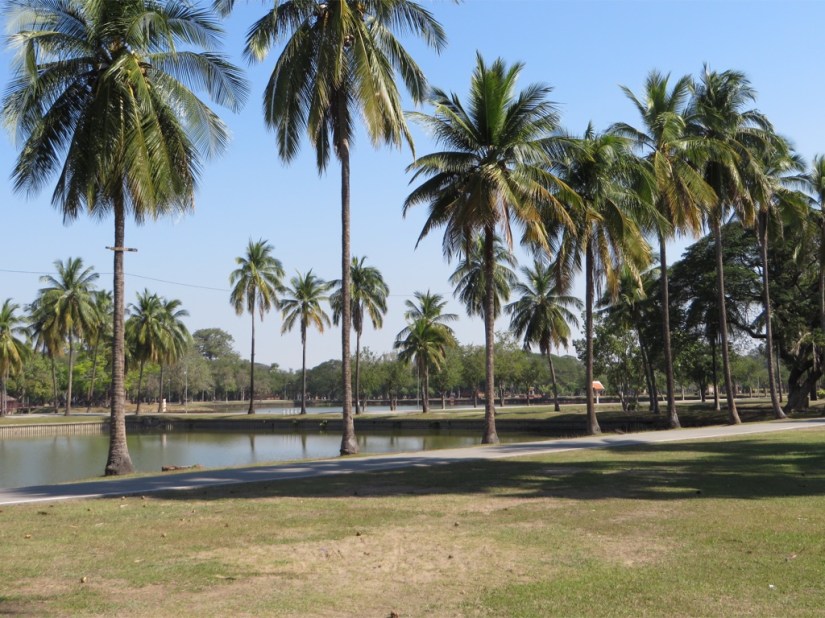
These wats are all within walking distance, set within a park with just bicycles or tuk-tuks for transport. The grounds are beautifully kept and several of the wats are surrounded by moats or reflected in ponds and the pink water lilies are lovely.
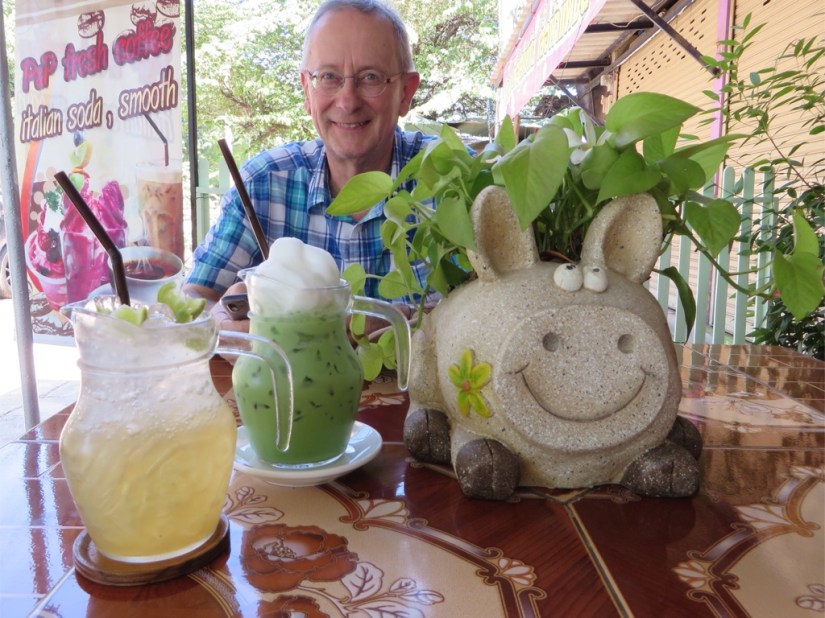
After all those temples we deserved a cold drink and a rest, and ordered a lemon soda and green tea … and look what we got!
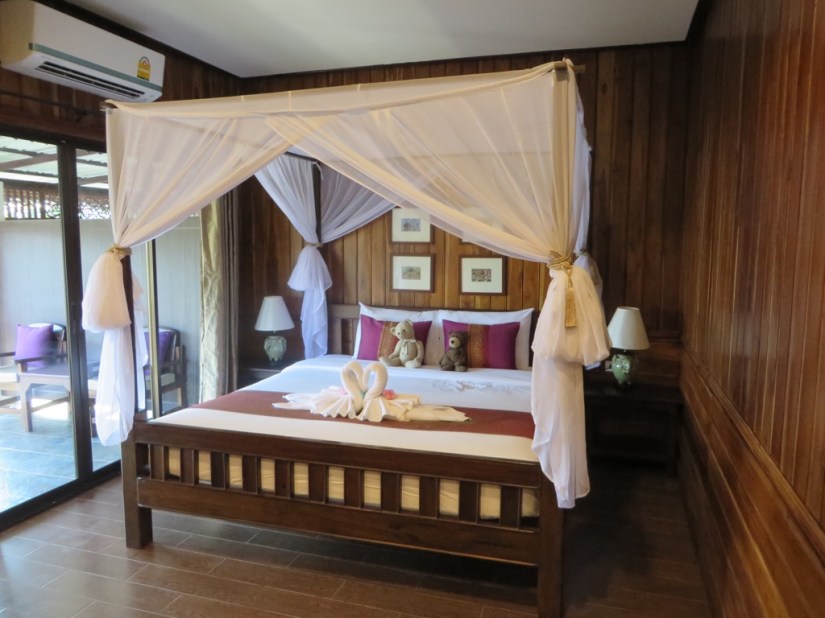
We are staying near the Historical Park in Thai Thai Sukhothai Guesthouse where we have been made most welcome.
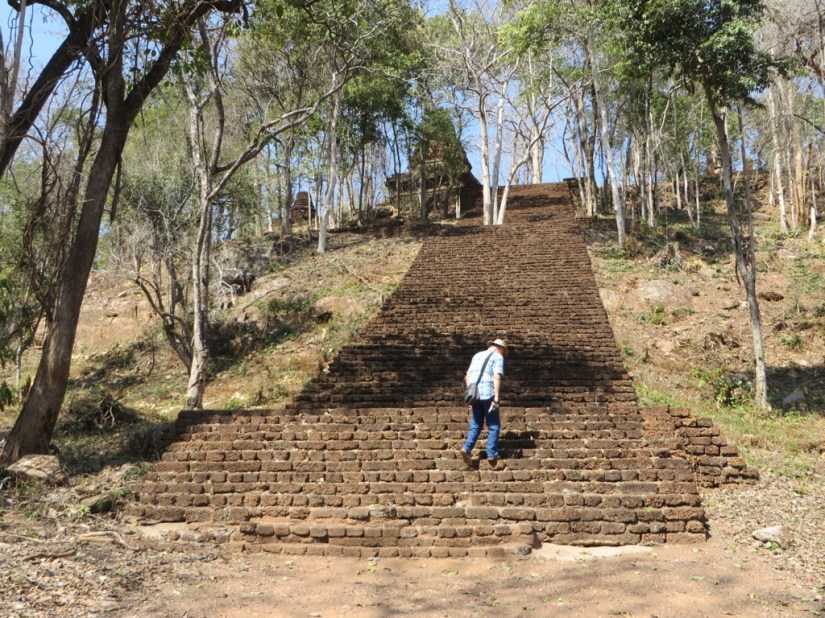
We took a trip out to Si Satchanalai which was built to defend the kingdom northwards in Sukhothai’s heyday and was ruled by one of its crown princes. Later when Sukhothai declined, it was annexed by the Lanna kingdom of Chiang Mai to the north. We hardly encountered anyone as we wandered round the six main wats making the experience quite atmospheric.
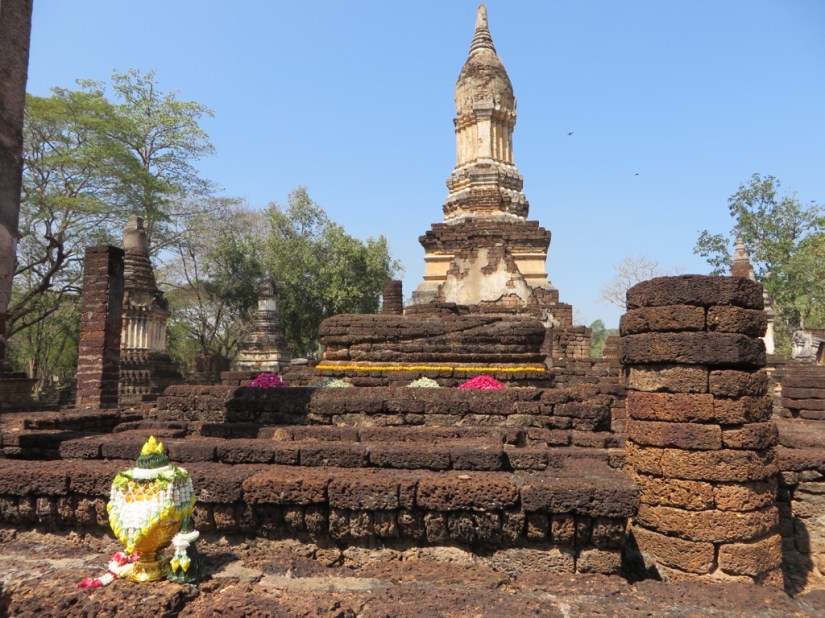
Wat Chedi Jet Taew is named for the 7 rows of small chedis thought to enshrine the royal rulers, which is why there had been an earlier ceremony offering respect to them.
The walking Buddha at Wat Phra Si Ratana is a fine example …
… and while the 39 elephants at Chang Lom might be fully standing and larger than life, they are in a bit of a sorry state.
On our last day, we took a tuk-tuk a little out of town where we saw this restored Buddha in a hall decorated with paintings showing how it was made, Sukhothai in the past and the King visiting.
The most striking feature of Wat Sri Chum is the large solid mondop with a single narrow slit through which you can glimpse the serene face of a single large seated Buddha. There is a passageway between the inner and outer walls which was lined with pictures from the Jataka, depicting the life of Buddha and we saw them in the museum. One told the fable that if you take a horse to the same waterhole every day and it may not drink, but take it to a different waterhole each day then it remains happy and interested and will drink.
The Buddha image is itself quite striking, known as Phra Acana, which means ‘one who is not frightened’. The long delicate fingers of his right hand extend down to summon the Earth Goddess and have been covered in bits of gold leaf by contemporary Thais. There are legends suggesting this Buddha can talk, either to inspire the Siamese army or frighten the Burmese army depending on the version, but both relying on the acoustic affects of the building and a hidden person speaking.
We couldn’t miss Chang Lom, another Wat surrounded by elephants, some of which had been restored and given back their trunks. At the bottom of the info board it mentions chang means elephant and Lom means surround …
So taking a tip from the local beer …
… when we looked round a family pottery still making Sawankhalok ware which was famous in the 14C for its grey-green glazes and plant and animal motifs, we chose an elephant and lion to bring home.
We spent the afternoon relaxing round the pool at a local hotel and tomorrow we leave the central plains and travel another 200 miles north … to the mountains!
It had been humid and in the mid 30s since we arrived, exactly as expected, but then we woke to a rain shower and a cooler day.
Arriving at the railway station in plenty of time, not only to buy our ticket for that day but to pre-book our remaining tickets for the trip and expecting it to be a challenge, we found an office specifically for tourists, where within 10 minutes we had all our tickets booked and paid for – such efficiency!
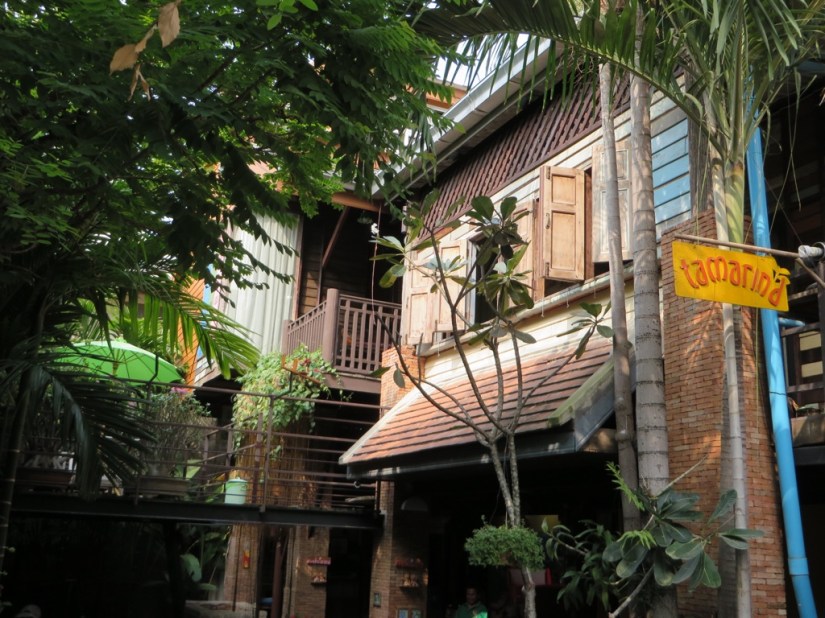
We had reclining seats and AC for our £7 ticket, as well as a hot snack of curry and rice which we had to turn down still being full from breakfast and travelled the 80 miles north to Ayutthaya. The wind had certainly picked up, and the temperature reduced considerably as we checked into Tamarind, a teakwood guesthouse in the edge of the Historic Park.
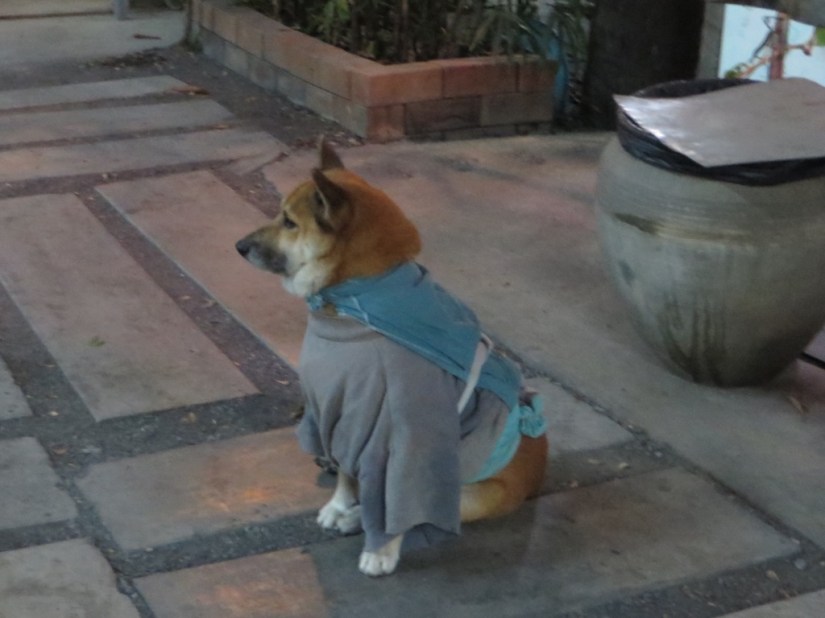
After another night of rain, everyone was wandering round in fleeces and coats, even the dogs.
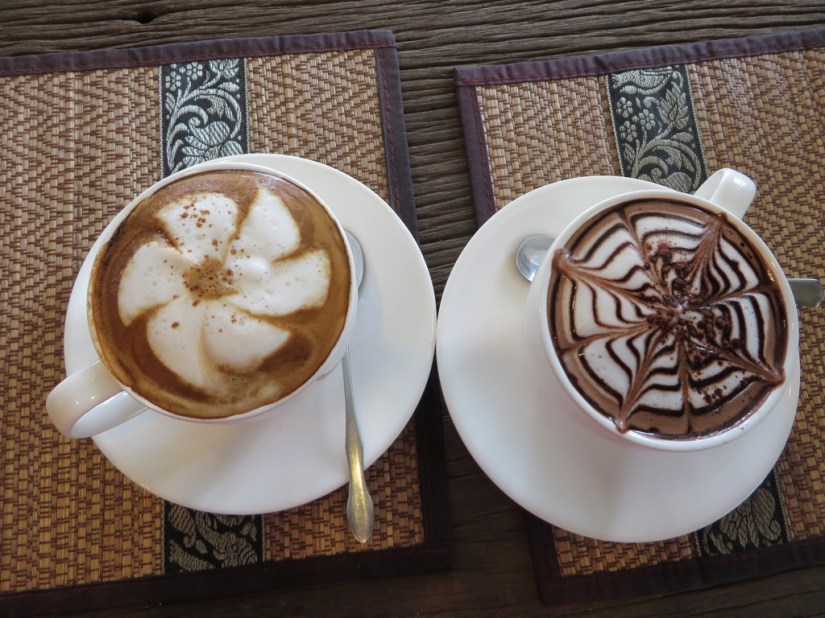
It was less than 20 degrees and I was feeling a little sorry for myself, full of cold no doubt caught on the plane, but slightly happier after a nice cup of hot chocolate … in Thailand!
Fortunately, the following day things starts warming up and by the time we left we were back in the 30s.
Ayutthaya was an island of palaces and pagodas built on canals and waterways and referred to as Venice of the East. By 1685 it had a population of around a million and was one of the largest and most cosmopolitan cities in the world, attracting adventurers, traders, diplomats and missionaries. I’ve been reading The Falcon of Siam which covers this period, with its main character Phaulkon beginning as a Greek cabin-boy and rising to be first minister to King Narai based in Ayutthaya and while definitely a novel, it still gives an interesting insight into what life must have been like. Unfortunately, all came to an end in 1767 when Burma, who had made many unsuccessful attempts to invade over the years finally succeeded and devastated the city. The remains were abandoned to the jungle and the capital moved south to Bangkok.
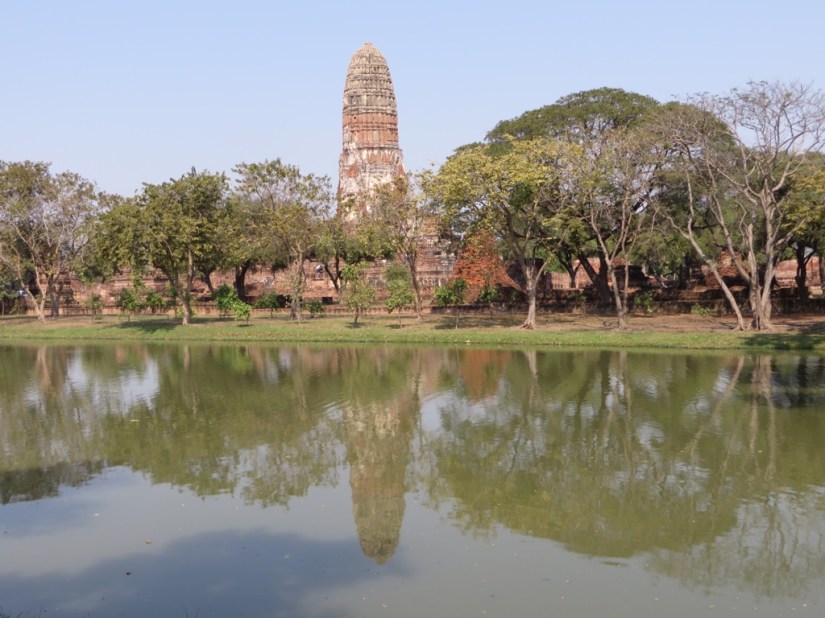
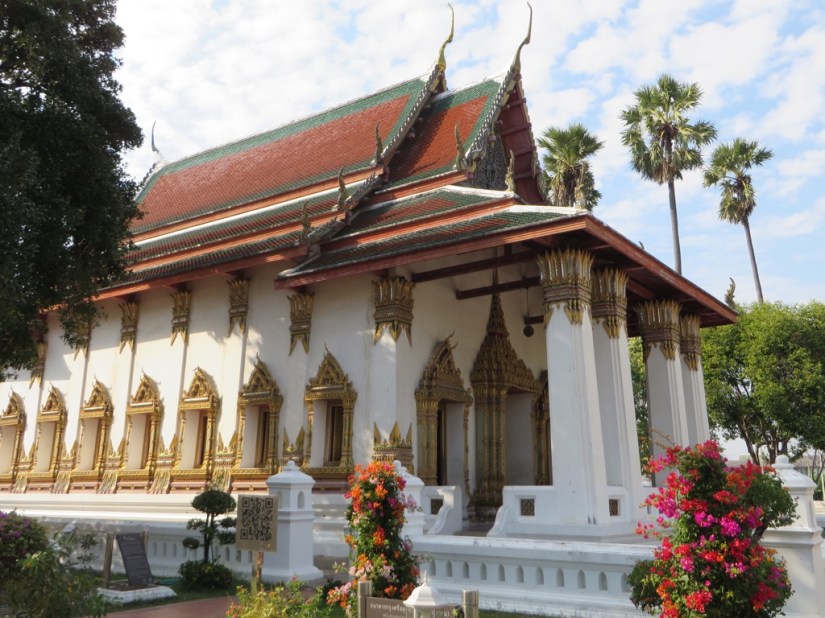
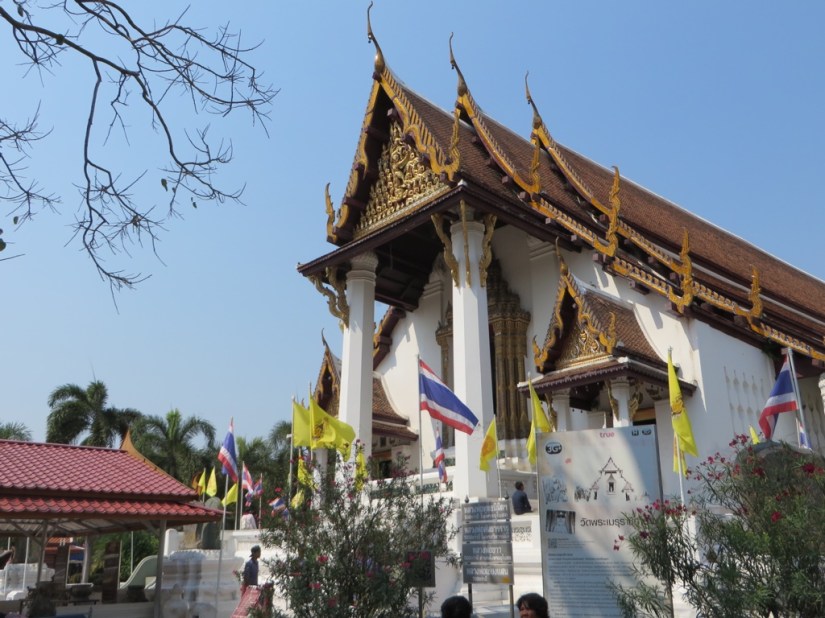
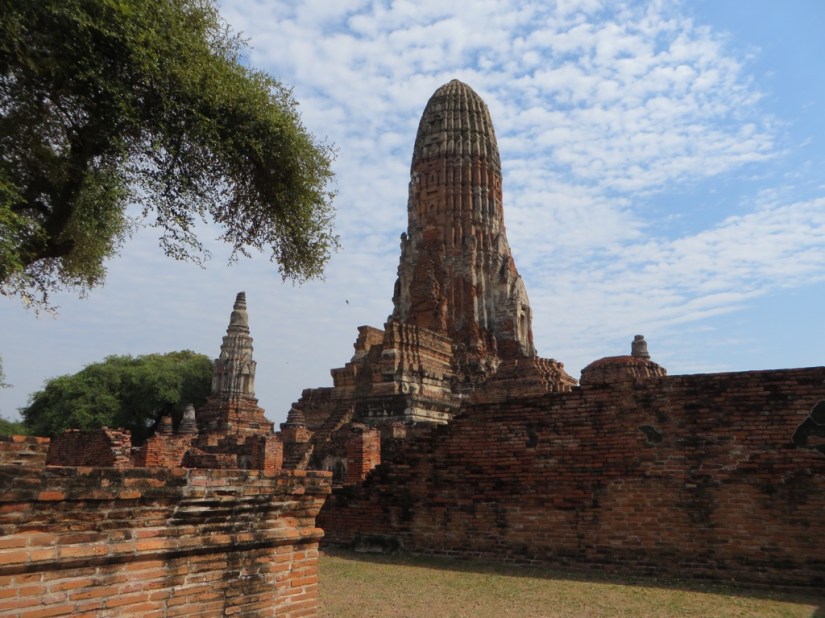
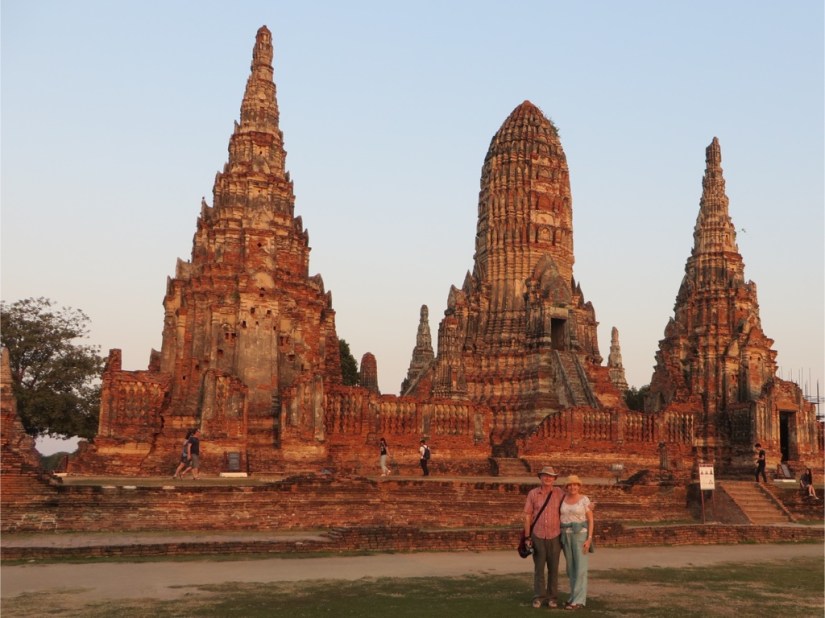
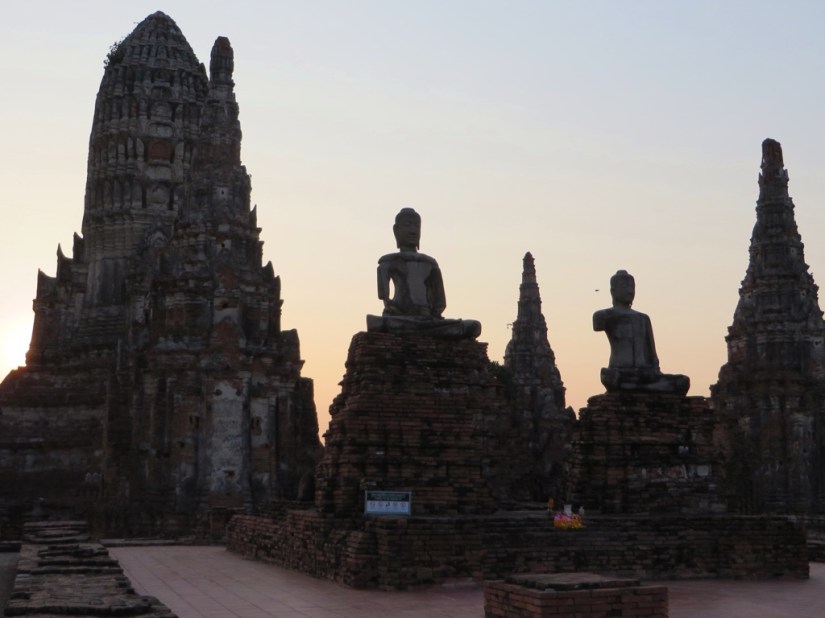
So we’ve been here for four days and have visited quite a few wats, which originally would have been covered in decorated stucco with a central circular tower or prang looking a bit like a cob of corn, surrounded by a number of chedi or spires, a hall either side and a wall round the outside. All that remains are some wonky bits of wall and various bits of column, prang and chedi. We have also been to a couple of wats which are still functioning and have lovely halls or viharn, always with multi-tiered roof and decorated at the end with a kind of finial called a lamyong.
Wat Suwan Dararam RatchaworawihanWat Na Phramen
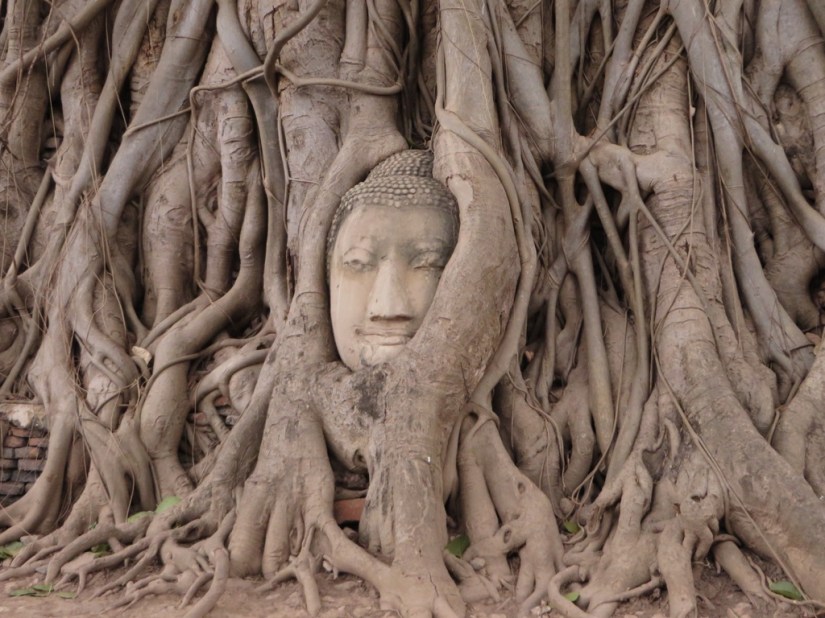
Anyway here are our pick of the wats … Wat Mahathat has a Buddha’s head entangled in the roots of a banyan tree and the main chedi is meant to contain Buddha’s relics …
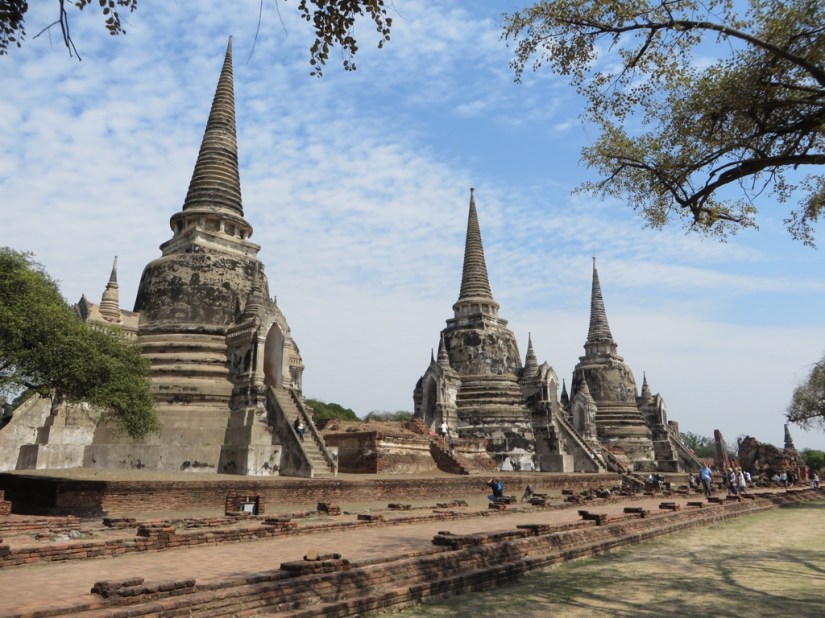
… and Wat Phra Si Sanphet has a row of three chedi, each containing the cremated remains of a king.
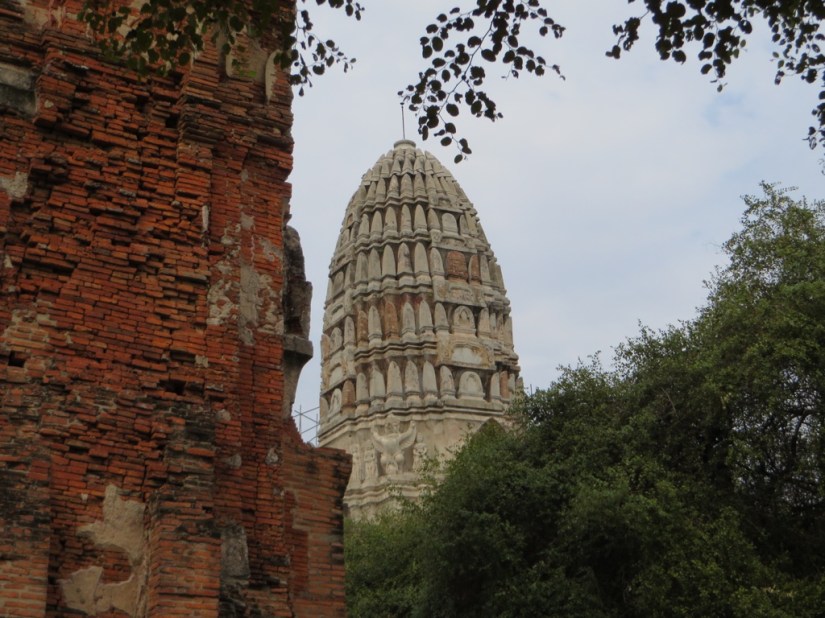
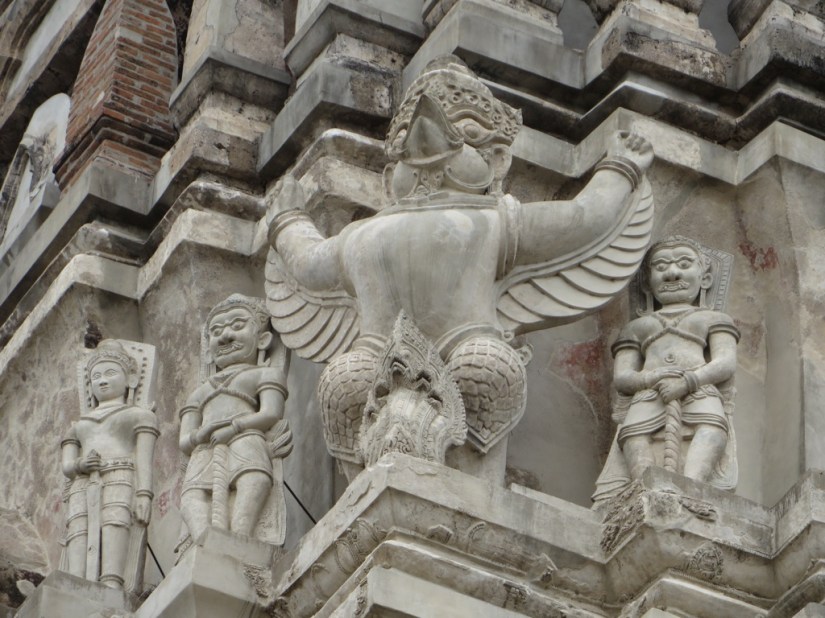
Wat Ratchaburana was built as a memorial to two princes who killed each other in hand to hand combat astride elephants fighting for the crown and still has some remaining stucco, albeit restored, of garudas swooping down on nagas.
We seemed for ever to be walking round one side or other of Wat Phra Ram, so here it is two ways …
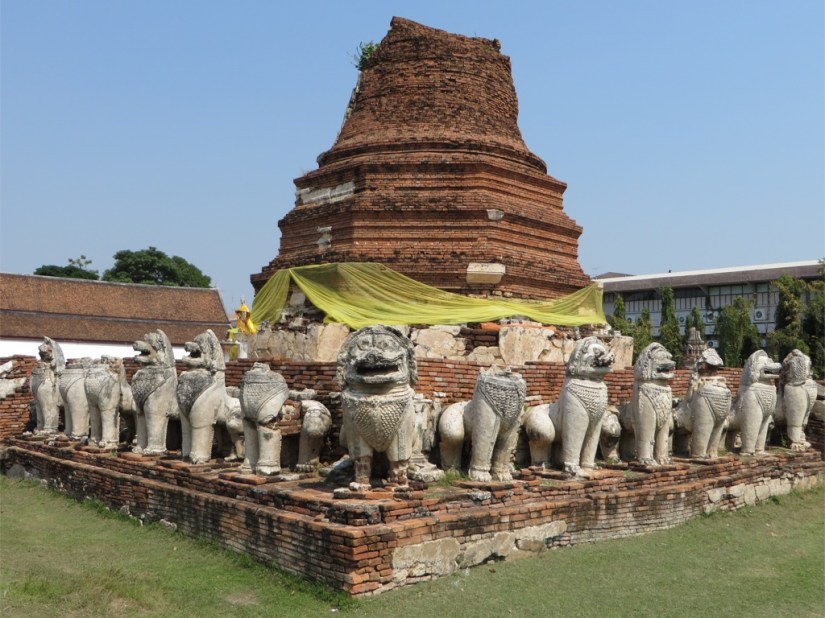
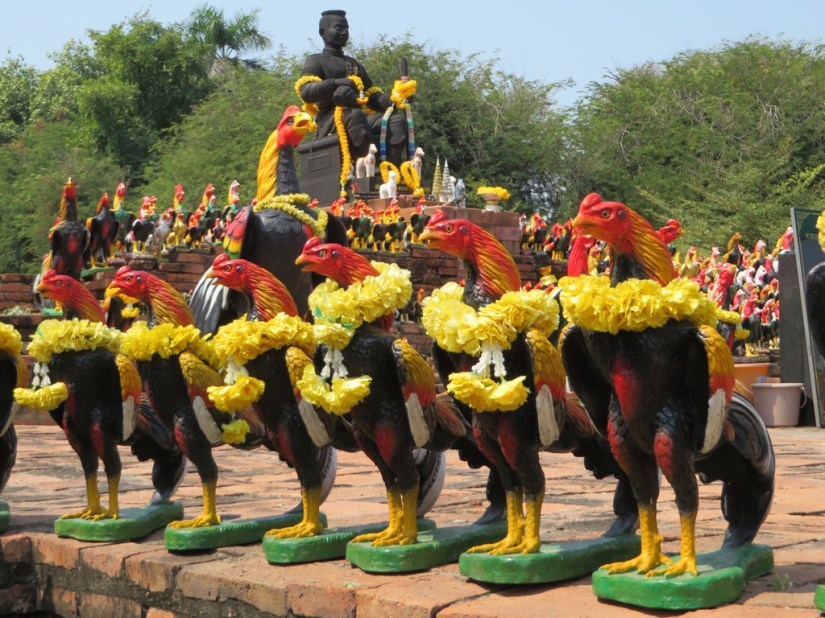
Wat Thammikarat is another personal favourite, partly for the splendid lions surrounding the main chedi but also for the amazing display of roosters in honour of a Thai prince who beat a Burmese prince in a bet on a rooster fight.
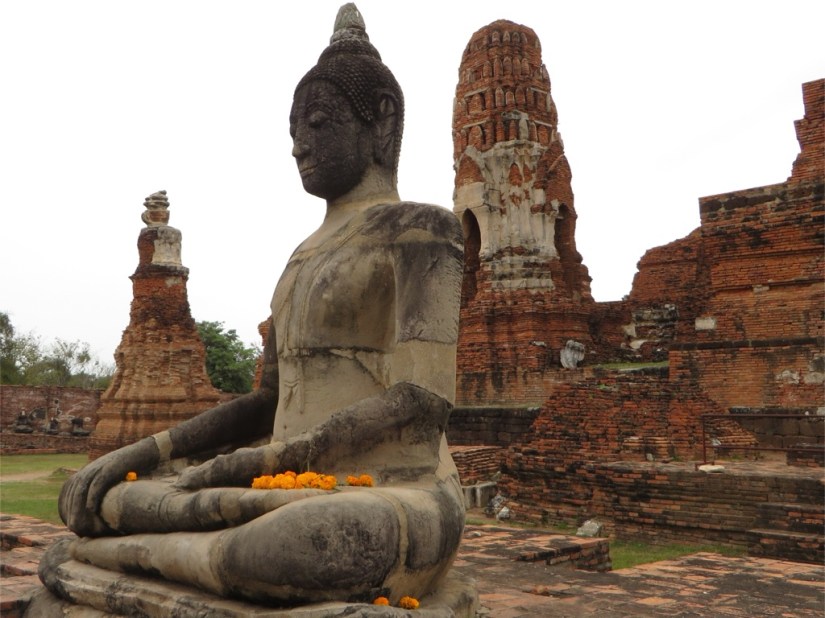
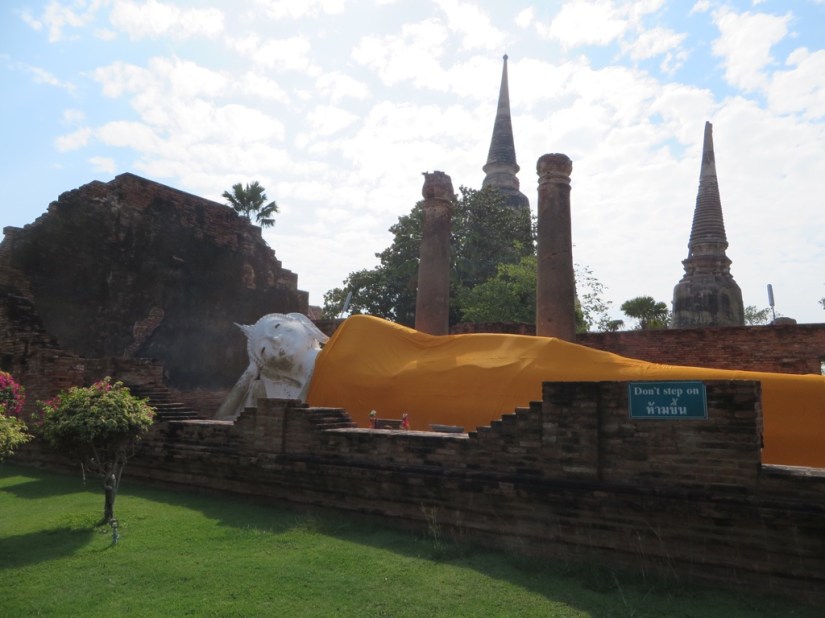
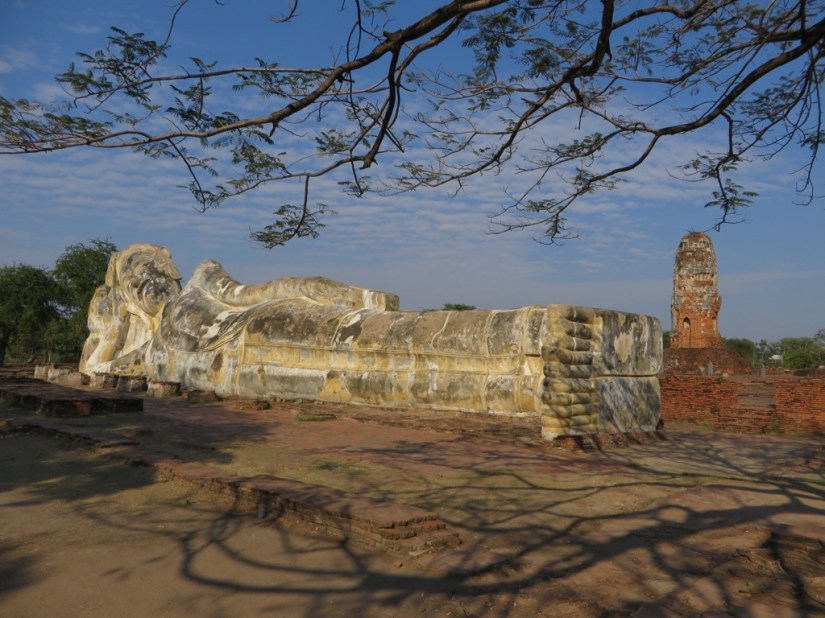
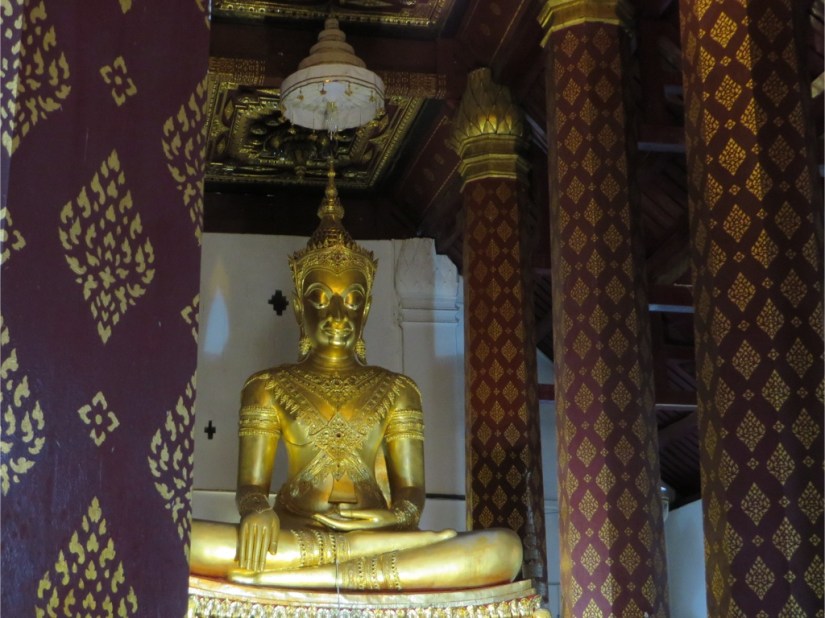
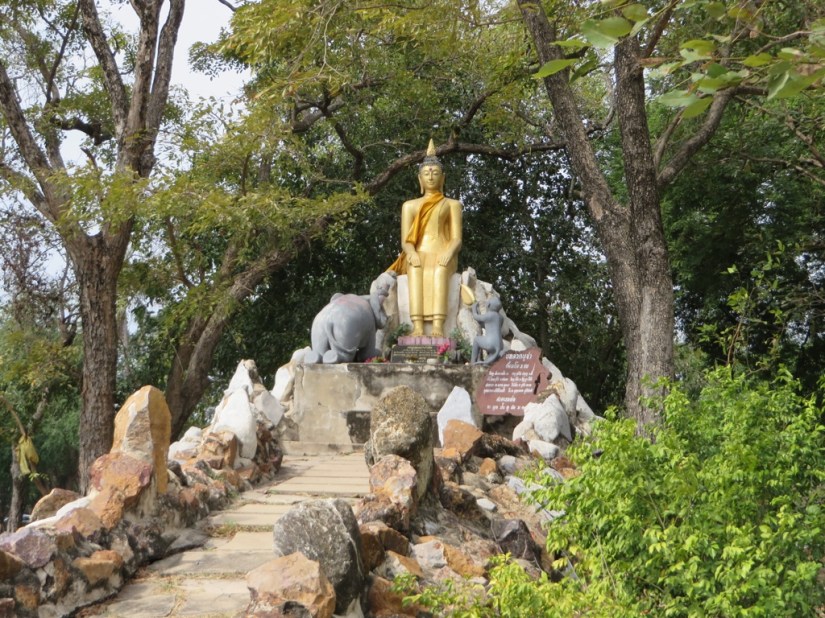
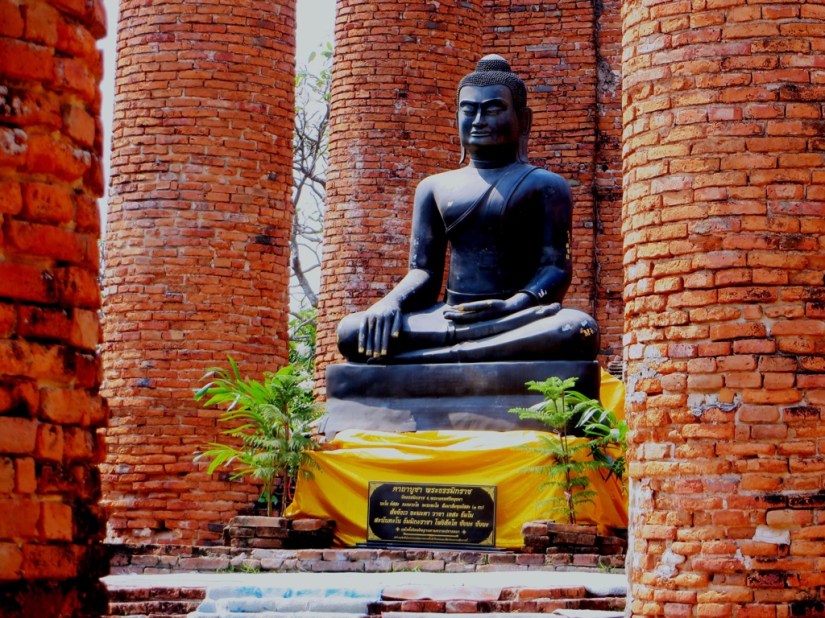
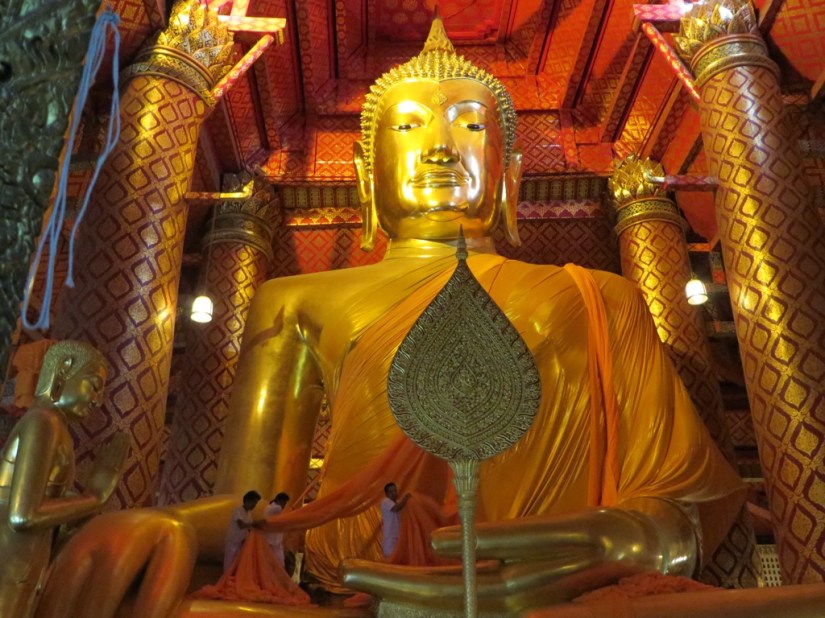
Then there are the Buddhas … large and small, sitting and reclined, gold and stone and even dressed and being dressed!
Wat Mahathat
Wat Na Phramen
Small Buddha in the park
Wat Phananchoeng
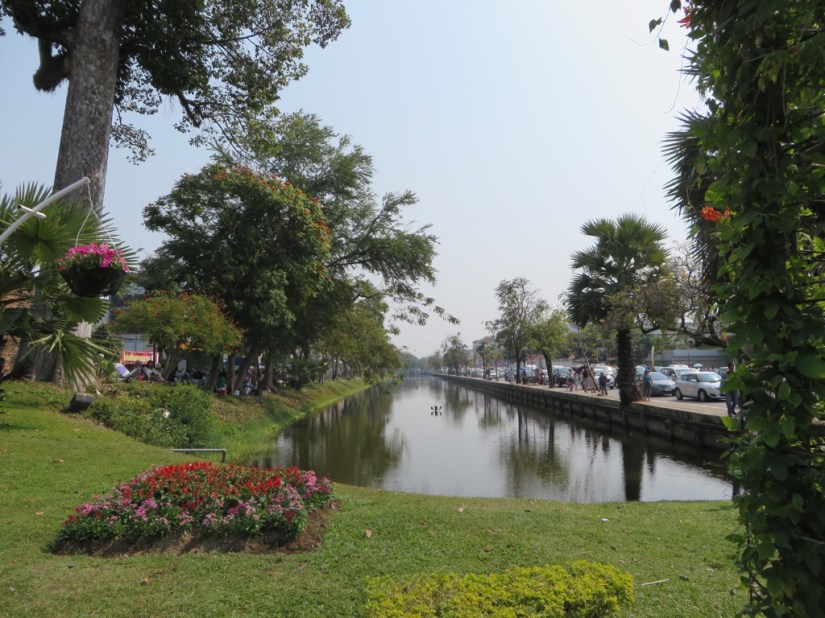
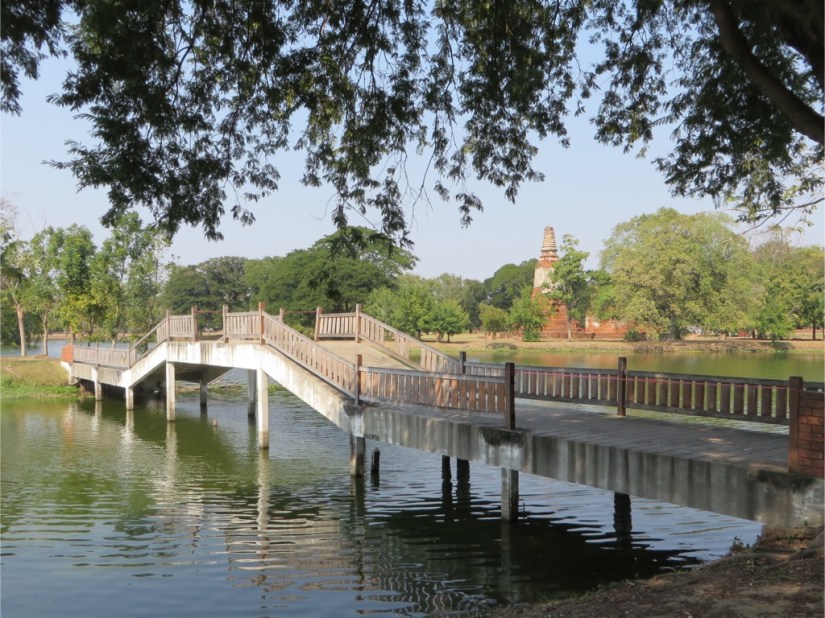
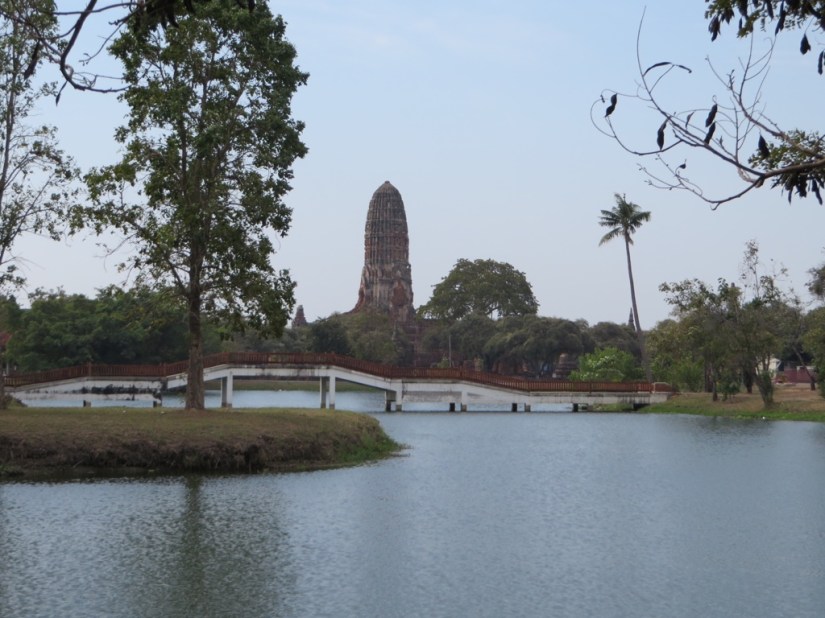
There are few canals now, apart from those in the ornamental park in the centre of town …
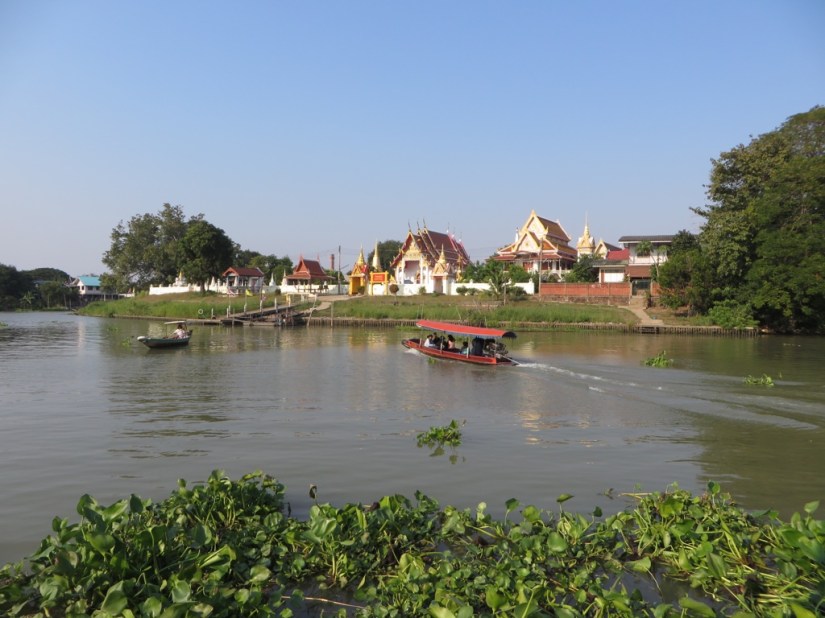
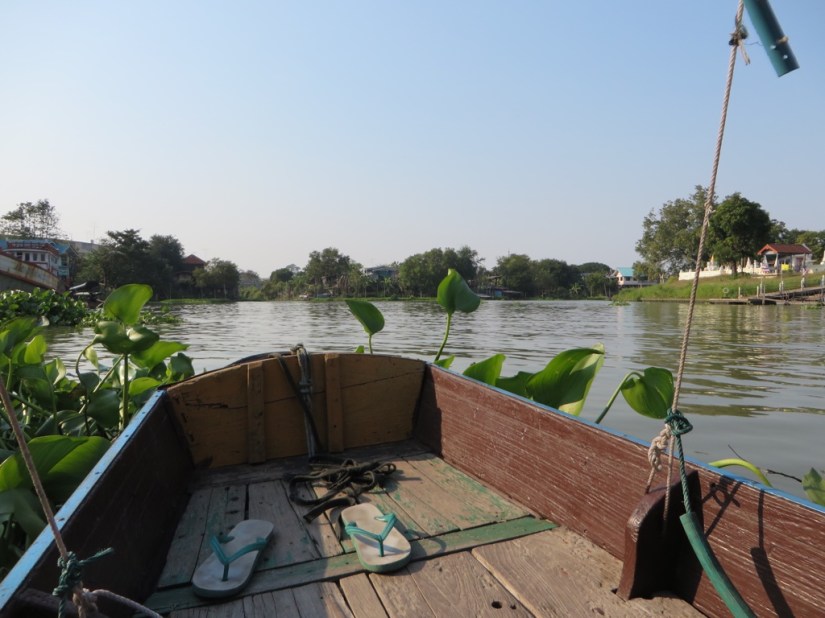
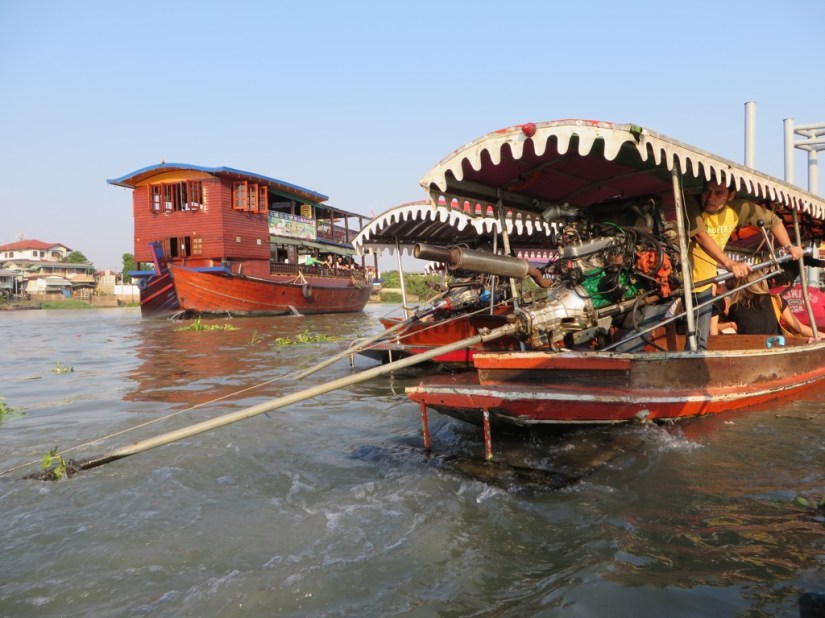
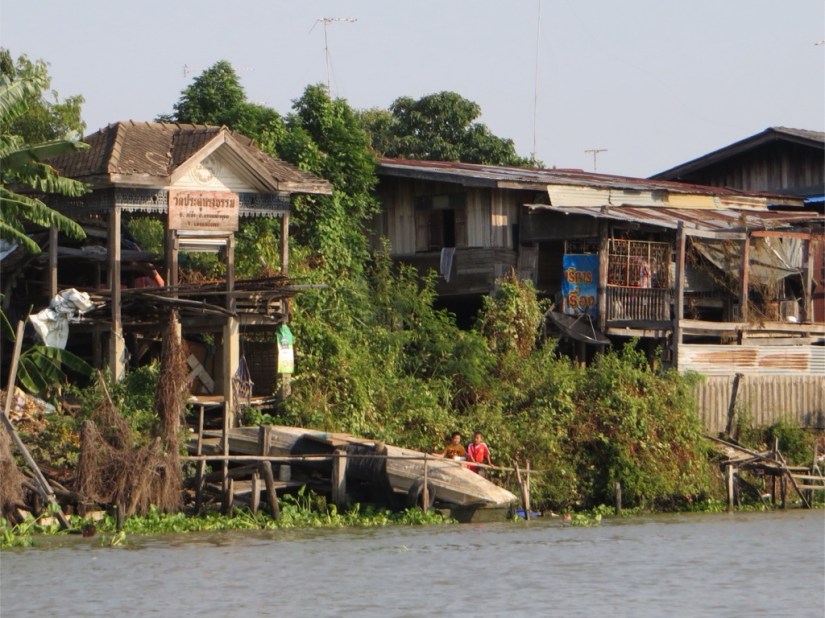
… but Ayutthaya is still surrounded by water and we took a long-tailed boat trip round the island.
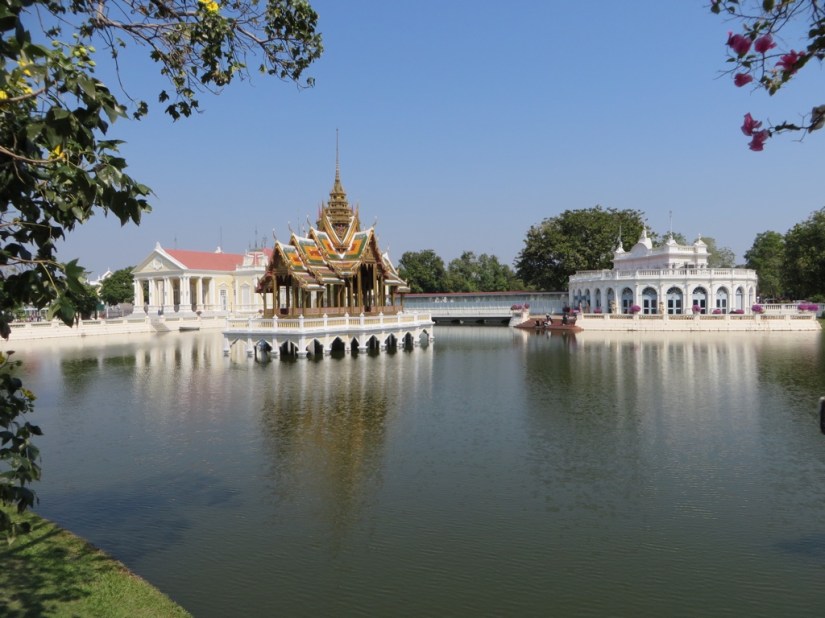
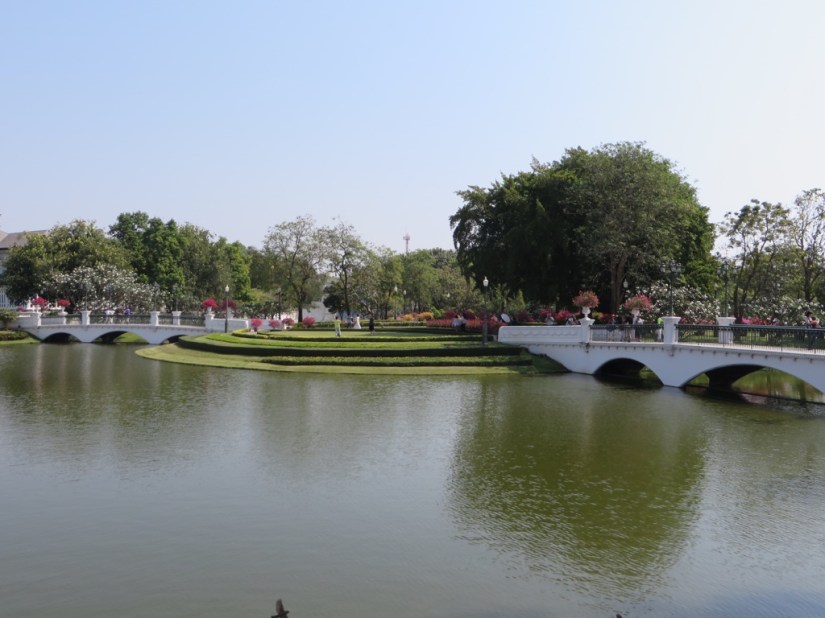
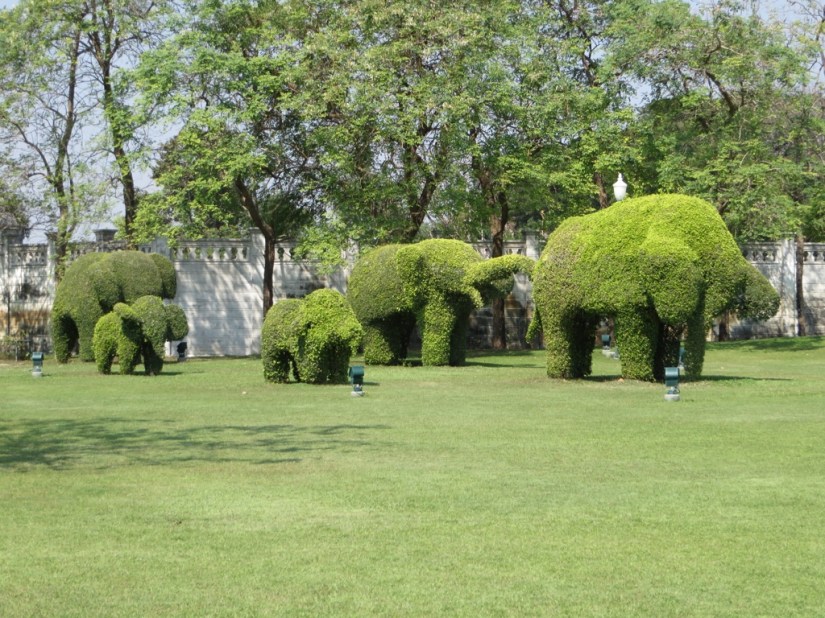
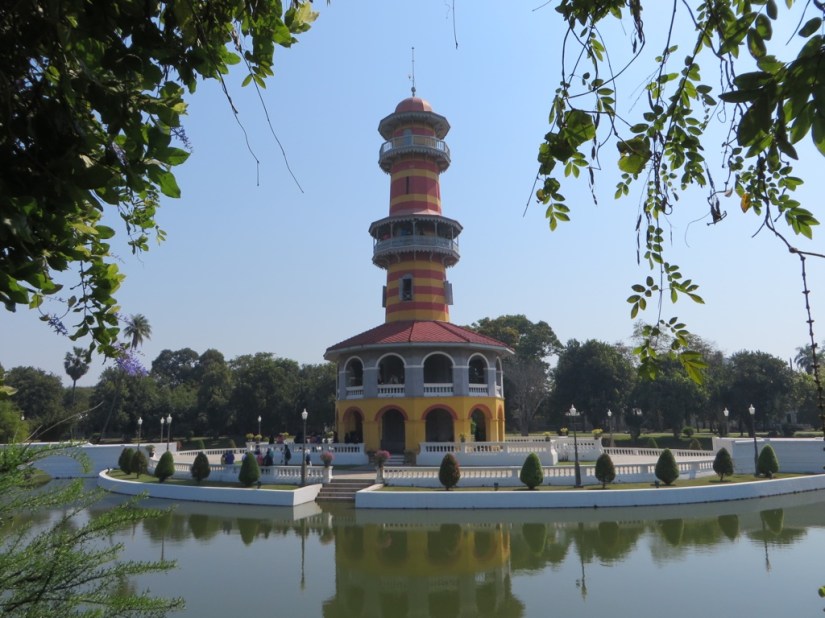
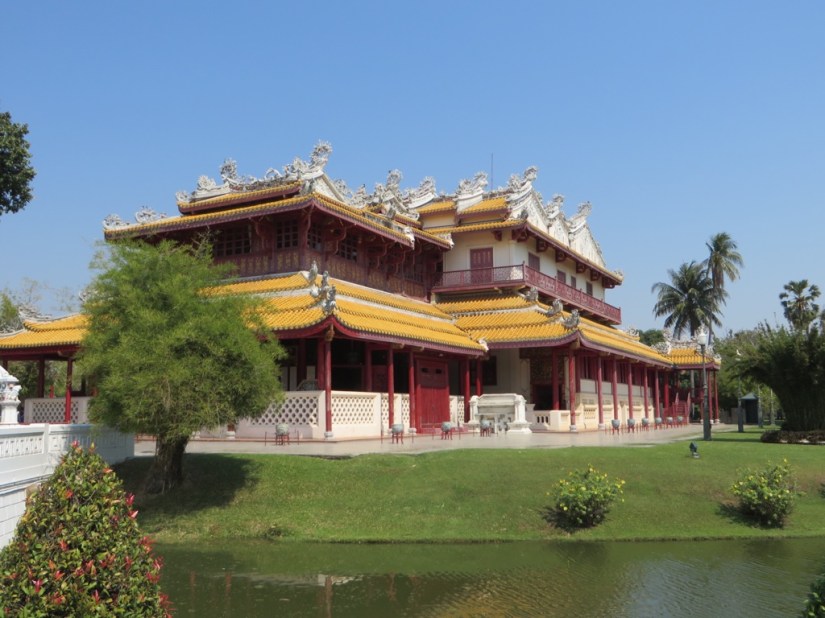
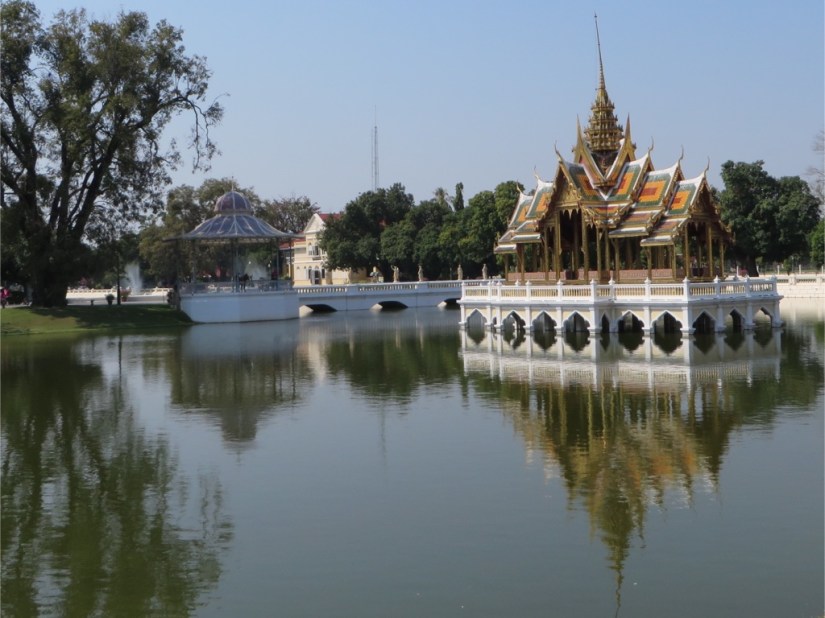
We also visited Bang Pa-In where there has been a summer palace since the mid 17C, although the present eccentric melange of European, Thai and Chinese styles dates to the late 19C. Our visit was made surreal by the piped lift music heard in every part of the perfectly manicured gardens as one vista after another opened up …
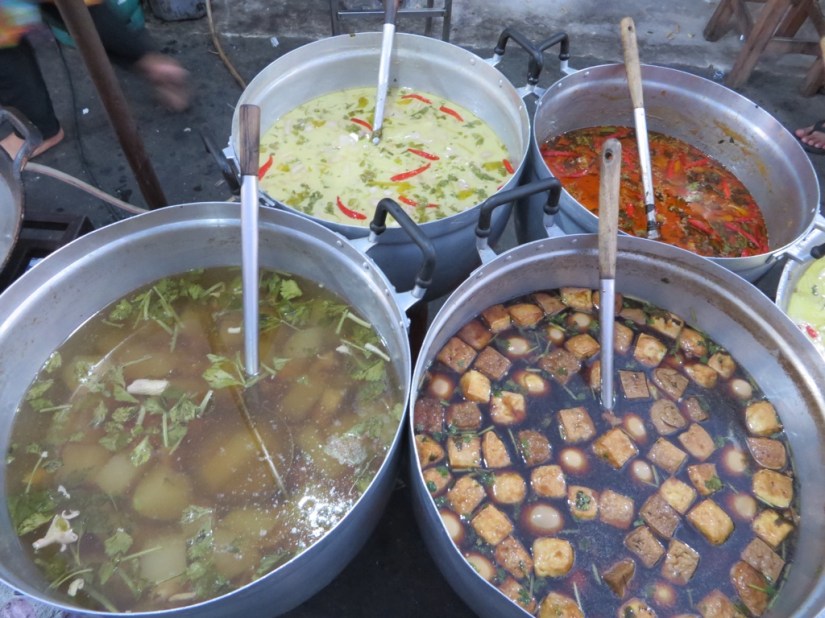
There was also the local market to check out …
… the noodle stall …
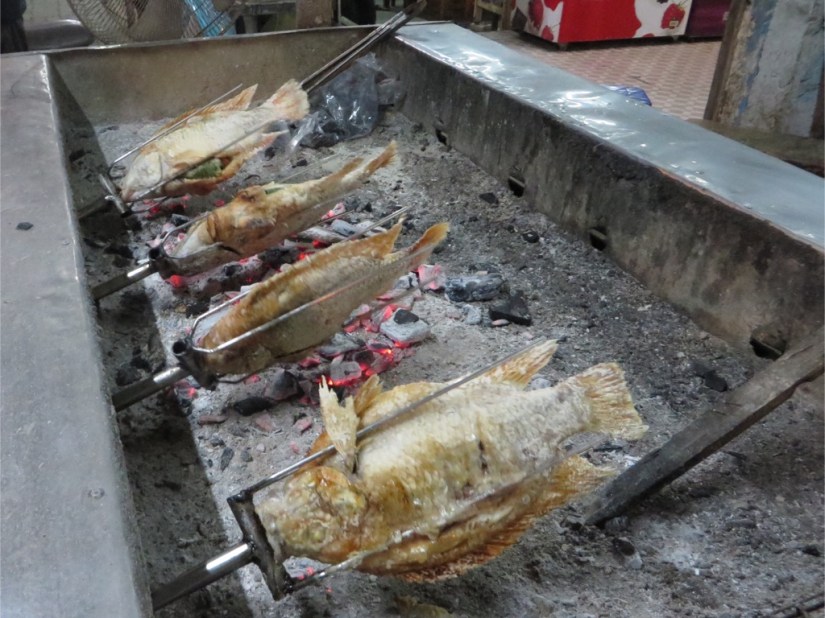
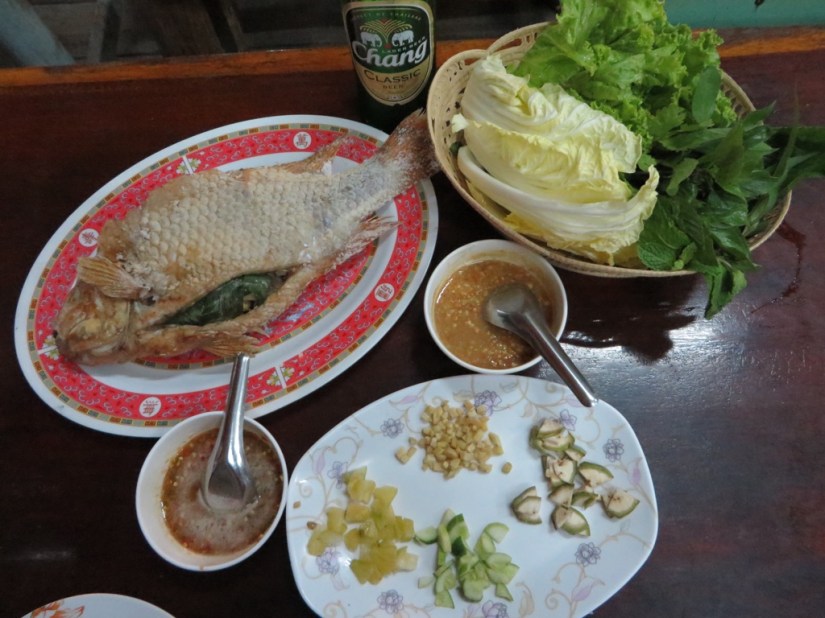
… and also a fish restaurant where they grill Ruby fish to order … delicious.
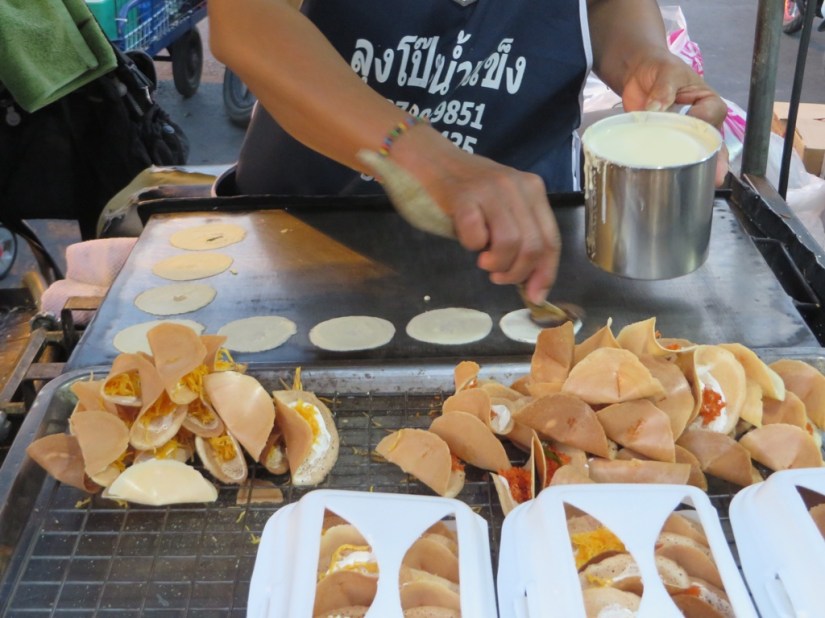
Not so sure everything was equally delicious at the night market as we were only brave enough to try the little sweet pancakes called kanoom berng.
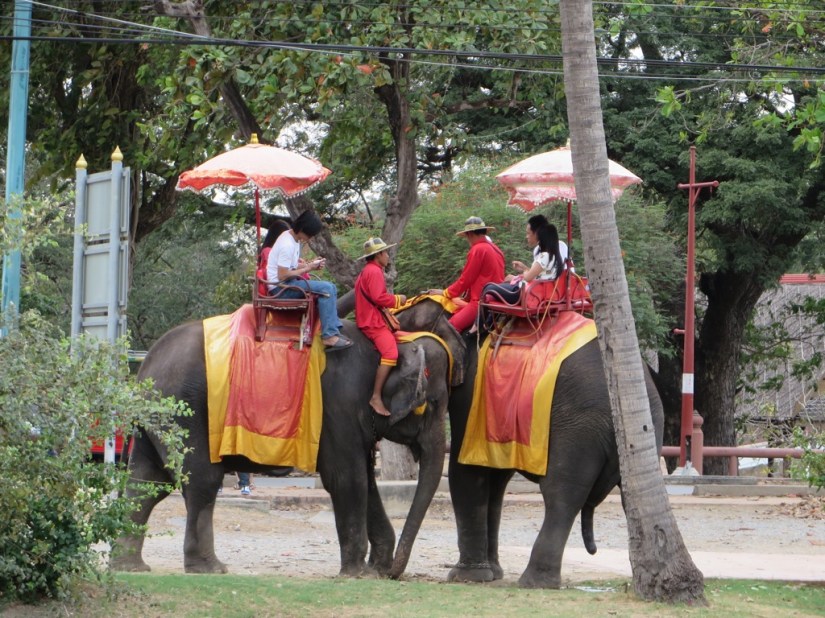
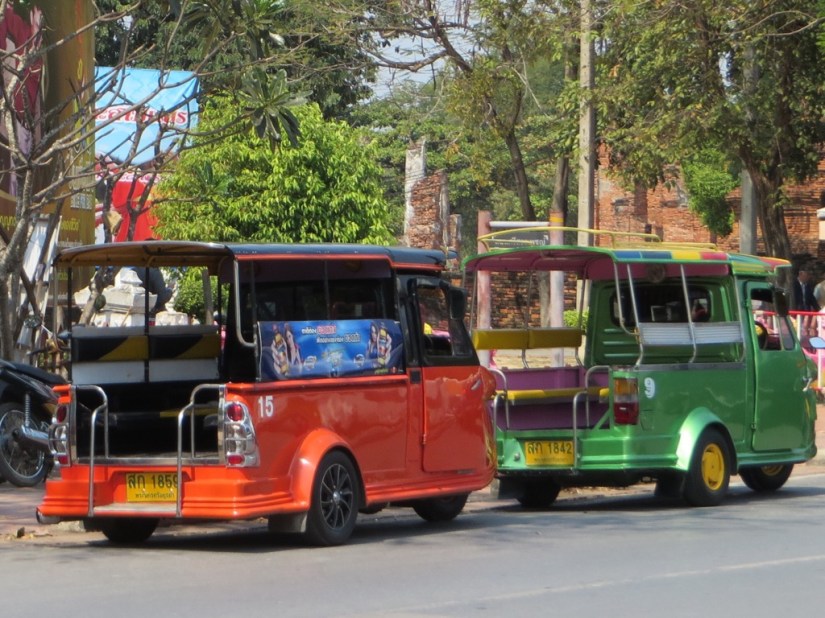
While we did our sightseeing on foot, some let an elephant or tuk-tuk take the strain!
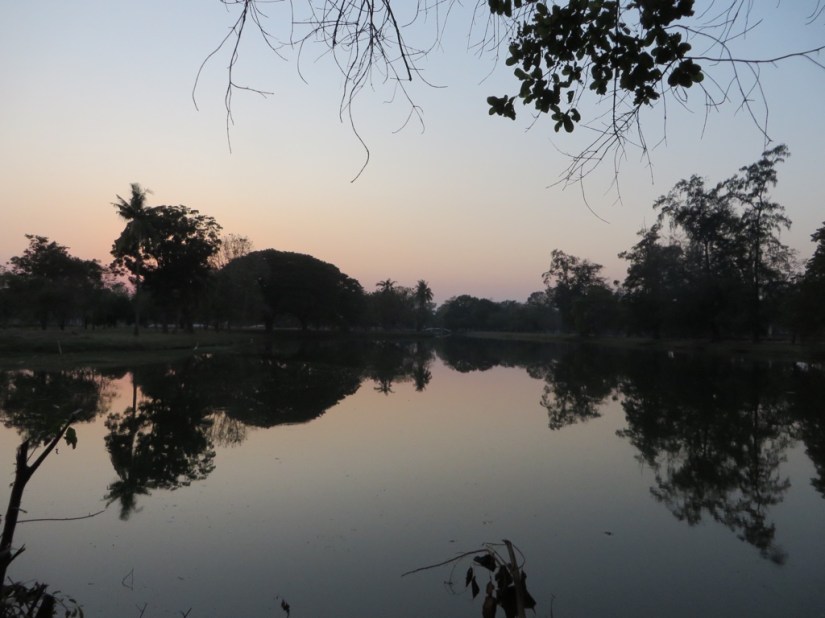
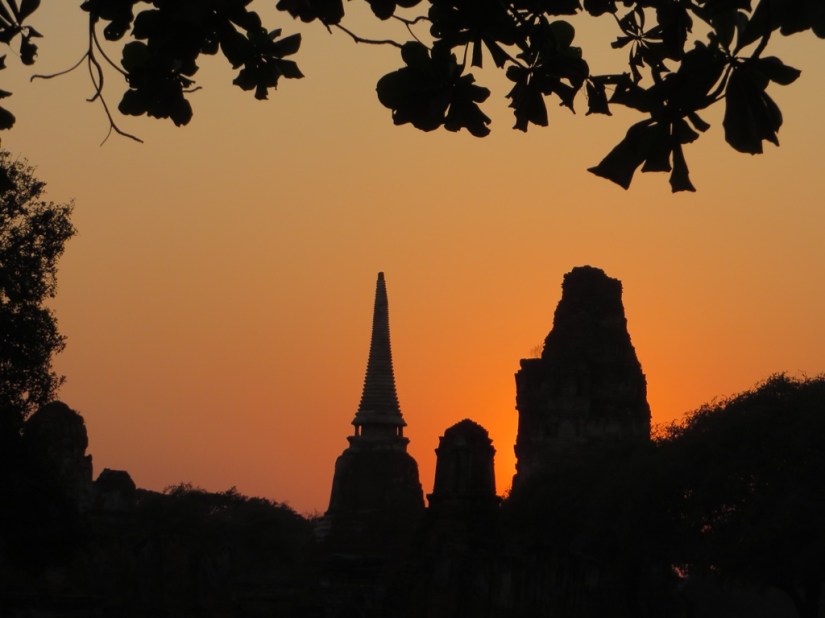
And finally a couple of sunsets to end our stay here …
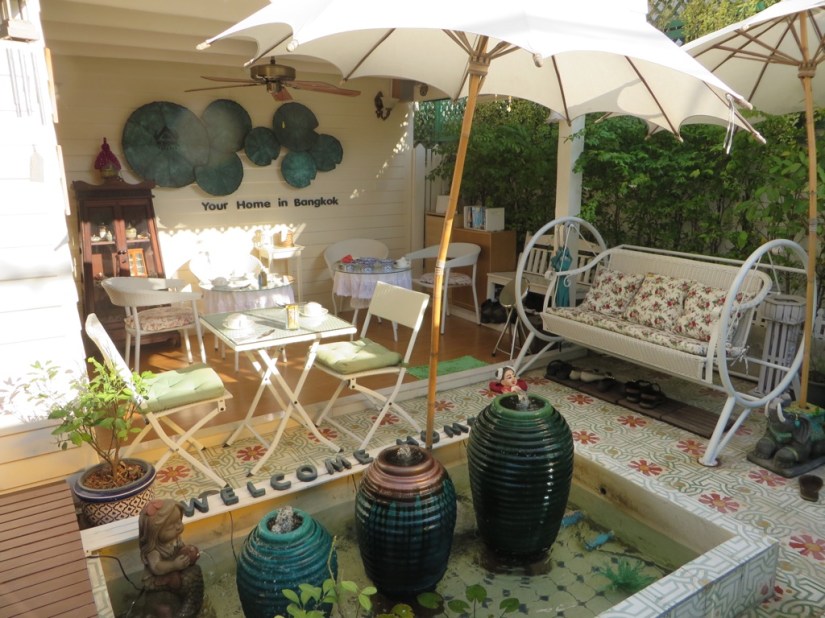
We are staying in W Home, a charming B&B in a neighbourhood of homes and local businesses just off Charoenkrung Road, the first road ever built in Bangkok.
Our comfy, if bijoux room, overlooks the lane outside and we were woken on our first morning by cockerels crowing.
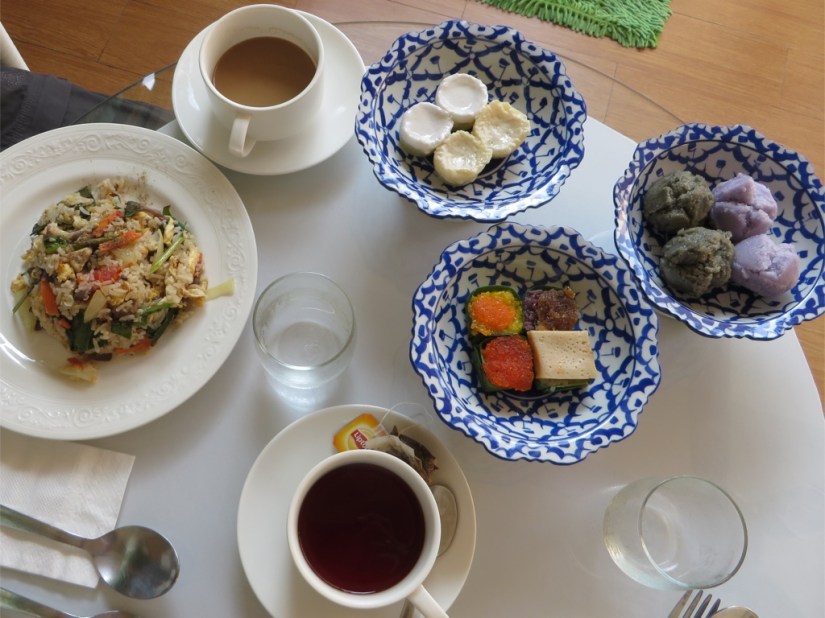
Breakfast was served in the courtyard and comprised a savoury dish of rice or noodles cooked with vegetables and maybe chicken followed by fruit and a variety of sweet treats including coconut flavoured sticky rice, lilac sponge cakes and coconut milk custard.
Nui drove us a short way to the main road to make sure we had our bearings and we walked a few minutes to the Chao Phraya river to catch a ferry. The pier is beside a local wat, not listed in any what wat guide guide, but nonetheless home to a huge golden reclining Buddha.
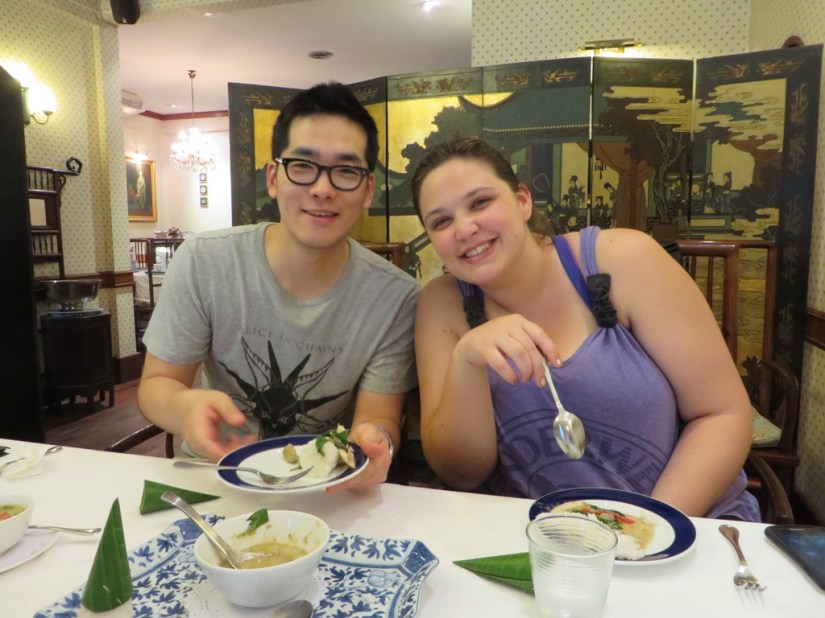
We have been to Bangkok before and visited the main sights including the Grand Palace and several wats, so this time thought we’d do something different. Our first day was also Chris’s birthday so we we wanted a memorable day. We began with a food tour of the Bang Rak neighbourhood with Taste of Thailand, guided by Ben and with fellow visitors Hyunsoo and MacKay. We stopped at a drinks van for Thai tea, made with hot tea and condensed milk served over ice, a local delicacy a bit sweet for me and a bit creamy for Chris, but good to try. Other stops included a fruit stall where we tried several unusual fruits, a curry paste shop where we were told about the four flavours in Thai cooking …
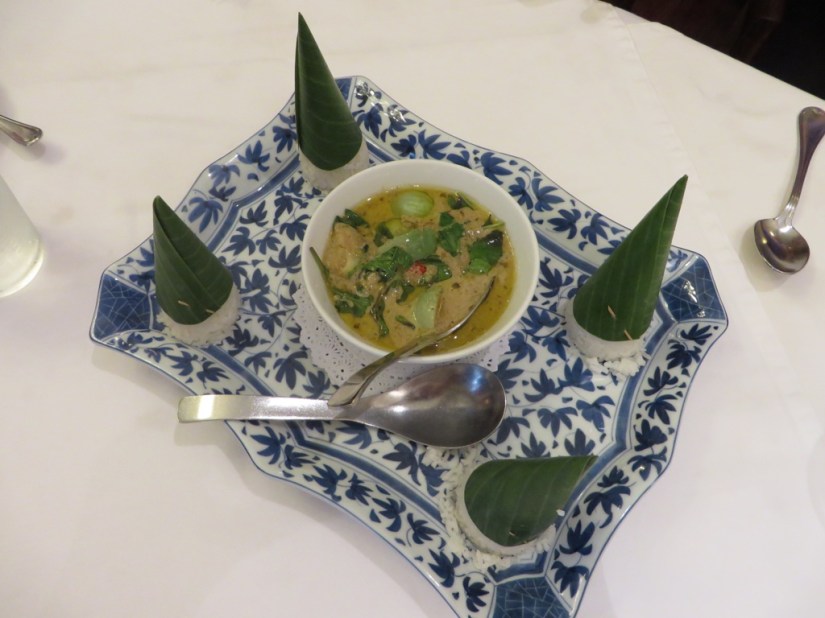
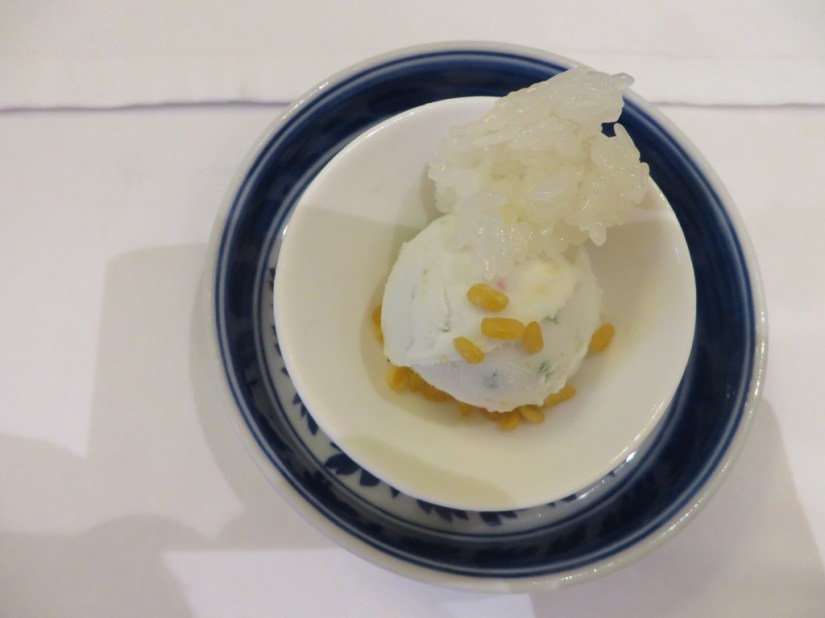
… a cake shop selling similar sweet delicacies to those we had tried at breakfast and then a Chinese pharmacy and grocery where they make a variety of homemade herbal drinks not only to refresh but to relieve ills as well – my rosella drink was definitely the winner! We then moved on to serious snacks – a shop selling roast pork and duck, where they roast 200 ducks each day – I had duck with noodles and Chris a veggie noodle dish; the next stop had spicy salads as its forte – a trio, one papaya which was quite hot, another with minced pork and coriander and the third with lemon grass and dried shrimp. Finally, when we thought we were almost full, we went to a restaurant run by a descendant of the royal family which serves Royal Thai cuisine and we had green curry with jasmine rice, coconut ice cream and jasmine tea – a fabulous end to our tour!
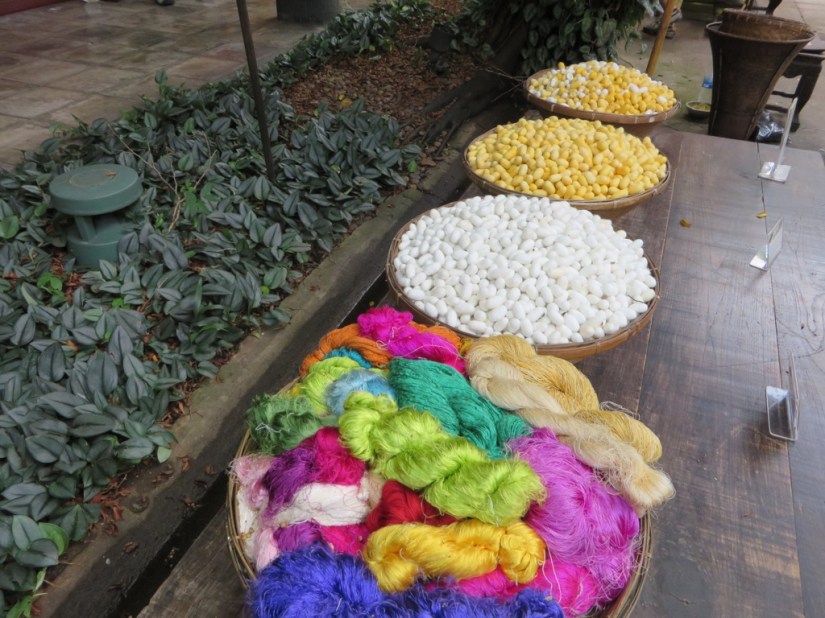
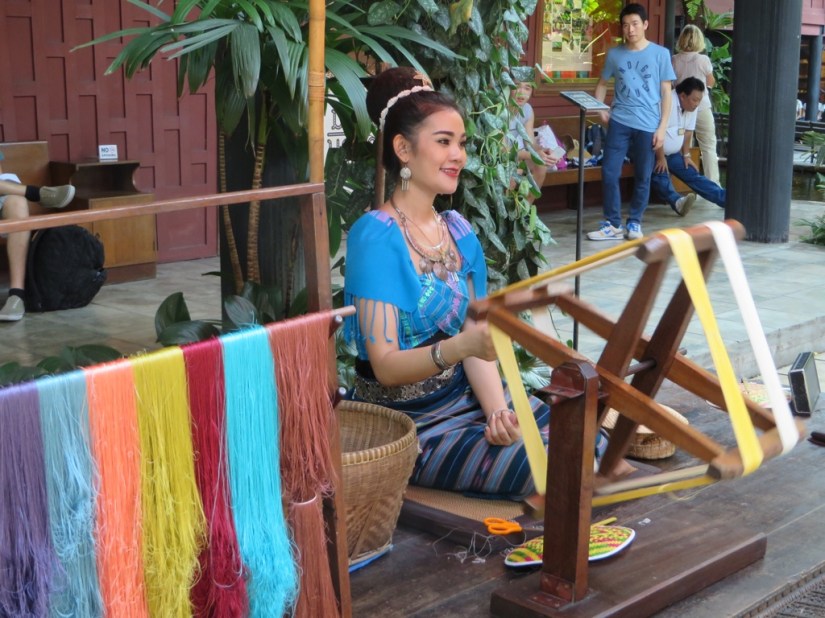
When we were here before, Chris bought a couple of snazzy elephant handkerchiefs at the airport which said Jim Thompson on the label. Despite the guide book referring to him as the most famous farang in Thailand, we had not heard of Jim Thompson, but now know he was an American who came to Thailand with the army after WW2, fell in love with the country and returned to live. He was an adventurer and entrepreneur whose fame partly came from reviving the dying silk-weaving industry, promoting the silk in America where it sold well, especially after his company made the costumes for The King and I on Broadway, depicting the life of King Rama IV. He gained further renown by constructing the Jim Thompson house by dismantling six teak houses, all over 200 years old and reassembling them to make a home which he filled with Oriental art and particularly Thai paintings which he opened to the public. And then one day, while visiting the Cameron Highlands in Malaysia, he went for a walk … and never came back. His mysterious disappearance has certainly added to his fame. We went on a tour of the house and watched a demonstration of boiling the silk cocoons to extract the thread and spinning it and I added several new hankies to Chris’s collection for his birthday.
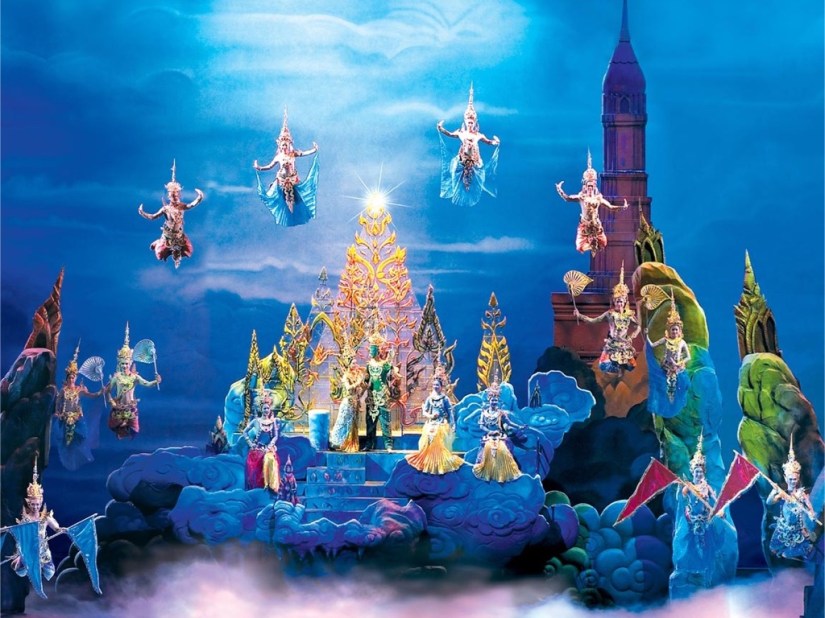
Later we went to see Siam Niramit, an unashamedly touristy show presenting a history of Thai culture and beliefs with a cast of 150, amazing costumes and sets and flashy special effects including flying deities, a thunderstorm with rain and a river running across the stage with boats not to mention the elephant – stunning! To top it all, we took our first tuk-tuk of the trip!
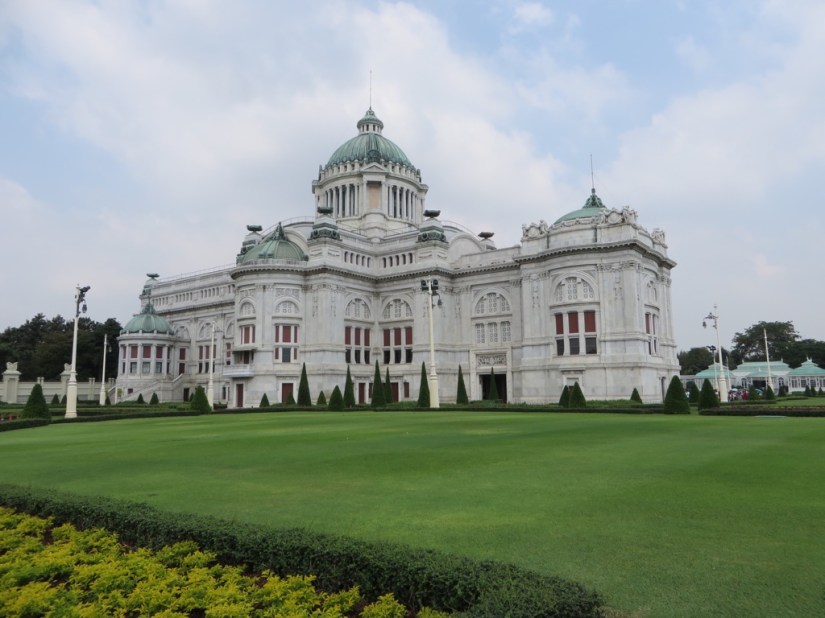
Rama V is still widely revered as the “Beloved Great King” for leading Siam into the modern world as an independent nation. He visited Europe and brought back ideas for updating the capital, the evidence being most apparent in Dusit Park which contains the Ananta Samakhon Throne Hall, a Renaissance style building containing exquisite works of art, showcasing the continuation of traditional Thai metal crafts using gold, precious stones, inlay and even iridescent beetle wings to produce palanquins and howdahs and screens made of embroidery and wood carving.
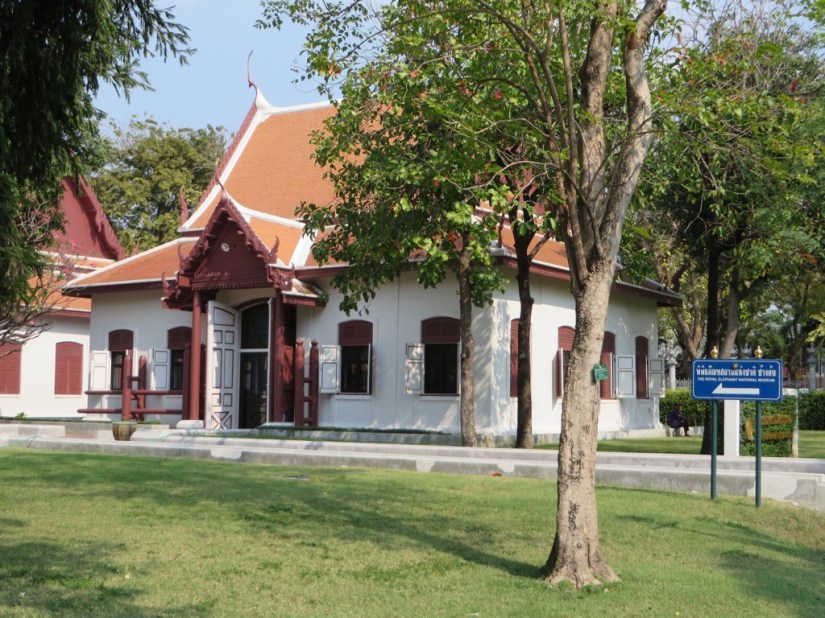
We saw the Royal Elephant National Museum, housed in what were the stables for the king’s white elephants, who now live in the Elephant Conservation Centre. These elephants are revered by Budhists and Hindus alike, and in times gone by it was a huge occasion when one was found in the countryside then paraded to the capital for presentation to the King, who was considered more blessed the more white elephants he had.
We also visited the Vimanmek Palace, built as a summer retreat, but relocated in Dusit in 1901 and occupied for several years by officials, concubines and family. All 81 rooms were out of bounds to male visitors except the King’s own apartments. It is built of golden teak without a single nail, and it’s delicate latticework verandah overlook lawns and lotus ponds.
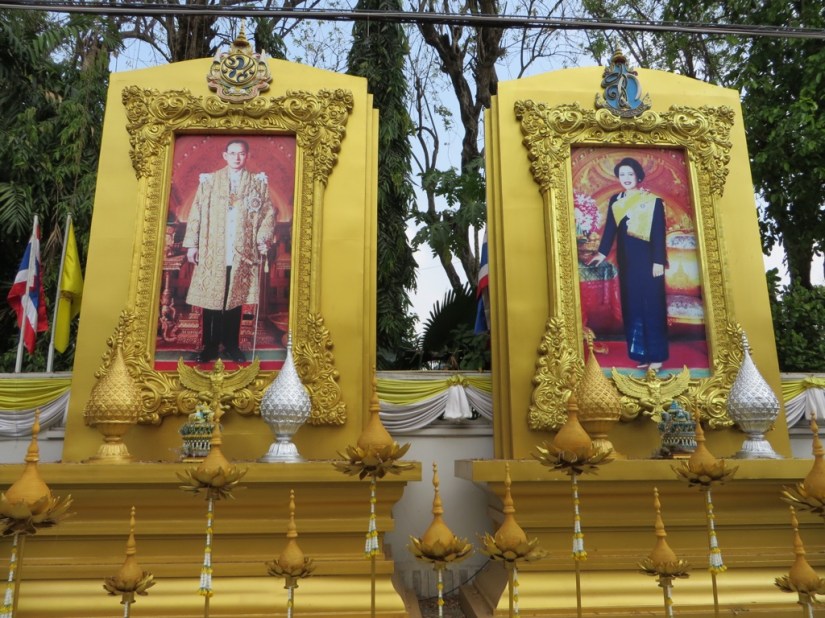
Talking birthdays, we’ve seen a couple of people wearing a yellow tshirt with ‘Bike for Dad’ on it and discovered that some 100,000 people joined in a bike ride round Bangkok to celebrate the King’s 88th birthday in December, following on the success of ‘Bike for Mum’ for the Queen last August on her 83rd birthday. Apparently these events have been promoted as a chance to rebuild national unity after the latest in a succession of coups removed the civilian government from power 18 months ago and everywhere you look there are flags and posters. Could you imagine British people ever referring to our Queen and Prince Philip as Mum and Dad … I don’t think so!
Later we walked to the Asiatique Riverfront, a recently redeveloped dockland area with a huge night market, restaurants and a Ferris wheel. We had a lovely meal overlooking the river, then Chris was delighted to see Liverpool score the winning goal against Norwich in the final minutes of the game. A little shopping and then home …
Why Thailand? Well it’s a whole lot warmer than England and that feels like a good enough reason in itself but more importantly, why have we not been?
Everyone we speak to seems to have visited but apart from a stopover in Bangkok, Thailand is a treasure we have yet to discover for ourselves! As always we’ll be exploring on our own, taking the train north in stages from Bangkok to Chiang Rai to see temples and palaces, elephants and a flower festival.
We then fly south to visit Khao Sok National Park and Phang Nga Bay before relaxing on the beach on Ko Lanta.
Having wished each other a Happy New Year while flying over Afghanistan, we arrived in Singapore on a warm but slightly grey New Year’s Day.
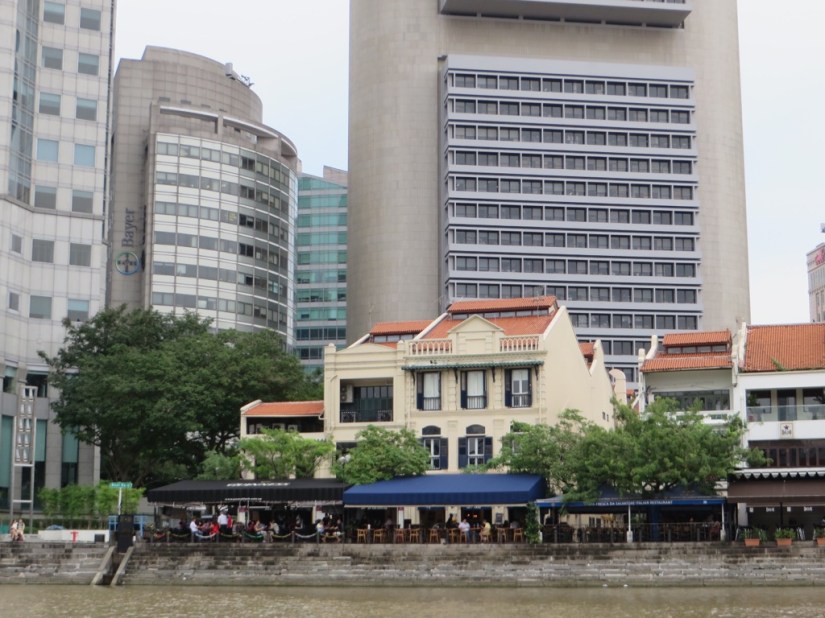
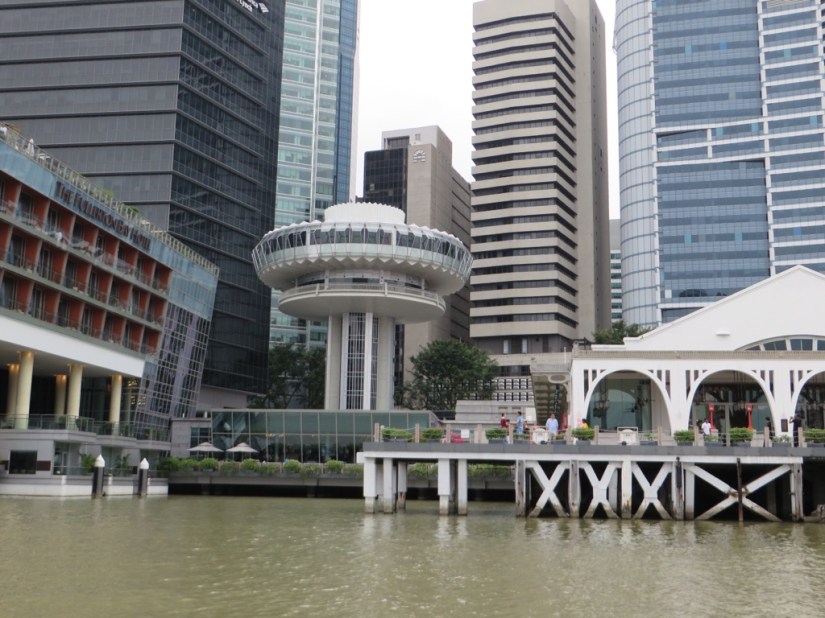
We started our sightseeing by making our way to Clarke Quay to catch a bumboat tour. The river was once the artery of Singapore, busy with boats carrying a myriad of goods including coffee, sugar and rice to the godowns or warehouses and remained a working river until the 1970s when a clean up campaign moved commercial traffic west. This ended the river’s vibrant history as a trade waterway, leaving newly cleaned waiters home only to tourist boats and the godowns of Clarke Quay and the Chinese shophouses of Boat Quay, now just restaurants with a river view.
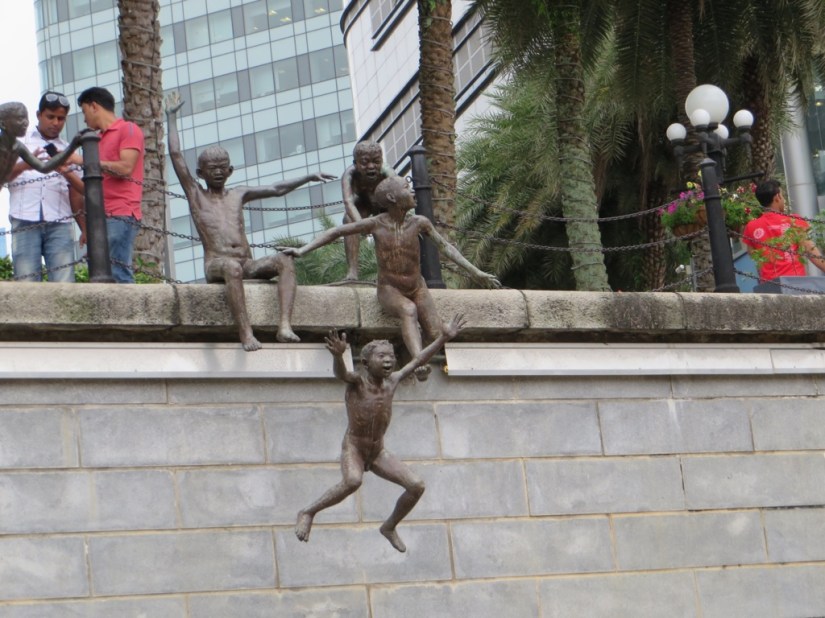
We continued past some lads going for a swim …
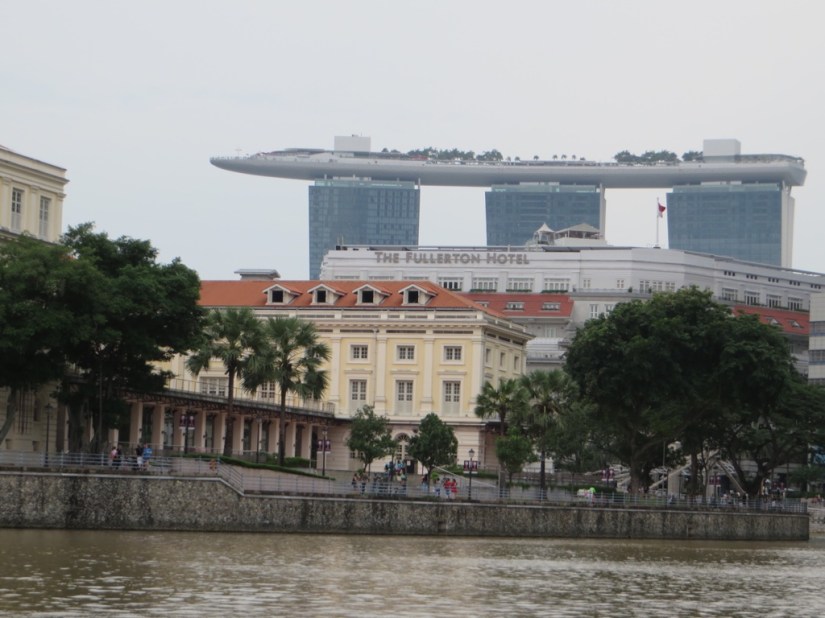
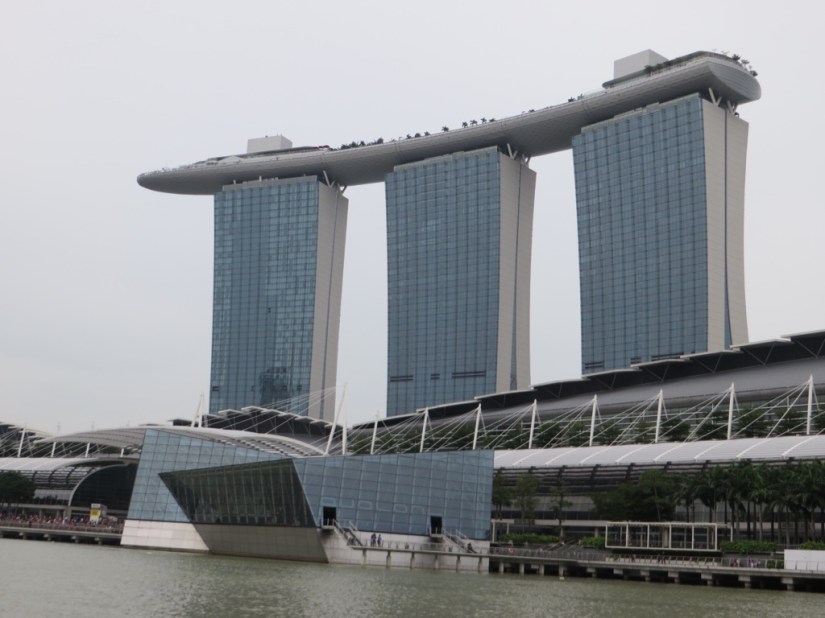
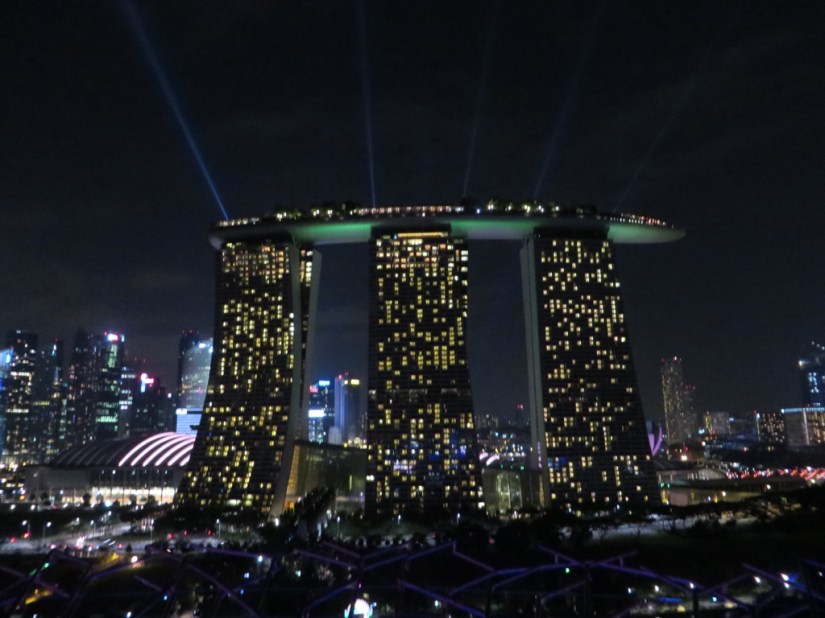
… on to Marina Bay, dominated by the new Marina Bay Sands Hotel looking like a ship stranded on top of three towers …
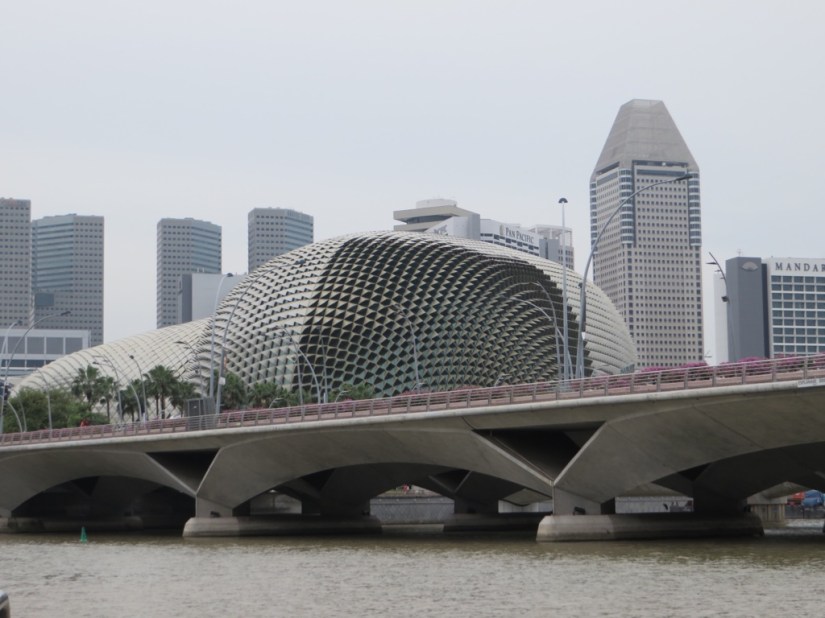
… the Esplanade Theatres affectionately called The Durians by the locals for their resemblance to this smelly fruit …
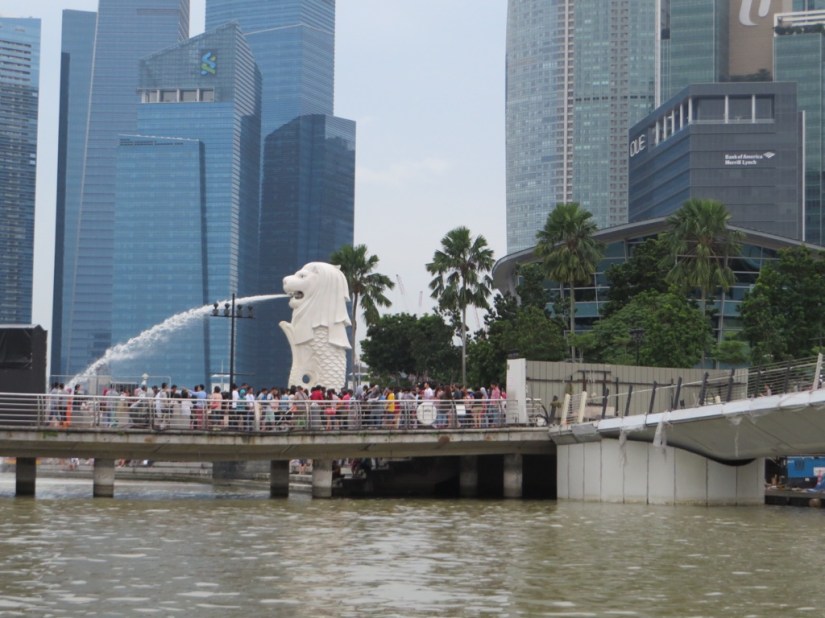
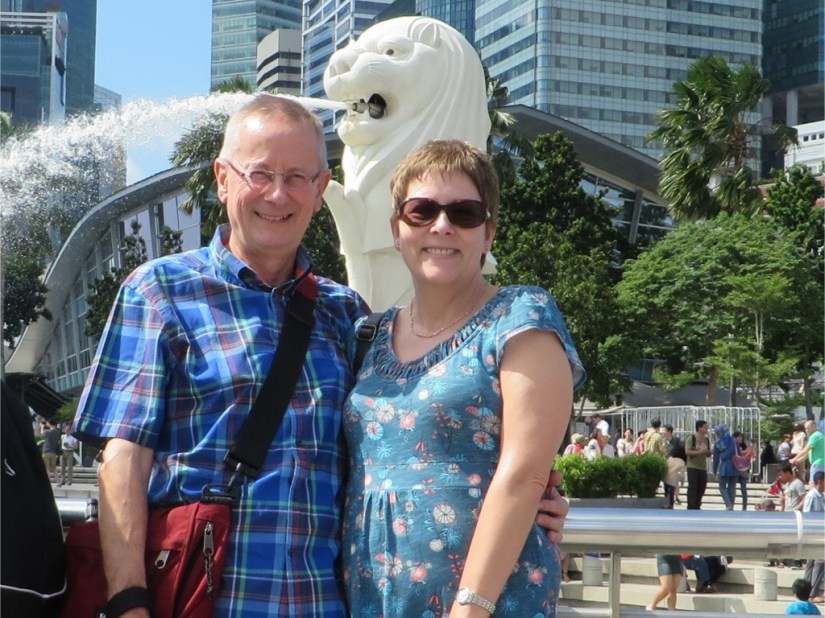
… and the Merlion, the half lion, half fish national symbol of Singapore.
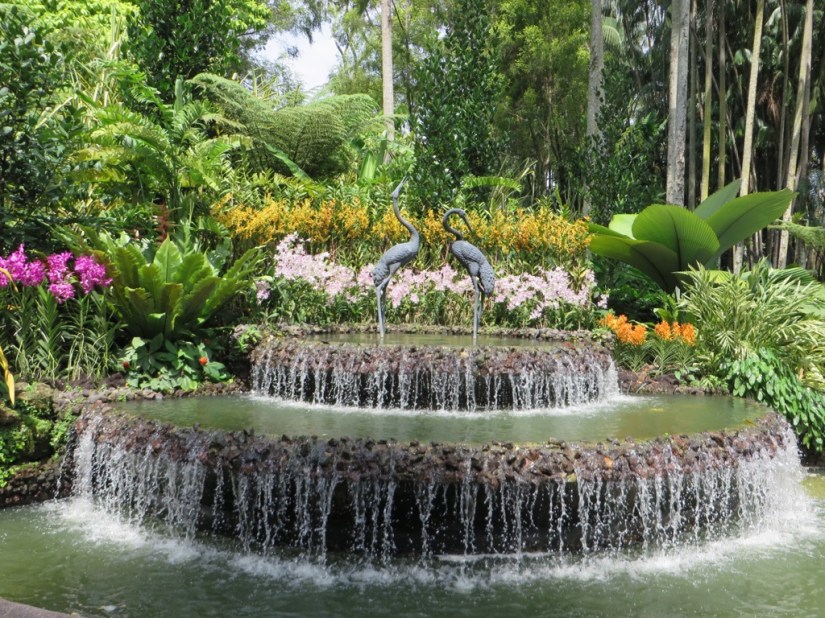
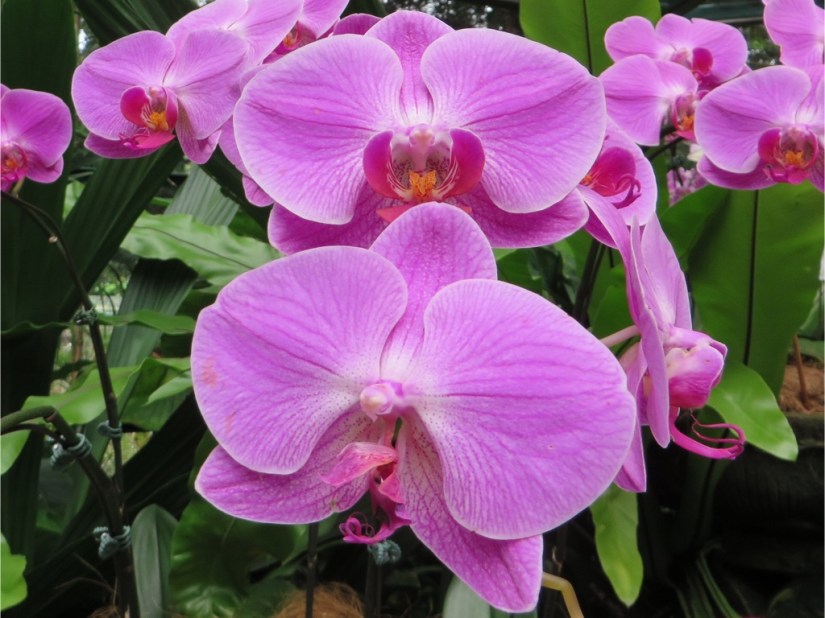
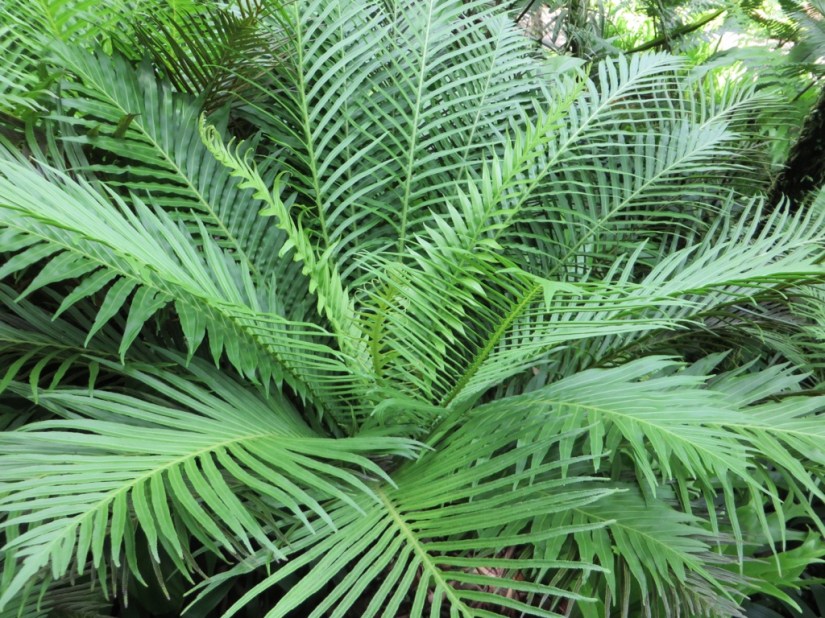
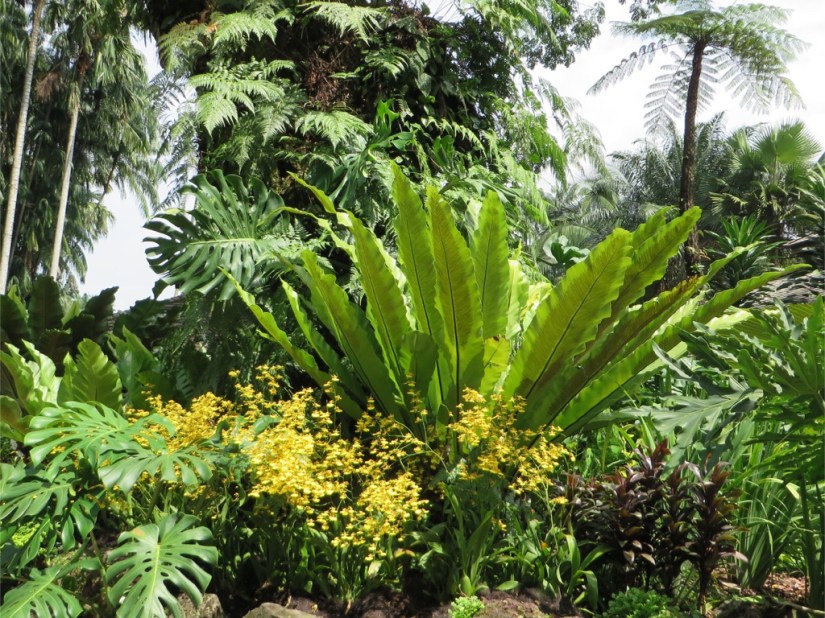
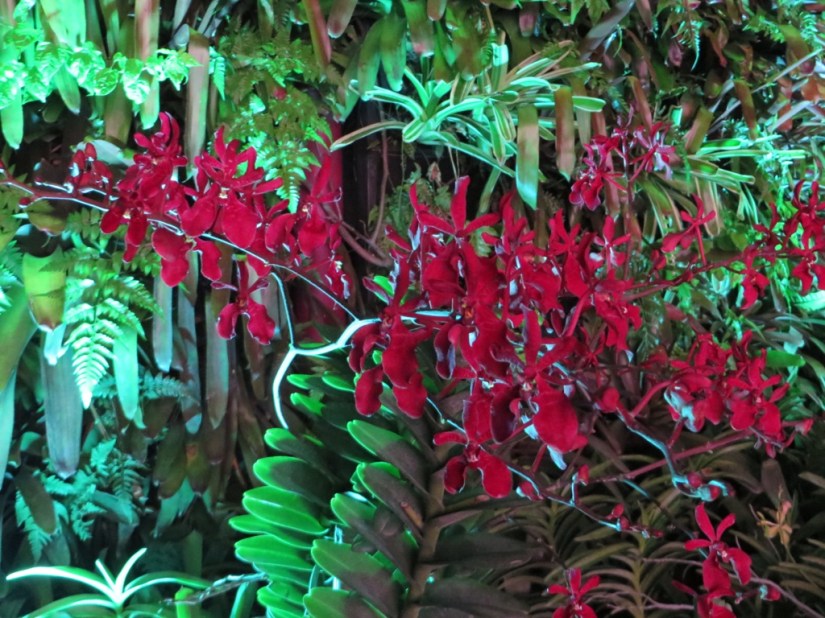
Skyscrapers I was expecting, and shopping malls and concrete, but I wasn’t expecting Singapore to be so green. There are trees lining many of the streets and lots of areas with grass, often shaded and providing a cool place to sit, and even gardens on the side of buildings! Then there are the parks, Fort Canning Park in the centre of the city and the immense Botanic Gardens to the north, where we spent all morning walking a couple of kms from one side to the other, and looking round the world’s largest collection of orchids which can be seen planted out in the gardens, rather than hidden in hothouses. There is also an area of rainforest which is part of the original vegetation that covered Singapore.
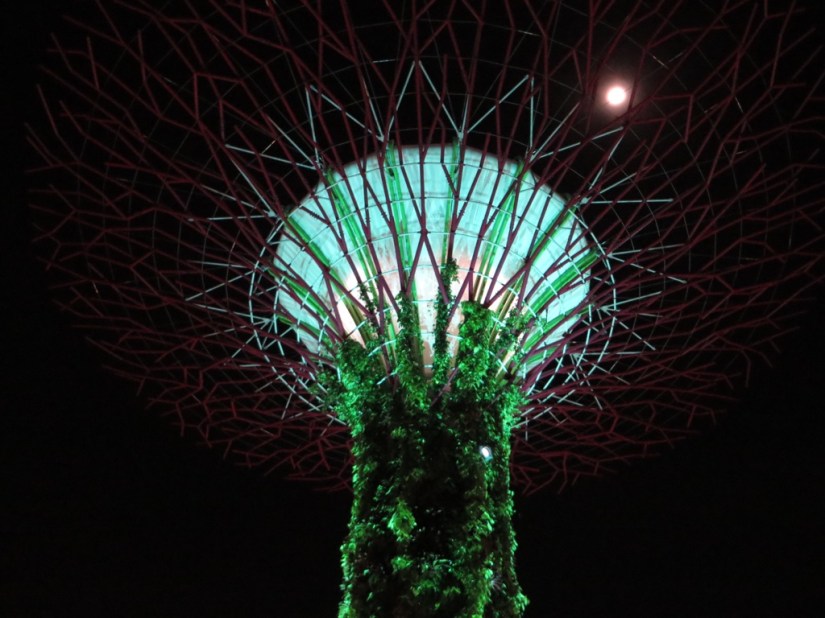
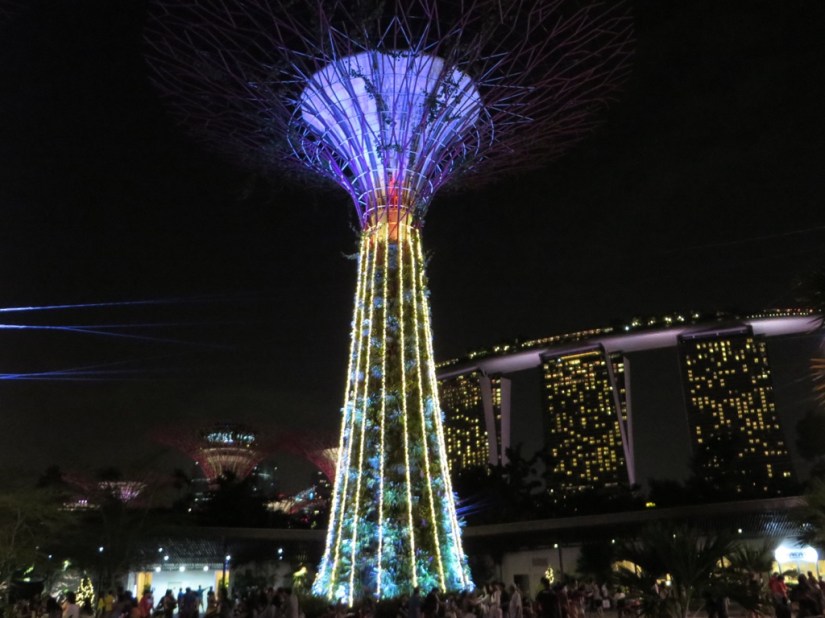
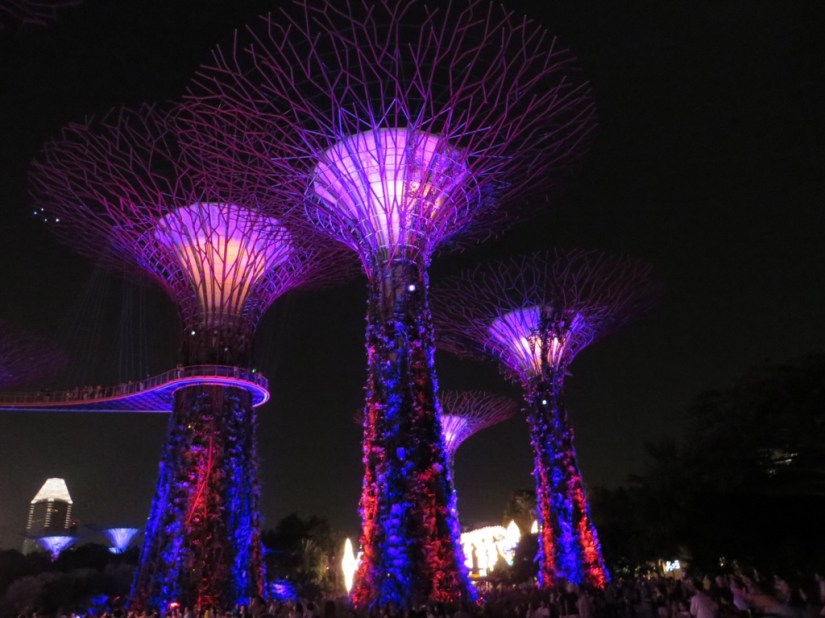
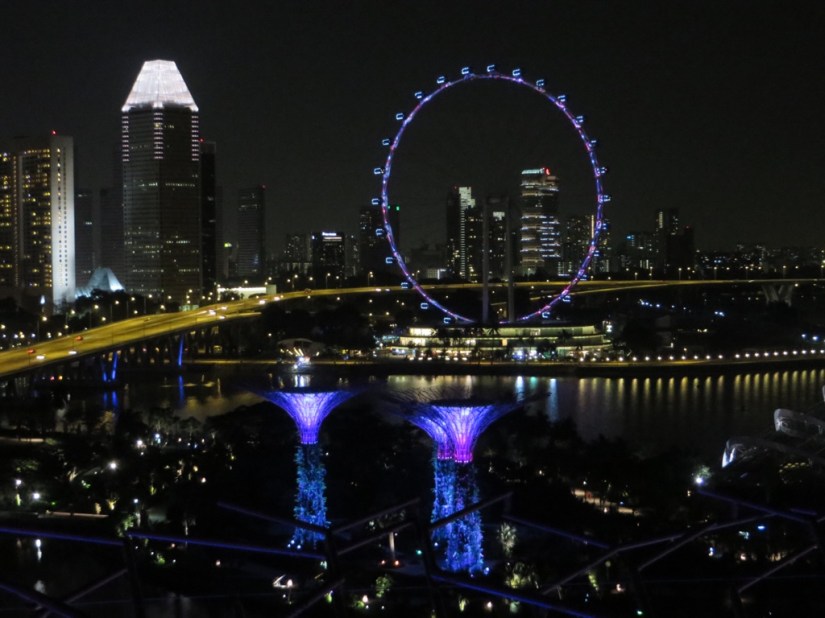
These parks are open from early in the morning till late at night, free and really well used with lots of families visiting and picnicing. The new Gardens by the Bay has a couple of huge domes filled with plants which we didn’t visit, but also Supertree Grove, containing giant tree sculptures planted with ferns and orchids which take centre stage for a free light show each evening.
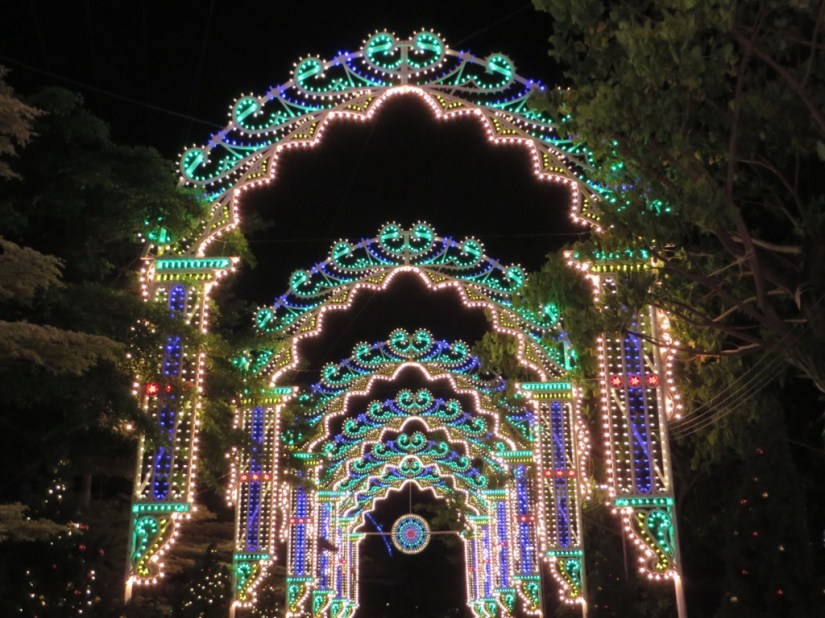
Everywhere is twinkly …
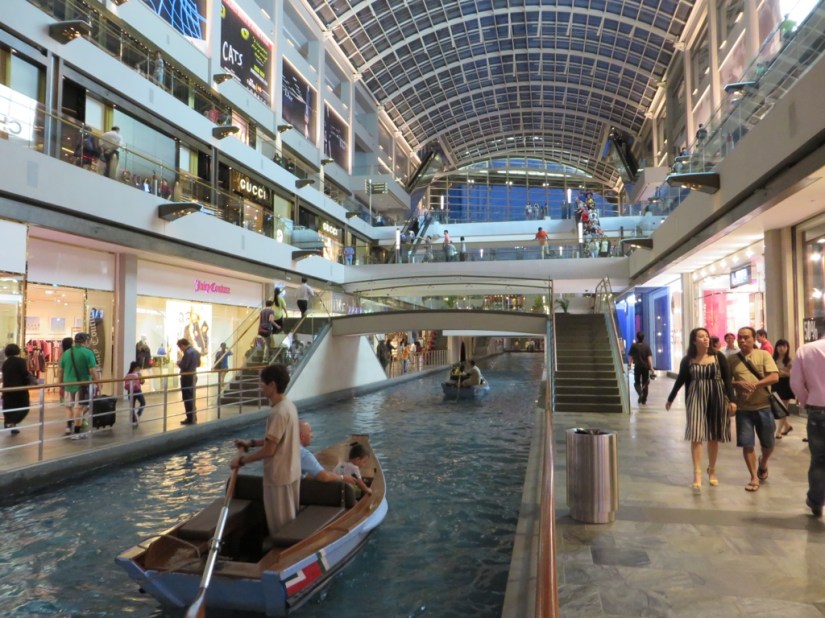
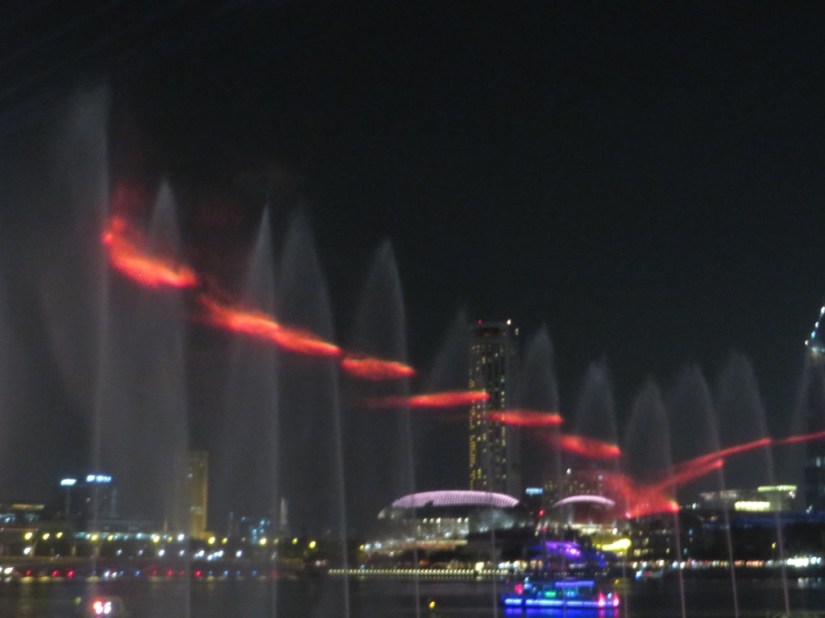
… and there is another free show at the Marina Sands complex and we walked through the huge shopping mall, complete with canal and sampan boat trips, to an outside area facing the bay where we watched Wonder Full, with images projected onto fountains.
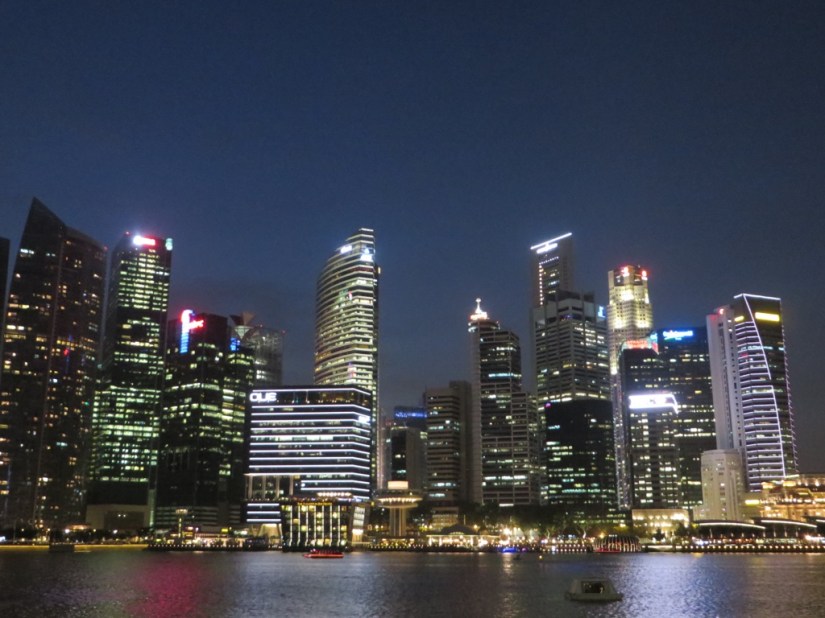
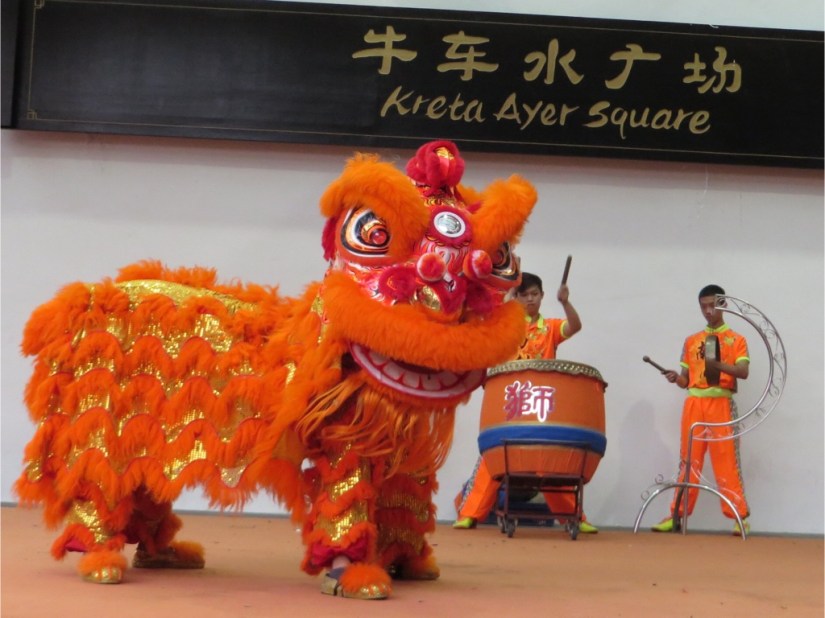
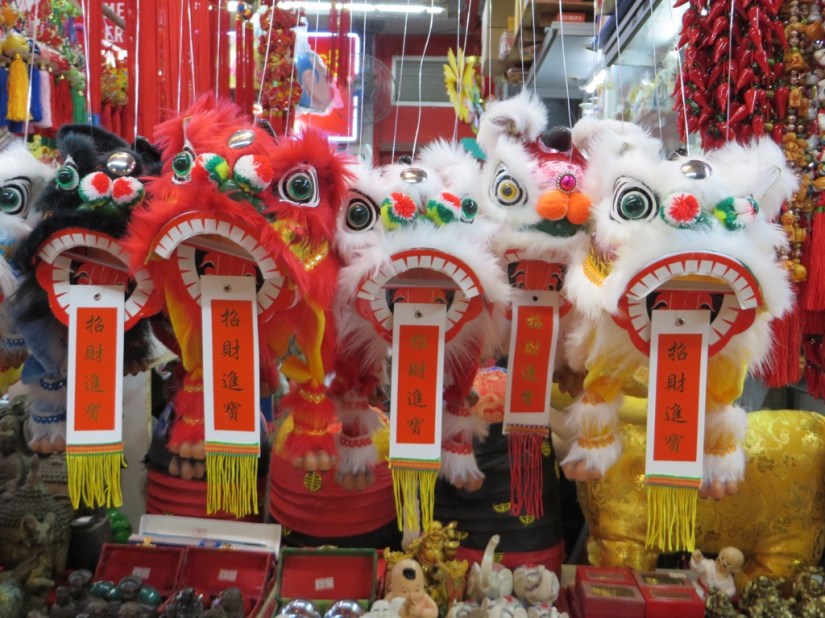
We have seen better, but the view across the bay with the skyscrapers of the Financial district behind was stunning. Chinatown has a display of drumming and lion dancing at the weekends, each lion containing two people who operate a wiggly tail, blinking eyes wagging ears and a mouth that opens and closes giving huge expression to their movement.
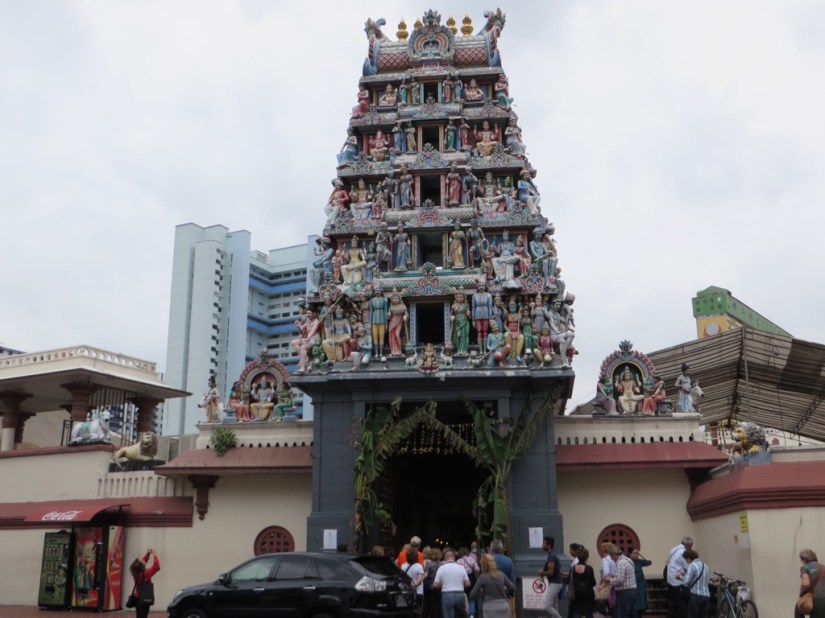
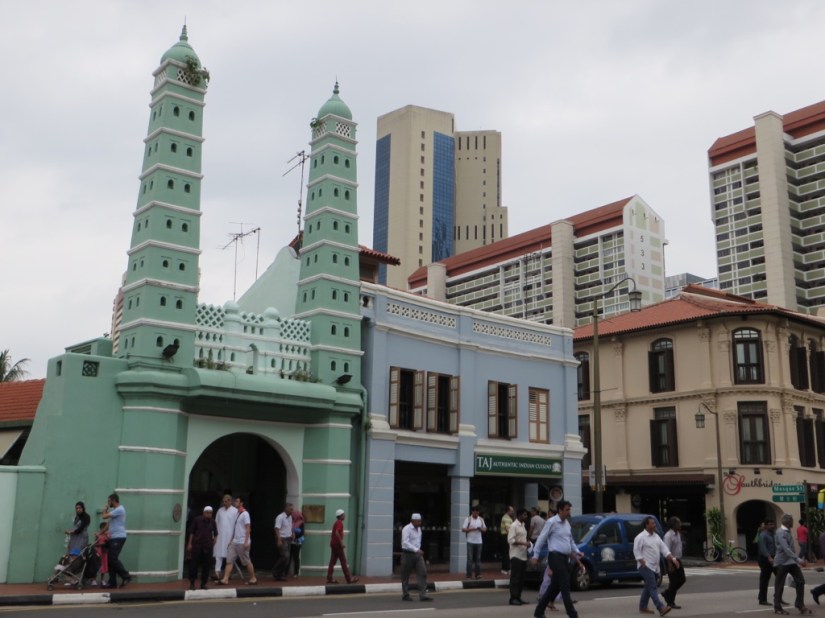
Malays, Chinese, Indians and Europeans all arrived in Singapore searching for work and commercial opportunities, and from the start, they settled in different areas of the city and we took a free bus tour provided by our hotel which helped us find our bearings and dropped us off in Chinatown. We passed the Sri Mariamman Temple, the oldest Hindu shrine founded by the Tamil pioneer who accompanied Raffles to Singapore …
… and almost next door, the Jamae Mosque built by settlers from the Coromandel coast in Southern India.
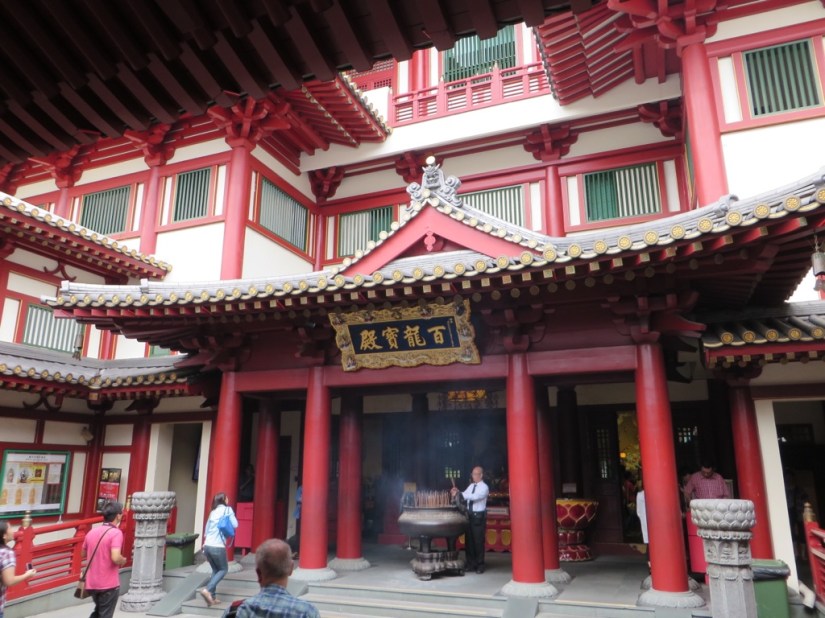
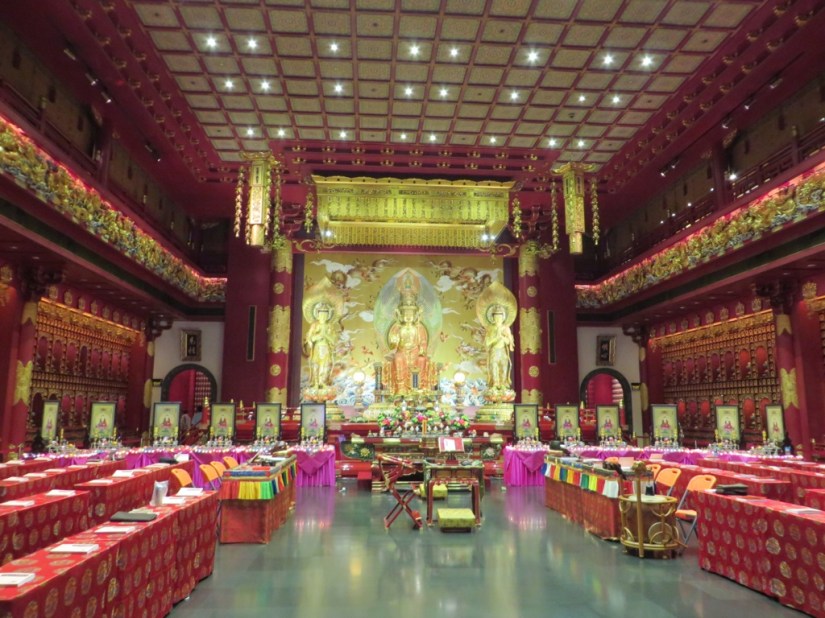
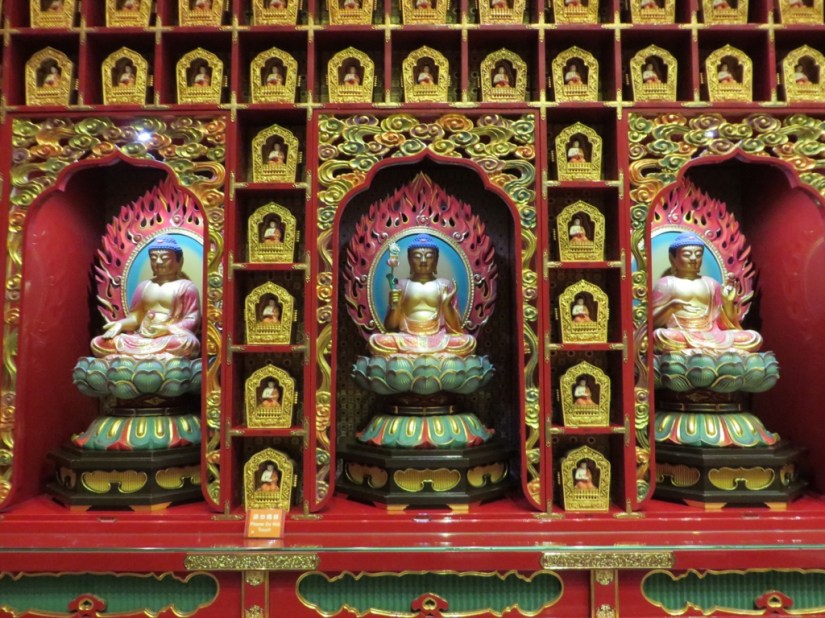
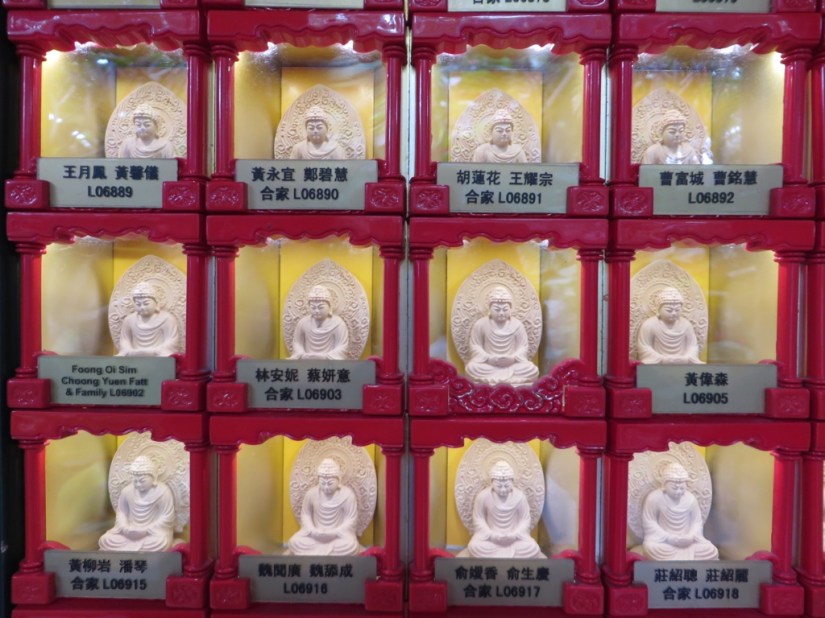
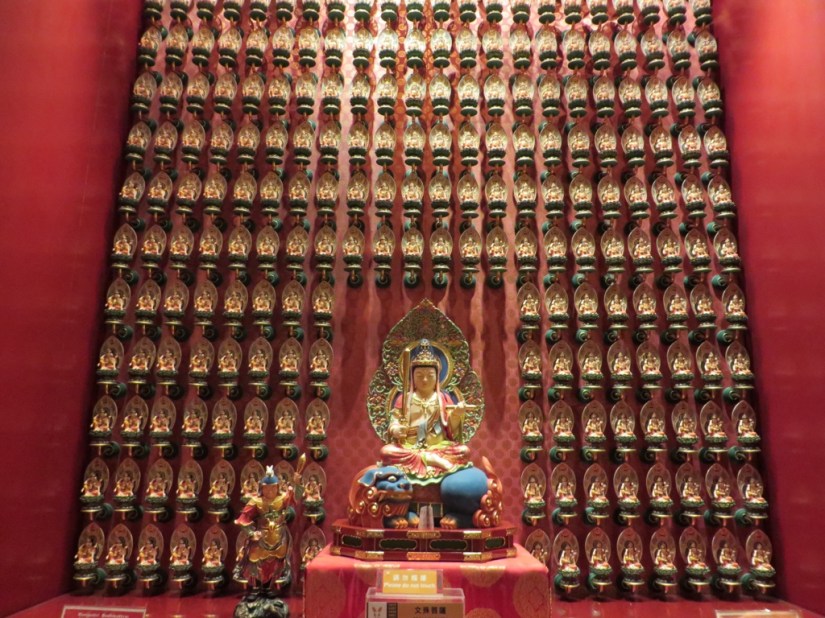
By far the newest and most ostentatious is The Buddha Tooth Relic Temple, built in 2007 to house a tooth of Buddha which was found in a collapsed stupa in a Burmese monastery and donated to Singapore by the abbot. The main hall contains a huge seated Buddha, but round the walls are more statues of Buddhas, surrounded by get more tiny Buddhas, each with a number. They are all available for adoption for a fee which will no doubt bring the donor good karma and recoup the £30m construction bill.
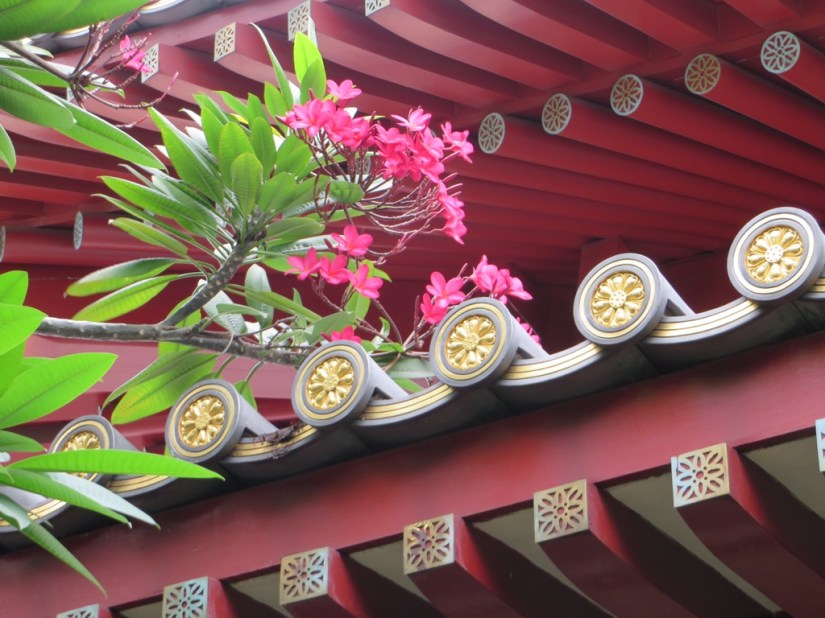
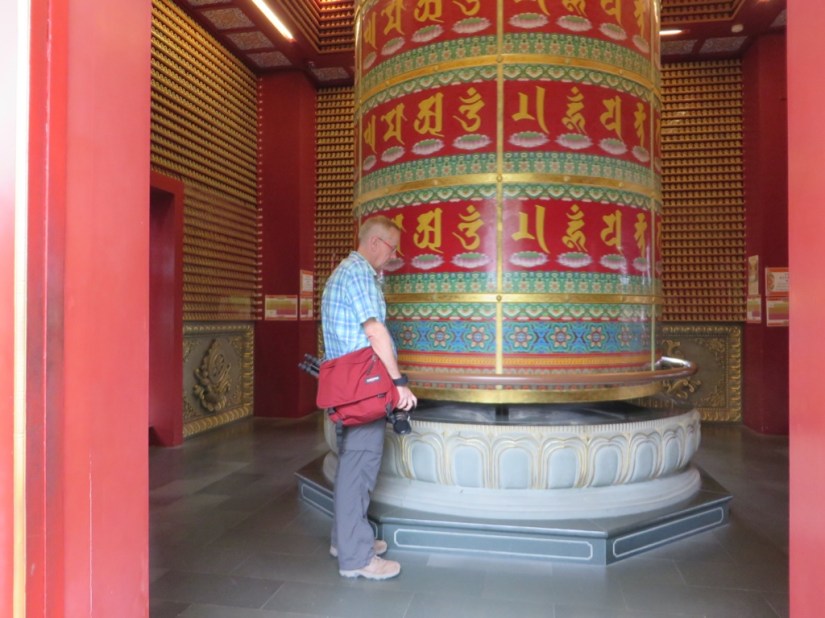
Upstairs is a stupa in its own chamber behind glass panels housing the tooth, together with lots more Buddhas, and finally the roof garden, with the Pavilion of 10,000 more Buddhas and a beautiful cloisonné prayer wheel.
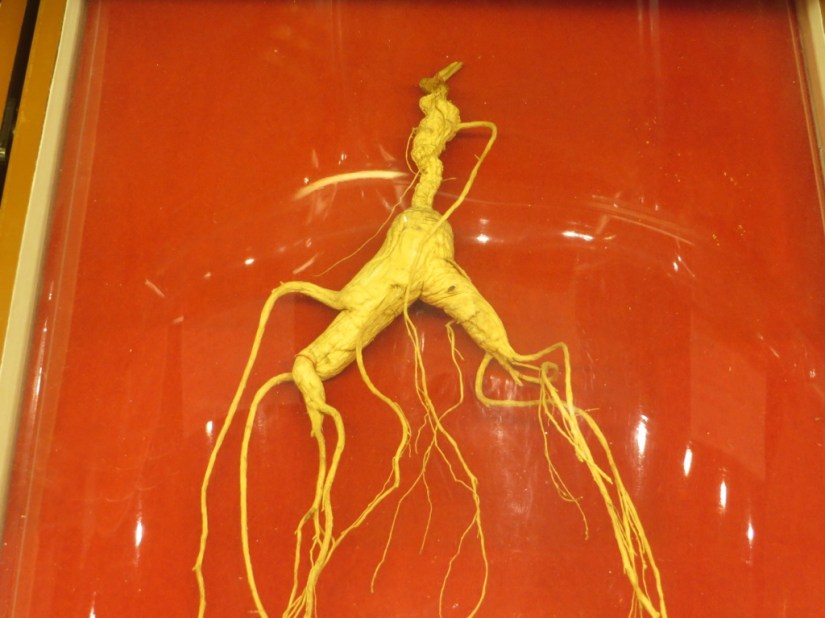
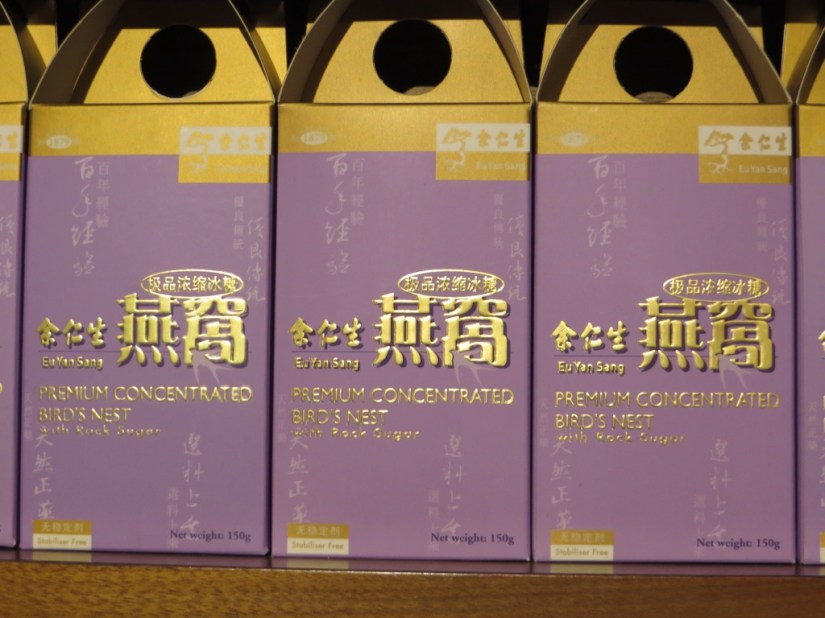
We popped into the Eu Yan Sang medical hall, one the oldest Chinese herbalists here, with the shop smelling like musty leaves, and selling everything from a piece of ginseng costing £9,000 to products made with the nests of swiftlets, specially collected for the purpose and cleaned, crushed up and infused for soup or tea to help to generally boost your health.
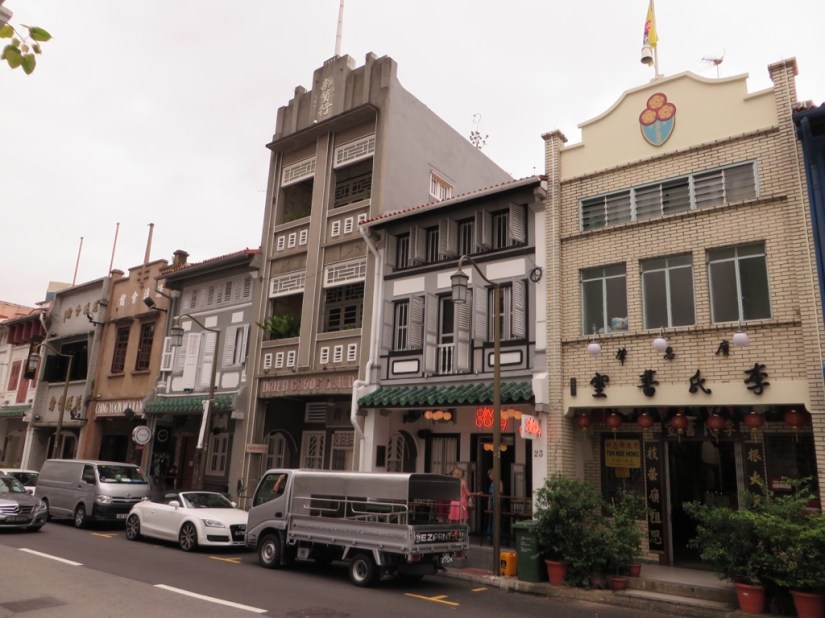
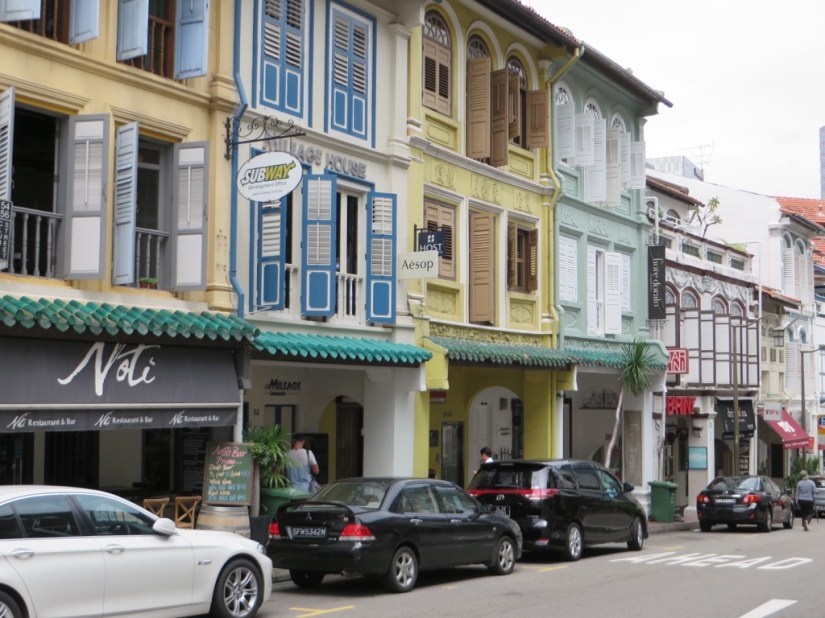
We passed lots of shophouses, most restored and now hotels and restaurants, but also some headquarters for clan or trade associations, looking more original.
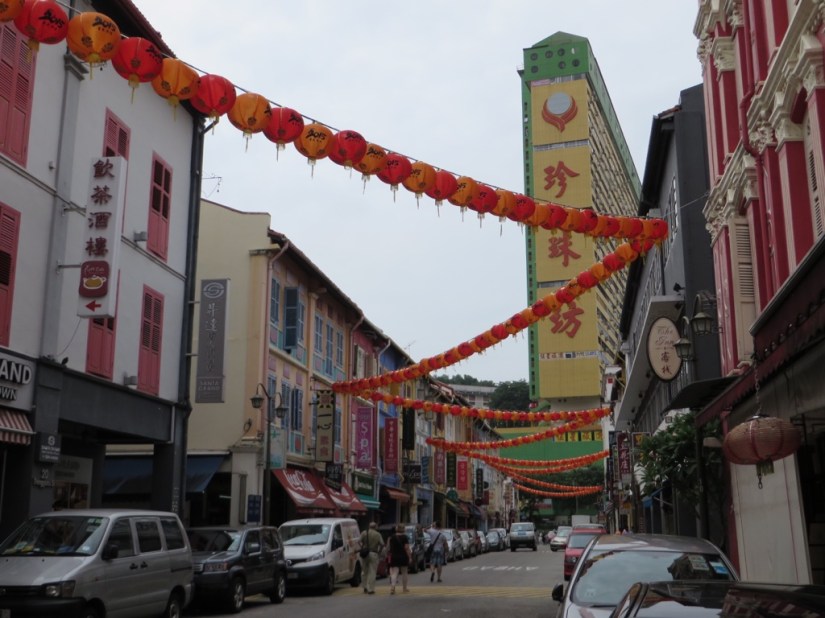
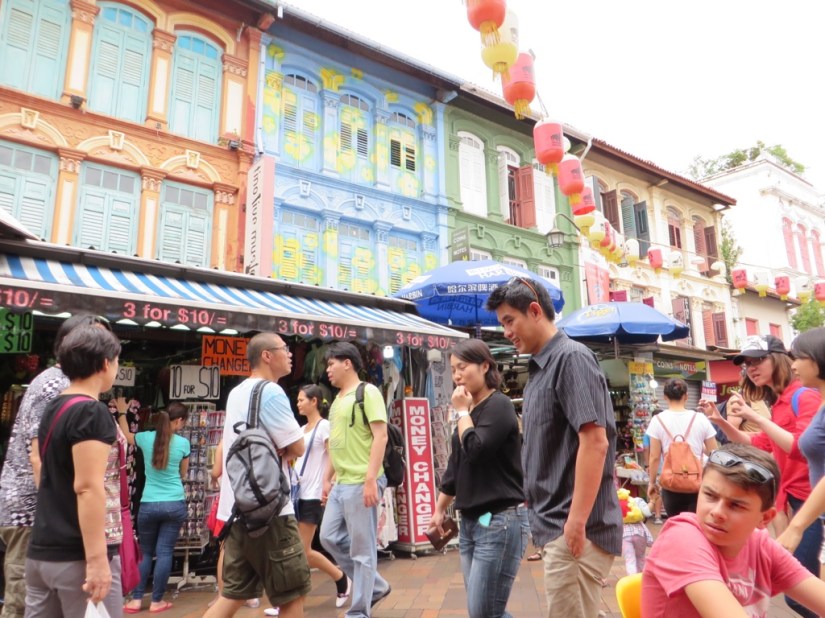
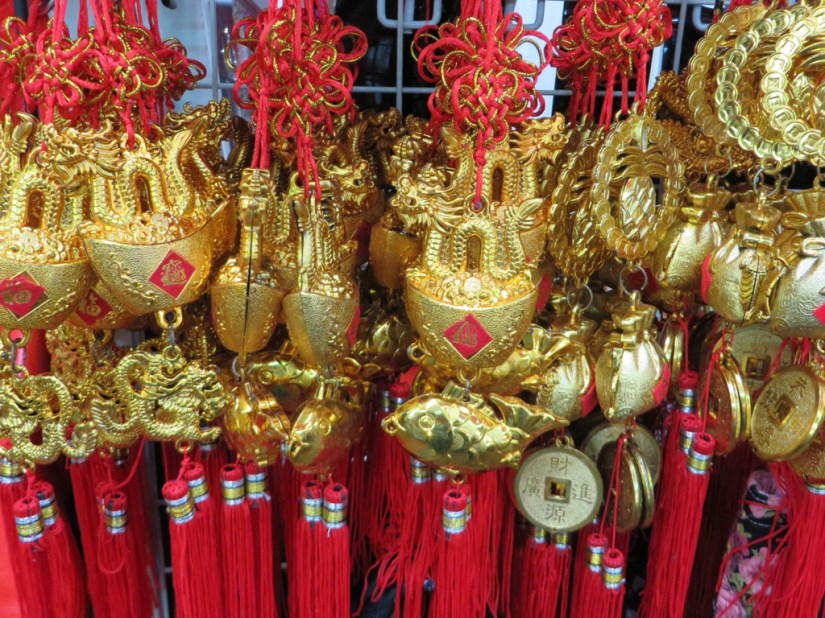
There were lanterns and bunting, Chinese signs and lots of souvenirs and the smell of BBQ pork and wafts of incense, typical of Chinatown everywhere.
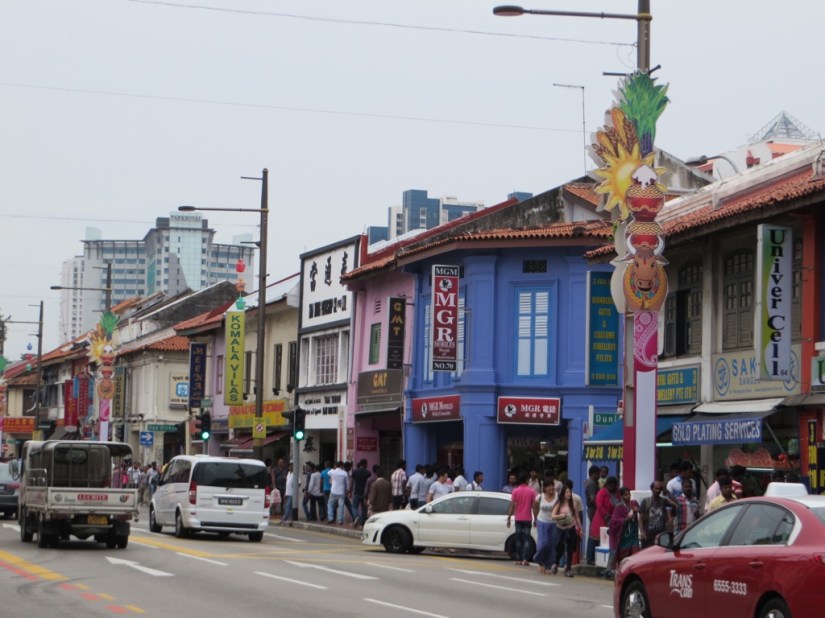
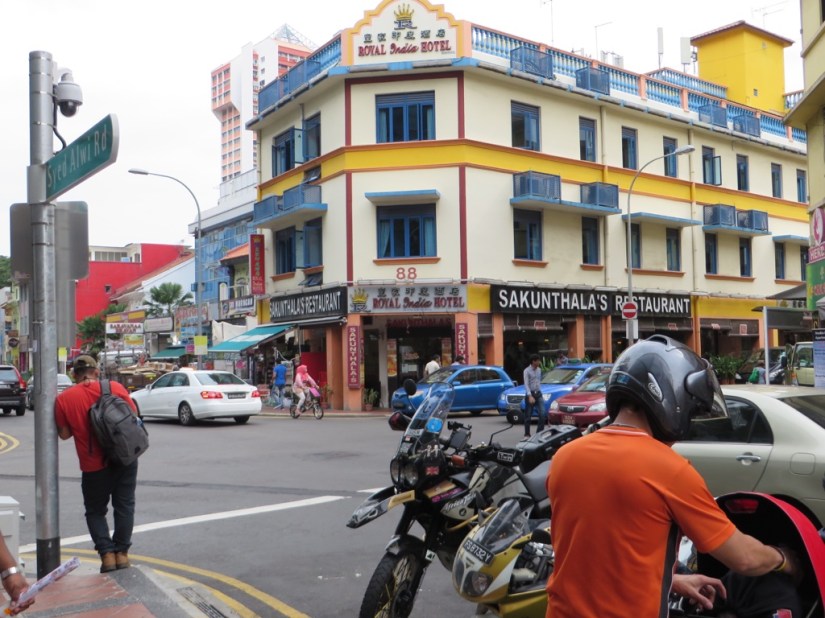
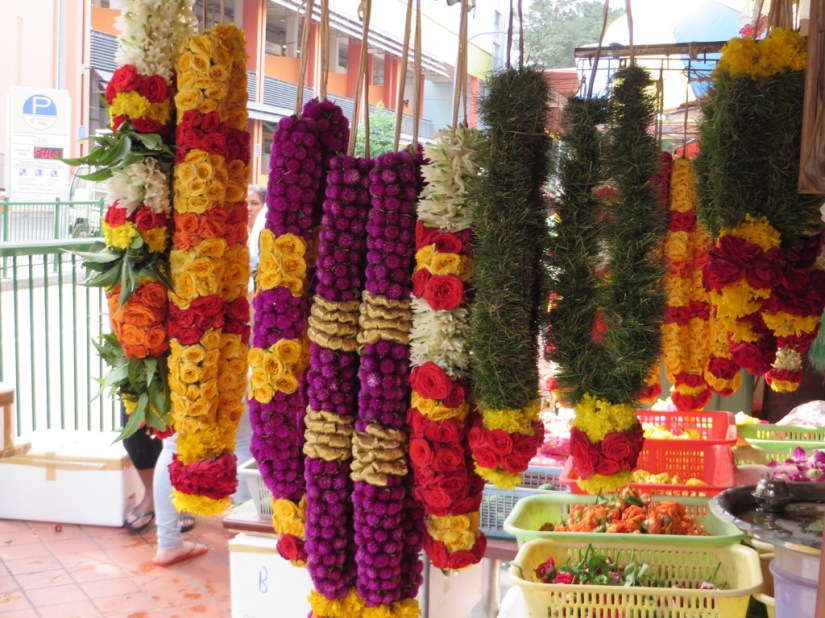
We stopped off in Little India and immediately there was the smell of flowers for temple offerings mixed with spices and the sound of Bollywood pounding out of a speaker. The snake charmers of old may no longer be here to entertain, there are no cows in the street and the pavements are free from rubbish, but it feels like India nonetheless.
Shopping is a major preoccupation in Singapore, and Orchard Road, named for the spice plantations originally in the area, is now a 2 kilometre stretch of shopping malls containing every shop imaginable, many of them famous designer brands and every one very large, very shiny and very smart, including Tangs, a store that has been on Orchard Road since 1950.
On our last day the sun came out and we revisited the Merlion, this time on foot, then crossed the river to see the statue of Stamford Raffles who arrived in 1819 and struck a treaty to set up a trading colony from which present day Singapore developed.
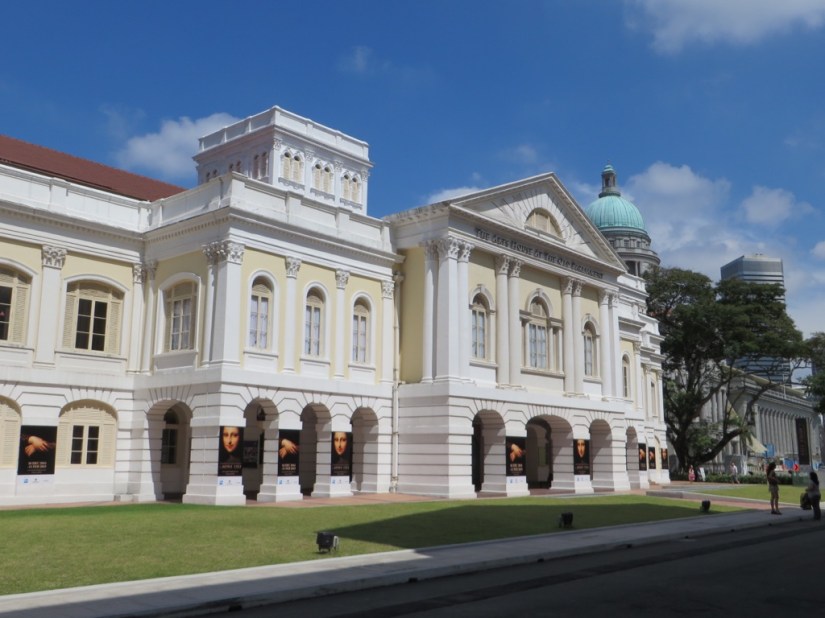
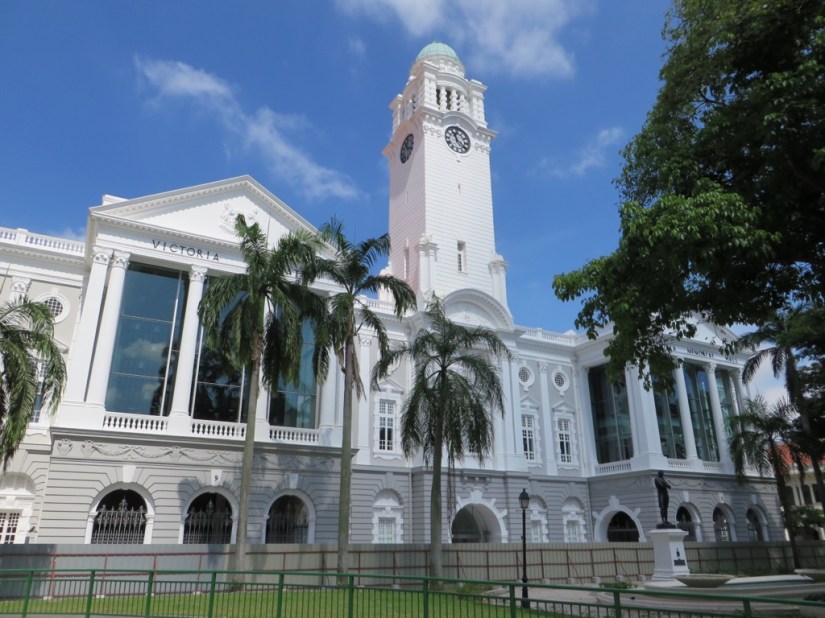
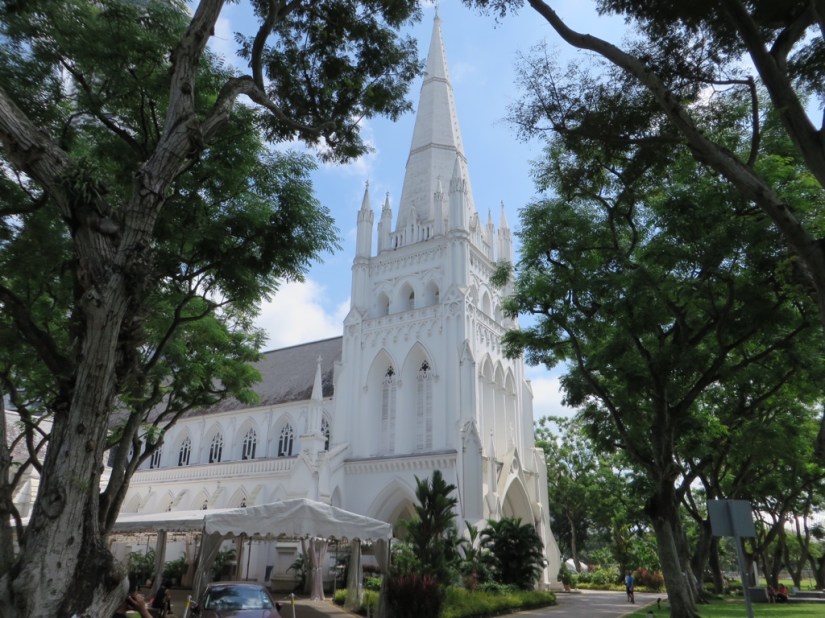
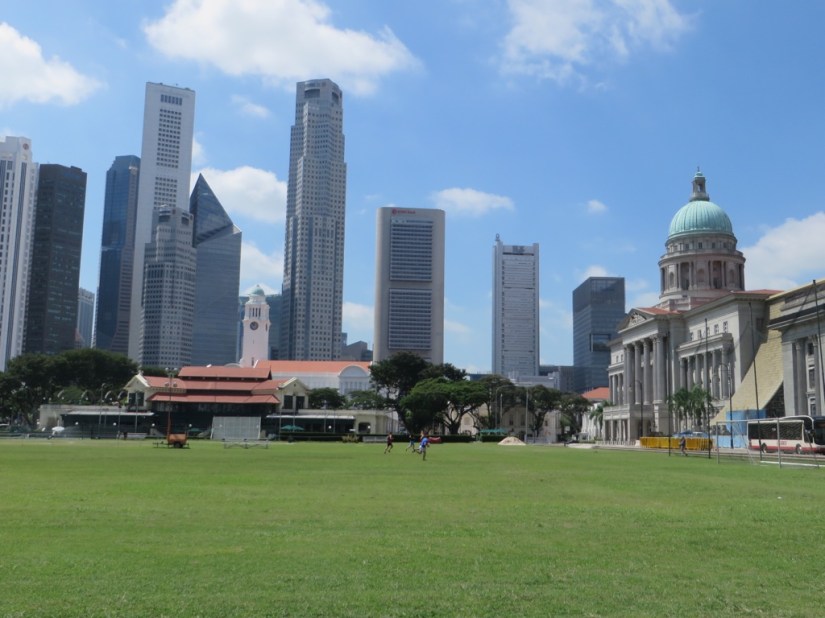
We saw some of the other colonial buildings …
Old Parliament BuildingVictoria TheatreSt Andrews CathedralThe Pedang
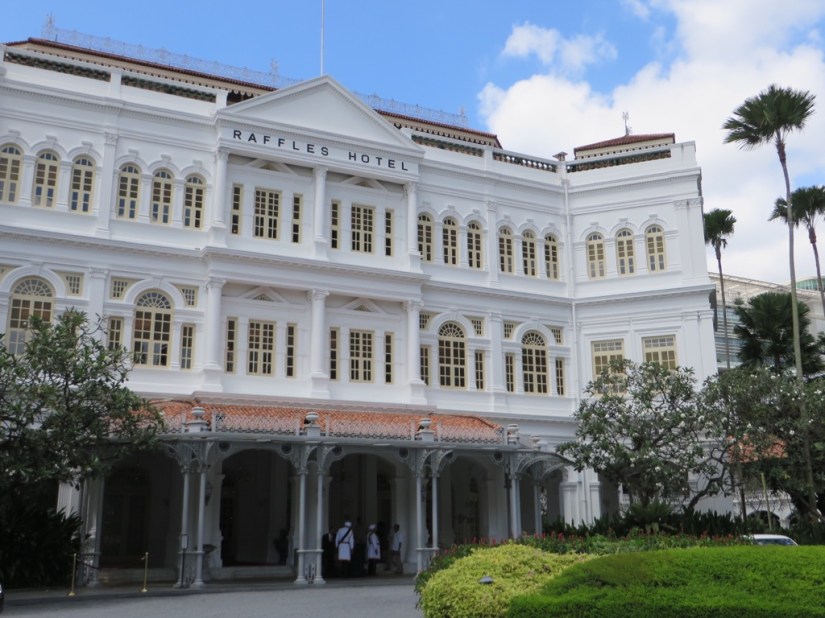
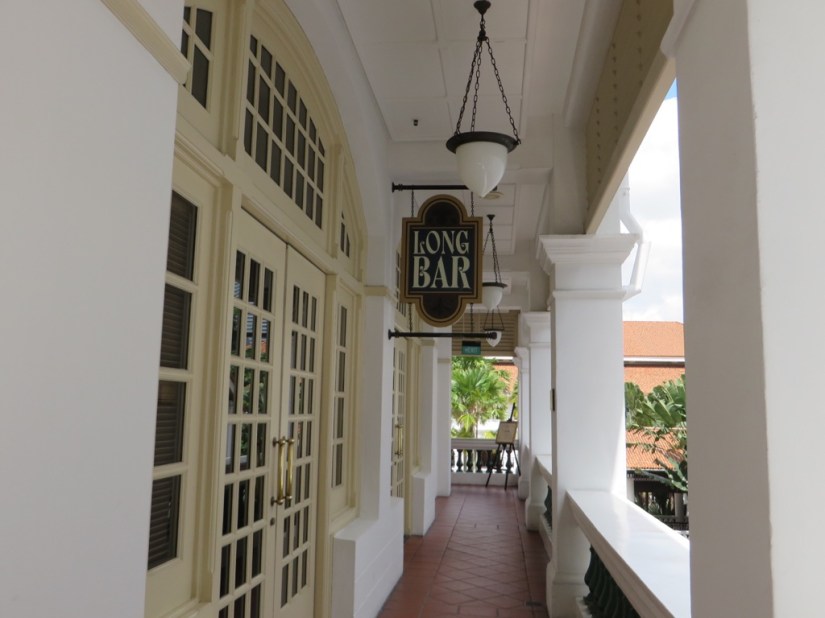
… ending with the Raffles Hotel, where the Long Bar was closed so we left without our Singapore Sling but some $60 better off!
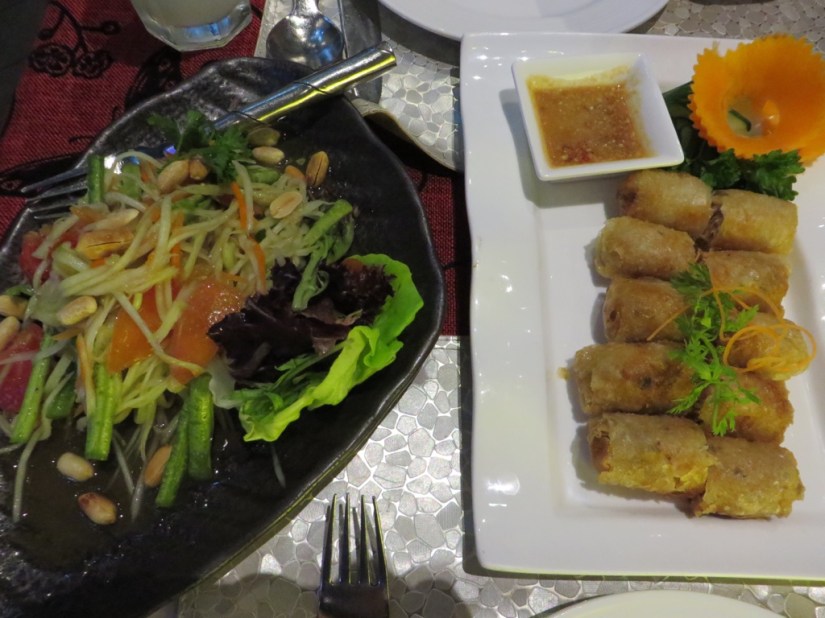
We’ve had a variety of food, starting with crispy spring rolls and green papaya salad at Indochine at the top of a Supertree watching as the sun set and the lights came on.
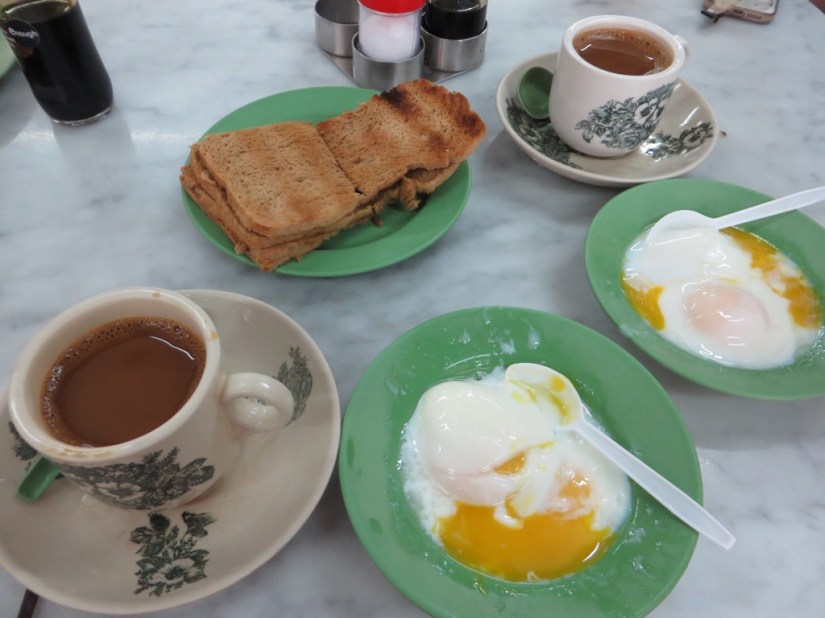
We visited the original Ya Kun Kaya kopitiam or coffee-shop, started in 1944 and still family run, to try kaya toast, a Singaporean delicacy. The kaya is a sweet paste made from coconut and eggs and is served with buttered toast or french toast, which are then dipped into a dish of soft boiled eggs. Always willing to try something new, needless to say we leapt in … the kaya was delicious, but we weren’t sure about serving it with eggs.
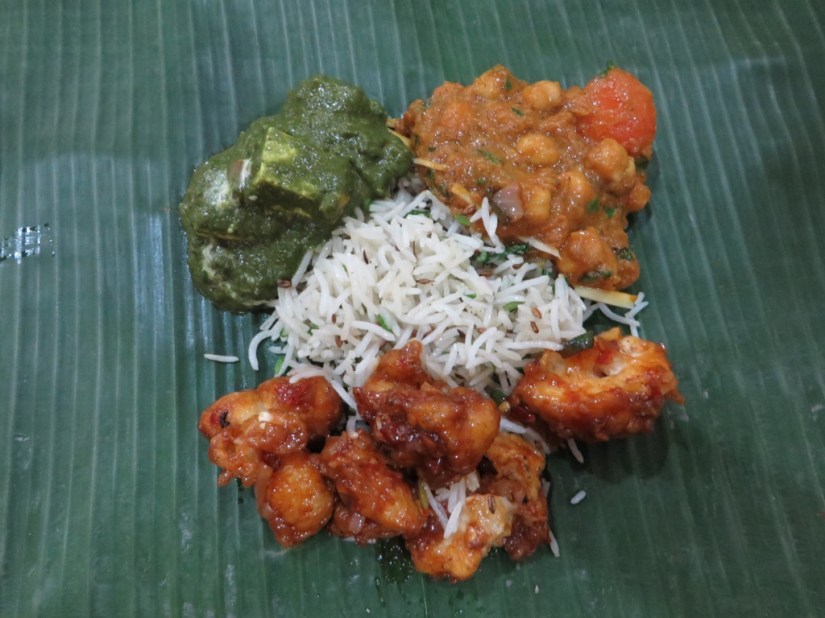
Chris found finding vegetarian fare a little limited apart from Indian and we had masala dosas for lunch in a little Southern Indian restaurant busy with locals for less than £2 each! We also went to Banana Leak Apolo where we had a mixture of vegetarian dishes which we ate off a banana leaf.
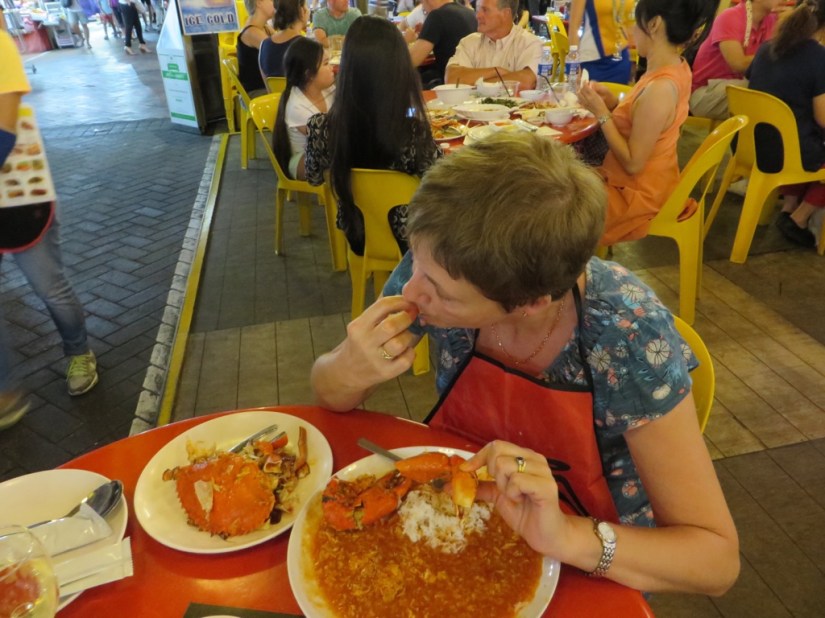
We’ve also stopped off at a couple of food halls for lunch where you can eat from anywhere in Asia, including the very popular chicken rice, a Hainanese dish of steamed chicken, rice, broth and greens with oyster sauce. The final treat was chilli crab, the national dish of Singapore, probably the messiest meal I’ve eaten, so I was pleased to be given an attractive bib!
The sauce was delicious as was the crab, but extracting it was quite labour intensive. Chris likes Tiger beer he tells me!
So what is Singapore like? Well it’s very clean and tidy, despite the fact they are building a new MRT line across the city and there are lots of areas of roadwork. Everyone is particularly courteous and helpful with English spoken everywhere. The customer service is so thoughtful such as when we collected our stored luggage to go to the airport we were offered a shower room and towels to freshen up and the man on the airport information desk followed me back to my seat some way down the concourse to make sure my free wifi code worked. All in all we had a great time and with so much more to see, I am sure we will return.
Next stop, visiting with family in Sydney, then more travels when we fly to Auckland on 2nd February.
 In just a morning we swapped a jungle paradise for a beach paradise! Ko Kho Khao, meaning Neck Mountain Island, is just a short ferry ride from the mainland, on some of the smallest but most colourful vehicular ferries I’ve ever seen.


 and a restaurant …







 Well we opted for the flights – who wouldn’t when you could fly in a plane with a beak!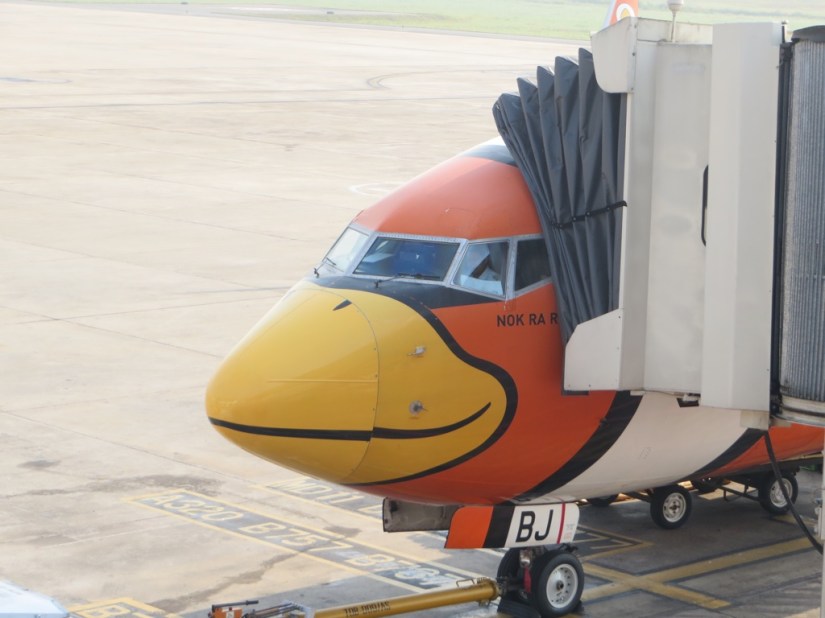



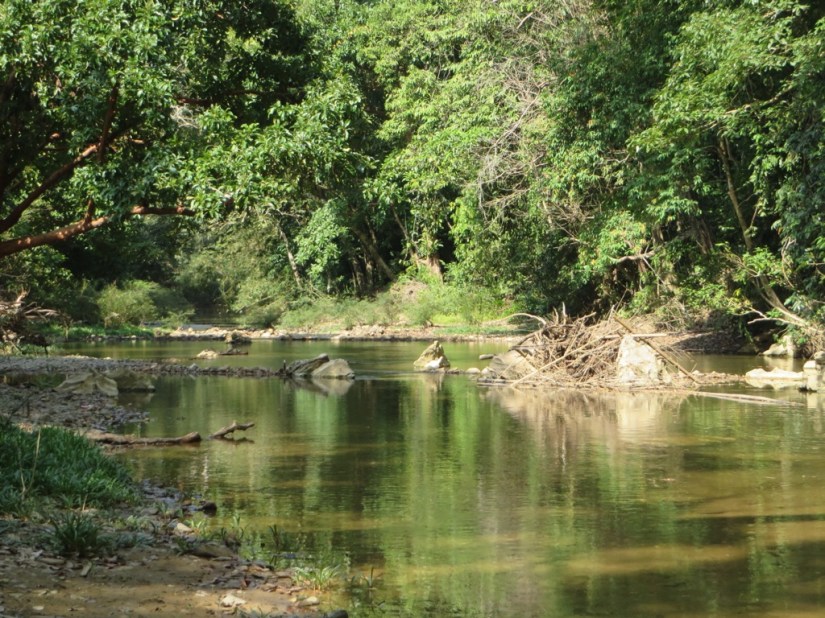




 Contrasting with the speed, noise and spray from a longtail boat was our sedate canoe ride along the Sok river one morning. The scenery changed at ever turn, and we stopped halfway for a coffee break, brewed up over a small fire on the bank. We were hoping to see kingfishers, but maybe they had already been fishing as all we caught was a couple of glimpses of iridescent blue as they flew past although we did see a frog … a tree frog perhaps!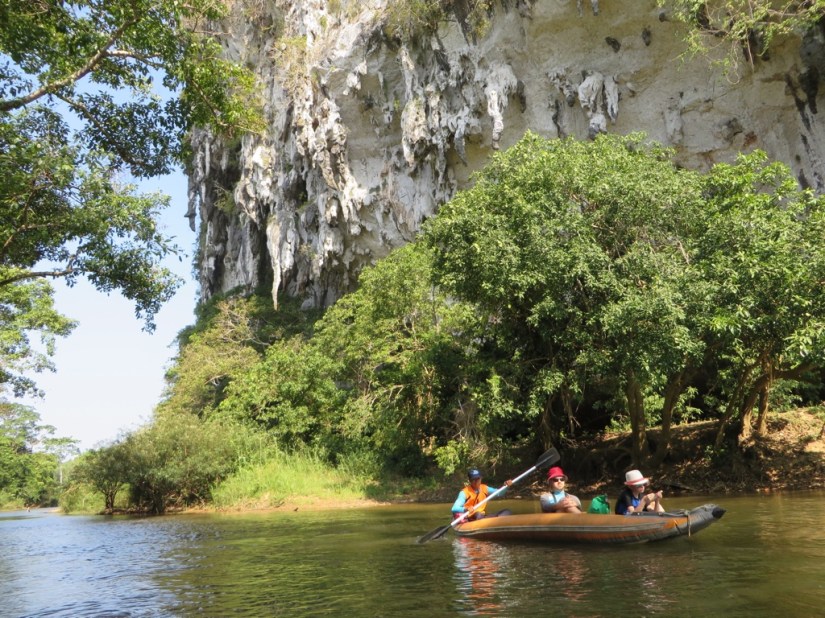








 Chiang Rai, 200km north, may have history and even some wats, but we arrived to go trekking and left more impressed with the contemporary art.









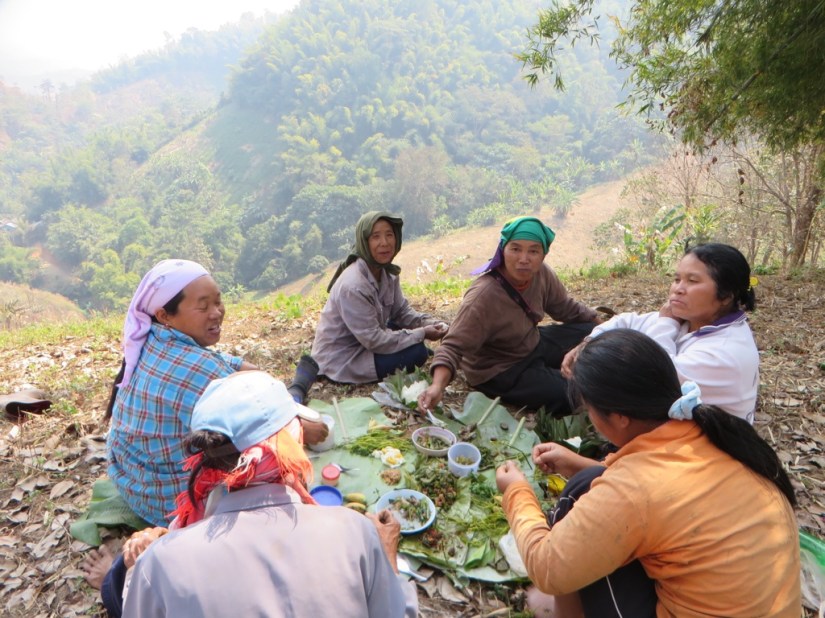 We stopped for a rest in a village where Lahu and Akha tribes live …





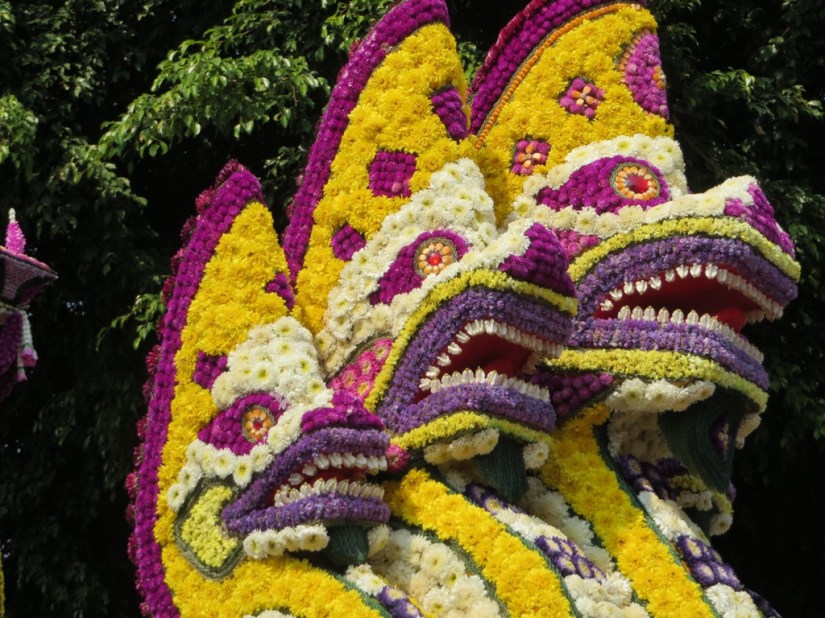 We timed our stay to catch the Flower Festival which began with a two hour parade round the outside of the old centre, ending in a park where the floats could be admired close up and there was an orchid display and street market. We just took so many pictures of the fabulous floats, together with school bands and people in traditional costumes. Some of the large figures are covered in coloured rice, and a few of the flowers were dried and dyed, but most were fresh using a lot of chrysanthemums and orchids and the effect was stunning.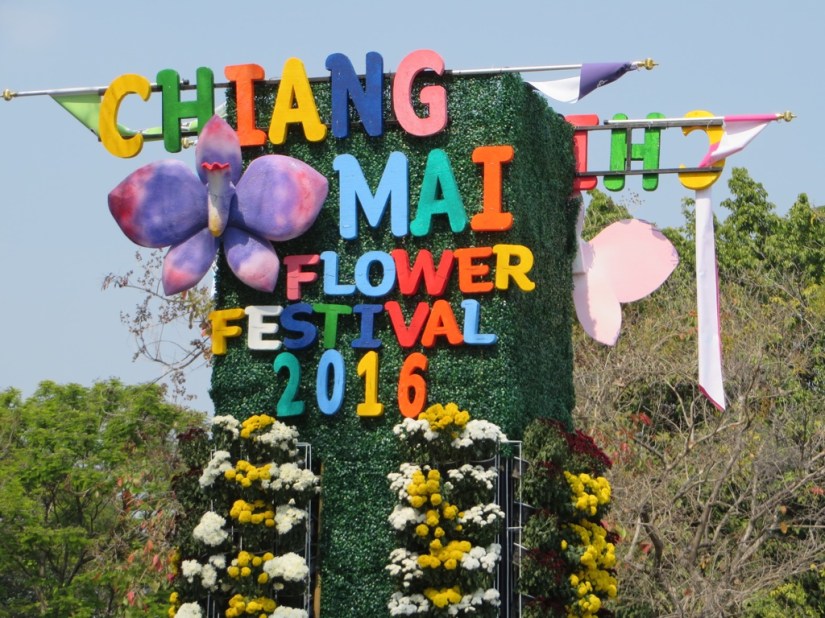






 Doing a cookery class has become a regular feature on our trips since our very first class in Bangkok in 2009 and we spent a great day at Thai Farm. We started with a quick market tour and also a look round their organic garden at various herbs and vegetables, then starting cooking in the lovely open air kitchen. Between us we made Tom Yam soup, Pad Thai, spring rolls, curry paste lovingly ground with a pestle and mortar and made into red and green curry, a stir fry with basil, sticky rice with mango and coconut bananas. As there were choices of what you could cook, with a group of 10 it was a little more confusing than all making the same thing, but it all worked out fine. I was most pleased with the pad Thai which I intend cooking again and while I love the green curry, but it wouldn’t seem the same without the special Thai aubergines which I’d have to get from a specialist shop.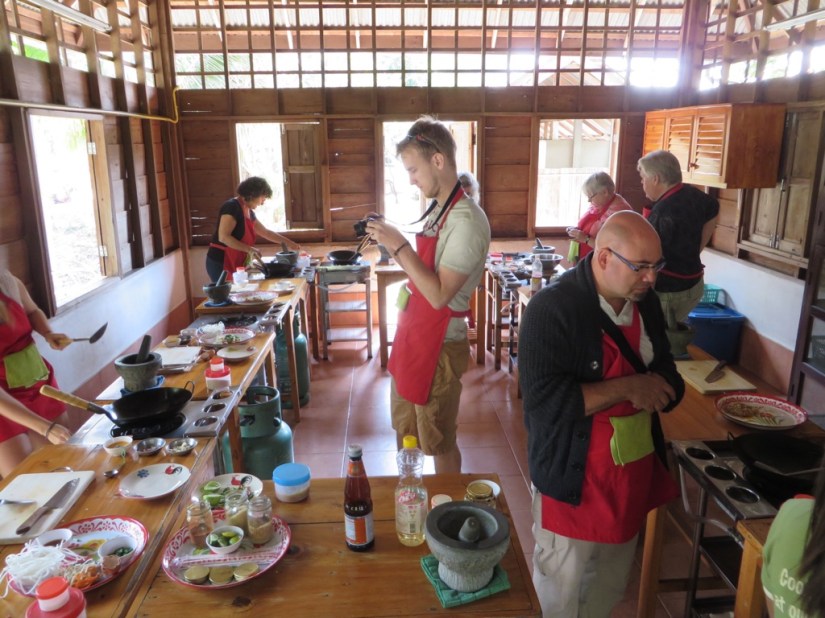
 After all that eating, a bit of exercise seemed a good idea and our guesthouse organised for us to go for a trek in Doi Inthanon National Park, 90 minutes from Chiang Mai. In a small group of 8 we began with a stop at Wachirathan Waterfall …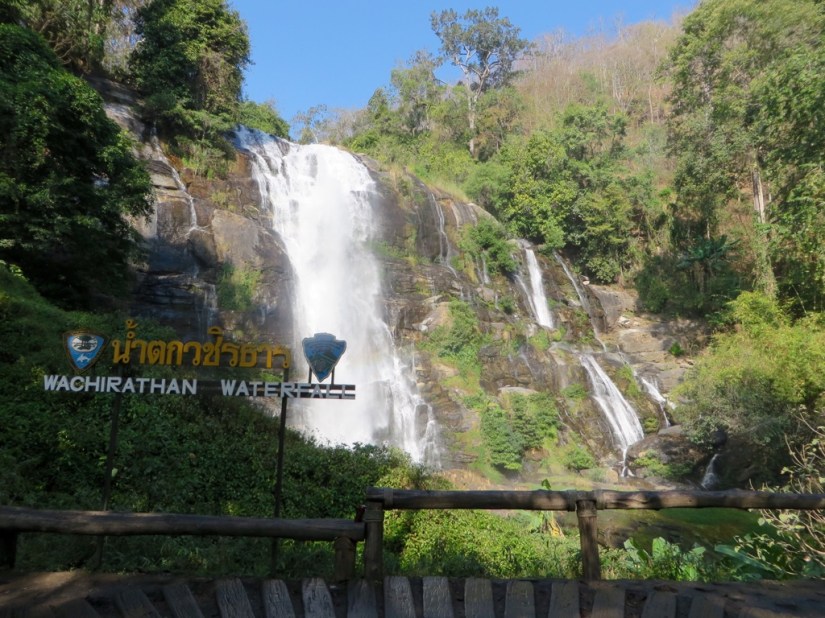
 Beginning at Phitsanulok Station, the train took us across the Central Plains with views of farmland as far as the eye can see, mainly rice, but also fruit, vegetables and flowers, punctuated with the odd building and town but then mountains started to loom all around, covered in trees and scrubby undergrowth.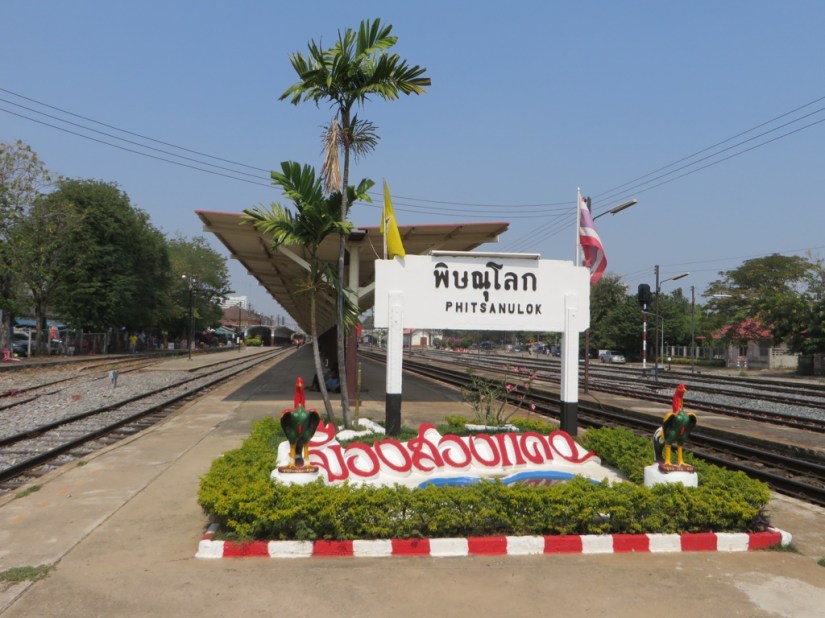

 From the lower terrace there are views to the city 300m below …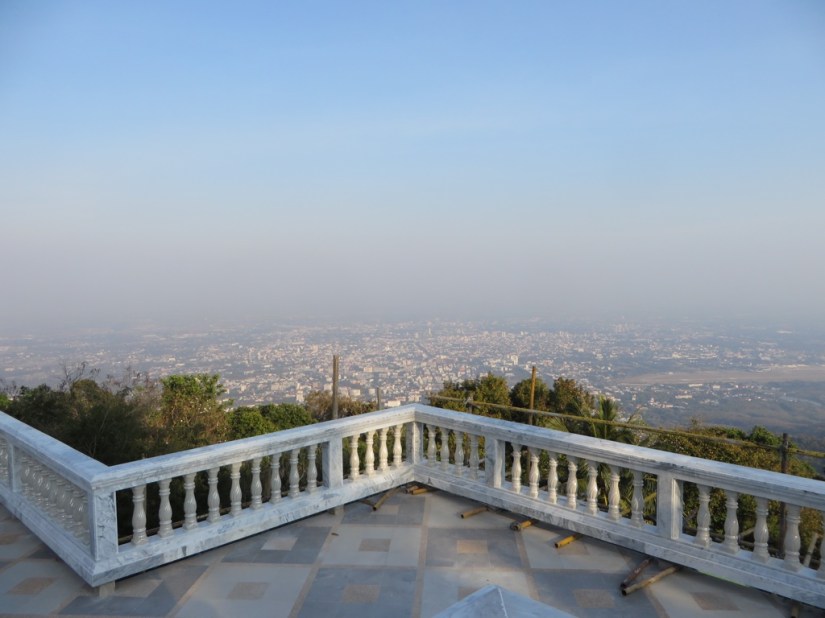
 There are plenty of opportunities to gain merit through donation by writing a prayer or message on a gold cloth to be draped round a Buddha, on a bell to tinkle from the eaves or a new tile for the roof. And thankfully, the walk down is a lot easier.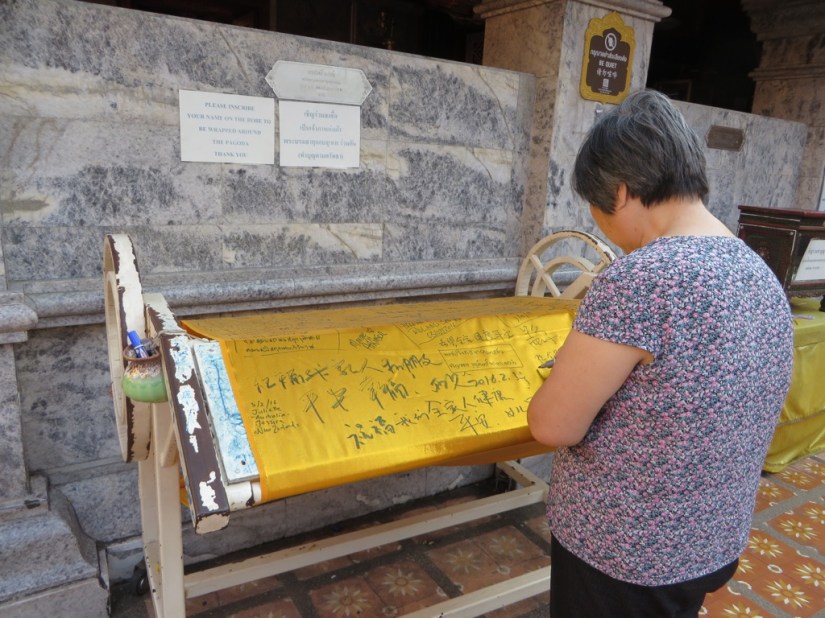














 It had been humid and in the mid 30s since we arrived, exactly as expected, but then we woke to a rain shower and a cooler day.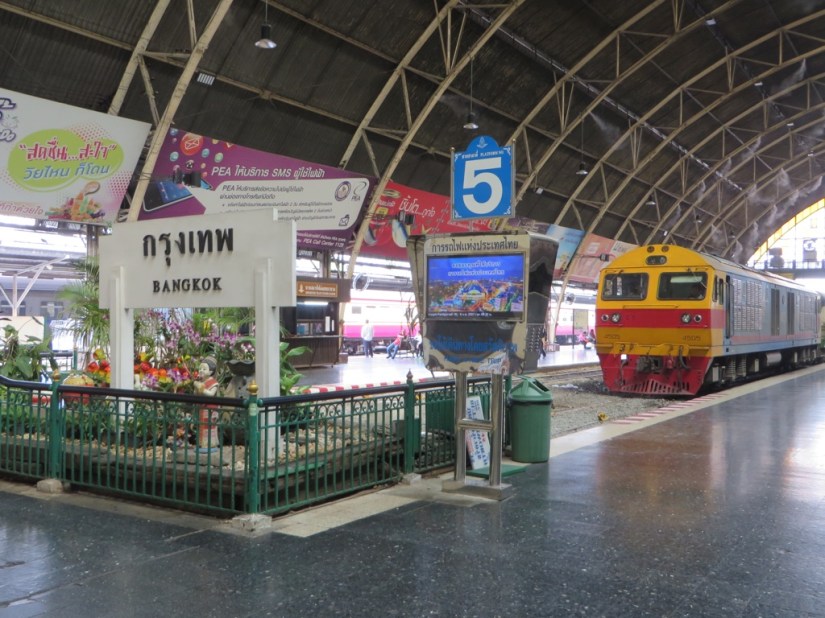
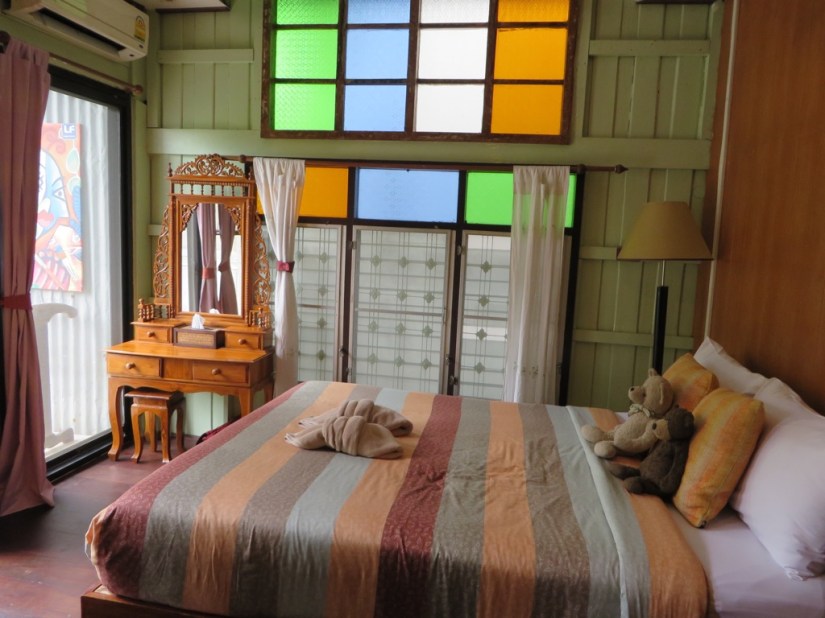
 We are staying in W Home, a charming B&B in a neighbourhood of homes and local businesses just off Charoenkrung Road, the first road ever built in Bangkok.
 Our comfy, if bijoux room, overlooks the lane outside and we were woken on our first morning by cockerels crowing.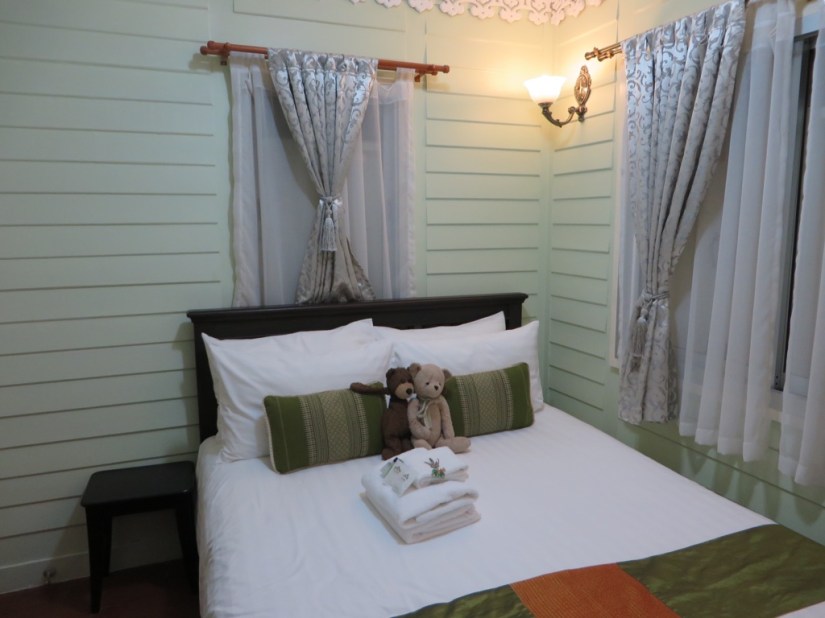


 When we were here before, Chris bought a couple of snazzy elephant handkerchiefs at the airport which said Jim Thompson on the label. Despite the guide book referring to him as the most famous farang in Thailand, we had not heard of Jim Thompson, but now know he was an American who came to Thailand with the army after WW2, fell in love with the country and returned to live. He was an adventurer and entrepreneur whose fame partly came from reviving the dying silk-weaving industry, promoting the silk in America where it sold well, especially after his company made the costumes for The King and I on Broadway, depicting the life of King Rama IV. He gained further renown by constructing the Jim Thompson house by dismantling six teak houses, all over 200 years old and reassembling them to make a home which he filled with Oriental art and particularly Thai paintings which he opened to the public. And then one day, while visiting the Cameron Highlands in Malaysia, he went for a walk … and never came back. His mysterious disappearance has certainly added to his fame. We went on a tour of the house and watched a demonstration of boiling the silk cocoons to extract the thread and spinning it and I added several new hankies to Chris’s collection for his birthday.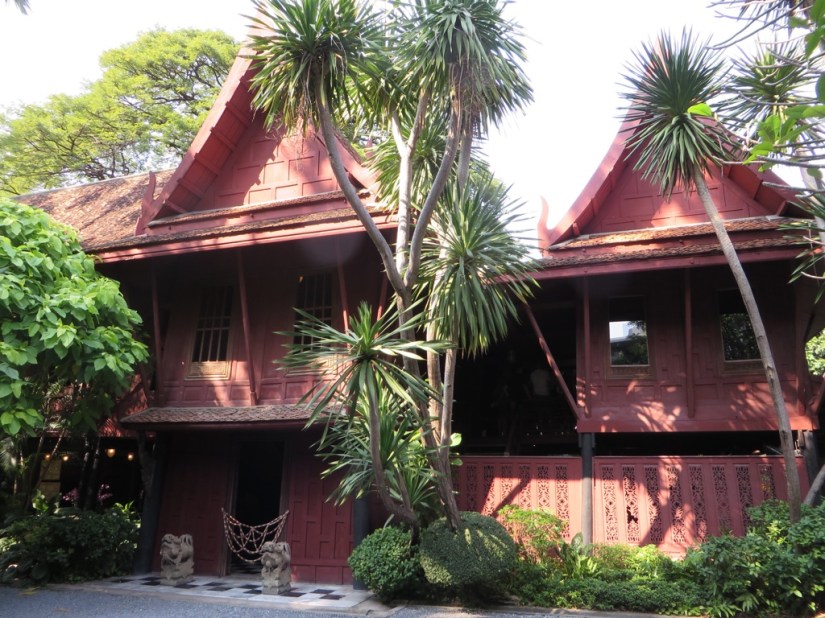






 Having wished each other a Happy New Year while flying over Afghanistan, we arrived in Singapore on a warm but slightly grey New Year’s Day.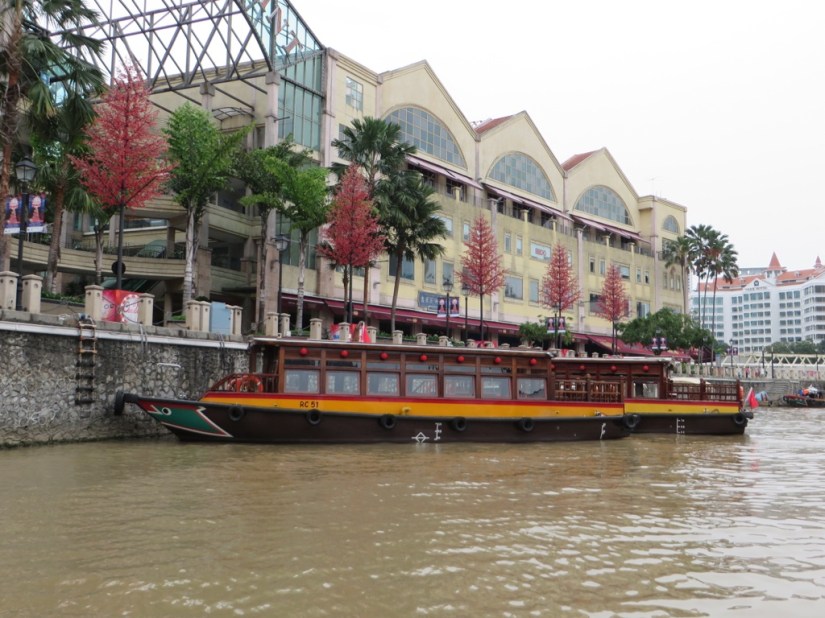
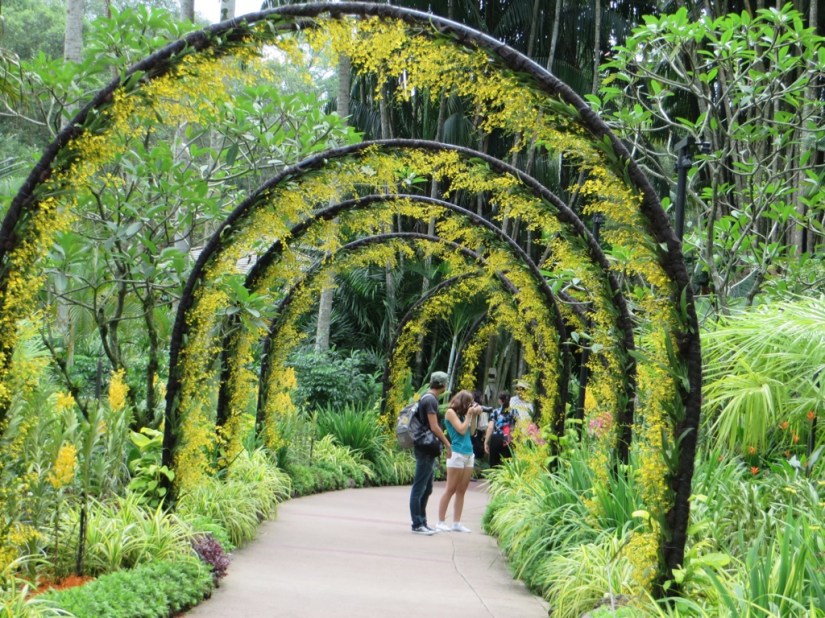
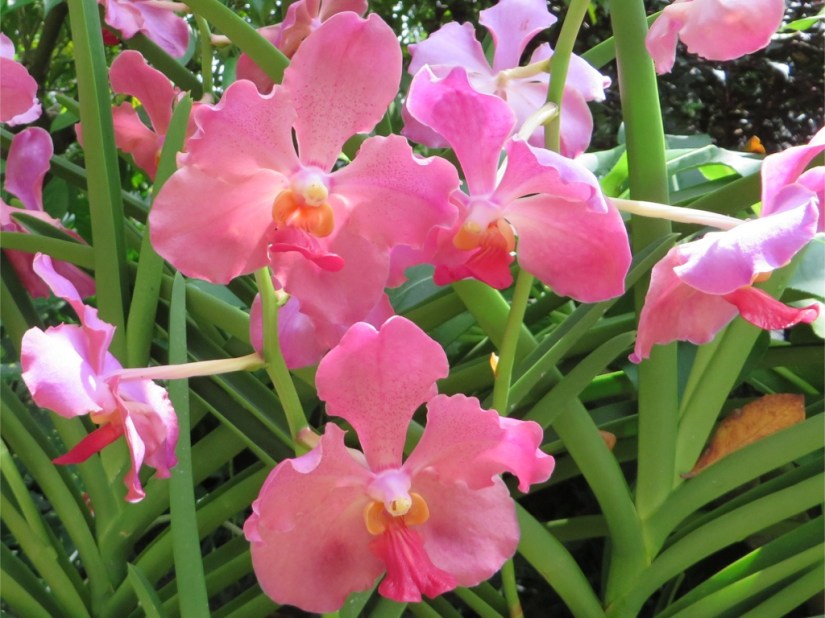
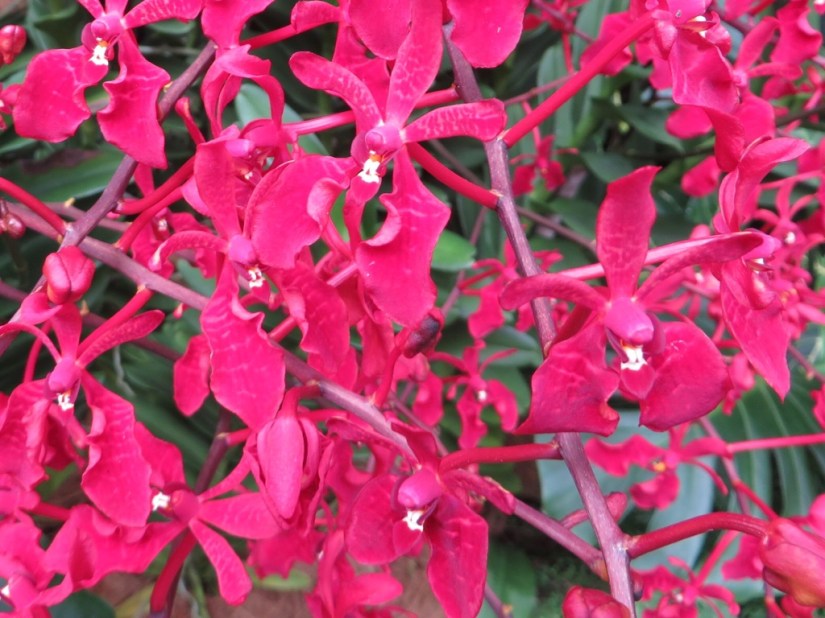
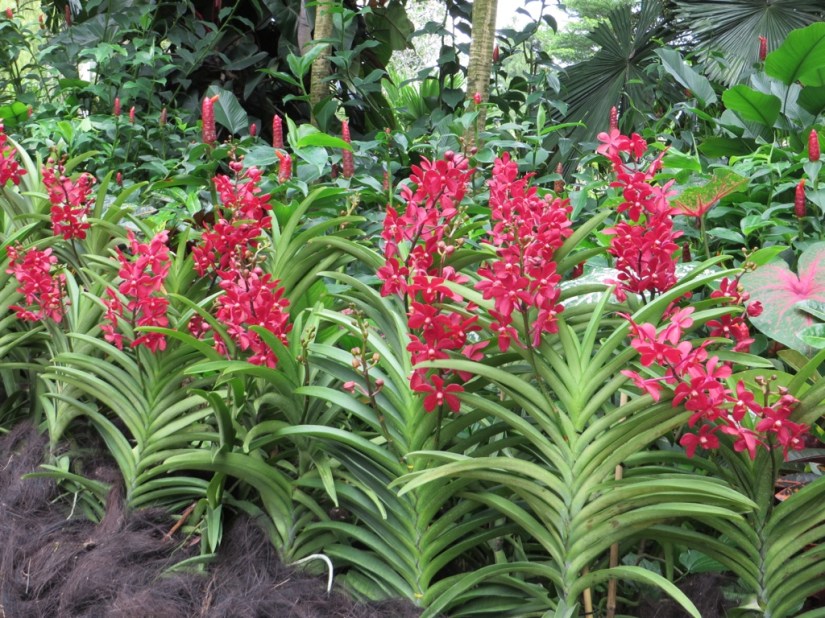
 These parks are open from early in the morning till late at night, free and really well used with lots of families visiting and picnicing. The new Gardens by the Bay has a couple of huge domes filled with plants which we didn’t visit, but also Supertree Grove, containing giant tree sculptures planted with ferns and orchids which take centre stage for a free light show each evening.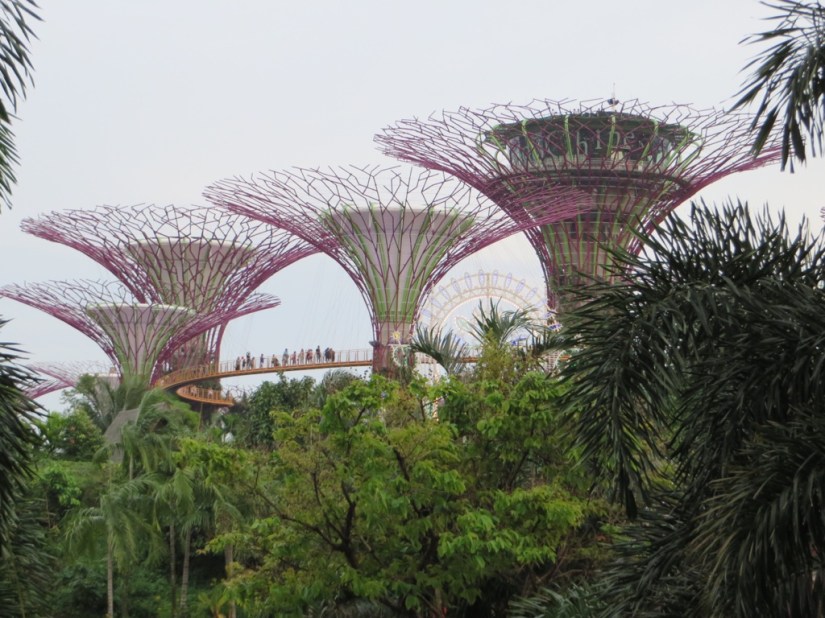

 Off Travelling Together