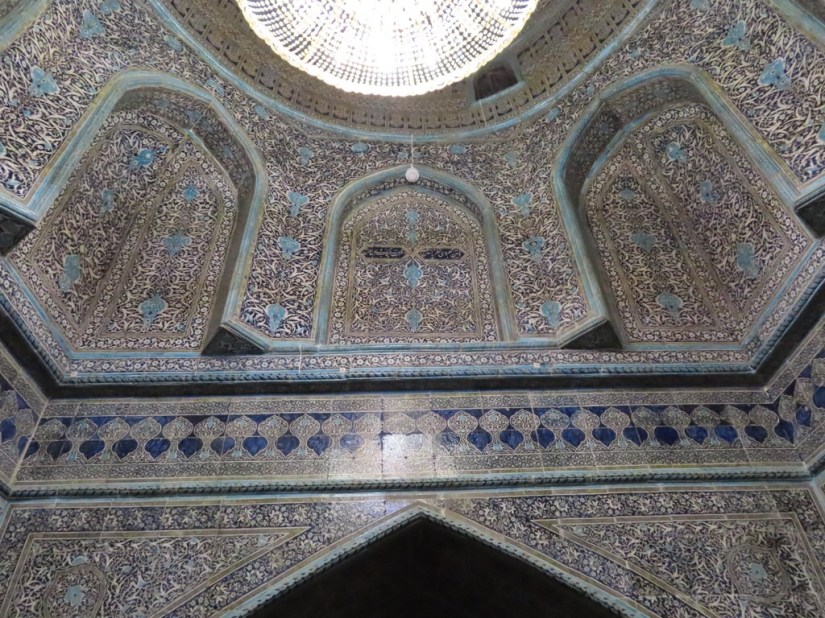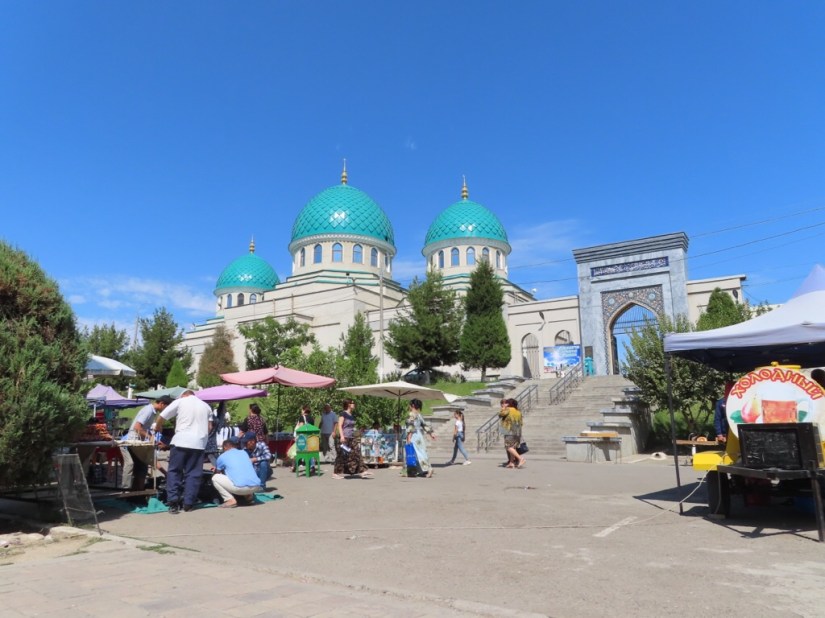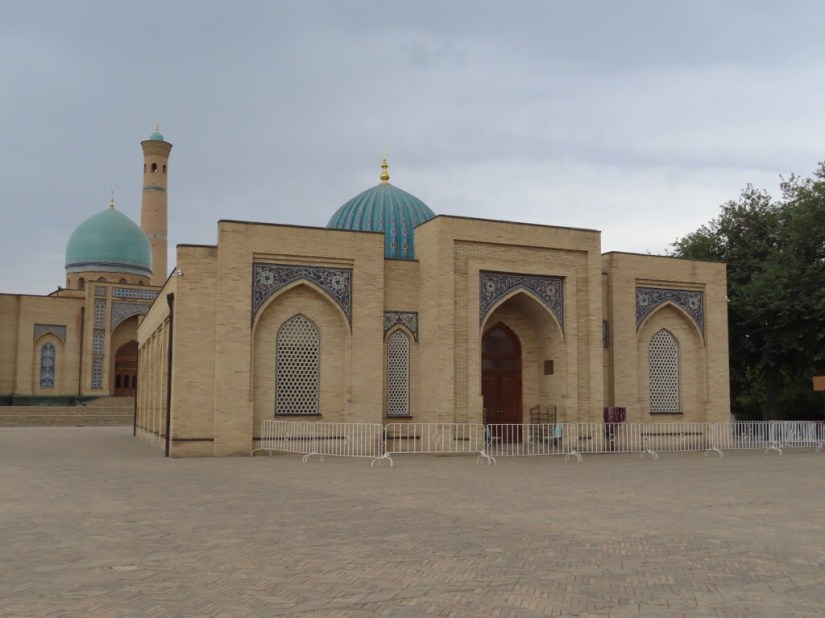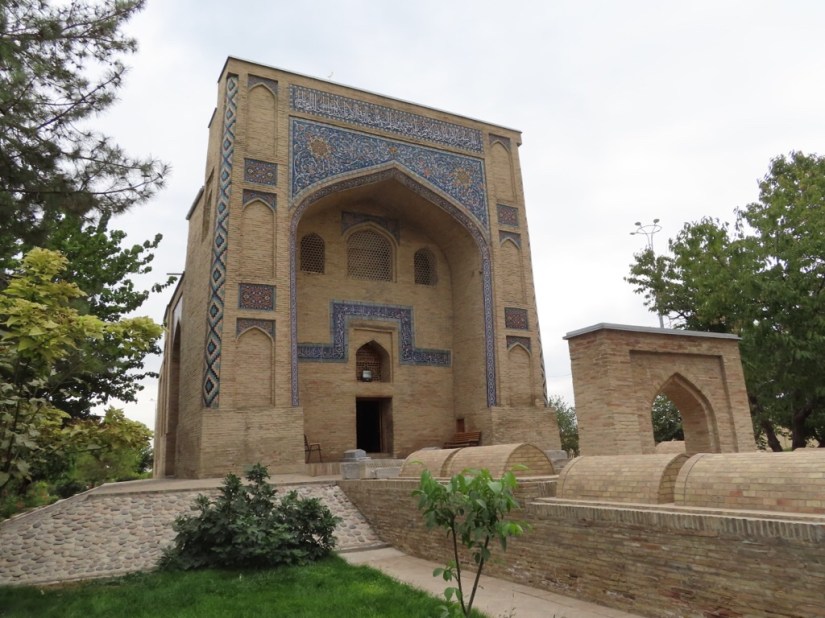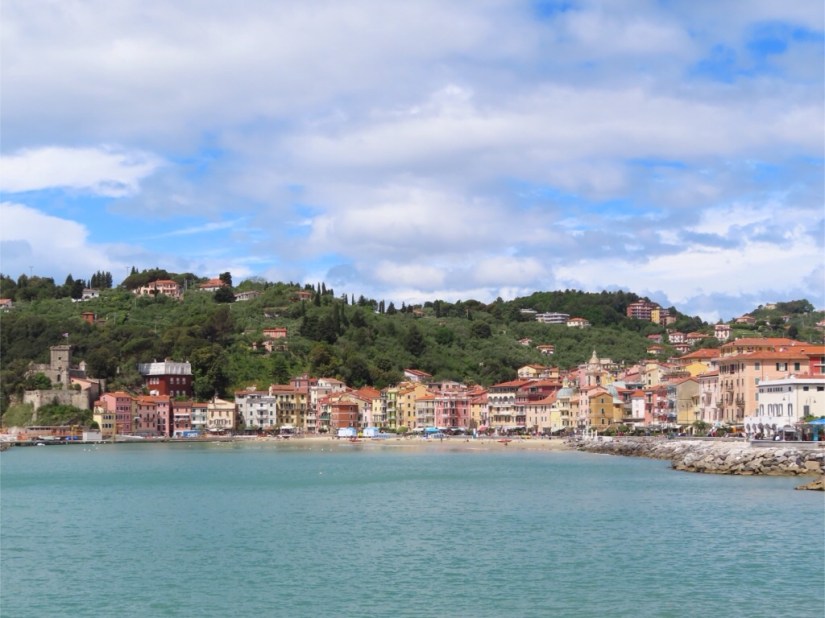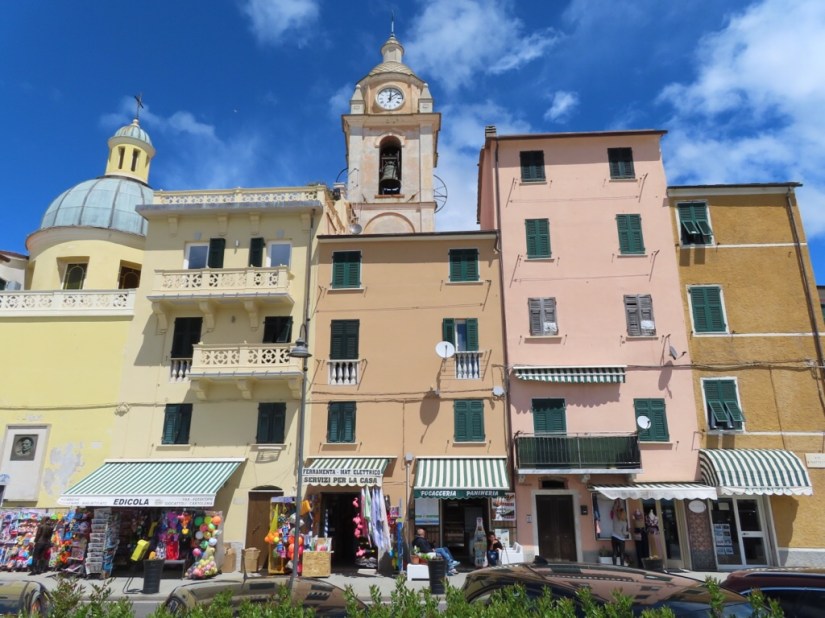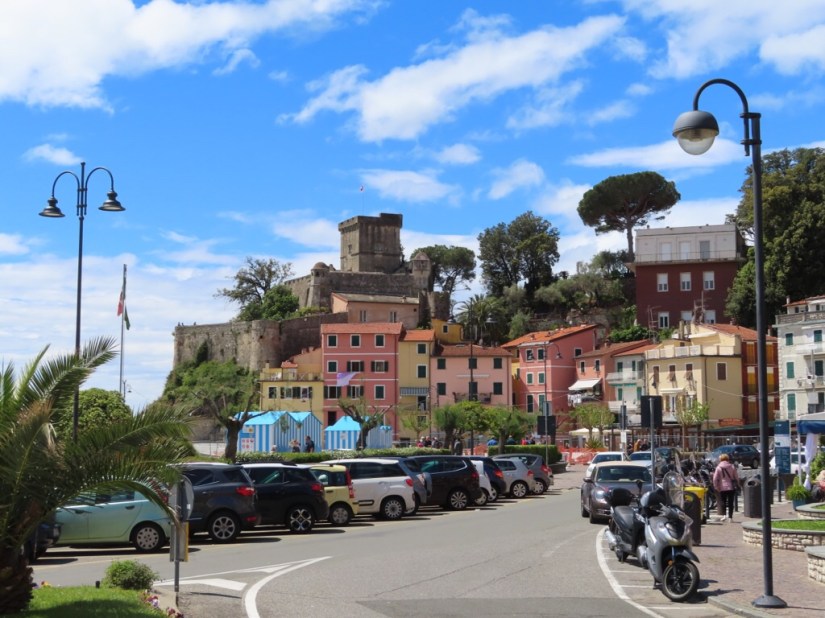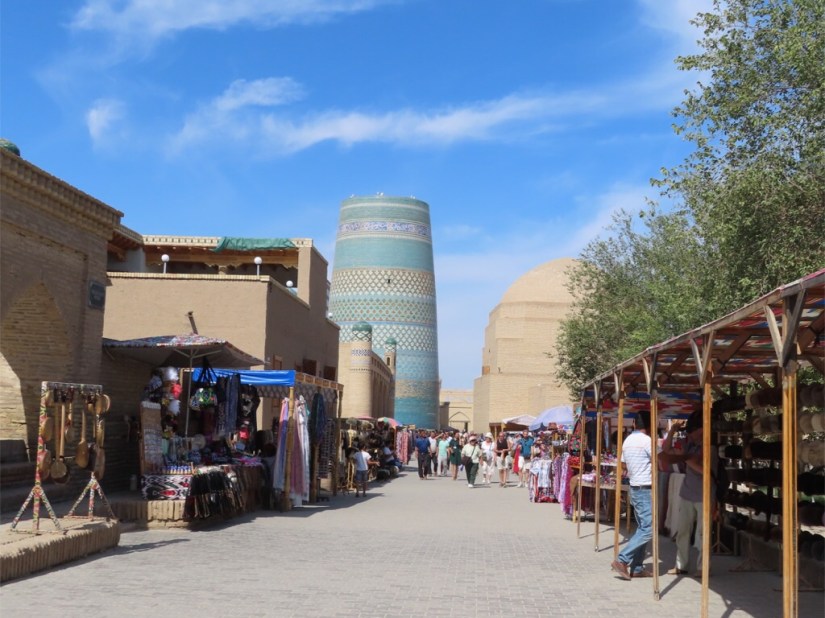
Khiva … Beyond the Walls

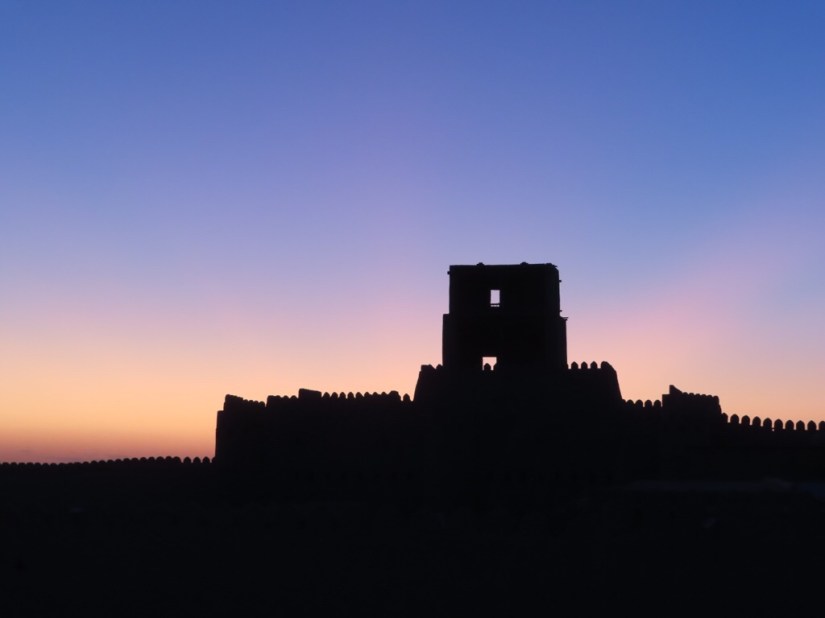
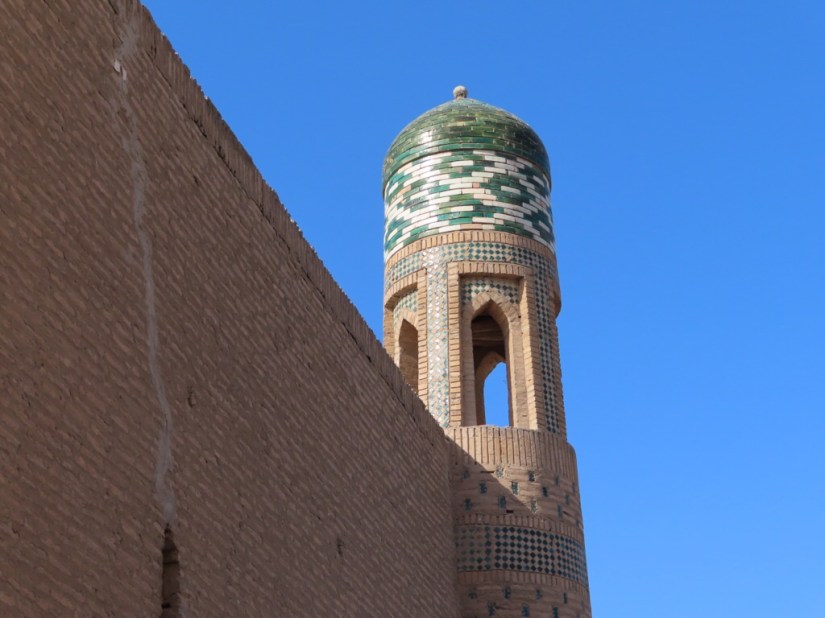
On our last day, we walked through the walls of Ichan Kala to explore the town outside. First was the double gate Kosh Darvaza …

… then the hospital built in 1910, with professional doctors to treat the sick …

… and the post office opposite.

A mosaic by a small park welcomes visitors to Khiva …

… a billboard celebrated the city.

… and posters remember its famous sons such as Al-Khwarizmi, known for his treatise on algebra, inventing the decimal point and giving his name to the word algorithm.

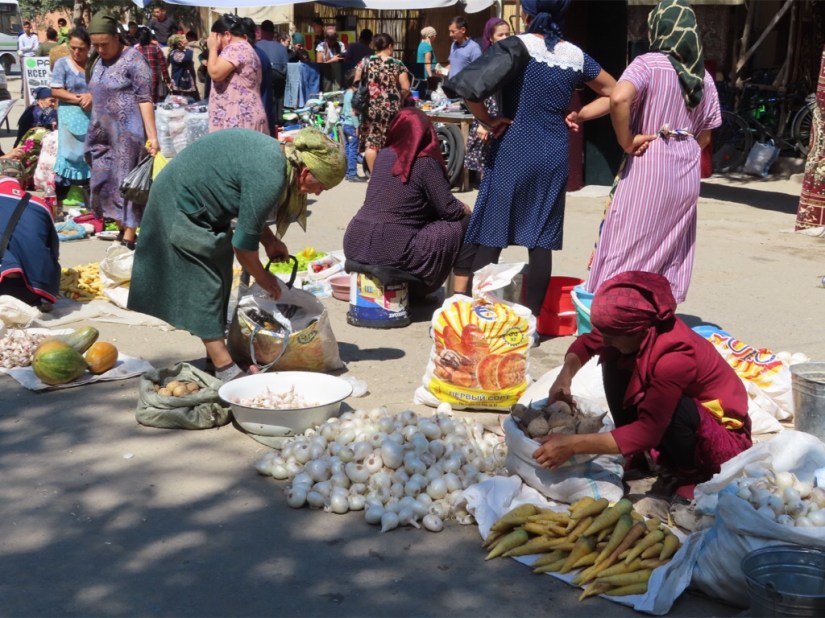
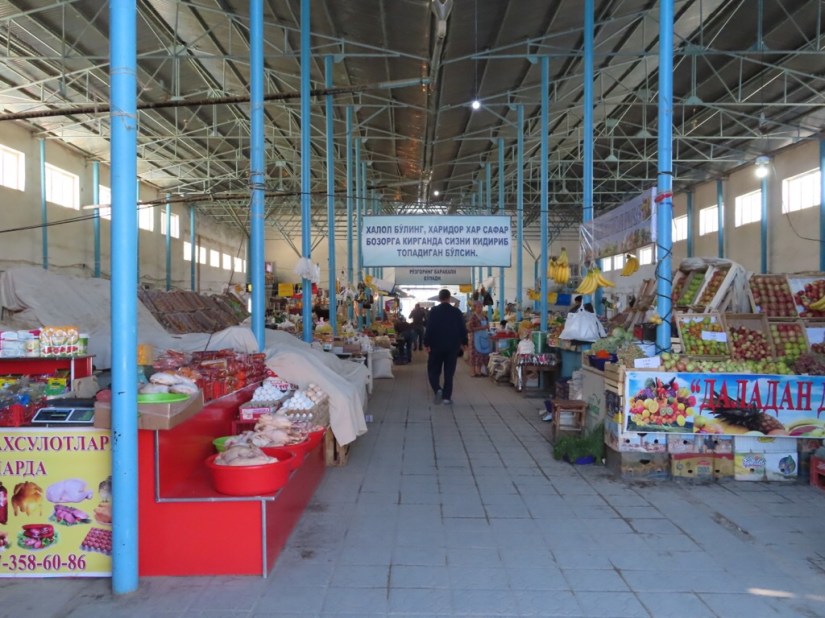
Opposite was the bazaar …

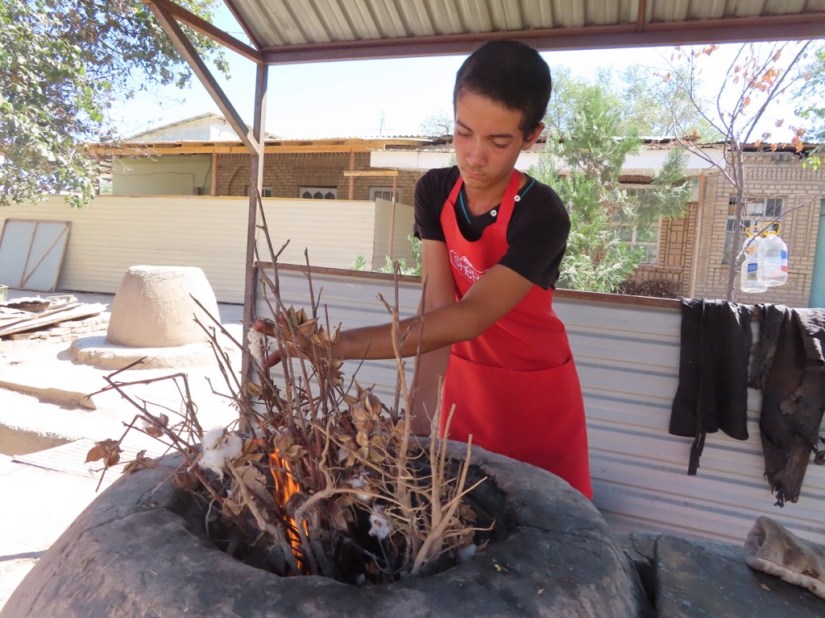
I tried a samsa, which was peeled off the inside of the tandir for me and tasted delicious … Chris chose ice cream over fruit!

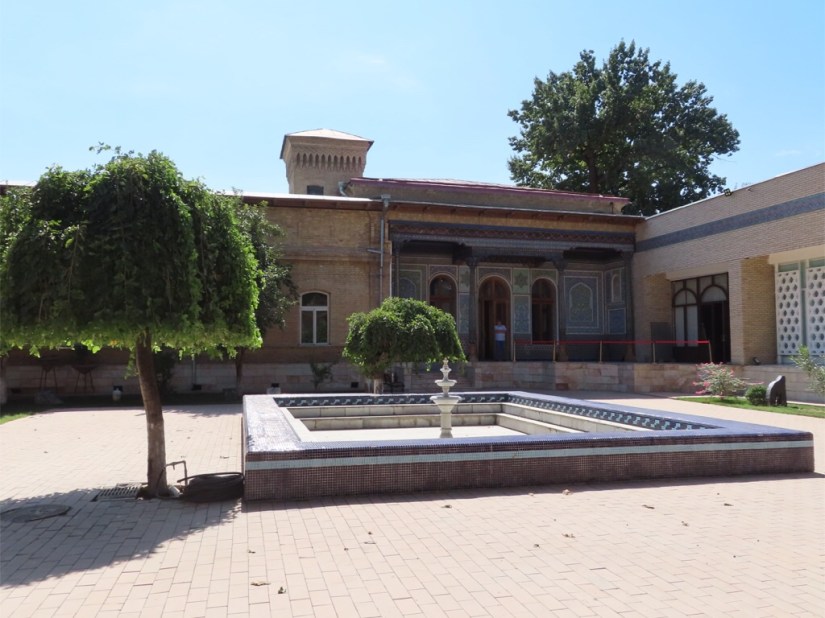
We took one of the plentiful little minibuses back to the north gate then headed for the Nurullabay Palace, which was built in 1912 when there was no space within the old city for a palace with gardens. A merchant sold the land to Mohammed Rakhim Khan on condition that the palace was named after him!

We looked round the Reception Building first, built later by Isfandir Khan. A community of Mennonites who had been invited to settle here by Mohammed Rakhim Khan and they assisted with the works, including the parquet wood floor and ghanch plasterwork.

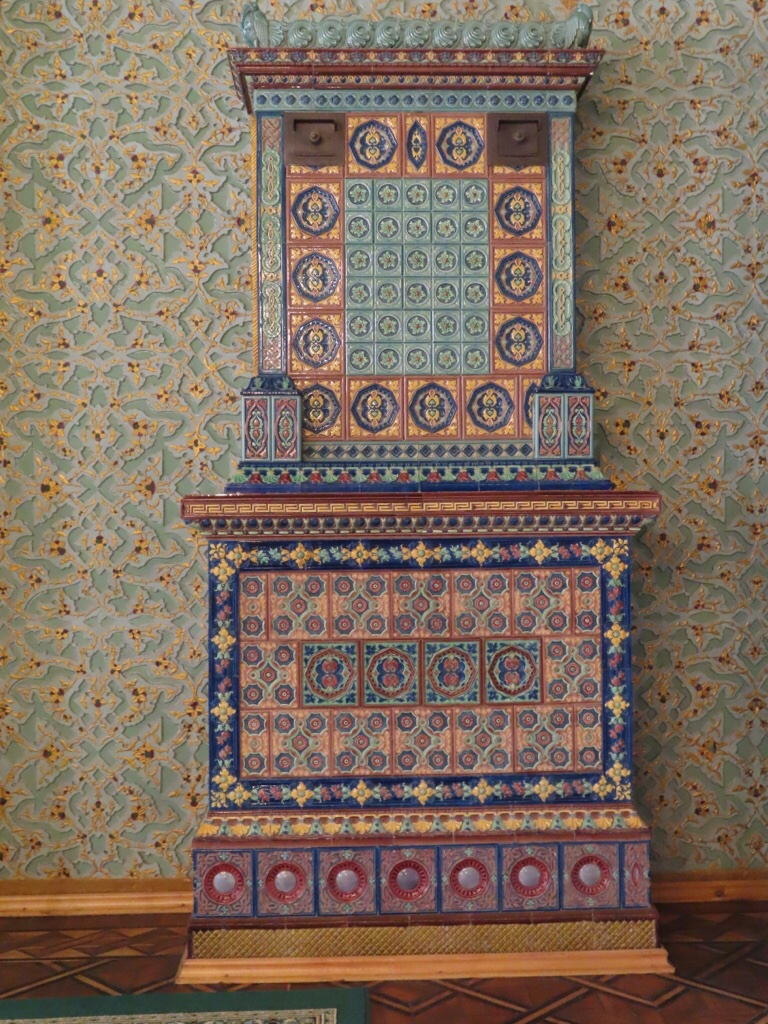
We were most struck by the splendid stoves with brightly coloured tiles which came from St Petersburg …

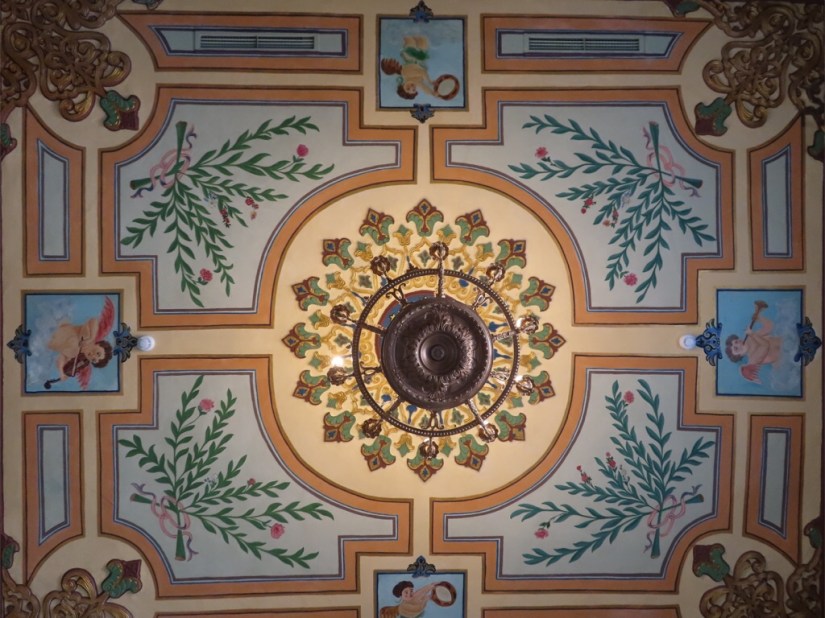
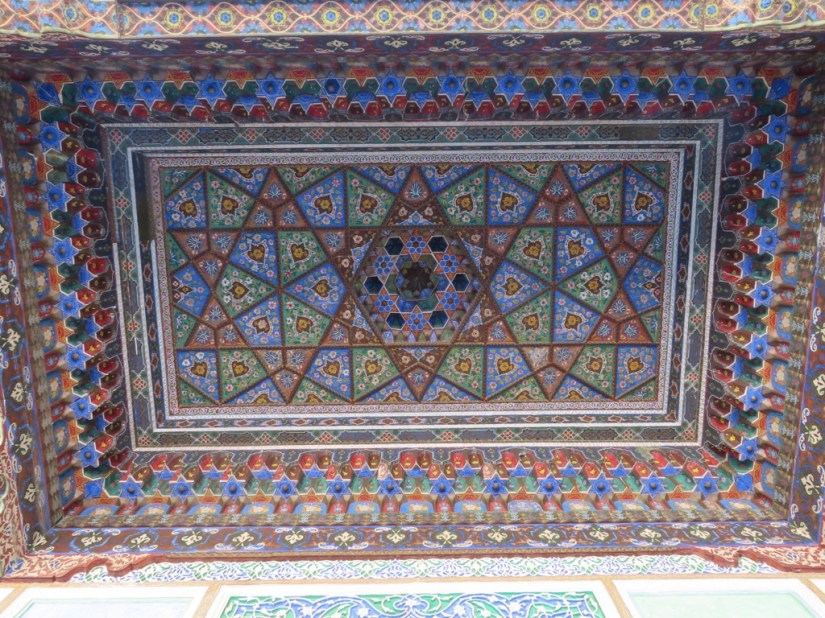
… and amused that cherubs had found their way onto the ceiling in a Muslim city!

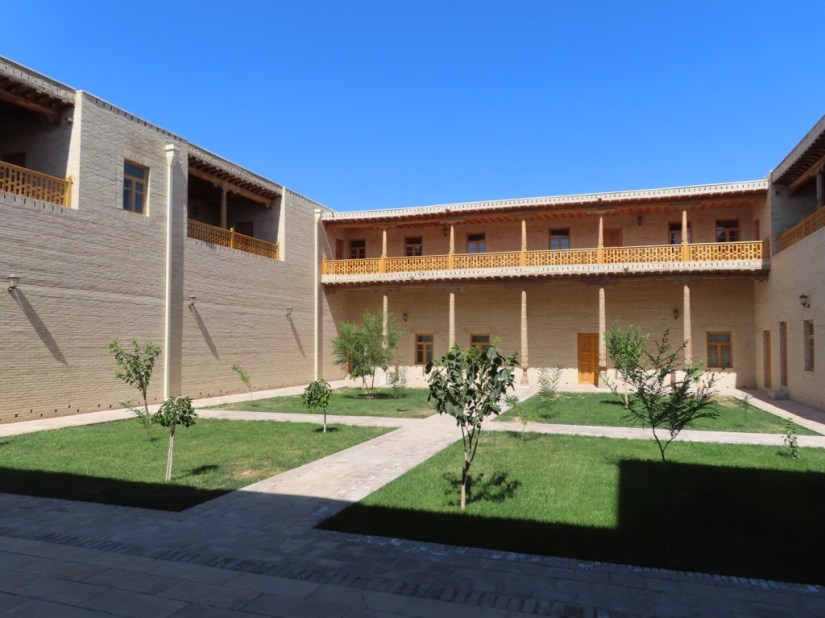
The main part of the palace is a maze of interconnecting courtyards and rooms and has been restored a couple of times.

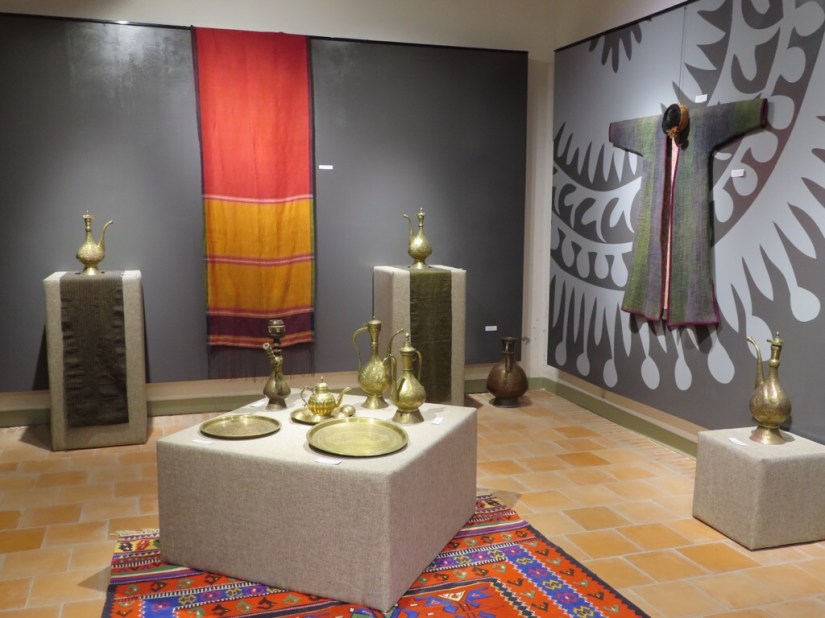
It contains no internal decoration, instead a modern, well lit exhibition space displaying arts and crafts but also some fascinating photos of Khivas past – possibly the image of Khiva museums to come!

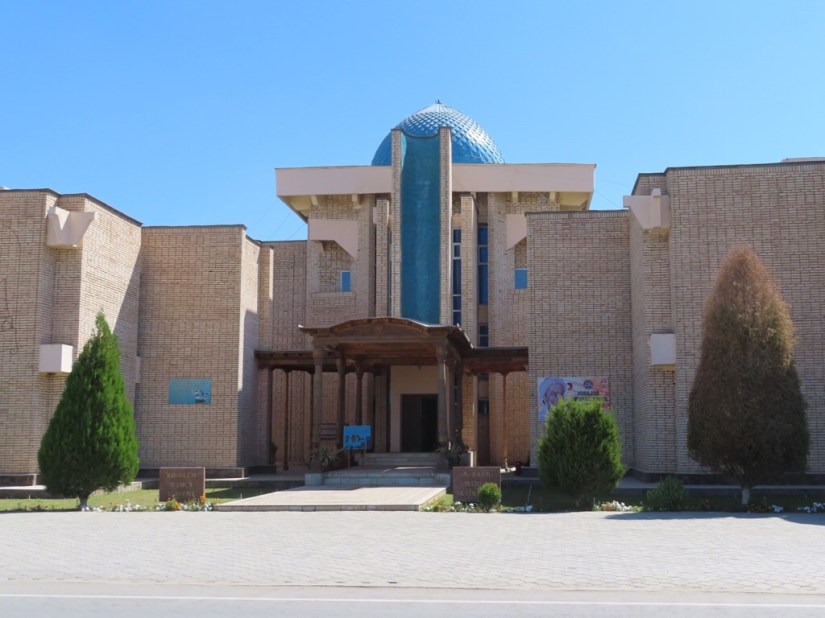
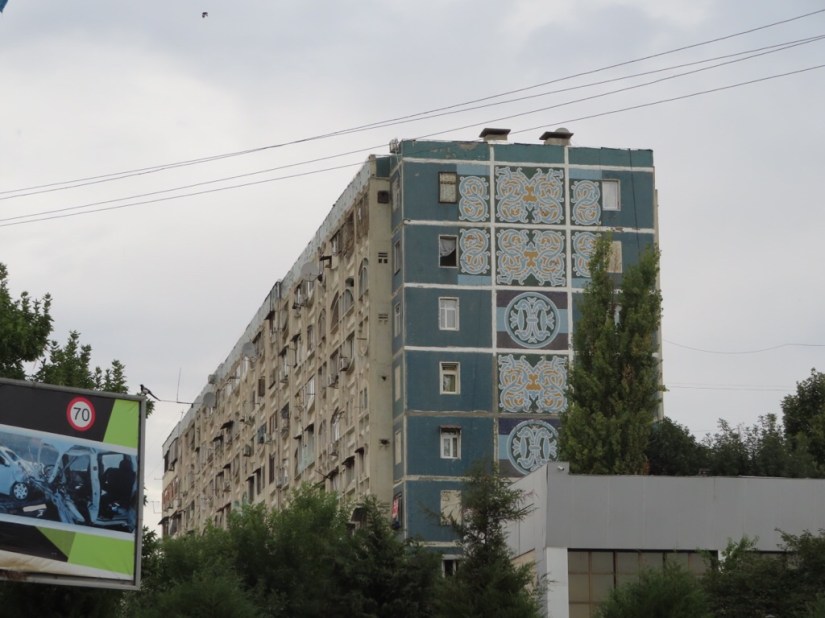
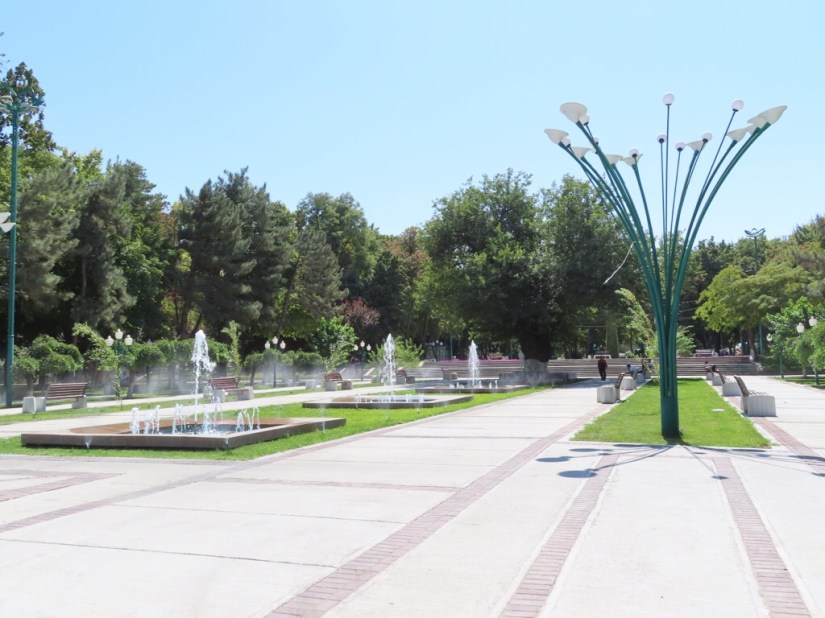
As we walked back we saw this smart academy copying the traditional aesthetic in a modern way.

So that brings our time in Khiva to an end. We are so pleased to have visited now as times are changing, and the city is definitely preparing for the ‘tourist potential’. Not all visitors are happy staying in a small family guesthouse, they would prefer five star hotels with pools …

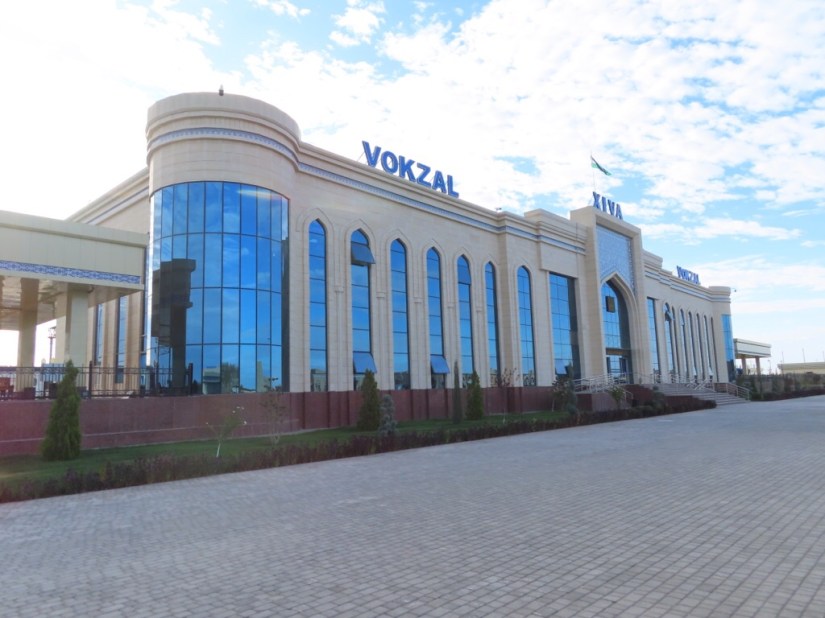
… and will come to Khiva via the railway station, a Palace built to welcome the tourists discovering the Silk Road in the 21st century.

Map

Fifty Fortresses of Elliq Kala

Having spent three days pottering round Khiva, it was time for a change so we arranged a day out through the guesthouse with Ali to drive us. Our main aim was to visit a few of the desert fortresses of ancient Khorezm, but we ended up seeing quite a lot more.

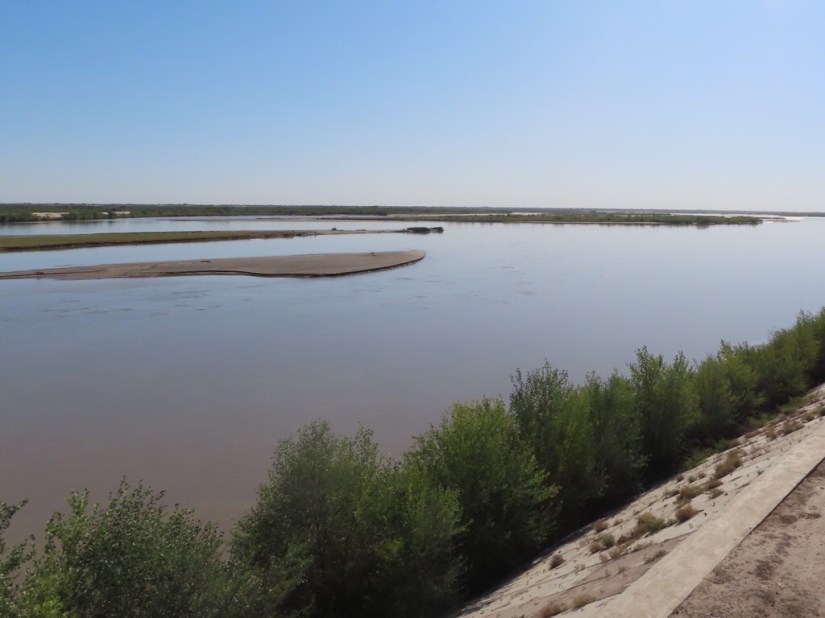
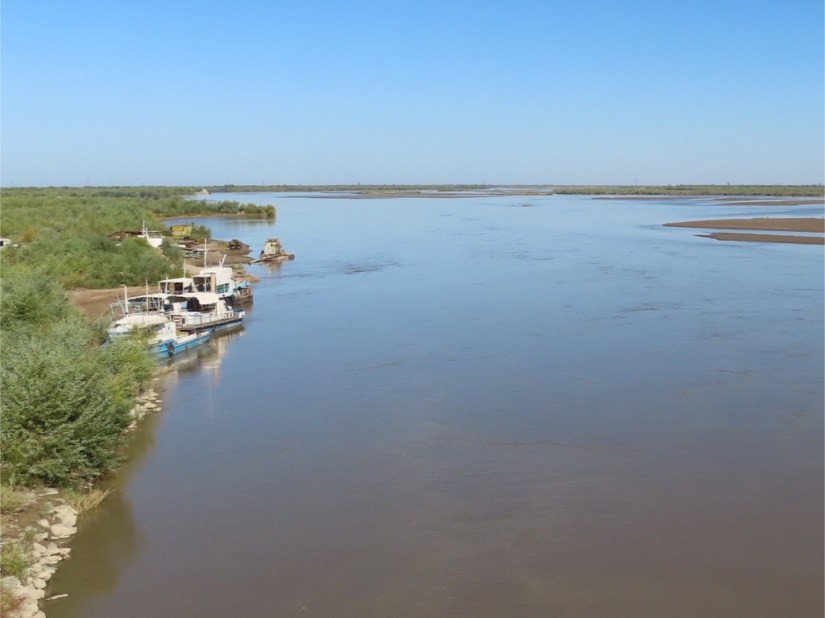
First we had to head north to Karakalpakstan, an autonomous republic within Uzbekistan with the border along the Amu Darya river.

As the Amu Darya forced its way into the Aral Sea, the region slowly drained and dried. Irrigation canals became fragile desert lifelines controlled by feudal lords, vulnerable to nomadic incursions and tribal war and stranded cities became ruins in the desert.

Once over the river we headed through farmland, growing cotton, fruit and vegetables …

… then as we continued through the gateway to Elliq Kala, the land became drier.

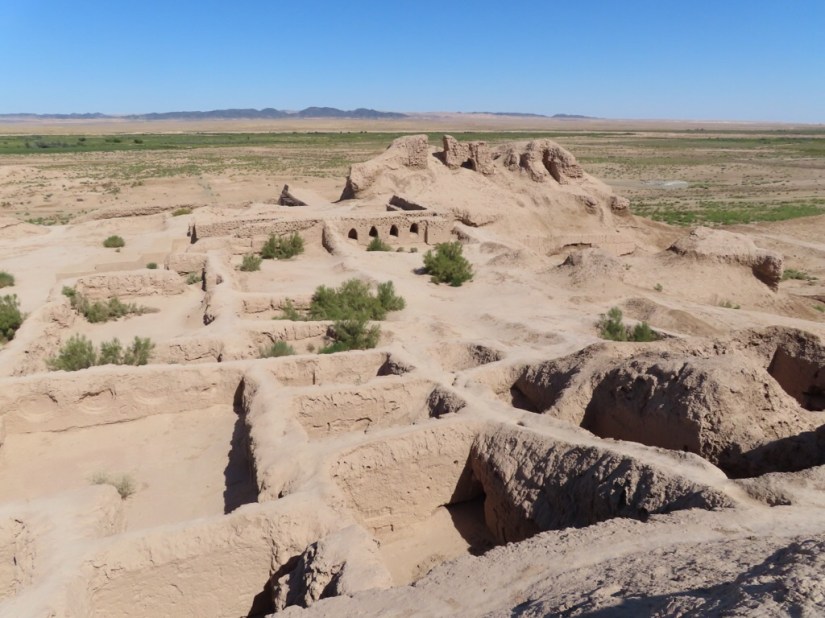
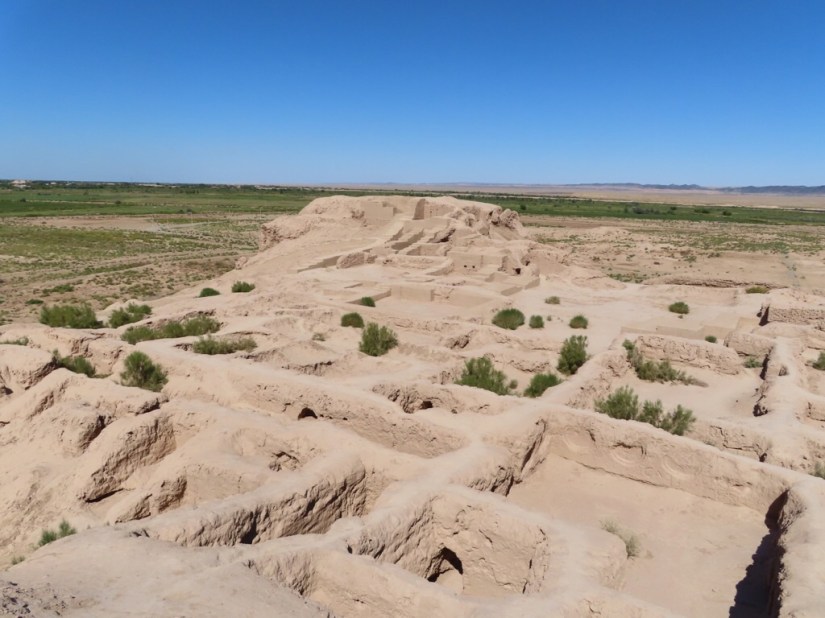
Our first Fortress was Toprak Kala which was first settled in the C1st BC but the ruins today are of a large fortified palace and temple complex built by the Khorezm kings in the C3-4th. They were rediscovered and excavated by the archeologist Sergei P. Tolstov in 1938 and all portable artefacts are in The Hermitage in St Petersburg.

It stands with the Sultan Vais Dag Mountains in the distance.

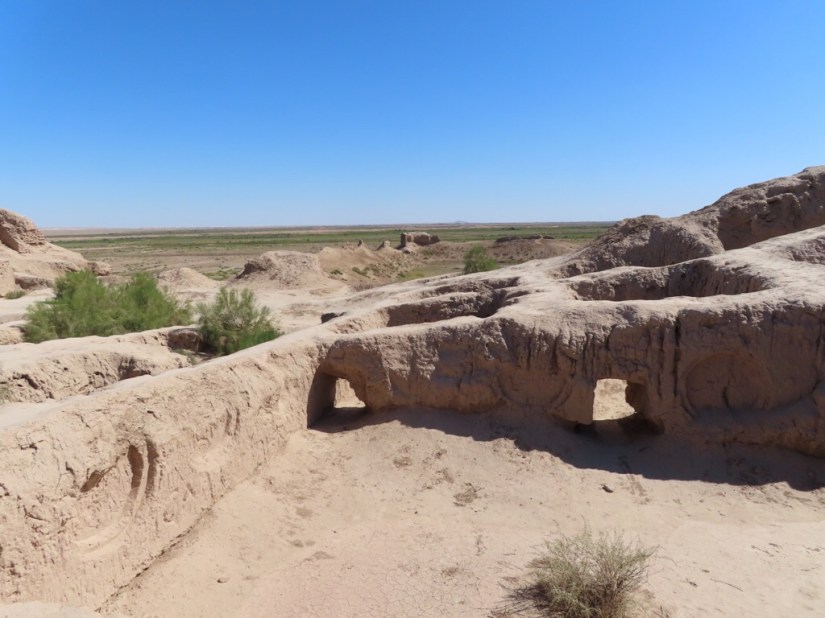
There are towers at each end, with a network of streets, courtyards and rooms between, as well as three main halls. Some rooms still have niches in the walls and fireplaces. Areas of restoration are quite distinct, but it is amazing how much remains bearing in mind it’s all just sun baked mud. Even more amazing is that this was just a small corner of an overall complex 350m x 500m surrounded by a high brick wall with 45 guard towers and a covered corridor for archers!

Kyzyl Kala or Red Fort was next …

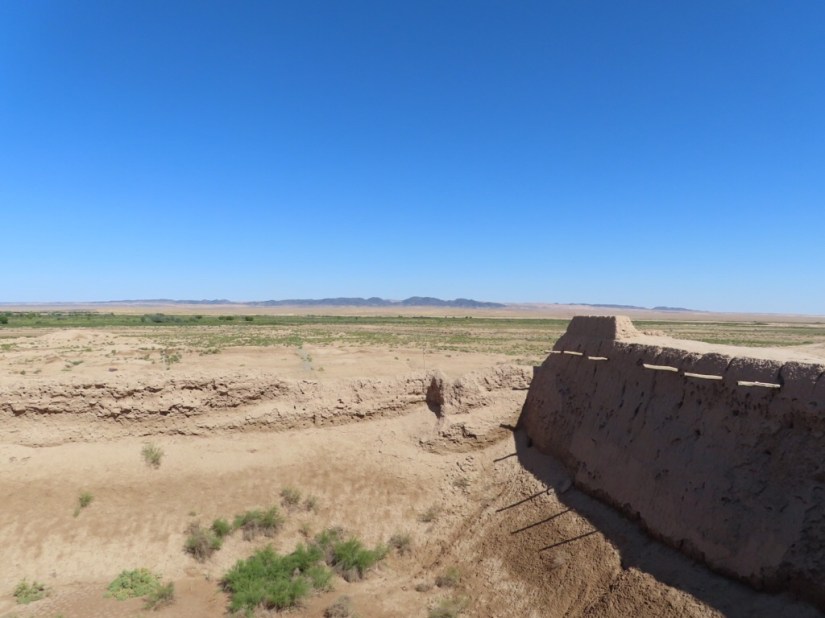
… probably of a similar age but subsequently rebuilt in the C12-13th, and was probably a garrison, with numerous arrow slits and observation points around its walls.

It was also the centre of the agricultural area and crossroads of caravan routes which passed through through the ridge Sultanuizdag. The modern retaining wall was added to prevent erosion, but does give a good idea how it originally looked.

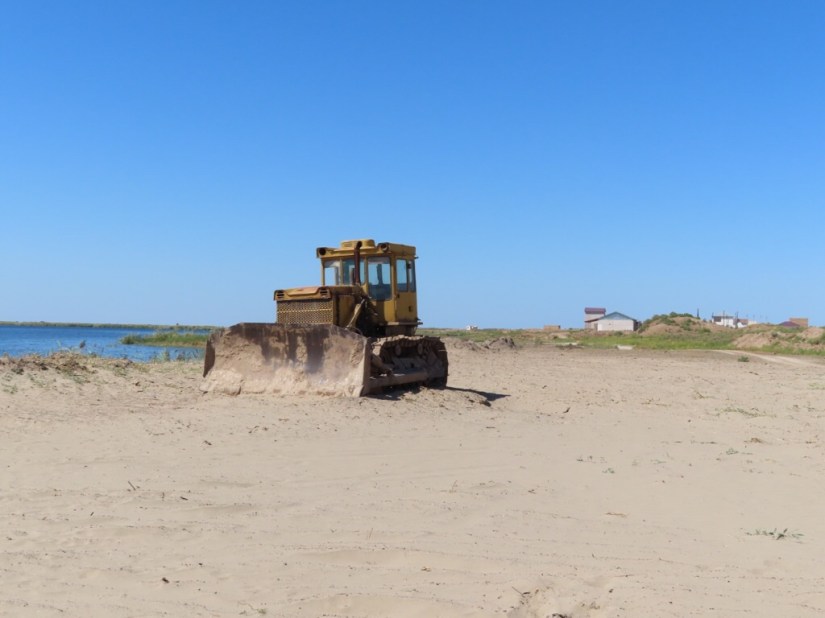
We stopped briefly at Akhchakol Lake, complete with a yurt resort and possibly boatrips …

… but with a digger out front I think they need to work on their image!

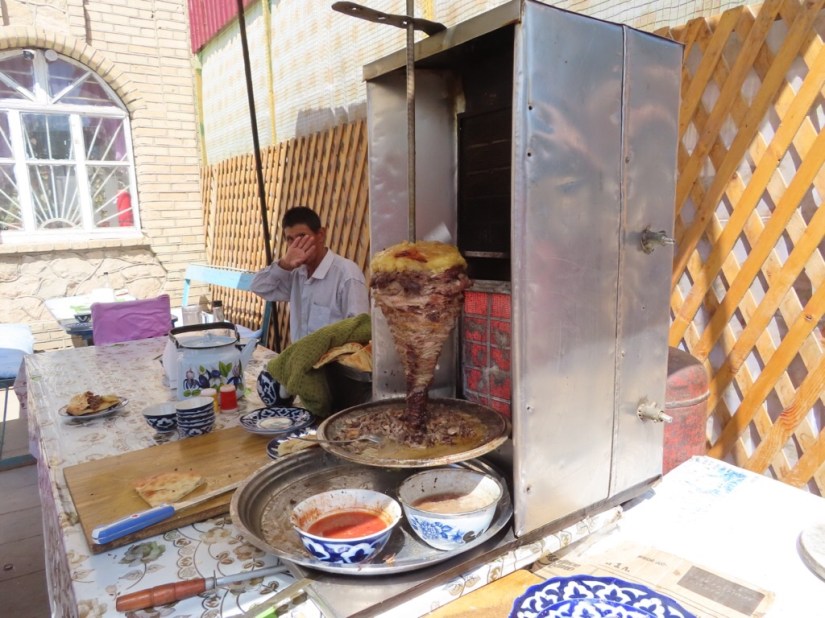
Time for lunch, and Ali took us to Boston bazaar, and to a small local restaurant where they were cooking kebabs …

… and samsas on the inside of a tandir.

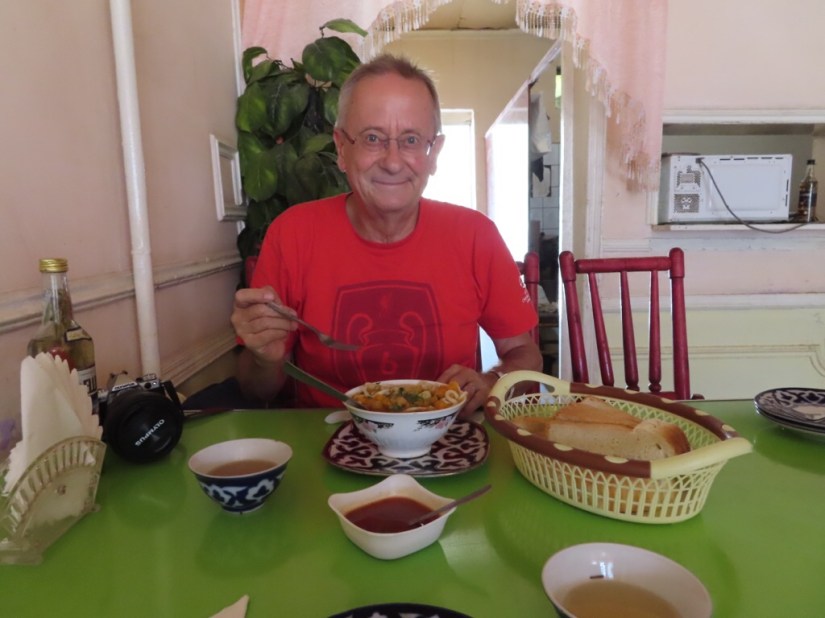
Despite being offered vegetable soup, meat was detected, so Chris drank tea and ate some bread while I eat my very tasty lavash with meat carved off the skewer.

We took a turn round the bazaar, where Chris could have made up for his lack of lunch with a wide choice of fruit, but choose a wedge of very sticky cake instead!

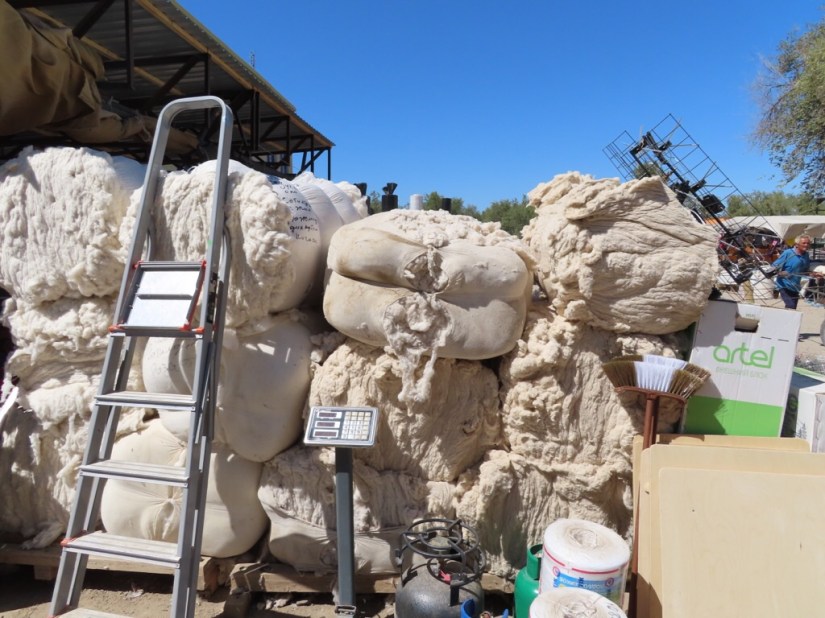
We also saw huge packs of cotton, and realised that this is why the bedding seems rather firm, no foam here … just cotton wadding!

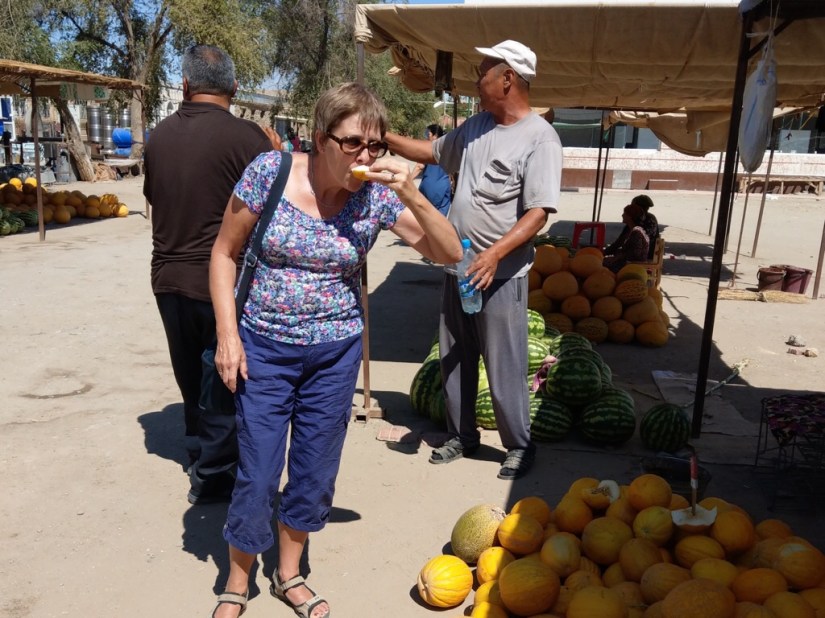
The area is renowned for its melons, and they are in season now. We have seen huge piles for sale everywhere and it is always part of the breakfast spread. There is watermelon, but the tastiest are the yellow melons. Ali gave us a piece to try in the market and it was the best melon so far, so sweet and tasty … even Chris was persuaded not only to try it, but said he liked it, which is an absolute first since I have known him! Having given it the thumbs up, Ali bought one for later!

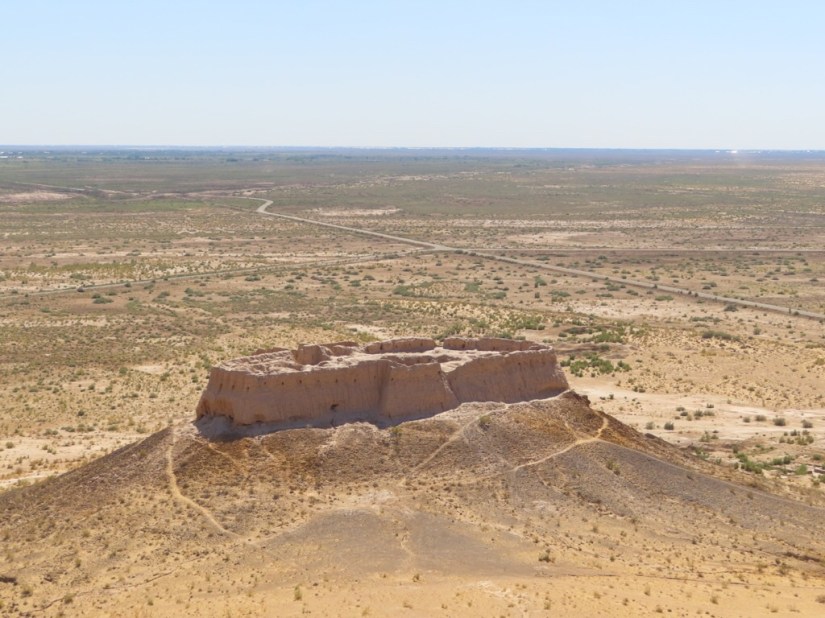
We continued to Ayaz Kala which is actually a collection of three forts which have survived since at least the C4th BC. This really is in the desert, with another yurt camp nearby and a bit of a walk up the hill!

The giant fortress is around 180m by 150m … here is Chris in the middle …

… and there are parts of tunnels and arrow slits in remaining parts of the walls. It would once have been a very wealthy place with sophisticated inhabitants. At least ten major structures have been identified within the complex, and archaeologists have unearthed everything from early wine presses to golden statues.

Looking down, we could see the lower fortress, but didn’t go and explore.

Despite looking dry and inhospitable, we spotted wildlife – a rodent like critter, species uncertain …

… and a bird …

… and tiny flowers …

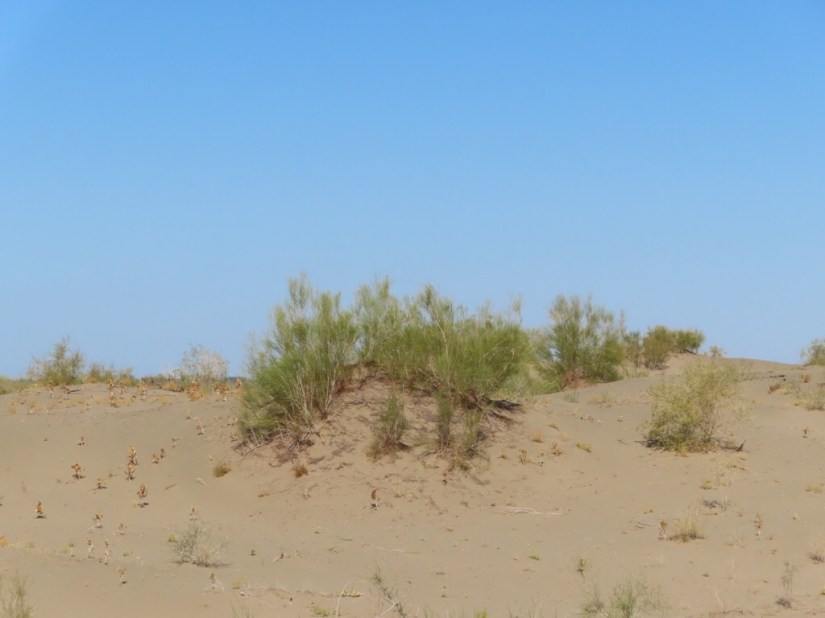
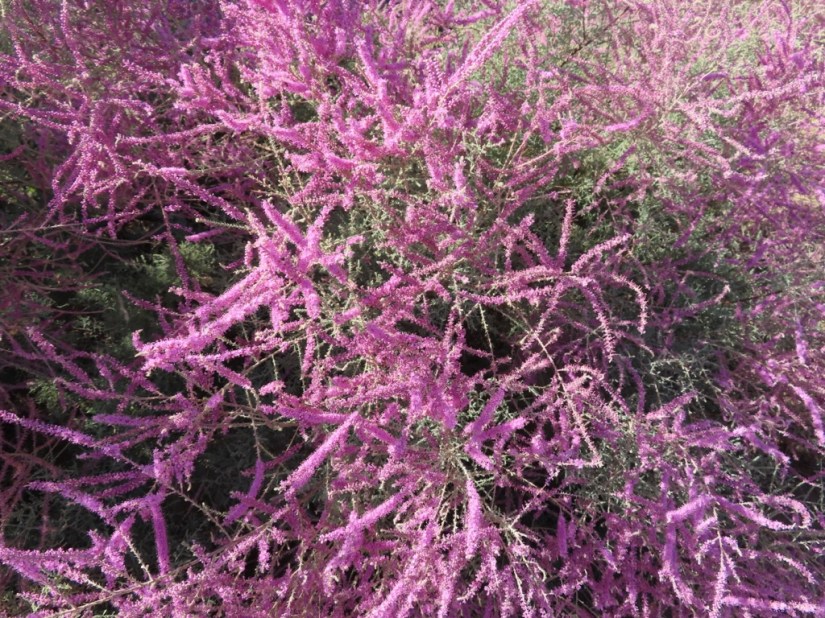
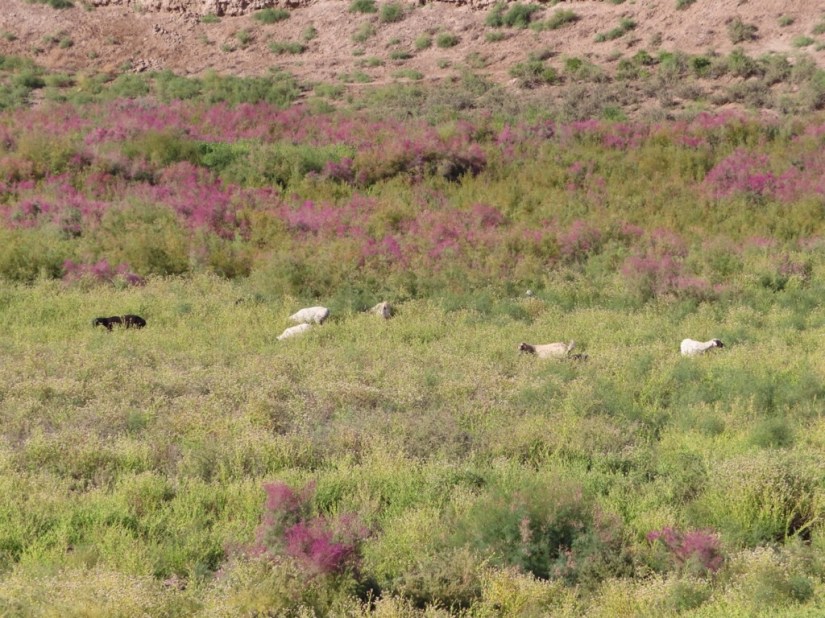
… as well as this purple bush that was growing everywhere along the road.

It was quite a walk to the fortress and back and we were pleased to join Ali in the shade where he shared the melon with us and a couple of other drivers … delicious!

We had to make a stop for fuel and strangely, only the driver can enter the service station … passengers have to wait in the waiting area, conveniently shady with seats 100m away! When I mentioned this, it was suggested that since we were running on propane it was for safety in case of an explosion – rather pleased we hadn’t opted for self drive!

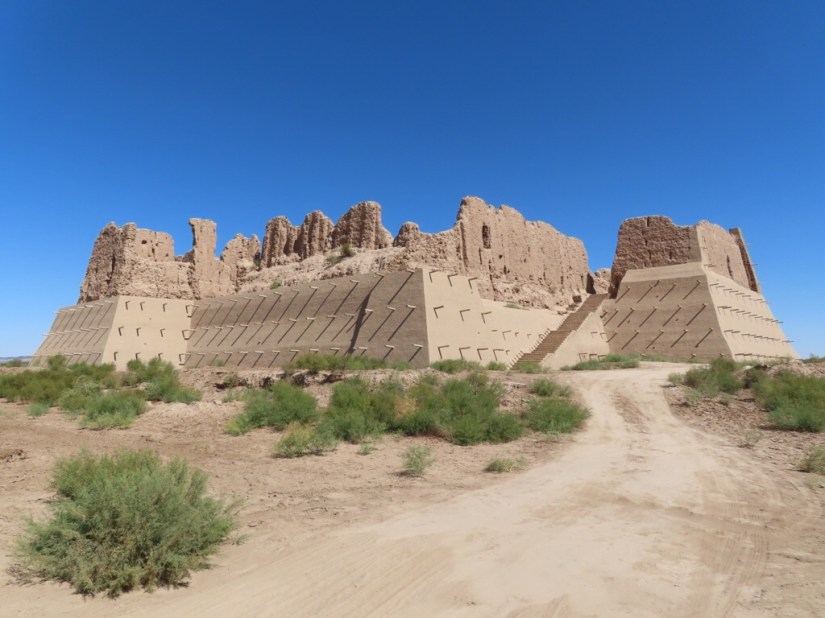
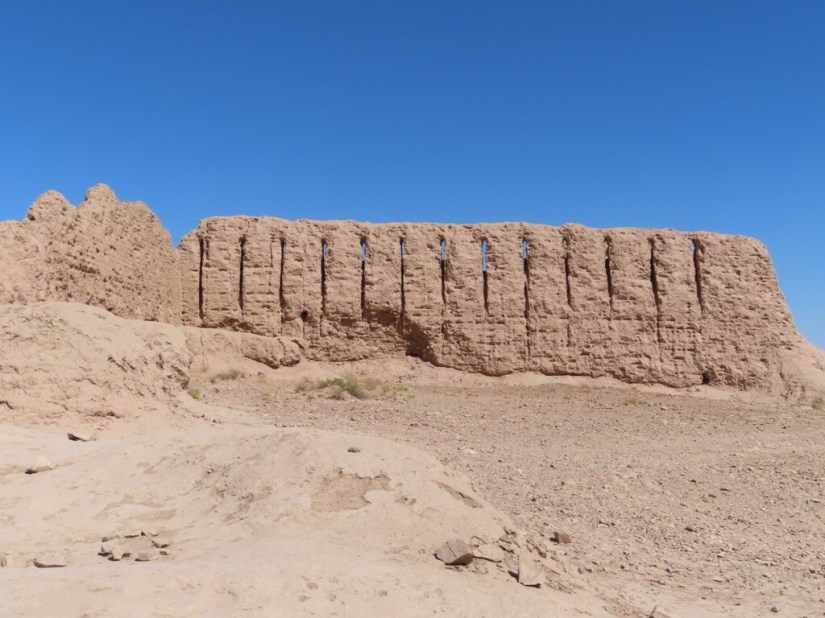
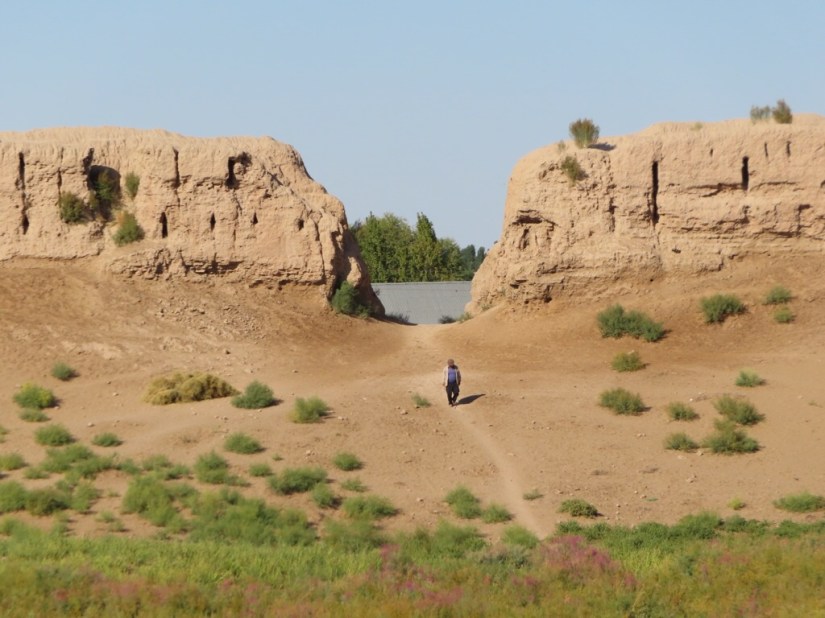
The last fort on our trip was Guldursun Kala Bolshaya which was most impressive for its size.

It was impossible to get it all in a photo!

With perimeter walls of about 1km long, there was plenty of space for the locals to graze their animals inside!

The present structure dates from the C12th so is much later than the others too. It also has a legend -Princess Guldursun fell in love with a Kalmyk warrior and opened the gates of her father’s fortress to him. Once inside he cast her aside and his troops killed everyone they could find and reduced the buildings to ruins.

In the late afternoon, we saw women picking cotton in a field and they gave us a cheery wave, but it must be back breaking work, and hard on the hands as the cotton plants are rough. Not all cotton workers choose this type of work. Many are conscripted by the government to assist the harvest and consequently Tesco & M&S and others banned the use of Uzbeki cotton in 2007. Despite reforms taken by the present government, citizens are still being forced to work in the annual harvest.

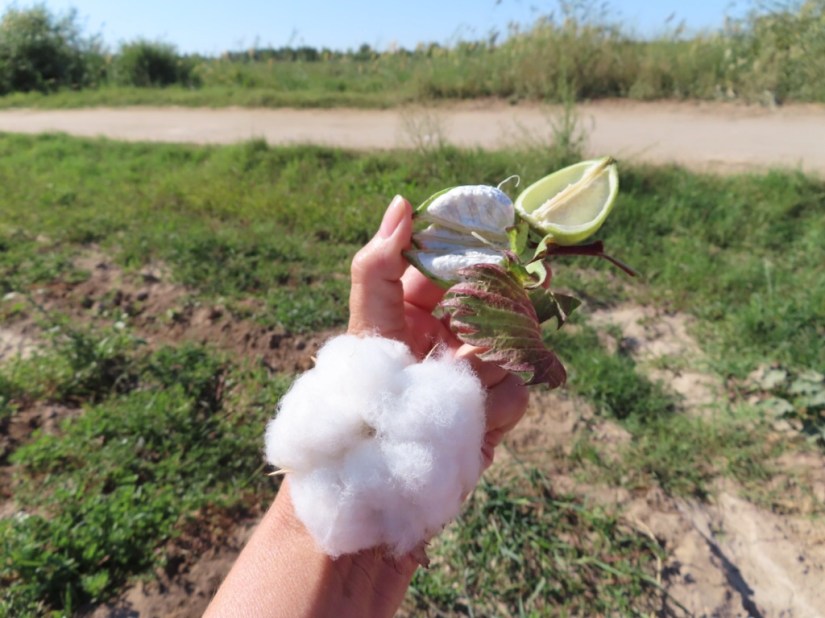
Earlier in the day we had stopped a picked both a bud which hadn’t opened, which was compact and slightly oily inside, and an opened pod, full of fluffy cotton. When the cotton is ready to harvest, the irrigation is stopped and this encourages the pods to open.

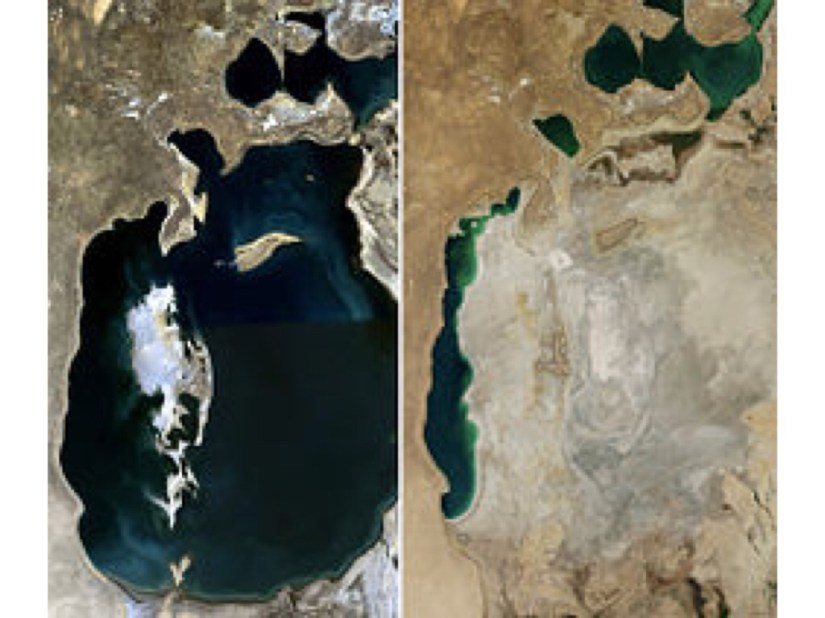
And cotton takes a lot of irrigation. When the Russian empire replaced much of the traditional agriculture with cotton in the C19th, it became the principle cash crop so dams and irrigation were built which led to the two longest rivers in Central Asia, the Amu Darya and Syr Darya to change course. The Aral Sea, formerly the fourth largest lake in the world with an area of 68,000 sqkm, has shrunk to 10% of its original size, splitting into four lakes. Here’s a picture of the Aral Sea in 1989 on the left and 2014 on the right …

Since then, storms of salt and dust from the dry seabed continue to affect agriculture, the ecosystem and health in the region.

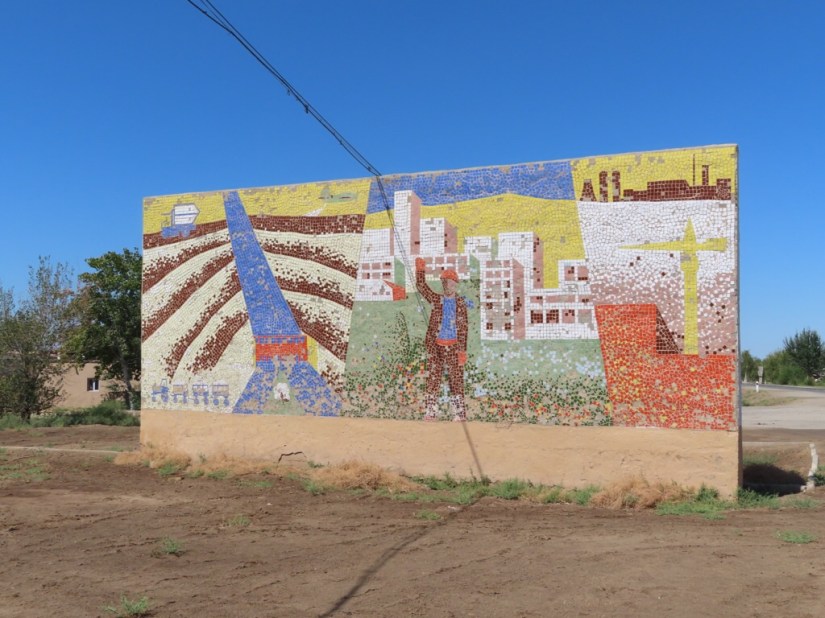
On the way back we passed this pair of mosaics by the road, celebrating the cotton crop, fertilised by plane and irrigated then fabricated in factories by happy workers and their families enjoying the good life in Uzbekistan.

Khiva … Within the Walls

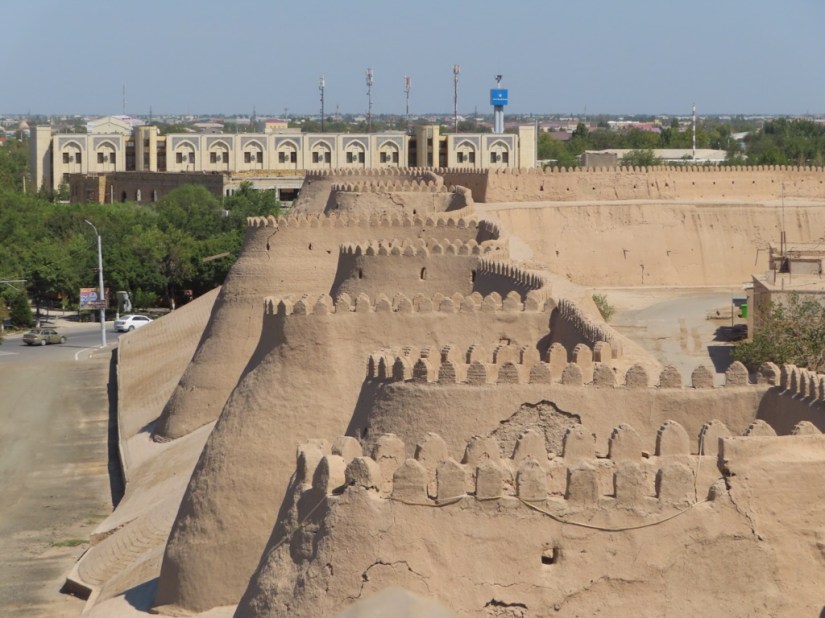
We knew we had arrived in Khiva when we saw the wall. This huge wall surrounds the city and contains four gates which would seal the town from dusk to dawn and offer protection to a city plagued by nomadic raids and desert storms.
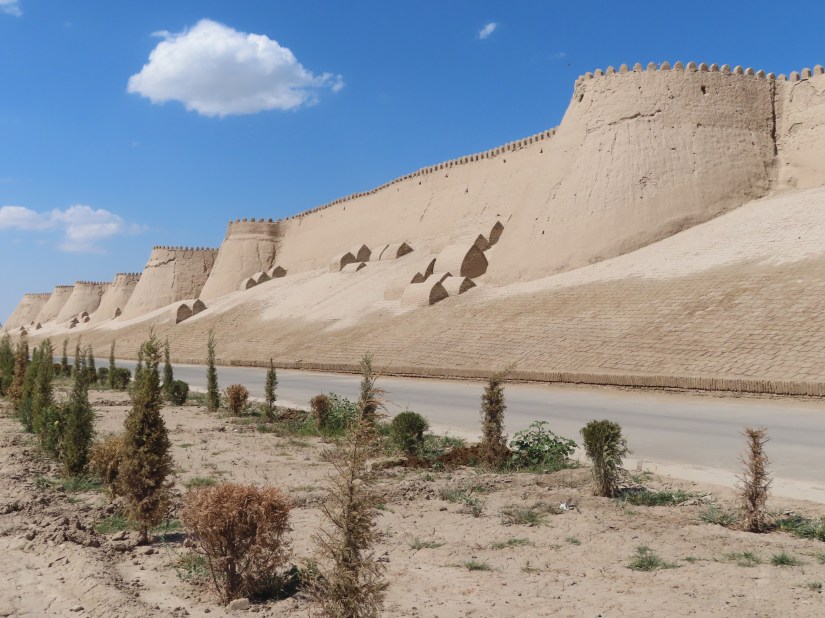
Khiva is one of the cities of ancient Khorezm, 900km west of Tashkent with a population today of 90,000 and the first site in Uzbekistan to be made a World Heritage site.

It is in the region of Khorezm which has always been an important area in Central Asia due to the Amu-Darya delta and early irrigation systems enabled agriculture in the villages and then commercial, political, and cultural development in the towns. Today its main crops are cotton and rice as well as being well known for its melons.

According to legends, Khiva was founded by Shem, the elder son of Noah, who dug a well in the middle of the desert which was named Khey-vakh which roughly means sweet water. Beginning as a minor fort and trading post, by the C10th the Arab traveler Al-Istarkhiy wrote that Khiva was among the 30 important cities in Khorezm. All the caravans had to stop here as it was the last resting-place before crossing the desert to Persia and from dawn to dusk, an endless string of camels with baggage passed through the gates.

There was never a single Silk Road, rather a network of different trade routes all linked together joining Xian in China with the Mediterranean, often changing depending on war, weather or robbers. Trade began with China’s desire for horses for which they traded silk, but many other commodities were traded, all light, valuable, exotic and highly desired. Central Asia was the clearing house for much of this trade as caravaners rarely made the whole journey, instead just carrying goods a fraction of the distance, sheltering in a network of caravanserais offering lodgings, stables and stores along the way, then trading it on. The Silk Road also enabled an exchange of culture including ideas on all aspects of religion, art and science being carried with the commercial goods the merchants traded from country to country. By the end of the C15th, the Silk Road began to decline as sea trade flourished.

The western Ata Darvoza (Father Gate) was rebuilt in 1975 after the original was pulled down to open the medieval city to motor traffic in 1920s …
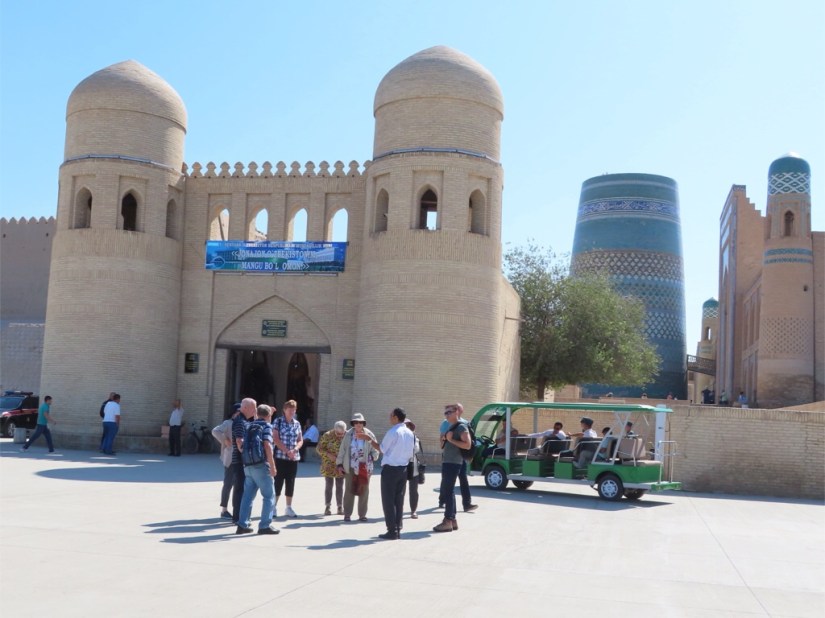
To the north is the double-sided guardrooms of the Bakcha Darvoza or Garden Gate where customs duties would be collected from the caravans arriving from Urgench. At the moment, the road in through this gate is being relaid, paid for by the Chinese who have bought a madrasa which they are converting into a hotel …

To the south is the Tash or Stone Darvoza, the arrival point for caravans from the Caspian area …
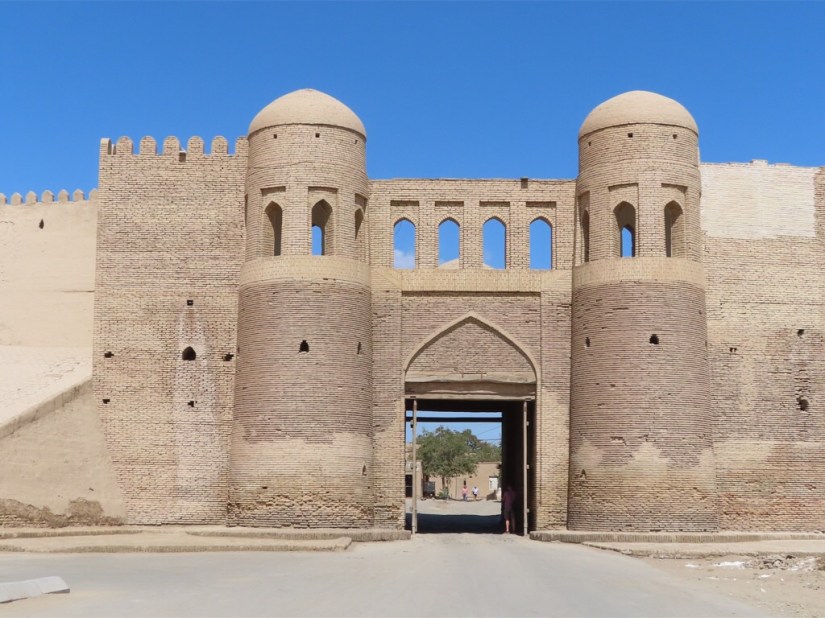
And finally the Polvon Darvoza or Warriors Gate where royal proclamations were announced. It dates from 1806 and was once the entrance to the slave market …

…and these niches in the tunnel would have been where slaves were kept chained.
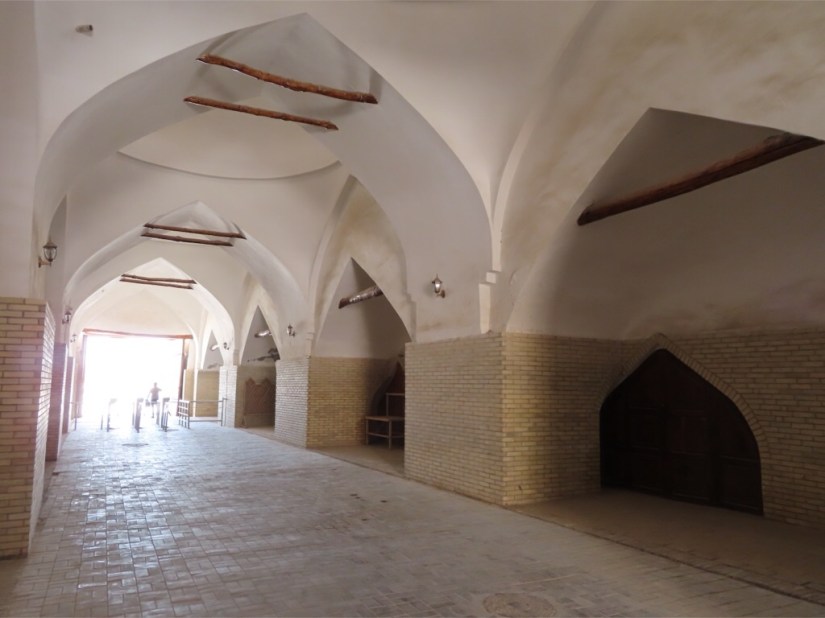
Outside there was a bazaar and local housing which was all cleared by the government a few years ago, but so far nothing more has happened.

We chatted to Nodir who is converting this madrasa to the Polvon Qori Hotel and he proudly showed us round. I’m sure it will be lovely when finished so one to look up if you are tempted to visit.

It is still possible to walk along one section of the city walls …
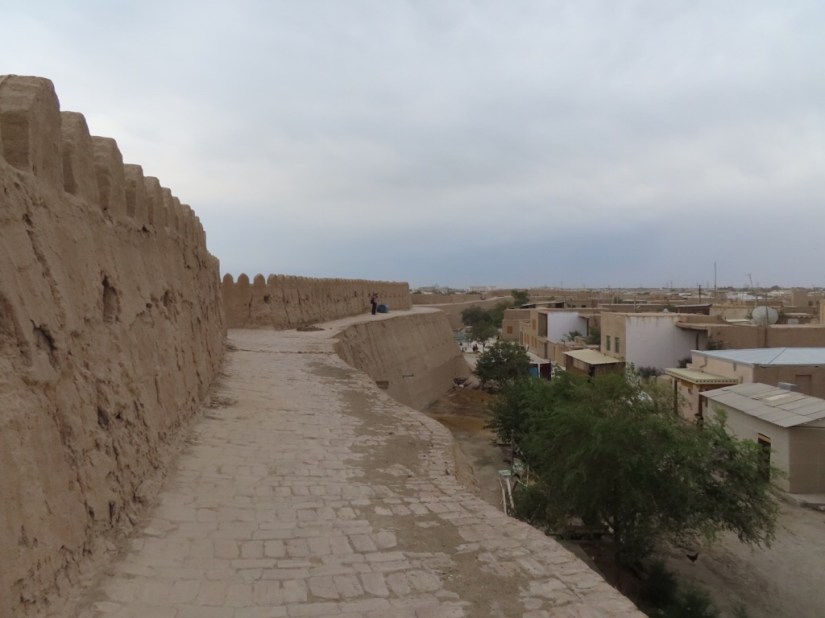
Just like Tashkent, Khiva was destroyed by Genghis Khan in the C13th, recovered under the Mongols and Timur then prospered under the Shaybanids, who ruled throughout the C16th and made Khiva the capital of Khorezm. Much was destroyed when the Persian Nadir Shah took the city in the C17th, but Persian control only lasted a few years and then Khiva Khanates took power. Mukhammad Amin ruled the area from 1763 to 1790 and began the process of re-populating and restoring the city. His immediate successors such as Mohammed Rahim (r. 1806-25), Alla Kuli (r. 1826-42) and Mohammed Amin (r. 1846-55) continued to strengthen the power of the state by reducing tribal conflict, reforming taxes, minting new coinage, and sponsoring large-scale construction projects. They built up a reputation abroad for their dictatorial style of leadership and the city prospered from the sale of slaves in the large market in the middle of town.

Slavery was the way of life in Central Asia. Nomadic tribes began to depend on Khiva for grain which couldn’t be grown without extra labour so the slave trade became of mutual benefit. Most slaves were brought by Turkmen tribesmen from the desert or Kazakh tribes of the steppes, who raided those unlucky enough to live or travel nearby and most were Kurds and Persians. By 1819, one foreign visitor to Khiva estimated that there were 30,000 slaves in Khiva, including 3,000 Russians and it was said that a Russian male in good health was worth four good camels. The practice of slave trading was to continue up until the beginning of the twentieth century but it was not until the 1920’s that the remaining slaves were freed as part of the People’s Revolution.

The number of Russian citizens held as slaves and the desire to control the trade in the region were two reasons that Russian interest in Central Asia increased in the C19th. Russia also needed to establish a secure source of cotton as The American Civil War had cut off Russia’s cotton supplies.

On the third attempt, Russia managed to annex the Khanate of Khiva in 1873 and make it a Russian protectorate and by 1876 all of modern day Uzbekistan was under Russian control. The Russians substantially increased cotton production which they shipped to Russia, but otherwise they interfered little with the indigenous people and the Khans continued as local leaders.

Following the the Russian Revolution of 1917, Khiva had a revolution too, and in 1920 the Khanate was replaced by the Khorezm People’s Soviet Republic which later became part of the Uzbek Soviet Socialist Republic and then modern Uzbekistan.

We had chosen to stay in the heart of the old city and were welcomed at the traditional Meros B&B by Jalolladin and his family. Like many of the houses, it is made with brick and rendered with a mud and straw mixture. Our room was decorated with a lovely painted wooden ceiling and local fabrics and had a balcony overlooking the wall where we could sit and drink tea as well as the rooftop where we could enjoy the great view with a beer or dinner.
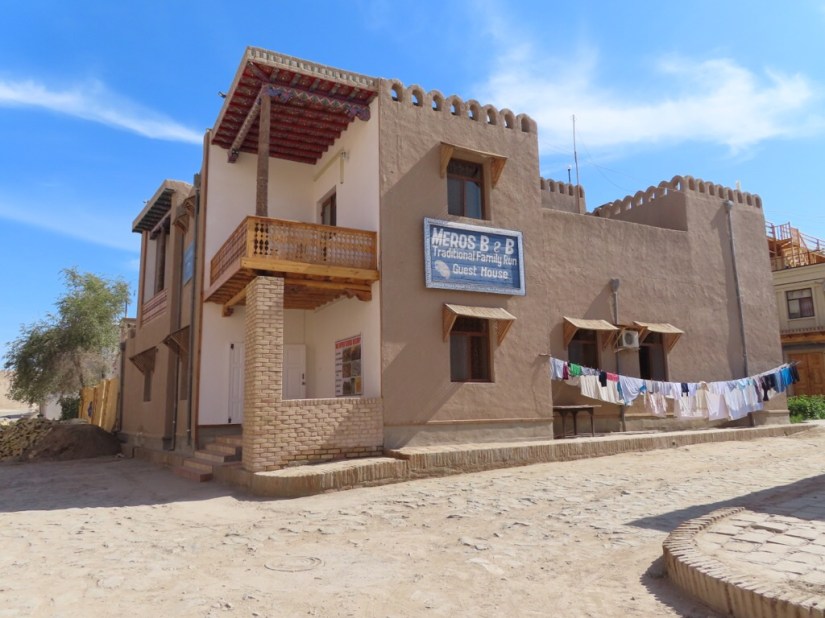
Khiva was divided into two parts in the C19th, Ichan Kala, the inner city with 10 meters high wall containing the Khan’s palace and where high officials, clergy and rich merchants lived, and Dishan Kala, the outer city where ordinary people, small merchants and craftsmen lived. The old city got UNESCO World Heritage status in 1990 and contains 54 historic buildings.

We’ve spent three days soaking up the Ichan Kala, the first day just wandering and then the next two days with the ticket that enables entry to the 54 historic buildings in the city. It seems like a time warp – devoid of cars in its central areas, and with most of the modern infrastructure hidden from view – we especially liked these AC covers!

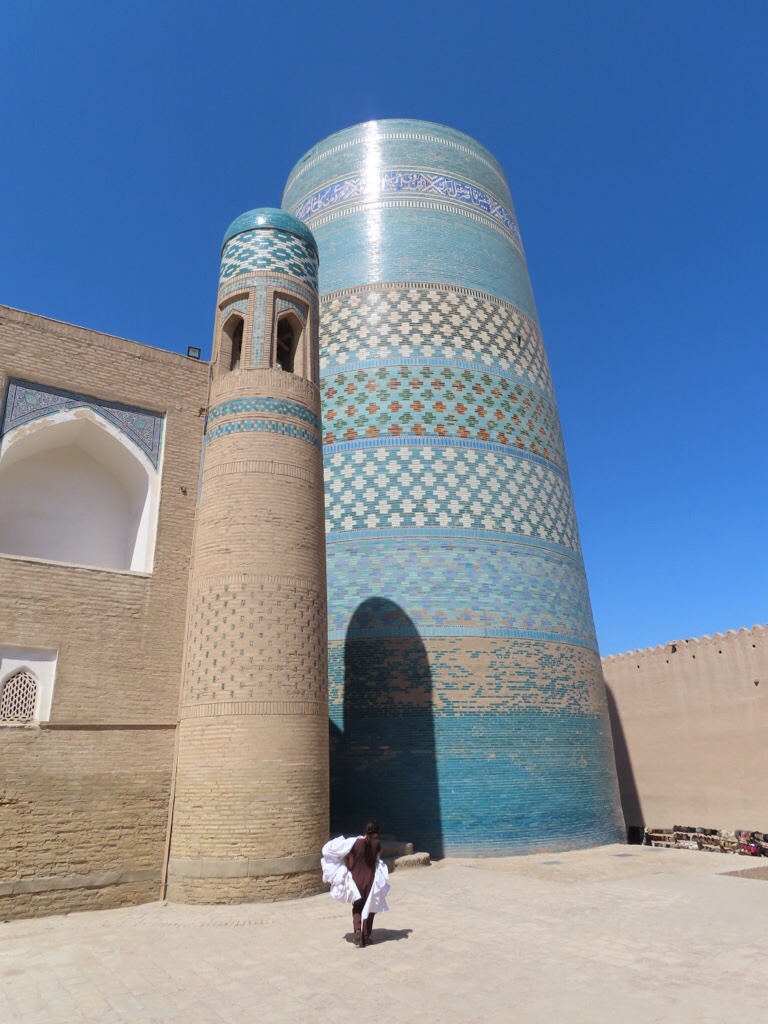
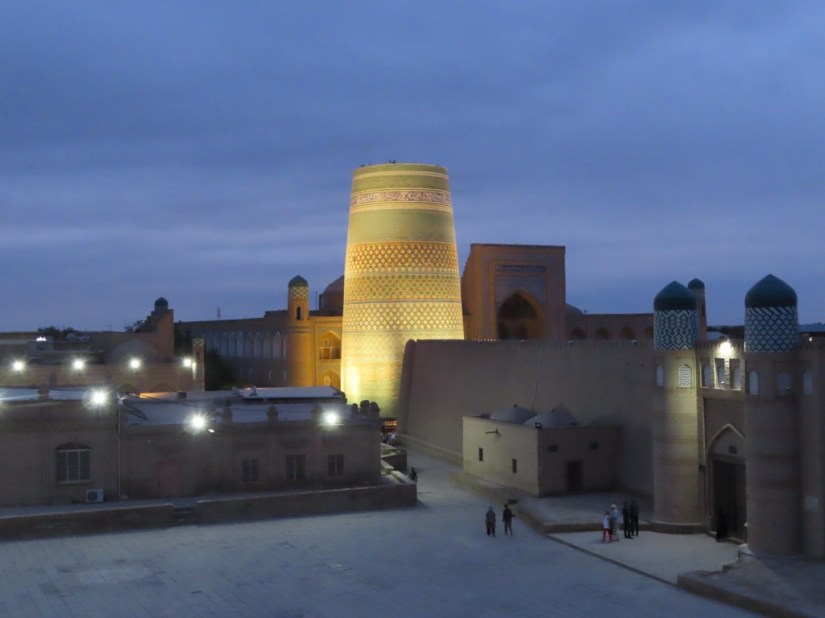
So where to start, maybe with the other most iconic symbol of Khiva, the unfinished Kalta Minor Minaret, commissioned in 1851 by Mohammed Amin Khan but only reaching 26m before the Khan’s untimely death, rather than the 70m planned. Nonetheless, it is still dazzling, covered in turquoise tiles … and now part of a smart hotel.

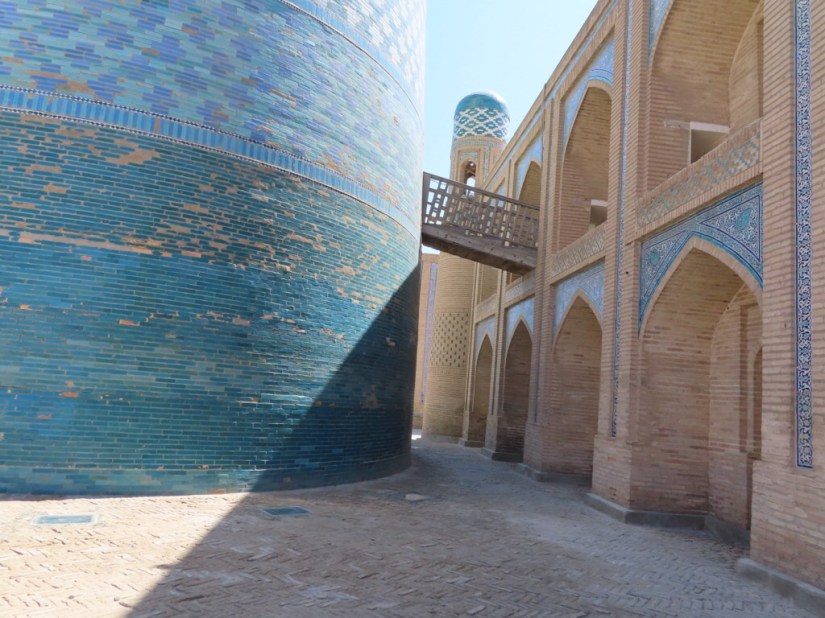
There are a couple of palaces … Kukhna Ark, the Khiva rulers’ own fortress and residence, first built in the 12th century by one Ok Shaykh Bobo, then expanded by the khans in the 17th century. The khans’ harem, mint, stables, arsenal, barracks, mosque and jail were all here.

Remaining is the restored, open-air throne room, where the khan dispensed judgement. The circular area on the ground was for the royal yurt, which the no-longer-nomadic khans still liked to use.

The tiled iwan or portico is simply stunning.
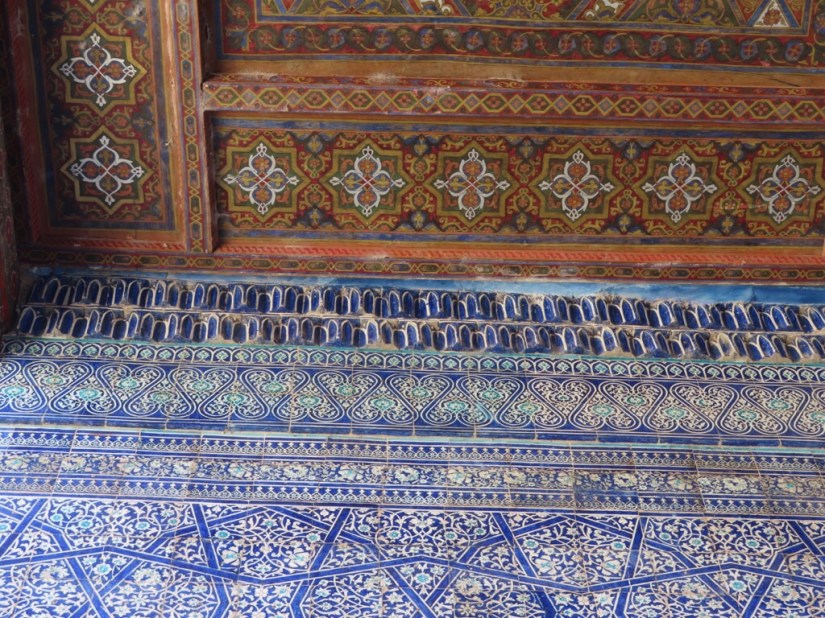
Behind is a beautifully decorated room where the wooden throne of the Khan sat, gilded in silver, but now in St Petersburg Hermitage.

There is also the 19th-century Summer Mosque is open-air and spectacularly ornate with superb blue-and-white plant-motif tiling and a red, orange and gold ceiling …

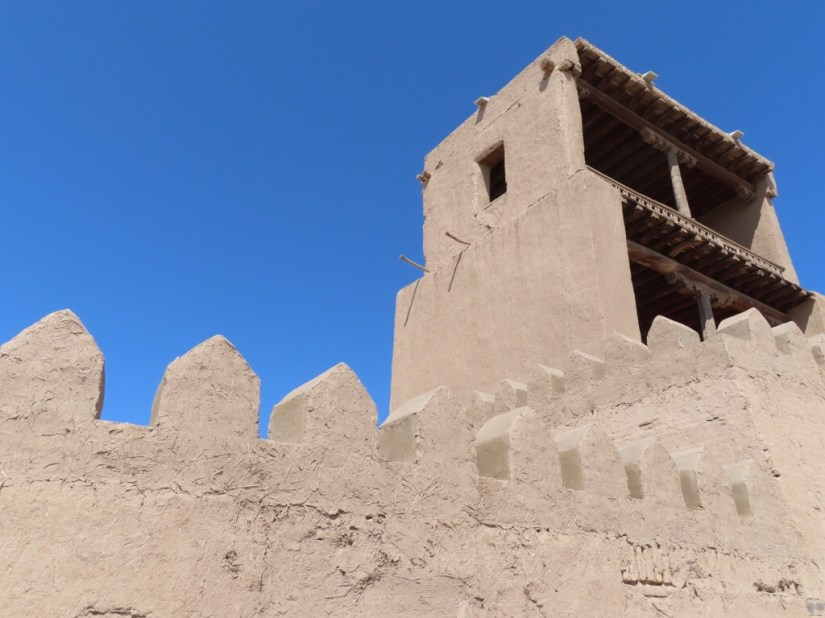
… and a watchtower which gives great views over the city …
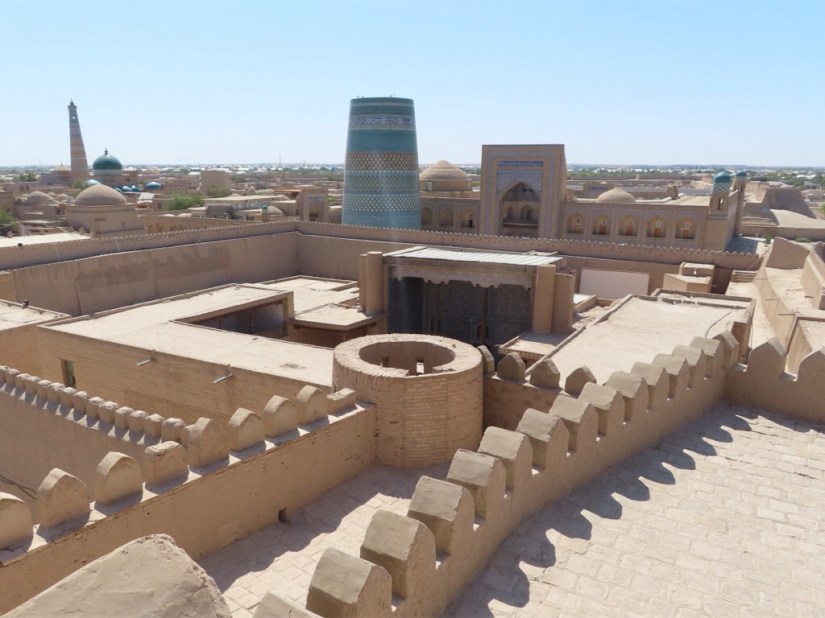
Tosh Hauli means Stone House because it is made of stone-hard bricks rather than clay, and this palace contains Khiva’s most sumptuous interior decoration, dense with blue ceramic tiles, carved wooden pillars and elaborate ghanch. Built by Allakuli Khan between 1832 and 1841 as a more splendid alternative to the Kuhna Ark, it’s said to have more than 150 rooms off nine courtyards, with high ceilings designed to catch the slightest desert breeze.

This is the main harem area with a row of 5 north facing decorated irwans for the Khan and his four official wives.

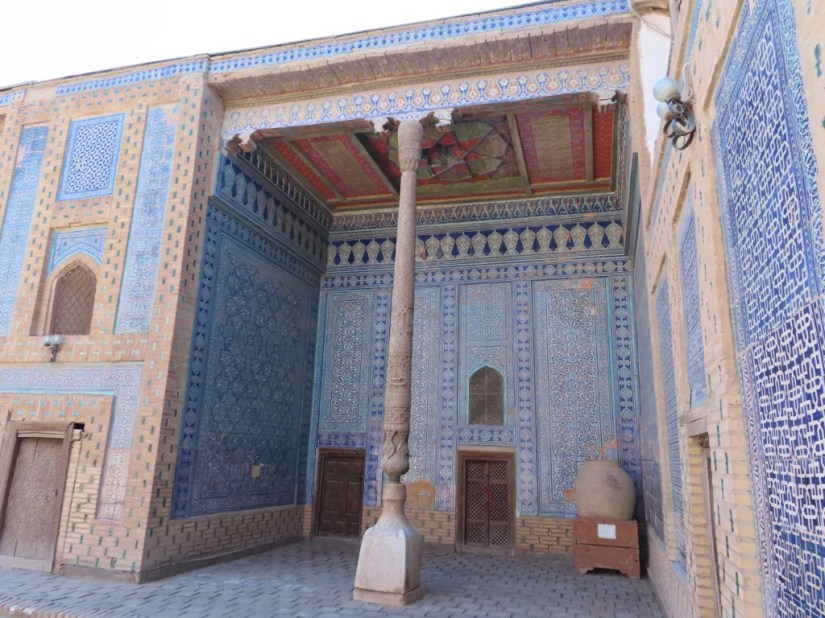
One pillar has the Zoroastrian emblem which signifies wealth and eternal life.
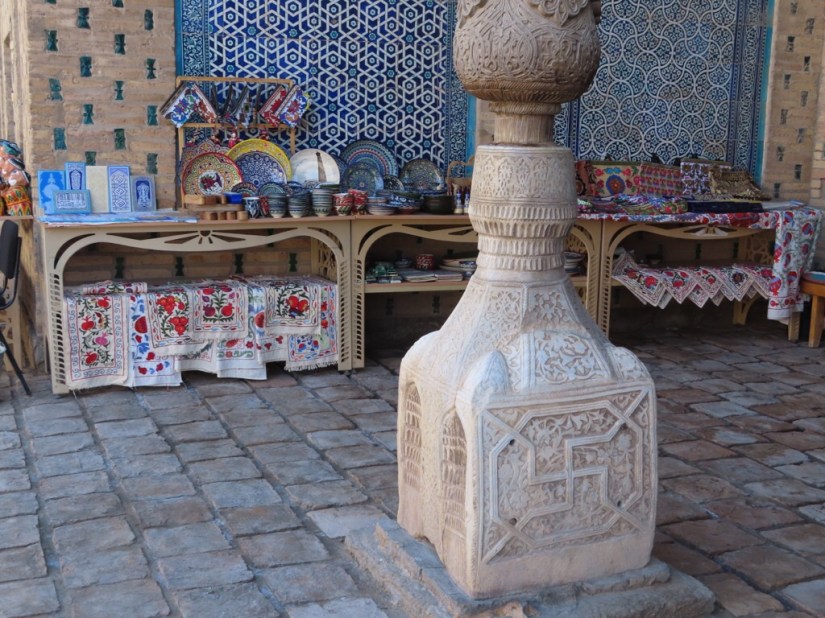
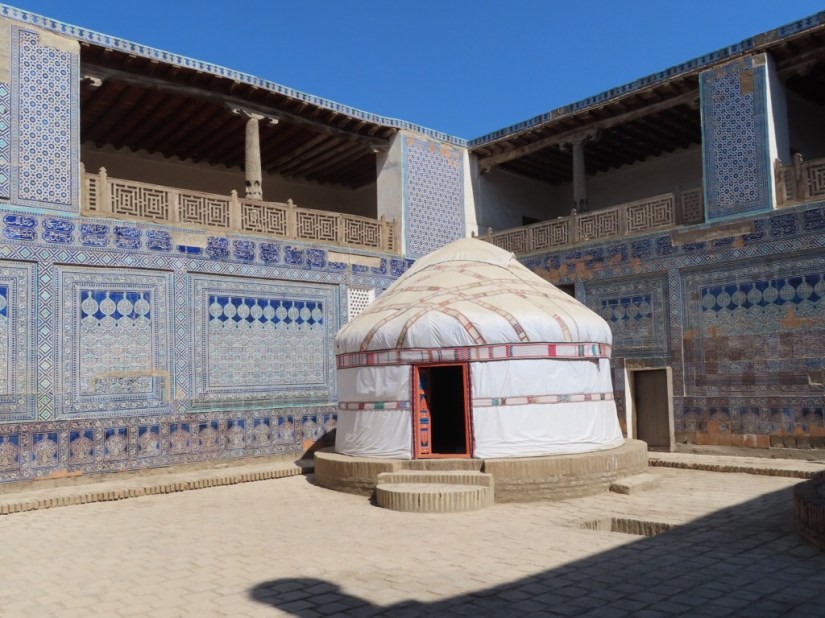
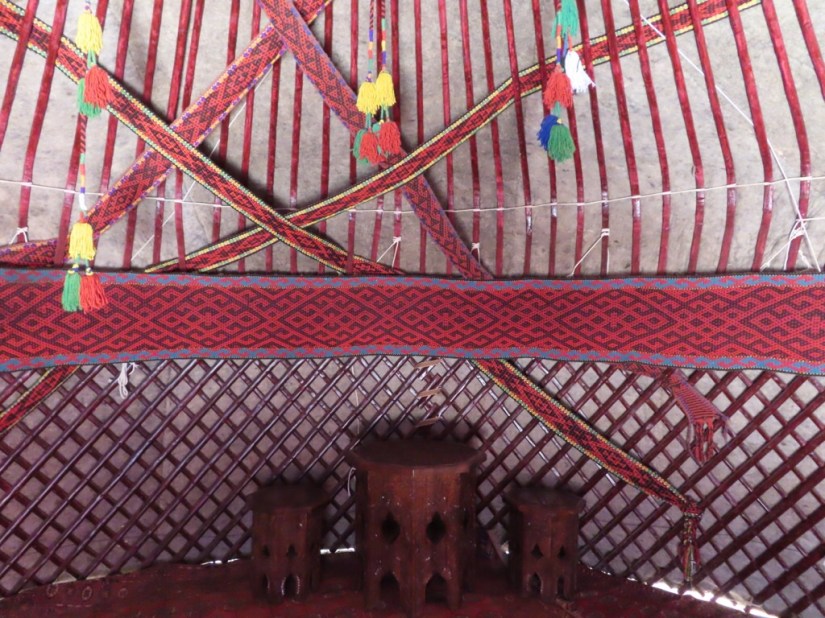
There are also other courtyards, this one complete with yurt …
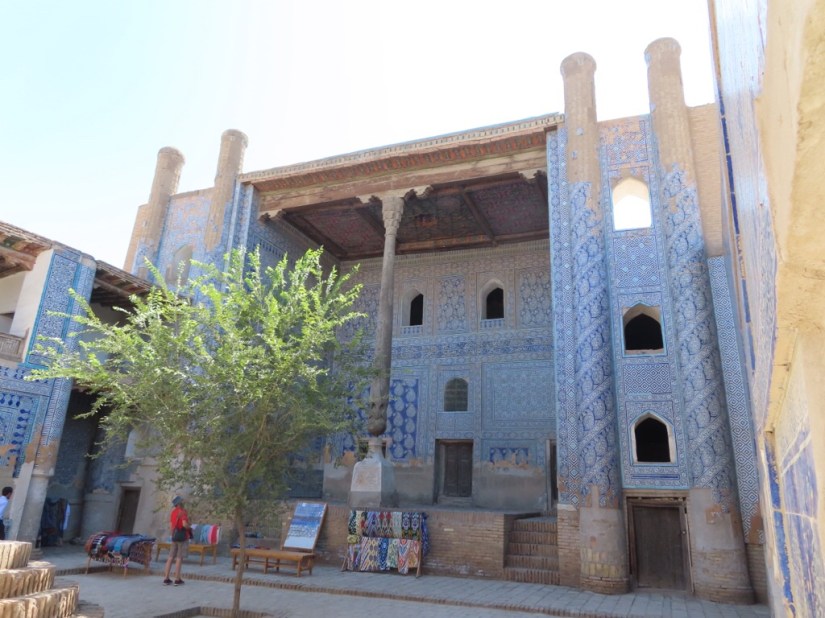
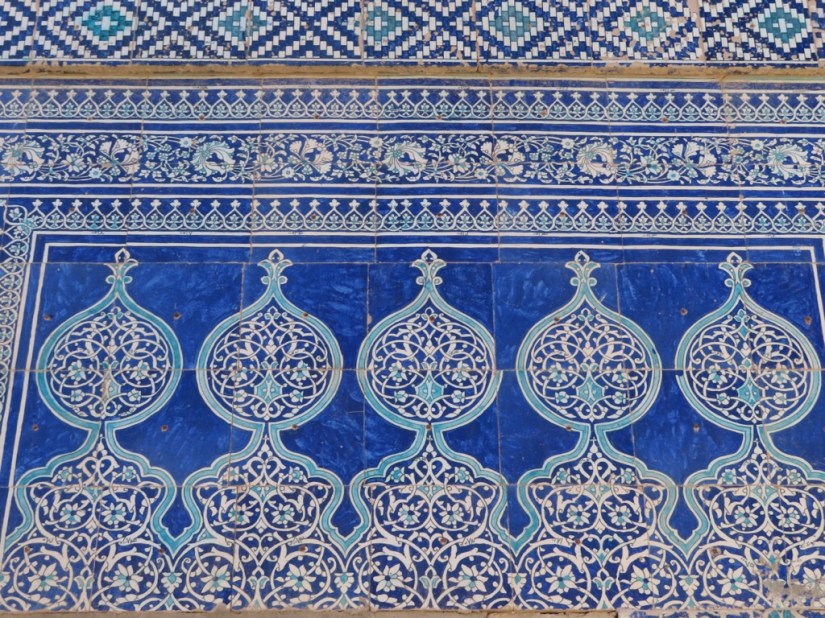
There are two mosques to mention, the C18th Juma or Friday Mosque with a rectangular prayer hall with a roof supported by 213 black elm pillars of various ages, all with carved designs …

…and a 33m minaret …
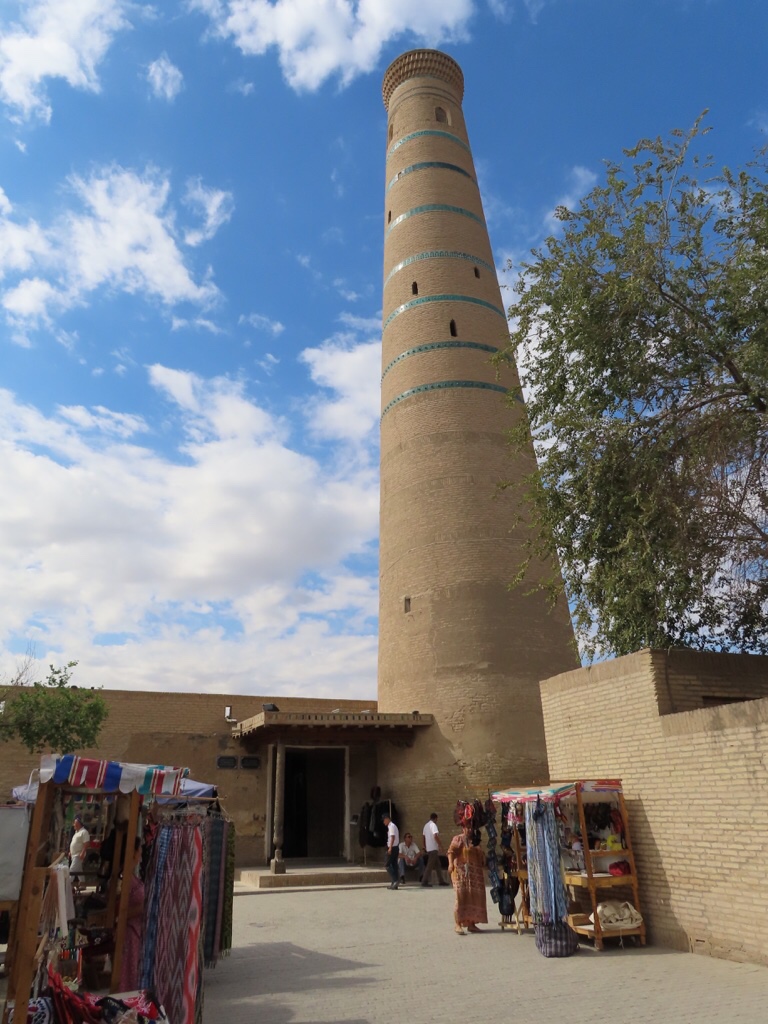
… and the small district Ak Mosque, unique for its wrap round verandah.

The most revered place in the city is the Pahlavon Mahmud Mausoleum, beneath a turquoise dome, with the tombs of the poet, philosopher and wrestler Pahlavon Mahmud who became Khiva patron saint, as well as several khans.
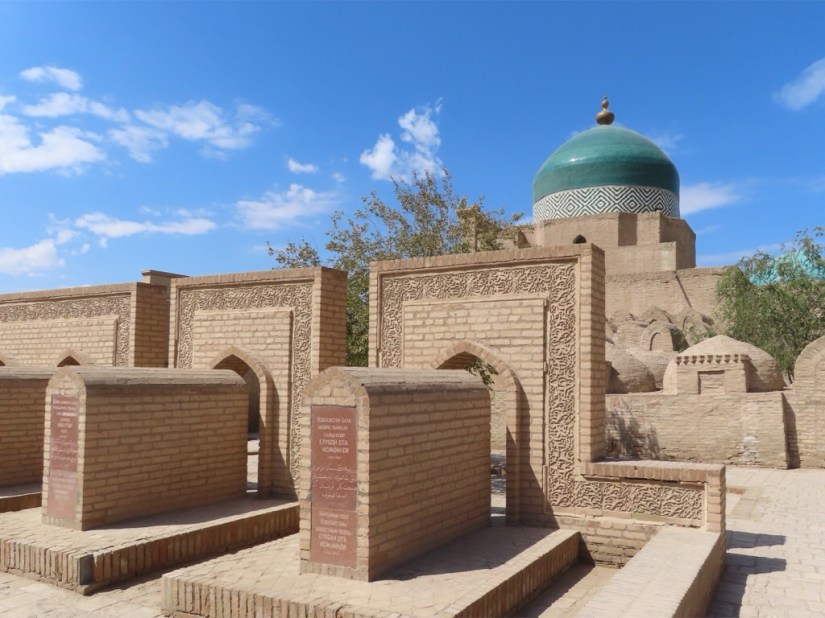
There are also numerous masdrassas, most now utilised as museums, workshops, shops, restaurants or hotels. The Islam-Khodja complex, built in 1910 comprising a madrasa which introduced modern education, customs, and economic development to the traditionalist Khanate …
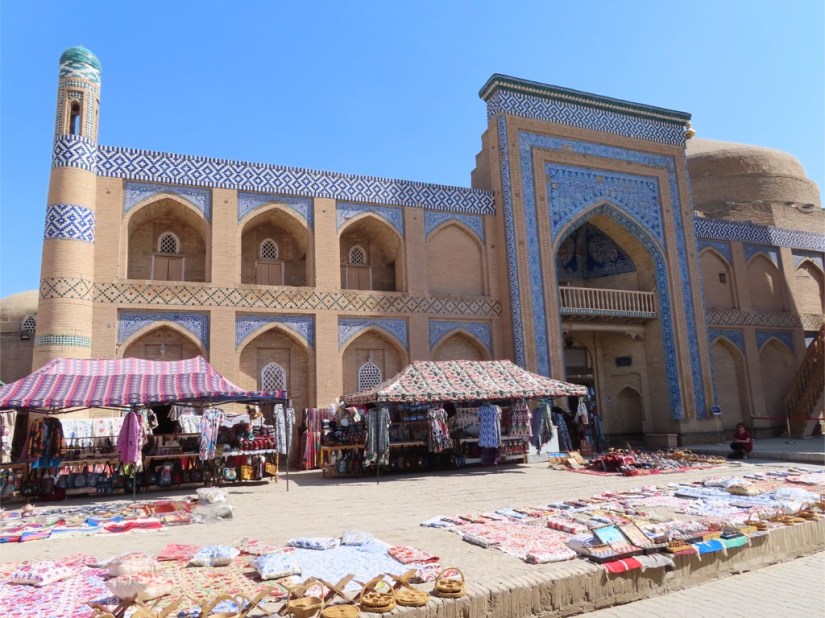
… as well as a 45m minaret …

… which we were able to climb …
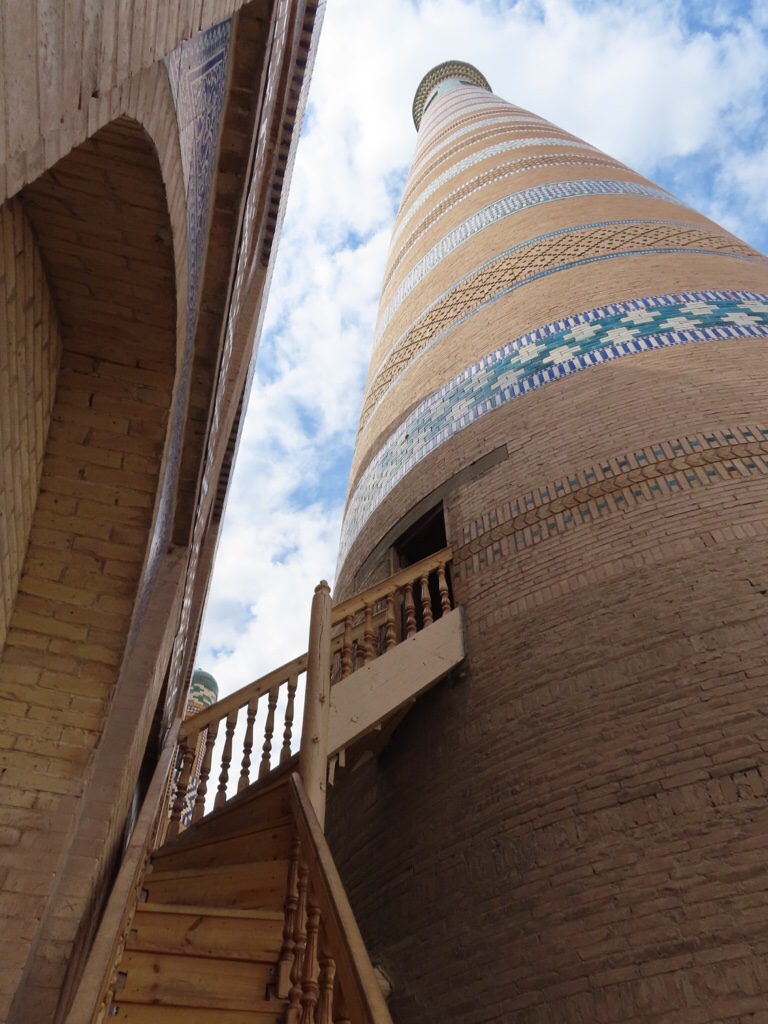
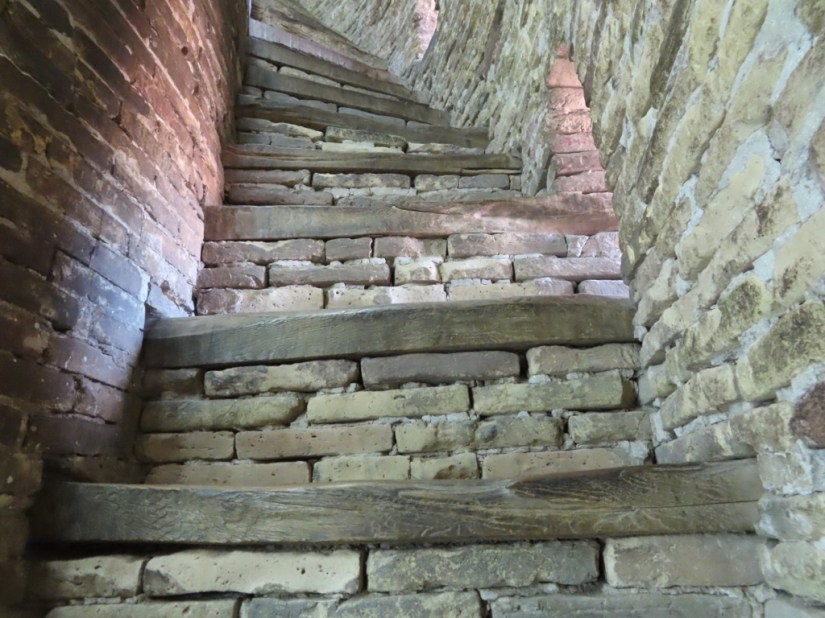
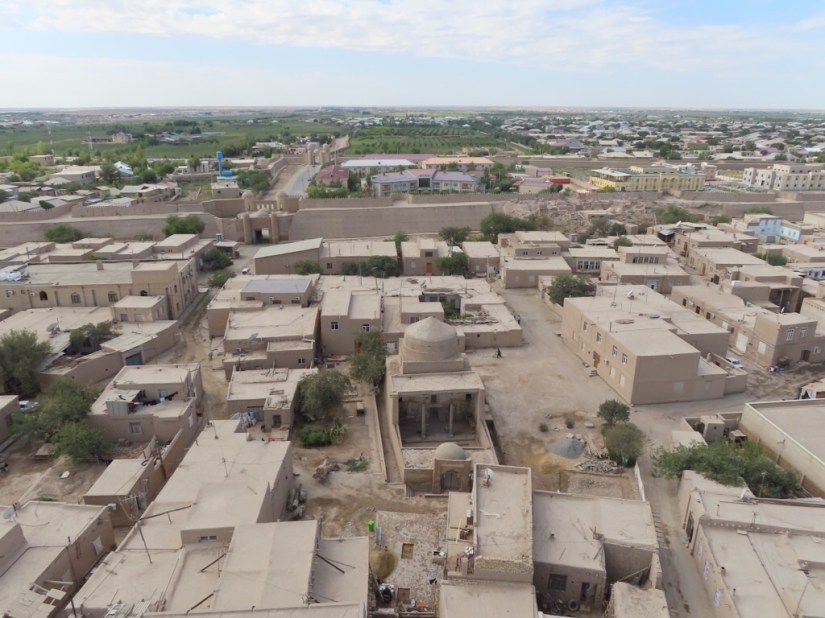
… for a great bird’s eye view of the city.
Opposite, looking slightly incongruous, is the First Russian School, built in 1912. The tall glass windows and lack of courtyard make this design ill-suited to the desert climate, but no doubt it was a sign of the forward thinking curriculum of Russian arithmetic, and world history.

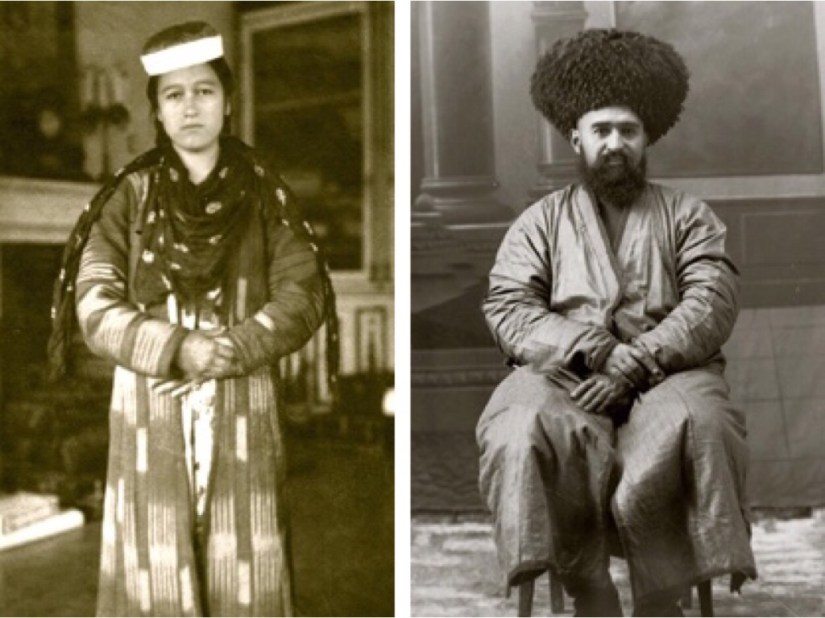
It houses a photography museum which showed the work of a local photographer called Devanov who tried to record a Khiva that was slowly disappearing and here are a couple of photos from the late C19th …

The men are wearing chugirmas which are the historically distinct sheepskin headwear for Khorezmian men, also being worn by the little band of players who have been plying their art in the street …

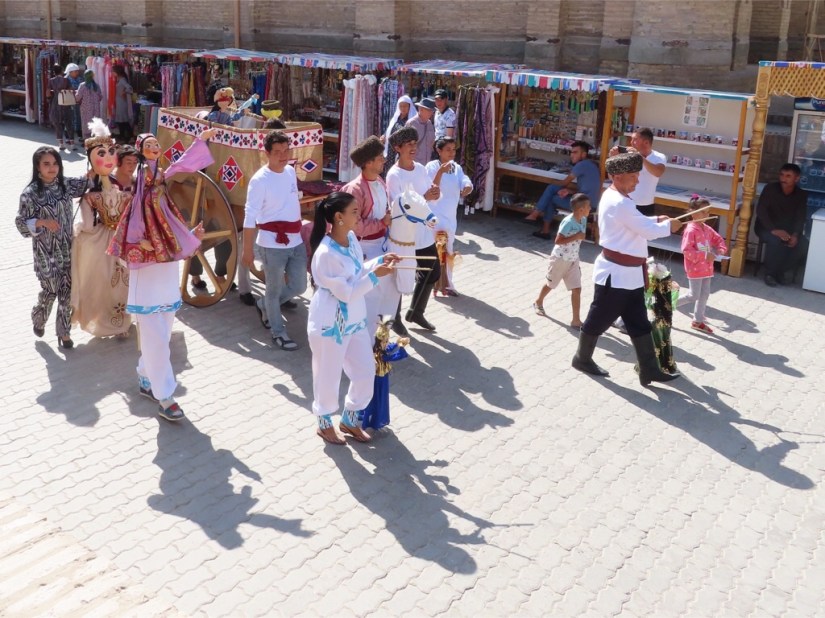
… and which explains the plentiful tourist hat stalls!
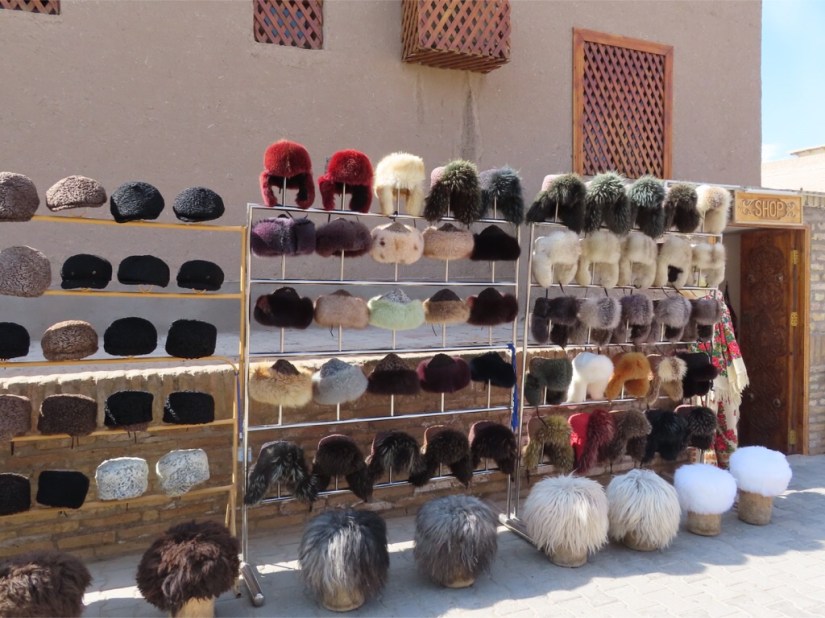
There are lots of fabric items for sale, scarves, table linen and also coats and dresses, made to measure in a Uzbeki material called adras which is a 50-50 silk cotton mix often with traditional ikat pattern. The pattern is made by binding individual yarns or bundles of yarns with a tight wrapping applied in the desired pattern. The yarns are then dyed and woven … and I chose one in shades of blue to bring home, which might get modelled during the trip so watch this space!

The Mohammed Rakhim Khan Madrassa was completed in 1876. As the Khan was a ruler with one foot in the historical traditions of the Khiva Khanate, and the other foot in what promised to be a Russian-dominated future, the madrasa taught not only traditional Islamic studies but also secular subjects such as astronomy, geography, and mathematics. The tiles were restored in 1992.

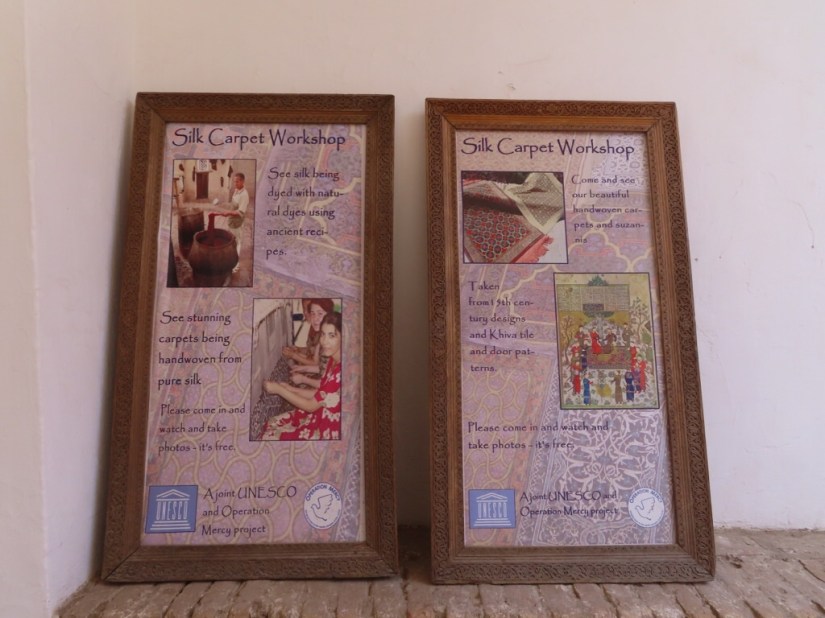
While researching our trip, I discovered a really useful online guidebook (http://www.khiva.info/display.php?site=khiva&page=&lang=en) which was set up a few years ago with help from a charity called Operation Mercy. One of the authors was an English volunteer called Christopher Aslan Alexander who ended up staying 7 years, setting up The Silk Carpet Workshop to train and give work to local people and then wrote A Carpet Ride to Khiva about his time here. We visited and saw carpets being woven.
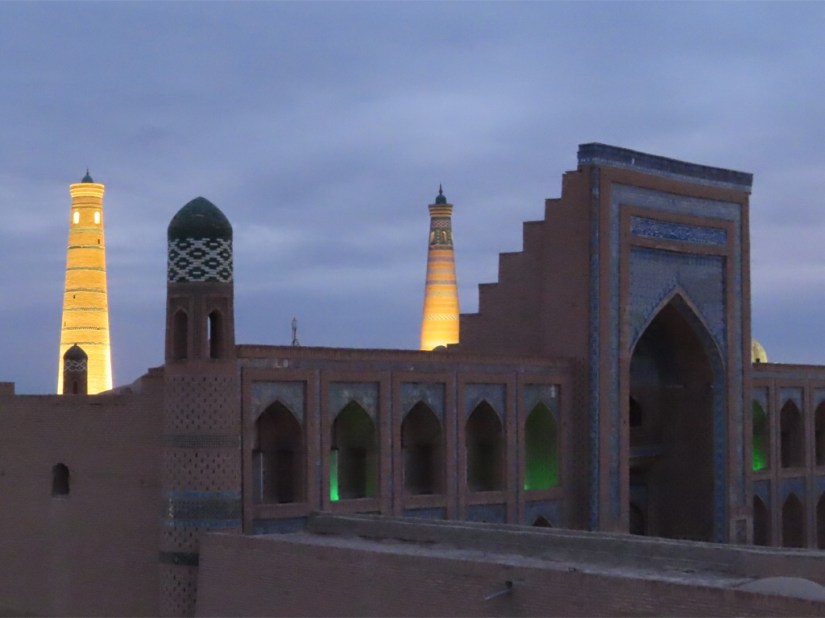
We have also taken photos at either end of the day, taking advantage of the good light, so here are early morning shots from Meros roof …
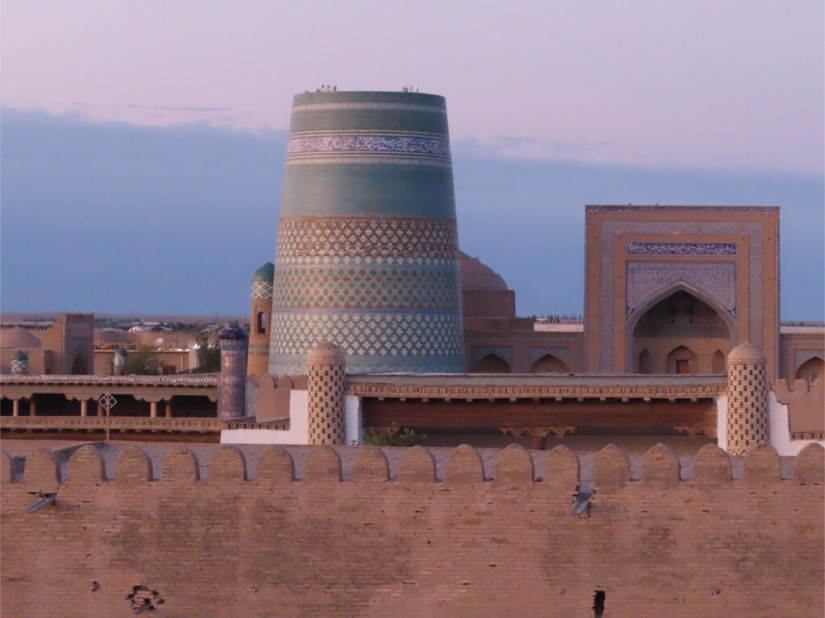
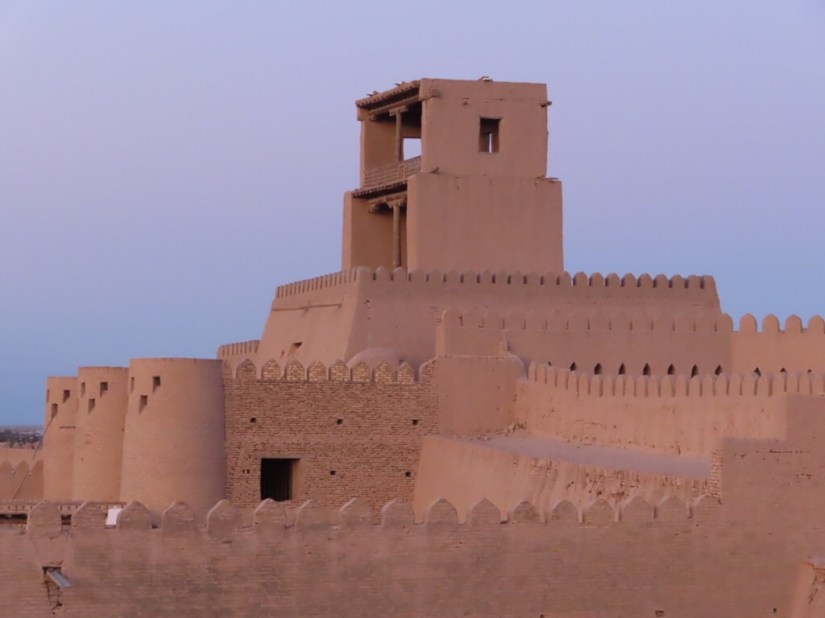
… and others late in the day …

… and also watching the watchers!

We’ve had a variety of food – generous breakfasts, salads, kebabs, soups, filled dumplings called manty and little pies called samsas … in a variety of spots including home cooked a Meros dinner on the roof, Terrassa Cafe, also with a great view and the friendly Teahouse Bir Gumbaz.
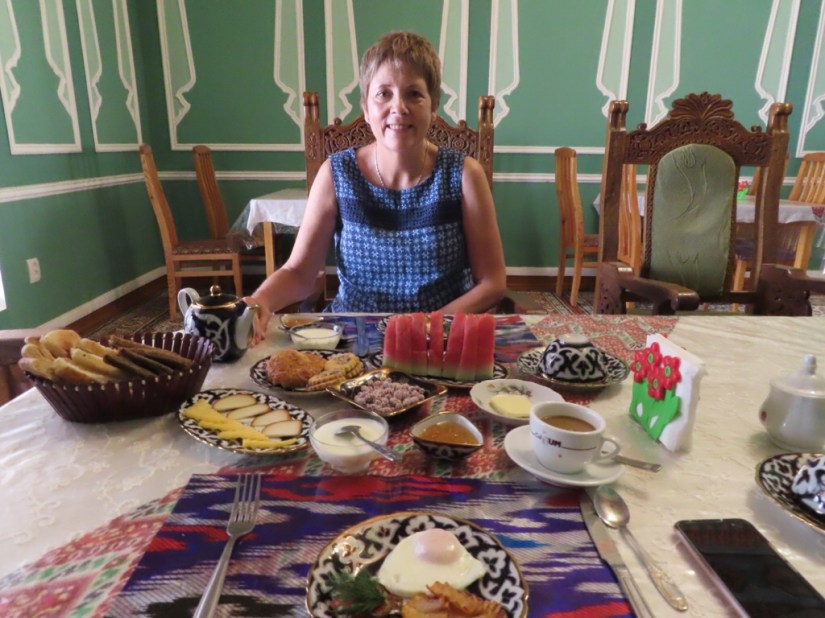
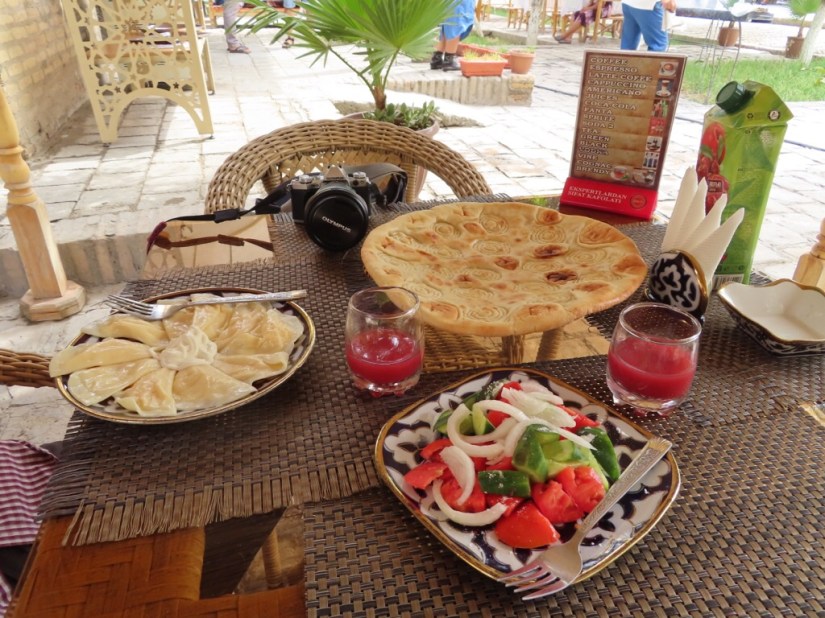
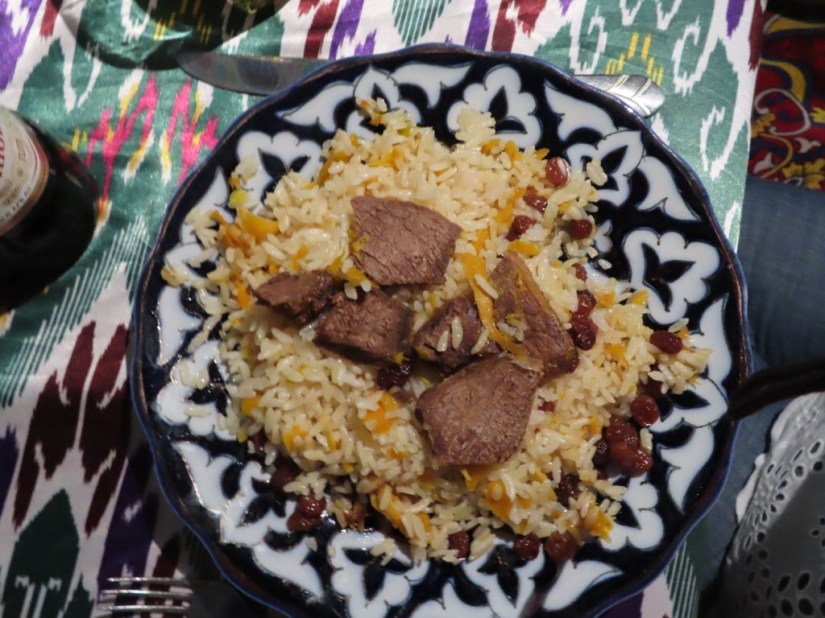
I’ve tried the plov, which had shards of carrot and raisins in the rice and slices of beef on top and was not nearly as greasy as I expected, but I’m sure it would have been different if I’d tried it in the market! Jokingly it is said the word for foreplay here is plov … as the oil in the bottom of the pan is meant to invigorate!
As if there haven’t been enough pics, here are just a few more …
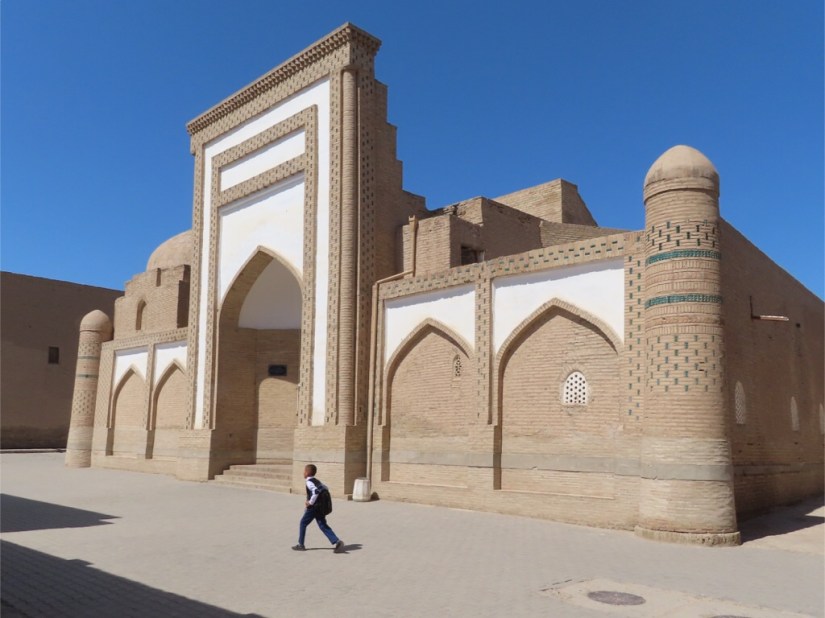
Finally here is Micha, the most famous … and only camel in Khiva who has been posing for photos for 20 years and is somewhat of an institution …

Map
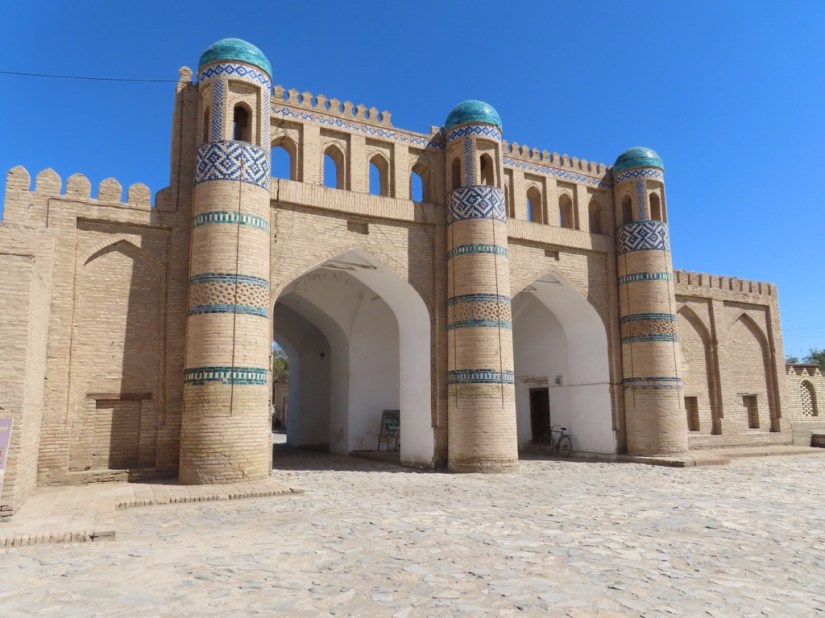
Finding our Feet in Tashkent

It has taken a couple of days to adjust to being away this time so I’m writing this sitting in Tashkent airport as we are about to move on!

While in Tashkent, we had hoped to visit a couple of museums to get a grounding in things Uzbeki and a look at the old parts of the city, maybe looking closer at the Soviet architecture when we return at the end of our trip. But of course nothing is that simple, everything is mixed up together. There is an excellent metro system, but there is quite a distance between stops so once we started walking, we found everything was further than we’d expected and we clocked up 11 miles on our second day! By day three we had embraced 21st century technology and the wonders of Y-taxi, the local taxi app with fares under £2 for a short hop and instantly everything became easier.

So Tashkent is the capital of Uzbekistan and is a metropolis of over 2.5 million people but it is also an old city which began as a settlement beside a fertile oasis. When the Arabs conquered the area in the C8th, it was already a major caravan crossroads on the Great Silk Road linking China with the Middle East and Europe and by the C11th it was called Tashkent, meaning City of Stone in Turkic. The city was destroyed by Genghis Khan in the C13th, recovered under the Mongols and Timur then prospered under the Shaybanids, the founding dynasty of modern Uzbekistan who ruled from the C15-17th.

They built the Kukeldash Madrasa or Islamic School, which had fallen into disrepair, but is now restored and back in use as a college for the study of Islam. The exterior has large Iranian-style iwan gates flanked by two levels of miniature iwan with pointed arches and small minaret-like towers called guldasta. Stylistically, apparently all madrasas in Uzbekistan are similar, whatever their age, although they can be decorated differently, and here there are lots of colourful majolica tiles.

Inside is a central courtyard with garden and fountain, surrounded with cells used as classrooms and dormitories for the students.

It was very peaceful walking round, yet so close to the bustle of the city just outside.

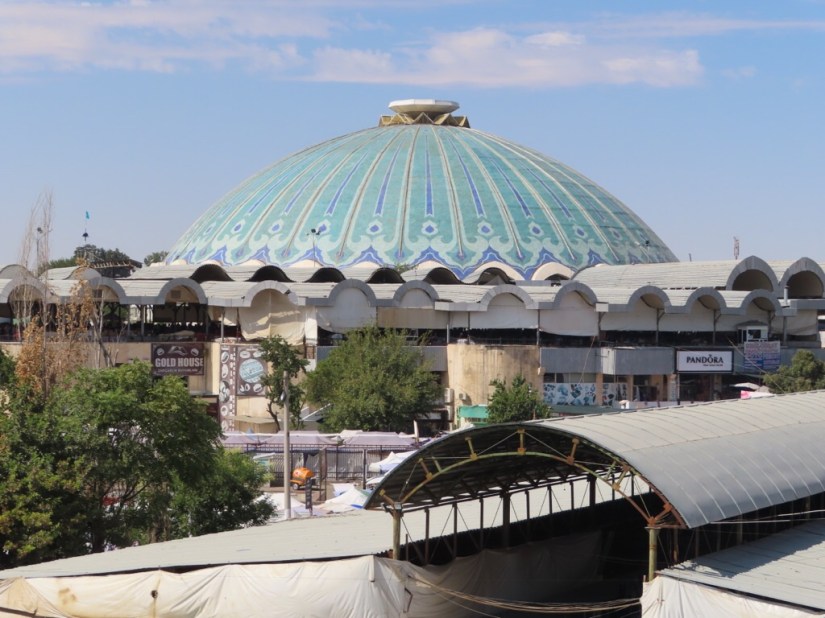
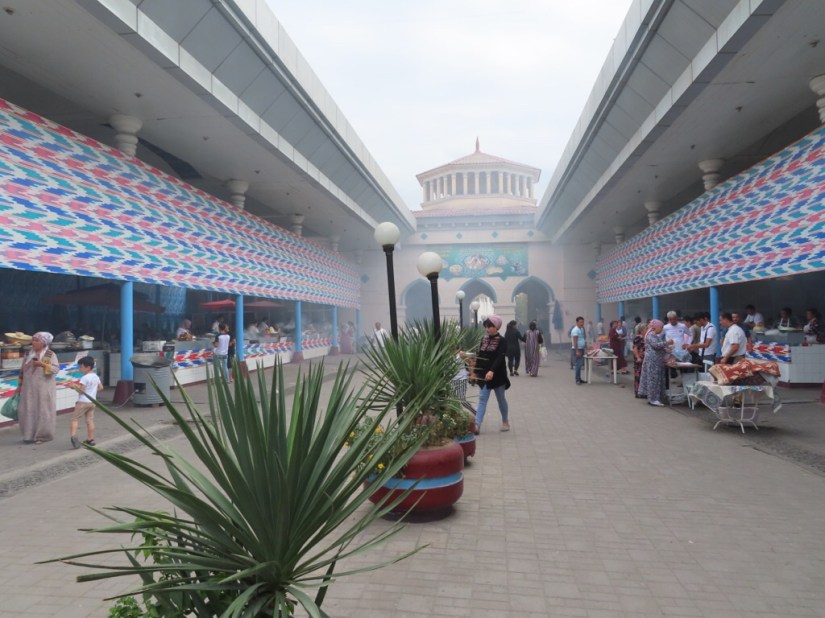
In the C9th roads led from all city gates to the Chorsu Bazaar, bringing traffic and trade to the center of the city. The surrounds would have been a warren of mud-walled houses and workshops, crowded bazaars, mosques, madrassahs and mausoleums. This is Chorsu Bazaar today …

… still a market and still hectic and filled with smoke from grilling kebabs!

Nearby is the Khast Imam Square with the beautiful C16th Barak Khan Madrassah at one end, now containing souvenir shops in the original student rooms.

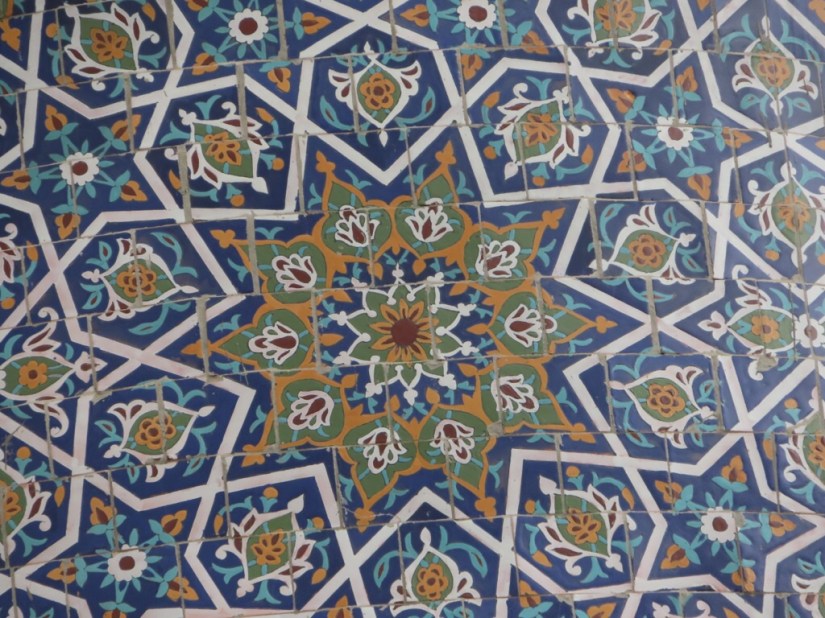
There is also a variety of patterned tiles … all in shades of blue!

The other end of the square, flanked by a pair of 50m-high minarets, is the Hazrat Imam mosque.

This is the largest place of worship in Tashkent and was built in 2007 in a record-breaking 4 months using sandalwood columns from India, green marble from Turkey and blue tiles from Iran.

The C18th Muyi Mubarak Madrasa is in the centre of the square holding what once was thought to be the oldest Quran in the world and also ‘the sacred hair’ believed to have belonged to the Prophet Muhammad. Unfortunately, it was closed when we visited so we missed these treasures.

As we left we saw the mausoleum of the scoholar and poet Abu Bakr Kaffal Shashi …

… and a brand new mosque, coming soon!

The other real treasure we found in Tashkent was the Museum of Applied Art, situated in the former home of Imperial Russian diplomat Alexander Polovtsev. This grand mansion was built in 1930 and decorated in traditional Uzbek style, using master craftsmen and contains a superb collection of applied arts, many collected by Polovtsev.

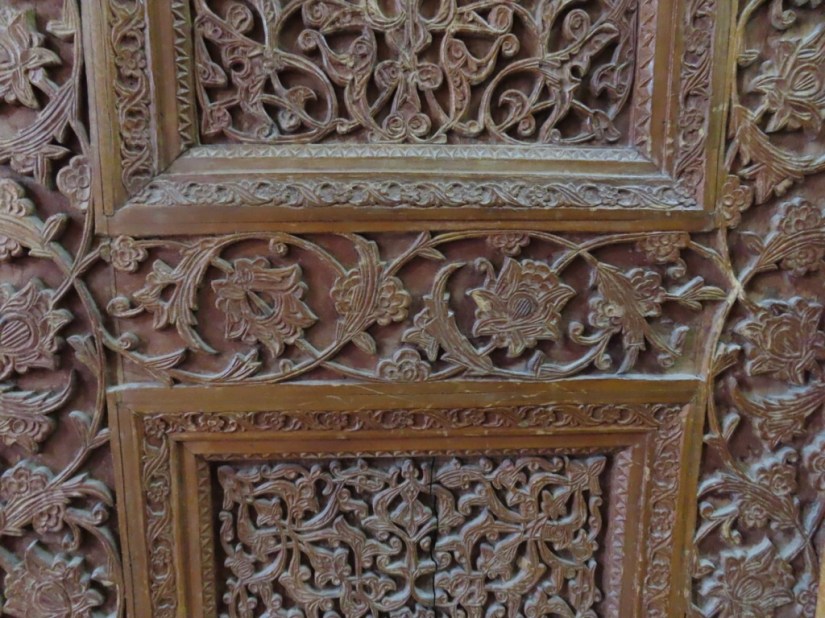
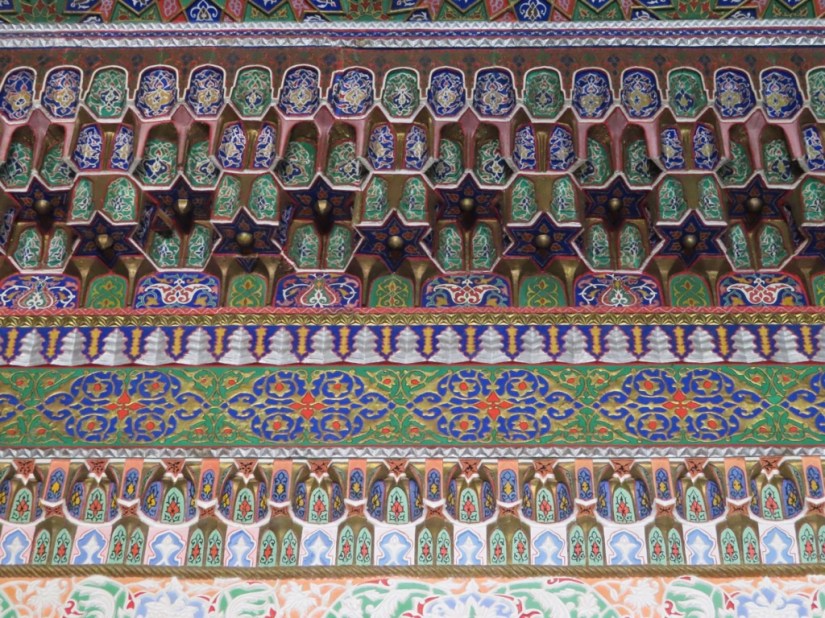
The decoration comprises panels of carved and painted plasterwork called ghanch and ceramic tiles on the walls and typical Tajik style wooden ceilings, also carved and painted. These started in the porch …

and continued into the central hall …

… and here are some details …

The collection included ceramics, metalwork, painted wood, jewellery and textiles including clothing, beadwork as well as printed and embroidered fabric.

Suzanis are large, hand-embroidered textile panels with the word coming from the Persian word suzan, which means needle.

Some were luxurious with gold thread on velvet …

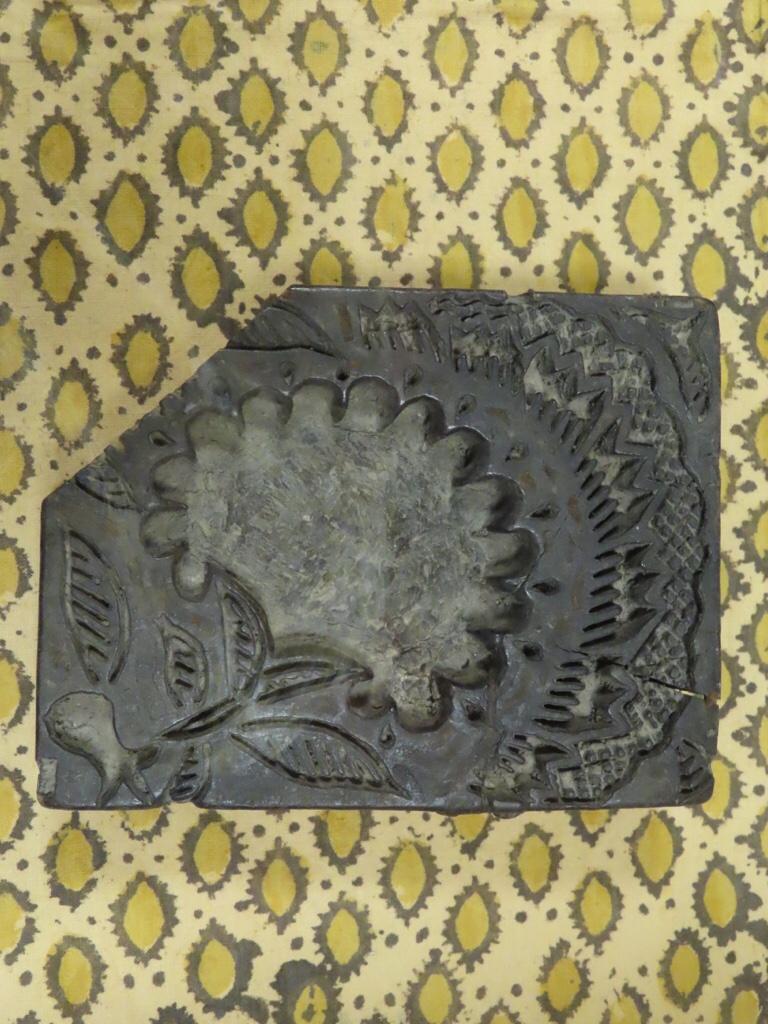
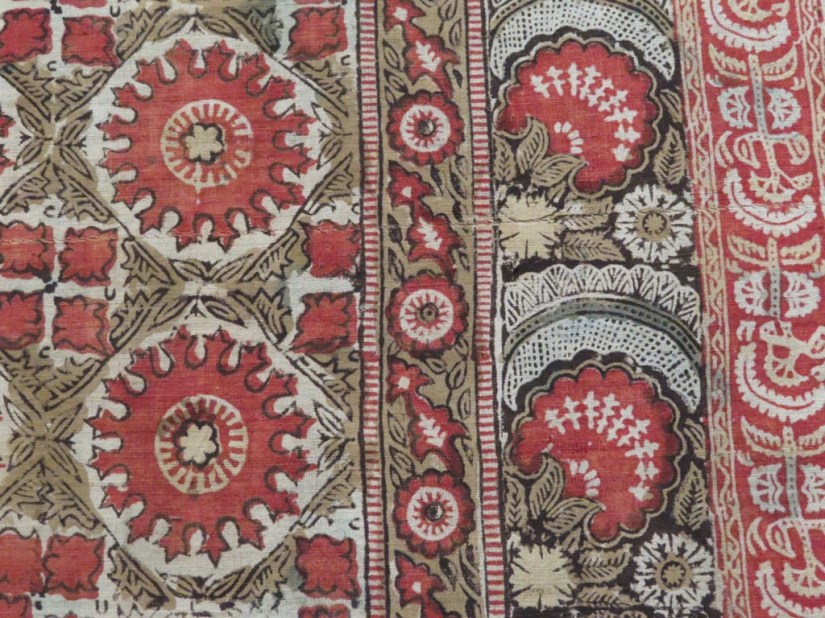
… and here is a wooden block and printed fabric …

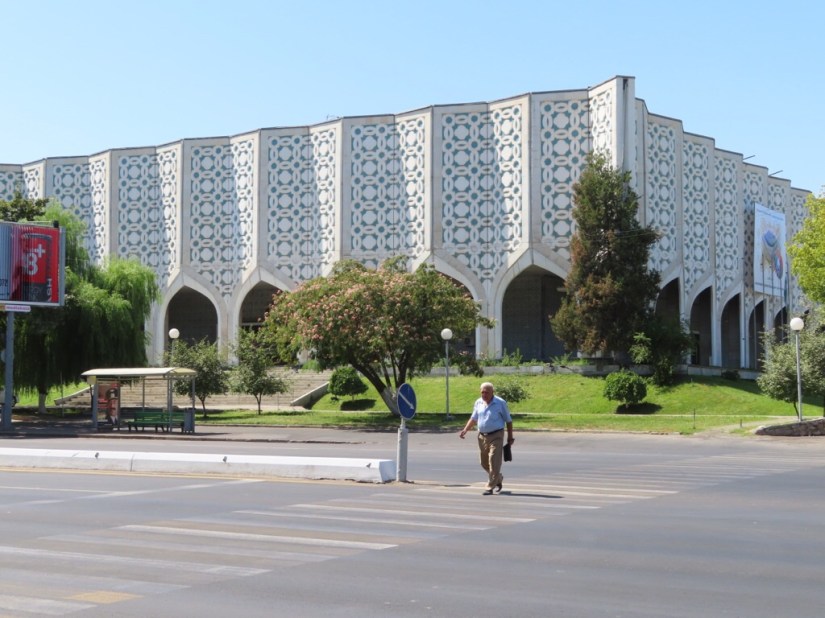
The State History Museum links the old with the new as it is housed in a building dedicated to Lenin and completed in 1970 to mark the centennial of his birth. It took history from prehistoric times to the present day on one floor while the top floor detailed the virtues of the independent Uzbekistan, in every aspect, but it wasn’t very engaging and we didn’t stay long. The best part was the facade which is decorated in oriental modernist style with patterned window grilles called pandzhara, a motif that became increasingly familiar during our sightseeing here.

So the Russian army arrived in 1865 and made Tashkent the capital of its Turkestan Province, incorporating vast areas of Central Asia. Amir Timur Square was built to form the center of a new Tashkent and once contained statues of the first Russian governor of Tashkent, followed later by statues of Lenin, Stalin, and Karl Marx but it’s now Amir Timur and his horse who occupy the centre of the capital.

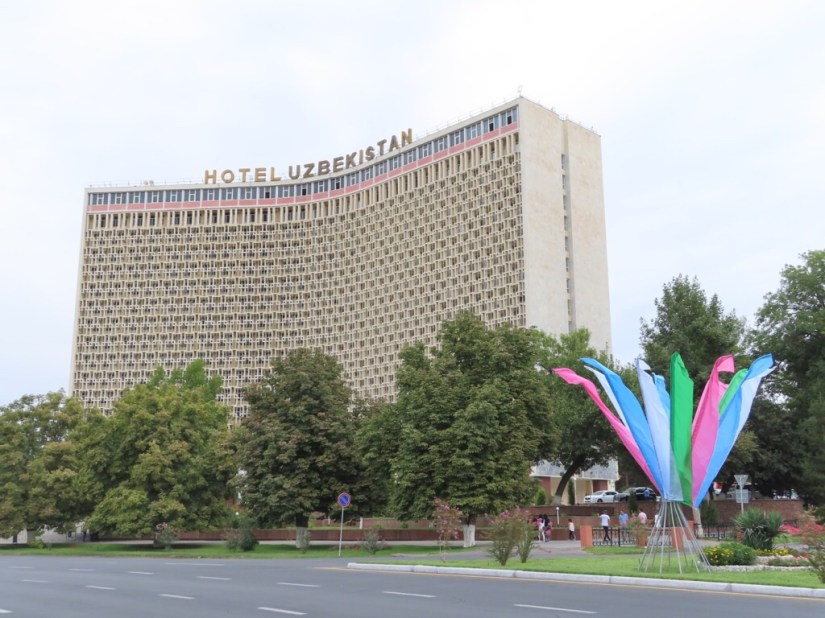
It also has a couple of the city’s iconic buildings – the Uzbekistan Hotel, generally looking a little tired but with a great facade …

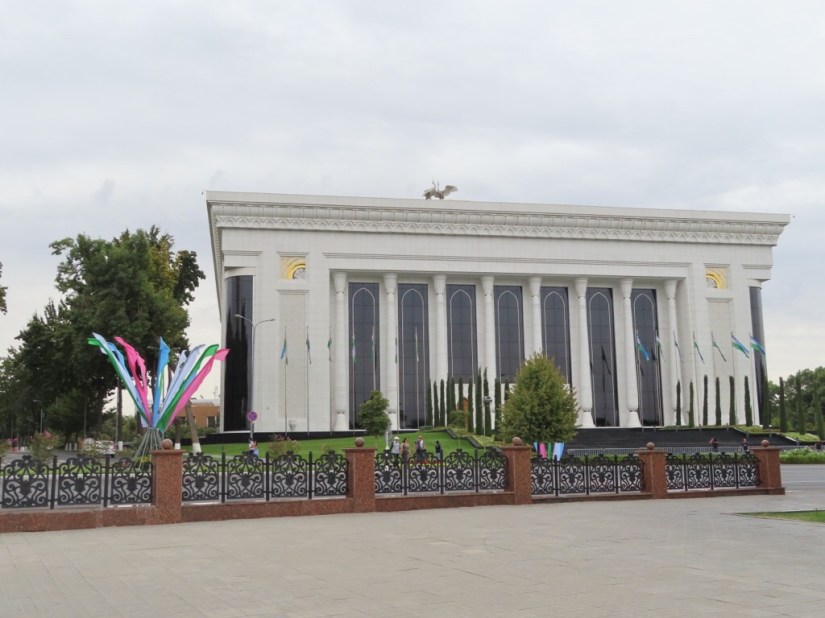
… and the more modern Forums Palace, built in autumn 2009 to hold important state and international events.

There is also the Tashkent Chime a symbol of the city since its construction in 1947, mirrored by a second chime since 2009.

Following the Russian Revolution in 1917, Tashkent emerged as capital of the Uzbek Soviet Socialist Republic and began to industrialize in the 1930s with scientific and engineering facilities being established in the postwar years.

The largest park in the capital was built on the site of an old quarry by Komosol Youth in the 1930s and is named after Alisher Navoi, the great Turkic poet and thinker.

It also contains The Istiqlol Palace, an events hall, once called the People’s Friendship Palace …

… complete with decorative facade …

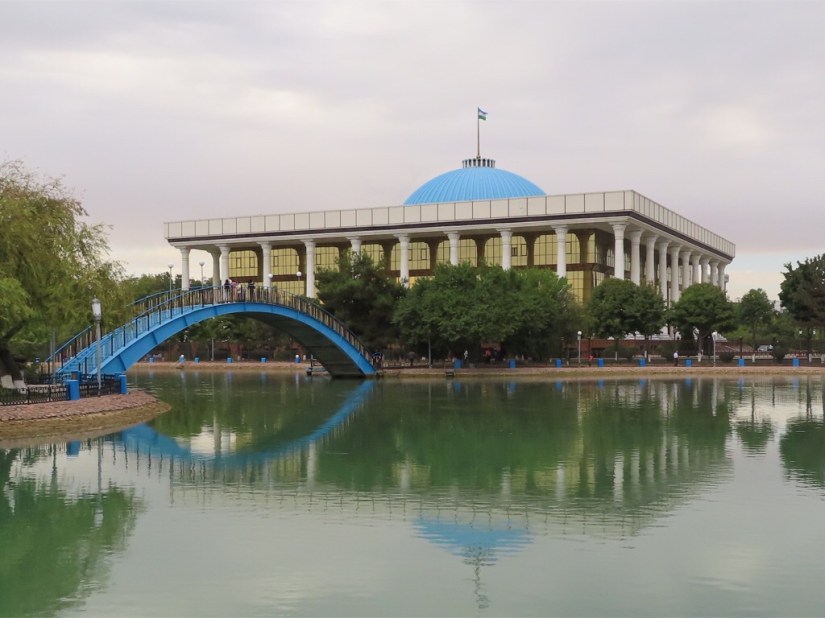
… and also a boating lake with Oliy Majlis, the Uzbek Parliament building behind.

Other parts of the park look a bit run down and less loved …

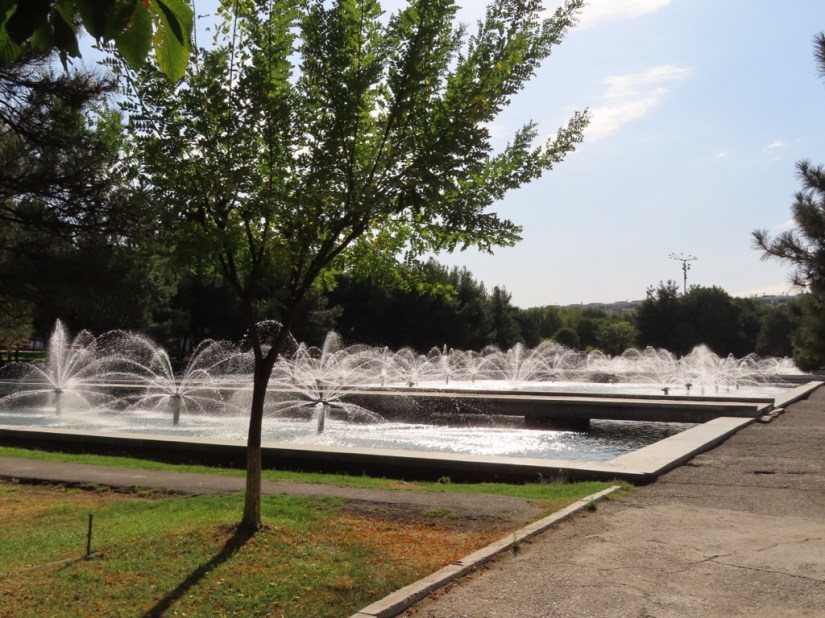
… but there were more fountains …

… and the Navruz Wedding Palace which is usually crowded with brides, grooms, camera men, drones, Hummer limos … in fact all the essentials of an Uzbek wedding, but quiet on Independence Day.

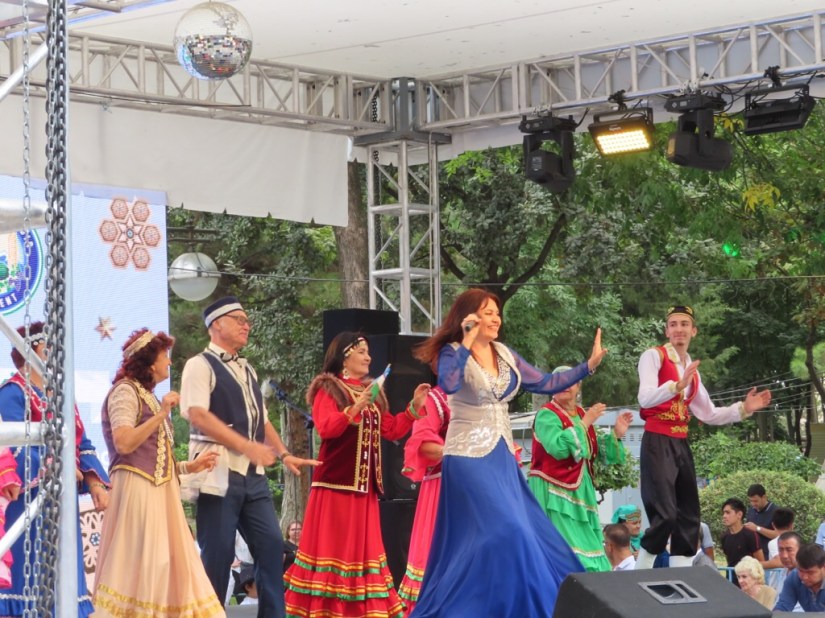
Independence Day brought various local celebrations in public places and fireworks later.

In 1966 Tashkent was hit by a massive earthquake which levelled much of the city which was rebuilt as a model Soviet city with wide streets planted with shade trees, parks, immense plazas for parades, fountains, monuments, acres of apartment blocks and served by the Tashkent metro system. At the collapse of the Soviet Union in 1991, Tashkent was the fourth-largest city in the USSR and a center of learning in the fields of science and engineering. Following independence in 1991, President Islam Karimov remained in power for 25 years until his death in 2016 when he was replaced by his long serving prime minister Shavkat Mirziyoyev.

So here’s a selection of other buildings, first the Central Exhibition Hall of the Academy of Arts …

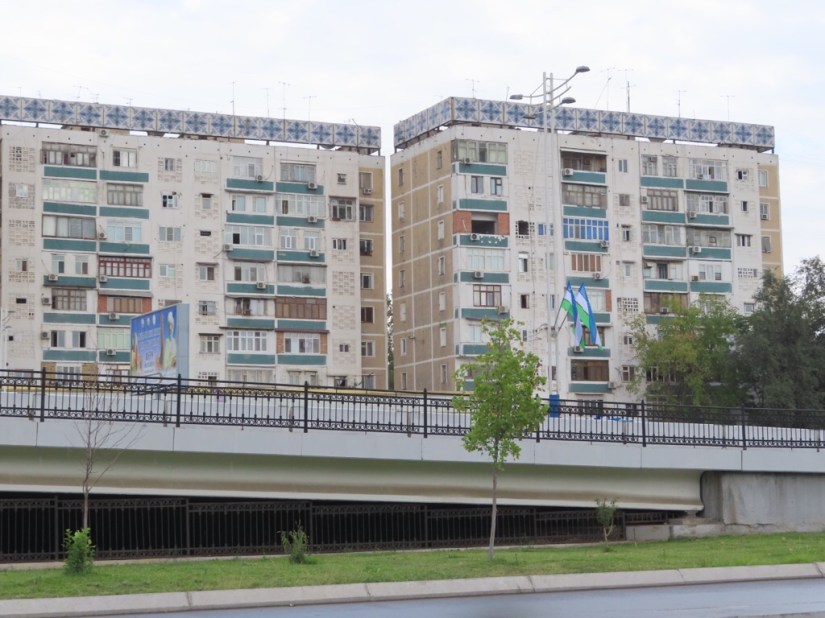
… and also a mixture of apartment blocks, office buildings, boulevards and plazas.

You can see how we got a bit overwhelmed!

Anyway, it’s been lovely and sunny, 25-30° with a breeze and low humidity … although there was a brief shower one day. We’ve been staying at Trip.le guesthouse, in a quiet residential area, but close to the metro and restaurants. It is set round a courtyard with private rooms, dorms, a kitchen with buffet breakfast and friendly staff.

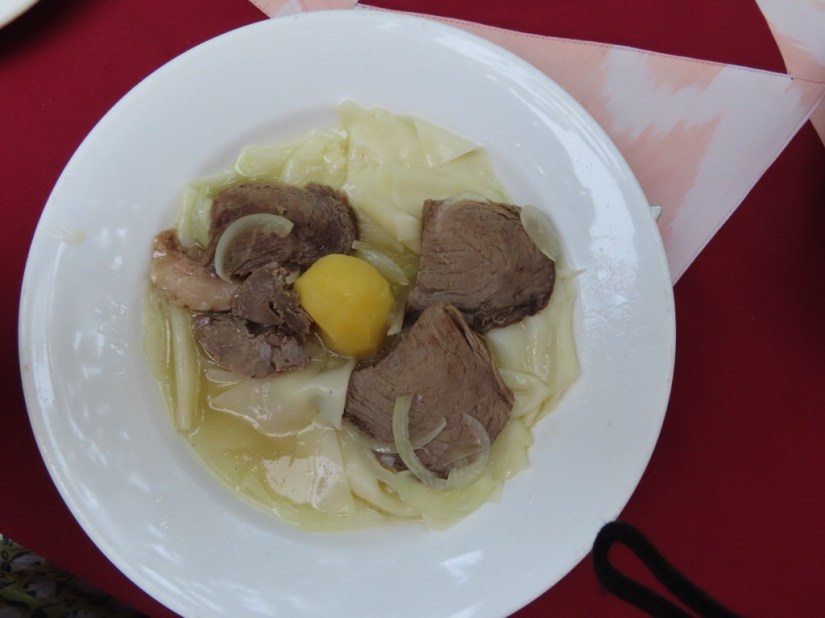
We’ve tried three restaurants – Jumani, Caravan for Uzbek food and Gruzinskiy Dvorak with a Georgian menu – and eaten well in all of them. We’ve begun our meals with various mezze and salads then Chris has dined on tofu, vegetable stew, cheese filled pastries and vegetable kebab. I’ve had a traditional Georgian dish of lamb stew with tomatoes and aubergines, spicy chicken with mushrooms and walnuts and also Beshbarmak, a national dish of nomadic Turkic peoples in Central Asia, with sheets of pasta, stewed horsemeat and a broth with sliced onions which was surprisingly delicious.

So that was Tashkent … we will be returning for a couple of days at the end of our trip, but meanwhile, it’s time to board the early morning plane and take a trip back in time to Khiva …

Map

Chris & Elaine’s Uzbekistan Silk Road 2019

The allure of the Silk Road for many is to take the path of adventurers and travellers like Marco Polo who followed its network between the Mediterranean and China and visited places mentioned in the lives of Alexander the Great, Ghengis Khan and Tamerlane.

For us, the architectural heritage with stunning Islamic tiling and intricately decorated mosques, madrasas and mausoleums is the biggest attraction, so we’ve focused our visit on Uzbekistan, home to Samarkand, Bukhara and Khiva, all great cities on the Silk Road and all filled with architectural treasures.

Uzbekistan is a doubly landlocked country in Central Asia, with mountains and steppes but comprised mainly of arid desert. A former Soviet republic, it retained a highly authoritarian regime after independence in 1991, but a change of president in 2016 has now made travel here more accessible. We will be arriving in the capital Tashkent and look forward to seeing the more recent remnants of Soviet rule before catching a flight back in time to Khiva, our most remote destination.

The train will then take us 1100km along the Silk Road back to Tashkent. We’ll be staying in guest houses, hoping there will be vegetarian alternatives to the national dish of rice and mutton called plov and with 10,000 Som to the £, feeling like millionaires. Chris is eager to play with his new Oly 12-100 Pro lens and back-button focus, whatever that is! There’s no rush, so we have plenty of time to soak up the atmosphere, take photos, browse in bazaars, drink tea and enjoy the sunshine …

Itinerary

Finding our Feet in Tashkent

Khiva … Within the Walls

Fifty Fortresses of Elliq Kala

Khiva … Beyond the Walls

Bukhara … Silk Road City of the Shaybanids

Samarkand … Timur’s Capital

Over the Mountains to Shakhrisabz

Tashkent Finale

Map

Chihuly: Reflections on Nature – Kew

Like a magpie, I love anything sparkly which definitely includes glass and our day out to Kew was so exciting, I had to share!

Dale Chihuly is possibly the most famous artist working in contemporary glass today and together with his team in Seattle, produces a range of beautiful glass.

The Shirley Sherwood Gallery was our first stop, where a film explained about Chihuly’s life and working methods and how his work has evolved over the last 50 years.

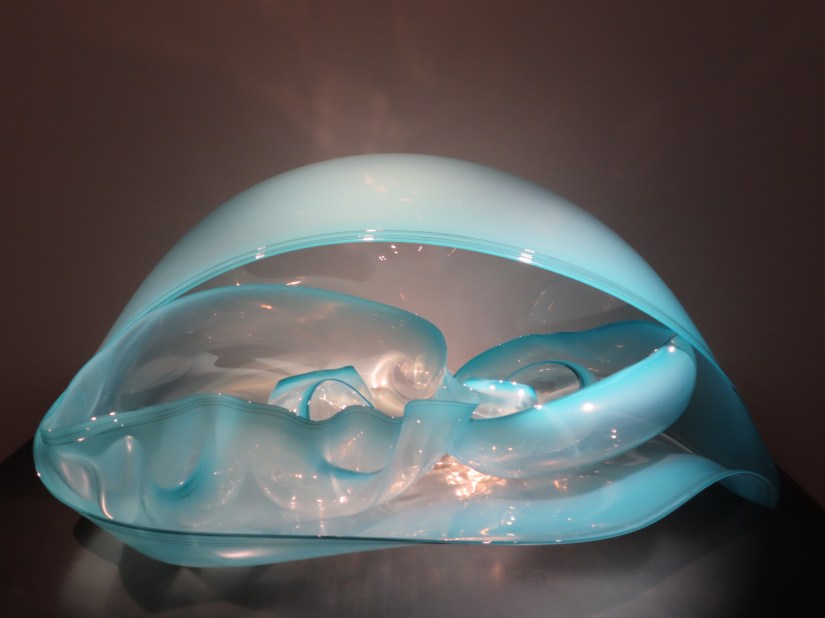
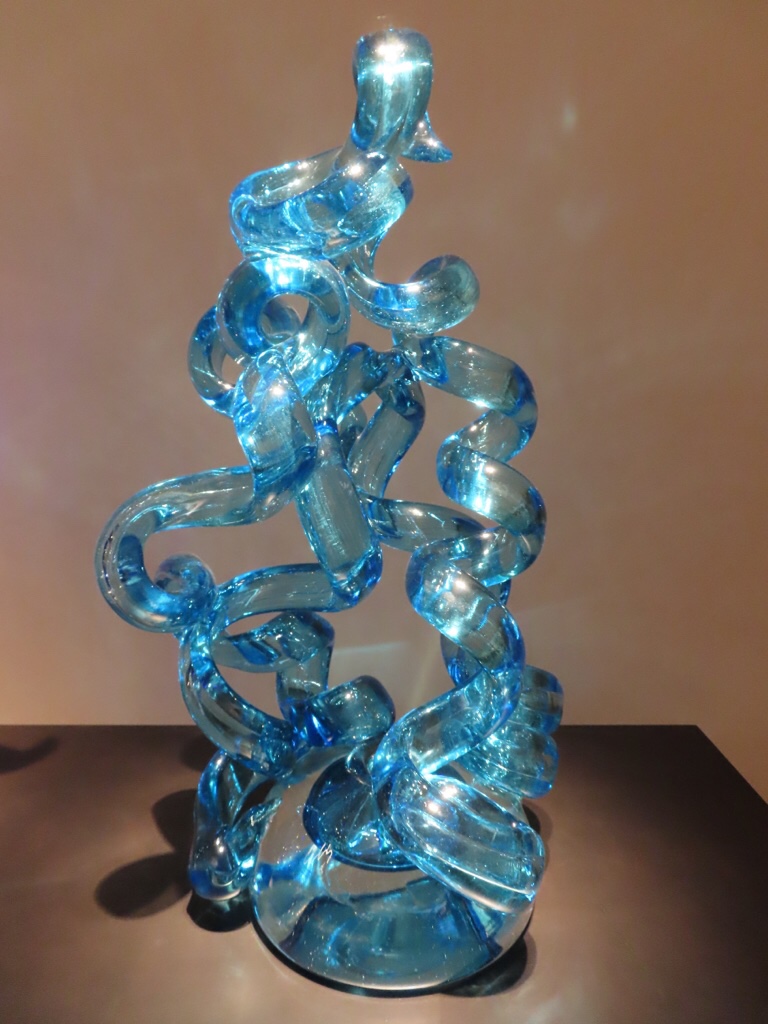
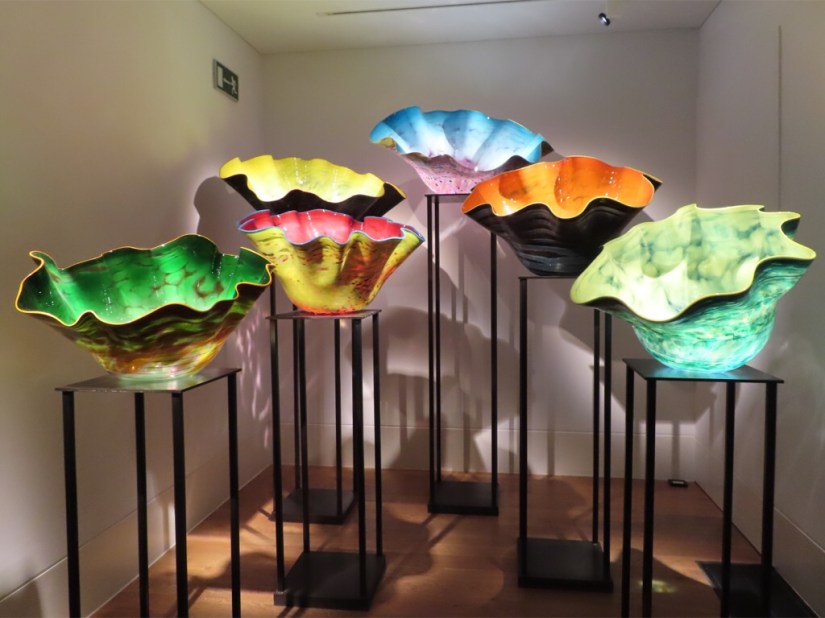
A stunning collection of smaller pieces were on display here including Baskets inspired by the slumped shape of Northwest Coast Indian baskets …

… Rotolo which unsurprisingly means coil in Italian …

… pieces from a series called Macchia which means spotted in Italian …

… and Cylinder vases with decoration inspired by designs on Navajo blankets.

I want my work to appear like it came from nature, so that if someone found it on a beach or in the forest they might think it belonged there. Dale Chihuly

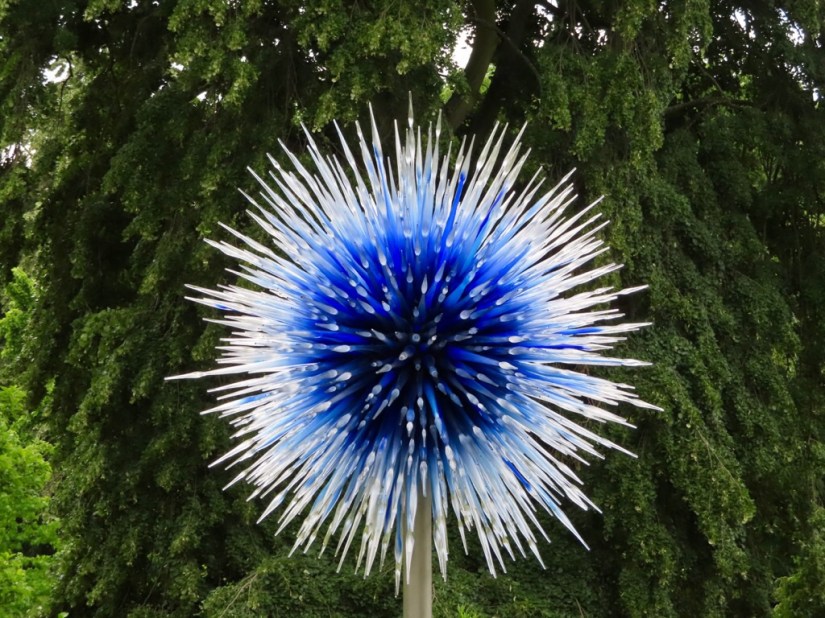
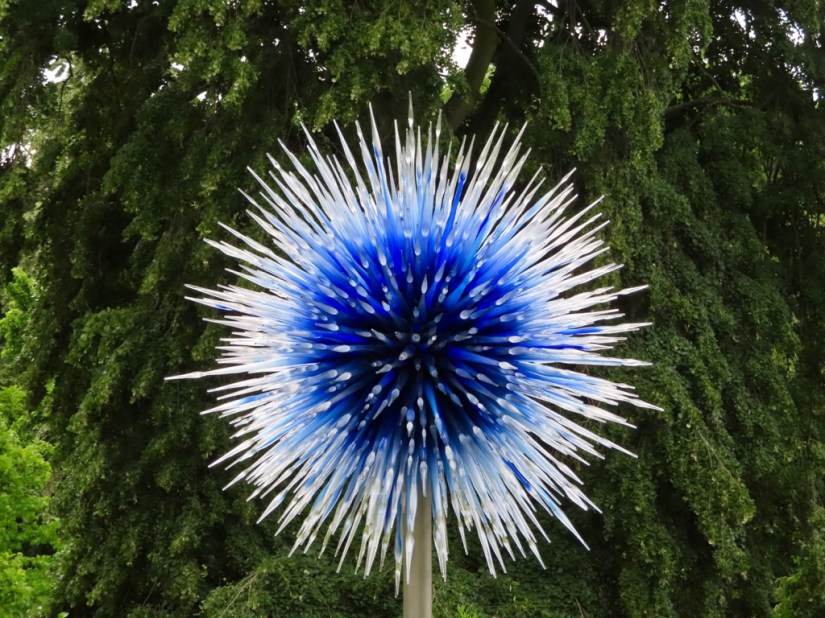
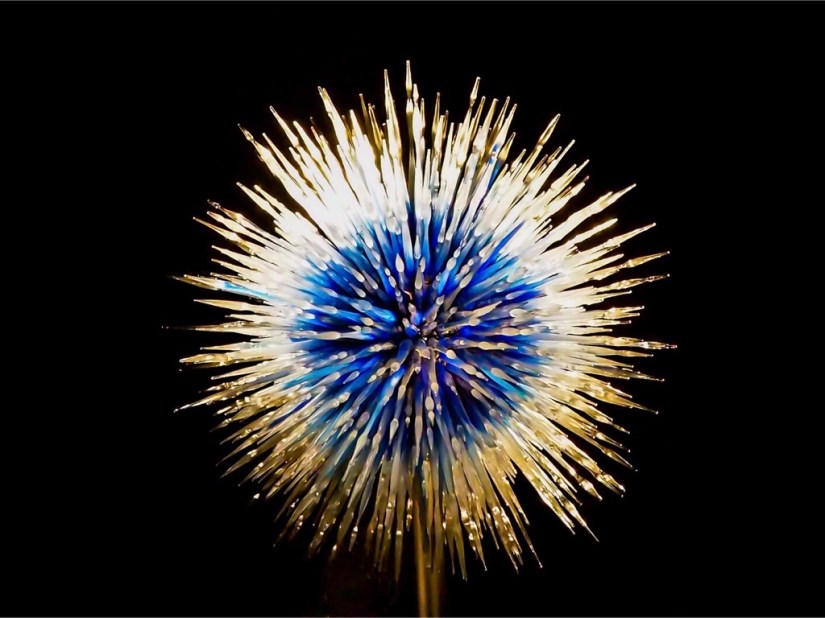
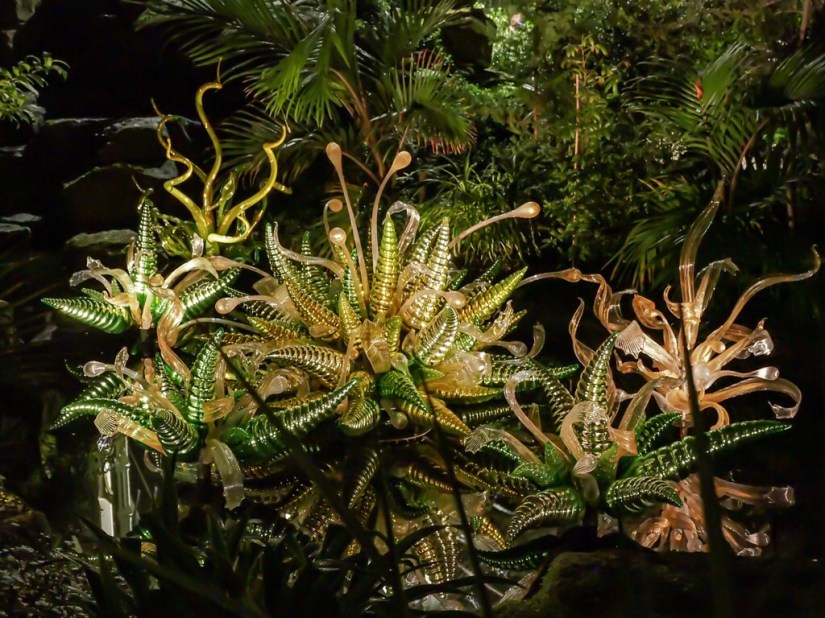
So with that in mind we explored the gardens, firstly with the free tour then again on our own and the sun occasionally came from behind a cloud and lit up the glass. We were so impressed with the glass sculptures especially the showstoppers like Sapphire Star …

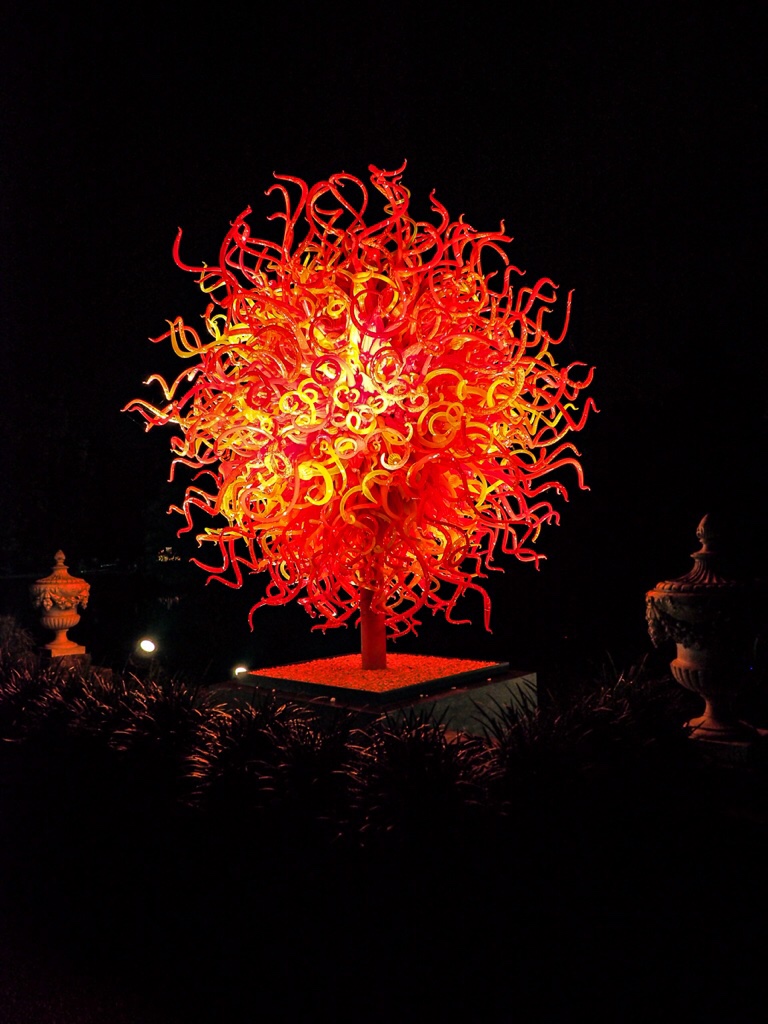
… Summer Sun …

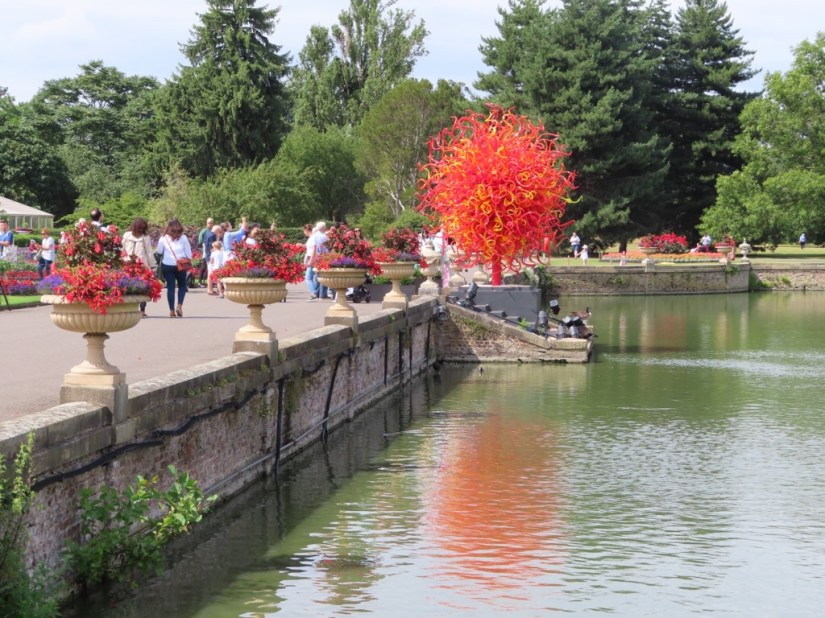
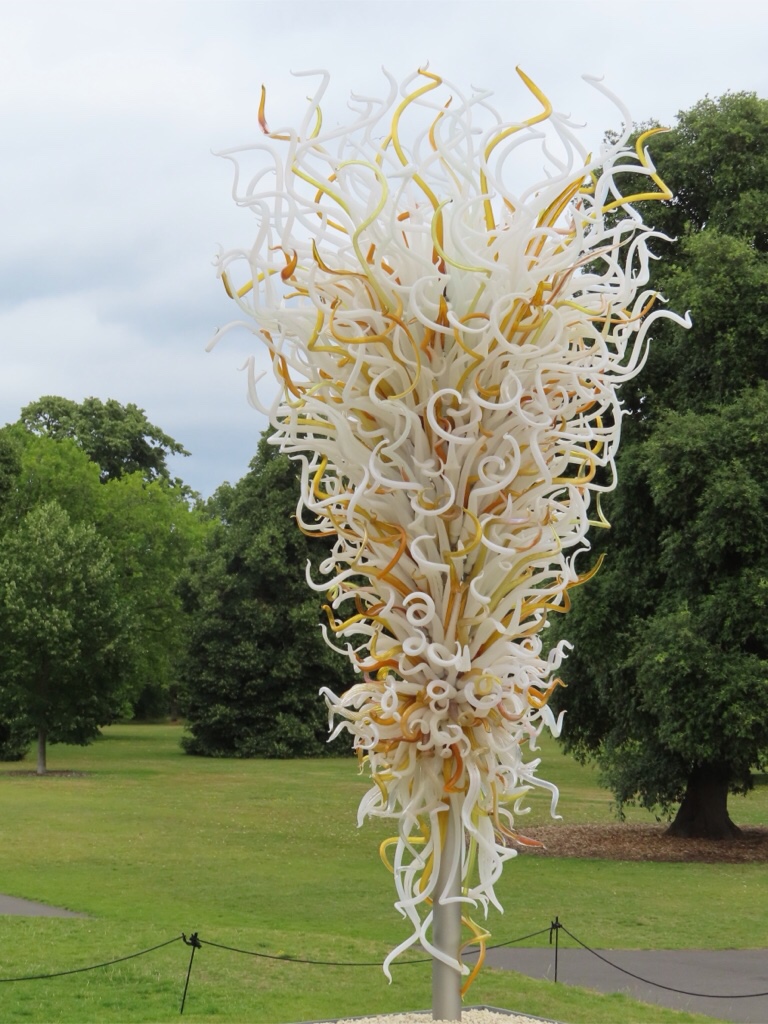
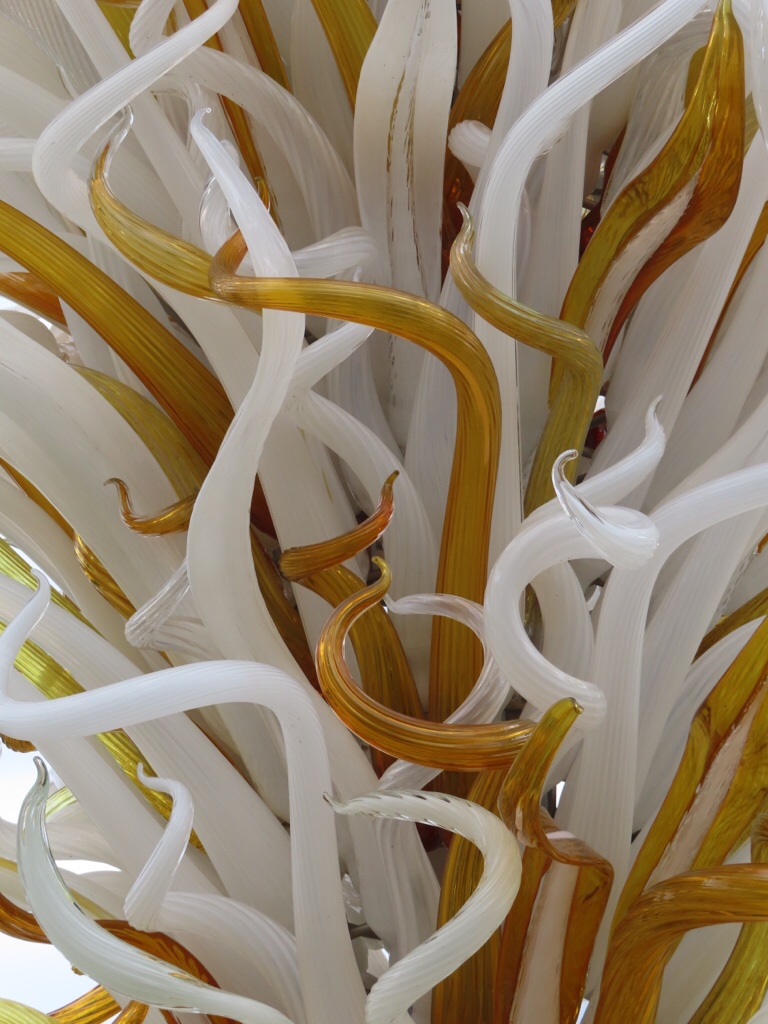
… Scarlet and Yellow Icicle Tower …

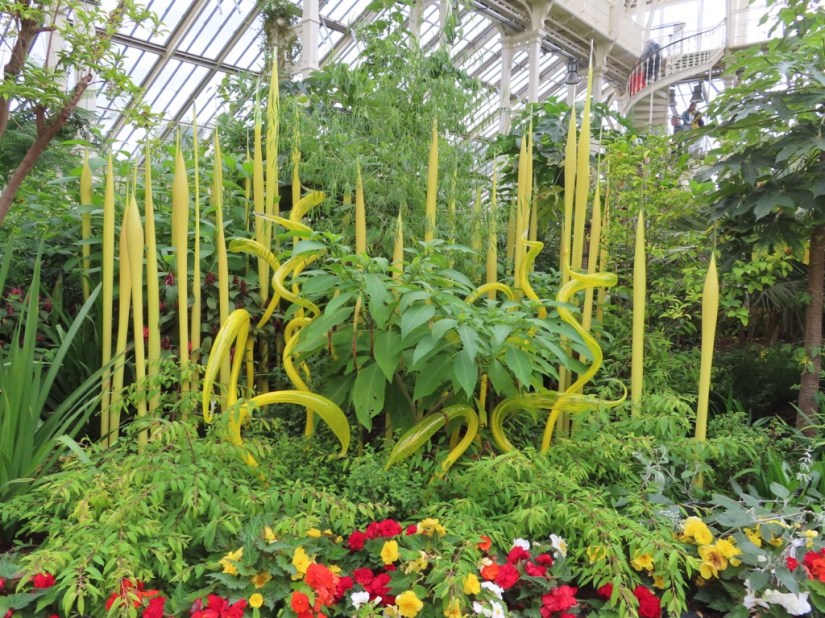
… and Lime Tower, all constructed a little like an artificial Xmas tree with up to 1800 glass pieces fitted onto a metal core.

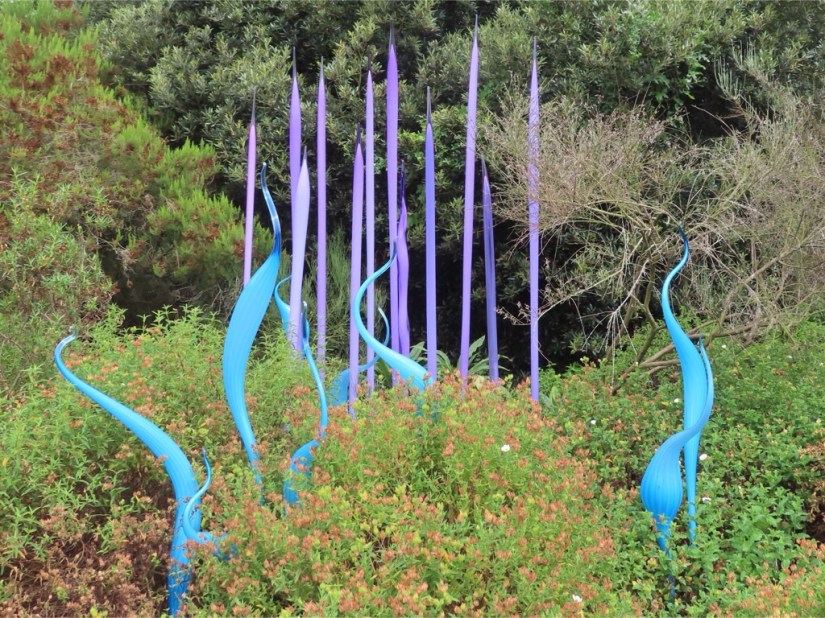
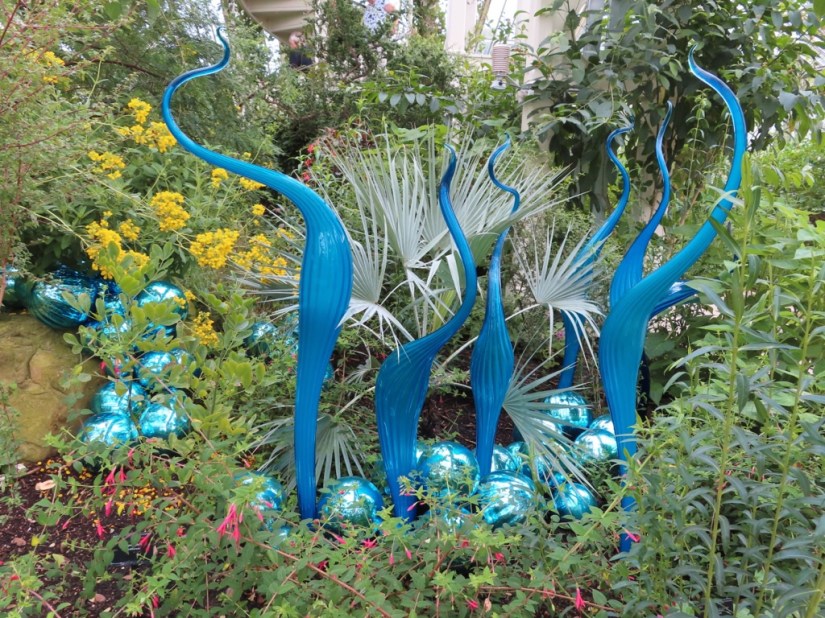
There were others that seemed to be growing out of the ground like the Neodymium Reeds and Turquoise Marlins in the Mediterranean Garden …

…the Cattails and Copper Birch Reeds within the long grass of an orchard …

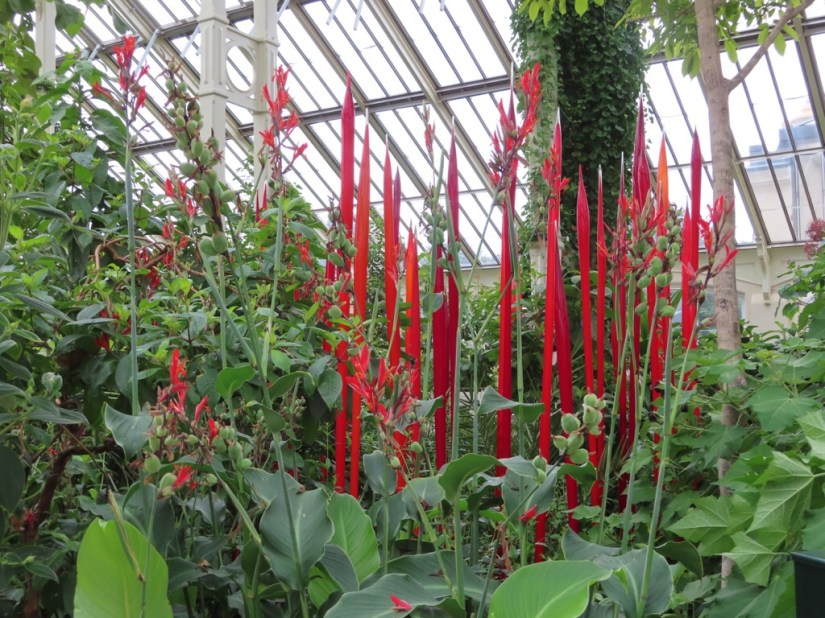
… and Paintbrushes, inspired by the plant called Indian Paintbrush that we saw growing in Utah.

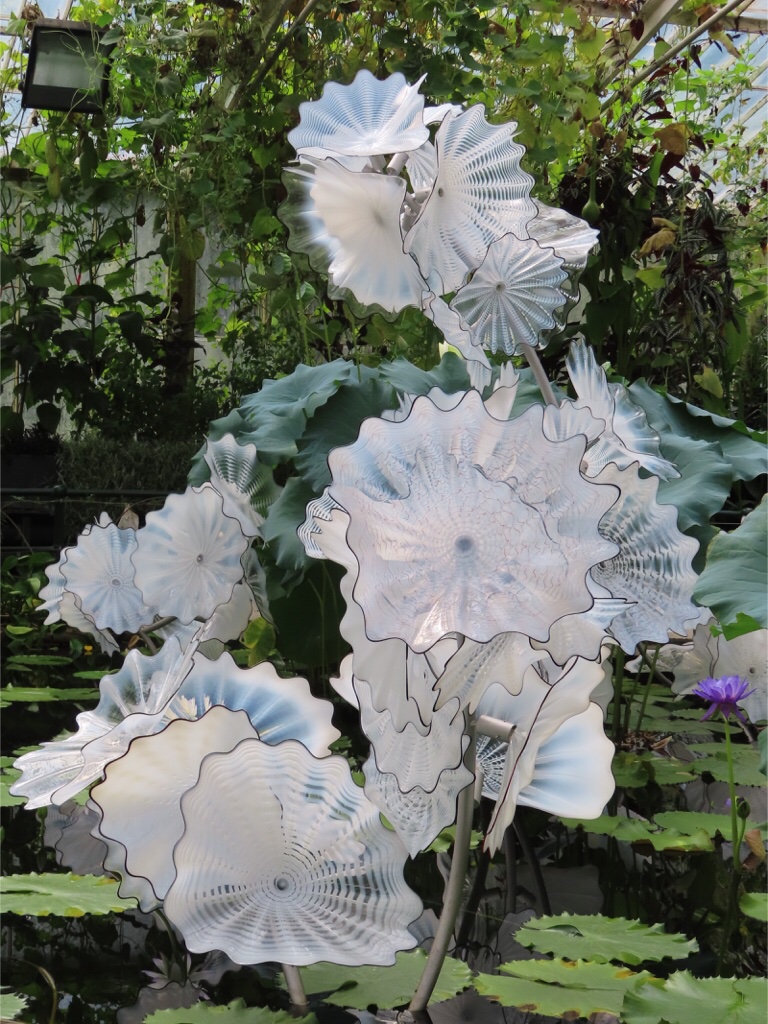
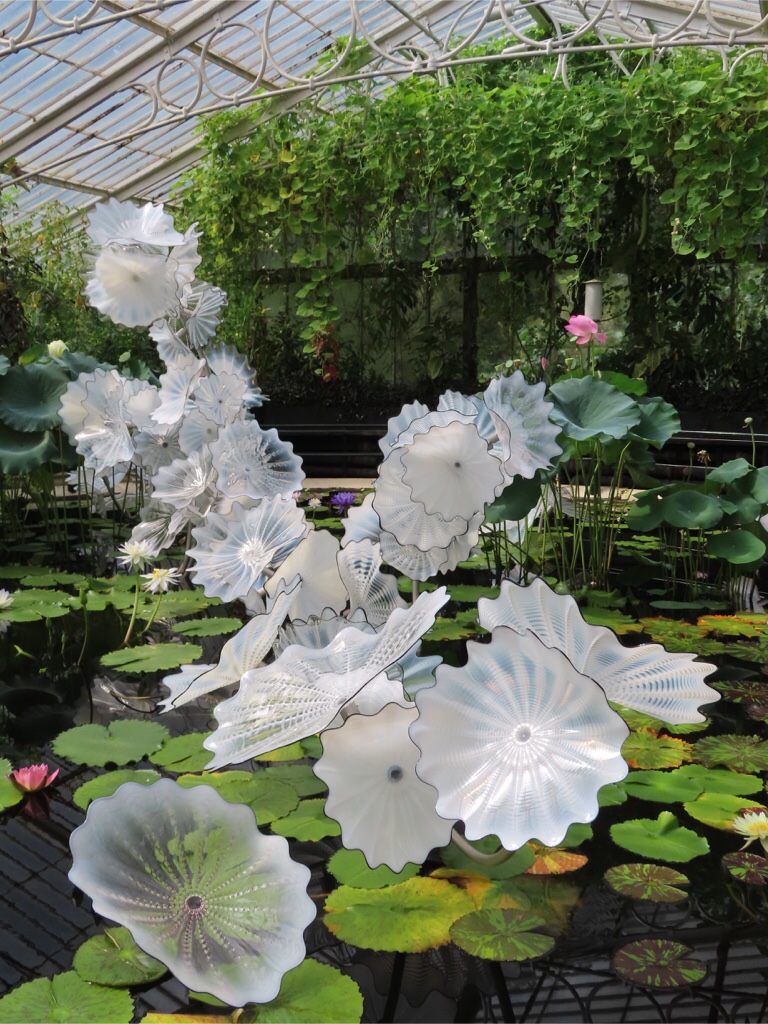
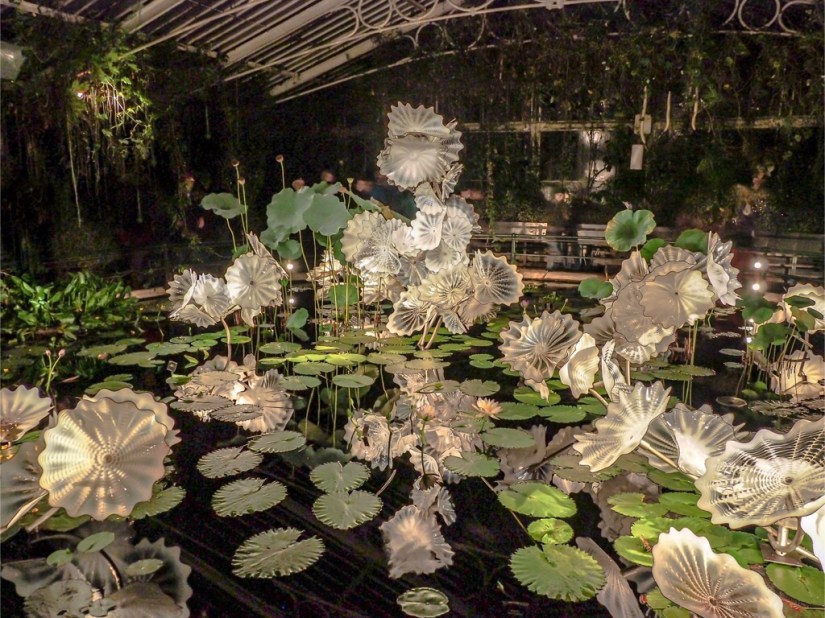
Glass was also installed in the conservatories with the very beautiful Ethereal White Persian Pond in the centre of the Waterlily House.

The newly restored Temperate House had Opal and Amber Towers flanking the entrance …

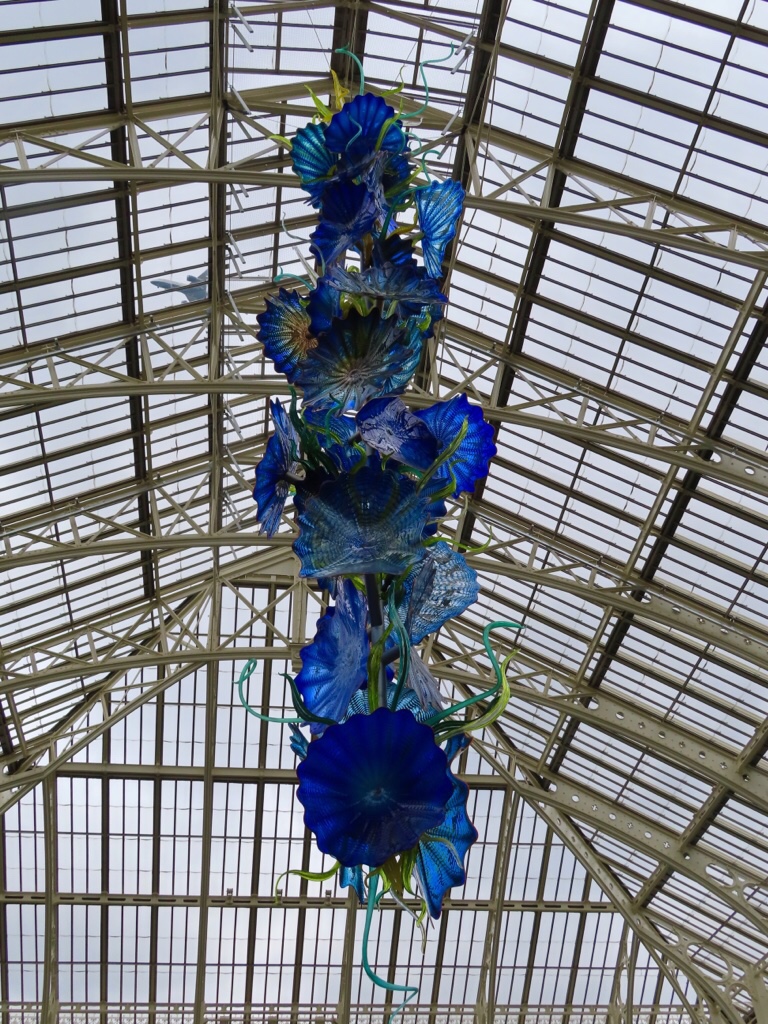
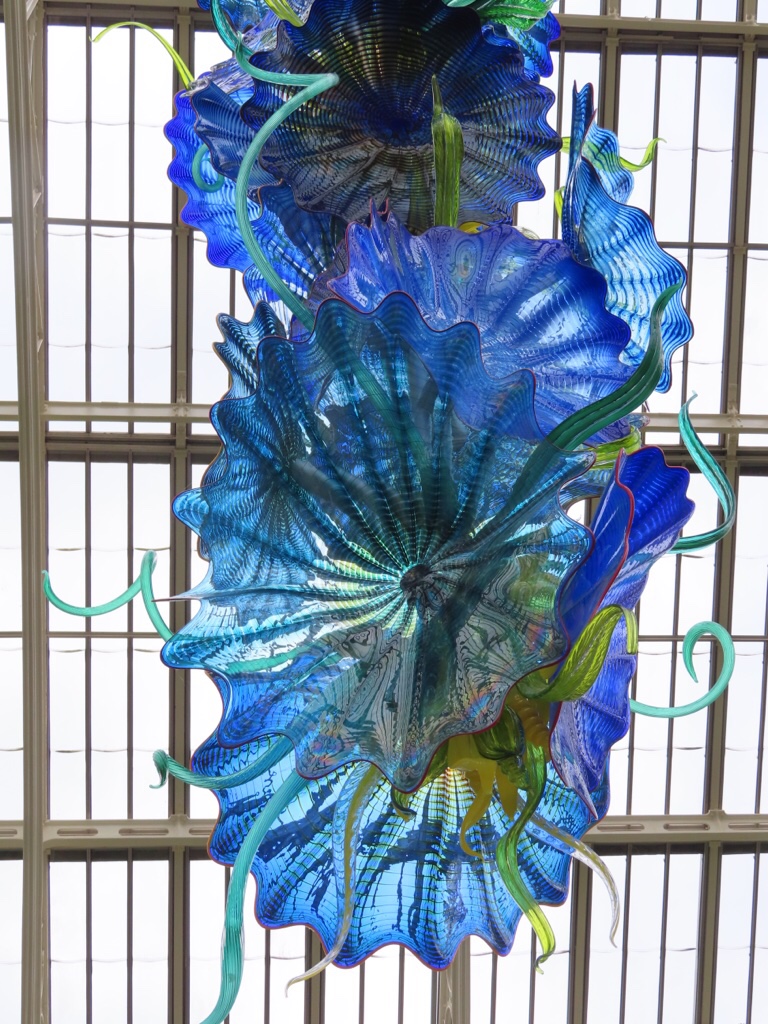
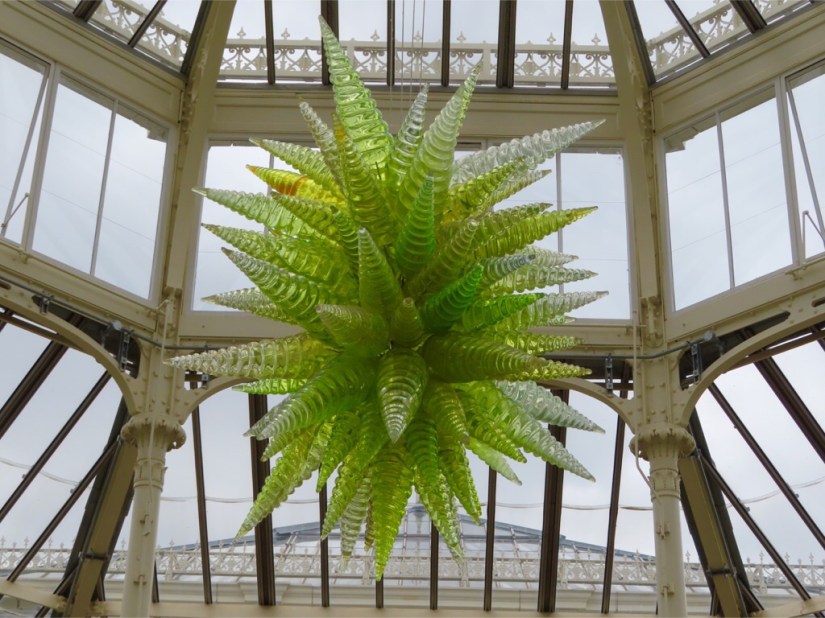
… and Persian Column suspended from the roof …

… and climbing the wrought iron spiral staircase to the balcony gave an opportunity for a close up.

There were also smaller pieces within the planting …

… and a final chandelier on the way out.

We were so inspired by our visit that we exchanged our tickets for a year’s membership … which is lucky, as when we got home we realised we had missed one of the exhibits called Nijima Floats … a treat for next time!

We made a return visit when the glass was lit up at night and Chris took these great pics …

… and this time we saw the floats!

https://www.kew.org

https://www.chihuly.com

Pisa and Home

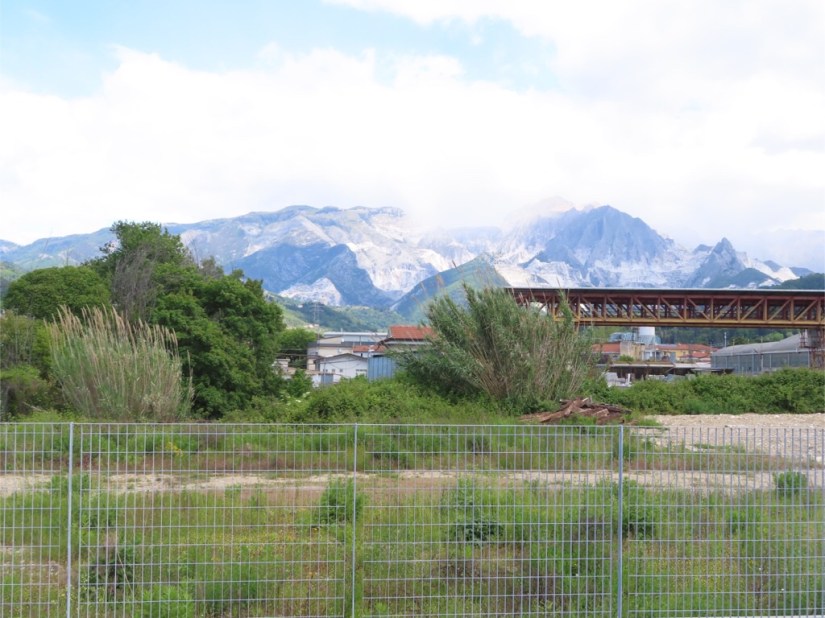
We made our way back to Pisa this morning by train which passed Carrara, famous for the marble quarries that we had seen in the distance yesterday …

… and also Viareggio, a popular seaside town which I can remember visiting on a family holiday with my father and sister years ago.

Arriving a little early to head to the airport, we first went in search of a place for some lunch and ended up at Osteria il Capodaglio where we had a lovely Tuscan meal to end our holiday.

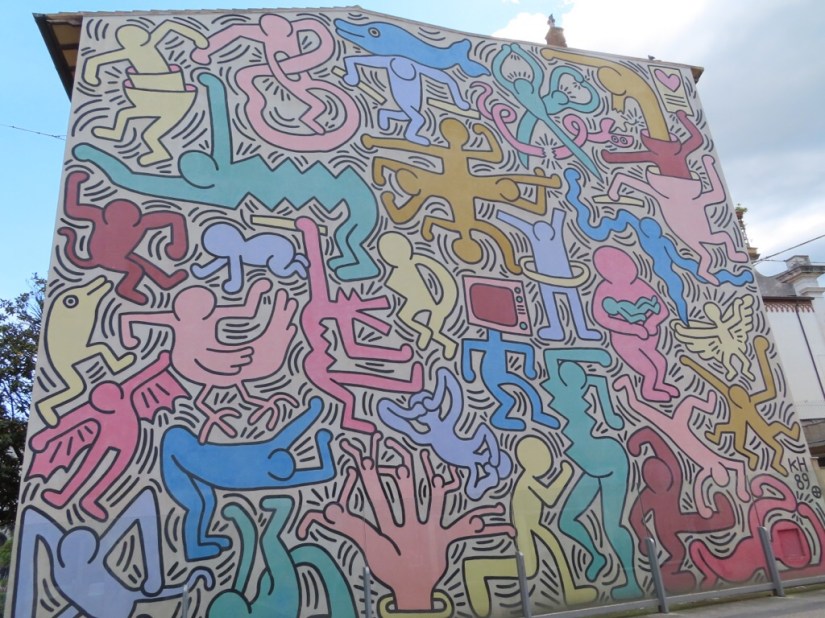
Walking back to the station, we passed a mural called Tuttomondo by an American artist called Keith Haring who we hadn’t heard of, but there is an exhibition of his ‘vibrant, graffiti-like painting’ at Tate Liverpool later this year.

Before we knew it the PisaMover shuttle was dropping us at the airport and as we waited for our flight, there was time for a little reflection …

We’ve had another great trip and while all the villages have proved very similar … clinging to rocks in some degree or another, tall slim houses painted in shades of orange with narrow cobbled streets, little harbours and churches with pretty towers … we were surprised by how different they all felt to visit.

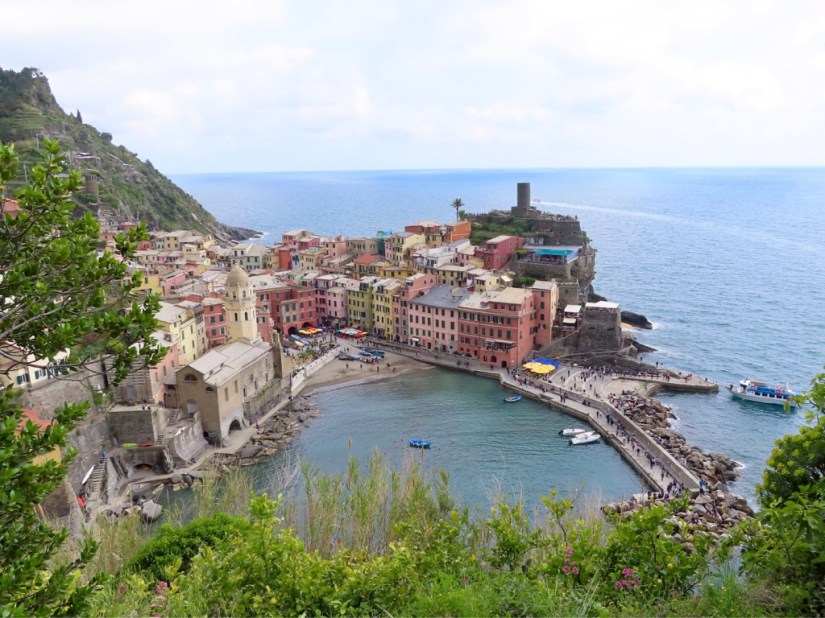
Of the Cinque Terre, Vernazza and Manarola were our favourites, maybe we stayed in Vernazza and saw it from every angle, with and without the crowds …

… and Manarola because as we walked down into the village, the views kept coming, saving the best till last.

Camogli was the real surprise, as I had chosen it as an affordable alternative to a Portofino rather than expecting it to be so statuesque as villages go!

Portofino had to be the jewel, but was maybe just a little too perfect.

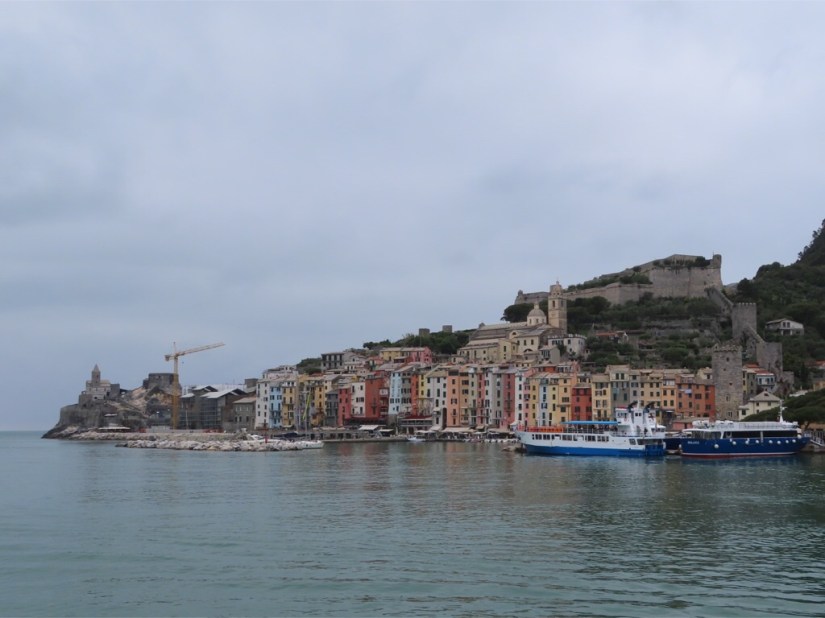
We didn’t see Portovenere at its best on such a gloomy day, but it was perfect for an afternoon, with lots too see and fun to travel by boat.

We have also become quite attached to Lerici, with our room overlooking all that is happening in the square and it is quite noticeable that the visitors are mainly Italian.

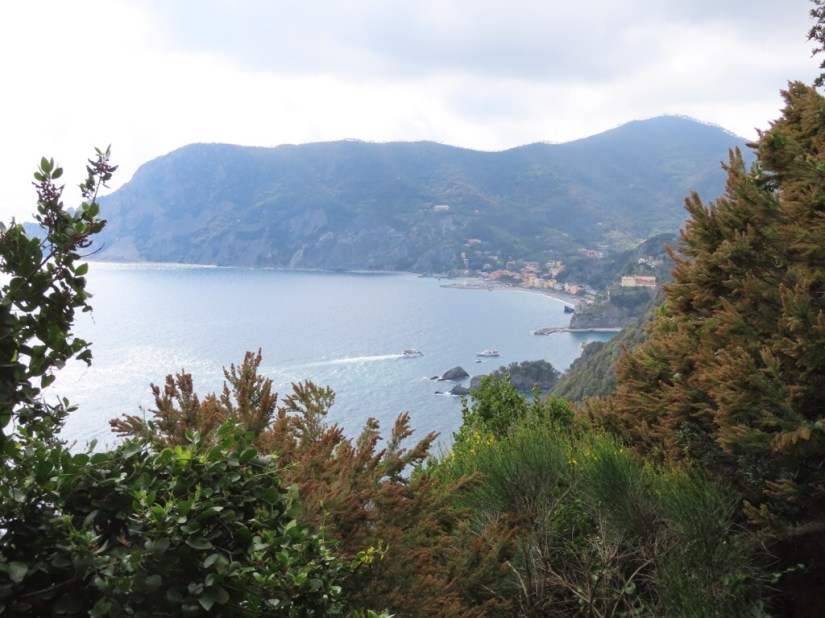
Finally Terrano, yet another of the most beautiful villages in Italy, but a little grey …

The walking has been great, getting away from the busiest tracks and finding some wonderful views of the coast, but usually with more ups and downs than we were expecting! We’ve used the Sunflower walking guide which has suggested good routes with accurate instructions – we only took the wrong path once – and the waymarking has been excellent everywhere.

The weather has been a bit chilly for May – few days hit 20° and only a couple got warmer. Fortunately we’ve dodged most of the showers except for the one really rainy day in Vernazza so for walking it’s turned out ok.

Just a quick mention here of the food. We have certainly had some very delicious dinners (with lots of local fish for me) and also tried a selection of local specialities including the walnut sauce and pesto with local pasta such as pansotti and trofie, savoury pies with vegetable and herb fillings, focaccia with a selection of toppings or fillings, and sweet treats like the gelato and panedolce. Then there were our fab picnics …

What we have really missed is vegetables, which may be arrayed in plenty in the markets, but never seem to make their way onto a restaurant menu, where side dishes are limited to mixed salad and maybe grilled veg or spinach if you are very lucky! So despite the claims for the healthy Mediterranean diet and on average the 8 miles we’ve walked every day, we’re not sure we’ll be trimmer than when we left … but we have had a good time!

All our arrangements have gone smoothly – the trains and buses were easy to use and our accommodation has been great – rooms with all mod cons including kettles and coffee makers, often a view and a breakfast basket … even if there were stairs to climb!

So there we have it, time to go home and our flight is being called so ciao until next time!

Map

Golfo dei Poeti – Lerici to Ameglia

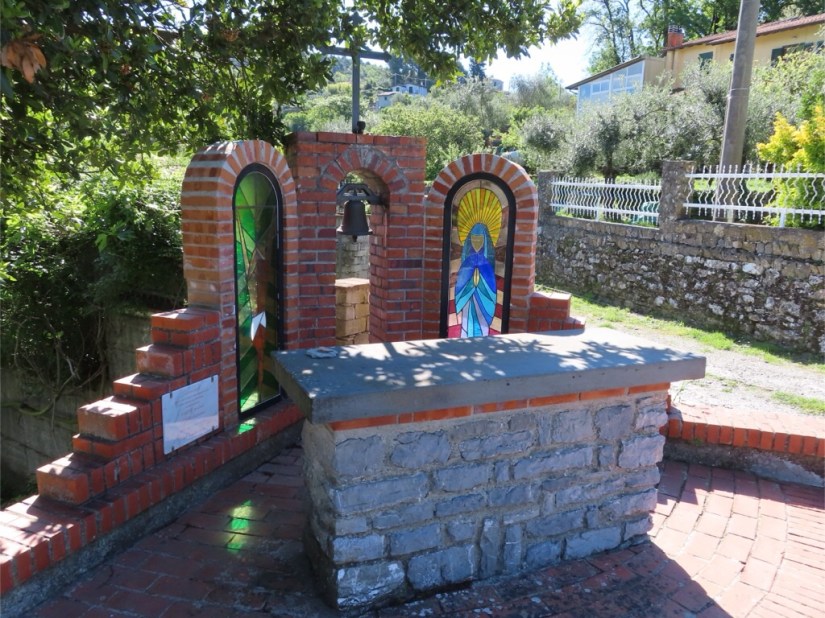
We took the bus Zanego and found the start of the walk by a small altar.

Most of the route was through a regional park which protects the area from overdevelopment and our track started through a green valley with wild flowers and the sound of birdsong, including a cuckoo.

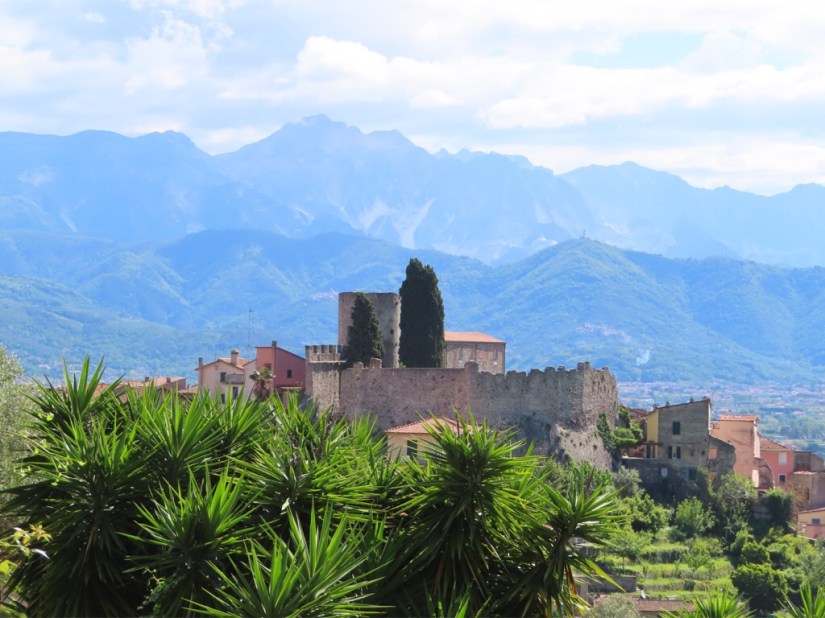
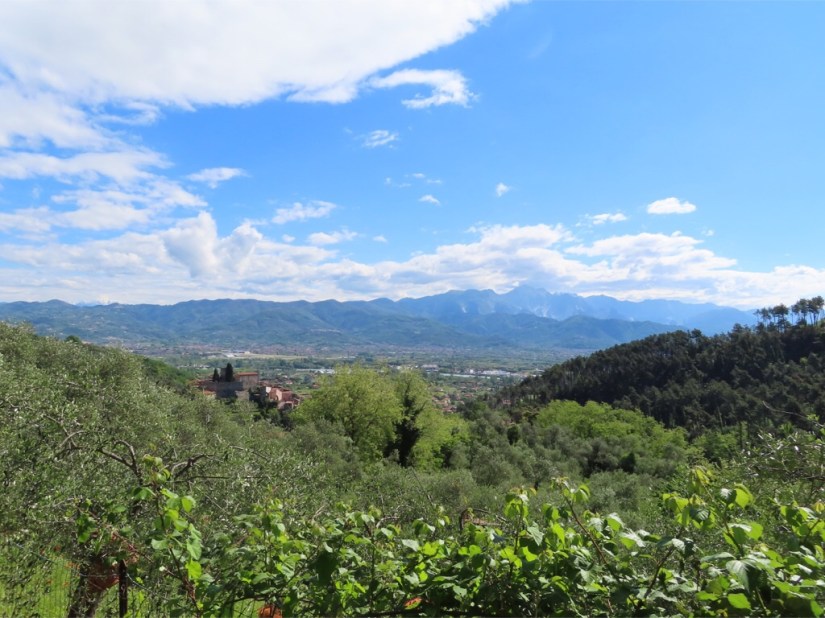
We got a great view across the Magra plain, with what looked like snow topped mountains to the left, the Apuan Alps in Tuscany to the right and the medieval castle of Ameglia in the foreground.

We walked down to Ameglia for a look round and to buy a couple of rolls for lunch.

The path then climbed steeply through woodland with views of the Magra estuary …

… before descending with views across to La Spezia …

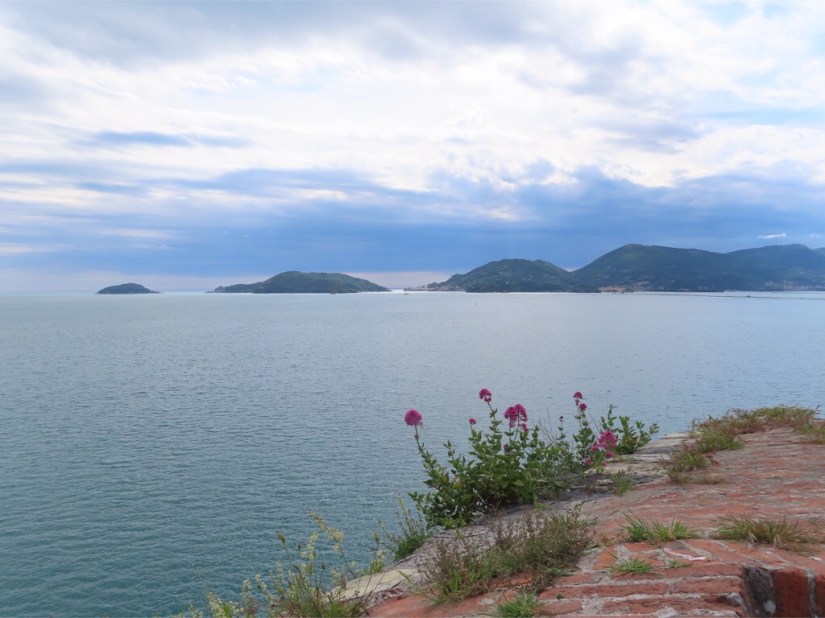
… and to Portovenere and the islands.

A final descent through the village of Serra and we were back in Lerici, with one last stop … the castle. It is such a landmark from the harbour, but there isn’t much inside, except a selection of viewpoints.

Our final afternoon – gelato, a rest and then dinner … this trip has flown by and we are back to Pisa for our flight tomorrow!
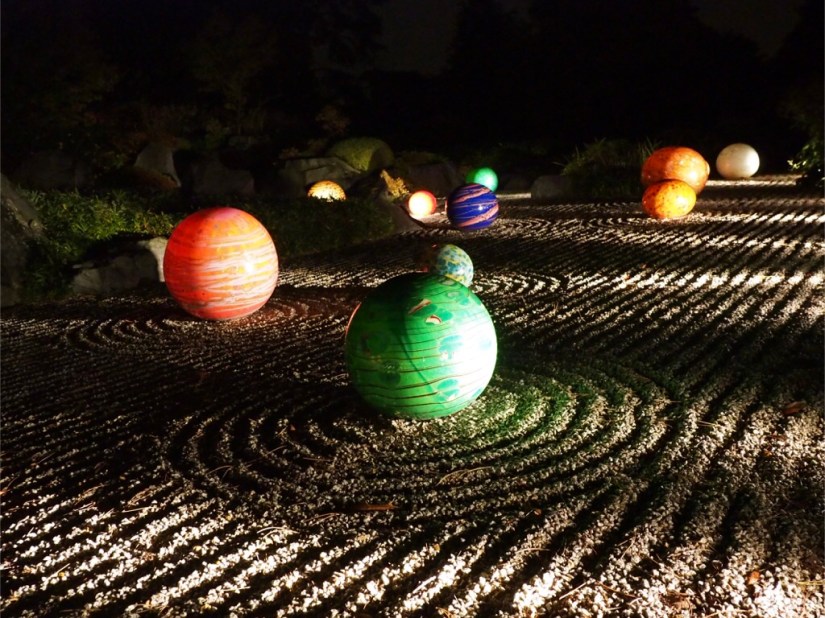
Map

Golfo dei Poeti – Lerici to Tellaro

Today’s walk was a climb out of Lerici for views across the gulf then a descent to the picturesque fishing village of Tellaro.

We started off ok, but were not sure if we’d taken the right path … maybe all the orange tape should have told us something …

… but we managed to get over the stream so just continued …

… which was fine for a while …

… until the path deteriorated into a steep slope covered in loose rubble …

… but we saw a waymark, so kept on going …

… and the path became increasingly overgrown!

Intrepid adventurers that we are, we finally made it, reaching a main path, with a big sign … annotated by previous walkers … shame they were at the wrong end for us!

Realising we had now reached the path we should have been on, we continued the rest of the walk without drama, with a view across the bay as promised …

… ruins of a C16th deserted plague village called Portesone …

… then the descent to Tellaro.

It was a little grey, so not at its best but we took some snaps then retreated to a warm bar for coffee and bruschetta.

The bus was imminent, with a long wait for the next one, so we didn’t linger and returned to Lerici, which was pretty deserted now the weekend is over. Fortunately the gelateria was open!

Back to Mani de Fatima for dinner for another delicious dinner and tiramisu for dessert!

A quick turn round the square for the lights then off to bed.
Map

Golfo dei Poeti – Lerici to San Terenzo

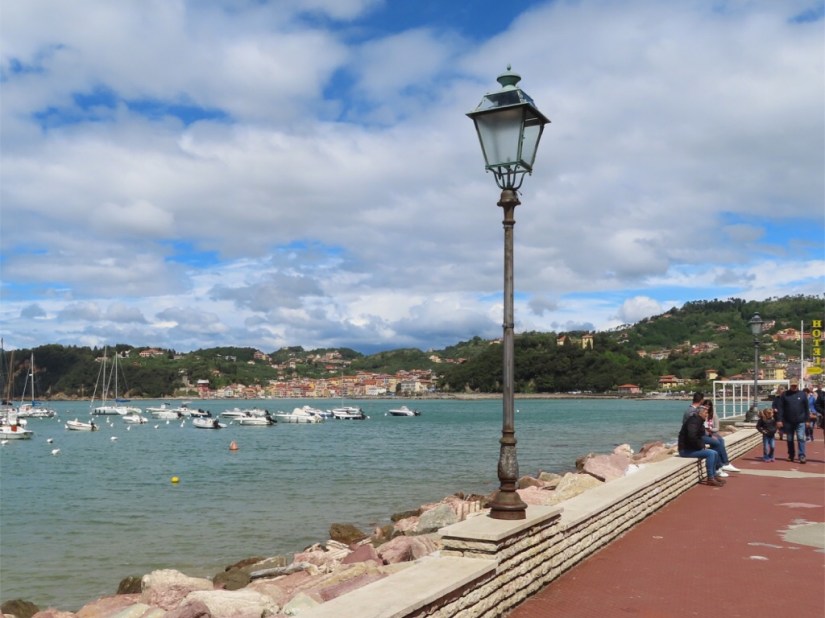
It was a bright but blowy morning here in Lerici and we set off along the coastal promenade which runs all the way to San Terenzo.

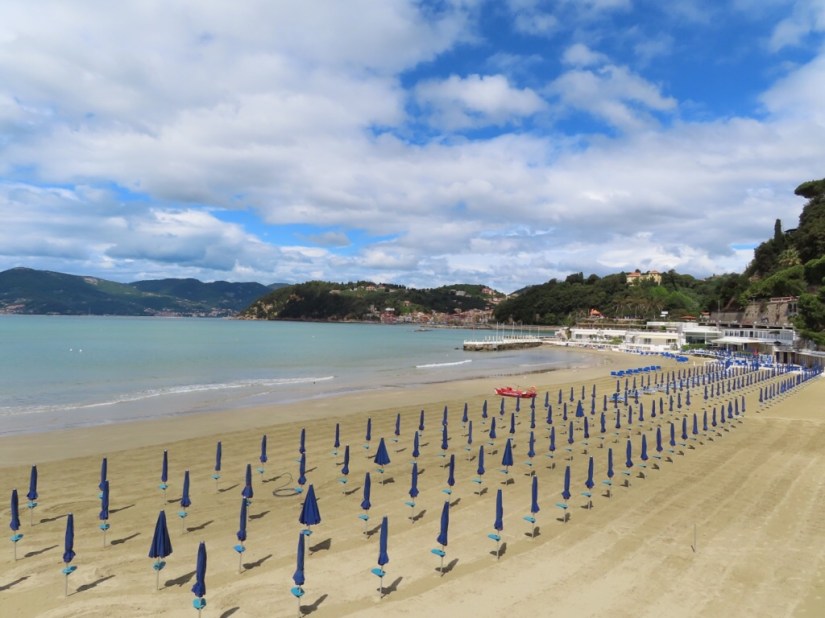
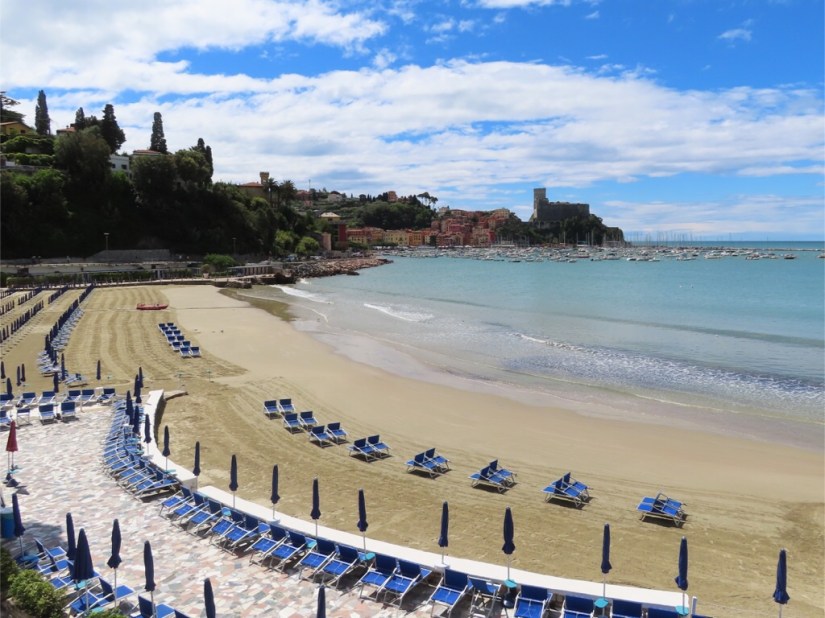
The lidos were getting ready for their summer visitors – a snip at €36/day for 2 people with sun beds and an umbrella – but this does include the convenience of changing rooms, toilets and showers, and perfectly clean and raked sand!

One of the beaches was hosting an event on the International Beach Tennis circuit …

… and while it was too chilly for most to paddle, there were a couple of brave souls!

San Terenzo was bustling on a Sunday morning and we passed Casa Magni- the house Shelley lived in with his wife, the local church and the castle.

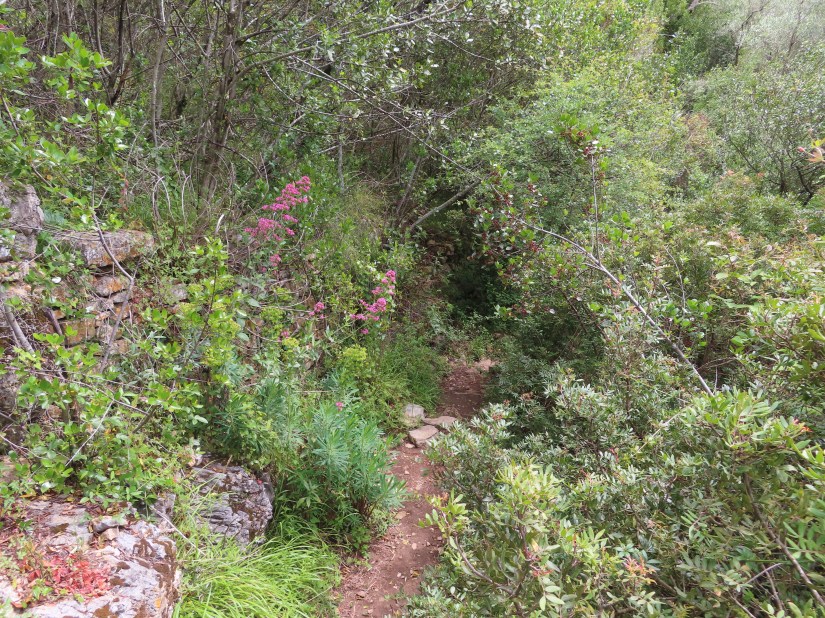
We took a footpath up through the back of the village … and you can guess, a mixture of mule track, earthen track and paved path and more ups and downs than we were expecting! It was all worthwhile for the views – leftwards to Lerici …

… and rightwards to San Terenzo, with Portovenere and the islands of Palmaria and Tino in the distance.

Back in Lerici, then sun had gone in and the wind had got up so we just chilled for the rest of the afternoon, then went for pizza later.

Map