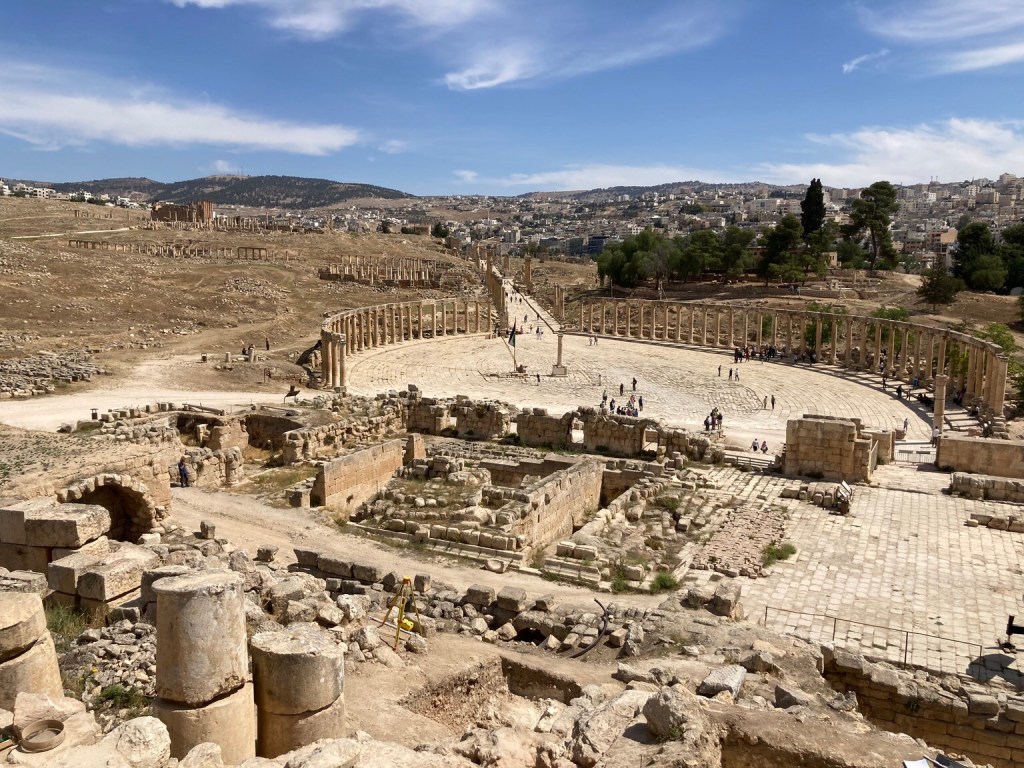
We arrived yesterday in time for a late dinner and woke to a lovely sunny day here in Jordan. We greeted fellow travellers as 30 of us boarded the coach for our day trip to Jerash. We began with a brief drive through the old and new parts of Amman and snaps were difficult, but here is the King Abdullah I Mosque, completed in 1989 and the only mosque in the city open to non-Muslims, with its sky blue dome and quasi-Brutalist minarets.
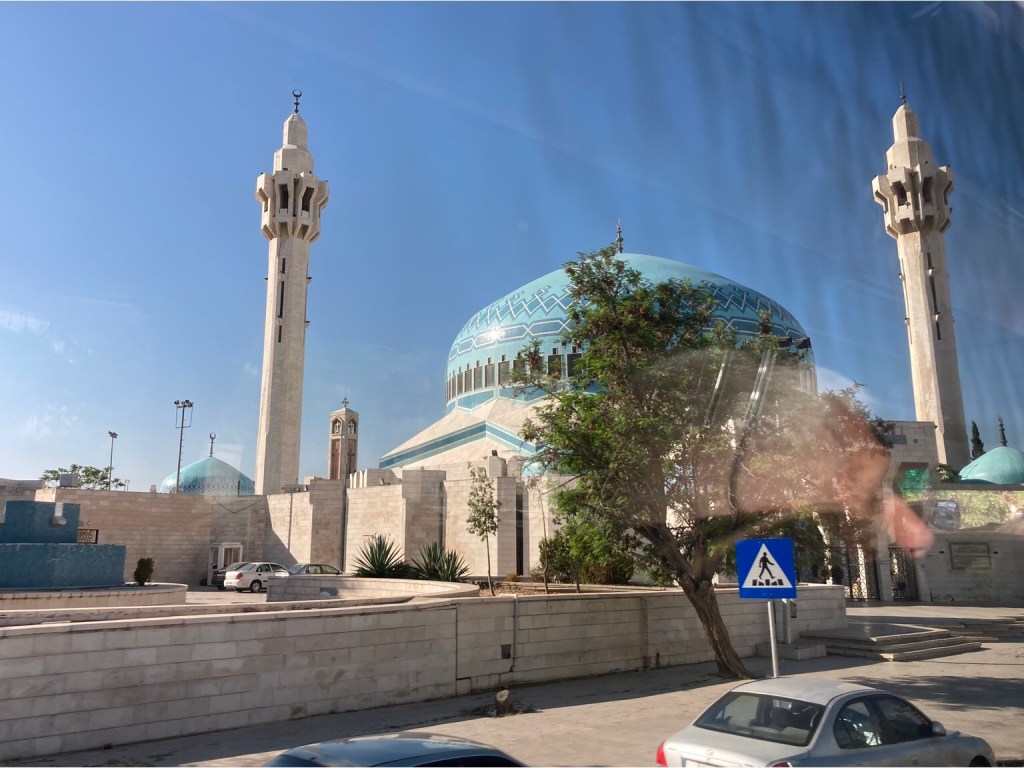
There are 4.5 million people living in Amman and the traffic is very busy, especially at rush hour as everyone has a car.
Finally we we out of Amman and during the drive, our guide Michael gave us a little background information about Jordan, officially the Hashemite Kingdom of Jordan. It is a constitutional monarchy, where the sovereign has substantial discretionary powers ruled by Abdullah II who succeeded to the throne in 1999.
Around 11 million people live here, 95% following Islam and 3% are Christian. A large proportion or the population are refugees – 2m from Palestine who live as part of society, 1.5m from Syria on three protected camps and 120,000 from Iraq who live in Amman. There are also a large number of migrant workers from Egypt and Asia.
Amman and today’s destination Jerash, were both part of the Decapolis, a group of ten Greco-Roman cities in the Jordan rift valley, which grew up along the trade route to Damascus, with Jerash being the best-preserved example of Roman-era ruins in Jordan.
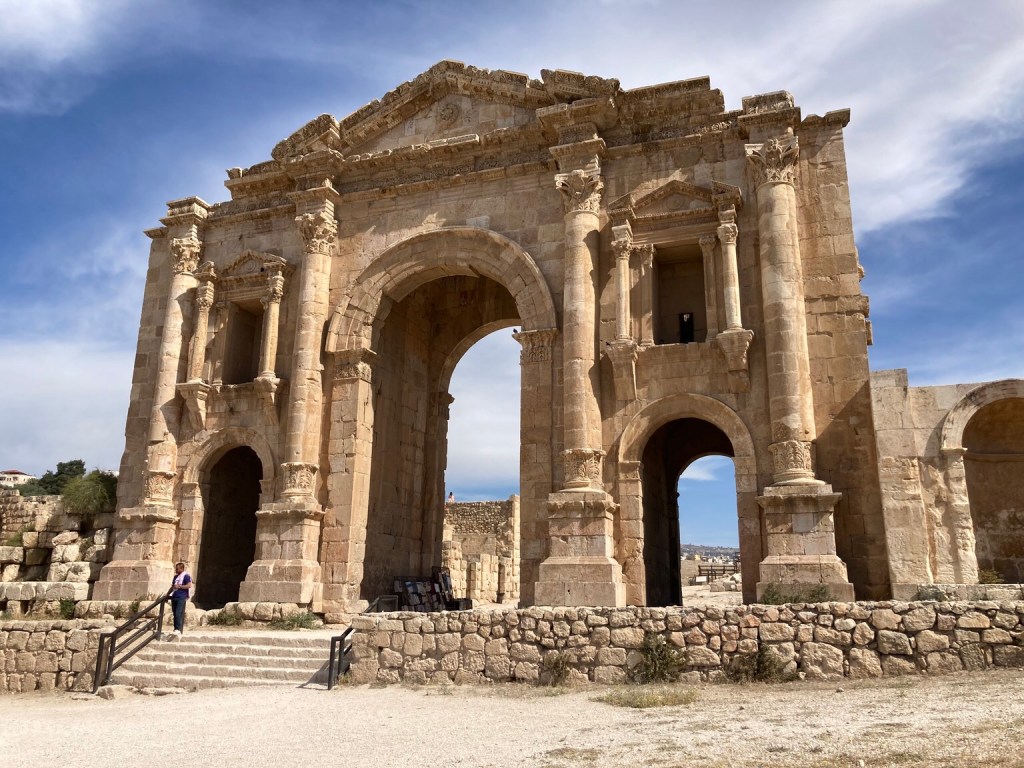
We entered through Hadrian’s Arch …
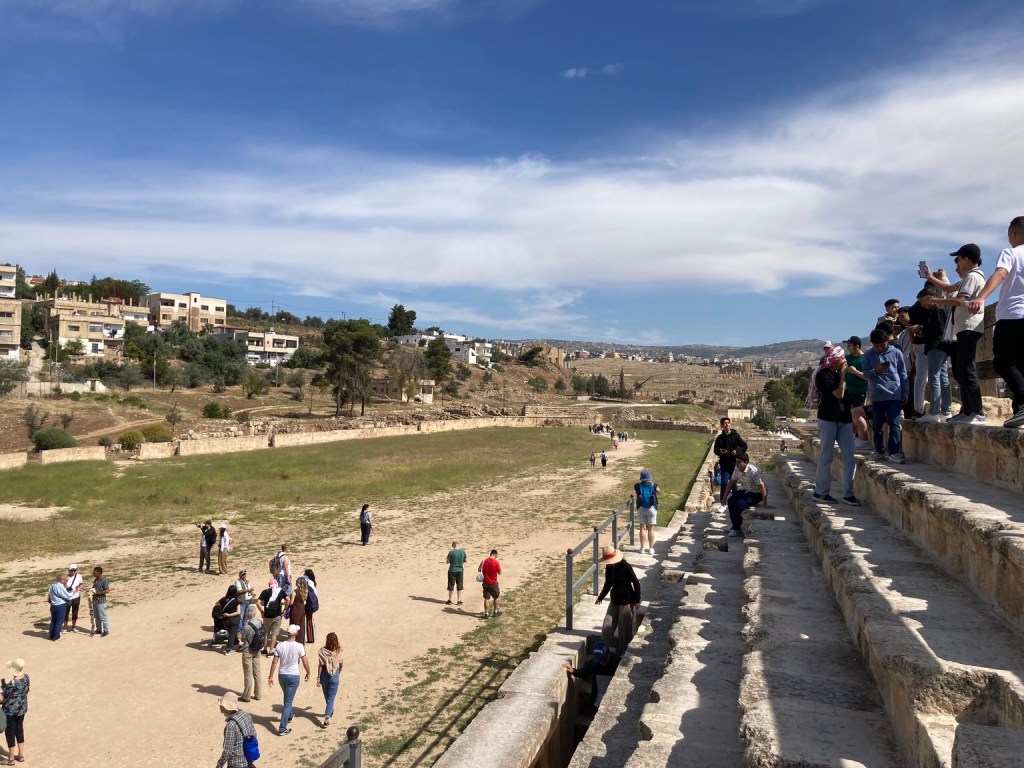
… and saw the hippodrome …
… before continuing through the South Gate.
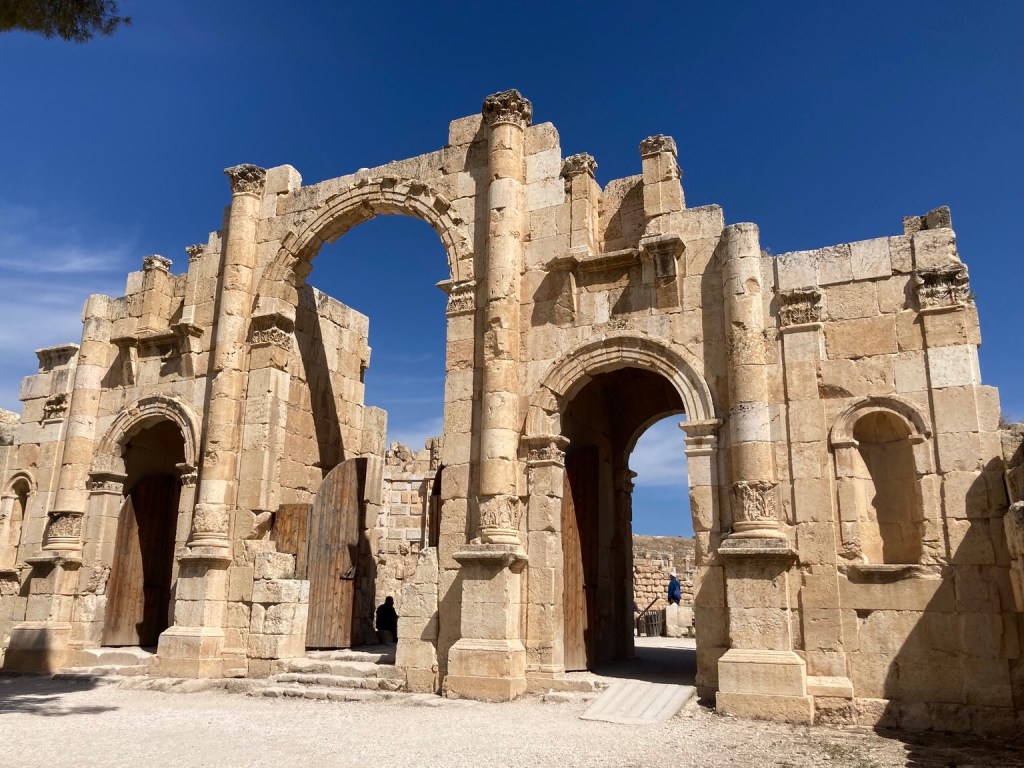
We walked along the East Souk which would have held small shops and glanced back at the gate …

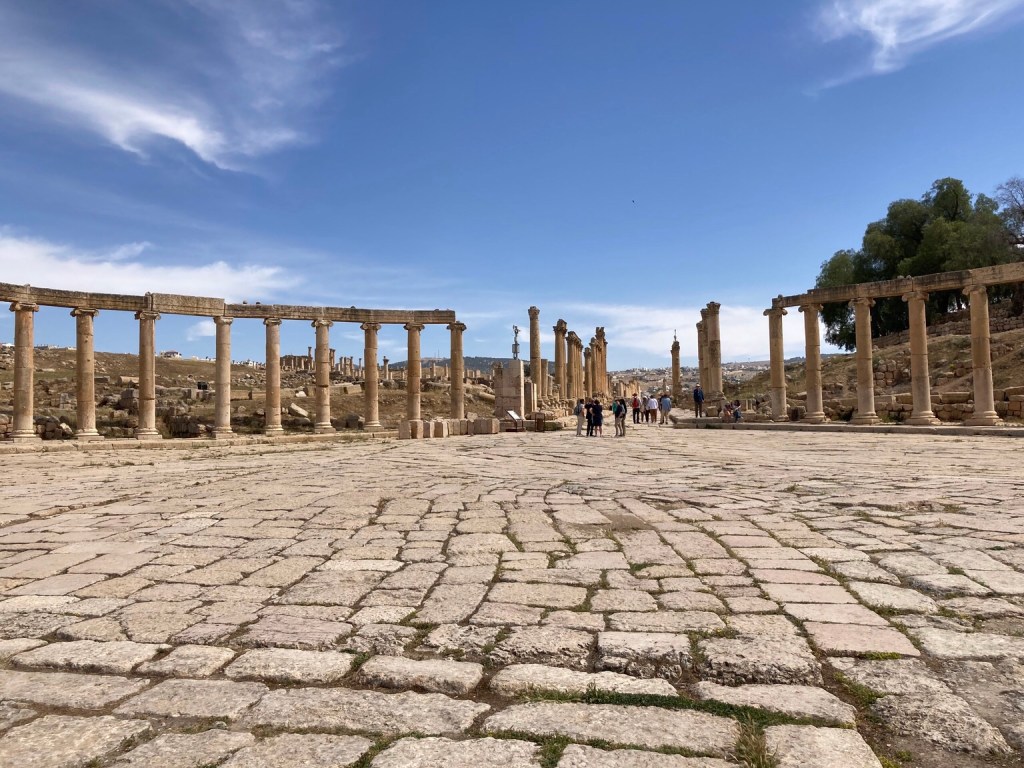
… before heading into the Forum surrounded by an Ionic colonnade and which would have contained more market stalls.
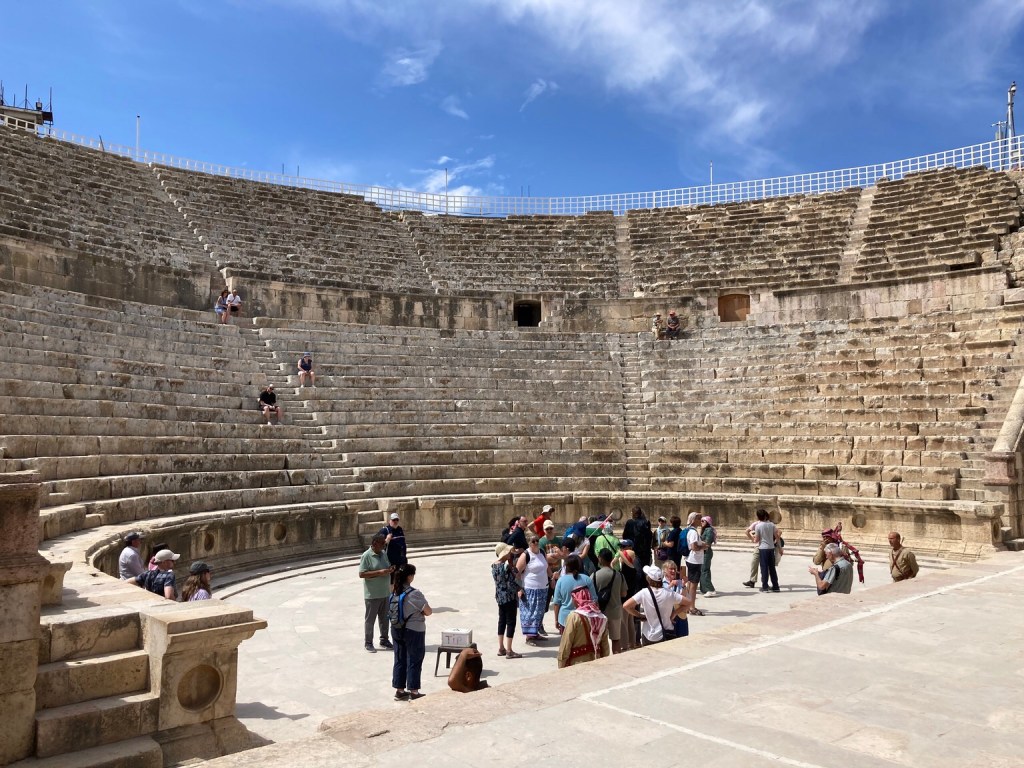
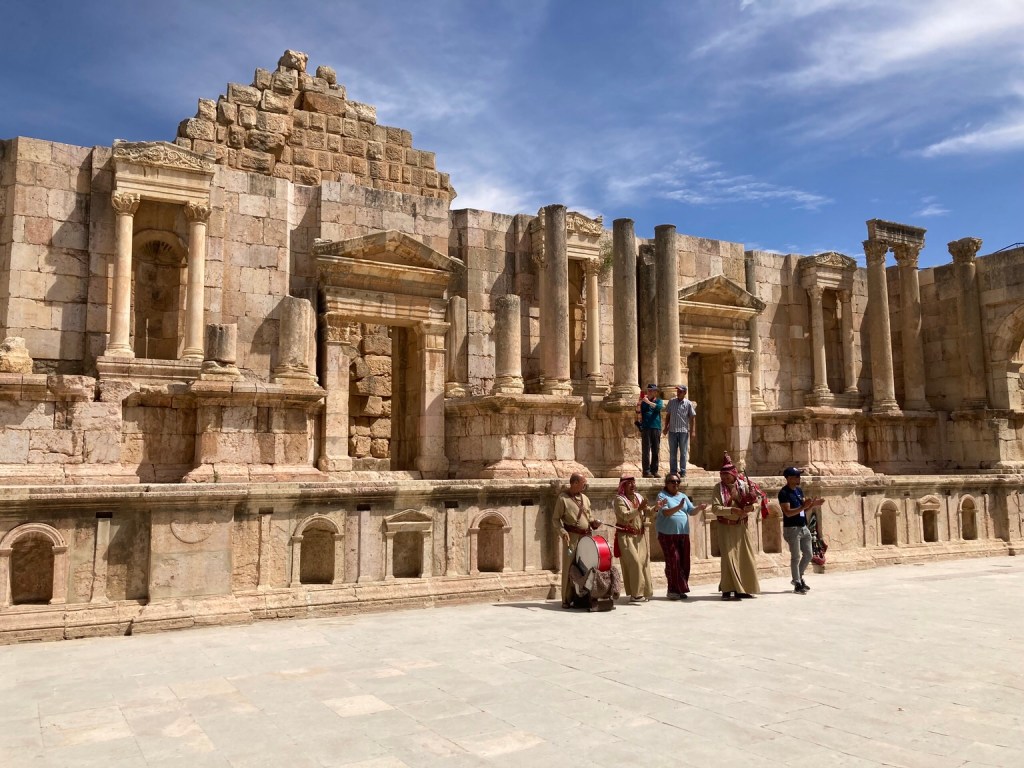
A detour took us up to the South Theatre …
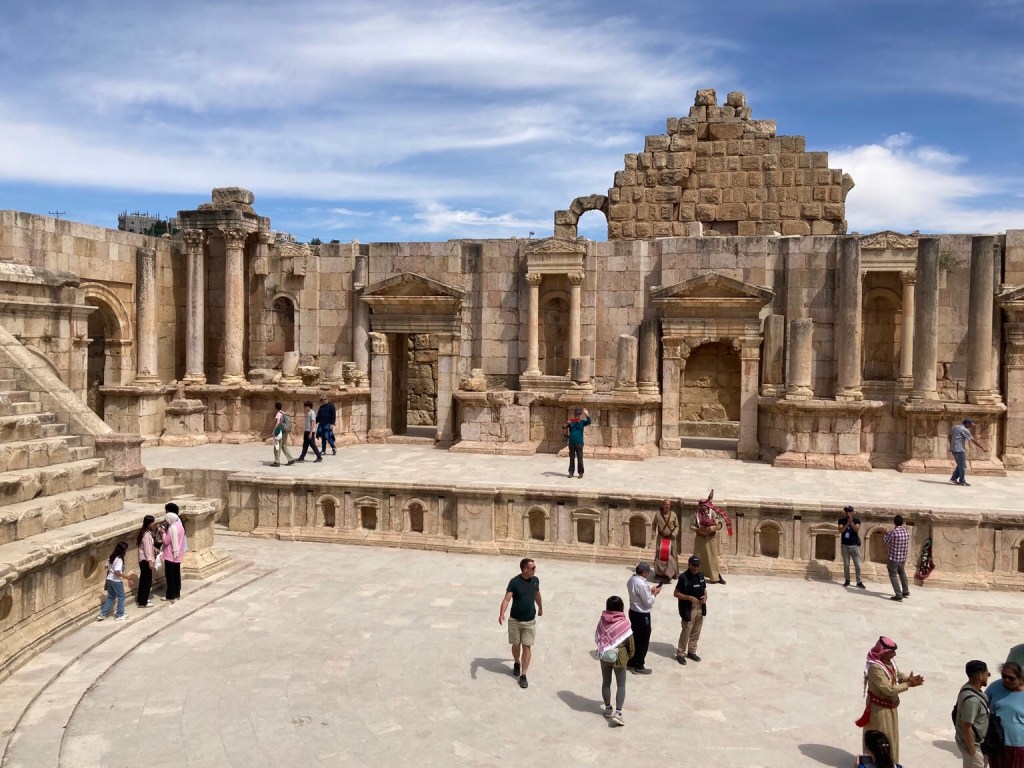
… and the Temple of Zeus …
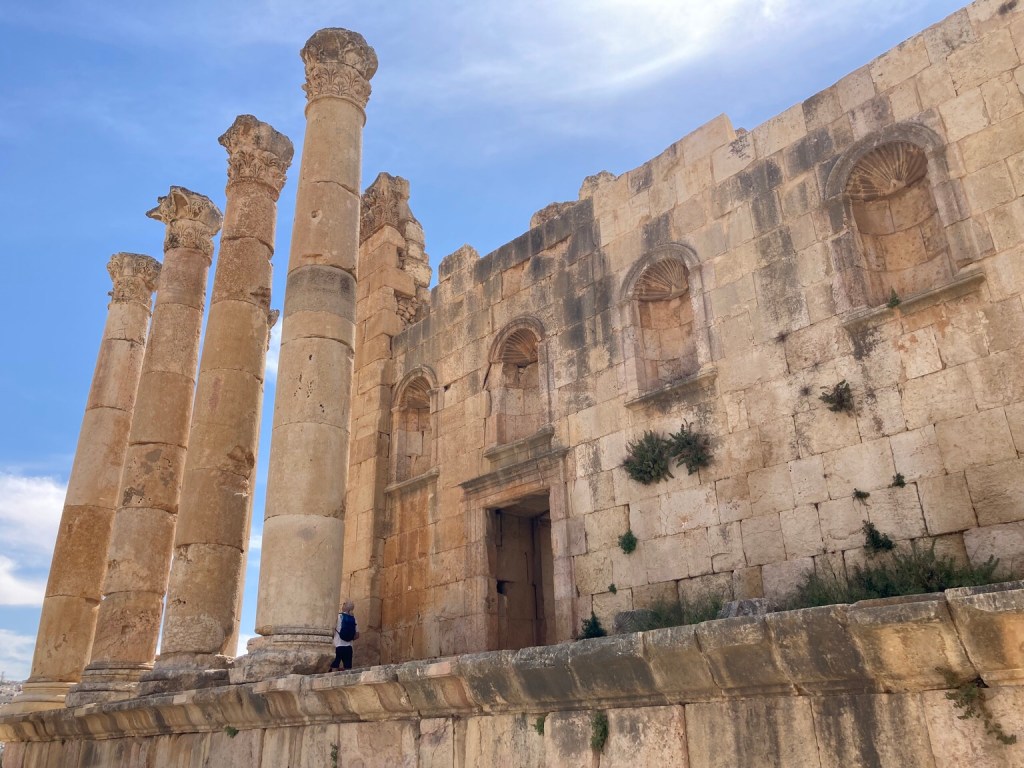
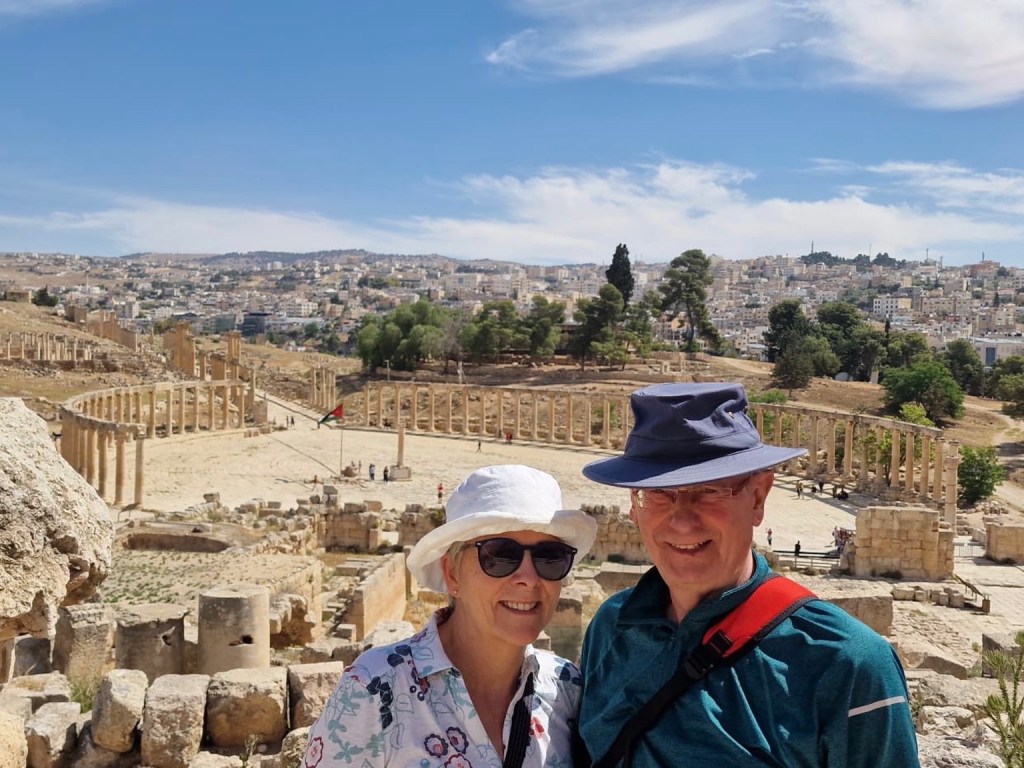
… where we also got a great panorama of the whole site, with the main colonnaded street or Cardo Maximus and the Temple of Artemis above on the left.
There was a large Christian community in Jerash and many churches. One was dedicated to Cosmas and Damianus and has a surviving mosaic floor decorated with a number of birds and animals including an elephant and a camel.

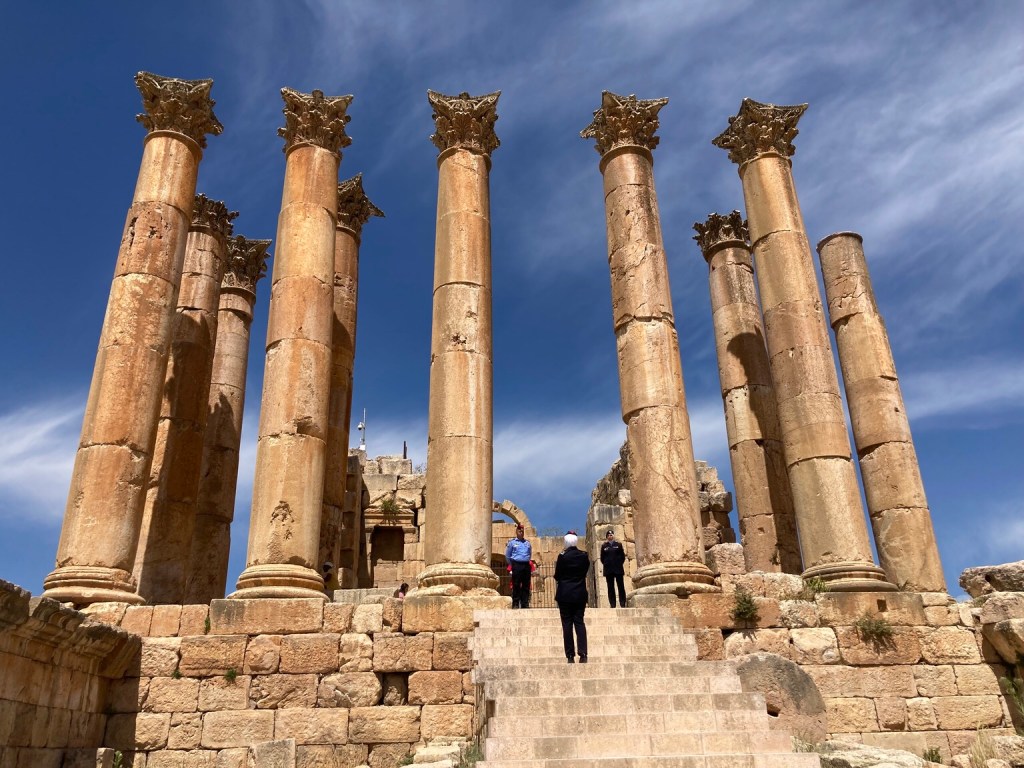
Finally we reached the Temple of Artemis with eleven of the twelve huge Corinthian columns that rim the temple platform still standing …
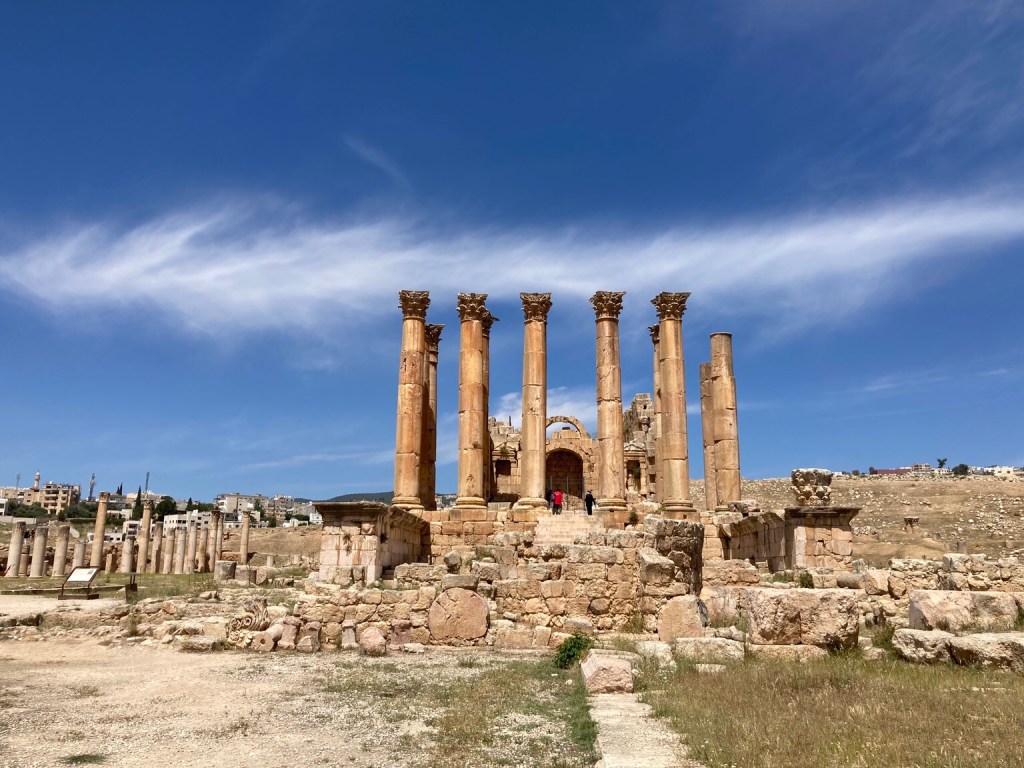
… and its capitals showing up splendidly against the blue sky.
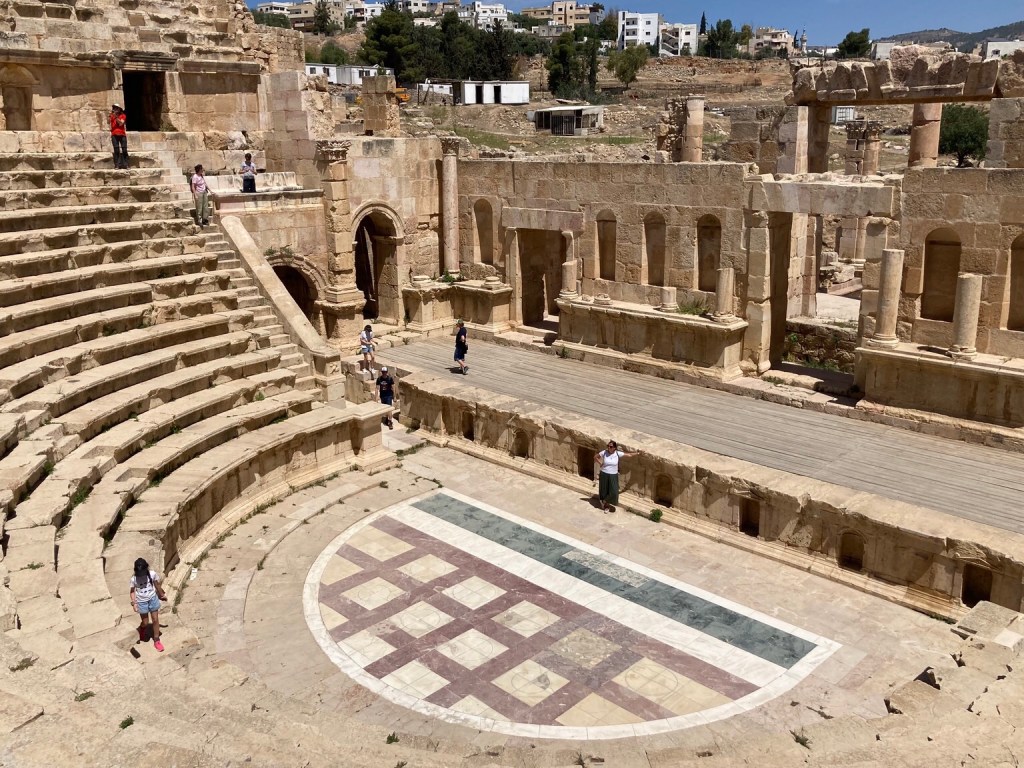
Walking downhill, we passed the smaller Northern Theatre …
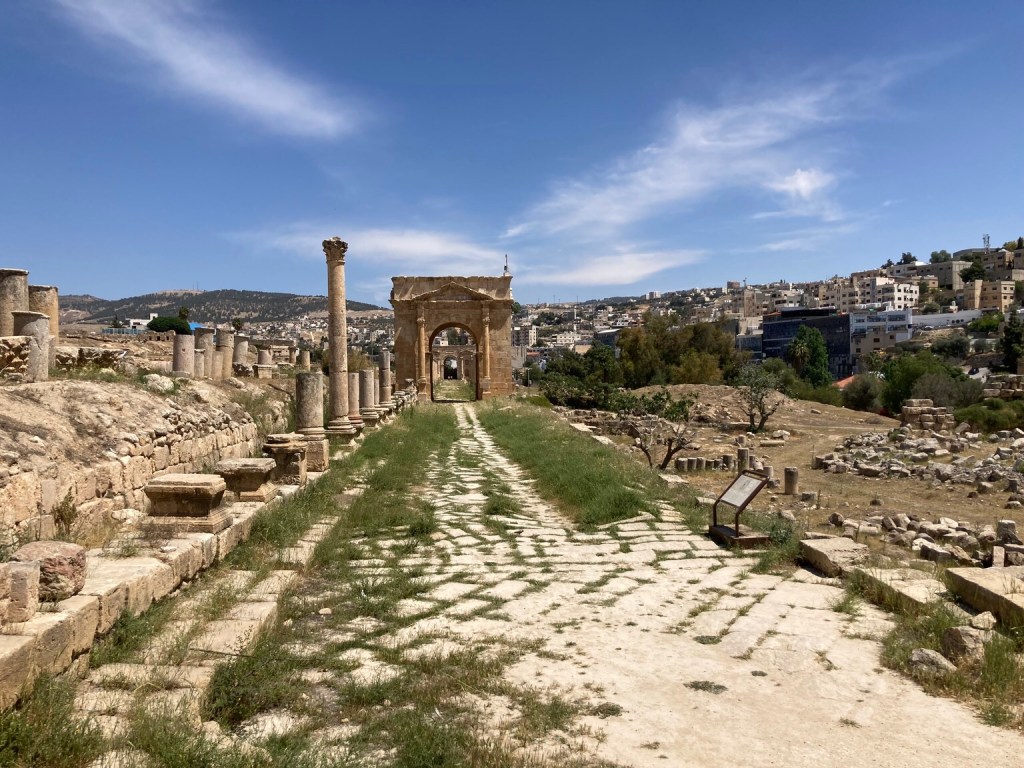
… before reaching the main street and looked towards the North Gate where the road would have continued to Damascus.
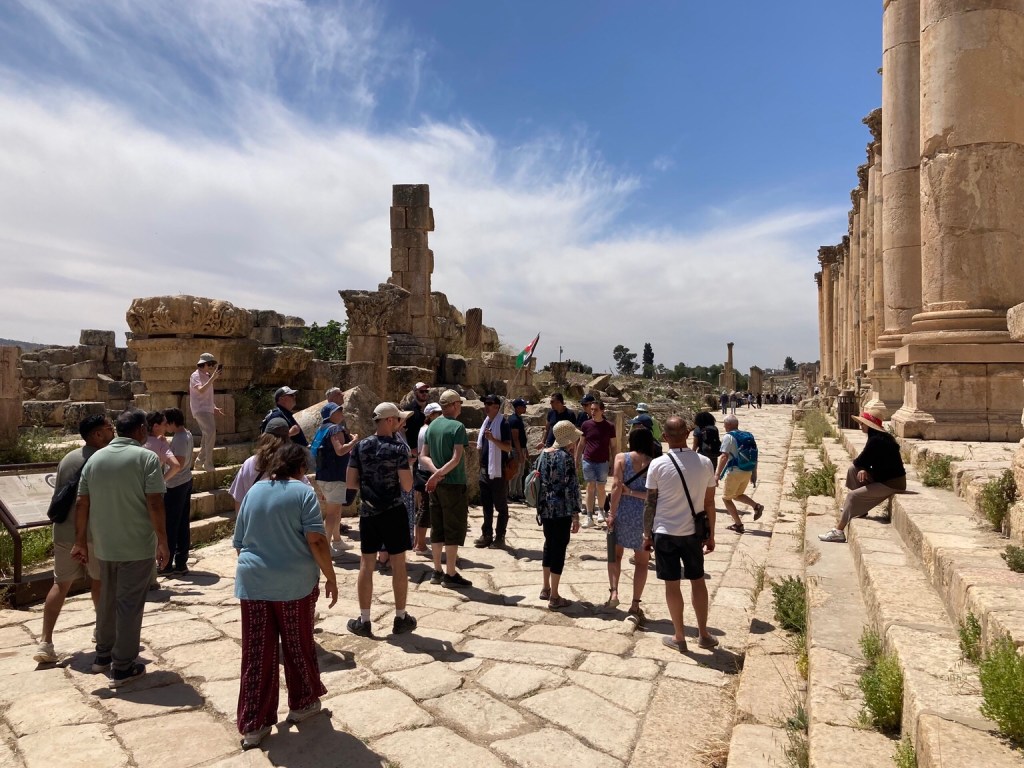
We returned along the Corda, still paved with the original stones and showing the ruts worn by chariots, as well as the drainage holes for the sewer system which runs underneath.
A final couple of snaps, the ornamental fountain called the Nymphaeum …
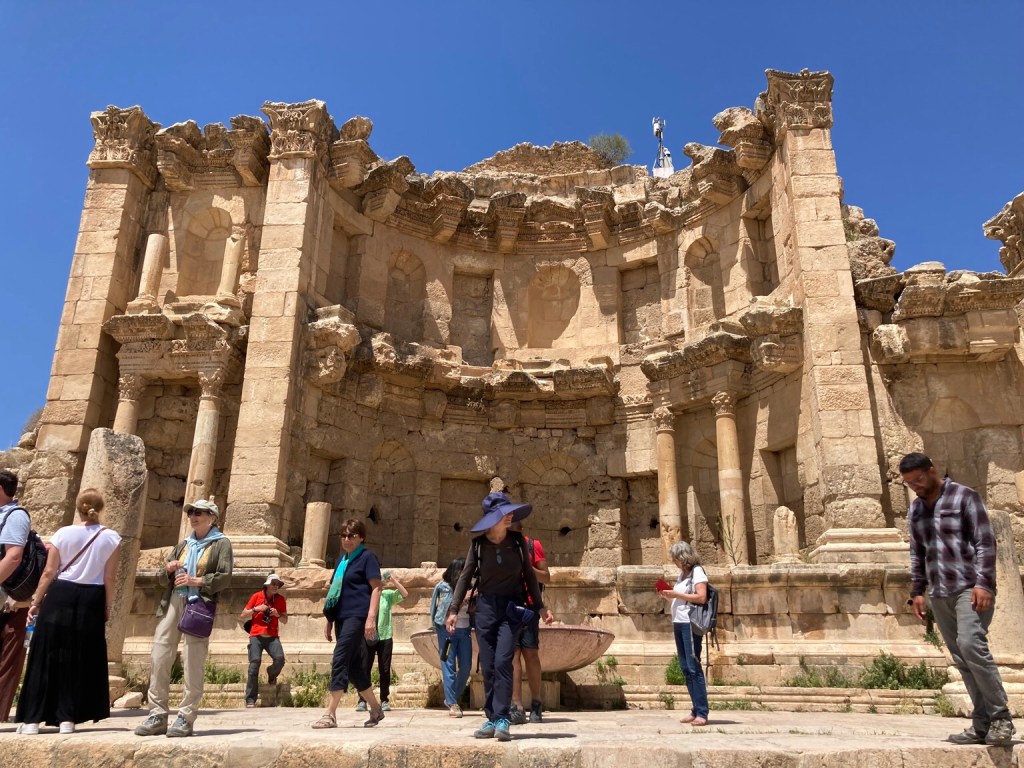
… and the Cathedral gateway …
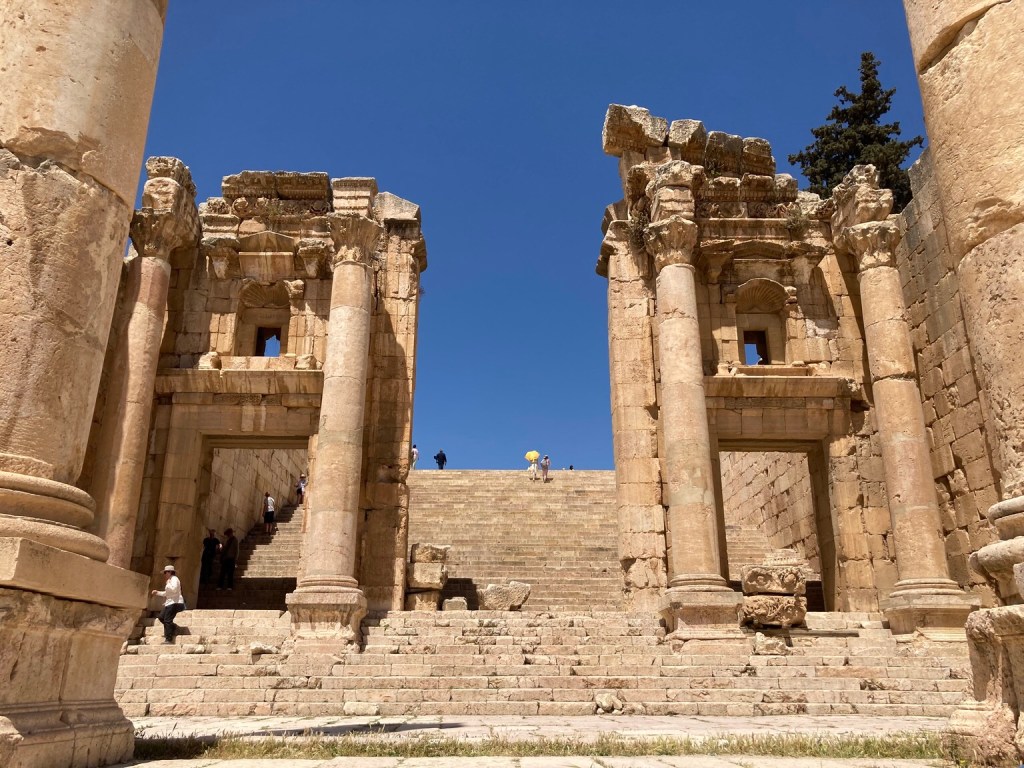
… and then we all deserved a sit down, a cool drink and a spot of lunch!
In the afternoon, we continued a short way further north, up into the hills to Ajloun Castle, built by Saladin in the C12th, to protect the area from the Crusaders, before returning to the hotel.
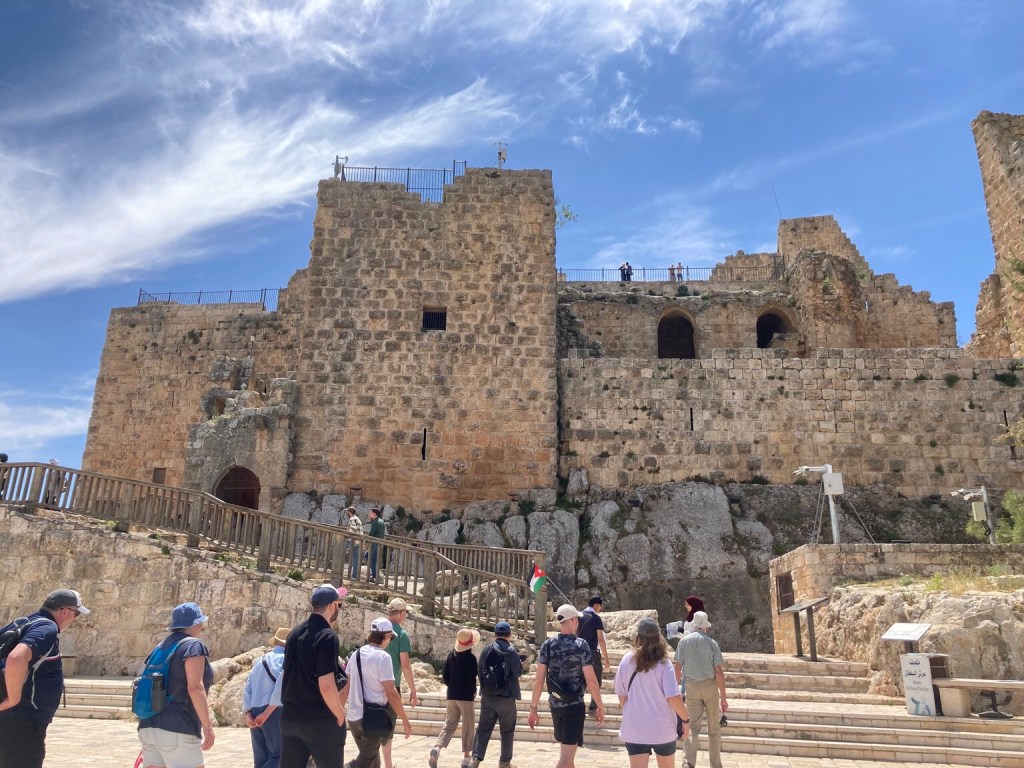
 Off Travelling Together