
Well we’ve walked around Seville Cathedral and photographed it so now it’s time to go in! We queued outside this doorway for tickets, admiring the bronze replica of the Giraldillo statue made while the original was restored.

Right by the door is the mausoleum of Christopher Columbus, where a mariners coffin is held by figures representing the kingdoms of León, Castile, Aragón and Navarra.

Interestingly, it may or may not contain his remains, which have removed around a bit, from Spain to the Dominican Republic, then Havana and back to Seville. Together with tales of the bones getting mixed up on the way, it’s possibly fitting that his bones may lay on both sides of the Atlantic.
It is impossible to convey the size of the cathedral or how overwhelming it is to be standing in the nave. One side contains the choir …

… and the other the main chapel dominated by a vast golden retablo telling the life of Christ in 45 scenes.

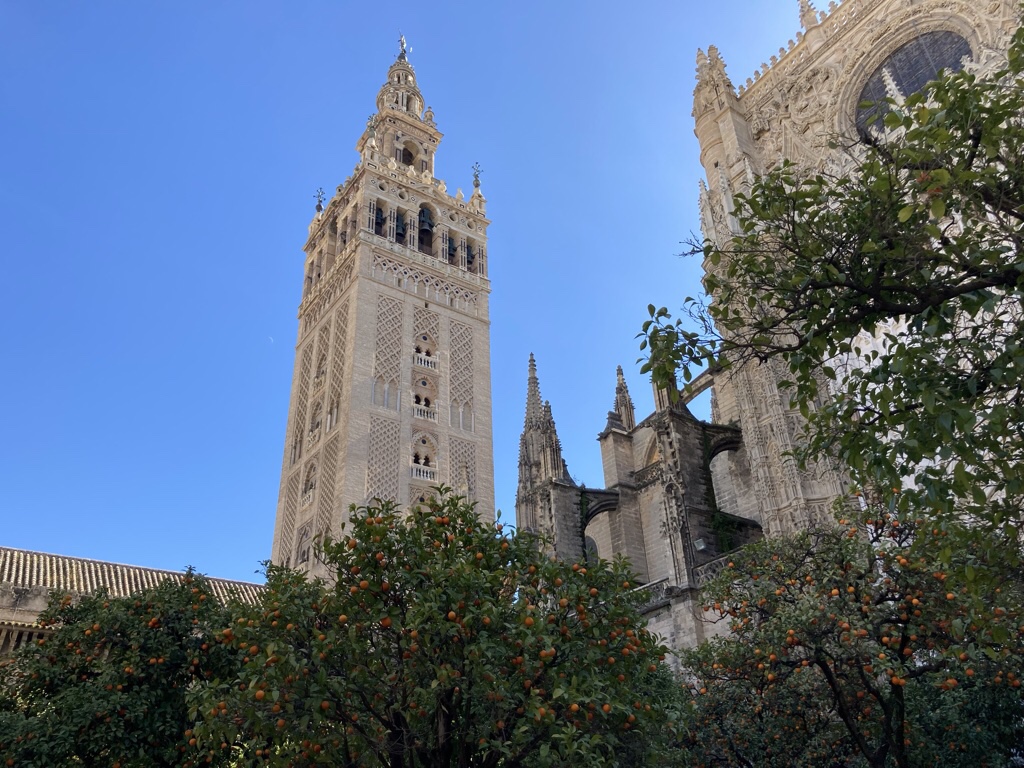
We made our way past umpteen chapels round the outside, filled with paintings until we reached the entrance for La Giralda, where a series of 35 ramps lead up the square tower to the top. There are 24 bells and they certainly make themselves heard, chiming every quarter and for longer on the hour!


The climb was certainly worth the view, where we could not only admire the buttresses and statuary of the cathedral …


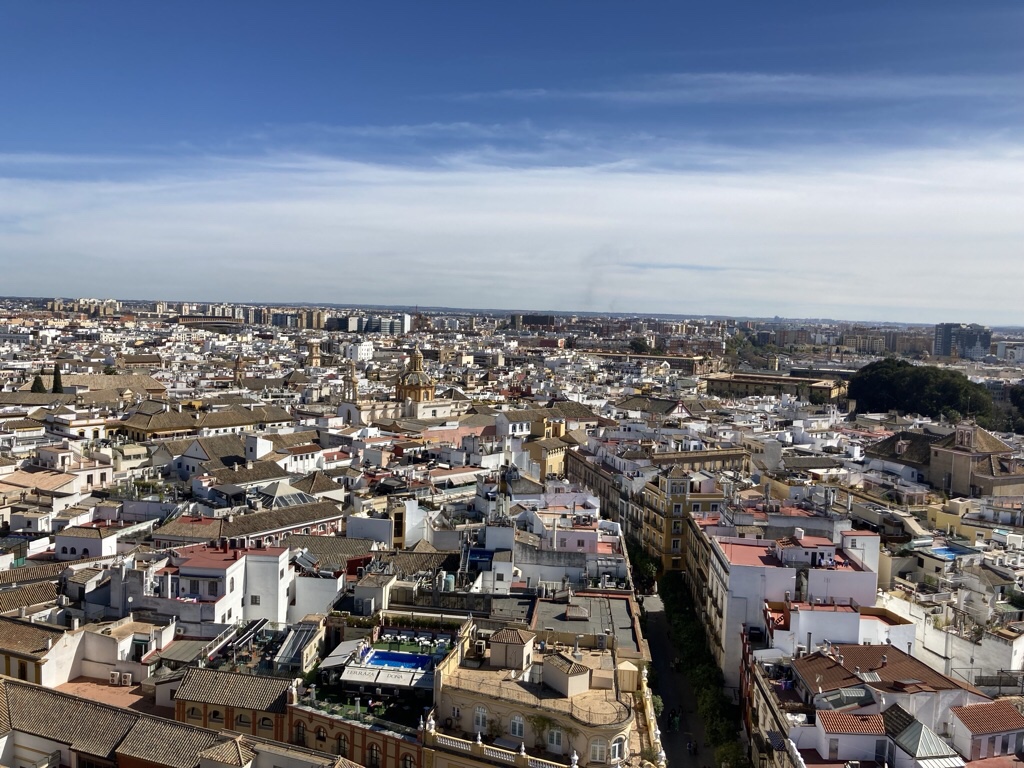
… but also the view over the city.
We left through the Patio de Los Naranjos, once the entrance courtyard for the old mosque where the faithful would have washed before prayer.

Just across the road is the General Archive of the Indies. It once housed the 38,000 documents covering four centuries of Spanish rule, but these have recently been moved elsewhere so the building can be admired in all its splendour.


The Old Tobacco factory is another massive structure, now part of the university, and where Carmen, from a C19th story was made into an opera by Bizet and worked as a cigar maker. At its peak it was the country’s largest single employer with some 10,000 women making cigarettes.

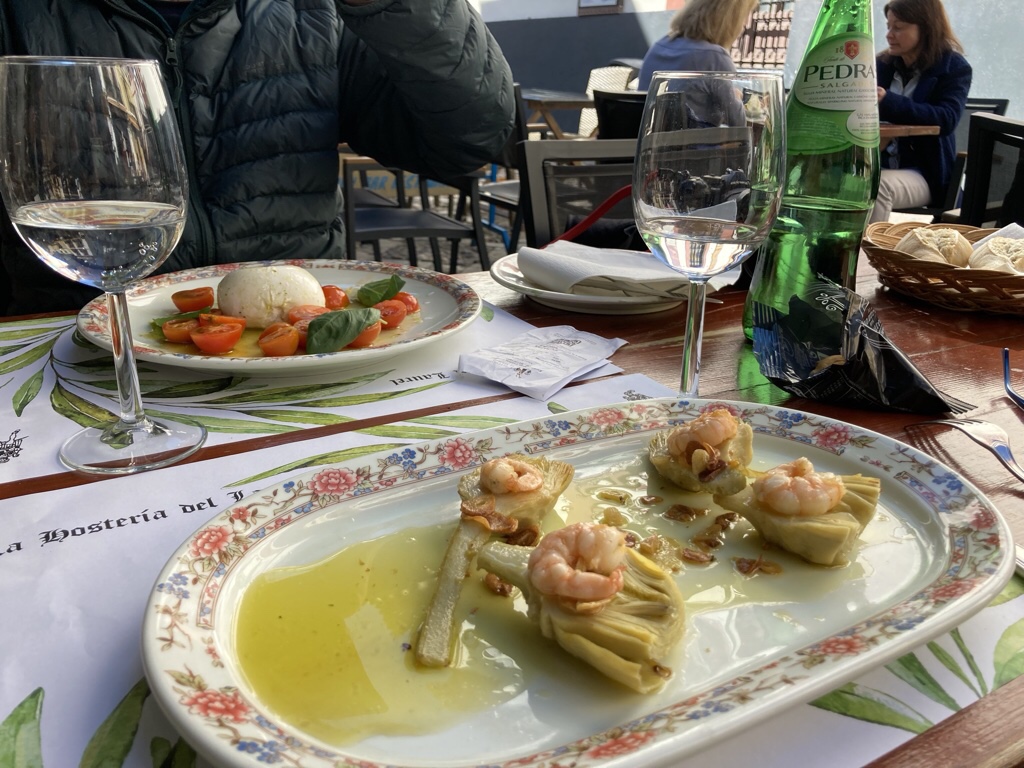
Having spotted the lovely courtyard with people lunching yesterday, we went to eat there ourselves … artichokes with prawns and buratta with tomatoes and even some Spanish tunes!

In the afternoon we headed for Las Setas, not realising that this striking wooden structure formed by six large, mushroom-shaped parasols was inspired by the arches of Seville’s cathedral. It’s proper name is the Metropol Parasol, but everyone soon started calling it The Mushrooms and the name stuck!

Once the site of a market, the land had become derelict and plans for underground parking with a new market area were halted by the discovery of Roman ruins. A competition was held for ideas won by a German architect Jürgen Mayer with a concept to incorporate the ruins, a area for a market and public events as well as a landmark structure with a panoramic view.

It’s free to wander under, but we paid to take the lift which gave us views not only of the structure but also of the city,could have returned later to see the evening light show, although we didn’t.


And it’s made of wood, covered with a protective polyurethane coating!

We both thought it quite striking with interesting shapes and shadows and we watched the world go by with our coffee and cake.


In the evening, we chose a change from tapas, but still with a Spanish connection, enjoying margaritas and Mexican in La Cantina, a selection of tacos, scopes and flautes which brought back memories of our trip to the Yucatan.

 Off Travelling Together