 The train chugged along for 6hrs and 400km, passing cotton field to begin with, then desert and finally more cotton as we approached Bukhara, so rather than spend time looking out of the window, I finally had a chance to get stuck into my book. I mentioned The Carpet Ride to Khiva in one of the last posts, but had read little more than the introduction but reading further, I began to suspect that the house at No 57 where the author stayed in Khiva is now Meros B&B … and having checked with Jaloladdin, he confirmed Aslan had lived with his family for 7 years and they still keep in touch … small world!
We were met at the station and welcomed at Hotel Khurjin by Avozshod who told us it was a restored C19th madrassa named for an Uzbek saddlebag, as the building splits and opens into two courtyards.


We stayed in one of the converted student rooms overlooking a pretty courtyard where we could relax and drink tea.


The rather attractive blue pipe is to feed water to the roof, where expansion is taking place!

So if you are sitting comfortably, I’ll tell you a story … When the Arabs arrived in the C1st, Bukhara was already a bustling Silk Road trading center. They managed to convert most of the local population to Islam but were replaced after a few decades by the Samanids, Sunni Muslims loyal to the caliph in Baghdad and admirers of Persian Shiite culture. In the C9th and C10th, Bukhara became a great city of trade and learning. It was home to 240 mosques and 113 madrasahs and produced great scholars such as Muhammad al-Bukhari who gathered the hadiths, or sayings of The Prophet Muhammed and the physician Abu Ali ibn-Sina, also known as Avicenna.
After two centuries under the Karakhan and Karakitay dynasties, Bukhara was attacked by the Mongols. When Genghis Khan arrived in Bukhara he reportedly entered the mosque and emptied cases that contained the Koran, the Muslim’s holiest book, and had them filled with grain for his horses. He then ordered the rulers of the city to bring musicians, wine and fermented mare’s milk and told the nobility to bring their riches. After gold and precious stones were laid at his feet, he set his troops loose. They took everything they could carry and burned what they couldn’t.
Bukhara was a minor city under Tamerlane but was reborn under the Uzbek Shaybanids and then the emirs of Bukhara beginning in the 16th century. During this era, Bukhara was the center of a empire that embraced much of Central Asia and was famous for its caravanserais, bazaars, carpets, fountains and 100 madrasahs with 10,000 students. Today, it is a city of around 250,000 and 150 historical monuments, so we’ll have our work cut out!
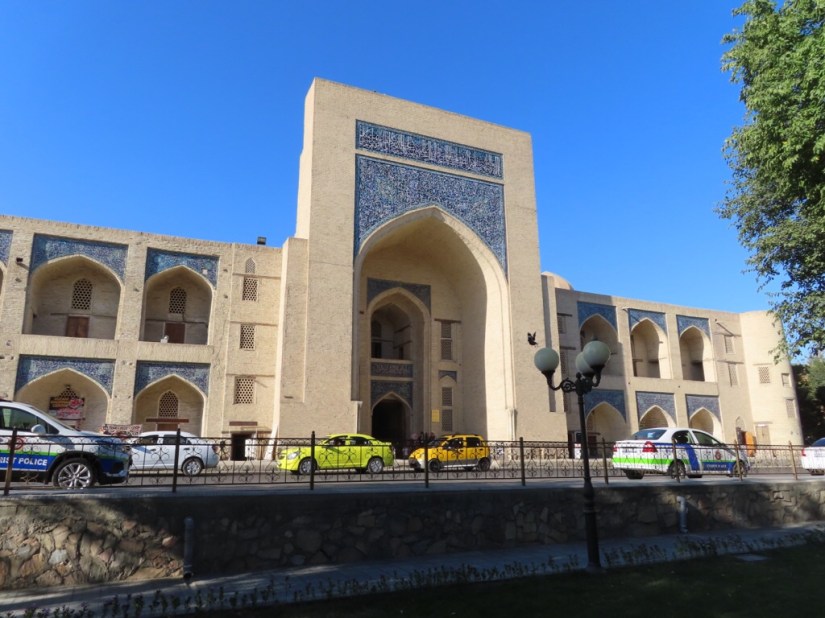
Just a few steps took us to the C16th Kukeldash Madrassah, once the largest Islamic school in Central Asia but looking a little rundown apart from some souvenir shops …
Opposite is the Lyabi-Khauz, a plaza built around a pool, which was constructed by the vizier Nadir Divan-Beghi in the C17th with the Nadir Divan-Beghi Khanaka at one end …

… and Nadir Divan-Beghi Madrasa opposite.


The construction of two monumental buildings facing one another was a common practice in central Asian cities and was known as kosh, and we will see it several times in Bukhara alone. Traditionally, Islam discouraged the depiction of human and animal forms in case it lead to idolatry but in the early C17th under the Shaybanids the rule was not so strictly enforced and here there are mosaics of fantastical birds and a sun with a human face.
Here is a statue of Hoja Nasruddin, a wise fool from folktales, which was very popular with the locals for souvenir photos …
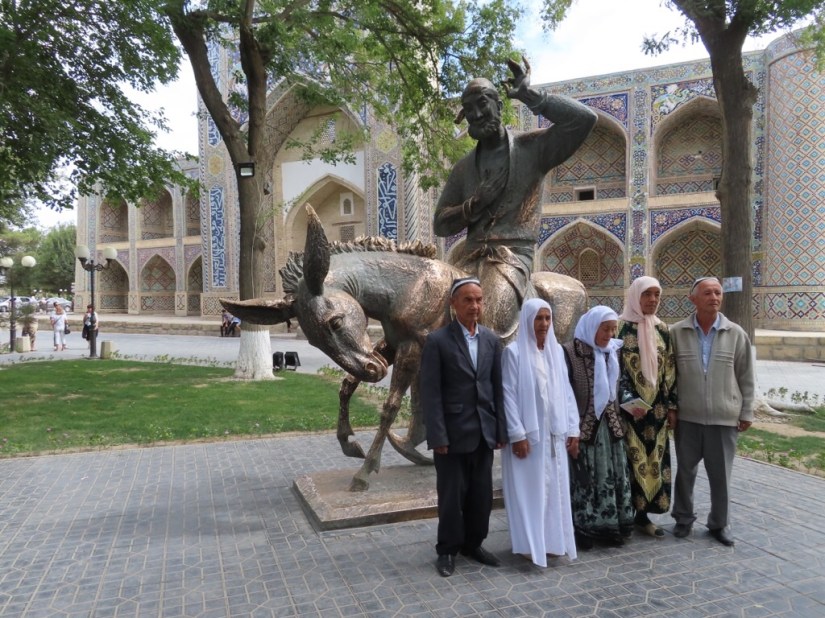
… and a here’s a souvenir pic of my Khiva dress too!

Nadir Divan-Beghi had great difficulty acquiring the site for the pond as there was a house owned by a Jewish widow. A canny bargainer, she agreed to swap her house for a piece of land and permission to build a synagogue on it, the first in the city …
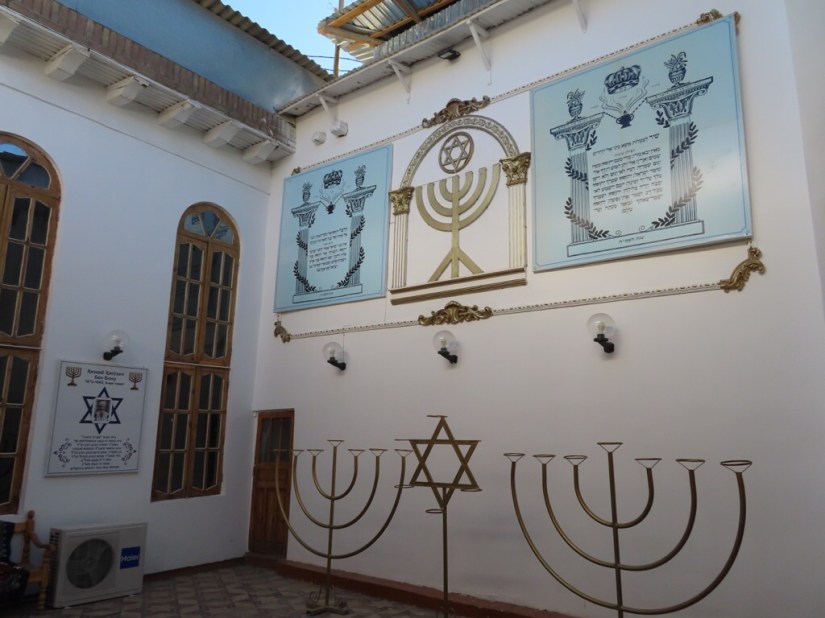
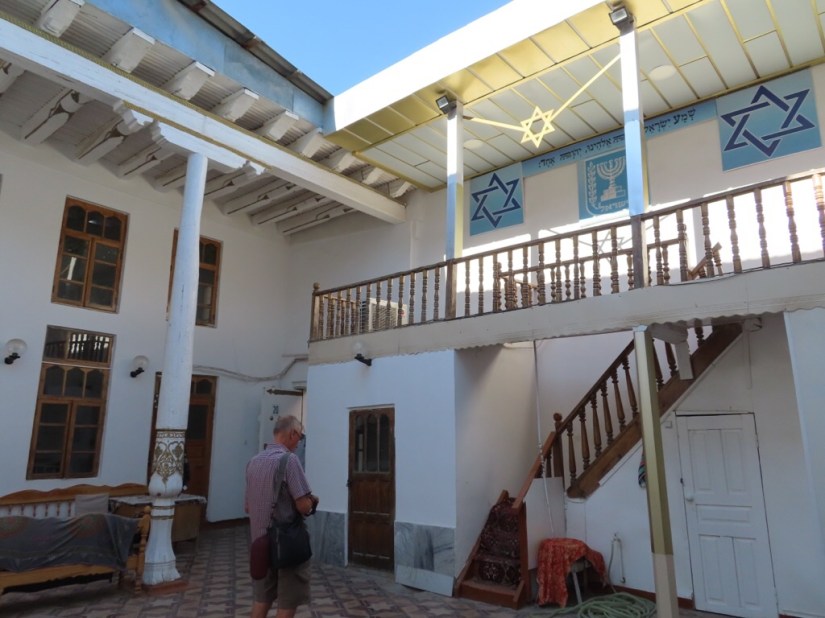

There had been Jews here since the C12th and they had their own culture and language, Bukhari, related to Persian but with the Hebrew alphabet. Many became successful despite discrimination and at one time there were seven synagogues, but most left the city between 1925 and 2000 for Israel and the US.
Also nearby are Maghoki Attar, the oldest surviving mosque with a C9th facade and C16th reconstruction …

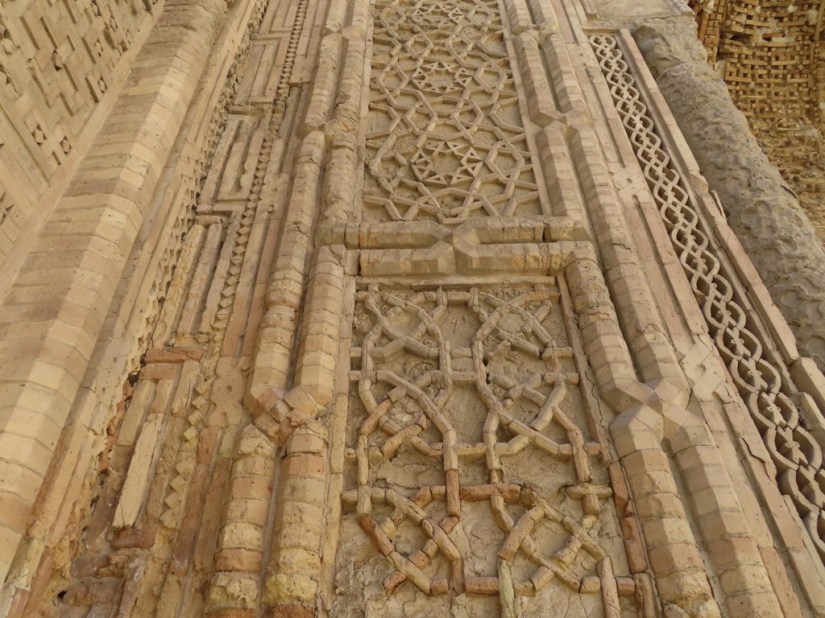
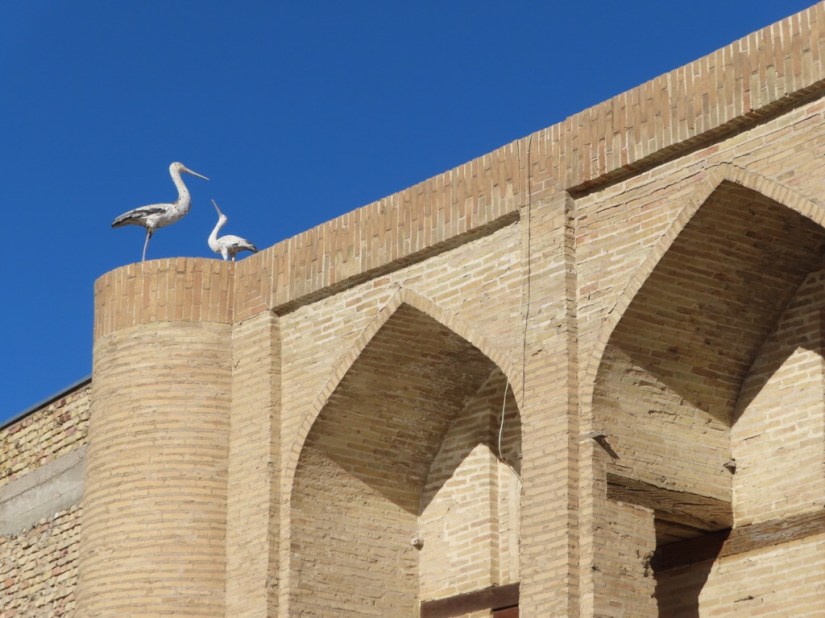
… and Char Minar, the gatehouse of a long-gone madrasa with four very pretty towers. Storks were once a familiar sight in the city, but unfortunately no longer as most fell victim to high soil salinity from a reduced water table and pesticide pollution, but there are a few fake ones about …

… and here are a couple more, on the roof of a madrasa!
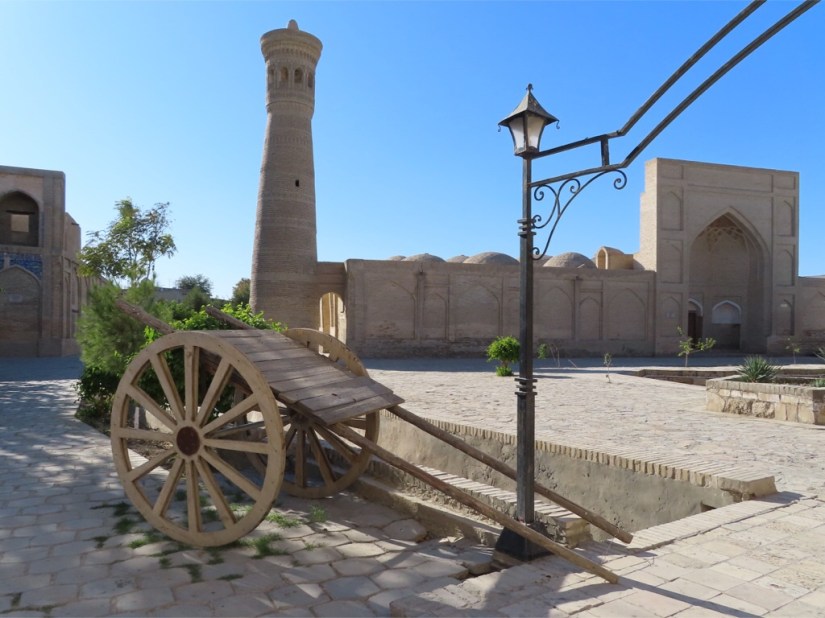
The Khoja Gaukushan Ensemble was built by the Juabari family in the C16th and is rare as it remains untouched by later redevelopment. Gaukushan refers to the slaughter of cattle so there might once have been an abattoir here. It is on the junction of two medieval streets and the Shah Rud canal, it comprises a mosque, a minaret, two madrasas and a hauz which is a pond.

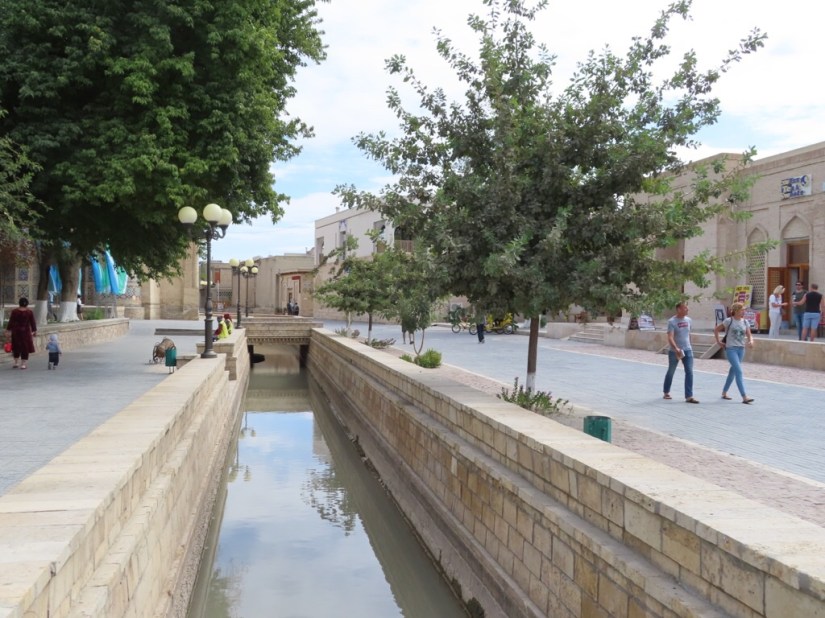
Bukhara once had a network of canals as well as 200 stone pool where people gathered, gossiped, drank and washed but water-borne diseases were rife as the water wasn’t kept clean and in Soviet times, most were drained.
The C16th trading domes became a symbol of Bukhara’s status as a Silk Road city and were built at busy crossroads providing a means of controlled and convenient trade. The large domes remained cool and were filled with shopping stalls and handicraft shops, each named for its particular speciality. Today four remain, filled with craft and souvenir stalls.

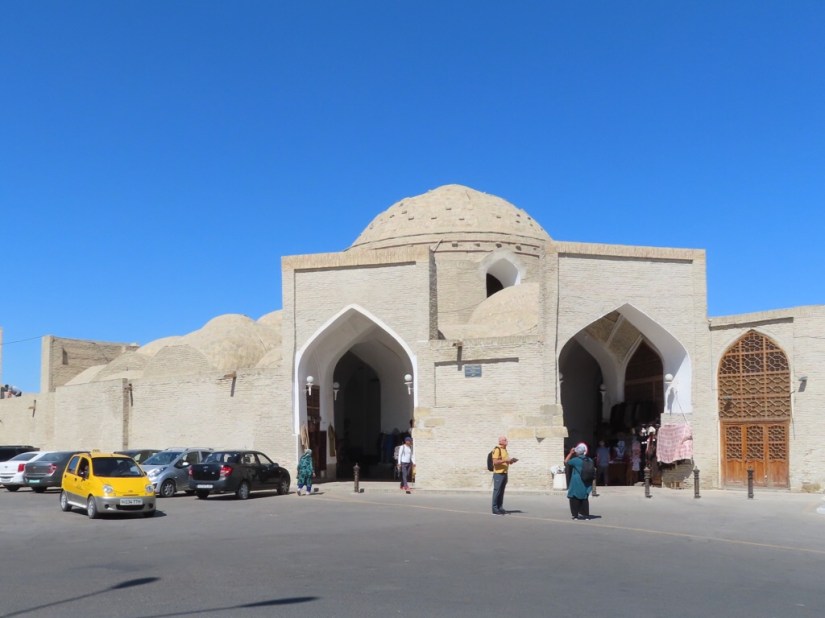


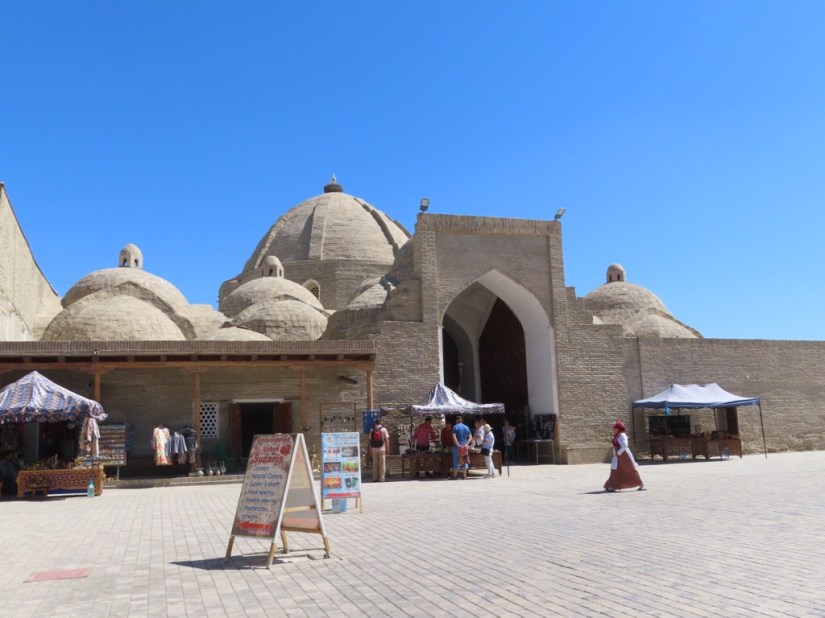
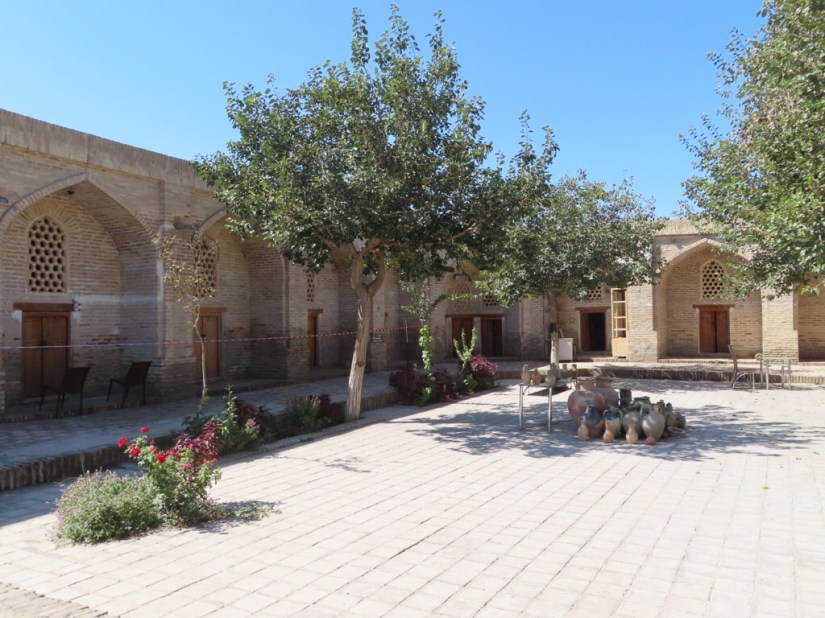
Nearby are a couple of caravanserai which would have given travellers shelter and water. They look similar to a madrasa, but the entrance is big enough to bring loaded animals inside and the door could be locked and guarded at night and provided rooms, however often travellers would have to bring food for themselves and their animals. It was also a good place to do business and exchange news. Today they sell craft and souvenirs too.


Our next stop was a pair of facing madrasas built over two centuries apart. Ulugh Beg Madrasa was constructed in 1419, the work of Ulugh Beg, the astronomer-king and grandson of Timur. It represented the first stirrings of Bukhara’s cultural rebirth, as the madrasa served as a magnet to attract scholars and scientists from across the Muslim world, eager to advance both piety and knowledge. A corded band decorates the gateway and the calligraphic inscription ‘Aspiration to knowledge is the duty of every Muslim man and woman’.
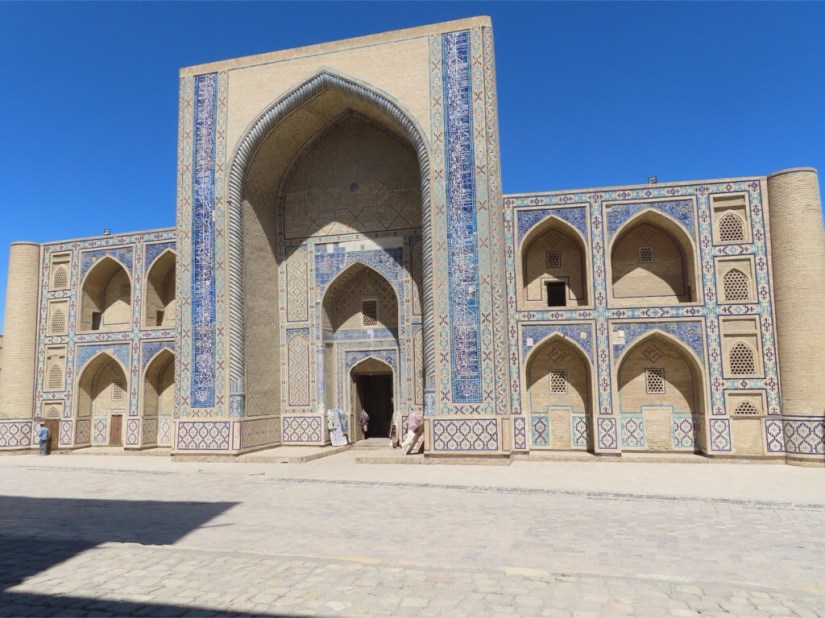


Opposite, the Abdullazizkhan Madrasa built in 1652 shows the progress of medieval Central Asian architecture. The gateway here is adorned with facets and ornamental stalactites patterned with bright floral designs and colours and even gilding.


Inside, restoration continues …


The Kalyan Minaret is the last surviving fragment of the Kara-khanid era mosque built by Mohammad Arslan Khan in 1127, predating the Mongol conquests and one of only a handful of buildings to wholly or partially survive Genghis Khan’s invasions. The ornamentation relied entirely on the brickwork, with the bands of glazed tile near the base of the lantern added since 1920.


Kalyan Mosque was built by Ubaydullah-khan, the first of the Shaybanids to make Bukhara his primary capital. It was finished by 1530 and stands on the site of a destroyed Karakhanid mosque. It serves as the city’s Friday mosque and can hold 12,000 people.
It opens onto the large sparse courtyard …


… surrounded by cool arcades.

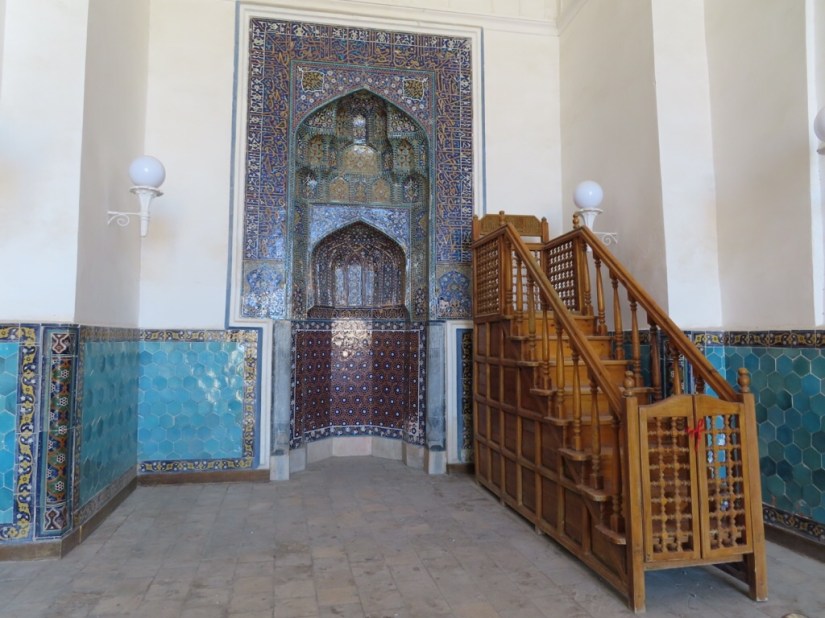
The mihrab has tilework signed by its creater, Bayazid Purani.
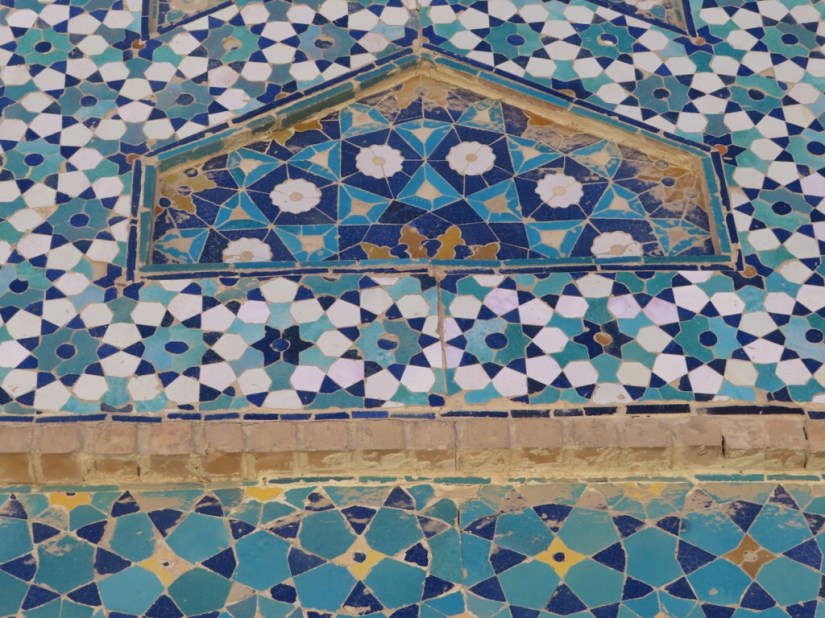
The Mir-i Arab Madrasa opposite was constructed in 1536, also by Ubaydullah-khan, funded by the sale of 3,000 slaves captured in his wars in Khorasan. The two-story facade is almost completely covered in glazed mosaic faience tiles, a time-consuming and expensive decorative treatment that was first popularized under Timur’s rule.

 In the Soviet era the Mir-i-Arab was the only madrasa allowed to operate throughout the entire realm and remains in active use, offering a 4 year course to 120 students in religious and general subjects. It is closed to visitors but peering through the pandzhara was like peeking into the quad of an Oxford college!

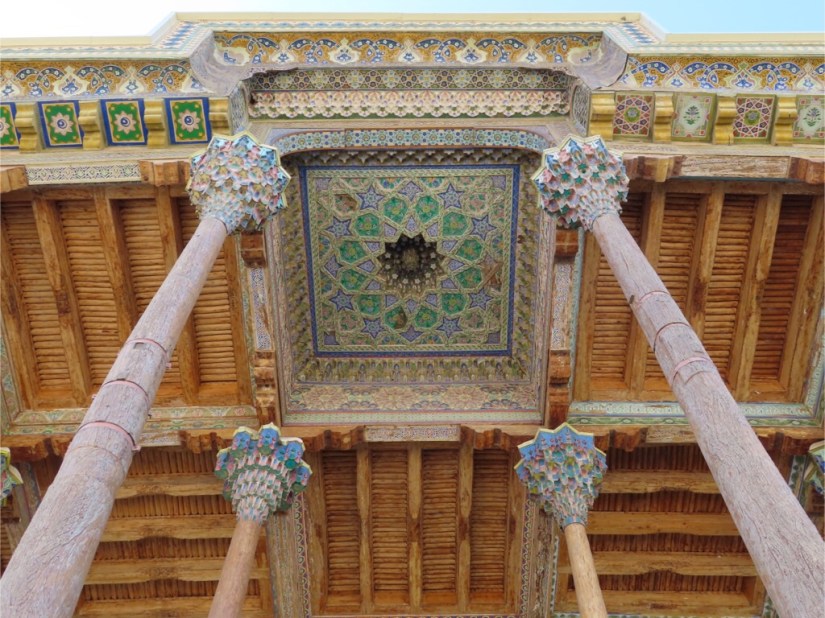
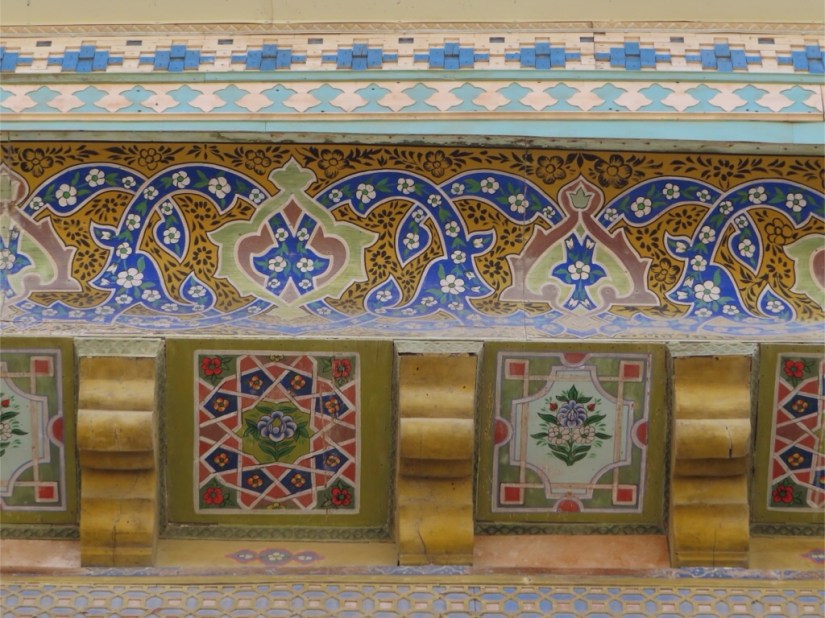
A short way west is the main central square or Registan of Bukhara. There were once a lot of public buildings here, but all that remains is the Bolo-Khauz Mosque which was built in 1712 by Emir Shahmurad who wanted to attend Friday prayers with the people. It is named for the far older hauz or pool in front. The irwan has a wooden ceiling leaning on refined columns and is decorated with fretwork and ornamented with floral and geometrical ornamental patterns. A short minaret was built in 1917.



 We took a tea break in a shady cafe …

… and read about two British officers in 1842 who were executed in this square in 1842. Colonel Charles Stoddart was a diplomat and British agent in Central Asia during the period of the Great Game. This was a defensive cold war for control of Central Asia which pitted imperial Russia, which was expanding to the south, against Britain, who wanted to protect India. He was sent on a mission to persuade the emir of Bukhara to free Russian slaves and sign a treaty of friendship with Britain but instead offended the emir as he did not bow or take gifts so was thrown into jail. Captain Arthur Conolly came to rescue him, but he was thrown into jail too. Receiving no reply to his letter to Queen Victoria, the emir had them marched out in front of a large crowd, made them dig their own graves, and had them beheaded. Bukhara later became a Russian protectorate although the emir reigned until 1920.
Across the road was the Ark, the fortified city within a city which was the residence of the emirs of Bukhara. Its foundations were laid in the C4th BC but has been destroyed and rebuilt several times and in 1920 it was bombed by the Red Army, destroying around 80%. The most impressive part was the entrance …

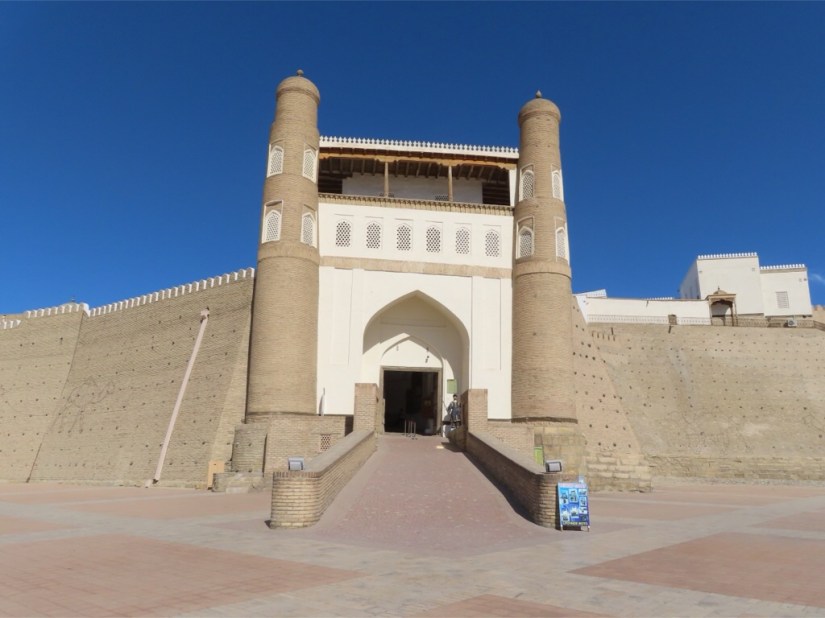
… but there was a Mosque …
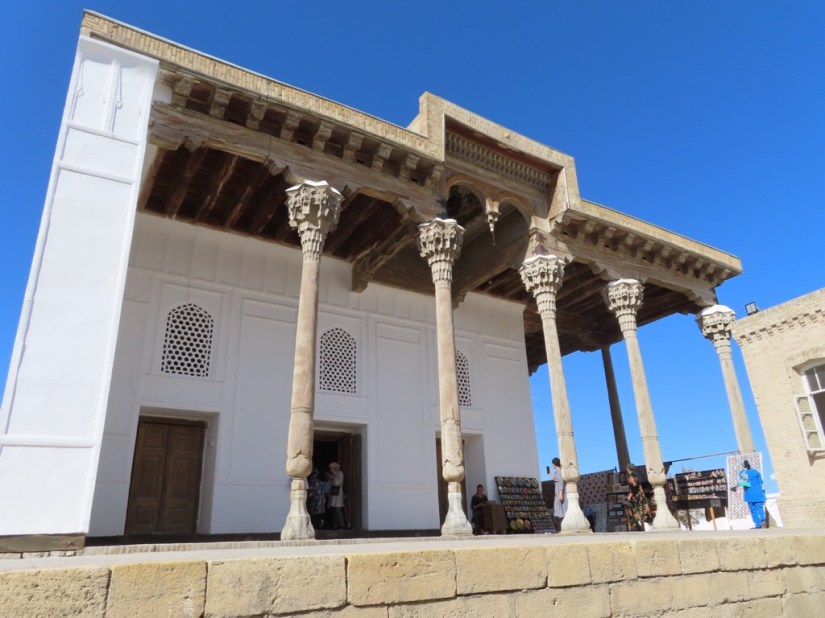

… Throne room …
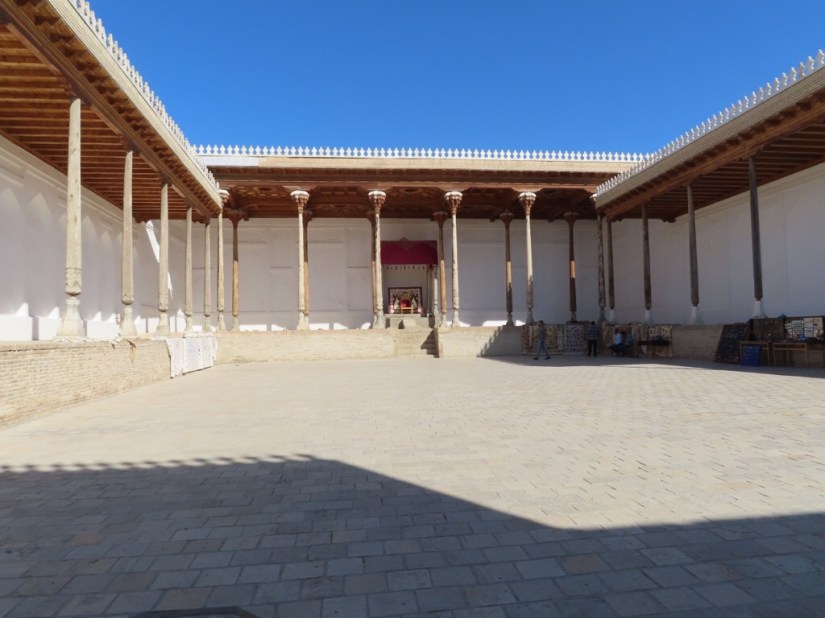
… courtyards overlooking the city …

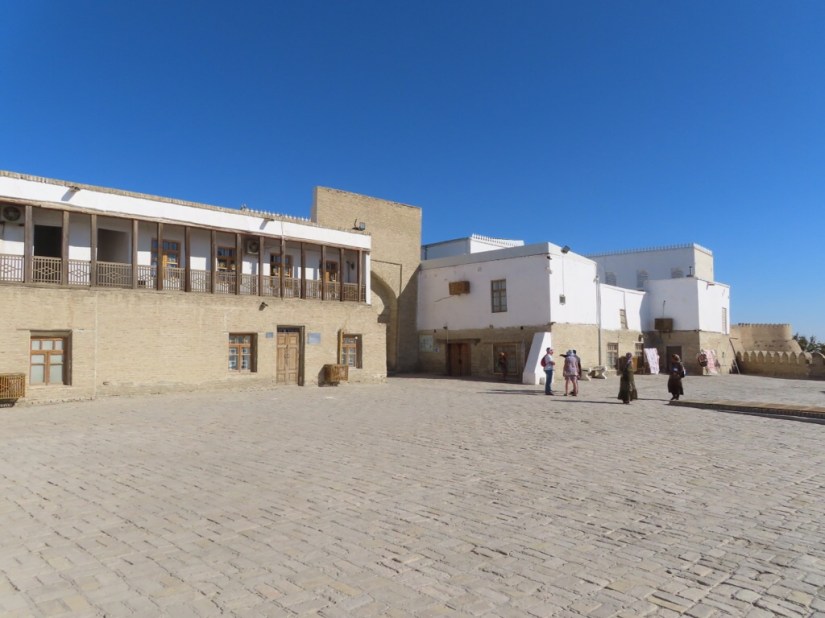
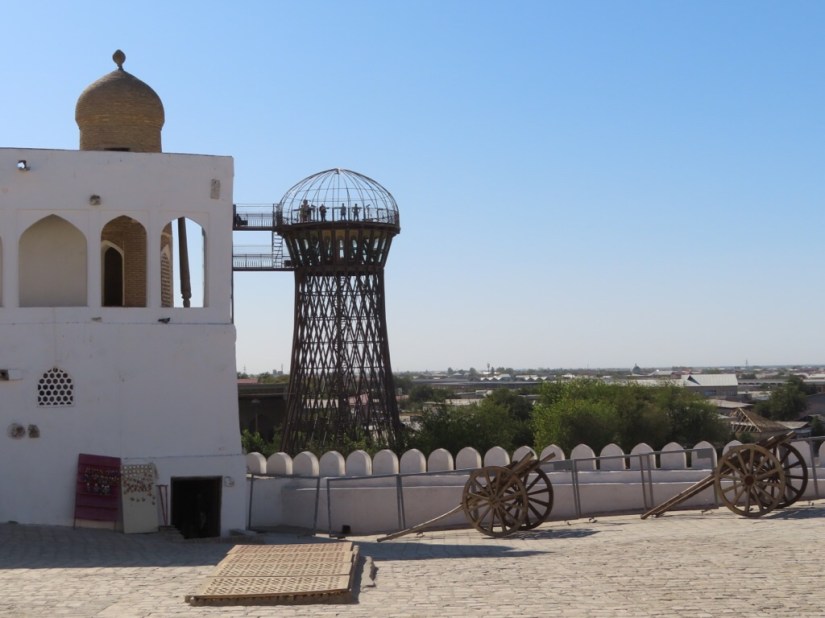
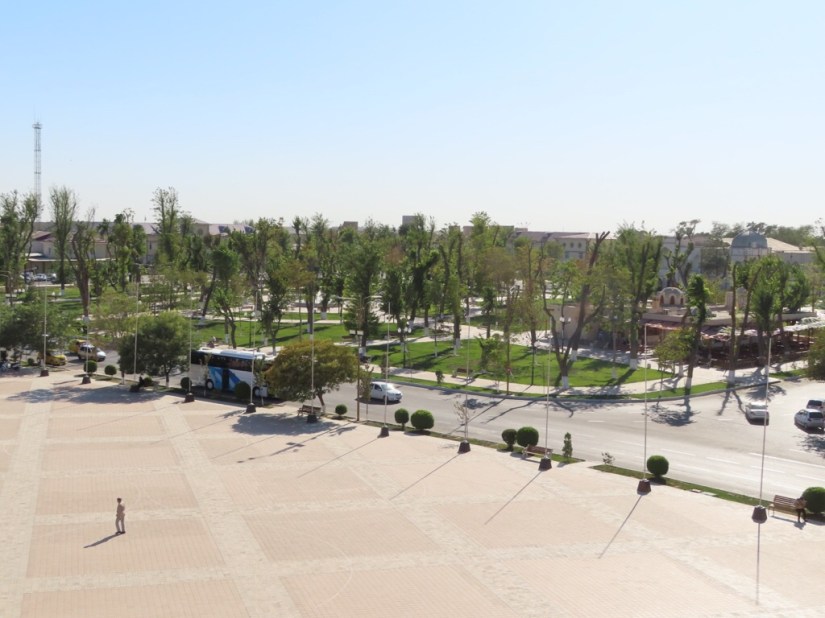 … and this rather strange viewing tower – us watching them watching us!
There was even photo evidence of real storks in the C19th!

Close by is Samonid Park built in the Soviet era and containing a funfair.

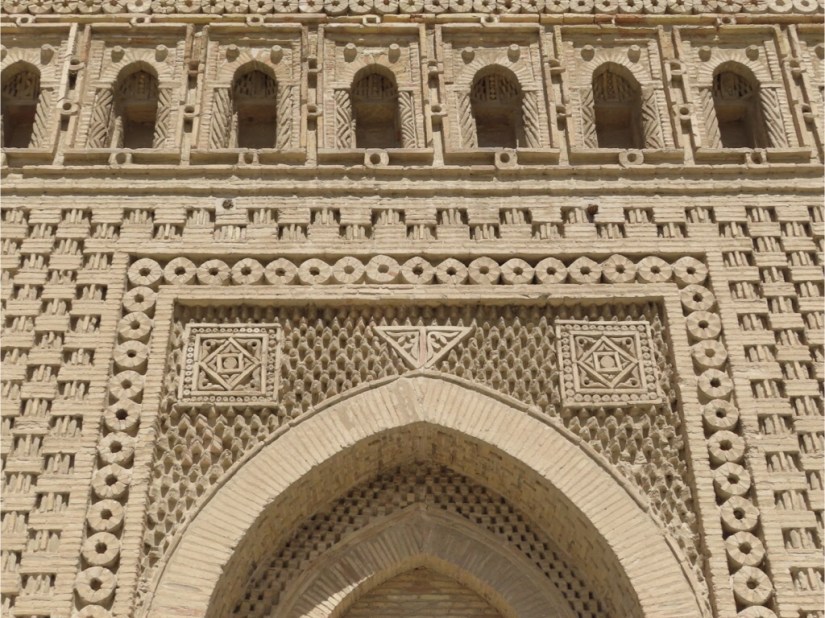
It is also home to the oldest building in the city, The Ismail Samani Mausoleum, built in the C10th and buried in sand for many years which preserved it. Despite being quite small and relying only the way the the light plays on its surface for its beauty, we found it charming.


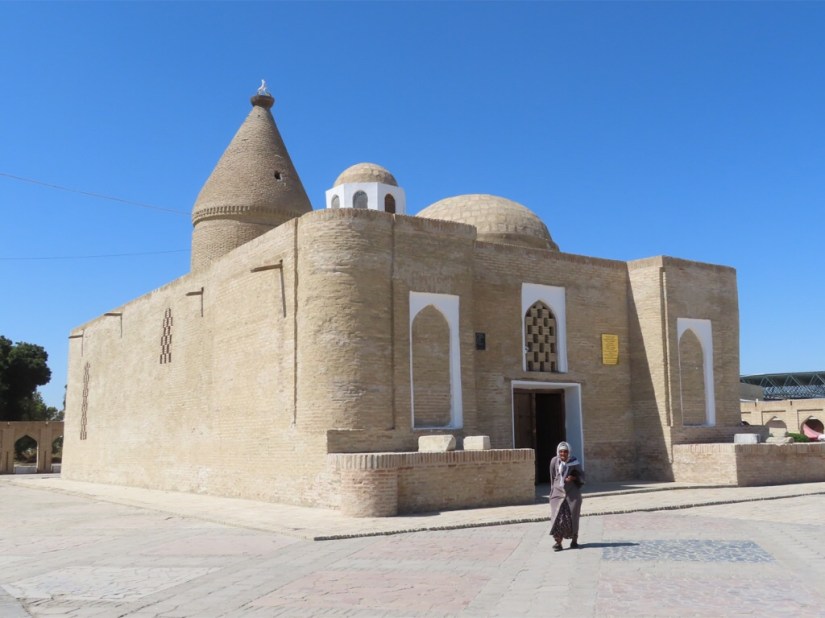
 Nearby were the Chashma-Ayub Mausoleum,over the source of a spring, which sprung up from the ground when struck by the Bible prophet Job …
…. and the Memoriam to Muhammad al-Bukhari.
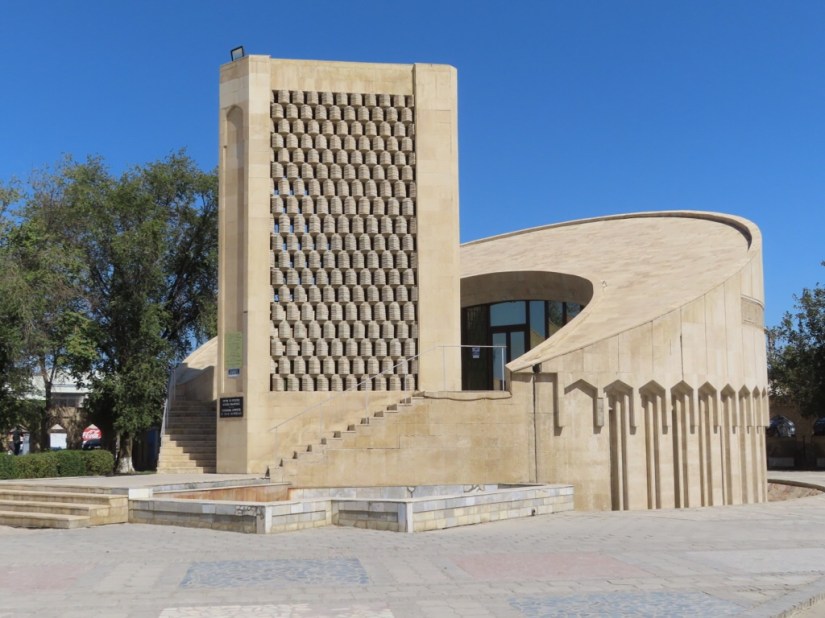
There were also a couple of places on the outskirts of town …
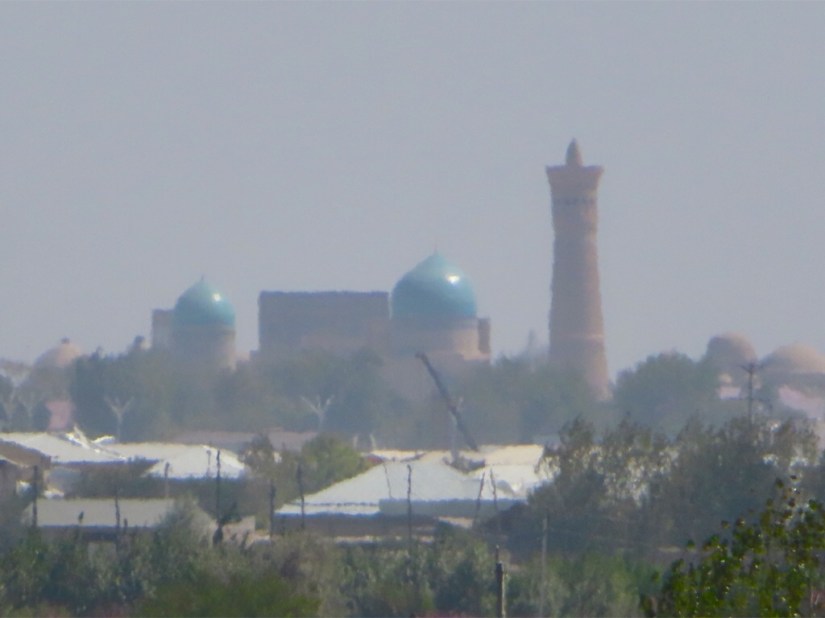
The Chor-Bakr Necropolis was built in the C16th, although it was already established as a burial ground. The main complex has two mosques, pool and later minaret. We went up on the roof for views … including this rather Impressionist snap of the Kalyan complex in the distance.
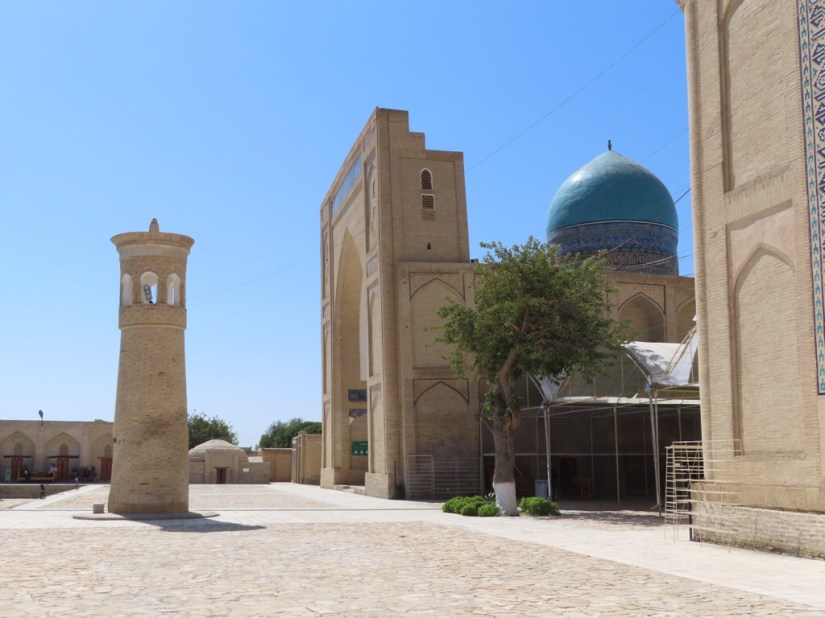


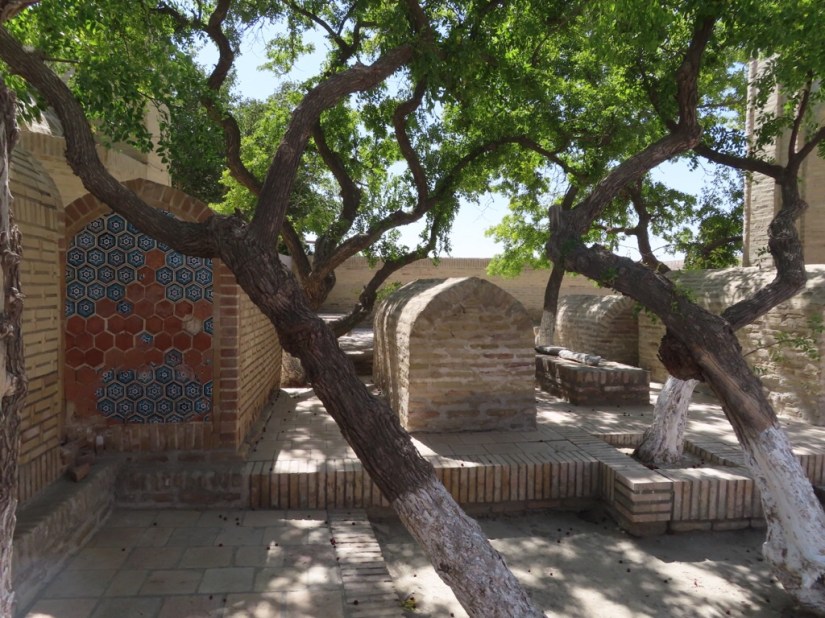
 It was quite peaceful wandering round the separate walled areas called khaziras, containing groups of family tombs.

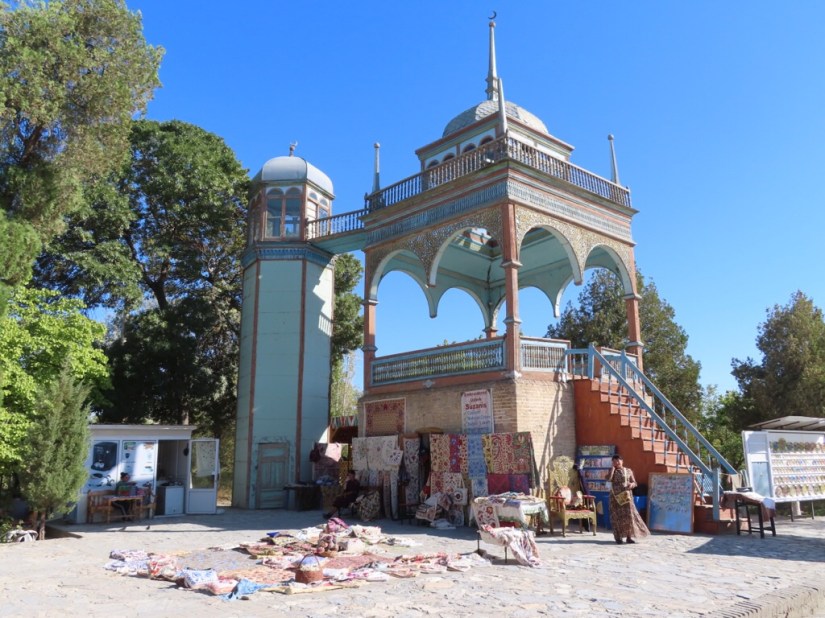
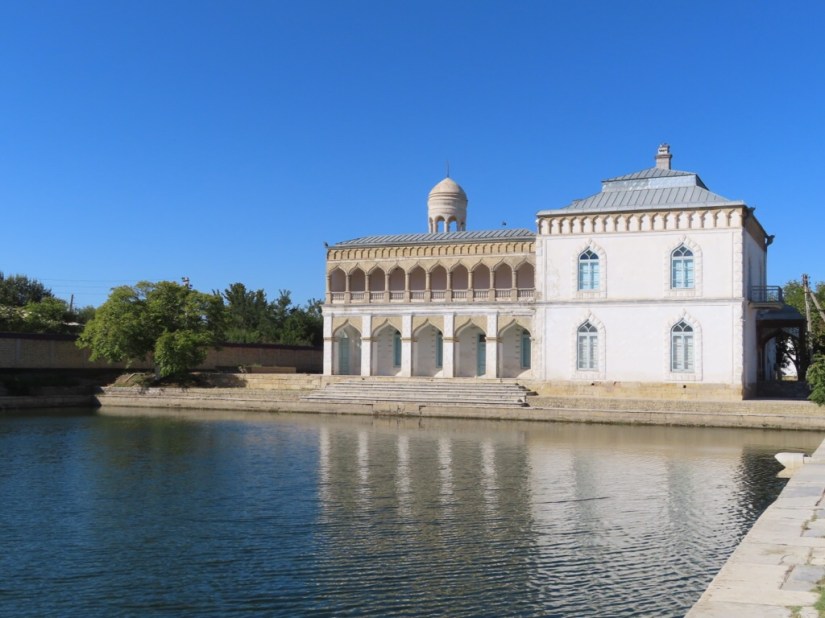
Sitorai Mokhi-Khosa Palace was the countryside residence of Bukhara emirs, now just on the outskirts of the city. The location is always cool, and was chosen by an ancient method of putting sheep carcasses at the likely construction sites and opting for the one with least decomposition. The original building from the mid C19th was replaced some years later by another emir, Muzaffar-Khan who devoted the palace to his wife Sitora. When she died, it was named Sitorai Mokhi-Khosa, translated from Tajik as ‘Star-like, Moon-like Palace’ but most existing buildings were completed in 1918 for the last emir of Bukhara, Alim Khan by the best Bukhara masters of the time.
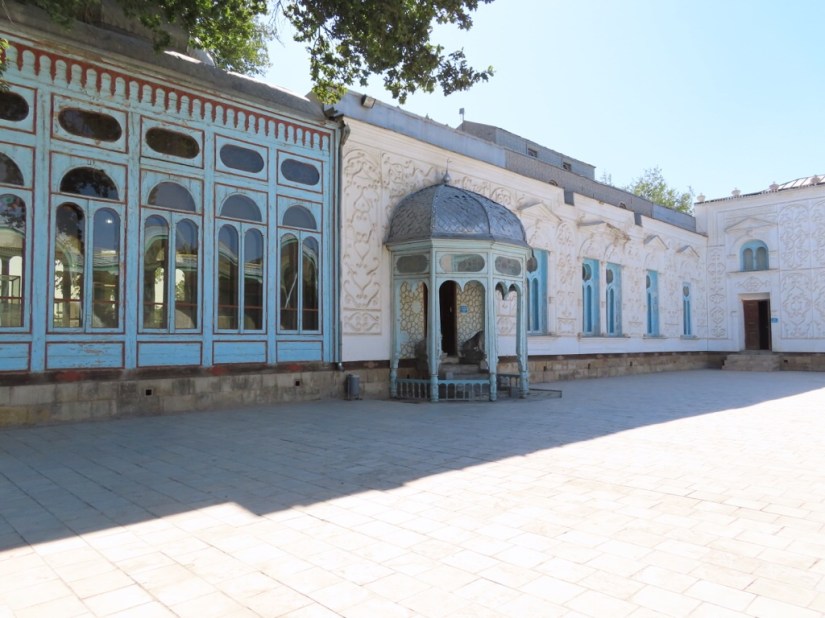

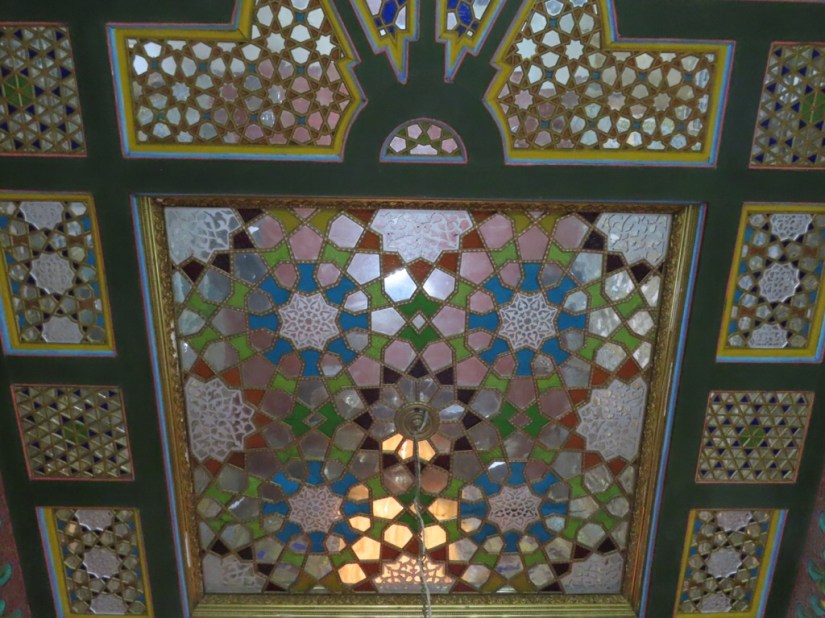
The White Hall is decorated with ganch, laid on walls covered with mirrors …

… while the rest is brightly coloured with more ganch …

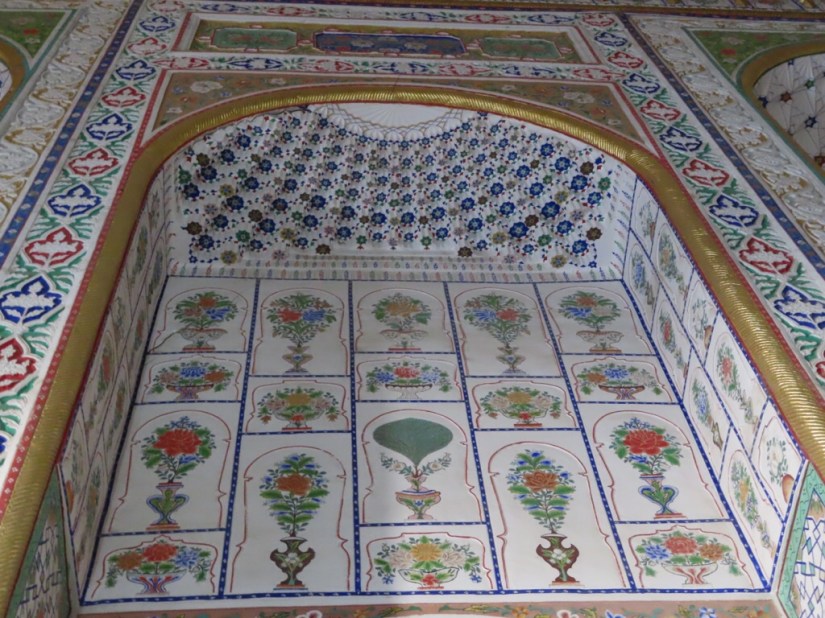
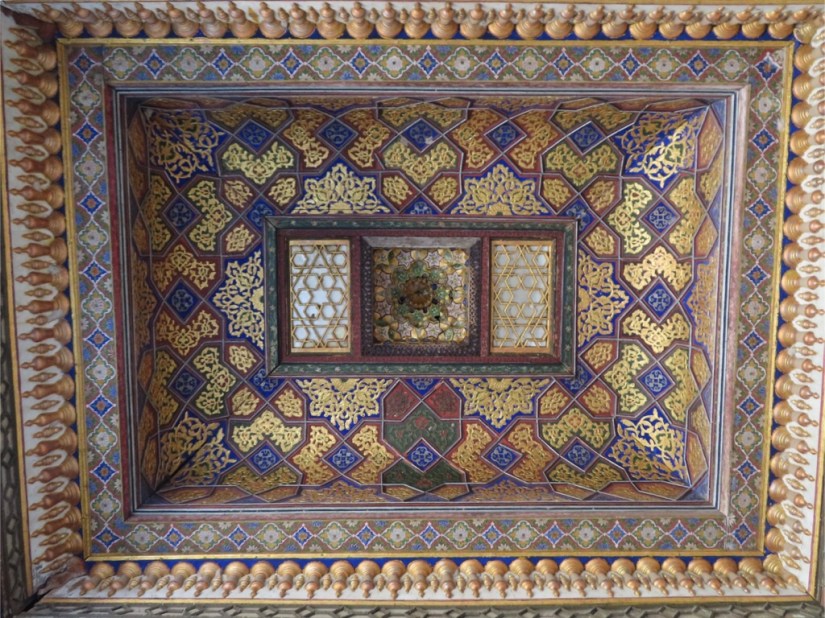
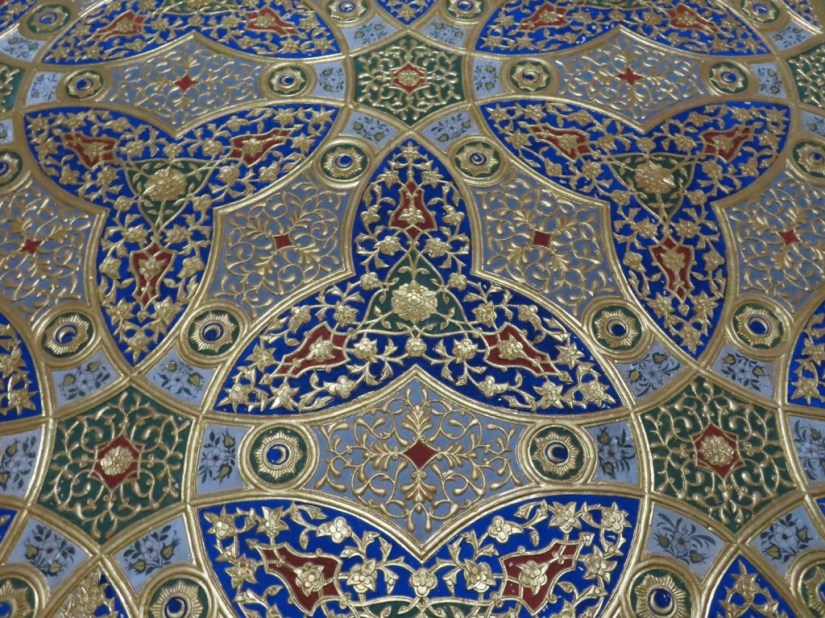 … and lots more mirrored tiles …


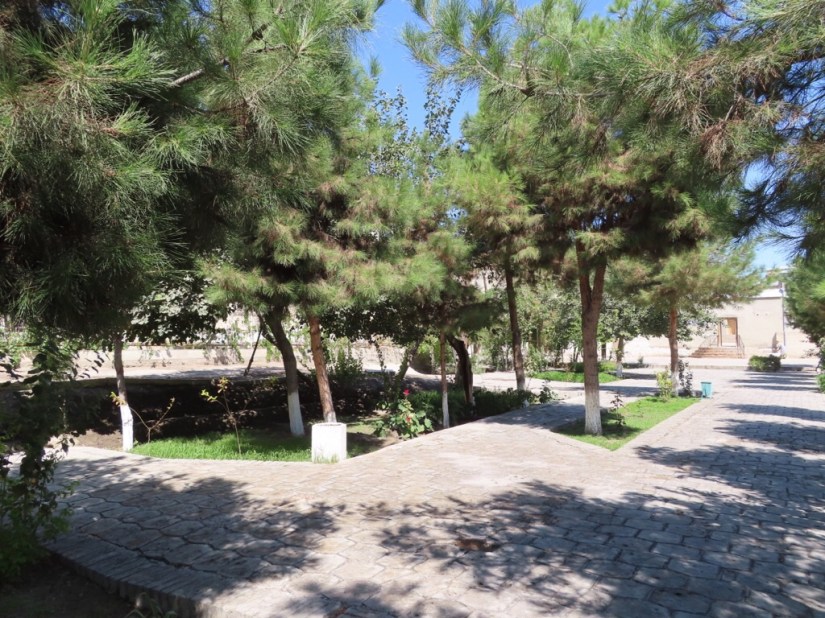
In the gardens there is tea room, small minaret, and guest house.
On our last day. we visited a museum which shows how the rich merchant class in Bukhara lived in the C19th. After entering through an outer courtyard which would have had stables and household area …
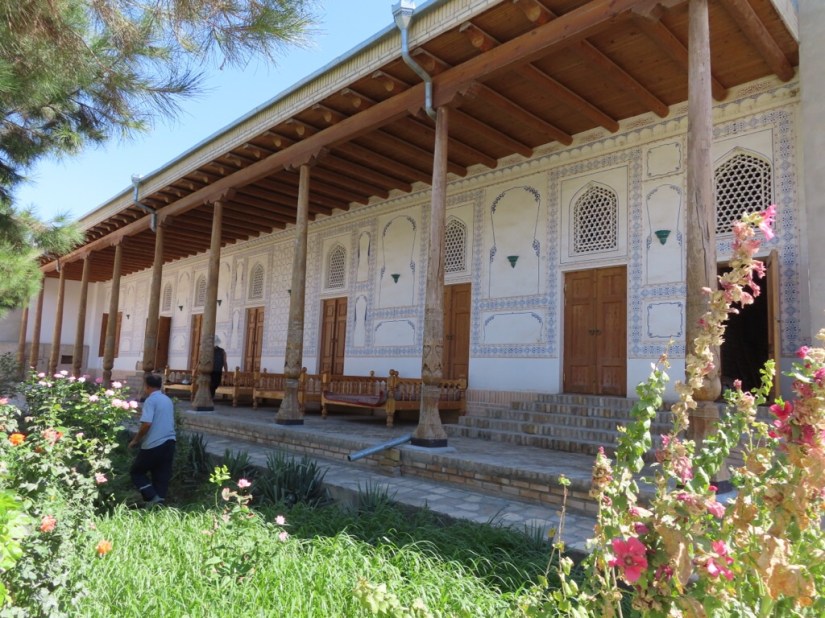
… there was then the havli berun or external male part of the house …
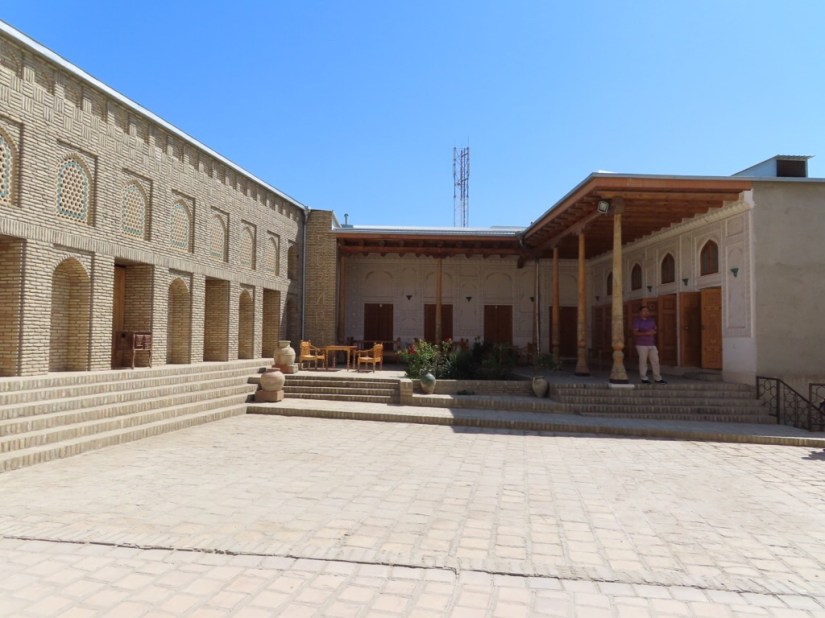

… followed by the havli darun or inner female area.
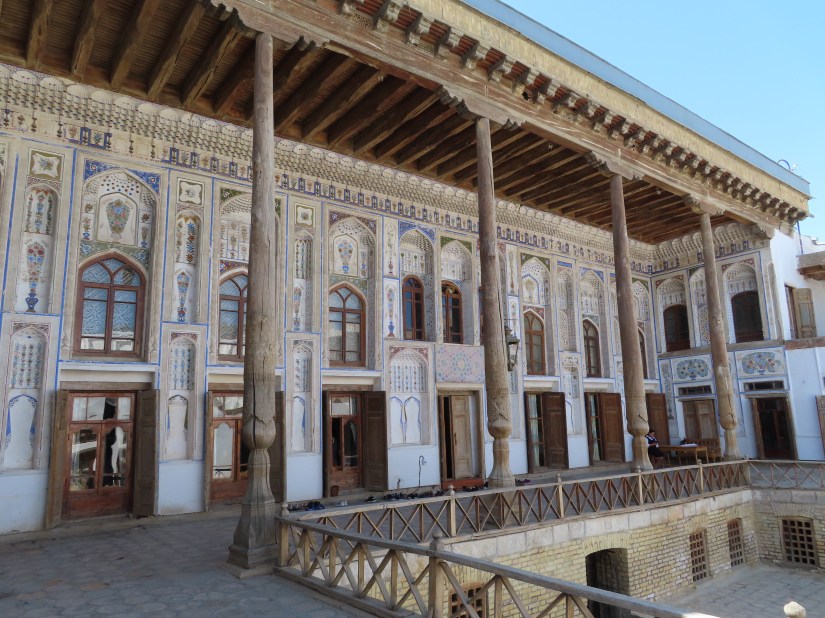
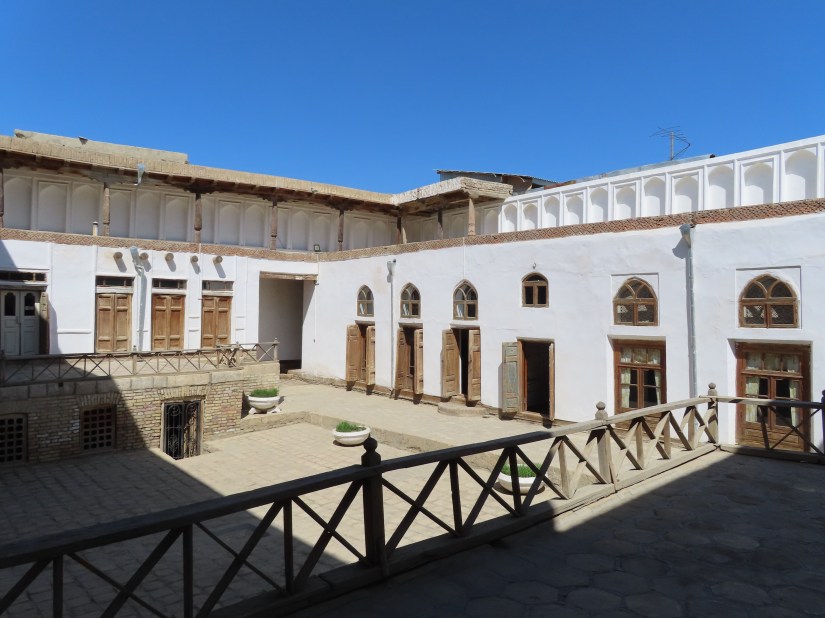


It was interesting to see how similar this is to the palace layouts in Khiva, albeit on a much smaller scale.
This was the family home of Fayzulla Khodjaev, a patron of art and fighter for equal rights and democracy.

He was sent to Moscow by his father in 1907 where he realized the huge gap between contemporary European society and the traditional ways at home. He joined the Pan-Turkism Jadid movement of reformers in 1916 and following the revolution in 1920, became head of the Bukharan People’s Soviet Socialist Republic which later formed part of the Uzbek Soviet Socialist Republic. He opposed Stalin’s control, particularly in the matter of cotton cultivation and was executed in 1938.
A last pot of tea by the Lyabi-Khauz …

…and suddenly the fountains were turned on!

We’ve really enjoyed our time here in Bukhara. Breakfast has been a lavish spread each morning, with far too much food, but we really appreciated the care and attention to detail with which it was served, making us feel like honoured guests.

Comparisons are inevitable, and on the surface, Khiva old city looked almost medieval with its walls and houses covered in mud render, despite the fact that it had been under constant restoration and the remaining buildings are C18th from the time of the Khanates, with the new town outside.
Here in Bukhara there isn’t a wall separating the old city from the rest, but it does form a core with a main souvenir-lined tourist thoroughfare linking the sights, but you don’t have to wander far to find local houses, old buildings yet to be restored and people going about their everyday lives, Most of the historic buildings are C16th, with some even older and beyond is modernity, with a dual carriageway ring road and wide roads lined with shops which we saw on our trips out.
We’ve tried several restaurants – Magrigri and Amulet with peaceful courtyards and Minzifa where the rooftop unfortunately gets booked days before, but we still had a good meal. Having said that, we’ve both had funny tummies for a couple of days so have been trying to pick the plainest offerings rather than embracing the cuisine so nothing new to report!
So, as we head further along the Silk Road, I’ll leave you with an evening shot of the Kalyan Minaret lit up after dark … next stop, Samarkand!

 Off Travelling Together