 Travelling again by tuk-tuk, our first stop was at a small roadside shrine to Ganesh, where our driver picked a stem with a few leaves and left it with some coins as an offering for a safe journey. Next stop was an ayurvedic herbal garden where Chris bought some red oil which he hopes will work wonders on his dodgy ankle. We were lucky enough to see a mother with two baby elephants as we passed the edge of Minnetiya Tank in the National Park …

… then stopped at a stall selling orange king coconuts, a variety native to Sri Lanka with no husk. It is used only for the water inside which is high in electrolytes and has long been used in Ayurvedic medicine.


Finally we arrived in Polonnaruwa and checked into our first floor room at the Thisara Guest House.


After the Chola king destroyed Anuradhapura, he made his capital at Polonnaruwa, but just 80 years later in 1070, King Viyajabahu drove out the Chola invaders and re-established a Sinhalese kingdom which began Polonnaruwa’s golden age. His successor, Parakramabahu made it into one of the greatest cities in South Asia, importing architects from India whose influence can be seen in the Hindu shrines and more lavish building continued in the region of spree of Nissankamalla.
Most of the ruins are covered by a $25 tourist day ticket, but we spent the afternoon looking at the rest. We hired a scooter from the guesthouse set out passed Parakrama Samudra, or Sea of Parakramabahu, a huge artificial lake built by the king which irrigated over 90 sq miles of paddy fields, only being restored in the 1950s.


Next, the southern ruins where we found a a circular image house with a central building that would have contained a monastic library surrounded by dagobas and ruins of monastic quarters …


… and also a statue believed to be Parakramabahu himself. He could be holding either a palm leaf manuscript representing law or a yoke representing royalty. Of course it might not be him at all – it might be a sage called Pulasti since it is near the monastic library!

We also looked at Island Park, once pleasure gardens but also containing a council chamber with a very fine lion marking where the throne would have been and inscriptions on the pillars saying who sat where.


Next day dawned bright and sunny so having had breakfast overlooking the paddy fields, we went to the museum to buy our ticket.

Just as we arrived the rear tyre of the scooter went flat, but we rang the guesthouse and in the time it took to see the museum, Mahesh had fixed the tyre and we were set to continue.
The Citadel is at the heart of the ancient city surrounded by walls and containing the Royal Palace which might have stood 7 storeys high, with wooden floors above the brick ones and still retains patches of original plaster.

The Council Chamber has some great sculptural features such as the embellished steps …

… fab lions at the top …

… dwarfs, lions and elephants on the frieze.


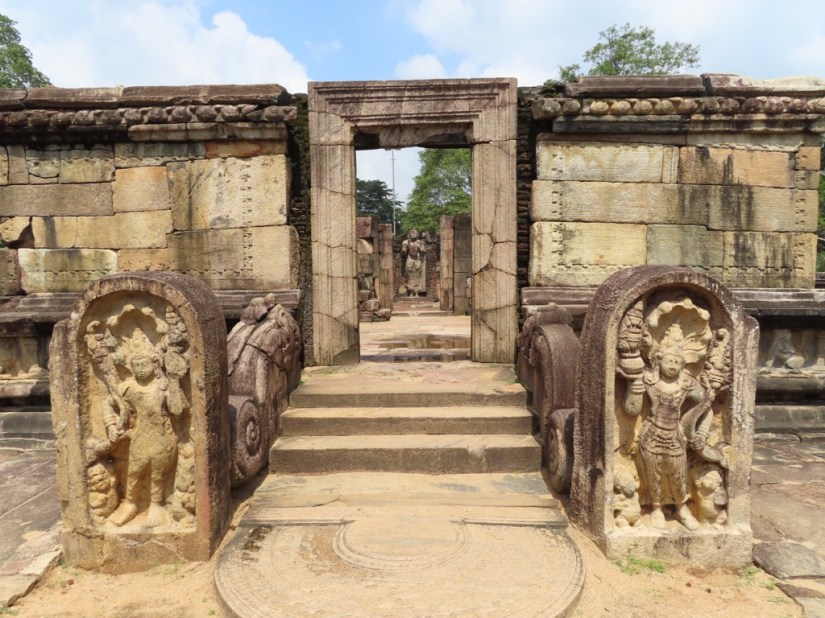
A little further down the road, the Quadrangle or Terrace of the Tooth Relic was the religious heart of the city and contained several impressive buildings. The Vatadage or circular relic house could well have enshrined the Tooth Relic in the small dagoba at the top between the seated Buddhas and is beautifully decorated. There are several features we can now recognise like the guardstones and moonstone at the entrance …

… and the balustrades with lions and makaras – mythical beasts with the body of a fish, foot of a lion, eye of a monkey, trunk or tusk of an elephant, tail of a peacock, ear of a pig and most noticeably the mouth of a crocodile!

As we walked round, the walls were in remarkably good shape …

… there were more guardstones …


… Buddhas in the centre …

… and the rear view.

Other buildings included the Hatadage …
… actually containing 3 Buddhas …

… the Atadage with just one Buddha …

… a seven storey temple which looks rather Cambodian …

… an open pavilion with pillars shaped as thrice-bent lotus stalks …

… and the Thuparama, a well preserved shrine decorated with vimanas – miniature representations of the dwellings of the gods.

We also liked this image of the Hindu goddess Lashkmi being given a shower by a pair of elephants which is a symbol of wealth.

Moving on, we passed Rankot Vihara, a brick dagoba – the largest here, but we’d seen bigger in Anuradhapura …

… and headed to the last group of ruins. Lankatilaka Vihara or Ornament of Lanka has towering brick walls enclosing a huge, though now headless Buddha. The shrine shows the shift in Buddhist architecture from the abstract symbolic form of the dagoba to the more personal and devotional approach focusing on the Buddha form. The exterior is decorated with vimanas or celestial dwellings of the gods.


The Kiri Vihara is the best preserved of the dagobas here, still with its lime plaster almost intact when it was rescued from the jungle.

Gal Vihara or Stone Shrine contains four beautiful Buddhas, all carved from the same granite outcrop. The striations of the rock add yet another dimension to these sculptures, but the last is kept almost hidden behind a grill.
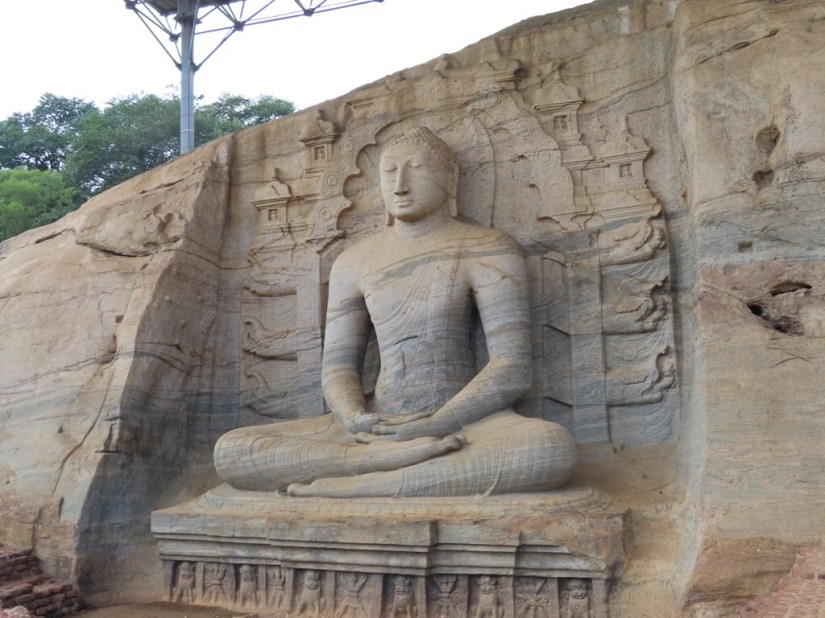

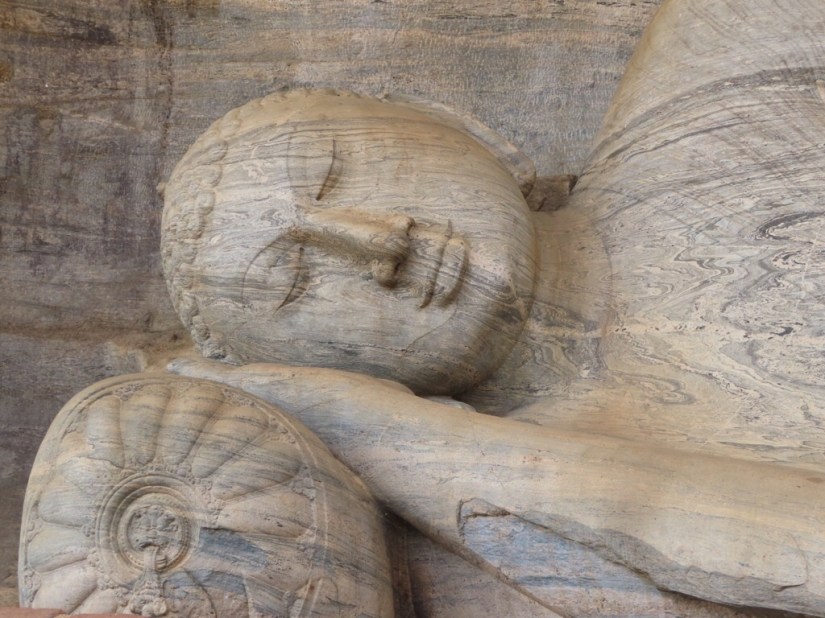
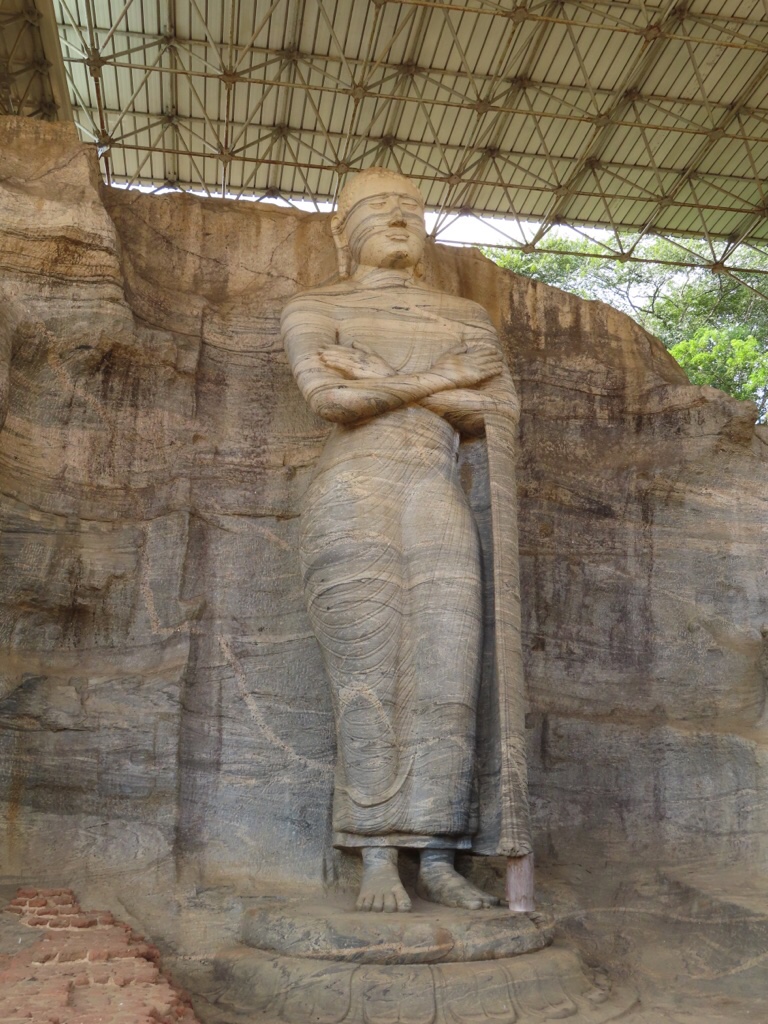
Finally the Tivanka-patamaghara Image house is a huge brick structure, decorated with more vimanas and containing a standing Buddha and remains of frescoes but no photos were allowed.


This wonderful city did not last long though. The cost of building and foreign wars pretty much bankrupted the state and opposing Tamil and Sinhalese factions battled for control with 12 rulers in 18 years. This enabled invaders to take hold once more, with a despotic Tamil mercenary called Magha instituting a reign of terror during which the irrigation system fell into ruin, people moved south and Polonnaruwa was abandoned.
While we’ve been here, I’ve been reading a novel called The River of Ink by Paul MM Cooper, about Asanka the court poet in the time of Magha, who managed to undermine him and help lead to his downfall. The tale ends with the Sinhalese establishing a new capital further south … which links in nicely with our next stop … Kandy.
All that remains is to show you a bit of nit-picking!

 Off Travelling Together