 We drove through desert that got rougher and rockier as we reached the foothills of the Andes, including areas where the road had been blasted through the rock. The views were stark but amazing. We arrived in the afternoon, and only had to walk over the road to our hotel. We took a turn round the town, and sat in the square, watching people taking their afternoon walk.
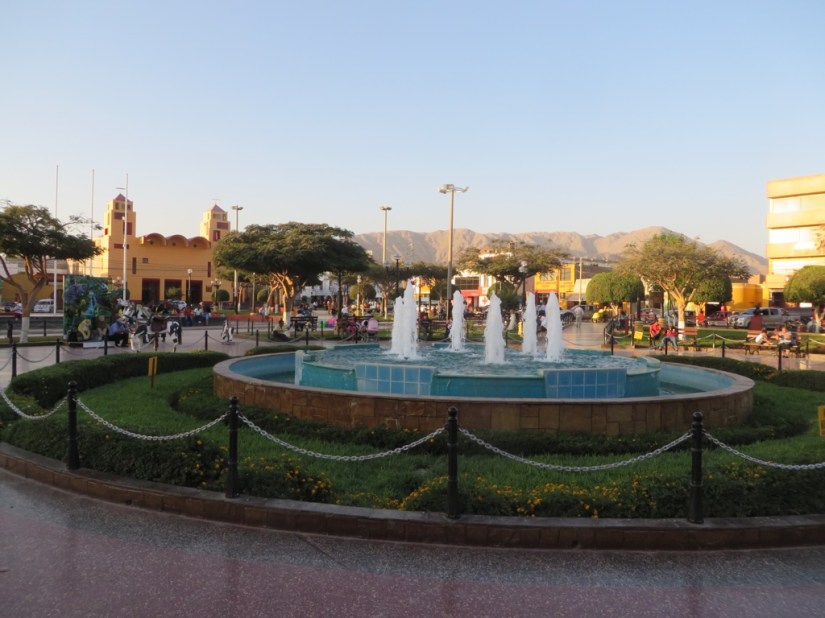
The upcoming elections are nationwide for regional presidents and mayors, and each of the candidates had a van driving round town playing loud music and advertising their cause.

Up early, having taken travel sickness tablets as recommended, just in case, and a very small breakfast, we went on a flight to see the Nasca Lines, drawings of animals, geometric figures and birds ranging up to 300m in length, scratched onto the arid crust of the desert and preserved for some 2000 years owing to a complete lack of rain. They were made by the Nasca Culture between 400 and 650 AD by removing surface stones and piling them onto the paler soil revealed below. The flight was a bit erratic, with the plane turning to ensure all 5 passengers saw all the formations, which were harder to spot than we had expected, but we saw them all even though we only managed a couple of photos.


Theories abound as to their purpose but nobody knows for sure. The geometric ones could indicate the flow of water or be connected to rituals to summon water. The spiders, birds, and plants could be fertility symbols. Other possible explanations include irrigation schemes or giant astronomical calendars.
So here are Hummingbird …
… Spider …

…The Tree and Hands by viewing tower …

… and Astronaut. Nasca in Quechua means “place tormented by droughts”. Although there are rivers, they only flow with water from the mountains in the rainy season. However the Nasca worked out that the water table is closer to the surface in the valleys and were able to construct aqueducts to take advantage of this so they could access water year round. We visited one of the aqueducts at Cantelloc, which runs underground to prevent evaporation, then towards the end runs on the surface with the sides lined with boulders, and then into a reservoir, which can be opened to irrigate the land.
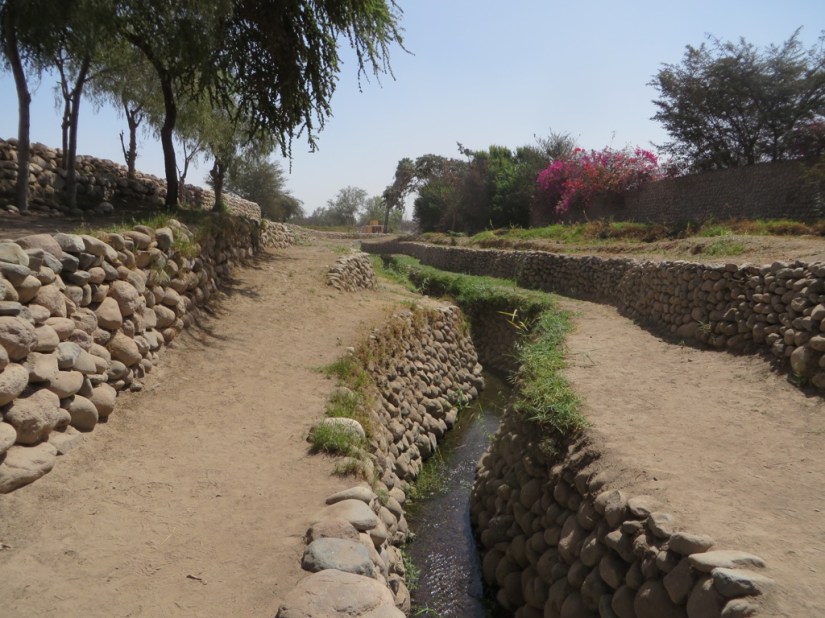
Along the length are viewing windows, with a spiral path to enable access to maintain and clean the channels, and are still used by the local farmers.

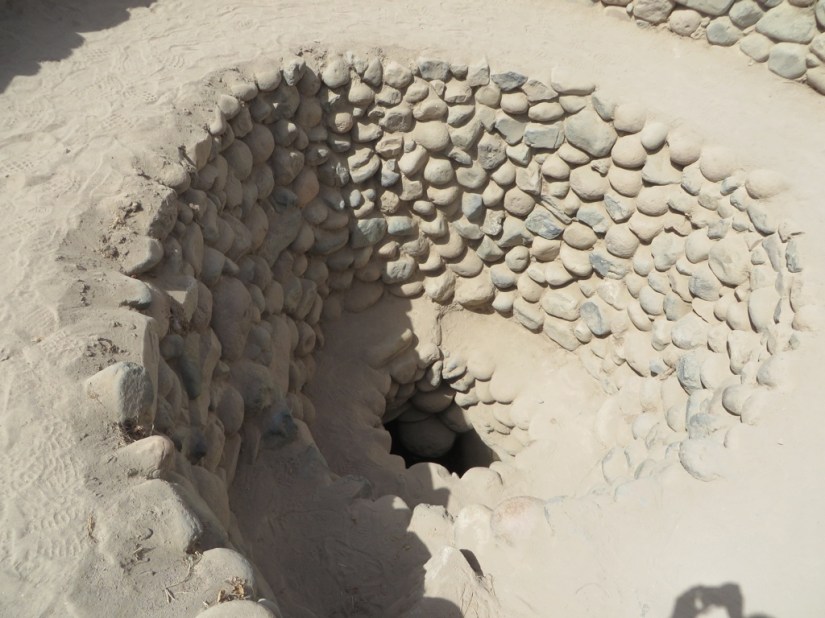
We then stopped at Las Agujas or the Needles, where it is possible to see a Nasca formed trapezoid shape on the ground at close quarters. It lines up with the underground Cantelloc aqueduct, so there is some evidence for the water theory for at least some of the Nasca lines.

We also visited the Chauchilla Cemetery from the time of the Nasca Culture. Many tombs have been robbed over the years, but there are several excavated graves here where mummies from other graves have been placed to show how they were buried, in a foetal position, dressed and wrapped in beautifully woven mantles then cloth into a funerary bundle.


They were surrounded by pottery and other everyday items for use in the afterlife, like this double spouted drinking vessel and vase we saw in Museo Larco in Lima.

On the way back, the visibility improved a little and we took a picture of the Cerro Blanco sand dune, the tallest in the world at 2070m, and popular destination for extreme sand boarders.

We stopped at Caxamarca, the Inca administrative centre for the region and home of the Inca representative. Part of the stone walls have been excavated and some of the adobe work reconstructed, showing a long corridor and part of a circular tower. There would also have been a palace, and steps to a temple of the sun. It is sad that a road has been built right through the middle of the site, just as at Huaca Pucllana in Lima … economics speaking louder that conservation.


Chatting to our guide on the way back, he explained about the huts we saw from the plane in the morning, saying they were occupied by squatters, who erect a hut on unclaimed desert, then after a couple of years they can claim the land and sell it on, all the while living in a cosy home on Main Street.

Apparently this is a common practise throughout South America. While talking about buildings, many consist of one storey with the floor for the storey above providing the roof and the steel reinforcing rods sticking up like aerials.

This is because they only pay tax on what is finished, and houses get added to over a period of years. Then there are the earthquakes, with the tectonic plates moving 2.5cm a year, there are regular tremors, with occasion large earthquakes like in Pisco in 2007 and Nasca in 1996, and reconstruction takes time. Add to that the desert dust and the fact it rarely rains in the parts of Peru we have seen so far, and you will understand when I say large areas are very much like building sites!
We drove back and chilled in the hotel until our final Cruz del Sur coach, this time 9hrs to Arequipa departing at 10pm, sweet dreams!
 Off Travelling Together